Your logo is already being used without permission somewhere right now. A counterfeit listing on a marketplace. A phishing page mimicking your login screen. A fake support account on social answering customer questions with bad links. A competitor bidding on your trademark in paid search. Each one chips away at the trust you spent years building.
The cost is not abstract. According to Straits Research, the brand protection software market reached USD 3.2 billion in 2026 and is projected to hit USD 6.62 billion by 2034 at a 9.51% CAGR. That growth tracks one thing: brand abuse is scaling faster than most teams can monitor manually. And it is no longer only a security problem. HubSpot's 2024 marketing trends survey, cited by Fortune Business Insights, found that 60% of respondents believed AI could damage brand reputation through plagiarism, unfairness, or brand misalignment.
For product marketing managers, this sits at the intersection of trust, reputation, and revenue. You spend cycles building positioning and proof points. Brand abuse undermines all of it at the exact moment a buyer is forming an impression. If you are evaluating tools, the real question is not "which platform is best." It is "which abuse surface am I actually solving." That question shapes everything else.
This is a category where adjacent stacks matter too. Teams often pair brand protection with brand intelligence, brand advocacy programs, and AI cybersecurity solutions to cover the full picture of reputation and risk.
What's inside
This guide compares nine brand protection software tools and maps each to the abuse surface it handles best. We selected platforms based on monitoring coverage across channels, takedown and enforcement workflows, analytics and reporting depth, and integration fit with security and GTM stacks. You will get a comparison table, individual breakdowns, a buyer's checklist, and FAQs. The goal is not to crown one winner. It is to help you build a shortlist that matches the threats you actually face, whether that is counterfeit listings, phishing, social impersonation, or paid search abuse.
TL;DR
- Best overall coverage: BrandShield, for breadth across websites, marketplaces, social, ads, apps, and dark web.
- Best for marketplace enforcement: Red Points, for counterfeit detection and high-volume takedowns.
- Best for digital risk and external threat visibility: ZeroFox, for social, domain, and impersonation breadth.
- Best for security-led teams: PhishLabs / Fortra and Netcraft, when brand protection must fit a broader threat stack.
- Best for fast-moving impersonation: Doppel, for multi-channel social engineering defense.
- Best for paid search protection: BrandVerity, for brand bidding and ad compliance monitoring.
- Best for trademark and IP-centered protection: Corsearch, for rights-based enforcement across abuse types.
What is brand protection software?
Brand protection software is a category of tools that detect, prioritize, and remove unauthorized or fraudulent use of a brand across digital channels before it damages trust or revenue. It monitors the open web, marketplaces, social platforms, paid ads, mobile app stores, domains, and the dark web for abuse, then coordinates enforcement to take that abuse down.
The job to be done is simple to state and hard to execute: find brand abuse at scale, decide what matters most, and remove it fast. The faster the loop runs, the less damage each incident does.
Most platforms in this space share a common set of capabilities:
- Multi-channel monitoring: Continuous scanning across marketplaces, social media, domains, paid search, apps, and dark web sources.
- Automated takedowns: Workflows that submit removal requests to platforms, registrars, and hosts, often with auto-detection feeding the queue.
- Evidence packaging: Screenshots, archives, and documentation that support enforcement and legal escalation.
- Analytics and reporting: Dashboards on detection volume, takedown success rate, time-to-removal, and threat trends.
- Security workflow integrations: Connections into SIEM, SOAR, and case management so brand threats feed the wider security operation.
The distinction worth knowing early: trademark monitoring watches for registration and naming conflicts, while brand protection covers the broader surface of counterfeit listings, phishing, impersonation, and fraud. Most mature programs need both.
When to use brand protection software
Different threats trigger different tooling needs. Here is how to pattern-match your situation before you shortlist.
Protect marketplaces and resale channels
Counterfeit and unauthorized sellers show up wherever your product has demand. They list knockoffs on marketplaces, undercut your pricing, and erode the buyer trust your brand earned. Marketplace monitoring matters most when you sell physical goods, license your name, or run a channel program. The volume is the problem: a single brand can face thousands of infringing listings at once. Enforcement workflows that batch detections and submit takedowns at scale are what separate a usable tool from a spreadsheet.
Stop phishing, impersonation, and fake sites
The moment a fraudster registers a lookalike domain or spins up a fake login page, your customers are exposed. This is where domain monitoring, social impersonation monitoring, and fraud detection earn their keep. Speed is everything. A phishing site live for six hours does far more damage than one taken down in thirty minutes. You want fast detection paired with takedown coordination across registrars, hosts, and platforms.
Monitor ads, social, apps, and dark web signals
Abuse rarely stays in one lane. A coordinated attack might spoof your ads in paid search, run impersonation accounts on social, publish a rogue app in an app store, and trade stolen credentials on the dark web. When your exposure spans these surfaces, you need a platform with broad coverage and the analytics to connect related signals. This is also where security teams want SIEM and SOAR integration so brand threats route into existing incident response.
Comparison table
The table below leads with the strongest all-around option, then sorts by breadth of coverage and market relevance. Pricing across this category is overwhelmingly quote-based, so we have noted that where public figures are not disclosed. Ratings reflect current G2 listings where available.
| # | Product | Intent | Key differentiation | Pricing | G2 rating |
|---|---|---|---|---|---|
| 1 | BrandShield | Broad online brand protection | AI monitoring and enforcement across web, marketplaces, social, ads, apps, and dark web | Quote-based | 4.7/5 |
| 2 | Red Points | Marketplace and counterfeit enforcement | Unlimited detections and takedowns within scope, AI Copilot prioritization | Quote-based (flat-fee model) | 4.8/5 |
| 3 | ZeroFox | Digital risk and external threat intelligence | 12B+ correlated data graph, brand, domain, and executive protection | Quote-based | 4.4/5 |
| 4 | EBRAND | Unified protection plus domain management | Brand protection, digital risk, and corporate domain management in one platform | Quote-based | 5.0/5 |
| 5 | PhishLabs / Fortra | Security-led managed protection | Managed phishing, domain, dark web, and social takedown services | Quote-based | 4.5/5 |
| 6 | Netcraft | Phishing and scam disruption | Cybercrime detection, disruption, and takedown at scale | Quote-based | Not listed |
| 7 | Doppel | Fast-moving impersonation defense | AI-native social engineering defense across domains, social, ads, messaging, apps, and dark web | Quote-based | 4.0/5 |
| 8 | BrandVerity | Paid search and ad compliance | Paid search trademark monitoring and web compliance oversight | Quote-based | 4.5/5 |
| 9 | Corsearch | Trademark and IP-centered protection | AI trademark screening plus brand and content protection | Quote-based | 4.6/5 |
1. BrandShield
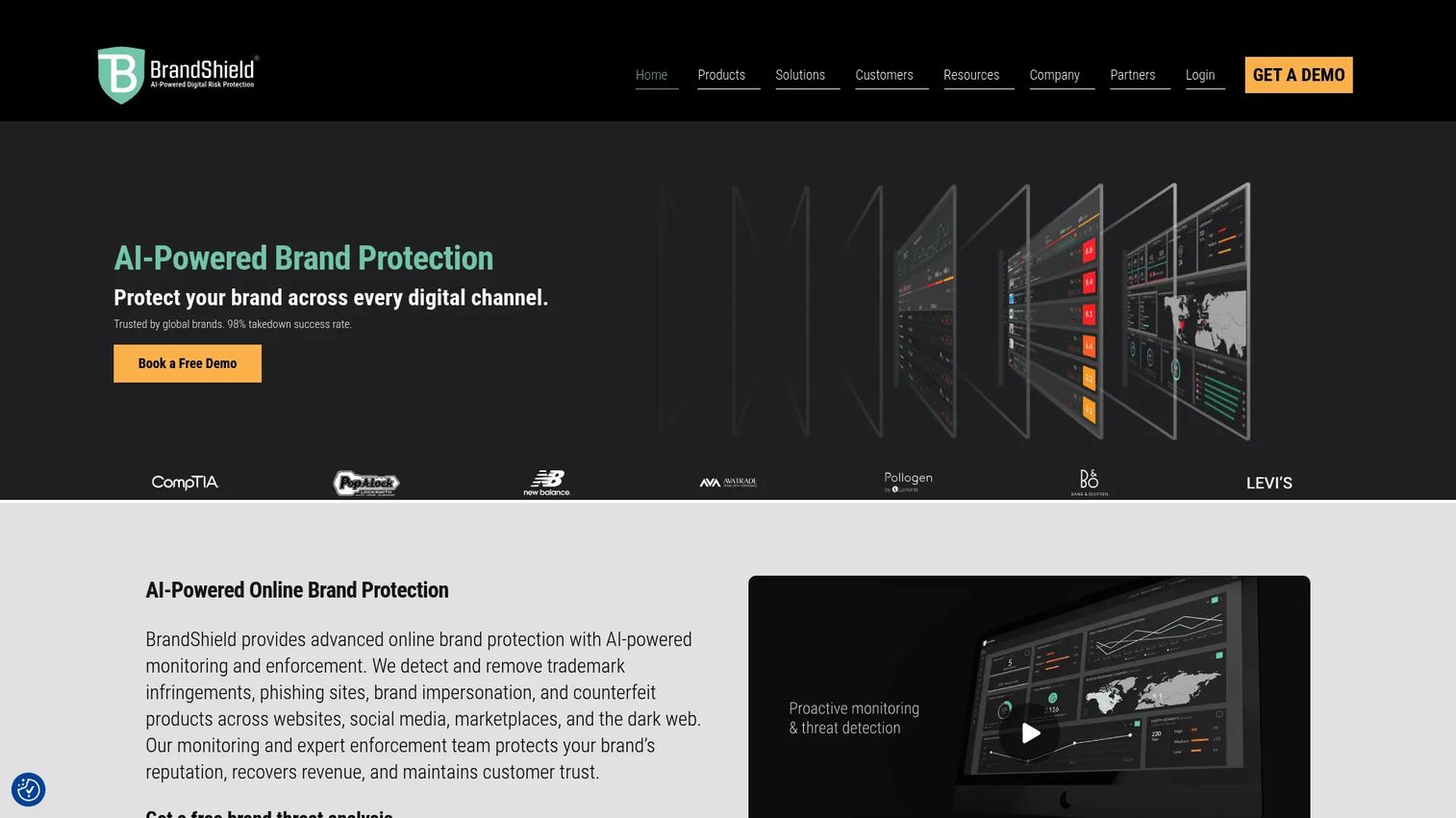
BrandShield is an AI-powered online brand protection and external cybersecurity platform built for breadth. It monitors and enforces across websites, marketplaces, social media, paid ads, mobile apps, and the dark web, which makes it a strong reference point when you are trying to cover most of your abuse surface from a single platform rather than stitching together point tools.
If you are a product marketing manager who needs to defend brand trust across every customer touchpoint, BrandShield gives you one place to see and act on the threats that undermine your positioning.
Best for: Enterprises needing managed brand protection against online impersonation, counterfeits, and phishing across many channels at once.
Key strengths
- AI-powered monitoring and enforcement: Detection and takedown run together, so threats move from spotted to submitted without manual handoffs.
- Broad threat coverage: Counterfeit, phishing, impersonation, and fake ad detection across the full digital surface.
- Multi-surface reach: Social scam, mobile app, and dark web threat coverage in addition to web and marketplaces.
Why choose BrandShield: Choose it when your abuse spans many channels and you want consolidated monitoring and enforcement rather than separate vendors for ads, social, and marketplaces. It fits teams that value managed coverage and a single pane of glass over piecing tools together themselves.
BrandShield pricing: BrandShield does not publish public pricing. The site uses demo and contact-sales flows, so plans are quote-based and scoped to your channels and volume. Expect an enterprise-oriented engagement rather than a self-serve tier.
2. Red Points
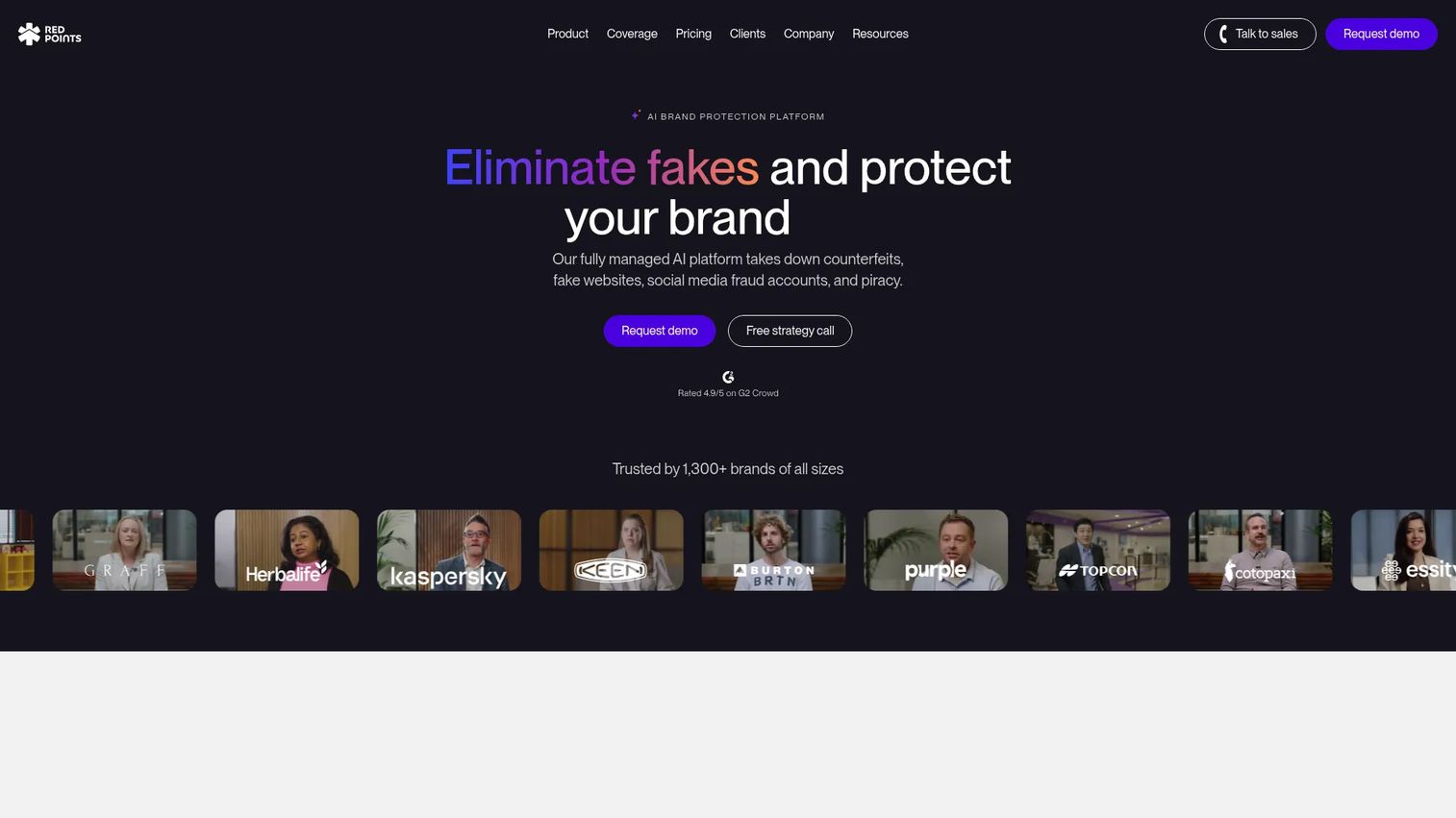
Red Points is AI-powered brand protection software focused on detecting and enforcing against counterfeits, piracy, impersonation, and related online fraud. Its sharpest edge is marketplace enforcement and counterfeit protection at scale, which makes it a natural fit inside a brand abuse program where takedown volume is the bottleneck.
Best for: Brands needing fully managed online brand protection and enforcement at scale, especially across marketplaces.
Key strengths
- Unlimited detections and takedowns: Within agreed scope, so high-volume abuse does not get rationed by a per-action cap.
- AI Copilot: Incident prediction and prioritization that helps teams act on the threats that matter first.
- Wide channel coverage: Marketplaces, social media, websites, domains, apps, ads, and China-focused channels.
Why choose Red Points: Choose it when counterfeit listings and piracy are your primary threat and you need enforcement that keeps pace with detection. The flat-fee model and unlimited-within-scope takedowns suit brands that face steady, high-volume abuse rather than occasional incidents.
Red Points pricing: Red Points uses a flat-fee model and does not display public prices. The pricing page lists plans such as Starter, Professional, and Enterprise, plus services like Field Investigations and Test Purchases, all quote-based. There is no free tier.
3. ZeroFox
ZeroFox is an external cybersecurity platform spanning cyber threat intelligence, brand and domain protection, executive protection, and takedowns. It is positioned for teams that want broad digital risk protection and visibility into external threats, not just brand abuse in isolation.
Best for: Enterprises needing external threat intelligence and digital risk protection alongside brand and domain monitoring.
Key strengths
- Threat intelligence at scale: A 12B+ correlated data graph that connects signals across the external attack surface.
- Brand and domain protection: Monitoring and enforcement against impersonation and lookalike domains.
- Executive and VIP protection: Coverage for high-profile individuals plus PII removal.
Why choose ZeroFox: Choose it when brand protection is one part of a larger external threat program and you want intelligence, domain monitoring, and executive protection under one roof. It suits security-aware organizations that treat brand abuse as a risk signal feeding broader threat response.
ZeroFox pricing: ZeroFox does not display public numeric pricing. The pricing page shows packaged offerings, including a Premium Bundle and Threat Intelligence, and prompts you to request pricing. Engagements are enterprise-scoped.
4. EBRAND
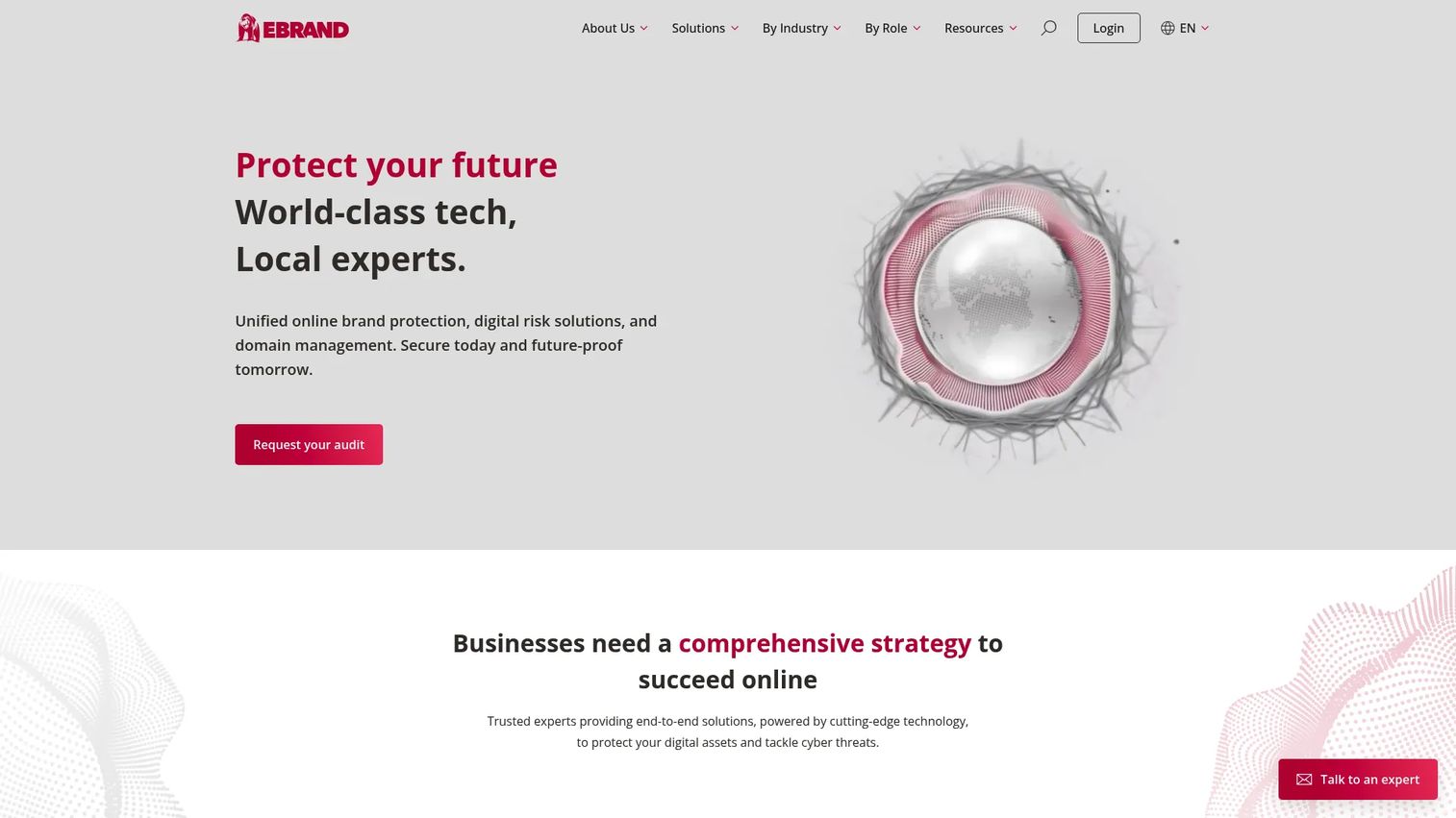
EBRAND brings online brand protection, digital risk solutions, and corporate domain management into one platform. The combination matters for teams that care about channel coverage and brand risk monitoring while also managing a large domain portfolio, since those functions often live in separate tools.
Best for: Enterprises that need brand protection, digital risk monitoring, and domain management in a single platform.
Key strengths
- Online brand protection: Monitoring and enforcement against abuse across digital channels.
- Digital risk protection: Coverage for the broader external risk surface beyond classic counterfeit and phishing.
- Corporate domain management: Portfolio management that pairs naturally with domain monitoring and defensive registration.
Why choose EBRAND: Choose it when domain management and brand protection should not live in two disconnected systems. Consolidating monitoring, enforcement, and domain oversight reduces the gaps where abuse slips through and simplifies reporting for stakeholders.
EBRAND pricing: EBRAND describes its pricing as flexible and directs prospects to contact its experts rather than publishing plan prices. Pricing is effectively quote-based and scoped to your needs.
5. PhishLabs / Fortra
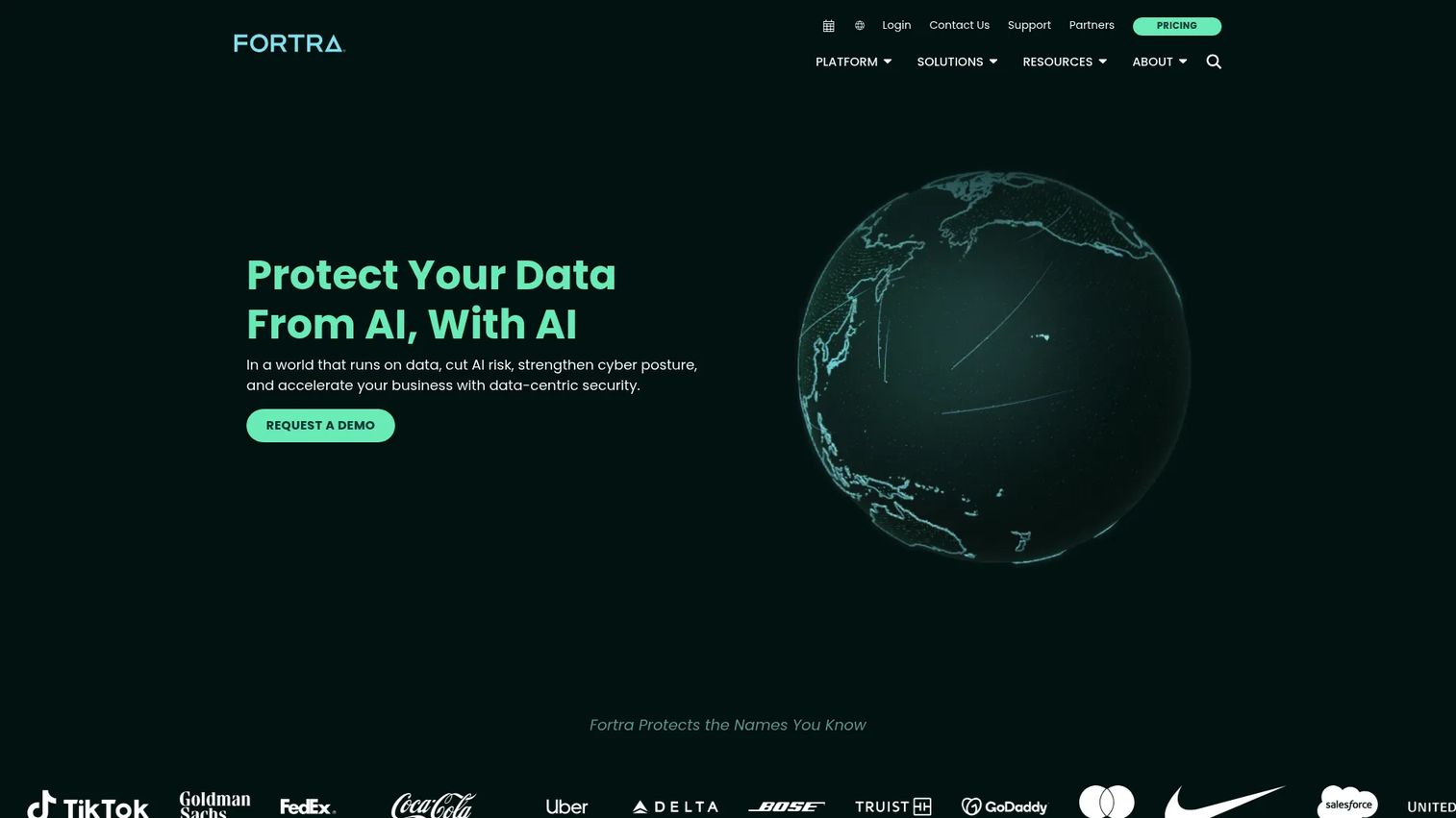
Fortra Brand Protection, formerly PhishLabs, provides managed digital risk protection and brand protection services against phishing, impersonation, fraud, and related threats. Its strength is the alignment with a broader threat-intelligence and security stack, which is why security-led teams often shortlist it.
Best for: Enterprises needing managed brand protection and threat takedown services that fit a wider security operation.
Key strengths
- Phishing protection: Detection and takedown of phishing sites and credential-harvesting pages.
- Domain monitoring: Watch for lookalike and abusive domain registrations.
- Dark web and social media monitoring: Coverage for credential leaks and impersonation across underground and social channels.
Why choose PhishLabs / Fortra: Choose it when your security team owns brand protection and wants managed services that plug into existing incident response. The managed model means analysts handle much of the detection and takedown work rather than your team running it solo.
PhishLabs / Fortra pricing: Fortra does not publish numeric pricing for its Brand Protection offering. The pricing page directs visitors to submit a form for details, so engagements are quote-based and enterprise-oriented.
6. Netcraft
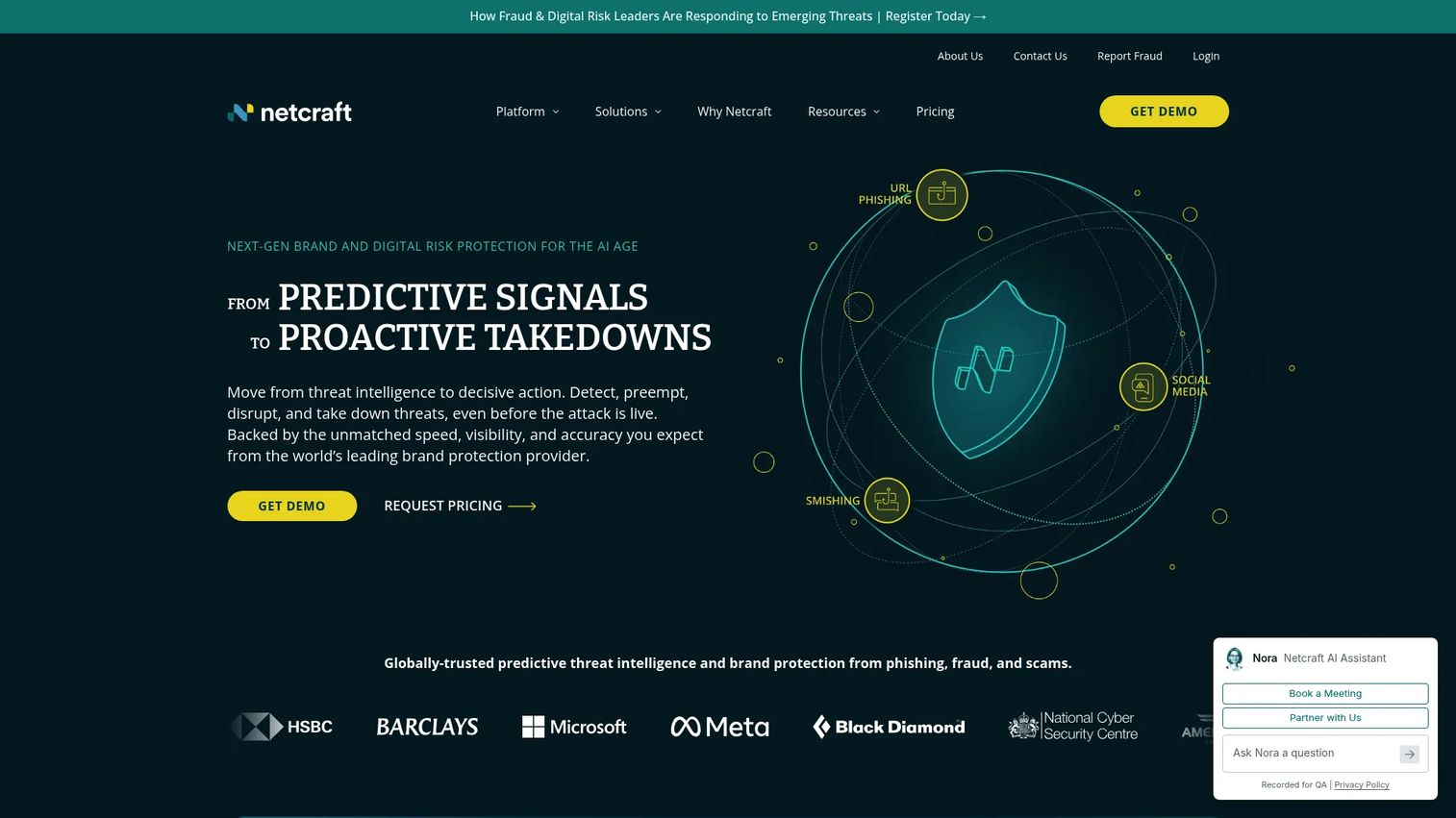
Netcraft is a cybercrime detection, disruption, and takedown platform built for brand protection and threat intelligence. It leans security-first, with practical coverage for phishing, scams, and brand impersonation backed by takedown services. Teams that want a security-leaning platform with hands-on disruption tend to look here.
Best for: Enterprises needing phishing, scam, and brand-impersonation detection paired with takedown services.
Key strengths
- Phishing detection and takedown: Detection feeding active disruption of phishing infrastructure.
- Threat intelligence and reporting: Intelligence and reporting that support both response and stakeholder visibility.
- Digital risk protection: Coverage across brand impersonation and scam channels.
Why choose Netcraft: Choose it when phishing and scam disruption is the core job and you value a vendor with deep takedown experience. Its security-first posture suits teams that treat brand impersonation primarily as a cybercrime problem.
Netcraft pricing: Netcraft uses quote-based pricing and directs prospects to request a custom quote. No public numeric price is listed.
7. Doppel
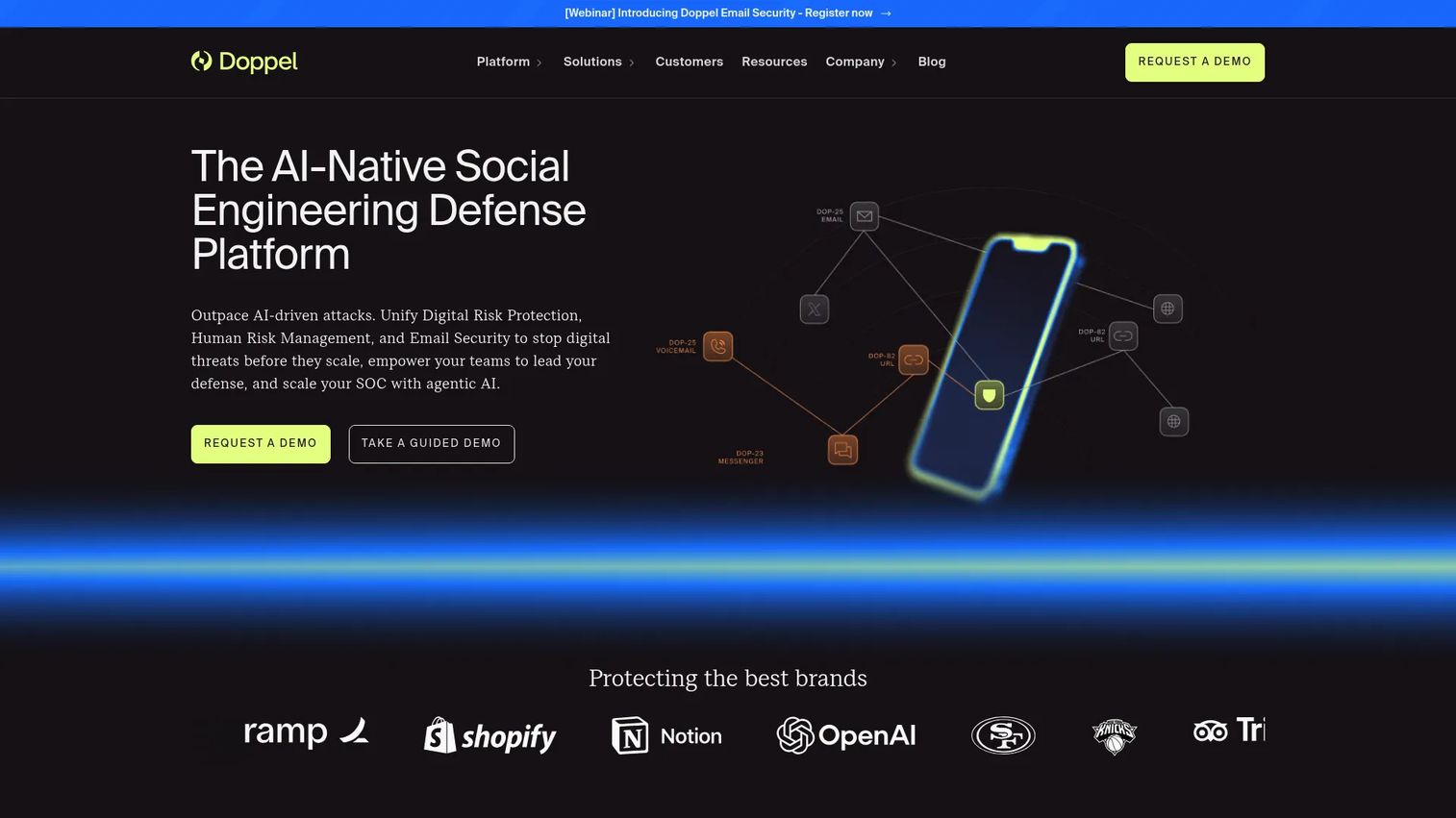
Doppel is an AI-native social engineering defense platform covering digital risk protection, human risk management, and email security. Its coverage spans domains, social, ads, messaging, app stores, email, and the dark web, which makes it a strong choice for teams facing fast-moving impersonation abuse across many channels at once.
Best for: Enterprises needing social engineering defense plus brand and impersonation protection across a wide channel set.
Key strengths
- Threat Graph correlation: Campaign-level correlation that connects related impersonation attempts instead of treating each as isolated.
- Multi-channel detection and takedown: Coverage across domains, social, ads, messaging, app stores, email, and dark web.
- Phishing simulation and awareness training: Tools that address the human side of social engineering risk.
Why choose Doppel: Choose it when impersonation moves fast and spreads across channels, and you want correlation that ties a campaign together rather than chasing individual incidents. The social-engineering framing fits teams that see brand abuse and human risk as connected problems.
Doppel pricing: Doppel does not display public pricing on its site and directs visitors to request a demo. Pricing is quote-based and enterprise-scoped.
8. BrandVerity
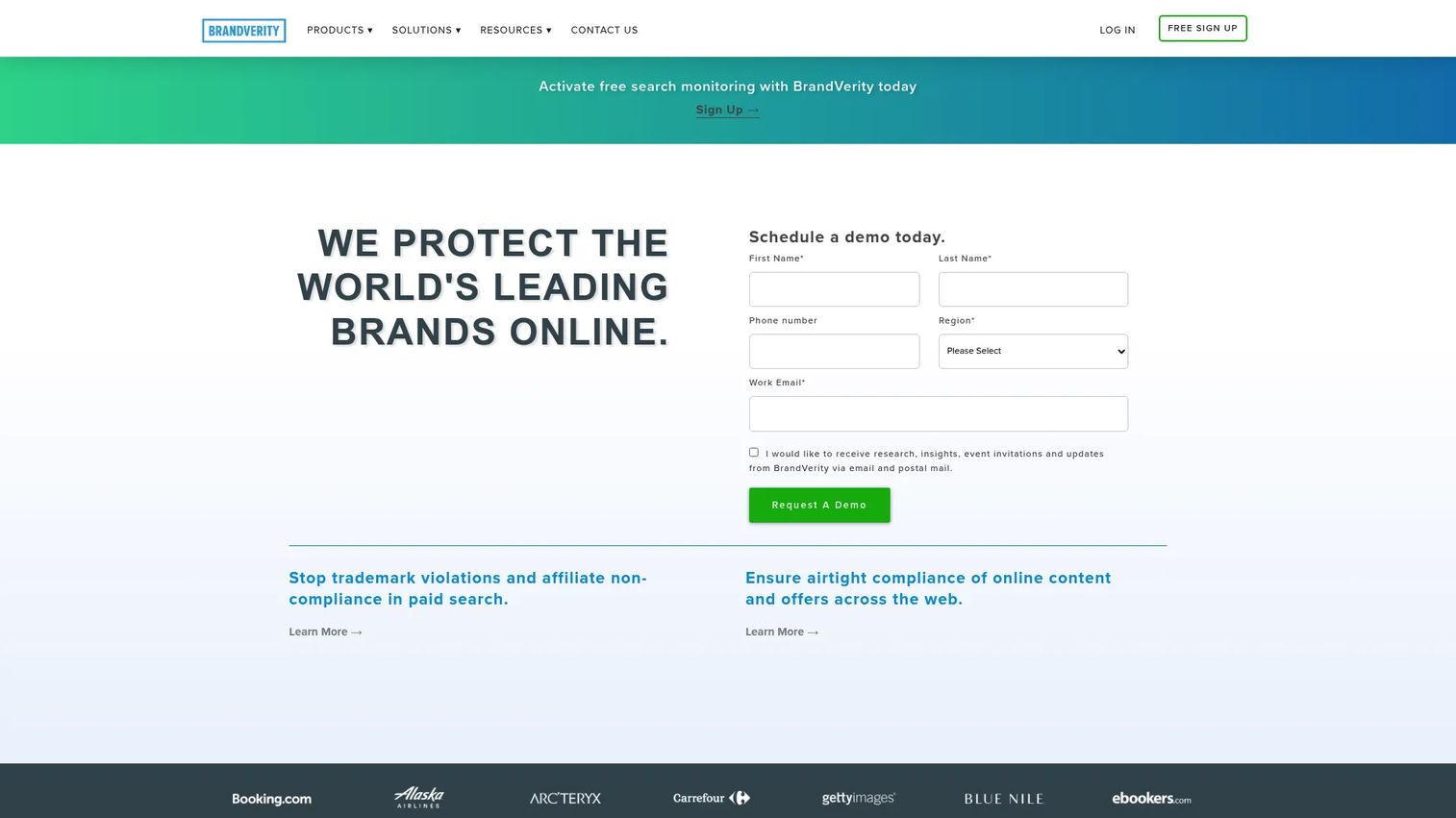
BrandVerity provides brand protection and compliance monitoring software focused on paid search and web content. It is a specialist pick rather than a broad platform, and that focus is the point: if brand bidding and ad abuse are your real problem, a dedicated paid search monitor will outperform a generalist.
Best for: Brands that need paid search trademark monitoring and web compliance oversight.
Key strengths
- Paid search monitoring: Coverage across search engines, geographies, and languages to catch trademark bidding abuse.
- Web compliance monitoring: Crawling and screenshot archiving that document violations as evidence.
- Bulk takedown and remediation: Workflows that handle ad and compliance violations at volume.
Why choose BrandVerity: Choose it when competitors or affiliates bid on your brand terms and ad abuse erodes your paid search performance. Because it specializes, it goes deeper on search engine and geographic coverage than broader platforms that treat ads as one channel among many.
BrandVerity pricing: BrandVerity lists Professional, Premium, and Enterprise plans but does not publish dollar amounts. Pricing is via demo or contact sales, and there is no free tier.
9. Corsearch
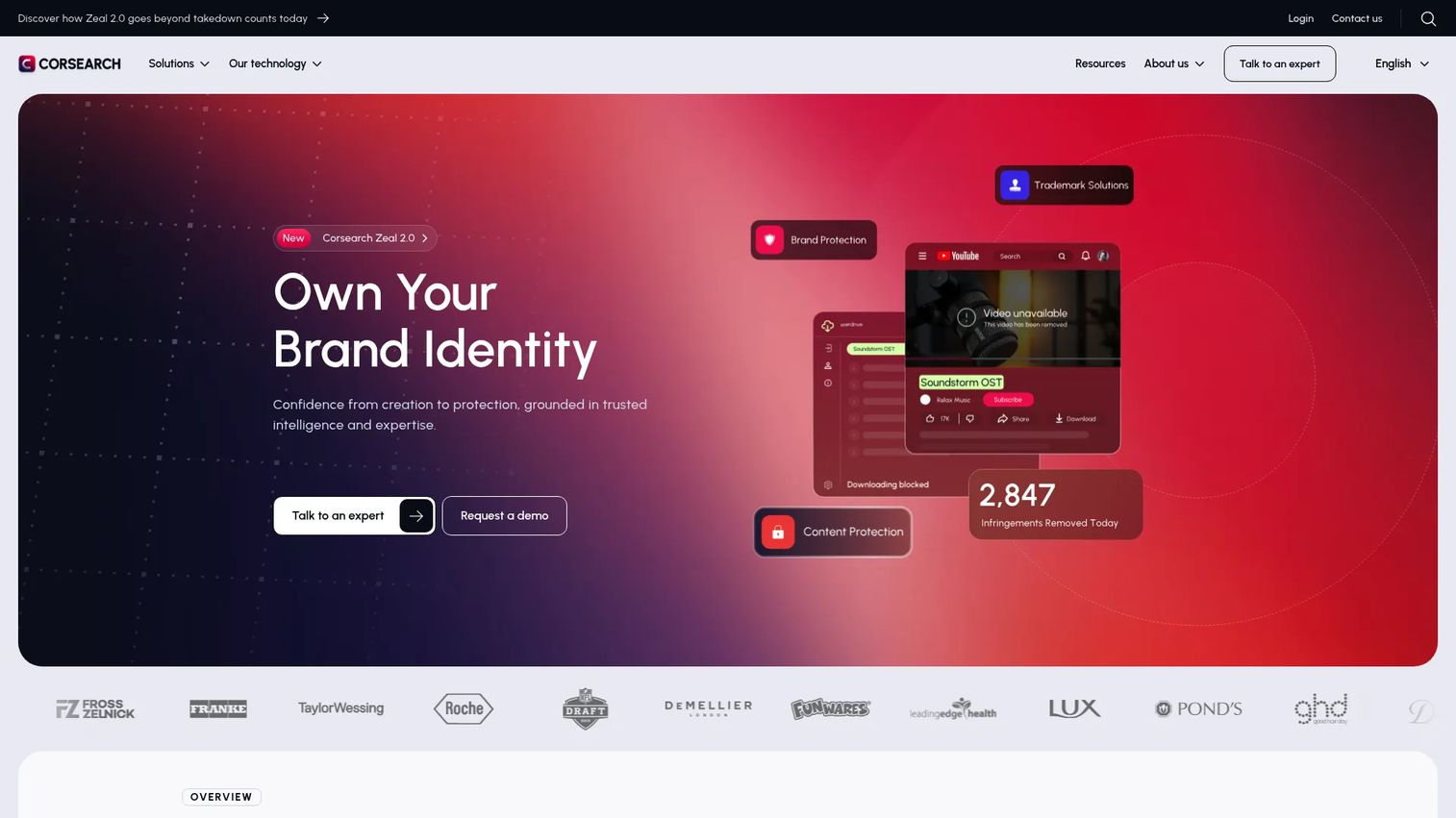
Corsearch provides B2B software and services for trademark intelligence, brand protection, and content protection. It is useful for teams that need rights and IP-centered protection, connecting trademark clearance to enforcement across counterfeit, impersonation, gray market, and domain abuse.
Best for: Enterprises needing trademark clearance plus online brand and content protection.
Key strengths
- AI trademark screening: Trademark screening and clearance that anchor enforcement in your IP rights.
- Brand protection coverage: Counterfeits, impersonation, gray markets, and domain abuse in one program.
- Content protection: Coverage for piracy and unauthorized distribution.
Why choose Corsearch: Choose it when your protection program is rights-driven and legal or IP teams own the workflow. Linking trademark clearance to enforcement gives you a defensible, rights-based foundation for takedowns rather than ad hoc removal requests.
Corsearch pricing: Corsearch does not expose public pricing and routes visitors to request a demo or talk to an expert. Pricing is quote-based.
Considerations before you buy
Use this checklist to pressure-test any shortlist before you commit.
Channel coverage
Map your actual abuse surface first, then check coverage against it. A marketplace-heavy brand needs different reach than a SaaS company facing phishing and lookalike domains. Confirm the platform covers marketplaces, social media monitoring, paid ads, mobile apps, domains, and dark web monitoring to the depth you need, not just the channels listed on a feature page.
Enforcement and takedown workflow
Detection without removal is just an alert feed. Ask how automated takedowns work, what the typical takedown success rate looks like, and how fast removals happen. Clarify whether the vendor handles enforcement as a managed service or hands you the workflow, since that changes your internal staffing.
Reporting and analytics depth
You will need to prove impact to leadership. Look for dashboards that report detection volume, time-to-removal, takedown success rate, and threat trends over time. Exportable reporting that maps to your brand risk monitoring narrative makes stakeholder updates far easier.
Integrations and security fit
If a security team owns or shares the tool, integration matters. Check for SIEM integration, SOAR integration, and case management connections so brand threats route into existing incident response rather than living in a silo. CRM and reporting integrations help when marketing and legal also need visibility.
Evidence and credibility
Enforcement and legal escalation depend on solid evidence. Confirm the platform captures screenshots, archives, and documentation that hold up with platforms, registrars, and courts. Strong evidence packaging is what turns a detection into a successful takedown.
Conclusion
The right brand protection platform is the one that matches the abuse surface you actually face. If counterfeit listings are eating your revenue, Red Points and BrandShield lead on marketplace enforcement. If phishing and impersonation are the threat, PhishLabs / Fortra, Netcraft, and Doppel bring security-grade detection and takedown. If paid search abuse erodes your campaigns, BrandVerity goes deepest on brand bidding. If your program is rights-driven, Corsearch anchors enforcement in trademark intelligence. And if you want the broadest single-platform coverage, BrandShield, ZeroFox, and EBRAND span the most channels.
Build your shortlist on three things: channel coverage against your real exposure, takedown speed and success rate, and reporting depth you can defend to leadership. Then verify how cleanly each option fits your enforcement workflow and security stack. Start by mapping where your brand is being abused most, and let that map, not the vendor pitch, drive the decision.
FAQs
Brand protection software detects unauthorized or fraudulent use of your brand across digital channels, prioritizes the threats that matter most, and coordinates their removal. It typically covers counterfeit listings, phishing, impersonation, paid search abuse, rogue apps, and dark web activity, then runs automated takedowns and reports on results.
At minimum, look for marketplace monitoring, social media monitoring, domain monitoring, paid search, mobile app stores, and dark web monitoring. The right mix depends on your exposure, so map your abuse surface first. A physical-goods brand prioritizes marketplaces, while a SaaS company often prioritizes domains, phishing, and impersonation.
Automated takedowns connect detection to enforcement. When the platform identifies abuse, it packages evidence such as screenshots and archives, then submits removal requests to the relevant platform, registrar, or host, often using pre-built templates and established relationships. Many tools auto-feed detections into the takedown queue so high-volume abuse does not bottleneck on manual review.
Trademark monitoring watches for registration conflicts and naming infringement, focused on your legal IP rights. Brand protection is broader, covering counterfeit listings, phishing, impersonation, ad abuse, and fraud across digital channels. Most mature programs use both: trademark monitoring to protect the mark itself, and brand protection to defend the brand experience everywhere it appears.
Yes, when abuse volume exceeds what your team can monitor manually. Even mid-market brands face counterfeit listings, phishing, and impersonation that erode trust and divert revenue. Because most platforms scope pricing to your channels and volume, you can match coverage to a mid-market footprint rather than paying for enterprise breadth you do not need.
Yes. Phishing detection and fake-site takedown are core capabilities for most platforms in this category. Tools monitor for lookalike domains and credential-harvesting pages, package evidence, and coordinate takedowns with registrars and hosts. Speed matters here, so prioritize vendors with fast detection and proven takedown success rates.
Ownership varies. Security teams often own it when phishing, dark web, and threat intelligence drive the program, especially with SIEM and SOAR integration. Legal and IP teams own it when trademark and enforcement are central. Marketing and product marketing teams care about trust, reputation, and revenue protection, so the best programs align all three around a shared platform and reporting view.
Prioritize channel coverage against your actual abuse surface, enforcement and takedown workflow strength, takedown success rate, reporting depth, and integration fit with your security and GTM stack. Ask whether enforcement is managed or self-run, how evidence is captured for legal escalation, and how quickly removals happen. Build the shortlist around the threats you face most, not the longest feature list.