You install the chargers. They work for a week. Then one goes offline at your busiest site, a driver can't start a session, and support has no idea which unit is down until someone calls.
That gap between installing hardware and actually running it is where EV charging software earns its budget. The chargers are the visible part. The software is the part that decides whether your network stays up, bills correctly, and scales past the first ten ports without a full-time babysitter.
The market is growing fast enough that this problem is only getting bigger. BCG (2024) put the European EV charging software market at €390M in 2023 and projected it to reach €1.9B by 2030, growing roughly 25% a year. Mordor Intelligence (2025) estimated the global EV charging management software platform market at USD 2.41B in 2025, on track for USD 8.26B by 2030. More chargers means more operational surface area, and more surface area is exactly what software has to manage.
This guide is for the person who has to pick the platform and then live with it. If you evaluate tools the way a product manager does, thinking about maintenance burden, integration depth, and whether the thing survives your release cadence, this comparison is built for you. We looked at four EV charging software companies, cut the marketing copy, and mapped each one to a specific operating model.
What's inside
This guide compares EV charging management software for network operators, fleets, property owners, and infrastructure teams. It is not a category explainer. It assumes you already know you need a platform and want to know which one fits.
We selected and evaluated each platform on:
- OCPP support and hardware compatibility: how many charger brands it can actually run
- Reliability and uptime: monitoring, alerts, and remote issue resolution
- Energy management: dynamic load balancing, peak shaving, and demand response
- Payments and billing: driver access, tariffs, and settlement
- Support and operational depth: how much of the day-to-day the vendor absorbs
- Scalability: whether the architecture holds up as your port count grows
TL;DR
- Best for hardware compatibility and operational simplicity: ChargeLab. Runs any OCPP-compatible charger with 24/7 support and dynamic power management.
- Best for white-label scale and developer ecosystem: AMPECO. Enterprise CPMS with a white-label driver app, roaming, and a deep API.
- Best for enterprise energy and operations depth: Driivz. Billing, settlement, and energy management built for large distributed networks.
- Best for mixed property types and flexible pricing: Epic Charging. Vendor-neutral platform with a granular pricing engine and multiple payment methods.
- How to decide: map your operating model first. Network scale, energy control, hardware variety, and property mix each point to a different platform.
What is ev charging software?
EV charging software is the platform that helps operators monitor, manage, monetize, and optimize electric vehicle charging infrastructure across one site or thousands.
It sits between the physical charger and everyone who touches it: the driver who plugs in, the site host who owns the location, the operator who bills, and the utility that supplies power. Sometimes called EV charging management software, charge point management software, or EV charging back office software, the category covers a consistent set of core capabilities:
- Charger monitoring and uptime: real-time status, fault detection, and alerts across every port
- Payments and billing: driver authentication, tariffs, subscriptions, and settlement
- OCPP interoperability: the Open Charge Point Protocol that lets one platform run many charger brands
- Energy and load management: dynamic power distribution, load balancing, and peak shaving
- Driver and site-host management: access control, RFID and app authentication, and per-host reporting
- Reporting, alerts, and maintenance workflows: usage data, remote diagnostics, and ticketing
The distinction that matters most for buyers: this is operational infrastructure, not a dashboard. A dashboard shows you a charger is down. Good electric vehicle charging software tells you why, opens a ticket, and often fixes it remotely before a driver notices.
When to use ev charging software
Not every deployment needs a full platform on day one. These are the moments where it stops being optional.
Manage a growing charger network
One or two chargers you can watch by hand. Twenty across five sites you cannot. Once your port count and site mix outrun a spreadsheet, ev charging station software becomes the difference between a network and a liability. The trigger is usually support load: when drivers start calling about failed sessions faster than your team can respond, you need monitoring and remote resolution, not more phone lines.
Control load and avoid expensive upgrades
Adding chargers can push a site past its electrical capacity, and a service upgrade from the utility can cost more than the chargers themselves. Dynamic load balancing spreads available power across active sessions so you charge more vehicles without tripping the main. Peak shaving shifts demand away from expensive rate windows. For fleets and multifamily buildings, this energy management layer is often the entire business case.
Support multiple charger brands and locations
Mixed hardware is the norm, not the exception. You inherit chargers from an acquisition, standardize on a new brand for the next site, and end up running three vendors at once. OCPP compatibility means one platform monitors, bills, and controls all of them from a single pane. Without it, every brand needs its own tool, and your operational overhead multiplies with each site.
Comparison table
Here is how the four platforms map to operating models, hardware variety, energy control, and property mix. Several of these EV charging software companies price by quote, which is standard for infrastructure software licensed per port.
| # | Product | Best for | Key differentiator | Pricing | G2 rating |
|---|---|---|---|---|---|
| 1 | ChargeLab | Operators needing broad hardware support and simple network management | Runs any OCPP-compatible charger with 24/7 support and dynamic power management | Reseller and enterprise licensing, quote-based | Not rated |
| 2 | AMPECO | Large-scale operators needing white-label and API breadth | White-label driver app plus roaming, load management, and open API | Custom, demo-led | Not rated |
| 3 | Driivz | Enterprise networks needing billing and energy depth | Billing, settlement, and energy management in one platform | Custom | Not rated |
| 4 | Epic Charging | Mixed property types needing flexible pricing and payments | Vendor-neutral platform with granular pricing engine | Custom, per-port SaaS license | Not rated |
None of the four publishes a standard price table, and none carried a meaningful G2 review count at the time of writing. That is normal for a category sold to operators through demos and reseller channels. Treat pricing as a conversation shaped by port count, feature scope, and support tier rather than a sticker.
Best 4 ev charging software platforms for 2026
One section per platform, in order of how cleanly each maps to a common operating model.
1. ChargeLab
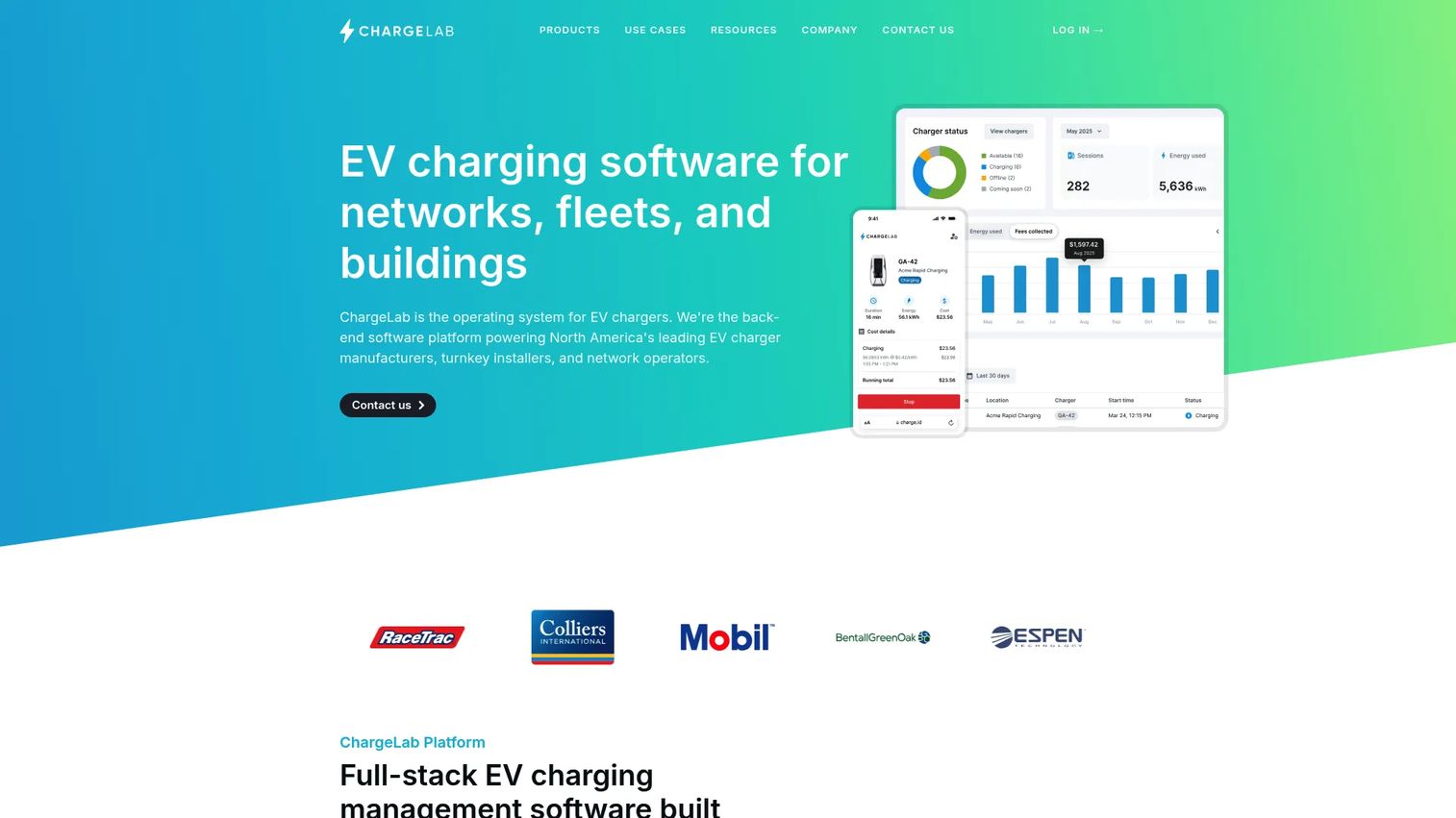
ChargeLab is an EV charging management software platform built for networks, fleets, site hosts, and hardware partners. Its core pitch is hardware freedom: connect any OCPP-compatible charger, run it from one back office, and lean on the vendor for support rather than staffing a NOC yourself. That makes it a fit for operators who care more about running the network than building the software layer.
The platform leads with three things that matter to anyone managing physical infrastructure. It connects any OCPP-compatible EV charger, so mixed hardware and future brand switches do not lock you in. It provides 24/7 customer support, which offloads the after-hours firefighting that eats operations teams alive. And it includes dynamic power management, so you can add ports without automatically triggering an electrical upgrade.
Best for: Operators and fleets that run mixed hardware and want broad OCPP support with vendor-backed support instead of a self-managed back office.
Key strengths
- Connect any OCPP-compatible EV charger
- 24/7 customer support
- Dynamic power management
Why choose ChargeLab: If your priority is straightforward network management across many charger brands, ChargeLab reduces the operational tax of running mixed hardware. It suits teams that want the vendor to absorb monitoring and support rather than build that muscle internally.
ChargeLab pricing: ChargeLab handles pricing through reseller and enterprise license pathways rather than a public price table. Expect the number to track your port count, deployment scope, and support requirements, so treat the first conversation as scoping rather than a quote you can lift off a page.
ChargeLab does not carry a meaningful G2 review score yet, so there is no reliable review-based rating to cite.
2. AMPECO
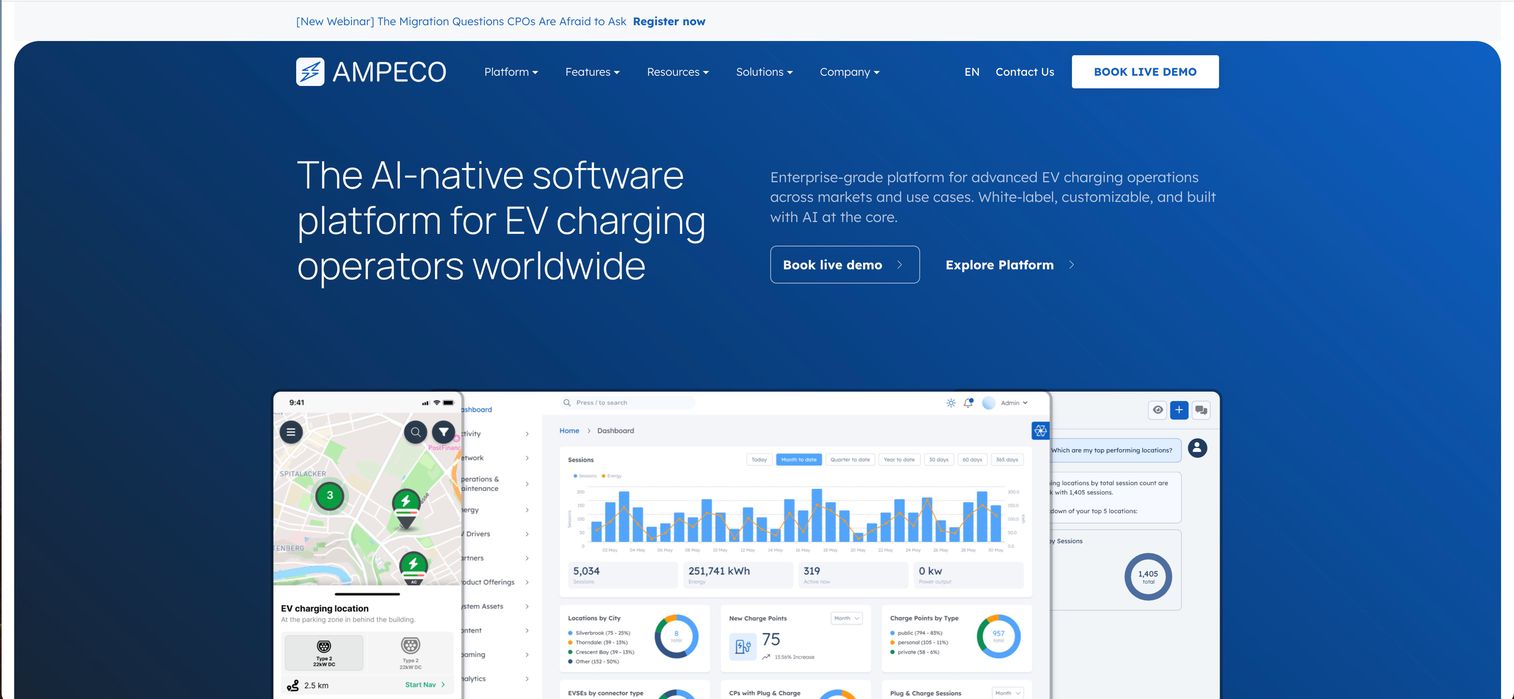
AMPECO is enterprise EV charging management software built for operators that need to run large networks under their own brand. It leans into white-label delivery, an open API, and the operational features that distributed networks depend on. The platform is a fit for operators and eMSPs that treat charging as a product line and want to control the driver experience end to end.
The breadth is the point here. AMPECO ships a white-label driver app and web portal, so the charging experience carries your brand rather than the vendor's. It handles tariffs, subscription plans, billing, and payments, which covers the monetization side without bolting on a separate billing tool. And it supports roaming, dynamic load management, and an open API, giving developer teams the hooks to integrate charging into a wider stack. The API depth in particular matters for product managers who need charging data flowing into existing systems without a fragile middle layer.
Best for: Large-scale operators and eMSPs that need a white-label CPMS with strong billing, roaming, and API access.
Key strengths
- White-label driver app and web portal
- Tariffs, subscription plans, billing, and payments
- Roaming, dynamic load management, API, and integrations
Why choose AMPECO: For teams building a branded charging product with room to integrate, AMPECO's white-label surface and open API give you control over both the driver experience and the data. It fits operators who want platform breadth rather than a fixed set of screens.
AMPECO pricing: AMPECO routes buyers to a demo and book-a-call flow rather than posting numbers, and describes flexible tariff and subscription structures on its plans page. Pricing tracks the scale of your network and the feature set you enable, so plan on a scoping conversation to get a real figure.
AMPECO does not have a verified G2 rating available to cite at the time of writing.
3. Driivz
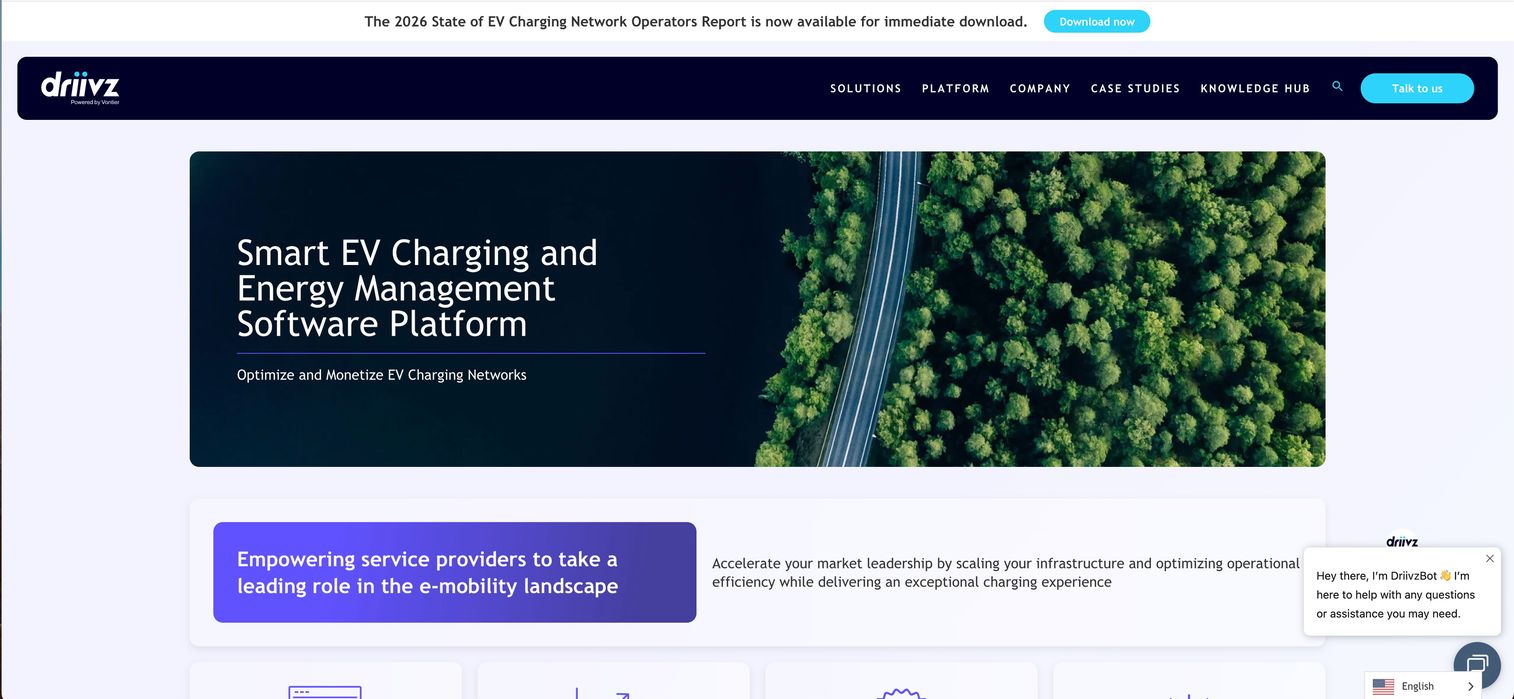
Driivz is EV charging and energy management software aimed at operators, fleets, and eMSPs running large distributed networks. Its center of gravity is the combination of billing, operations, and energy management in one platform, which is where enterprise operators tend to feel the pain as they scale. If your challenge is running a profitable network across many sites rather than lighting up your first location, Driivz is built for that shape of problem.
Three capabilities define it. Driivz handles EV charging billing and settlement, which covers the money flow across drivers, hosts, and roaming partners. It provides operations management and remote issue resolution, so faults get diagnosed and often fixed without a truck roll. And it delivers energy management, load balancing, and demand response, letting operators control power cost and grid interaction at scale. That energy layer is the differentiator for networks where electricity is the largest operating expense.
Best for: Enterprise operators and fleets that need billing, operations, and energy management unified for a large, distributed network.
Key strengths
- EV charging billing and settlement
- Operations management and remote issue resolution
- Energy management, load balancing, and demand response
Why choose Driivz: When profitability and control across a distributed network are the goal, Driivz brings billing and energy management under one roof so you are not stitching together separate tools. It suits enterprise teams that need operational depth over quick setup.
Driivz pricing: Driivz pricing is not posted on its site, which is typical for enterprise ev charger software sold through direct sales. The cost reflects network size, the modules you turn on, and the energy and settlement features you need, so a direct conversation is the only way to get an accurate number.
Driivz does not have a verified public G2 rating to cite here.
4. Epic Charging
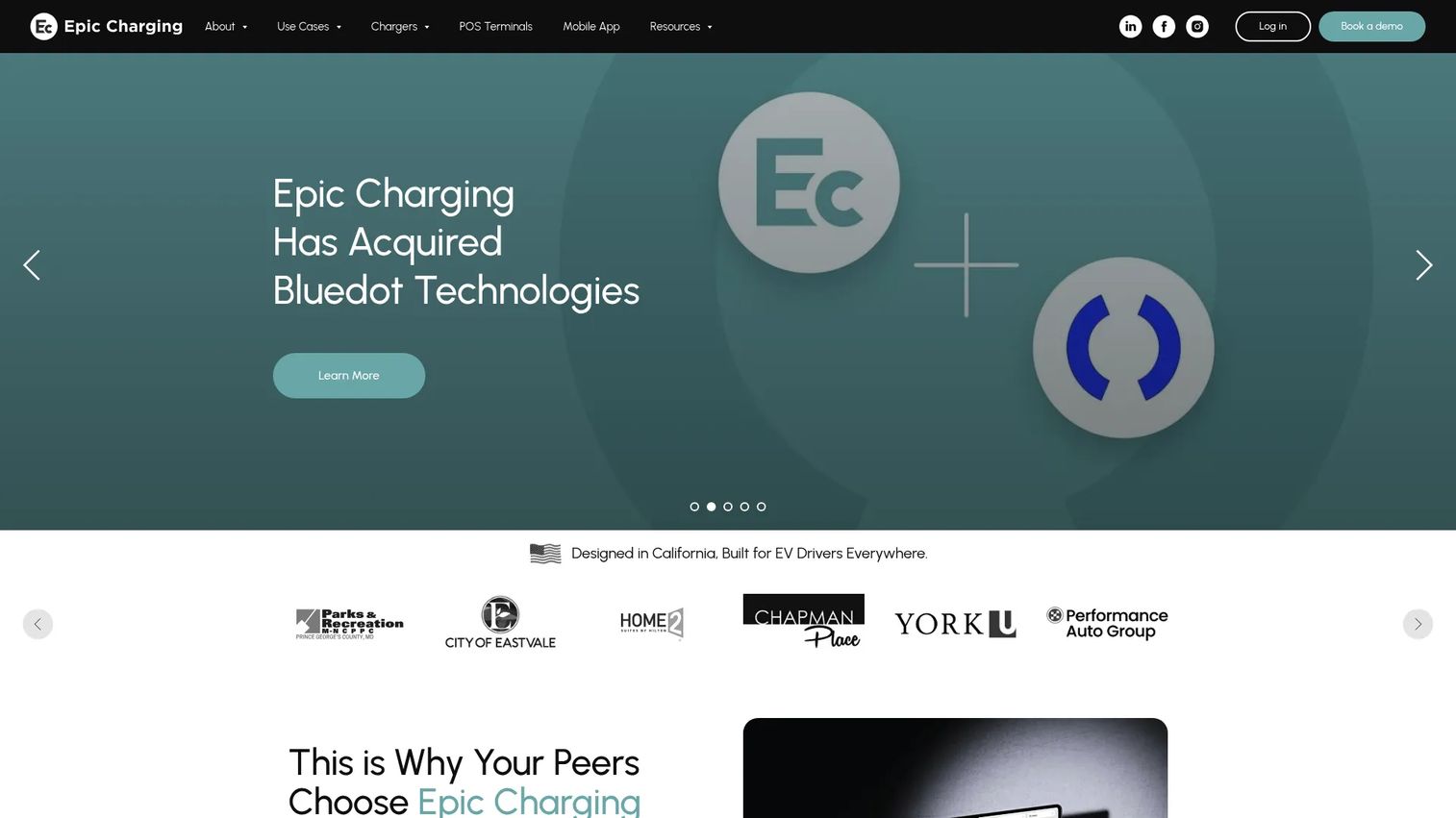
Epic Charging is an EV charging software platform for operators, fleets, multifamily, municipalities, and workplaces. Its strength is flexibility across property types and payment models, backed by a vendor-neutral, OCPP-based approach. That mix makes it a fit for anyone managing a portfolio of different sites where the billing logic changes from one location to the next.
The pricing engine is where Epic stands out. It supports kWh, time, session, tiered, and idle fees, so you can match the billing model to each site rather than force one scheme everywhere. Beyond that, it offers OCPP interoperability and a white-label app and dashboard, load management to keep sites within capacity, and multiple payment options including RFID, QR, app, and credit card. Remote charging control and charger migration support round out the operational picture, which helps when you inherit hardware and need to bring it onto the platform without ripping it out.
Best for: Operators managing mixed property types who need vendor-neutral control, flexible pricing, and multiple payment methods.
Key strengths
- OCPP interoperability with white-label app and dashboard
- Pricing engine with kWh, time, session, tiered, and idle fees
- Load management, remote control, RFID, QR, app, and card payments
Why choose Epic Charging: For a portfolio spanning multifamily, workplace, and municipal sites, Epic's granular pricing engine and payment flexibility let you tailor each location without running separate tools. It fits operators who need optimization and control across a varied footprint.
Epic Charging pricing: Epic customizes pricing by project and describes EV charging software as typically licensed as a SaaS fee per port. The final rate depends on port count, the property types you cover, and the payment and pricing features you enable, so expect a project-based quote rather than a fixed rate.
Epic Charging does not have a verified third-party rating to cite at the time of writing.
Considerations
Before you sign, work through this checklist. Each item maps to a cost you will pay later if you skip it now.
OCPP and hardware compatibility
Confirm which OCPP versions the platform supports and which specific charger models it has certified, not just which it claims to work with. OCPP is a spec, and vendor implementations vary. If you run mixed hardware or expect to switch brands, a gap here means you either replace chargers or run a second tool. Ask for the certified hardware list in writing.
Energy and load management
If electricity is your largest operating cost, or if a site is near its electrical limit, this is not optional. Check for dynamic load balancing across active sessions, peak shaving against your rate schedule, and demand response if your utility offers it. Confirm whether these run automatically or need manual configuration, because manual load management does not scale past a handful of sites.
Support and operations
Decide how much of the daily operational load you want to own. Some platforms hand you a dashboard and expect your team to run it. Others provide 24/7 monitoring and remote issue resolution that absorbs most faults before a driver notices. The right answer depends on whether you have an operations team, and the cost of building one should factor into your comparison.
Security and compliance
Charging platforms handle payment data, driver identities, and increasingly grid interaction, so security posture matters. Ask about payment compliance, data handling, and access controls. If you sell into regulated environments or government sites, confirm the vendor can meet the procurement requirements before you get deep into evaluation.
Reporting and integrations
For a product manager, integration depth often decides the tool. Check which systems the platform connects to out of the box, whether it exposes a real API rather than a limited export, and how clean the usage and billing data is. Reporting that cannot feed your existing analytics or finance stack becomes a manual reconciliation job every month.
Conclusion
The right EV charging software depends less on a feature checklist and more on your operating model.
- ChargeLab fits operators who want broad hardware compatibility and vendor-backed support without building a back office.
- AMPECO fits large-scale operators who need white-label control, billing depth, and an open API to integrate charging into a wider stack.
- Driivz fits enterprise networks where profitability and energy management across many sites are the core challenge.
- Epic Charging fits portfolios of mixed property types that need flexible pricing and multiple payment methods per site.
Start by naming your operating model. If hardware variety is your reality, weight OCPP support and pick ChargeLab or Epic Charging. If you are building a branded product with a developer team behind it, look hard at AMPECO. If energy cost and enterprise scale define the problem, evaluate Driivz. Then book demos with the two closest fits and pressure-test them on the checklist above, especially the certified hardware list and the automation of load management. Those two answers separate the platforms that scale from the ones that become your next operational headache.
FAQs
There is no single best platform, because the right one depends on your network's shape. For broad hardware compatibility and vendor-backed support, ChargeLab is a strong fit. For enterprise networks where billing and energy management across many sites are the core challenge, Driivz is built for that scale. Match the platform to your operating model rather than chasing a universal winner.
OCPP, the Open Charge Point Protocol, is the open standard that lets one software platform monitor, bill, and control chargers from many different hardware vendors. It matters because it prevents lock-in. With OCPP support, you can run mixed hardware, switch charger brands, and add sites without buying a separate tool for each vendor. Without it, your operational overhead multiplies with every brand you deploy.
Load balancing distributes available electrical capacity across active charging sessions so you can serve more vehicles without exceeding a site's power limit. Dynamic load balancing adjusts in real time as sessions start and stop. Many platforms also offer peak shaving, which shifts demand away from expensive utility rate windows, and demand response, which coordinates with the grid. For fleets and multifamily sites, this energy management layer often carries the entire business case.
The core set is charger monitoring and uptime, OCPP interoperability, payments and billing, energy and load management, and reporting with maintenance workflows. Which of those weighs heaviest depends on your situation. Uptime and remote resolution matter most for public networks, energy management matters most where electricity is the top cost, and integration depth matters most for teams feeding charging data into a wider stack.
Start with OCPP compatibility, and confirm the certified hardware list in writing rather than trusting a general claim of support. Vendor implementations of OCPP vary, so a platform that supports the spec may still not run your specific models cleanly. Platforms built for hardware freedom, like ChargeLab and Epic Charging, are designed to run many brands from one back office, which is what you want when your fleet is not standardized.
Hardware is the physical charger that delivers power to the vehicle. EV charging software is the platform that runs it: monitoring status, authenticating drivers, processing payments, managing power, and generating reports. Hardware without software is a dumb outlet that you cannot bill, monitor, or optimize. The software is what turns a set of chargers into a managed, monetizable network.