If you are comparing Drift alternatives in 2026, the decision has most likely been made for you. In March 2026, Clari and Salesloft announced the gradual sunset of Drift and named 1mind as the exclusive successor for existing customers. The product is closed to new customers, drift.com now resolves to Salesloft, and no public end-of-life date has been published. The practical deadline is not a shutdown announcement. It is your next renewal.
That makes this a migration, not a shopping trip, and migrations are where inbound leads go missing. Replacing Drift is really six smaller decisions: website chat, AI qualification, CRM routing, sales execution, pipeline visibility, and whether you rebuild what you had or buy something narrower.
The shortlist below spans AI buyer engagement platforms, CRM-native conversational marketing tools, live chat platforms, a sales engagement suite, and a revenue orchestration platform. Every tool is labeled by category. Every pricing figure comes from the vendor's own pricing page. No tool here is a perfect Drift clone, because Drift replacements rarely need to be.
TL;DR
- The official successor: 1mind is the product Clari and Salesloft are referring existing Drift customers to. It is enterprise, sales-led, and narrower in scope than Drift was, so being the named successor does not make it the automatic choice. Contact sales for pricing.
- Best for AI buyer engagement: Promptbar is the first shortlist pick for teams replacing Drift with a modern, AI-powered website conversion workflow. Free plan available; paid plans start at $99/month.
- Best for Salesforce-native pipeline: Qualified connects website visitor data to Salesforce accounts and routes high-intent traffic to reps. Contact sales for pricing.
- Best for HubSpot-native GTM teams: HubSpot connects chat, CRM, forms, and marketing automation in one place. Free plan available; paid plans start at $7/seat/month.
- Best for support-led chat: Intercom, Tidio, and Crisp each cover AI-assisted support conversations at different price points and scale.
- Best for sales engagement beyond chat: Salesloft manages cadences, conversation intelligence, and deal execution after a lead enters the pipeline. Contact sales for pricing.
- Best for pipeline visibility: Clari gives revenue teams forecasting and deal inspection after engagement occurs. Contact sales for pricing.
What's inside
- What happened to Drift, with the full ownership and sunset timeline.
- How much time existing Drift customers realistically have.
- How we selected and labeled these 11 tools.
- A comparison table with category, free plan, and starting price for all 11.
- Per-tool sections with positioning, key features, limitations, and pricing.
- Use-case routing by job: AI chat, CRM-native qualification, support chat, and pipeline visibility.
- A migration checklist for moving off Drift without losing inbound leads.
What happened to Drift
Drift launched in 2015 and effectively created the conversational marketing category: website chat that qualified visitors, routed them to reps, booked meetings, and pushed the conversation data into the CRM. For most of a decade those four jobs were what teams meant when they said they ran Drift.
The product is now being retired. Here is how it got there:
February 2024: Salesloft acquires Drift. Drift is folded into Salesloft's revenue platform. Self-serve signup and public pricing disappear, and new feature investment starts flowing to the parent platform rather than to Drift itself.
August 2025: a security incident. A breach affecting a Drift integration reaches more than 700 organizations. It is worth knowing about if you are mapping your own exposure, but Clari and Salesloft did not name it as the reason for what came next, and it should not be presented as the cause.
December 2025: Clari and Salesloft merge. Drift now sits inside a combined revenue platform where it overlaps with several first-party products.
March 2026: the sunset is announced. Clari and Salesloft announce the gradual sunset of Drift's conversational marketing product and an exclusive agreement to refer existing Drift clients to 1mind as the successor. Drift is closed to new customers.
Now: drift.com resolves to Salesloft, whose page describes the transition from Drift to 1mind. Existing customers can still log in. No universal end-of-life date has been published, and active development has stopped.
How much time do you actually have?
There is no public shutdown date, so do not plan around one you read on a vendor blog, including this one. Ask Clari and Salesloft to confirm your own dates in writing.
What you can plan around is your renewal. A product with no roadmap and no new customers is not something to re-sign for a multi-year term, and the referral to 1mind is a referral rather than a migration: existing clients are pointed at the successor, not moved onto it automatically, which means the data mapping work is yours either way.
The practical sequence for most teams is to treat the current contract term as the migration window, run the replacement in parallel before the renewal date rather than after it, and keep Drift live until lead flow through the new tool has been verified. The migration checklist at the end of this article covers the mechanics.
What to look for in a replacement
The sunset answers why you are moving. It does not answer what to move to. Five things separate a clean replacement from a painful one.
Start by mapping the jobs, not the tool
Drift's strength was connecting website intent to pipeline. Before shortlisting anything, write down which of its jobs you actually use: triggering conversations with visitors, routing qualified prospects to reps, booking meetings from chat, and writing conversation data back to CRM records. Most teams discover they use two of the four heavily and the rest barely. The shortlist gets much shorter once that is on paper.
AI agent capability is now the baseline
Buyers expect chat to qualify intent, answer product-specific questions, book meetings, and carry the conversation across channels. Scripted playbooks and static routing logic no longer meet that bar, which is part of why the category consolidated in the first place. Several tools on this list are purpose-built AI SDRs rather than chat widgets with automation bolted on.
CRM fit decides how much breaks on handoff
The Salesforce versus HubSpot question matters most at migration time. A replacement that does not map cleanly to existing CRM workflows produces broken routing and missed follow-up. PMMs feel this acutely, because a conversation that captures interest but does not land in the account record means the sales conversation starts from scratch and the positioning story resets.
Chat alone does not prove product value
A visitor who reaches the pricing page after reading three feature pages is not the same buyer as someone who typed a question into a widget and left. For complex products, chat qualifies interest, and something else has to carry product understanding: documentation, a recorded walkthrough, a product-led trial, or a demo the buyer can run themselves. Worth deciding deliberately rather than assuming the chat replacement will cover it, because Drift never did.
Avoid buying into another consolidation
Drift customers have now been through an acquisition, a merger, and a sunset in just over two years. When evaluating replacements, ask about ownership, funding stage, and published roadmap, and weight self-serve pricing and data portability higher than you normally would. A tool you can export from and leave is worth something on its own.
How we picked these Drift alternatives
Each tool on this list covers at least one job that Drift historically owned: website conversion, AI qualification, CRM-native routing, sales execution, or pipeline management. Pricing comes from each vendor's own pricing page or G2 pricing data. G2 ratings come from each tool's live listing.
One tool is here for a different reason. 1mind is the successor Clari and Salesloft named, so it belongs near the top whether or not it suits every team. The rest are ordered by how directly they serve someone leaving Drift.
Two entries, Salesloft and Clari, are products of the same company following the December 2025 merger, and that company is the one retiring Drift. They are listed separately because they solve different problems, and flagged as related so nobody shortlists both thinking they are independent options.
Drift alternatives at a glance
The right Drift alternative depends on which job you are replacing. The table below labels each tool by category and shows pricing and G2 rating so you can shortlist before reading every section.
| # | Tool | Category | Best for | G2 rating | Free plan | Starting price |
|---|---|---|---|---|---|---|
| 1 | Promptbar | AI buyer engagement | AI-powered website conversion and lead qualification | Not listed | Yes | $0/month |
| 2 | 1mind | AI sales agent | The successor named for existing Drift customers | 4.9/5 | No | Contact sales |
| 3 | Qualified | Conversational marketing and pipeline generation | Salesforce-native website qualification | 4.9/5 | No | Contact sales |
| 4 | Tidio | Live chat and AI support | SMB, ecommerce, and support-heavy teams | 4.6/5 | Yes | $0/month |
| 5 | Salesforce | CRM and AI sales engagement | Enterprise teams standardizing on Salesforce | 4.4/5 | Yes (Free Suite) | $25/user/month |
| 6 | HubSpot | CRM, marketing automation, and chat | HubSpot-native GTM teams | 4.4/5 | Yes | $0/month |
| 7 | Intercom | Customer communication and AI support | Support-led conversational experiences | Not listed | No | $29/seat/month (annual) |
| 8 | Knock AI | AI buyer engagement and pipeline generation | Multi-channel qualification and meeting booking | 4.9/5 | No | From $2,000/month |
| 9 | Crisp | Live chat and customer messaging | Lean teams needing chat and shared inbox | 4.5/5 | Yes | $0/month |
| 10 | Salesloft | Sales engagement platform | Outbound cadences and sales execution after lead capture | 4.5/5 | No | Contact sales |
| 11 | Clari | Revenue orchestration and forecasting | Pipeline visibility after engagement | 4.6/5 | No | Contact sales |
The best Drift alternatives in 2026
Each tool below is labeled by category. The Promptbar section leads because it covers the closest job to Drift's core website engagement use case. 1mind follows as the officially named successor. The rest are ordered by how directly they serve someone leaving Drift.
1. Promptbar (AI buyer engagement)
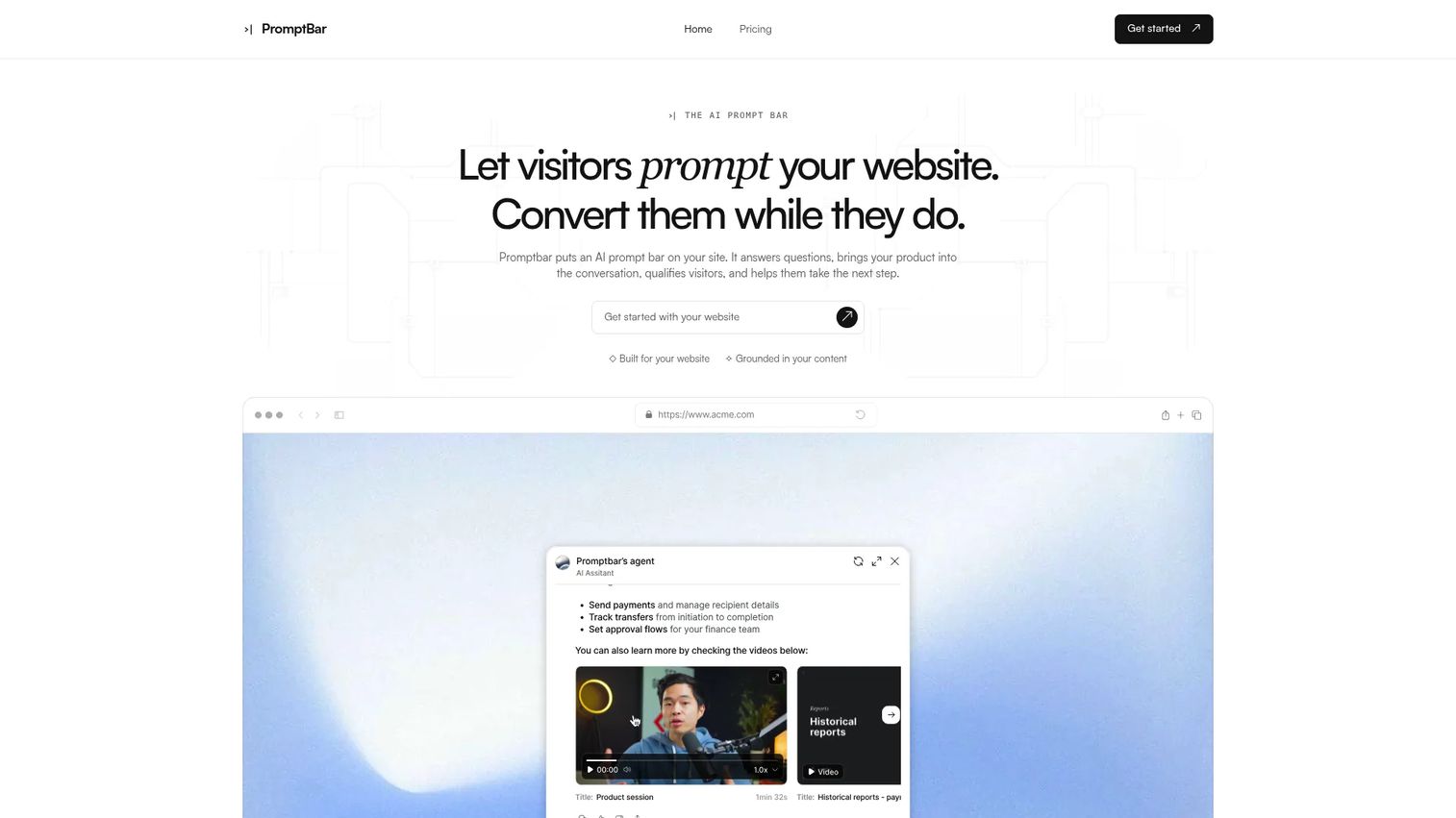
Promptbar is an AI prompt bar for B2B websites that answers visitor questions in natural language, surfaces product resources and demos, captures and qualifies leads, and books meetings, all from a single persistent interface. It fits teams that want intelligent website engagement without building out a full conversational marketing suite.
Best for: B2B websites replacing Drift's chat, lead capture, and meeting booking with an AI-native buyer engagement layer.
What it is: Promptbar is an AI-powered website visitor experience platform. It grounds answers in a company's own website and documentation content, provides inline citations, and routes qualified visitors to meetings through CRM, calendar, and Slack integrations. Plans range from a free tier through a $399/month Pro plan.
Key features:
- Natural-language question answering grounded in website and documentation content
- Inline citations for sourced answers
- Email lead capture and visitor qualification scoring
- Meeting booking, rep routing, and CRM sync
- A/B testing, API access, and webhooks on higher tiers
Where Promptbar falls short: Promptbar is a newer entrant with limited public review data, which makes it harder to benchmark adoption against tools with established G2 review histories. Teams evaluating it should prioritize a hands-on trial and test CRM integration depth, qualification logic customization, and how well the AI grounds answers in niche or technical product documentation. The Enterprise tier uses custom pricing, so budget predictability requires a direct conversation.
Pricing: Free plan includes one prompt bar and 100 conversations per month. Starter is $99/month with 3 prompt bars and 2,000 conversations. Pro is $399/month with 10 prompt bars and 10,000 conversations. Enterprise uses custom pricing.
How it compares to Drift: Promptbar covers Drift's website engagement, lead capture, and meeting booking jobs in an AI-native format. It does not replicate the account-based playbook engine or Salesforce-first pipeline orchestration Drift offered at the top of its range.
2. 1mind (AI sales agent, named Drift successor)
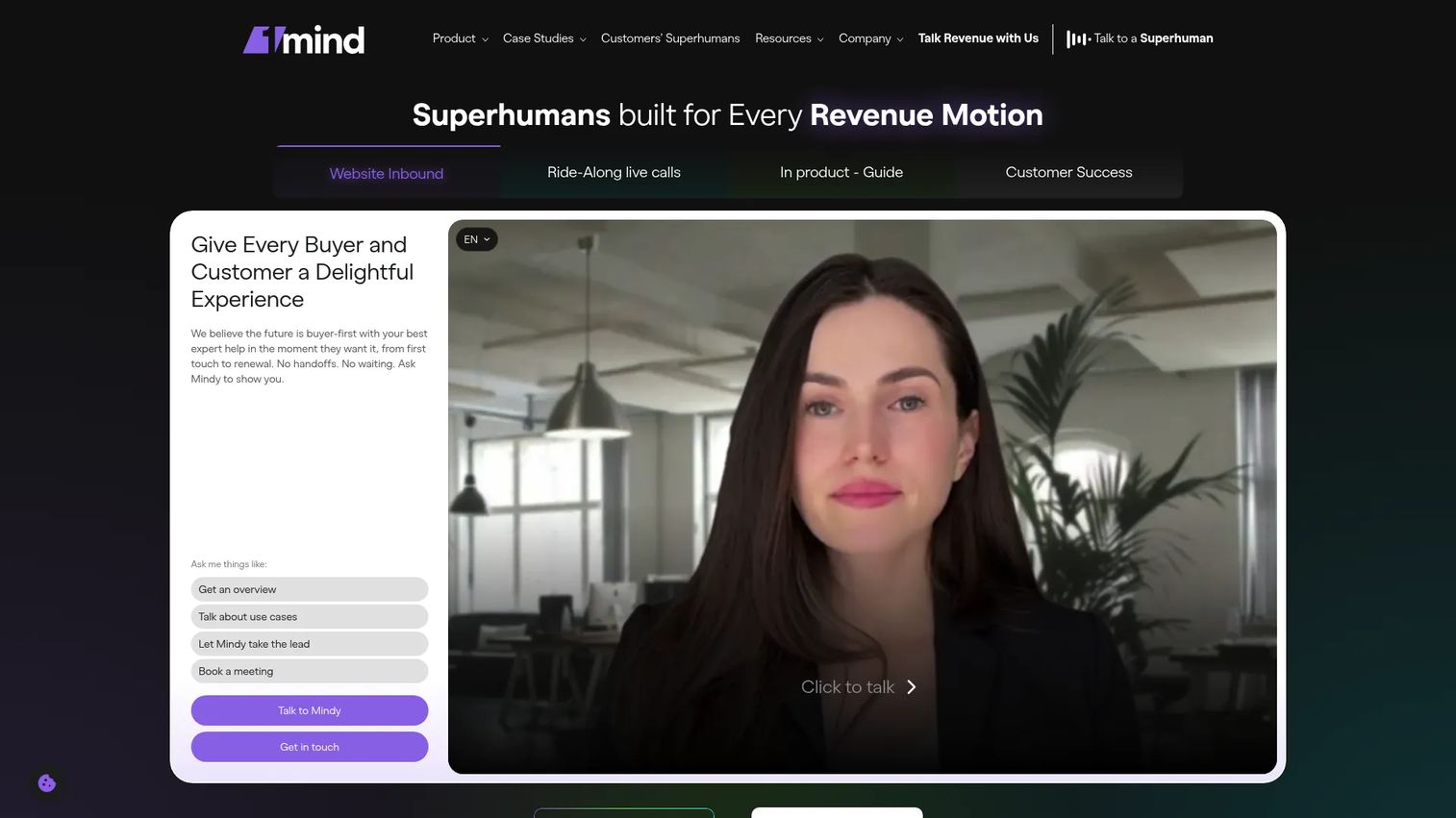
1mind is the product Clari and Salesloft named as Drift's exclusive successor in March 2026. Existing Drift clients are being referred to it. That referral is a starting point for an evaluation, not a conclusion: 1mind is narrower than Drift was in several areas, and being the designated successor does not make it the right fit for every team leaving.
Best for: Mid-market and enterprise B2B revenue teams that want AI agents operating across website qualification, live sales calls, product onboarding, and customer expansion.
What it is: 1mind deploys AI Superhumans across the buyer journey, including a website inbound agent for lead qualification, Ride-Along Superhumans that join live sales calls to answer technical questions, in-product guidance agents, and customer success agents for onboarding and retention. A shared intelligence layer connects context across interactions. G2 rates it at 4.9/5.
Key features:
- Website inbound AI agent for lead engagement and qualification
- Ride-Along Superhumans for live call support and technical question answering
- In-product guidance for activation and expansion moments
- Customer success agent for onboarding and retention
- Shared Brain integrating with Salesforce, HubSpot, Marketo, Salesloft, Gong, and Gainsight
Where 1mind falls short: Pricing is not publicly listed, requiring a direct sales conversation before budget qualification. The platform's breadth across website, live calls, and post-sale means implementation scope is broader than a straight chat replacement. Its 4.9/5 G2 rating comes from a small number of early reviews, so the pattern is harder to benchmark against established tools. Teams that relied on Drift's visitor de-anonymization, web-wide intent data, or outbound automation should confirm coverage directly, since the successor product is not a feature-for-feature match.
Pricing: Enterprise pricing; contact 1mind directly for a quote.
G2 rating: 4.9/5
How it compares to Drift: 1mind covers Drift's website qualification job and extends it across live sales calls, in-product moments, and post-sale engagement. It is the path of least resistance for existing Drift customers, and it is also the one option on this list where the vendor relationship arrives pre-negotiated, which is worth factoring into how hard you push on commercial terms.
3. Qualified (conversational marketing and pipeline generation)
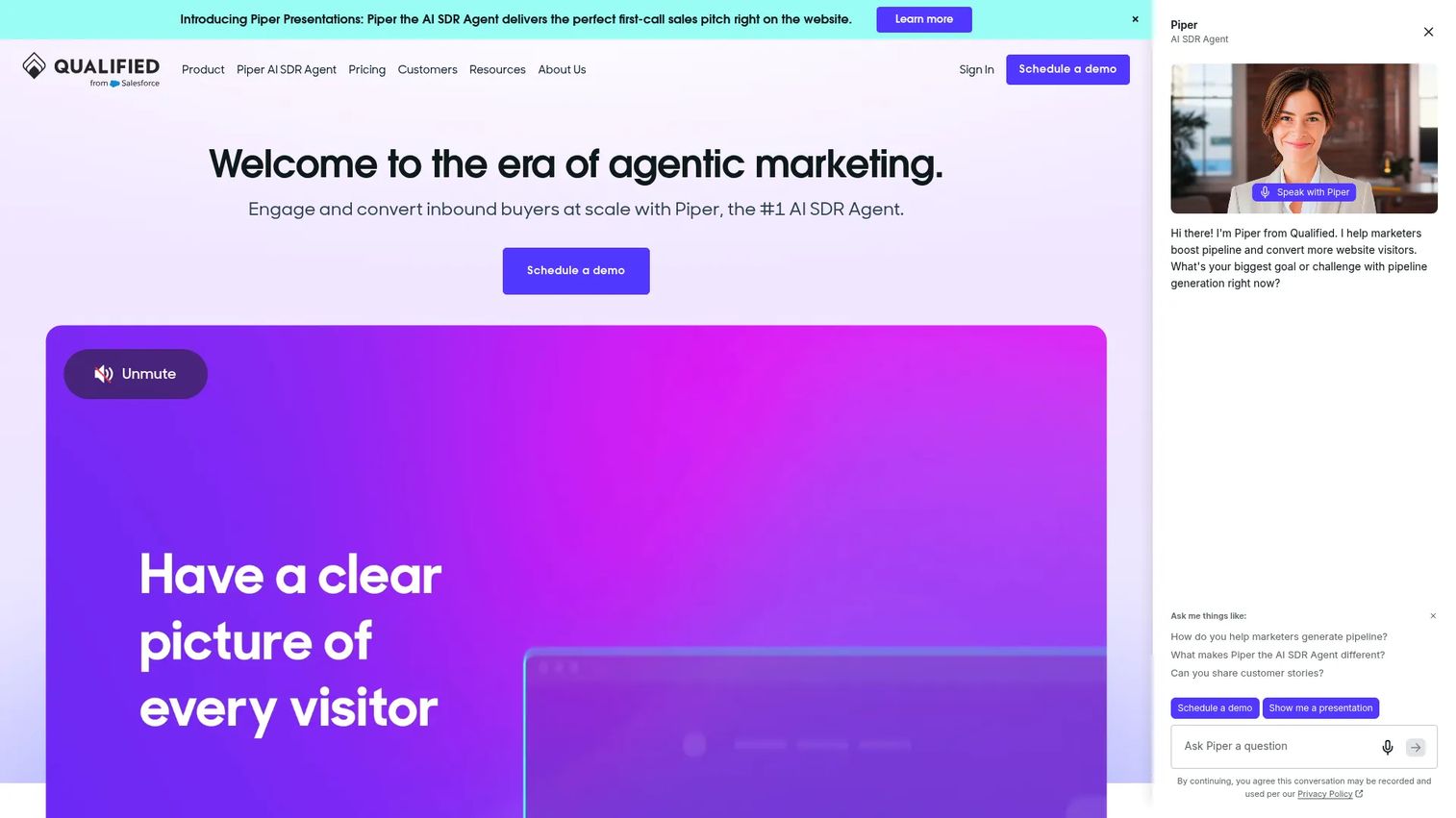
Qualified is the strongest shortlist pick for B2B teams whose Drift use case was tightly integrated with Salesforce. It connects real-time website visitor data to Salesforce account records, qualifies intent through Piper, its AI SDR agent, and routes high-intent traffic to reps or to a meeting booking flow without a rep present.
Best for: B2B revenue teams running a Salesforce-native inbound pipeline motion with significant web traffic from named accounts.
What it is: Qualified is an agentic marketing platform built for Salesforce-first B2B companies. Piper, its AI SDR, handles text, voice, and video conversations with site visitors, generates personalized follow-up, and connects engagement data to pipeline records in Salesforce. G2 rates it at 4.9/5.
Key features:
- Piper AI SDR for text, voice, and video buyer conversations
- Real-time visitor identification and Salesforce account matching
- Intent-based routing and rep assignment
- AI-generated personalized buyer emails and nurture sequences
- Meeting scheduling directly from conversations
Where Qualified falls short: Qualified reviewers on G2 note that setup and ongoing administration can require meaningful RevOps involvement, particularly for teams with complex routing rules or multiple Salesforce object configurations. It is designed for Salesforce-native teams; teams running HubSpot or a non-Salesforce CRM will not get the same account-matching depth. Pricing is not publicly listed, which means budget qualification requires a sales conversation upfront.
Pricing: Qualified offers Premier, Enterprise, and Ultimate plans. No numeric prices are displayed publicly. Contact Qualified's sales team for a quote.
G2 rating: 4.9/5
How it compares to Drift: Qualified covers the Salesforce-native qualification and routing use case with deeper account intent signals and an AI agent layer. Teams that used Drift primarily for chat and support, rather than pipeline generation, will likely find Qualified overbuilt for their needs.
4. Tidio (live chat and AI support)
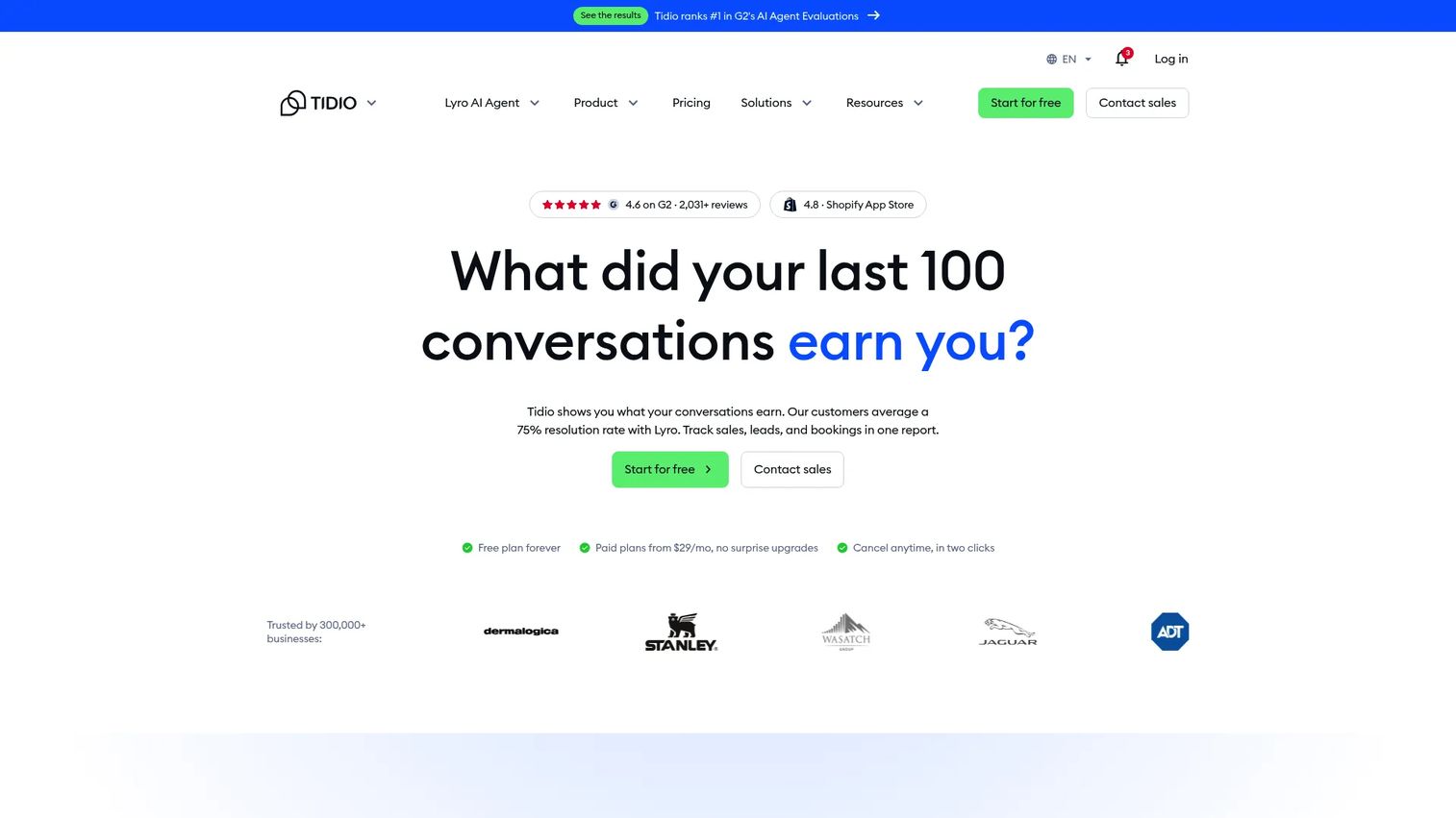
Tidio is the accessible live chat pick for SMB and ecommerce teams. Its Lyro AI agent handles a significant share of customer conversations automatically, and its free tier lets small teams get started without a budget commitment.
Best for: Ecommerce brands and small businesses replacing a chat tool for customer support, order management, and automated FAQ deflection.
What it is: Tidio is an AI-powered customer service and sales platform combining Lyro AI, live chat, ticketing, no-code automation flows, and multichannel support for email, Instagram, Messenger, WhatsApp, and chat. Shopify integration covers order management directly from the inbox. G2 rates it at 4.6/5.
Key features:
- Lyro AI Agent for automated conversation handling
- No-code Flows automation builder
- Shopify order management within the support inbox
- Multichannel support across email and social messaging platforms
- Analytics and agent performance reporting
Where Tidio falls short: Tidio reviewers on G2 note limitations for B2B enterprise routing, advanced CRM-based qualification logic, and deeper pipeline reporting. It is built for volume support and ecommerce flows rather than named-account pipeline generation. G2 reviewers on higher-tier plans have noted that usage-based conversation pricing can make costs less predictable as volume grows.
Pricing: Free plan available. Starter starts at $24.17/month (billed annually). Growth starts at $49.17/month (billed annually). Plus starts at $300/month with usage-based pricing. Premium uses custom pricing.
G2 rating: 4.6/5
How it compares to Drift: Tidio covers the customer support and lightweight chat jobs. Teams that used Drift for B2B pipeline qualification and Salesforce routing will need to pair Tidio with a separate CRM integration or pipeline tool.
5. Salesforce (CRM and AI sales engagement)
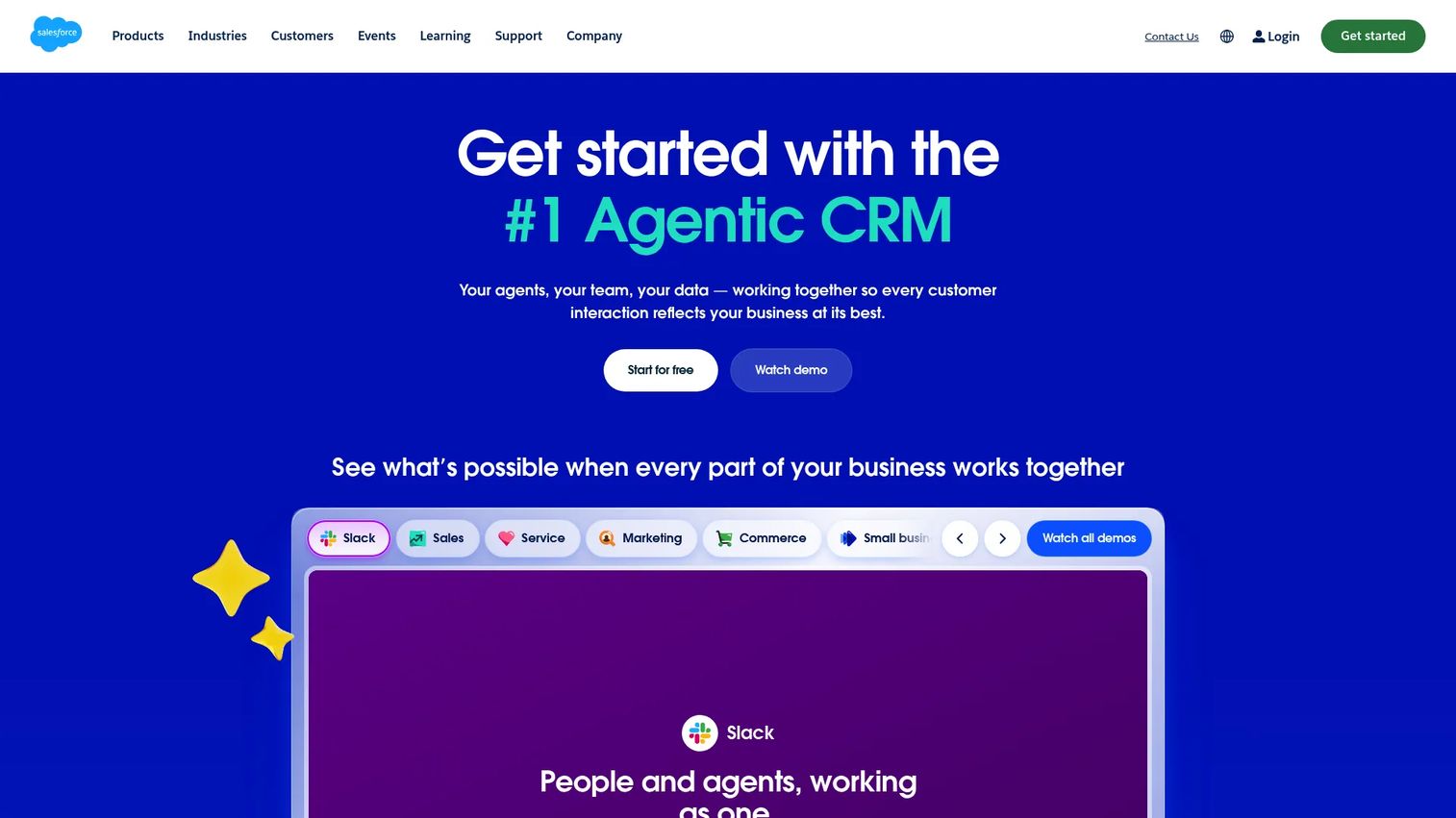
Salesforce is not a Drift replacement in the narrow sense. It is the system of record and engagement infrastructure that makes every other tool in this list work better when it is already in the stack.
Best for: Enterprise teams whose Drift replacement project is part of a broader move to consolidate GTM workflows inside Salesforce, including AI-assisted engagement through Agentforce.
What it is: Salesforce is a cloud-based CRM platform spanning sales, service, marketing, analytics, workflow automation, and AI capabilities. Its Sales Cloud and Agentforce products address the sales engagement and AI qualification jobs that overlap with Drift. G2 rates it at 4.4/5.
Key features:
- Contact and account data management across the full GTM motion
- Agentforce and Einstein AI for sales guidance, automation, and conversation handling
- Sales forecasting and opportunity management
- Workflow automation and process routing
- Native integrations across Salesforce's own product suite
Where Salesforce falls short: Salesforce G2 reviewers consistently note that implementation is complex and admin-heavy, particularly for teams without dedicated Salesforce administrators or RevOps support. Starter plans cover the basics but the AI and advanced routing features that compete with dedicated conversational marketing tools require higher tiers and additional licenses. For teams replacing Drift with a lightweight chat tool, Salesforce will feel overbuilt.
Pricing: Free Suite available. Starter Suite at $25/user/month. Pro Suite at $100/user/month (billed annually). Core at $195/user/month, Advanced at $395/user/month, and Max at $550/user/month (both billed annually). A 30-day free trial is available.
G2 rating: 4.4/5
How it compares to Drift: Salesforce does not replace the chat widget or the real-time visitor engagement layer. It replaces the CRM, routing, and pipeline logic underneath it. Teams already on Salesforce should evaluate Qualified for the website engagement layer that connects to their existing records.
6. HubSpot (CRM, marketing automation, and chat)
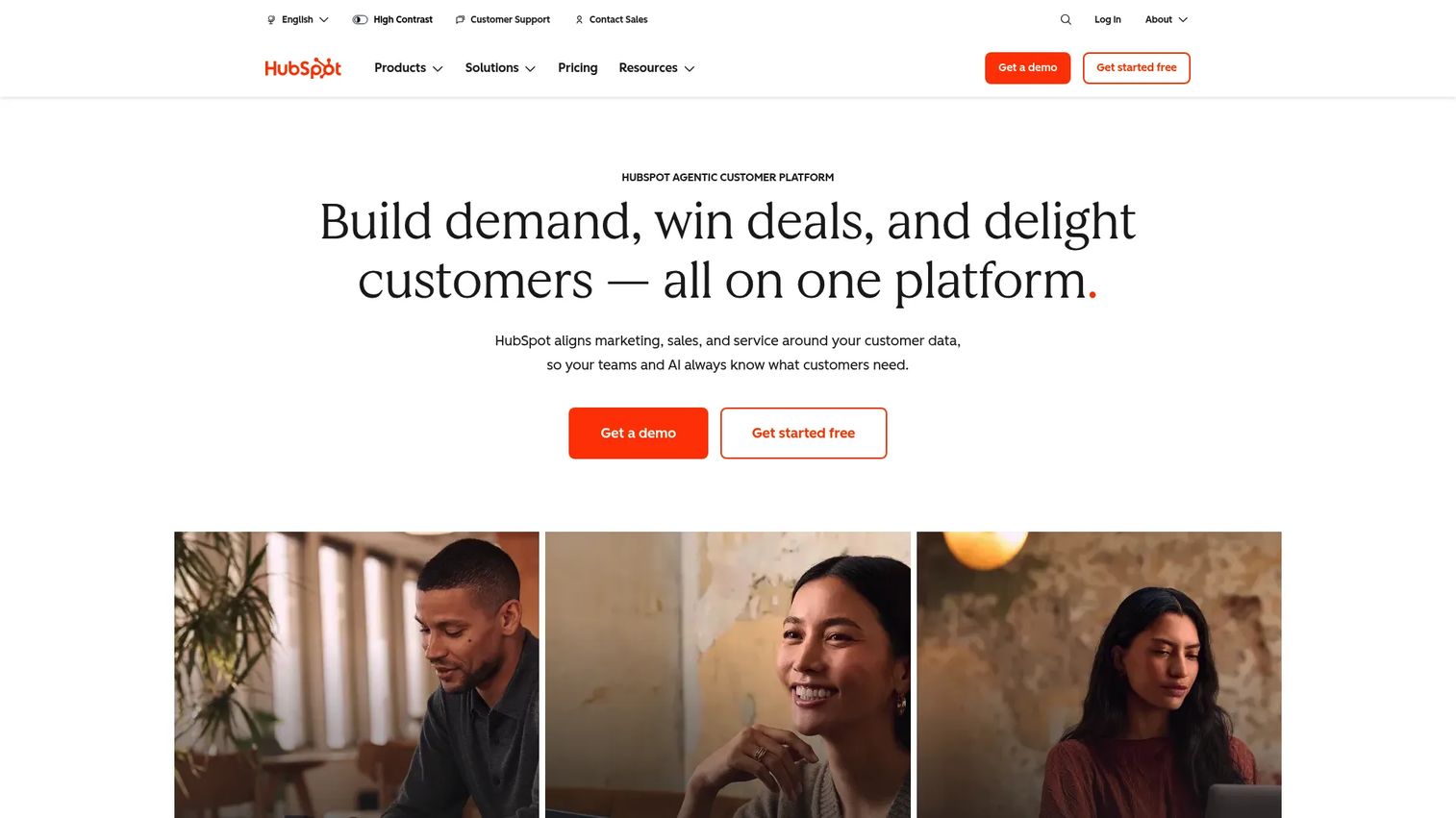
For PMMs and demand gen teams running their GTM stack inside HubSpot, replacing Drift with HubSpot's own chat and automation tools avoids the data synchronization problem entirely.
Best for: HubSpot-native marketing and GTM teams who want chat, CRM, lead forms, and campaign reporting inside a single system.
What it is: HubSpot is an all-in-one customer platform combining CRM, marketing automation, sales tools, service, content management, and AI capabilities. Its chatflows connect directly to contact records, deal stages, and lifecycle marketing automation without requiring a third-party integration. G2 rates HubSpot Marketing Hub at 4.4/5.
Key features:
- Chatflows connected natively to HubSpot CRM records
- Marketing automation and lead nurturing workflows
- Breeze AI for content generation, prospect research, and customer service agents
- Campaign analytics and revenue reporting within the same platform
- Forms, landing pages, and email integrated with chat triggers
Where HubSpot falls short: HubSpot's chat and automation capabilities are strong for inbound marketing motions, but G2 reviewers note it is less specialized than dedicated conversational marketing tools for complex sales routing or real-time account identification against a named account list. Professional and Enterprise tiers carry required onboarding fees ($3,000 and $7,000 respectively) that add meaningful upfront cost. Teams that relied on Drift's AI SDR or real-time visitor identification capabilities will find HubSpot's chat less capable in those areas.
Pricing: Free plan available. Starter from $7/seat/month. Professional from $800/month. Enterprise from $3,600/month. HubSpot AEO add-on at $50/month.
G2 rating: 4.4/5
How it compares to Drift: HubSpot replaces the chat, lead capture, routing, and CRM handoff for teams already inside HubSpot. It does not match the real-time account-based engagement depth Drift offered, but it eliminates the integration overhead.
7. Intercom (customer communication and AI support)
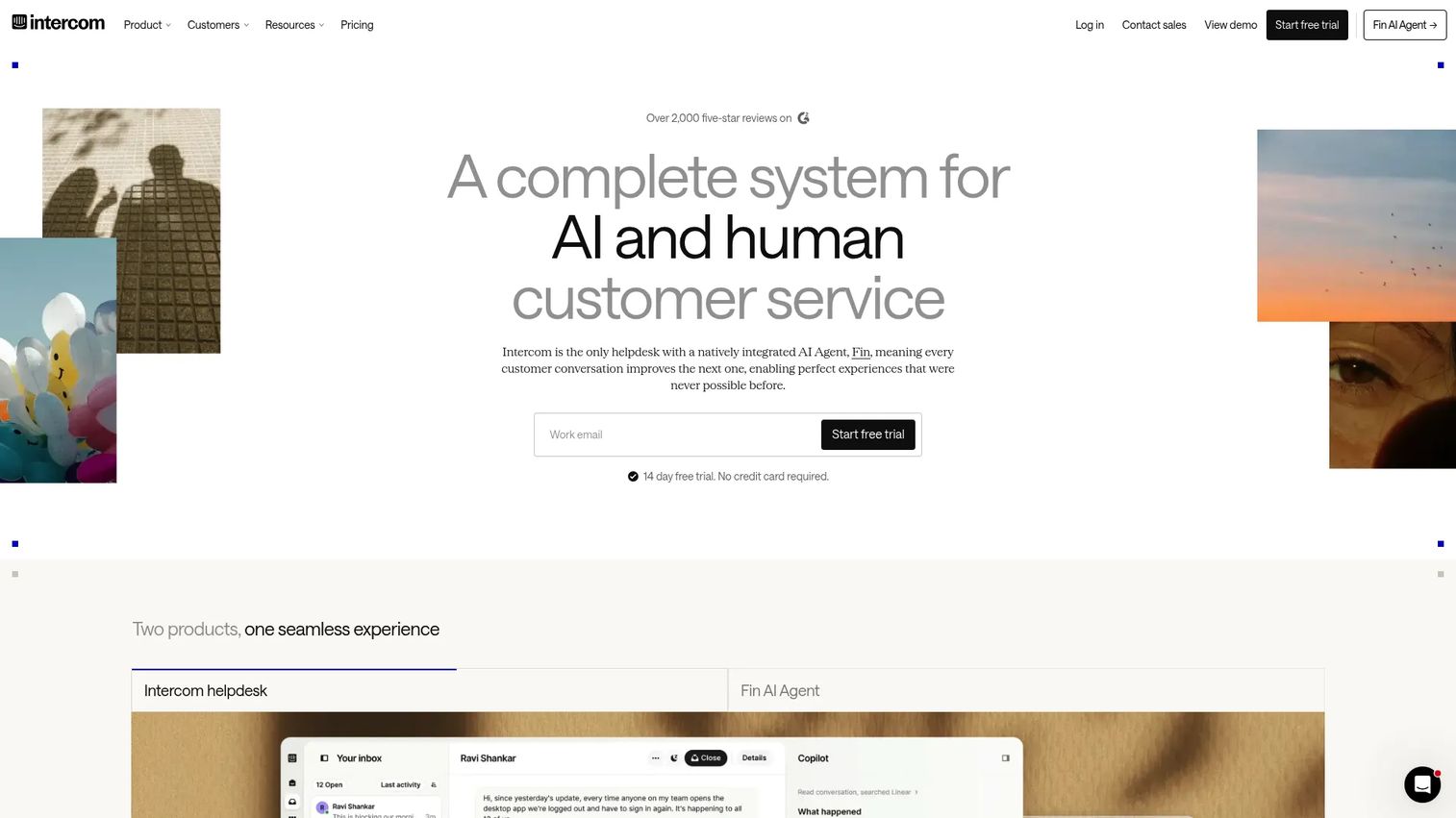
Intercom is the support-led alternative for teams that need AI-assisted customer communication at scale. Fin, its AI agent, handles a meaningful share of incoming conversations automatically.
Best for: Teams replacing Drift's chat for customer support, help center deflection, and post-sale communication rather than inbound pipeline generation.
What it is: Intercom is an AI-first customer service platform combining Fin AI Agent, a human-agent inbox, ticketing, a help center, outbound messaging, and workflow automation. All plans include Fin; usage-based charges apply for AI resolution volume above plan thresholds.
Key features:
- Fin AI Agent for automated customer conversation handling
- Omnichannel inbox across chat, email, and messaging channels
- Ticketing and workflow automation builder
- Help Center with knowledge base and self-serve support
- Reporting and analytics across support volume and resolution rates
Where Intercom falls short: Intercom does not have a public G2 rating available for attribution in this article. Teams moving from Drift's sales-focused pipeline routing to Intercom will find it less specialized for sales-led qualification and named-account engagement. Reviewers note that per-seat pricing plus AI resolution-based usage charges can make total cost harder to predict at scale.
Pricing: Essential at $29/seat/month (billed annually). Advanced at $85/seat/month (billed annually). Expert at $132/seat/month (billed annually). A 14-day free trial is available. No free plan.
How it compares to Drift: Intercom covers the support and customer communication jobs where Drift was often used as a secondary tool. Teams replacing the sales routing and qualification side should evaluate Intercom alongside a separate pipeline tool.
8. Knock AI (AI buyer engagement and pipeline generation)
Knock AI is an AI-forward buyer engagement platform for B2B teams that need multi-channel qualification beyond the website.
Best for: B2B marketing and RevOps teams converting high-intent demand into qualified conversations and meetings across website, Slack, WhatsApp, and LinkedIn.
What it is: Knock AI is a form-free buyer engagement platform using first-party intent tracking, AI agents for qualification and routing, and multi-channel conversation capabilities. G2 rates it at 4.9/5. It connects to CRM and communication tools for automated lead scoring and follow-up.
Key features:
- First-party intent tracking and real-time visitor qualification
- AI agents for question answering, routing, and meeting booking
- Multi-channel conversations via Slack, WhatsApp, and LinkedIn
- CRM connection for automated enrichment and follow-up
- Pipeline Foundation, Pipeline Acceleration, and Enterprise Pipeline tiers
Where Knock AI falls short: Knock AI's pricing starts at $2,000/month, which positions it above the range most SMB or early mid-market teams can absorb without strong pipeline ROI evidence first. The tool is newer, and public review depth is thinner than established platforms. Teams should request a pilot with their actual traffic volume and ICP before committing.
Pricing: Pipeline Foundation from $2,000/month. Pipeline Acceleration from $3,500/month. Enterprise Pipeline uses custom pricing.
G2 rating: 4.9/5
How it compares to Drift: Knock AI covers the website qualification and routing jobs with an AI-agent layer and extends them across additional channels. Its price point targets revenue teams with meaningful inbound traffic and a clear pipeline ROI case to make.
9. Crisp (live chat and customer messaging)
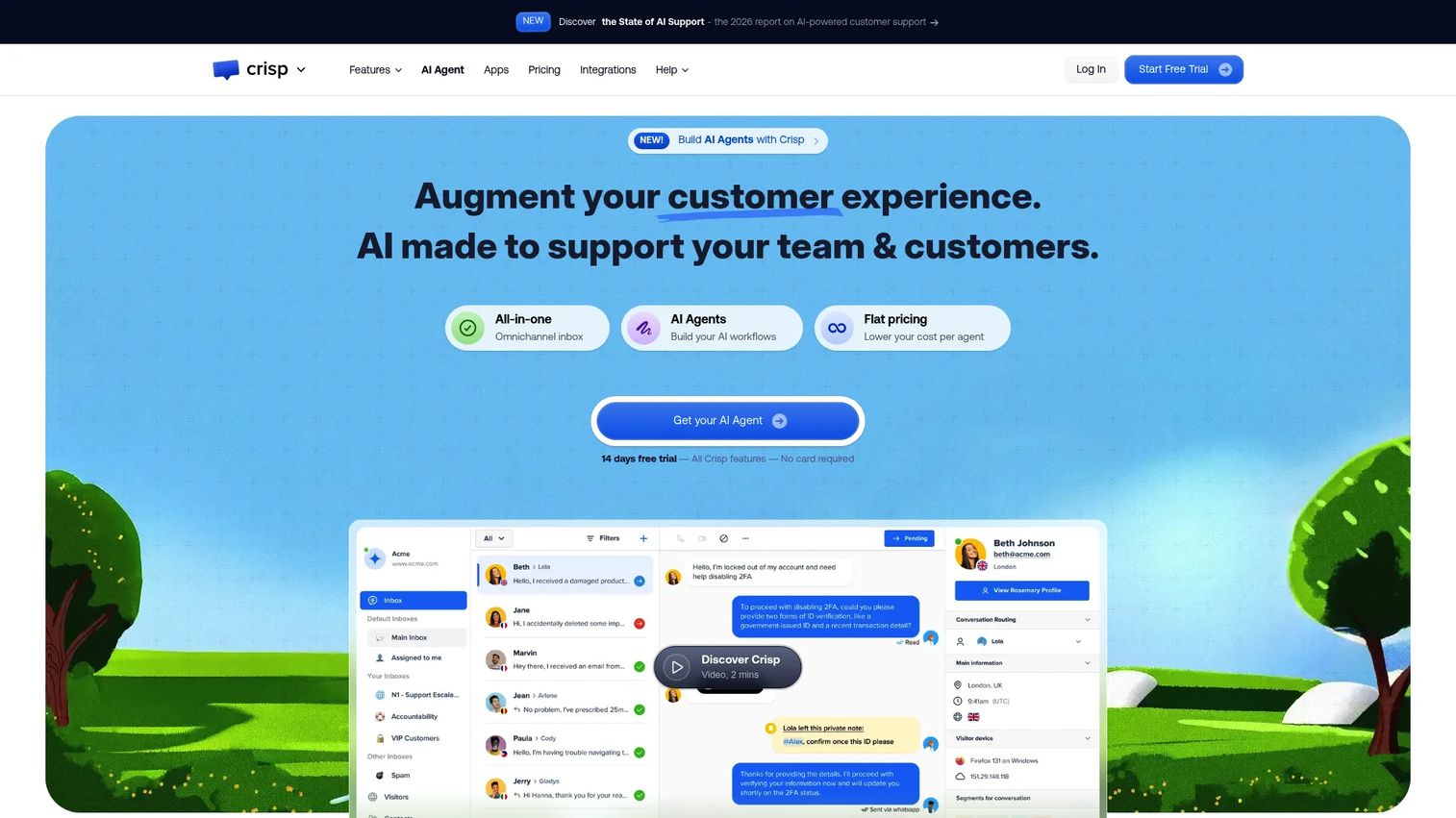
Flat per-workspace pricing makes Crisp an accessible live chat option for lean teams that need a shared inbox and chat without seat-based cost scaling.
Best for: Small to mid-size teams wanting a flat-priced shared inbox, website chat, and omnichannel customer messaging without per-seat pricing complexity.
What it is: Crisp is an AI-powered customer support platform with a shared inbox, website chat widget, AI agent, workflow automation, knowledge base, ticketing, and analytics. Pricing is per workspace rather than per seat. G2 rates it at 4.5/5.
Key features:
- Omnichannel shared inbox across chat, email, and messaging
- AI Agent and AI-powered workflow automation
- Knowledge base and customer portal
- Routing and assignment rules
- Website chat widget with customization options
Where Crisp falls short: Crisp reviewers on G2 note limitations for enterprise-level routing complexity and advanced CRM pipeline reporting. It is built for lean team support operations rather than named-account qualification or AI SDR-level engagement. Teams replacing Drift for sales pipeline generation will find Crisp under-equipped for that specific job.
Pricing: Free plan available. Mini at $45/month per workspace. Essentials at $95/month per workspace. Plus at $295/month per workspace. Enterprise uses custom pricing.
G2 rating: 4.5/5
How it compares to Drift: Crisp covers live chat and shared inbox workflows for support and customer communication. It does not match the pipeline generation or Salesforce account routing side.
10. Salesloft (sales engagement platform)
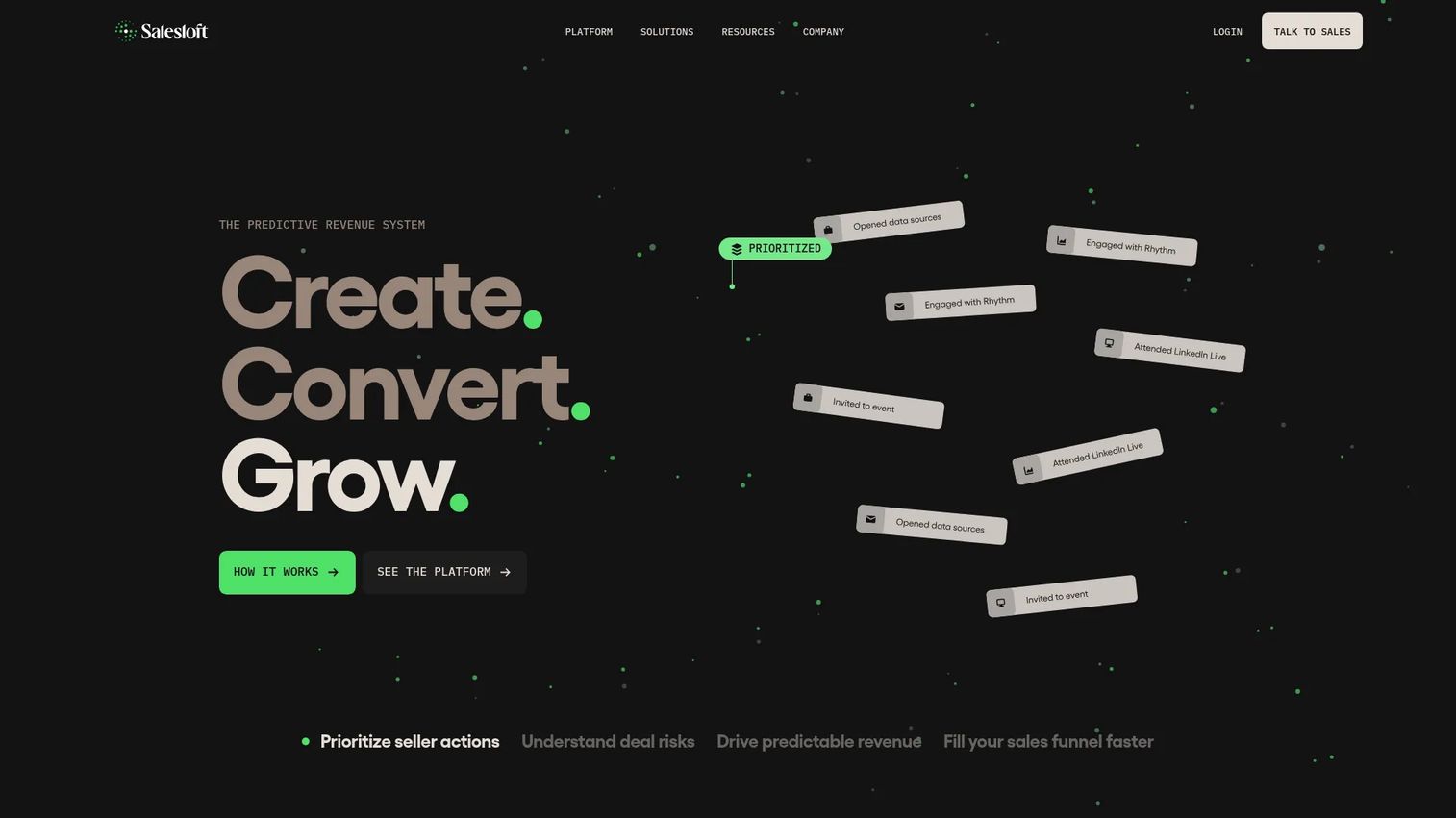
Salesloft addresses what happens after a lead enters the pipeline. Note that Salesloft, now merged with Clari, is the company that acquired Drift and announced its sunset, so evaluating it means re-entering the same vendor relationship through a different product.
Best for: B2B revenue teams that need cadence management, conversation intelligence, deal tracking, and AI-prioritized seller workflows after a lead is captured.
What it is: Salesloft is a predictive revenue system covering AI-powered sales cadences, conversation intelligence with call recording and coaching, deal management, Rhythm AI for seller workflow prioritization, and revenue forecasting. G2 rates it at 4.5/5.
Key features:
- AI-powered sales cadences and buyer engagement across email, call, and social
- Conversation intelligence with call recording, transcription, and coaching
- Deal management and opportunity inspection
- Rhythm AI for daily seller action prioritization
- Revenue forecasting and pipeline analytics
Where Salesloft falls short: Salesloft G2 reviewers note that adoption among reps can require active enablement effort, particularly on teams where managers do not reinforce cadence discipline. Pricing is not publicly listed. The platform adds significant capability beyond what most teams need for a chat replacement specifically, which means the ROI case rests on broader sales execution improvement, not just inbound conversion.
Pricing: Contact Salesloft for a quote. No public pricing is available.
G2 rating: 4.5/5
How it compares to Drift: Salesloft does not replace the website chat widget. It handles the sales execution layer after a lead is captured and routed. Teams that want to improve rep follow-up and pipeline management should evaluate it alongside a chat replacement, not instead of one.
11. Clari (revenue orchestration and forecasting)
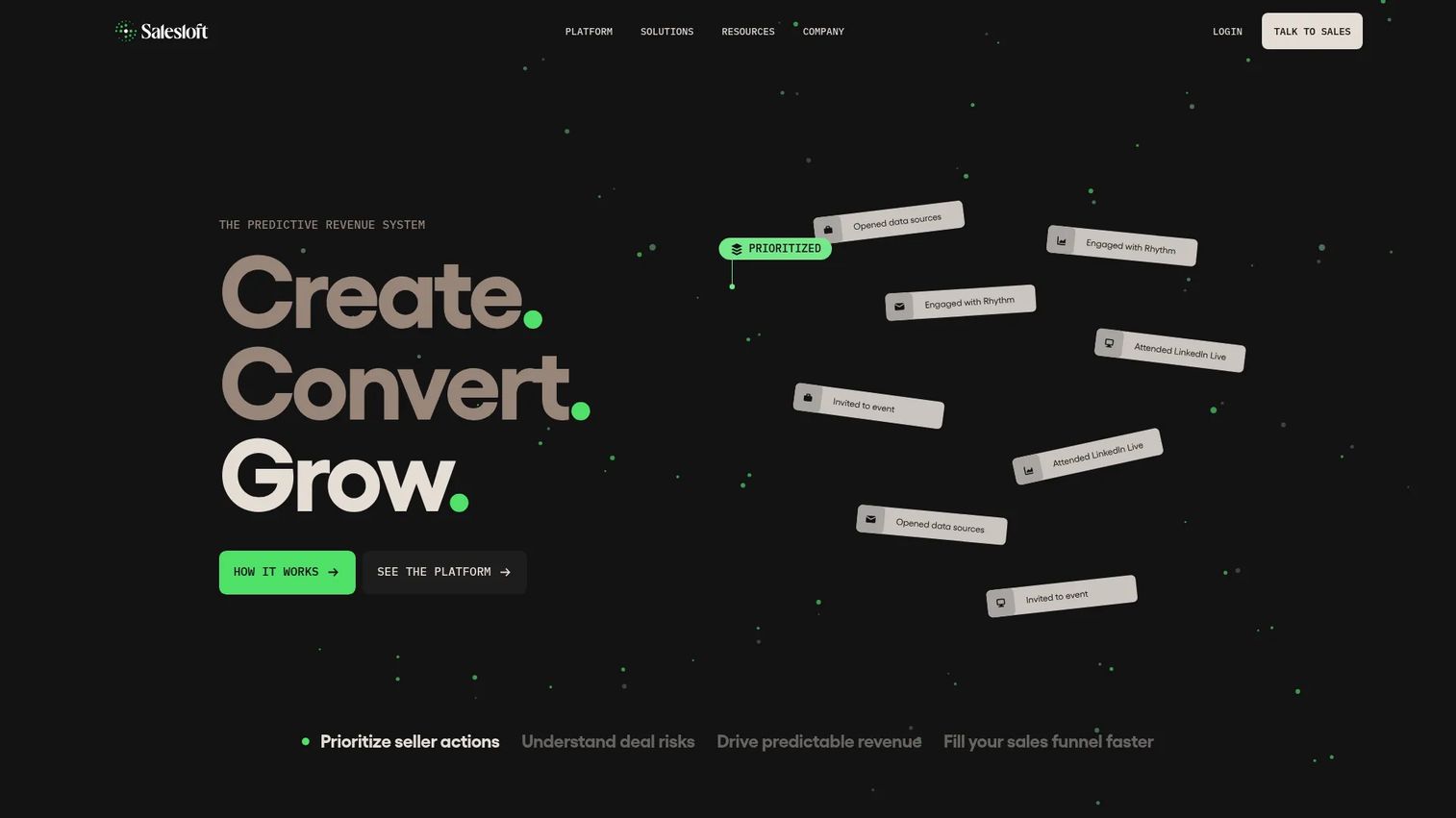
Clari belongs on this list because teams replacing Drift often discover a broader pipeline visibility problem in the process. Clari and Salesloft merged in December 2025 and are now one company.
Best for: Enterprise revenue teams that need AI-driven forecasting, pipeline inspection, and deal risk identification across the full revenue lifecycle.
What it is: Clari is a revenue orchestration platform covering AI-driven forecasting, pipeline and opportunity management, sales engagement and prospecting, automated revenue data capture, conversation intelligence, and customer retention tracking. G2 rates it at 4.6/5. Pricing is custom.
Key features:
- AI-driven revenue forecasting and pipeline insight
- Deal inspection and opportunity risk identification
- Sales engagement and prospecting workflow tools
- Automated revenue data capture and CRM integration
- Conversation intelligence and coaching capabilities
Where Clari falls short: Clari reviewers on G2 note that full value realization requires clean CRM data and meaningful implementation investment. It is not a lightweight chat replacement or a quick-start tool. Pricing is enterprise-level and requires a sales conversation, which makes it a later evaluation for teams focused first on replacing the website engagement layer.
Pricing: Custom pricing; contact Clari for a quote.
G2 rating: 4.6/5
How it compares to Drift: Clari does not replace live chat or visitor engagement. It gives leadership visibility into what happens after engagement enters the pipeline. Teams whose Drift data was informing pipeline health metrics should evaluate Clari as the downstream layer.
Should we just take the 1mind referral?
It is the fastest path, and it is worth treating as one option among several rather than the default.
The referral means the commercial relationship is pre-arranged, which saves procurement time but also removes the competitive pressure that usually improves terms. 1mind is also narrower than Drift was in a few areas that matter if you relied on them, particularly visitor de-anonymization, web-wide intent data, and outbound automation. Run it against at least one alternative on this list, confirm coverage of the specific Drift features your motion depends on, and get the migration path in writing.
Which Drift alternative is best for Salesforce teams?
Qualified is the strongest shortlist pick for Salesforce-native website qualification.
Salesforce itself is the broader consolidation option for teams standardizing their entire GTM stack. Qualified layers on top of Salesforce account data to identify and route high-intent visitors in real time. For PMMs, the relevant question is whether routing rules and qualification logic can be tied to campaign and segment data already living in Salesforce. Involve RevOps early in the Qualified evaluation; routing configuration is not a marketing-only decision.
Which Drift alternative fits HubSpot teams?
HubSpot is the natural starting point for teams already running CRM, forms, chat, and marketing automation inside HubSpot.
The main evaluation question is tier gating. HubSpot's free chatflows cover basic use cases. Teams needing automation triggers, advanced reporting, or AI-powered agents will need Professional or Enterprise, and both carry onboarding fees. For PMMs, HubSpot's value is that campaign launch, lead capture, and chat sit in the same analytics view, which makes measuring launch performance against pipeline impact more straightforward.
Which Drift alternative handles support-led chat?
Intercom covers AI support at scale. Tidio fits SMB and ecommerce teams. Crisp suits lean teams that want flat per-workspace pricing.
83% of companies were actively integrating AI into customer experience programs as of 2025, according to SupportNinja via EMARKETER, which reflects how quickly support-chat expectations shifted. Intercom handles high-volume AI support with Fin. Tidio's Lyro AI works well for ecommerce volume at lower price points. Crisp gives small teams a shared inbox and chat without per-seat cost scaling. None of the three replaces the sales pipeline routing side.
What is the cheapest way to replace Drift?
Promptbar, HubSpot, Tidio, and Crisp all offer free plans, and Salesforce offers a Free Suite.
Promptbar's free plan covers one prompt bar and 100 conversations per month. Tidio's free plan covers basic live chat. Crisp's free plan includes a shared inbox and website chat widget. HubSpot's free plan covers CRM and basic chatflows. Enterprise-focused tools like Qualified, Knock AI, 1mind, Salesloft, and Clari use contact-sales pricing. If budget is the constraint, a free tier is a reasonable way to run the replacement in parallel during the migration window before committing.
Which Drift alternative covers pipeline visibility?
Clari is the pick when the real problem is understanding what happens to pipeline after engagement, not replacing the chat experience.
Teams replacing Drift often discover that losing its engagement data exposes a gap in how leadership tracks conversation-to-pipeline conversion. Salesloft addresses the sales execution layer closer to the conversation. Clari addresses the forecasting and deal inspection layer further downstream. Both are worth evaluating alongside a chat replacement rather than instead of one, bearing in mind they are now the same company.
How to migrate off Drift without losing inbound leads
Map everything before switching anything: current playbooks, routing rules, meeting links, CRM field mappings, and form triggers. Export your conversation history and lead data while the account is active rather than assuming it will be available later.
Run the replacement in parallel on lower-risk pages first, such as blog posts and secondary landing pages, before cutting over on high-traffic conversion pages. Keep a fallback form live on key pages until routing and CRM notifications are confirmed working.
Test the full lead flow end to end, from trigger to CRM record to rep notification, before removing Drift from any page where you depend on meeting volume. Schedule the cutover away from a launch, a campaign peak, or a quarter end, and time the whole sequence against your renewal date rather than against a shutdown date that has not been published.
Conclusion
Replacing Drift is a category decision before it is a vendor decision, and in 2026 it is also a deadline. The product is closed to new customers and winding down, so the question is not whether to move but what to move to and when.
1mind is the officially named successor and the shortest path for existing customers, with the caveat that it is narrower than Drift was. Promptbar is the first pick for teams that want modern AI buyer engagement on their website. Qualified and Salesforce serve Salesforce-native revenue teams with different levels of platform scope. HubSpot fits teams already running their GTM stack inside HubSpot. Tidio, Intercom, and Crisp each serve support-led chat at different price points and scale. Knock AI covers AI-forward buyer engagement for teams ready to invest at the enterprise level. Salesloft handles sales execution after a lead is captured, and Clari gives revenue leadership pipeline visibility after engagement has occurred.
Start by identifying which Drift job you are replacing. Chat, qualification, CRM routing, sales engagement, and pipeline visibility are five different problems. The right shortlist covers the specific ones you need to solve. Then work backwards from your renewal date.
Frequently asked questions: Drift alternatives
Yes, gradually. In March 2026, Clari and Salesloft announced the gradual sunset of Drift's conversational marketing product and named 1mind as the exclusive successor for existing customers. Drift is closed to new customers and active development has ended. No universal end-of-life date has been published, so existing customers should confirm their own timeline directly with Clari and Salesloft in writing rather than relying on third-party reports, including this one.
The best alternative depends on which Drift job you are replacing. 1mind is the officially named successor for existing customers. Promptbar leads this list for AI buyer engagement and website conversion. Qualified fits Salesforce-native pipeline teams. HubSpot fits teams already inside HubSpot. Intercom, Tidio, and Crisp cover support-led chat at different price points.
No. The arrangement refers existing Drift clients to 1mind as the successor; it does not migrate them automatically, and it does not prevent you from choosing something else. Since the data mapping work is required either way, the switching cost of evaluating alternatives is lower than it looks.
Tidio, Crisp, HubSpot, and Promptbar all offer free plans, which makes them the practical starting points for small teams. Tidio fits ecommerce and support-heavy small businesses. Crisp fits lean teams that want flat per-workspace pricing. HubSpot fits teams that want chat inside a free CRM. Promptbar fits teams replacing Drift's AI conversation layer on a limited budget.
Qualified is the strongest conversational marketing shortlist pick for Salesforce-native B2B revenue teams. It identifies and routes website visitors based on Salesforce account data and handles qualification through its Piper AI SDR. Salesforce itself is the broader consolidation option for teams standardizing their full GTM stack inside the platform.
HubSpot is the most direct option for teams already using HubSpot CRM, forms, email, and marketing automation. Chat conversations, lead records, and campaign attribution live in the same system, which removes the data synchronization problem that comes with a separate chat tool. Review which HubSpot tier includes the automation and AI features your team needs before committing.
Pricing varies significantly by category. Free plans are available from Promptbar, Tidio, Crisp, HubSpot, and Salesforce. Mid-market chat tools like Tidio and Crisp start under $100/month. Enterprise-focused platforms like Qualified, Knock AI, 1mind, Salesloft, and Clari use contact-sales pricing, with Knock AI's public FAQ placing its starting price at $2,000/month. Total cost depends on seats, AI usage volume, CRM integration depth, and implementation scope.
Map your current playbooks, routing rules, meeting links, CRM field mappings, and form triggers before switching anything, and export your conversation and lead data while the account is active. Run the replacement tool in parallel on lower-risk pages, such as blog posts or secondary landing pages, before cutting over on high-traffic conversion pages. Keep a fallback form live on key pages until routing and CRM notifications are confirmed. Test the full lead flow, from chat trigger to CRM record to rep notification, before removing Drift from any page where you depend on meeting volume.