You wrote a bond at 2 a.m. The paperwork sat in a folder for three days. A court date slipped. Now you're chasing a defendant who forgot an appearance you never reminded them about, and a forfeiture clock is ticking.
That's the real problem bail bonds software solves. Not "digital transformation." Just fewer things falling through the cracks when your day runs on phone calls, jail lobbies, and deadlines nobody moves for you.
The shift is already underway. According to ZipDo (2026), 68% of bail agents now use digital platforms to process applications, and WorldMetrics (2026) reports that 50% of U.S. bail agents run paperless documentation systems. Mobile-first workflows are growing fast too, with ZipDo (2026) putting mobile bail app adoption at a 22% five-year growth rate. Agencies are moving off paper because manual follow-up does not scale past a certain caseload.
A good bail management system does three unglamorous jobs well: it reminds defendants before they miss court, it collects money without you calling every week, and it keeps documents signed and stored so nothing gets lost. Everything else is a bonus.
This guide compares four bail bond agency software platforms built specifically for agencies. No generic CRMs bolted onto a bail workflow. Each one handles the operational core: eSign, court reminders, GPS check-ins, arrest alerts, payment plans, and document management. If you're evaluating a bail management software purchase, book a demo or trial with the two that fit your caseload before you commit.
What's inside
This is a buying guide for bail agency owners and operations leaders comparing bail agent software in 2026. Every tool here was selected on four criteria: whether it automates court reminders and defendant monitoring, whether it handles payments and payment plans natively, whether it supports eSign and document management without manual re-entry, and whether pricing and scale (including multi-office and unlimited offices support) fit a growing agency. We prioritized platforms built for bail, not repurposed field-service tools.
TL;DR
- Best for public, add-on-based pricing: Captira, starting at $99 per month with a la carte defendant monitoring and reminders.
- Best for unlimited bonds and automation depth: eBail, with unlimited defendants and built-in payments, check-ins, and arrest monitoring from $99 per month.
- Best for agencies that want tailored operations: Simply Bail, with GPS check-ins, arrest alerts, payment plans, and inventory in one system.
- Best for AI-assisted intake and breadth: BailBooks, starting at $55 per month with AI bond intake, video interviews, and mobile apps.
- Buying rule of thumb: pick the tool that automates the follow-up you currently do by hand.
What is bail bonds software?
Bail bonds software is a bail management system that helps agencies write bonds, monitor defendants, collect payments, and stay compliant with court and surety requirements from one platform. It replaces spreadsheets, paper contracts, and manual phone reminders with automated workflows.
The category has matured because the operational stakes are high. A missed court date can trigger a forfeiture. A lost contract can void collateral. A skipped check-in can mean a defendant is off the radar until it's too late. Software exists to make those failure points automatic instead of dependent on someone remembering.
Core features you should expect from any serious bail bond agency software:
- eSign and document management: Sign bail contracts and indemnitor agreements electronically, then store them against the defendant record. No printing, no filing cabinet.
- Court reminders and automated notifications: Text and email reminders sent before appearances, so defendants show up and you avoid forfeitures.
- GPS check-ins and defendant monitoring: Location-verified check-ins and, in many tools, geofencing and re-arrest monitoring across states.
- Arrest alerts: Automated notifications when a defendant is booked again, so you can act before a bond is at risk.
- Payments and payment plans: Online payments, recurring auto-pay, and structured payment plans that collect without weekly phone calls.
- Inventory management: Track power of attorney forms and surety inventory so nothing is unaccounted for.
- Reporting and compliance workflows: Build the records surety partners and auditors ask for without rebuilding them by hand.
- Multi-office support: Run several locations, or unlimited offices, under one login with shared data.
The best bail management software ties these together so one action, writing a bond, populates the reminders, the payment schedule, the monitoring, and the paperwork automatically.
When to use bail bonds software
Not every agency needs the same feature depth. Here is how to pattern-match to your situation.
Replace manual court reminders
If you or a staffer spends hours each week calling defendants about upcoming dates, that's the first thing to automate. Automated court reminders cut forfeiture risk and free up the phone. Any tool on this list handles this, so weigh it by how much control you get over timing and message content.
Standardize a growing multi-office operation
If you're adding locations or agents, spreadsheets stop working. You need one system where every bond, payment, and check-in lives in a shared record. Look for platforms that support multiple offices, or unlimited offices, without charging per location in a way that punishes growth.
Collect payments without chasing people
If accounts receivable is a mess of partial payments and missed installments, prioritize payment plans, online payments, and auto-pay. Native payment collection tied to the defendant record beats a separate processor you reconcile by hand every month.
Comparison table
Here's how the four platforms line up on intent, standout capability, pricing, and rating. Ratings are omitted where a verified public score wasn't available at the time of writing.
| # | Product | Intent | Key use case | Pricing | G2 rating |
|---|---|---|---|---|---|
| 1 | Captira | All-in-one bond management with add-ons | Automated defendant communications, eSign, arrest history | From $99/mo | Not listed |
| 2 | eBail | Unlimited bonds and deep automation | Unlimited defendants, payments, check-ins, arrest monitoring | From $99/mo | Not listed |
| 3 | Simply Bail | Tailored digital case processing | GPS check-ins, arrest alerts, payment plans, inventory | Custom | Not listed |
| 4 | BailBooks | AI-assisted, all-in-one platform | AI bond intake, video interviews, mobile apps, payments | From $55/mo | Not listed |
All four cover the operational core. The difference is packaging: Captira and eBail publish pricing and lean on flexible add-ons, Simply Bail tailors plans to your agency, and BailBooks pushes furthest into AI-assisted intake and mobile.
1. Captira
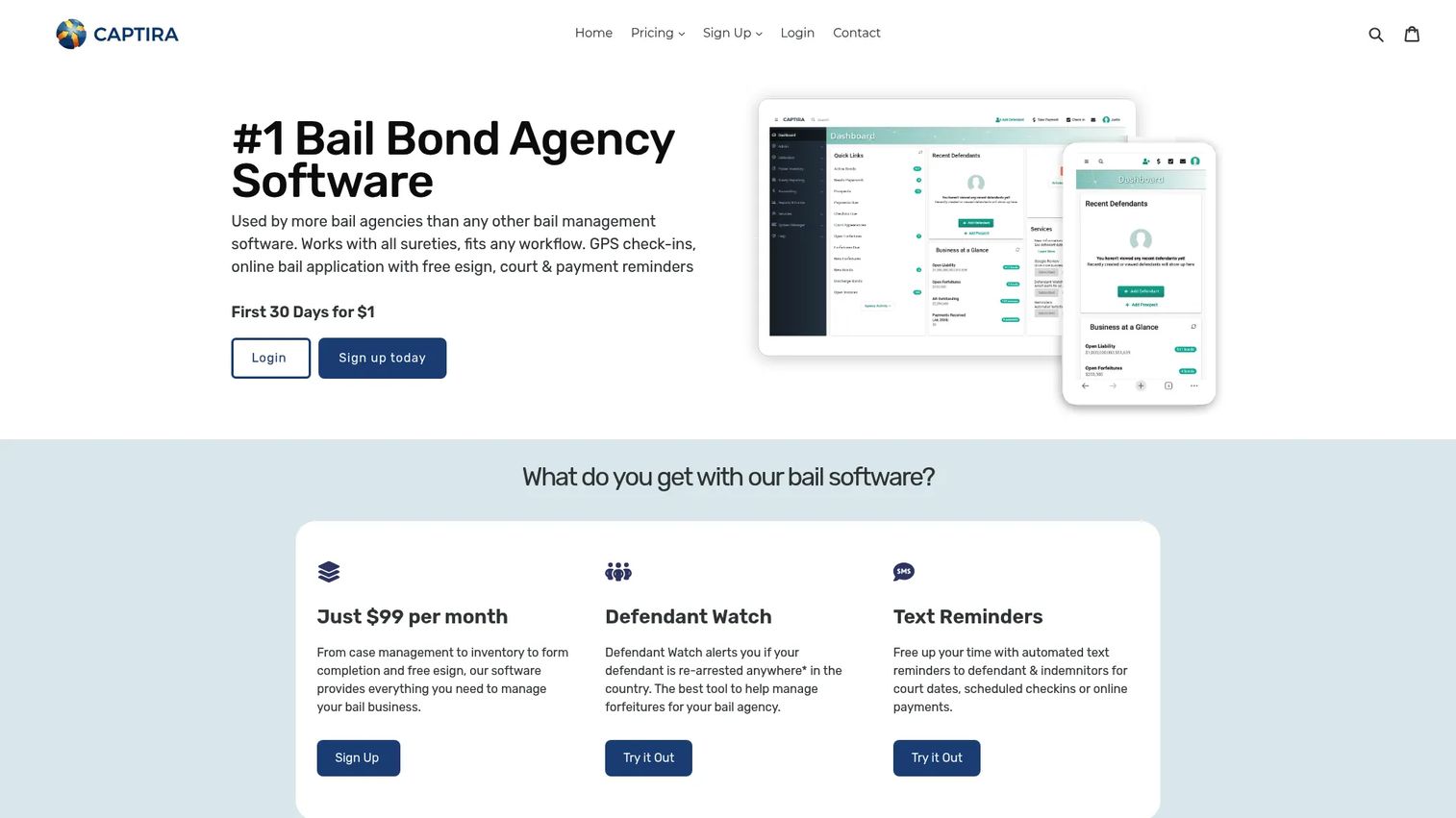
Captira is bail bond software built for agencies that want an all-in-one bond management system with automated defendant communications and public, predictable pricing. It handles the full workflow: online bail applications, free eSign, defendant monitoring, automated reminders, and re-arrest alerts. The a la carte model means you pay a base fee and add only the services you actually use.
Best for: Agencies that want transparent, add-on-based pricing and strong automated defendant communications.
Key strengths
- Defendant Watch alerts: Automated re-arrest monitoring so you know when a defendant is booked again and a bond is at risk.
- Automated text reminders: Court reminders and check-in prompts sent by text, priced per message so small agencies don't overpay.
- Online bail applications with free eSign: Defendants apply and sign contracts remotely, and Text2Apply is included at no extra cost.
Why choose Captira: If you like knowing exactly what you'll pay, Captira's public pricing and modular add-ons are hard to beat. You start with the base plan and layer on Defendant Watch, arrest history, or payments only when you need them. That keeps costs proportional to caseload, which matters for a smaller or seasonal agency.
Captira pricing: Plans start at $99 per month for the base bail management system. Add-ons are priced individually: Defendant Watch is a $10 monthly system fee, Automated Reminders run 5 cents per message, Arrest History reports are $4 each, Bail Pay is $29 per month, Auto Pay is 99 cents per successful payment, and Text2Apply is included free. There is no free tier, but the a la carte structure keeps entry costs low.
2. eBail
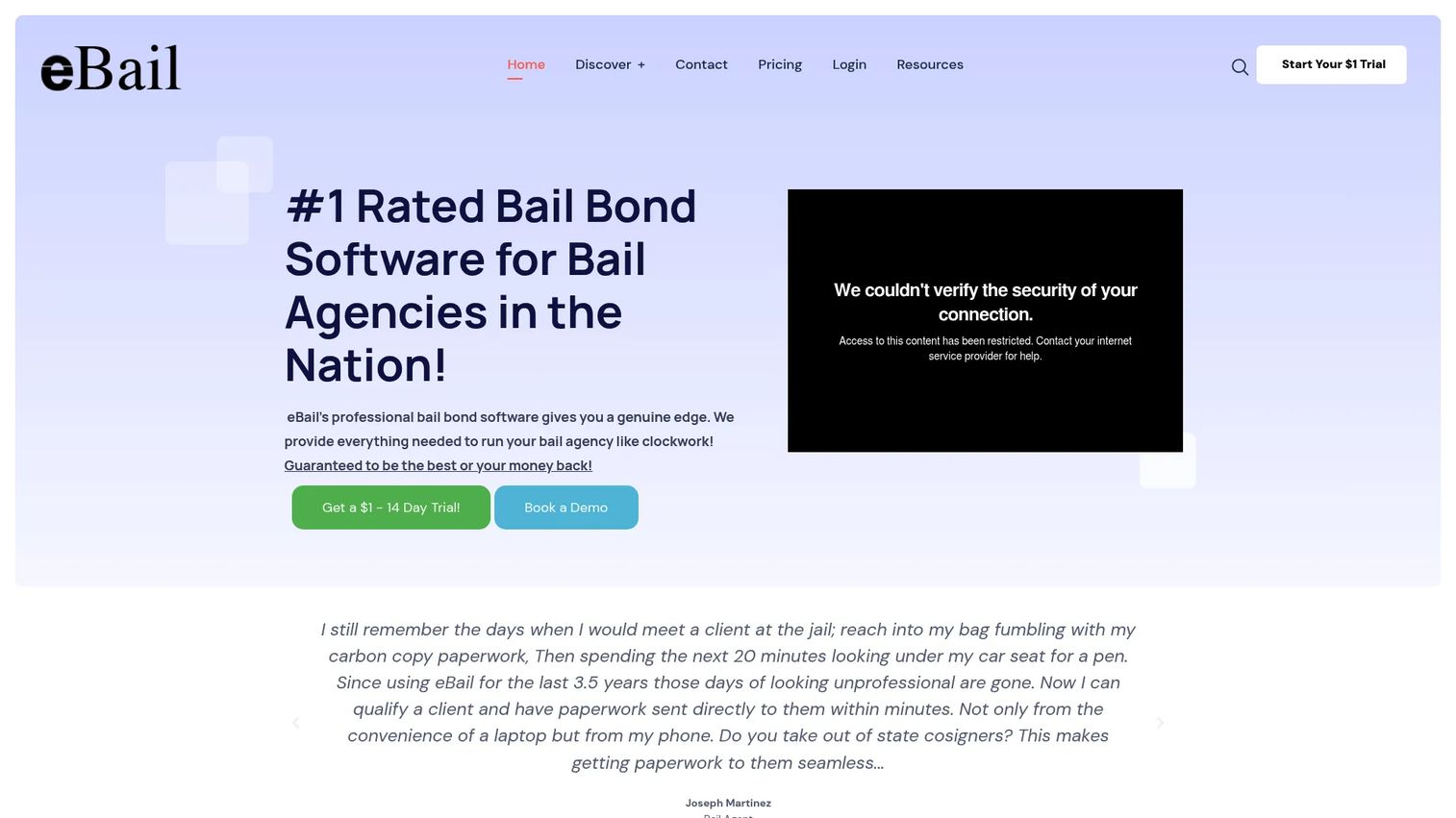
eBail is bail bond software built around speed and automation depth for agencies that write high volumes of bonds. It positions on unlimited bonds and defendants, which removes the per-record math that slows down busy offices. The platform bundles automated payments, check-ins, court reminders, and arrest monitoring, plus eSign contracts and document management, into a single workflow.
Best for: Agencies that need unlimited bond capacity and want automation running across payments, check-ins, and monitoring at once.
Key strengths
- Unlimited bonds and defendants: No caps and no per-record fees, so cost stays flat as your caseload grows.
- End-to-end automation: Payments, check-ins, court reminders, and arrest monitoring run automatically from one system, cutting manual follow-up.
- eSign and document management: Contracts are signed electronically and stored against the defendant record, so paperwork stays organized.
Why choose eBail: The automation-heavy angle is the draw here. Instead of stitching together a reminder tool, a payment processor, and a monitoring service, eBail runs all of it from one place. For a growing agency, unlimited bonds means the tool doesn't get more expensive just because you got busier.
eBail pricing: Monthly plans start at $99 per month for the Premium tier. Pro is $199 per month, and the General Managing Agency plan is $349 per month for larger operations. Annual pricing is also offered, and enterprise arrangements are handled by sales contact. There's no free tier, but each plan includes unlimited bonds and defendants.
3. Simply Bail
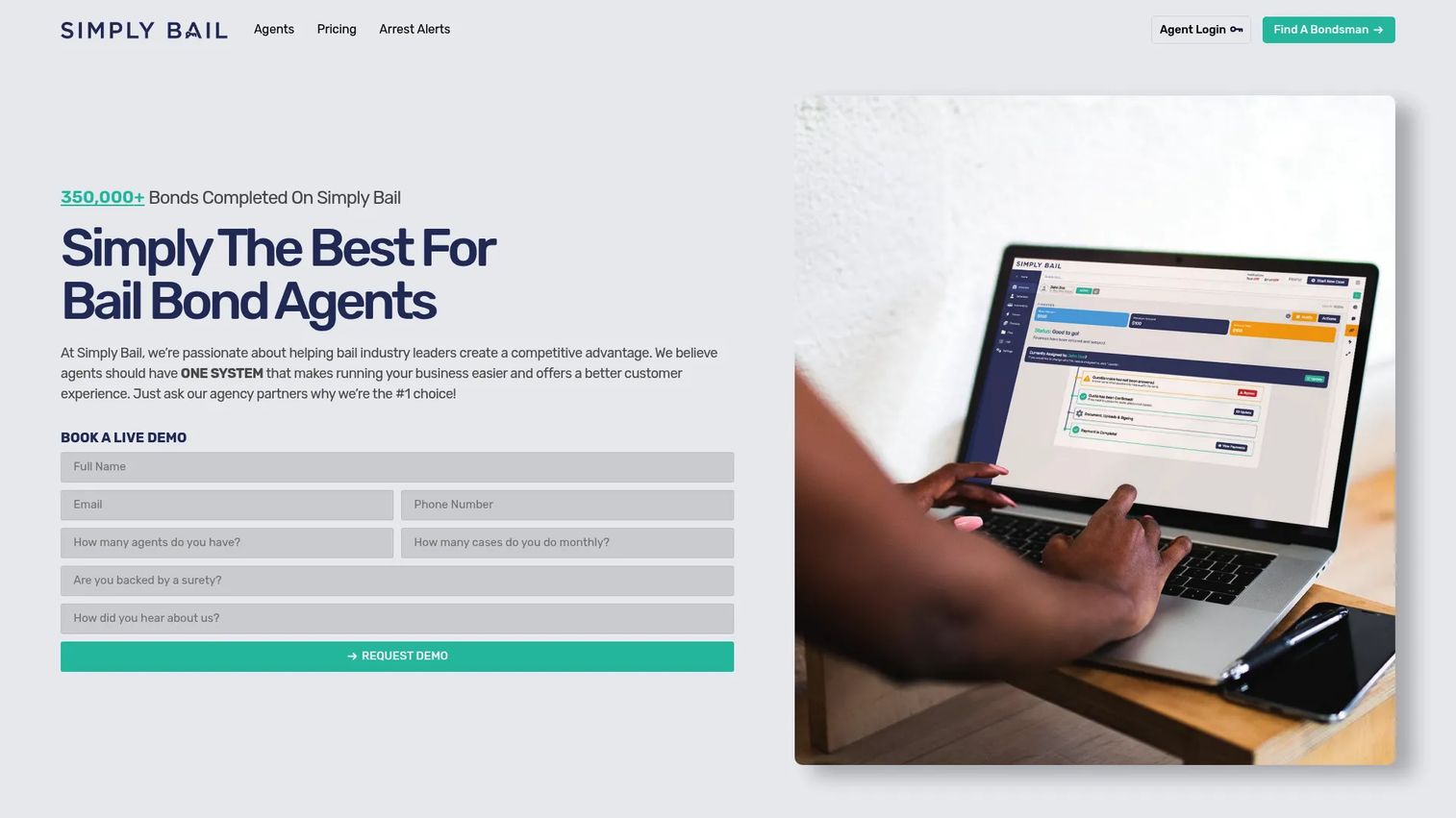
Simply Bail is a bail management system and digital case-processing platform for agencies that want one system covering both operations and the defendant experience. It emphasizes reducing manual follow-up: electronic document signing, court date reminders, GPS-based check-ins, arrest alerts, payment plans, inventory management, and reporting all live in one place. The pricing is tailored rather than published, so plans are shaped around your agency's size and workflow.
Best for: Bail agencies that want a tailored setup covering case management, monitoring, and payments in a single platform.
Key strengths
- GPS-based check-ins and arrest alerts: Location-verified check-ins paired with automated arrest alerts keep defendant monitoring active without manual work.
- Payment plans and reporting: Structured payment plans plus reporting give you both collection and the records for compliance workflows.
- Inventory management: Track power of attorney forms and surety inventory so nothing goes unaccounted for.
Why choose Simply Bail: The pitch is one system for the whole operation, from intake through court dates through collections, with data ownership messaging that appeals to agencies wary of scattered tools. Because pricing is tailored, it fits agencies that want a plan built around their caseload rather than a fixed tier. Shortlist it first if you value a single, consolidated platform over a la carte add-ons.
Simply Bail pricing: Simply Bail does not publish pricing publicly. The company offers tailor-made plans and directs prospects to contact them for a quote, so pricing is shaped around agency size, agent count, and feature needs. Request a demo to see the platform and get a plan scoped to your operation.
4. BailBooks
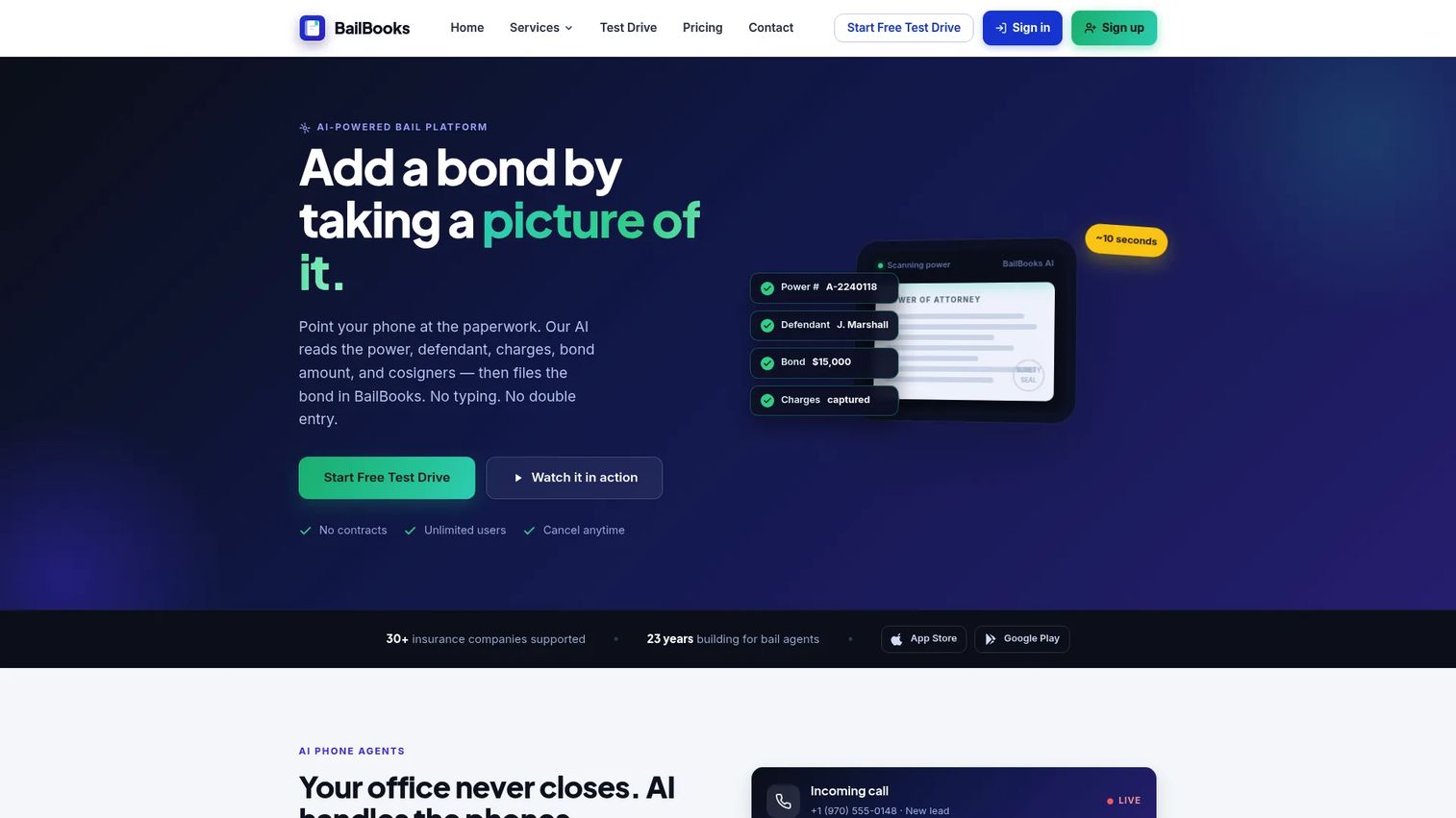
BailBooks is online bail bond management software for agencies and sureties that pushes the category further with AI-assisted workflows. Beyond the standard case management, it adds AI bond intake, AI phone agents, eSign packets, video interviews, iOS and Android apps, Defendant Watch, court date lookup, text alerts, and BailbondPay payments. The tiered plans all include the full platform, differing by agent count, bond volume, and storage.
Best for: Agencies that want an all-in-one platform with AI-assisted intake, mobile apps, and surety support at an accessible entry price.
Key strengths
- AI bond intake and phone agents: AI-assisted intake and phone handling reduce the manual data entry that eats staff time.
- Mobile apps and video interviews: iOS and Android apps plus video interviews let you run defendant workflows from anywhere.
- Defendant Watch and BailbondPay: Built-in re-arrest monitoring and native payment collection keep monitoring and money in one system.
Why choose BailBooks: BailBooks broadens the category beyond basic case management. The AI intake and phone agents are the differentiator, aimed at cutting the repetitive data entry that slows agencies down. Every tier includes the full feature set, so you're choosing capacity, not features, which makes it easy to start small and scale.
BailBooks pricing: Plans start at $55 per month for Copper, then Bronze at $65, Silver at $80, Gold at $105, and Premium at $130 per month. All plans include the full platform, with tiers scaling by agent count, bond volume, and storage. Optional add-ons include SMS Text Alerts at $20 per month, Time Clock at $4.95 per month, and Payment Portal at $19.95 per month. A free test drive is available with no credit card required.
Considerations before you buy
The feature lists look similar across these tools. The differences that matter show up in how they fit your actual operation. Run through this checklist before you commit.
Automation you'll actually use
Every tool automates court reminders and monitoring. What varies is control. Can you set reminder timing, edit message content, and choose which channels fire? Automation you can't tune becomes noise defendants ignore. Test the reminder and arrest alerts flow during a demo or trial with your own scenarios.
Payment collection that fits your model
Look at how payments and payment plans work end to end. Does the tool support recurring auto-pay, partial payments, and online payments tied to the defendant record? A processor that lives outside the system means monthly reconciliation by hand. Native collection is worth paying for.
Scale and multi-office support
If you run or plan to run more than one location, confirm how the tool handles multiple or unlimited offices. Check whether pricing scales by office, agent, or bond volume, and whether shared data across locations is included or gated behind a higher tier.
Document handling and compliance
Confirm that eSign and document management store signed contracts against each defendant record, not in a separate folder. Ask how the tool supports forfeiture management and the reporting your surety partners and auditors require. Compliance workflows are where manual gaps cost the most.
Pricing transparency
Captand eBail publish pricing; Simply Bail tailors it; BailBooks lists tiers with add-ons. Map the total cost, base plus the add-ons you'll actually use, before comparing. The cheapest base plan isn't always the cheapest at your volume.
Conclusion
The four platforms here all handle the operational core of a modern bail agency: eSign, court reminders, GPS check-ins, arrest alerts, payments, and document management. The right pick comes down to your caseload, your appetite for AI-assisted workflows, and how you want to pay.
If you want transparent, add-on-based pricing that stays proportional to a smaller caseload, start with Captira. If you write high volumes and want unlimited bonds with deep automation, eBail fits. If you'd rather have a tailored, single-system setup shaped around your agency, request a plan from Simply Bail. And if AI intake, mobile apps, and an accessible entry price matter most, BailBooks is the one to trial.
The next step is simple: shortlist two, book a demo or trial with each, and run your own workflows through them, a real bond, a real reminder, a real payment. The tool that removes the most manual follow-up from your week is the one worth buying. Software should reduce the manual heroics your agency operations depend on, not add another tab to manage.
FAQs
Entry pricing for bail bonds software typically starts around $55 to $99 per month. BailBooks starts at $55 per month, while Captira and eBail both start at $99 per month. Simply Bail offers tailored pricing on request. Add-ons for monitoring, reminders, and payments can raise the total, so map your real usage before comparing.
Prioritize the three that reduce the most manual work: automated court reminders to cut forfeitures, native payments and payment plans to collect without weekly calls, and eSign with document management to eliminate paper. Defendant monitoring and arrest alerts come next. Everything else is secondary to those core workflows.
Yes. GPS check-ins are standard across the category, and several platforms pair them with geofencing and re-arrest monitoring. Simply Bail and Captira both offer location-verified check-ins, and Captira adds Defendant Watch for multi-state re-arrest alerts. Confirm the specifics during a demo, since check-in frequency and geofencing options vary.
Yes. Automated court reminders and arrest alerts are core features across all four tools. Reminders go out by text and email before appearances, and arrest alerts fire when a defendant is booked again. The difference is control: check whether you can set timing, edit messages, and choose channels.
All four scale beyond a single location, but the model differs. eBail includes unlimited bonds and defendants, BailBooks scales tiers by agent count and bond volume, and Simply Bail tailors plans to agency size. If you need unlimited offices under one login, confirm during evaluation whether multi-office data sharing is included or gated behind a higher tier.
Look for online payments, recurring auto-pay, and structured payment plans tied directly to the defendant record. Native collection beats a standalone processor you reconcile by hand every month. Captira offers Bail Pay and Auto Pay, eBail bundles automated payments, and BailBooks includes BailbondPay. Test partial payments and installment handling before committing.
Very. A lost contract can void collateral, and missing paperwork slows forfeiture management and audits. Strong document management stores eSigned contracts and indemnitor agreements against each defendant record, so nothing lives in a separate folder. Treat it as a core requirement, not a nice-to-have, when comparing bail management software.
For deep automation across payments, check-ins, court reminders, and arrest monitoring in one system, eBail is a strong fit, especially with unlimited bonds. BailBooks is the pick if you want AI-assisted intake and phone agents to cut data entry on top of standard automation. Both reduce the manual follow-up that eats agency time.