A sensitive investigation lands in your organization. The case starts as an email thread, migrates to a shared folder, grows into a spreadsheet tracking interviews, and eventually produces a manual status report someone assembled the night before the board meeting.
That pattern is expensive. According to NAVEX's 2025 Global Ethics and Compliance Benchmark Report, 35% of organizations cite case complexity as the biggest factor affecting time to investigate and close reports. Yet 67% already have centralized compliance investigation programs, meaning the gap is rarely intent. It's infrastructure.
Investigation management software exists to close that gap. It gives security, compliance, legal, HR, and operations teams a single place to intake cases, assign work, document evidence, manage sensitive records, and produce defensible reports. For a Series B founder scaling into repeatability, it's the difference between a VP of Security who has the information they need on day one versus one who has to build the system while managing the caseload.
The question isn't whether to invest. It's which platform fits the investigation types you run, the evidence burden you carry, and the reporting your board expects.
What's inside
This guide covers 19 investigation management platforms evaluated for workflow depth, evidence handling, security controls, and reporting capability. The list spans investigative case management, intelligence analysis, eDiscovery, workplace investigations, and risk platforms, so you can match the tool to the actual job.
Selection criteria:
- Verified product capabilities for investigation workflows
- G2 ratings and pricing sourced from official pages and live review listings (September 29, 2026)
- Coverage across law enforcement, corporate security, compliance, legal, HR, and intelligence use cases
- Fit for teams that need governance and executive visibility, not just task tracking
TL;DR
- Best for structured investigative case management: Case IQ covers configurable workflows, confidential intake, evidence records, and one-click reporting across compliance, HR, fraud, and security teams
- Best for corporate security and threat intelligence: Ontic centralizes risk intelligence, threat monitoring, investigations, and entity analysis for enterprise security operations
- Best for complex multi-team investigations: Kaseware supports law enforcement, intelligence, fusion centers, and corporate security with link analysis, geospatial tools, and configurable workflows
- Best for eDiscovery and evidence-heavy legal review: RelativityOne and Logikcull handle large-scale document collection, review, redaction, and production for legal and compliance teams
- Best for workplace and employee relations cases: HR Acuity specializes in confidential employee-relations case management with investigation workflows and benchmarking analytics
- Best entry point for incident reporting: CRIMR starts at $19.99/month for structured incident capture that feeds into your existing case management system
What is investigation management software?
Investigation management software is a platform that helps teams intake, assign, document, investigate, secure, report, and close cases from a centralized system.
The category covers a wide range of workflows. Understanding where each fits helps you avoid buying a platform optimized for one job and forcing it to do another.
Core functions
Every investigation management platform should support some combination of:
- Case intake and classification
- Task assignment, ownership, and deadlines
- Evidence and document organization with access controls
- Witness, subject, and entity records
- Investigation timelines and activity histories
- Cross-team collaboration with permission-based visibility
- Dashboards, reports, and executive summaries
- Audit trails, retention policies, and encrypted access
- Integrations with HR systems, identity providers, ticketing tools, and data sources
Major category types
Investigative case management: Structured workflows, evidence records, assignments, and investigation reports. Platforms like Case IQ and Kaseware operate here.
Incident management: Event intake, response coordination, severity tracking, and remediation. Resolver and Omnigo cover this layer alongside broader case work.
Intelligence investigation software: Link analysis, geospatial views, entity relationships, and threat monitoring. Ontic and Intrace are built for this.
Workplace investigation software: Confidential complaint intake, employee interviews, HR workflows, and outcome tracking. HR Acuity is the dedicated option.
Legal and eDiscovery platforms: Document collection, review, search, redaction, and production. Logikcull, RelativityOne, and Reveal operate in this space.
Risk and compliance investigation software: Regulatory alerts, policy concerns, corrective actions, and remediation tracking. Resolver covers this alongside its incident and investigation modules.
Category boundary
Investigation management software is distinct from a general project management tool or document repository. It adds controlled access, chain-of-custody records, defensible audit logs, and investigation-specific workflows that a shared folder or spreadsheet cannot provide. Smaller teams with low case volume and simple workflows may find a lighter case-tracking system sufficient before investing in a dedicated platform.
When to use investigation management software
Centralize investigations across multiple teams
When cases move between security, compliance, legal, HR, and operations, ownership and evidence can fracture across systems. A shared platform gives each team role-appropriate access to the same record without duplicating files or losing handoff context. This matters most when a single incident triggers parallel tracks, a security event that also requires an HR interview and a legal hold, for example.
Manage evidence-heavy or sensitive cases
When evidence includes emails, images, audio, interview notes, or linked entities, an unstructured approach creates chain-of-custody gaps. Platforms built for this work let you attach, version, and control access to evidence at the file level. Audit logs capture who viewed or modified each record, which becomes essential during regulatory review or litigation.
Report investigation status to leadership without manual assembly
Executives need visibility into case volume, aging, risk categories, and resolution status without asking investigators to build reports from scratch. A purpose-built platform produces dashboards and exports that give your VP of Security or General Counsel a defensible status view at any point in the cycle. For a Series B company, that visibility is also what makes a newly hired functional leader credible on day one.
Investigation management software comparison
The table below covers all 19 platforms. Pricing and G2 ratings are sourced from official vendor pages and live G2 listings as of September 29, 2026. Use "Custom pricing" entries as a signal to request a scoped quote, not a reason to skip evaluation.
| # | Product | Best for | Key differentiator | Pricing | G2 rating |
|---|---|---|---|---|---|
| 1 | Altia CLIO | Critical incident coordination | Live operational picture with defensible records | Custom pricing | N/A |
| 2 | Ontic | Corporate and government security intelligence | Connected threat intelligence and investigation workflows | Custom pricing | 4.5/5 |
| 3 | Omnigo Case Management Software | Law enforcement and campus security | Cross-case connection discovery with chain-of-custody evidence | Custom pricing | 4.2/5 |
| 4 | Resolver | Enterprise risk and incident-linked investigations | Unified risk, incident, and investigation data with no-code workflows | Custom pricing | 4.3/5 |
| 5 | Case IQ Investigation Management Software | Compliance, HR, fraud, and ethics investigations | Configurable workflows with one-click investigation report generation | Custom pricing | 4.5/5 |
| 6 | Comtrac | Government and regulatory investigations | AI-assisted evidence mapping to offence elements | Custom pricing | 5.0/5 |
| 7 | CRIMR | Multi-site retail and business incident reporting | Structured AI-guided incident capture with API integration | From $19.99/mo | N/A |
| 8 | Filevine Case Management Software | Legal teams managing investigation-related matters | Integrated document management, communication, and workflow automation | Custom pricing | 4.6/5 |
| 9 | Intrace | OSINT and threat-intelligence investigations | Real-time monitoring with graph-based link analysis | Custom pricing | N/A |
| 10 | Kaseware Incident Management | Complex multi-agency or multi-department investigations | Link analysis, geospatial tools, and configurable case workflows | From $102/user/mo | N/A |
| 11 | LexisNexis TraceIQ | UK tracing, debtor recovery, and fraud investigations | Multi-bureau identity linking with reverse-search capabilities | Custom pricing | N/A |
| 12 | Logikcull | Legal holds, eDiscovery, and public records | GenAI-powered fact finding with automated processing | Custom pricing | N/A |
| 13 | RelativityOne | Enterprise eDiscovery and complex legal investigations | AI-assisted review, email threading, and advanced analytics | Custom pricing | 4.6/5 |
| 14 | SmartAdvocate Investigation Management Software | Law firms managing litigation and investigation matters | AI-assisted case summaries with 175+ integrations | Custom pricing | 4.7/5 |
| 15 | Workplace Investigations Management | HR and workplace investigation teams | Confidential intake and structured investigation workflows | Custom pricing | N/A |
| 16 | Kroll | Organizations needing managed investigative services | Specialist investigative advisory with global reach | Custom pricing | 3.8/5 |
| 17 | LexisNexis Risk Solutions | Fraud prevention and financial-crime compliance | LexID-powered identity resolution and risk intelligence | Custom pricing | 4.8/5 |
| 18 | Reveal | Legal departments and law firms with large evidence sets | AI-powered predictive review and interactive data dashboards | Custom pricing | 4.6/5 |
| 19 | HR Acuity | Enterprise HR and employee relations teams | Best-practice investigation workflows with benchmarking analytics | Custom pricing | 4.6/5 |
Pricing and ratings verified September 29, 2026, from each vendor's official pricing page and G2 listing.
19 best investigation management software tools for 2026
1. Altia CLIO
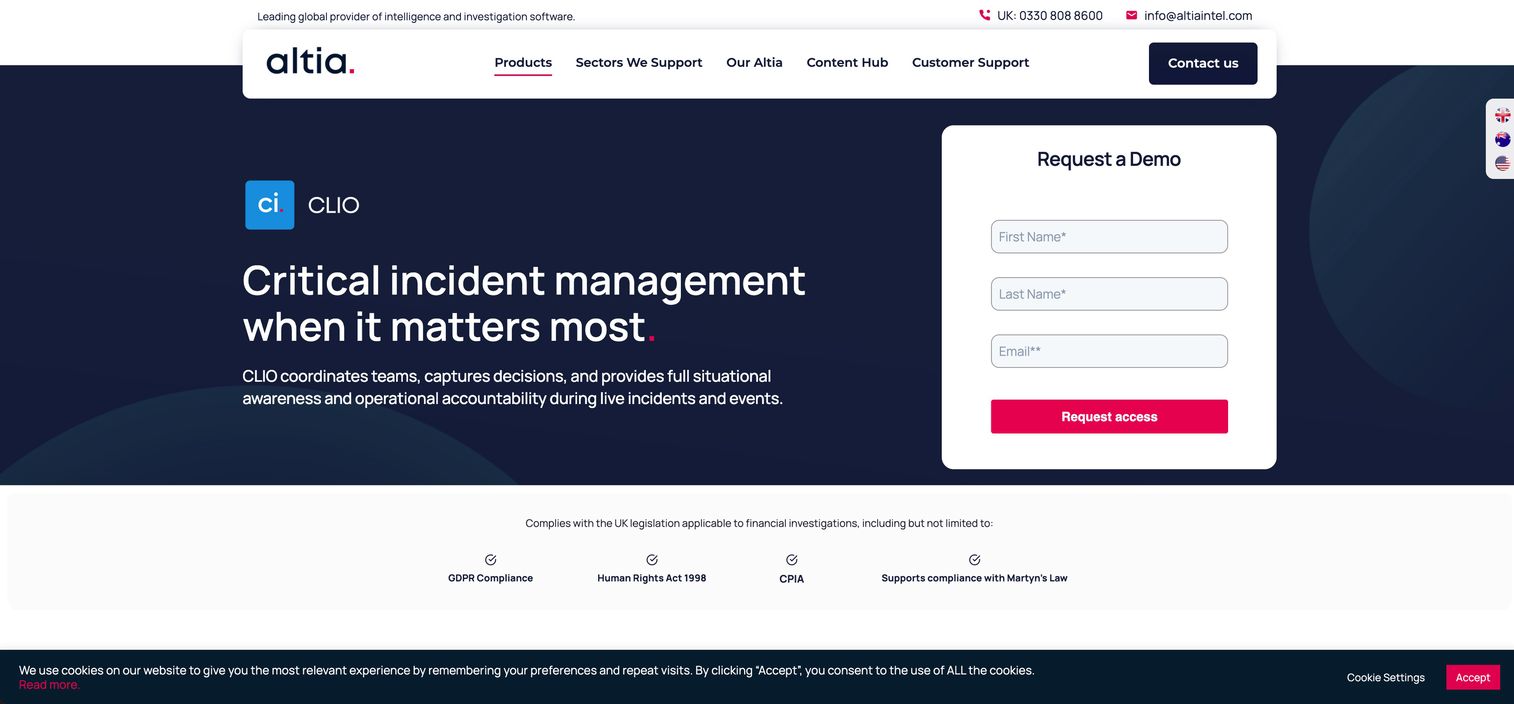
Altia CLIO is a critical incident management platform designed for coordinating teams, capturing decisions in real time, and maintaining a defensible record throughout live incidents and events. It creates a shared situational awareness picture that can be accessed by multiple parties simultaneously, centralizing information that would otherwise scatter across radio channels, email, and personal notes.
Best for: Organizations managing civil emergencies, public-order situations, live events, and operational risk where a common operating picture matters.
Key features
- Shared live operational picture across multiple teams
- Real-time decision and action capture
- Defensible record maintenance for post-incident review
- On-premise and Azure cloud deployment options
- Multi-source information aggregation
Why choose Altia CLIO: If your investigation concern is coordinating live response, rather than managing case workflows after the fact, Altia CLIO provides the operational picture that keeps teams aligned during fast-moving events. It's a strong fit for security operations centers and public-safety organizations that need a system of record for the incident itself, not just the investigation that follows.
Altia CLIO pricing: Contact Altia directly for a quote. Pricing is not displayed on the vendor's website and is structured around deployment scope and team size.
No G2 rating is currently available for Altia CLIO.
2. Ontic
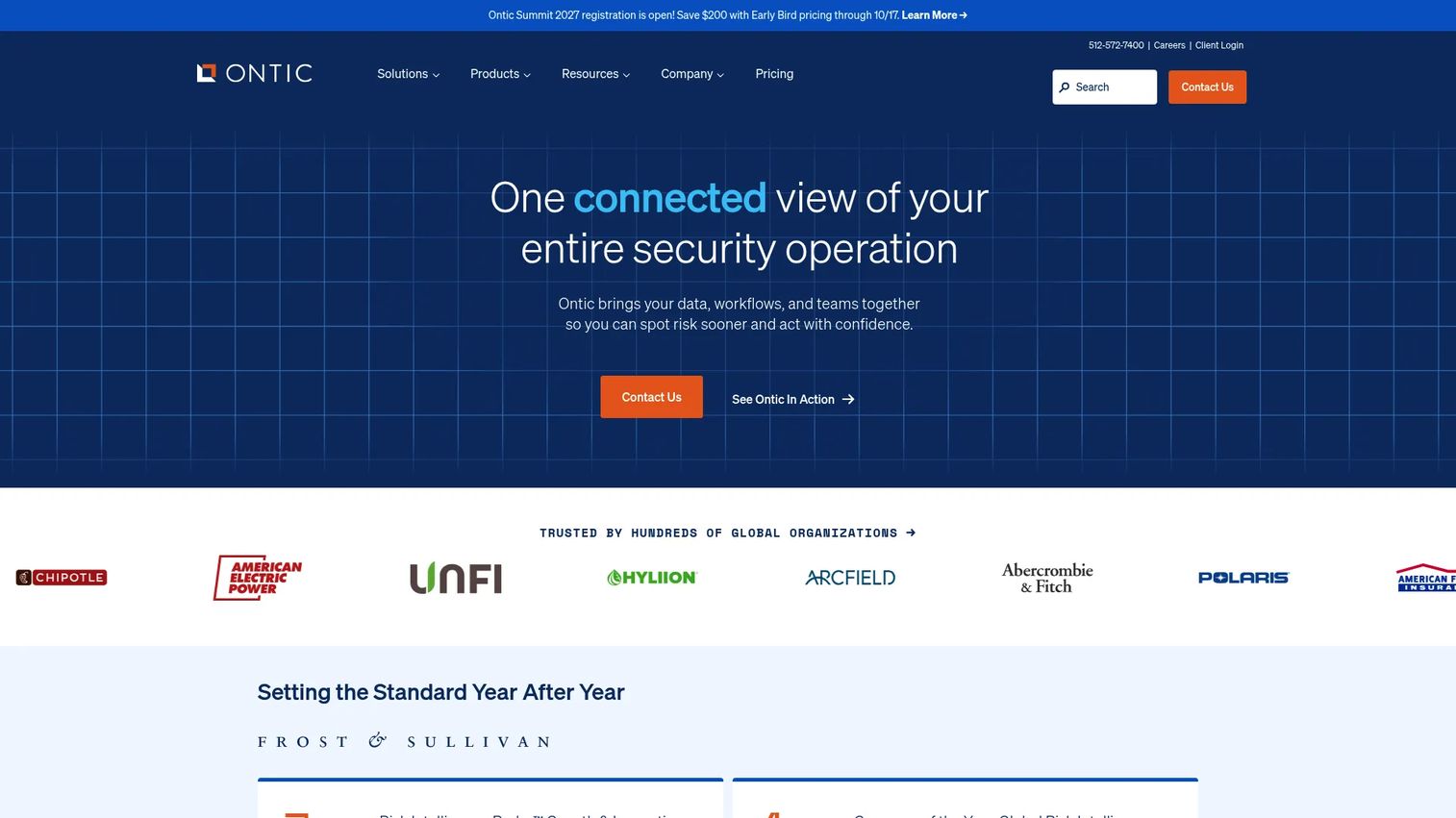
Ontic is an AI-powered connected intelligence platform for corporate and government physical security teams. It centralizes threat monitoring, risk assessments, investigations, incidents, and security operations into a single environment with integrated identity resolution and public-record research. Ontic is designed for teams that need to see connections between people, events, and risk signals across multiple data sources rather than managing individual cases in isolation.
Best for: Enterprise corporate and government security teams managing threat intelligence, risk assessments, and cross-functional investigations.
Key features
- Multi-source risk intelligence and threat monitoring
- Investigations and case management with workflow automation
- Entity and relationship analysis with maps and visualizations
- Integrated identity resolution and public-record research
- Role-based governance and access controls
Why choose Ontic: Ontic is built for security operations teams whose primary challenge is connecting intelligence signals to active investigations and cases. If your organization runs a corporate threat program and needs a platform that links threat data to investigation workflows rather than treating them as separate systems, Ontic fits that model.
Ontic pricing: Custom pricing covers licensed products, users, integrations, and implementation scope. Customer success, training, and platform updates are included. Request a quote at ontic.co/pricing.
G2 rating: 4.5/5.
3. Omnigo Case Management Software
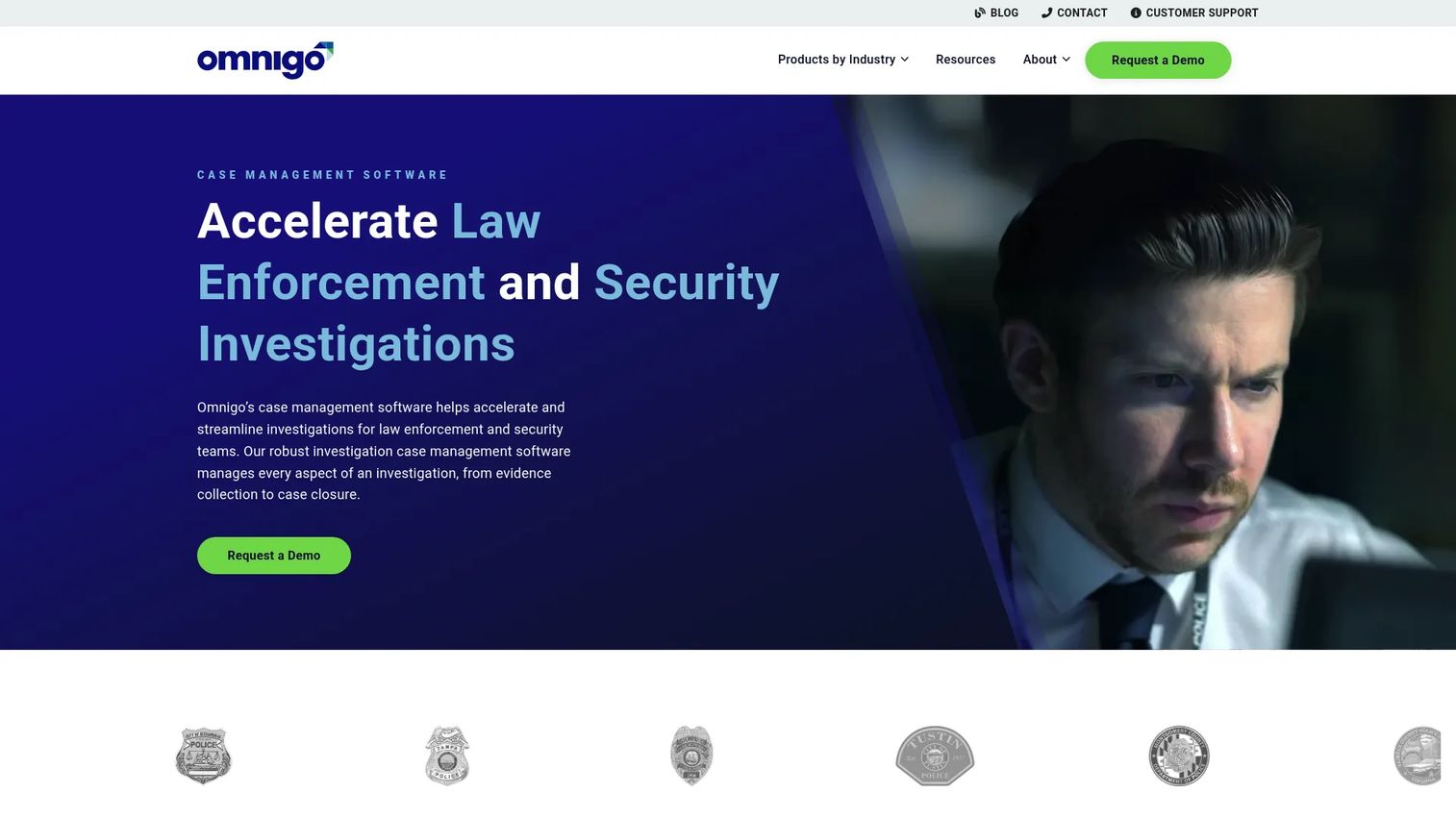
Omnigo provides case management for law enforcement, campus safety, and security organizations. The platform centralizes investigation timelines, cross-case connection discovery, team collaboration, and digital and physical evidence with chain-of-custody tracking. Its cross-case search capability lets investigators identify links between separate records that would otherwise remain siloed.
Best for: Law enforcement agencies and security organizations managing investigations, evidence, and case oversight across distributed teams.
Key features
- Case-progress timelines with searchable case data
- Cross-case connection discovery and advanced search
- Secure digital and physical evidence management with chain-of-custody support
- Team collaboration, file sharing, and task assignment
- Customizable dashboards and real-time notifications
Why choose Omnigo: Omnigo suits organizations that need structured evidence handling and cross-case pattern recognition built into the same environment. Campus safety teams, corporate security operations, and municipal agencies often find the combination of incident intake, case management, and evidence chain-of-custody in one platform reduces the manual bridging work between separate tools.
Omnigo pricing: Contact Omnigo for a quote. Pricing is not displayed on the vendor's website.
G2 rating: 4.2/5.
4. Resolver
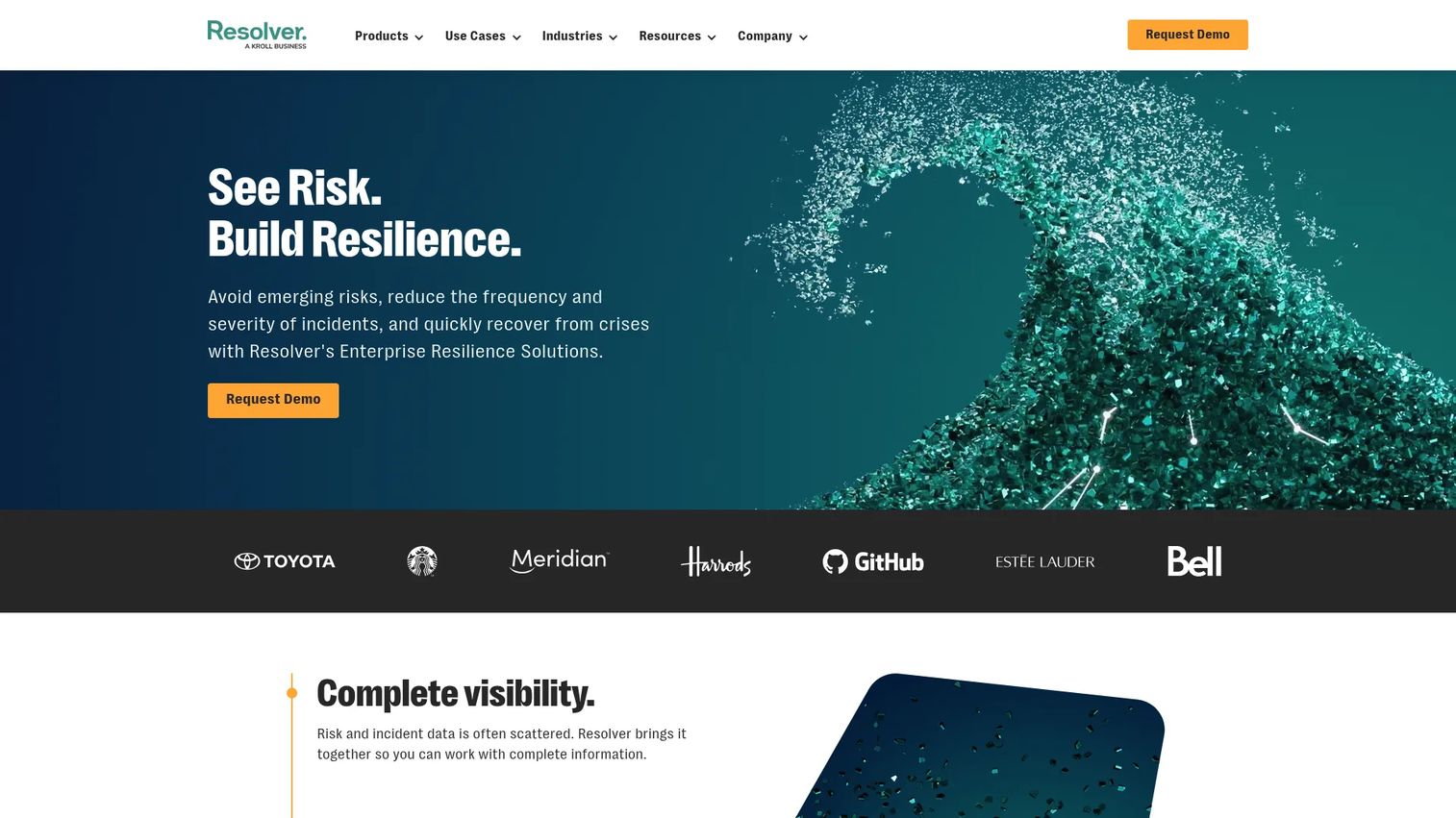
Resolver is an enterprise resilience and risk intelligence platform that connects governance, risk, compliance, security, and investigation workflows in one environment. Its no-code configurability lets large organizations build custom forms, workflows, and dashboards without engineering involvement. Resolver links incidents to investigations to corrective actions, creating a data trail that satisfies both operational and executive reporting needs.
Best for: Large organizations that need to connect incident response, risk registers, compliance tracking, and investigation workflows under a single data model.
Key features
- Unified incident reporting and investigation workflows
- Configurable no-code forms, workflows, dashboards, and reports
- Risk registers and corrective action tracking
- Enterprise risk management, internal audit, and third-party risk modules
- AI-assisted regulatory summaries and gap analysis
Why choose Resolver: Resolver is the right fit when investigations don't live in isolation from risk and compliance data. Teams that need to show a board or regulator how an incident triggered an investigation, what corrective actions resulted, and how controls changed benefit from Resolver's connected data model. It's broader than a pure investigation tool but more cohesive than running three separate systems.
Resolver pricing: Custom pricing is based on selected solutions, customization level, and active users. Contact Resolver at resolver.com/pricing for a scoped quote.
G2 rating: 4.3/5.
5. Case IQ Investigation Management Software
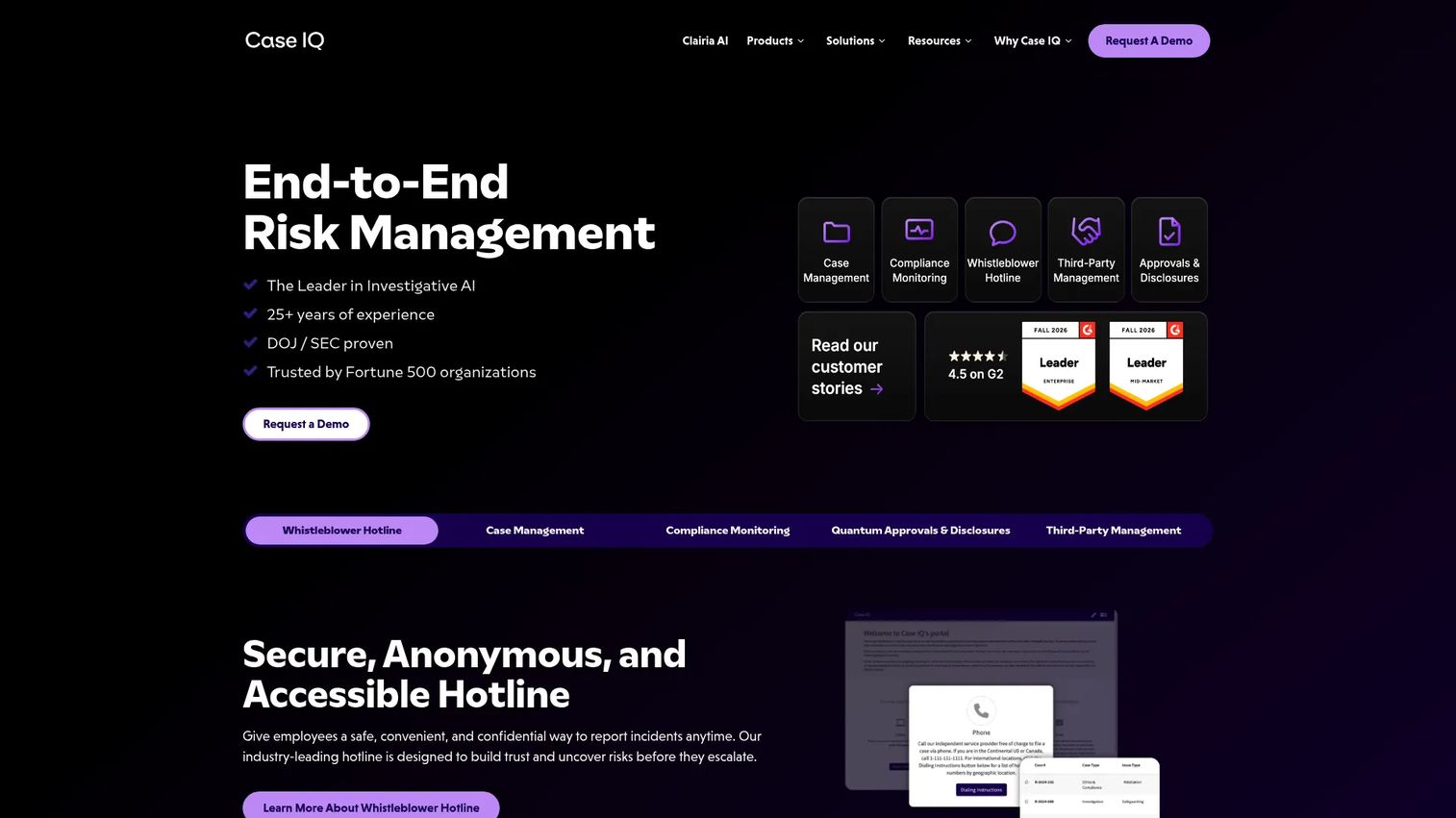
Case IQ is a dedicated investigative case management platform for compliance, ethics, fraud, HR, and security investigations. It supports multichannel case intake, configurable workflows with automated routing and escalation, secure role-based document access, and one-click investigation report generation. The Clairia AI assistant provides investigation summaries and case insights.
Best for: Compliance, ethics, audit, and corporate investigation teams that need configurable, secure case workflows across multiple investigation categories.
Key features
- Multichannel case intake with customizable forms
- Configurable workflows with automated routing, reminders, and escalations
- Role-based access controls and centralized case documentation
- One-click investigation report generation
- Clairia AI assistant for investigation insights and summaries
Why choose Case IQ: Case IQ performs best for organizations that run multiple investigation types, say ethics complaints, fraud cases, and workplace incidents, and need consistent process without building separate systems for each. The configurability means a compliance team can design workflows that match how they actually investigate, rather than adapting to a rigid template.
Case IQ pricing: Pricing is customized based on organization size, solution modules, implementation scope, integrations, user access, and contract term. It typically includes a one-time implementation component and annual subscription fees. Contact Case IQ at caseiq.com/pricing for a scoped estimate.
G2 rating: 4.5/5.
6. Comtrac
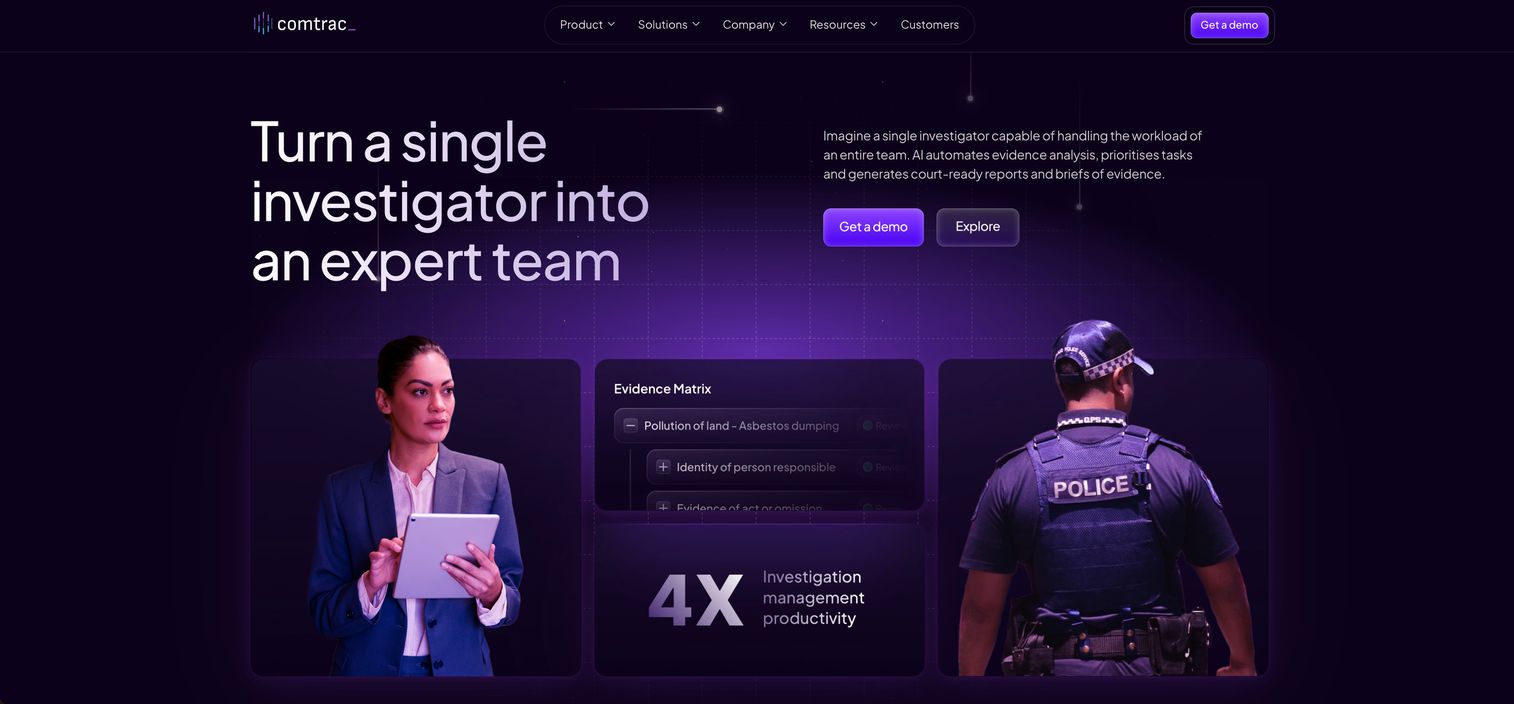
Comtrac is an AI-enhanced investigation management platform built for law enforcement, government regulators, and private enterprise. Its standout capability is AI-assisted evidence mapping that ties collected evidence directly to offence elements, reducing the manual analysis work investigators carry between capture and brief preparation. Field evidence capture comes through the Frontline mobile app, and the platform produces court-ready documents and briefs of evidence automatically.
Best for: Government regulators, law enforcement agencies, and enterprise teams managing complex, evidence-intensive investigations that require court-ready documentation.
Key features
- AI-assisted evidence mapping to offence elements
- Field evidence capture via the Frontline mobile app
- Automated investigation reports and briefs of evidence
- Court-ready document production
- Access controls and audit history
Why choose Comtrac: Comtrac is purpose-built for regulatory and law enforcement workflows where evidence must be mapped to specific legal elements and documents must survive court scrutiny. If your investigation team produces formal briefs or regulatory submissions, the automated document generation alone can significantly reduce preparation time.
Comtrac pricing: Contact Comtrac directly for pricing. No pricing is displayed on the vendor's website.
G2 rating: 5.0/5 (based on one review).
7. CRIMR
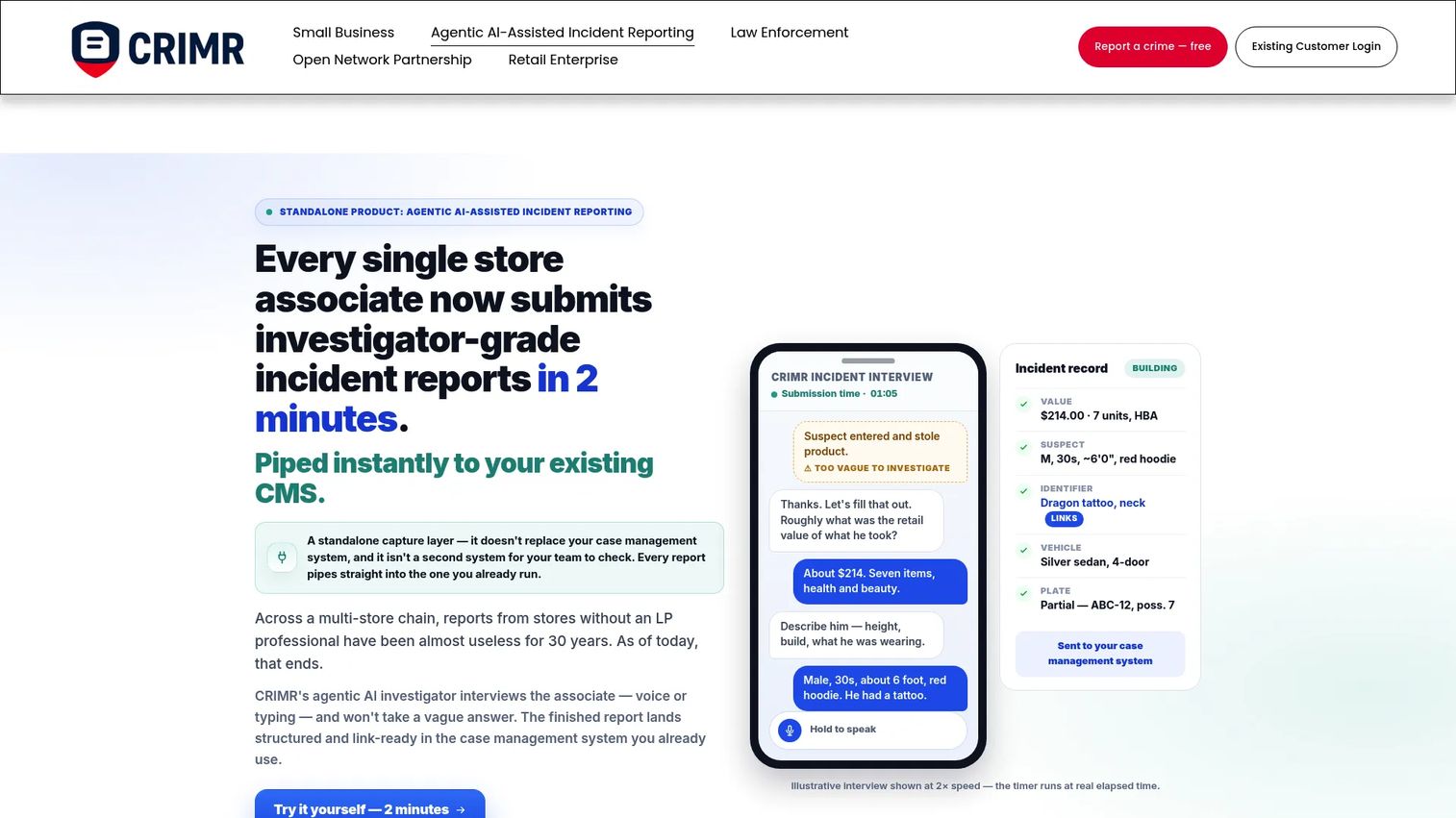
CRIMR is an AI-assisted incident reporting tool that captures structured, investigation-ready incident reports and sends them directly into an existing case management system via API, webhook, SFTP, or email. It guides users through an interview process by voice or text, capturing suspects, vehicles, plate numbers, timelines, evidence, and photos in a consistent format regardless of who completes the report.
Best for: Multi-site retail and business operations that need consistent, standardized incident documentation feeding into a separate case management platform.
Key features
- AI-guided incident interviews by voice or text
- Structured capture for suspects, vehicles, timelines, and evidence
- Photo attribution to suspects or vehicles
- API, webhook, SFTP, and email-to-case integrations
- Audit logging and row-level security
Why choose CRIMR: CRIMR isn't a full case management system. It solves the front end of the investigation workflow: Getting a complete, structured incident report out of every employee, every time, regardless of their experience level. Teams that already have a case management system but struggle with inconsistent intake will find CRIMR addresses that specific gap.
CRIMR pricing: Plans start at $19.99/month, which includes unlimited locations, 1 user, 10 GB storage, and 10 incident reports per month. Additional users cost $5 each, extra storage is $5 per 10 GB, and additional reports run $1 each.
No G2 user reviews are currently available for CRIMR.
8. Filevine Case Management Software
Filevine is a cloud-based legal case management platform that integrates document management, case communication, workflow automation, billing, and client collaboration in one system. Law firms and legal operations teams use it to manage matters from intake through resolution, including cases that involve investigation-related documents, timelines, and multi-party correspondence.
Best for: Law firms and legal operations teams that need investigation-related matter management integrated with documents, communications, billing, and deadlines.
Key features
- Document management with search, PDF editing, OCR, and unlimited storage
- Two-way texting, captured emails, task management, and client portals
- Customizable workflow automation with deadline chains and reminders
- Intake Wizard, lead tracking, and conflict checks
- Timekeeping, billing, and invoicing
Why choose Filevine: Filevine suits legal teams where investigation work is one part of a broader matter portfolio. If your organization manages litigation that includes investigative discovery alongside contracts, billing, and client communication, Filevine's integrated model reduces the tool sprawl that comes from running separate systems for each function.
Filevine pricing: Packages are custom-built for each organization. Contact Filevine sales for a tailored quote at filevine.com/pricing.
G2 rating: 4.6/5.
9. Intrace
Intrace is a risk-intelligence and OSINT investigation platform that combines real-time physical and digital threat monitoring with deep investigative analysis. It monitors violence, crime, infrastructure, and weather events alongside social, messaging, web, and dark-web sources, then lets investigators build unified profiles using AI-assisted OSINT search, graph-based link analysis, and timeline views.
Best for: Corporate security, law enforcement, intelligence, and risk teams that need to connect threat monitoring with structured OSINT investigations and evidence preservation.
Key features
- Real-time physical and digital threat monitoring
- AI-assisted OSINT search with adverse-media filtering and record enrichment
- Interactive graph-based link analysis with map and timeline views
- Evidence preservation and case organization
- Investigation report generation
Why choose Intrace: Intrace is strongest when the investigation starts with a threat signal rather than a reported incident. Security teams that monitor external risk and need a path from signal detection to structured investigation, including evidence preservation and reporting, will find Intrace covers that full arc.
Intrace pricing: Contact Intrace at intrace.ai for pricing. No standard plans are displayed on the vendor's website. A 7-day trial is available.
No verified G2 rating is currently available for Intrace.
10. Kaseware Incident Management
Kaseware is an investigation-first incident management platform used by law enforcement, intelligence teams, fusion centers, corporate security, and educational institutions. It combines case and evidence management, link analysis, geospatial visualization, custom workflow configuration, and mobile field access in a single environment. Public submission portals let organizations receive incident reports from external parties directly into the platform.
Best for: Organizations managing complex investigations across departments, locations, or agencies that need link analysis, geospatial tools, and configurable case workflows.
Key features
- Case and evidence management with records and reporting
- Geospatial and link analysis for entity and relationship mapping
- Custom workflows, forms, and dashboards
- Mobile reporting and field access
- Public portals for external incident submissions
Why choose Kaseware: Kaseware earns its place when investigations cross organizational or geographic boundaries and investigators need to visualize connections between people, locations, and events. Fusion centers, multi-agency task forces, and corporate security operations with field teams across multiple sites are the environments where its analytical depth has the most impact.
Kaseware pricing: The Kaseware Essentials plan starts at $102 per user per month, with a minimum subscription of 20 users. Higher tiers covering insights, connections, and enterprise capabilities are available at additional cost.
No G2 rating is currently available for Kaseware.
11. LexisNexis TraceIQ
LexisNexis TraceIQ is a UK-focused tracing and investigation tool that provides a centralized view of consumer, business, and asset intelligence using multi-bureau data and LexID linking technology. It supports reverse telephone searches, insolvency searches, email address lookups, linked and forwarding address tracing, and property register searches through a web portal or REST API.
Best for: UK organizations conducting debtor tracing, fraud investigations, mortality verification, and asset reunification work where identity linking across multiple data sources is the core job.
Key features
- Reverse telephone number and email address search
- Linked and forwarding address tracing
- Associated-individual and business linking
- Property register search
- Web portal and REST API access
Why choose LexisNexis TraceIQ: TraceIQ is a data intelligence tool, not a case workflow platform. It's the right choice when the investigation problem is identifying and locating individuals or assets rather than managing a structured case from intake to resolution. Many organizations use it alongside a case management system, feeding TraceIQ results into the case record.
LexisNexis TraceIQ pricing: Contact LexisNexis Risk Solutions for pricing. No standard plan information is displayed for TraceIQ specifically.
No verified G2 rating is currently available for LexisNexis TraceIQ.
12. Logikcull
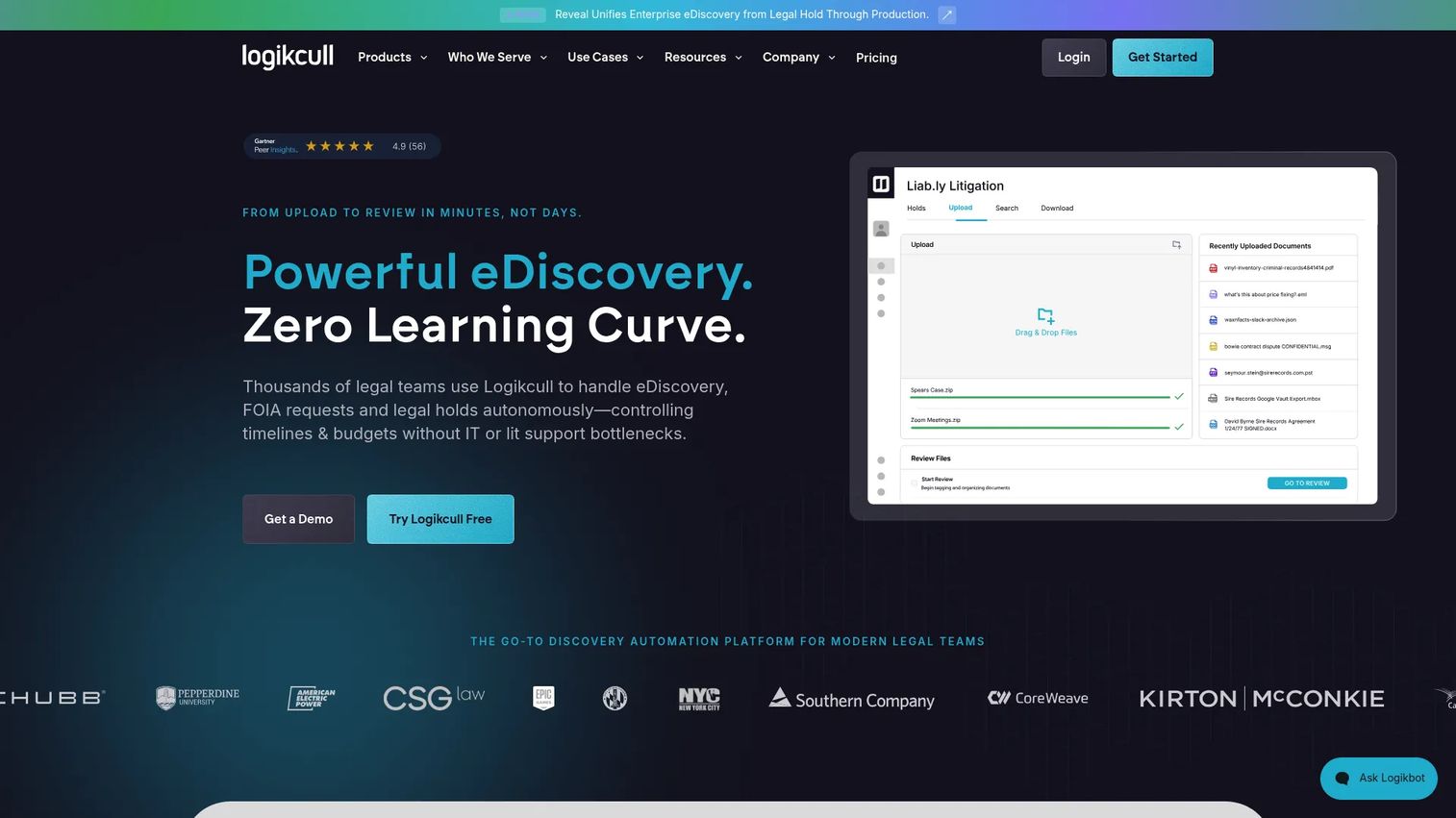
Logikcull is an eDiscovery and legal-holds platform for collecting, processing, searching, reviewing, redacting, and producing legal and public-records data. Its GenAI-powered fact-finding capability lets teams ask natural-language questions of their document set and receive cited answers, compressing the early-case-assessment phase significantly. Collections connect directly from Slack, Microsoft 365, Google Workspace, Box, and Dropbox.
Best for: Legal teams, law firms, government agencies, and organizations managing eDiscovery, legal holds, public-records responses, or investigation-related document review.
Key features
- GenAI-powered natural-language fact finding with cited answers
- Automated processing, OCR, deduplication, and email threading
- Search, review, tagging, redaction, and production workflows
- PII detection and bulk redaction
- Legal holds, custodian tracking, and audit trails
Why choose Logikcull: Logikcull fits organizations whose investigation challenge is primarily evidence volume and review speed rather than case workflow coordination. When a matter generates thousands of documents that need to be collected, processed, and reviewed under a legal hold, Logikcull's automation reduces the time and cost of that work compared to manual document-by-document review.
Logikcull pricing: Three plans are available: Pay As You Go (storage-based monthly billing), Logikcull Subscription (annual), and Corporate Suite (annual, includes legal holds and collections). Contact Logikcull for numeric pricing at logikcull.com/pricing.
No verified current G2 rating was found for Logikcull. Capterra reports a 4.6/5 rating.
13. RelativityOne
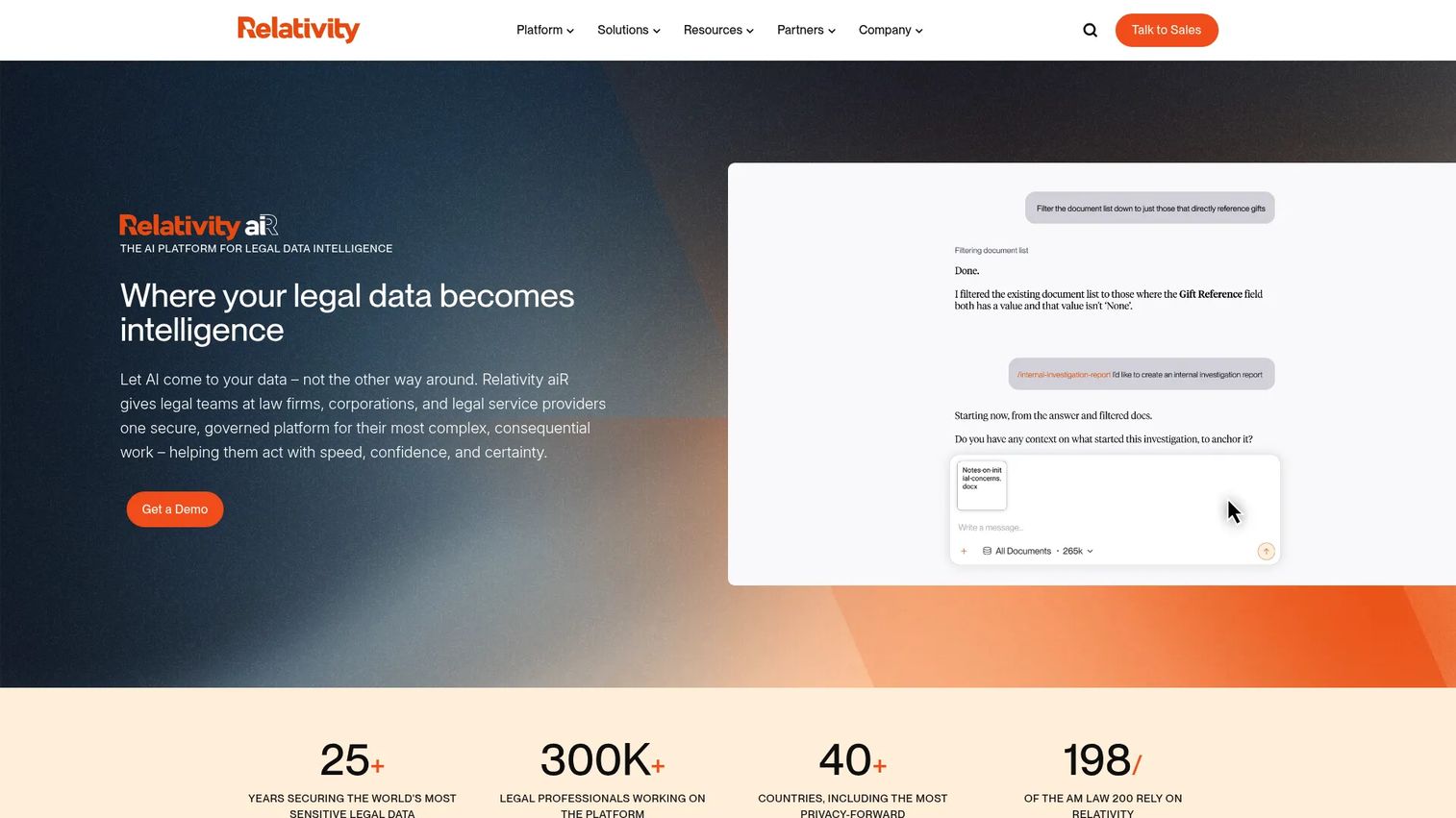
RelativityOne is a cloud-based legal intelligence and eDiscovery platform for litigation, investigations, regulatory requests, and data breach response. It handles the full document lifecycle from collection and processing through AI-assisted review, production, and audit. Note that Relativity renamed the platform to Relativity aiR on September 16, 2026; official materials still reference RelativityOne as of this publication date.
Best for: Law firms, corporations, and legal service providers managing complex eDiscovery, internal investigations, regulatory matters, and data breach response with large, diverse datasets.
Key features
- Legal hold, data collection, processing, analytics, review, and production
- AI-assisted review, privilege detection, and data breach response
- Email threading, clustering, sentiment analysis, OCR, and translation
- Automated workflows and Review Center
- Audit and security controls
Why choose RelativityOne: RelativityOne is appropriate when investigation work involves large volumes of electronically stored information that require structured review, privilege logging, and court-admissible production. It's more infrastructure than a case management tool, and the investment reflects that. Teams running a handful of small internal investigations will find it overbuilt. Enterprise legal departments with complex, recurring eDiscovery obligations will find it covers workflows that lighter tools cannot.
RelativityOne pricing: Flexible pay-as-you-go or annual commitment models are available. Contact Relativity for pricing at relativity.com/pricing.
G2 rating: 4.6/5.
14. SmartAdvocate Investigation Management Software
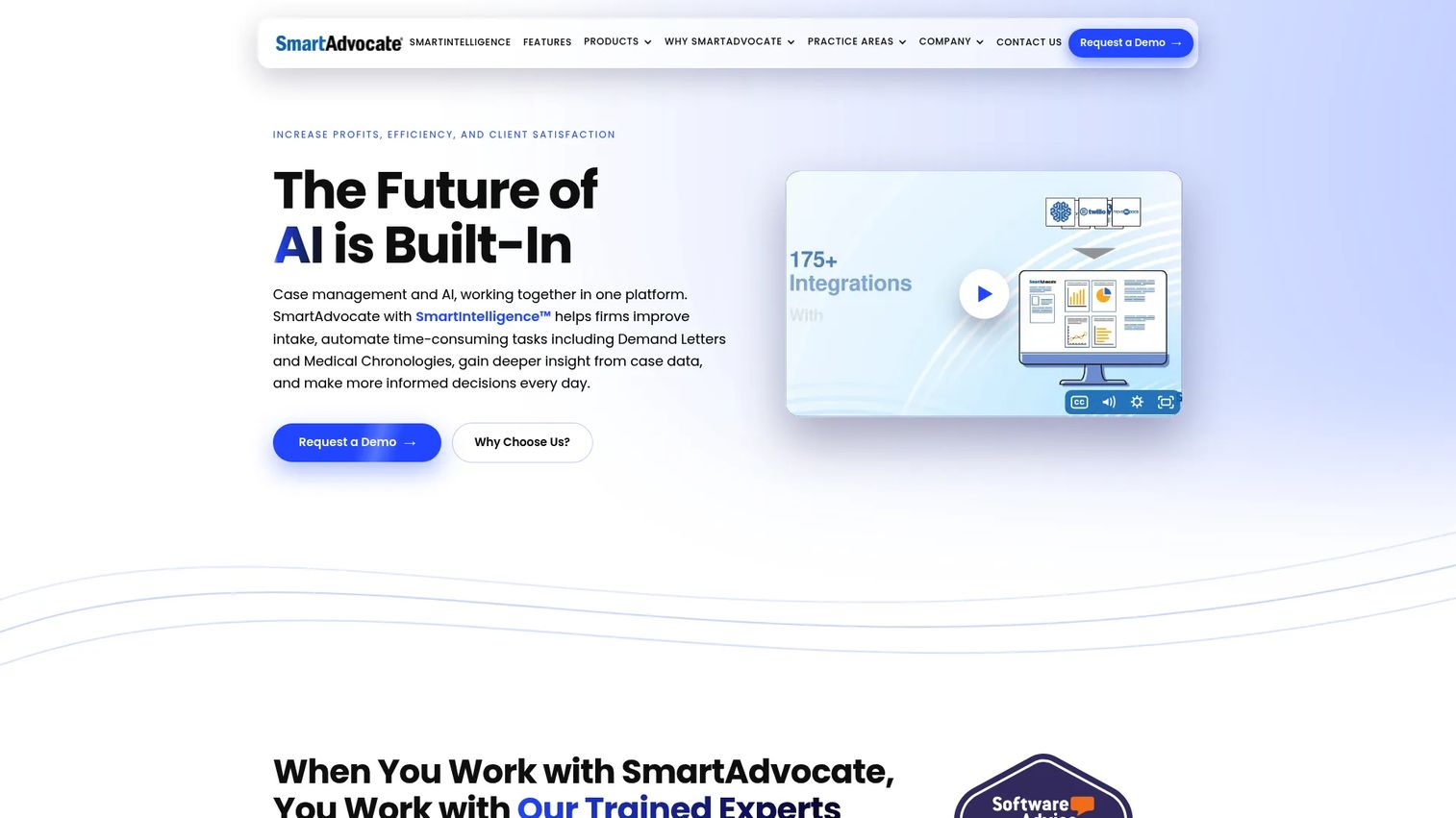
SmartAdvocate is a web-based legal case management platform for law firms handling complex litigation and investigation-related matters. It covers intake, investigation workflows, document management, AI-assisted case summaries, automated task sequences, and client communication in an integrated system with over 175 integrations.
Best for: Law firms managing investigation-related matters that require configurable workflows, centralized case data, AI-assisted documentation, and deep integration with legal technology tools.
Key features
- AI tools for case, medical-record, document, and deposition summaries
- Automated WorkPlans and Procedures for tasks, documents, and communications
- Document management with templates, scanning, barcoding, and e-signatures
- Intake Wizard, lead tracking, and conflict checks
- 175+ integrations including Outlook and client portal access
Why choose SmartAdvocate: SmartAdvocate suits law firms where investigation matters sit within a high-volume litigation practice. Its automation of repetitive task sequences, document generation, and deadline management reduces administrative overhead on cases that follow predictable procedural patterns. The 175+ integrations make it practical for firms already running a broad legal technology stack.
SmartAdvocate pricing: Pricing is based on firm size and requirements. Request a tailored quote or demo at smartadvocate.com.
G2 rating: 4.7/5.
15. Workplace Investigations Management
Workplace Investigations Management is listed here based on its positioning as a workplace investigation workflow platform covering confidential intake, investigation plans, interview records, and outcome tracking for HR and compliance teams. At the time of research, the vendor's website was inaccessible, so capabilities and pricing could not be independently verified. Verify product details and pricing directly with the vendor before shortlisting.
Best for: HR, employee relations, and compliance teams managing confidential workplace investigations with structured intake and outcome tracking.
Key features
- Confidential complaint intake
- Investigation plans and task management
- Interview and witness record documentation
- Findings and outcome tracking
- Reporting and role-based permissions
Why choose Workplace Investigations Management: Purpose-built workplace investigation platforms separate the investigative record from the HR system of record, which matters for confidentiality. Teams that need a dedicated space for sensitive employee cases, apart from the broader HRIS, may find this positioning relevant.
Workplace Investigations Management pricing: Contact the vendor directly for pricing information.
No G2 rating is currently verified for this platform.
16. Kroll
Kroll is a global financial and risk advisory firm. Its investigation and diligence practice covers corporate fraud investigations, compliance reviews, third-party due diligence, forensic accounting, and regulatory response. Kroll is primarily a managed-services business, meaning you're engaging specialist investigators and advisors rather than purchasing a software platform.
Best for: Organizations that need specialist investigative expertise, external investigator credibility, or managed support for complex fraud, corruption, regulatory, or sensitive internal investigations.
Key features
- Corporate investigations and fraud inquiry services
- Third-party diligence and compliance reviews
- Cyber and data resilience advisory
- Forensic accounting and transaction advisory
- Regulatory response and restructuring support
Why choose Kroll: Kroll is the right choice when the investigation requires external credibility, specialist expertise, or independence that an internal team cannot provide. A board investigation into executive misconduct, a regulatory inquiry that benefits from an external forensic firm's signature, or a complex cross-border fraud case where internal resources are insufficient are the scenarios where Kroll adds value that no software platform replicates.
Kroll pricing: Engagements are project-scoped and custom-priced. Contact Kroll at kroll.com for a scoped engagement proposal.
G2 rating: 3.8/5 (based on 3 reviews).
17. LexisNexis Risk Solutions
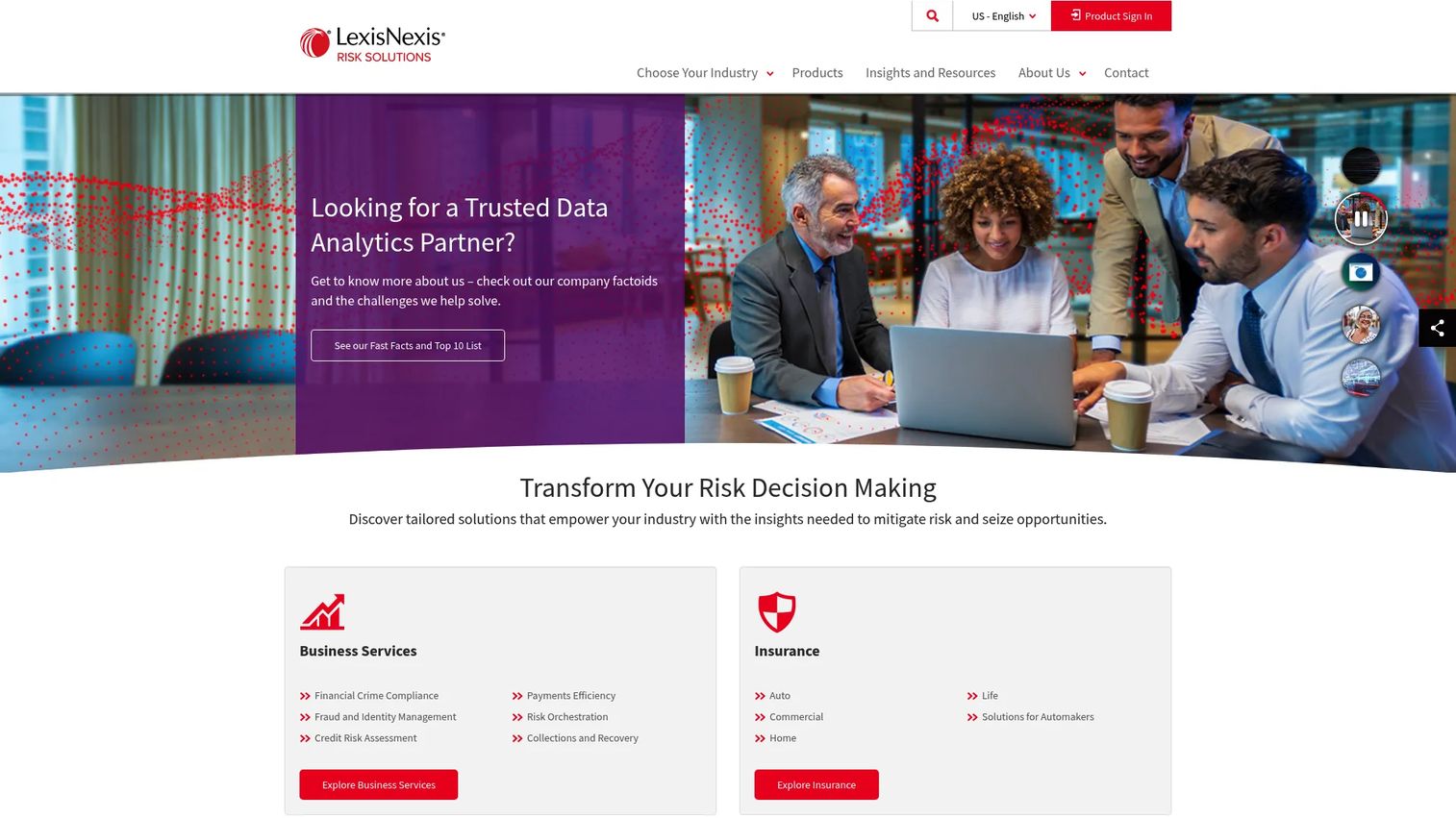
LexisNexis Risk Solutions provides data analytics, risk decisioning, and fraud intelligence for financial services, insurance, government, and healthcare organizations. Its proprietary LexID linking technology connects identity data across sources to support fraud investigation, financial crime compliance screening, identity verification, and risk orchestration workflows.
Best for: Organizations in financial services, insurance, and government that need data-driven fraud investigation, identity resolution, and financial-crime compliance at scale.
Key features
- Fraud and identity intelligence with LexID linking
- Financial crime compliance screening and risk intelligence
- Risk orchestration and customer onboarding
- Identity verification and authentication
- Advanced analytics and data enrichment
Why choose LexisNexis Risk Solutions: LexisNexis Risk Solutions is a data and decisioning layer, not a case management workflow tool. It performs best when integrated into a fraud or compliance investigation program where the core challenge is enriching and verifying identity information at volume. Organizations that need structured case workflows alongside this data capability typically pair it with a dedicated investigation platform.
LexisNexis Risk Solutions pricing: Contact LexisNexis Risk Solutions at risk.lexisnexis.com for a scoped quote. Pricing is sales-led.
G2 rating: 4.8/5 (for LexisNexis Intelligent Investigator, the specific product reviewed on G2).
18. Reveal
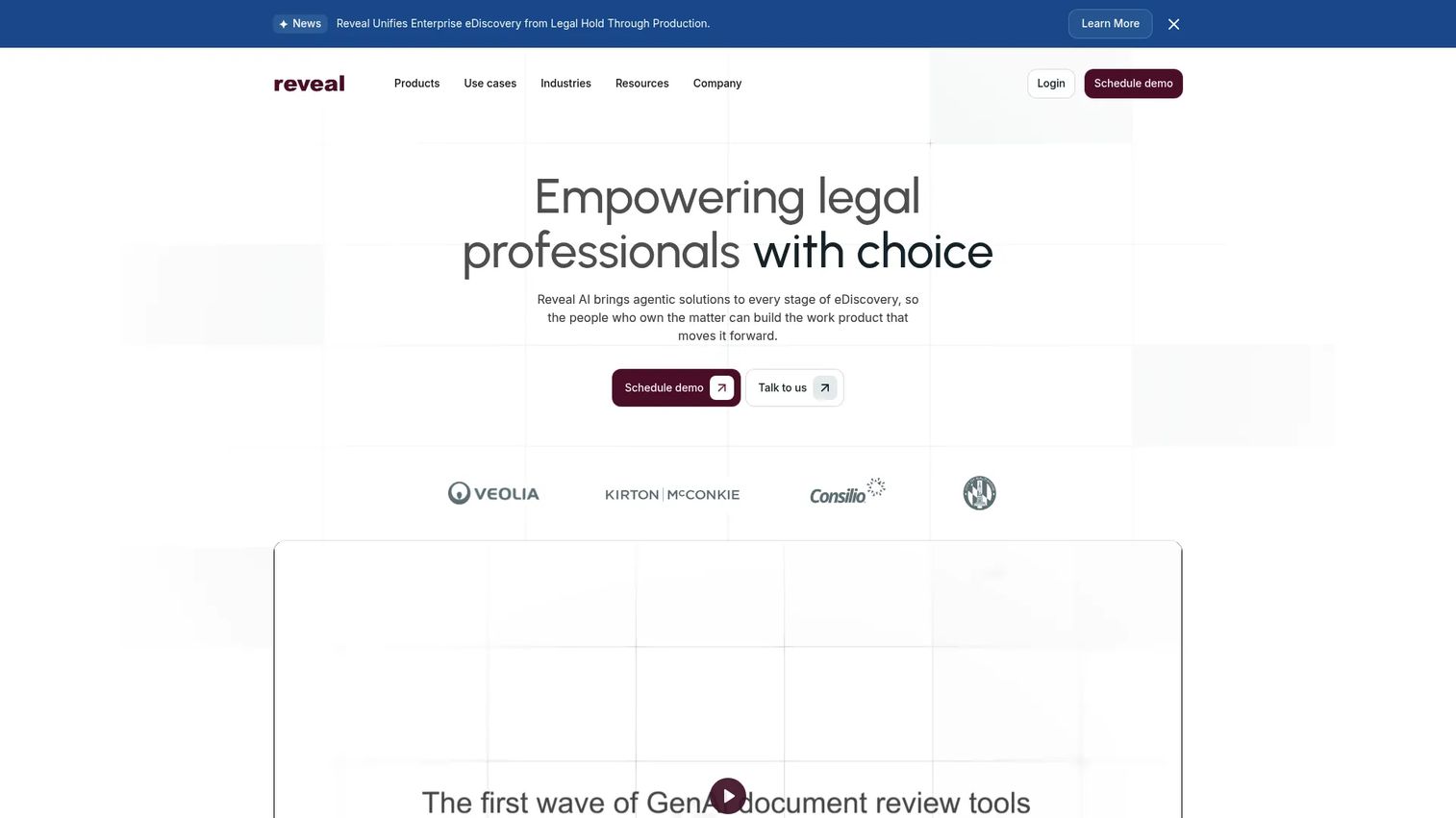
Reveal is an AI-powered eDiscovery platform for legal departments, law firms, and legal service providers managing complex litigation, internal investigations, early case assessment, legal holds, and analytics. Its AI capabilities include supervised learning, predictive scoring, concept search, and document review with explanations and citations. The platform supports over 900 file types for processing and production.
Best for: Legal departments and law firms reviewing large, complex collections of digital evidence in litigation, regulatory, and investigation matters.
Key features
- Data processing and production for over 900 file types
- Interactive dashboards, clusters, heatmaps, and concept search
- OCR, translation, transcription, and image labeling
- Supervised learning, predictive scoring, and AI model library
- AI-assisted document review with explanations and citations
Why choose Reveal: Reveal is strongest when the bottleneck in an investigation is reviewing a large, unstructured document collection efficiently. Its predictive scoring and supervised-learning capabilities let review teams prioritize the documents most likely to be relevant rather than reviewing linearly. For legal operations teams with recurring complex matters, that prioritization is where time savings compound.
Reveal pricing: Pricing is handled through customer-specific agreements. Contact Reveal at revealdata.com for pricing details.
G2 rating: 4.6/5.
19. HR Acuity
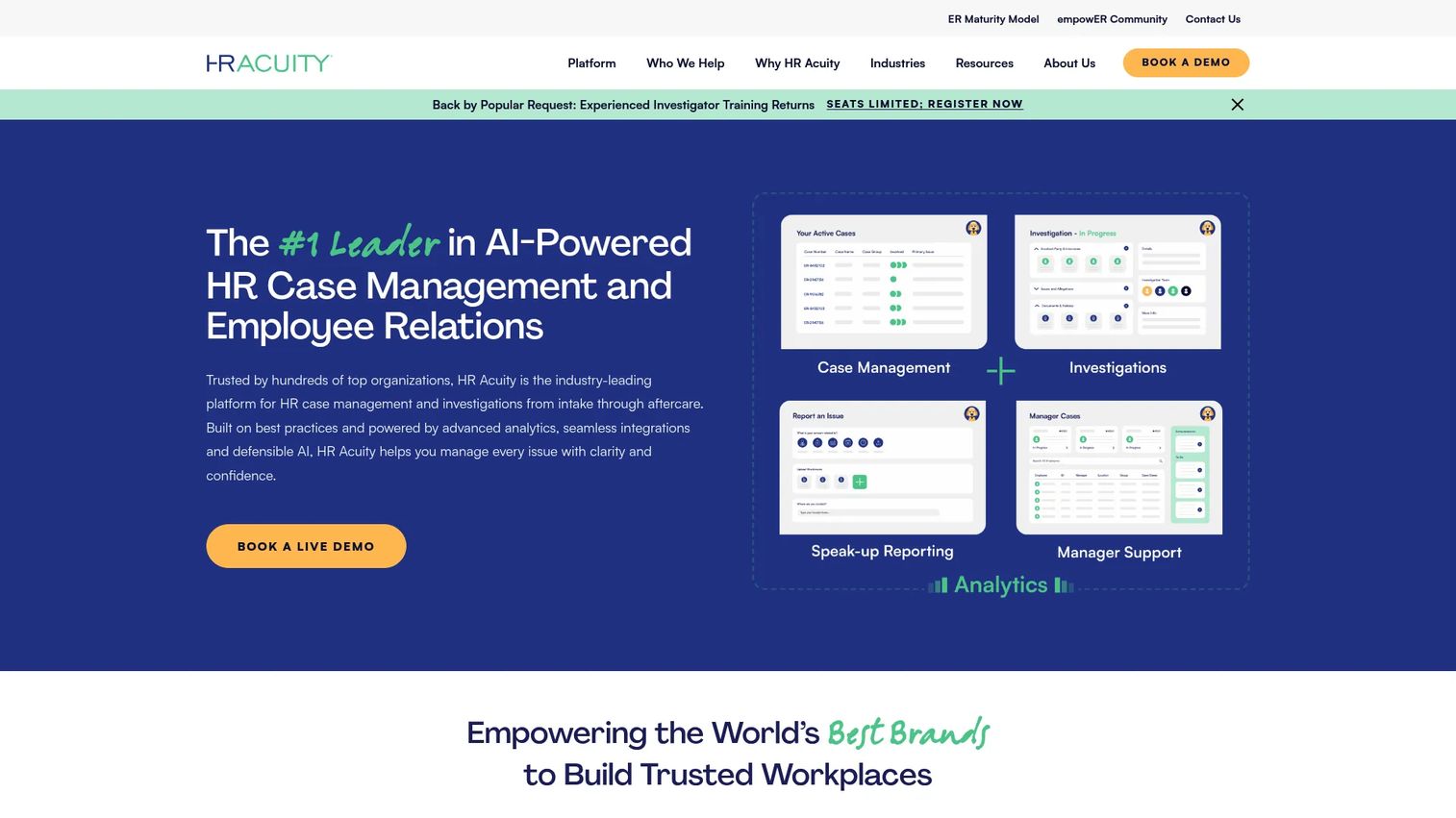
HR Acuity is an AI-powered employee relations and HR case management platform for enterprise HR, legal, and compliance teams. It centralizes workplace investigation workflows, anonymous and named reporting, case documentation, AI-assisted investigation plans and summaries, and benchmarking analytics that compare your case data against industry norms. HRIS integrations keep employee records current across systems.
Best for: Enterprise HR and employee relations teams managing sensitive workplace cases, investigations, and employee-relations reporting at scale.
Key features
- Centralized employee-relations case management
- Best-practice investigation workflows and configurable interview guides
- Anonymous and named workplace reporting options
- AI-powered case insights, summaries, investigation plans, and timelines
- Dashboards, analytics, and benchmarking against industry data
Why choose HR Acuity: HR Acuity is the most purpose-built option for teams whose primary investigation workload is employee relations: Harassment complaints, misconduct allegations, policy violations, and workplace conflict. The benchmarking capability lets HR leaders compare case volume, type, and resolution data against peer organizations, which is a meaningful signal for board reporting and compliance reviews.
HR Acuity pricing: Contact HR Acuity at hracuity.com for pricing. No standard plans are displayed on the vendor's website.
G2 rating: 4.6/5.
Considerations when choosing investigation management software
Match the platform to the investigation type
Criminal investigations, corporate security cases, workplace complaints, legal discovery, and intelligence analysis require different workflows, evidence models, and permission structures. A platform built for HR case management will frustrate a law enforcement team that needs link analysis and geospatial mapping. Identify your primary investigation type before evaluating features, and confirm the platform has reference customers in that context.
Evaluate evidence and information handling
Ask vendors specifically about file type support, OCR, metadata preservation, version control, chain-of-custody logging, and retention settings. A platform that stores evidence without a defensible access and modification log creates risk in regulated environments or litigation. If your cases involve large document volumes, test search performance against a representative dataset rather than a demo environment.
Review permissions and auditability
Every investigation management platform should support role-based access at the case level, not just the platform level. Auditors and regulators will ask who accessed which records and when. Verify that the platform produces audit logs that satisfy your data retention and compliance requirements, and confirm whether logs are editable by administrators or append-only.
Test reporting and executive visibility
The report a VP of Security or General Counsel needs for a board meeting is different from the operational dashboard an investigator uses daily. Request examples of both during evaluation. Check whether reports can be exported in formats your board uses, and whether dashboards can be configured to show case aging, risk category distribution, and investigator workload without custom development.
Confirm integration and implementation requirements
Ask about native integrations with your identity provider, HR system, and ticketing tools. Also ask how long implementation takes, whether configuration requires the vendor's professional services team, and what ongoing administration looks like after go-live. For a Series B team handing the platform to a newly hired VP, implementation complexity is a real cost that often doesn't appear in the initial pricing discussion.
Conclusion
The right investigation management platform depends on the type of work your organization runs most.
Choose a focused investigative case platform, such as Case IQ or Kaseware, when structured case workflows and evidence records are the primary requirement. Choose an intelligence-led platform like Ontic or Intrace when threat context, entity relationships, and link analysis are central. For large-scale document review, Logikcull, RelativityOne, or Reveal handle the evidence volume that general case management tools cannot. HR Acuity is the clearest choice for employee relations and workplace investigation specialization. Resolver connects the dots when investigations need to link to risk registers and corrective actions.
To choose well, start with these five steps:
- List the investigation types your organization handles most frequently
- Select three platforms that match those workflows from this guide
- Build a requirements matrix covering evidence handling, permissions, reporting, integrations, and implementation
- Request demonstrations using one of your own representative cases, not a vendor-curated scenario
- Include migration, training, and administration in the total cost comparison, not just the per-user price
Getting this right is worth the time. An investigation platform that earns its place in your stack will give the security or compliance leader you just hired a system that works on day one, reduce founder involvement in sensitive escalations, and produce the defensible records your board expects.
Start your journey with Guideflow today!
FAQs
Investigation management software is a centralized platform for intaking, assigning, documenting, investigating, reporting, and closing cases. It replaces fragmented email threads, spreadsheets, and shared folders with structured workflows, controlled evidence access, audit trails, and executive-ready reporting. The category spans investigative case management, incident management, intelligence analysis, workplace investigations, eDiscovery, and risk and compliance platforms.
Incident management focuses on intake, response coordination, severity classification, remediation, and closure. It's optimized for speed. Investigation management adds deeper layers: Evidence records, witness and subject documentation, investigation timelines, findings, outcome tracking, and defensible reporting. Many platforms cover both, but the depth of investigation-specific features varies significantly. If your priority is post-incident case building rather than real-time response, confirm the platform has dedicated investigation workflow support and not just an extended incident record.
Core capabilities to evaluate include configurable case intake, role-based access at the case level, evidence attachment and chain-of-custody logging, document search, task assignment with deadlines, investigation timelines, audit trails, reporting dashboards, and export formats. Integration with identity providers, HR systems, and ticketing tools adds operational value. For evidence-heavy teams, also check OCR support, metadata preservation, version control, and retention settings.
Law enforcement teams typically need criminal case management, evidence tracking with chain-of-custody records, field access, link analysis, geospatial mapping, and multi-agency collaboration. Kaseware and Omnigo are specifically designed for law enforcement and public safety contexts. Comtrac targets government and regulatory investigators with court-ready document generation. The best fit depends on whether your primary challenge is case coordination, evidence management, intelligence analysis, or field reporting.
Corporate security teams use these platforms to manage physical threats, workplace incidents, third-party risk cases, executive protection concerns, and cross-functional security investigations. Ontic is built specifically for this context with intelligence monitoring, entity analysis, and investigation workflows connected. Resolver and Kaseware also serve corporate security teams with broader risk and incident management layers. The key differentiator is whether the platform connects threat data to active investigations or manages them separately.
HR Acuity is the most purpose-built option for employee relations and workplace investigations, with anonymous and named reporting, configurable interview guides, AI-assisted investigation plans, and benchmarking analytics. Case IQ also handles workplace cases as part of a broader investigation workflow that spans compliance and ethics. Workplace investigation teams should prioritize confidential intake, role-based case access, consistent process documentation, and a reporting layer that satisfies both HR leadership and legal review.
Not typically. Investigation management platforms handle case coordination, evidence records, and workflow governance. eDiscovery platforms handle large-scale document collection, processing, search, review, redaction, and production under legal holds. Some investigation platforms include basic document management, but Logikcull, RelativityOne, and Reveal handle the volume, AI-assisted review, and court-ready production workflows that investigation platforms cannot match at scale. Many organizations run both: One for case workflow, one for document review within a matter.
Cost varies by the number of users, case volume, modules selected, storage, integrations, implementation scope, and contract term. Kaseware publishes a starting price of $102 per user per month with a 20-user minimum. CRIMR starts at $19.99 per month for a single-user entry plan. Most platforms in this category, including Case IQ, Ontic, Resolver, and HR Acuity, use custom pricing based on organizational requirements. When requesting a quote, include your case volume, the number of investigators, integration requirements, and implementation timeline so vendors can provide a scoped estimate rather than a list-price range.
Most enterprise investigation platforms support integrations with identity providers, HR systems, CRM, document repositories, ticketing platforms, and analytics tools. Native integrations, API access, and partner-supported connectors vary by vendor. Ask specifically which integrations are included in your tier versus available at additional cost, and whether the integration requires your engineering team or the vendor's professional services. For Series B organizations handing a platform to a newly hired security or compliance leader, integration complexity and time-to-configuration are practical factors in the total implementation cost.
Run one representative case through each shortlisted platform during the evaluation. Choose a case type your team handles frequently, something that involves at least two investigators, some evidence attachments, and a leadership reporting requirement. Score each platform on workflow fit, sensitive-data handling, permissions, executive reporting, integration with your existing stack, and the time it took to configure and produce a report. That hands-on test surfaces friction that demo environments are designed to hide. Also ask the vendor what the first 30 days of implementation look like and who is responsible for ongoing administration after go-live.