Your support tickets, customer interviews, open-text survey answers, and documentation searches all contain product signal. Most teams still treat that pile of text like noise.
The decision to add natural language understanding software to your stack is not just a technology choice. It determines whether you get a maintainable product capability or a fragile feature that returns false positives, confuses users, and creates a new operational burden no one budgeted for.
According to Mordor Intelligence (2026), the global NLU market was valued at $25.88 billion in 2025 and is projected to reach $73.29 billion by 2030. That growth reflects real adoption pressure: Product teams across SaaS are being asked to add AI features, improve support deflection, and instrument customer language at scale, often without adding headcount.
Picking the wrong tool means engineering rework, missed activation targets, and governance problems that surface after procurement has already signed off.
This guide cuts through the category sprawl and helps you match the right platform to the actual job.
What's inside
This guide covers nine natural language understanding software options for product managers evaluating language AI across cloud APIs, open source frameworks, and LLM platforms.
Tools were selected and scored on:
- NLU capability depth: Classification, entity extraction, sentiment analysis, and semantic understanding
- Product workflow fit: Search, support routing, feedback analysis, and AI feature development
- Deployment and integration model: Managed API, open source library, or hosted foundation model
- Pricing model, governance, and maintainability: Including PII handling, model versioning, and release-cadence risk
TL;DR
- Best managed NLU API for GCP teams: Google Cloud Natural Language API fits teams running on Google Cloud that need pre-trained analysis without model training overhead
- Best for AWS-native text pipelines: Amazon Comprehend handles entity extraction, PII detection, and custom classification inside existing AWS infrastructure
- Best for Microsoft enterprise stacks: Microsoft Azure AI Language connects language capabilities to Azure governance and security controls
- Best for custom model control: Hugging Face Transformers and spaCy suit teams with ML engineering capacity who need domain adaptation or deterministic extraction pipelines
- Best for flexible AI product features: OpenAI, Cohere, and Anthropic Claude fit roadmaps involving retrieval, semantic search, document intelligence, or generative AI assistant experiences
What is natural language understanding software?
Natural language understanding software is technology that converts human language into structured meaning a product or workflow can act on.
It sits within the broader discipline of natural language processing (NLP), but NLU focuses specifically on interpretation: Meaning, context, intent, entities, relationships, and sentiment. Generative AI models can reason over and produce language, while NLU focuses on understanding it. Traditional NLU APIs deliver pre-built services for known tasks. Foundation model platforms offer flexible reasoning across a wider range of language jobs. Open source frameworks provide building blocks for custom pipelines.
Core capabilities to look for
When evaluating NLU software against your product requirements, check for:
- Intent classification: Routing requests by what the user wants to accomplish
- Named entity recognition: Extracting people, places, organizations, products, and custom entity types
- Sentiment and opinion mining: Measuring tone at document or entity level
- Text classification: Assigning categories to documents, tickets, or feedback
- Entity linking and relationship extraction: Connecting entities to known concepts
- Language detection and multilingual support: Processing text in the languages your product supports
- Semantic search and embeddings: Matching meaning rather than keywords
- PII detection or redaction: Identifying and handling sensitive personal information
- Summarization: Condensing long documents into actionable output
- Evaluation and monitoring: Tracking precision, recall, and model behavior over time
Where NLU software fits in a product roadmap
Product managers reach for NLU software when they need to turn text into product actions. Common outcomes include faster support routing, more discoverable knowledge bases, instrumented customer feedback, intelligent form completion, and AI features that respond to user context rather than exact keywords. Each of these connects to measurable PM metrics: Support deflection rate, search success rate, activation rate, and time to first value.
For a broader look at text analysis software options, including tools designed for analytics teams rather than API integrations, that companion guide covers the category from a different angle.
When to use natural language understanding software
Turn unstructured feedback into roadmap evidence
Support tickets, NPS comments, app store reviews, and research transcripts contain feature requests, friction signals, and churn indicators. NLU software can classify feedback themes, extract entities, detect sentiment shifts, and surface patterns across thousands of data points your team cannot read manually. Before feeding results into roadmap prioritization, validate the model's output against a manually labeled sample set to establish a precision baseline your stakeholders will trust.
Improve search and self-service support
Keyword search fails when users describe problems in their own words. Semantic search, powered by embeddings and intent detection, matches meaning rather than exact phrases. Layering intent classification on top of a help center or ticketing system can reduce first-contact resolution time and shift support volume toward self-serve. For enterprise search software that combines NLU with document retrieval at scale, the linked guide covers dedicated search platforms.
Add language-aware features without building a model team
Managed NLU APIs reduce infrastructure ownership and let a small team ship language features quickly. Use a managed API when the task is well-defined, the language patterns are stable, and the team does not have ML engineering capacity for model training and evaluation cycles. Choose an open source framework when the product requires domain adaptation, custom entity types, or deployment in environments where sending data to a third-party API is not an option.
Natural language understanding software comparison
No two tools here operate at the same layer of the language AI stack. A lightweight open source library and a full foundation model platform solve different problems at different cost structures. Evaluate against the specific job before comparing features.
| # | Product | Best for | Key differentiator | Pricing | G2 rating |
|---|---|---|---|---|---|
| 1 | Google Cloud Natural Language API | GCP teams needing managed NLU | Pre-trained entity, sentiment, syntax, and classification APIs | Free tier; from $0.50/1K units | 4.3/5 |
| 2 | Amazon Comprehend | AWS-native text analytics | PII detection, custom classification, AWS integration | Free tier; usage-based | 4.2/5 |
| 3 | Microsoft Azure AI Language | Microsoft enterprise environments | Azure-native language services with Microsoft governance | Free tier; standard usage-based | 4.3/5 |
| 4 | IBM Watson Natural Language Understanding | Regulated enterprise text analysis | Enterprise NLU with IBM Cloud options | Free tier; from $0.003/item | 4.2/5 |
| 5 | Hugging Face Transformers | Custom NLP model development | Open source model ecosystem and fine-tuning flexibility | Free library; platform from $9/mo | 4.4/5 |
| 6 | spaCy | Production NLP pipelines in Python | Fast, customizable industrial NLP library | Free open source | 4.5/5 |
| 7 | OpenAI | Generative AI product features | General-purpose models, embeddings, structured outputs | Free tier; paid from $20/mo | N/A |
| 8 | Cohere | Enterprise retrieval and semantic search | Reranking and embeddings for enterprise workloads | Free trial; from $4/hr (Vault) | N/A |
| 9 | Anthropic Claude | Long-context analysis and AI assistants | Strong document reasoning and enterprise controls | Free tier; Pro from $17/mo | 4.6/5 |
Best 9 natural language understanding software tools for 2026
1. Google Cloud Natural Language API
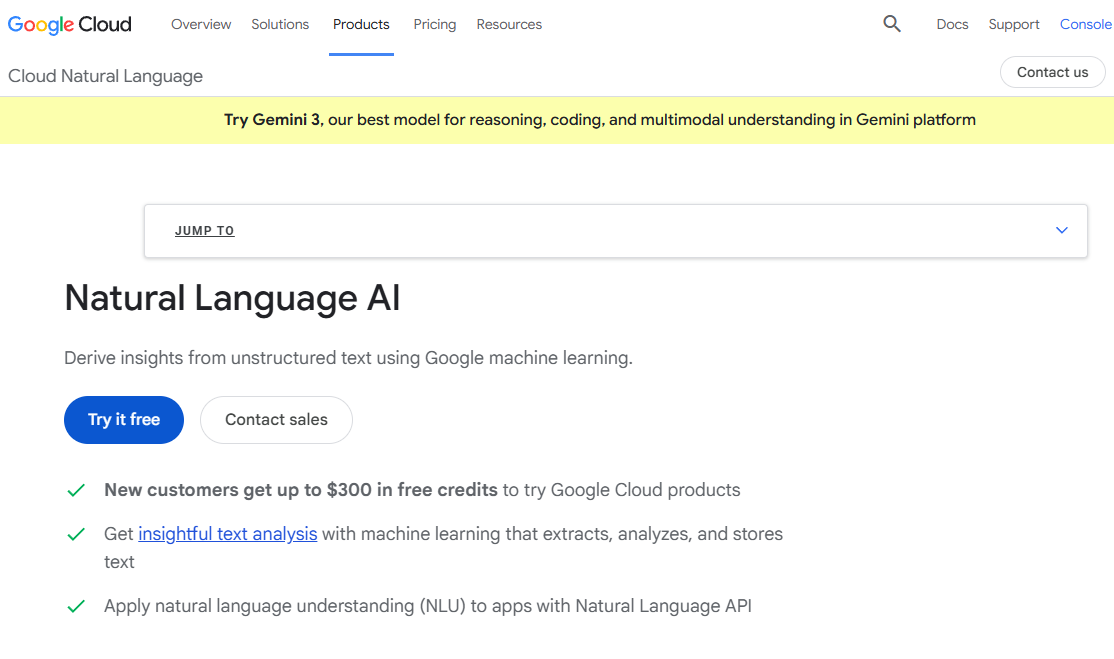
Google Cloud Natural Language API is a managed NLU service that extracts structured insights from text using pre-trained machine learning models, with no model training required. The API covers entity analysis, sentiment, syntax, entity-level sentiment, content classification, and text moderation. Teams on Google Cloud can call it directly from existing infrastructure and connect results to BigQuery, Pub/Sub, or downstream workflows.
Best for: Product and data teams already operating on Google Cloud that need reliable, pre-trained analysis of customer text, content, or support data.
Key features
- Entity and entity-sentiment analysis
- Document-level sentiment analysis
- Syntax and part-of-speech tagging
- Content classification with predefined categories
- Text moderation for harmful-content signals
Why choose Google Cloud Natural Language API: It fits teams that prioritize managed infrastructure, GCP-native billing, and defined analysis tasks over flexible generative workflows. The product performs best on structured extraction jobs; teams needing open-ended reasoning or generation will want to combine it with adjacent Google AI services.
Google Cloud Natural Language API pricing: The API uses pay-as-you-go unit pricing billed monthly. Entity Analysis and Sentiment Analysis are free for the first 5,000 units, then $1.00 per 1,000-character unit. Syntax Analysis is $0.50 per 1,000-character unit after the free tier. Entity Sentiment Analysis starts at $2.00 per 1,000-character unit above the free allowance. Content Classification is free up to 30,000 units, then $2.00 per 1,000-character unit. New Google Cloud accounts also receive up to $300 in free credits, separate from these per-feature tiers.
G2 rating: 4.3/5
2. Amazon Comprehend
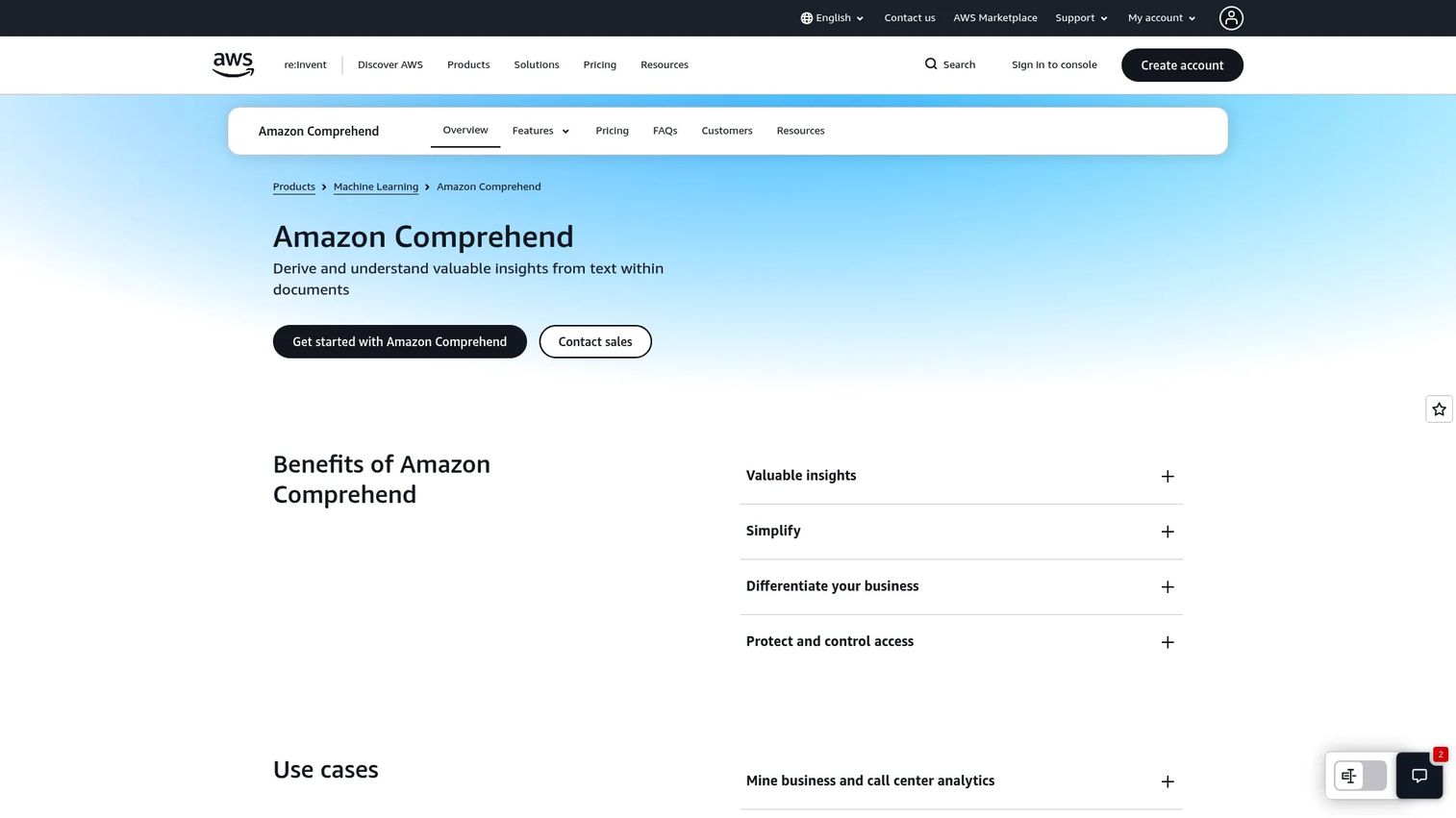
Amazon Comprehend is a managed NLP service that analyzes text at scale across entities, key phrases, language detection, targeted sentiment, syntax, and events. Beyond pre-built capabilities, the service supports custom classification models and custom entity recognizers that teams can train on their own labeled data without leaving the AWS environment. PII detection and redaction make it a practical fit for teams processing customer-facing text under data handling constraints.
Best for: Engineering and product teams building text intelligence into AWS-native applications, particularly where data already lives in S3 or flows through Lambda.
Key features
- Sentiment, key phrase, and targeted sentiment analysis
- Custom entity recognition with training on labeled data
- Custom text classification models
- PII detection and configurable redaction
- Synchronous and asynchronous document processing
Why choose Amazon Comprehend: The strongest argument for Comprehend is AWS integration depth. If your data pipeline already runs through S3, Lambda, or Kinesis, adding Comprehend avoids cross-cloud data transfer and keeps IAM-governed access controls intact. Custom models add meaningful capability, but they require labeled training data and evaluation effort, so budget for that work before committing.
Amazon Comprehend pricing: Pricing is usage-based with no fixed monthly fee. Standard NLP requests are measured in 100-character units with a 300-character minimum per request. Custom model training costs $3 per hour, and custom model management is $0.50 per month. The free tier includes 50,000 text units per API per month for eligible APIs, plus five topic-modeling jobs up to 1 MB each, available for 12 months from first use. Real-time and asynchronous jobs use different pricing meters.
G2 rating: 4.2/5
3. Microsoft Azure AI Language
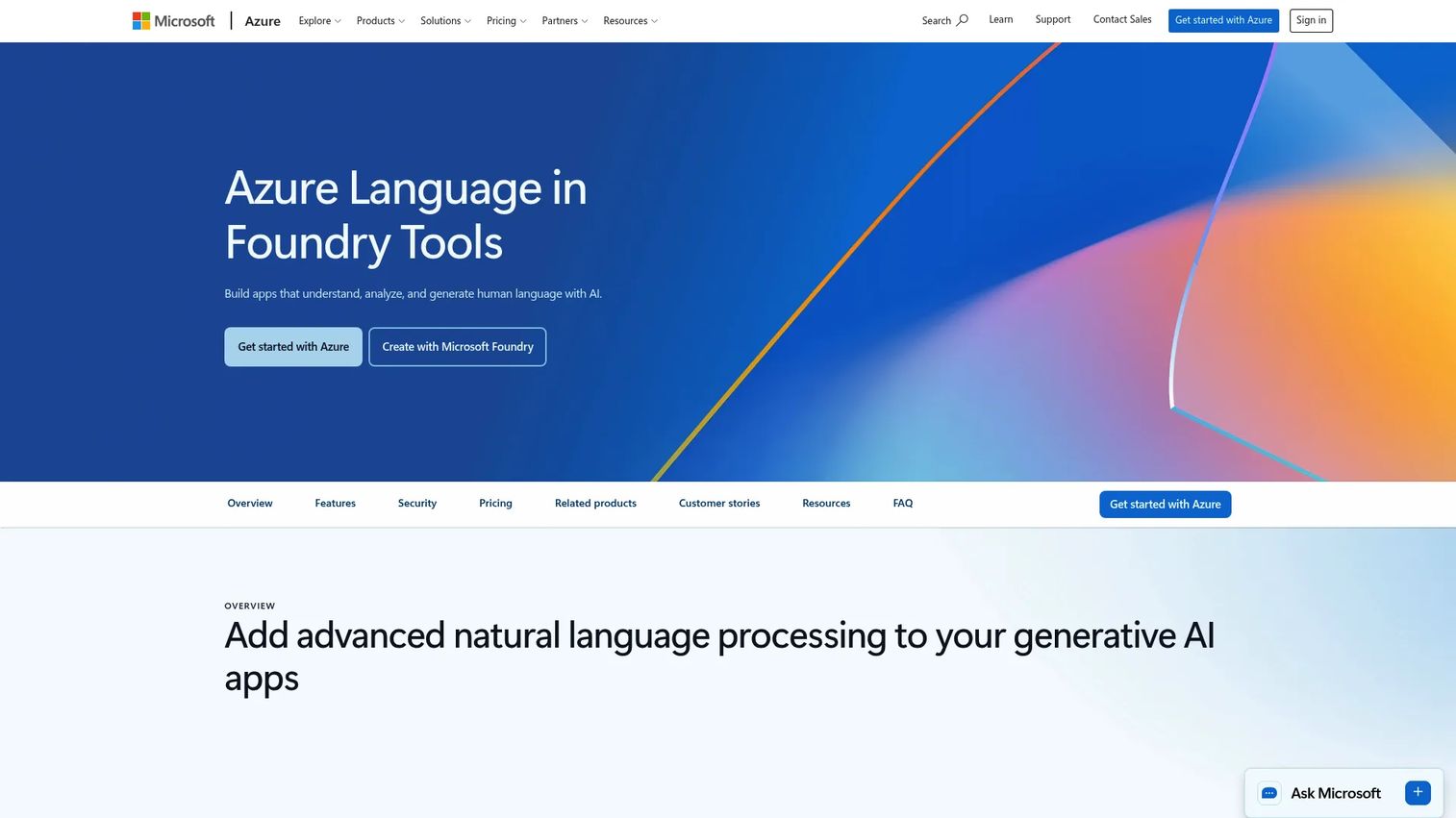
Microsoft Azure AI Language, now part of Azure Language in Foundry Tools, consolidates a range of NLP capabilities into one service. Named entity recognition, sentiment and opinion mining, extractive and abstractive summarization, conversational language understanding, custom question answering, and text analytics for health are all available from the same API surface. For organizations that govern access through Microsoft Entra and run data workloads on Azure, this integration removes friction that cross-cloud alternatives create. For those building AI customer service software on Microsoft infrastructure, Azure AI Language is frequently the foundational layer.
Best for: Product organizations already governed through Azure that need language capabilities connected to Microsoft data services, security policies, and the Power Platform.
Key features
- Named entity recognition and PII detection
- Sentiment and opinion mining at sentence and document level
- Extractive and abstractive summarization
- Conversational language understanding for intent and entity extraction
- Custom text classification with your own training data
Why choose Microsoft Azure AI Language: The case for Azure AI Language rests on governance alignment. Teams in regulated industries or large enterprises that already run security reviews against Azure posture will find the approval path shorter than it would be for a standalone NLU service. Distinguish pre-built text analytics, which require no training, from custom conversational language projects, which need labeled data and design time.
Microsoft Azure AI Language pricing: The service includes a Free tier covering 5,000 shared text records per month across several language features. Standard paid tiers are usage-based. Paid numeric pricing was not displayed on the public pricing page at time of research, so check the Azure pricing calculator directly before estimating your bill.
G2 rating: 4.3/5
4. IBM Watson Natural Language Understanding
IBM Watson Natural Language Understanding extracts structured metadata from unstructured text, including entities, keywords, categories, concepts, relations, semantic roles, sentiment, and emotion. It is an API-based service available on IBM Cloud and has been used in regulated enterprise contexts where IBM's broader AI governance and data-handling commitments matter to procurement. One important fact for evaluation: IBM announced the service was deprecated on July 31, 2026, with removal from IBM Cloud scheduled for January 31, 2028. Teams evaluating it today should factor migration planning into the total cost of ownership.
Best for: Organizations already invested in IBM Cloud architecture that need language analysis within IBM AI and data governance programs and have runway before the 2028 retirement date.
Key features
- Entity and keyword extraction
- Sentiment and emotion analysis
- Category classification for content
- Relations and semantic role extraction
- IBM Cloud deployment with governance controls
Why choose IBM Watson Natural Language Understanding: It belongs on a shortlist when language analysis must fit an IBM-centered architecture and the team has a migration plan for post-2028. Avoid broad claims about regulatory compliance outcomes; evaluate IBM's specific data-handling documentation against your own security requirements.
IBM Watson Natural Language Understanding pricing: The Lite plan is free, covering 30,000 NLU items and one custom model per calendar month. The Standard plan starts at $0.003 per item for usage beyond 5 million items per month. Custom Watson Knowledge Studio entity and relation models cost $800, and custom classification models cost $25.
G2 rating: 4.2/5
5. Hugging Face Transformers
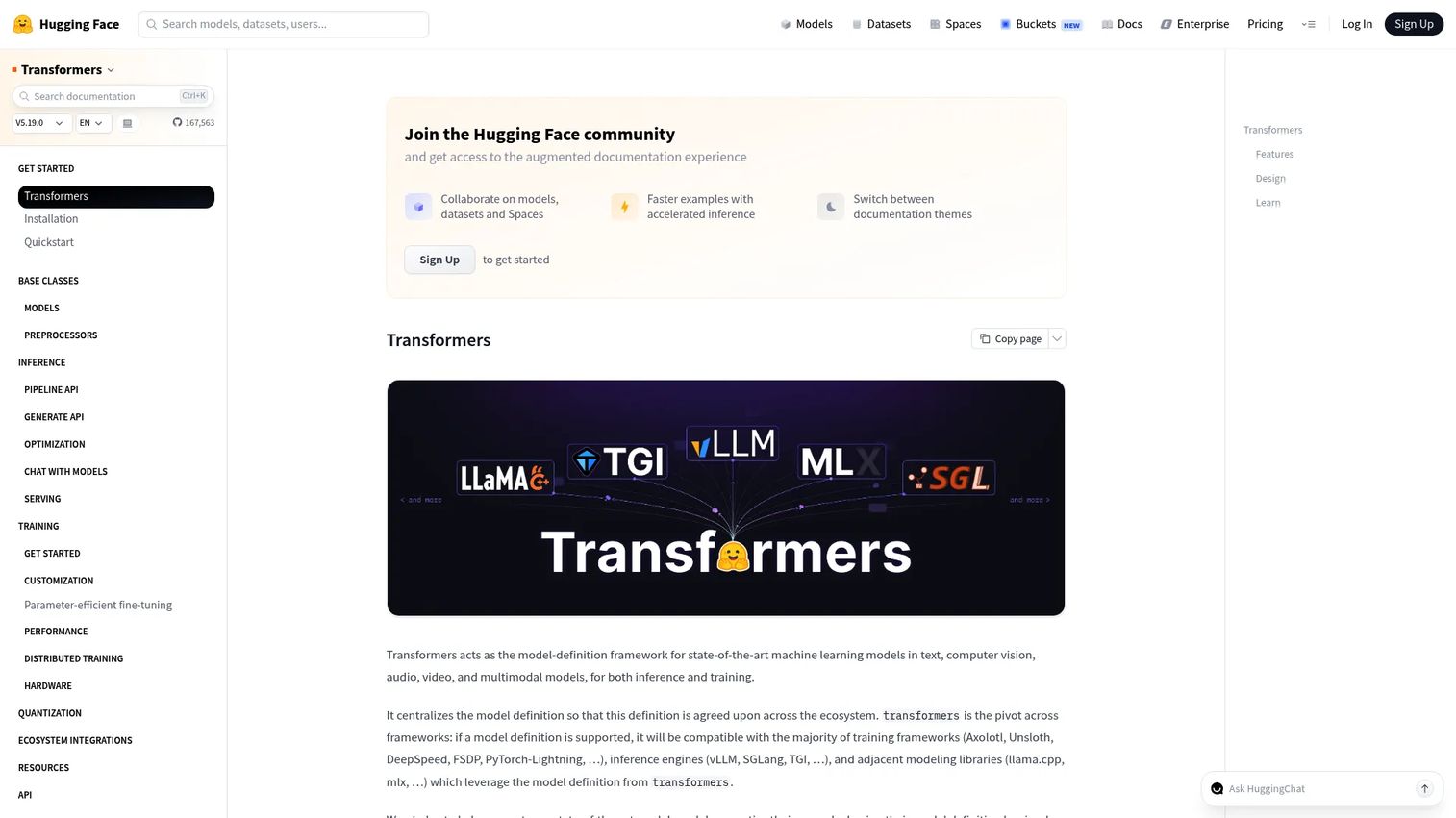
Hugging Face Transformers is an open source Python library that gives teams access to thousands of pre-trained models for text, vision, audio, and multimodal tasks. Unlike a managed NLU API, Transformers is a building block. Teams choose a model, evaluate it on their own data, fine-tune it if needed, and then handle hosting, inference, and monitoring themselves, or use Hugging Face's paid platform for some of those functions. For product and ML teams building AI model deployment pipelines, this library is often the starting point for custom NLU components.
Best for: Product and ML engineering teams that need model flexibility, domain-specific fine-tuning, or access to a wide range of open source architectures that packaged APIs cannot match.
Key features
- Pre-trained transformer model library across NLP tasks
- Pipeline API for inference: Text classification, token classification, question answering
- Trainer API for fine-tuning with mixed precision and distributed training
- Support for PyTorch, TensorFlow, and JAX
- Broad model hub with community and research models
Why choose Hugging Face Transformers: Ownership shifts to your team, including evaluation, deployment, monitoring, and model updates. That trade-off is worth accepting when the product needs domain-specific behavior, a particular model architecture, or on-premise inference that third-party APIs cannot provide.
Hugging Face Transformers pricing: The Transformers library itself is free and open source under Apache 2.0. The Hugging Face platform offers optional hosting and collaboration tiers: Pro at $9 per month, Team at $20 per month, and Enterprise at $50 per month. These platform plans cover compute, storage, and collaboration features, not the library license.
G2 rating: 4.4/5
6. spaCy
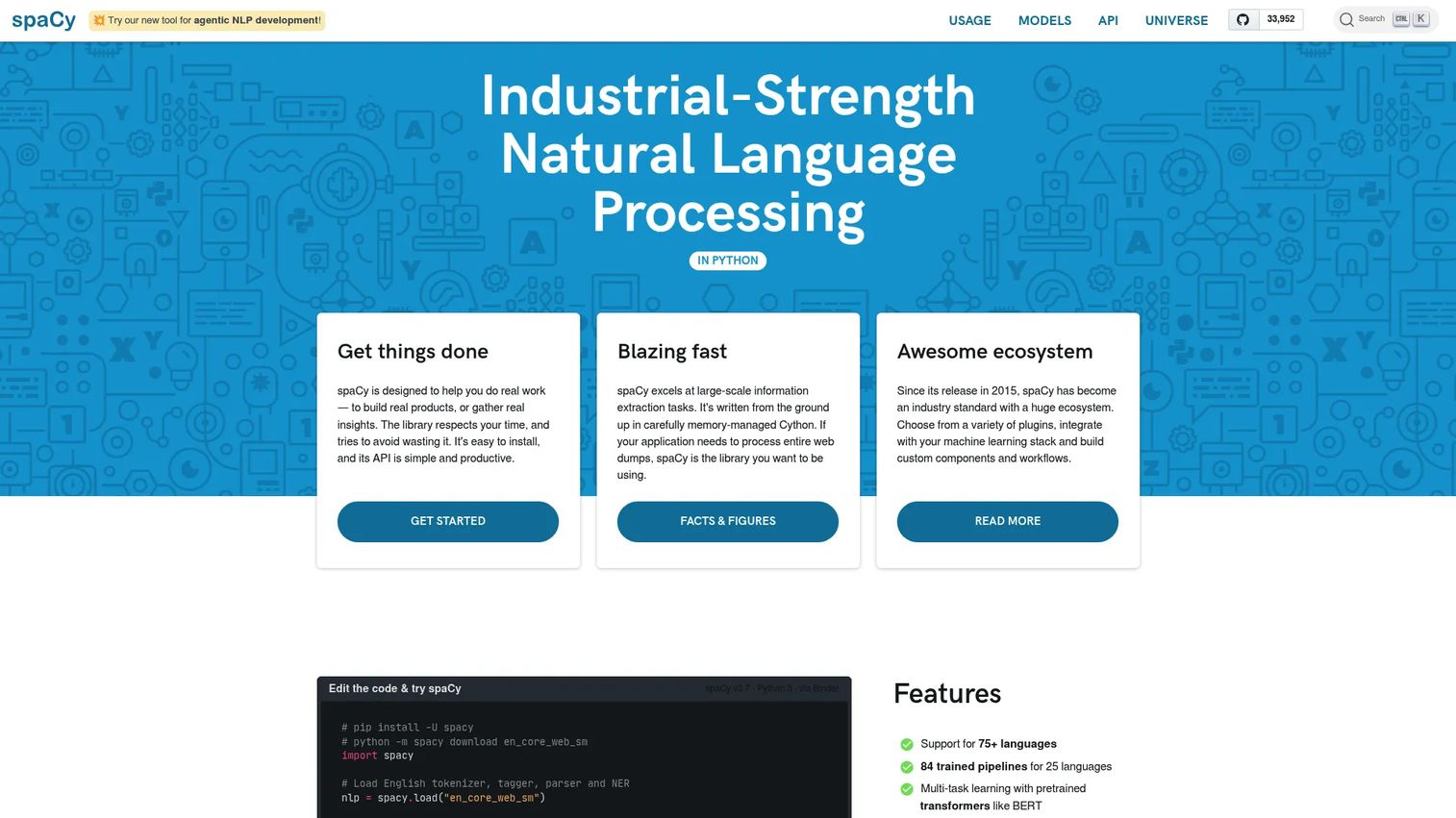
spaCy is a Python-first NLP library designed for production pipelines rather than research experimentation. It handles tokenization, part-of-speech tagging, dependency parsing, named entity recognition, sentence segmentation, text classification, lemmatization, morphological analysis, entity linking, rule-based matching, and transformer integration. Because spaCy is built for speed and determinism, it is a strong fit for engineering teams that want predictable, inspectable text processing. For a comparison with product analytics software that ingests NLP output downstream, that guide covers the analytics layer.
Best for: Engineering-led teams that need fast, controllable NLP building blocks for structured text workflows in Python production environments.
Key features
- Named entity recognition with pre-trained and custom pipelines
- Dependency parsing for relationship extraction
- Rule-based pattern matching with Matcher and PhraseMatcher
- Custom pipeline components for extensible workflows
- Built-in visualizers for debugging NLP output
Why choose spaCy: Choose it for deterministic extraction and domain-specific text workflows where you need to inspect and trust exactly what the model does at each step. It is especially useful when a fully generative model would be excessive for the task and when the team needs to maintain the pipeline across frequent product releases without large evaluation overhead.
spaCy pricing: The core library is free and open source under the MIT license. There is no paid tier for the library itself. Commercial support or training options may be available through Explosion AI, the company behind spaCy, but no public pricing for those services appeared on the official site at time of research.
G2 rating: 4.5/5
7. OpenAI
OpenAI offers general-purpose foundation models rather than a narrow, task-specific NLU API. For product managers building AI features, this matters because the same model can handle classification, entity extraction, summarization, semantic search via embeddings, structured JSON outputs, and multi-turn assistant experiences. Teams building AI copilot software or AI product features often start with OpenAI's API before deciding whether a more specialized tool is worth the switching cost.
Best for: SaaS product teams prototyping or shipping flexible AI features that require both language understanding and generated responses in the same workflow.
Key features
- Structured output mode for reliable JSON extraction
- Text embeddings for semantic search and clustering
- Function and tool calling for agentic workflows
- Text classification via prompt-based or fine-tuned approaches
- Multimodal input including images and documents
Why choose OpenAI: Use it when the product roadmap involves more than a single, well-defined NLU task. The flexibility is real, but so is the operational investment: Prompt versioning, evaluation pipelines, output monitoring, safety controls, and cost tracking all require deliberate instrumentation before a feature is production-ready.
OpenAI pricing: ChatGPT plans start free, with Plus at $20 per month, Pro at $200 per month, and Team at $25 per user per month (annual) or $30 per user per month (monthly). API pricing is token-based and varies by model; check the OpenAI API pricing page directly before estimating costs, as rates change frequently.
8. Cohere
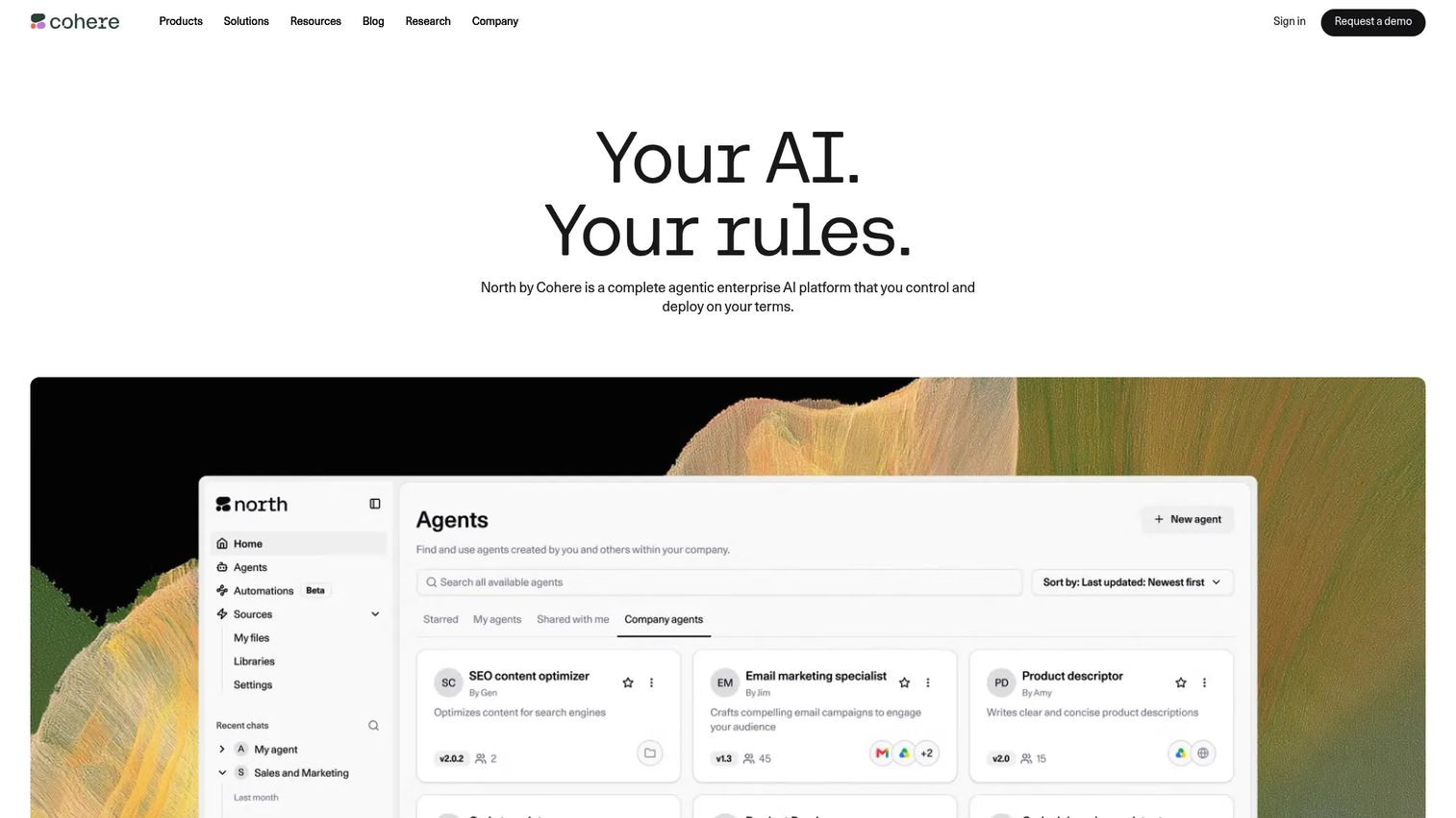
Cohere builds enterprise AI products focused on retrieval, embeddings, reranking, and generative language workflows over private data. Its Embed and Rerank products are designed specifically for search quality improvement, which matters to product managers who know that poor retrieval accuracy drives user frustration and support tickets. For teams building enterprise search software or knowledge assistant features, Cohere's retrieval-first positioning is worth evaluating as an alternative to general-purpose foundation models. Cohere also supports private deployment through its Model Vault, including encrypted inference for organizations with strict data residency requirements.
Best for: Product teams where semantic search quality, retrieval relevance, and enterprise data privacy are central product requirements rather than secondary features.
Key features
- Text embeddings for semantic search, clustering, and classification
- Rerank model for improving retrieval result relevance
- Enterprise language models for chat, reasoning, and RAG workflows
- Private deployment via Model Vault with encrypted inference
- North agentic AI platform with enterprise workflow integrations
Why choose Cohere: Search quality shapes feature adoption and support deflection in ways that are easy to underestimate. If ranking and retrieval are core to the product experience, Cohere's purpose-built Rerank and Embed products can outperform general embedding APIs in retrieval benchmarks. The enterprise deployment model also addresses data governance concerns earlier in the procurement process.
Cohere pricing: The API offers free trial usage. For production workloads, Standard Vault pricing for Embed 4 Small starts at $4.00 per hour per instance, $2,500 per month, or $25,000 per year. Other model and enterprise offerings may require a sales conversation for pricing.
9. Anthropic Claude

Anthropic Claude is a foundation model platform suited to reasoning, long-document analysis, text transformation, classification, structured extraction, and assistant experiences. Claude is not a pre-packaged NLU API, but its strong performance on complex, context-heavy inputs makes it a practical choice for product teams working with large documents, multi-turn customer context, or enterprise assistant workflows. For teams evaluating agentic AI platforms that use Claude as an underlying model, the linked guide covers the orchestration layer. McKinsey (2025) found that 62% of surveyed organizations were at least experimenting with AI agents, which signals broad organizational readiness for the kinds of workflows Claude supports.
Best for: Product teams building AI features where understanding long or complex inputs matters, including enterprise document analysis, configurable AI assistants, and structured extraction from lengthy source material.
Key features
- Long-context document analysis across extended inputs
- Structured data extraction via tool use and JSON output
- Text classification and sentiment analysis via prompting
- Tool use and multi-step workflow execution
- Enterprise access controls and configurable safety settings
Why choose Anthropic Claude: It earns consideration when the product requires strong reasoning over documents that exceed what shorter-context models handle reliably, or when enterprise guardrails and response configurability are evaluation criteria alongside raw capability. Model evaluations must reflect your own domain language, edge cases, and acceptable error thresholds before committing.
Anthropic Claude pricing: The Free plan is available to everyone. Pro costs $17 per month on annual billing ($200 billed up front) or $20 per month billed monthly. Max plans start from $100 per month. Team is $25 per person per month (annual) or $30 per month with a minimum of five members. Enterprise pricing requires contacting Anthropic's sales team. Separate API model pricing also applies for developers building directly on Claude.
G2 rating: 4.6/5
Considerations when choosing natural language understanding software
Define the task before comparing model brands
The product requirement should come first. Decide whether you need entity extraction, intent classification, semantic search, summarization, or a multi-function AI assistant before evaluating platforms. A model that excels at open-ended reasoning adds unnecessary cost and evaluation overhead for deterministic extraction jobs.
Establish a labeled evaluation set before committing
Build a representative test set from real product language, with sensitive data removed. Measure precision, recall, consistency, latency, and cost per successful task. Include ambiguous inputs and multilingual examples if the product supports multiple languages. Results from your own domain will differ significantly from benchmark scores.
Match the deployment model to your engineering capacity
Managed APIs reduce infrastructure work but limit model control. Open source frameworks add operational ownership, including deployment, monitoring, and model updates. Foundation model platforms speed up prototyping but require strong prompt versioning, evaluation discipline, and observability practices before production rollout.
Treat governance as a product requirement, not a procurement checkbox
Evaluate data retention controls, data handling terms, PII detection workflows, regional deployment options, access management, and vendor model-change policies. Surface these requirements before the prototype gains internal traction, not after. For a broader look at AI governance tools, that guide covers the governance and compliance layer specifically.
Plan for release cadence and model drift
Language behavior changes as models update, prompts evolve, taxonomies shift, and product vocabulary grows. Assign an owner, version prompts and classifiers, and schedule quality reviews after major product releases. Unmonitored NLU features accumulate technical debt faster than most engineering teams expect.
Conclusion
The natural language understanding software category spans three meaningfully different deployment models, and the right choice depends on your specific task and team capacity.
Choose Google Cloud Natural Language API, Amazon Comprehend, Microsoft Azure AI Language, or IBM Watson Natural Language Understanding when the job is a defined extraction or classification task and your team operates within that vendor's cloud infrastructure. Each brings pre-trained capabilities with minimal setup overhead, and each connects to its parent cloud's governance and security controls. Note that IBM's service is deprecated and scheduled for removal in 2028.
Choose Hugging Face Transformers or spaCy when your team has ML engineering capacity and needs domain adaptation, custom entity types, or on-premise inference that API-based services cannot provide. The library is free; the operational cost is real.
Choose OpenAI, Cohere, or Anthropic Claude when the roadmap includes flexible AI features, retrieval, document intelligence, or multi-turn assistant experiences that go beyond what a pre-built NLU API can handle.
The most practical next step: Pick one high-value workflow, create a small labeled evaluation set, and run the top two candidates against the same inputs before committing to the architecture. That exercise surfaces latency, cost, and accuracy differences that no comparison table can fully capture.
FAQs
NLP is the broader discipline covering all computational work with human language, including parsing, generation, translation, and speech. NLU is the subset focused on interpreting meaning: Intent, sentiment, entities, relationships, and context. Modern foundation models blur the older category boundaries, but the distinction remains practically useful when scoping a product requirement, since it helps you decide whether you need interpretation, generation, or both.
The answer depends on the specific job. Managed APIs like Google Cloud Natural Language API and Amazon Comprehend fit defined extraction and classification tasks. Foundation model platforms like OpenAI and Anthropic Claude fit flexible AI features and retrieval workflows. Open source tools like Hugging Face Transformers and spaCy fit teams that need deeper model control or domain-specific pipelines. Start with the task, not the brand.
Yes. Classification, topic extraction, entity recognition, sentiment analysis, and summarization all apply to feedback data from support tickets, NPS surveys, app reviews, and research transcripts. Before routing results into roadmap decisions, validate the model's output against a manually labeled sample to establish a precision baseline and catch systematic errors in your specific product domain.
Precision, recall, and F1 score measure extraction and classification accuracy. Latency and cost per request affect product experience and unit economics at scale. Failure rate and user correction rate reveal real-world reliability. Retrieval relevance scores apply to semantic search use cases. Downstream business metrics, including ticket deflection rate, search success rate, and support containment rate, connect model performance to outcomes your stakeholders care about.
A managed NLU API often suits stable, well-defined intent taxonomies where classification accuracy is high and the vocabulary is consistent. LLMs handle more flexible language, can manage far fewer labeled examples, and adapt to new intents without retraining. The trade-off is that LLMs require stronger output controls, prompt versioning, and evaluation pipelines before production use. For a small, stable intent set, the managed API is usually faster and cheaper to operate. For an evolving or complex intent space, an LLM may reduce annotation overhead.
All nine tools in this guide offer some multilingual support, but quality varies significantly by language, dialect, domain terminology, and task type. Major languages like English, Spanish, French, and German typically receive the most model development investment. Before committing to a platform for a multilingual product, require test cases from the specific languages your users write in, not just the languages a vendor lists on its feature page.
Semantic search uses embeddings, numerical representations of text meaning, to match queries to documents by conceptual similarity rather than keyword overlap. A reranking model then orders results by relevance. For grounded answer generation (retrieval augmented generation), a language model synthesizes an answer from retrieved documents. Each layer needs its own evaluation: Embedding quality, retrieval recall, ranking precision, and answer accuracy all require separate measurement before a search feature ships.
Pricing models differ by category. Cloud NLU APIs like Google Cloud Natural Language API and Amazon Comprehend charge per unit of text processed. Foundation model platforms like OpenAI and Anthropic Claude charge per input and output token. Cohere's Model Vault charges by the hour or month per instance. Open source libraries like spaCy and Hugging Face Transformers are free; the cost is in hosting, compute, and engineering time. Model total cost of ownership by successful user task rather than by raw request volume to get a figure your finance team can work with.