There are more places to buy crypto than ever, and most of them look identical on the surface. Same charts. Same "trusted by millions" copy. Same promise of the lowest fees. Then you fund an account, place your first trade, and the spread quietly eats a percentage you never saw advertised.
That gap between the advertised fee and the real cost is where most people lose money without noticing. A maker-taker schedule reads clean on a pricing page. An instant-buy spread does not. And the platform that feels cheapest for a $100 purchase can be the most expensive one once you start trading actively.
The stakes are not small. The global cryptocurrency exchange platform market was worth about USD 45.9 billion in 2023 and is projected to reach USD 264.3 billion by 2030, a 28.4% CAGR according to Grand View Research (2024). Global crypto users sat around 560 million in 2024 and could pass 1 billion by 2030, per HashCodex (2025). More users, more platforms, more noise to cut through before you commit funds.
This shortlist skips the hype. The goal is simple: help you match a cryptocurrency exchange platform to how you actually intend to use it, whether that means a first purchase, active trading, or self-custody swaps. Fee transparency and security come first because those are the two things that quietly compound over time.
What's inside
This guide is for anyone choosing a primary crypto exchange, from a founder parking treasury exposure to an active trader optimizing fees. We picked seven platforms and ranked them by fit, not popularity.
Each pick was evaluated against four criteria that matter most when real money is involved:
- Fees and cost transparency: maker-taker schedules, instant-buy spreads, and subscription options.
- Security and trust posture: custody model, compliance history, and account protections.
- Liquidity and asset breadth: how deep the order books run and how many assets you can access.
- Usability across surfaces: beginner experience, advanced tooling, and mobile app quality.
The list balances mainstream centralized exchanges with one decentralized option, so readers who want self-custody and permissionless swapping have a clear path too.
TL;DR
Short on time? Here are the decision shortcuts by use case:
- Best for beginners and trust: Coinbase. Clean UX, strong compliance posture, and a subscription that rebates trading fees.
- Best for balanced active trading: Kraken. Transparent maker-taker fees, deep liquidity, and stocks plus ETFs on the same platform.
- Best for security-focused users: Gemini. Compliance-first positioning and ActiveTrader for execution quality.
- Best for mobile and rewards: Crypto.com. Mobile-first exchange with card rewards and CRO benefits.
- Best for low-fee breadth: Binance. Broad market access and consistently high liquidity in volume rankings.
- Best for altcoin variety: BitMart. Wide token selection plus copy trading and futures.
- Best for DeFi and self-custody: Uniswap. Permissionless onchain swaps with full wallet control.
What a cryptocurrency exchange platform is
A cryptocurrency exchange platform is a service that lets you buy, sell, convert, and trade digital assets, either through a company that holds your funds (centralized) or through a protocol that lets you trade directly from your own wallet (decentralized).
Most people start with a centralized exchange because it feels familiar. You create an account, verify your identity, connect a bank card or transfer, and buy crypto in a few clicks. The exchange holds your assets in custody and runs the order book that matches buyers and sellers. A decentralized exchange (DEX) removes the middleman: trades settle onchain, and you keep custody of your assets the entire time.
Core functions to expect from any crypto trading platform:
- Buy and sell: convert fiat to crypto and back, often with a card, bank transfer, or fiat on-ramp.
- Convert and swap: move between assets like BTC and ETH without cashing out to fiat.
- Order book access: place market, limit, and stop orders against live liquidity.
- Custody: hold assets in an exchange wallet, or withdraw to self-custody.
- Liquidity: deep order books mean tighter spreads and less slippage on larger trades.
The distinction between custodial and non-custodial matters more than most beginners realize. On a centralized exchange, the platform controls the private keys. On a DEX, you do. That single difference shapes everything from security to convenience.
Centralized exchange vs decentralized exchange
The two models solve the same problem in opposite ways. Here is the plain-English version.
| Model | How it works | Best for |
|---|---|---|
| Centralized exchange (CEX) | Company holds custody, runs the order book, handles fiat on-ramps and support | First purchases, recurring buys, active trading, fiat deposits |
| Decentralized exchange (DEX) | Protocol matches trades onchain via liquidity pools, you keep custody | Self-custody, permissionless token swaps, DeFi access |
Most readers should start with a centralized exchange. It handles the boring-but-critical parts: identity verification, fiat rails, customer support, and a familiar interface. Once you understand how trading works and want to hold assets yourself or access tokens not listed on major exchanges, a DEX becomes worth adding. The evaluation path is different: instead of comparing account features, you are comparing wallet compatibility, supported chains, and network fees.
When to use each type
Not every crypto exchange fits every buyer. Here is how to match the model to your situation.
Choose a centralized exchange when you want simplicity
If this is your first purchase, or you plan to set up recurring buys and fund from a bank account, a centralized exchange is the obvious starting point. Fiat on-ramps, clear onboarding, and account recovery options make the experience approachable. This is where nearly every reader should begin, and it covers most crypto exchanges in USA that serve retail users.
Choose an advanced exchange when you care about fees and execution
Active traders live and die by maker-taker pricing, spread, and charting depth. If you place limit orders, trade frequently, or move larger size, the difference between a 0.60% taker fee and a 0.10% one compounds fast. A low fee crypto exchange with deep liquidity and a real order book saves meaningful money over a year of trading.
Choose a DEX when self-custody and permissionless access matter
If you want to hold your own keys, swap tokens without an account, or access assets that centralized platforms have not listed, a DEX is the tool. You connect a wallet, approve a swap, and pay network fees. There is no signup and no custody handoff. This path suits readers comfortable managing a wallet and reading onchain transaction costs.
Comparison table
The table below sorts by fit for the primary keyword and reader intent, not alphabetically or by volume. Pricing reflects verified first-party sources where available; crypto exchange fees vary by product, tier, and jurisdiction, so always confirm the current schedule before funding.
| # | Product | Intent | Key differentiation | Pricing | G2 rating |
|---|---|---|---|---|---|
| 1 | Coinbase | Beginners and trust | Mainstream UX with fee-rebate subscription | Coinbase One from $4.99/month | 4.0/5 |
| 2 | Kraken | Balanced active trading | Maker-taker tiers plus US stocks and ETFs | 0.40% maker / 0.80% taker (Tier 1) | 4.1/5 |
| 3 | Gemini | Security-focused users | Compliance-first with ActiveTrader | Free account; product-specific fees | 4.4/5 |
| 4 | Crypto.com | Mobile and rewards | Card rewards plus CRO benefits | Basic free; Plus from $4.99/month | 4.1/5 |
| 5 | Binance | Low-fee breadth | Broad market access and liquidity | Maker-taker (varies by tier) | 4.0/5 |
| 6 | BitMart | Altcoin variety | Wide token selection plus copy trading | Futures maker 0.0400% / taker 0.0600% | Not listed |
| 7 | Uniswap | DeFi and self-custody | Permissionless onchain swaps | 0% interface fee; network costs apply | Not listed |
1. Coinbase
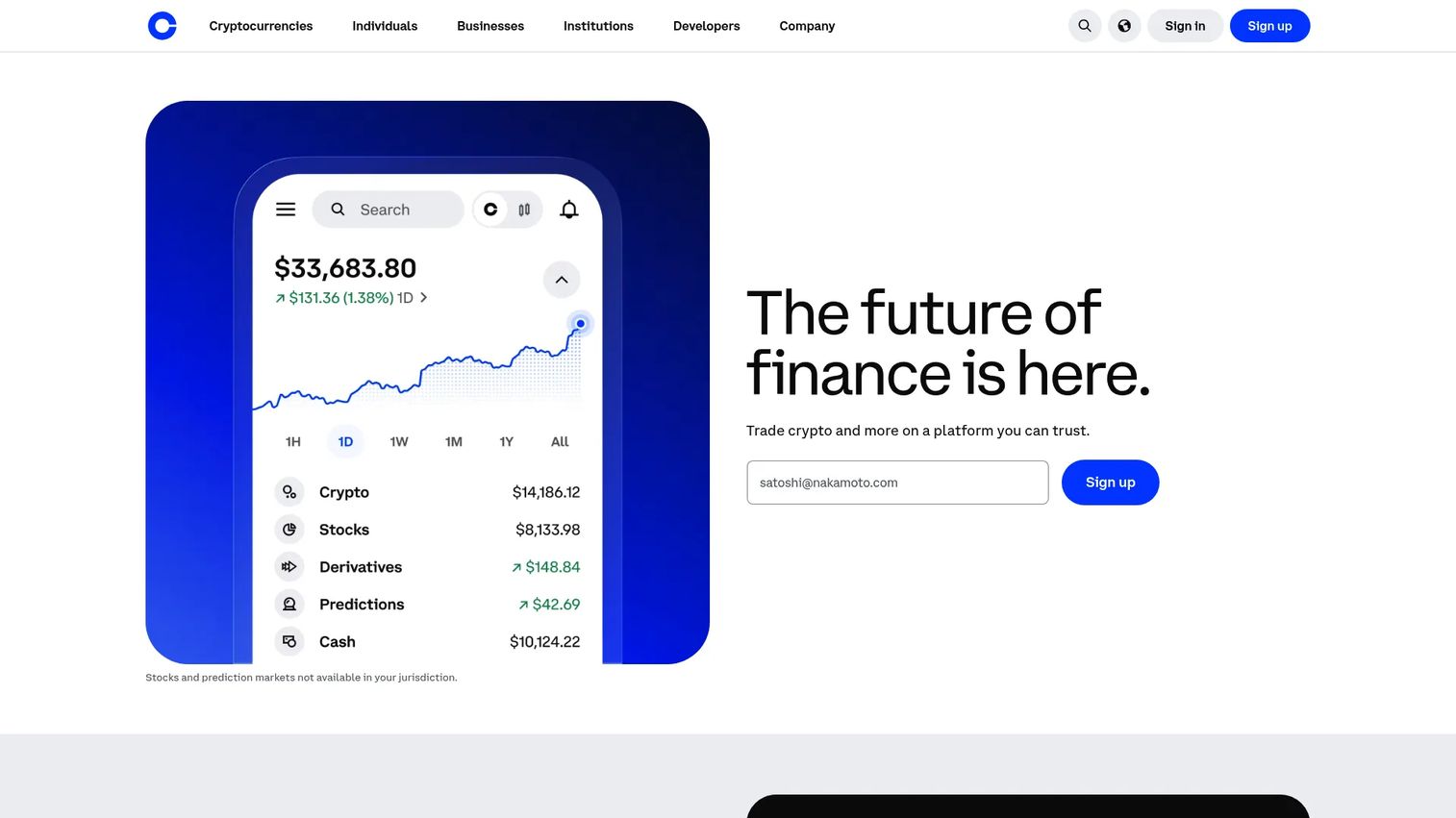
Coinbase is the platform most people mean when they say "buy some crypto." It built its reputation on trust: a public US company, a strong compliance posture, and an interface that a first-time buyer can navigate without a tutorial. The main app handles simple buying with fixed pricing, while Coinbase Advanced Trade opens up volume-based maker-taker fees and deeper charting for people who want tighter execution.
The ecosystem story is what keeps users on the platform as they mature. You can buy and sell crypto, access advanced trading tools and developer products, and use a self-custody wallet, all under one brand. That breadth means a beginner does not have to switch platforms when they want more control later.
Best for: Beginners and trust-focused buyers who want a mainstream, compliant on-ramp with room to grow into advanced trading.
Key strengths
- Trust and compliance: A regulated US public company with a long track record and clear account protections.
- Two-tier experience: Simple app for buying, Advanced Trade for maker-taker pricing and charting.
- Fee rebates via subscription: Coinbase One membership offsets trading fees for active users.
Why choose Coinbase: If security and ease of use matter more than shaving every basis point off your fees, Coinbase is the safe default. It suits founders and first-time buyers who value a recognizable, compliant brand and a smooth onboarding path over the absolute lowest cost.
Coinbase pricing: Coinbase One membership comes in three tiers. Basic is $4.99/month or $49.99/year, Preferred is $29.99/month or $299.99/year, and Premium is $299.99/month or $2,999.99/year. Each tier layers on trading-fee benefits, support, and rewards. Standard trading on the app carries a spread plus fees; Advanced Trade uses volume-based maker-taker pricing.
2. Kraken
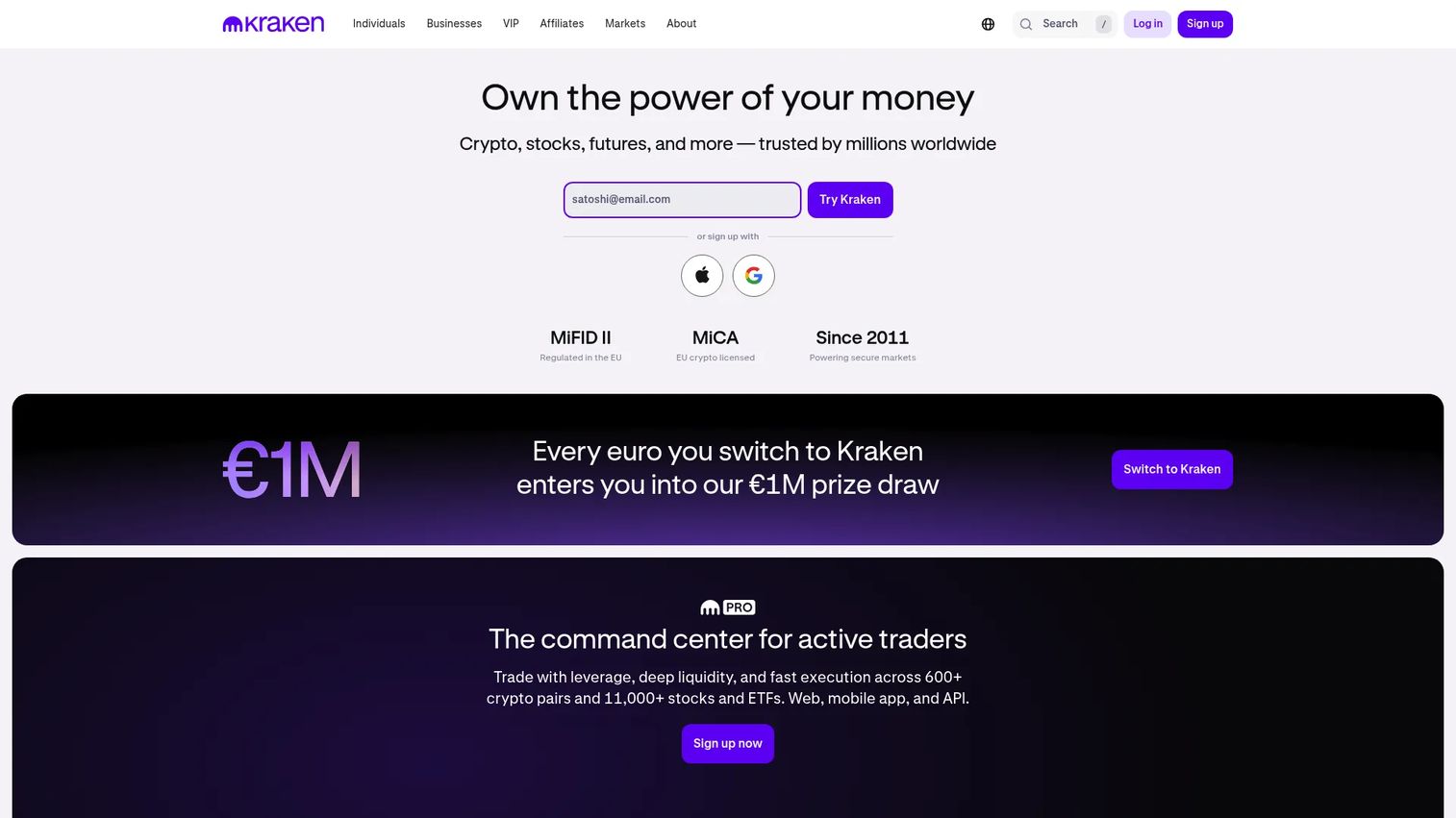
Kraken has spent years building a reputation for fee transparency and reliability, which is exactly what active traders want. The platform splits into a simple experience for casual buyers and a more advanced path with maker-taker fee tiers, deep liquidity, and serious charting. It is one of the few crypto trading platforms that also offers US stocks and ETFs alongside crypto, futures, margin, and staking.
That combination makes Kraken a strong home base for someone who wants one account for both crypto and traditional assets. The fee schedule is public and readable, which removes the guesswork that plagues instant-buy pricing elsewhere.
Best for: Active crypto traders who want transparent fees, deep liquidity, and US stocks plus ETFs on one platform.
Key strengths
- Transparent maker-taker fees: A public, tiered schedule that scales down as 30-day volume rises.
- Multi-asset access: Crypto, US stocks, ETFs, futures, margin, and staking in one place.
- Execution depth: Deep order books and advanced order types for serious traders.
Why choose Kraken: Choose Kraken when you value fee clarity and want to trade actively without stitching together multiple platforms. It fits the reader who has outgrown a beginner app but still wants a clean, well-documented experience.
Kraken pricing: Kraken uses a maker-taker fee model based on 30-day trading volume. The entry tier is 0.40% maker and 0.80% taker, scaling down to 0.0% maker and 0.10% taker at higher volume tiers, with Pro tiers reaching as low as 0.0% maker and 0.05% taker. Kraken also offers commission-free stock and ETF trading in the US. Instant buys carry a spread rather than a listed flat fee.
3. Gemini
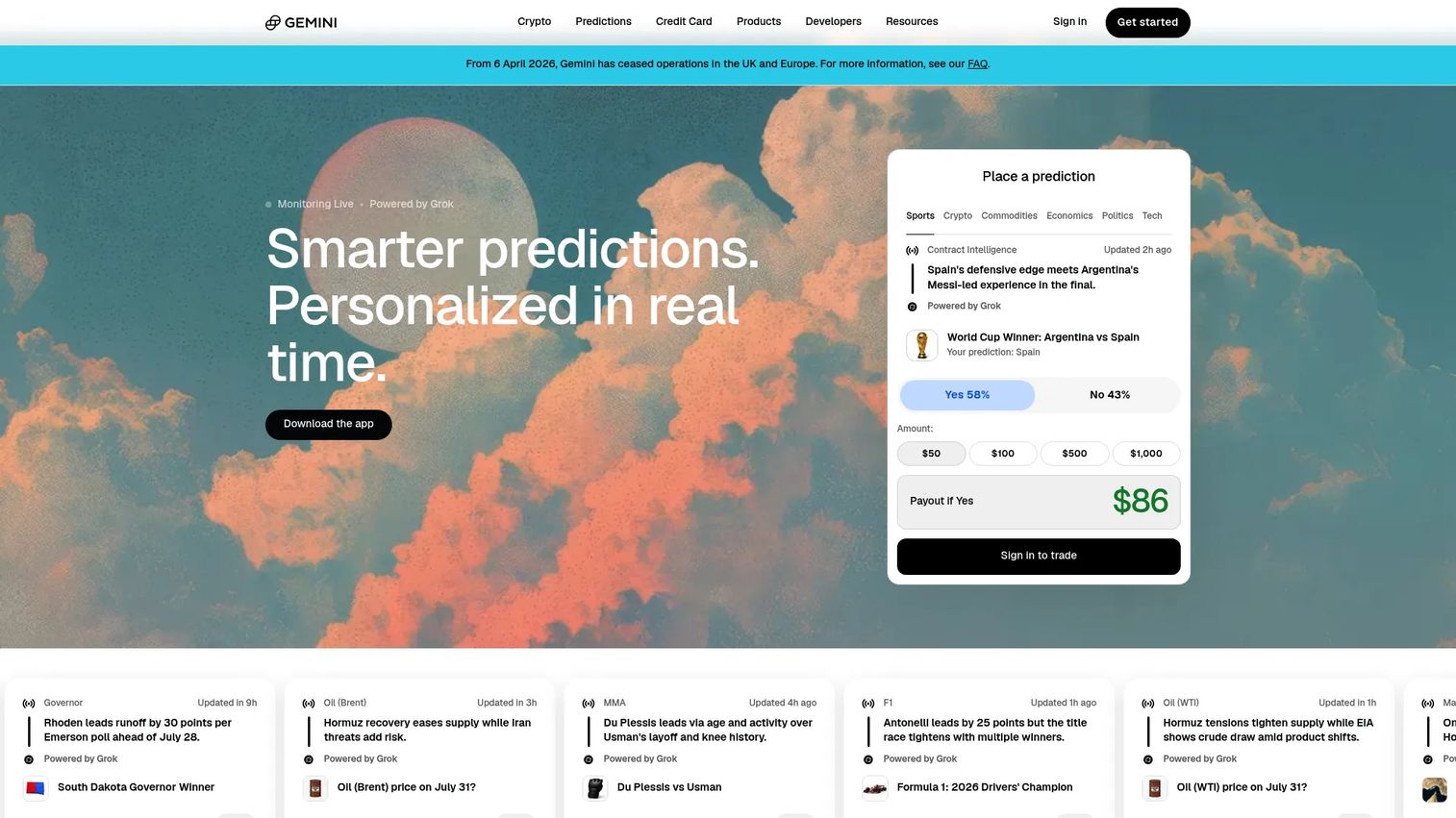
Gemini built its brand around one idea: security first. The platform emphasizes a compliance-forward posture, custody options, and a track record that appeals to users who treat safety as the primary buying criterion. Its ActiveTrader interface delivers advanced charting and multiple order types for people who want execution quality, while the standard Gemini experience keeps buying simple.
The platform also supports staking, custody, clearing, and mobile trading, plus derivatives availability in selected jurisdictions. For a security-focused buyer, Gemini is built to inspire confidence without sacrificing the tools that active traders need.
Best for: Security-focused individuals and businesses who want a compliance-forward crypto exchange with a capable advanced trading interface.
Key strengths
- Security-first positioning: Compliance posture and custody options aimed at safety-conscious users.
- ActiveTrader interface: Advanced charting and multiple order types for precise execution.
- Broad product suite: Staking, custody, clearing, wallet, and mobile trading under one roof.
Why choose Gemini: Pick Gemini when trust and execution quality are non-negotiable. It suits users and businesses who want a secure crypto exchange with institutional-grade custody thinking, without giving up an advanced trading path.
Gemini pricing: Gemini offers a free account. Rather than a single platform-wide subscription price, it uses product-specific fee schedules. The standard Gemini mode applies a fee and spread on instant orders, while ActiveTrader uses a volume-based maker-taker schedule that lowers as trading activity grows. Confirm the current fee page for the exact tiers that apply to your volume.
4. Crypto.com
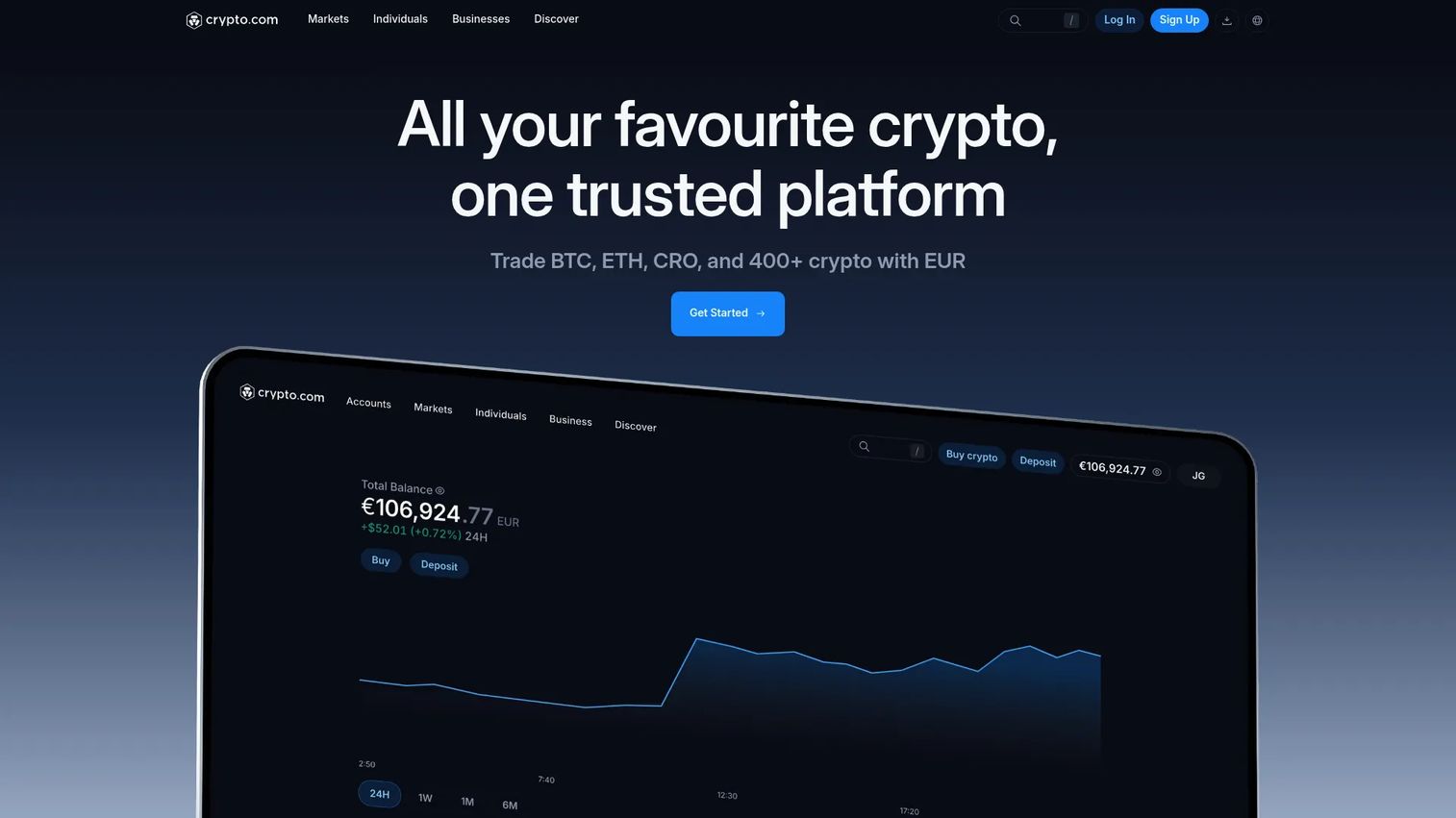
Crypto.com is built mobile-first, and it shows. The exchange app packs broad asset access, advanced trading features, and a rewards system tied to CRO balances and its card program. If your crypto life happens on your phone, this is one of the strongest crypto exchange apps for day-to-day use, from buying and trading to spending through the card.
The platform supports 400+ cryptocurrencies and layers on cash-back and APY benefits through its Level Up tiers. For readers who want an all-in-one hub that combines trading, earning, and spending, Crypto.com covers a lot of ground in a single app.
Best for: Mobile-first users who want an all-in-one app combining trading, rewards, and a crypto card.
Key strengths
- Mobile-first experience: A polished app for buying, trading, and managing crypto on the go.
- Rewards and card benefits: CRO balance perks, cash-back, and APY through Level Up tiers.
- Broad asset access: Support for 400+ cryptocurrencies with fee credits at higher tiers.
Why choose Crypto.com: Choose Crypto.com if mobile usability and rewards matter as much as raw trading. It fits users who want their exchange, card, and earning products in one place rather than spread across separate apps.
Crypto.com pricing: The Level Up program includes Basic (free), Plus at US$4.99/month or US$49.90/year, Pro at US$29.99/month or US$299.90/year, and Private, which requires a 12-month CRO lockup starting at US$50k. Higher tiers unlock zero trading fees, cash benefits, and APY. Spot trading fees follow a maker-taker structure by volume tier, with CRO balance benefits reducing costs further.
5. Binance
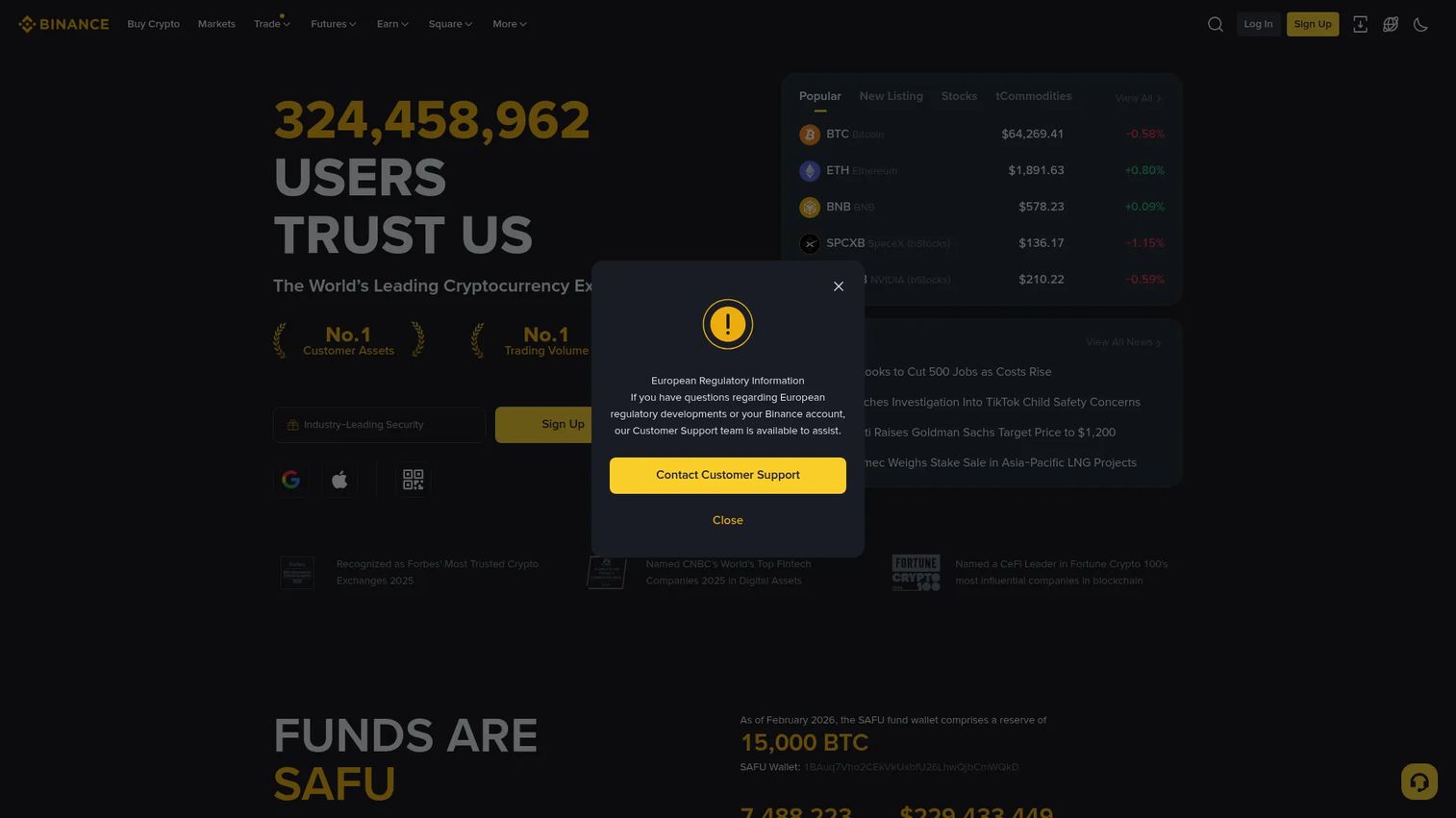
Binance consistently shows up at the top of volume rankings for one reason: liquidity. Deep order books mean tighter spreads and less slippage, which matters most when you trade actively or move larger size. The platform offers spot, margin, and futures trading, P2P trading, and passive rewards through Binance Earn, giving traders a wide surface to work with.
Its low-fee positioning and market breadth make it a magnet for cost-conscious traders. That said, availability varies by jurisdiction, and the regulatory picture differs from region to region, so confirm what is accessible where you live before committing.
Best for: Cost-conscious active traders who want deep liquidity and broad market access.
Key strengths
- Deep liquidity: Consistently high volumes mean tighter spreads and lower slippage.
- Market breadth: Spot, margin, futures, and P2P trading across a wide asset range.
- Passive earning: Binance Earn products for holding and generating yield.
Why choose Binance: Choose Binance when low fees and liquidity are your priority and you are comfortable verifying regional access. It suits experienced traders who value cost efficiency and a broad market over a simplified beginner flow.
Binance pricing: Binance uses a maker-taker fee model, with exact rates varying by product and VIP tier. Fees scale down as trading volume rises, and holding the platform's native token can reduce costs further. Because the schedule differs by product and jurisdiction, check the current fee page for the rates that apply to your account and region before trading.
6. BitMart
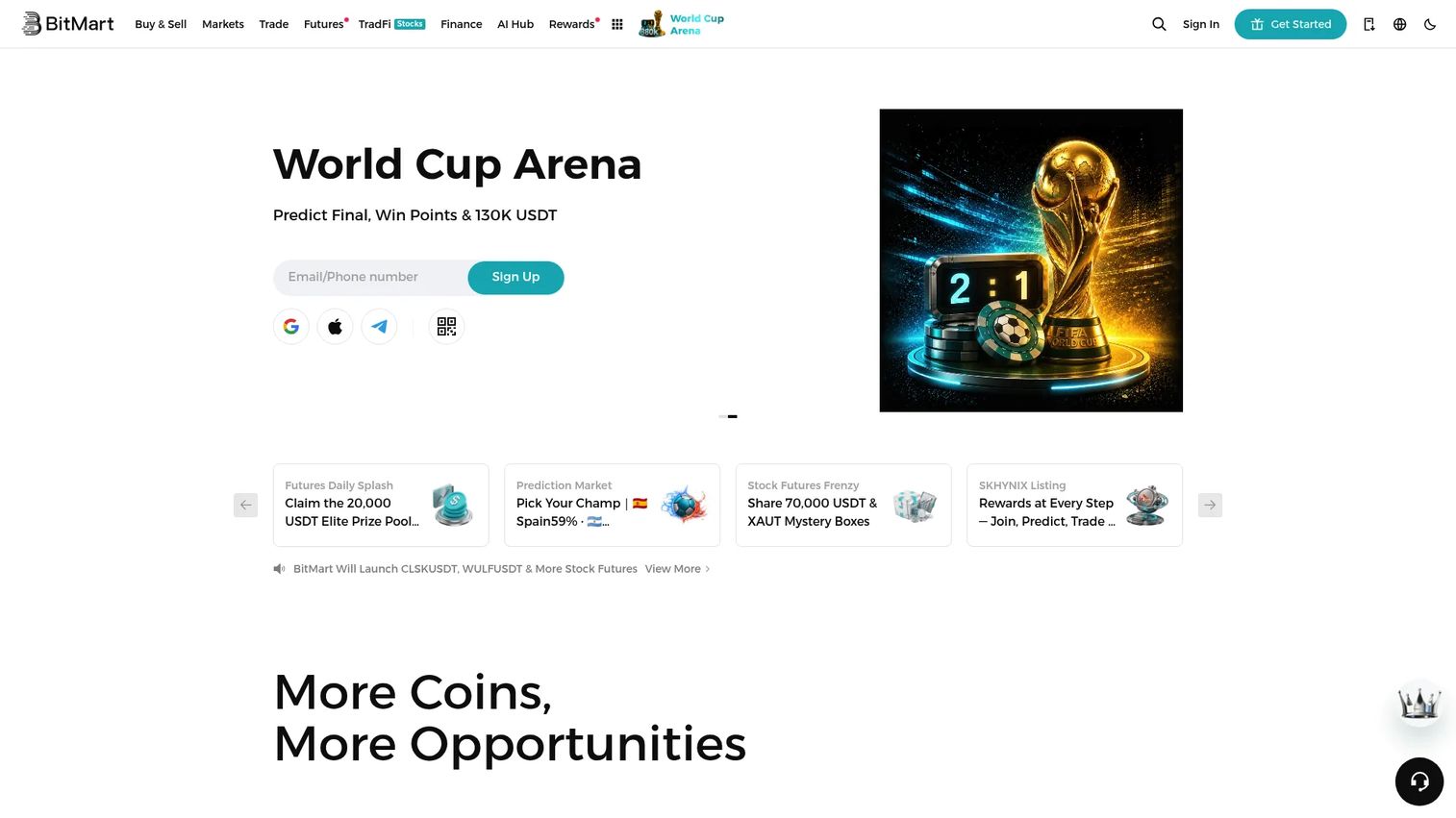
BitMart earns its place for one specific job: reaching beyond the biggest assets. Traders looking for a wide selection of tokens, including newer and smaller-cap coins, will find more variety here than on more conservative platforms. It combines spot trading, futures trading, and a BitMart Card, plus copy trading for people who want to mirror the moves of more experienced traders.
That token breadth is the draw. If your strategy involves altcoins that mainstream exchanges have not listed, BitMart is worth evaluating as a complement to a primary account.
Best for: Traders seeking wide altcoin variety plus copy trading and futures in one exchange.
Key strengths
- Altcoin breadth: A wide selection of tokens beyond the largest assets.
- Copy trading: Mirror the strategies of experienced traders directly.
- Spot and futures: Both trading types plus a BitMart Card in one platform.
Why choose BitMart: Choose BitMart when asset variety is your priority and you want access to tokens the major exchanges have not added. It fits traders who treat altcoin exposure as a deliberate part of their strategy.
BitMart pricing: BitMart's fee page lists spot pairs by class and a futures schedule. The visible futures rates are 0.0400% maker and 0.0600% taker per trade. Spot fees vary by pair class, so review the current fee page for the exact rates that apply to the assets you plan to trade.
7. Uniswap
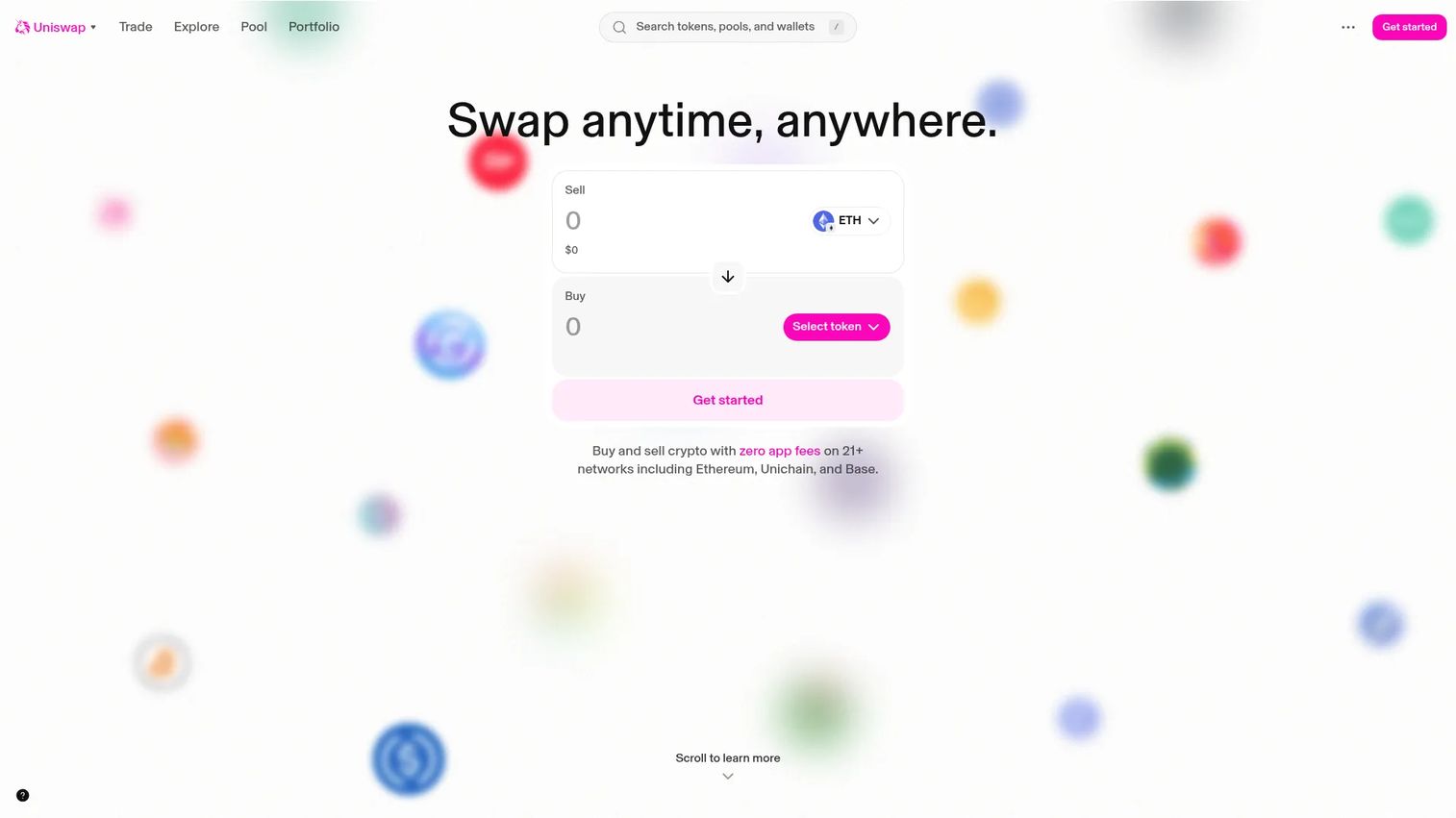
Uniswap is the odd one out on this list, and deliberately so. It is not a hosted account you sign up for; it is a decentralized protocol and app suite for swapping, bridging, and managing onchain assets. You connect a wallet, approve a swap, and trade directly against automated market maker liquidity pools. You keep custody the entire time.
This is the pick for readers who want the centralized exchange vs decentralized exchange decision to land on self-custody. Permissionless token swaps mean you can trade assets without an account or identity check, and the Uniswap Wallet handles swapping, sending, bridging, and multi-network asset management. It is a fundamentally different evaluation path from the hosted platforms above.
Best for: Users and developers who want permissionless onchain swapping with full self-custody.
Key strengths
- Permissionless swaps: Trade tokens directly from your wallet against liquidity pools, no account required.
- Self-custody by design: You hold your keys and assets throughout every transaction.
- Wallet and developer tools: Uniswap Wallet plus protocol docs for onchain builders.
Why choose Uniswap: Choose Uniswap when custody control and permissionless access matter more than a hosted account. It suits readers comfortable managing a wallet and reading network fees, who want direct onchain swaps rather than a custodial trading venue.
Uniswap pricing: Uniswap Labs states it does not charge an interface fee on its own interface or wallet as of December 27, 2025. You still pay swap and network (gas) costs, which depend on the chain and pool you trade through. Interface fees on other DeFi and CeFi surfaces can run higher, so costs are usage-based rather than subscription-based.
Considerations before you commit
Before you fund any cryptocurrency exchange platform, run through this checklist. The advertised headline rarely tells the whole story.
Fee structure beyond the headline
Look past the "low fees" banner. Compare the maker-taker schedule for active trading against the instant-buy spread for simple purchases. A platform can be cheap for one and expensive for the other. Model your actual trading pattern, not the best-case tier.
Security and custody model
Decide who holds your keys. Custodial exchanges handle security for you but control your assets; a DEX or self-custody wallet puts that responsibility on you. Check for account protections, two-factor authentication, and the platform's compliance and incident history.
Liquidity and supported assets
Deep liquidity means tighter spreads and less slippage, which matters more as your trade size grows. Confirm the platform lists the assets you actually want, especially if your strategy reaches beyond the largest coins into altcoins.
Availability and regulatory disclosures
Crypto exchanges in USA face different rules than platforms elsewhere, and access varies by jurisdiction. Confirm the platform legally serves your region and read its regulatory disclosures before depositing. This is not optional due diligence.
Payment methods and fiat on-ramps
Check how you fund and withdraw. Bank transfers, cards, and fiat on-ramps carry different fees and speeds. For a first purchase, a smooth fiat on-ramp can matter more than a marginally lower trading fee.
Conclusion
The right cryptocurrency exchange platform depends entirely on how you intend to use it, not on which brand runs the most ads.
If you are new or prioritize trust, start with Coinbase for its compliance posture and clean onboarding, or Gemini if security is your single most important criterion. If you trade actively and care about cost and execution, Kraken delivers transparent maker-taker fees and deep liquidity, while Binance leans into low fees and market breadth for cost-conscious traders. If your crypto life is mobile, Crypto.com combines trading, rewards, and a card in one app. For altcoin variety, BitMart reaches beyond the majors. And if self-custody and permissionless swaps are the point, Uniswap is the clear DEX choice.
Match the platform to your use case, confirm fees and regional availability before funding, and remember that the cheapest headline is rarely the cheapest reality. The best crypto trading platform is the one that fits how you actually trade.
FAQs
Safety comes from trust signals rather than absolute guarantees. Look for a regulated, compliance-forward platform with clear account protections, two-factor authentication, and a track record you can verify. Coinbase and Gemini both lead on this, pairing strong security posture with beginner-friendly interfaces that reduce costly mistakes.
The cheapest option depends on your volume, because most platforms use maker-taker fees that fall as you trade more. Binance and Kraken are known for competitive schedules, but the advertised fee is not the whole story. Instant-buy spreads can cost far more than the listed maker-taker rate, so model your real trading pattern before deciding.
An exchange is where you buy, sell, and trade crypto; a wallet is where you store it. On a custodial exchange, the platform holds your assets in its own wallet. A self-custody wallet, like the Uniswap Wallet, puts the private keys, and full control, in your hands.
Most people should start with a centralized exchange for the simpler experience, fiat on-ramps, and customer support. A decentralized exchange like Uniswap makes sense once you want self-custody, permissionless access, or tokens that centralized platforms have not listed. The choice comes down to convenience versus control, and your comfort managing a wallet.
Prioritize five things: transparent fees (both maker-taker and instant-buy spreads), a security and custody model you understand, deep liquidity for tighter spreads, the specific assets you want to trade, and payment methods that fit how you fund. Regional availability and regulatory disclosures should also factor into any final decision.
Custodial exchanges handle security for you, but they also control your assets, which is a form of counterparty risk. Strong account security like two-factor authentication reduces personal risk, but for long-term holdings many users move assets to self-custody. The general rule: use exchanges for trading, and consider self-custody for amounts you intend to hold.
Crypto.com is built mobile-first and is one of the strongest crypto exchange apps for managing everything from your phone, including trading, rewards, and card spending. Coinbase and Kraken also offer capable mobile apps that mirror much of their desktop functionality, so the best pick depends on whether you want an all-in-one hub or a straightforward trading app.