You shipped three services last quarter. Now you have thirty. Somewhere in that growth, service-to-service traffic stopped being something anyone fully understands. A request that used to hit one endpoint now fans out across a dozen pods. When latency spikes at 2 a.m., nobody can say which hop caused it. When security asks whether traffic between services is encrypted, the honest answer is "mostly, we think."
This is the exact pain that service mesh software exists to solve. As microservices multiply, the networking logic that used to live in a monolith gets scattered across every team's codebase. Retries, timeouts, mutual TLS, load balancing, tracing, each service reinvents them, inconsistently. A service mesh pulls that logic out of your application code and into a dedicated infrastructure layer, so the same security, traffic, and observability rules apply everywhere without touching a single line of business logic.
The market signals this shift clearly. The global service mesh market is estimated at USD 0.88 billion in 2026 and projected to reach USD 23.05 billion by 2035, a 41.3% CAGR, according to Business Research Insights (2026). Over 55% of enterprises running microservices have already integrated a mesh for traffic observability, and Kubernetes-based deployments make up roughly 60% of the total.
For presales engineers and platform teams evaluating options, the decision usually comes down to five factors: Kubernetes fit, the security model (especially mTLS), traffic management depth, observability, and operational overhead. This shortlist compares seven service mesh software options against those criteria. If your day job includes walking buyers through technical architecture, you already know that being able to explain fit with a clear, honest comparison beats any glossy pitch, the same principle behind interactive product experiences that let people validate before they commit.
What's inside
This guide is for platform engineers, DevOps teams, cloud architects, and the presales engineers who support their technical evaluations. Every tool here targets teams running Kubernetes or broader cloud-native architectures.
We selected these seven based on architecture fit, security features (identity and mTLS), observability depth, traffic management capabilities, ecosystem maturity, and enterprise readiness. The list mixes open-source projects and vendor-backed platforms, so you can weigh community-driven flexibility against commercial support. We also flag one important 2026 support change you need to know before you commit to a migration path.
TL;DR
- Best overall for Kubernetes-heavy teams: Istio, the most feature-rich and widely adopted service mesh, with deep traffic control and ambient mode.
- Best for a simpler operational model: Linkerd, a lightweight, Rust-based mesh with automatic mTLS and strong telemetry.
- Best for AWS-native environments: AWS App Mesh, though note its end-of-support date in 2026 before starting new projects.
- Best for Red Hat and OpenShift shops: OpenShift Service Mesh, tightly integrated with the OpenShift platform.
- Best for lightweight, low-footprint Kubernetes setups: Traefik Mesh, with a non-invasive, node-based design.
- Best for multi-platform (Kubernetes plus VMs): Kuma, a flexible, cloud-agnostic control plane.
- Best for broad service networking and discovery: Consul, which pairs mesh capabilities with identity-based service discovery.
What service mesh software is
Service mesh software is a dedicated infrastructure layer that manages service-to-service communication inside a distributed application, handling security, traffic routing, and observability without changing application code.
It works by splitting responsibilities across two planes. The data plane is a set of lightweight proxies (often Envoy-based sidecars) deployed alongside each service. These proxies transparently intercept all inbound and outbound traffic. The control plane configures and coordinates those proxies, pushing policy, certificates, and routing rules across the mesh. Because interception is transparent, developers write normal application code while the mesh enforces networking behavior underneath.
Core capabilities to know
Most service mesh software converges on the same core feature set. When you evaluate options, map each candidate against these:
- Security: mutual TLS (mTLS) for encrypted service-to-service traffic, workload identity, authorization policies, RBAC, and automated certificate management, the foundation of zero-trust security inside the cluster.
- Traffic management: request routing, retries and timeouts, load balancing, circuit breaking, and progressive delivery patterns like canary deployments and A/B testing.
- Observability: metrics, distributed traces, logs, and topology maps that expose how requests flow between services and where they slow down.
- Service discovery and policy distribution: the mesh knows where every service instance lives and pushes consistent policy across all of them.
- Decoupling: networking logic lives in the mesh, not in your application, so teams ship features without rewriting connection handling.
This structured, capability-led framing is exactly how technical buyers evaluate any category, whether it is mesh software or the audit management software their security team relies on.
Service mesh vs API gateway
These two get confused constantly, so worth being precise. An API gateway manages north-south traffic, requests entering your system from outside (external clients, mobile apps, partners). A service mesh manages east-west traffic, the internal service-to-service communication between microservices inside your cluster.
An API gateway handles authentication, rate limiting, and request routing at the edge. A service mesh handles mTLS, retries, and observability between internal services. Most mature architectures run both: the gateway guards the front door, the mesh governs everything happening behind it. They are complementary layers, not competing choices.
When to use service mesh software
A service mesh is not free overhead-wise, so deploy it when the problem it solves is real. Three situations make the case clearly.
Secure traffic between microservices
When you need zero-trust security inside the cluster, a mesh is the cleanest path. Instead of trusting the network, every service authenticates with a cryptographic identity, and all traffic is encrypted with mTLS by default. This matters most in regulated environments or when a compliance audit asks you to prove that payment data never crosses the wire in plaintext. The mesh enforces authorization policies centrally, so a new service inherits the right rules automatically. Security teams reviewing this often want a hands-on walkthrough, the kind of self-serve validation a sandbox enables for technical buyers doing deep validation, proof-of-concept evaluation, and compliance review.
Improve observability in Kubernetes
When a request touches eight services and one of them is slow, you need to see the whole path. Service mesh software exposes golden signals (latency, traffic, errors, saturation) per service automatically, plus distributed traces that follow a request across every hop. During incident response, this turns "something is slow" into "the checkout service's call to inventory is timing out." Teams use this telemetry to debug production issues faster and to build reliable service dependency maps without instrumenting every codebase by hand.
Standardize traffic management for releases
When your release engineering team wants controlled rollouts, the mesh becomes the control point. Route 5% of traffic to a new version, watch the error rate, then ramp up, canary deployment without custom tooling. Add automatic retries, timeouts, and load balancing to reduce the blast radius of a bad deploy. This is where platform and release engineering teams get the most leverage, because the same traffic-splitting rules work for every service, tied directly to risk reduction.
Comparison table
Pricing for service mesh software varies widely. Several options are fully open source and free, while vendor-backed platforms use subscription or enterprise pricing, and cloud-native offerings pass through only underlying infrastructure costs. Note the 2026 support change on AWS App Mesh before planning any new deployment. Tools are sorted by relevance to Kubernetes-first buyers.
| # | Product | Intent | Key use case | Pricing | G2 rating |
|---|---|---|---|---|---|
| 1 | Istio | Feature-rich enterprise mesh | Kubernetes, multi-cluster, hybrid traffic control | Free, open source | Not listed |
| 2 | Linkerd | Lightweight Kubernetes mesh | Simple, secure service-to-service comms | Free open source; managed plan available | 4.4/5 |
| 3 | AWS App Mesh | AWS-native managed mesh | Microservices on ECS, EKS, EC2 | No product fee; pay for AWS resources | 4.3/5 |
| 4 | Traefik Mesh | Low-footprint mesh | Simple Kubernetes deployments | Open source | 4.5/5 |
| 5 | Consul | Service networking + mesh | Service discovery, secure networking | PAYG, Flex, Enterprise (contact sales) | 4.3/5 |
| 6 | Kuma | Multi-platform mesh | Kubernetes plus VM environments | Open source | Not listed |
| 7 | OpenShift Service Mesh | Enterprise OpenShift mesh | Microservices on Red Hat OpenShift | Included in OpenShift Container Platform | Not listed |
1. Istio
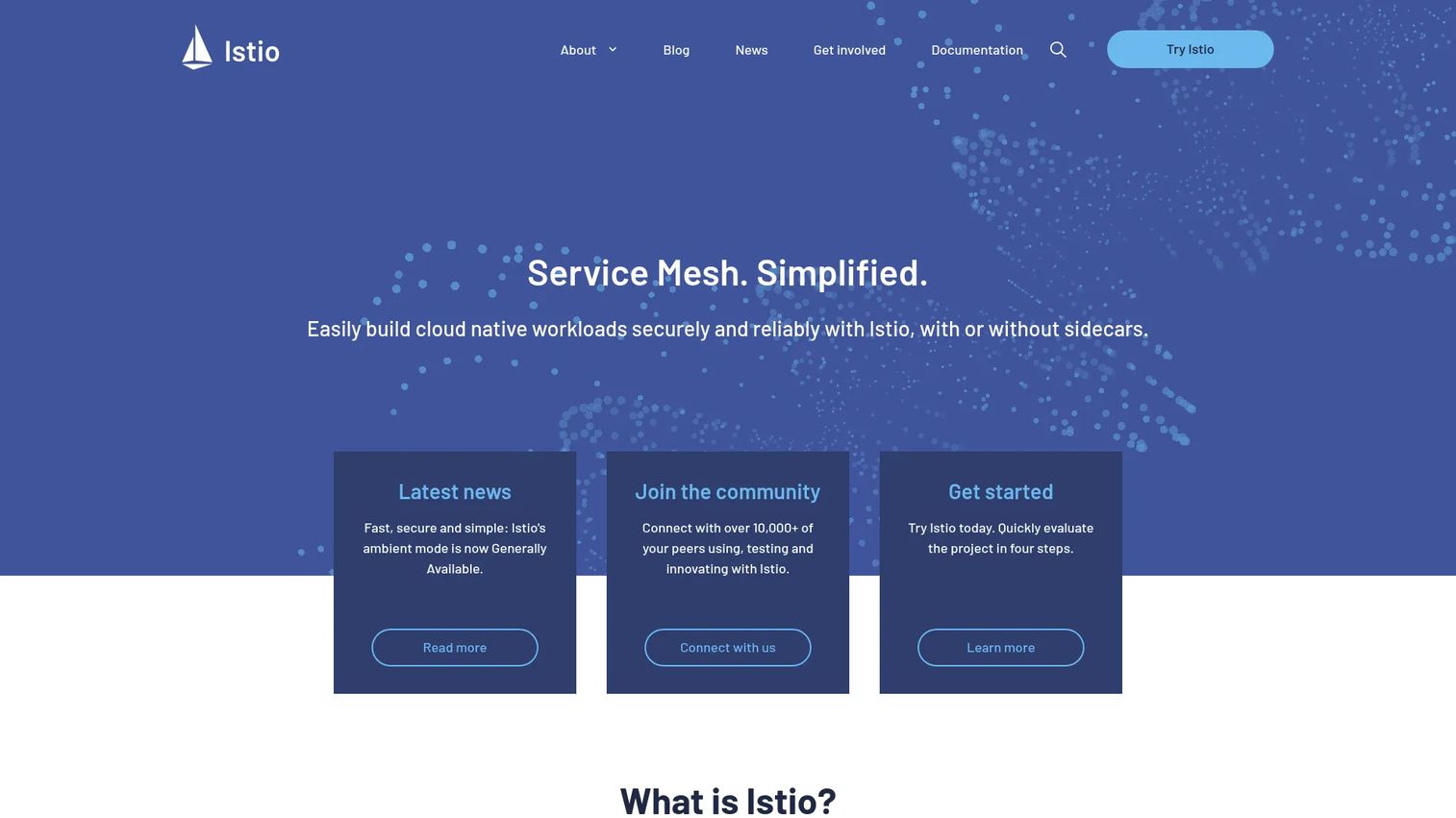
Istio is the most established and feature-rich service mesh software available, and for many teams it sets the reference point everything else is measured against. It is open source, built on the Envoy proxy, and designed for securing, connecting, and observing cloud-native services at scale. If a buyer wants the deepest possible traffic control and the largest ecosystem, Istio is the name that comes up first.
Its strength is breadth. Istio handles Kubernetes service mesh deployments, multi-cluster topologies, and hybrid environments spanning on-prem and cloud. It gives you fine-grained traffic management (routing, retries, failovers, weighted load balancing), mTLS-based security with workload identity, and rich observability through metrics, logs, and traces. Istio's ambient mode, which runs without per-pod sidecars, has made the operational profile lighter for teams that want mesh benefits with a smaller footprint.
Best for: Teams running Kubernetes or hybrid workloads that need the deepest service mesh security, traffic control, and observability.
Key strengths
- mTLS service-to-service security: Encrypts and authenticates all internal traffic with workload identity, the backbone of a zero-trust posture.
- Advanced traffic management: Routing, retries, failovers, and load balancing give release teams precise control over canary and A/B rollouts.
- Deep observability: Metrics, logs, and distributed traces expose service behavior across every hop without code changes.
Why choose Istio: Choose Istio when you need the most complete feature set and a large community behind it. It is the safest pick for enterprise reference architectures and complex multi-cluster estates. For presales teams, it is the mesh to mention when a buyer wants a deep, defensible technical benchmark.
Istio pricing: Istio is fully open source. Stable binary releases are available to everyone at no cost, and there are no paid tiers or public pricing on the official site. Your only real spend is the compute and operational time to run it.
2. Linkerd
Linkerd is an open-source service mesh for Kubernetes built around simplicity, security, and reliability. Where Istio optimizes for maximum configurability, Linkerd optimizes for a clean operational model. Its data plane proxy is written in Rust, which keeps the footprint small and predictable, an appealing property when you are running the mesh across hundreds of pods.
Linkerd ships automatic mTLS out of the box, so encrypted service-to-service communication is on by default with no configuration. It proxies HTTP, HTTP/2, gRPC, and raw TCP, and provides retries, timeouts, load balancing, traffic splitting, and multi-cluster communication. Built-in telemetry gives you golden metrics per service without wiring up a separate stack. For platform teams that value a mesh they can reason about, Linkerd is a strong evaluation candidate.
Best for: Kubernetes teams that want a lightweight service mesh with built-in security and telemetry, minus heavy configuration.
Key strengths
- Automatic mTLS: Encrypted, authenticated traffic between services with zero manual setup.
- Lightweight Rust data plane: A small, fast proxy that keeps resource overhead low across large deployments.
- Built-in observability: Retries, timeouts, load balancing, traffic splitting, and per-service metrics work without external tooling.
Why choose Linkerd: Choose Linkerd when your priority is a Kubernetes-native mesh you can operate confidently without a dedicated mesh specialist. It holds a 4.4/5 rating on G2, and reviewers consistently point to its clarity. It differs from heavier enterprise meshes by trading maximal knobs for predictable operations.
Linkerd pricing: Linkerd's open-source project is free. A managed offering, Managed Linkerd by Buoyant, is available on a contact-sales basis for teams that want commercial support. The core mesh remains free to self-host.
3. AWS App Mesh
AWS App Mesh is a managed service mesh for monitoring and controlling service-to-service communication across AWS. It is built on the Envoy proxy and works with services running on ECS, EKS, EC2, and Kubernetes on AWS. For teams already committed to the AWS ecosystem, it offers consistent visibility and traffic controls without standing up a separate control plane.
App Mesh gives you network traffic controls, Envoy-based proxy integration, and mTLS service-to-service authentication. It surfaces standardized metrics, logs, and traces that plug into AWS observability tooling. The managed model means AWS handles the control plane, so your team focuses on configuring routes and policies rather than operating mesh infrastructure.
Best for: Teams running microservices on AWS that want mesh traffic control and observability tightly integrated with AWS services.
Key strengths
- Envoy-based proxy integration: Consistent, standards-based data plane across ECS, EKS, and EC2 workloads.
- mTLS authentication: Encrypted, authenticated service-to-service traffic inside your AWS environment.
- Managed control plane: AWS operates the mesh infrastructure so your team configures policy instead of running it.
Why choose AWS App Mesh: Important 2026 caution: AWS has announced end of support for App Mesh on September 30, 2026. That reality reshapes selection. For any new project, treat App Mesh as a short-term or migration-only option and plan a path to an alternative mesh. For presales teams, flagging this proactively during technical qualification builds trust and prevents a buyer from committing to a dead-end path.
AWS App Mesh pricing: There is no additional charge for App Mesh itself. You pay only for the underlying AWS resources (compute, networking) consumed by the Envoy proxies. It carries a 4.3/5 rating on G2.
4. Traefik Mesh
Traefik Mesh is a lightweight, non-invasive service mesh for Kubernetes built on Traefik. Its defining design choice is that it uses no sidecars. Instead, proxy endpoints run once per node, which keeps the deployment simple and the resource footprint low. For teams that want mesh capabilities without injecting a proxy into every pod, this is a genuinely different architecture.
Traefik Mesh supports the Service Mesh Interface (SMI) specification and is opt-in by default for existing services, so you can adopt it incrementally without rewiring your whole cluster at once. That non-invasive posture makes it well suited to smaller platform teams or fast-moving environments where operational simplicity matters more than exhaustive feature depth.
Best for: Kubernetes teams that want a simple, low-footprint service mesh they can adopt gradually.
Key strengths
- No sidecars: Node-level proxy endpoints reduce per-pod overhead and simplify the deployment model.
- SMI support: Standard interface support keeps the mesh interoperable with the wider Kubernetes ecosystem.
- Opt-in by default: Existing services stay untouched until you explicitly route them through the mesh.
Why choose Traefik Mesh: Choose Traefik Mesh when your team wants mesh basics, traffic routing and observability, without the operational surface of a full sidecar mesh. It holds a 4.5/5 rating on G2. It fits best in smaller clusters and teams prioritizing a light touch over deep configurability.
Traefik Mesh pricing: Traefik Mesh is open source. The broader Traefik product line has commercial tiers, but the mesh itself is free to deploy. Check the Traefik pricing page for details on the commercial ecosystem around it.
5. Consul
Consul from HashiCorp is broader than a pure service mesh. It is an identity-based service networking platform that combines service discovery, secure communication, and network automation across multi-cloud and hybrid environments. The mesh capabilities sit inside that larger networking story, which is exactly why it appeals to platform teams thinking beyond a single cluster.
Consul provides service discovery and health monitoring, a service mesh with mTLS and identity-based authorization, plus traffic management and network automation. The distinction worth understanding: a pure service mesh focuses on east-west traffic between microservices, while Consul also owns service discovery and networking across VMs, bare metal, and multiple clouds. If you need one platform to register services, secure their traffic, and automate networking, Consul covers more ground.
Best for: Platform teams that need service discovery, service mesh, and secure service-to-service networking in one identity-based platform.
Key strengths
- Service discovery and monitoring: A central registry with health checks keeps every service reachable and observable.
- mTLS and identity-based authorization: Secure, policy-driven service-to-service communication built on workload identity.
- Traffic management and network automation: Routing plus automation across multi-cloud and hybrid infrastructure.
Why choose Consul: Choose Consul when service discovery and cross-environment networking matter as much as the mesh itself, especially if you already run HashiCorp tooling like Terraform or Vault. The integrated stack reduces the number of moving parts across your platform. It holds a 4.3/5 rating on G2.
Consul pricing: HashiCorp offers Consul through its cloud platform with Pay-as-You-Go, Flex, and Enterprise Self-Managed plans. The Flex and Enterprise tiers are contact-sales, and a free tier is available for getting started. Check HashiCorp's pricing page for current details tied to your consumption.
6. Kuma
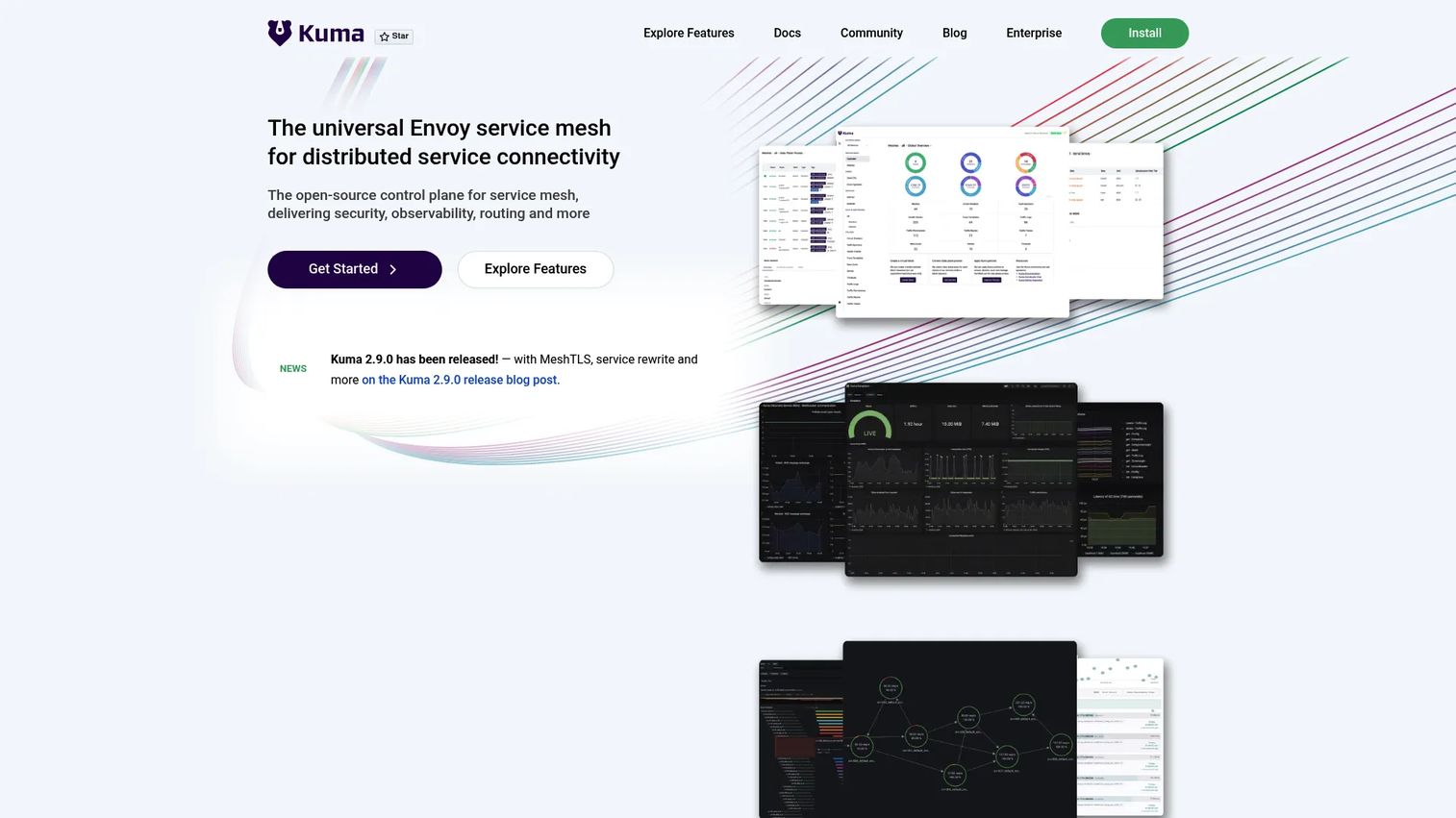
Kuma is an open-source service mesh control plane designed for securing, observing, and routing service traffic across Kubernetes, VMs, and bare metal. Its multi-platform, multi-zone design is the headline: where many meshes assume Kubernetes-only, Kuma is built for heterogeneous environments from the start. That makes it a strong fit for teams whose infrastructure has not fully converged on containers.
Kuma provides mTLS and traffic permissions, a full set of traffic policies (routing, retry, timeout, circuit breaker, and fault injection), and observability through a service map, traces, logs, and metrics. Its multi-zone operation lets you run a single logical mesh across regions or clouds, which suits distributed and cloud-agnostic deployments well.
Best for: Teams that need an open-source mesh control plane spanning Kubernetes and non-Kubernetes (VM, bare metal) workloads.
Key strengths
- mTLS and traffic permissions: Encrypted traffic with fine-grained permission policies between services.
- Rich traffic policies: Routing, retries, timeouts, circuit breaking, and fault injection for resilient, testable rollouts.
- Multi-zone observability: A service map, traces, logs, and metrics across zones for a unified view of distributed traffic.
Why choose Kuma: Choose Kuma when your environment mixes Kubernetes with VMs or spans multiple regions and clouds. Its flexibility and cloud-agnostic posture make it a practical control plane for teams that cannot assume everything runs in a single cluster. The commercial Kong Mesh distribution builds on Kuma if you later want enterprise support.
Kuma pricing: Kuma is open source and free to deploy. Public numeric pricing for the project is not published, since the core control plane is community-driven. Teams needing commercial backing typically evaluate the Kong Mesh distribution built on top of it.
7. OpenShift Service Mesh
OpenShift Service Mesh is Red Hat's service mesh for managing connectivity, security, and observability of microservices on OpenShift. Built on the Istio foundation, it packages mesh capabilities into the OpenShift platform with enterprise support and lifecycle management. For organizations standardized on Red Hat, it removes the burden of assembling and maintaining a mesh from upstream components.
It delivers traffic management, mTLS security with policy enforcement, and telemetry and observability. Because it aligns with OpenShift operations, it integrates cleanly with observability tools commonly paired in that ecosystem, such as Kiali for mesh visualization and Jaeger for distributed tracing. The value is a supported, integrated mesh rather than a DIY assembly.
Best for: Enterprises running microservices on OpenShift that need service-to-service security and traffic control with vendor support.
Key strengths
- Traffic management: Istio-based routing, retries, and progressive delivery integrated into the OpenShift workflow.
- mTLS security and policy enforcement: Encrypted service-to-service traffic with centralized authorization policy.
- Telemetry and observability: Built-in metrics and tracing, with Kiali and Jaeger available for visualization and trace analysis.
Why choose OpenShift Service Mesh: Choose it when your team has standardized on the OpenShift ecosystem and wants a supported, integrated mesh rather than maintaining Istio yourself. Its strength is deepest when OpenShift is already your platform of record and you value Red Hat's enterprise lifecycle.
OpenShift Service Mesh pricing: OpenShift Service Mesh is included as a capability within OpenShift Container Platform rather than sold as a standalone product. Pricing varies by cluster size and subscription. Check Red Hat's OpenShift pricing page to model cost against your deployment.
Considerations before you choose
Picking service mesh software is less about the feature checklist and more about fit with your existing environment and team. Run any finalist through these criteria before you commit.
Kubernetes and platform fit
Confirm the mesh matches your actual footprint. A Kubernetes-only mesh is fine if everything runs in containers, but if you have VMs or bare metal in the mix, prioritize a multi-platform control plane. Verify multi-cluster and hybrid support if your estate spans regions or clouds.
Security and compliance model
Evaluate the mTLS implementation, workload identity, authorization policies, and certificate management. For regulated workloads, confirm the mesh can prove encrypted service-to-service traffic and enforce zero-trust policies centrally. This is often the exact question a security review will ask, and the same rigor buyers apply to audit management and other compliance-sensitive purchases.
Operational overhead
Be honest about who will run this. Sidecar versus sidecar-less architecture, upgrade cadence, and observability wiring all affect the day-two burden. A lighter mesh may serve a small platform team better than a maximally configurable one.
Ecosystem and support
Weigh open source flexibility against vendor-backed support. Community-driven projects give you control; commercial distributions give you a support contract and lifecycle guarantees. If a support SLA matters to your organization, factor that in early.
Vendor and product roadmap
Check the roadmap and support status before you build on any option. The AWS App Mesh end-of-support date in 2026 is a clear example: a capable product can still be the wrong long-term bet if its support window is closing.
Conclusion
The right service mesh software depends far more on your environment than on a raw feature count. For Kubernetes-heavy teams that want the deepest capabilities, Istio remains the reference standard. If you value a clean operational model, Linkerd is the strong lightweight pick. AWS-native teams can use AWS App Mesh today but should plan around its 2026 end-of-support date. Red Hat shops get the tightest fit with OpenShift Service Mesh, and teams spanning Kubernetes plus VMs should look hard at Kuma. If service discovery and cross-environment networking matter as much as the mesh, Consul covers the widest ground, while Traefik Mesh suits smaller teams that want a light footprint.
The practical next step: map your requirements (Kubernetes footprint, security model, operational maturity, ecosystem alignment) to one or two finalists, then run a focused proof of concept. Selection is a fit exercise, not a popularity contest. Get the environment match right and the rest follows. For presales teams supporting that evaluation, the same discipline that makes a great technical demo, showing fit clearly instead of overselling, applies here too. You can explore how event management, contract management, and marketing resource management categories get evaluated with the same buyer-first rigor.
FAQs
Service mesh software in Kubernetes is an infrastructure layer that manages service-to-service communication between pods. It deploys lightweight proxies (a data plane) alongside your services and a control plane that configures them, handling mTLS, traffic routing, and observability without changing application code. It lets platform teams enforce security and traffic policy consistently across every service in the cluster.
An API gateway manages north-south traffic, requests entering your system from external clients. A service mesh manages east-west traffic, the internal service-to-service communication between microservices. The gateway handles edge concerns like authentication and rate limiting, while the mesh handles internal mTLS, retries, and observability. Most mature architectures run both as complementary layers.
Not always. If you run a handful of services with simple communication needs, the operational overhead may outweigh the benefit. A mesh earns its place when you have many services, need zero-trust security with mTLS, want consistent observability across hops, or require standardized traffic management for canary and progressive rollouts. Match the tool to the scale of your problem.
For Kubernetes service mesh security, Istio and Linkerd both provide strong mTLS, workload identity, and authorization policies. Istio offers the deepest, most configurable security controls, while Linkerd delivers automatic mTLS with minimal setup. For OpenShift environments, OpenShift Service Mesh brings Istio-based security with enterprise support. The best choice depends on your platform and how much configurability you need.
Istio is the most feature-rich service mesh, with extensive traffic management, multi-cluster support, and configurability built on Envoy. Linkerd prioritizes a simpler operational model, using a lightweight Rust data plane and automatic mTLS out of the box. Istio suits teams wanting maximum control and enterprise breadth; Linkerd suits teams wanting a Kubernetes-native mesh they can operate with less specialization.
AWS App Mesh remains functional for existing AWS workloads, but AWS has announced end of support on September 30, 2026. For new projects, treat it as a short-term or migration-only option and plan a path to an alternative mesh. Existing users should begin evaluating replacements now to avoid running unsupported infrastructure past the deadline.
Evaluate five things: Kubernetes and platform fit (including VM or multi-cluster needs), the security model (mTLS, identity, authorization, certificate management), traffic management depth, observability capabilities, and operational overhead. Also check vendor support status and roadmap, since a capable product with a closing support window can still be the wrong long-term bet.