You added a second payment provider to cut declines in one region. Then a third for redundancy. Now your finance team reconciles three dashboards by hand, your developers maintain three integrations, and nobody can answer a simple question: where is money leaking?
That is the problem payment orchestration software solves. Not another gateway. A layer above your existing providers that handles routing, failover, smart retries, reconciliation, and reporting from one place. The global payment orchestration platform market is projected to grow from about US$3.13B in 2026 to US$7.27B by 2031, an 18.31% CAGR, according to Mordor Intelligence (2026). Cloud-based solutions already hold roughly 62 to 77% of that share, which tells you where buyers are heading: scalable, API-first infrastructure they do not have to maintain themselves.
If you are evaluating payment orchestration platforms, the hard part is not finding vendors. It is matching a vendor to your routing control needs, your reconciliation ownership, your geography, and how mature your payment stack already is. A SaaS company selling globally has different priorities than a marketplace running in-person and online. This guide treats the decision that way. For teams building related infrastructure decisions, our roundup of the best AI orchestration platforms covers an adjacent category worth understanding.
What's inside
This guide is for payment, fintech, ecommerce, and SaaS operators comparing payment orchestration providers across scale, geography, integration maturity, and business model. Some of you run a single provider and plan to add more. Some already juggle several and need a control layer on top.
We shortlisted nine platforms using six criteria that map to real operational pain: routing control, payment method coverage, reconciliation visibility, integration flexibility, operational tooling (fraud, vault, analytics), and buyer fit by scale and region. Pricing and ratings reflect verified, current sources. We sorted by fit for orchestration specifically, not alphabetically and not by brand size.
TL;DR
Short on time? Here is the quick version of the best payment orchestration software for 2026:
- Best overall for complex orchestration stacks: Solidgate, payments plus billing, vault, and fraud in one suite.
- Best for control-layer and white-label flexibility: Corefy, deep routing ownership across providers and channels.
- Best for API-first orchestration portability: Primer, no-code workflows and fast experimentation.
- Best for token vault portability and enterprise scale: Spreedly, credential abstraction to avoid lock-in.
- Best for enterprise orchestration architecture control: IXOPAY, governance and customization for large teams.
- Best for cloud-native checkout control: Gr4vy, flexible architecture and developer-friendly setup.
- Best for SaaS and billing-adjacent complexity: Paddle, payments wrapped with tax and compliance.
- Best for broader enterprise payments infrastructure: Checkout.com, global acquiring depth.
- Best for unified commerce and global acquiring: Adyen, one stack across online and in-person.
What is payment orchestration software?
Payment orchestration software is a technology layer that sits between a merchant and multiple payment service providers, routing each transaction to the best processor, handling failover and retries, and unifying reporting, reconciliation, and compliance across the entire payment stack.
It is not a gateway and not a processor. A gateway connects you to one acquirer. A processor moves the money. Orchestration sits above both, letting you connect many of each and decide, transaction by transaction, where a payment goes. When one provider declines or goes down, the orchestration layer can reroute in real time without a developer touching code.
The core capabilities that define the category:
- Multi-PSP routing: Direct transactions to the optimal provider based on cost, geography, card type, or success rate.
- Payment failover and smart retries: Automatically reroute failed transactions to a backup provider and retry declines on a smarter schedule.
- Tokenization: Store card credentials in a vault so you can move them between providers without re-collecting data.
- Payment reconciliation: Match settlements, fees, and payouts across every provider in one reconciliation dashboard.
- Payment analytics: See approval rates, decline reasons, and cost per transaction across providers in real time.
- Compliance and security: PCI scope reduction, 3D Secure, and fraud rules managed centrally.
- Connector marketplace: Pre-built integrations to PSPs, acquirers, and local payment methods.
Done well, orchestration turns a tangle of provider integrations into one intelligent routing engine you actually control.
When to use payment orchestration software
Not every business needs an orchestration layer on day one. These triggers usually mean you do.
When you have multiple PSPs
The clearest signal. If you run more than one provider for regional redundancy, cost optimization, or provider diversification, you are already orchestrating manually. A platform replaces brittle if-then logic in your codebase with managed multi-PSP routing and clean failover. The more providers you add, the higher the maintenance tax you remove.
When approval rates need a lift
Declined transactions are lost revenue you already earned the right to. Intelligent payment routing sends each transaction to the provider most likely to approve it. Smart retries recover soft declines that would otherwise vanish. Payment failover catches outages before customers notice. Small percentage gains in approval rates compound fast at volume.
When ops needs visibility
After scale, reconciliation becomes the quiet killer. Finance teams stitch together settlement files from every provider by hand. Orchestration centralizes payment reconciliation and analytics so you can see fees, settlements, and leakage in one view instead of five spreadsheets.
When global expansion is on the roadmap
Entering new markets means supporting local payment methods, multiple currencies, and regional acquirers. An orchestration layer lets you add coverage through a connector marketplace instead of a new integration project per country, which keeps global payments expansion measured in weeks, not quarters.
Comparison table
Here is the shortlist at a glance. Pricing and ratings reflect verified, current sources as of mid-2026. We sorted by fit for orchestration specifically.
| # | Product | Intent | Key differentiation | Pricing | G2 rating |
|---|---|---|---|---|---|
| 1 | Solidgate | Complex orchestration stacks | Orchestration plus billing, vault, and fraud | Quote-based, volume-tied | 4.8/5 |
| 2 | Corefy | Control-layer, white-label | Deep routing ownership and payouts | From €2,500/mo | 4.7/5 |
| 3 | Primer | API-first portability | No-code workflows across PSPs | Free plan; from $1,000/mo | 4.6/5 |
| 4 | Spreedly | Token vault portability | Credential abstraction, 150+ gateways | API-usage based | 4.4/5 |
| 5 | IXOPAY | Enterprise architecture control | Single integration, smart routing | From $1,000/mo | Not listed |
| 6 | Gr4vy | Cloud-native checkout control | Flexible architecture, vaulting | From $199/mo (vault) | 5.0/5 |
| 7 | Paddle | SaaS billing-adjacent | Merchant of record, tax handled | 5% + 50¢ per txn | 4.5/5 |
| 8 | Checkout.com | Enterprise payments infra | Global acquiring, unified API | Custom | Not listed |
| 9 | Adyen | Unified commerce | Online and in-person on one stack | $0.13 + 4% per txn | 4.0/5 |
1. Solidgate
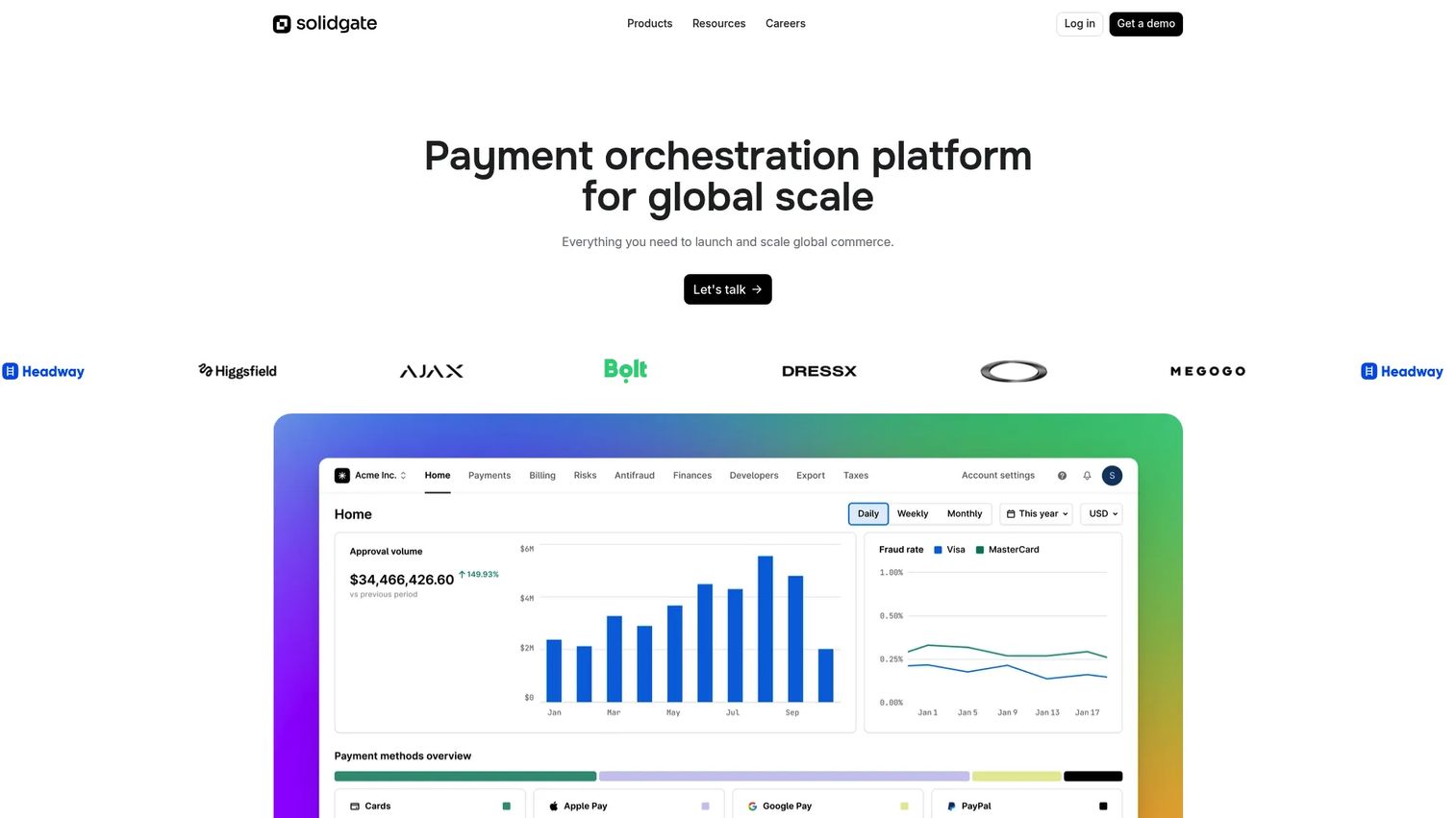
Solidgate is a payment orchestration platform for global commerce that pairs multi-provider routing with billing, a card vault, and fraud tooling in one suite. It is built for merchants who want more than a routing engine: they want the operational layer around payments handled in the same place. That makes it a strong fit for subscription and high-volume businesses where billing complexity and payment performance are tightly linked.
Best for: Merchants that need global payment orchestration plus subscription billing and fraud tools in one platform.
Key strengths
- Multi-provider routing with real-time failover: Direct each transaction to the best provider and reroute instantly when one declines or goes down.
- Hosted, branded checkout: A customizable payment form you control without building checkout from scratch.
- Flexible billing engine: Recurring, usage-based, and hybrid pricing models supported natively alongside payments.
Why choose Solidgate: If your payment problem is inseparable from your billing problem, a combined suite removes the seams between the two. Teams running global subscription revenue get routing, smart retries, and reconciliation without bolting a separate billing tool onto an orchestration layer. The tradeoff is breadth over pure-play modularity, which suits operators who want fewer vendors.
Solidgate pricing: Pricing is quote-based and tied to transaction volume and product mix. Solidgate does not publish numeric tiers; exact pricing depends on your volume and which products you use. Its G2 rating sits at 4.8/5.
2. Corefy
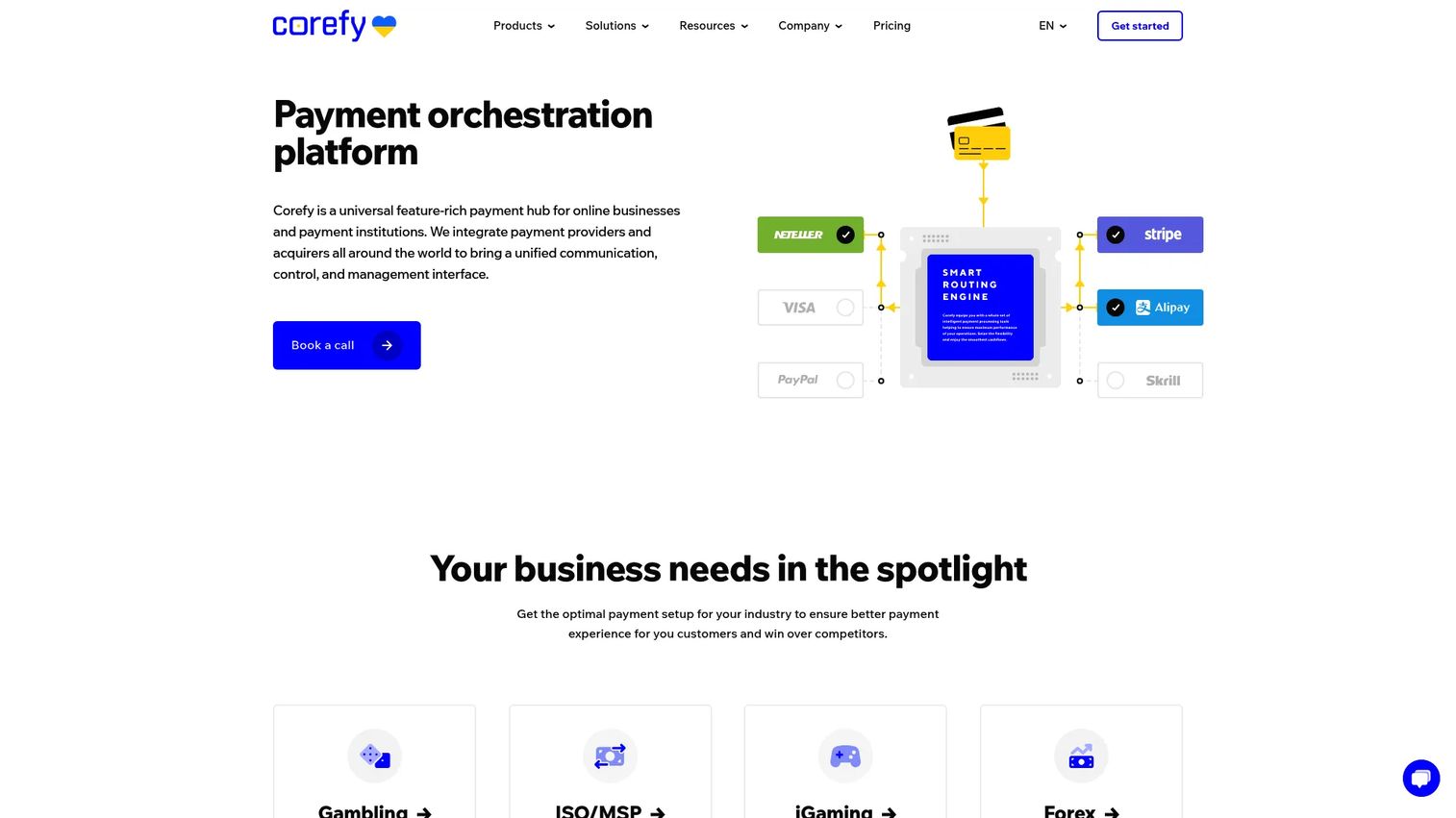
Corefy is a payment orchestration platform built for online businesses and payment institutions that want to own their routing logic. Its strength is the control layer: deep configuration over how transactions cascade across providers, plus payouts and a white-label setup that lets you put your own brand on the entire flow. Teams that treat routing as a competitive advantage rather than a utility tend to gravitate here.
Best for: Businesses needing a white-label payment orchestration and payout platform with deep routing control.
Key strengths
- Routing and cascading: Define exactly how transactions fall through to backup providers when a primary declines.
- Payouts and batch payouts: Handle outbound payments alongside acceptance from the same platform.
- Merchant portal and analytics: A dashboard with reconciliation and reporting across every connected provider.
Why choose Corefy: Choose Corefy when you want to own routing logic internally rather than hand it to a black box. The white-label layer matters for payment institutions and platforms reselling payments under their own brand. It fits teams with the operational maturity to configure cascades deliberately and the volume to justify a platform fee.
Corefy pricing: Corefy publishes its plans. Standard is €2,500/month with 10,000 included successful transactions, Professional is €6,000/month with 100,000 included, and Enterprise is custom with over 1,000,000 included. Overage in one calculator view shows €0.06 per transaction. Its G2 rating is 4.7/5.
3. Primer
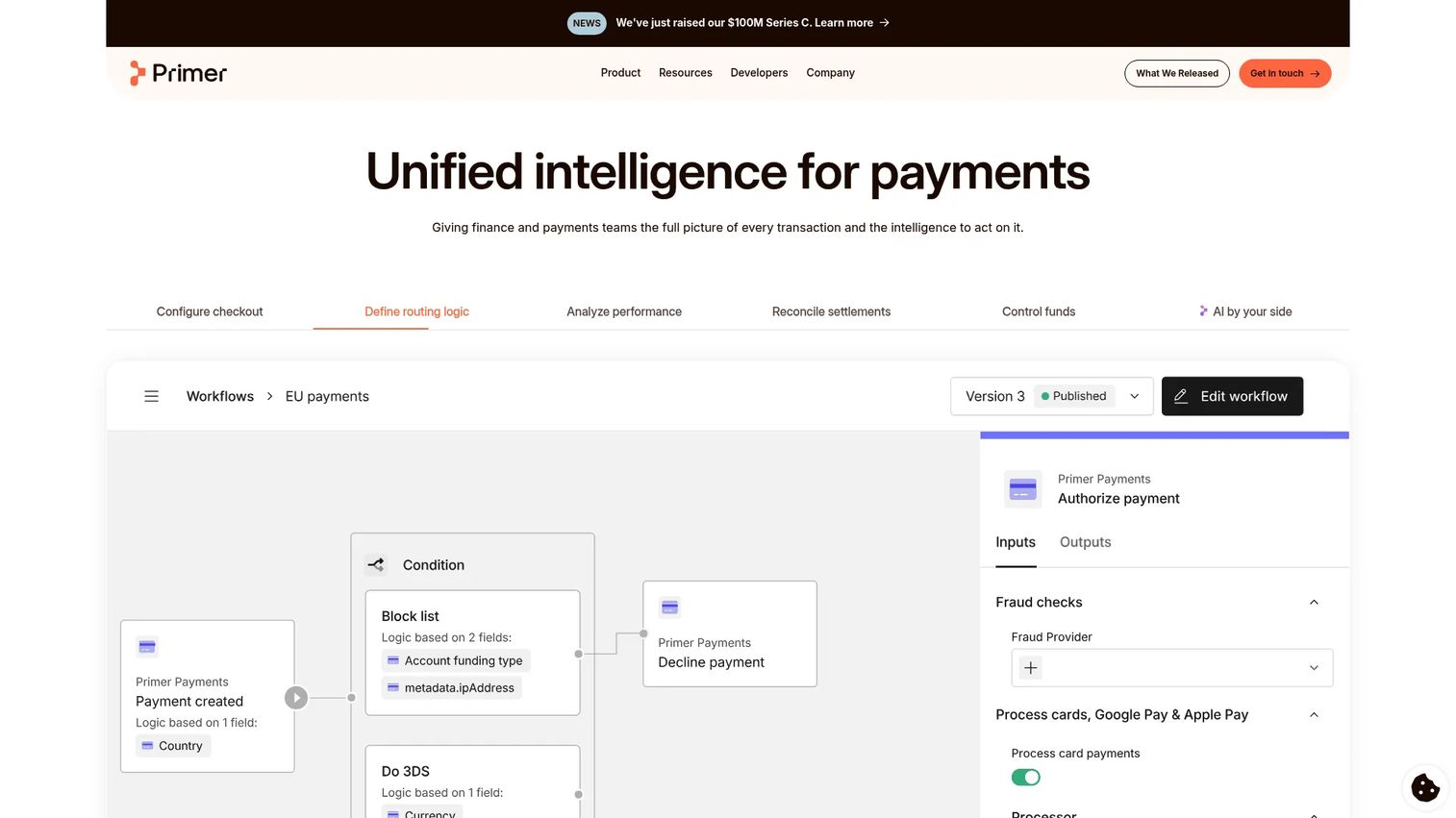
Primer is unified payments infrastructure for finance and payments teams who want to experiment fast without rewriting code for every change. Its workflow builder lets you configure routing, fallbacks, and checkout logic with low-code tooling, so a payments analyst can test a new routing rule without a sprint. That portability across providers is the core appeal.
Best for: Merchants that need unified payment orchestration and optimization across multiple providers with fast iteration.
Key strengths
- No-code workflow builder: Configure routing, retries, and conditional logic without deploying code.
- Checkout and orchestration in one layer: Manage the buyer-facing checkout and the routing behind it together.
- Fallbacks, network tokenization, and 3D Secure: Recover declines and reduce friction with built-in optimization tools.
Why choose Primer: Choose Primer when speed of experimentation matters more than legacy constraints. Teams with product ownership over their checkout get to test routing hypotheses quickly and roll back just as fast. It suits organizations that view payment optimization as an ongoing experiment, not a one-time setup.
Primer pricing: Public pricing shown on G2 lists a Free Plan, Primer Grow at $1,000 per month, and Primer Scale at $15,000 per year. Its G2 rating is 4.6/5.
4. Spreedly
Spreedly is an open payments orchestration platform built around a single normalized API and a portable token vault. Its defining idea is credential abstraction: store cards once, then connect and switch among 150+ gateways without re-vaulting data or rebuilding integrations. That makes provider agility and avoiding lock-in the headline value for enterprise teams.
Best for: Businesses needing gateway-agnostic payments orchestration with vaulting and routing controls.
Key strengths
- Portable token vault: Store payment credentials independently of any single processor for true portability.
- Single normalized API: One integration that connects to 150+ gateway connections.
- Product areas for the full flow: Vault, Protect, Optimize, Resolve, and Connect cover vaulting, fraud, routing, recovery, and connectivity.
Why choose Spreedly: Choose Spreedly when avoiding processor lock-in is a strategic priority. Owning your vault means you can renegotiate or replace a provider without a painful card migration. It fits enterprise teams that want governance over their payment data and the freedom to route across many gateways.
Spreedly pricing: Public numeric pricing is not displayed on the site. Spreedly states pricing is based on API usage and gateway types, and some features require contacting an account manager. Its G2 rating is 4.4/5.
5. IXOPAY
IXOPAY is an enterprise payment orchestration and payments intelligence platform designed for large teams that need governance and customization. A single integration connects you to a broad set of PSPs and payment methods, while smart routing and automated reconciliation handle the operational heavy lifting. The positioning leans toward organizations with complex internal requirements.
Best for: Enterprises needing global payment orchestration, smart routing, and analytics with architecture control.
Key strengths
- Single integration to many providers: Pre-built connectivity to PSPs and payment methods through one connection.
- Smart transaction routing: Route based on configurable rules to lift approval rates and manage cost.
- Automated reconciliation: Match transactions and settlements across providers without manual stitching.
Why choose IXOPAY: Choose IXOPAY when you are a larger team that needs governance, white-label options, and deep customization over how payments are architected. Its reconciliation automation removes a real finance burden at scale. It fits enterprises that treat their payment infrastructure as a system to govern, not just a service to consume.
IXOPAY pricing: Its public sandbox page states plans start at $1,000 per month. A full tier breakdown is not publicly itemized. No verified G2 rating was available at the time of writing.
6. Gr4vy
Gr4vy is a cloud-native payment orchestration platform for merchants and platforms that want flexible architecture and a developer-friendly setup. A single integration reaches 400+ payment methods and anti-fraud providers, with routing, retries, and workflows on top and a cloud vault underneath. It appeals to teams building custom payment flows who want control without managing infrastructure.
Best for: Enterprise merchants and platforms needing payment orchestration and vaulting with a cloud-native architecture.
Key strengths
- Single integration to 400+ payment methods: Connect acceptance and anti-fraud providers through one cloud-native layer.
- Routing, retries, and workflows: Build conditional payment logic that fits your specific flow.
- Cloud vault with tokenization: Store credentials, forward cards, and keep data portable across providers.
Why choose Gr4vy: Choose Gr4vy when your team wants to build custom payment flows with developer-friendly tooling and a cloud-native foundation. The tradeoff is usually around how much internal ownership the team wants to carry, which suits engineering-led organizations comfortable owning their architecture. Its vaulting and tokenization make data portability straightforward.
Gr4vy pricing: Public Cloud Vault plans include Entry at $199 per month and Growth at $299 per month, with Advanced as contact-sales. The broader orchestration offering is enterprise-style pricing on the site. Its G2 seller rating is 5.0/5.
7. Paddle
Paddle takes a different shape from a pure orchestration layer. It is a merchant-of-record platform for SaaS and digital businesses that bundles payments, billing, tax compliance, fraud protection, and revenue recovery into one model. Instead of orchestrating across your own provider contracts, Paddle becomes the seller of record and handles the payment complexity on your behalf.
Best for: SaaS and digital product companies selling globally that want hands-off tax and billing compliance.
Key strengths
- Merchant of record: Paddle sells on your behalf and absorbs payment, tax, and compliance liability.
- Subscriptions and billing: Recurring billing, plans, and revenue recovery built in.
- Tax and compliance handled: Global sales tax and VAT calculated, collected, and remitted automatically.
Why choose Paddle: Choose Paddle when payment complexity is really compliance complexity. SaaS teams selling into many countries often care more about tax and billing automation than granular routing control. The integrated model trades some routing flexibility for genuinely hands-off finance operations, which is the right call for many digital businesses.
Paddle pricing: Paddle uses all-inclusive pay-as-you-go pricing at 5% + 50¢ per checkout transaction, with custom pricing for larger businesses. There is no free tier. Its G2 rating is 4.5/5.
8. Checkout.com
Checkout.com is a global digital payments platform for enterprise merchants. It is less a pure orchestration layer and more a broad payments infrastructure with global acquiring, processing, and a unified API, plus orchestration-adjacent capabilities like routing and optimization. For enterprises that want a single provider doing the heavy lifting across acceptance and acquiring, it is a natural evaluation.
Best for: Enterprise businesses needing global payment acceptance, acquiring, and optimization from one platform.
Key strengths
- Unified payments API: One integration for global acceptance and processing.
- Global acquiring: Direct acquiring across regions reduces the chain between you and the funds.
- Payment methods, fraud, and risk tools: Built-in optimization and risk management at enterprise scale.
Why choose Checkout.com: Choose Checkout.com when a broad payments platform makes more sense than a thin orchestration layer over many providers. Enterprises that want acquiring depth and processing under one roof get fewer moving parts. It fits organizations consolidating onto a primary provider rather than maximizing provider diversity.
Checkout.com pricing: Pricing is tailored to the business and risk profile, with transparent Interchange++ and all-inclusive options referenced on the pricing page. No public starter price is shown.
9. Adyen
Adyen is a global payments platform that unifies online, in-person, and platform or marketplace payments on a single integration. Its depth in unified commerce and global acquiring makes it a common pick for enterprises with complex omnichannel or international needs. Like Checkout.com, it sits closer to full payments infrastructure than to a pure-play orchestration layer.
Best for: Enterprises needing a single global payments stack across online and in-person channels.
Key strengths
- Single integration for online and in-person: One stack for ecommerce, point of sale, and platform payments.
- 100+ payment methods globally: Broad local payment method coverage for international commerce.
- Unified commerce, risk, and compliance: Centralized risk management and compliance across channels.
Why choose Adyen: Choose Adyen when omnichannel and international depth outweigh the need to orchestrate across many independent providers. Retailers and marketplaces running both physical and digital commerce get one consistent stack. It fits enterprises that prioritize unified commerce over maximum provider portability.
Adyen pricing: Adyen's public pricing shows per-transaction fees starting at $0.13 + 4% for supported payment methods in North America, with no setup or monthly fees. Other products are priced separately. Its G2 rating is 4.0/5.
How to choose payment orchestration software
The right platform depends on four questions about your operation. Work through them before you book a single vendor demo.
Routing control
Decide how much routing logic you want to own. Platforms like Corefy and Gr4vy give you deep, configurable control over cascades and conditional rules. Others abstract more of that away. If routing is a competitive lever for you, prioritize configurability and a clear connector marketplace.
Reconciliation ownership
Ask who reconciles, and how. If your finance team is drowning in settlement files, prioritize platforms with strong reconciliation dashboards and automated matching across providers. This is where operational pain hides after scale, and where the business case often gets made.
Geography and coverage
Map your current and planned markets to local payment methods and currency support. A platform strong in one region may be thin in another. Check that the connector marketplace covers the acquirers and methods your expansion roadmap needs.
Stack maturity and model
Be honest about your payment stack today. Early teams may prefer a merchant-of-record model like Paddle that wraps compliance and tax. Mature teams with multiple PSPs and engineering capacity get more from an API-first orchestration layer they configure themselves. Match the platform to where you actually are.
Conclusion
There is no single best payment orchestration software, only the best fit for your routing control, reconciliation ownership, geography, and stack maturity.
If you want orchestration bundled with billing and fraud, Solidgate is the strongest all-in-one. For deep routing ownership and white-label control, Corefy leads. Primer wins on API-first portability and fast experimentation, while Spreedly is the pick when avoiding vault lock-in matters most. IXOPAY and Gr4vy serve enterprise architecture control, one through governance, one through cloud-native flexibility. Paddle fits SaaS teams that want compliance handled for them. And for broad enterprise infrastructure, Checkout.com and Adyen bring global acquiring and unified commerce depth.
Your next step: shortlist two or three based on the four questions above, then build a business case around the approval-rate lift and reconciliation hours you expect to recover. That number, not the feature list, is what gets the deal approved.
FAQs
Payment orchestration software is a layer that sits above your payment providers, routing each transaction to the best processor, handling failover and retries, and unifying reconciliation, analytics, and compliance across the stack. It lets you connect many gateways and processors and manage them from one control plane instead of maintaining separate integrations.
A payment gateway connects you to a single acquirer to authorize one stream of transactions. Payment orchestration is the orchestration layer above multiple gateways and processors, deciding where each transaction routes and rerouting on failure. In the payment gateway vs payment orchestration distinction, the gateway is a connection and orchestration is the intelligence directing many connections.
Most businesses adopt it once they run more than one PSP, want to lift approval rates, or need cleaner reconciliation across providers at scale. Global expansion is another common trigger, since adding local payment methods through a connector marketplace beats building a new integration per country.
Prioritize multi-PSP routing, payment failover, smart retries, tokenization, a reconciliation dashboard, and payment analytics. For regulated or high-volume businesses, chargeback prevention, fraud rules, 3D Secure, and compliance tooling matter just as much as routing.
Yes, when configured well. Intelligent payment routing directs transactions to the provider most likely to approve them, smart retries recover soft declines, and failover catches outages. Even small approval-rate gains compound into meaningful recovered revenue at volume.
Routing applies rules, by cost, geography, card type, or success rate, to send each transaction to the optimal provider. Payment failover reroutes to a backup provider when the primary declines or goes down. Smart retries re-attempt soft declines on an optimized schedule rather than failing immediately.
Ecommerce, SaaS, marketplaces, and fintech operators with multiple providers, meaningful transaction volume, or international ambitions benefit most. These payment orchestration providers add the most value where decline rates, reconciliation overhead, or geographic coverage are active problems.
No. While enterprise payments teams use it heavily, mid-market merchants adding a second PSP or expanding internationally benefit too. Merchant-of-record models like Paddle also bring orchestration-style benefits to smaller SaaS teams without requiring them to manage provider contracts directly.