You added a consent banner last quarter. Then your analytics numbers cratered. Conversions you used to track quietly vanished, attribution went fuzzy, and finance started asking why pipeline reporting no longer matched reality.
That is the trap most marketing teams fall into. A consent management platform is supposed to make your site lawful without breaking the measurement your campaigns depend on. Done wrong, it does the opposite. Tags fire before consent, or worse, every signal gets blocked and your dashboards go dark.
The market reflects how serious this has become. The global consent management market reached roughly USD 1.07 billion in 2026 and is projected to hit USD 2.34 billion by 2031, growing at a 17.05% CAGR, according to Mordor Intelligence (2026). Cloud deployments made up 64.10% of that market in 2025, and large enterprises held 47.10% of spend.
The real question is not whether you need consent management software. Under GDPR consent management rules in the EU and CCPA consent management obligations in California, you almost certainly do. The question is which platform collects consent, logs it, blocks trackers correctly, supports consent revocation, and still talks cleanly to Google Consent Mode v2 and your CRM. This guide walks through 11 tools built to do exactly that, with the same scrutiny you would apply to any analytics or CRM decision. If clean, defensible data is your real concern, the way you handle measurement matters as much as the banner itself, which is why teams pair consent tooling with strong marketing analytics and a reliable customer data platform.
What's inside
This guide is built for digital and growth marketers who own website tagging, analytics continuity, and the operational side of privacy compliance. We selected platforms based on four criteria that matter when you are the one keeping campaigns running: depth of consent collection and logging, quality of tracker scanning and auto-blocking, interoperability with Google Consent Mode v2 and IAB TCF, and how cleanly each tool integrates with martech and analytics systems. Pricing and G2 ratings are included where verified. We skipped tools that only solve one narrow piece of the puzzle.
TL;DR
- Best for enterprise privacy ops: OneTrust and Ketch both go far beyond banners into full governance and data subject request automation.
- Best for automated cookie compliance: Cookiebot by Usercentrics and Cookie Information lead on scanning and auto-categorization.
- Best for lean and CMS-heavy teams: CookieYes and Consentmanager offer fast setup with free tiers.
- Best all-around CMP: Usercentrics covers web, app, and connected TV consent in one place.
- Best for preference management depth: Didomi and Data Privacy Manager extend consent into first-party data activation and lifecycle workflows.
- Best for cross-border publishers: Consentmanager and Osano handle multi-jurisdiction compliance with IAB TCF support.
What is a consent management platform?
A consent management platform (CMP) is software that collects, stores, and enforces user permissions for data processing so a website or app can comply with privacy laws like GDPR, CCPA, CPRA, and ePrivacy. In plain terms, it is the system that shows a consent banner, records what each visitor agreed to, and controls which trackers and tags are allowed to fire based on that choice.
Consent management platforms sit between your visitors and your martech stack. They capture the yes or no, write it to a tamper-resistant log, and pass that signal downstream to analytics, advertising, and personalization tools. The good ones do this without forcing you to manually rewrite every tag.
Core capabilities to expect from consent management software:
- Consent banner and preference center: A customizable banner for the initial choice, plus a preference center where users can change granular settings later.
- Cookie scanning and auto-blocking trackers: Automated cookie scanning that finds and categorizes trackers, then blocks them until consent is granted.
- Consent logging and audit trail: Time-stamped consent records that create a defensible audit trail for regulators.
- Consent revocation: A clear path for users to withdraw permission at any time, with the change propagated downstream.
- Google Consent Mode v2 support: Signal passing so Google tags adjust behavior based on consent state instead of going dark.
- IAB TCF framework support: Transparency and Consent Framework signaling for ad-tech and publisher use cases.
- Multi-jurisdiction compliance: Geotargeting that serves the right experience based on a visitor's location and applicable law.
- CRM and analytics integrations: Downstream activation so consented data flows cleanly into your existing tools.
The category exists because privacy law turned an abstract obligation into an operational one. You cannot just promise to respect consent. You have to prove it, log it, and enforce it across every tag on your site.
When to use a consent management platform
Launch or expand in regulated markets
If you serve visitors in the EU, UK, or California, cookie consent management stops being optional. GDPR and ePrivacy require prior consent before non-essential trackers fire. CCPA and CPRA give users opt-out rights. A CMP enforces these rules at the tag level so a single banner project covers the legal surface.
Protect analytics and attribution continuity
This is the marketer's real concern. When consent collection is handled poorly, tags break and your measurement falls apart. A CMP with Google Consent Mode v2 support lets Google tags adjust to consent state rather than disappear, preserving modeled conversions and keeping attribution defensible to your CFO.
Centralize consent across a growing stack
When you run multiple domains, apps, and ad platforms, consent fragments fast. A CMP centralizes consent records, syncs preferences across devices, and pushes consistent signals to every downstream system. That single source of truth is what makes downstream activation lawful instead of risky.
Comparison table
Here is a side-by-side view of all 11 consent management platforms, ranked by relevance to marketing teams that care about measurement continuity. Pricing and ratings reflect verified values where available.
| # | Product | Intent | Key use case | Pricing | G2 rating |
|---|---|---|---|---|---|
| 1 | Ketch | Enterprise privacy ops | Consent, DSR automation, data activation | Free; Starter $150/mo | 4.6/5 |
| 2 | OneTrust | Enterprise governance | Privacy, consent, third-party risk | Custom | 4.4/5 |
| 3 | Usercentrics | All-around CMP | Web, app, and CTV consent | Free; Essential €7/mo | 4.3/5 |
| 4 | Cookiebot by Usercentrics | Automated cookie compliance | Scanning, banner, consent storage | Free; from $8/mo | 4.2/5 |
| 5 | CookieYes | Lean and CMS teams | Cookie banner, scanning, policy pages | Free; Basic $10/mo | 4.8/5 |
| 6 | Didomi | Preference management depth | Consent and preference across devices | Contact sales | 4.5/5 |
| 7 | Osano | All-in-one privacy | Consent, DSARs, data mapping | Free trial | 4.5/5 |
| 8 | Consentmanager | Cross-border publishers | CMP with IAB TCF, A/B testing | Free; Starter €23/mo | Capterra 4.1/5 |
| 9 | Cookie Information | EU compliance scanning | Cookie banner, scanning, records | Free; from €19/mo | 4.4/5 |
| 10 | Legit | French formalities | Guichet Unique automation | Not public | Not rated |
| 11 | Data Privacy Manager | Privacy workflow depth | Consent, ROPA linkage, automation | Not public | 4.5/5 |
1. Ketch
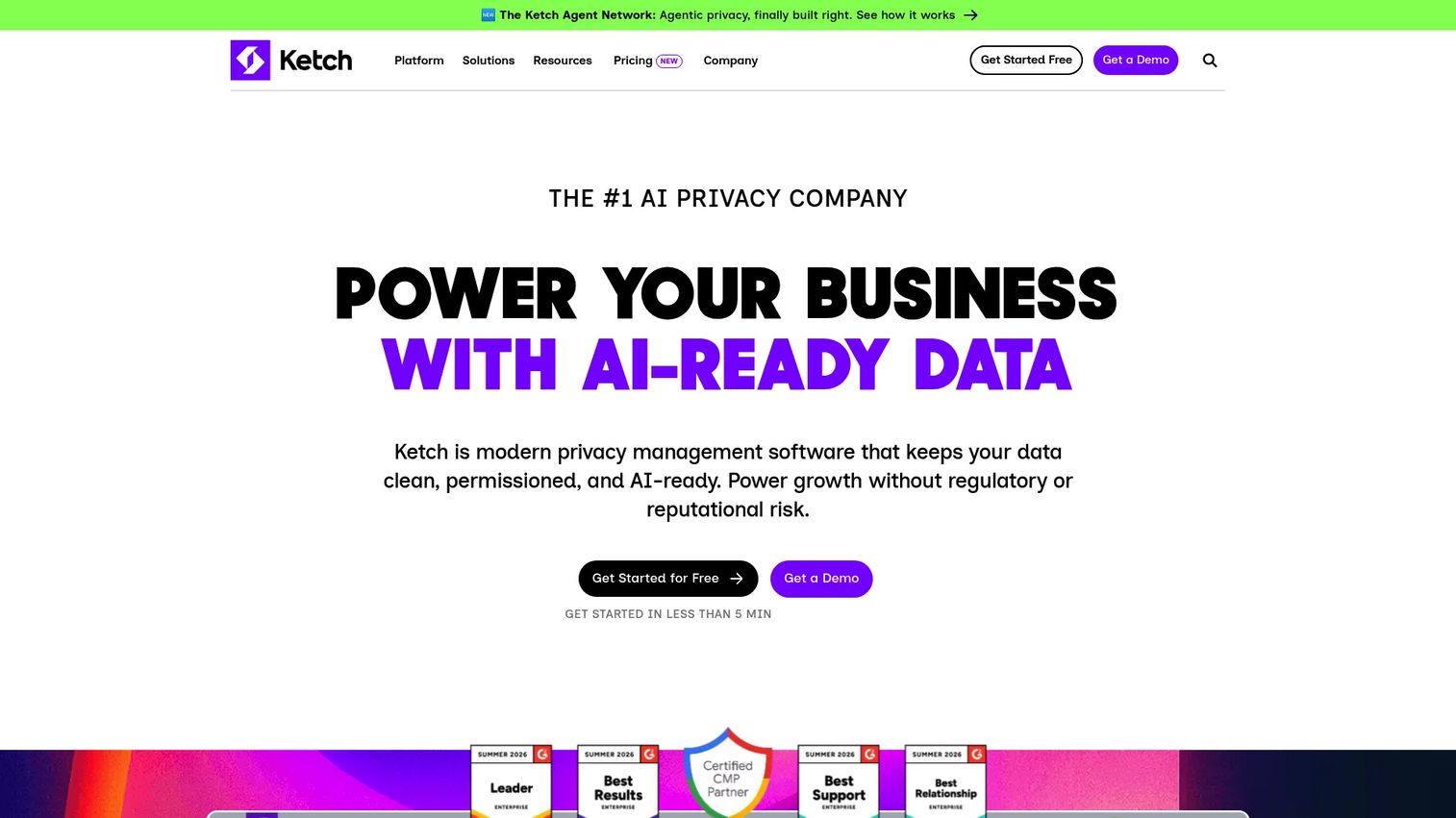
Ketch is privacy management software for collecting, controlling, and activating permissioned data. It positions itself as an AI-ready privacy platform, which matters as data governance expands beyond cookies into how first-party data gets used downstream. For marketers, the appeal is that consent does not just sit in a log, it becomes a usable signal for compliant activation across your stack.
Ketch goes well past the banner. It combines consent management and privacy experiences with data subject request automation, data mapping and discovery, identity sync across devices, and marketing preference management. That breadth makes it a fit when privacy compliance is a program, not a one-off project.
Best for: Teams that need enterprise privacy compliance, consent collection, and data subject request automation in one platform.
Key strengths
- Consent and preference management: Captures consent and granular preferences, then makes them available for compliant downstream activation.
- DSR automation: Orchestrates data subject request workflows so legal and ops are not handling them manually.
- Identity sync across devices: Keeps consent consistent for a user across sessions and devices.
Why choose Ketch: Choose Ketch when you want consent to feed real data activation, not just satisfy a banner requirement. The combination of consent, DSR automation, and data mapping suits growth teams who want defensible first-party data they can actually use in campaigns.
Ketch pricing: Ketch offers a free plan at $0 per month limited to 5,000 unique users monthly. The Starter plan is $150 per month for up to 30,000 users. The Plus plan starts from $499 per month billed annually for up to 100,000 users, and the Pro plan is custom pricing for larger needs. Ketch holds a 4.6 out of 5 rating on G2.
2. OneTrust
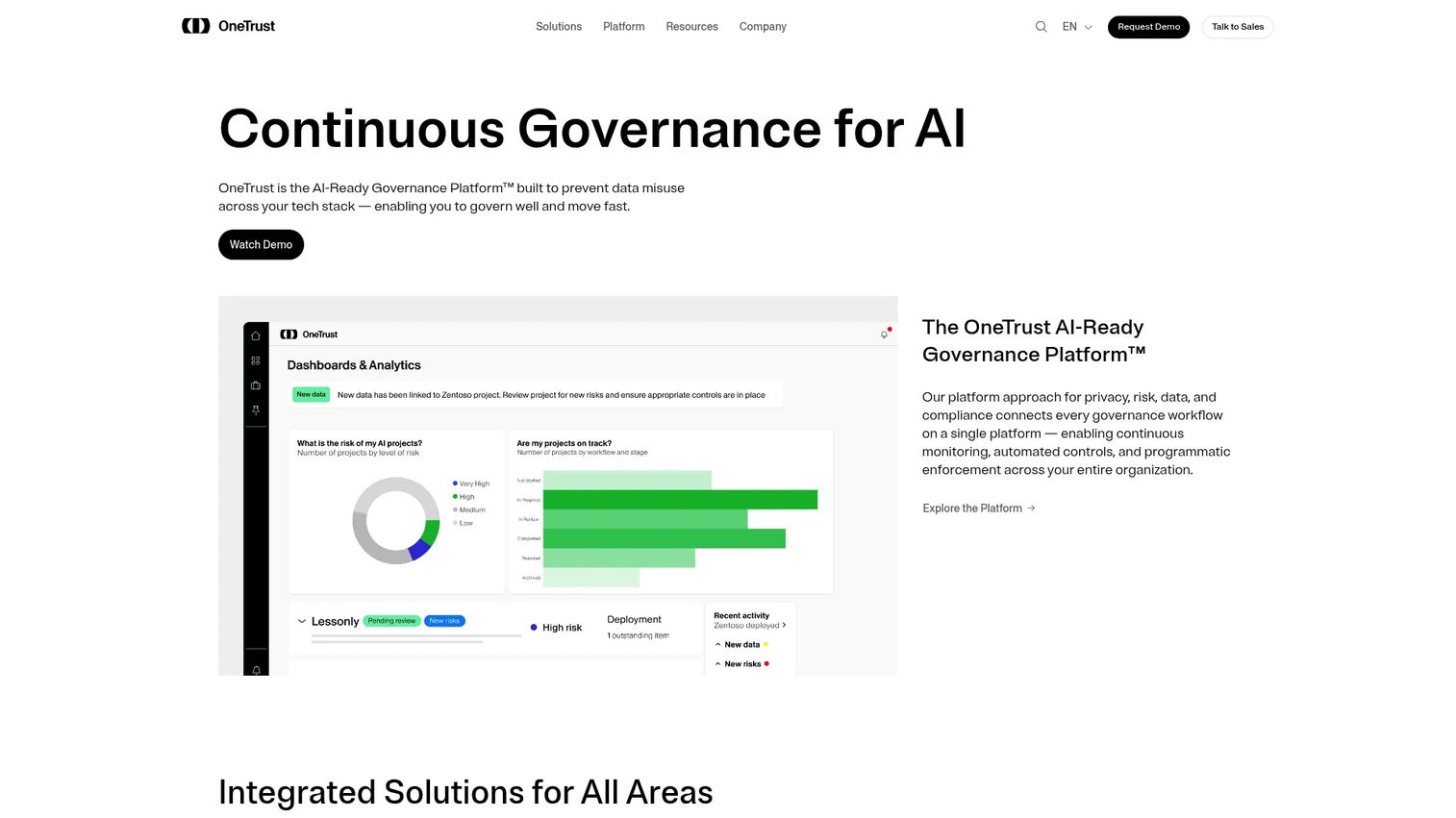
OneTrust is an AI-ready governance platform built to manage privacy, consent, risk, and compliance across a tech stack. It is the benchmark name in the category, often the first vendor larger teams shortlist when they have formal governance requirements. The consent module is one piece of a much wider compliance suite.
OneTrust covers AI governance, consent and preferences, privacy automation, tech risk and compliance, and third-party management. For marketing teams inside a larger organization, the consent banner and preference management capabilities slot into a platform that legal, security, and procurement already trust, which removes a common internal blocker.
Best for: Enterprises that need a broad governance stack spanning privacy, consent, third-party risk, and tech-risk programs.
Key strengths
- Consent and preferences: Banner, preference center, and universal consent management across properties.
- Privacy automation: Workflow automation for assessments, records, and regulatory obligations.
- Third-party management: Vendor and third-party risk tracking tied into the same platform.
Why choose OneTrust: Choose OneTrust when consent is one requirement inside a larger compliance mandate. The trade-off is scope. You are buying a governance platform, which is more than a lean team needs but exactly right for organizations with dedicated privacy functions.
OneTrust pricing: OneTrust does not display public numeric prices. Its pricing page shows solution packages with usage-based billing across modules like the consent management platform, privacy automation, and tech risk and compliance. Pricing is obtained directly through sales. OneTrust holds a 4.4 out of 5 rating on G2.
3. Usercentrics
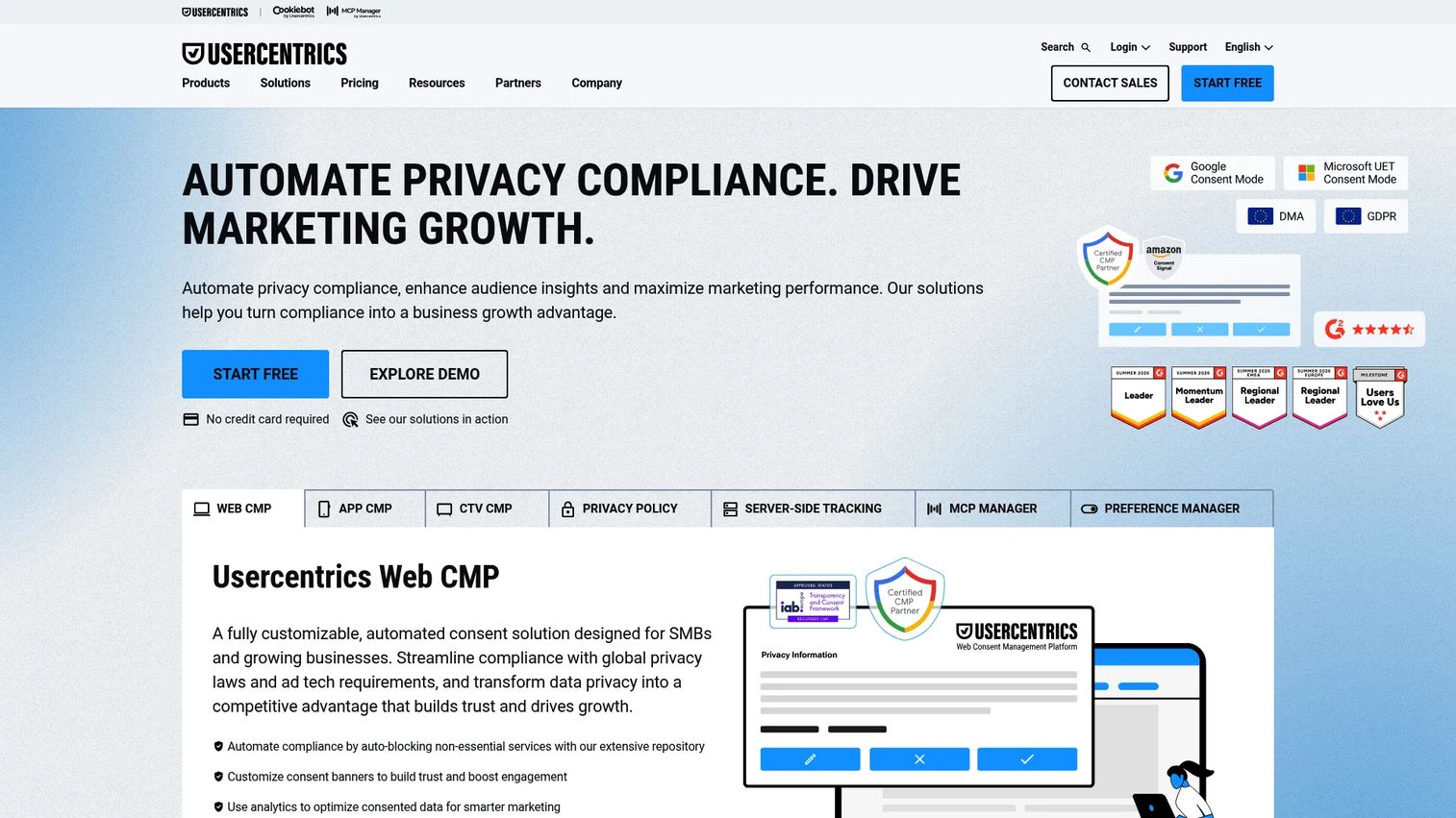
Usercentrics is consent management and privacy compliance software for websites, apps, and connected TV. It unifies consent collection across surfaces into one place, which is useful when your properties span more than a single website. For a marketer juggling web analytics, mobile, and tag management, that consolidation reduces the number of moving parts.
The platform provides a web CMP for consent collection, an app CMP for mobile consent, and a privacy policy generator. It handles multi-jurisdiction compliance and integrates with the tag and analytics tools marketing teams already run, so consent signals reach your measurement layer without manual rework.
Best for: Teams that need consent management and privacy compliance across web, app, and connected TV properties.
Key strengths
- Web CMP: Consent collection and banner management for websites with geotargeting.
- App CMP: Dedicated mobile app consent handling for cross-platform compliance.
- Privacy policy generator: Built-in tooling to keep policy pages aligned with what you actually collect.
Why choose Usercentrics: Choose Usercentrics when you want one consent layer across web and app rather than separate tools. It strikes a balance between marketer-friendly administration and the multi-jurisdiction coverage growing teams need.
Usercentrics pricing: Usercentrics shows public pricing in EUR with a Free plan at €0 per month, then Essential at €7 per month, Plus at €15 per month, Pro at €30 per month, and Business at €50 per month. An Unlimited access plan for high-traffic properties is available via sales. Usercentrics holds a 4.3 out of 5 rating on G2.
4. Cookiebot by Usercentrics
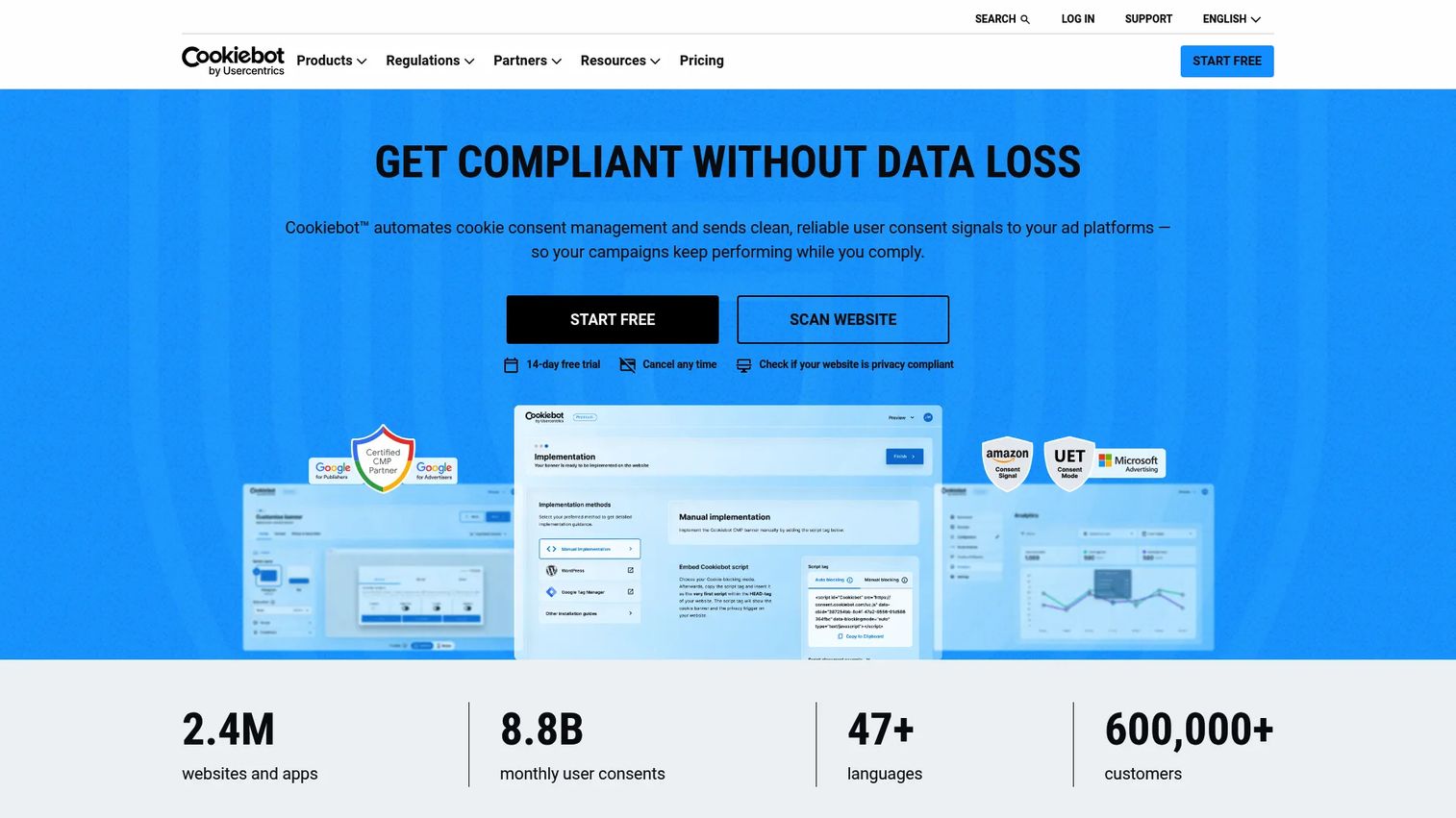
Cookiebot by Usercentrics is a consent management platform focused on cookie compliance, consent capture, and tracker scanning. It is a Google-certified CMP with patented scanning technology that automatically identifies and controls cookies and trackers on a site. For teams that want robust cookie consent management without standing up a full privacy ops program, it is a clean fit.
Cookiebot automates cookie and tracker scanning, handles consent banner customization and localization, and stores consent records for compliance reporting. The automated scanning is the standout, since it keeps your categorization current as new trackers appear without manual auditing.
Best for: Businesses that need an automated cookie consent management platform for website compliance.
Key strengths
- Automated scanning: Continuously identifies and categorizes cookies and trackers across your domains.
- Banner customization and localization: Brand-aligned consent banners that adapt by language and region.
- Consent storage and reporting: Consent records and reporting that support an audit trail for regulators.
Why choose Cookiebot: Choose Cookiebot when cookie compliance is the priority and you want auto-blocking trackers handled with minimal manual upkeep. The Google certification and Consent Mode compatibility make it reliable for preserving Google measurement.
Cookiebot pricing: Cookiebot offers a Free plan covering up to 50 subpages on one domain, then premium tiers that scale by subpages and domains: Premium Lite at $8 per month, Small at $16, Medium at $34, Large at $56, and XLarge at $96, each per domain. A 14-day trial is available. Cookiebot holds a 4.2 out of 5 rating on G2.
5. CookieYes
CookieYes is a cookie consent and privacy compliance platform for websites and apps. It started as a WordPress plugin and grew into a broader CMP, which shows in how fast it sets up. For lean teams and CMS-heavy environments, the no-code setup gets a compliant banner live quickly without engineering involvement.
CookieYes handles automated cookie scanning with audit reports, a customizable consent banner, and support for Google Consent Mode v2 and IAB TCF v2.3. That combination of ease and modern signal support makes it punch above its weight for small to mid-sized teams.
Best for: Businesses that need a website cookie consent manager with compliance-focused features and fast setup.
Key strengths
- Automated scanning and audit reports: Scans for cookies and generates reports that support consent records.
- Customizable banner: Brand-aligned consent banner with granular category controls.
- Consent Mode v2 and TCF v2.3 support: Modern signal passing for Google tags and ad-tech interoperability.
Why choose CookieYes: Choose CookieYes when you want speed and simplicity without giving up Google Consent Mode v2 or IAB TCF support. It is especially strong for WordPress and other CMS-driven sites where minimal overhead matters.
CookieYes pricing: CookieYes offers a Free plan at $0 per month per domain, then Basic at $10 per month per domain, Pro at $25 per month per domain, and Ultimate at $55 per month per domain. Annual billing is available alongside monthly, and a 14-day free trial is offered. CookieYes holds a 4.8 out of 5 rating on G2.
6. Didomi
Didomi is a privacy platform for consent and preference management. It pairs a consent management platform with a preference management platform, which is where it differentiates. Beyond capturing the initial yes or no, it manages ongoing preferences and helps activate more first-party data across web, app, and connected devices.
Didomi combines its CMP, a preference management platform, and compliance and tracker scanning. For teams that care about both regulatory coverage and customer experience polish, the preference center capabilities give users granular control while keeping consent records clean and synced across devices.
Best for: Enterprises that need consent and preference management across web, app, and connected devices.
Key strengths
- Consent management platform: Banner and consent collection with multi-jurisdiction support.
- Preference management platform: Granular preference center that extends consent into lifecycle data.
- Compliance and tracker scanning: Cookie scanning and compliance tooling to keep categorization current.
Why choose Didomi: Choose Didomi when preference management and first-party data activation matter as much as the consent banner. The preference center depth suits teams building personalized, lawful customer journeys across devices.
Didomi pricing: Didomi does not publish numeric pricing on its site. Its offers page lists Essential, Advanced, and Premium plans as contact-sales options. Pricing is scoped through a sales conversation based on traffic and modules. Didomi holds a 4.5 out of 5 rating on G2.
7. Osano
Osano is a data privacy management platform spanning consent, data subject access requests, data mapping, assessments, and vendor risk. It is a broader privacy operations play rather than a banner-only tool, which makes it relevant when you are thinking about a privacy program rather than a single compliance task.
Osano covers cookie consent, subject rights management, data mapping, vendor privacy risk management, privacy assessments, and a unified consent and preference hub. That unified hub is the marketer-relevant piece, since it ties consent and preferences together and feeds consistent signals downstream.
Best for: Teams that need an all-in-one privacy compliance platform beyond cookie consent.
Key strengths
- Cookie consent: Consent banner and cookie consent management with auto-blocking trackers.
- Subject rights management: Workflow handling for DSARs and consent revocation.
- Unified consent and preference hub: One place for consent records and preferences across the program.
Why choose Osano: Choose Osano when you want consent inside a broader privacy program covering vendor risk and assessments. The unified consent and preference hub keeps downstream activation consistent while the wider platform handles program obligations.
Osano pricing: Osano does not display public numeric pricing on its plans page. It points visitors to a demo or free trial, with self-service plans referenced but not priced on-page. Pricing is confirmed through sales. Osano holds a 4.5 out of 5 rating on G2 based on its reviews.
8. Consentmanager
Consentmanager is a consent management platform for website cookie consent and privacy compliance. It is registered with the IAB as a Consent Management Provider, which makes it a natural fit for publishers and marketers with ad-tech requirements and cross-border consent needs. The CMP ID registration signals serious IAB TCF support.
Consentmanager handles cookie banner and consent management, A/B testing and optimization, and a privacy policy generator. The A/B testing is unusual in this category and useful for marketers who treat the consent banner as a conversion surface worth optimizing rather than a fixed compliance artifact.
Best for: Businesses that need a GDPR-focused consent banner and CMP with tiered website and app usage limits.
Key strengths
- Cookie banner and consent management: Customizable banner with multi-jurisdiction compliance and geotargeting.
- A/B testing and optimization: Test banner variants to balance consent rates with compliance.
- Privacy policy generator: Generate and maintain policy pages aligned to your tracker inventory.
Why choose Consentmanager: Choose Consentmanager when cross-border consent and IAB TCF support are priorities, especially for publishers. The A/B testing capability also appeals to growth teams optimizing consent acceptance rates.
Consentmanager pricing: Consentmanager offers public pricing in EUR with a Free plan, Starter at €23 per month, Essential at €59 per month, Professional at €219 per month, and an Ultimate plan that is custom-priced by agreement. Capterra shows a 4.1 out of 5 rating for the product.
9. Cookie Information
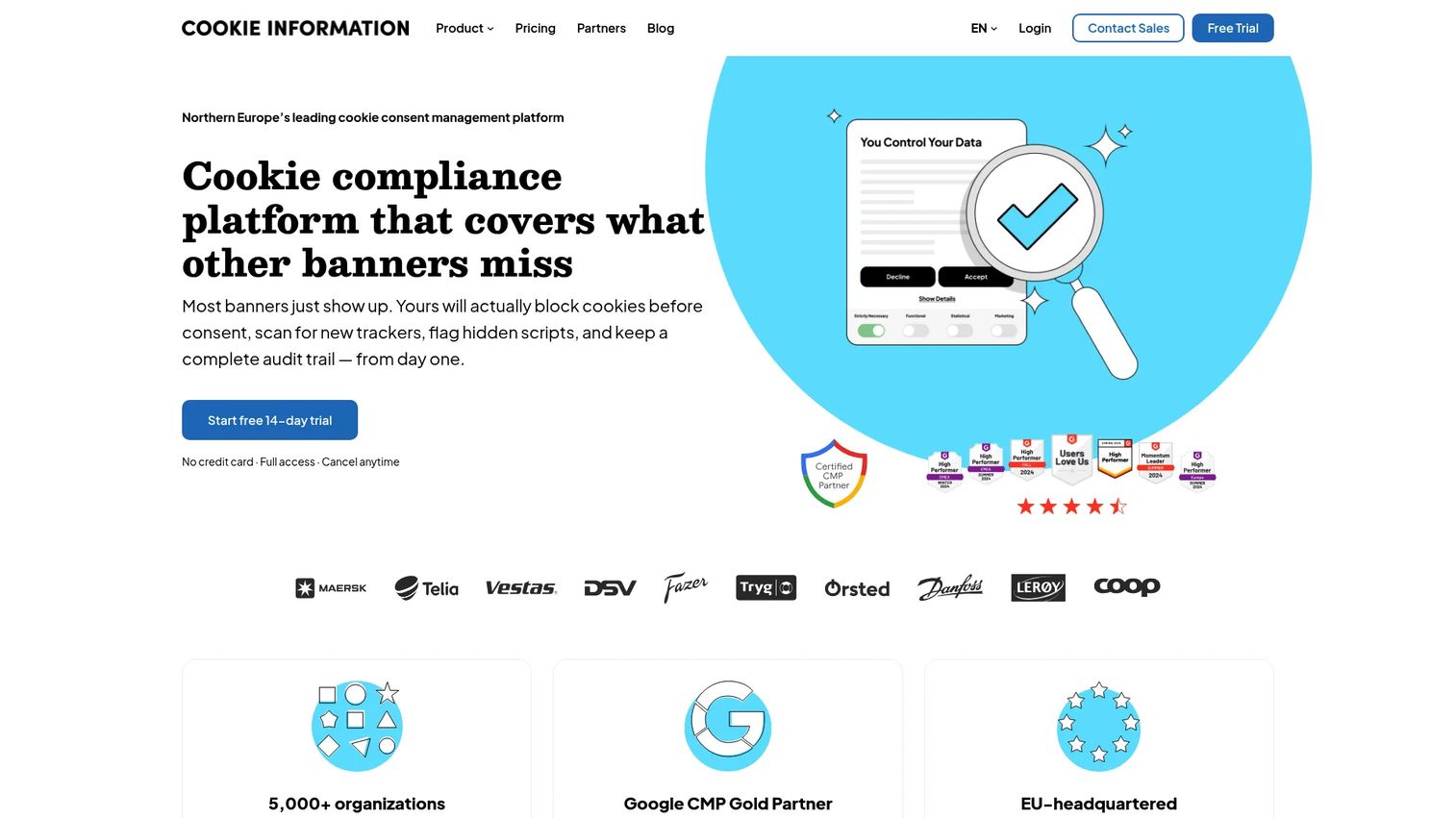
Cookie Information is a cookie consent management and compliance platform for websites and apps. It is strong with European and Scandinavian compliance-minded teams, though the capabilities are broadly useful for any organization with GDPR and ePrivacy obligations. Scan-based setup gets you to a documented, defensible state quickly.
Cookie Information provides automated cookie scanning and classification, Google Consent Mode v2 support, and audit-ready consent records with a compliance dashboard. The audit-ready records are the differentiator for teams that expect scrutiny and want a clean audit trail without manual logging.
Best for: Teams that need a GDPR and ePrivacy cookie banner with automated scanning and consent records.
Key strengths
- Automated scanning and classification: Finds and categorizes cookies and trackers automatically.
- Google Consent Mode v2 support: Preserves Google measurement by adjusting tags to consent state.
- Audit-ready consent records: Time-stamped consent logging with a compliance dashboard for reporting.
Why choose Cookie Information: Choose Cookie Information when audit-ready consent records and ePrivacy coverage are central. The compliance dashboard makes it straightforward to demonstrate consent logging if a regulator asks.
Cookie Information pricing: Cookie Information offers a Free plan covering one domain, then Essential from €19 per month per domain and Business from €35 per month per domain. A free trial is available. Cookie Information holds a 4.4 out of 5 rating on G2.
10. Legit
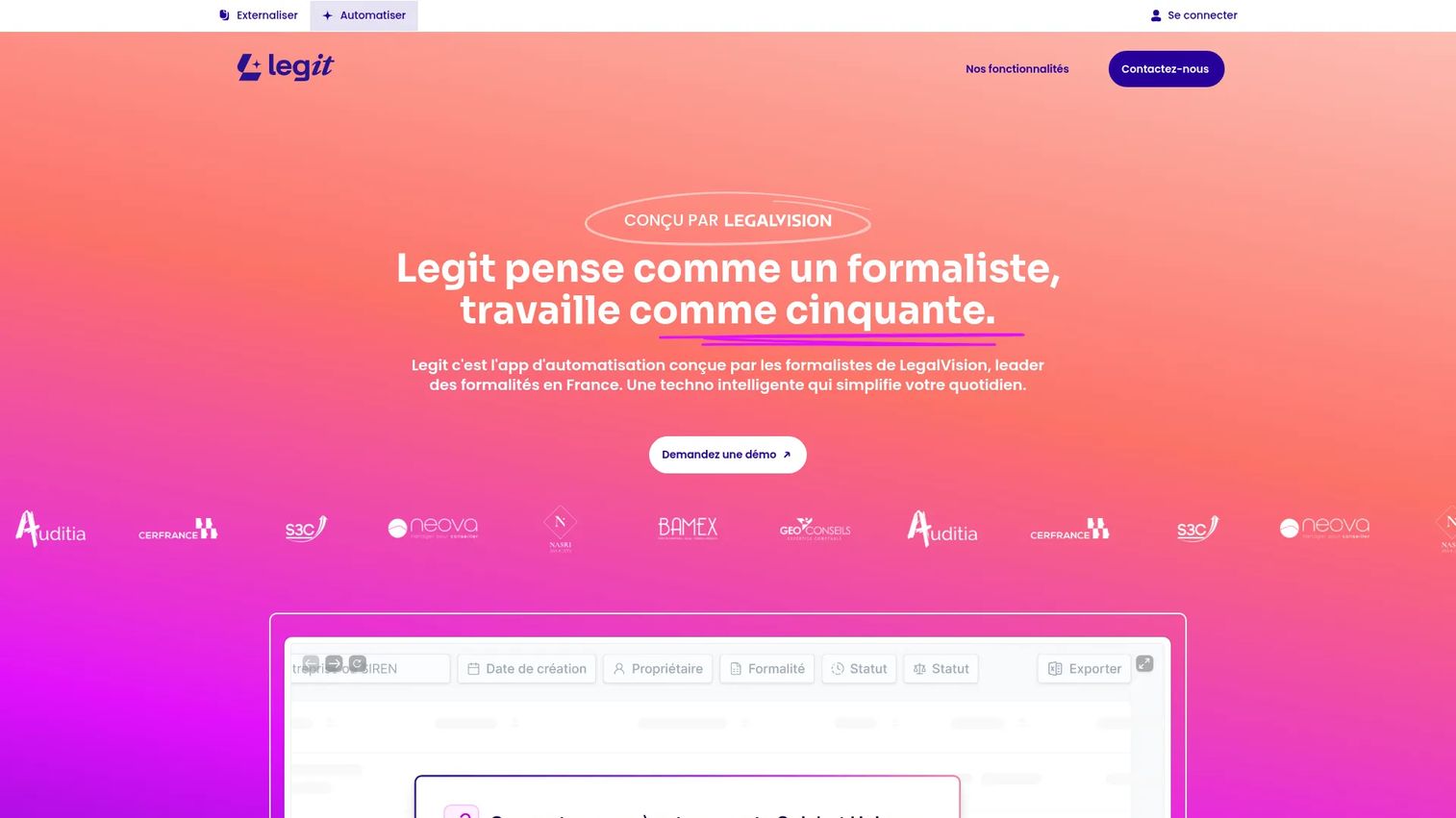
Legit is a French automation app for formalities around the Guichet Unique, built by LegalVision's formalists. It sits at the operational, paperwork end of compliance rather than the cookie-banner end, which makes it a different kind of tool from the pure CMPs above. Teams handling French administrative filings will recognize its niche immediately.
Legit offers Guichet Unique integration with real-time dossier sync, AI-assisted form prefill from statutes and meeting minutes, and payment delegation to a third party. It is purpose-built for formalities teams managing filings in France rather than for website consent collection.
Best for: Formalities teams handling Guichet Unique filings in France.
Key strengths
- Guichet Unique integration: Real-time dossier sync for French administrative formalities.
- AI-assisted form prefill: Prefills forms from statutes and meeting minutes to cut manual entry.
- Payment delegation: Delegates payment for filings to a third party to streamline the process.
Why choose Legit: Choose Legit if your compliance work centers on French Guichet Unique formalities rather than cookie consent management. It solves a specific administrative workflow that broad CMPs do not address.
Legit pricing: Legit does not publish public pricing on its site, and no verified rating was available for this specific product. Pricing is scoped directly with the vendor.
11. Data Privacy Manager
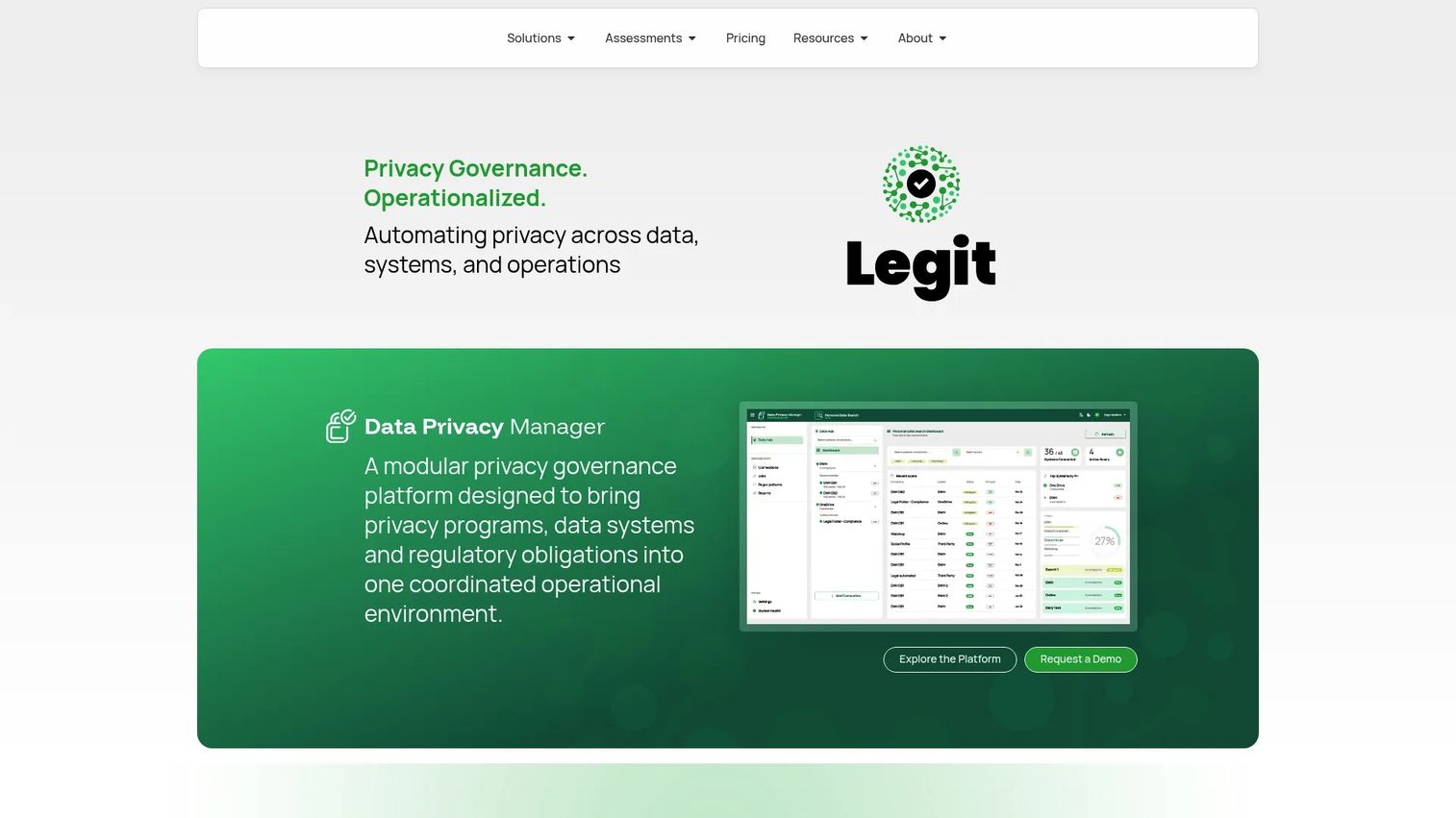
Data Privacy Manager is a privacy management and automation platform that handles consent and preference management alongside broader data privacy workflows. It is built for organizations that need more workflow depth than a basic consent banner tool, connecting consent to records of processing activities and personal data discovery.
The platform covers personal data discovery, consent and preference management, and privacy program automation. Central management of GDPR processes comes from connecting it to the systems and applications that hold personal data, which makes it a fit for teams that need consent tied into a wider data inventory.
Best for: Organizations that need privacy automation and consent management with workflow depth.
Key strengths
- Personal data discovery: Locates personal data across connected systems for a unified view.
- Consent and preference management: Captures consent and preferences with revocation handling.
- Privacy program automation: Automates GDPR processes including ROPA linkage and lifecycle workflows.
Why choose Data Privacy Manager: Choose Data Privacy Manager when consent needs to connect to records of processing and personal data discovery, not just sit in a banner. It suits enterprise teams running a full privacy program rather than a standalone cookie project.
Data Privacy Manager pricing: Data Privacy Manager does not publish public pricing on its site. Pricing is scoped directly through the vendor based on systems and scope. Data Privacy Manager holds a 4.5 out of 5 rating on G2.
Considerations before you choose
Picking a consent management platform is less about feature checklists and more about how it behaves inside your existing stack. Run through these criteria before committing.
Measurement continuity and Consent Mode v2
The single biggest risk for marketers is broken analytics. Verify that the platform supports Google Consent Mode v2 so Google tags adjust to consent state rather than going dark. Confirm how modeled conversions behave and whether your attribution survives the switch.
Consent logging and audit trail
Collecting consent is only half the job. You need defensible consent records with time stamps, version history, and the ability to prove what each user agreed to. Check how long records are retained and how easily you can export them if a regulator asks.
Scanning, auto-blocking, and revocation
Look at how the tool handles cookie scanning and auto-blocking trackers. Trackers should stay blocked until consent is granted, and consent revocation should propagate downstream immediately. Manual tag management defeats the purpose, so favor automated enforcement.
Integrations and downstream activation
Your CMP has to talk to your CRM, analytics, and ad platforms. Confirm the depth of CRM and analytics integrations and whether consented data flows cleanly into downstream activation. A consent signal that never reaches your tools is a compliance win and a marketing loss.
Multi-jurisdiction and website speed impact
If you serve multiple regions, verify geotargeting and multi-jurisdiction compliance for GDPR, CCPA, CPRA, and ePrivacy. Also test website speed impact, since a heavy consent script can slow page loads and hurt conversion.
Conclusion
The right consent management platform depends on how deep your privacy obligations go and how protective you are of your measurement. For enterprise privacy ops where consent is part of a wider governance mandate, OneTrust and Ketch lead. If automated cookie compliance is the core need, Cookiebot by Usercentrics and Cookie Information handle scanning and consent records cleanly. Lean and CMS-heavy teams get fast, affordable coverage from CookieYes and Consentmanager, while Usercentrics offers strong all-around consent across web, app, and connected TV.
For teams that want consent to power first-party data activation and lifecycle preferences, Didomi and Data Privacy Manager extend the category into preference management and workflow automation. Osano fits when consent belongs inside a broader privacy program.
The main trade-off is consistent across the list: ease of implementation versus depth of privacy operations. Pick the lightest tool that still protects your analytics, supports Google Consent Mode v2, and logs consent defensibly. Start a trial with your two best-fit options, run them against your live tag setup, and watch what happens to your conversion tracking before you commit.
Start your journey with Guideflow today!
FAQs
A consent management platform is software that collects, stores, and enforces user permissions for data processing so a website or app complies with privacy laws like GDPR, CCPA, CPRA, and ePrivacy. It shows a consent banner, records each choice in a consent log, and controls which trackers fire based on that choice. The good ones do this automatically without forcing you to rewrite every tag by hand.
If you serve visitors in the EU, UK, or California, almost certainly yes. GDPR consent management and ePrivacy rules require prior consent before non-essential trackers fire, while CCPA consent management and CPRA give users opt-out rights you must honor and document. A CMP enforces these rules at the tag level and keeps the consent records that prove compliance.
For marketers, a CMP should collect consent without breaking analytics. That means Google Consent Mode v2 support so Google tags adjust rather than disappear, clean CRM and analytics integrations so consented data still flows downstream, and reliable consent logging for defensible reporting. The goal is lawful measurement, not just a banner that satisfies legal.
A CMP integrates with Google Tag Manager by passing consent state signals that control when tags fire. With Google Consent Mode v2, Google Analytics and Google Ads tags adjust their behavior based on consent rather than going dark, which preserves modeled conversions. This lets you keep measuring performance while respecting user choices.
A cookie banner is just the visible prompt asking for permission. A consent management platform is the full system behind it: it scans and categorizes trackers, blocks them until consent is granted, logs every choice in an audit trail, handles consent revocation, and passes signals downstream. The banner is one feature of a CMP, not the whole thing.
Consent logging is the time-stamped recording of what each user agreed to, including the version of the banner and the categories accepted. It matters because privacy laws require you to prove consent, not just claim it. If a regulator audits you, a defensible consent log with version history and revocation records is your evidence that you handled permissions lawfully.
Prioritize multi-jurisdiction compliance and geotargeting so the platform serves the right experience based on a visitor's location and applicable law. Confirm it covers GDPR, CCPA, CPRA, and ePrivacy, supports IAB TCF if you work with ad-tech, and centralizes consent records across domains. A single source of truth for consent is what keeps cross-border downstream activation lawful.
It can, which is why website speed impact is worth testing. A heavy or poorly loaded consent script can delay page rendering and hurt conversion, while a well-optimized one loads asynchronously with minimal effect. Some platforms also offer A/B testing on the consent banner so you can balance acceptance rates against compliance without guessing.