Someone installs your app. They open it once. Then they vanish.
That is the shape of most mobile funnels. Acquisition spends real money to get the install, activation loses a chunk of those users in the first session, and by day seven you are looking at a retention curve that flattens near the floor. The install was never the problem. The gap between install and habit is.
Most teams try to close that gap with more pushes. More reminders. Louder notifications. That rarely works, because volume is not the same as relevance. What moves retention is sending the right message, in the right channel, at the right moment, tied to what the user actually did.
The market has noticed. The mobile engagement market is projected to reach $81.98B in 2026, up from $56.04B in 2025, according to The Business Research Company (2026). That is a lot of budget chasing the same problem you have: getting users to come back.
The catch for a growth marketer is tool sprawl. You already pay for analytics, a CRM, an email tool, and maybe a CDP. A new mobile engagement platform has to earn its slot by replacing something or measurably lifting retention. This guide compares seven platforms so you can pick one that ships faster, measures cleaner, and does not just add another tab.
What's inside
This guide is for growth, lifecycle, and product marketers choosing a mobile engagement platform for an app-first or omnichannel motion. It is neutral and evaluation-oriented, not a vendor pitch.
We compared each tool on the criteria that decide whether it earns a place in your stack:
- Channel coverage: push notifications, in-app messaging, SMS, email, web push
- Automation and journeys: event-triggered flows and lifecycle orchestration
- Segmentation and personalization: behavioral, predictive, and real-time targeting
- Analytics and reporting: funnels, cohorts, attribution, and experimentation
- Integrations: CRM, CDP, warehouse, and marketing stack fit
TL;DR
Short on time? Here are the fast answers:
- Broadest omnichannel fit: Braze, for cross-channel journeys at mid-market and enterprise scale.
- Best for mobile-first lifecycle marketing: MoEngage, built around app engagement and predictive segments.
- Best for retention and behavioral analytics: CleverTap, which pairs deep analytics with campaign orchestration.
- Best for enterprise app messaging: Airship, with mobile-first roots and strong message center tooling.
- Best for lean teams and fast setup: OneSignal, with a free tier and quick activation.
- Best for developer-led behavioral automation: Customer.io, for data-driven journeys with warehouse sync.
What is mobile engagement software
Mobile engagement software is a customer engagement platform that helps teams reach app and mobile users through push notifications, in-app messaging, and other channels, then automate and measure those interactions to improve activation and retention.
A mobile engagement platform sits between your product data and your users. It ingests behavioral events, groups users into segments, triggers messages based on what they do, and reports on whether those messages changed behavior. Think of it as the layer that turns raw app activity into timely, relevant communication.
Core capabilities to expect:
- Cross-channel messaging across mobile push, in-app, web push, SMS, and email
- Behavioral segmentation and personalization
- Event-triggered automation and lifecycle journeys
- Analytics, cohort reporting, and A/B testing
- Integrations with your CRM, CDP, warehouse, and analytics stack
The common thread is omnichannel engagement. A user who ignores a push might open an email. Someone mid-session responds better to an in-app message than a notification they see later. The platform coordinates those channels so the message meets the user where they already are.
Push notifications
Push notifications are the workhorse of app engagement. They pull users back into the app with timely nudges: a cart left behind, a new match, a price drop, a streak about to break.
The difference between a push that lifts retention and one that drives an uninstall is targeting. Blast the whole base with the same message and you train users to swipe it away or disable notifications entirely. Segment by behavior and time the send to the user's active window, and open rates climb. Mobile push works best when it is specific, personal, and earned.
In-app messaging
In-app messaging reaches users while they are already inside the app, which makes it the highest-context channel you have. No permission prompt, no delivery lag, no lock screen to compete with.
Teams use in-app messages for onboarding walkthroughs, feature announcements, upsell prompts, and surveys. Because the user is engaged in that moment, an in-app message can guide activation without interrupting the session. It complements push: push brings them back, in-app messaging shapes what they do once they arrive.
Automation and journeys
Automation and journeys turn one-off campaigns into repeatable lifecycle programs. Instead of sending a manual blast, you build a flow that reacts to user behavior: a welcome series after signup, a win-back sequence after seven days of inactivity, a conversion nudge after a key event.
Good journey orchestration handles branching, wait steps, and channel fallbacks. If a user does not open the push, the flow can try email next. Lifecycle messaging like this runs without a marketer touching it, which is the whole point. You set up the logic once and it scales.
Analytics and optimization
Analytics and reporting are how you prove the program works. Funnels show where users drop. Cohort reports show whether a campaign changed retention over time. A/B testing tells you which message, timing, or channel wins.
For a growth marketer accountable for retention, this is the section that earns budget. Being able to tie a lifecycle flow to a measurable lift in day-30 retention is the difference between "we send pushes" and "we moved the number." The best platforms make that attribution defensible enough to show leadership.
When to use mobile engagement software
Not every team needs a dedicated platform on day one. Here is when the category earns its place.
Improve activation after signup
The first session decides a lot. Users who hit their first meaningful action stick; users who bounce at a blank state rarely return. Onboarding journeys, contextual in-app prompts, and well-timed nudges walk new users to that first win. If your activation rate is soft and you are relying on the product alone to carry onboarding, a mobile engagement platform gives you levers to pull.
Recover dormant users
Every app accumulates users who drifted away. Win-back flows target them by behavior: last active date, features they used, purchases they made. A segmented push or email that references what they actually cared about outperforms a generic "we miss you" every time. Recovering even a fraction of dormant users is cheaper than acquiring new ones, which is exactly the CAC math leadership wants to see.
Orchestrate lifecycle messaging across channels
Users do not live in one channel. Cross-channel messaging lets app push, in-app, SMS, email, and web push work as one program instead of four disconnected tools. A single journey can start with a push, fall back to email, and confirm with an in-app message. Consolidating that orchestration into one platform is also a direct answer to tool sprawl.
Prove retention impact to leadership
When pipeline or retention is soft, marketing is the first place leadership looks. Analytics and reporting give you the defensible story: this cohort saw this flow, retention moved this much. Attribution your CFO believes is worth as much as the retention lift itself, because it protects the budget that funds the program.
Comparison table
Here is a side-by-side view of the seven platforms. Pricing reflects what each vendor publishes; several use custom, sales-led pricing, and G2 ratings are current at the time of writing.
| # | Product | Best for | Key use case | Pricing | G2 rating |
|---|---|---|---|---|---|
| 1 | Airship | Enterprise mobile-first messaging | Cross-channel messaging and message centers | Custom, quote-based | 4.0/5 |
| 2 | MoEngage | Mobile-first lifecycle marketing | Omnichannel journeys and predictive segments | Custom, sales-led | 4.5/5 |
| 3 | Braze | Cross-channel engagement at scale | Journey orchestration with Canvas | Custom, usage-based; 14-day trial | 4.5/5 |
| 4 | CleverTap | Retention and behavioral analytics | Behavior-driven campaigns and analytics | From $75/month | 4.6/5 |
| 5 | OneSignal | Lean teams and fast setup | Cross-channel messaging and automation | Free; Growth from $19/month | 4.7/5 |
| 6 | Customer.io | Behavioral automation | Data-driven multi-channel journeys | From $100/month | 4.4/5 |
| 7 | Iterable | Enterprise lifecycle marketing | Cross-channel orchestration and personalization | Custom, sales-led | 4.4/5 |
Best mobile engagement software for 2026
Each section below covers what the tool does, who it fits, its key strengths, why you would choose it, and pricing. Read them against your own stack and lifecycle maturity, not in isolation.
1. Airship
Airship is a customer engagement platform built around cross-channel messaging, orchestration, personalization, and analytics. Its roots are mobile-first, and that shows in its push and message center tooling. Enterprise app teams use it to coordinate messaging across push, SMS, RCS, MMS, email, web, mobile wallet, and app and web notifications from one place.
Best for: Enterprise teams that need a mature cross-channel messaging and app engagement platform.
Key strengths
- Unified messaging across push, SMS/RCS/MMS, email, web, wallet, and notifications
- Customer data management, segmentation, and personalization
- Journey orchestration with testing, optimization, and analytics
Why choose Airship: If your app is central to the business and you need message centers, wallet, and mature cross-channel orchestration, Airship covers that breadth. It fits teams with the scale and process to run a full omnichannel program rather than a scrappy single-channel one.
Airship pricing: Airship does not publish public pricing. Its plans, including the Airship Experience Platform and Airship Essentials, are quote-based, so you request pricing through sales.
For a growth marketer, Airship makes sense when mobile is the core surface and you need depth across channels. If you only need push and a couple of flows, this is more platform than the job requires.
2. MoEngage
MoEngage is a customer engagement platform built for B2C and mobile-first teams. It combines cross-channel messaging with customer journey analytics and AI-driven personalization, which makes it a strong fit for lifecycle marketing where app engagement is the primary motion.
Best for: B2C teams that need omnichannel engagement and customer journey automation centered on the app.
Key strengths
- Cross-channel messaging across mobile push, web push, email, SMS, in-app, and on-site
- Customer journey analytics, segmentation, campaign management, and flows
- AI and ML-driven personalization, predictions, and decisioning
Why choose MoEngage: MoEngage leans into predictive segments and journey analytics, so you can build flows that react to predicted behavior, not just past events. That suits retention marketers who want the platform to help decide who to message, not just how.
MoEngage pricing: MoEngage lists Growth and Enterprise plans, plus MoEngage Personalize and MoEngage Inform as products. Public numeric pricing is not shown; both plans route through sales.
If your growth motion is B2C and app-heavy, MoEngage's analytics-plus-messaging combination reduces the need for a separate product analytics tool. Enterprise demand gen teams with complex attribution will appreciate the journey-level reporting.
3. Braze
Braze is a customer engagement platform known for cross-channel messaging and journey orchestration through its Canvas builder. It targets mid-market and enterprise teams that need unified engagement across many channels, with AI-powered personalization layered on top.
Best for: Mid-market and enterprise teams that need broad cross-channel orchestration at scale.
Key strengths
- Cross-channel messaging across email, push, SMS/MMS/RCS, WhatsApp, and in-app
- Journey orchestration with Braze Canvas
- BrazeAI-powered personalization and decisioning
Why choose Braze: Braze is often the default when a team wants one platform to run every channel with sophisticated branching journeys. Canvas is flexible enough for complex lifecycle programs, which is why it shows up in a lot of enterprise stacks.
Braze pricing: Braze publishes edition names, Braze Go, Select, Pro, and Enterprise, but no public numeric prices. Pricing is usage-based and sales-led. A 14-day free trial is available.
For a growth marketer running an omnichannel motion, Braze is a strong consolidation play: it can replace several point tools. The tradeoff is that usage-based pricing means you should model your message volume before committing, since costs scale with sends.
4. CleverTap
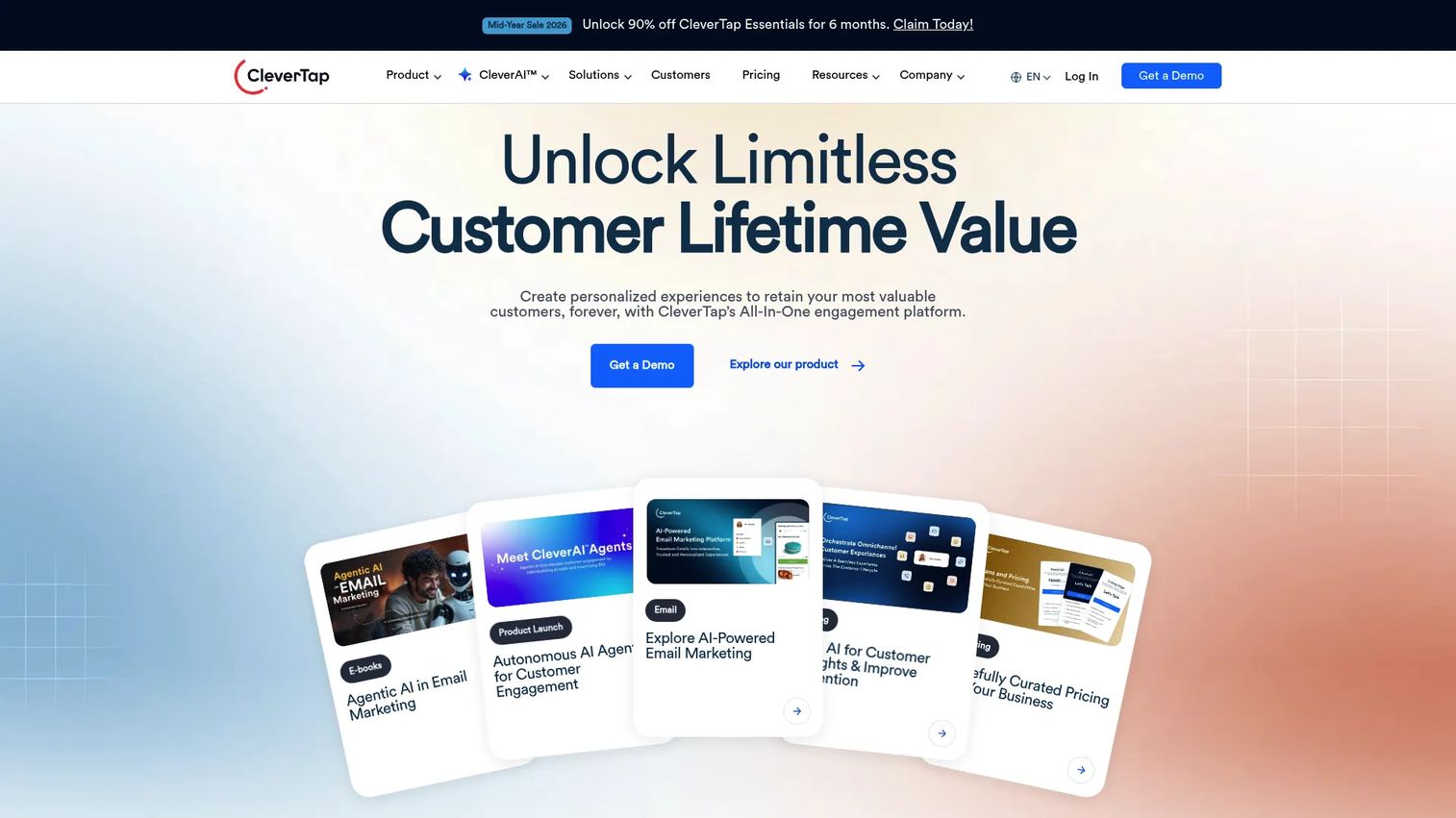
CleverTap is a customer engagement and retention platform that pairs behavioral analytics with multi-channel campaign orchestration. It is built for teams that treat retention and customer lifetime value as the primary scoreboard, not just message delivery.
Best for: Teams that want analytics, segmentation, and messaging in one platform focused on retention.
Key strengths
- Behavioral analytics and user segmentation
- Omnichannel campaign orchestration
- Personalization and experimentation
Why choose CleverTap: CleverTap's analytics depth is the draw. You can spot the behavior that predicts churn, build a segment around it, and message that segment without leaving the tool. For retention-focused growth teams, that tight loop between insight and action is the point.
CleverTap pricing: CleverTap publishes three editions. Essentials starts at $75/month, and Advanced and Cutting Edge use custom pricing. A free trial is available through the pricing page.
CleverTap fits mid-market growth marketers who want a defensible retention story backed by their own behavioral data. The published entry price also makes it easier to justify than fully sales-gated platforms when you are early in evaluation.
5. OneSignal
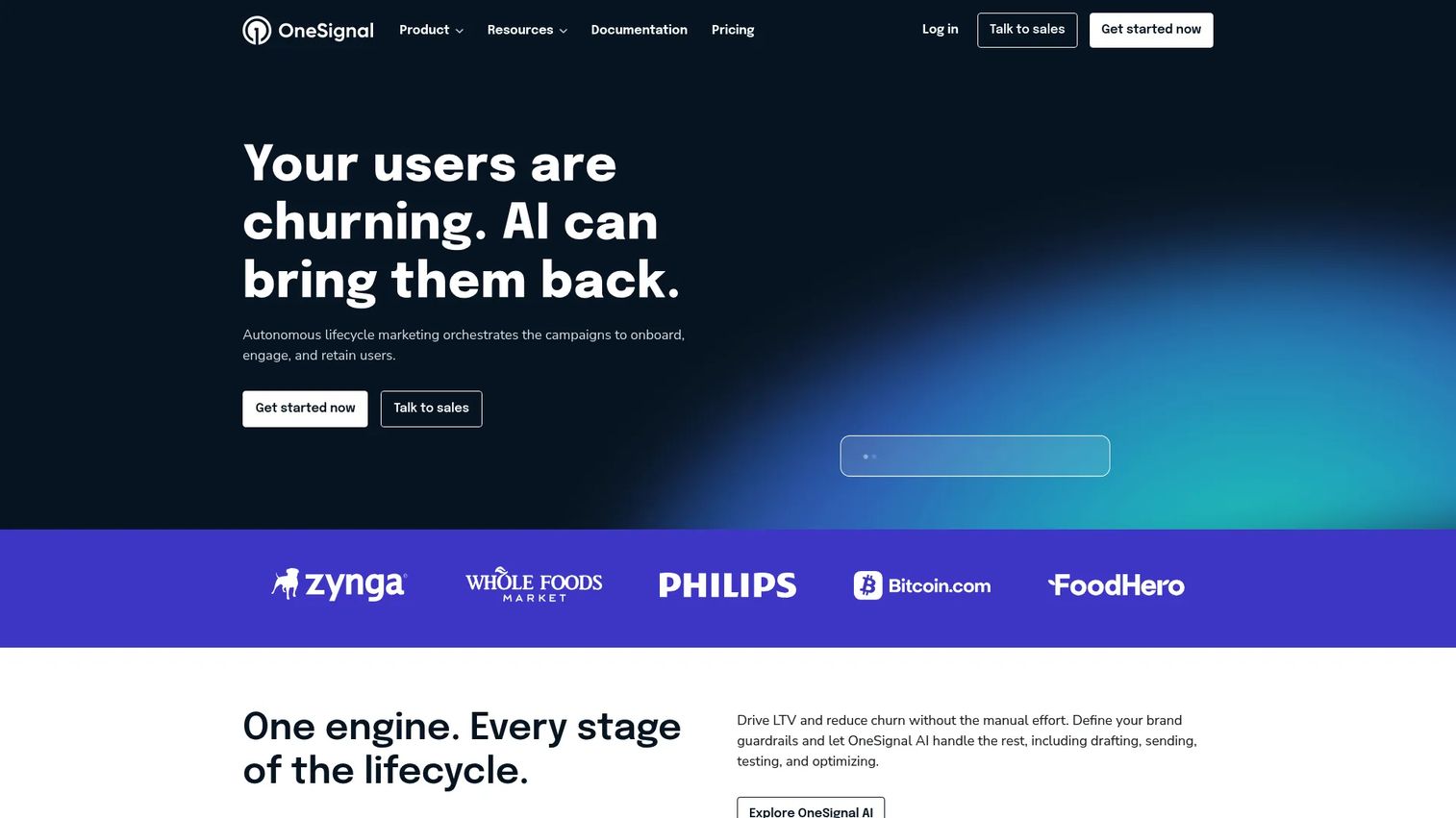
OneSignal is a customer engagement platform for push notifications, email, SMS/RCS, in-app messaging, and Live Activities. It is widely used by lean teams because it activates fast and has a genuinely usable free tier.
Best for: Startups and lean teams that want cross-channel messaging without a heavy setup or a sales call.
Key strengths
- Omnichannel messaging across mobile push, web push, email, SMS/RCS, and in-app
- Journeys for visual workflow automation
- A/B testing, segmentation, analytics, localization, and integrations
Why choose OneSignal: OneSignal removes the friction of getting started. A one- to three-person marketing team can ship push and in-app messaging quickly, then grow into journeys and cross-channel flows as needs expand. Its high G2 rating reflects that ease of use.
OneSignal pricing: OneSignal offers a free plan. The Growth plan starts at $19/month month-to-month, while Professional and Enterprise are custom with annual contracts.
For an early-stage growth generalist owning every channel with a scrappy budget, OneSignal is the natural starting point. The free tier and low entry price mean you can prove value before asking finance for anything.
6. Customer.io
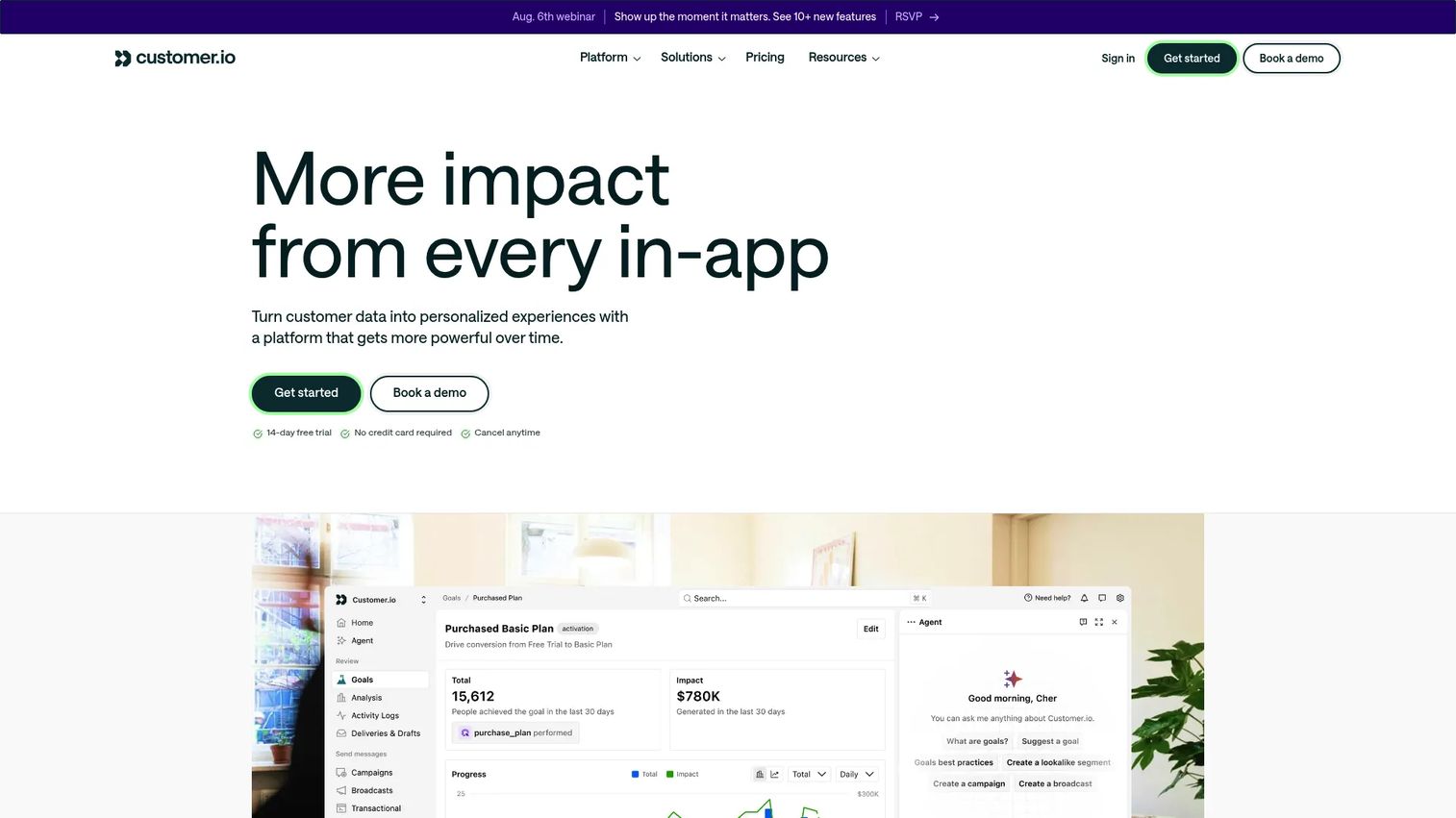
Customer.io is a customer engagement platform built for data-driven, event-triggered messaging across channels. Its visual workflow builder and warehouse sync make it a favorite for teams that want granular control over behavioral automation.
Best for: Growth and product teams that need event-driven, multi-channel automation with strong data flexibility.
Key strengths
- Visual workflow builder
- Multi-channel campaigns
- Data warehouse sync
Why choose Customer.io: Customer.io shines when your messaging logic is complex and tied closely to product events. The warehouse sync means you can trigger flows off the same data your analytics team trusts, which keeps segmentation clean. It rewards teams comfortable working with data.
Customer.io pricing: Essentials starts at $100/month billed monthly. Premium starts at $1,000/month billed yearly, and Enterprise is custom. A 14-day free trial is offered.
For a growth marketer who wants to run experiments without filing an engineering ticket for every flow, Customer.io's builder and data model are a good match. It fits teams that value control and clean data over an all-in-one analytics suite.
7. Iterable
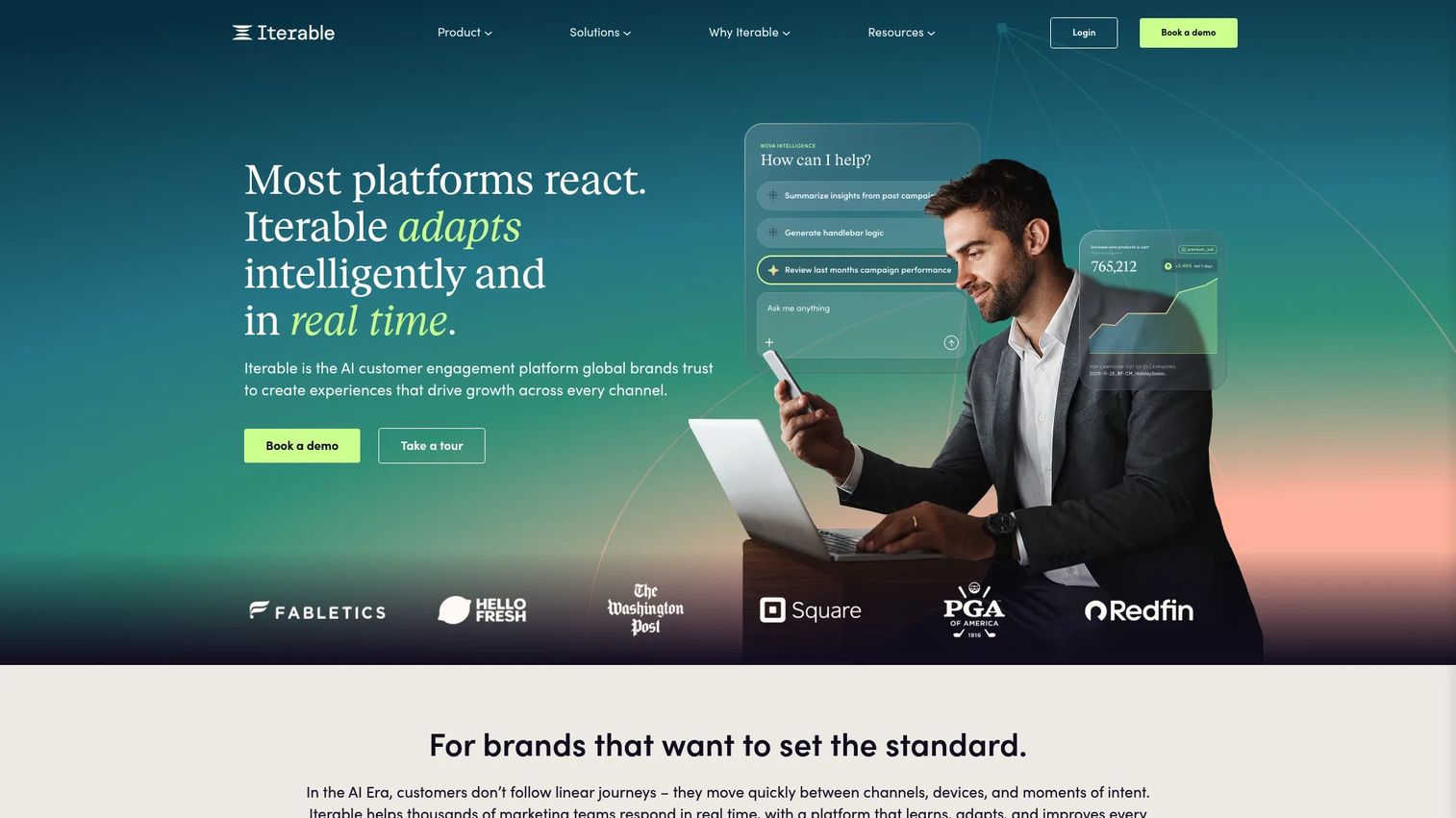
Iterable is an AI customer engagement platform for cross-channel messaging and journeys. It targets enterprise teams running multi-channel lifecycle marketing that needs real-time branching and deep personalization.
Best for: Enterprise teams running multi-channel lifecycle marketing and customer engagement at scale.
Key strengths
- Cross-channel campaign orchestration
- Journey automation with real-time branching
- Data activation and personalization
Why choose Iterable: Iterable's strength is orchestrating complex journeys that react in real time as user data changes. For enterprise lifecycle teams juggling many segments and channels, that responsiveness keeps messaging relevant instead of stale. Personalization and data activation round out the case.
Iterable pricing: Iterable does not disclose public pricing on its site. Plans are quote-based and sales-led, so you will work with their team to scope a plan.
Iterable fits enterprise growth and lifecycle teams that already have clean data and need orchestration to match their complexity. If you are early-stage or want a published price to compare, it will take a sales conversation to get there.
Considerations
Before you commit, run the shortlist through this checklist. The right platform depends on your lifecycle maturity, not on which vendor has the loudest homepage.
Channel coverage
Confirm the tool supports every channel you actually use: mobile push, in-app messaging, SMS, email, and web push. A platform strong on push but thin on in-app may force a second tool, which defeats the consolidation goal. Map coverage to your real channel mix, not a hypothetical one.
Segmentation depth
Check whether segmentation is behavioral, predictive, and real-time. Static list-based segments age fast. You want to build a segment on live behavior and have flows react as users move in and out of it. Predictive segments help you message likely churners before they leave.
Analytics and attribution
Verify the reporting can tie campaigns to retention and revenue, not just opens and clicks. Look for funnels, cohort analysis, and holdout groups for clean attribution. If you cannot prove a flow moved day-30 retention, you cannot defend the spend.
Integrations and data flow
Make sure the platform connects to your CRM, CDP, warehouse, and analytics stack. Warehouse sync in particular keeps segmentation consistent with the data your team already trusts. Poor integrations create the data-quality problems that undermine every downstream campaign.
Security and governance
For enterprise buyers, check roles, permissions, compliance, and approval workflows. Procurement, security, and legal will all weigh in, so confirm the platform meets enterprise compliance requirements before you get attached to it.
Pricing model
Understand whether pricing is seat-based, contact-based, or usage-based. Usage-based platforms scale with message volume, so model your sends before signing. A published entry price makes early evaluation easier; sales-gated pricing means budgeting a longer buying cycle.
Conclusion
The broadest fit for most teams running an omnichannel motion at scale is Braze, with MoEngage close behind for mobile-first B2C lifecycle marketing. Both handle cross-channel journeys, segmentation, and analytics in one place.
For retention-focused teams that want analytics and messaging tightly linked, CleverTap is the pick, and its published entry price eases evaluation. Airship suits enterprise app teams that need message centers and wallet depth. Iterable fits enterprise lifecycle teams with clean data and complex orchestration needs.
If you are a lean or early-stage team, start with OneSignal for its free tier and fast setup. If your messaging is event-heavy and data-driven, Customer.io gives you the control and warehouse sync to run flows without engineering bottlenecks.
The decision comes down to five factors: channel coverage, automation depth, analytics, integrations, and pricing model. Match the tool to your current lifecycle maturity rather than the one with the most features. A platform you can activate and measure this quarter beats a heavier one you never fully deploy. When you narrow the field, pick the one that improves mobile app retention without adding another silo to your stack.
If your evaluation also touches product onboarding or activation flows where users need to experience a feature rather than read about it, Guideflow and its interactive walkthroughs can complement your engagement stack by turning key moments into guided, self-serve experiences you can share and analyze.
FAQs
Mobile engagement software is a platform that reaches app and mobile users through push notifications, in-app messaging, and other channels, then automates and measures those interactions. It helps teams improve activation, retention, and conversion by sending relevant messages tied to user behavior. It sits between your product data and your users as the coordination layer for engagement.
Look for cross-channel messaging (push, in-app, SMS, email, web push), behavioral segmentation, event-triggered automation and journeys, and analytics with A/B testing. Integrations with your CRM, CDP, warehouse, and analytics stack matter just as much. Without clean data flow, the messaging and reporting both suffer.
Marketing automation is broader and often email- and web-centric, aimed at nurturing leads through a funnel. A mobile engagement platform centers on app and mobile users, with push notifications and in-app messaging as first-class channels and behavioral events as the main trigger. The overlap is real, but the emphasis on mobile app engagement and real-time behavior is what separates the category.
OneSignal is the common starting point for startups and lean teams. It has a free plan, activates fast, and covers push, in-app, email, and SMS without a sales call. You can prove value on the free tier, then move to the Growth plan at $19/month as needs grow.
Braze, Airship, MoEngage, and Iterable all target enterprise app and lifecycle marketing. Braze and Iterable emphasize cross-channel orchestration at scale, Airship brings mobile-first depth with message centers and wallet, and MoEngage pairs omnichannel messaging with predictive analytics. All four use custom, sales-led pricing, so budget for a longer buying cycle.
They improve retention by targeting the moments where users drop. Onboarding journeys walk new users to their first meaningful action, and win-back flows re-engage dormant users based on what they did before. Because messages are triggered by behavior and timed to the user's active window, they feel relevant instead of spammy, which keeps users coming back.
Most support mobile push, in-app messaging, web push, SMS, and email, and some add RCS, MMS, WhatsApp, and mobile wallet. The value of a user engagement platform is coordinating those channels so a single journey can move between them. A push that goes unopened can fall back to email, then confirm with an in-app message.
Measure it with cohort retention, activation rate, funnel conversion, and campaign-level lift against a holdout group. Opens and clicks are useful signals, but retention and conversion are the numbers leadership cares about. The strongest platforms let you attribute a specific flow to a measurable change in day-7 or day-30 retention, which is what makes the spend defensible.