A board member forwards an article about the EU AI Act at 9:47pm on a Tuesday. The question lands in your inbox by Wednesday morning: "What's our exposure?" You don't have a clean answer. Nobody on the team does. You ship AI features. Your sales team uses ChatGPT. Engineering shipped a Copilot integration last sprint. Customer success quietly rolled out an internal agent built on Claude. And procurement at your largest enterprise prospect just sent a 60-question AI risk questionnaire. The deal is now sitting in legal.
This is the moment most SaaS founders start shortlisting AI governance tools. Not because the topic is interesting. Because the cost of not having an answer is now measured in deals and board confidence.
Gartner forecasts that by 2026, organizations that operationalize AI transparency, trust, and security will see a 50% improvement in AI model adoption, business goals, and user acceptance. The flip side is the part founders feel first: the companies that don't operationalize this lose deals to ones that have. The EU AI Act is now in force, phased obligations are landing through 2026 and 2027, and the procurement teams at your enterprise prospects already have AI risk questionnaires ready.
The right ai governance platform gives you an inventory of where AI lives in your stack, the policies to govern it, and the evidence to prove it.
What's inside
This guide is built for SaaS founders, GRC leads, and AI/ML leaders at companies shipping AI features who need to shortlist 2 or 3 governance vendors fast. We selected 10 tools based on four criteria:
- Coverage of model, agent, application, and shadow AI inventory
- Regulatory mapping breadth across EU AI Act, NIST AI RMF, ISO 42001, GDPR, and SOC 2
- Monitoring and audit-trail capability
- Realistic fit for mid-market SaaS, not only the Fortune 500
Pricing reflects what's publicly verifiable on each vendor's pricing page at the time of writing. G2 ratings reflect current listings.
TL;DR
- Best for analyst-backed, audit-ready governance with agentic AI coverage: Credo AI
- Best for organizations standardized on Microsoft: Microsoft Purview
- Best for regulated industries (insurance, financial services): Monitaur
- Best for bias detection, model monitoring, and LLM observability: Fiddler AI
- Best for shadow AI discovery and data security overlap: Securiti.ai
- Best when MLOps and governance need to live in one platform: DataRobot
Background: What AI governance tools actually do
AI governance tools are software platforms that centralize the discovery, policy enforcement, risk monitoring, and audit documentation of AI models, agents, and applications across an organization.
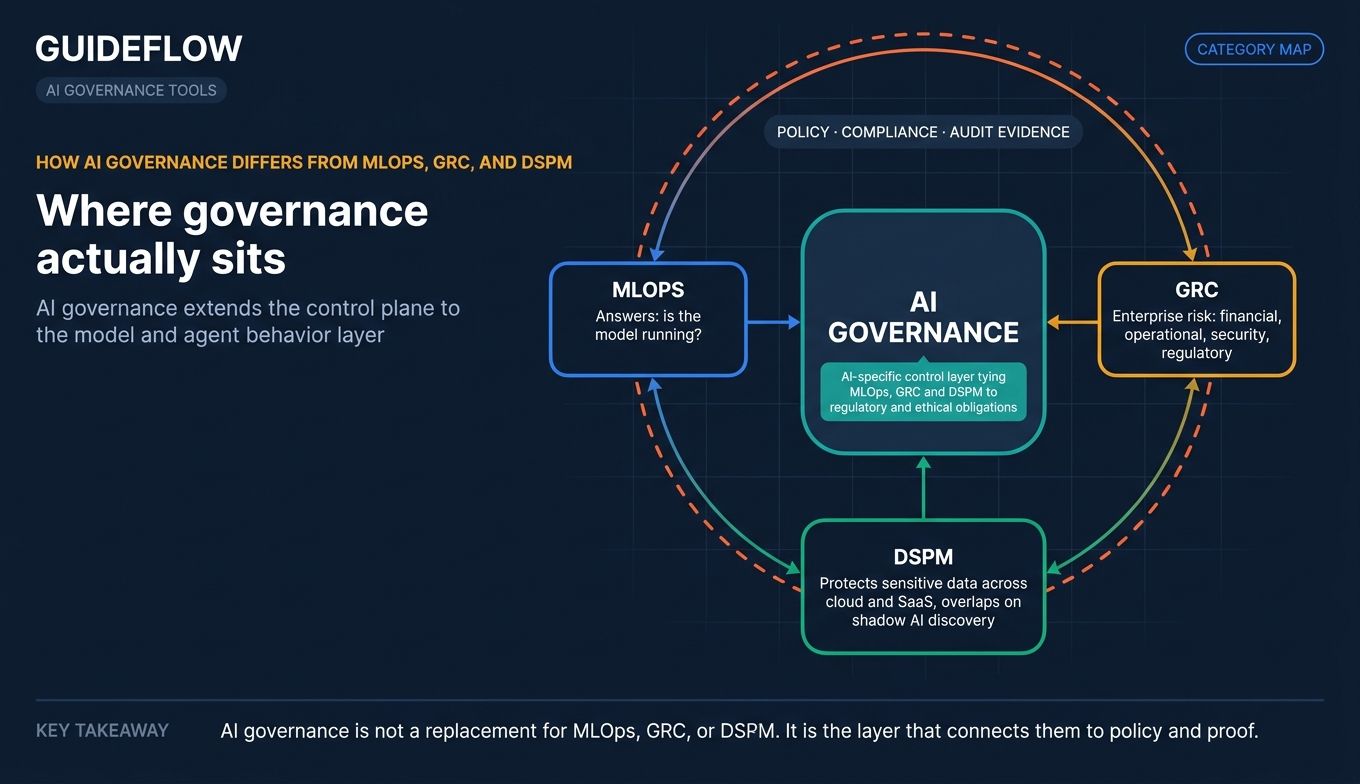
That definition matters because the category is often confused with adjacent ones. AI governance software is not MLOps. It is not GRC. It is not data security posture management. It is the AI-specific control layer that ties all three to regulatory and ethical obligations.
Core capabilities of an AI governance platform
- AI inventory and registry covering models, agents, embedded AI, and shadow AI
- Policy engine and approval workflows
- Risk assessment, fairness testing, and bias detection
- Continuous AI governance monitoring (drift, performance, prompt logging, output filtering)
- Compliance mapping to EU AI Act, NIST AI RMF, ISO 42001, GDPR, and SOC 2
- Audit trails and evidence collection for regulators and enterprise buyers
- Explainability and model documentation (often called factsheets or model cards)
How AI governance differs from MLOps, GRC, and DSPM
MLOps focuses on building, deploying, and operating models. It answers "is the model running?" Model governance tools sit on top to answer "should it be running, and how do we prove it complies?"
GRC covers enterprise risk broadly: financial, operational, security, regulatory. AI governance platforms either integrate with GRC or extend it specifically for AI risk taxonomy.
DSPM (data security posture management) protects sensitive data across cloud and SaaS. It overlaps with AI governance solutions on shadow AI discovery, but stops at the data layer. AI governance extends the control plane to the model and agent behavior layer.
When you need an AI governance tool
When your board asks how you comply with the EU AI Act
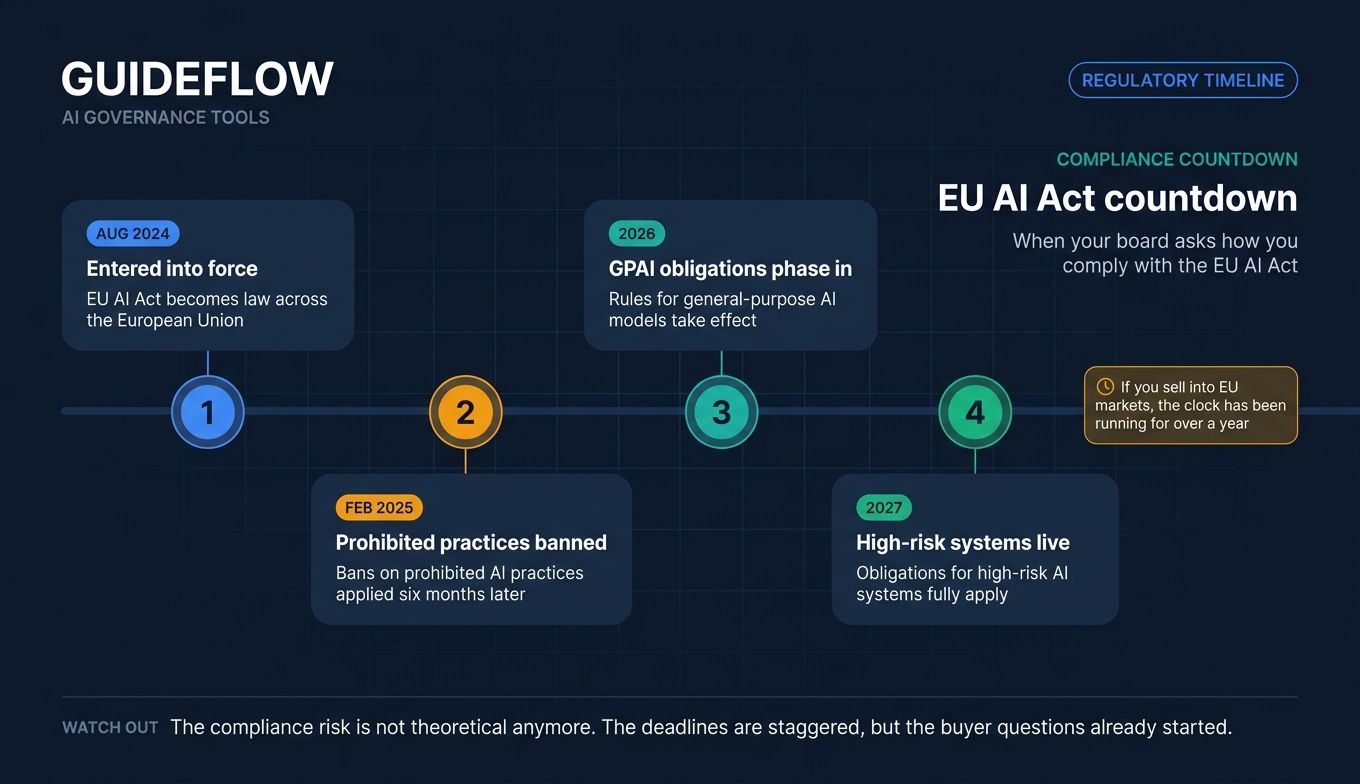
The EU AI Act entered into force in 2024. Bans on prohibited AI practices applied 6 months later, with obligations for general-purpose AI and high-risk systems phasing in over 2026 and 2027. If you sell into EU markets, the clock has been running for over a year. The board question is no longer hypothetical.
When enterprise deals stall on AI risk questionnaires
Procurement at enterprise buyers now routinely sends multi-page AI risk questionnaires before signing. Without an inventory, policy documentation, and audit trail, you're answering questions in spreadsheets while the deal slips a quarter. Pairing these documents with interactive demos of your AI features can also help procurement teams understand exactly what they're evaluating. The questionnaires are getting longer every release cycle.
When shadow AI usage outpaces visibility
Your team uses ChatGPT, Claude, Copilot, and dozens of embedded AI features inside tools you already pay for. You can't govern what you can't see. Shadow AI discovery is now a discrete capability category, and it's usually the first thing founders realize they need.
Comparison table
The table below sorts vendors by relevance to the SaaS founder buyer. Pricing columns reflect what each vendor publishes on its first-party pricing page. Where vendors do not publish a starting price, the entry says "Contact sales" and the body section explains what's known about the model. G2 ratings reflect current listings; where a vendor has fewer than five reviews, that's noted.
| # | Product | Intent | Key differentiation | Pricing | G2 rating |
|---|---|---|---|---|---|
| 1 | Credo AI | Enterprise AI governance for models, agents, applications | Pre-built policy packs and compliance mapping across EU AI Act, NIST AI RMF | Contact sales | Insufficient G2 reviews |
| 2 | Microsoft Purview | Governance for Microsoft-stack AI (Copilot, Azure OpenAI) | Native discovery and DLP applied to AI prompts | From $12/user/month (Purview Suite) | 4.5/5 (Capterra) |
| 3 | IBM watsonx.governance | Enterprise AI lifecycle governance and risk | Automated factsheets, hybrid cloud, mappings to NIST AI RMF and EU AI Act | Lite free tier; Essentials from USD 795 per instance | 4.3/5 |
| 4 | OneTrust AI Governance | AI governance tied to existing privacy/GRC programs | Inventory and risk aligned to EU AI Act, NIST, ISO 42001 | Contact sales | Not separately rated on G2 |
| 5 | Holistic AI | End-to-end governance with bias and fairness depth | Shadow AI discovery, automated testing, continuous monitoring | Contact sales | Insufficient G2 reviews |
| 6 | Fiddler AI | AI observability with guardrails and governance | LLM observability, real-time guardrails, explainability | Free tier; Developer at $0.002/trace; Enterprise custom | 4.3/5 |
| 7 | Monitaur | Governance for regulated industries | Model lifecycle documentation and audit defense for insurance and financial services | Contact sales | Insufficient G2 reviews |
| 8 | Securiti.ai | Data + AI governance with shadow AI discovery | DSPM heritage, Data+AI Command Center, unified PrivacyOps | Business at $599/month or $6,110/year (Privacy Center); Enterprise custom | 4.7/5 |
| 9 | DataRobot | AI platform with embedded governance | Unified MLOps and governance for agentic AI pipelines | Contact sales | 4.8/5 (Capterra) |
| 10 | ModelOp Center | Vendor-agnostic enterprise AI governance | Centralized AI system of record across ML, GenAI, agentic, vendor AI | Contact sales | 4.9/5 |
Best AI governance tools in 2026
1. Credo AI
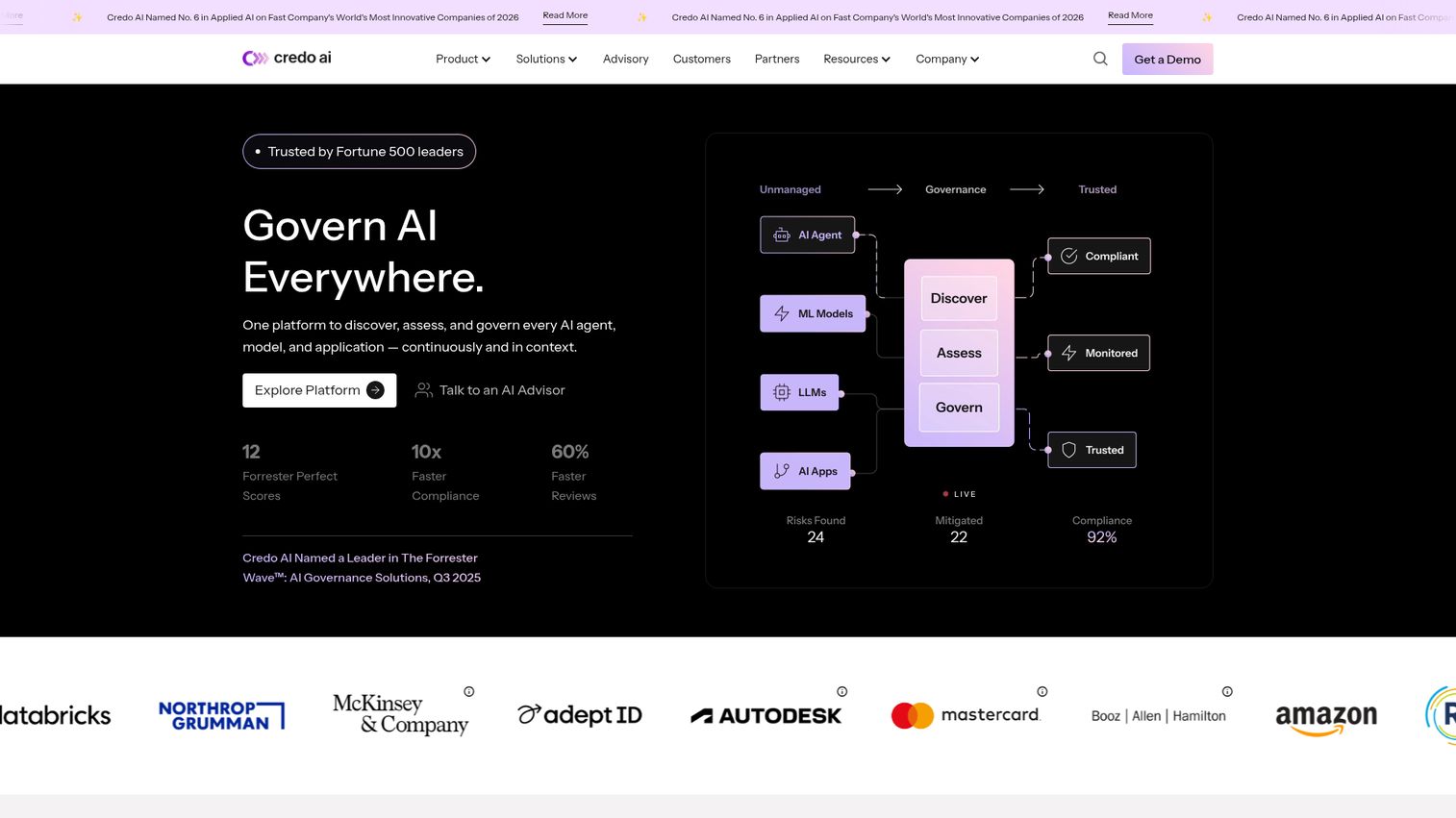
Credo AI is an enterprise AI governance platform for discovering, assessing, and governing AI agents, models, and applications. It's one of the most frequently cited vendors when founders and GRC leads start shortlisting. The platform's stated focus on AI agents (not only models) is a real differentiator as the buying market shifts toward agentic AI in 2026. For broader context on this shift, see our roundup of agentic AI tools for sales and the leading AI orchestration platforms powering these systems.
Best for: Mid-market and enterprise SaaS companies with multi-regulatory exposure and a dedicated AI or GRC owner who can run the platform day to day.
Key strengths
- AI Registry for discovery and cataloging: Inventory of AI systems across the organization, including vendor AI, internal models, and embedded applications.
- Risk Intelligence with continuous monitoring: Automated red-teaming, alerts, and drift detection that surface issues before they hit a board report.
- Policy Engine with compliance mapping: Pre-built policy packs, custom guardrails, and evidence generation tied to regulatory frameworks.
Why choose Credo AI: Credo AI is what most enterprise AI risk programs benchmark other vendors against. If you need an audit-ready story for your board within a quarter and the buyer at your next enterprise deal is a CISO or General Counsel, Credo AI is built for that conversation. The agentic AI angle matters more every quarter as customers ship agents into production.
Credo AI pricing: Credo AI does not publish pricing on its first-party site. The platform is sold through enterprise sales conversations, with pricing tied to scope of AI inventory and modules. Prospects request a demo to start the process.
2. Microsoft Purview
Microsoft Purview offers a unified approach to help organizations secure and govern data across heterogeneous data estates. For SaaS companies standardized on Microsoft 365 and Azure, Purview extends data governance directly into AI activity (Copilot and Azure OpenAI Service) without bolting on another vendor. It's often the path of least resistance for stack consolidation.
Best for: SaaS companies already running on Microsoft 365 and Azure, especially those who want governance for Copilot interactions covered by existing licenses.
Key strengths
- Data Loss Prevention applied to AI prompts: Policies extend to AI chat prompts and responses, blocking sensitive data leakage in Copilot.
- Insider Risk Management: Behavioral signals across the Microsoft estate including AI activity.
- eDiscovery: Compliance and investigation capabilities applied to AI-generated content.
Why choose Microsoft Purview: Stack consolidation is the case. If your E5 license already covers a chunk of Purview, adding AI governance capabilities is significantly cheaper than buying a standalone ai governance platform. The fit weakens if most of your AI runs outside the Microsoft ecosystem.
Microsoft Purview pricing: Microsoft publishes pricing on its Purview pricing page. The Microsoft Purview Suite starts at $12.00 per user per month, paid yearly. Microsoft 365 E5 is $57.00 per user per month and includes a broad set of Purview capabilities. Pay-as-you-go offerings exist for Data Governance, Data Security, and Data Compliance scenarios.
3. IBM watsonx.governance
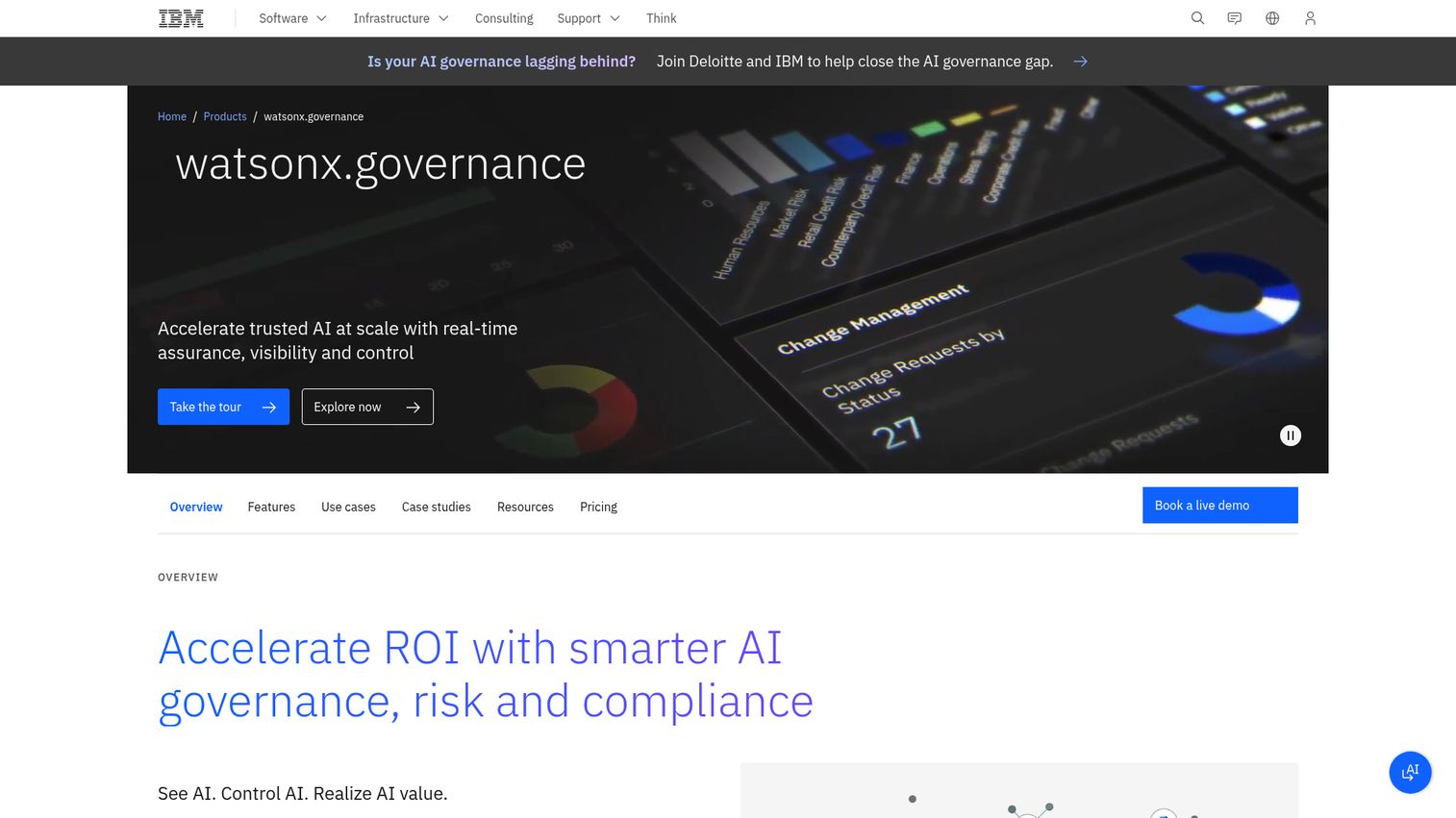
IBM watsonx.governance is an enterprise AI assurance and governance platform for managing AI risk, compliance, monitoring, and lifecycle oversight across hybrid, multi-vendor environments. IBM brings decades of model risk management heritage from banking and regulated industries into a modern AI governance solution.
Best for: Regulated industries (financial services, healthcare, insurance) and enterprises with existing IBM relationships who want lifecycle governance across ML, generative AI, and agentic AI.
Key strengths
- Governance Graph: Maps AI assets, policies, risks, and regulatory requirements in one structured view.
- AI risk and control mapping: Compliance applicability workflows across enterprise GRC domains.
- Model evaluation and monitoring: Lifecycle tracking with automatic documentation of model facts.
Why choose IBM watsonx.governance: When your buyers, auditors, or regulators expect documented model governance with named frameworks (NIST AI RMF, EU AI Act), watsonx.governance produces artifacts they recognize. The hybrid cloud and on-prem deployment options matter for organizations with data residency constraints.
IBM watsonx.governance pricing: IBM publishes pricing on its watsonx.governance pricing page. Options include a Lite tier (free for limited use), Essentials with pay-as-you-use components, and named instance pricing: Essentials at USD 795 per instance and Standard at USD 3,710 per instance. IBM notes prices are indicative and vary by country and locale.
4. OneTrust AI Governance
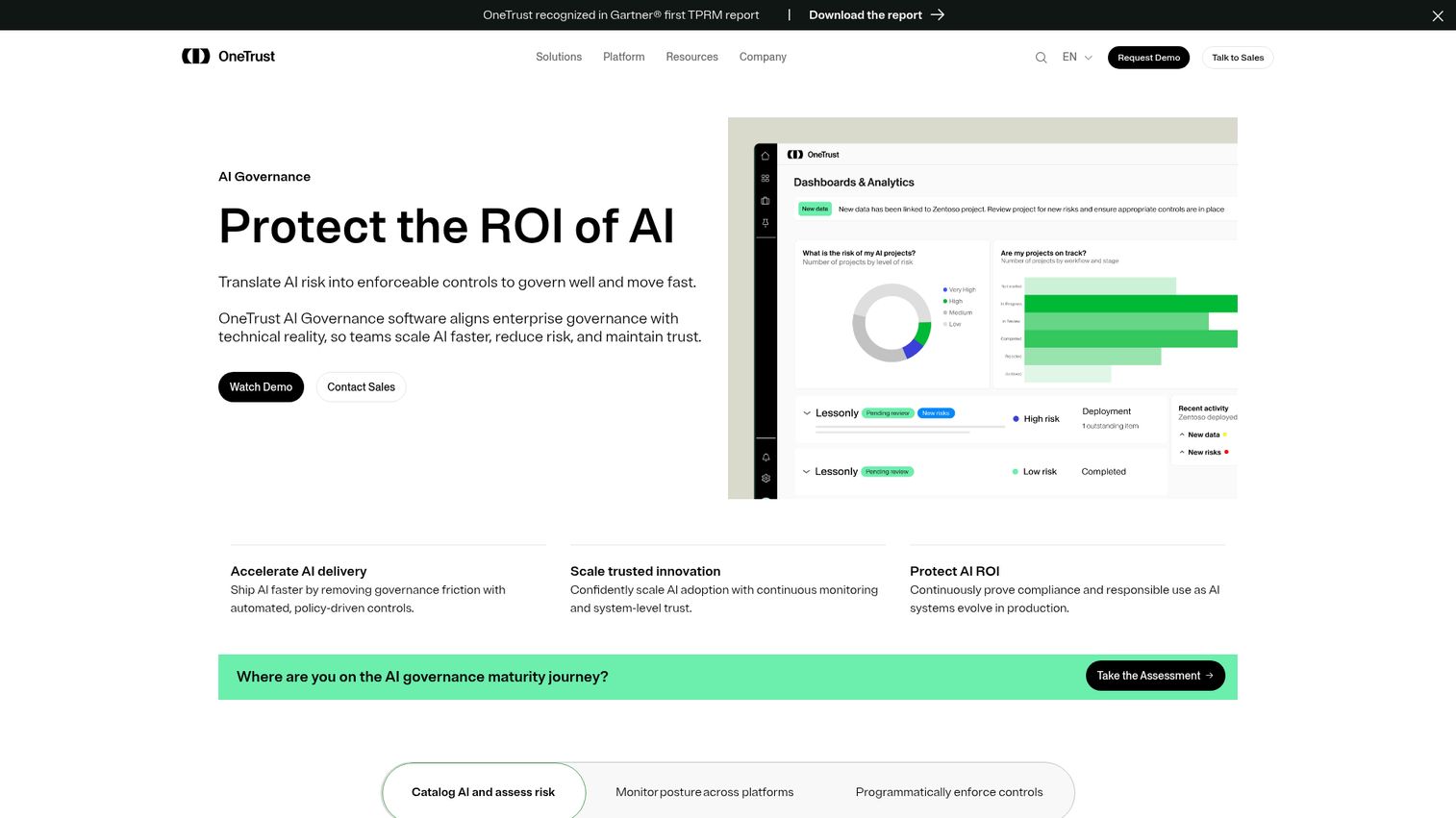
OneTrust AI Governance helps enterprises align AI governance with technical reality so teams can scale AI faster, reduce risk, and maintain trust. It's the natural choice for organizations already running OneTrust for privacy (GDPR, CCPA) who want to consolidate AI governance under the same vendor.
Best for: Companies already standardized on OneTrust for privacy and compliance who want to extend the same workflows to AI risk.
Key strengths
- Central inventory: Tracks models, datasets, agents, and vendors in one registry.
- AI risk identification: Aligned to frameworks including the EU AI Act, NIST AI RMF, and ISO 42001.
- Runtime guardrails: Prompt and output filtering with policy-based action controls.
Why choose OneTrust: Consolidation is the case. Adding AI governance to an existing OneTrust deployment is faster than evaluating a new vendor, and the cross-mapping between AI risk and existing privacy workflows reduces duplicate work. If you're not already on OneTrust, the calculus changes.
OneTrust pricing: OneTrust does not publish numeric pricing for AI Governance. Its pricing page states pricing is based on admin users and AI inventory, with a "Get Pricing" call to action for sales. Customers report enterprise contracts vary widely depending on modules.
5. Holistic AI
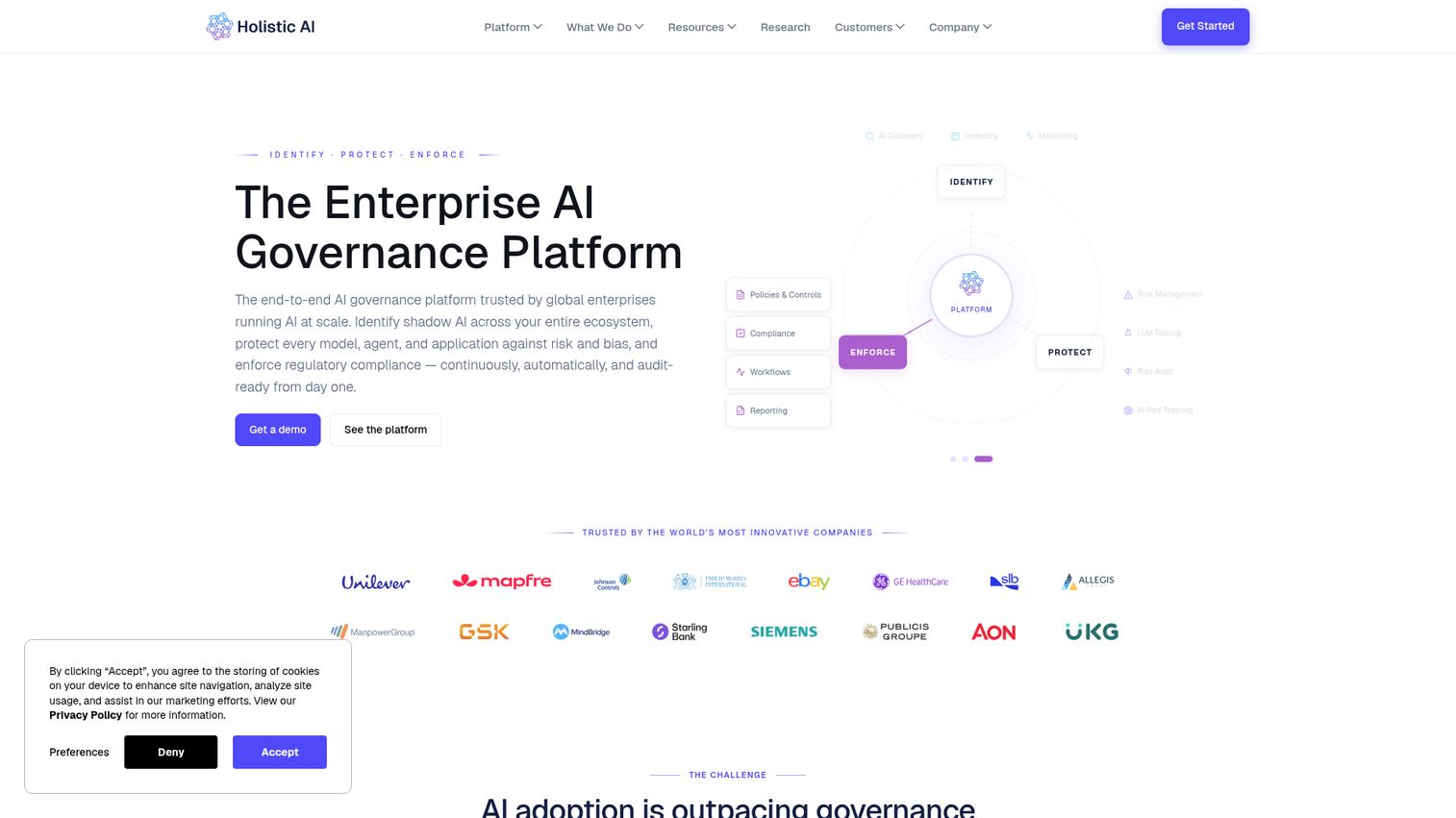
Holistic AI is an enterprise AI governance platform for discovering, assessing, and governing AI systems across an organization. It has strong roots in bias and fairness research and has expanded into a full enterprise governance offering with an active open-source library.
Best for: Organizations needing deep bias and fairness assessment alongside policy enforcement, especially for hiring AI, public sector, or regulated use cases like NYC Local Law 144.
Key strengths
- Shadow AI Discovery: Surfaces AI usage across SaaS and cloud environments before it becomes a governance gap.
- Automated Testing: Built-in bias, robustness, and performance testing across models and applications.
- Continuous Monitoring: Ongoing observability of AI behavior in production.
Why choose Holistic AI: When fairness, bias, and auditability are core to your regulatory exposure (HR tech, public sector, financial services), Holistic AI's depth in assessment shows up early. The open-source library is also useful for teams who want to start with frameworks before committing to a paid platform.
Holistic AI pricing: Holistic AI does not publish pricing on its first-party site. The platform is sold through enterprise sales conversations.
6. Fiddler AI
Fiddler AI provides experiments, monitoring, guardrails, and governance for compound AI. It started in model monitoring and explainability and has extended into governance and runtime guardrails for LLM applications and agents. If your governance pain is production-side (drift, hallucinations, LLM behavior), Fiddler is built for that lane.
Best for: Teams with AI applications and agents in production who need observability, guardrails, and governance in one platform.
Key strengths
- Evaluate and monitor agents and predictive applications: Lifecycle observability across both predictive ML and generative workloads.
- Real-time guardrails: Enforce policies that prevent costly incidents in production.
- Enterprise visibility and compliance: Centralized monitoring with the documentation auditors want.
Why choose Fiddler AI: Fiddler shines when your most painful unknowns are about production behavior (is the model drifting, is the LLM hallucinating, are agents acting inside policy). It's less of a policy and registry play than Credo AI, more of an ai governance monitoring layer.
Fiddler AI pricing: Fiddler publishes pricing on its pricing page. The Free tier includes real-time guardrails. The Developer tier is $0.002 per trace and adds unified observability, custom evaluators, RBAC and SSO, and SaaS deployment. Enterprise is custom and adds enterprise-grade guardrails, flexible deployment, and dedicated support.
7. Monitaur
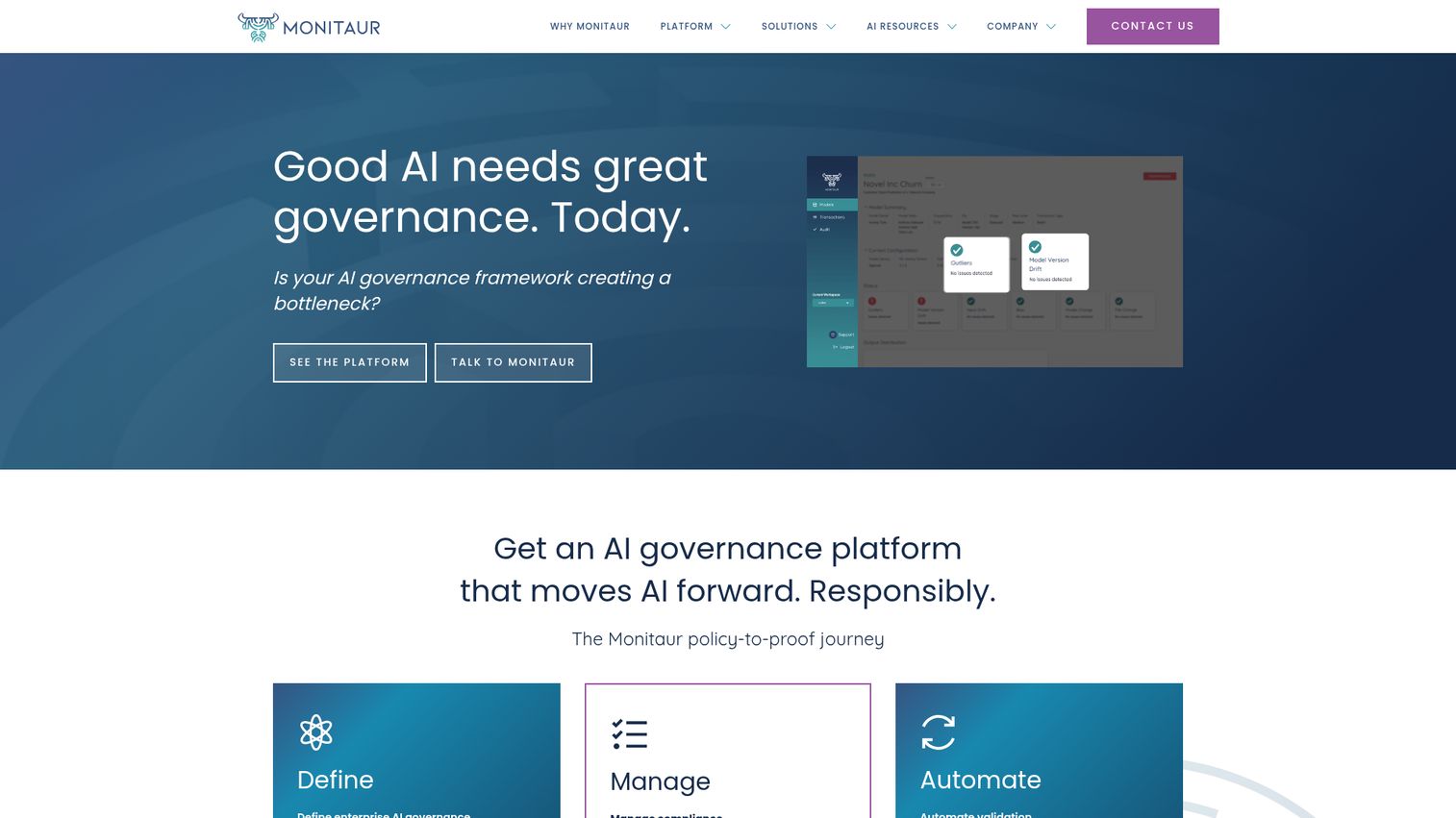
Monitaur is an AI governance platform for defining governance, managing compliance, and automating validation across AI systems and models. It's built for regulated industries (especially insurance) where model risk management and audit defense are not optional.
Best for: SaaS companies selling into insurance, banking, or healthcare where model risk management is regulated and auditors are real users of your governance artifacts.
Key strengths
- Complete Inventory: Centralized record of models, including vendor AI and embedded systems.
- Vendor Governance: Controls and documentation for third-party AI dependencies.
- Automate Record: Continuous production validation that builds the audit trail without manual work.
Why choose Monitaur: When your auditor or regulator is the primary user of your governance tool, Monitaur's documentation depth and regulated-industry posture pay back fast. For SaaS companies selling into insurance carriers or financial services, this is the tool the buyer recognizes.
Monitaur pricing: Monitaur does not publish pricing on its first-party site. It is sold through sales conversations and is enterprise-focused.
8. Securiti.ai
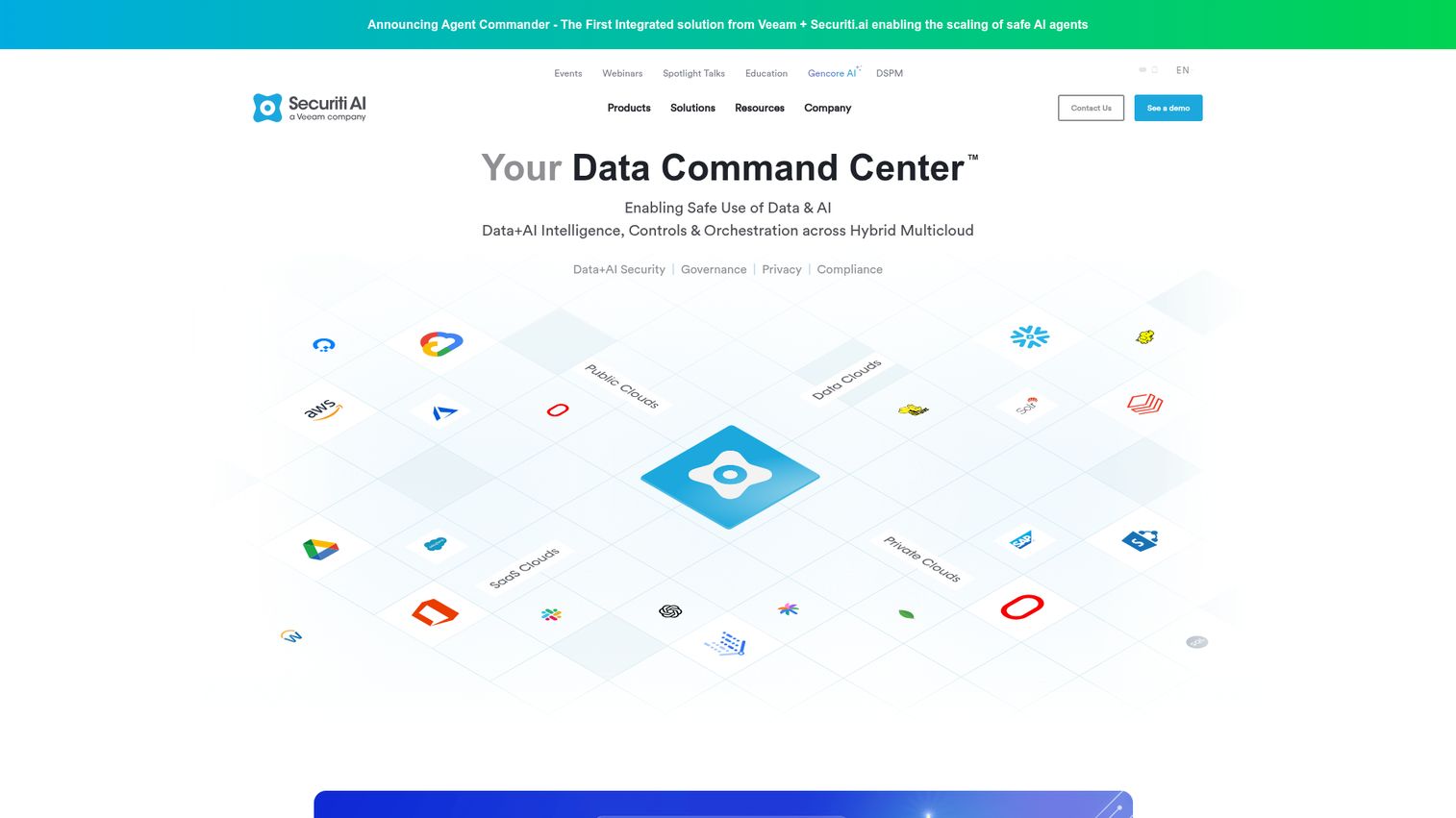
Securiti.ai provides a Data+AI Command Center to help enterprises use data and AI safely across hybrid multicloud and SaaS environments. Its heritage is data security and privacy (DSPM, PrivacyOps), which makes it the strongest fit when shadow AI overlaps with sensitive data exposure.
Best for: Organizations whose AI governance problem is mostly a shadow AI discovery and sensitive-data-leakage problem.
Key strengths
- Data Security Posture Management: Maps and protects sensitive data across cloud and SaaS.
- Data Discovery and Classification: Surfaces where regulated data lives and how AI systems use it.
- Data Access Intelligence and Governance: Connects access patterns to AI usage for clear policy enforcement.
Why choose Securiti.ai: When you can't even inventory where AI is running in your environment, start with discovery. Securiti's data-first heritage means shadow AI and sensitive data are governed in the same workflow rather than two parallel tools.
Securiti.ai pricing: Securiti's first-party Privacy Center pricing page lists the Business plan at $599 per month or $6,110 per year, and Enterprise as custom pricing. A 30-day free trial is available. Note this is the published Privacy Center pricing; broader Data+AI Command Center deployments are quoted by sales.
9. DataRobot
DataRobot is an enterprise AI platform for developing, delivering, and governing production-grade agentic AI applications. It combines MLOps and governance in one suite, which appeals to teams who don't want to maintain two separate vendors for build and govern.
Best for: Organizations running their own ML and generative AI at scale who want governance built into the same platform that builds and deploys.
Key strengths
- Multi-agent and generative workflows: Build with LLMs, vector databases, predictive models, and multimodal data in one platform.
- Cross-cloud and on-prem deployment: Deploy complex agentic pipelines wherever data and policy require.
- Enterprise-grade monitoring and governance: Trace and monitor workflows, inputs, and outputs with security and governance built in.
Why choose DataRobot: If MLOps and governance are both unsolved at your company, one vendor reduces stack complexity. It's less compelling for organizations governing only third-party AI like ChatGPT and Claude.
DataRobot pricing: DataRobot does not publish a public price on its pricing page. It directs prospects to contact a representative to discuss pricing options.
10. ModelOp Center
ModelOp Center is enterprise AI governance software that provides a centralized system of record, lifecycle automation, and governance for ML, GenAI, agentic, and vendor AI. It's vendor-agnostic across model frameworks and clouds, which matters for large enterprises with sprawling AI estates.
Best for: Large enterprises with multi-cloud, multi-framework model portfolios needing centralized governance across teams.
Key strengths
- Centralized AI system of record: Inventory across all enterprise AI assets, internal and vendor.
- Automated lifecycle workflows: Enforceable governance controls tied to approval and release processes.
- Operational intelligence: Reporting on cost, risk, performance, and ROI across the AI estate.
Why choose ModelOp Center: When you have 100+ models across multiple teams and clouds, ModelOp's orchestration depth shows up. It's overkill for organizations with a smaller model footprint, but the right call when governance has to span ML, GenAI, agentic AI, and vendor AI in one place.
ModelOp Center pricing: ModelOp does not publish pricing on its first-party site. It is sold through enterprise sales conversations with demo and contact CTAs.
Considerations: What to verify before buying
A buying decision in this category fails most often on fit, not features. Verify these five before signing.
Stack fit and integration depth
Does the platform integrate with your MLOps stack (SageMaker, Vertex AI, Databricks)? Your GRC, ticketing, and identity tools (ServiceNow, Jira, Okta)? Day-one value depends on this. Ask for a customer reference at your stage who runs a similar stack.
Regulatory coverage that matches your exposure
EU AI Act if you sell in EU. SOC 2 and HIPAA if you sell into US healthcare. NAIC if insurance. Don't buy regulatory coverage you don't need. Do buy what your buyers will ask about in security reviews, even if no regulator forces it yet.
First-week setup reality
How long until you have a real inventory of your AI? Until you can show a policy enforcement event? Verify the vendor's claim against a customer reference at your stage, not against a sales deck. AI governance software earns its place by week two or not at all.
Pricing model versus your scale
Per-model, per-seat, per-application, or platform fee. Per-model gets expensive fast if you're shipping AI features every sprint. Platform fees protect against scale-out cost but cost more day one. Map the pricing model to your 12-month AI roadmap before signing.
Governance owner inside your org
Who runs this internally? GRC lead, Head of AI, CISO, VP Engineering? If you don't have the owner, the tool sits unused. Founders who buy ai governance solutions before naming the owner watch them gather dust. A spreadsheet with one accountable owner beats a $50K tool with none.
How to choose the right AI governance tool for your stage
The right shortlist depends on what's actually forcing the timing.
If you're early Series B with AI features but no acute compliance pressure yet
Start with inventory and observability. Fiddler AI (free tier and per-trace pricing) handles production monitoring without a large commitment. Securiti.ai or Microsoft Purview cover shadow AI discovery if you're already on those stacks. Defer the full policy stack until a board, customer, or regulator forces the timing.
If your board just asked about EU AI Act exposure
Credo AI, Holistic AI, or OneTrust AI Governance. All three emphasize EU AI Act-aligned workflows and audit-ready documentation. Credo AI is the most frequently cited vendor in the category. OneTrust is the cleanest path if your privacy program already runs there.
If enterprise deals are stalling on AI risk questionnaires
Credo AI or IBM watsonx.governance. Both produce the documentation enterprise buyers want to see, factsheets, risk assessments, and evidence packets that survive procurement review. This is the use case where governance investment pays back directly in closed revenue. (Side note: how vendors let buyers explore complex platforms also matters in this cycle, which is why teams increasingly invest in interactive demo experiences alongside governance documentation, often paired with buyer enablement tools to move deals through procurement faster.)
If you're in a regulated industry (insurance, finance, healthcare)
Monitaur for insurance and financial services where model risk management is regulated. IBM watsonx.governance for organizations with decades of regulated-industry posture and hybrid cloud needs. DataRobot if MLOps and governance both need to live under one vendor. Sales teams in these industries often combine governance platforms with AI sales tools and presales software to manage the additional documentation cycle that compliant deals require.
Conclusion
The 2026 shortlist sorts cleanly by what's forcing your timing:
- 🥇 Credo AI for analyst-cited, audit-ready governance with agentic AI coverage
- 🏢 Microsoft Purview for Microsoft-stack consolidation
- 🏦 Monitaur for regulated-industry SaaS where auditors are real users
- 🔍 Securiti.ai when shadow AI is the bigger problem than policy
- 🛠️ Fiddler AI when production monitoring is the entry point
- 🏛️ IBM watsonx.governance when factsheets and lifecycle documentation matter most
Shortlist 2 or 3 based on your scenario. Run a 30-day evaluation focused on first-week inventory build. Force the vendor to produce one piece of audit-ready evidence by week two. That's the gut test. The right tool earns its place in your stack the first quarter. Anything else gets ripped out at renewal. For more category roundups like this one, browse our full library of best tools comparisons.
FAQs
MLOps focuses on building, deploying, and operating models. AI governance focuses on the policy, risk, compliance, and audit layer that sits across all models, whether you built them or are using third-party AI like OpenAI or Anthropic. Some platforms (DataRobot, ModelOp Center) do both, which appeals to teams who want one vendor instead of two.
Enterprise contracts for AI governance platforms are commonly quote-based and often land in the mid-five-figure annual range and up, scaling to six figures for large model portfolios. Some vendors publish lower entry points: Fiddler AI offers a free tier and a Developer tier at $0.002 per trace, IBM watsonx.governance has a Lite tier and Essentials starting at USD 795 per instance, and Microsoft Purview Suite starts at $12 per user per month. Pricing models vary: per-trace, per-user, per-instance, or platform fees.
Yes, arguably more. Third-party AI creates shadow AI and data exposure risk you don't control. Tools like Securiti.ai, Microsoft Purview, and OneTrust specifically govern third-party AI usage across your organization, including discovery of unsanctioned tools and policy controls on prompts and outputs.
Agentic AI refers to AI systems that take autonomous actions (call APIs, send emails, execute workflows). Governing them requires monitoring not just outputs but actions taken, permissions, and chained behaviors. Vendors like Credo AI, OneTrust, and ModelOp Center are extending governance concepts toward agent-like and automation-heavy AI systems. Our deep dive on agentic AI tools for sales covers how these systems are being deployed in revenue workflows.
They provide structured mappings to EU AI Act requirements (risk classification, technical documentation, transparency obligations, human oversight). The platform automates evidence collection and produces the documentation regulators and auditors request. Without a tool, EU AI Act compliance is a manual spreadsheet exercise across legal, engineering, and product.
Observability monitors model behavior in production (drift, accuracy, hallucinations). Governance covers the full lifecycle: policy, approval, risk, compliance, audit, and observability. Fiddler AI began in observability and extended into governance. Credo AI began in governance and integrates observability data. The categories are converging.
Open-source frameworks (NIST AI RMF playbooks, Holistic AI's open-source library, Microsoft's Responsible AI Toolbox) help structure your approach but don't replace a commercial ai governance platform for inventory, audit trails, and regulatory evidence at scale. Most companies use both: open-source frameworks to design the program, commercial software to operate it.
Securiti.ai, Microsoft Purview, and OneTrust all provide capabilities to discover and control unsanctioned AI usage across SaaS and cloud environments. Securiti.ai's data-first heritage makes it especially strong when shadow AI overlaps with sensitive data exposure. Microsoft Purview is the path of least resistance if your stack is already on Microsoft 365.
For most mid-market SaaS companies, software plus an internal owner beats consulting alone. AI governance consulting is useful for the first 30 to 60 days (program design, policy drafting, framework selection), but the operating system has to live in software your team uses weekly. Buy the platform first, scope consulting to the gaps.