Your job descriptions are quietly costing you deals on talent. Every hiring manager writes their own version. Titles drift. Requirements balloon to fifteen bullets nobody actually screens against. Legal flags a posting after it has been live for two weeks. And the candidate you wanted read a vague, biased, scope-creeping JD and never applied.
That mess scales badly. When a company is hiring 5 people a quarter, inconsistent job descriptions are an annoyance. When it is hiring 50, they become a compliance liability, a bias risk, and a drag on every leadership search that has to move fast. The job description management software market reflects how seriously teams now take this. It is projected to roughly double from about USD 0.8 billion in 2025 to USD 1.6 billion by 2035 at a 7.1% CAGR, according to Future Market Insights (2025), with cloud-based delivery already accounting for around 59% of revenue.
The category sits in two camps. One side focuses on job post optimization: writing quality, inclusive language, bias reduction, and candidate attraction. The other focuses on job information management: governance, version control, workflow approvals, and clean ATS integration and HRIS integration across the stack. Position description software that nails one does not automatically nail the other, and that distinction is the whole game when you shortlist.
For a founder, the question is not whether your recruiter likes the editor. It is whether the tool reduces hiring friction, lowers compliance and pay transparency risk, and gives a new VP something that works on day one. The same operating-leverage logic that drives teams toward better analytics platforms drive roi, tighter contract management, and consolidated customer data platform stacks applies here. This guide ranks seven tools so you can match the right one to where your bottleneck actually lives.
What's inside
This guide is for recruiters, talent acquisition leaders, HR teams, and the founders and hiring leaders who care whether job description software actually reduces recruiting drag. We evaluated each tool against the criteria that matter when you are scaling: governance and version control, ATS integration and HRIS integration, bias reduction and compliance support, analytics, and hiring team collaboration.
The shortlist deliberately balances both modes of the category: job post optimization tools that sharpen writing, inclusive language, and candidate attraction, and job information management platforms built for centralized job descriptions, structured templates, and approval workflows. Pricing and ratings reflect verified public sources where available, and we write around anything a vendor keeps behind a sales call.
TL;DR
- Best overall for job post optimization: Datapeople, for AI-assisted, compliant, on-brand writing with strong analytics.
- Best for enterprise job information governance: JDXpert, for structured job data, version control, and approval workflows.
- Best for inclusive language and content quality: Textio, for real-time bias reduction across recruiting and feedback.
- Best for centralized job libraries and career site publishing: Ongig, for content standardization plus SEO-ready career pages.
- Best for role mapping and job architecture: RoleMapper, for skills frameworks and pay transparency alignment.
- Best for ATS-linked recruiting workflows: HireRabbit, for social recruiting and branded career sites.
- Best for structured interview support alongside job content: Clovers, for interview intelligence and bias reduction.
If your bottleneck is writing quality, start with optimization tools. If it is governance and sync, start with a job information management platform.
What is job description software?
Job description software is a category of HR and recruiting tools that help teams write, standardize, optimize, govern, and distribute job content across the hiring stack, replacing scattered documents and spreadsheets with a managed system. Some platforms lead with job post optimization and language quality. Others lead with job information management, treating every role as structured, governed data.
The two modes solve different problems. Optimization-first tools improve how a posting reads: tone, inclusive language, bias reduction, requirement clarity, and candidate attraction. Governance-first platforms improve how job content is controlled: a single source of truth, version control, workflow approvals, and bi-directional sync with the rest of the HR stack. Most scaling companies eventually need both, which is why the shortlist below spans the full range.
Core capabilities to expect across job description management software:
- Structured templates that standardize format, sections, and required fields across teams.
- Language guidance for inclusive language, readability, and bias reduction.
- Compliance prompts for pay transparency, EEO, and regional regulations.
- Workflow approvals so legal, DEI, and hiring managers sign off before a posting goes live.
- Version control with audit trails showing who changed what and when.
- Analytics on job posting performance, quality, and inclusivity.
- ATS integration and HRIS integration to sync content into systems like Workday, Greenhouse, and SuccessFactors.
- Job libraries that centralize approved descriptions for reuse and governance.
The strongest platforms connect these capabilities so a single approved description flows from draft to posting to system of record without anyone retyping it. That is the difference between a writing tool and a job information management platform.
When to use job description software
Standardize job content across teams
Use it when different managers write inconsistent postings and recruiting has no single standard. As headcount grows, every manager-authored JD becomes a fork: different titles, different requirement bars, different tone. Structured templates and centralized job descriptions give you one approved format, so a posting for the same role reads the same whether it comes from the New York office or a remote lead in Austin. That consistency is what makes job posting performance comparable across teams.
Reduce compliance and bias risk
Use it when legal, DEI, or pay transparency requirements need built-in guardrails rather than a manual review at the end. Pay transparency laws now vary by state and country, and a missing salary range or a biased phrase can stall a posting or expose you to risk. Tools with bias reduction, inclusive language guidance, and compliance prompts catch these issues during writing, not after a posting goes live. The same discipline that drives teams toward dedicated audit management software applies to job content.
Connect job descriptions to HR systems
Use it when job content has to sync across ATS, HRIS, and compensation platforms without manual copy-paste. A governed description should flow into Greenhouse or Workday, carry its approval history, and update everywhere when it changes. Strong ATS integration and bi-directional HRIS integration are what turn a writing tool into infrastructure your new VP of People can rely on from day one.
Comparison table
Here is the shortlist at a glance, sorted by relevance to the primary keyword. Pricing and ratings reflect verified public sources. Where a vendor keeps numbers behind a sales call, we note that honestly rather than guess.
| # | Product | Intent | Key differentiation | Pricing | G2 rating |
|---|---|---|---|---|---|
| 1 | Datapeople | Job post optimization | AI Smart Editor for compliant, on-brand writing with recruiting analytics | Request pricing | 4.4/5 |
| 2 | JDXpert | Job information management | Governed job data, approvals, version control, certified integrations | From $12,000/year | 4.2/5 |
| 3 | Textio | Inclusive language | Real-time bias reduction across recruiting and feedback | Free trial; contact sales | 4.2/5 |
| 4 | Ongig | Centralized job libraries | Bias analysis plus SEO-ready career site builder | From $4,900/year | Not yet rated |
| 5 | RoleMapper | Role mapping | AI job architecture with embedded de-biasing | Demo-based | Not yet rated |
| 6 | HireRabbit | ATS-linked workflows | Social recruiting and branded career sites | Not publicly listed | 4.5/5 |
| 7 | Clovers | Interview support | Structured interviews and interview intelligence | Not publicly listed | 4.8/5 |
1. Datapeople
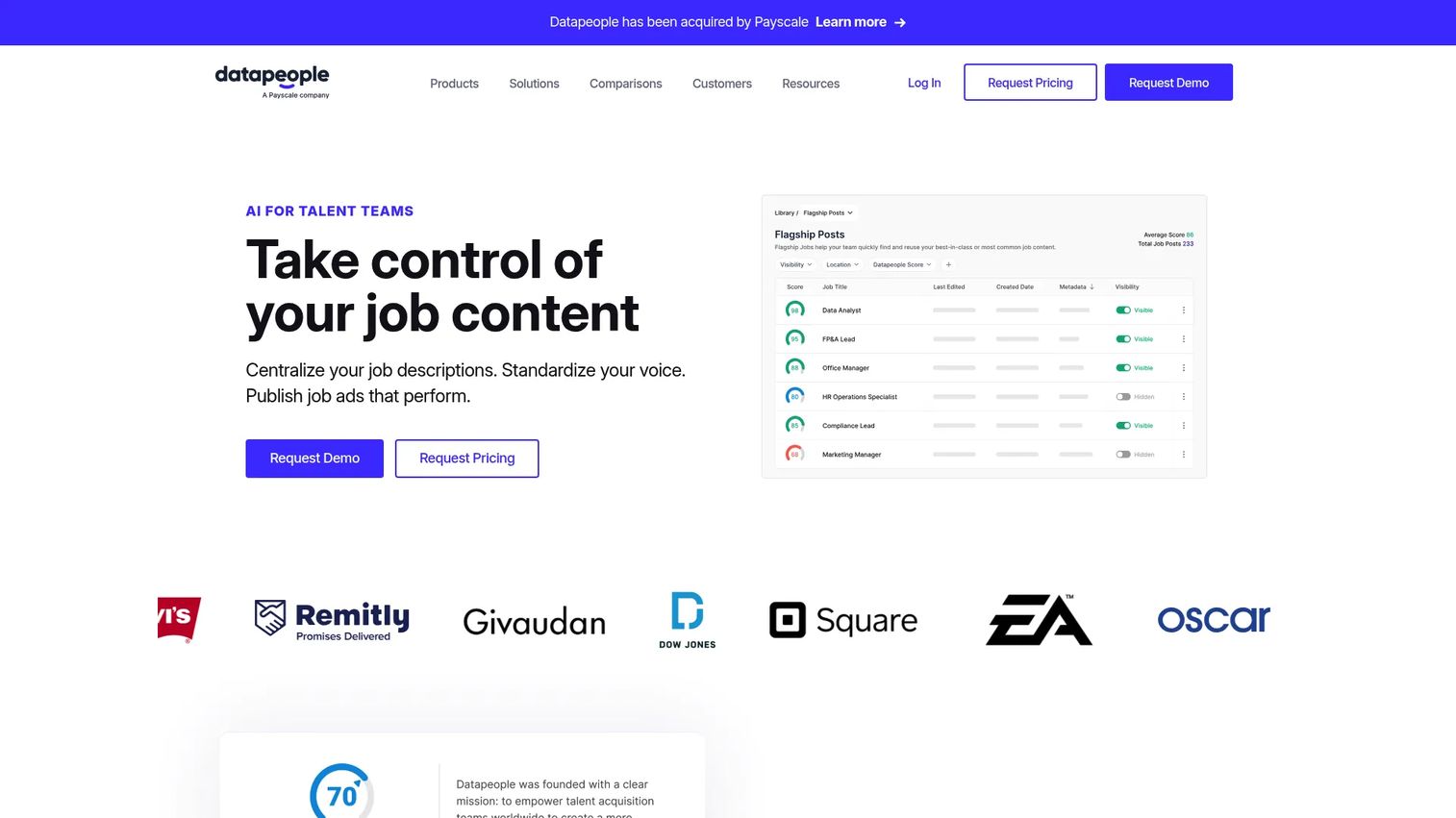
Datapeople is an AI-powered recruiting platform built around creating, standardizing, and optimizing job content and the workflows around it. It sits firmly in the job post optimization camp, helping talent teams write market-ready job descriptions that read clearly, stay compliant, and attract a wider candidate pool. The platform has been acquired by Payscale, which adds a compensation and pay transparency angle to its job content focus.
For a scaling SaaS company, Datapeople is the tool that fixes writing quality and inclusivity at the source. Its Smart Editor flags vague requirements, biased phrasing, and readability issues as a hiring manager types, so postings improve before they ever reach a candidate. The First Draft AI builder gets a manager from a blank page to a usable draft fast, which matters when leadership wants a role live this week, not next sprint.
Best for: Enterprise and mid-market talent teams standardizing job descriptions and improving compliance and quality of hire.
Key strengths
- Smart Editor: Real-time guidance for compliant, on-brand, inclusive job writing and job title guidance.
- First Draft AI: Generates usable job description drafts fast, cutting manager writing time.
- ATS and HRIS integrations: A browser overlay and connectors push optimized content into existing systems.
Why choose Datapeople: If your bottleneck is the quality and consistency of what managers write, Datapeople intervenes at the moment of writing rather than the moment of review. The recruiting analytics tie job content choices to job posting performance, so you can see which language attracts more qualified applicants instead of guessing.
Datapeople pricing: Datapeople publishes plan names, Comply and Architect, with detailed feature sets, but no public dollar amounts. The pricing page directs visitors to request pricing. There is no publicly listed free tier. Teams evaluating it should expect a sales conversation scoped to headcount and hiring volume.
2. JDXpert
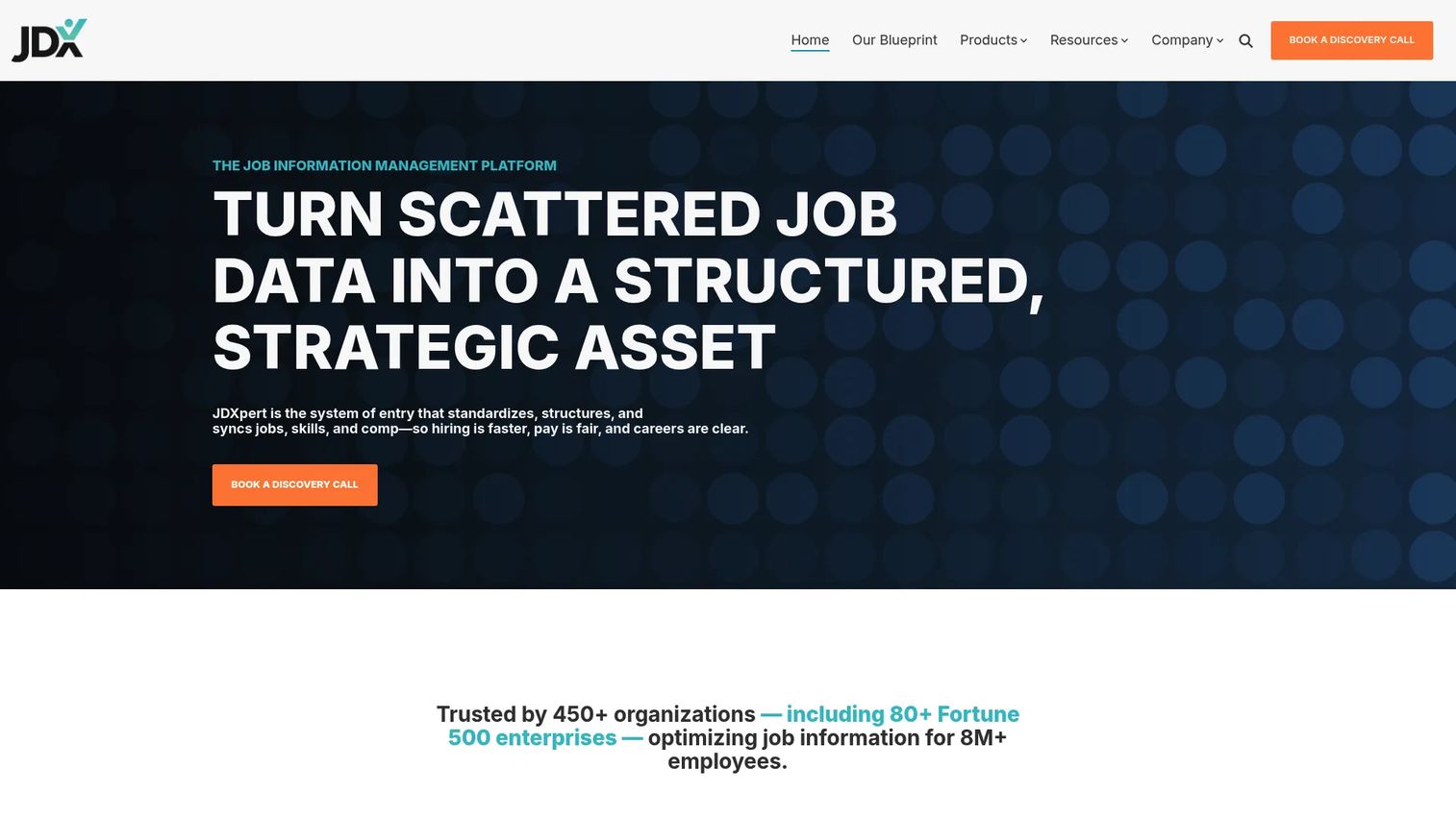
JDXpert is a job information management platform built to govern job data, descriptions, workflows, analytics, and integrations as a single source of truth. Where Datapeople optimizes the writing, JDXpert governs the entire lifecycle of a job description, treating each role as structured data rather than a loose document. That makes it the strongest fit for enterprise HR teams that need control, not just polish.
The platform centers on governance. Structured job data, approval workflows with audit trails, and version control mean every change is tracked, reviewed, and reversible. For hiring team collaboration across legal, compensation, and HR business partners, the approval workflow keeps everyone in one system instead of a thread of email attachments. An AI Wizard helps draft content, and certified bi-directional integrations sync governed descriptions across the HR stack.
Best for: Mid-market and enterprise HR teams managing centralized job descriptions and governed job information at scale.
Key strengths
- Job information governance: Structured job data with version control and full audit trails.
- Workflows and approvals: Routed approval workflows so legal and compensation sign off before posting.
- Certified integrations: Bi-directional sync with ATS and HRIS platforms keeps content consistent everywhere.
Why choose JDXpert: When the problem is governance, not prose, JDXpert is the answer. It is built for the company where a job description is a controlled document with compliance implications, multiple approvers, and a long shelf life. The analytics and reporting give HR leaders visibility into how job content is maintained across hundreds of roles.
JDXpert pricing: JDXpert does not display public pricing on its own site and directs visitors to book a discovery call. Capterra reports a starting price around $12,000 per year. There is no free tier. The investment reflects its positioning as enterprise-grade job information management rather than a lightweight writing aid.
3. Textio
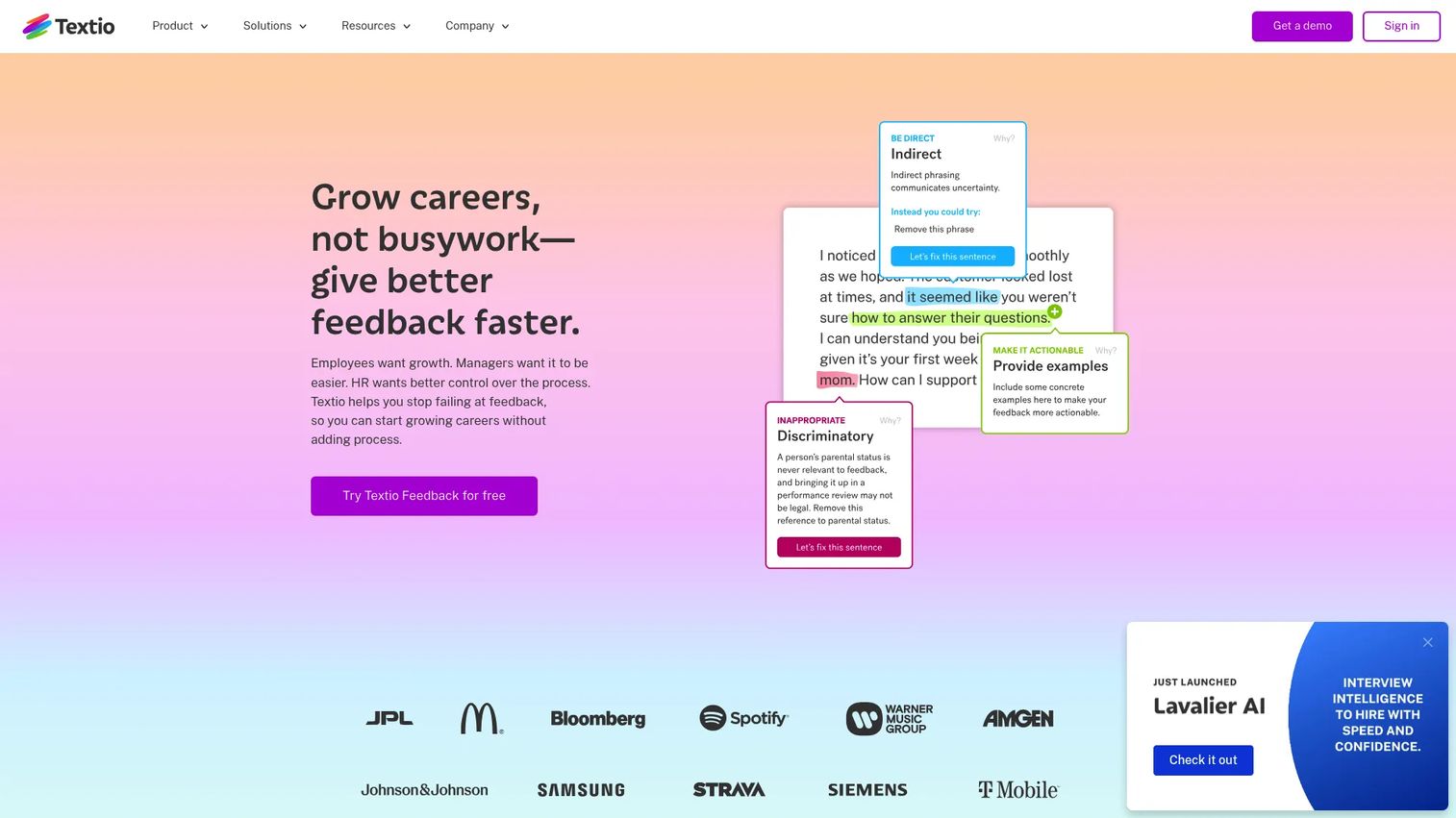
Textio is AI-powered HR writing software focused on inclusive language across recruiting, interview feedback, and performance feedback. It is the specialist for bias reduction and content quality, analyzing tone, language patterns, and inclusivity in real time as people write. For teams where candidate experience and equitable language are board-level concerns, Textio is the sharpest instrument on this list.
What sets Textio apart is breadth across the writing your company does about people, not just job postings. Its real-time guidance flags biased or exclusionary phrasing in job descriptions, then carries the same discipline into interview feedback and performance reviews. That consistency matters: a company that writes inclusive job descriptions but biased interview notes has only solved half the problem. Textio closes the loop on recruiting analytics around language quality.
Best for: HR teams that want AI help writing more inclusive recruiting content and feedback at scale.
Key strengths
- Inclusive content optimization: Real-time guidance for inclusive language and market-ready job descriptions.
- Risk detection: Flags biased or non-compliant phrasing before content is published.
- Feedback workflows: Extends bias reduction into interview feedback and performance feedback.
Why choose Textio: Choose Textio when language quality and bias reduction are the priority and you want one standard applied across recruiting and people writing. It is less about governing job data and more about making every word your company writes about candidates fairer and clearer.
Textio pricing: Textio does not show public pricing. The site offers a free trial and directs teams to contact sales for a package scoped to their needs. Expect pricing tied to seats and usage rather than a flat published rate.
4. Ongig
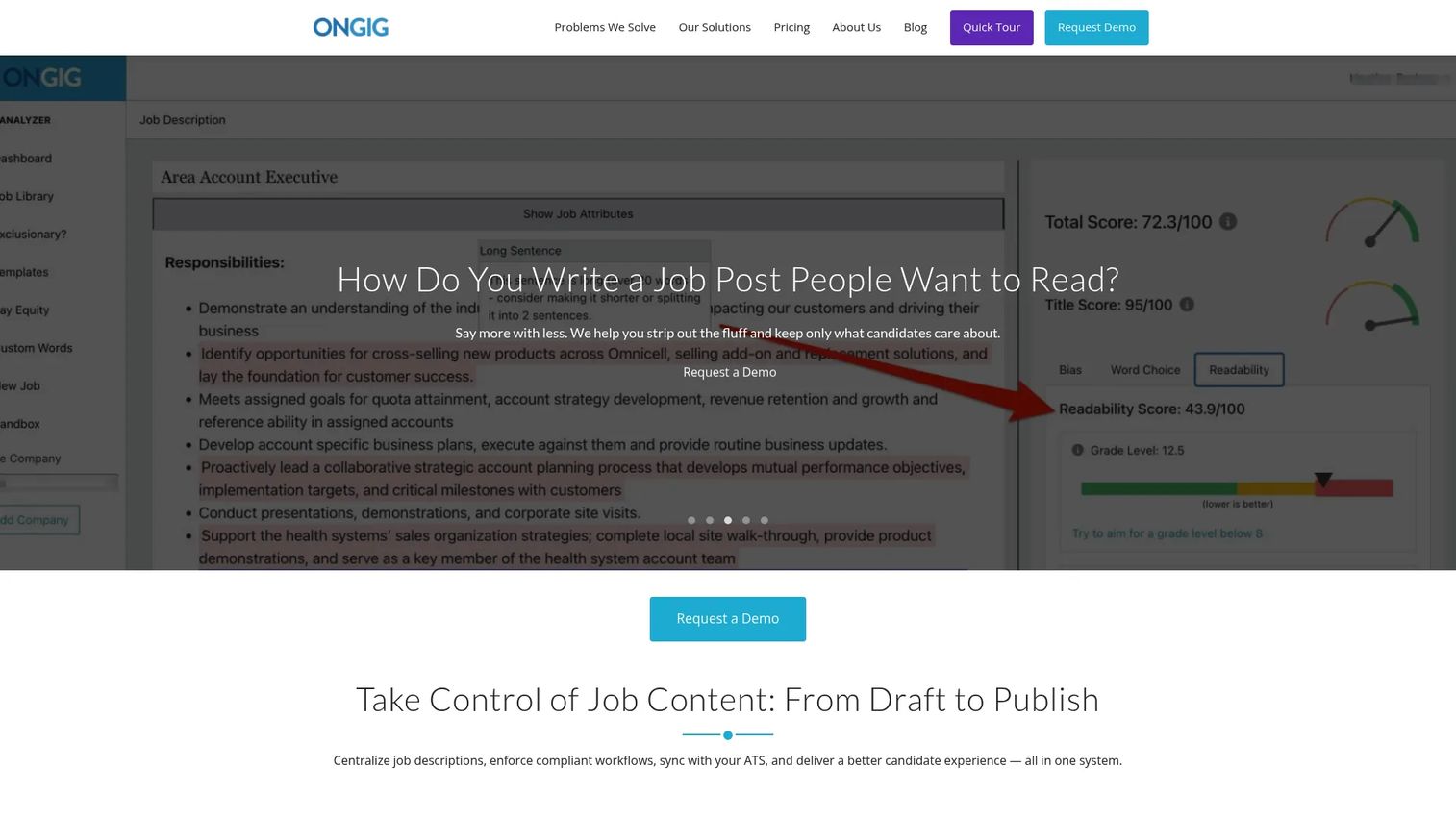
Ongig is AI-powered job description and career site software that pairs content standardization with publishing. It is the strongest pick when your problem is not just writing one good JD but operating job content at scale, then surfacing it on a career site that actually converts. Ongig combines readability and bias analysis with a career site builder, so the same governed content powers both your standards and your candidate-facing pages.
The platform reads and rewrites job descriptions for readability and bias, imports roles through ATS and HRIS connectors, and centralizes approved content into reusable job libraries. Its career site builder and AI job search turn that content into SEO-ready pages that help candidates find roles, which directly supports candidate attraction. For founders, Ongig is job content management and distribution in one place, reducing the handoffs between recruiting, marketing, and web.
Best for: Mid-market and enterprise HR teams standardizing job descriptions and improving career-site job search.
Key strengths
- Readability and bias analysis: AI-powered scoring for clarity, inclusive language, and bias reduction.
- ATS and HRIS import: Pulls jobs from existing systems and standardizes them centrally.
- Career site builder: Publishes SEO-ready career pages with AI job search built in.
Why choose Ongig: Choose Ongig when you want centralized job descriptions and a career site working from the same source. It closes the gap between job content standards and the candidate-facing experience, with optional services for bias audits and JD rewrites when you need a one-time cleanup.
Ongig pricing: Ongig publishes tiered annual pricing. The Lite tier starts at $4,900 per year, the Professional tier from $14,900 per year, and the Enterprise tier from $39,900 per year. Add-on services include a JD Bias Audit from $6,900, a JD Rewrite Service from $9,900, and a Career Site Builder from $12,900. There is no free tier listed.
5. RoleMapper
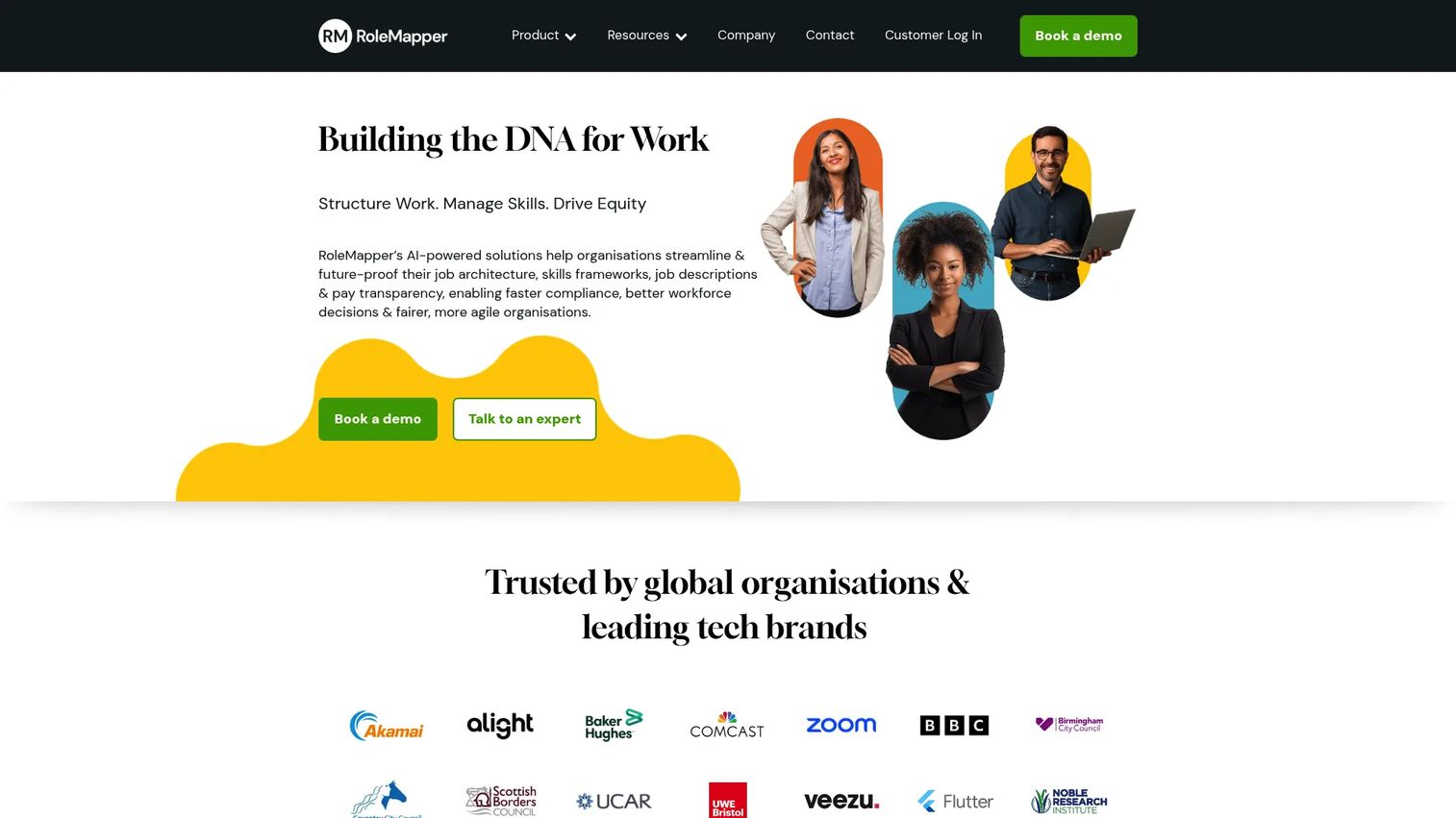
RoleMapper is AI-powered job architecture and job data governance software for HR, reward, and talent teams. It goes a layer deeper than most tools on this list. Instead of optimizing individual postings, RoleMapper structures the underlying role mapping and job architecture: role profiles, skills frameworks, and the relationships between jobs across the organization. That makes it the right tool when the problem is structural, not editorial.
For enterprises navigating pay transparency regulations and skills-based hiring, RoleMapper builds the framework that everything else hangs on. It enriches roles with AI-powered market data, embeds de-biasing and inclusion into how jobs are defined, and governs the whole system with user permissions, workflows, audit trails, and reporting. The result is standardized job descriptions that map cleanly to compensation bands and skills, which is exactly what pay transparency compliance demands.
Best for: Mid-market and enterprise HR teams managing job architecture, role profiles, and skills frameworks.
Key strengths
- AI market data enrichment: Aligns roles to market benchmarks for pay transparency readiness.
- Embedded de-biasing: Builds inclusion and bias reduction into the job definition itself.
- Governance controls: Permissions, workflow approvals, audit trails, and reporting across the job framework.
Why choose RoleMapper: Choose RoleMapper when your challenge is job architecture, not just job writing. It is built for the company standardizing thousands of roles, aligning them to skills and pay bands, and governing that structure with the rigor that compliance and reward teams require.
RoleMapper pricing: RoleMapper does not publish pricing on its website and routes visitors to book a demo or talk to an expert. Pricing is scoped to the size and complexity of your job architecture, so expect a consultative quote rather than a published rate.
6. HireRabbit
HireRabbit is recruitment software focused on social media hiring, with branded career sites and job posting distribution. It belongs on this list as the more recruiting-process-oriented option rather than a pure writing-optimization tool. If your job descriptions are fine but your distribution and candidate sourcing are the bottleneck, HireRabbit addresses the surrounding workflow.
The platform helps teams build custom career sites, distribute postings across social networks, and integrate job posting with channels like Facebook. For a founder who cares about candidate attraction and where job content actually reaches people, that distribution layer matters as much as the words on the page. Treat HireRabbit as broader recruiting software with job description and posting functionality, not a governance or optimization engine.
Best for: Teams that want to source candidates through social networks and branded career sites.
Key strengths
- Social media recruitment: Distributes job postings across social channels to widen reach.
- Custom career sites: Branded pages that present roles to candidates consistently.
- Job posting integration: Connects postings to channels including Facebook for sourcing.
Why choose HireRabbit: Choose HireRabbit when the gap is in distribution and social sourcing rather than writing quality or job information governance. It is the recruiting-process complement to the optimization and governance tools higher on this list.
HireRabbit pricing: HireRabbit does not publicly list pricing, and its site restricts automated access, so expect to contact the vendor directly for a quote. The platform carries a strong but lightly reviewed rating on G2, so validate fit with a direct conversation scoped to your sourcing channels.
7. Clovers
Clovers is an AI-supported hiring and interview platform. It is the most adjacent option on this list. Clovers is not a pure job description tool, but it earns a place if you want job content paired with structured interview and recruiting-process support. The connection is real: the language you use to define a role should carry through to how you interview for it, and Clovers focuses on that downstream half.
The platform provides role-based interview guides, one-way and live video interviews, and candidate summaries with grading. Its interview intelligence supports bias reduction in the evaluation stage, which complements the bias work that optimization tools do at the writing stage. For a talent team that wants a consistent, fairer hiring process from job definition through final interview, Clovers extends the standard beyond the posting.
Best for: Talent acquisition teams wanting AI-assisted interview workflows and collaboration alongside job content.
Key strengths
- Role-based interview guides: Structured interviews tied to the role being filled.
- Video interviews: One-way and live formats for flexible, consistent candidate evaluation.
- Candidate summaries and grading: AI-assisted scoring with bias reduction in the interview stage.
Why choose Clovers: Choose Clovers only when you want interview and recruiting-process support in addition to job content, not as a standalone job description platform. It pairs well with an optimization or governance tool that owns the job content itself, with ATS integration tying the two stages together.
Clovers pricing: Clovers does not publish pricing, and its plans are scoped through a sales conversation. The platform holds a strong rating on G2, so use a direct discussion to confirm where it fits alongside your job description software.
Considerations before you buy
Before you commit budget, run your shortlist against the criteria that actually predict whether the tool reduces hiring friction at your stage.
Where your bottleneck lives
Decide whether your real problem is writing quality, governance, or distribution. Optimization tools fix prose and bias. Job information management platforms fix control and version control. Recruiting-process tools fix sourcing and interviews. Buying the wrong category is the most common and most expensive mistake.
ATS and HRIS integration depth
A tool that does not sync cleanly with your stack becomes another silo. Confirm certified, bi-directional integration with your specific systems, whether that is Greenhouse, Workday, or SuccessFactors. The same stack-fit discipline that guides contract lifecycle management and marketing resource management decisions applies here.
Compliance and pay transparency coverage
Verify the tool handles the regulations you actually face: pay transparency ranges, EEO language, and regional requirements. Built-in compliance prompts and bias reduction during writing beat a manual legal review at the end of every posting.
Analytics and proof of impact
Look for analytics that connect job content to job posting performance, not vanity metrics. You want to see whether better language widens your qualified applicant pool, the same way you would expect marketing analytics to tie campaigns to pipeline.
Workflow approvals and collaboration
Check that approval workflows match how your legal, DEI, and hiring managers actually sign off. Strong hiring team collaboration and audit trails keep governance from becoming a bottleneck of its own.
Conclusion
The right job description software depends entirely on where your bottleneck sits. If managers write inconsistent, biased, or non-compliant postings, Datapeople is the best overall pick for job post optimization, with Textio the specialist when inclusive language and bias reduction are the priority. If the problem is control, JDXpert is the strongest job information management platform for governance, version control, and approval workflows, while RoleMapper goes deeper into role mapping and job architecture for pay transparency alignment. If you need centralized job libraries plus a career site, Ongig handles content operations and publishing in one place. HireRabbit and Clovers round out the list for social sourcing and structured interview support.
The practical next step is simple: audit your current job-description workflow against the five criteria above. Map where time leaks, where compliance risk hides, and where content drifts out of sync with your ATS and HRIS. That audit tells you which category to buy, and which of these seven tools earns a place in your stack within the first quarter. Hiring infrastructure that scales without becoming another mess is worth the hour it takes to choose well.
Start your journey with Guideflow today!
FAQs
Job description software helps teams write, manage, optimize, and govern job content far more consistently than documents or spreadsheets. It standardizes templates, guides inclusive language and bias reduction, supports compliance and pay transparency, and centralizes approved descriptions in job libraries. Some tools focus on writing quality while others focus on governance and version control across the HR stack.
An ATS manages applicants and the hiring workflow: tracking candidates, scheduling, and moving people through stages. Job description software manages the content and structure of the role itself, including writing quality, compliance, approvals, and version control. They are complementary, and strong ATS integration is what lets a governed description flow from your job description tool into your applicant tracking system.
Yes. Many tools include pay transparency prompts, salary-range fields, and compliance checks built into structured templates. Platforms with role mapping and job architecture, like RoleMapper, go further by aligning roles to market data and compensation bands, which makes consistent, compliant pay ranges easier to maintain across hundreds of roles.
Many of the enterprise-focused tools do, especially those built around job information management and governance. JDXpert offers certified bi-directional integrations, and Ongig and Datapeople connect to common ATS and HRIS systems. Always confirm certified integration with your specific platform during evaluation, since depth of HRIS integration varies by vendor.
Language guidance and inclusive writing tools are strongest here. Textio specializes in real-time bias reduction across recruiting and feedback writing, while Datapeople and Ongig both flag biased phrasing during job writing. RoleMapper embeds de-biasing into how roles are defined, and Clovers extends bias reduction into the interview stage.
Job information management platforms and content hubs are best suited for centralized job descriptions. JDXpert governs job data as a single source of truth with version control, and Ongig centralizes approved content into reusable job libraries that also power its career site. RoleMapper centralizes role profiles and job architecture for enterprise-scale governance.
For a scaling company, it usually pays for itself by reducing recruiting friction and compliance risk. Consistent, compliant, inclusive job descriptions help leaders hire faster with less operational drag, and clean ATS and HRIS integration means a new VP of People inherits working infrastructure rather than a spreadsheet mess. The right pick depends on whether your bottleneck is writing quality, governance, or distribution.