A single expired certificate can take down checkout, break an API, or knock out an internal service mesh for hours. Most teams find out the hard way, in the middle of an incident, that nobody owned the renewal.
That is the real shape of the problem. It is rarely a breach headline. It is a quiet expiry, an orphaned service account, a key that nobody rotated, a certificate issued by a CA no one remembers approving. Multiply that across hybrid cloud and multi-cloud footprints, and the number of machine identities now dwarfs the number of human ones. According to Business Research Insights (2024), roughly 60% of cybersecurity experts consider machine identities a higher security risk than human identities.
Machine identity management is how you get ahead of that. It is the discipline of discovering, governing, and automating the lifecycle of non-human identities: digital certificates, cryptographic keys, SSH keys, API tokens, and service accounts. Done well, it prevents outages, enforces least privilege, and gives you the audit trail compliance teams keep asking for.
If your evaluation work also touches how vendors prove technical fit, our roundups on the best AI security posture management tools and audit management software cover adjacent ground for security buyers. For lifecycle-heavy categories more broadly, the patterns in contract lifecycle management software rhyme with what you will see here: discovery, automation, and governance always win over manual tracking.
What's inside
This guide compares 10 real machine identity management software platforms for 2026. It is written for presales engineers, security architects, PKI admins, and DevSecOps leads who are past the definition stage and into vendor comparison.
We selected and ranked tools based on four things that matter most in a technical evaluation:
- Lifecycle automation depth: issuance, certificate renewal, certificate rotation, and certificate revocation without manual steps.
- Discovery and inventory: how well the platform finds certificates and keys you forgot you had.
- PKI and integration breadth: support for public and private CAs, HSMs, CI/CD, and cloud platforms.
- Governance and enterprise fit: policy enforcement, auditing, and reporting that survives a compliance review.
Each entry includes verified pricing where vendors publish it, current G2 ratings where available, key strengths, and a clear read on who the tool fits.
TL;DR
- Best for unified machine identity security and Zero Trust: CyberArk, especially post-Venafi for certificate and machine identity governance at enterprise scale.
- Best for PKI orchestration and crypto-agility: Keyfactor, built for large-scale certificate lifecycle management and digital trust.
- Best for cloud-first certificate lifecycle automation: AppViewX, with strong PKI, SSH, and code signing coverage.
- Best for broad enterprise digital trust: DigiCert ONE, pairing public CA scale with lifecycle automation.
- Best for cloud-native and DevOps workflows: HashiCorp Vault and Smallstep, for dynamic, short-lived certificates and workload identity.
- Best pragmatic SSH and SSL/TLS management: ManageEngine Key Manager Plus, with a genuine free tier.
What is machine identity management software?
Machine identity management software is a platform that discovers, governs, and automates the full lifecycle of non-human identities, the credentials machines use to authenticate to each other. That includes digital certificates, cryptographic keys, SSH keys, API tokens, and service accounts across on-premises, hybrid cloud, and multi-cloud environments.
The category exists because machines now outnumber people on the network by a wide margin, and each machine needs an identity to prove it is what it claims to be. Every TLS handshake, every mTLS connection between microservices, every signed software artifact depends on a valid, trusted machine identity. When one expires or gets compromised, things break or get exploited.
Core assets these platforms manage:
- PKI and digital certificates: the trust chains behind TLS, mTLS, and code signing.
- Cryptographic keys: the public and private key pairs that underpin encryption and authentication.
- SSH keys: often the most overlooked and least rotated credentials in any estate.
- Machine and workload credentials: service accounts, OAuth clients, and API tokens used in machine-to-machine authentication.
It helps to draw clean lines between machine identity management and the adjacent categories it gets confused with.
| Category | Primary job | Identity focus |
|---|---|---|
| Machine identity management | Discover, govern, and automate certificate and key lifecycles | Non-human identities (certs, keys, service accounts) |
| Human IAM | Authenticate and authorize people | Human users |
| Secrets management | Store, distribute, and rotate credentials securely | Secrets, tokens, passwords |
| PAM | Control and monitor privileged access | Privileged human and machine sessions |
| CIEM | Manage cloud entitlements and permissions | Cloud identities and access rights |
The market reflects how fast this is growing. MarketIntelo (2024) reports that 73% of global organizations plan to increase machine identity management investments through 2026, and pegs the MIM market at USD 3.8 billion in 2025 heading toward USD 14.2 billion by 2034. Business Research Insights (2024) notes that around 60% of machine identity deployments are now cloud-based, which tells you where the operational pressure is coming from.
What machine identity management software should do
Before you sit through a single demo, get clear on the functional baseline. A serious platform should cover the entire lifecycle, not just one slice of it. Use this as your evaluation checklist:
- Discovery: continuous certificate discovery and key inventory across networks, cloud accounts, and CI/CD pipelines, so nothing stays hidden.
- Issuance: automated certificate issuance from public and private CAs, with policy guardrails.
- Renewal: hands-off certificate renewal before expiry, ideally driven by ACME or native integrations.
- Rotation: scheduled or event-driven certificate rotation and key rotation to limit credential lifetime.
- Revocation: fast certificate revocation when a key is compromised or a service is decommissioned.
- Monitoring: real-time monitoring of expiry, anomalies, and policy drift, with alerts that reach the right team.
- Auditing: complete audit trails for every issuance, renewal, and revocation event.
- Policy enforcement: centralized rules for key length, algorithms, validity periods, and approved CAs, supporting crypto-agility.
- Integrations: native hooks into HSMs, Kubernetes, service meshes, load balancers, DevOps tooling, and ITSM.
If a tool nails discovery and automation but has thin auditing, it will struggle in a regulated environment. If it has strong governance but weak integrations, your platform engineers will route around it. The best machine identity solutions balance all three.
When to use machine identity management software
Most buyers arrive at this category through one of a few specific triggers. See which one sounds like you.
Avoid certificate outages
If you have ever had a production service go down because a certificate expired, you already know the case. Centralized discovery plus automated certificate renewal and rotation removes the single most common, most preventable cause of outage. This alone justifies the project for many teams.
Govern cloud and DevOps sprawl
Hybrid cloud and multi-cloud estates spawn certificates and keys faster than any spreadsheet can track. DevOps pipelines mint short-lived credentials by the thousand. Machine identity management gives you a single inventory and consistent policy enforcement across all of it.
Support Zero Trust
Zero Trust depends on continuous verification and least privilege for every identity, human and machine. Strong machine identity security underpins machine-to-machine authentication with short-lived, automatically rotated certificates instead of long-lived static secrets.
Centralize compliance evidence
Frameworks like PCI-DSS, ISO 27001, NIST guidance, and GDPR all expect you to control and audit cryptographic material. A central platform turns scattered, manual evidence gathering into a reportable, defensible audit trail.
Comparison table
Here is the full shortlist of machine identity management software for 2026, ranked by overall enterprise fit, lifecycle depth, and breadth of coverage. Use it to narrow to two or three before you book demos.
| # | Product | Intent | Key differentiation | Pricing | G2 rating |
|---|---|---|---|---|---|
| 1 | CyberArk | Unified machine identity security and Zero Trust | Privileged access plus machine identity governance, post-Venafi | Custom (quote-based) | 4.5/5 |
| 2 | Keyfactor | Enterprise PKI and certificate automation | Digital trust and crypto-agility at scale | Custom / pay-as-you-go | 4.5/5 |
| 3 | AppViewX | Cloud-first certificate lifecycle automation | CLM, PKI, SSH, and code signing in one platform | Custom (quote-based) | 4.5/5 |
| 4 | DigiCert | Broad enterprise digital trust | Public CA scale plus lifecycle automation | From $0/mo (DNS Essentials) | 4.3/5 |
| 5 | Sectigo | Certificate discovery and management | Public and private CA management at volume | Single-domain SSL from $66 | 4.5/5 |
| 6 | HashiCorp Vault | Cloud-native secrets and dynamic certs | PKI secrets engine and developer workflow fit | Free tier; PAYG and Enterprise | 4.3/5 |
| 7 | Smallstep | Device and workload identity | Hardware-backed, short-lived certificates | Custom (quote-based) | 4.2/5 |
| 8 | Entrust | Portfolio PKI, HSM, and key management | PKI, Certificate Hub, IoT, and HSMs together | IDaaS from $2/user/mo | 4.3/5 |
| 9 | Red Hat Certificate System | Enterprise PKI operations | Full issuance-to-recovery PKI lifecycle | Custom (quote-based) | 4.7/5 |
| 10 | ManageEngine Key Manager Plus | Pragmatic SSH and SSL/TLS management | Centralized SSH key and certificate lifecycle | Free tier; licensed by keys | 4.5/5 |
1. CyberArk
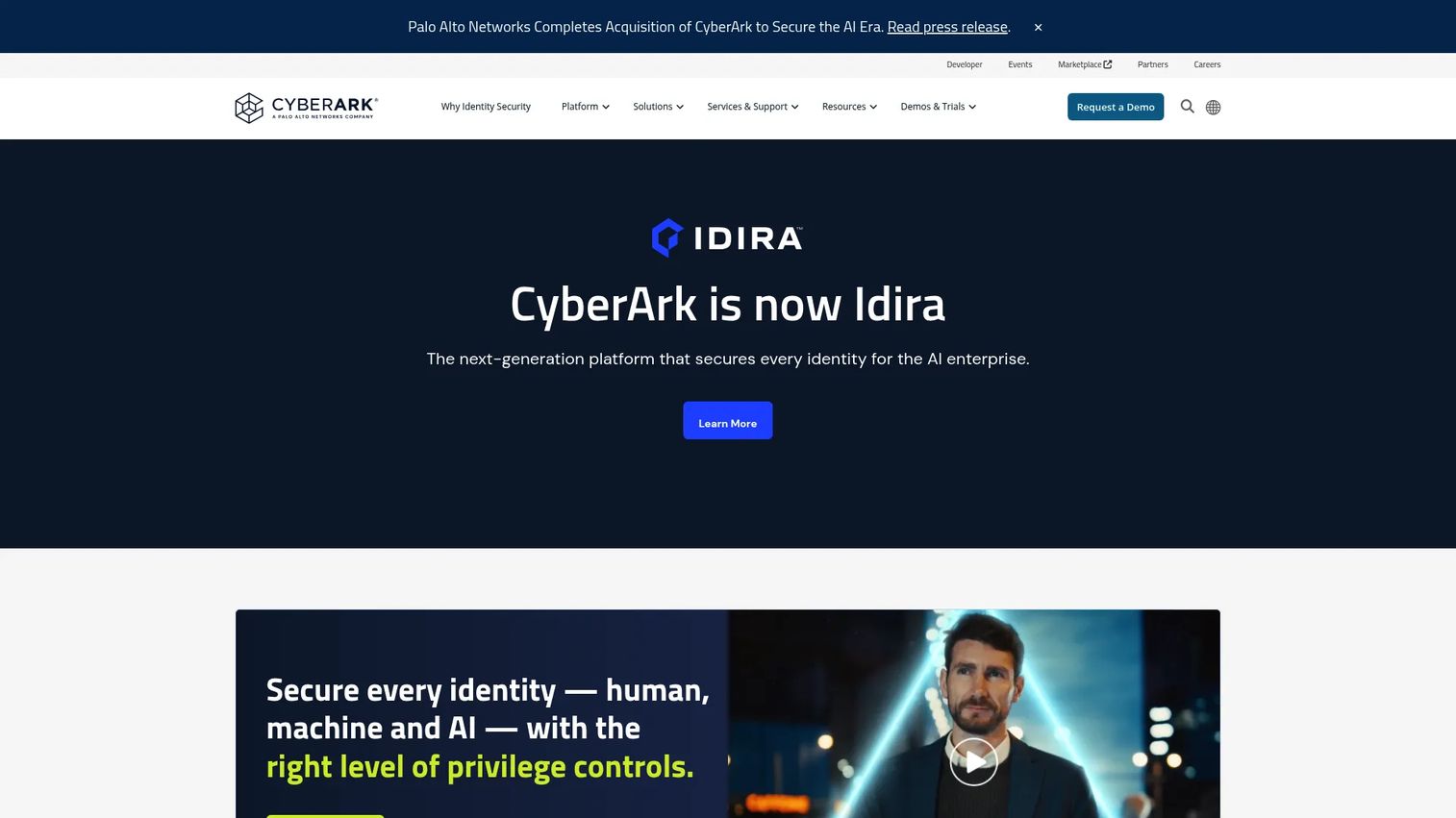
CyberArk sits at the center of the identity security conversation, and with its Venafi acquisition it now folds machine identity management into the same platform that handles privileged access and secrets management. For buyers who want human and non-human identities governed under one roof, that consolidation is the headline. The platform covers discovery, automated provisioning and rotation, and policy governance across certificates and keys, aligned to a Zero Trust model of continuous verification and least privilege.
Best for: Enterprises that want machine identity security unified with privileged access and broader identity governance.
Key strengths
- Unified identity security: privileged access management, secrets management, and machine identity governance on one platform.
- Automated rotation and provisioning: lifecycle automation for certificates and credentials with policy guardrails.
- Zero standing privileges: Zero Trust access controls that enforce least privilege for human and machine identities.
Why choose CyberArk: If your security program is already consolidating identity tooling, CyberArk lets machine identities ride the same governance, discovery, and Zero Trust controls as your privileged human access. The post-Venafi direction matters here, because it brings deep certificate lifecycle management into a platform that enterprise security teams already trust for the hardest access problems.
CyberArk pricing: CyberArk does not publish list pricing on its first-party pages, which route buyers to a demo and quote flow. Plan for an enterprise-tier engagement and expect pricing to scale with the number of identities, environments, and modules in scope. CyberArk holds a 4.5/5 rating on G2.
2. Keyfactor
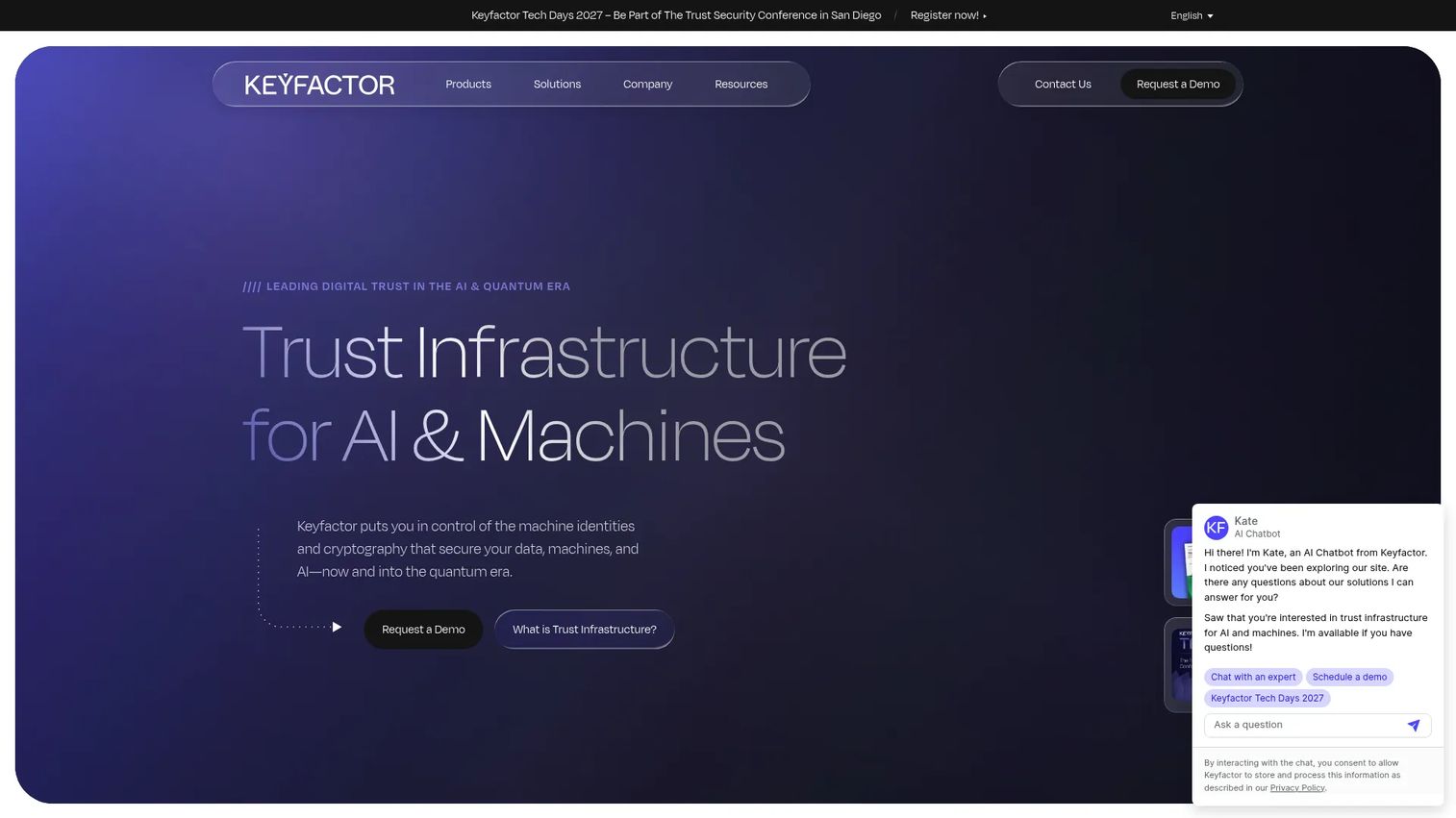
Keyfactor is a digital trust platform built specifically around PKI, certificate lifecycle management, and machine identity at enterprise scale. It pairs certificate automation with cryptographic discovery and inventory, and delivers SaaS-based PKI through EJBCA SaaS. For teams whose core problem is sheer certificate volume across many CAs, Keyfactor is purpose-built for the job.
Best for: Large enterprises that need PKI orchestration, certificate automation, and crypto-agility across a complex CA estate.
Key strengths
- Certificate lifecycle automation: end-to-end issuance, renewal, rotation, and revocation across public and private CAs.
- Cryptographic discovery and inventory: continuous visibility into certificates and keys wherever they live.
- SaaS-delivered PKI: EJBCA SaaS provides managed PKI without standing up your own infrastructure.
Why choose Keyfactor: Keyfactor's center of gravity is digital trust and PKI automation, which makes it a strong fit when certificate sprawl, not access governance, is your primary pain. Its crypto-agility focus also helps teams preparing for algorithm changes and post-quantum readiness, where the ability to re-issue and rotate at scale becomes a real operational requirement.
Keyfactor pricing: Keyfactor does not display public numeric pricing for its core platform. EJBCA SaaS is described as pay-as-you-go, but no list price is shown, so expect a custom quote based on certificate volume and deployment model. Keyfactor holds a 4.5/5 rating on G2.
3. AppViewX
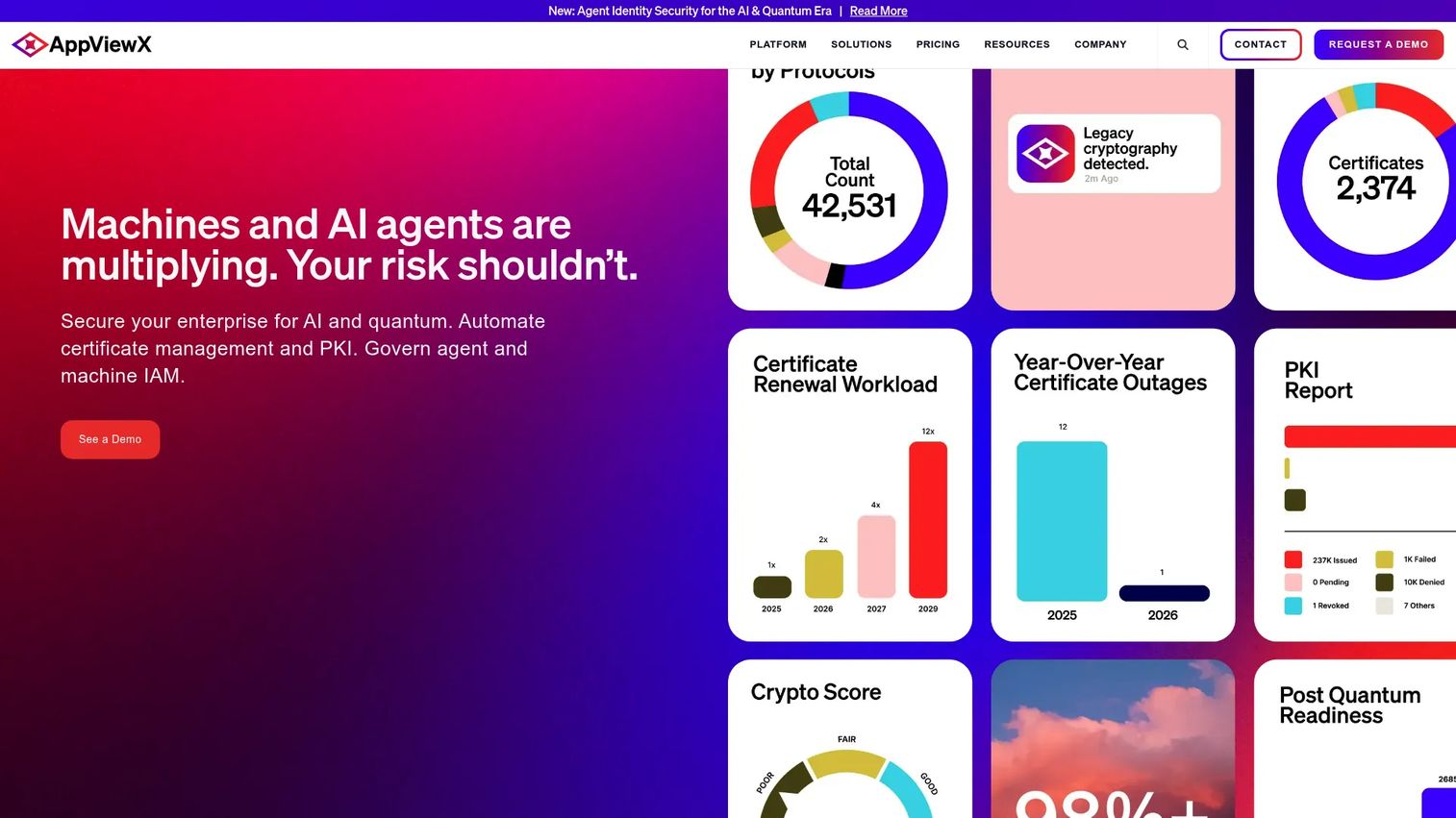
AppViewX is an enterprise machine identity security platform that brings certificate lifecycle management, PKI, code signing, SSH, and application delivery automation into one place. It is built for cloud-first operations, with strong automation for the workflows that platform and security teams run every day. More recently it has extended into AI agent identity security, which is a useful signal of where the category is heading.
Best for: Large enterprises automating certificate lifecycle management alongside SSH and code signing in cloud-heavy environments.
Key strengths
- Certificate lifecycle automation: policy-driven issuance, renewal, and rotation with broad CA support.
- PKI and certificate visibility: discovery and inventory across hybrid and multi-cloud footprints.
- SSH, code signing, and ADC automation: lifecycle coverage beyond certificates, including AI agent identity.
Why choose AppViewX: AppViewX fits teams that want one platform to handle certificates, SSH keys, and code signing rather than stitching together point tools. Its automation and application delivery roots make it especially relevant where certificate operations sit close to load balancers, ingress, and CI/CD pipelines.
AppViewX pricing: AppViewX does not publish public pricing; the site directs buyers to request a custom quote. Pricing will reflect the modules in scope and the scale of your certificate and key estate. AppViewX holds a 4.5/5 rating on G2.
4. DigiCert ONE
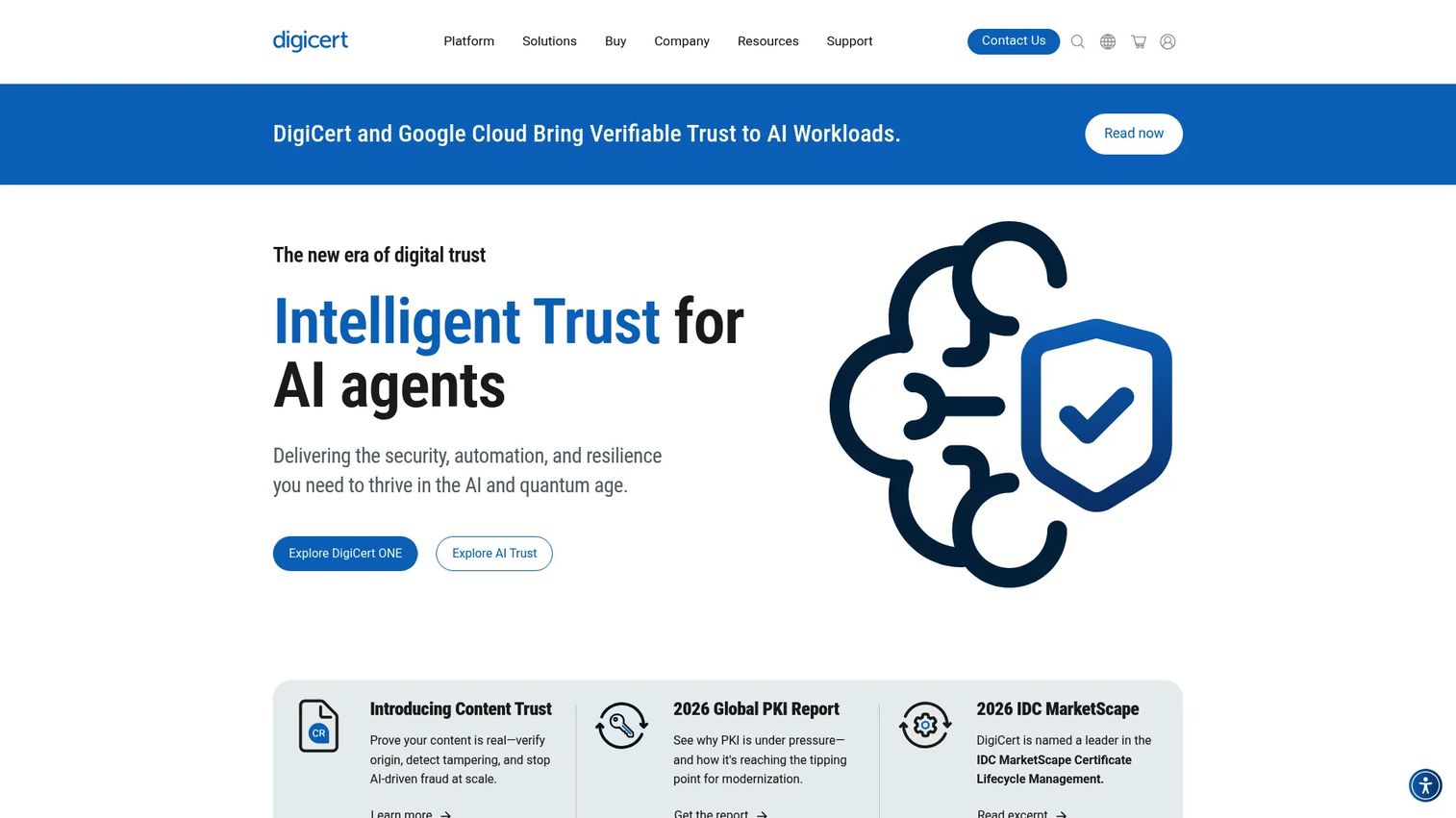
DigiCert brings together public CA scale and unified certificate lifecycle management under its DigiCert ONE platform. It is a strong choice when you need both a trusted public CA and the automation to manage certificates across websites, email, software, devices, and DNS. ACME automation and AI-driven validation help reduce the manual work that usually surrounds public certificate issuance.
Best for: Organizations that want enterprise-grade public certificates plus lifecycle automation in one trust platform.
Key strengths
- Certificate issuance and lifecycle automation: managed issuance, renewal, and revocation across many certificate types.
- ACME and AI validation: automation that cuts manual steps out of public certificate workflows.
- DNS and broad trust coverage: certificate, device, and DNS services with secure API access.
Why choose DigiCert ONE: DigiCert is one of the few vendors that pairs a major public CA with serious lifecycle tooling, so you are not bolting automation onto a third-party CA. That matters for teams who want issuance and management governed by the same provider, with the trust and validation depth that comes from a large public CA.
DigiCert pricing: DigiCert publishes product-specific pricing on its buy page. DNS Essentials starts at $0/month, Basic OV certificates start at $26/month per standard domain, and Secure Site OV starts at $44/month per standard domain, all on 12-month auto-renewing terms. Higher tiers and account-specific pricing are quote-based. DigiCert holds a 4.3/5 rating on G2.
5. Sectigo Certificate Manager
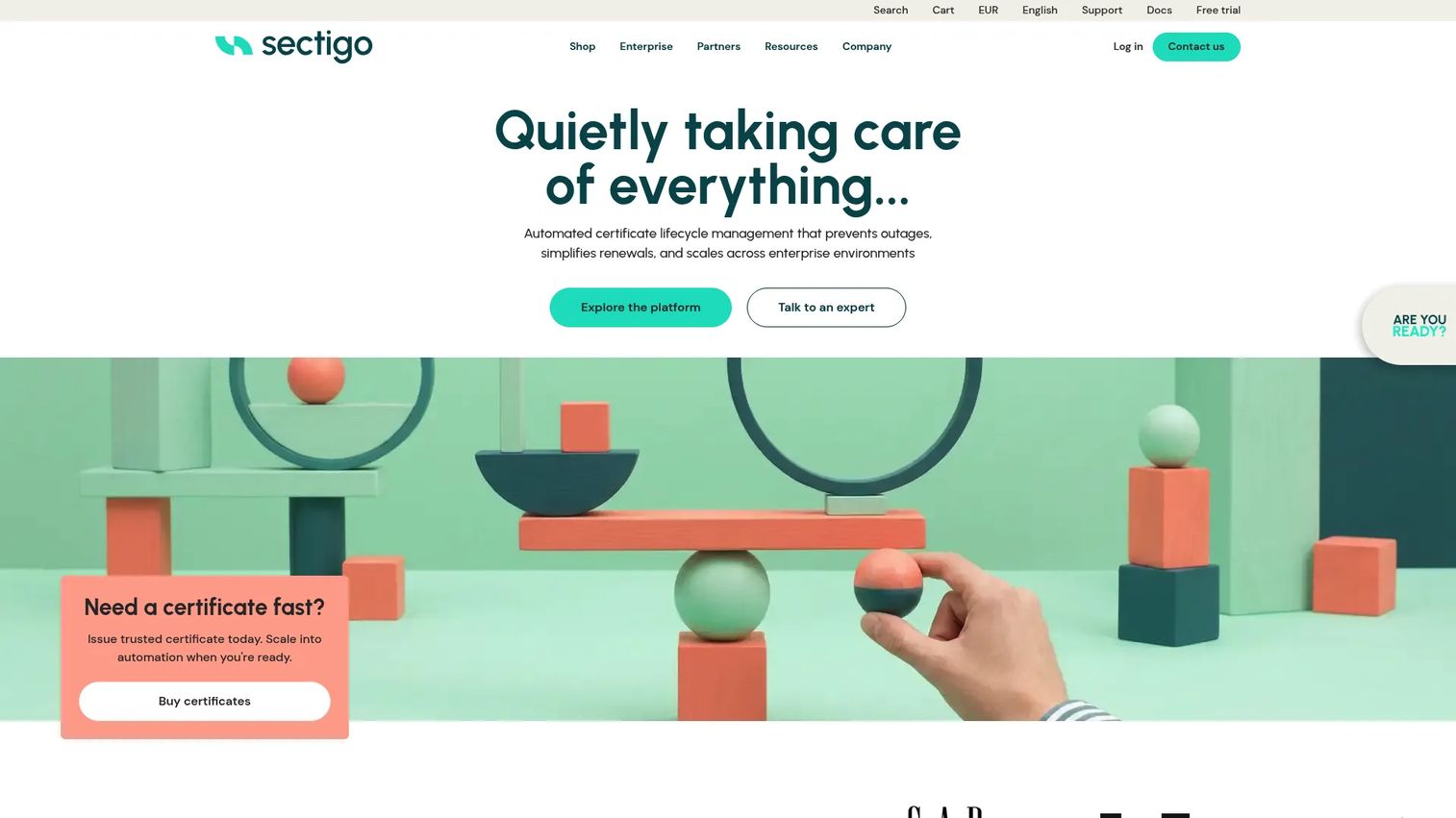
Sectigo pairs a public CA with Sectigo Certificate Manager, a platform focused on certificate discovery, issuance, deployment, and centralized management across both public and private CAs. For organizations managing large certificate inventories, the appeal is one console that spans many CAs with automation and integrations layered on top.
Best for: Organizations buying SSL/TLS certificates at volume and managing large, mixed-CA certificate inventories.
Key strengths
- Certificate discovery and inventory: find and track certificates across public and private CAs.
- Certificate lifecycle management: centralized issuance, deployment, renewal, and revocation through Sectigo Certificate Manager.
- Private PKI and automation: integrations and automation for both public and private trust.
Why choose Sectigo: Sectigo works well when you want certificate management anchored to a CA that issues at global scale, with a manager console that handles discovery and lifecycle across mixed environments. Teams that already buy public certificates from Sectigo get a natural path to consolidating management without adding a separate vendor.
Sectigo pricing: Sectigo publishes public pricing for single-domain SSL certificates: DV from $66, OV from $184, and EV from $257.66, all on six-year subscription terms. Sectigo Certificate Manager pricing is not publicly listed and is quote-based by inventory and feature set. Sectigo Certificate Manager holds a 4.5/5 rating on G2.
6. HashiCorp Vault
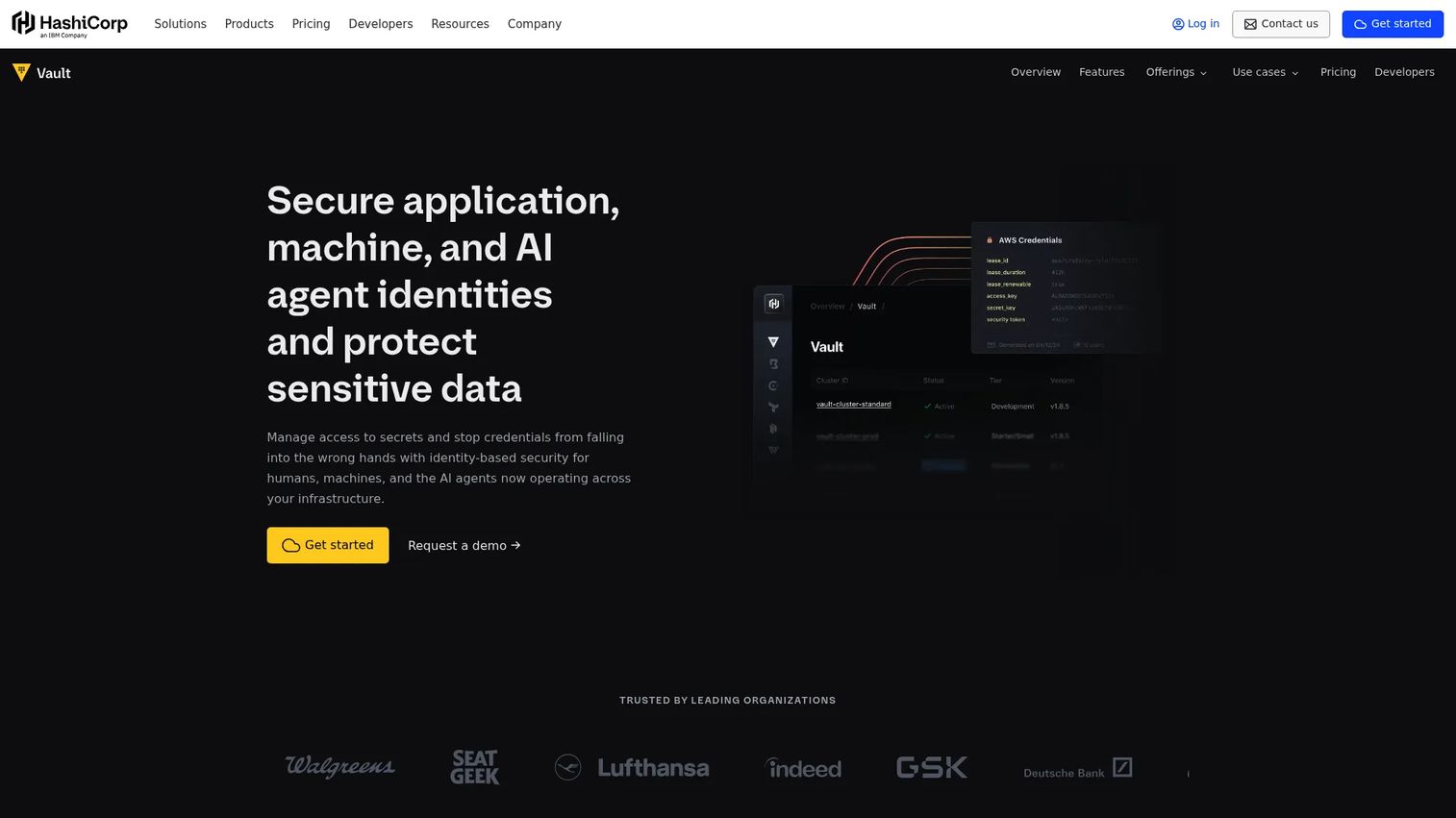
HashiCorp Vault is an identity-based secrets management platform whose PKI secrets engine makes it a serious option for cloud-native machine identity. It issues dynamic, short-lived certificates on demand, which fits microservices and ephemeral infrastructure better than long-lived certs ever did. For DevOps teams already running Vault for secrets, extending it to certificate issuance is a natural move.
Best for: Cloud-native and DevOps teams that want dynamic certificate issuance tied into their existing secrets workflow.
Key strengths
- PKI secrets engine: dynamic, short-lived certificate issuance for workloads and services.
- Secrets management: centralized storage and access for secrets, tokens, and encryption keys.
- Dynamic credentials and encryption as a service: just-in-time credentials with identity-based access controls.
Why choose HashiCorp Vault: Vault is the pragmatic choice when developers, not security admins, own the certificate workflow. Its API-first model and dynamic issuance pattern suit CI/CD, Kubernetes, and service mesh environments where credentials should live for minutes, not years. Teams that want machine-to-machine authentication baked into their platform tooling gravitate here.
HashiCorp Vault pricing: HashiCorp offers a free tier for HCP Vault, plus pay-as-you-go and custom Enterprise pricing. No Vault-specific list price is published, so usage-based and Enterprise costs require a quote. HashiCorp Vault holds a 4.3/5 rating on G2.
7. Smallstep
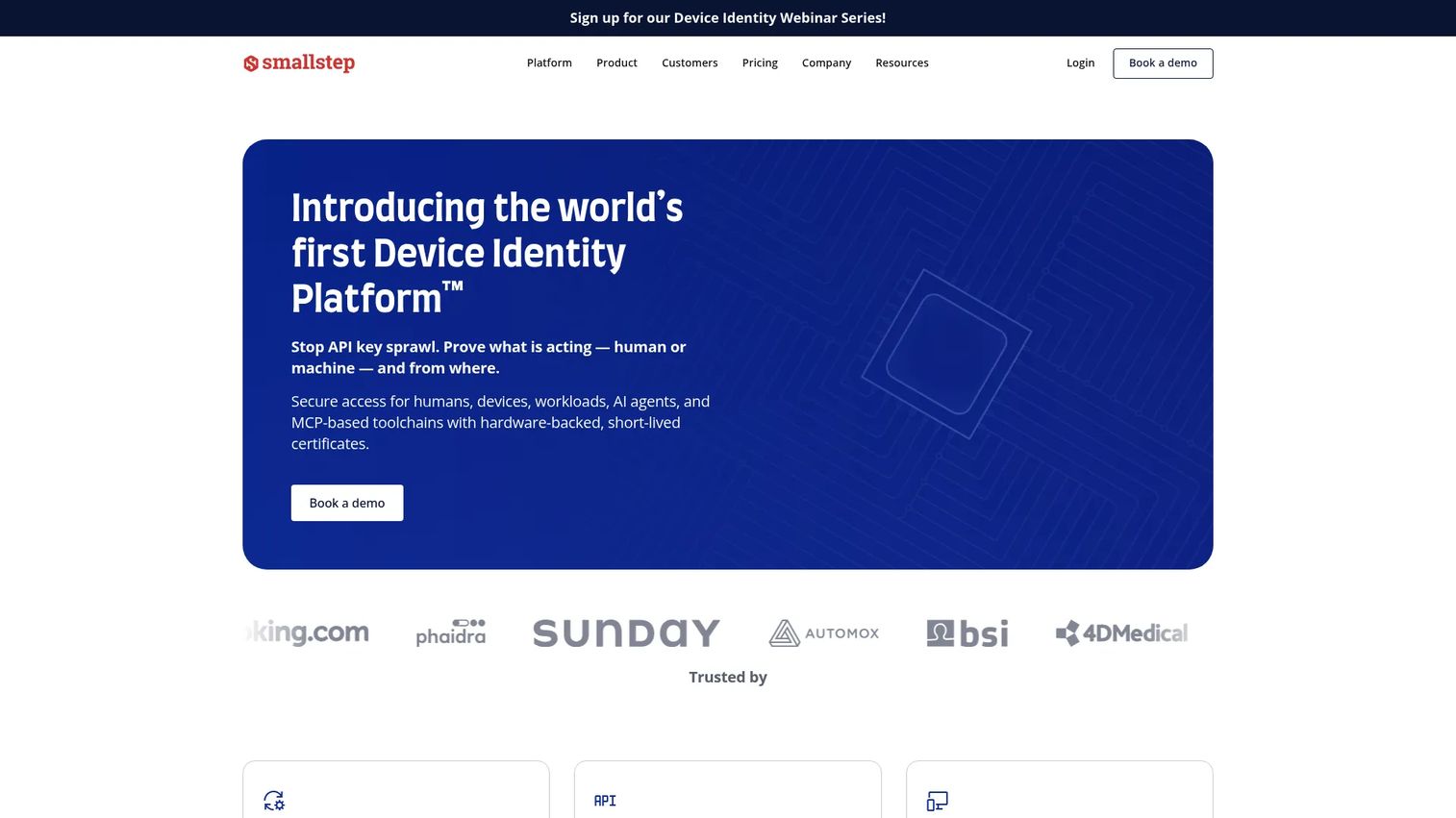
Smallstep is a device identity platform that secures access for humans, devices, workloads, and AI agents using hardware-backed, short-lived certificates. It leans into cloud-native identity workflows and Zero Trust, with managed certificate infrastructure that handles enrollment and renewal automatically. For teams who want strong cryptographic device identity without running their own CA, it is a clean fit.
Best for: Teams that need hardware-backed device and workload identity with certificate-based access control.
Key strengths
- Hardware-backed, short-lived certificates: strong device identity rooted in hardware attestation.
- Device identity for access: VPN, ZTNA, SSH, Wi-Fi, and workload identity from one platform.
- ACME Device Attestation and agent enrollment: automated, attested enrollment for devices and workloads.
Why choose Smallstep: Smallstep excels when device identity and Zero Trust access are the core requirement, not just certificate accounting. Its short-lived, hardware-backed approach reduces the blast radius of any single compromised credential, which is exactly what continuous verification asks for. It is also a natural fit for securing emerging workload and AI agent identities.
Smallstep pricing: Smallstep does not publish public pricing; the pricing page invites buyers to contact sales for a scoped quote, with bundles and bespoke options available. Cost will depend on the number of devices and workloads under management.
8. Entrust
Entrust takes a portfolio approach to machine identity, spanning PKI, Certificate Hub, IoT Security, HSMs, and key management. Rather than a single product, it offers identity-centric security infrastructure that large enterprises and governments assemble around their specific trust requirements. That breadth is the point: if you need PKI, hardware roots of trust, and certificate governance from one vendor, Entrust covers a lot of ground.
Best for: Enterprises and governments that want PKI, HSMs, and certificate governance from a single identity-centric vendor.
Key strengths
- PKI and Certificate Hub: centralized certificate discovery, governance, and lifecycle management.
- HSMs and key management: hardware roots of trust for high-assurance cryptographic operations.
- IoT Security: machine identity for connected device fleets at scale.
Why choose Entrust: Entrust fits organizations that treat cryptographic trust as core infrastructure and want HSM-backed assurance alongside certificate governance. Its portfolio depth makes it a strong anchor vendor for regulated industries and IoT-heavy environments where hardware-grade key management is non-negotiable.
Entrust pricing: Entrust publishes pricing for its Identity as a Service workforce bundles, starting at $2 per user per month, with a Plus bundle at $3.50 per user per month and a Premium bundle that is contact-sales. PKI, HSM, and Certificate Hub offerings are quote-based. Entrust holds a 4.3/5 rating on G2.
9. Red Hat Certificate System
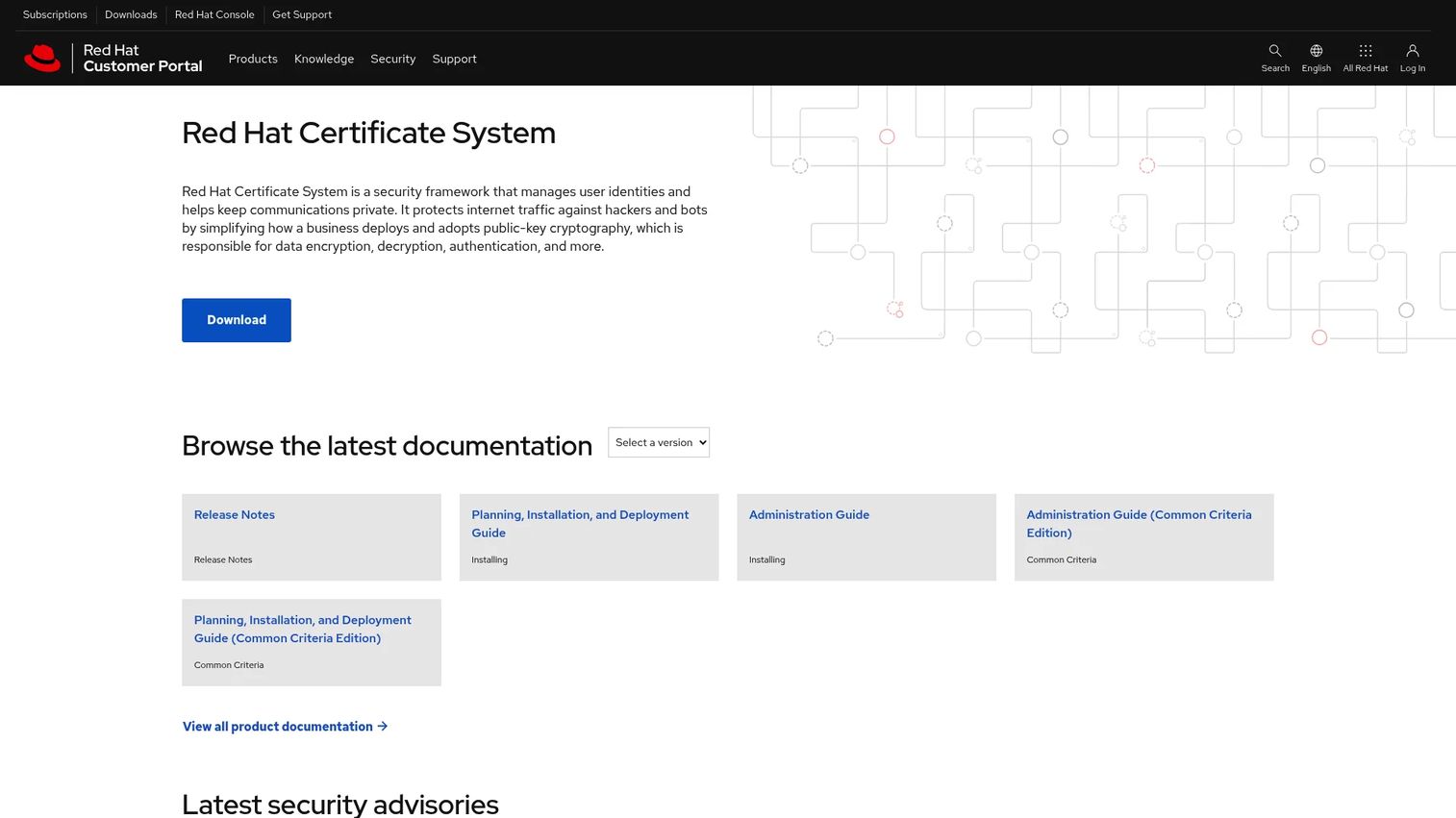
Red Hat Certificate System is enterprise PKI software for managing identities and private communications through the full certificate lifecycle. It covers issuance, renewal, revocation, archiving, and recovery, with high availability, auditing, and role-based access controls built in. For organizations that want to run their own PKI with enterprise support behind it, it is a proven option.
Best for: Organizations that want to operate their own enterprise PKI with full lifecycle and recovery capabilities.
Key strengths
- Public key cryptography and CLM: complete certificate lifecycle management on a self-operated PKI.
- Issuance to recovery: issuance, renewal, revocation, archiving, and key recovery in one system.
- High availability and auditing: role-based access controls and audit logging for governance.
Why choose Red Hat Certificate System: This is the pick for teams that need control and ownership of their PKI rather than a SaaS-managed model, backed by Red Hat's enterprise support. Key archiving and recovery are standout capabilities for organizations with strict data-recovery and compliance obligations.
Red Hat Certificate System pricing: Red Hat does not publish public pricing for Certificate System; it is licensed through Red Hat's enterprise model and requires a quote. It holds a 4.7/5 rating on G2, based on a small number of reviews.
10. ManageEngine Key Manager Plus
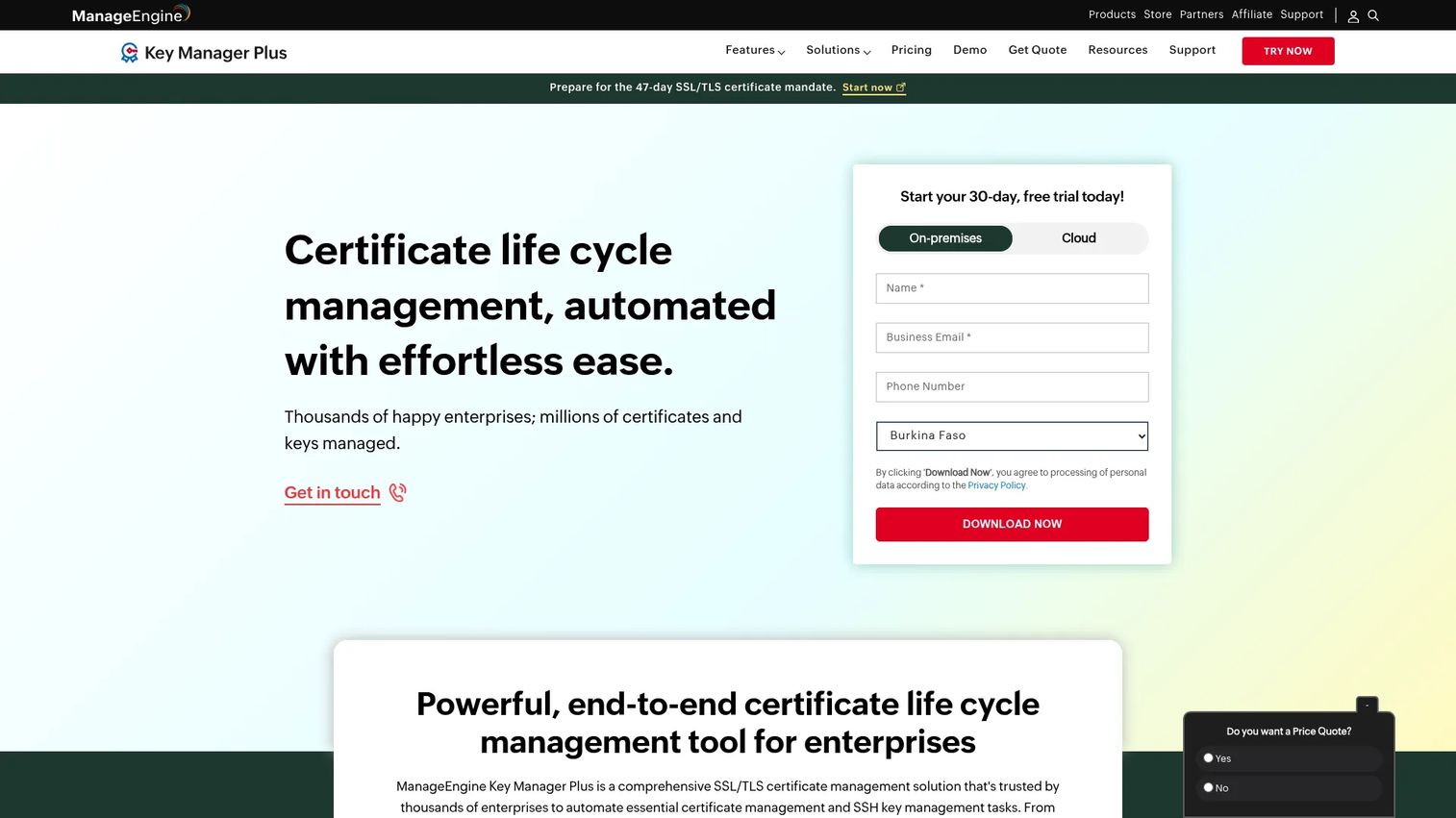
ManageEngine Key Manager Plus is web-based software for SSH key and SSL/TLS certificate lifecycle management. It is the pragmatic pick for teams that want centralized discovery, rotation, and auditing without a heavyweight enterprise PKI program. The free tier and clear licensing make it easy to start, which matters when you are proving value before a bigger commitment.
Best for: Teams that need centralized, no-nonsense management of SSH keys and SSL/TLS certificates.
Key strengths
- SSL/TLS discovery and inventory: automated certificate discovery across your estate.
- SSH key lifecycle management: discovery, rotation, and control of SSH keys, a commonly neglected risk.
- Auditing and compliance tracking: reporting and audit trails to support framework requirements.
Why choose ManageEngine Key Manager Plus: Key Manager Plus is the practical option when SSH keys and certificate sprawl are your immediate problem and you want something you can stand up quickly. It fits mid-sized teams and security functions that need centralized control and audit visibility without committing to a full PKI platform on day one.
ManageEngine Key Manager Plus pricing: Key Manager Plus offers a free edition supporting up to 5 keys, and a fully functional 30-day evaluation supporting up to 50 keys. The registered Standard edition is licensed by the number of managed keys, with pricing provided on request. It holds a 4.5/5 rating on G2.
Considerations
Once you have a shortlist, pressure-test each tool against the realities of your environment. These are the criteria that separate a clean rollout from a stalled one.
Integration depth
Map the platform against your actual stack: the CAs you use, your HSMs, Kubernetes and service meshes, load balancers, CI/CD, and ITSM. A tool that automates issuance but cannot deploy to your ingress or trigger your ticketing system leaves manual gaps. Ask for integration coverage in writing, not just a logo wall.
Governance and policy enforcement
Centralized policy is what keeps crypto-agility from becoming chaos. Check how the platform enforces key length, algorithms, validity periods, and approved CAs, and how it handles exceptions. Strong least privilege and continuous verification controls are essential if Zero Trust is on your roadmap.
Compliance and auditability
If you answer to PCI-DSS, ISO 27001, NIST, or GDPR, the audit trail is not optional. Verify that every issuance, renewal, rotation, and revocation is logged and reportable. The right tool turns a compliance audit from a fire drill into a query.
Deployment model and supportability
Decide early whether SaaS, self-hosted, or hybrid cloud fits your security posture and operational capacity. Self-operated PKI gives you control; managed PKI reduces overhead. Either way, weigh vendor support quality, because machine identity failures tend to surface at the worst possible moment.
Conclusion
The right machine identity management software depends on what is breaking and where. For unified machine identity security and Zero Trust across human and non-human identities, CyberArk is the consolidation play. For PKI orchestration and crypto-agility at scale, Keyfactor and AppViewX lead. DigiCert ONE and Sectigo pair public CA trust with lifecycle automation, while HashiCorp Vault and Smallstep fit cloud-native and DevOps teams that want short-lived, dynamic certificates. Entrust and Red Hat Certificate System suit organizations that want portfolio depth or full PKI ownership, and ManageEngine Key Manager Plus is the pragmatic starting point for SSH and SSL/TLS lifecycle management.
Pick based on lifecycle automation depth, governance needs, and environment fit, not feature checklists. Shortlist two or three, then run a hands-on evaluation against your real certificates, keys, and integrations before you commit. The platform that prevents your next outage is the one that proves itself in your environment.
FAQs
It is software that discovers, governs, and automates the lifecycle of non-human identities, including digital certificates, cryptographic keys, SSH keys, and service accounts. It handles issuance, renewal, rotation, and revocation, plus discovery, monitoring, and policy enforcement across hybrid cloud and multi-cloud environments. The goal is preventing outages and breaches caused by mismanaged machine identities.
Secrets management mainly stores, distributes, and rotates credentials like tokens and passwords. Machine identity management goes further, governing the full lifecycle, trust chains, discovery, and policy for certificates and keys. In practice the two overlap, and several platforms do both, but machine identity management adds PKI-aware governance and certificate-specific automation that pure secrets tools do not.
Many services depend on valid certificates to authenticate and to establish encrypted connections. When a certificate expires, TLS or mTLS handshakes fail, trust chains break, and traffic to or between those services stops. Because the failure is sudden and total, an expired certificate often takes a production service fully offline until someone renews and redeploys it.
Yes. Zero Trust requires continuous verification and least privilege for every identity, including machines. Machine identity management supports this by issuing short-lived certificates, automating certificate rotation, and enforcing policy on machine-to-machine authentication. Replacing long-lived static secrets with automatically rotated credentials is a core Zero Trust practice.
Focus on lifecycle automation depth, certificate and key discovery, integration breadth, deployment flexibility, and governance. Most importantly, look for proof that the tool fits the buyer's actual environment, the specific CAs, HSMs, cloud platforms, and CI/CD tooling in play. A hands-on evaluation against real certificates and keys beats any feature checklist.
Hybrid cloud and multi-cloud estates, DevOps-heavy environments, and IoT fleets need it most, along with any organization managing large volumes of certificates, SSH keys, or service accounts. The more machine identities you have and the faster they are created, the harder manual tracking becomes and the more a dedicated platform pays off.
Yes. PKI remains foundational because digital certificates and trust chains are core to secure machine-to-machine authentication in most environments. Even cloud-native approaches that issue short-lived certificates rely on PKI underneath. Machine identity management adds automation and governance on top of PKI rather than replacing it.
Yes. They improve compliance by giving you visibility into every certificate and key, enforcing policy on rotation and revocation, and producing auditable records of every lifecycle event. That supports frameworks like PCI-DSS, ISO 27001, NIST guidance, and GDPR, turning evidence gathering from a manual scramble into a reportable, defensible process.