A driver finishes a route with three cases short. Nobody knows if they were returned, sold off-book, or never loaded. The invoice went out anyway. Two weeks later, finance is still reconciling that route against a spreadsheet that stopped matching reality on day one.
That gap between what left the warehouse and what actually got delivered is the core problem direct store delivery software exists to close. When you run dozens or hundreds of routes a week, manual route sheets and end-of-day guesswork stop scaling. Inventory drifts. Invoices carry errors. Back-office teams spend more time reconstructing what happened than acting on it.
The market reflects how urgent this has become. The global direct store delivery software market was estimated at USD 2.8 billion in 2024 and is forecast to reach USD 6.5 billion by 2033, growing at 11.2% CAGR, according to LinkedIn Market Insight (2024). Cloud deployment already accounts for 65% of that market, signaling a decisive shift toward SaaS delivery models over on-premise systems.
For operators, distributors, and field-sales leaders, the question is no longer whether to adopt dsd software. It is which system matches your route complexity, your mobile field execution needs, your inventory visibility gaps, and your back-office stack. This guide covers the strongest dsd software for distributors in 2026, evaluated through the lens that actually matters in daily operations: dsd route accounting, mobile usability, inventory control, and erp integration.
What's inside
This guide is for supply chain, operations, and distribution leaders comparing direct store delivery software for operational scale. It is written as an operator's evaluation guide, not a generic vendor roundup.
We selected and ranked 10 tools against four criteria that separate workable systems from shelfware:
- Route accounting depth: how well the system tracks the financial and operational reality of each route
- Mobile field execution: how usable the mobile dsd software is for drivers and reps, including offline capture
- Inventory visibility: how accurately it tracks stock loaded, delivered, returned, and adjusted
- Integration depth: how cleanly it syncs with ERP, POS, and back-office finance systems
Pricing and ratings reflect verified public sources where available. Where a vendor does not publish pricing, we say so rather than guess.
TL;DR
- Best for ERP-centric distributors: Deacom and inecta anchor delivery data inside a single operational system, so route activity and finance stay in sync.
- Best for route-heavy field operations: bMobile Route Software and RoutePro focus on route planning, delivery tracking, and driver workflows at volume.
- Best for combined field sales and commerce: Pepperi and inSitu Sales pair order-taking with delivery execution in one workflow.
- Best for large CPG and FMCG distribution: Botree and Ivy Mobility scale route-to-market and retail execution across big field forces.
- Best for regulated food and beverage: BatchMaster and inecta handle batch, lot traceability, and compliance alongside delivery.
- Best for end-to-end DSD route accounting: NCS eDSD ties back-office ERP to mobile delivery and order-to-cash.
What is direct store delivery software?
Direct store delivery software is a system that manages the process of delivering goods directly from a distributor to a retail store, tracking the routes, deliveries, invoices, and inventory movements involved so operations and finance stay accurate.
Unlike warehouse-to-distribution-center models, direct store distribution puts a driver or rep at the store with authority to sell, restock, invoice, and reconcile on the spot. The software exists to keep that field activity accurate and connected to the back office.
Core capabilities of direct store delivery route accounting software include:
- Route accounting: reconciling what was loaded, sold, delivered, returned, and settled per route
- Delivery tracking: real-time visibility into route progress and completion
- Invoice handling: generating and adjusting invoices at the point of delivery, part of the order delivery invoicing workflow
- Inventory visibility: tracking stock across load, delivery, return, and adjustment
- ERP or POS sync: pushing delivery, order, and financial data into back-office systems
- Proof of delivery: capturing signatures, timestamps, and delivery confirmation in the field
The category overlaps with route optimization, mobile order capture, and field force automation. What defines it is the combination of dsd route accounting and field execution in one connected workflow. The strongest systems in 2026 run cloud-first, sync in real time, and give operators a single source of truth from the truck to the ledger.
When to use direct store delivery software
Not every distributor needs a full DSD platform on day one. These three situations are the clearest signals that manual methods have stopped working.
Improve route accounting and reconciliation
When field reps still fill out paper route sheets and the back office reconciles them against a spreadsheet, errors compound fast. Every manual transcription is a chance for stock counts, invoices, and settlements to drift apart. If dispatch cannot tell you what happened on a route until the driver returns and hands over paperwork, you have outgrown manual dsd route accounting. Purpose-built software closes the loop between field reps, dispatch, and finance in real time.
Keep inventory accurate in the field
Inventory does not stay still on a DSD route. Stock is loaded, delivered, returned, sold off the truck, and adjusted for damage, all in a single shift. For perishables and fast-moving goods, a stale count means spoilage, stockouts, or shrink you cannot explain. Strong inventory visibility across every one of those movements is what protects inventory accuracy and margin. This is where mobile dsd software earns its cost, by capturing each transaction as it happens instead of hours later.
Sync deliveries with ERP and POS systems
When delivery data lives in one system and finance lives in another, someone spends their week keying invoices twice. Backend synchronization removes that lag. Orders, invoices, inventory adjustments, and payments flow into your ERP or POS without manual re-entry, which reduces errors and speeds up order-to-cash. For finance, operations, and order management teams, erp integration is what turns field activity into clean, reportable data.
Comparison table
The table below ranks the 10 tools by relevance to direct store delivery buying intent. Pricing and G2 ratings reflect verified public sources as of mid-2026. Where a vendor does not publish pricing, that is noted rather than estimated.
| # | Product | Intent | Key use case | Pricing | G2 rating |
|---|---|---|---|---|---|
| 1 | Deacom | ERP-anchored DSD | Unified ERP with route and inventory workflows | Quote-based | 4.2/5 |
| 2 | BatchMaster Software | Process manufacturing + DSD | Batch, lot traceability, and distribution | Quote-based | 2.9/5 |
| 3 | inecta | Food-industry ERP + DSD | Food supply chain with traceability | Quote-based | Not listed |
| 4 | Pepperi | B2B commerce + DSD | Order-taking plus delivery execution | Custom | 4.3/5 |
| 5 | RoutePro | Route accounting | Van sales, pre-sell, and delivery confirmation | Contact vendor | Not listed |
| 6 | bMobile Route Software | Route management | Route, order, inventory, and delivery in one | Route/user-based | 4.7/5 |
| 7 | Botree | CPG route-to-market | Distributor management and field-sales automation | Contact vendor | Not listed |
| 8 | inSitu Sales Software Suite | Field sales + delivery | Field sales, B2B storefront, and dispatch | From $200/mo | Not listed |
| 9 | Ivy Mobility | Consumer goods RTM | Route-to-market and retail execution | Contact vendor | 4.6/5 |
| 10 | NCS eDSD | End-to-end DSD | Back-office ERP plus mobile route accounting | Contact vendor | Not listed |
1. Deacom
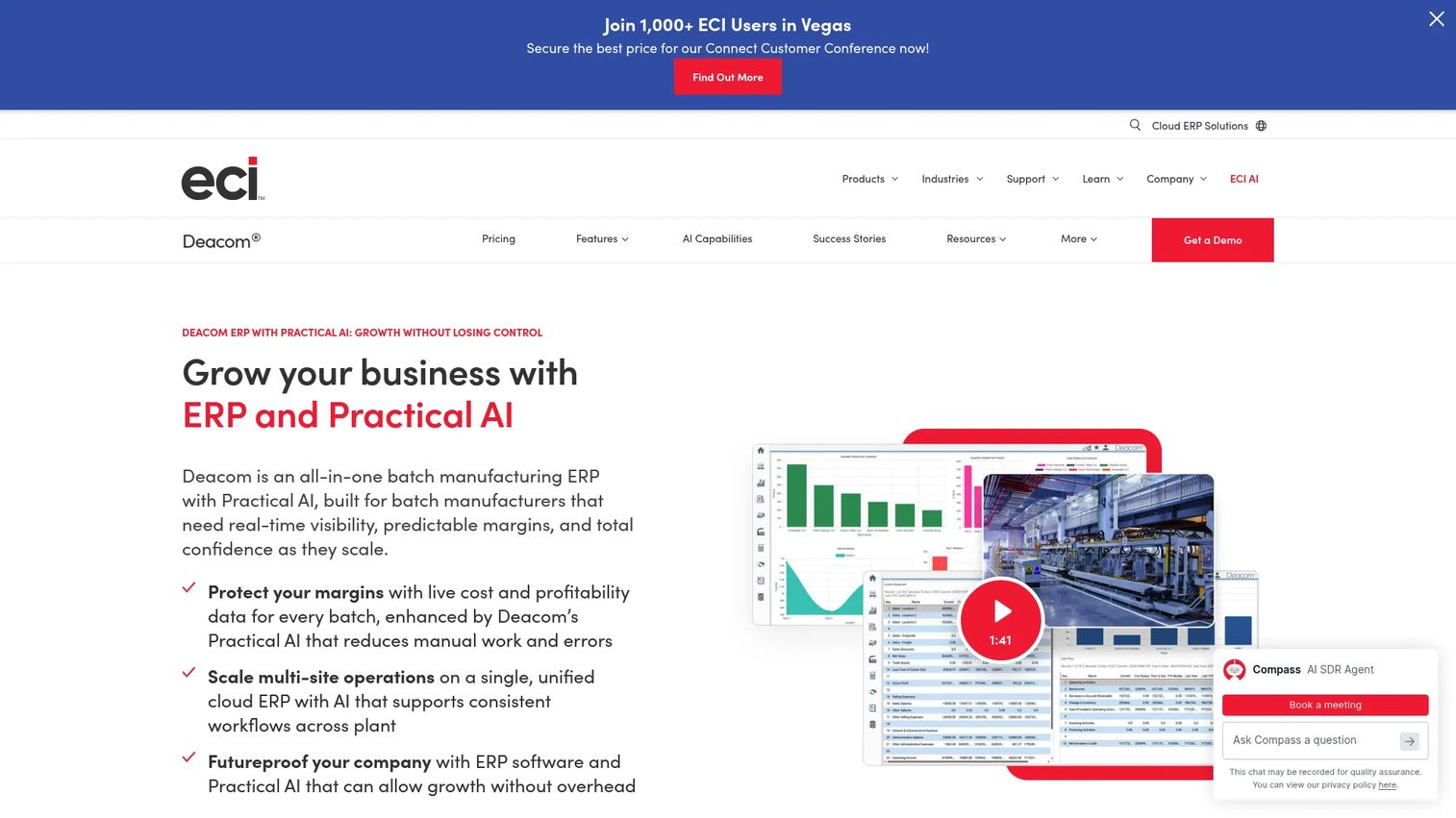
Deacom is an ERP built for manufacturers and distributors that want one operational system rather than a patchwork of tools. Its relevance to direct store delivery comes from keeping delivery activity, inventory, and finance inside the same platform. For a distributor tired of syncing three systems, that single source of truth is the whole pitch.
The value here is architectural. When your route accounting lives in the same system as your production and financials, you remove the reconciliation lag that eats back-office time. Pricing hierarchies flow into field invoicing, and inventory movements update the ledger without a nightly export. For teams whose main pain is fragmented data, that matters more than any single feature.
Best for: Manufacturers and distributors that want route, inventory, and finance workflows inside one ERP.
Key strengths
- Configurable pricing hierarchy: Sales and purchasing pricing rules carry through to field invoicing consistently.
- Product configurator: Handles complex product and packaging variations without external tooling.
- MRP and production job management: Connects production planning directly to what ships and delivers.
Why choose Deacom: Choose Deacom if consolidation is your priority and you would rather run one system than integrate several. It fits operators who see the ERP as the backbone and want DSD to be a native part of it, not a bolt-on. The trade-off is that this is a full ERP commitment, best suited to teams ready for that scope.
Deacom pricing: Deacom does not publish public pricing. Cost is quote-based and depends on modules, users, and configuration, so you will need to contact sales for a tailored figure. Deacom holds a 4.2/5 rating on G2.
2. BatchMaster Software
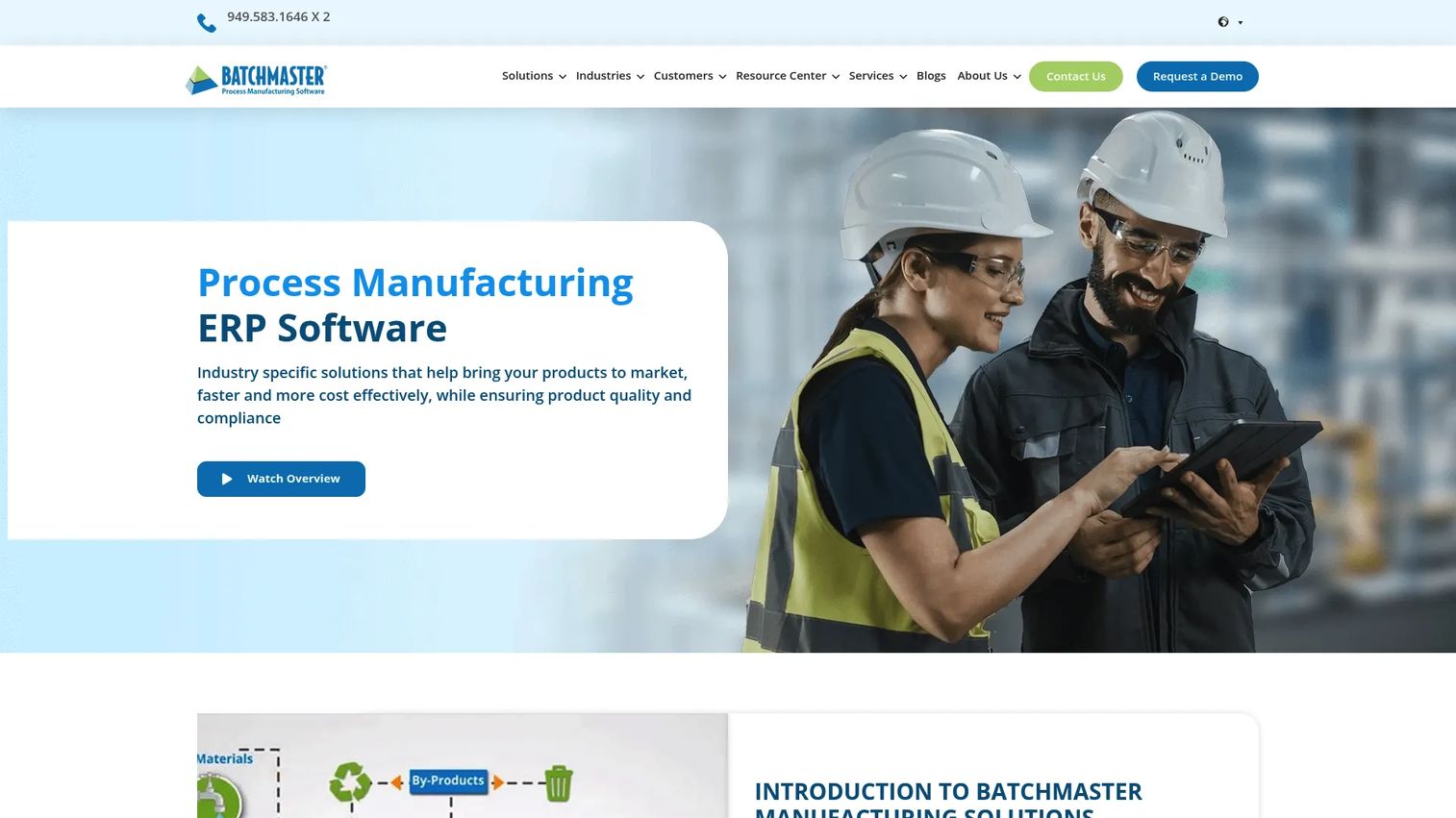
BatchMaster Software is an ERP built for formula- and batch-based process manufacturers. It matters for DSD when your delivery operation sits downstream of regulated, recipe-driven production, common in food, beverage, and chemicals. The system connects formulation and production to the inventory that eventually loads onto delivery routes.
For distributors of manufactured goods, the strength is traceability. Every lot that leaves production carries its compliance record forward, so if a recall hits, you can trace product from batch to store. That end-to-end visibility is hard to retrofit later, which is why manufacturers with delivery arms often anchor on a system like this early.
Best for: Mid-market process manufacturers that also run distribution and need regulated, formula-based production tied to inventory.
Key strengths
- Flexible deployment: Runs cloud or on-premise depending on your infrastructure preference.
- Full production suite: Covers formulation, production, inventory, and costing in one system.
- Compliance and traceability: Lot traceability, recall management, and compliance support built in.
Why choose BatchMaster: Pick BatchMaster if your DSD operation is downstream of process manufacturing and compliance is non-negotiable. It fits teams who need production and inventory tightly linked before delivery even enters the picture. It is less of a pure route tool and more of a manufacturing-first platform with distribution capability.
BatchMaster pricing: BatchMaster does not display public plan pricing and directs prospects to request a demo. Its G2 profile shows a 2.9/5 rating, so weigh reviewer feedback carefully during evaluation.
3. inecta
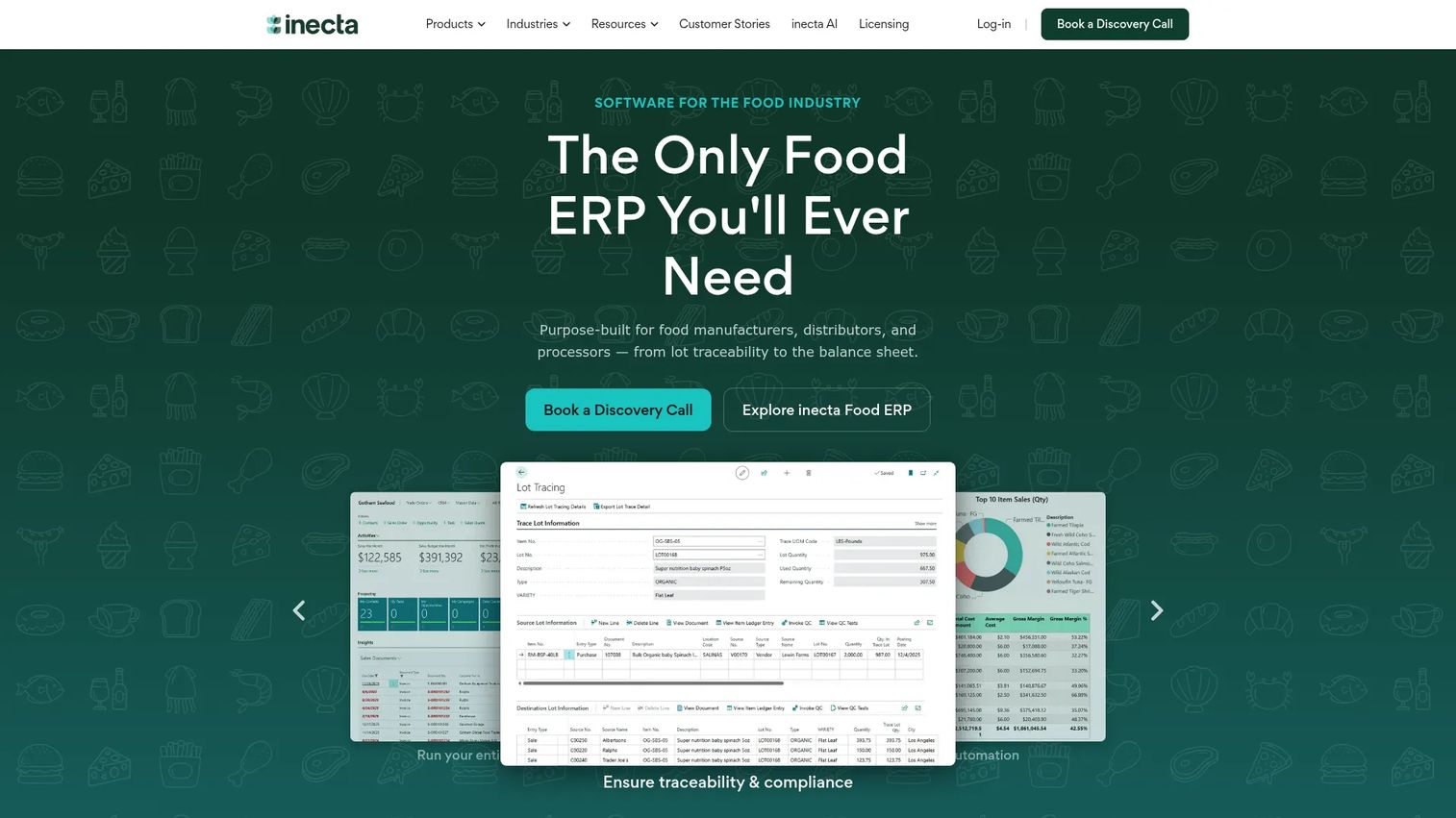
inecta is a food-industry ERP built on Microsoft Dynamics 365 Business Central and hosted in Microsoft Azure. That foundation matters: if you already live in the Microsoft stack, integration-led deployment is more predictable. inecta focuses on food and beverage operations where traceability, allergen visibility, and supply chain control are core requirements, not add-ons.
For food distributors running DSD, inecta ties production planning, ingredient tracking, and delivery into one flow. The Business Central base means it scales financial reporting and inventory visibility alongside route activity, which appeals to operators who want a recognized ERP backbone rather than a niche point tool.
Best for: Food and beverage companies needing an ERP tailored to food supply chain operations with delivery.
Key strengths
- Production planning: Aligns what you make with what you deliver across the food supply chain.
- Ingredient and allergen tracking: Maintains allergen visibility from ingredient to delivered product.
- Food safety and compliance: Built-in traceability supports food safety and recall readiness.
Why choose inecta: Choose inecta if you are a food or beverage operator already committed to Microsoft Dynamics, since the shared foundation makes back-office coordination cleaner. It fits distributors who want food-specific compliance without building it themselves. The fit narrows if you are outside food or want a route-first rather than ERP-first system.
inecta pricing: inecta uses quote-based pricing that varies by users, modules, and operational complexity, so you contact sales for a tailored quote. A public G2 rating was not confirmed, though reviews are available on Capterra for cross-reference.
4. Pepperi Unified B2B Commerce Platform
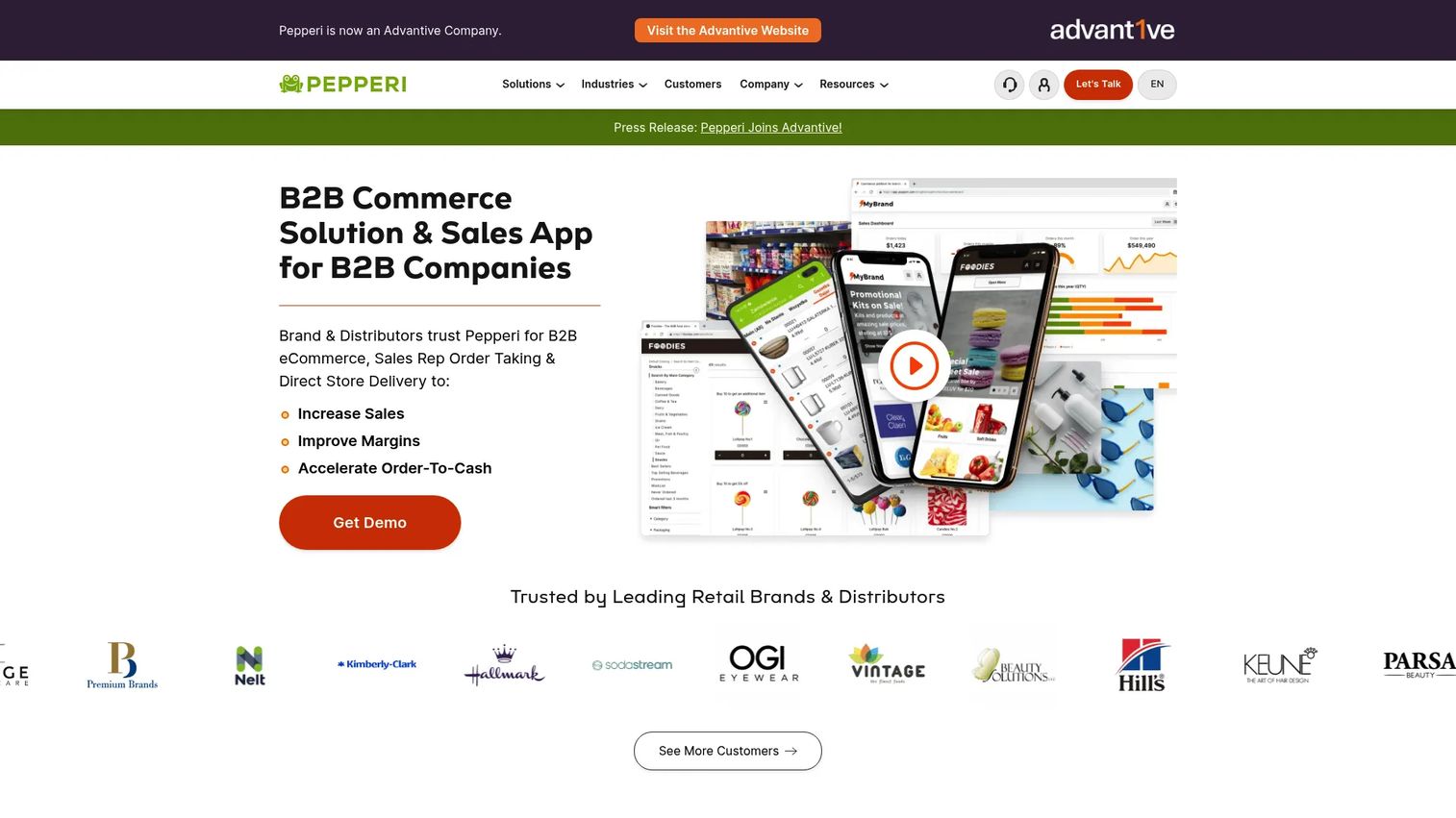
Pepperi is a unified B2B commerce platform that combines eCommerce, sales rep order-taking, DSD, and inside sales on one platform. Its angle on direct store delivery is that ordering and delivery are not separate problems. When a rep can take an order, apply trade promotions, and confirm delivery in one workflow, the store relationship stays consistent.
This commerce-plus-route overlap is where Pepperi differentiates. For distributors whose field reps both sell and deliver, or whose customers expect a B2B storefront alongside van sales, running commerce and route execution on one system removes the seam where orders usually get lost. Customer-facing order management is the strength here.
Best for: Manufacturers and wholesalers that want unified B2B sales, commerce, and DSD in one stack.
Key strengths
- B2B eCommerce: Gives store customers a self-serve ordering channel alongside rep-led sales.
- Mobile order taking: Reps capture orders in the field with real-time catalog and pricing.
- Trade promotions and pricing controls: Manages complex promotions and pricing at the point of sale.
Why choose Pepperi: Choose Pepperi when your DSD operation is really a commerce operation with delivery attached, and you want order-taking and route execution unified. It fits teams selling across multiple channels who need one consistent customer experience. It leans more toward commerce depth than pure route accounting.
Pepperi pricing: Pepperi does not publish public pricing on its site and positions itself as book-a-demo. It holds a 4.3/5 rating on G2, where pricing is listed as custom.
5. RoutePro
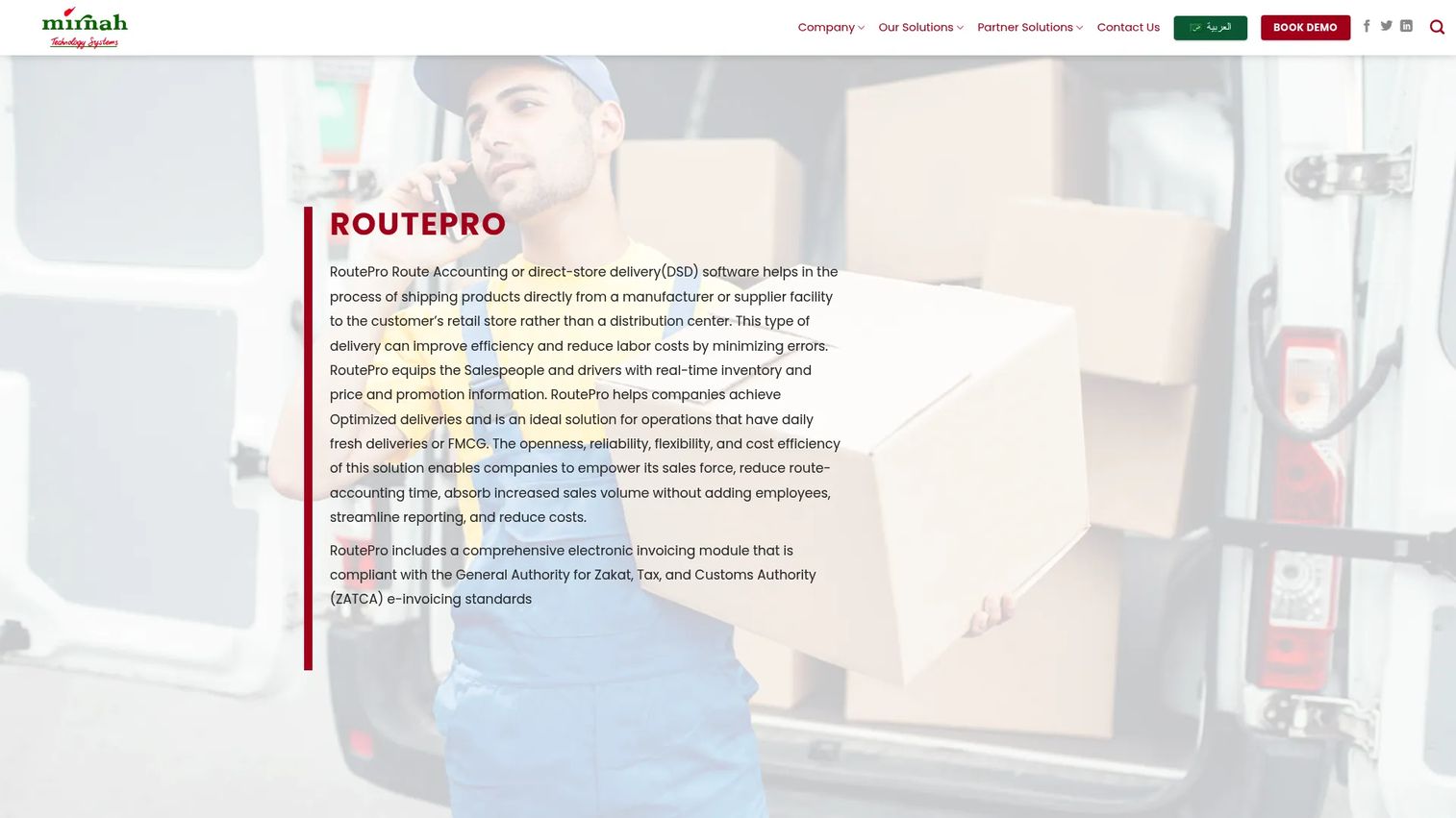
RoutePro is route accounting and direct store delivery software built for distributors running mobile warehouses, van sales, pre-sell, and delivery confirmation. It focuses squarely on the field: journey planning, real-time inventory, and proof of delivery capture. For FMCG teams whose entire model is the route, that focus is the appeal.
RoutePro handles the operational core well. Reps get real-time inventory and price and promotion data on the device, manage customer orders and outstanding balances, and capture eSignature-based proof of delivery. The barcode scanning and route optimization support keep field execution tight, which is what route-driven distributors need most.
Best for: FMCG and distributor teams whose primary model is route-based van sales and delivery.
Key strengths
- Real-time inventory and promotions: Reps see live stock, pricing, and promotion data in the field.
- Journey and route planning: Plans routes and sequences stops for field efficiency.
- Proof of delivery capture: Barcode scanning and eSignature confirm each delivery on the spot.
Why choose RoutePro: Choose RoutePro if you want a route-first tool that handles van sales, pre-sell, and delivery confirmation without the overhead of a full ERP. It fits FMCG distributors who need mobile field execution to be the center of gravity. Back-office depth depends on how you integrate it with your existing finance stack.
RoutePro pricing: RoutePro does not display public pricing; the site presents it as a contact-to-start product. A verified third-party rating for the specific product was not confirmed during research.
6. bMobile Route Software
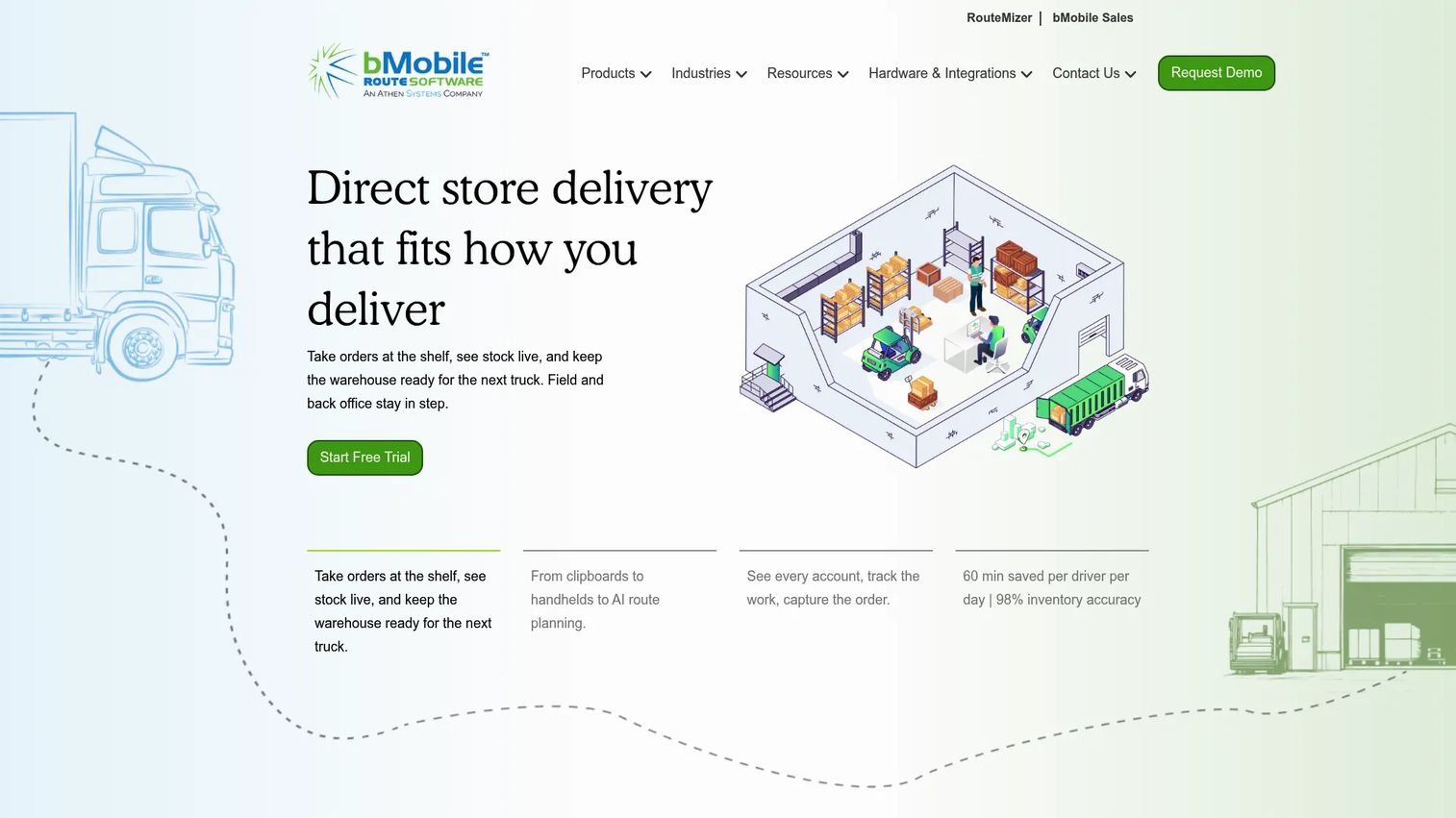
bMobile Route Software is direct store delivery and route management software that bundles route, order, inventory, warehouse, and CRM workflows into one subscription. Its highest G2 rating on this list, 4.7/5, reflects distributors who value having the full operational picture in a single tool rather than stitched-together modules.
The operational strength is consolidation at the route level. Route planning and optimization, real-time delivery tracking, and inventory workflows all live together, so drivers work in one app and the back office sees one dataset. For distributors who want mobile dsd software that covers the whole route lifecycle without per-module upcharges, this packaging is attractive.
Best for: Distributors that want route, order, inventory, and delivery operations in one platform.
Key strengths
- Route planning and optimization: Builds and optimizes routes to improve field efficiency.
- Real-time delivery tracking: Gives dispatch live visibility into route progress.
- Unified operational modules: Order, inventory, warehouse, and CRM workflows in one subscription.
Why choose bMobile Route Software: Choose bMobile if you want a purpose-built DSD platform with strong field usability and a single subscription that covers core modules. Its 4.7/5 G2 rating signals that distributors using it for daily route work rate it highly. It fits teams that want route-first depth without assembling multiple tools.
bMobile Route Software pricing: bMobile states pricing is typically based on the number of routes or users and is sold as a single subscription including core modules. No public numeric price is shown, so you contact sales for a quote. It holds a 4.7/5 rating on G2.
7. Botree
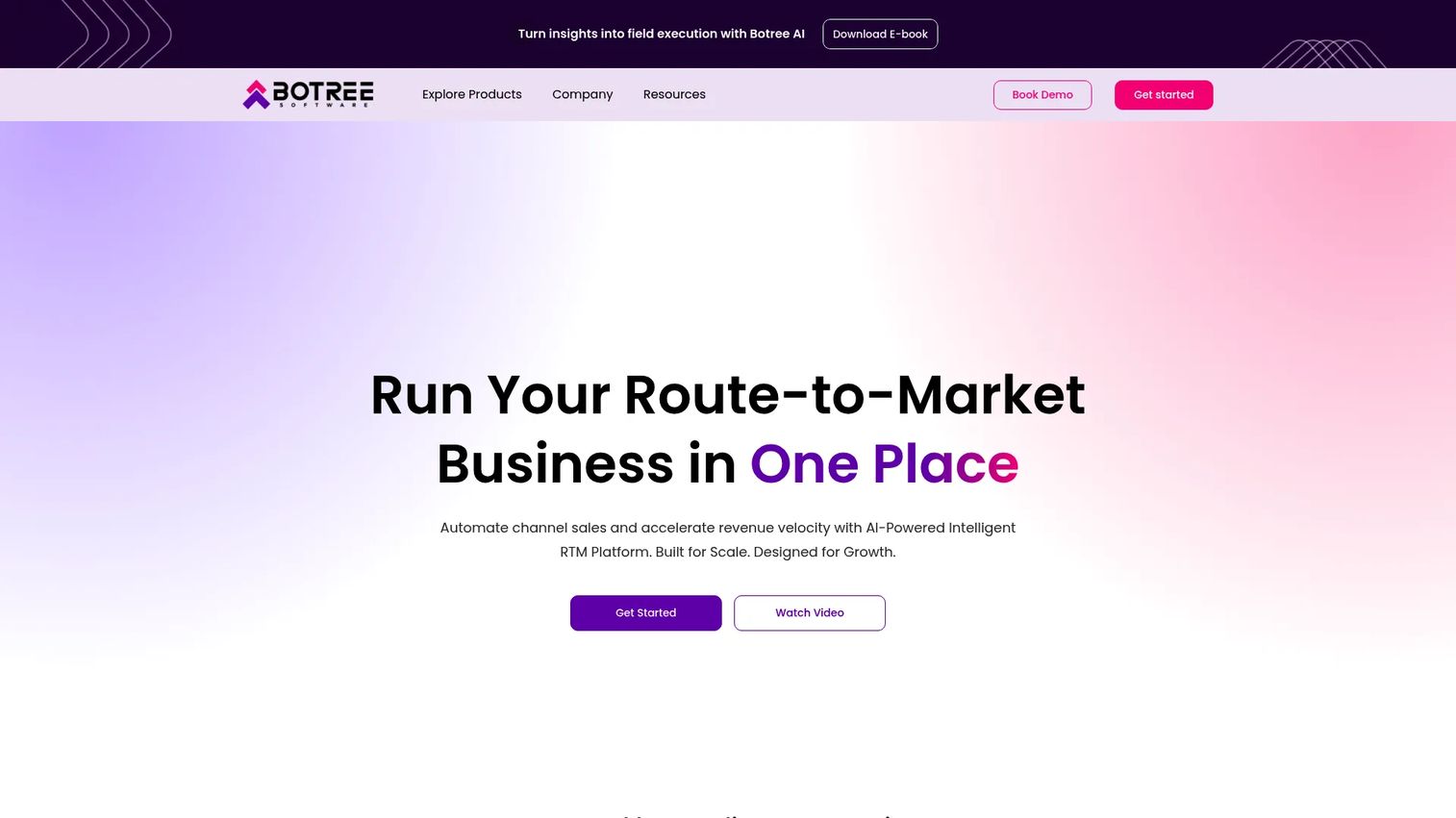
Botree is AI-powered route-to-market software for distributor management, sales force automation, and retail execution. It targets large-scale CPG and FMCG operations where a big field force and complex distribution network need central control. If you manage hundreds of distributors or thousands of retail outlets, Botree operates at that scale.
The strength is breadth across the distribution chain. Its distributor management system handles inventory, orders, claims, and scheme execution, while sales force automation guides order booking and route optimization. Layered AI features add product recommendations, fraud detection, and real-time sales insights, which appeal to enterprise operators who want signal, not just record-keeping.
Best for: CPG and FMCG brands needing enterprise distribution and field-sales automation at scale.
Key strengths
- Distributor management system: Handles inventory, orders, claims, and scheme execution across the network.
- Sales force automation: Guides order booking with dashboards and route optimization.
- AI analytics: Adds product recommendations, fraud detection, and real-time sales insights.
Why choose Botree: Choose Botree if you run enterprise-scale route-to-market and need central control over a large distribution and field-sales network. It fits CPG brands operating across regions with complex distributor structures. It is built for scale, so smaller distributors may find it heavier than their operation requires.
Botree pricing: Botree does not publish public pricing on its site, so evaluation starts with a sales conversation. A verified current G2 rating was not confirmed during research; its seller profile showed no reviews at the time of checking.
8. inSitu Sales Software Suite
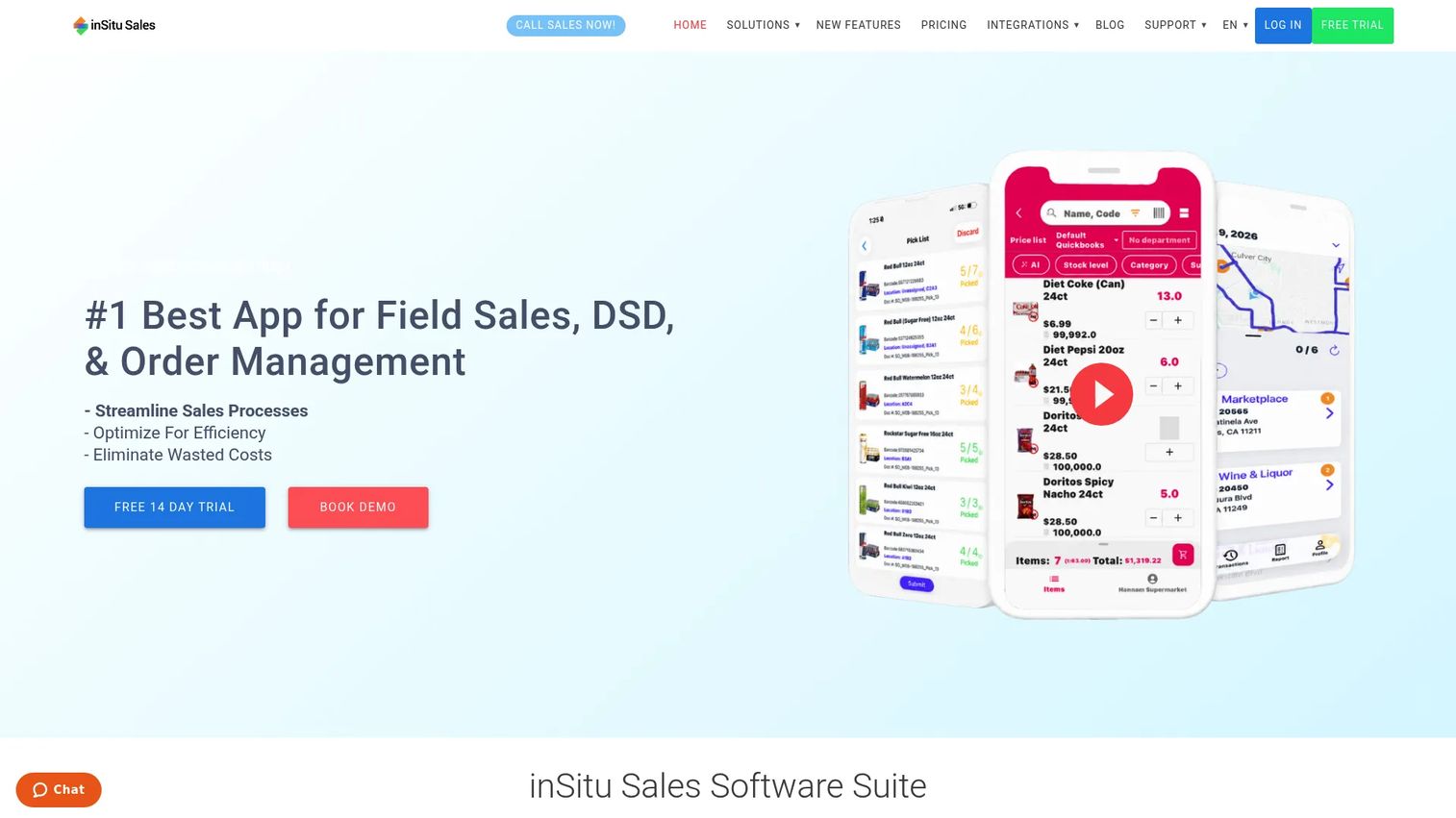
inSitu Sales Software Suite is a software suite for wholesale distributors covering field sales, B2B eCommerce, inventory, and dispatch. It is one of the few tools on this list with fully public, transparent pricing, which makes it easy to evaluate cost against your route count from the start. That transparency matters to operators tired of gated pricing pages.
The suite ties field order capture to fulfillment and delivery in one workflow. The field sales app carries real-time inventory and custom pricing, the inventory app handles order fulfillment and picking, and driver dispatch adds route optimization with proof of delivery. For direct store distribution teams that want sales execution and delivery in one connected suite, that coverage is practical.
Best for: Wholesale distributors wanting field sales, B2B storefront, inventory, and delivery in one suite.
Key strengths
- Field sales and B2B eCommerce: One app for rep order capture with real-time inventory and custom pricing.
- Inventory management: Handles fulfillment, back-orders, transfers, picking, and packing.
- Driver dispatch and delivery: Route optimization with proof of delivery capture.
Why choose inSitu Sales: Choose inSitu if you want transparent pricing and a suite that connects field sales, storefront, inventory, and dispatch without a full ERP commitment. It fits wholesale distributors who want to model cost up front and start on a trial. The published tiers make it one of the more accessible options for smaller operations to evaluate.
inSitu Sales pricing: inSitu publishes public pricing with a 14-day free trial and both monthly and annual billing, where annual saves 10%. Tiers include Starter B2B eCommerce and Starter App at $200/mo, Pro at $329/mo, and Enterprise at $429/mo, with additional app users at $34.99/mo on applicable plans.
9. Ivy Mobility
Ivy Mobility is cloud-based SaaS for consumer goods route-to-market, retail execution, and distribution management. It is mobile-first by design, aimed at consumer goods companies that need field reps, merchandisers, and delivery teams working from one unified system. For operators managing shelf compliance alongside delivery, that combined scope is the draw.
The differentiator is intelligence layered onto field execution. AI-driven recommendations and predictive insights guide reps, while image recognition supports shelf compliance and merchandising audits. Route optimization and distribution management keep the delivery side tight. For consumer goods brands where in-store presence and delivery both matter, Ivy Mobility covers both.
Best for: Consumer goods companies needing unified field sales, merchandising, and route-to-market software.
Key strengths
- AI-driven insights: Predictive recommendations guide rep actions in the field.
- Retail execution and image recognition: Automates shelf compliance checks and merchandising audits.
- Route optimization and distribution: Manages route efficiency and distribution control in one system.
Why choose Ivy Mobility: Choose Ivy Mobility if you are a consumer goods operator who needs merchandising and shelf compliance alongside route and delivery execution. It fits brands where the in-store experience is as important as the delivery itself. Its 4.6/5 G2 rating reflects users who value that unified route-to-market scope.
Ivy Mobility pricing: Ivy Mobility does not publish public pricing; the site directs visitors to contact the company for pricing details. It holds a 4.6/5 rating on G2.
10. NCS eDSD
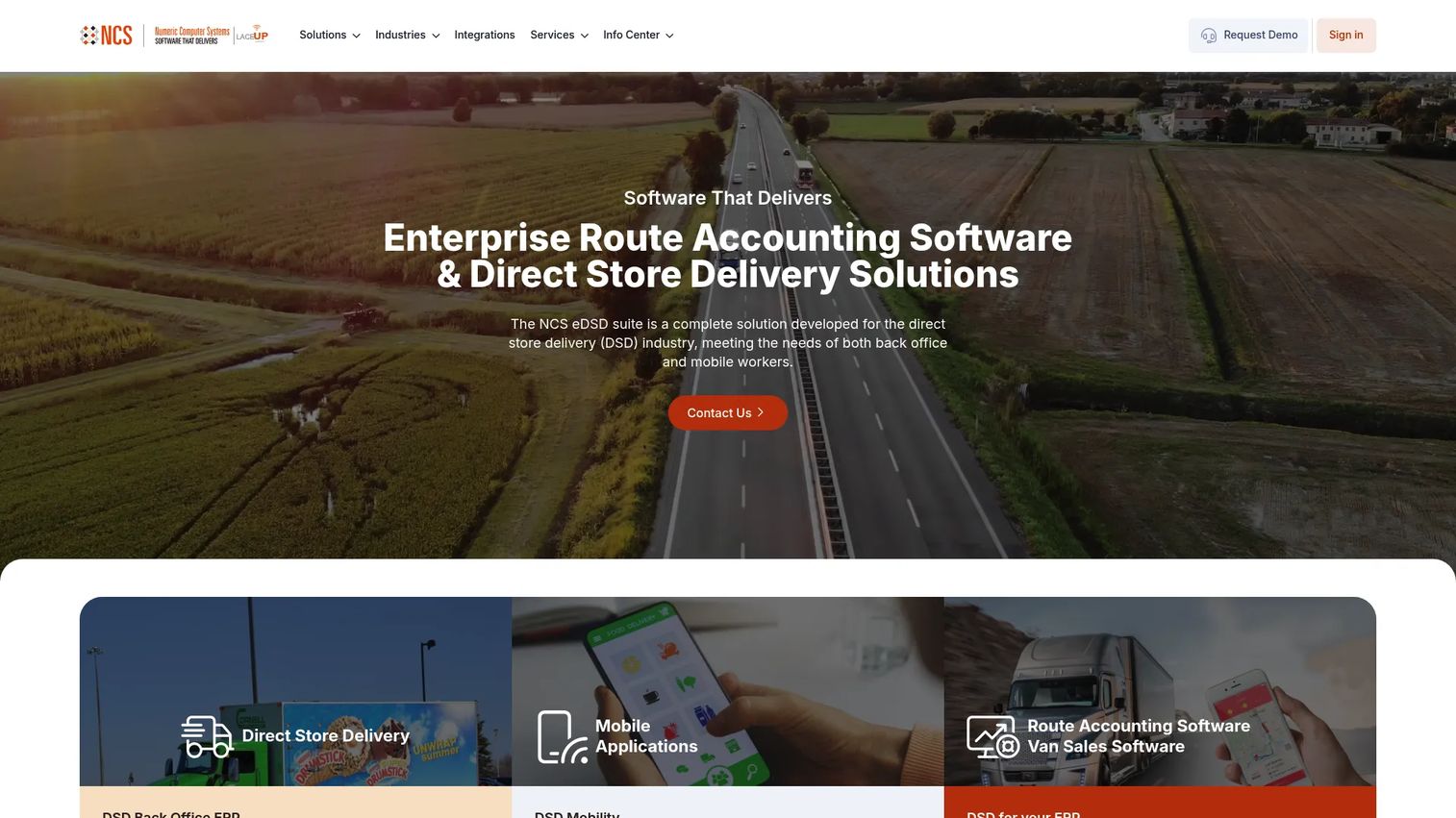
NCS eDSD is enterprise route accounting software and direct store delivery software for both back-office and mobile workers. It closes this list with genuine end-to-end scope: a DSD back-office ERP paired with mobile apps for sales, delivery, and merchandising, all tied together by order-to-cash workflows. For distributors that want the full loop in one vendor, that completeness is the point.
The operational strength is the connection between the office and the truck. The back-office ERP handles distribution, inventory, manufacturing, financial accounting, and reporting, while the mobile applications put sales, delivery, and merchandising workers on the same data. That tight order-to-cash coupling is what makes dsd route accounting reliable across the whole operation.
Best for: DSD distributors needing integrated back-office ERP and mobile route accounting in one system.
Key strengths
- DSD back-office ERP: Covers distribution, inventory, manufacturing, financials, and reporting.
- Mobile field applications: Equips sales, delivery, and merchandising workers on shared data.
- Order-to-cash workflows: Ties field activity to finance for reliable route accounting.
Why choose NCS eDSD: Choose NCS eDSD if you want a single vendor covering both the back office and mobile field execution, with route accounting connected end to end. It fits distributors who prioritize integration between office and field over assembling best-of-breed point tools. The full-suite approach suits teams ready to commit to one operational backbone.
NCS eDSD pricing: NCS does not publish public pricing on its site, so evaluation begins with a sales conversation. A verified current G2 rating for NCS eDSD specifically was not confirmed during research.
Considerations before buying DSD software
The right pick depends less on feature checklists and more on how a system fits your operation. Use these criteria to pressure-test any vendor before you commit.
Integration depth with your back office
Ask exactly which ERP and POS systems the vendor supports natively, and how deep the erp integration goes. A shallow integration that syncs once a day is not the same as real-time. Confirm whether orders, invoices, inventory adjustments, and payments all flow both directions without manual re-entry.
Field usability and offline capture
Your drivers and reps live in the mobile app. If it is clunky, adoption fails regardless of back-office power. Test the mobile dsd software in a realistic field scenario, and confirm offline mode works, since coverage gaps are a daily reality on routes. Offline capture that syncs cleanly later is non-negotiable.
Inventory accuracy across the full lifecycle
Confirm the system tracks stock loaded, delivered, returned, sold, and adjusted, not just delivered. Partial tracking leaves gaps that undermine inventory accuracy and hide shrink. For perishables, ask how it handles spoilage and returns specifically.
Reporting and route accounting depth
Route accounting is the financial and operational truth of each route. Ask how the system reconciles a route end to end, and what reports it produces for finance. Route optimization is useful, but do not confuse route planning features with route accounting rigor.
Implementation time and fit for your scale
A full ERP-anchored system carries a longer runway than a route-first tool. Match the implementation scope to your urgency and your operation's size. Ask for a realistic timeline from a reference customer of similar scale, not the vendor's best case.
Conclusion
The strongest direct store delivery software in 2026 is the one that matches your operation's shape. For distributors that want everything inside one operational system, Deacom, inecta, and NCS eDSD anchor delivery to ERP and keep route data and finance aligned. For route-first field operations, bMobile Route Software and RoutePro focus on mobile field execution, delivery tracking, and driver workflows. Pepperi and inSitu Sales suit teams where order-taking and delivery live in one workflow, and Botree and Ivy Mobility scale route-to-market across large CPG field forces.
Your decision comes down to four things: route complexity, mobile needs, inventory visibility, and integration depth. A route-heavy FMCG distributor will weight mobile usability and route accounting; a food manufacturer with a delivery arm will weight ERP fit and traceability.
Next step: shortlist two or three tools that match your scale, then run each through the considerations checklist above with a real route scenario. Insist on a live walkthrough and, where possible, a reference customer of similar size before you sign.
FAQs
Direct store delivery software manages the process of delivering goods directly from a distributor to retail stores, tracking routes, deliveries, invoices, and inventory in one connected system. It supports route execution, delivery confirmation, invoicing, and inventory control, keeping field activity synced with the back office. Direct store delivery companies use it to replace manual route sheets and spreadsheet reconciliation.
The features that matter most are route accounting, mobile field execution, inventory visibility, proof of delivery, and integration depth. Route accounting reconciles the financial reality of each route, while mobile workflows keep drivers and reps productive in the field. Strong erp integration ensures orders, invoices, and inventory sync cleanly with your back office.
Route accounting tracks the financial and operational data of a delivery: what was loaded, sold, delivered, returned, and settled per route. Route optimization focuses on planning the most efficient sequence of stops and travel. You need both, but they solve different problems: one keeps your books accurate, the other keeps your routes efficient.
Usually, yes. If you need synchronized orders, invoices, inventory, and back-office reporting, erp integration removes the double data entry that slows order-to-cash. Distributors already running an ERP should confirm the DSD system syncs both directions in real time rather than through a nightly batch export.
Food and beverage, bakery, beverage distribution, perishables, and high-frequency restock operations rely on it most heavily. These businesses deliver directly to stores on recurring routes, where inventory accuracy and fast reconciliation directly affect margin. Any operation with drivers who sell, restock, and invoice at the store benefits from direct store distribution software.
It tracks inventory across every movement on a route: loaded onto the truck, delivered, returned, sold off the truck, and adjusted for damage. Capturing each transaction as it happens, rather than at end of day, keeps counts accurate and exposes shrink early. That full-lifecycle tracking is what protects inventory accuracy for perishables and fast-moving goods.
Mobile dsd software runs the field rep and driver workflow: capturing orders, confirming proof of delivery, generating invoices, processing returns, and recording inventory movements. It works offline so coverage gaps do not stop the route, then syncs to the back office once a connection returns. Mobile direct store delivery is where field execution and back-office data meet in real time.
Ask which ERP and POS systems it integrates with natively and how real-time that sync is. Confirm the mobile app is usable in the field and works offline, then ask what reporting and route accounting depth it delivers. Finally, ask about realistic implementation time and request a reference customer of similar scale before committing.