You sent the registration link three weeks ago. Now it's event week, and you're juggling a spreadsheet of 400 sign-ups, a Slack workspace nobody reads, a Google Form for submissions, and a panel of judges asking how exactly they're supposed to score 60 projects by Sunday night. The hackathon will probably still happen. It just won't feel managed.
That stack sprawl is the real problem most organizers face. Discovering a hackathon and running one are completely different jobs, and the tools that help people find your event rarely help you operate it. Registration lives in one place, team formation in another, submissions in a third, judging in a fourth, and your post-event report is a manual export nightmare. The right hackathon software collapses those jobs into one workflow.
The category is growing fast for a reason. The hackathon management software market reached USD 1.16 billion in 2024 and is projected to hit USD 3.5 billion by 2035, a 10.6% CAGR according to WiseGuy Reports (2024). More organizers are running recurring, sponsor-heavy, and hybrid events that demand real infrastructure rather than stitched-together free tools.
This guide is a buying guide, not a directory of hackathons to enter. We separate discovery platforms from organizer suites from broader event operations tools, so you can match the right software to your event type. If you're also evaluating adjacent categories, our roundups of the best event management software and best event planning software cover the wider stack.
What hackathon software is
Hackathon software is a category of tools that helps organizers discover, launch, run, judge, and report on hackathons from a single platform, instead of stitching together registration forms, spreadsheets, and chat apps. A good hackathon platform supports the full event lifecycle: building the event page, collecting registrations, forming teams, accepting project submissions, coordinating judges, and measuring outcomes afterward.
The core jobs hackathon management software supports:
- Event discovery and a hackathon website: A branded landing page where participants find and sign up for your event.
- Registration and onboarding: Low-friction sign-up, profiles, and waivers.
- Team formation: Matching solo participants and managing team rosters.
- Project submissions: Structured upload forms for code, demos, and decks.
- Judging and scoring: Rubrics, voting, and live leaderboards.
- Communication: Announcements, reminders, and mentor routing.
- Sponsor workflows: Branded pages, prize tracks, and lead capture.
- Analytics: Attendance, submission rates, and engagement reporting.
Who uses it: developer relations teams, university program leads, innovation managers, community managers, startup ecosystem operators, and sponsor activation teams. Some are seasoned organizers running their tenth event. Others are first-timers researching how to run a hackathon without burning out their volunteers.
What hackathon software helps organizers do
Organizer workflows run from pre-event setup to post-event reporting. The software should carry you through each stage without forcing a tool switch.
- Pre-event: Build the hackathon website, open registration, set tracks and prizes, recruit mentors and judges.
- During the event: Push announcements, manage team formation, route mentor questions, open and close the submission window.
- Judging: Distribute projects to judges, apply rubrics, run audience voting, calculate winners.
- Post-event: Export submission data, measure participation, share results, and report sponsor ROI.
The end-to-end view matters. The fewer handoffs between tools, the fewer things break at 2 a.m. on hackathon night.
What participants expect from hackathon software
Participants judge your event by its software before they judge your prizes. A clunky sign-up or a confusing submission form costs you registrations and completions.
- Discovery: Find the event and understand the theme quickly.
- Sign-up: Register in under two minutes, no friction.
- Team formation: Find teammates or join an existing team.
- Updates: Get clear announcements and deadline reminders.
- Submissions: Upload projects without guessing the format.
- Judging visibility: See how scoring works and when results land.
Every point of friction here is a drop-off. Smooth participation drives completion rates, and completion drives the repeat attendance that makes recurring programs worth running.
Who needs hackathon software
Different buyers use the same category in very different ways. Find yourself below.
Developer relations and community teams
DevRel teams run public hackathons to grow developer communities, drive API adoption, and generate ecosystem momentum. They need a developer community platform angle: recurring events, public discovery, and engagement analytics that prove the program moves adoption. For these teams, registration volume and post-event activation matter more than a polished judging rubric.
Universities and student programs
Schools run hackathons for student participation, learning outcomes, and sponsor visibility. They care about easy student registration at scale, mentor coordination, fair judging, and sponsor pages that justify the partnership budget. University event teams often run on volunteer labor, so admin simplicity is non-negotiable.
Enterprise innovation and internal hackathons
Internal innovation teams run employee hackathons to surface new ideas and build cross-team collaboration. They need team coordination, private and secure access, structured submissions, and a clean final presentation flow for leadership. The output is often a roadmap input, so capturing and exporting ideas cleanly is the point.
Sponsors and partner managers
Sponsors fund hackathons to reach developers, capture leads, and prove event ROI. They use software to track participation in their prize tracks, get branded visibility, capture leads, and measure engagement. The KPI is simple: how many qualified builders touched our brand, and what did it cost per head.
What to look for in hackathon software
This is the evaluation framework. Use it to score any tool on the list.
Registration and participant onboarding
Low-friction sign-up is the single biggest lever on attendance. Good hackathon registration software should support fast account creation, custom fields, waivers, and a clean confirmation flow. Every extra field is a reason to abandon. Look for the ability to collect what you need without making sign-up feel like a job application.
Team formation and collaboration support
Solo participants who can't find a team don't submit. Team matching, roster management, and internal messaging keep people connected. Evaluate whether the platform lets participants browse open teams, post skills, and message each other, or whether you'll be playing matchmaker in a Slack channel.
Submission, review, and judging workflow
This is where weak software shows. Strong hackathon submission software handles structured project uploads, links to repos and demos, and clear deadlines. Strong hackathon judging software handles rubrics, distributes projects to judges, supports audience voting, and calculates results automatically.
| Judging element | What good looks like |
|---|---|
| Rubric | Weighted criteria, customizable per track |
| Judge assignment | Auto-distribute projects across panel |
| Voting modes | Rubric scoring plus optional audience vote |
| Results | Live leaderboard, automatic winner calculation |
| Audit trail | Score history and exportable records |
Sponsor, mentor, and admin workflows
Sponsor pages, prize tracks, mentor routing, and role-based admin controls quietly decide whether an event feels professional. Check for branded sponsor placements, mentor sign-up and routing, and granular permissions so participants, mentors, and judges each see the right view.
Reporting, analytics, and post-event insights
The event isn't over when the winners are announced. You need attendance numbers, submission rates, judge activity, and sponsor engagement to report up and plan the next one.
| KPI | Why it matters |
|---|---|
| Registration to check-in rate | Measures real attendance vs. sign-ups |
| Submission rate | Shows how many teams shipped |
| Judge completion | Flags scoring bottlenecks early |
| Sponsor engagement | Justifies partner budgets |
| Repeat attendance | Tracks program health over time |
When to use hackathon software
A dedicated platform earns its keep as event complexity and scale rise. Here's when it's worth it.
Run a virtual or hybrid hackathon
A virtual hackathon platform has to do more coordination than an in-person event because you can't fix problems by walking across a room. Remote participants need a single source of truth for the schedule, submissions, and judging. An online hackathon platform that centralizes announcements, team formation, and submissions keeps a distributed event from fragmenting across time zones.
Manage a large in-person event
At a 500-person campus event, software replaces the clipboard. Centralized check-in, push announcements, and structured judging cut the admin load that otherwise eats your volunteer team. The bigger the room, the more a hackathon organizer software layer pays for itself.
Support multiple audiences at once
Most events serve students, professionals, mentors, sponsors, and judges simultaneously, each needing a different view.
| Audience | What they need from the platform |
|---|---|
| Participants | Sign-up, team formation, submissions |
| Mentors | Routing, office-hours scheduling |
| Judges | Rubric, project queue, scoring |
| Sponsors | Branded pages, prize tracks, leads |
| Organizers | Dashboard, comms, reporting |
When you're juggling that many roles, a single hackathon management platform beats five disconnected tools every time.
Comparison table
A quick way to shortlist by intent before you read the full sections. Pricing and ratings reflect publicly available information at the time of writing; where a vendor doesn't publish a figure, we've noted it rather than guessed.
| # | Product | Intent | Key use case | Pricing | G2 rating |
|---|---|---|---|---|---|
| 1 | Devpost | Discovery + management | Public and private hackathons | Student free, Teams seat-based | Not rated |
| 2 | Major League Hacking | Community + events | Student and developer programs | Hack Day reimbursements | Not rated |
| 3 | Open Hackathons | Technical mentorship | GPU/HPC hackathons | Not published | Not rated |
| 4 | HackHub | Management | Online/offline event ops | Not published | Not rated |
| 5 | HackaBox | Management | End-to-end organization | Not published | Not rated |
| 6 | Xthon | Management | Online and corporate events | Free to €1/participant | Not rated |
| 7 | HackHQ | Submissions + judging | Self-serve judging | Free to $599/event | Not rated |
| 8 | BuilderBase | Management | AI-native builder events | Not published | Not rated |
| 9 | Commudle | Community + events | DevRel and communities | Free plans available | Not rated |
| 10 | HackPulse | Management + judging | Structured judging | Free trial available | Not rated |
| 11 | Hackathony | Management | Hackathon operating system | Not published | Not rated |
| 12 | Kreathon | Management | Timeline and phase control | Not published | Not rated |
| 13 | EventMobi | Event management | Hybrid and virtual events | From $3,000/event | 4.6/5 |
| 14 | AngelHack | Services + management | Custom developer programs | Custom | Not rated |
| 15 | Hackathon.com | Services + management | Turnkey corporate hackathons | Quote-based | Not rated |
Use the table to narrow to two or three options, then read the sections below for fit.
15 best hackathon software tools for 2026
1. Devpost
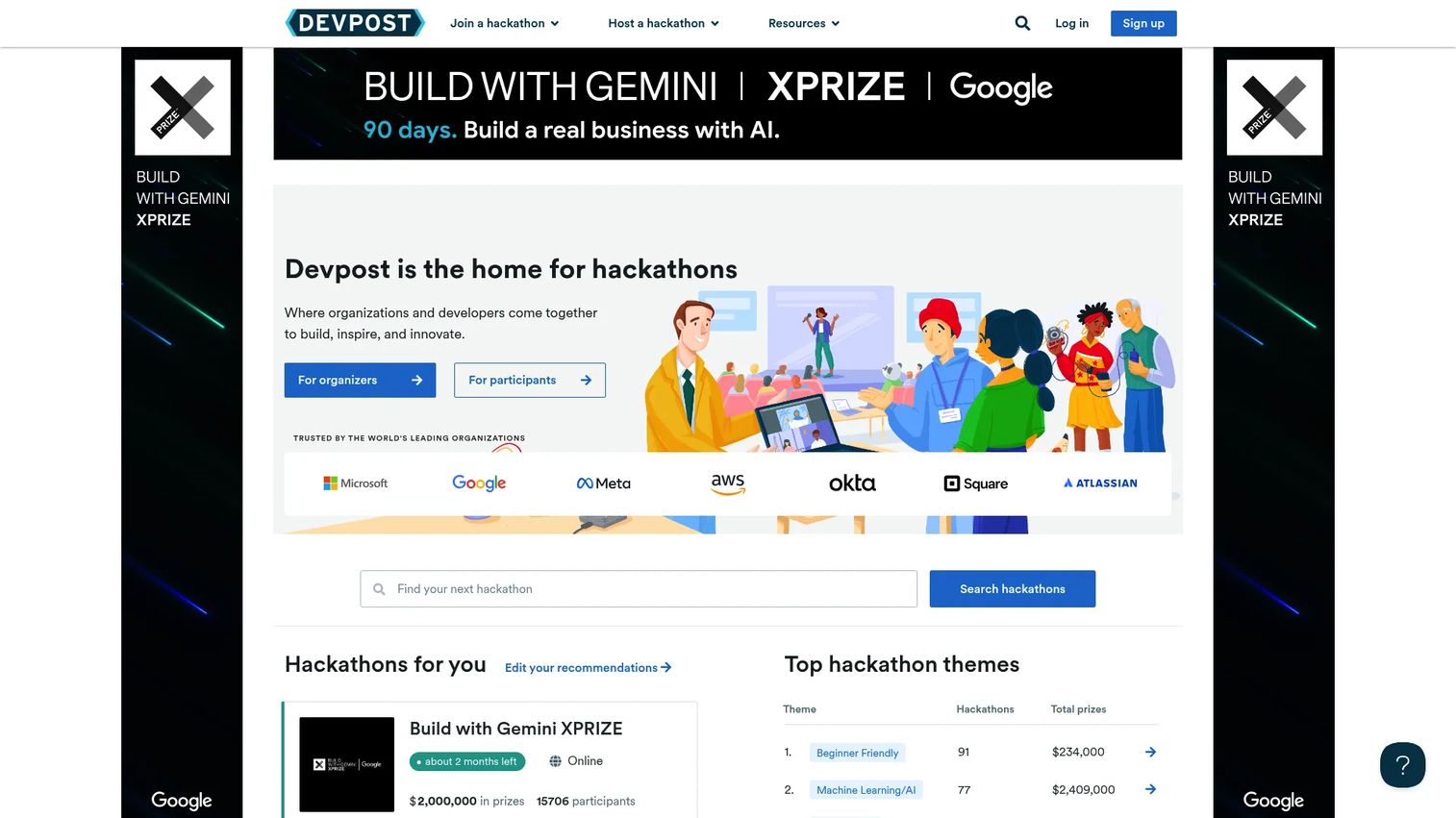
Devpost is the best-known name in the category, working as both a discovery platform and an organizer suite. Participants browse public hackathons by theme and format, while organizers run public, internal, or customer events with registration, submissions, judging, and voting in one place. It's the default for teams that want both reach and operational tooling.
Best for: Organizations running public, internal, or customer hackathons that want discovery and management together.
Key strengths
- Public discovery: A large audience of developers browsing and entering hackathons.
- Private hackathons: Internal and customer events with secure access.
- Unified workflow: Registrations, submissions, judging, and voting in a single platform.
Why choose Devpost: If you want participation reach and end-to-end management without running two tools, Devpost covers both. It's the safest pick for a public developer hackathon where discovery drives sign-ups.
Devpost pricing: Student-run, student-only hackathons are free. Devpost for Teams is an annual subscription based on the number of seats, with optional managed services and professional support; pricing is contact-based rather than publicly listed.
2. Major League Hacking
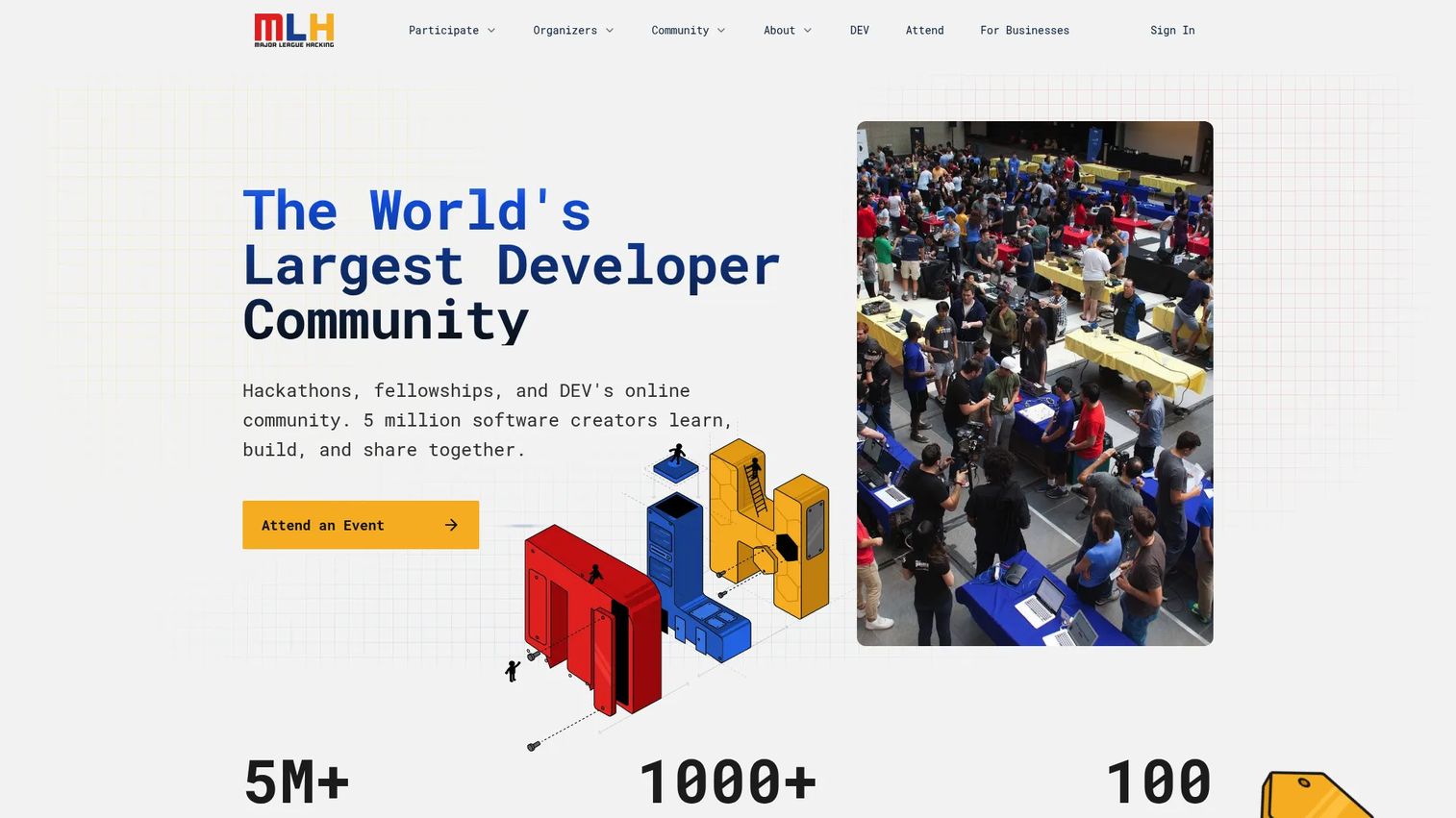
Major League Hacking is a global developer community built around hackathons, fellowships, and learning programs rather than a pure software suite. It supports student and developer communities organizing events, with organizer perks like swag and reimbursements, plus 12-week remote fellowship tracks that extend engagement beyond a single weekend.
Best for: Student and developer communities organizing hackathons and ongoing learning programs.
Key strengths
- Hackathon ecosystem: Events and developer programming at community scale.
- Fellowship tracks: Remote programs that deepen participant engagement.
- Organizer support: Swag and reimbursements for qualifying hack days.
Why choose Major League Hacking: Choose MLH when community and ecosystem matter as much as the event itself. The reach and program support help student-led teams run credible events with backing.
Major League Hacking pricing: Publicly visible pricing appears as organizer reimbursements for Hack Days, starting around $7 USD per checked-in hacker up to a $350 USD cap per event. No standard software subscription price is published.
3. Open Hackathons
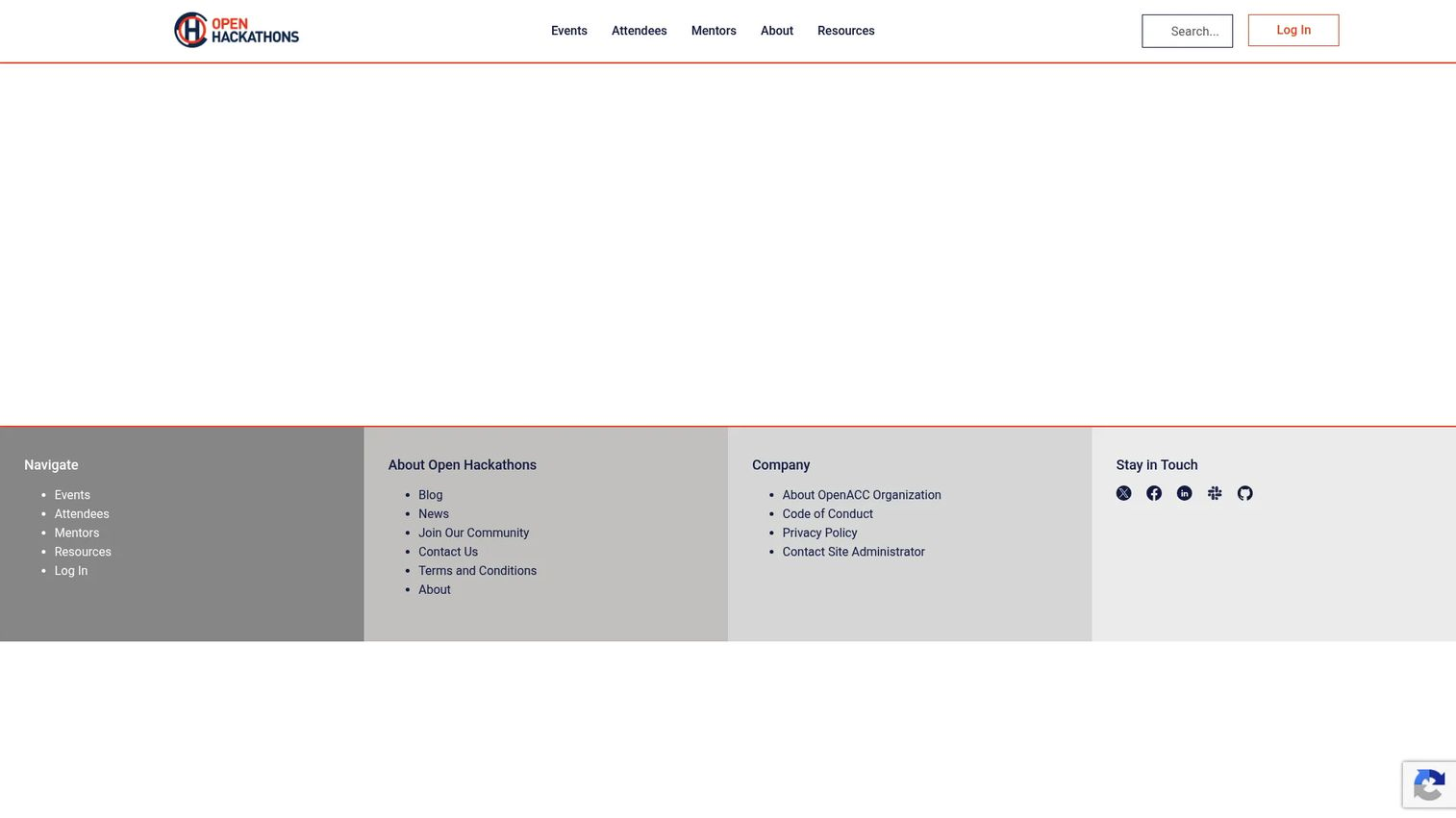
Open Hackathons is a community site for GPU and HPC hackathons, built around a mentor-driven, scientific computing model. It lists events, connects participants with mentors, and provides resources for technically deep, research-oriented programs that don't fit the general-purpose hackathon mold.
Best for: Researchers and developers looking to join or run GPU and HPC hackathons.
Key strengths
- Event listings: A focused calendar of technical, compute-heavy hackathons.
- Mentor participation: A model built around expert mentorship.
- Resources: Toolkits and content for advanced technical programs.
Why choose Open Hackathons: This is the niche pick for scientific and high-performance computing events. If your hackathon centers on GPU work or research workflows, the mentor model and community fit are hard to match elsewhere.
Open Hackathons pricing: No public pricing was available for this program. Treat it as community-led and confirm details directly with the organizers.
4. HackHub
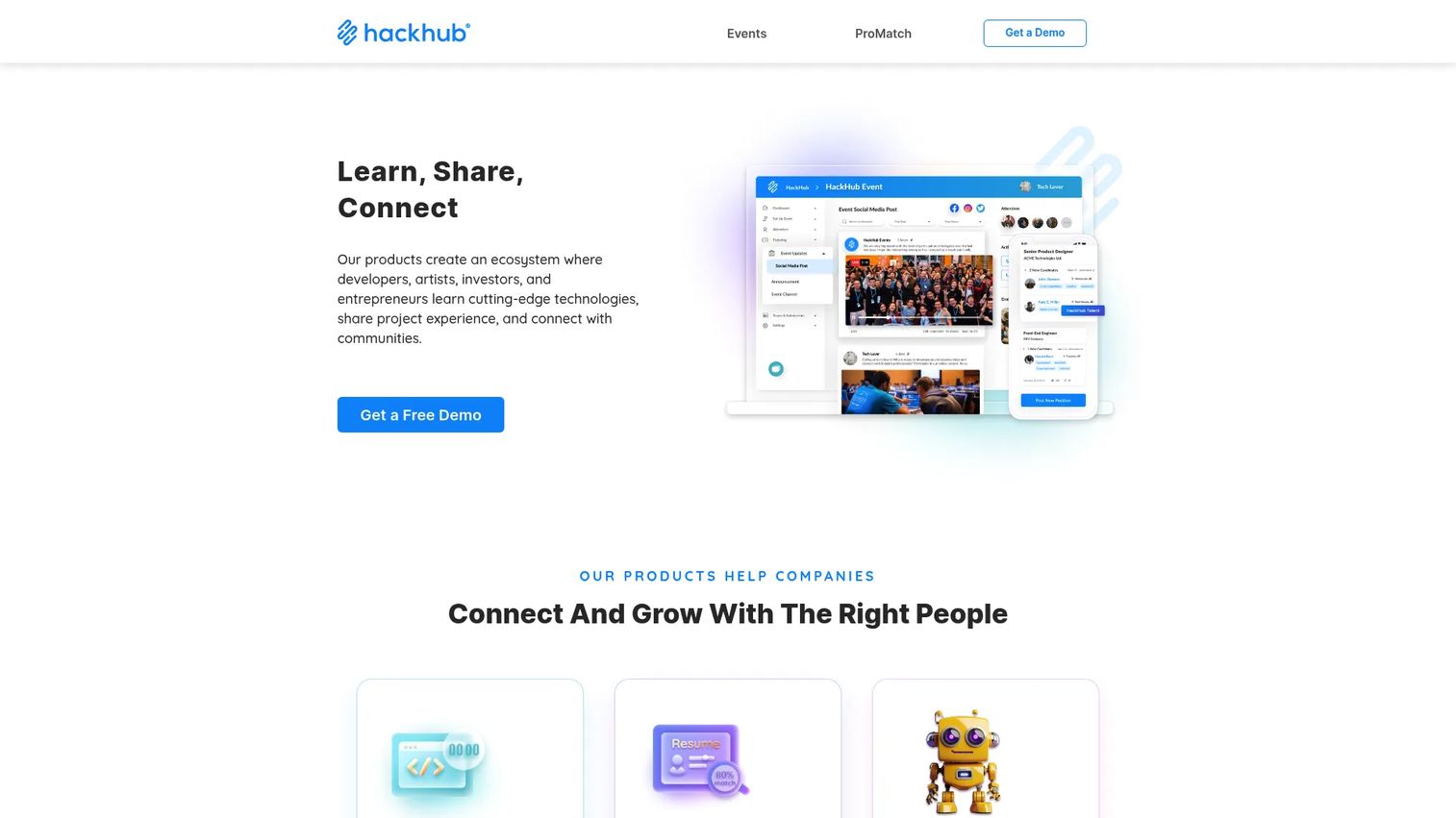
HackHub is a hackathon and event management platform with adjacent products for talent matching and STEAM education. Its core HackHub Event product handles online and offline hackathon management, while a Pro Match hiring layer and an API for importing registered participants round out the ecosystem.
Best for: Organizations running hackathons or innovation events that also care about talent pipelines.
Key strengths
- Event management: Online and offline hackathon operations in one tool.
- Talent matching: AI-driven hiring layer connected to event participants.
- API access: Import registered participants from other systems.
Why choose HackHub: If your hackathon doubles as a recruiting funnel, the talent matching layer is a genuine differentiator. It connects the people who show up with the roles you're trying to fill.
HackHub pricing: No public pricing page or listed prices were available at the time of writing. Contact HackHub directly for current plans.
5. HackaBox
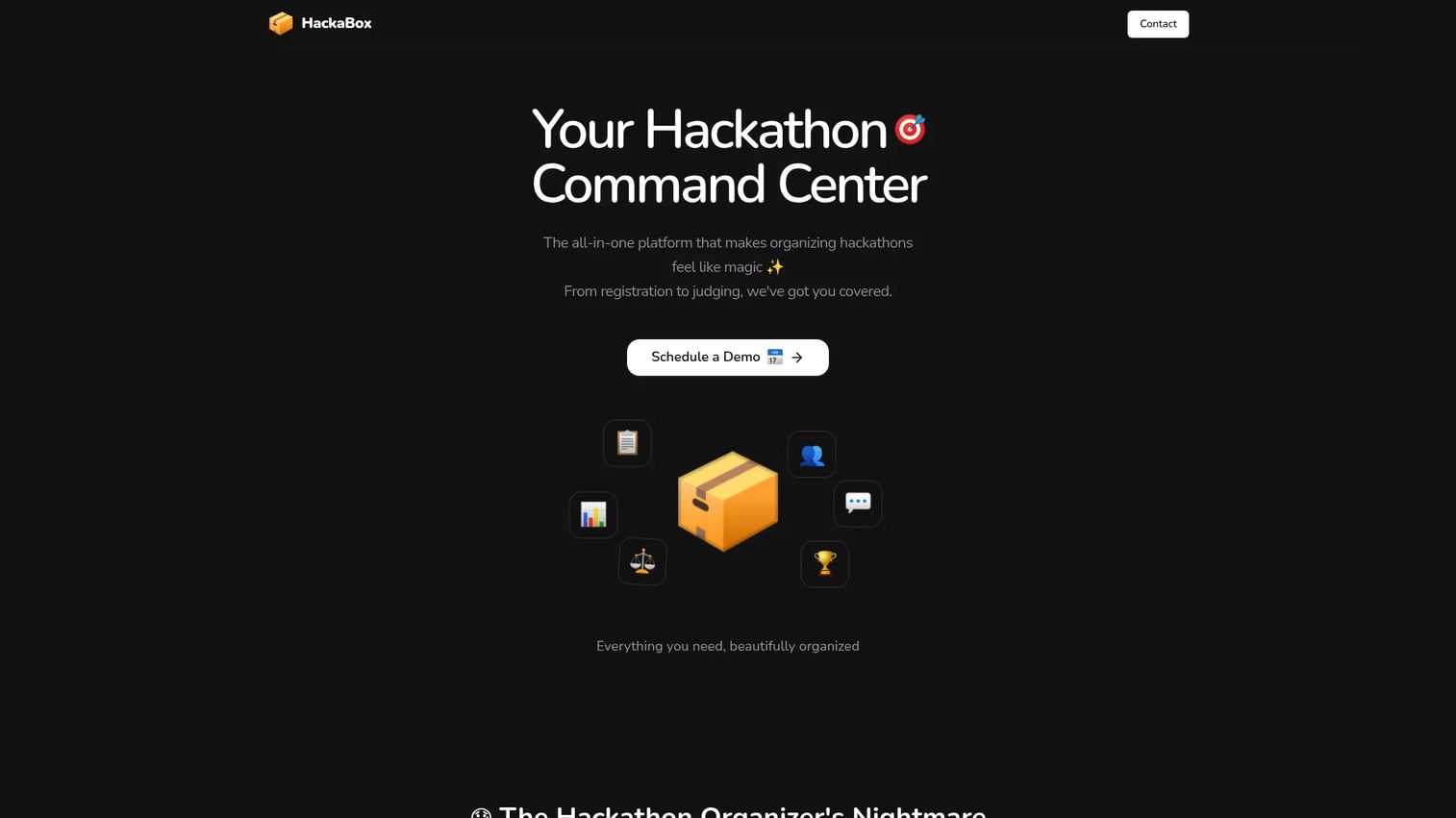
HackaBox bills itself as an all-in-one platform for organizing hackathons, built to reduce the tool sprawl that drains organizer teams. It covers participant applications, AI-powered team formation, real-time judge scoring, and a communication hub that ties into Slack, email, and SMS.
Best for: Hackathon organizers who want registration, team formation, judging, and communications in one tool.
Key strengths
- Smart applications: Structured participant intake and screening.
- AI team formation: Automated matching for solo participants.
- Communication hub: Slack, email, and SMS coordination in one place.
Why choose HackaBox: If consolidating your stack is the goal, HackaBox is built around exactly that. The AI team formation is especially useful for events with lots of solo registrants.
HackaBox pricing: No public pricing was visible at the time of writing. Reach out to HackaBox for a quote based on your event size.
6. Xthon
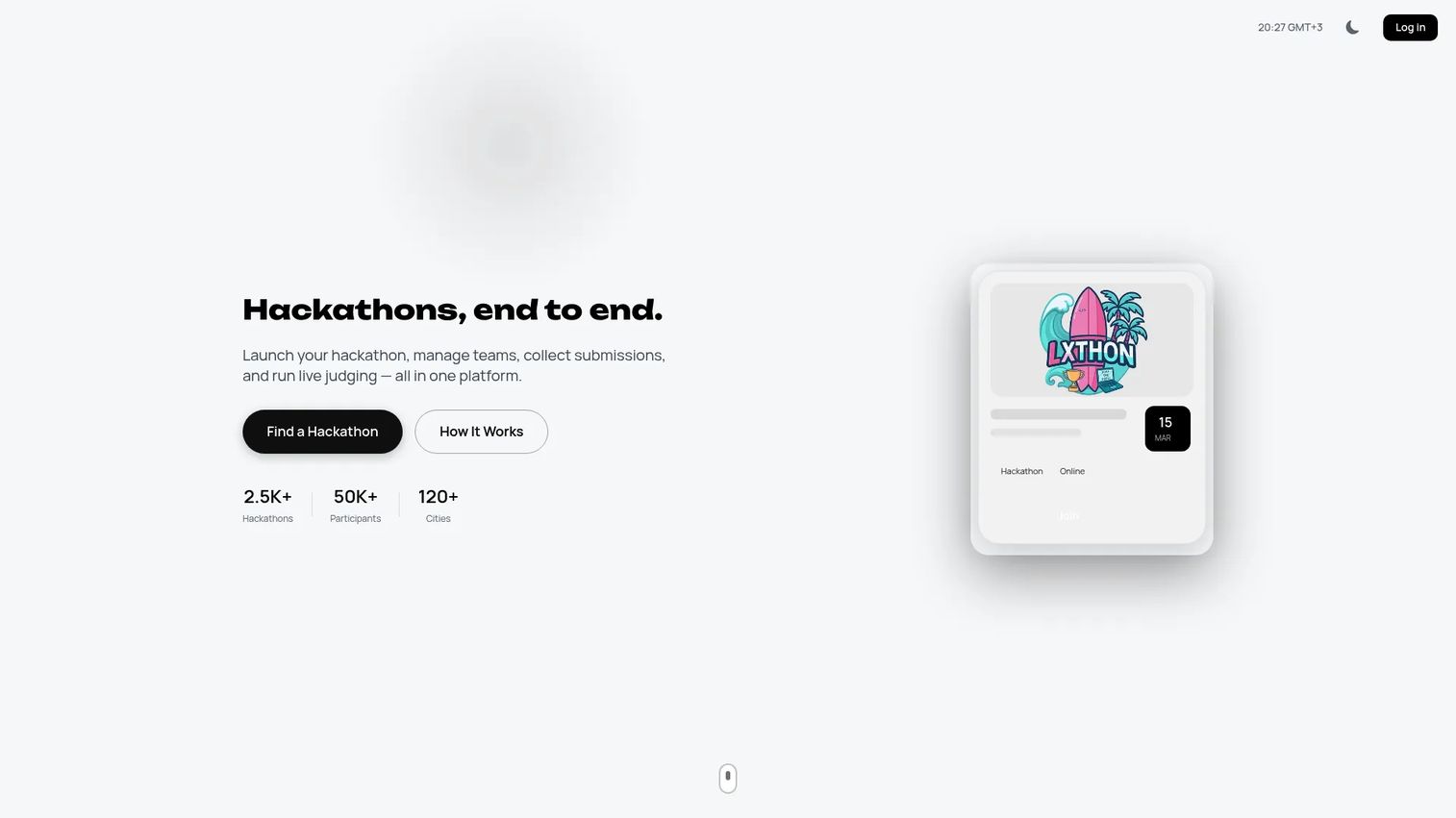
Xthon is a hackathon platform for organizing, managing, and running events end to end, with a clear focus on online, hybrid, and corporate formats. It covers hackathon setup, team management, challenges and judging, and a real-time leaderboard that keeps participants engaged through the event.
Best for: Teams and organizers running online, hybrid, or corporate hackathons.
Key strengths
- End-to-end setup: Launch and configure a hackathon quickly.
- Team management: Roster and team tools built in.
- Real-time leaderboard: Live standings that keep energy up.
Why choose Xthon: The pricing model is unusually transparent and friendly to smaller events. If you're a student group or running a lean corporate event, the per-participant model scales with you instead of against you.
Xthon pricing: Xthon publishes clear tiers: an Early Bird 2026 offer listed as free, a Students Forever plan free for up to 100 participants, and a Standard Plan at €1 per participant with the first 50 participants free.
7. HackHQ
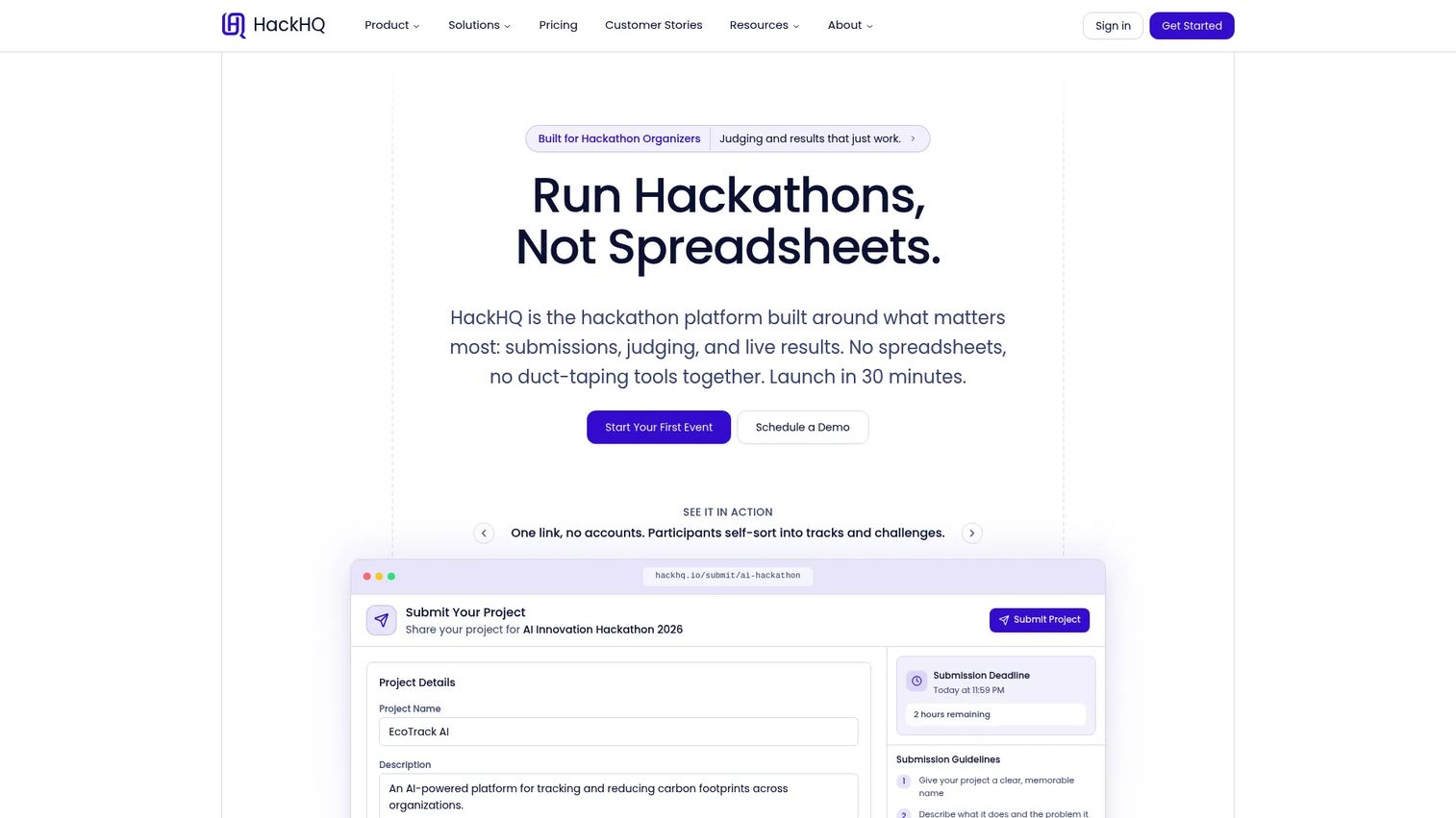
HackHQ is a hackathon platform focused tightly on submissions, judging, and live results. It offers custom branded event pages, submission forms with team and track tracking, weighted rubric judging with audience voting, a live leaderboard, and automatic winner calculation. It's the cleanest pick when judging is your bottleneck.
Best for: Organizers running hackathons, pitch competitions, or innovation challenges who want self-serve judging and results.
Key strengths
- Rubric judging: Weighted criteria with mobile-friendly scoring.
- Audience voting: Optional crowd vote alongside judge scores.
- Live results: Real-time leaderboard and one-click winner assignment.
Why choose HackHQ: If you've ever watched judging stall an otherwise great event, HackHQ is the fix. Flat per-event pricing with no per-seat fees makes it easy to budget for a single event or a recurring series.
HackHQ pricing: HackHQ uses flat, public, per-event pricing: a Free plan at $0 per event, a Starter plan at $199 per event, and a Pro plan at $599 per event. Paid plans are one-time with no subscription and include a 14-day money-back guarantee.
8. BuilderBase
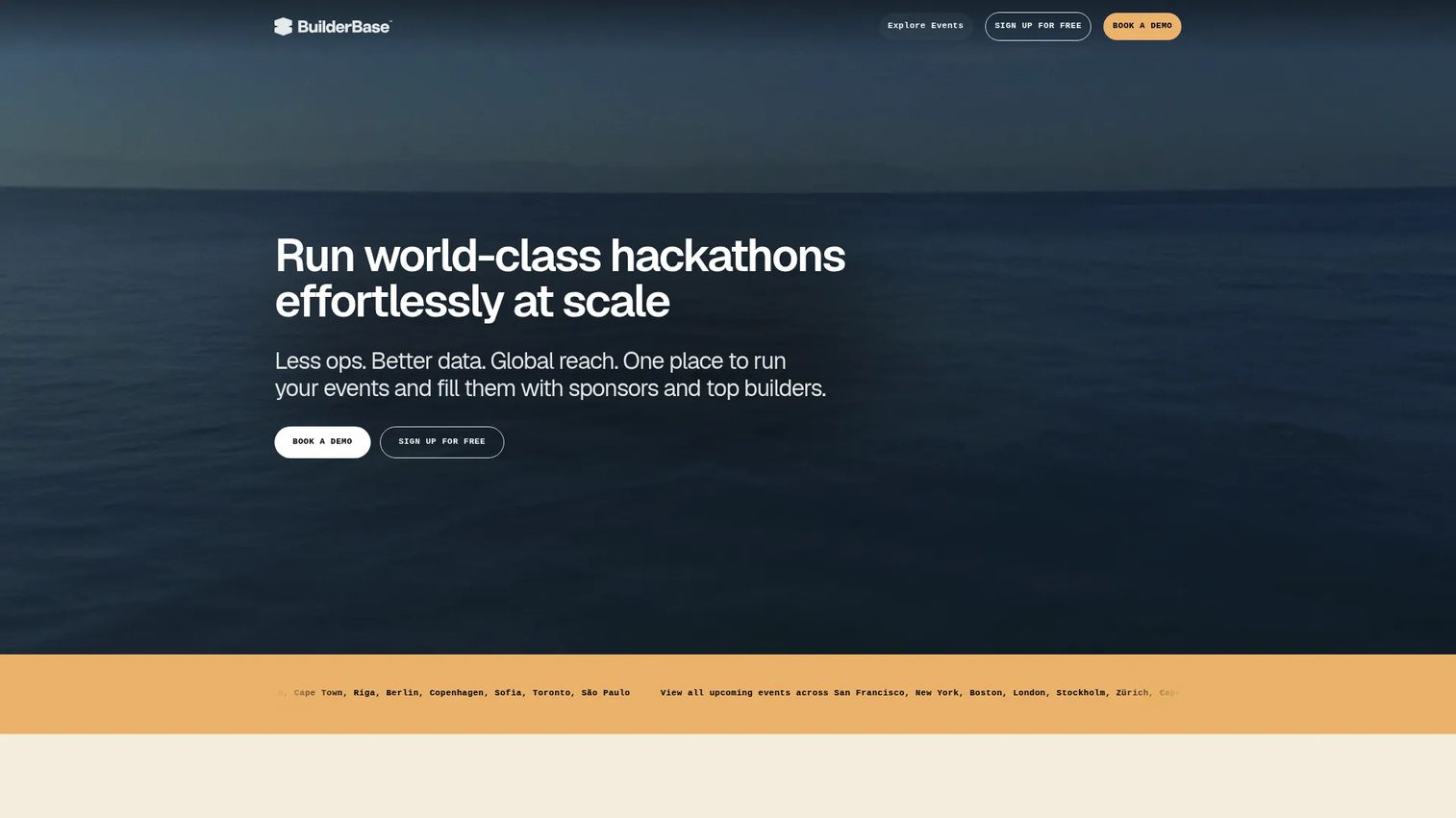
BuilderBase is an AI-native platform for organizing hackathons and other builder events at scale. It handles the full event lifecycle from creation to judging, with AI applicant screening and sponsor ROI reporting built in. The positioning targets large, sponsor-heavy programs that need to prove value to partners.
Best for: Teams running hackathons, innovation sprints, or other builder events at scale.
Key strengths
- AI screening: Automated applicant review for high-volume events.
- Lifecycle management: Creation through judging in one platform.
- Sponsor ROI reporting: Engagement data partners actually want.
Why choose BuilderBase: When you're running large events with serious sponsor commitments, the AI screening and ROI reporting do real work. It's built for scale and for the conversations you have with partners afterward.
BuilderBase pricing: BuilderBase offers a free sign-up and a demo option, but no public pricing figures were visible at the time of writing. Request a demo to discuss enterprise terms.
9. Commudle
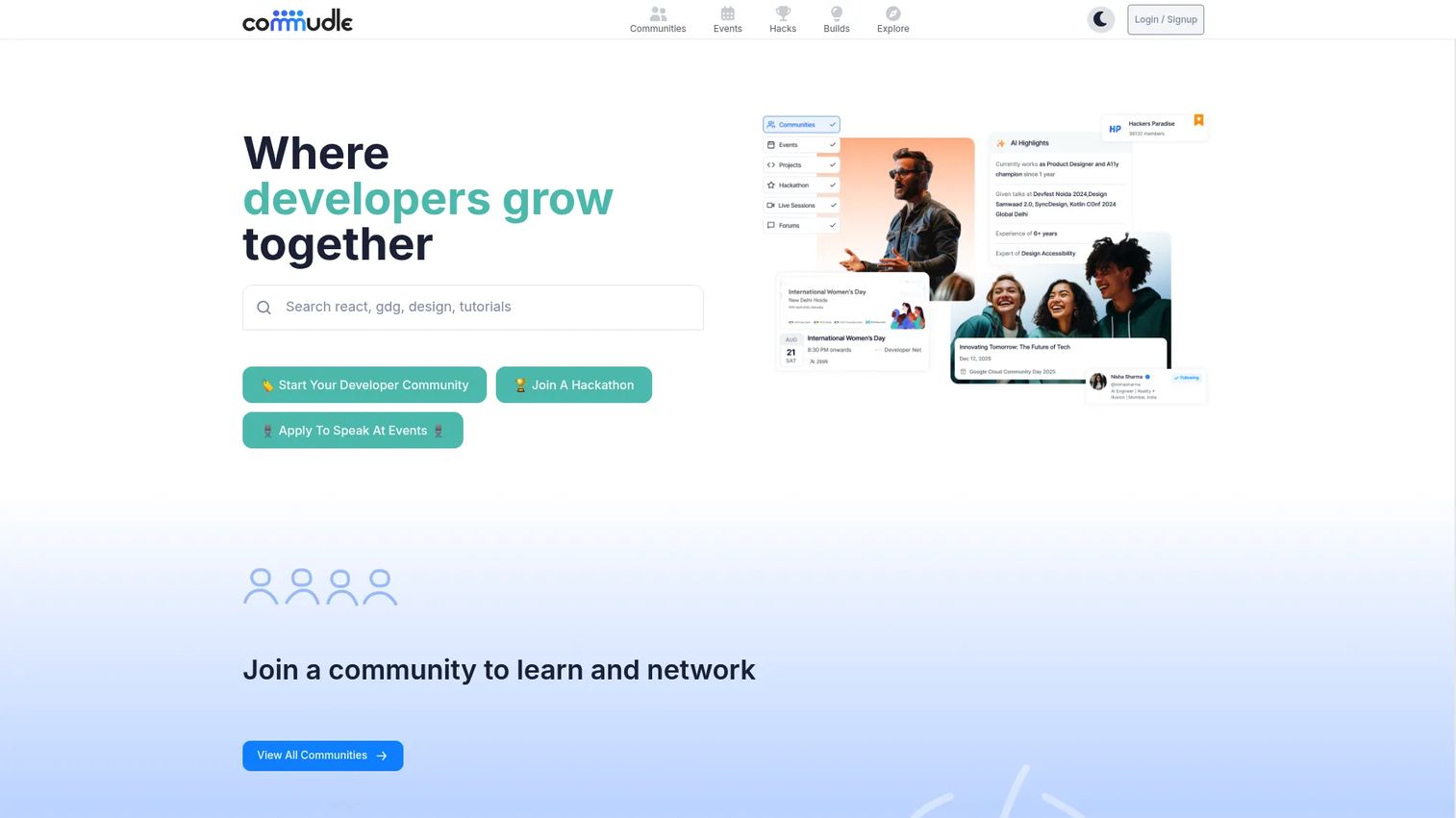
Commudle is a developer community platform that handles community and event management, including hackathons, with custom dashboards, APIs, and paid ticketing. It's built for DevRel teams and communities that need a single place for events, engagement, and ongoing community operations, not just a one-off hackathon.
Best for: Developer communities and DevRel teams needing one platform for events, engagement, and community operations.
Key strengths
- Community management: Ongoing engagement beyond single events.
- Custom dashboards and APIs: Flexible reporting and integration.
- Hackathons and ticketing: Event hosting with paid ticket support.
Why choose Commudle: If your hackathon is one motion inside a larger community program, Commudle ties them together. It's a strong fit for teams thinking about community management as an ongoing discipline rather than a calendar of disconnected events.
Commudle pricing: Commudle publishes free plans for independent student-led and non-profit tech communities. DevRel agencies are directed to contact sales for custom pricing.
10. HackPulse
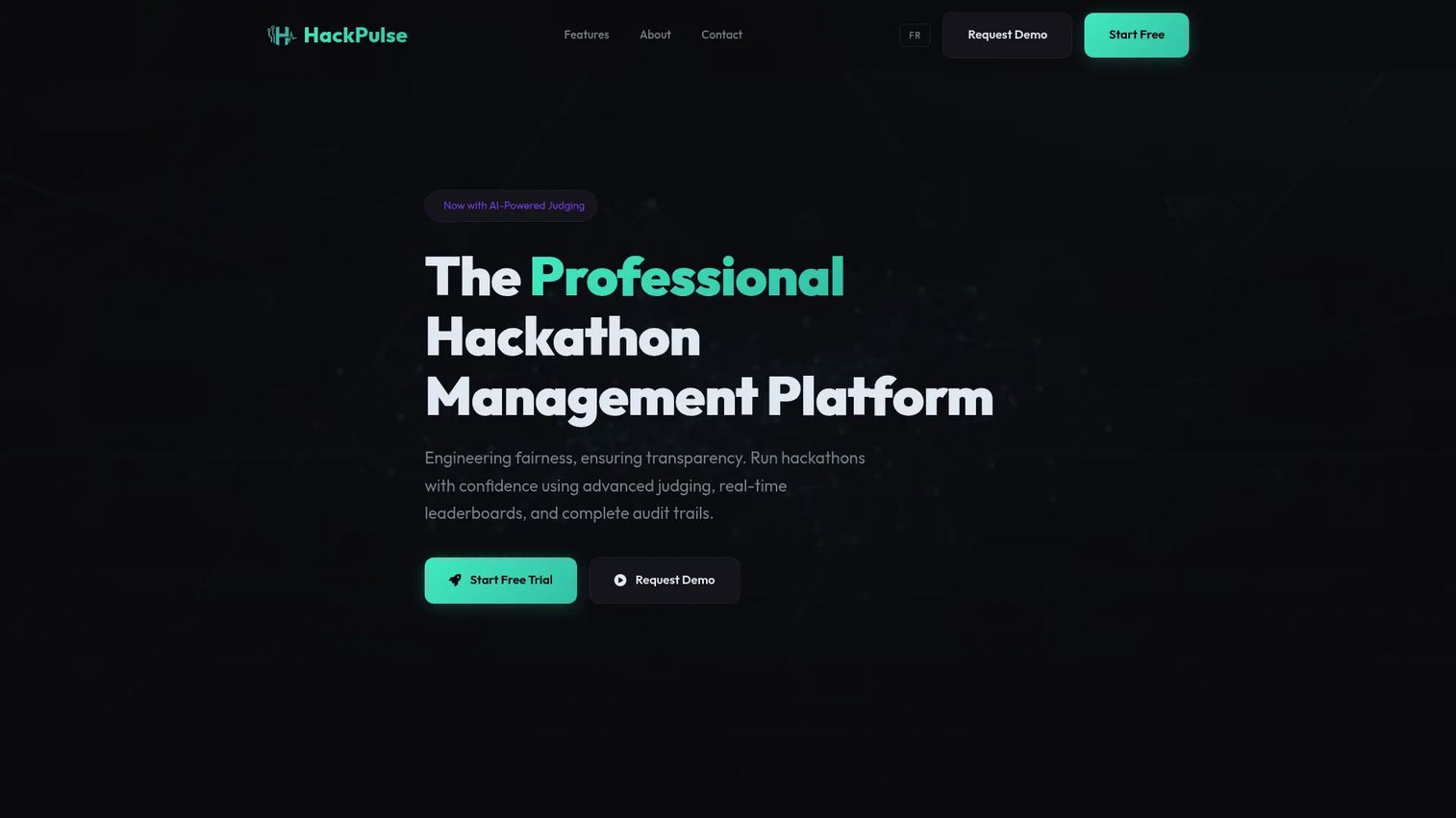
HackPulse is a hackathon management platform with a strong emphasis on judging, leaderboards, and audit trails. It pairs complete event management with branded landing pages, an advanced judging system, and AI-powered analysis, aimed at organizers who want a structured, defensible evaluation workflow.
Best for: Hackathon organizers needing a structured judging and submission workflow.
Key strengths
- Advanced judging: Structured scoring with audit trails.
- Branded landing pages: Polished event pages out of the box.
- AI-powered analysis: Automated insight on submissions.
Why choose HackPulse: When fairness and a clear paper trail matter, the audit-trail focus stands out. It's well suited to events where results may be questioned and you need defensible scoring records.
HackPulse pricing: HackPulse offers a free trial and a demo request, but a public pricing page was not available at the time of writing. Contact the team for current plans.
11. Hackathony
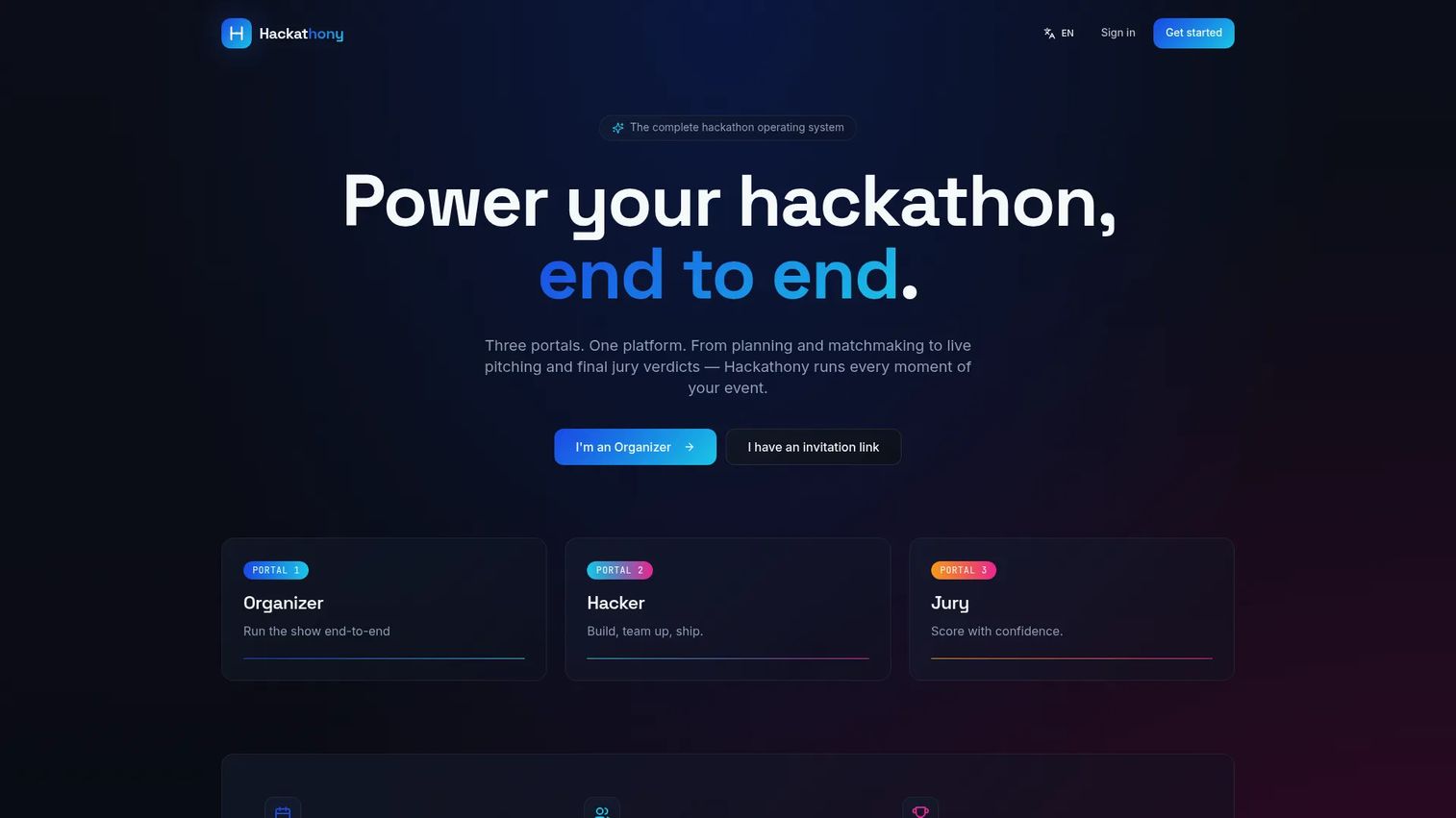
Hackathony positions itself as a hackathon operating system with three dedicated portals: an organizer portal for end-to-end event management, a hacker portal for building and teaming up, and a jury portal for live scoring and GO/NO-GO decisions. The split-portal model gives each role a purpose-built view.
Best for: Teams running hackathons that need planning, matchmaking, pitching, and judging in one platform.
Key strengths
- Organizer portal: End-to-end event management in one place.
- Hacker portal: Building, teaming up, and shipping for participants.
- Jury portal: Live scoring, GO/NO-GO decisions, and exports.
Why choose Hackathony: The role-specific portals keep each audience focused on their job. If you want participants, organizers, and judges working in clean, separate views, Hackathony's structure delivers that.
Hackathony pricing: No public pricing was available at the time of writing. Contact Hackathony for plan details based on your event.
12. Kreathon
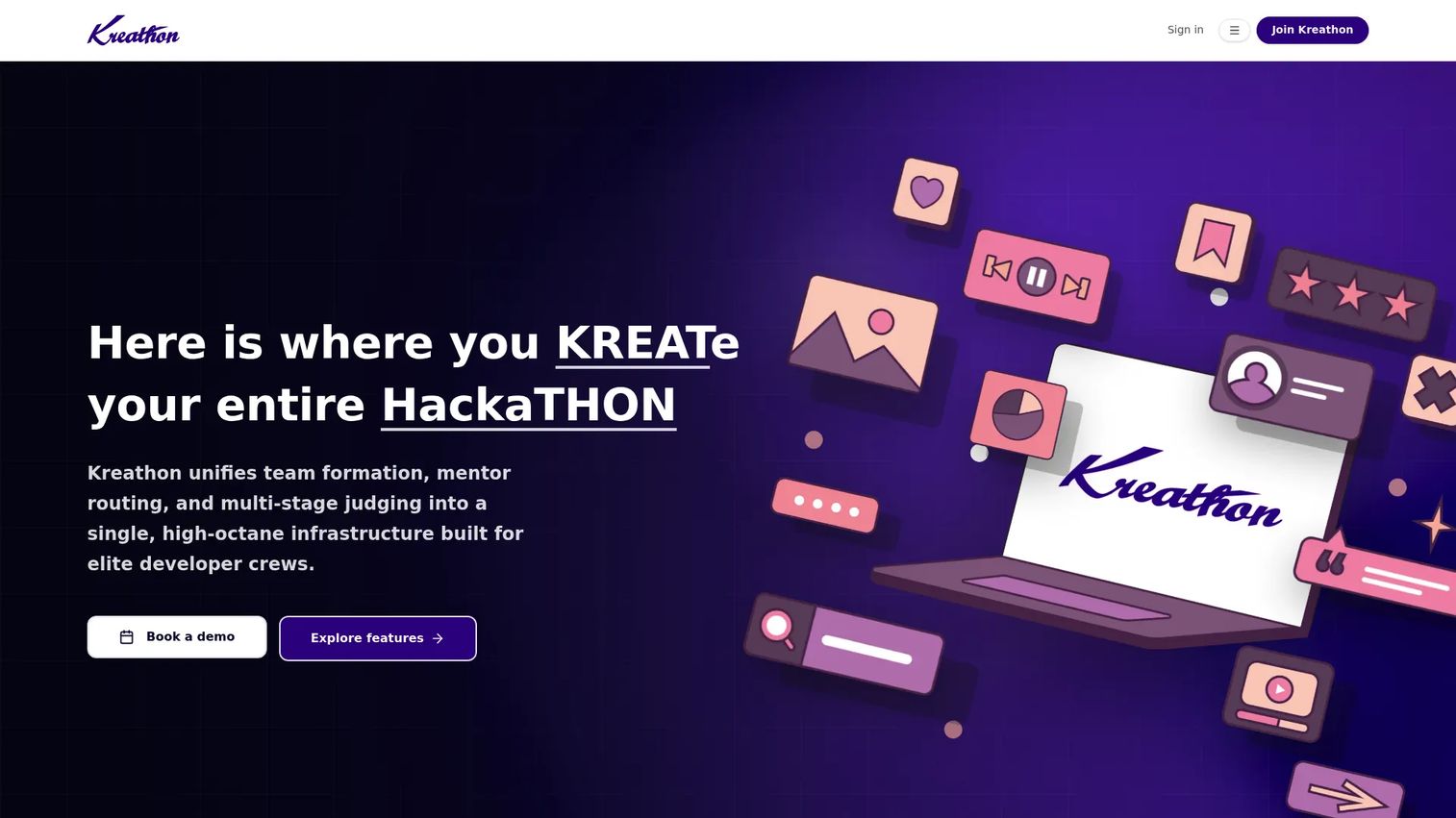
Kreathon is hackathon operations software built around timeline management and event phases. It offers an overview dashboard with real-time metrics, timeline control across registrations, submissions, and phases, and role-based access for participants, mentors, and juries. The emphasis is centralized control of a multi-stage event.
Best for: Teams running structured hackathons and developer events with distinct phases.
Key strengths
- Overview dashboard: Real-time event metrics at a glance.
- Timeline control: Manage registration, submission, and judging phases.
- Role-based access: Distinct views for participants, mentors, and juries.
Why choose Kreathon: If your event runs in clear stages with handoffs between them, Kreathon's phase management keeps the timeline tight. The role-based access reduces the chance of someone seeing the wrong screen at the wrong time.
Kreathon pricing: No public pricing was available at the time of writing. The site is demo-led, so request a walkthrough for pricing.
13. EventMobi
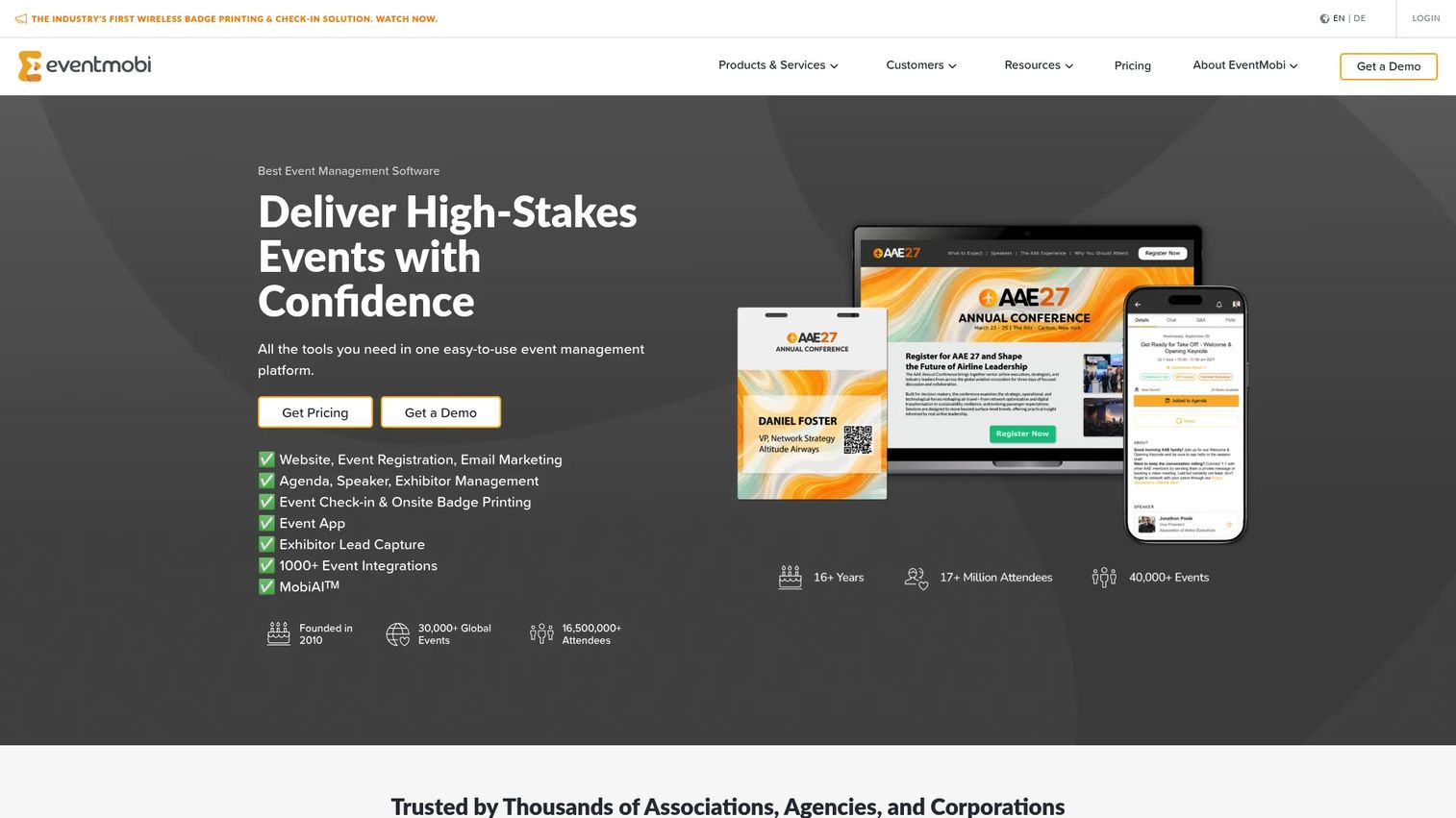
EventMobi is a broader event management platform that can support hackathon-style programming alongside conferences and association events. It covers registration and ticketing, check-in and badge printing, a mobile event app, and virtual and hybrid event tools, making it a fit for organizers who run more than just hackathons.
Best for: Teams needing a flexible all-in-one platform for conferences, associations, and hybrid events.
Key strengths
- Registration and check-in: Ticketing plus on-site badge printing.
- Mobile event app: Attendee engagement on any device.
- Virtual and hybrid tools: Built for distributed audiences.
Why choose EventMobi: If your hackathon sits inside a wider event calendar, EventMobi's breadth and proven track record make it a safe central platform. It carries a strong 4.6/5 rating on G2, the highest verified score on this list.
EventMobi pricing: EventMobi publishes two models: Per Event Pricing starting at $3,000 per event and Per Year Pricing starting at $8,900 per year. Custom pricing is available for large or unique requirements.
14. AngelHack
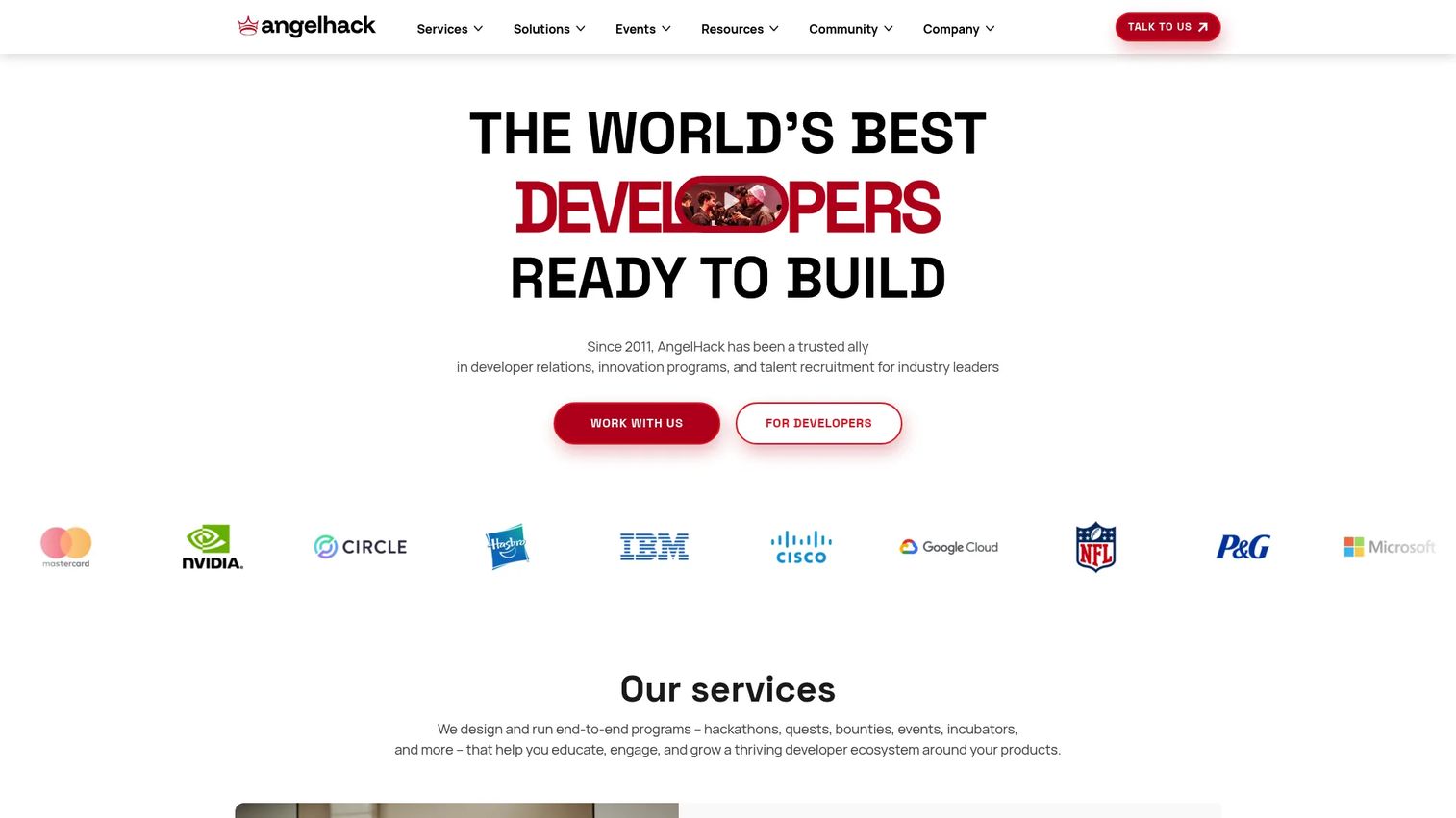
AngelHack is a developer relations and innovation company focused on hackathons, developer quests, bounty programs, and incubators. It runs virtual, in-person, and hybrid hackathons as managed programs, making it less a self-serve tool and more an ecosystem partner for companies that want a hackathon run for them.
Best for: Companies looking to run custom developer engagement or hackathon programs with hands-on support.
Key strengths
- Managed hackathons: Virtual, in-person, and hybrid programs.
- Developer quests: Bounty and engagement programs beyond events.
- Incubator programs: Longer-term developer engagement support.
Why choose AngelHack: When you want the reach and reputation of an established ecosystem and don't want to operate the event yourself, AngelHack delivers a managed program. The global developer network is a meaningful draw for sponsor-driven events.
AngelHack pricing: AngelHack does not publish public pricing and directs prospects to talk to its team for custom program quotes.
15. Hackathon.com
!Hackathon services screenshot
Hackathon.com is a full-service corporate hackathon agency that plans and runs hackathons end to end, pairing strategy and event management with a hackathon management platform and judging tools. It bundles recruitment, workshops, mentors, and post-event reporting, aimed at companies that want a turnkey partner rather than software to self-operate.
Best for: Companies that want a turnkey partner to organize a corporate hackathon.
Key strengths
- Strategy and management: End-to-end event planning and execution.
- Platform and judging tools: Software layer under the managed service.
- Post-event reporting: Recruitment outcomes and program impact.
Why choose Hackathon.com: This is the pick when you want a corporate hackathon handled for you, from strategy through reporting. The managed model suits teams without the internal bandwidth to operate the event themselves.
Hackathon.com pricing: Pricing is not publicly displayed; the site directs visitors to request a quote based on the scope of the program.
How these tools compare by use case
Map the right tool to the right event type instead of chasing the longest feature list.
Best for hackathon discovery and participation
Discovery platforms help participants find your event; management platforms help you run it. For public reach and a built-in audience, Devpost leads on discovery while also handling operations. Major League Hacking adds community scale and ecosystem credibility. Open Hackathons is the discovery layer for technical GPU and HPC events. If your bottleneck is sign-ups, start here.
Best for organizer operations
For registration, submissions, judging, and reporting in one workflow, HackHQ stands out for self-serve judging and transparent per-event pricing. HackPulse leans into structured judging with audit trails. Hackathony and Kreathon both offer strong end-to-end operations, with role-based portals and phase management respectively. HackaBox and Xthon round out the operations-first picks.
Best for community and ecosystem growth
If the hackathon is one motion inside a larger program, Commudle ties events into ongoing community operations. Major League Hacking extends engagement through fellowships. BuilderBase scales sponsor-heavy programs with AI screening and ROI reporting. AngelHack and Hackathon.com bring managed services for teams that want the program run for them.
Common mistakes when choosing hackathon software
The actionable guidance above tells you what to do. Here's what trips organizers up, paired with the fix.
Choosing a tool without matching the event format
Picking software before you've settled on virtual, hybrid, or in-person is a common misstep. A remote event needs centralized announcements and async submissions; a large in-person event needs fast check-in and on-site coordination. The fix: decide your format first, then shortlist tools that are built for it. The right event management software for a hybrid event looks different from the one for a campus weekend.
Overlooking sponsor and mentor workflows
Buying for participant features alone leaves sponsors and mentors stranded, which quietly damages the experience and your renewal odds. Sponsors want branded pages and lead capture; mentors want clean routing and scheduling. The fix: include sponsor and mentor workflows in your evaluation checklist, and weight them by how much your event depends on partner funding and expert support.
Skipping judging and reporting details
Judging is where good events stall. If you don't vet the scoring workflow, you'll discover the gaps at the worst possible moment, with judges confused and results late. The fix: test the judging flow before you commit. Confirm rubric support, judge assignment, voting modes, and automatic results. Then check that post-event reporting gives you the numbers you need for next time.
Conclusion
The hackathon software market splits into three camps, and knowing which one you need is most of the decision. Discovery platforms like Devpost, Major League Hacking, and Open Hackathons help participants find your event. Organizer suites like HackHQ, HackPulse, Hackathony, Kreathon, HackaBox, and Xthon run registration, submissions, and judging end to end. Broader platforms and services like EventMobi, BuilderBase, Commudle, AngelHack, and Hackathon.com handle wider event calendars, scale, or fully managed programs.
Score any option against the same criteria: low-friction registration, real team formation, a judging workflow that won't stall, sponsor and mentor support, and reporting you can act on. Match the tool to your format, virtual, hybrid, or in-person, before you fall for a feature list.
Your next step is simple. Pick your event type, shortlist two or three tools from the comparison table, and test the judging and registration flows before you commit. If you're also building out the wider stack, our guides to event management and event marketing software will help you fill the gaps.
FAQs
Hackathon software is a category of tools that helps organizers discover, launch, run, judge, and report on hackathons from one platform. It supports event pages, registration, team formation, submissions, judging, communication, sponsor workflows, and analytics, replacing the spreadsheets and forms most teams otherwise stitch together.
Look for low-friction registration, team formation and matching, structured project submissions, a judging workflow with rubrics and voting, communication tools, and post-event reporting. Sponsor pages, mentor routing, and role-based admin controls matter for larger or partner-funded events. The right mix depends on your event format and scale.
Event management software handles general event logistics like registration, ticketing, and attendee apps across conferences and meetups. Hackathon software adds the workflows specific to building competitions: team formation, project submissions, rubric judging, live leaderboards, and winner calculation. Some platforms, like EventMobi, span both, while dedicated tools like HackHQ go deeper on judging.
Set up a hackathon website for discovery and registration, then use the platform to onboard participants, enable team formation, and centralize announcements. During the event, open a structured submission window, route mentor questions, and run judging through rubrics with optional audience voting. An online hackathon platform that keeps all of this in one place prevents a distributed event from fragmenting.
Universities usually want easy student registration at scale, fair judging, mentor coordination, and sponsor visibility, often run by volunteers. Devpost is a common choice for student events thanks to free student-run hackathons and broad reach. HackHQ suits campus events that need clean, self-serve judging, and Xthon's free student plan fits lean budgets.
Internal hackathons need private and secure access, simple admin, team coordination, and a clean final presentation flow. HackHQ works well for internal events that want self-serve judging and live results, while Devpost for Teams supports private internal and customer hackathons. For fully managed corporate programs, AngelHack and Hackathon.com run the event for you.
Pricing models range from free to custom enterprise quotes. Xthon offers free student plans and €1 per participant; HackHQ uses flat per-event pricing from free to $599; EventMobi starts at $3,000 per event or $8,900 per year. Several platforms, including BuilderBase, Hackathony, and AngelHack, use contact-based or custom pricing rather than public figures.
Compare five things: registration friction, team formation support, the judging and submission workflow, sponsor and mentor handling, and reporting depth. Match those against your event format and scale, then weigh pricing model and any G2 ratings. Test the judging and registration flows on a shortlist of two or three tools before committing.