
A manager can shadow maybe five calls a week. A rep makes forty. Do the math, and 87% of what your team says to buyers never gets reviewed by anyone.
That gap is where inconsistency lives. New reps forget last week's feedback. Top performers keep winning without anyone documenting why. And the best objection handling on the team stays trapped in one person's calls, never copied by the other nine.
Most enablement leaders blame the coaching cadence. More one-on-ones, they think. Tighter scorecards. Stricter QA. But the bottleneck isn't the manager's calendar. It's the fact that manual review doesn't scale past a handful of calls per rep.
The sales coaching software market sat at USD 57.3 billion in 2025 and is projected to reach USD 106.6 billion by 2035, growing at a 6.4% CAGR, according to Future Market Insights (2025). Buyers are spending because the old model, one manager listening to a fraction of calls, stopped working the moment call volume outpaced manager hours.
Call coaching software closes that gap. It captures every call, surfaces what happened, and turns raw conversations into repeatable coaching.
What's inside
This guide compares eight call coaching software tools built for sales teams and contact centers. It's written for enablement leaders and frontline managers who need to coach more calls, standardize feedback, and connect coaching to ramp and win rate.
We picked tools based on:
- Coaching depth: scorecards, libraries, and behavior-change workflows, not just call storage
- Analytics: conversation intelligence, call analytics, and rep-level insight
- Real-time versus post-call support: live prompts, review-based coaching, or both
- Integrations and adoption: CRM, call recording, and conferencing fit that managers actually use
TL;DR
- Best for revenue-focused coaching: Gong ties call analysis to pipeline and deal execution
- Best for real-time supervisor support: Dialpad and Balto surface live prompts during the call
- Best for AI scorecards and QA alignment: AmplifAI and Observe.AI connect quality management to coaching
- Best for sales methodology reinforcement: Alpharun pairs QA with AI role plays and practice
- Best for enterprise governance: Verint runs QA, workforce management, and coaching at scale
- Best for AI-surfaced next actions: Cresta recommends the coaching move on high-volume teams
Match the tool to your motion. Sales teams and contact centers coach differently, so start by naming which one you run.
What is call coaching software
Call coaching software captures sales and support calls, analyzes the conversation, and helps managers coach reps more consistently than manual review allows.
Manual coaching depends on a manager finding time to listen, take notes, and remember what to raise in the next one-on-one. Software-driven coaching records everything, transcribes it, scores it against a rubric, and flags the moments worth reviewing. The manager stops hunting for calls and starts coaching the ones that matter.
The core building blocks are consistent across most platforms:
- Call recording and transcription: every call captured and turned into searchable text
- Conversation intelligence: AI that identifies topics, talk ratio, objections, and competitor mentions
- Call analytics: rep-level and team-level metrics on behaviors and outcomes
- Coaching scorecards: structured rubrics that tie feedback to observable behaviors
- Recommendations: AI-surfaced moments and suggested coaching actions
Here's the practical difference between the two models:
| Dimension | Manual coaching | Software-driven coaching |
|---|---|---|
| Call coverage | A handful per rep, per week | Every call captured |
| Feedback consistency | Varies by manager | Standardized by scorecard |
| Speed to feedback | Days, if at all | Same day, sometimes live |
| Behavior tracking | Memory and notes | Analytics and trends |
| Scales with headcount | No | Yes |
The point isn't to replace the manager. It's to give the manager coverage they can't get by listening alone.
When to use call coaching software
Scale rep ramp without overloading managers
Onboarding is the first place coaching software pays off. A new rep on a 60-day ramp needs feedback on real calls fast, not a note two weeks after a call went sideways.
With coaching software, a new hire's first ten calls get transcribed, scored, and flagged automatically. The manager reviews the two calls that need attention instead of scrubbing all ten. That's the difference between coaching one new rep and coaching a cohort of six without adding hours to anyone's week.
Standardize feedback across managers
Three managers, three definitions of a good discovery call. That inconsistency shows up later as uneven win rates and messaging drift.
Standardization looks like this:
- One shared scorecard every manager grades against
- A call library of best-in-class examples reps can study
- Agreed definitions of talk track adherence and objection handling
- Consistent language in feedback, so a rep hears the same thing from any manager
When the rubric is shared, coaching stops depending on who a rep reports to.
Improve QA and performance coaching together
QA tells you whether a call met compliance and quality standards. Coaching tells a rep how to improve. Teams need both, and the strongest platforms connect them.
The before state: QA scores a sample of calls for compliance, coaching happens separately in ad hoc one-on-ones, and neither informs the other. The after state: a low QA score on discovery automatically routes that call into the rep's coaching queue with the exact moment flagged. Compliance visibility and skill development run on the same loop.
Comparison table
Here's how the eight tools compare. Sales-focused platforms lead, followed by contact center and enterprise options. Read "best for" first, then match pricing and rating to your buying context.
| # | Product | Best for | Key differentiation | Pricing | G2 rating |
|---|---|---|---|---|---|
| 1 | Gong | Revenue teams tying coaching to pipeline | Conversation intelligence plus forecasting | Custom quote | 4.7/5 |
| 2 | Dialpad | Live guidance in the flow of the call | AI-native calling with real-time coaching | From $15/user/mo | 4.4/5 |
| 3 | AmplifAI | QA plus performance management | Unified contact center performance view | Custom pricing | 4.7/5 |
| 4 | Alpharun | Regulated high-volume sales coaching | Real-time QA plus AI role plays | Custom pricing | Not listed |
| 5 | Observe.AI | High-volume QA and coaching | Agentic CX with real-time guidance | Custom pricing | 4.6/5 |
| 6 | Balto | In-call agent assist | Real-time guidance plus closed-loop QA | Custom pricing | 4.8/5 |
| 7 | Verint | Enterprise governance at scale | Workforce engagement plus quality automation | Custom pricing | 4.4/5 |
| 8 | Cresta | AI-surfaced next coaching action | Conversation intelligence across every call | Custom pricing | 4.2/5 |
Custom pricing means the vendor sets price by team size, seats, and modules. Ask for a quote scoped to your rep count and the specific coaching workflow you plan to run.
Best call coaching software for 2026
1. Gong
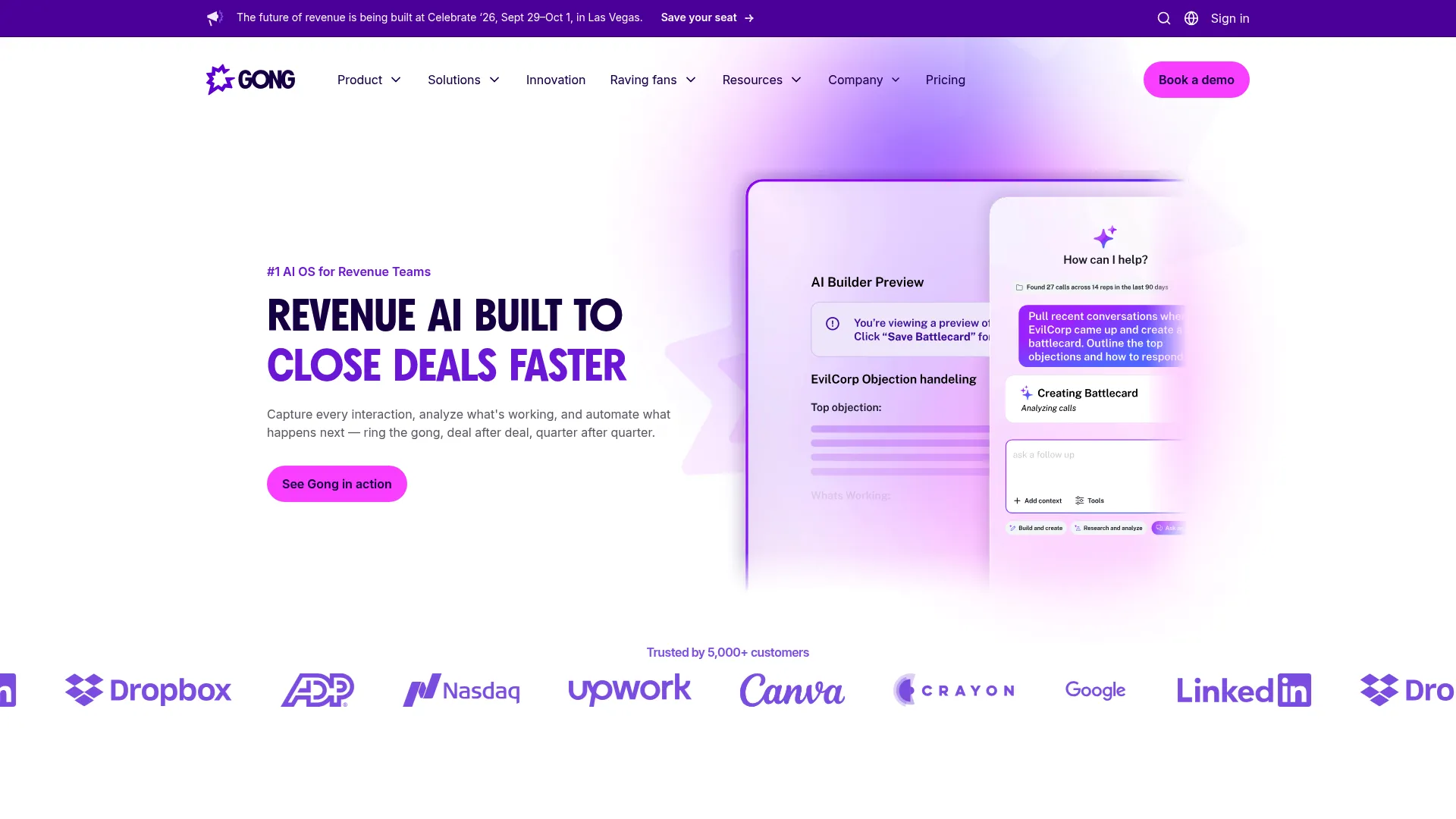
Gong is a revenue AI platform that captures and analyzes customer interactions to improve coaching, forecasting, and deal execution. It records calls across the sales motion, transcribes them, and layers conversation intelligence on top so managers can see what's happening inside deals without sitting on every call. For enablement leaders who want coaching tied to revenue outcomes rather than isolated call scores, Gong makes that connection directly.
The pitch that lands with revenue teams: coaching and forecasting live in the same system. A manager can spot a stalled deal, trace it back to a weak discovery call, and coach the exact behavior that's costing pipeline. That link between call quality and pipeline health is what separates Gong from tools that only score calls.
Best for: Revenue teams that need conversation intelligence, coaching, and forecasting in one platform.
Key strengths
- Call recording and transcription across the sales motion
- AI-powered coaching and deal insights
- Forecasting and pipeline visibility
Why choose Gong: Choose Gong when coaching needs to connect to revenue, not just call scores. It fits sales orgs where managers coach on deal execution and leadership wants pipeline visibility in the same view.
Gong pricing: Gong does not publish a public price. Pricing depends on team size, per-user licenses, and a platform fee, and the company asks visitors to request a customized quote.
2. Dialpad

Dialpad is an AI-native customer communications platform covering calls, messages, meetings, and contact centers. Its coaching value comes from AI that works live during the conversation, transcribing in real time and surfacing prompts while the rep is still on the call. For teams that need fast coaching loops rather than after-the-fact review, that live layer changes the coaching cadence.
Because the calling platform and the coaching layer are the same product, there's no separate integration to maintain between where calls happen and where coaching lives. That matters for teams that want real time coaching without stitching two systems together.
Best for: Teams needing AI-powered business calling, messaging, meetings, and contact-center workflows in one platform.
Key strengths
- AI transcription during live calls
- Automated call summaries
- AI coaching and live guidance
Why choose Dialpad: Choose Dialpad when live guidance and fast coaching loops matter more than deep post-call deal analysis. It fits teams that want calling and coaching in a single AI-native platform.
Dialpad pricing: Dialpad Connect starts at $15/user/month for Standard and $25/user/month for Pro. Enterprise is contact sales. A 14-day free trial is available.
3. AmplifAI
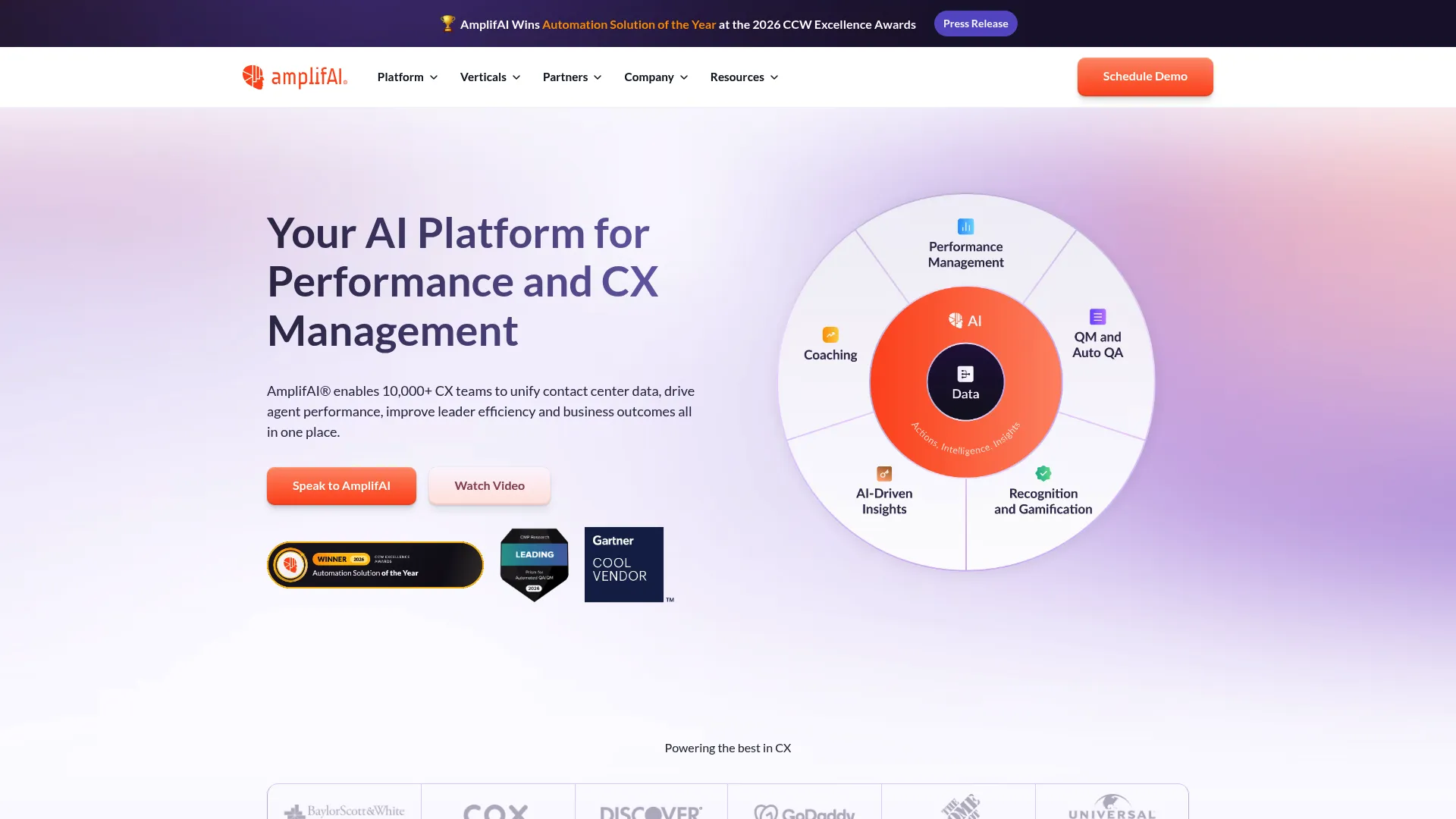
AmplifAI is an AI-powered contact center platform for performance, CX, QA, and coaching. It pulls contact center data into a unified performance view, automates quality management, and turns that data into coaching actions managers can assign and track. For organizations that treat coaching as a governed program rather than an ad hoc habit, that structure is the draw.
The strength here is coaching operations. AmplifAI connects automated QA to performance management, so a quality signal becomes a coaching task with an owner, a due date, and a measurable follow-up. Supervisor coaching stops being a black box and becomes something leadership can measure across teams.
Best for: Contact centers that want AI-driven coaching, QA, and performance management in one system.
Key strengths
- Unified contact center data and performance view
- Automated QA and quality management
- AI-enabled coaching and performance management
Why choose AmplifAI: Choose AmplifAI when coaching effectiveness and governance matter as much as the coaching itself. It fits contact centers that need to prove coaching drives measurable performance change.
AmplifAI pricing: AmplifAI does not publish public pricing on its site. It uses sales-led CTAs and states that BPO-specific pricing is available on request.
4. Alpharun
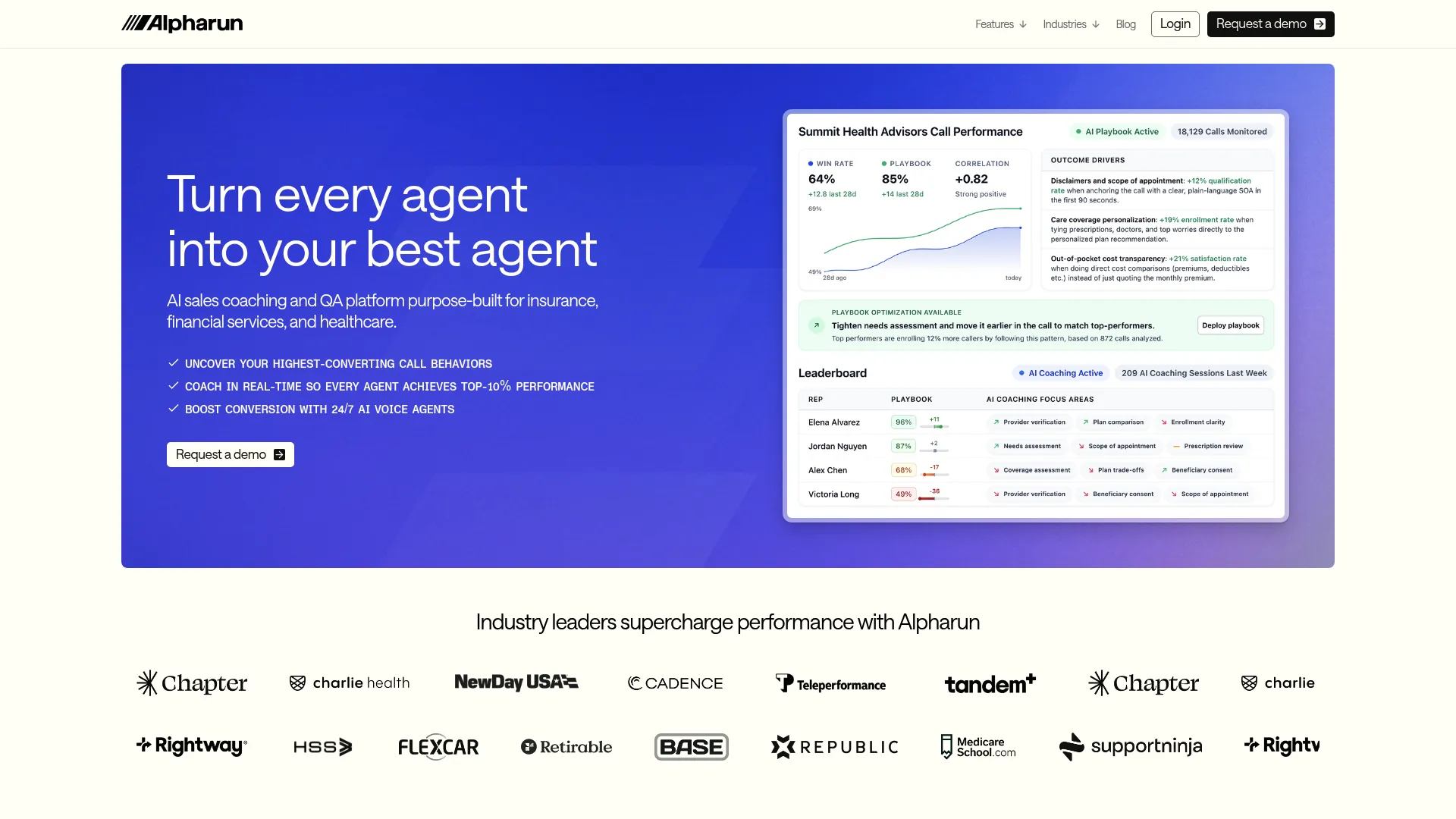
Alpharun is an AI sales coaching and QA platform built for regulated, high-volume sales teams. It combines real-time QA, sales coaching, and AI role plays, so reps get both live quality checks and structured practice away from live calls. For teams in insurance, financial services, and healthcare, the compliance angle sits alongside skill development rather than competing with it.
What stands out is the practice layer. AI role plays let reps rehearse objection handling and talk track adherence before they ever get on a real call. That pairs review-based coaching with reps-only practice, which is useful when high call volume leaves little room for live shadowing.
Best for: Insurance, financial services, and healthcare sales teams needing coaching, QA, and compliance support.
Key strengths
- Real-time QA and sales coaching
- AI role plays and training
- AI voice agents
Why choose Alpharun: Choose Alpharun when practical coaching tied to rep behavior and compliance both matter. It fits regulated, high-volume teams that want QA and skills practice in one place.
Alpharun pricing: Alpharun does not publish public pricing on its site. The homepage directs prospects to request a demo for a scoped quote.
5. Observe.AI
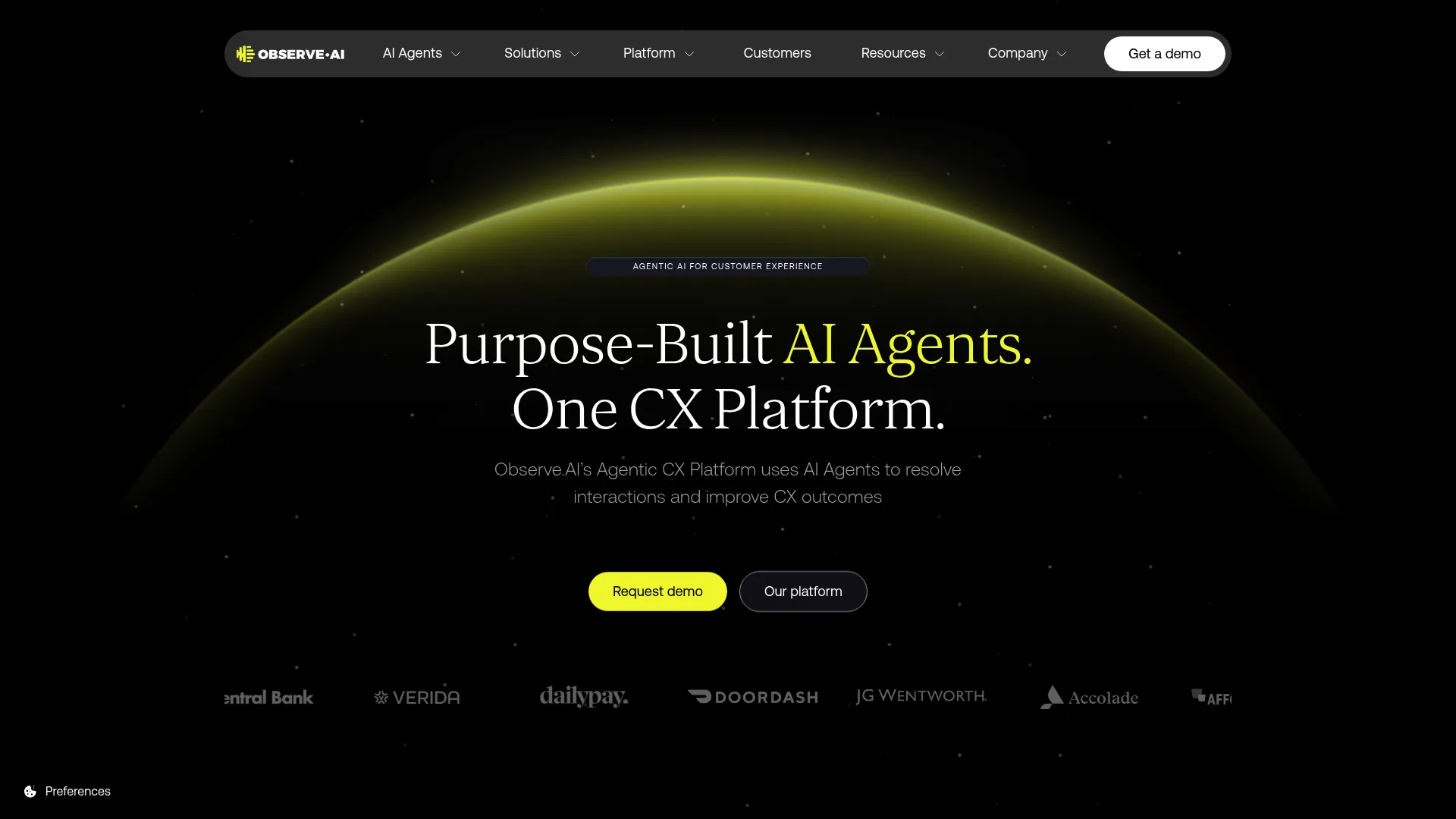
Observe.AI is an agentic CX platform for contact centers, combining AI agents, real-time guidance, and post-interaction conversation intelligence. It analyzes interactions after the call for QA and coaching while also guiding agents live during conversations. For high-volume teams balancing quality assurance and skill development, that dual coverage is the appeal.
The analytics depth is the differentiator. Observe.AI applies conversation intelligence across interactions, so QA teams see patterns and coaches see the specific moments worth reviewing. That gives high-volume contact centers coaching visibility without listening to every recording by hand.
Best for: Enterprise contact centers needing AI-driven coaching, QA, and automation at volume.
Key strengths
- AI agents for customer experience
- Real-time AI guidance and coaching
- Post-interaction conversation intelligence and QA
Why choose Observe.AI: Choose Observe.AI when QA and coaching need to run together across a large volume of calls. It fits enterprise contact centers that want conversation intelligence feeding both quality and coaching.
Observe.AI pricing: Observe.AI does not list pricing publicly. The site directs prospects to contact sales for tailored pricing scoped to their operation.
6. Balto
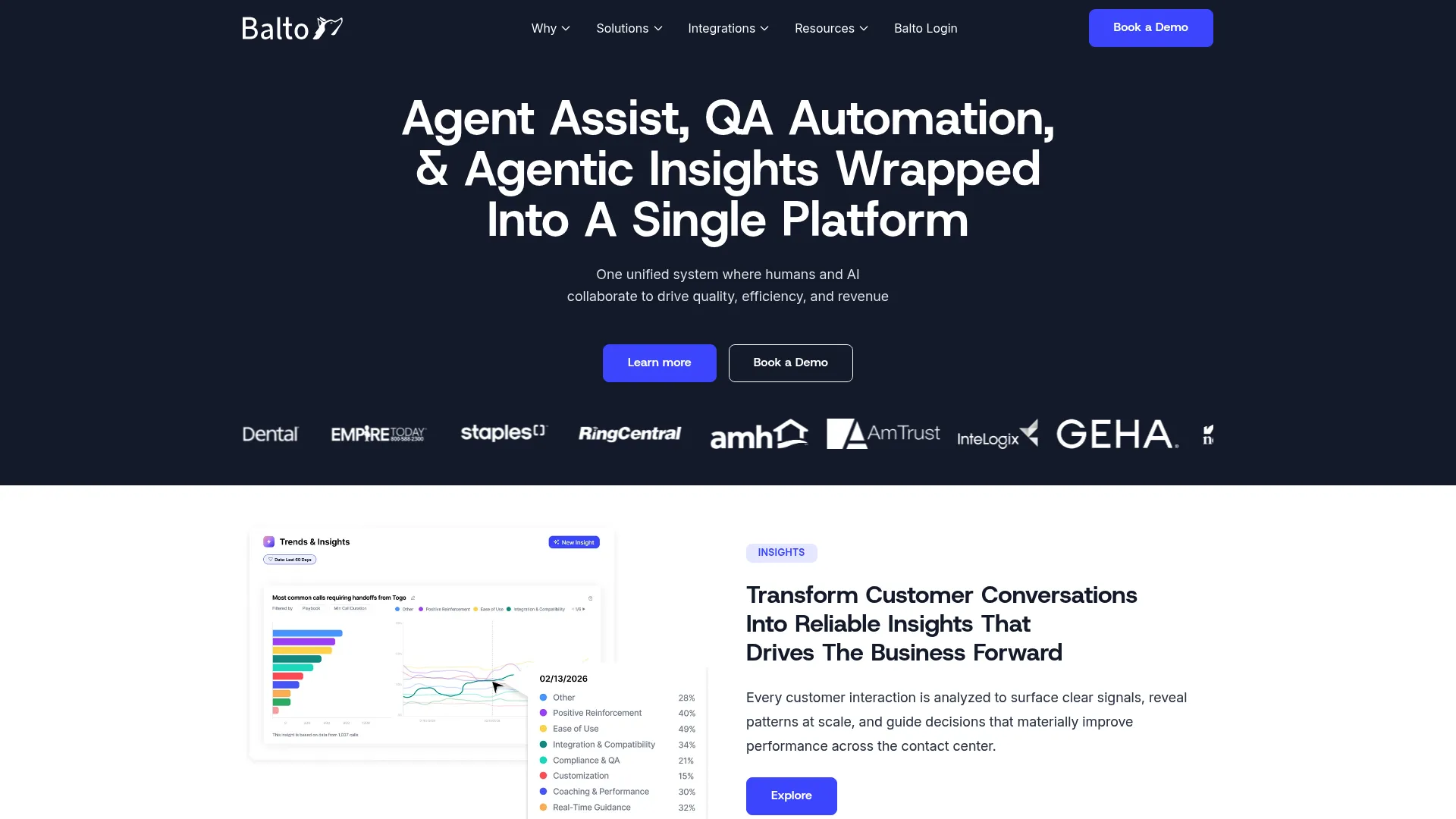
Balto is AI workforce software for contact centers that combines real-time agent guidance, QA, coaching, compliance, notes, and insights. Its focus is in-call assist: prompting the agent with the right thing to say while the conversation is happening, then closing the loop with QA and coaching afterward. For teams that value guidance during the call more than after-the-fact analysis, Balto leans into that moment.
The closed-loop design is what stands out. Real-time prompts guide the agent live, QA scores the outcome, and coaching addresses the gap, all in one system. Supervisors get live visibility plus a coaching trail, which is useful when the goal is to correct behavior in the moment, not next week.
Best for: Contact centers that want live agent assistance plus closed-loop QA and coaching.
Key strengths
- Real-time agent assist and guidance
- Automated QA, coaching, and compliance
- AI notes and conversation insights
Why choose Balto: Choose Balto when in-call guidance matters more than post-call deal review. It fits contact centers that want to shape behavior live and close the loop with coaching afterward.
Balto pricing: Balto does not publish public pricing. Pricing is custom and shared during evaluation, with the site directing visitors to contact sales.
7. Verint
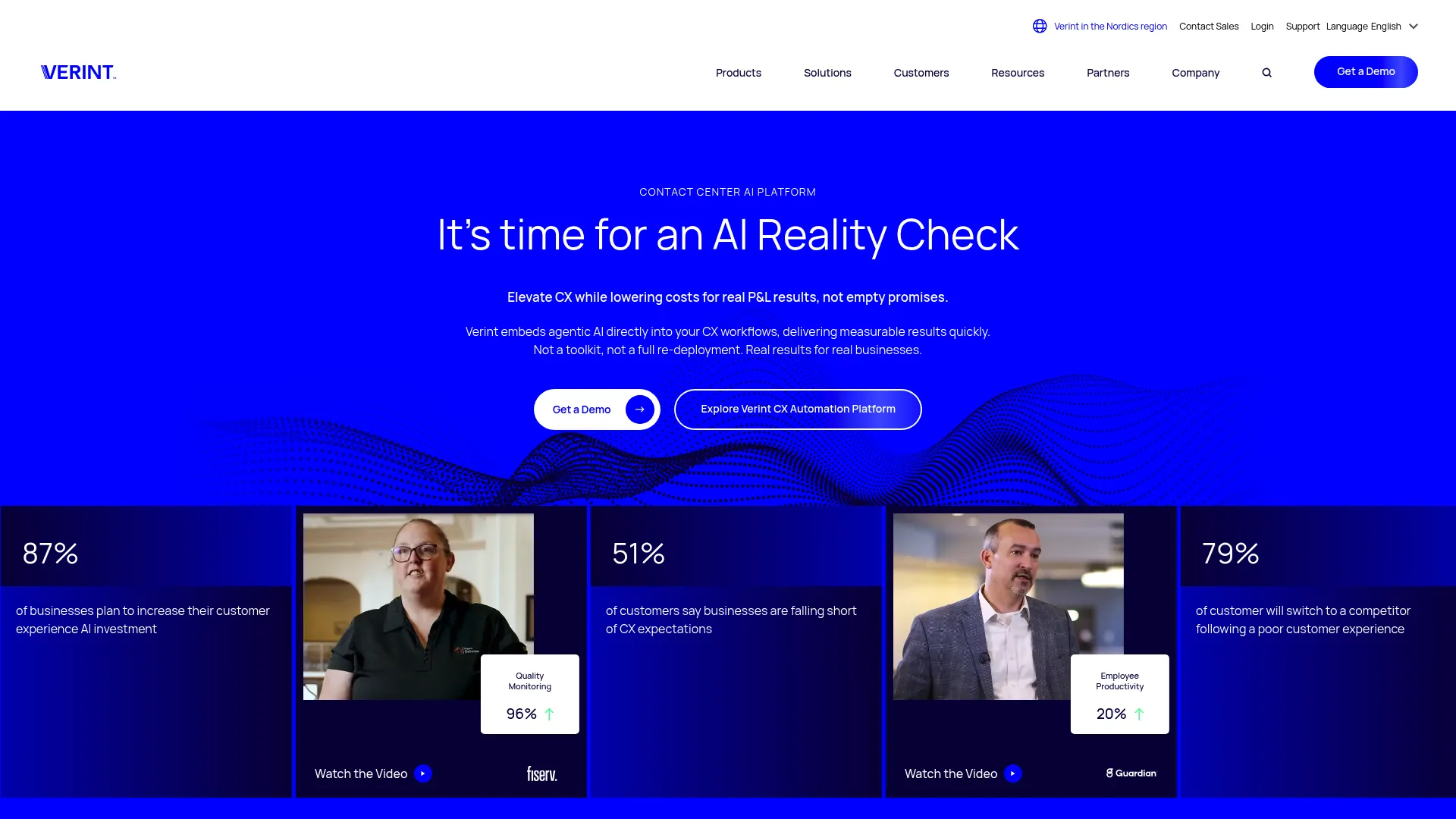
Verint is enterprise customer engagement and workforce engagement software for contact centers and related CX operations. It covers omnichannel engagement, workforce management, and quality automation, with coaching sitting inside a broader performance and governance stack. For large contact center environments where coaching is one part of a wider operations program, Verint fits the scale.
The enterprise workflow strength is governance. Verint connects quality automation, workforce engagement, and coaching, so a large organization can run consistent programs across sites and teams with the permissions and oversight that scale demands. That's the draw for operations that need coaching to fit inside existing enterprise processes.
Best for: Large organizations needing omnichannel CX, workforce, and self-service automation alongside coaching.
Key strengths
- Omnichannel customer engagement
- AI-powered virtual assistants and bots
- Workforce engagement and quality automation
Why choose Verint: Choose Verint when coaching needs to fit inside enterprise-grade workforce and quality management. It fits large contact centers with governance, permissions, and multi-site consistency needs.
Verint pricing: Verint does not expose public numeric pricing on its main product pages. Its Community Commercial Edition shows contact-sales pricing, and other products use custom or usage-based pricing.
8. Cresta
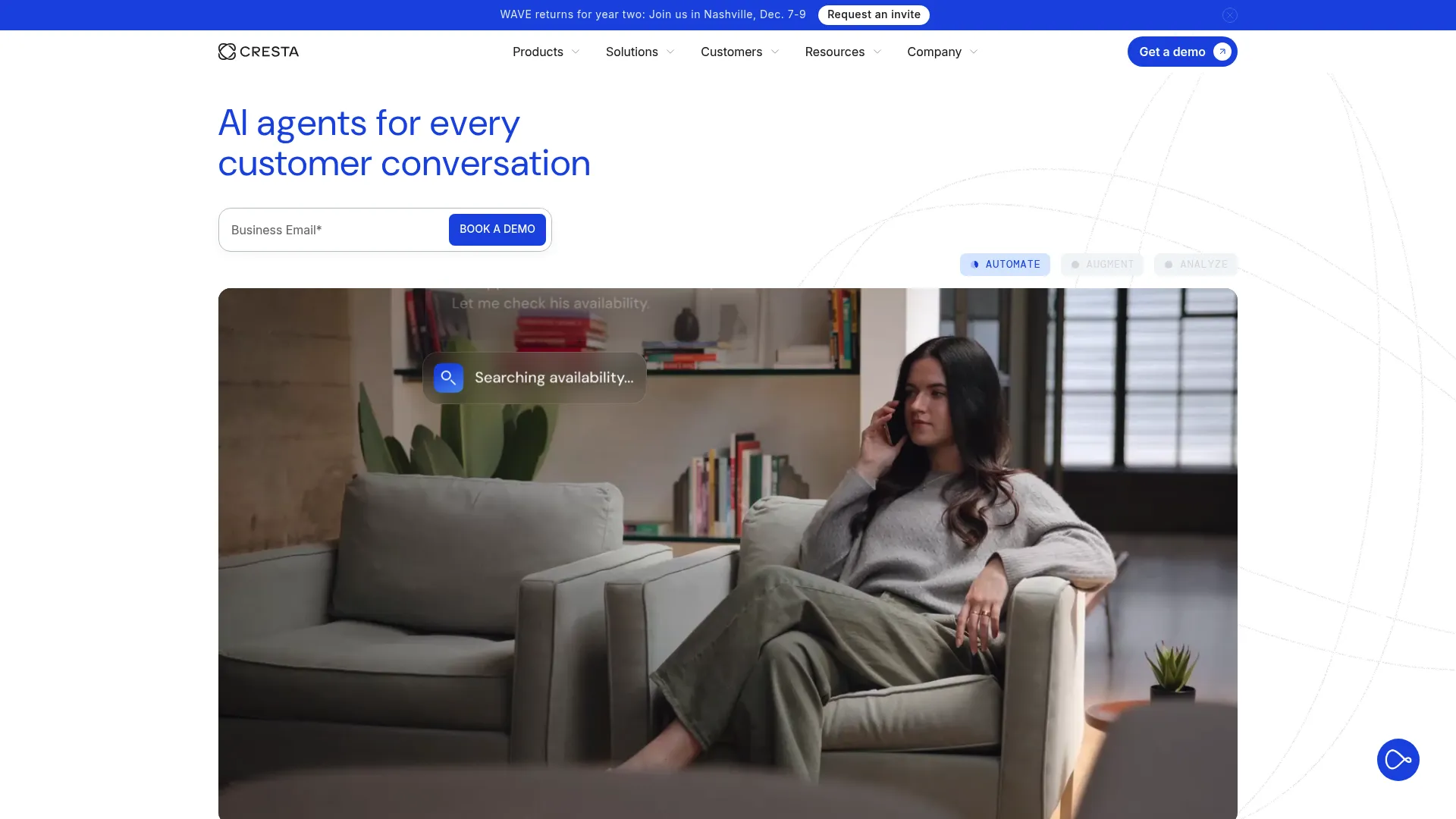
Cresta is an enterprise customer experience AI platform for contact centers, built around AI agents, agent assist, and conversation intelligence. It analyzes every interaction, guides agents in real time, and surfaces the next best action so coaches know what to address without reviewing calls manually. For teams that want AI to point them at the coaching move, Cresta is built for that.
The coaching strength is the recommendation layer. Cresta runs conversation intelligence across the full interaction volume and surfaces where coaching will move the needle. That helps high-volume teams prioritize which behaviors and which agents to coach first, rather than sampling calls at random.
Best for: Large enterprises running contact-center operations that want AI automation and agent assist.
Key strengths
- AI Agent for autonomous customer conversations
- Agent Assist for real-time guidance and auto-summaries
- Conversation Intelligence across 100% of interactions
Why choose Cresta: Choose Cresta when you want AI to surface the next coaching action across high call volume. It fits large enterprise contact centers that want automation, assist, and coaching prioritization together.
Cresta pricing: Cresta uses custom enterprise pricing with no public self-serve tiers. Pricing is sold direct to enterprise and scoped per deployment.
Considerations
Coaching depth versus call recording
A repository of recorded calls is not a coaching system. Storage tells you a call happened. Coaching tells a rep how to improve.
Before you buy, check whether the tool actually changes behavior. Ask to see the scorecard workflow, the coaching queue, and how a flagged moment turns into an assigned action with follow-up. If the demo only shows call search and playback, you're looking at recording, not coaching.
Real-time coaching versus post-call coaching
Live prompts help most in high-volume, transactional calls where an in-the-moment nudge prevents a bad outcome. Review-based coaching fits complex sales calls where the value is in reflecting on discovery, objection handling, and deal strategy after the fact.
A simple decision rule: high volume and short calls lean real time; longer, consultative deals lean post-call. Many teams run both, so check that the tool supports the mix your motion actually needs.
Scorecards and measurement
Scorecards only work when they map to observable behaviors, not vague traits. "Confident" is not measurable. "Asked at least three discovery questions before pitching" is.
Verify the measurement model before rollout:
- Scorecard criteria tied to specific, observable actions
- Baseline call scores captured before any coaching change
- Call score improvement tracked over time by rep and cohort
- Talk track adherence and objection handling scored consistently
- A link from coaching activity to downstream outcomes like win rate
Integrations and workflow fit
Coaching that lives outside the manager's daily tools gets ignored. The best tool is the one managers actually open.
Check integrations before you commit:
- CRM sync so coaching connects to deals and accounts
- Call recording and conferencing capture from where calls happen
- Alerts routed to where managers already work
- Minimal added steps for reps and managers to adopt the workflow
Governance and scale
Tooling fails when enablement can't maintain it. A scorecard nobody owns goes stale. A library nobody curates fills with outdated calls.
Run a short operational check: Who owns the scorecards? Who updates the call library? What are the permission levels across managers, reps, and admins? How do you version and retire coaching content as messaging changes? If those answers are unclear before purchase, adoption will stall after it.
Conclusion
The right call coaching software depends less on the ranked list and more on your motion and your priorities.
If you run a revenue team and want coaching tied to pipeline, Gong connects call quality to deal execution. If live guidance matters most, Dialpad and Balto surface prompts in the moment. For QA-plus-coaching in a contact center, AmplifAI and Observe.AI run quality and coaching on one loop. For regulated sales teams, Alpharun pairs QA with practice. For enterprise governance across sites, Verint fits the scale. And when you want AI to point at the next coaching action, Cresta is built for that.
Next step: shortlist two tools that match your motion, then map each against your current coaching workflow. Ask each vendor to demo the exact path from a flagged call to an assigned coaching action with measurable follow-up. The tool that shows that path cleanly is the one your managers will actually use.
Start your journey with Guideflow today!
FAQs
Call coaching software captures sales or support calls, analyzes the conversation, and helps managers coach reps more consistently. It's more than call recording. Recording stores the call, while coaching software combines call data, conversation analysis, scorecards, and coaching workflows so feedback ties to observable behavior and improvement.
Real time coaching gives live prompts and guidance while the rep is still on the call, which helps most in high-volume, transactional conversations. Post call coaching reviews the recording afterward, which fits complex sales calls where the value is in reflecting on discovery and strategy. Many teams need both, depending on the call type and volume.
Transcription, coaching scorecards, call analytics, coaching workflows, and integrations do the heavy lifting. Transcription makes calls searchable, scorecards standardize feedback, analytics surface patterns, and workflows turn insight into assigned action. The best tool is the one that fits the manager's actual workflow, because a tool managers don't open coaches no one.
Track call score improvements, talk track adherence, and objection handling at the rep and cohort level, then connect those to downstream outcomes like ramp time and win rate. The key step people skip is baseline measurement. Capture current scores before rollout, or you'll have no way to prove coaching changed anything.
No. Both contact centers and sales teams use it, but the workflow differs by motion. Contact centers lean toward high-volume QA, compliance, and real-time agent assist. Sales teams lean toward deal review, discovery coaching, and methodology reinforcement. Pick a tool built for the motion you run.
Focus on governance, consistency, adoption, and manager usability. Enablement owns onboarding, ramp, and behavior change, so the platform has to standardize feedback across managers, connect to ramp and win rate, and stay maintainable as messaging shifts. If managers won't adopt it, none of the features matter.
They integrate with CRM, call recording, conferencing, and enablement systems so coaching data connects to real deals. The important test is minimal workflow disruption. A coaching tool that forces managers into a separate system, disconnected from where they run deals, tends to get ignored no matter how strong the analytics are.
No. They augment managers by making coaching scalable across every call instead of a handful per week. AI surfaces the moments worth reviewing and standardizes scoring, but human judgment still drives the feedback, the context, and the relationship. The manager coaches. The software just makes sure no call goes unreviewed.