Your legislative tracking lives in a spreadsheet. Your alerts pile up in three inboxes. Your stakeholder notes sit in a doc someone last touched two sessions ago. And when leadership asks what moved this week, you spend an afternoon reconstructing it.
That fragmentation is the real cost of running public affairs without a system. The global public affairs and advocacy software market was valued at USD 1.2 billion in 2024 and is projected to reach USD 2.5 billion by 2033, growing at a 9.2% CAGR through 2033, according to Verified Market Reports (2024). More telling for your day-to-day: over 72% of advocacy groups had adopted digital-first lobbying and grassroots outreach tools by 2023, per Global Market Statistics (2024). The teams still stitching workflows together by hand are now the exception.
Good public affairs software collapses that sprawl into one operating layer. Legislative monitoring, stakeholder relationships, outreach, and compliance stop being four separate manual jobs and become one repeatable workflow with board-level visibility. For a SaaS founder, the analogy is obvious: this is stack rationalization for the policy team, the same way you'd consolidate five point tools into one system that scales without you in every loop.
The category is not one-size-fits-all. Some tools win on all-in-one breadth. Some win on transparent pricing. Some win on state coverage or raw data access. The right pick depends on your geography, your organization type, and how mature your workflow already is. This guide is built to help you match fit, not just scan features.
What's inside
This guide is for public affairs, government affairs, nonprofit advocacy, association, and corporate affairs teams evaluating lobbying software for federal, state, local, nonprofit, or enterprise use cases. We built the list from current public affairs, government relations, and legislative tracking platforms actually used by these teams in 2026.
We ranked and segmented each tool against four criteria that decide real-world fit:
- Workflow coverage: how much of the tracking-to-reporting lifecycle it handles in one place
- Data freshness and breadth: federal, state, local, and regulatory coverage
- Stakeholder and outreach depth: contact management, relationship mapping, and advocacy execution
- Compliance and pricing clarity: disclosure support, reporting, and how transparent the cost structure is
TL;DR
- Best all-in-one platform: Quorum, for teams that need legislative tracking, stakeholder CRM, grassroots advocacy, and PAC management under one roof.
- Best for pricing transparency and staff data: LegiStorm, with a public price list, a free tier, and deep congressional and state contact intelligence.
- Best for policy intelligence breadth: FiscalNote, spanning AI-driven legislative and regulatory tracking, news monitoring, and advocacy tools.
- Best for fast state tracking: FastDemocracy, with a free individual tier and strong 50-state alerts and collaboration.
- Best for clear, published pricing: BillTrack50, with all-50-state and Congress coverage and per-state subscription math you can budget against.
- Best for data and API flexibility: LegiScan, for teams that want turnkey monitoring plus structured legislative data feeds.
- Best for Florida-heavy workflows: LobbyTools, purpose-built for state-level Florida legislative intelligence.
What is lobbying software?
Lobbying software is software that helps public affairs and government relations teams track legislation, manage stakeholders, run outreach, and handle compliance workflows in one place. It is often used interchangeably with public affairs software and government relations software, since the underlying jobs overlap heavily.
Most platforms in this category cluster their capabilities into a handful of core areas. Knowing these clusters makes it easier to compare tools that describe themselves in very different marketing language.
- Legislative tracking and alerts: bill tracking software that monitors bills, amendments, hearings, and votes across federal, state, and local jurisdictions, with real-time notifications.
- Stakeholder and contact management: stakeholder management software features like contact databases, legislator and staff directories, and relationship mapping to see who knows whom.
- Outreach and advocacy execution: advocacy software tools for grassroots campaigns, action alerts, email and letter campaigns, and coordinated stakeholder outreach.
- Compliance and reporting: activity logging, disclosure support, and audit-friendly records that reduce the manual burden of lobbying reporting.
- Analytics and issue monitoring: policy intelligence software that surfaces trends, news, regulatory movement, and issue-level dashboards.
- Segment-specific fit: coverage and workflows tuned by geography (federal, state, local, EU) or organization type (corporate, nonprofit, association, PAC).
The practical takeaway: no single tool leads on every cluster. A platform built for congressional staff data will feel different from one built for 50-state bill tracking or one built for grassroots campaigns.
When to use lobbying software
Centralize legislative monitoring
Use it when your team is pulling bill updates from too many manual sources. If you are checking multiple state legislature sites, forwarding alert emails, and copying summaries into a shared doc, you have outgrown the spreadsheet. Legislative tracking software puts bill tracking, alerts, summaries, and reporting in one place, so the whole team works from the same live view instead of five stale versions.
Coordinate outreach and stakeholder relationships
Use it when outreach depends on knowing who talks to whom. Multi-stakeholder policy work means tracking dozens of legislators, staffers, and coalition partners across several issues at once. Stakeholder management software gives you contact history, relationship mapping, and issue-based outreach, so a handoff between team members does not reset the relationship to zero.
Reduce compliance and reporting drag
Use it when disclosure and activity capture are eating real hours. Lobbying disclosure, activity logs, and PAC-adjacent workflows are error-prone when done by hand. Compliance software for lobbying captures activity as it happens and formats it for reporting, which shrinks the scramble before every filing deadline and keeps your records audit-ready.
Comparison table
These tools differ meaningfully by geography, workflow depth, and organization fit. An all-in-one suite and a focused bill tracker solve different problems, so read the intent column before the pricing column. Pricing and ratings below reflect each vendor's published information as of mid-2026.
| # | Product | Intent | Key use case | Pricing | G2 rating |
|---|---|---|---|---|---|
| 1 | Quorum | All-in-one public affairs suite | Legislative tracking, stakeholder CRM, advocacy, and PAC in one platform | Request pricing | 4.3/5 |
| 2 | LegiStorm | Congressional and state intelligence | Staff and contact data with transparent pricing | Free tier; paid from $199/month | 4.6/5 |
| 3 | FiscalNote | Policy intelligence platform | AI-driven legislative, regulatory, and news monitoring | Request pricing; PolicyNote API from $0 | 4.2/5 |
| 4 | FastDemocracy | Fast state and federal tracking | Real-time bill alerts and team collaboration | Free tier; Professional quote-based | 4.4/5 |
| 5 | BillTrack50 | Transparent legislative tracking | All-50-state and Congress bill and regulation tracking | Free tier; from $84 per state/month | Not listed |
| 6 | LegiScan | Data and API-driven tracking | Turnkey monitoring plus legislative data feeds | Forever Free tier; paid from $25/year | Not listed |
| 7 | LobbyTools | Florida legislative intelligence | State-level Florida tracking, alerts, and calendars | Pricing on request | Not listed |
The 7 best lobbying software platforms
1. Quorum
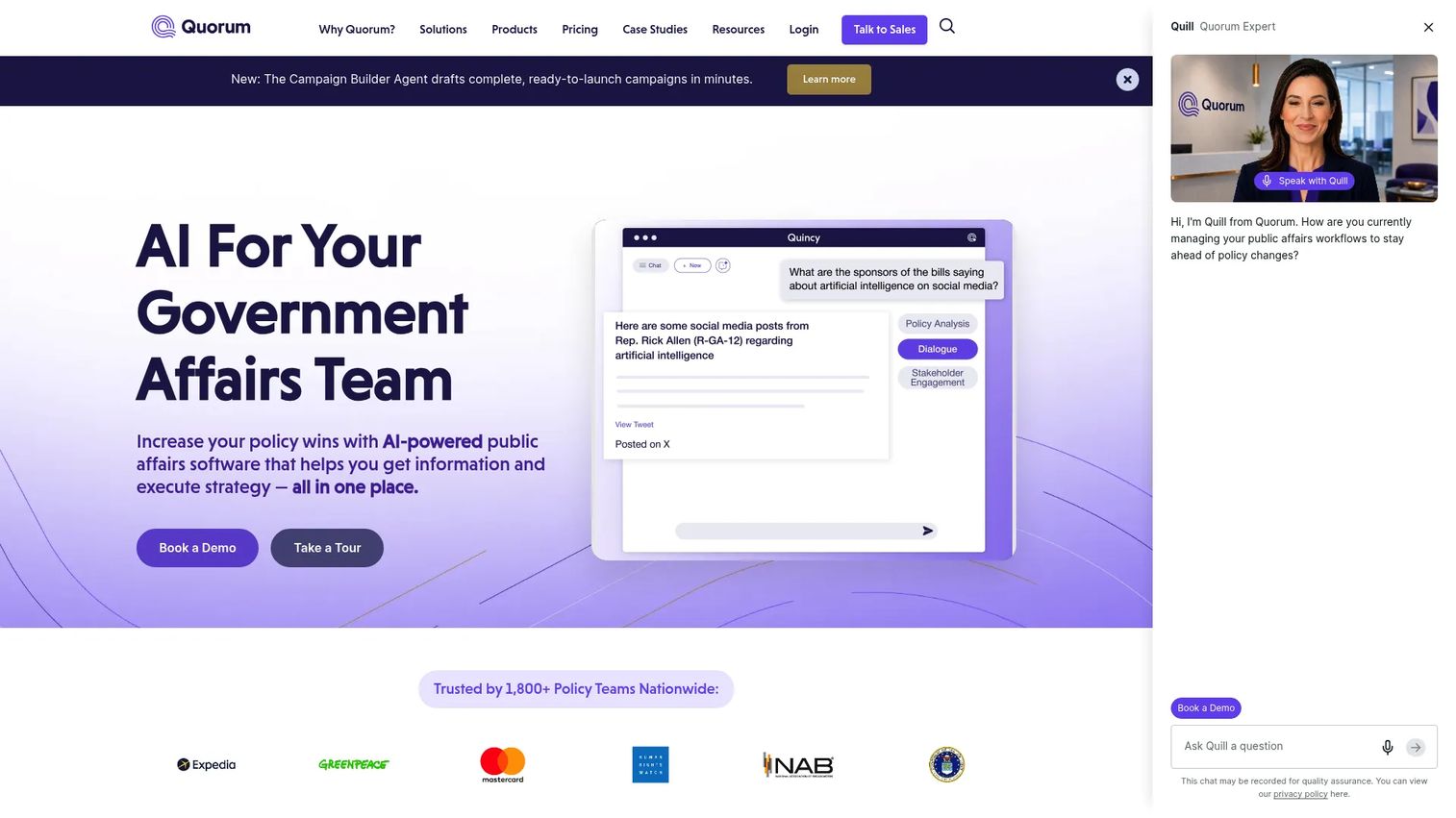
Quorum is the broadest all-in-one public affairs platform on this list. It brings legislative and regulatory tracking, stakeholder engagement, grassroots advocacy, and PAC management into a single system, connected by an AI layer that helps summarize bills and surface what matters. For teams tired of running four tools that do not talk to each other, the appeal is consolidation: one place to track policy, manage relationships, and run campaigns.
Quorum segments its product by use case rather than selling a single monolith. You can choose coverage tuned for federal, state, local and school board, stakeholder engagement, EU and international, or PAC workflows. That segmentation matters because a corporate affairs team and a nonprofit advocacy team need different things from the same suite.
Best for: Public affairs teams that want one platform for policy tracking, advocacy, and relationship management instead of a stitched-together stack.
Key strengths
- All-in-one coverage: Legislative and regulatory tracking, stakeholder CRM, grassroots, and PAC management under one login.
- AI-assisted workflows: An AI assistant helps summarize legislation and surface relevant activity across issues.
- Segment-specific products: Dedicated configurations for federal, state, local, EU, stakeholder, and PAC use cases.
Why choose Quorum: If your operating model spans tracking, outreach, and campaign execution, Quorum removes the seams between them. It is the strongest fit for mid-market and enterprise public affairs teams that want a public affairs CRM and a policy tracker in the same tool, rather than exporting between systems. Teams running heavy grassroots advocacy or PAC management alongside legislative tracking get the most out of the breadth.
Quorum pricing: Quorum does not publish numeric pricing. Its site lists multiple products, including Federal, State, Grassroots, PAC, Local and School Board, Stakeholder, and EU and International, each on a request-pricing basis. You contact sales for a quote scoped to your coverage and team size. Quorum holds a 4.3/5 rating on G2.
2. LegiStorm
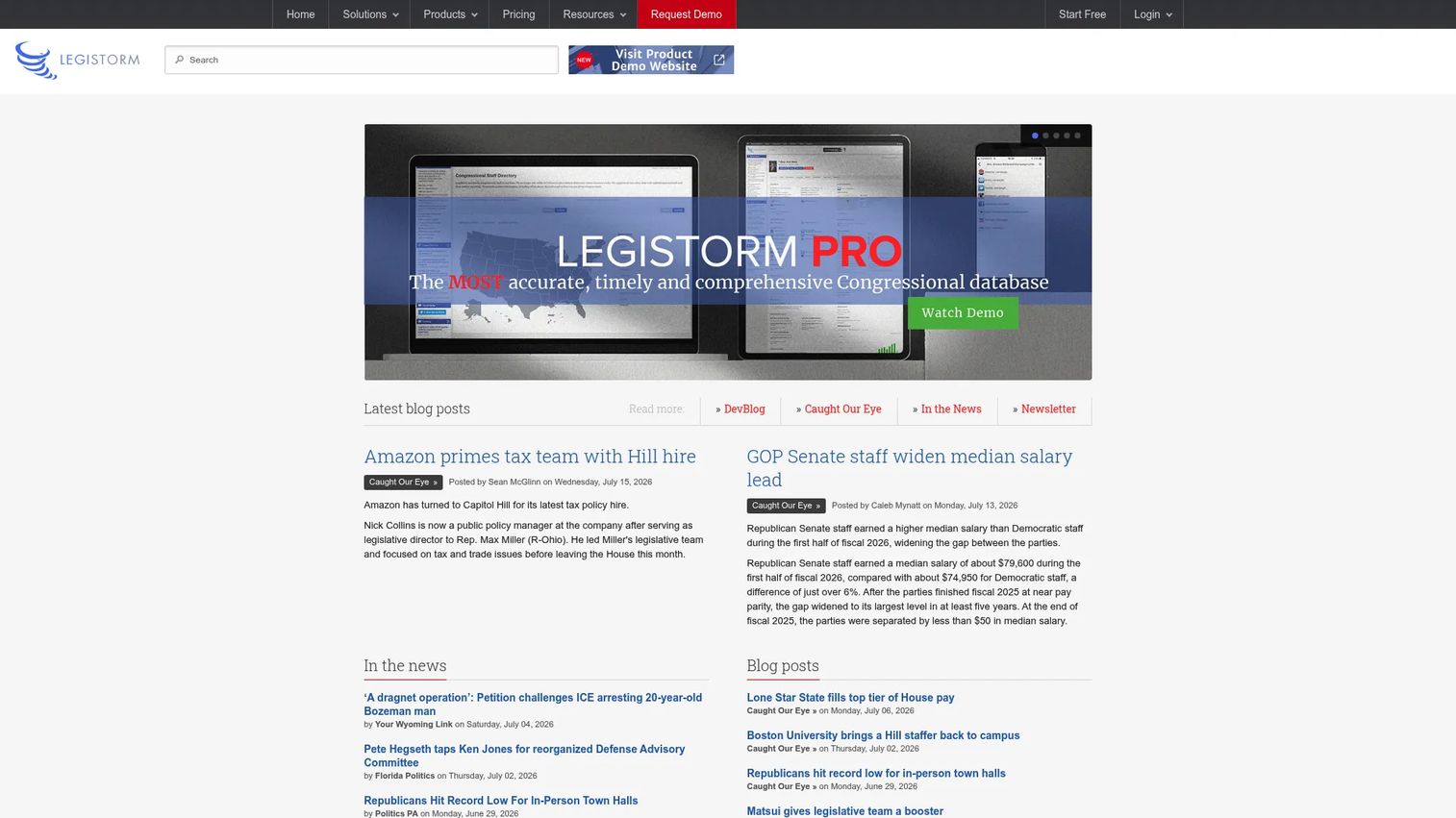
LegiStorm is a public affairs platform built around congressional, state legislature, and lobbying intelligence. Its standout asset is depth of people data: a detailed congressional staff and member directory, plus state legislature and lobbying intelligence. If your work depends on knowing exactly who staffs which committee and how to reach them, LegiStorm is built for that job.
It also earns points for something rare in this category: transparent, published pricing. You can see the tiers before you ever talk to a rep, which makes budgeting and internal approval far simpler.
Best for: Government relations, public affairs, and congressional research teams that live and die by accurate staff and contact data.
Key strengths
- Deep contact database: A congressional staff and member directory plus state legislature and lobbying intelligence.
- Transparent pricing: Public tiers with a genuine free plan, so you can evaluate cost before committing.
- Contact and alert tooling: Custom contact lists, alerts, and meeting tools that turn research into outreach.
Why choose LegiStorm: Choose LegiStorm when accurate people data and relationship mapping matter more than an all-in-one campaign suite. The transparent price list is a real advantage for smaller teams and anyone who needs to justify spend line by line. The free tier also lets you validate fit before paying.
LegiStorm pricing: LegiStorm publishes its pricing openly. Paid plans start at $199/month for Pro Lite, with Pro at $279/month and Pro Premium at $389/month on monthly billing; annual billing lowers Pro to $229/month and Pro Premium to $329/month. A Forever Free plan is available for basic access. LegiStorm holds a 4.6/5 rating on G2, the highest on this list.
3. FiscalNote
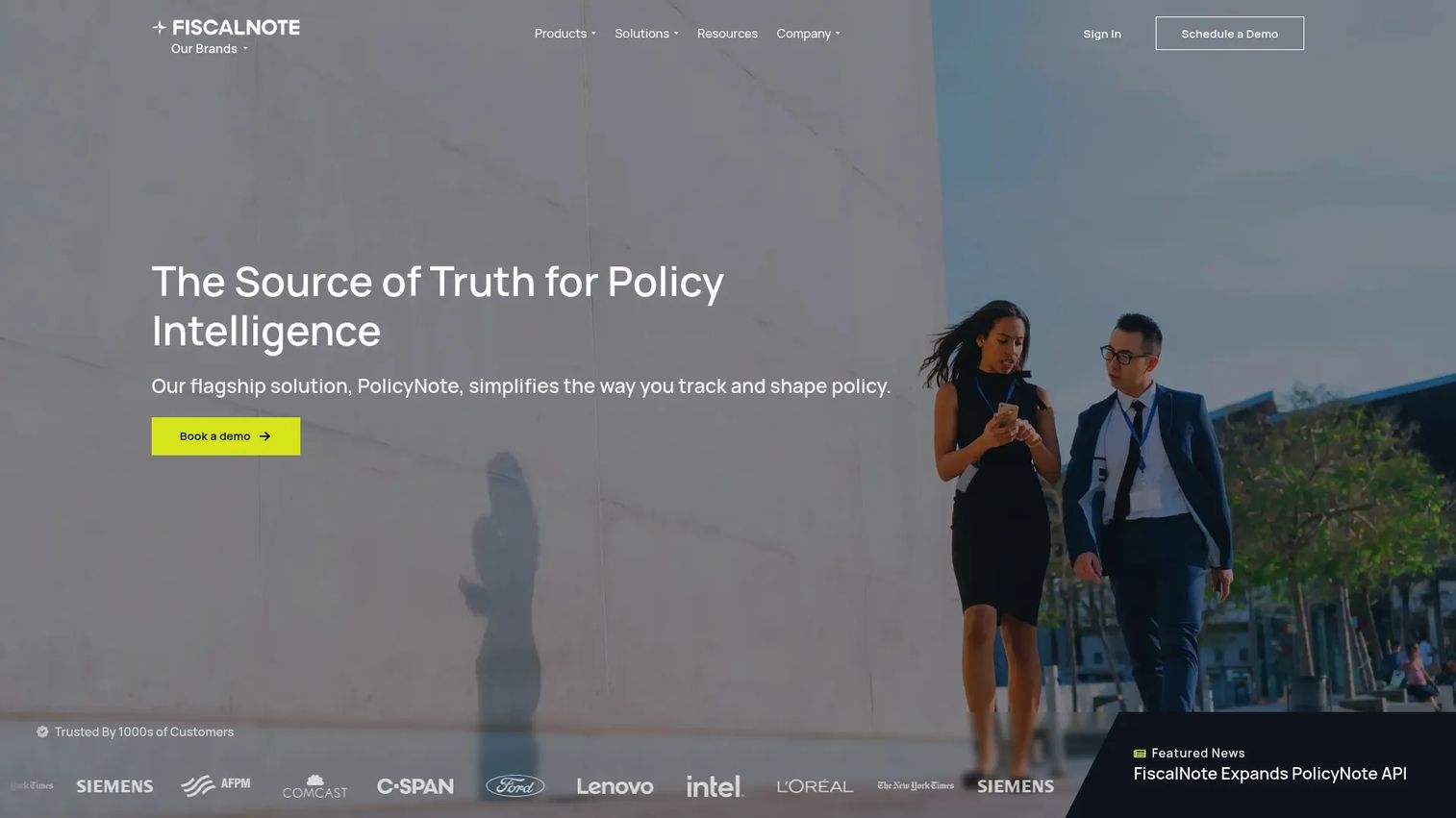
FiscalNote is a policy intelligence software platform for teams that need to track legislative, regulatory, and broader policy developments at scale. Its product family spans PolicyNote for legislative and regulatory monitoring, VoterVoice for advocacy, and CQ for congressional news and analysis. The through-line is AI-powered tracking that curates bill summaries, alerts, and reporting instead of leaving you to read every document by hand.
Because FiscalNote is a family of products rather than a single app, it helps to map which module solves your problem before you evaluate. Policy intelligence, stakeholder monitoring, and advocacy each live in a distinct part of the suite.
Best for: Government affairs teams that need legislative and regulatory intelligence across a wide policy surface, with news monitoring built in.
Key strengths
- AI-powered tracking: Legislative and regulatory monitoring with AI-generated bill summaries and alerts.
- News and analysis: CQ-style congressional news layered onto policy tracking for context.
- Advocacy tools: VoterVoice supports grassroots advocacy and stakeholder outreach alongside monitoring.
Why choose FiscalNote: Choose FiscalNote when your team needs breadth of policy intelligence, from legislation to regulation to news, in one ecosystem. It fits organizations with wide issue portfolios that need AI bill tracking to keep pace. The product-family structure means you can start with the module you need and expand.
FiscalNote pricing: FiscalNote's core products use request-based pricing, so you contact the team for a quote. Its PolicyNote API pricing is published: a Free tier at $0/month, a Self-Serve tier at $300/month, and a Full Service tier with custom pricing. FiscalNote holds a 4.2/5 rating on G2.
4. FastDemocracy
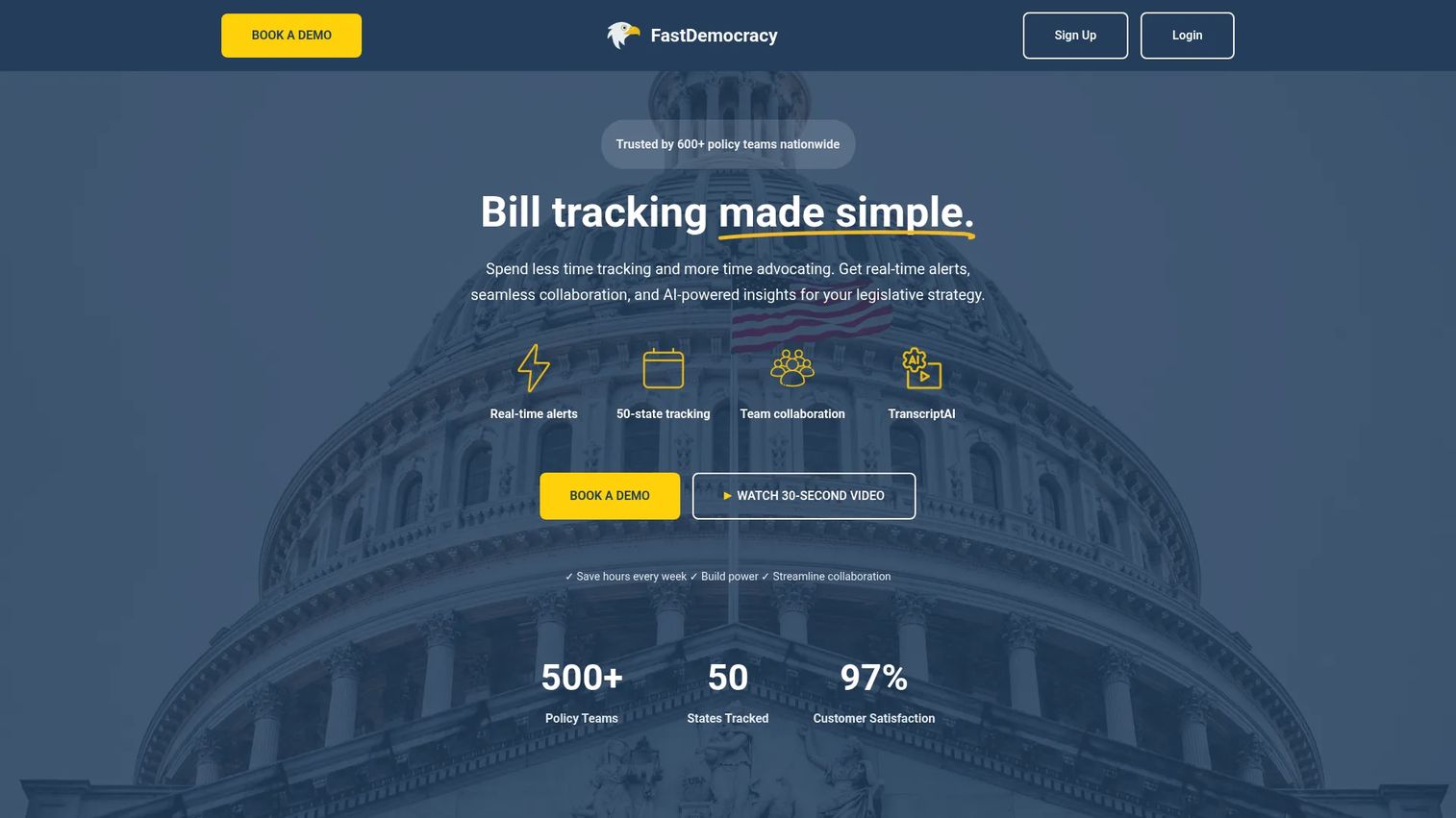
FastDemocracy is a legislative tracking and advocacy platform built for policy teams, nonprofits, lobbyists, and government relations professionals who need speed to value. It covers bill tracking across all 50 states, Congress, DC, and Puerto Rico, with real-time alerts on bills, amendments, and hearings. AI-powered bill insights and bill-similarity detection help teams spot related legislation moving across jurisdictions.
The free individual tier is a genuine differentiator. A single practitioner can start tracking legislation without a procurement process, then move the team onto the Professional plan when the workflow proves out.
Best for: Teams that prioritize fast state and federal legislative monitoring and want to start tracking without a lengthy buying cycle.
Key strengths
- Real-time alerts: Bill, amendment, and hearing notifications across 50 states, Congress, DC, and Puerto Rico.
- Team collaboration: Shared tracking, reporting, and notes so the whole team works from one view.
- AI bill insights: AI-powered summaries and bill-similarity detection to connect related legislation.
Why choose FastDemocracy: Choose FastDemocracy for speed and broad state coverage without upfront friction. The free tier lets an individual validate the tool immediately, and the Professional tier adds collaboration and reporting for teams. It is a strong fit for nonprofits and lean government relations teams doing serious state and local lobbying work.
FastDemocracy pricing: FastDemocracy offers a Free version for individual use. FastDemocracy Professional, for professional users, adds real-time alerts, reporting, collaboration, and bill-similarity detection; its pricing is quote-based, structured around multi-year contracts and state or nationwide coverage options, so you request a demo for a scoped price. FastDemocracy holds a 4.4/5 rating on G2.
5. BillTrack50
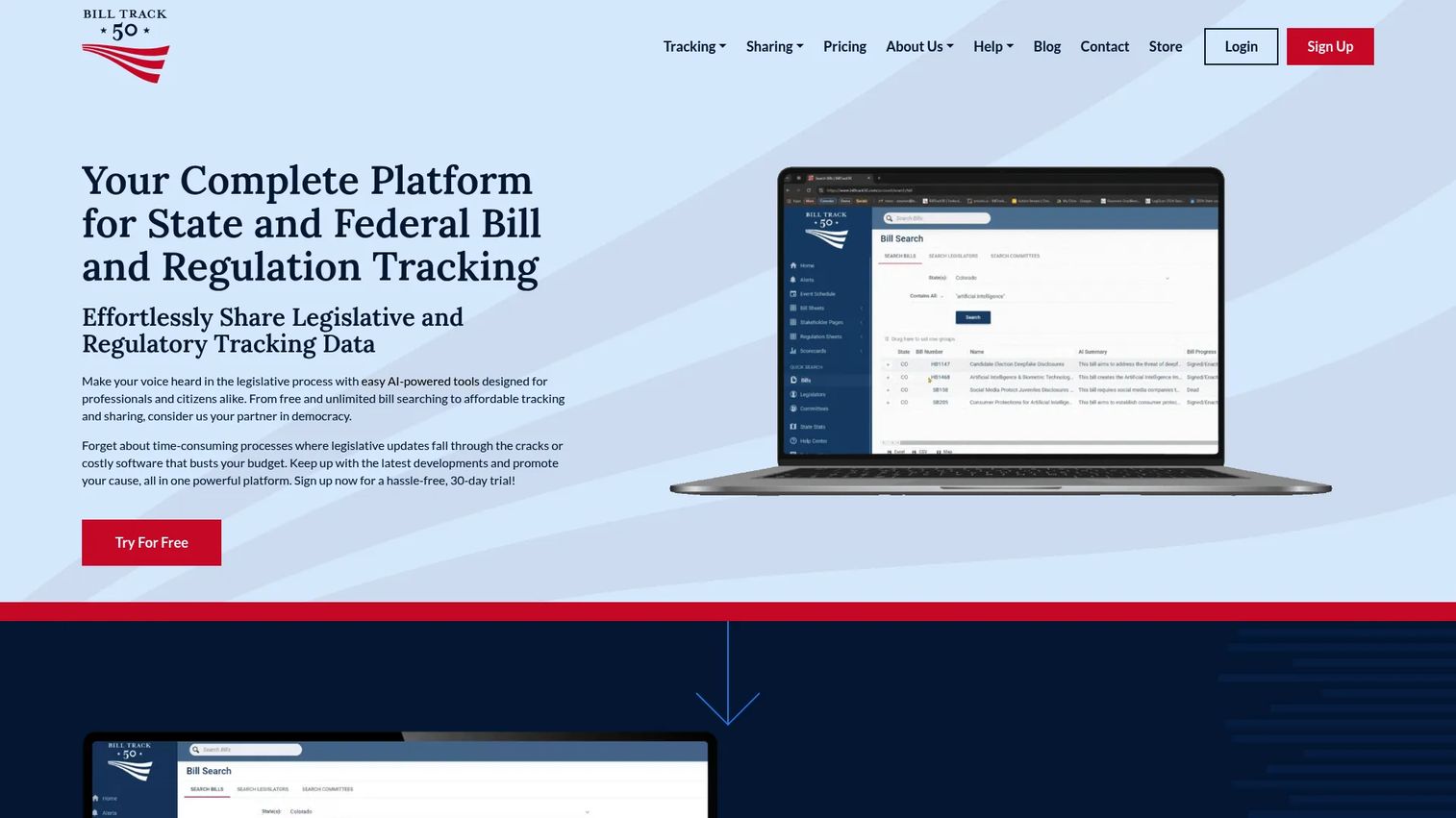
BillTrack50 is a legislative and regulation tracking platform covering all U.S. states, DC, and Congress. What sets it apart is pricing transparency: it publishes per-state and unlimited subscription math you can budget against without a sales call. Unlimited searching and tracking, AI-powered summaries, daily email alerts, and collaboration tools round out the workflow.
For buyers who want to know exactly what broad legislative visibility costs before committing, BillTrack50 removes the guesswork. The pricing is modular, so you pay for the states and coverage types you actually track.
Best for: Teams that want clear, published pricing and broad bill tracking software coverage across states and Congress.
Key strengths
- Broad coverage: Legislation and regulation tracking across all U.S. states, DC, and Congress.
- Transparent, modular pricing: Per-state and unlimited tiers you can budget against directly.
- AI summaries and alerts: AI-powered summaries plus daily email alerts and collaboration tools.
Why choose BillTrack50: Choose BillTrack50 when clear pricing and broad legislative visibility are your priorities. The per-state model suits teams that track a handful of specific states, while the unlimited tiers fit organizations monitoring nationwide. The free Citizen tier lets you test the interface before subscribing.
BillTrack50 pricing: BillTrack50 publishes its pricing. A free Citizen tier is available. Legislation Pro is $84 per state or Congress/month, and Legislation Unlimited covers all states and Congress for $420/month. Regulations Pro is $42 per state and/or federal/month, with Regulations Unlimited at $210/month. Annual and monthly billing options are available.
6. LegiScan
LegiScan is a legislative tracking and data platform that monitors bills, alerts, and reports across U.S. states and Congress, and adds something most tools on this list do not: robust API access. Its national legislative search engine, custom bill monitoring, and email alerts serve the turnkey user, while its Public, Pull, and Push APIs serve teams that want to feed legislative data into their own applications.
That dual nature is the point. LegiScan works as a straightforward tracking service and as data infrastructure, which makes it a natural fit for organizations that want both a dashboard and structured feeds.
Best for: Government affairs teams and organizations that need bill tracking plus legislative data via API access for custom applications.
Key strengths
- National search: A legislative search engine spanning U.S. states and Congress.
- Custom monitoring and reporting: Bill tracking with email alerts and dynamic reporting.
- API access: Public, Pull, and Push APIs for teams that want structured legislative data feeds.
Why choose LegiScan: Choose LegiScan when you need both a turnkey tracking service and data infrastructure. Teams building internal dashboards, custom applications, or white-label experiences get the API depth they need, while everyday users get straightforward monitoring. The Forever Free tier makes it easy to start.
LegiScan pricing: LegiScan publishes annual pricing. GAITS tracking plans include OneVote (Forever Free), OneVote+ ($25/year to $1,000/year), and GAITS Pro ($100/year to $3,000/year), with fees scaling by covered states. API plans include a Public API (Forever Free), Pull API ($1,000/year to $6,000/year), and Push API ($2,000/year to $12,000/year).
7. LobbyTools
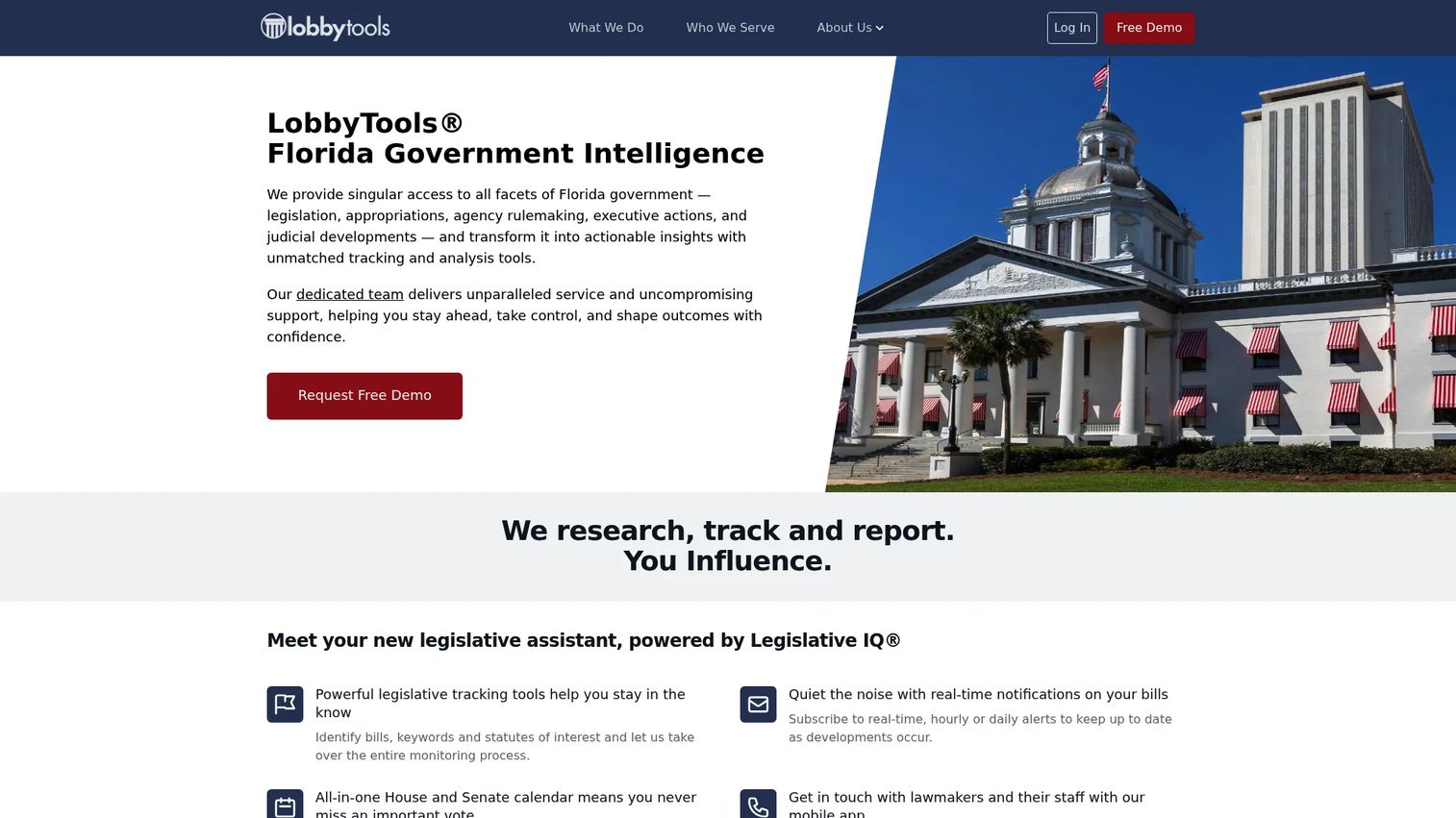
LobbyTools is a Florida-focused legislative intelligence service. It describes itself as Florida's legislative research, tracking, news, and analysis service, offering singular access to Florida government. Bill tracking, legislative research, real-time notifications, House and Senate calendar tracking, and policy notes are all built around one state's workflow rather than a national footprint.
That focus is a feature, not a limitation, for the right buyer. If your work is concentrated in Tallahassee, a purpose-built Florida tool can capture nuance and local context that broader national platforms treat as an afterthought.
Best for: Teams whose work is concentrated in Florida state government and who need deep local legislative intelligence.
Key strengths
- Florida-specific depth: Bill tracking and legislative research tuned to Florida government.
- Real-time notifications: Alerts on legislative movement as it happens.
- Calendar tracking: House and Senate calendar visibility for planning around session activity.
Why choose LobbyTools: Choose LobbyTools when the bulk of your government affairs work happens in Florida. A specialized state platform delivers local context and calendar detail that a national tool may not prioritize. It is a focused pick for lobbyists, associations, and corporate affairs teams operating primarily at the Florida state level.
LobbyTools pricing: LobbyTools does not publish numeric pricing on its site. Its subscriber agreement states that pricing terms are confidential and set out in the subscription form, so you contact the company directly for a quote scoped to your needs.
Considerations before you buy
Shortlisting is easier once you know which criteria actually drive fit. Weigh these against your current workflows before committing.
Geographic coverage
Match the tool to where you actually work. A federal-first team, a 50-state monitoring operation, and a single-state shop have different coverage needs. Confirm the platform covers your jurisdictions at the depth you need, including regulatory tracking if that matters, before you evaluate anything else.
Workflow depth versus focus
Decide whether you need an all-in-one suite or a focused best-of-breed tool. An all-in-one platform reduces context switching and gives leadership one dashboard. A focused legislative tracking software tool may go deeper on its one job. Neither is universally better; it depends on how many jobs you are trying to unify.
Stakeholder and relationship data
If outreach is core to your motion, evaluate the contact database and relationship mapping directly. Depth and freshness of staff, member, and stakeholder data vary widely. A stale directory quietly costs you meetings, so test the data on people you already know before you trust it on people you don't.
Compliance and reporting fit
Check how the platform handles reporting and disclosure. If lobbying disclosure or activity capture is a recurring burden, compliance software for lobbying that logs activity and formats it for filing will pay for itself. Ask specifically how audit-friendly the records are.
Pricing transparency
Weigh published pricing against request-only pricing. Transparent tiers make budgeting and internal approval faster, which matters for lean teams. Request-based pricing is common for enterprise suites and is not a red flag, but scope your quote carefully so you know what coverage you are actually buying.
Conclusion
The strongest pick depends entirely on your operating model. Quorum leads for all-in-one coverage when you need legislative tracking, stakeholder CRM, advocacy, and PAC in one system. LegiStorm wins on transparent pricing and staff data. FiscalNote offers the broadest policy intelligence software footprint across legislation, regulation, and news. FastDemocracy is the fast, low-friction choice for state tracking. BillTrack50 gives you clear, published pricing and broad coverage. LegiScan stands out for data and API flexibility. And LobbyTools is the specialist for Florida-heavy work.
Here is the practical next step: shortlist two tools that match your geography and workflow maturity, then run each against your current process for a real reporting cycle. Track how much manual work each one removes from legislative monitoring, outreach, and compliance. The right platform will not just centralize your data; it will make the whole workflow repeatable enough that leadership gets visibility without you rebuilding the picture by hand every week.
FAQs
Lobbying software is used to centralize the core work of public affairs teams: legislative monitoring, contact and stakeholder management, outreach, and compliance. Instead of tracking bills across multiple sites, managing contacts in spreadsheets, and logging activity by hand, teams run these workflows in one system with real-time alerts and reporting. It turns scattered manual tasks into a repeatable process the whole team shares.
Prioritize bill tracking and legislative alerts, since that is the daily engine of the work. Then evaluate stakeholder CRM and contact data quality, reporting and disclosure support, and integrations with the rest of your stack. The right order depends on your motion, but coverage of your jurisdictions and freshness of data should be non-negotiable before you look at anything else.
The terms overlap heavily and are often used interchangeably in the market. Public affairs software is the broader label, covering legislative tracking, stakeholder engagement, advocacy, and policy intelligence. Lobbying software usually emphasizes the direct-engagement and compliance side. In practice, most platforms in this guide market themselves under both terms because they serve the same buyers and the same core jobs.
For broad multi-state coverage, FastDemocracy and BillTrack50 both track all 50 states plus Congress, with FastDemocracy offering a free individual tier and BillTrack50 offering transparent per-state pricing. Quorum covers state, local, and school board work within its all-in-one suite. For deep single-state work in Florida specifically, LobbyTools is the purpose-built option.
Pricing spans a wide range. Some tools publish it openly: LegiStorm starts at $199/month with a free tier, BillTrack50 starts at $84 per state or Congress/month, and LegiScan offers a Forever Free tier with paid plans from $25/year. Others, including Quorum, FiscalNote's core products, and LobbyTools, use request-based pricing scoped to your coverage and team size. Free tiers exist at several vendors, so you can validate fit before you commit budget.
Yes. Nonprofit advocacy teams use these platforms for bill tracking, grassroots advocacy campaigns, and stakeholder outreach, often alongside compliance tracking to stay within lobbying limits. Tools with free or low-cost entry tiers, like FastDemocracy and BillTrack50, are especially common in nonprofits that need legislative monitoring without an enterprise budget. Advocacy software features such as action alerts and email campaigns are core to how these teams mobilize supporters.
Legislative tracking is about the policy: monitoring bills, amendments, hearings, and votes, then getting alerted when something moves. Stakeholder management is about the people: maintaining a contact database, mapping relationships, and logging outreach history with legislators, staff, and coalition partners. Both matter in the same workflow because tracking a bill is only useful if you know who to contact and what your history with them is.
Yes. Compliance software for lobbying supports activity logging, reporting, and disclosure, often formatting records for filing requirements automatically. By capturing lobbying activity as it happens and keeping audit-friendly records, these tools reduce the manual scramble before filing deadlines and lower the risk of gaps in your disclosure. For teams with recurring reporting obligations, this alone can justify the investment.