A radiologist reads a chest CT in under two minutes. Then spends six minutes dictating, correcting transcription errors, fixing a laterality mistake, and formatting the impression by hand.
The read is not the bottleneck. The report is.
Most radiology speech recognition already works well enough that 85% of radiologists use it to record reports, while 15% still dictate for transcription, according to a 2017 Healthcare IT News study citing Reaction Data. So the question in 2026 is not whether to use radiology reporting software. It is which one shaves minutes off every report without introducing an error that reaches a patient.
That trade-off, faster turnaround against patient safety, is the whole decision. A tool that saves four minutes per report but slips one wrong "left" for "right" past review is a bad tool, no matter how fast it feels.
This guide compares seven radiology dictation and reporting tools on the criteria that actually move the needle for a practice.
What's inside
This guide is for radiologists, imaging group leaders, practice managers, and healthcare software buyers evaluating radiology dictation software for 2026. We selected and ranked tools on the factors that decide daily reporting workflow:
- Voice recognition accuracy and how each tool handles laterality and measurements
- PACS integration, RIS integration, and EHR integration depth, not just generic compatibility
- Templates and macros for structured reporting and report standardization
- Deployment and security, including cloud vs on-prem, HIPAA posture, and Mac support
- Pricing and adoption friction, from solo practices to enterprise health systems
TL;DR
- Best for enterprise radiology departments: PowerScribe One, for deep workflow standardization and structured reporting at scale.
- Best for modern AI-assisted reporting: Rad AI Reporting, for GenAI report generation on top of existing PACS, RIS, and EHR systems.
- Best for independent or Mac-friendly workflows: VoiceboxMD, for solo physicians who want AI dictation without heavy IT setup.
- Best for structured reporting on existing dictation: rScriptor, adding SmartMacros and templates without replacing your voice engine.
- Best for browser-based cloud dictation: RadVoice, cloud-native with no voice training and templates by subspecialty.
- Best for guideline-aware automation: GigHz Precision AI, for structured, scoring-aware report drafting.
- Best for standardizing templates and macros: rScriptor or PowerScribe One.
What is radiology dictation software?
Radiology dictation software is medical speech recognition and radiology reporting software that turns a radiologist's spoken findings into a structured, signed report inside the imaging workflow. It combines voice recognition with report formatting, templates, and integration into the systems radiologists already use.
Unlike generic transcription or consumer voice typing, it understands radiology vocabulary, subspecialty terminology, measurements, and the structure of a diagnostic report. The global medical speech recognition software market was valued at USD 1.52 billion in 2023 and is projected to reach USD 3.17 billion by 2030, according to Grand View Research (2024). That growth reflects how central these tools have become to reporting workflow.
Core capabilities you should expect:
- Voice recognition: real-time speech-to-text tuned for radiology terms and measurements
- Report structuring: organized sections for technique, findings, impression, and recommendations
- Templates and macros: reusable language and structured reporting to reduce repetitive dictation
- Integration support: PACS integration, RIS integration, and EHR integration for a continuous workflow
- Auditability and review: error checking, flagging of uncertain text, and human sign-off before finalization
The category spans two overlapping jobs. Some tools own the entire reporting stack, from dictation to signature. Others focus on structured reporting and sit on top of an existing voice engine. Knowing which job you are buying for is the first decision.
When to use radiology dictation software
Speed up report turnaround
When volume climbs or a backlog builds, faster report creation becomes the priority. AI dictation and templates cut the repetitive phrasing that eats minutes on every normal study. The medical dictation software market was valued at USD 2.8 billion in 2025 and is projected to reach USD 6.2 billion by 2034, according to MarketIntelo (2025), driven largely by turnaround-time pressure.
Reduce report errors and laterality mistakes
When precise terminology and measurement handling matter most, the right tool supports the radiologist's review rather than replacing it. Real-time error checking can flag a mismatched "left" or "right," an impossible measurement, or an inconsistent impression. Automation should surface uncertainty for human review, not paper over it. Patient safety depends on the radiologist staying in the loop.
Standardize reporting across a practice
When a group needs consistent wording and structured impressions across radiologists and subspecialties, templates and macros do the heavy lifting. Report standardization reduces variation between readers, simplifies peer review, and makes downstream data cleaner. This matters most for multi-site groups and teleradiology practices where template governance keeps everyone aligned.
Comparison table
The table below compares the seven tools on who they fit best, what sets each apart, published pricing, and verified ratings. Use it as the fast path to a shortlist, then read the sections for workflow detail. Pricing and ratings reflect verified values at the time of writing; where a vendor does not publish pricing or a rating is not established, the field is left open.
| # | Product | Best for | Key differentiator | Pricing | G2 rating |
|---|---|---|---|---|---|
| 1 | VoiceboxMD | Solo and small practices | AI scribe plus dictation across Mac, Windows, iOS, web | From $49/mo | 4.5/5 |
| 2 | Rad AI Reporting | AI-assisted radiology reporting | GenAI report generation on existing PACS/RIS/EHR | Demo-based | Not established |
| 3 | PowerScribe One | Enterprise radiology departments | Cloud speech recognition with structured reporting at scale | Sales-led | Not established |
| 4 | rScriptor | Template-heavy practices | Structured reporting layer over existing dictation | From $199/radiologist/mo | Not established |
| 5 | Dragon Medical One | Broad clinical dictation | Cloud speech recognition across EHRs | From $99/mo | 4.3/5 |
| 6 | RadVoice | Browser-based dictation | Cloud-native dictation with subspecialty templates | Launch pricing pending | Not established |
| 7 | GigHz Precision AI | Guideline-aware reporting | Structured drafting with scoring support | From $199/user/mo | Not established |
Best radiology dictation software for 2026
1. VoiceboxMD
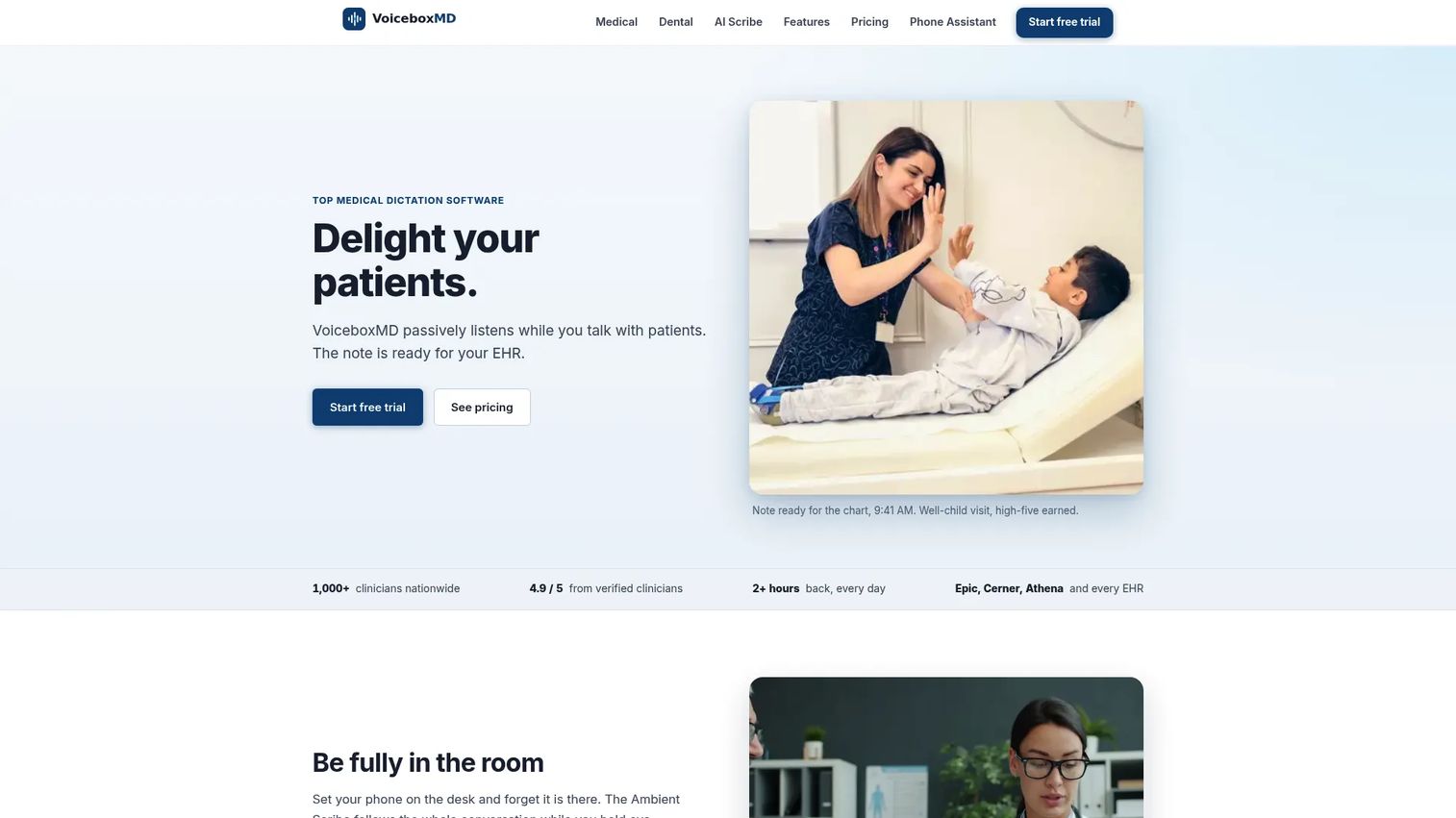
VoiceboxMD is medical dictation and AI scribe software built for physicians and other clinicians, not radiology-only. It pairs real-time speech-to-text with an AI Medical Scribe that generates SOAP notes, and it runs across Windows, Mac, iOS, and the web. For a solo radiologist or a small imaging group that wants dictation without a heavy IT rollout, that cross-platform, EHR-agnostic reach is the draw.
The Mac and multi-device support matters more than it sounds. Most enterprise radiology reporting software is Windows-first, so Mac-based practices often get pushed toward workarounds. VoiceboxMD sidesteps that.
Best for: Solo and small medical practices needing dictation plus AI documentation support.
Key features
- Real-time medical speech-to-text
- AI Medical Scribe with SOAP note generation
- EHR-agnostic dictation across Windows, Mac, iOS, web
- Cross-device continuity
Why choose VoiceboxMD: If you run a small or independent practice and procurement friction is your enemy, this is the low-setup entry point, especially if your team lives on Macs.
VoiceboxMD pricing: Three monthly plans: Essential at $49/mo, Power at $79/mo, and Premium at $139/mo. All plans include a 7-day free trial.
VoiceboxMD holds a 4.5/5 rating on G2, though that reflects a small number of reviews, so treat it as directional rather than settled.
2. Rad AI Reporting
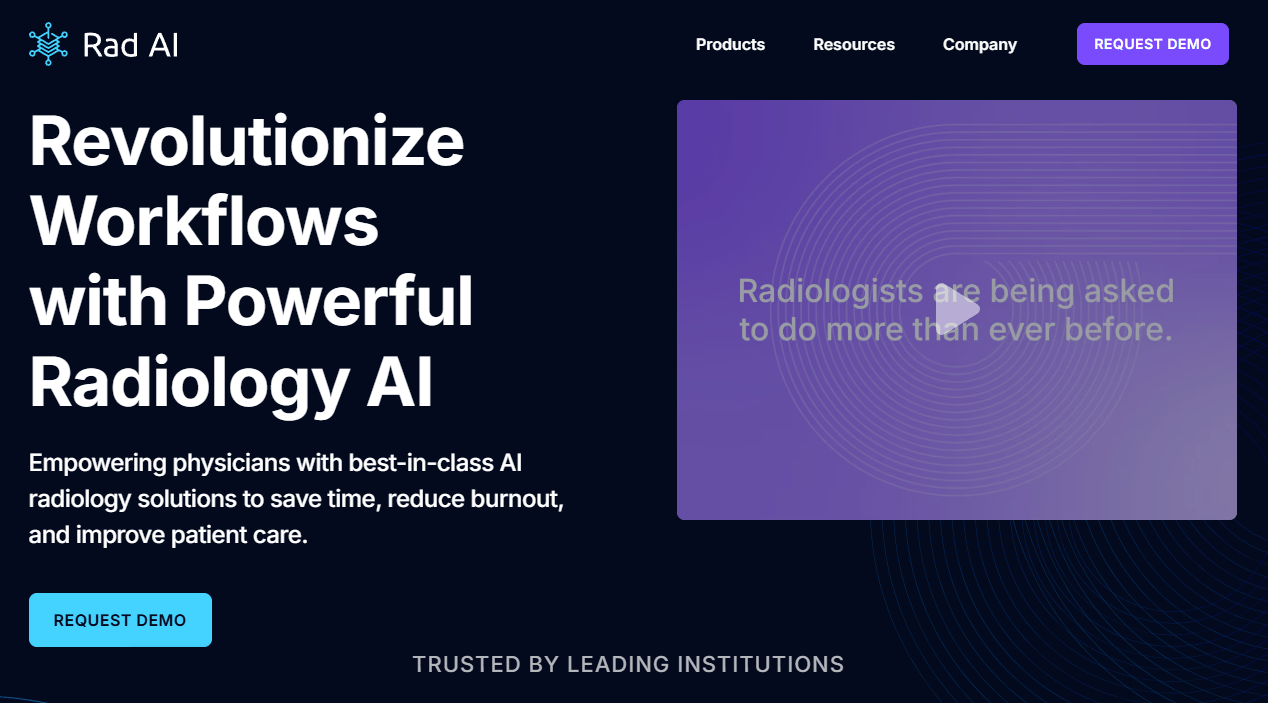
Rad AI Reporting is AI-assisted radiology reporting software designed to speed up dictation and report generation without forcing a practice off its current systems. You dictate using your existing microphone and work inside your PACS, RIS, and EHR, while generative AI reduces the words you dictate and drafts report language for you. It positions itself as an open platform with integrations and workflow support.
The appeal for a group already invested in its stack is continuity. You get GenAI speed layered onto the workflow your radiologists already know, rather than a migration.
Best for: Radiology practices seeking AI-assisted reporting and workflow efficiency without replacing core systems.
Key features
- Dictate using existing microphone, PACS, RIS, and EHR systems
- Generative AI to cut dictation time and words dictated
- Open platform with integrations
- Workflow support inside current tools
Why choose Rad AI Reporting: Choose it when you want to add AI report generation on top of an established reporting workflow, not tear it out and start over.
Rad AI Reporting pricing: Rad AI runs a demo-based, sales-led process, and the product page routes to a request-demo flow rather than listing numeric plans. Expect to scope pricing directly with their team based on your practice size and workflow.
A settled G2 review score is not yet established for Rad AI Reporting, so weigh it on workflow fit and a hands-on evaluation rather than aggregate ratings.
3. PowerScribe One
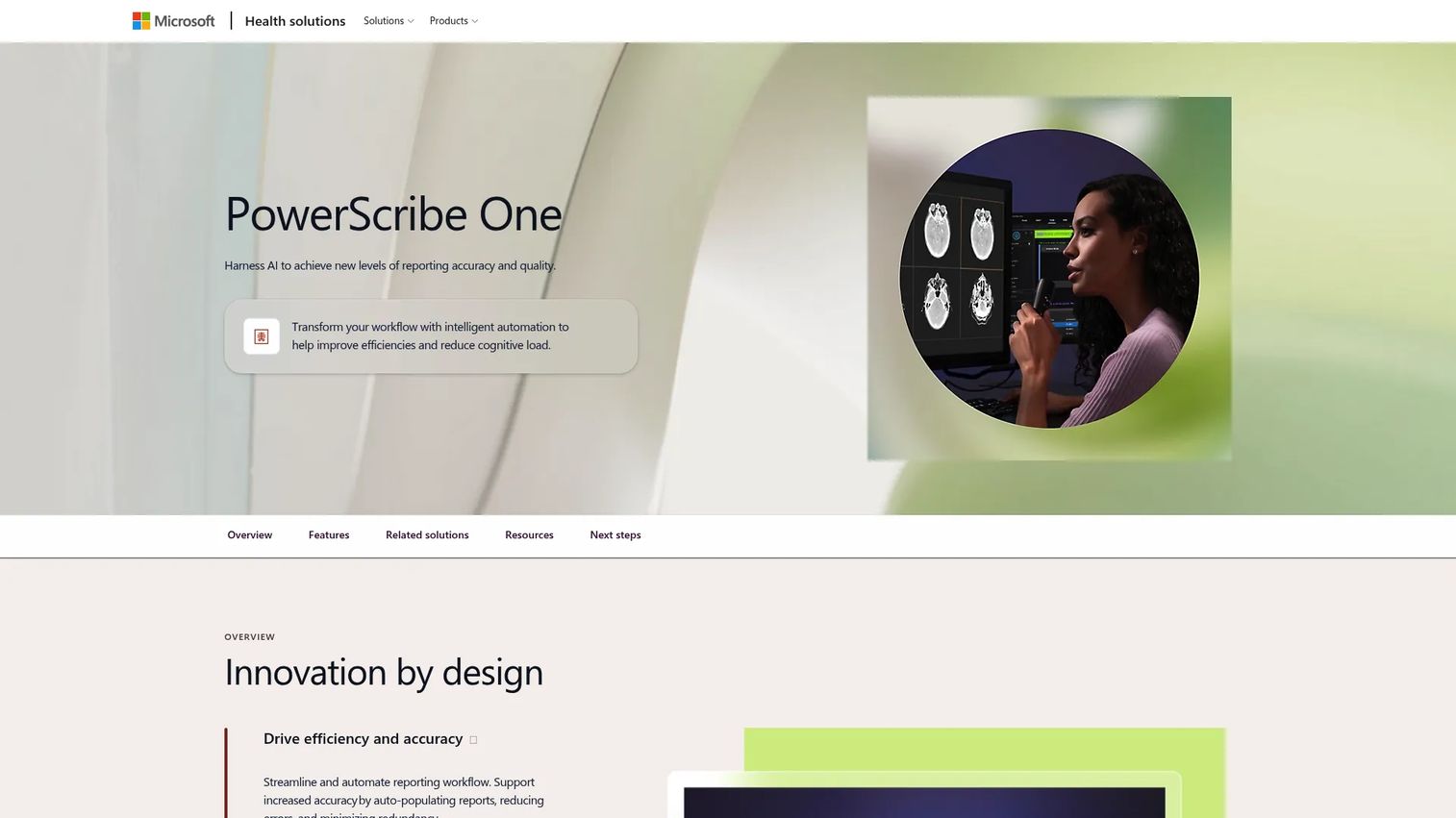
PowerScribe One is the enterprise standard for radiology reporting and dictation, now delivered as cloud-based radiology reporting software with AI, speech recognition, and workflow automation. It carries the features large health systems lean on: cloud speech recognition, automated quality checks and clinical guidance, AI findings, structured reporting, and EMR follow-up automation. Ambient mode and a heads-up display round out the reporting experience.
For a department reading at scale, the value is standardization and governance. When dozens of radiologists share templates, macros, and quality rules, consistency stops being a hope and becomes a system.
Best for: Large health systems and departments that prioritize standardization and deep workflow integration.
Key features
- Cloud speech recognition
- Automated quality checks and clinical guidance
- AI findings and structured reporting
- EMR follow-up automation
- Ambient mode and heads-up display
Why choose PowerScribe One: Pick it when enterprise governance, structured reporting at scale, and tight EMR follow-up matter more than a light footprint or fast self-serve setup.
PowerScribe One pricing: PowerScribe One is sold through an enterprise, sales-led process, so pricing is scoped with the vendor around your health system's size, deployment, and integration needs rather than published as a plan.
A current G2 rating for PowerScribe One is not established from primary sources at the time of writing, so base your evaluation on a departmental pilot and reference calls with comparable health systems.
4. rScriptor
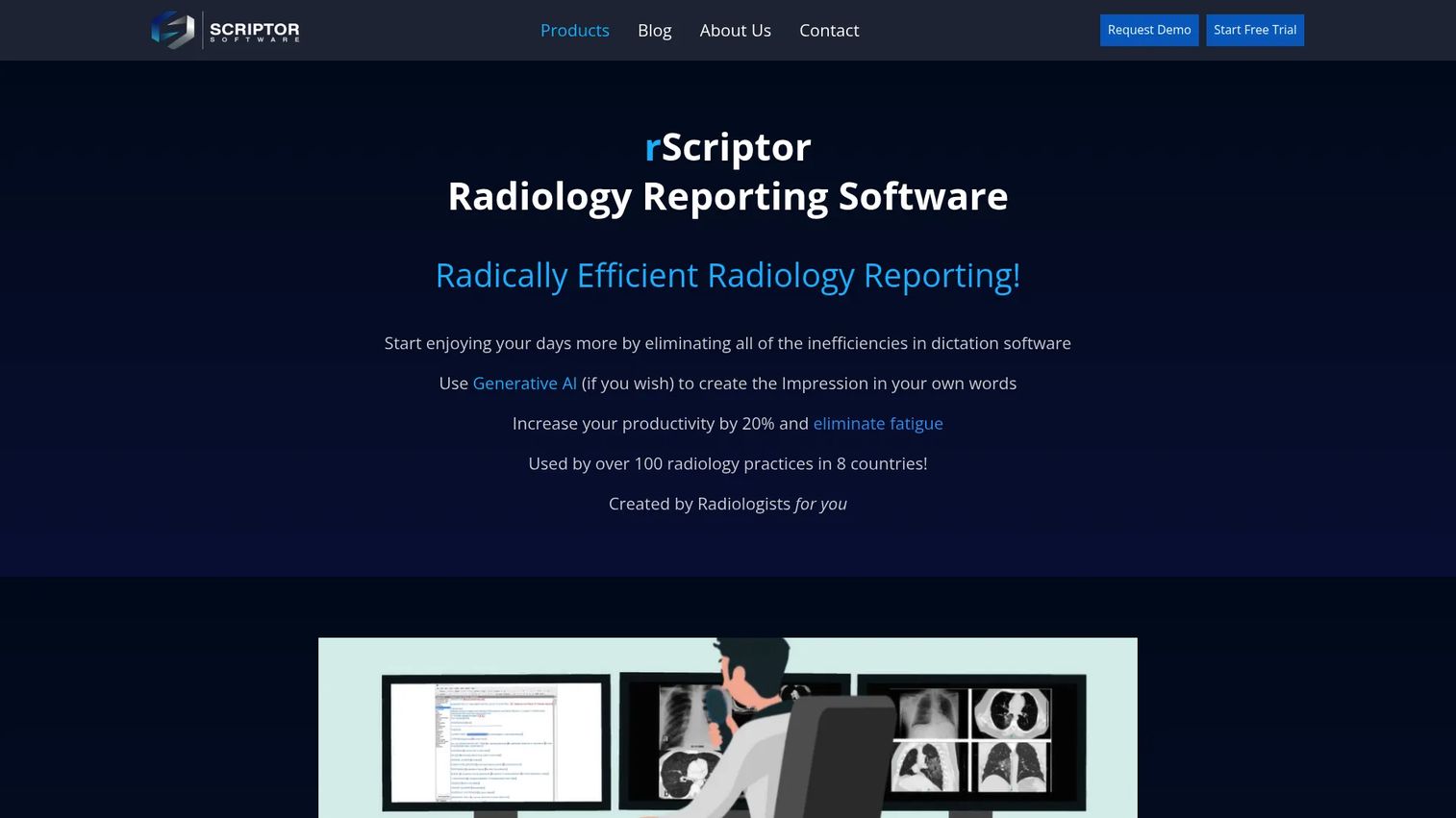
rScriptor is radiology reporting software focused on structured report creation, and it works alongside your existing dictation software rather than replacing it. That is the key idea: keep your voice engine, add a structured reporting layer on top. It brings SmartMacros, a radiology knowledge base, real-time NLP error checking, and cross-PACS compatibility, with a free trial to test the fit.
For a group standardizing on templates and macros, rScriptor turns free-form dictation habits into consistent, structured reports. The real-time NLP checking is the patient-safety angle, catching inconsistencies as the report takes shape.
Best for: Radiology practices that want structured reporting with customizable templates and macros.
Key features
- Structured radiology report creation
- SmartMacros
- Radiology knowledge base
- Real-time NLP error checking
- Works with existing dictation software
Why choose rScriptor: Choose it when your voice recognition already works and the gap is standardization, or when you are migrating a group off inconsistent, free-form dictation styles.
rScriptor pricing: Published per-radiologist monthly pricing scales with team size. An Individual License is $299 per radiologist per month, monthly group licenses run from $279 down to $249 as headcount grows, and 2-year licenses start at $249 and reach $199 per radiologist per month for 100 or more radiologists. A free trial is offered.
A verified G2 rating for rScriptor is not established at the time of writing, so lean on the free trial and template migration test to judge fit.
5. Dragon Medical One
Dragon Medical One is cloud-based medical speech recognition software for healthcare documentation broadly, with radiology relevance through its clinical vocabulary and voice command set. It handles real-time speech recognition directly into EHRs, built-in voice commands for formatting and navigation, and smartphone microphone support through PowerMic Mobile. There is no voice profile training required to start.
Position it as clinical dictation, not a full radiology reporting stack. For a radiologist who mostly needs accurate speech into an EHR and lives in a Windows environment, it fits. For structured radiology reporting with subspecialty templates and impression logic, a radiology-specific tool goes deeper.
Best for: Healthcare teams needing clinical dictation that integrates with EHR workflows.
Key features
- Real-time speech recognition into EHRs
- Built-in voice commands for formatting and navigation
- PowerMic Mobile smartphone microphone support
- No voice profile training required
Why choose Dragon Medical One: Choose it when you want broad, reliable clinical dictation across the EHR rather than a radiology-only reporting platform, and you are comfortable in the Windows ecosystem.
Dragon Medical One pricing: Subscription pricing runs $99/month on a 12-month term, $89/month on 24 months, and $79/month on 36 months, with prepaid options and a one-time $525 setup fee noted at the point of sale. A 14-day free trial is available.
Dragon Medical One holds a 4.3/5 rating on G2.
6. RadVoice
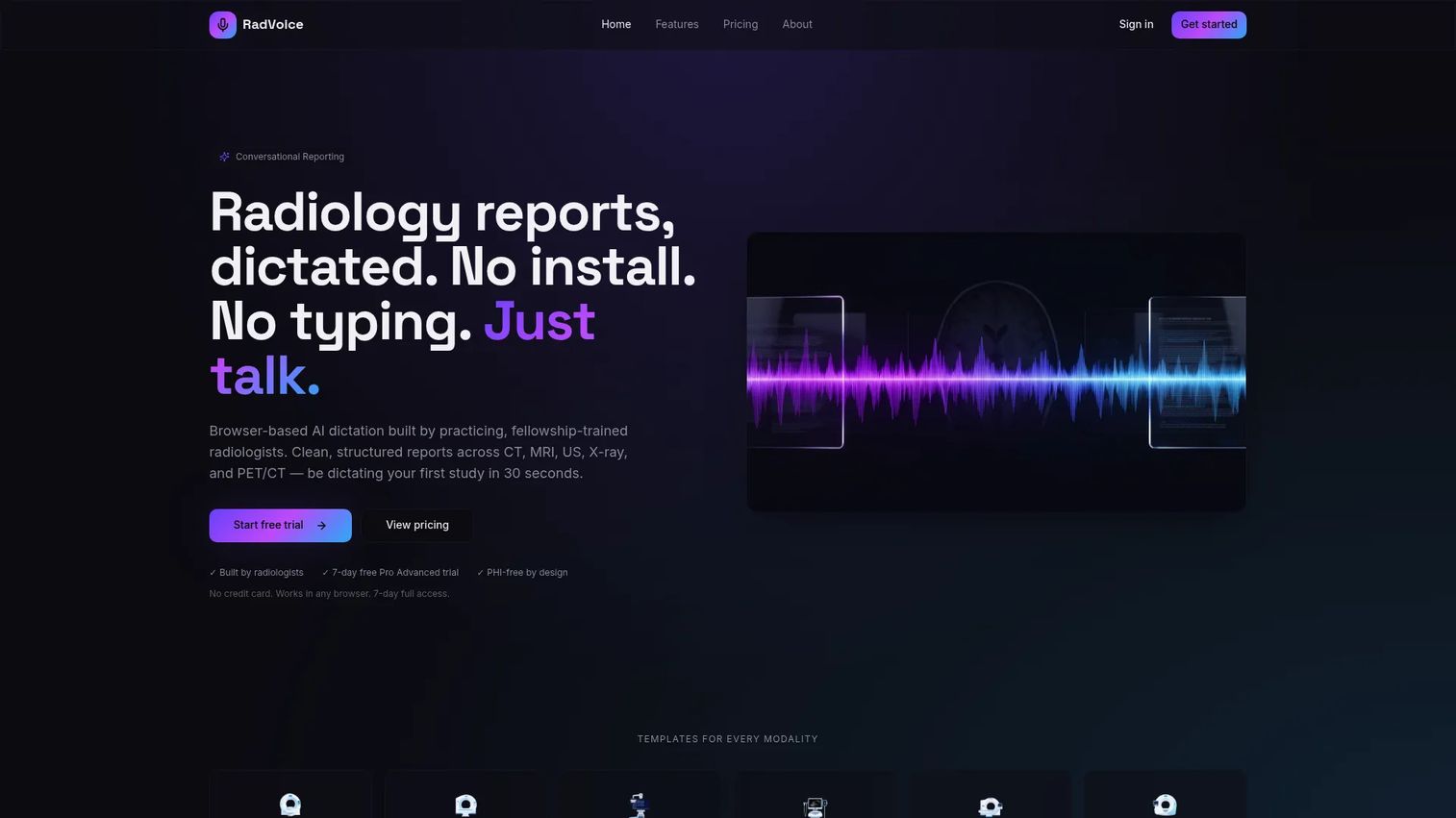
RadVoice is browser-based AI voice dictation built specifically for radiologists. Being browser-native and cloud-based is the point: no heavy install, and quick adoption for an individual radiologist or a smaller group trying modern dictation. It brings AI report formatting and cleanup, a conversational RadVoice Agent, templates by modality and subspecialty, macros and autotext, and multilingual dictation with translation.
For a radiologist who wants to open a tab and start dictating, the low setup is the draw. Templates by subspecialty mean the structure is already close to what you report day to day.
Best for: Radiologists who want browser-based AI dictation and report cleanup.
Key features
- Browser-native dictation
- AI report formatting and cleanup
- Conversational RadVoice Agent
- Templates by modality and subspecialty
- Macros, autotext, and multilingual dictation
Why choose RadVoice: Choose it when you value fast, cloud-native adoption and subspecialty templates, and you would rather work in the browser than manage a desktop install.
RadVoice pricing: RadVoice lists Starter, Pro, Pro Advanced, and Group/Enterprise plans, plus a Resident Bulk Plan billed per cohort. Launch pricing for the main plans is still being announced, and a free tier is offered, so confirm current numbers directly before you commit.
A G2 rating for RadVoice is not established at the time of writing, so evaluate it through the free tier and a short live dictation test.
7. GigHz Precision AI
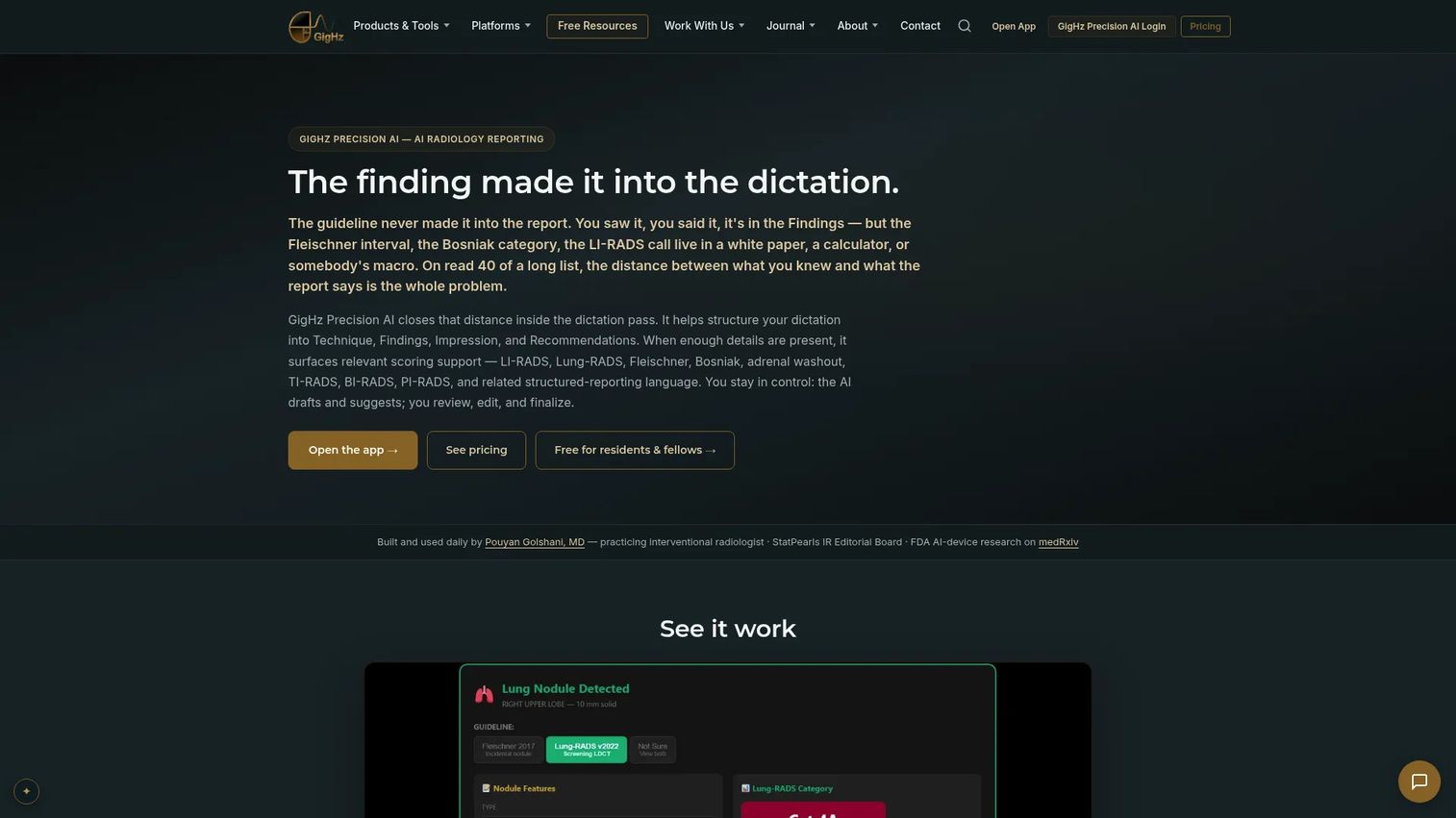
GigHz Precision AI is an AI radiology report assistant that turns dictation into structured, guideline-aware reports. Its structured drafting covers technique, findings, impression, and recommendations, and it layers in scoring support for LI-RADS, Lung-RADS, Fleischner, Bosniak v2019, TI-RADS, BI-RADS, PI-RADS, and adrenal washout. The workflow is built around traceable rationale and reviewer-confirmed output.
For a practice that wants guideline logic baked into the report rather than looked up separately, that scoring support is the differentiator. The traceable rationale and reviewer-confirmed step keep the radiologist in control, which is the right posture for patient safety.
Best for: Radiology practices that want guideline-aware structured reporting inside the dictation workflow.
Key features
- Structured report drafting: technique, findings, impression, recommendations
- Guideline and scoring support across LI-RADS, Lung-RADS, Fleischner, and more
- Traceable rationale
- Reviewer-confirmed workflow
Why choose GigHz Precision AI: Choose it when guideline-aware, scoring-driven reporting is central to your subspecialty mix and you want the rationale visible and confirmable before sign-off.
GigHz Precision AI pricing: Founding pricing with monthly billing lists a Solo practice plan at $249/user/mo and a Group plan for five or more users at $199/user/mo. Enterprise and teleradiology are a custom quote, and residents and fellows get free access for three or more months in exchange for structured feedback.
A current G2 rating for GigHz Precision AI is not established from primary sources at the time of writing, so weigh it on a guideline-focused pilot.
Considerations
Accuracy and patient safety
Judge voice recognition accuracy by how the tool handles the hard cases, not the easy dictation. Check laterality handling, measurement capture, and whether the software flags uncertain or inconsistent text for you. The best real-time error checking surfaces a mismatched "left" or "right" before it reaches the impression. Whatever the tool claims, the radiologist still owns human review before sign-off. Automation that reduces review to a rubber stamp trades patient safety for speed, which is the wrong trade.
PACS, RIS, and EHR integration
Integration depth matters more than a generic "works with PACS" claim. Verify that PACS integration, RIS integration, and EHR integration keep the workflow continuous, so a radiologist is not copy-pasting between systems or losing prior context. Ask exactly which systems are supported and how deep the hooks go. Some structured reporting tools deliberately sit on top of existing dictation, which can be an advantage if your voice engine already works.
Templates, macros, and structured reporting
Look at how easily your team can build, govern, and reuse standardized language. Templates and macros are only useful if radiologists actually adopt them, so test how quickly a new template goes live and whether migration from your current language is manual or assisted. For groups, template governance is what keeps report standardization from drifting across readers and subspecialties.
Deployment and security
Confirm cloud vs on-prem, HIPAA posture, BAA availability, and how much IT overhead the rollout carries. Cloud-native tools tend to adopt faster and need less local maintenance, while some enterprises still require on-prem control. Check Mac support if your practice is not Windows-only. Keep this concrete: which systems, which controls, whose responsibility.
Cost and adoption
Compare the pricing model, contract terms, training time, and rollout complexity together, not in isolation. A cheaper monthly plan that takes weeks to adopt can cost more than a pricier tool your radiologists use on day one. The real test is whether the tool saves enough radiologist time, on turnaround and repetitive dictation, to justify switching.
Conclusion
The right radiology dictation software depends on what you are actually buying: enterprise standardization, standalone clinical dictation, or a structured reporting layer on top of what already works.
For large departments that need governance and structured reporting at scale, PowerScribe One is the enterprise anchor. For AI-assisted reporting without a migration, Rad AI Reporting layers GenAI onto your existing PACS, RIS, and EHR. Solo and Mac-friendly practices get a low-friction start with VoiceboxMD, while RadVoice offers cloud-native, browser-based dictation with subspecialty templates. If your voice engine works and the gap is standardization, rScriptor adds SmartMacros and structured reporting on top, and GigHz Precision AI brings guideline-aware scoring into the draft. Dragon Medical One remains the broad clinical dictation option across the EHR.
Next step: shortlist two tools from the comparison table, then run a short pilot on real studies. Measure turnaround time and, more importantly, whether accuracy and laterality handling hold up under your own review discipline before you commit.
FAQs
For a small or independent practice, prioritize low setup time, transparent pricing, and platform fit. VoiceboxMD suits Mac-based or multi-device teams and starts at $49/mo, while RadVoice offers browser-based dictation with a free tier. The trade-off is depth: enterprise tools like PowerScribe One go deeper on governance and structured reporting, but carry heavier deployment for a small group.
For most reporting workflows, yes. PACS integration keeps images and the report in one continuous flow, which matters most in high-volume settings where switching context costs minutes per study. That said, some structured reporting tools, like rScriptor, deliberately sit on top of existing dictation and PACS rather than replacing them, so the integration is about fitting your current stack rather than owning it.
Accuracy varies by workflow, subspecialty vocabulary, and how disciplined the review step is. Modern radiology speech recognition handles routine dictation well, which is why 85% of radiologists already use it per a 2017 Reaction Data study. But raw recognition accuracy is not the whole story: human review still matters for clinical safety, especially on laterality errors and measurements that a model can get confidently wrong.
Yes, but as broad clinical dictation rather than a radiology-specific reporting stack. Dragon Medical One handles accurate speech into EHRs with clinical vocabulary and voice commands, which fits radiologists who mainly need reliable dictation. For subspecialty templates, structured impressions, and radiology-specific reporting logic, dedicated radiology reporting software tools like PowerScribe One, rScriptor, or Rad AI Reporting go deeper.
Hospitals should weigh governance, template management, SSO and security, integration depth across PACS, RIS, and EHR, and auditability of who changed what. Structured reporting and quality checks reduce variation across a large reading group. Enterprise tools like PowerScribe One are built for that scale, but the buying decision should still rest on a departmental pilot and reference calls with comparable health systems.
It can, by cutting repetitive dictation and after-hours report cleanup, which are common burnout drivers. Templates and macros remove the friction of retyping normal findings, and faster turnaround means fewer reports pile up. It is not a cure on its own, but reducing the documentation load on every study adds up across a shift, which supports burnout reduction over time.
Cloud radiology dictation can support HIPAA workflows, but safety depends on the vendor's controls, BAA availability, and your own internal policies, not the cloud label alone. Confirm the vendor signs a BAA, ask how data is encrypted and access-controlled, and align the deployment with your compliance team. This is an operational checklist, not legal advice, so route the specifics to your own counsel and security staff.
Templates and macros speed up report creation, enforce consistent wording, and cut the repetitive dictation that eats time on routine studies. For an individual radiologist, they mean fewer words spoken per normal report. For a group, they drive report standardization across readers and subspecialties, which makes peer review cleaner and downstream data more reliable.