Your onboarding flow asks users for the same proof twice. Security wants stronger verification. Legal wants fewer copies of sensitive data. Engineering sees another identity project waiting to consume two quarters.
That tension is where decentralized identity becomes a serious architectural conversation. The underlying idea is straightforward: Let users hold cryptographically verifiable credentials and present them on demand, rather than your systems collecting and storing the same raw documents over and over. The World Bank's 2024 ID4D Global Dataset found that 2.8 billion people live in countries without a way to prove official identity online, which signals how early the global infrastructure still is. Meanwhile, the global decentralized identity market reached an estimated $3.65 billion in 2025 (Grand View Research, 2026), with OpenID4VC protocol adoption accelerating across government and enterprise programs.
Choosing the right platform is not a feature comparison. It requires understanding which role your product plays: Credential issuer, verifier, wallet operator, or some combination. The eight tools below cover that range.
What's inside
This guide is written for product managers evaluating decentralized identity platforms before technical discovery, architecture review, or pilot design. Tools were selected across four implementation paths:
- Enterprise identity environments with existing Microsoft or Ping Identity infrastructure
- Standards-first credential issuance and verification
- Open-source and developer-oriented DID tooling
- Wallet, consent, and selective disclosure experiences for privacy-sensitive onboarding
Selection criteria: Standards support (W3C verifiable credentials, OpenID4VCI, OpenID4VP), production readiness, pricing transparency, and fit for the issuer-holder-verifier model. These platforms are not interchangeable. The right choice depends on whether you are issuing credentials, verifying them, operating a wallet, or connecting all three.
TL;DR
- Best for Microsoft-centered enterprises: Microsoft Entra Verified ID fits teams already operating within Microsoft Entra, with free usage up to 50,000 transactions per month
- Best for standards-first development: SpruceID offers open-source building blocks for DIDs, wallets, and mobile credentials, particularly in government contexts
- Best for portable credential ecosystems: Affinidi covers issuance, verification, wallet capabilities, and consent-driven data sharing, with a free tier for developers
- Best for focused credential programs: Truvera targets reusable credential issuance and verification workflows with a 30-day free trial
- Best for protocol flexibility: walt.id, MATTR, Indicio, and PingOne Credentials each serve distinct enterprise, developer, and regulated implementation models
What is decentralized identity?
Decentralized identity is an identity model in which people, organizations, devices, or software agents control cryptographically verifiable identifiers and credentials without relying on one central identity provider for every interaction.
The core components
- Decentralized identifiers (DIDs): Identifiers that resolve to a DID document containing verification methods and service endpoints. The DID document is the public record that lets a verifier confirm who signed a credential
- Verifiable credentials: Digitally signed claims, such as employment status, age eligibility, organizational role, or an identity verification result. The W3C Verifiable Credentials specification defines the data model
- Digital identity wallets: The holder's interface for storing, managing, and presenting credentials. Wallet UX and recovery design are often the biggest product risk
- Issuer-holder-verifier model: The issuer signs a credential, the holder stores and presents it, and the verifier checks cryptographic validity and revocation status
- Trust infrastructure: The registries, trust lists, and revocation mechanisms used to resolve identifiers and validate issuer authority
How decentralized identity differs from familiar identity systems
| Model | Who controls identity data | Typical example | Best fit |
|---|---|---|---|
| Centralized identity | One provider | App account database | Product login and account administration |
| Federated identity | Identity provider | SSO through an enterprise IdP | Workforce and B2B SaaS access |
| Decentralized identity | Holder and trusted issuers | Wallet-held verifiable credentials | Portable proofs and cross-organization verification |
| Self-sovereign identity | Holder-directed model with broad user control | Credential ecosystem using DIDs and wallets | Privacy-sensitive, reusable credential experiences |
Self-sovereign identity (SSI) is a related approach that emphasizes user control over credentials and data sharing. It describes a design philosophy more than a specific protocol.
Important clarification for product teams
Decentralized identity does not automatically replace SSO, account management, fraud controls, or consent design. Most product teams operate a hybrid model: Decentralized credentials for reusable proofs, conventional authentication and authorization where they already work well.
When to use decentralized identity
Reduce repeated verification during onboarding
Use decentralized credentials when users submit the same documents across products, partners, or marketplaces. Reusable credentials reduce repetitive data collection, but only when issuers, wallets, and verifiers support compatible standards and shared trust rules. Map the full issuer chain before committing to a platform.
Verify claims without collecting excess data
Use decentralized identity when the product needs one specific attribute rather than a complete document. Selective disclosure lets a holder prove they are above a certain age, belong to a verified organization, or hold a certification, without exposing unrelated fields. Confirm your required credential format with engineering before shortlisting platforms.
Support multi-party ecosystems
Use decentralized identity when trust must cross organizational boundaries: Educational credentials, supply-chain participant verification, partner ecosystems, or regulated cross-border services. These deployments require governance decisions about issuer trust lists, revocation handling, schema versioning, and support operations. The platform is only one input.
Decentralized identity tools comparison
Not every platform below does the same job. A DID library, a managed credential service, and an enterprise identity extension address different implementation problems. Compare platforms by ecosystem role first, then by protocol support and pricing.
Pricing and G2 ratings verified from vendor pricing pages and review listings, October 2026. Mark unavailable ratings as N/A.
| # | Product | Best for | Key differentiator | Pricing | G2 rating |
|---|---|---|---|---|---|
| 1 | Microsoft Entra Verified ID | Entra-centered enterprises | Integrated with Microsoft identity and Azure | Free up to 50,000 transactions/month; Entra Suite from $12/user/month | 4.1/5 |
| 2 | SpruceID | Standards-first developers and government | Open-source DID, credential, and wallet tooling | Contact vendor | N/A |
| 3 | Affinidi | Portable credential and consent-driven workflows | VC issuance, verification, wallet, and trust-network | Free developer tier; paid plans on request | 5.0/5 |
| 4 | Truvera | Focused credential issuance and verification | Reusable credential infrastructure with wallet SDK | 30-day free trial; production pricing on request | 4.3/5 |
| 5 | walt.id | Protocol-flexible credential services | Open-source Community Stack plus enterprise tier | Community Stack free; Enterprise on request | N/A |
| 6 | MATTR | Regulated and enterprise credential programs | Standards-based credential and wallet infrastructure | Free trial; paid plans on request | N/A |
| 7 | Indicio | Enterprise credential orchestration | Reusable credentials with biometric identity verification | Developer Package complimentary; Startup from $500/month | 4.6/5 |
| 8 | PingOne Credentials | Ping Identity customers | Credential capabilities within a broader IAM stack | Contact vendor | 4.4/5 |
Best decentralized identity tools for 2026
1. Microsoft Entra Verified ID
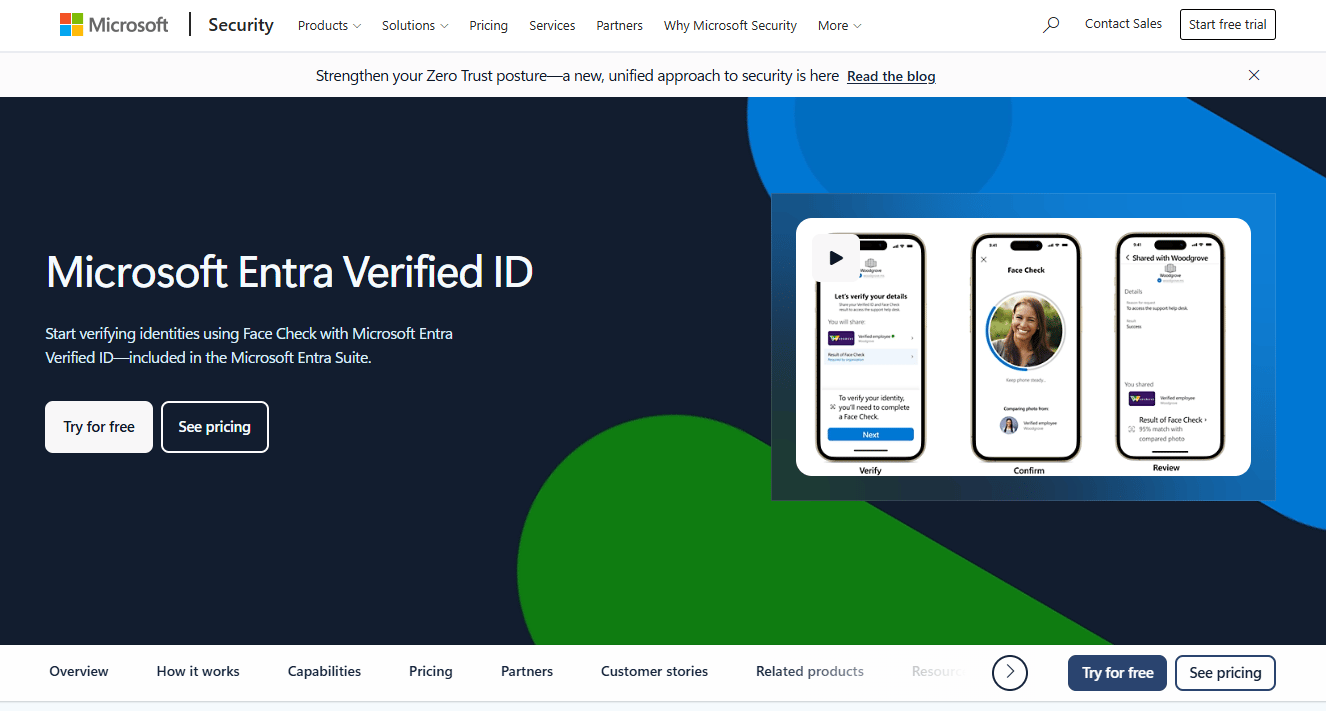
Microsoft Entra Verified ID is a managed verifiable credential service for building user-owned identity scenarios within the Microsoft identity stack. It supports credential issuance and verification through APIs, credential branding customization, and a Face Check facial matching capability for high-assurance verification. Organizations issue credentials to users, who store them in a compatible digital wallet and present them for verification at a later point.
Best for: Product teams at organizations already standardizing identity around Microsoft Entra ID and Azure, where a separate credential platform would create cross-team friction.
Key features
- Issue and verify W3C verifiable credentials
- Face Check facial matching for high-assurance scenarios
- Customize credential branding, claims, and revocation rules
- User-approved credential presentation via digital wallet
- Open-standards support for interoperability
Why choose Microsoft Entra Verified ID: The strongest argument is organizational fit. If the IAM team already owns Entra ID and the security team lives inside Azure, adding a credential program here avoids a parallel procurement and a second identity stack. It is a weaker fit for teams seeking a chain-agnostic credential infrastructure outside the Microsoft perimeter.
Microsoft Entra Verified ID pricing: The service is free up to 50,000 transactions per month with an Azure subscription. For organizations standardizing across the full identity suite, Microsoft Entra Suite is priced at $12 per user per month, billed annually, and includes Verified ID along with other Entra capabilities. Microsoft Entra ID P1 or P2 is required to continue beyond the free transaction allowance.
G2 rating: 4.1/5
2. SpruceID

SpruceID builds digital trust infrastructure for government agencies and regulated organizations, covering identity, credentials, digital transformation, and privacy-preserving verification. Its tooling spans mobile driver's license issuance and verification, secure digital wallets, SSO, digital forms, and legacy-system integration. SpruceID's approach is standards-first: ISO and W3C credential formats are central to its architecture rather than optional add-ons.
Best for: Product and engineering teams building credential issuance, wallet, or verification flows that require open-standards compliance and deep protocol-level control, particularly in public-sector or government-adjacent programs.
Key features
- Digital identity and credential platforms with ISO and W3C support
- Secure digital wallets and SSO integration
- Mobile driver's license issuance and verification
- Privacy-preserving verification and fraud prevention
- Digital forms, workflow automation, and legacy-system connectors
Why choose SpruceID: Choose SpruceID when you need durable, open-standards identity infrastructure rather than a narrow credential feature. The trade-off is ownership: Open components give engineering flexibility, but the product team must define wallet UX, credential recovery, issuer trust rules, and revocation behavior before build begins. That is an opportunity cost decision worth making explicit.
SpruceID pricing: SpruceID's terms state that services are currently available without charge, with the right to introduce fees in the future. Commercial and deployment arrangements vary. Contact SpruceID directly for current engagement terms before committing to architecture decisions based on cost assumptions.
3. Affinidi

Affinidi provides privacy-first infrastructure for verifiable identity, trust verification, credential management, and governed AI-agent interactions. It covers the full credential stack: W3C verifiable credential issuance and verification, decentralized identity with DIDComm v2.1 encrypted messaging, wallet and vault capabilities, and consent-driven data sharing. For teams designing portable identity workflows, Affinidi also supports OpenID4VCI and OpenID4VP, the protocols that underpin interoperable credential exchange.
Best for: Product teams designing portable credential and consent-driven data-sharing workflows that require multi-wallet support and privacy-aware user experiences.
Key features
- W3C verifiable credential issuance and verification
- Decentralized identity with DIDComm v2.1 encrypted messaging
- OpenID4VCI and OpenID4VP protocol support
- Wallet and vault capabilities for credential storage
- Consent-driven data sharing with schema and credential management
Why choose Affinidi: The platform fits teams trying to reduce repeat form entry or let users share verified claims without handing over a full document. Success depends heavily on consent copy, user comprehension, and wallet choice. If your product involves telling a user exactly what data they are sharing and why, the instrumentation of that consent journey matters as much as the credential infrastructure underneath it.
Affinidi pricing: Developers start on the Essential Plan, which is free. Paid plans for production-scale deployments require contacting Affinidi directly, as tier pricing is not displayed on the documentation portal.
G2 rating: 5.0/5
4. Truvera
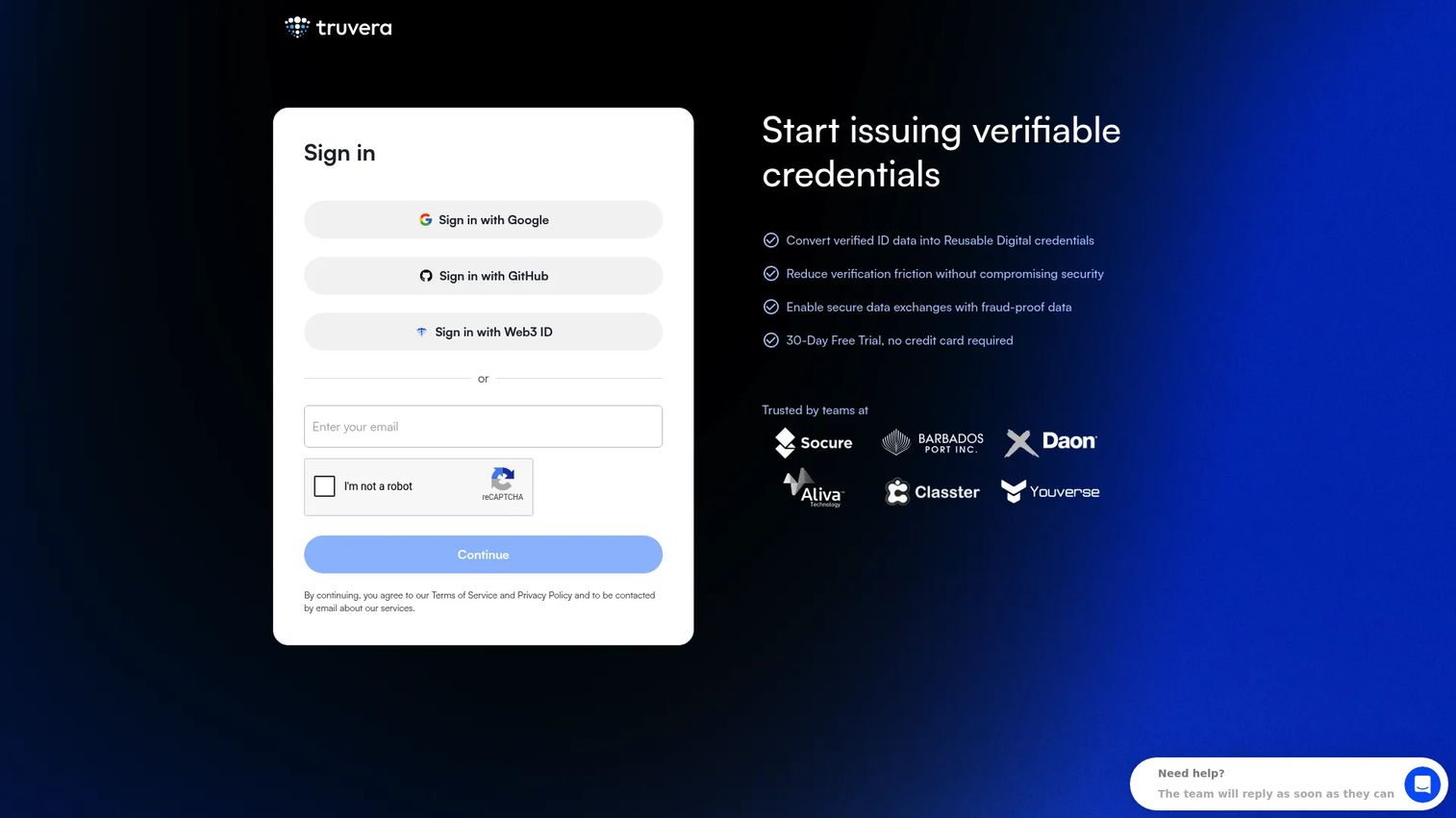
Truvera is a digital identity platform focused on issuing, verifying, managing, and storing reusable verifiable credentials. The platform covers the full credential lifecycle: Issuance, verification, revocation, and unrevocation, alongside tools for creating and managing decentralized identifiers. Truvera also includes zero-knowledge proofs, selective disclosure, a credential wallet SDK, and white-label wallet options, which makes it a practical choice for organizations that want to offer a branded holder experience without building a wallet from scratch.
Best for: Teams that need a production-ready credential program with clear issuer and verifier workflows, particularly for onboarding, partner verification, education, or marketplace use cases.
Key features
- Issue, verify, manage, revoke, and unrevoke verifiable credentials
- Create and manage decentralized identifiers (DIDs)
- Zero-knowledge proofs and selective disclosure
- Credential wallet SDK and white-label wallet options
- Bulk credential issuance with schema and webhook support
Why choose Truvera: Truvera suits PMs who want a focused credential product rather than a broader identity suite. Before moving to production, work through who issues the credential, which claims are required, how revocation propagates, and how your support team handles failed presentations. Those decisions shape the integration more than the platform choice itself.
Truvera pricing: A 30-day free trial is available with no credit card required. Production plan pricing is not displayed on the current site; contact Truvera for volume and white-label wallet terms.
G2 rating: 4.3/5
5. walt.id
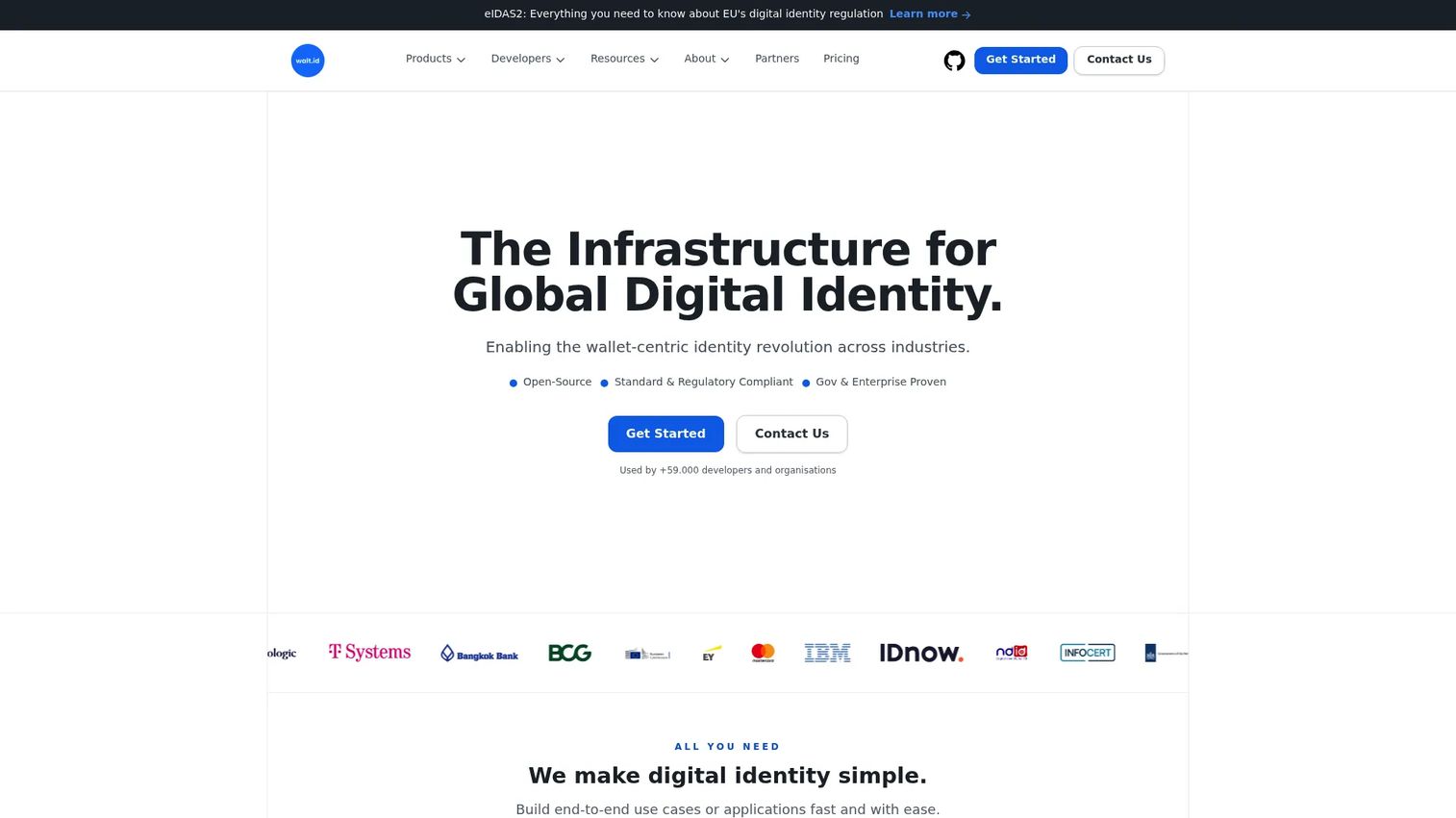
walt.id provides open-source and enterprise infrastructure for issuing, managing, and verifying digital identity credentials and wallets. Protocol flexibility is its main differentiator: Walt.id supports W3C verifiable credentials, SD-JWT VC, ISO/IEC 18013-5 (mdoc), OID4VCI, OID4VP, and the Digital Credentials API. For product teams navigating EUDI Wallet alignment or mobile credential requirements, that protocol breadth is significant. Most of the tooling is open-source and available immediately.
Best for: Technical product teams that need control over credential formats, OpenID4VC flows, SD-JWT, or mdoc support, and want a white-label wallet option with full protocol configurability.
Key features
- W3C Verifiable Credentials, SD-JWT VC, and ISO/IEC 18013-5 support
- OID4VCI, OID4VP, and Digital Credentials API support
- Digital credential issuance and verification APIs
- Credential wallet infrastructure and SDK options
- Credential status, revocation, and suspension management
Why choose walt.id: It fits teams with clear technical ownership and a defined protocol requirement. The open-source Community Stack removes early cost barriers, but teams inherit implementation decisions around wallet UX, security review, and operational monitoring. Treat the protocol requirements as product requirements before beginning platform selection.
walt.id pricing: The Community Stack is open-source and free to build with. The Enterprise Stack adds compliance features, scalability, role-based access control, encryption, integrations, and support. Enterprise pricing requires contacting walt.id directly.
G2 rating: N/A
6. MATTR
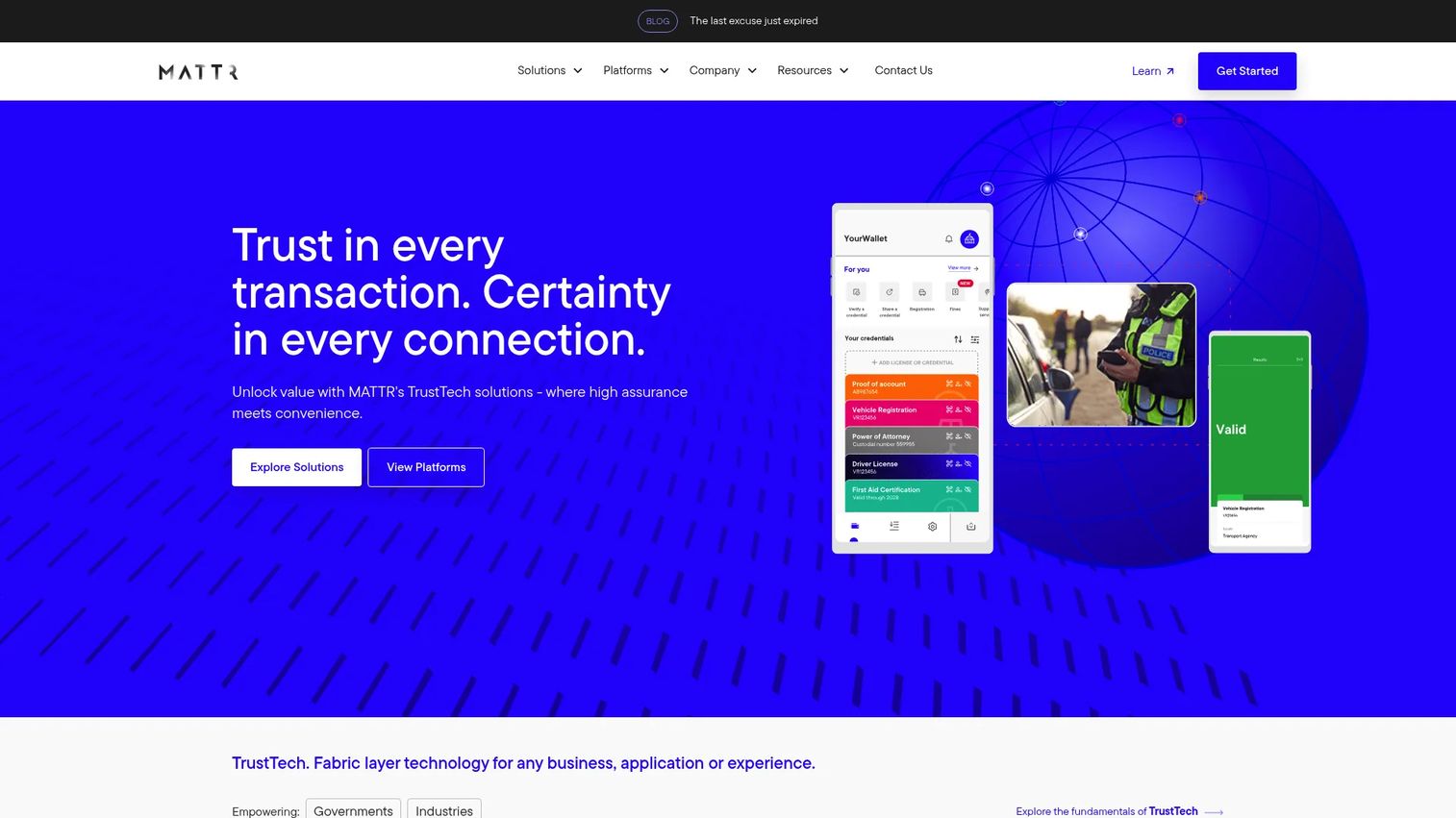
MATTR provides standards-based digital trust infrastructure for issuing, holding, managing, and verifying digital credentials. Its platform, MATTR VII, covers digital credential issuance and lifecycle management, credential holding and presentation through mobile SDKs and white-label apps, online and in-person verification, and trust-network management. MATTR's customer base includes governments, financial institutions, and enterprises building interoperable credential programs, which reflects its emphasis on governance and policy controls.
Best for: Enterprise teams operating in regulated environments where credential format, trust policy, lifecycle controls, and operational support matter alongside the front-end experience.
Key features
- Digital credential issuance and lifecycle management
- Credential holding and presentation via mobile SDKs and white-label apps
- Online, in-person, and proximity credential verification
- Trust-network, tenant, certificate, and access-control management
- Privacy-preserving proof options
Why choose MATTR: The fit is strongest for higher-governance deployments. PMs often underestimate the operational requirements that appear after launch: Trust registry approvals, issuer credential management, environment separation between staging and production, and escalation paths when verification fails. Choosing a platform with enterprise deployment support reduces the operational burden on the product team post-launch.
MATTR pricing: MATTR offers a free trial for MATTR VII. Paid plan pricing is not displayed before upgrading; contact MATTR for commercial terms. Pay-as-you-go pricing details are provided after a paid plan is activated.
G2 rating: N/A
7. Indicio
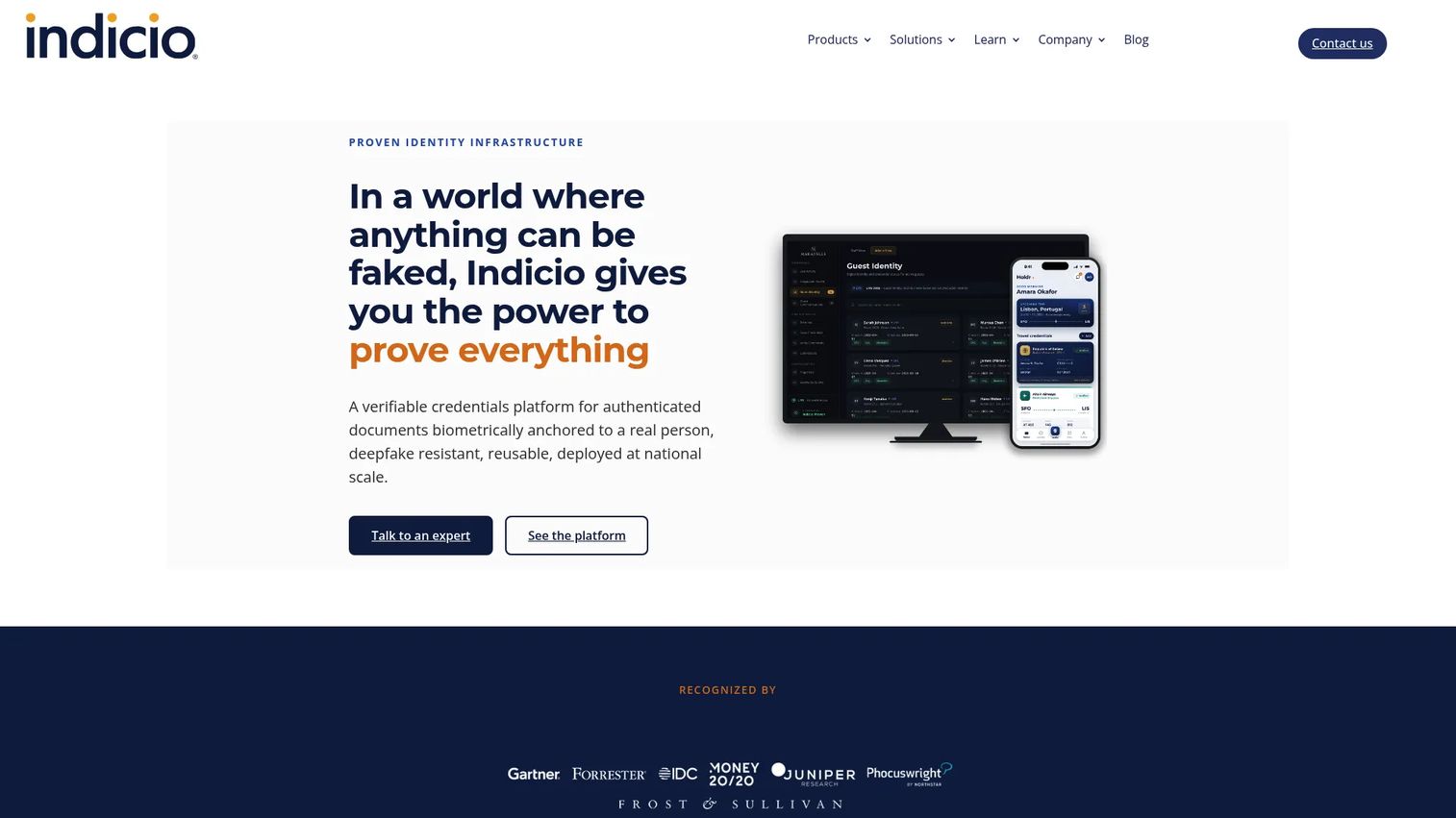
Indicio provides verifiable identity and trust infrastructure for travel, financial services, government, enterprises, and AI agent workflows. Its Proven platform supports authenticated biometric identity verification, tamper-evident reusable verifiable credentials, and fraud and deepfake protection. Credential format coverage is broad: MDOC/mDL, SD-JWT, W3C VC, and AnonCreds are all supported, which matters for teams working across multiple regulatory contexts or international identity programs.
Best for: Product teams building trusted credential workflows in travel, financial services, or government contexts where credential reuse, biometric verification, and fraud resistance are primary requirements.
Key features
- Authenticated biometric identity verification
- Tamper-evident, reusable verifiable credentials
- Mobile wallet integration
- Fraud, deepfake, and credential-misuse protection
- Support for mDOC/mDL, SD-JWT, W3C VC, and AnonCreds
Why choose Indicio: Indicio fits teams that need a partner for end-to-end credential experiences including the holder wallet. A strong platform does not eliminate the need for product decisions about credential recovery, consent copy, renewal triggers, and support escalation. The case for wallet adoption depends on the user having a compelling reason to claim, retain, and reuse a credential: Build that reason into the product design before selecting infrastructure.
Indicio pricing: The Developer Package is complimentary. The Startup Package runs $500 per month and the Business Package runs $1,000 per month, both billed monthly. Production-scale platform pricing for Indicio Proven requires a direct conversation with the team.
G2 rating: 4.6/5
8. PingOne Credentials
PingOne Credentials is a SaaS service for creating, issuing, managing, revoking, and verifying digital verifiable credentials within the Ping Identity platform. It supports customizable credential branding, configurable attributes, automated issuance, centralized lifecycle management, selective disclosure, and real-time verification. For enterprises already running Ping Identity for authentication, workforce identity, or customer identity, PingOne Credentials extends the stack rather than adding a disconnected identity layer.
Best for: Large organizations already operating Ping Identity for authentication or access management that want credential capabilities without adopting a separate identity infrastructure.
Key features
- Customizable digital credentials with branding and configurable attributes
- Automated issuance and centralized lifecycle management
- Selective disclosure, consent controls, and real-time verification
- Enterprise identity stack alignment with Ping Identity
- Governance and administration through existing IAM policies
Why choose PingOne Credentials: The argument is integration ownership. If the identity team already controls a Ping deployment, adding credentials here means the product team shares an operating model with a known counterpart rather than negotiating with a new vendor. The fit weakens for startups or teams operating outside the Ping stack, where the cost of the broader IAM footprint outweighs the credential capability.
PingOne Credentials pricing: Product-specific pricing is not displayed on the PingOne Credentials page. Ping directs prospective customers to contact sales for plan packaging and licensing details. Ask specifically whether credentials are bundled within an existing PingOne agreement or licensed separately.
G2 rating: 4.4/5
Considerations when choosing decentralized identity tools
Choose the ecosystem role first
Decide whether your product is issuing credentials, verifying them, offering a wallet, or connecting all three. A platform built for credential issuance is not automatically the right choice for a team that primarily needs verification APIs. Map the role before evaluating features.
Validate standards and wallet compatibility
Ask engineering to confirm required protocols, credential formats, DID methods, and revocation support before shortlisting. Avoid committing to a proprietary holder experience before defining which organizations must accept the credential and which wallet a user is likely to already have.
Design the user journey before choosing infrastructure
Map the complete flow: Enrollment, proofing, credential issuance, wallet claim, presentation, verification result, support escalation, renewal, and revocation. The strongest protocol stack cannot fix a consent flow users abandon. Consent copy, recovery design, and drop-off instrumentation are product decisions, not platform decisions.
Build measurement into the first release
Track credential issuance completion, wallet claim rate, presentation success, verification completion, repeat credential use, and support tickets. Segment by platform, region, user type, and acquisition channel. Establish a baseline before claiming that the program is working.
Establish governance and operations
Assign owners across product, IAM, security, legal, support, and engineering before launch. Define who approves issuers, updates schemas, handles compromised credentials, monitors revocation, and responds when verification fails at scale.
Conclusion
The eight platforms above cover a wide range of implementation paths. Microsoft Entra Verified ID is the strongest fit for organizations already inside the Microsoft identity stack. SpruceID suits standards-first teams and government programs that need open-source building blocks with protocol-level control. Affinidi fits portable-data and consent-driven credential experiences with a free developer entry point. Truvera works for focused credential issuance and verification programs with a 30-day trial to validate fit before committing.
Walt.id is the right call for teams that need protocol flexibility across OpenID4VC, SD-JWT, and mdoc formats. MATTR and Indicio are worth evaluating for high-governance or regulated deployments where operational support and biometric verification matter. PingOne Credentials fits organizations already operating Ping Identity who want to extend rather than replace their IAM foundation.
The core principle across all eight: Choose the platform after defining the credential lifecycle and user journey, not before. The platform supports the identity model. It does not replace product strategy, governance, or UX validation.
If you're building onboarding or verification workflows that sit alongside identity infrastructure, explore the best identity verification software guide for adjacent tools that complement decentralized credential programs.
FAQs
Decentralized identity is an architecture that allows people, organizations, or devices to hold and present cryptographically verifiable credentials without depending on one central provider for every verification. The holder stores credentials in a digital wallet and presents them to a verifier, who checks cryptographic validity and revocation status without querying the original issuer in real time.
Decentralized identity describes an architecture that reduces reliance on central identity providers. Self-sovereign identity is a related philosophy that emphasizes user control over credentials and data sharing decisions. Not all decentralized identity systems implement the full SSI model; many enterprises adopt decentralized credentials without giving users complete autonomy over every aspect of their identity data.
No. Some DID methods use public blockchains or distributed ledgers for identifiers and trust data, but personal credential data typically stays off-chain. Many production credential systems use standards-based cryptographic proofs with no blockchain dependency at all. Ask any shortlisted vendor which DID methods they support and how identifier resolution works.
Verifiable credentials are digitally signed claims that a verifier can check cryptographically. Examples include employment eligibility, professional certification, age verification, organizational membership, or the result of a prior identity-proofing event. The W3C Verifiable Credentials Data Model specification defines the structure, and the signature allows a verifier to confirm authenticity and revocation status without contacting the issuer directly.
The model describes three roles in a credential transaction: The issuer creates and signs the credential, the holder stores it in a wallet and presents it on request, and the verifier validates the cryptographic signature and checks whether the credential has been revoked. One organization can play more than one role. A university might issue educational credentials and also verify partner credentials as part of an enrollment process.
SSO and decentralized identity solve different problems. SSO helps users authenticate across applications without re-entering passwords. Verifiable credentials let users present trusted claims, such as proof of age or verified employment, to any relying party that accepts the credential format. Most organizations use both, with SSO handling session authentication and credentials handling cross-organizational or high-assurance verification moments.
Track completion rates at each step in the credential lifecycle: Issuance initiation, issuance completion, wallet claim, presentation attempt, and verification success. Add repeat credential use per user, verification failure reasons, support ticket volume related to credential or wallet issues, and time saved in onboarding compared to the prior document-collection flow. Segment all metrics by platform, region, user segment, and acquisition channel before drawing conclusions. For context on measuring related identity workflows, the age verification software and address verification software guides cover adjacent measurement approaches.
Validate the user benefit clearly: Does the user gain something measurable, or does the credential exist primarily for the product's verification needs? Then confirm issuer trust rules, wallet compatibility with your target users' devices, privacy expectations and consent copy, credential revocation and renewal flows, recovery experience when a wallet is lost, analytics instrumentation across the issuance and presentation journey, and operational ownership after launch. Involve security and legal stakeholders during architecture review, not after the platform decision is made.