Your team wants to ship an API this quarter. Nobody wants to spend two weeks sizing instances, tuning autoscaling groups, or babysitting a Kubernetes cluster that idles at 3% utilization overnight. That tension, delivery speed versus infrastructure toil, is exactly what a serverless platform exists to remove.
The market agrees. Grand View Research valued serverless computing at USD 24.51 billion in 2024, with a projected climb to USD 52.13 billion by 2030. Adoption inside the hyperscalers is already deep: Datadog's 2024 State of Serverless found that over 70% of AWS customers, 60% of Google Cloud customers, and 49% of Azure customers in its sample run at least one serverless workload today.
So the question is no longer "should we use serverless." It is "which platform fits our workload, our runtime model, and how our team actually operates." That decision looks different for a two-person startup shipping event-driven functions than it does for a platform team standardizing on hybrid cloud governance. The wrong pick shows up later as portability lock-in, surprise pay-as-you-go bills, or an operating model your engineers quietly resent.
This guide is for product managers, engineering leaders, and platform teams weighing that call. If you also evaluate the observability layer that sits on top of these workloads, our roundup of application performance monitoring tools pairs well with what follows, and teams instrumenting user behavior across services often cross-reference a customer data platform too.
What's inside
We compared seven serverless platforms that credibly serve production workloads in 2026: APIs, event-driven apps, batch jobs, and containerized workloads. Each was assessed against four criteria that matter to a technical buyer: workload fit (what it runs best), scaling model (how it handles spikes and idle time), portability (how tied you are to one vendor), and pricing style (how usage maps to cost).
We prioritized platforms with real adoption, documented pricing, and a clear operating model. Managed compute services, framework layers, edge runtimes, and Kubernetes-native options all made the cut, so you can match the platform to your constraints rather than the reverse.
TL;DR
- Best for AWS-first teams: AWS Lambda is the foundational serverless compute service on AWS, with event-driven execution and 220+ native integrations.
- Best for containerized workloads: Cloud Run runs your own containers serverless-style, scaling to zero without giving up container workflows.
- Best for edge deployment: Cloudflare Workers executes globally at the edge with no cold starts, ideal for latency-sensitive APIs.
- Best for hybrid cloud and Kubernetes alignment: Red Hat OpenShift Serverless brings Knative-based, event-driven apps to teams already on OpenShift.
- Best for a framework layer on AWS: Serverless Framework gives teams opinionated tooling and a large plugin ecosystem on top of Lambda.
- Best for Azure-native teams: Azure Functions delivers event-driven functions wired into the Microsoft ecosystem.
What a serverless platform is
A serverless platform is a cloud service that runs your code or containers on demand, automatically handling provisioning, scaling, and server management so your team focuses on application logic instead of infrastructure. You deploy a function or a container image; the platform decides when to run it, how many copies to spin up, and when to shut them all down.
"Serverless" is a misnomer worth clearing up early. Servers still run your code. You just don't manage, patch, or size them. The operator owns the fleet; you own the logic.
How serverless works
Three mechanics define the model. First, execution is event-driven: code runs in response to a trigger, an HTTP request, a message on a queue, a file upload, a scheduled cron, or a database change. Second, the platform can scale to zero: when nothing is calling your function, no instances run and you pay nothing for idle capacity. Third, billing is pay-as-you-go: you're charged for actual execution (requests plus compute duration), not for reserved capacity sitting warm.
Together these change the cost curve. A workload with spiky, unpredictable traffic stops paying for peak capacity 24/7. A background job that fires twice a day stops holding a reserved instance the other 23 hours.
Common serverless workload types
A serverless application rarely maps to one shape. In practice, teams run:
- APIs and web backends: request/response endpoints behind an HTTP trigger
- Event-driven processing: queue consumers, webhooks, stream handlers
- Scheduled tasks: cron-style jobs, nightly reports, cleanup routines
- Batch and async jobs: file processing, ETL steps, media transcoding
- Integrations and glue code: connecting SaaS tools, transforming payloads
- AI and inference workloads: short-lived model calls and orchestration
Key features buyers evaluate
When shortlisting a serverless platform, technical buyers weigh a consistent set of factors:
- Automatic scaling: how fast it scales up under load and down to zero at idle
- Runtime support: which languages and versions run natively, plus custom runtime options
- Observability: built-in logs, traces, and metrics, and how they feed your monitoring stack
- Developer experience: deploy speed, local testing, and iteration loop
- Deployment model: functions, containers, or both
- Portability: how much of your setup moves if you change providers
When to use serverless
Ship APIs without managing infrastructure
Serverless architecture fits well when traffic is spiky or unpredictable, when time-to-market matters more than squeezing out per-request cost, and when the team wants to skip capacity planning entirely. If a launch could bring 10x traffic for a day and then quiet down, scaling to zero between spikes keeps the bill honest. You trade some control over the runtime for not owning the fleet.
Run event-driven workflows and background jobs
The model maps cleanly to asynchronous work. A webhook fires a function. A file lands in storage and triggers processing. A message hits a queue and a consumer picks it up. A scheduled job runs at 2 a.m. and shuts down when it's done. Because serverless functions are event-driven by design, you wire triggers to code and let the platform handle concurrency and retries.
Support experimentation and fast product iteration
For small teams and early-stage products, serverless lowers the operational overhead of validating an idea. You can stand up an endpoint, ship it, measure, and iterate without provisioning a cluster first. That speed compounds when you're testing multiple features or running short-lived experiments. The same instinct that drives product teams to reach for a fast interactive demo instead of a staging environment applies here: reduce the setup tax between an idea and shipping it.
Comparison table
The seven platforms below span managed functions, container runtimes, edge compute, framework tooling, and Kubernetes-native serverless. Use the intent column to match a platform to your operating model, then read the full section for fit. Pricing is usage-based for most of these, so entry figures reflect the smallest billable unit or paid plan rather than a flat monthly seat.
| # | Product | Intent | Key use case | Pricing | G2 rating |
|---|---|---|---|---|---|
| 1 | Serverless Framework | Framework layer for AWS-first serverless apps | Deploying and managing Lambda apps with plugins | Free CLI; Pay-As-You-Go from $4 per credit | 4.1/5 |
| 2 | AWS Lambda | AWS-first serverless compute | Event-driven functions across AWS services | From $0.20 per million requests; free tier | 4.6/5 |
| 3 | Cloud Run | Container-first serverless | Deploying containers and jobs without infra | From $0.00001800/vCPU-second; free tier | Not listed |
| 4 | Cloudflare Workers | Edge-first serverless functions | Low-latency APIs and edge logic | Free plan; Paid from $5.00/month | Not listed |
| 5 | Red Hat OpenShift Serverless | Kubernetes-native, hybrid cloud serverless | Event-driven apps on OpenShift | Included with OpenShift subscription | 4.5/5 |
| 6 | Azure Functions | Azure-native serverless functions | Event-driven code with Azure integrations | Usage-based; free monthly grant | 4.4/5 |
| 7 | IBM Cloud Functions | Legacy FaaS on IBM Cloud | Event-driven code for IBM environments | Free tier; 5M executions/month | 3.9/5 |
1. Serverless Framework
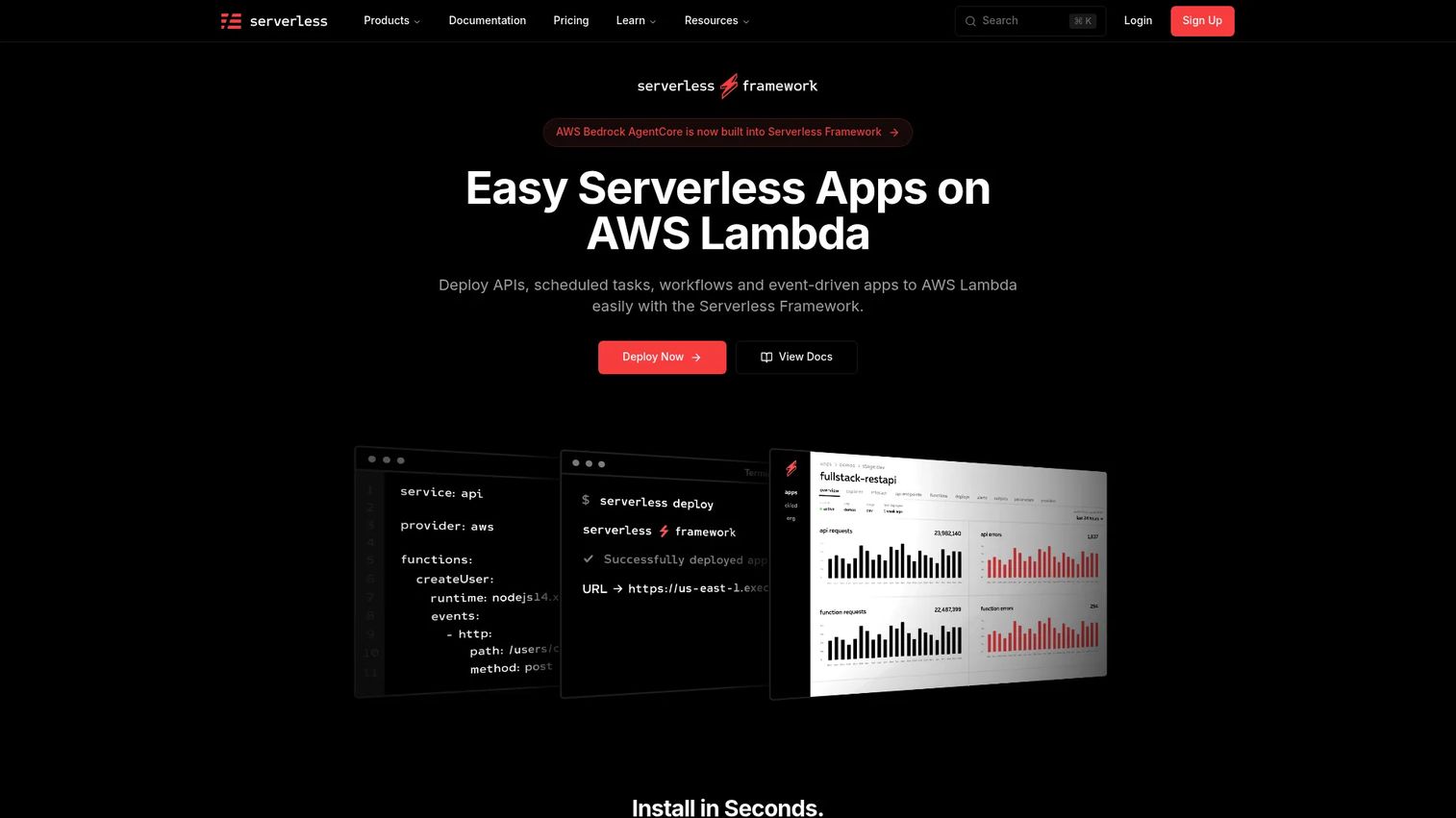
Serverless Framework is a CLI and dashboard for building and deploying serverless applications and infrastructure, primarily on AWS. Instead of hand-writing raw infrastructure config, you describe your service in a YAML file and deploy code plus infrastructure together with a single command. It sits a layer above AWS Lambda, giving teams repeatable structure, a plugin ecosystem, and optional dashboard observability.
Best for: Teams standardized on AWS Lambda that want opinionated tooling and a plugin ecosystem instead of raw infrastructure config.
Key strengths
- Code and infra together: Deploys application code and its supporting infrastructure in one command, so environments stay reproducible.
- Plugin ecosystem: A large plugin library covers custom domains, offline local development, bundling, and Step Functions integration.
- CLI plus dashboard: CLI v4+ pairs with an optional dashboard for traces, metrics, and service-instance billing.
Why choose Serverless Framework: If your team already lives in AWS Lambda but wants a consistent deployment workflow across many functions and services, the framework layer removes repetitive config work. It's the practical choice when you value opinionated structure and community plugins over building your own tooling. The tradeoff is an AWS-first center of gravity, which is a feature if you're committed to AWS and a constraint if you plan to spread across clouds.
Serverless Framework pricing: CLI v4+ is free for most users. Organizations earning over $2M annually require a paid subscription. Public pricing includes Pay-As-You-Go at $4 per credit, Reserved Credits as low as $1 per credit, and an example 50-credit monthly plan priced around $142. There is a free tier for smaller teams.
2. AWS Lambda
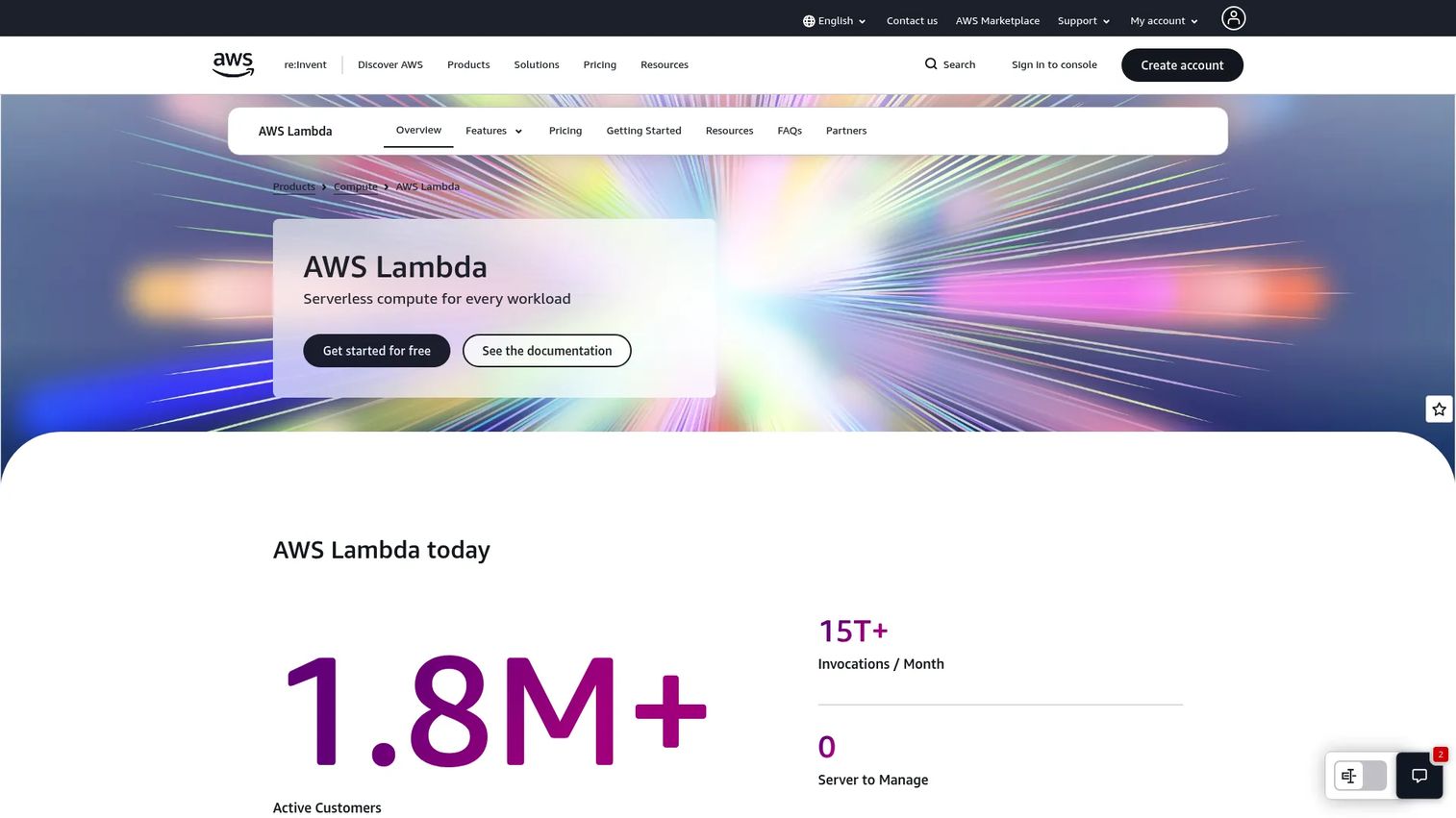
AWS Lambda is Amazon Web Services' serverless compute service for running code without managing servers. It's the foundational FaaS offering on AWS and, for many teams, the default meaning of "serverless functions." You upload code, define a trigger, and Lambda handles execution and scaling. Its gravitational pull comes from how tightly it integrates with the rest of AWS.
Best for: Teams building event-driven or serverless applications on AWS that want deep native integration across the AWS service catalog.
Key strengths
- Serverless compute with pay-per-use billing: You pay per request and execution duration, with a generous monthly free tier.
- Deep event-driven integrations: Native triggers span 220+ AWS services, from S3 and DynamoDB to EventBridge and API Gateway.
- Multiple execution options: Functions, MicroVMs, and Managed Instances give teams flexibility across latency and control needs.
Why choose AWS Lambda: If your stack already runs on AWS, Lambda is the path of least resistance for event-driven work. The breadth of native triggers means you rarely write glue code to connect services. It's the strongest fit when AWS is your home and you want serverless functions that plug directly into everything else you already run there.
AWS Lambda pricing: Lambda charges for what you use. Lambda Functions are priced from $0.20 per million requests plus execution duration. The free tier includes one million requests and 400,000 GB-seconds per month. Lambda Managed Instances add a 15% premium on the EC2 on-demand instance price, and Durable Functions carry additional charges for durable operations, data written, and retention. Exact duration rates are region-dependent.
3. Cloud Run
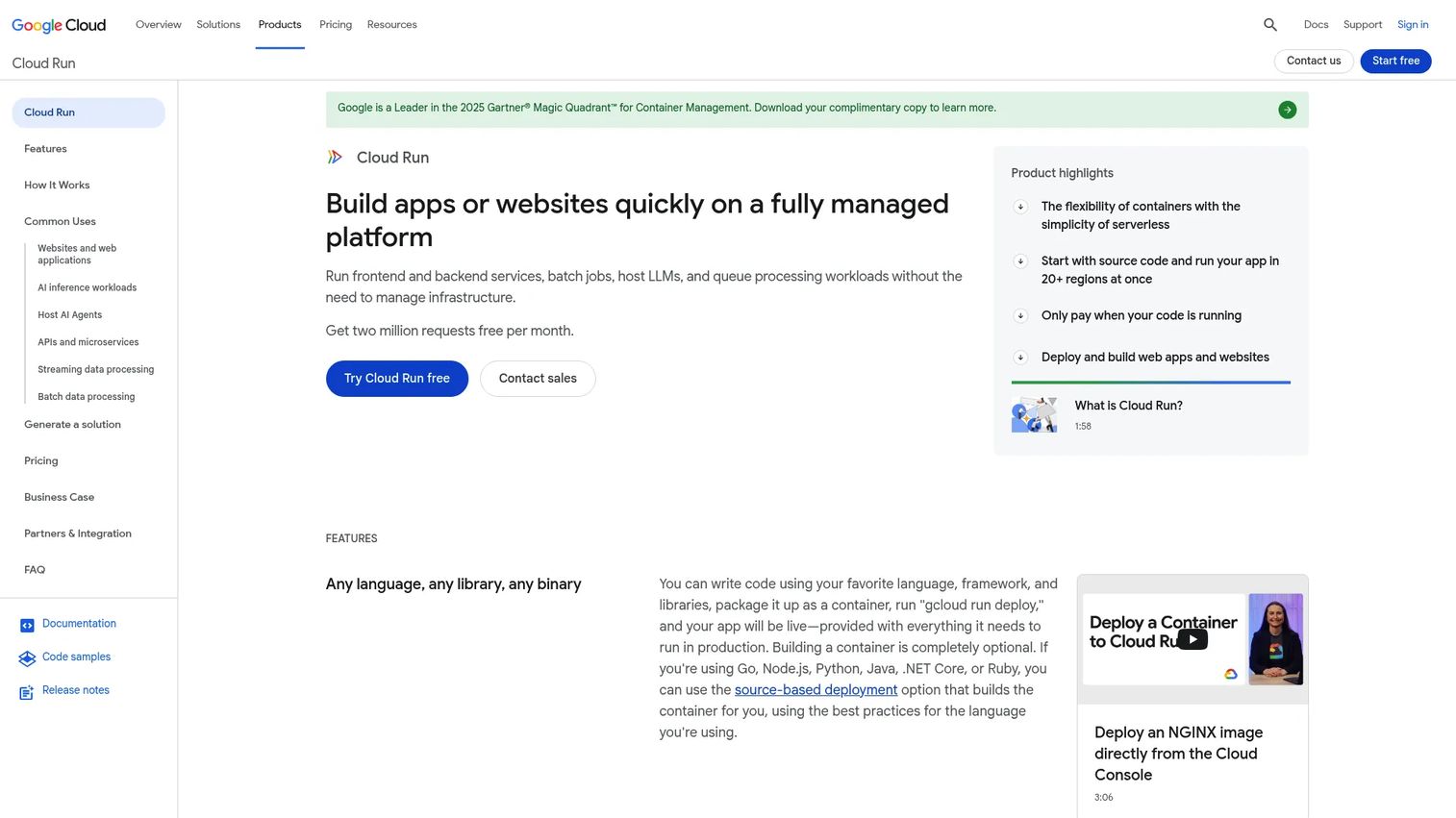
Cloud Run is Google Cloud's fully managed serverless platform for running containers, functions, jobs, and related workloads. Where function-first platforms ask you to fit their runtime, Cloud Run runs your container image and scales it serverless-style, including down to zero. That makes it a strong pick for teams that want serverless economics without abandoning container workflows.
Best for: Teams that want to deploy containers or serverless workloads without managing infrastructure, especially those already using Docker.
Key strengths
- Fully managed container runtime: Runs any container image with autoscaling to zero, so idle services cost nothing.
- Source-to-container deployments: Deploy from source or use Cloud Run functions, plus support for jobs and batch work.
- Flexible connectivity: Supports GPUs, VPC connectivity, and HTTP/gRPC services for a wide range of workloads.
Why choose Cloud Run: If your team has already invested in containerized workloads and wants to keep that portability while getting scale-to-zero and pay-per-use billing, Cloud Run is the natural fit. You bring the container; Google runs it. That container-first model also eases migration, since a container that runs locally runs on Cloud Run with far less rework than porting to a proprietary function runtime.
Cloud Run pricing: Cloud Run is pay-per-use with an always-free tier. CPU is billed from $0.00001800 per vCPU-second and memory from $0.00000200 per GiB-second, with pricing depending on region and billing mode. The platform lists free monthly usage for CPU and memory, plus requests under request-based billing.
4. Cloudflare Workers
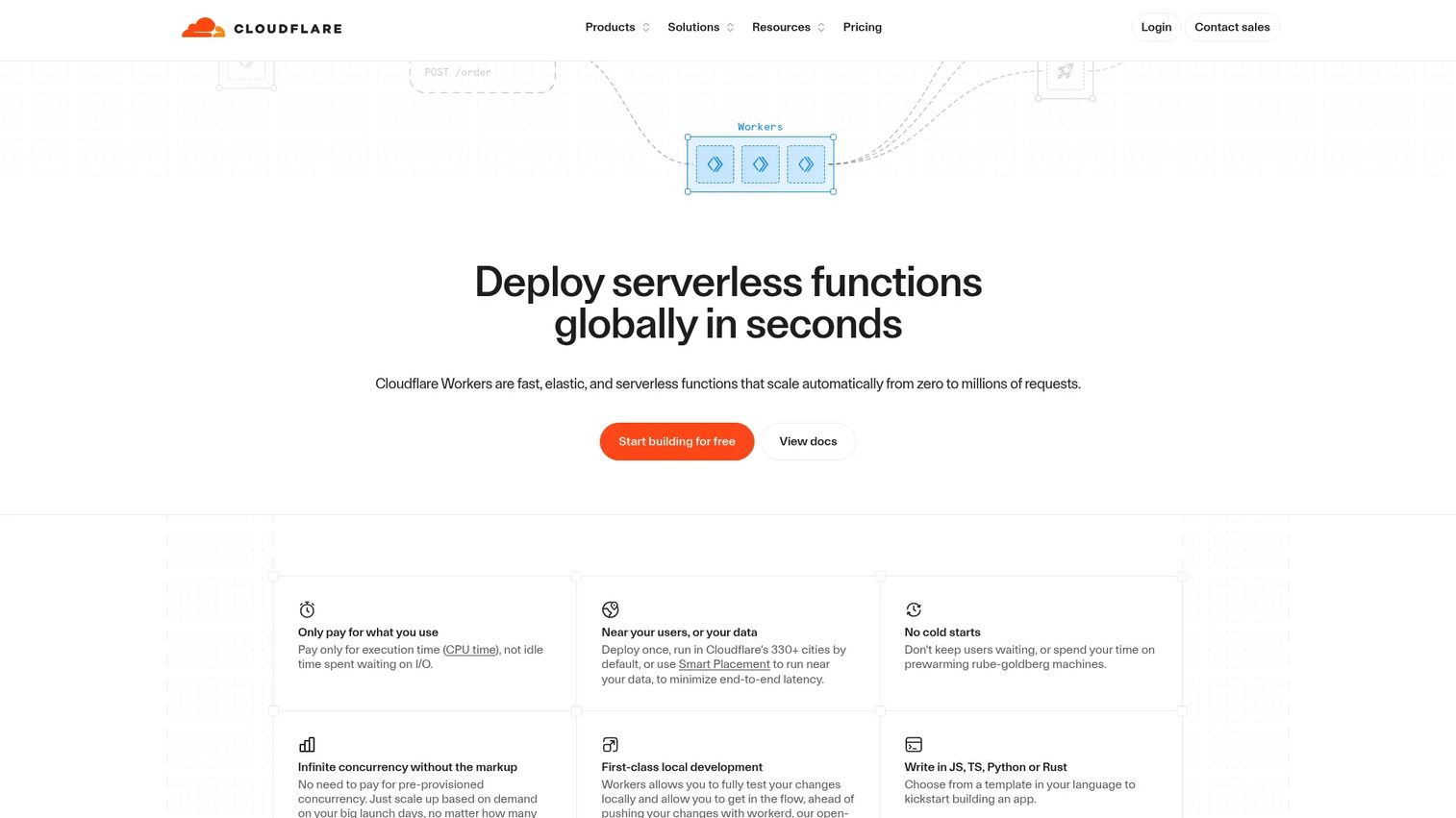
Cloudflare Workers is an edge serverless platform for building and running code on Cloudflare's global network. Instead of running in one region, your code executes at edge locations close to users, which cuts latency for request/response workloads. Its standout characteristic is the absence of cold starts, a common pain point in traditional serverless functions.
Best for: Teams building low-latency APIs, web apps, and edge logic where global response time matters.
Key strengths
- Global edge deployment: Code runs across Cloudflare's network, close to users, reducing round-trip latency.
- No cold starts: Workers avoid the cold-start delay that affects many serverless runtimes, keeping response times consistent.
- Broad language support: Runs JavaScript, TypeScript, Python, and Rust for a range of application styles.
Why choose Cloudflare Workers: If latency is a first-class requirement, edge execution and zero cold starts are hard to beat. It's the strongest fit for APIs, personalization logic, and web apps where every millisecond of round-trip time affects the experience. Teams building latency-sensitive front doors or request-time logic will find the edge model materially different from region-bound functions.
Cloudflare Workers pricing: Workers offers a Free plan and a Paid plan. The Paid plan starts at $5.00 per month plus usage-based charges for requests and CPU time. The free tier makes it easy to prototype before committing.
5. Red Hat OpenShift Serverless
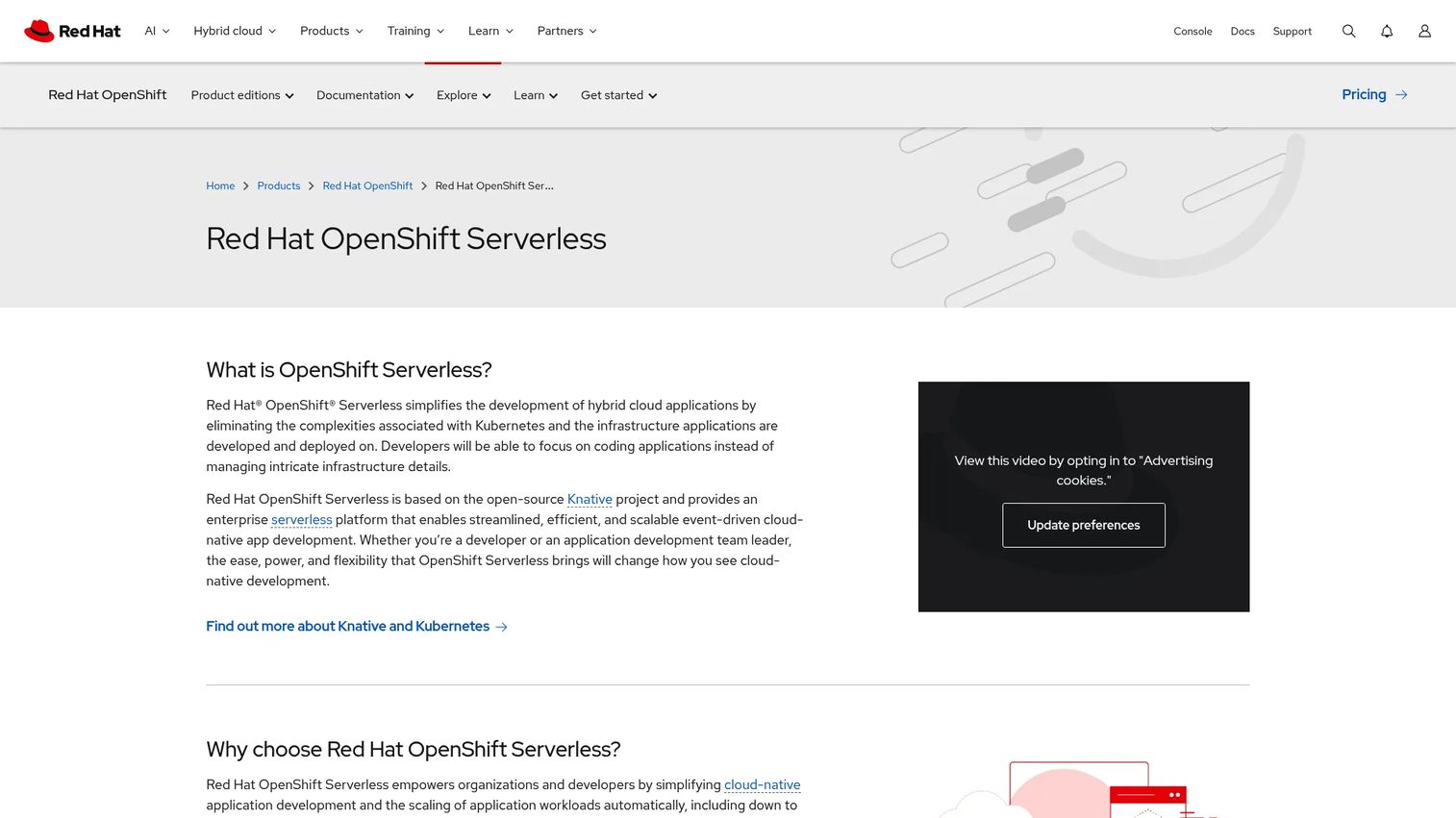
Red Hat OpenShift Serverless is an enterprise serverless platform for building and scaling event-driven applications on OpenShift. Built on Knative, it brings serverless abstractions to Kubernetes without locking you into a single public cloud. For teams that have already standardized on OpenShift, it extends that investment into serverless territory across hybrid cloud and multicloud environments.
Best for: Teams already using OpenShift that want serverless, event-driven workloads with hybrid cloud portability.
Key strengths
- Built on Knative: Uses the open Knative project, keeping your serverless layer Kubernetes-native and portable.
- Scales to zero: Applications scale down to zero when idle and back up on demand, matching serverless economics.
- Hybrid and multicloud: Event-driven app development runs consistently across hybrid cloud and multicloud footprints.
Why choose Red Hat OpenShift Serverless: If your organization runs OpenShift and cares about avoiding cloud lock-in, a Knative-based serverless layer keeps workloads portable across on-prem, private, and public clouds. It's the strongest fit for enterprises with governance requirements and existing Kubernetes investment that want serverless without ceding control to a single hyperscaler.
Red Hat OpenShift Serverless pricing: OpenShift Serverless is included as part of any OpenShift subscription. There's no standalone public price on the product page; cost is folded into your broader OpenShift commitment.
6. Azure Functions
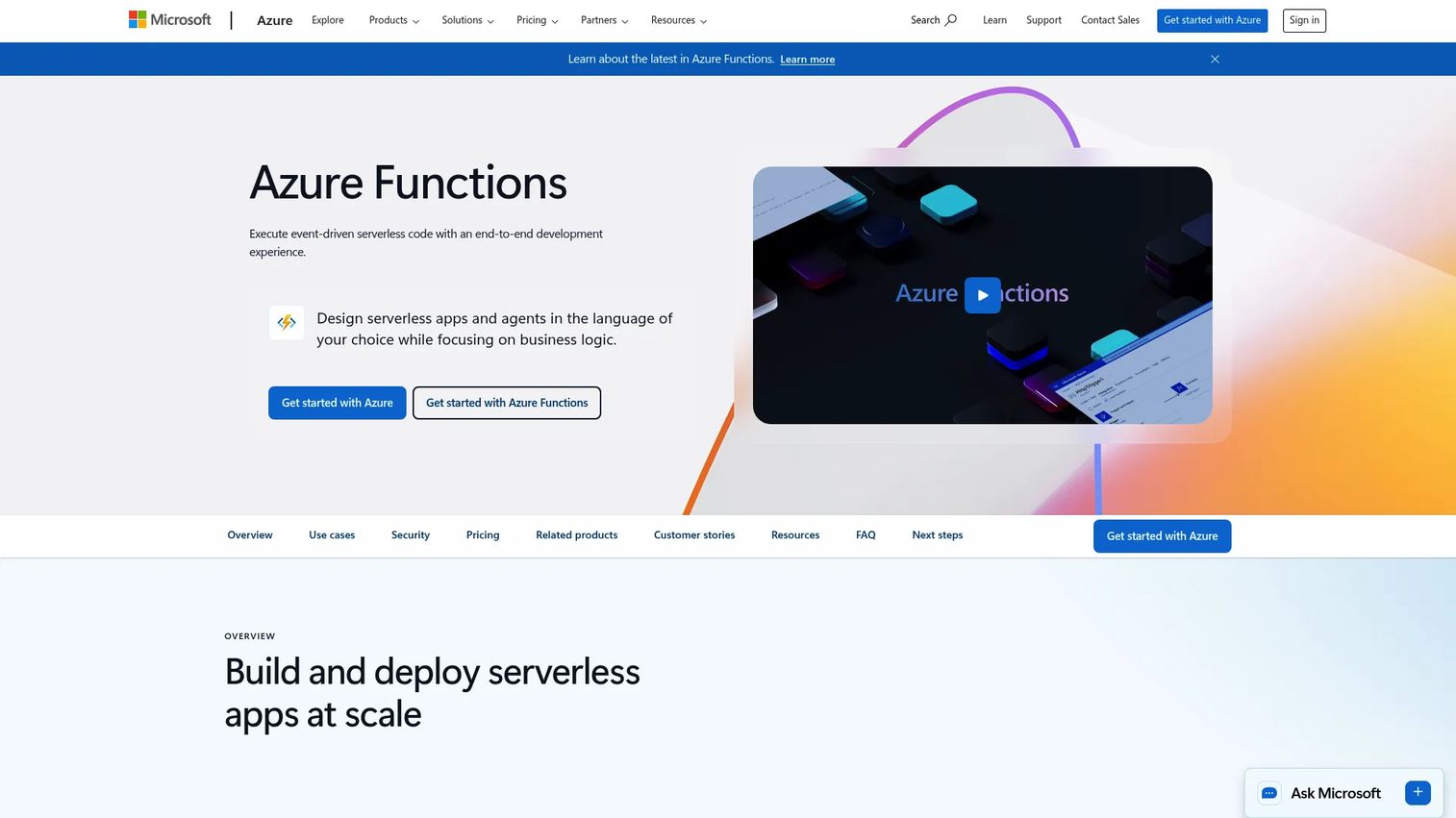
Azure Functions is Microsoft's serverless, event-driven code execution service on Azure. It plays the same role in the Microsoft ecosystem that Lambda plays in AWS: the default serverless compute layer, wired into the surrounding services. For teams standardizing on Azure, it's the natural place to run event-driven functions.
Best for: Teams that need event-driven serverless code with native Azure integrations across the Microsoft stack.
Key strengths
- Event-driven serverless functions: Code runs in response to triggers, with native bindings to Azure services.
- Multiple hosting plans: Options include Flex Consumption, Premium, App Service, and Azure Container Apps for different scaling needs.
- Broad runtime support: Runs C#, Java, JavaScript, PowerShell, Python, Rust, and Go natively.
Why choose Azure Functions: If your organization already runs on Azure, Functions gives you serverless compute that connects cleanly to the rest of the Microsoft ecosystem, from identity to storage to messaging. The multiple hosting plans let you tune between pure consumption billing and reserved capacity as workloads mature. It's the clear fit when Azure is your home cloud.
Azure Functions pricing: Azure Functions is usage-based across plans including Flex Consumption, Consumption, and Premium. The pricing page shows free monthly grants, and per-unit rates vary by plan and region. The Consumption plan bills per execution and per GB-second, while Premium bills on vCPU and memory for lower-latency needs.
7. IBM Cloud Functions
IBM Cloud Functions is IBM's function-as-a-service platform for running event-driven code on IBM Cloud, based on Apache OpenWhisk. It runs lightweight code in response to HTTP requests and IBM Cloud or third-party events. Note that IBM Cloud Functions is deprecated: per IBM docs, new Functions entities could not be created after December 28, 2023, and existing entities were supported only until October 2024. It's included here for historical context and for teams evaluating IBM's serverless heritage.
Best for: Teams needing historical context on IBM's serverless FaaS offering; new deployments are not supported.
Key strengths
- Event-driven serverless compute: Runs code in response to HTTP requests and events from IBM Cloud or third-party sources.
- OpenWhisk heritage: Based on Apache OpenWhisk, giving it an open-source lineage familiar to platform engineers.
- Free-tier execution: IBM Cloud free accounts historically included 5 million executions per month.
Why choose IBM Cloud Functions: Given its deprecated status, new projects should not build on IBM Cloud Functions. It matters mainly for teams maintaining legacy IBM-hosted workloads or documenting the OpenWhisk lineage that influenced later platforms. If you're deep in IBM Cloud and evaluating current options, look to IBM's newer container and Code Engine offerings rather than Functions.
IBM Cloud Functions pricing: IBM Cloud free accounts included IBM Cloud Functions with 5 million executions per month. No public paid starting price is listed on IBM's site, and the service is deprecated for new use.
Considerations before you choose
Picking a serverless platform is less about ranking features and more about matching the model to how your team operates and what your workload demands. Run through this checklist before committing.
Runtime and deployment model
Decide whether you want to ship functions or containers. Function-first platforms like AWS Lambda and Azure Functions optimize for small units of code and event triggers. Container-first Cloud Run and Knative-based OpenShift Serverless let you package anything that runs in a container. If your workloads are already containerized, that choice narrows the field quickly.
Scaling behavior and cold starts
Confirm how the platform handles scale to zero and cold starts. For steady internal APIs, cold starts rarely matter. For latency-sensitive, user-facing endpoints, they matter a lot, which is where an edge model like Cloudflare Workers earns its place. Ask how fast the platform scales up under a traffic spike, not just how low it scales down.
Portability and lock-in
Weigh how much of your setup moves if you switch providers. Knative-based platforms and plain containers travel more easily than proprietary function runtimes with vendor-specific triggers and bindings. If avoiding lock-in is a strategic priority, favor open standards even if a proprietary option is marginally faster to adopt.
Pricing model and cost predictability
Pay-as-you-go is a strength for spiky workloads and a risk for steady, high-volume ones. Model your expected request volume and duration against the platform's billing units before you commit. A workload that runs constantly may cost more on pure consumption pricing than on a reserved or premium plan.
Conclusion
The right serverless platform is the one that matches your workload, your runtime model, and how your team prefers to operate. For AWS-first teams, AWS Lambda is the foundational choice, with Serverless Framework layering opinionated tooling on top. Teams with containerized workloads that want scale-to-zero without abandoning Docker should look hard at Cloud Run. When global latency is the requirement, Cloudflare Workers and its edge execution stand out.
For enterprises invested in Kubernetes and hybrid cloud, Red Hat OpenShift Serverless keeps a serverless application portable across clouds via Knative. Azure Functions is the clear fit for Microsoft-centric shops. IBM Cloud Functions, now deprecated, is best treated as historical context rather than a target for new builds.
Choose based on three things: your runtime model (functions or containers), your deployment constraints (single cloud, edge, or hybrid), and your team's operating preferences. Get those right and the platform decision follows naturally, freeing your engineers to focus on the product instead of the plumbing, the whole point of going serverless in the first place.
FAQs
A serverless platform is a cloud service that runs your code or containers on demand and automatically handles provisioning, scaling, and server management. You focus on application logic while the provider owns the underlying servers. Billing is usually pay-as-you-go based on actual execution rather than reserved capacity.
Yes. AWS Lambda is the foundational serverless compute service on AWS, running your code in response to events without requiring you to manage servers. It's a FaaS offering that many teams treat as the default meaning of serverless functions. It integrates natively with 220+ AWS services.
Serverless abstracts away the runtime entirely: you ship code or a container and the platform decides when and how to run it, scaling to zero when idle. Traditional containers on a cluster require you to manage orchestration, capacity, and scaling yourself. Container-first serverless platforms like Cloud Run blend the two, running your containers with serverless scaling and billing.
Choose Cloud Run when your workloads are already containerized and you want to keep that portability while getting scale-to-zero and pay-per-use billing. Choose Lambda when your stack lives on AWS and you want event-driven functions that plug natively into the AWS service catalog. If avoiding cloud lock-in matters, containers on Cloud Run travel more easily than proprietary function runtimes.
Scale to zero means the platform runs no instances of your workload when there's no traffic, so you pay nothing for idle capacity. When a request or event arrives, the platform spins up capacity to handle it, then scales back down afterward. It's central to serverless cost efficiency for spiky or intermittent workloads.
It depends on your traffic pattern. For spiky, intermittent, or low-volume workloads, pay-as-you-go serverless often costs less because you don't pay for idle capacity. For steady, high-volume workloads running constantly, a reserved or container-based model can be cheaper. Model your expected request volume and duration against each platform's billing units before deciding.
The common risks are vendor lock-in from proprietary triggers and runtimes, cold-start latency for infrequently called functions, and cost unpredictability under high sustained volume. You can mitigate lock-in by favoring open standards like Knative or plain containers, address cold starts with edge platforms or provisioned concurrency, and control cost by modeling usage before committing to a pricing model.