Your auditor asks for six months of access logs. You open a shared drive, three spreadsheets, and a Slack thread from March. Two of the screenshots are stale. One control owner left the company. The audit window closes in eleven days.
That scramble is what manual compliance work actually feels like. It is not one bad week. It is a recurring tax on the same people every quarter, and it gets heavier as the company adds frameworks, vendors, and headcount.
The market has noticed. The global compliance automation software market was worth USD 4.35B in 2024 and is projected to reach USD 13.07B by 2033, a 13.7% CAGR, according to Dataintelo (2024). That growth is not hype. It is teams deciding that tracking controls in a workbook does not scale past a certain point.
Compliance automation tools change the day-to-day math. Instead of collecting evidence by hand before every audit, the platform pulls it continuously. Instead of mapping controls across frameworks manually, it reuses evidence you already have. This matters whether you sit in security, GRC, RevOps, or enablement, because everyone downstream depends on the same clean posture data.
What's inside
This guide is for anyone evaluating automated compliance software to replace spreadsheet tracking and reduce audit drag. We looked at platforms that reduce manual effort, cover multiple frameworks, and connect to the systems you already run.
We selected tools based on four criteria:
- Framework coverage: how many standards the platform supports out of the box
- Automation depth: how much evidence collection and monitoring runs without human effort
- Integrations: how well it connects to your cloud, identity, and ticketing stack
- Fit by team size: whether it serves lean startups, mid-market, or enterprise programs
The list spans dedicated compliance automation platforms, broader GRC suites, asset-visibility tools, and managed service providers.
TL;DR
- Best for enterprise compliance programs: Vanta, for continuous monitoring and broad integration coverage
- Best for control-centric governance: AuditBoard, for connected audit, risk, and compliance at scale
- Best for MSP and multi-tenant delivery: Cynomi, for partner-led vCISO and compliance services
- Best for workflow-heavy GRC teams: LogicGate, for configurable, no-code process design
- Best for audit readiness and centralized evidence: Secureframe, for automated evidence and remediation
- Best for broad compliance operations: Hyperproof, for control mapping across many frameworks
Every tool here supports continuous compliance rather than one-off audit prep, so evidence stays current between cycles.
What is compliance automation software?
Compliance automation software is a platform that automates evidence collection, control monitoring, reporting, and recurring compliance tasks across one or more regulatory frameworks. Instead of a person taking screenshots and filing them, the software connects to your systems and gathers proof on a schedule.
The category replaces a manual, point-in-time process with a continuous one. That shift is the whole point.
Core capabilities you will see across most compliance automation tools:
- Automated evidence collection: pulls logs, configs, and settings from cloud, identity, and HR systems
- Continuous control monitoring: checks controls against framework requirements in near real time
- Control mapping: maps one piece of evidence to many controls across frameworks
- Policy management: stores, versions, and distributes policies with acknowledgment tracking
- Remediation workflow: routes failed checks to owners with due dates and status
- Compliance reporting software features: dashboards and exports that show posture at a glance
The difference between automated and manual compliance tracking is timing and ownership. Manual tracking asks a person to remember, gather, and update. Automated compliance monitoring asks a system to watch continuously and flag what breaks.
Why compliance automation matters now
Manual compliance holds up at small scale. One framework, one cloud account, a handful of controls: a spreadsheet works. Then you add SOC 2, ISO 27001, a customer who demands HIPAA, and forty new vendors. The workbook cracks.
The break is not dramatic. It is quiet. A control owner forgets to re-run a check. A screenshot ages out. Nobody notices until the auditor does. By then the fix is a fire drill.
Continuous compliance changes the failure mode. When the platform monitors controls every day, a broken setting surfaces in hours, not at audit time. That turns compliance from a quarterly panic into a background process.
What teams get when they move off spreadsheets:
- Faster audit readiness: evidence is already collected and mapped, so prep shrinks
- Fewer surprises: real-time compliance monitoring catches drift before it compounds
- Reusable evidence: one control satisfies many frameworks through control mapping
- Cleaner reporting: a live compliance dashboard beats reconstructing status from memory
- Time back: the people who ran the workbook do higher-value work
Here is the practical contrast between the two models:
| Task | Manual (spreadsheet) | Automated (platform) |
|---|---|---|
| Evidence collection | Person gathers before each audit | System pulls continuously |
| Control monitoring | Periodic manual checks | Automated compliance monitoring |
| Multi-framework | Duplicate work per framework | Reuse via control mapping |
| Drift detection | Found at audit time | Found in hours |
| Reporting | Rebuilt each cycle | Live dashboard |
When to use compliance automation software
When audits keep slowing down the team
If every audit turns into a two-week evidence hunt, that is the signal. When evidence collection and reporting run continuously, prep stops being a scramble. The auditor asks, you export, and the proof is already mapped to the control. Teams that adopt compliance automation platforms usually feel this relief first.
When compliance lives in spreadsheets
A workbook cannot tell you your posture right now. It tells you your posture the last time someone updated it. Centralized posture tracking beats manual tracking because the data is current and owned by the system. If your source of truth is a tab someone forgot to touch, you have outgrown the spreadsheet.
When you need multiple frameworks in one place
SOC 2, ISO 27001, HIPAA, GDPR, PCI DSS: many overlap. Control mapping lets one piece of evidence satisfy requirements across several frameworks at once. Reusable evidence and continuous monitoring turn a multi-framework program from parallel spreadsheets into a single system. This is where compliance monitoring software earns its cost.
Comparison table
Pricing for most of these platforms is quote-based and personalized, so confirm current numbers with each vendor. Ratings reflect current G2 listings at the time of writing.
| # | Product | Best for | Key differentiator | Pricing | G2 rating |
|---|---|---|---|---|---|
| 1 | Vanta | Enterprise compliance programs | Continuous monitoring with broad integrations | Custom quote | 4.6/5 |
| 2 | Drata | SOC 2 and broader GRC | Automated evidence and Trust Center | Custom quote | 4.7/5 |
| 3 | Secureframe | Audit readiness | Evidence collection with AI remediation | Custom quote | 4.7/5 |
| 4 | Cynomi | MSP and multi-tenant delivery | Partner-led vCISO platform | Partner/demo based | 4.9/5 |
| 5 | Hyperproof | Broad compliance operations | Control mapping across frameworks | Custom quote | 4.5/5 |
| 6 | AuditBoard | Large audit and risk programs | Connected audit, risk, compliance | Custom quote | 4.7/5 |
| 7 | LogicGate | Workflow-heavy GRC teams | No-code configurable workflows | Custom quote | 4.6/5 |
| 8 | Scrut | Fast-growing security teams | 70+ frameworks, 150+ integrations | Custom quote | 4.9/5 |
| 9 | JupiterOne | Asset visibility | Cyber asset graph and blast radius | From $25,000/yr | Not listed |
| 10 | Sprinto | Lean, fast-scaling teams | Common Control Framework | Custom quote | Not listed |
| 11 | Scytale AI | Multi-framework with expert help | AI automation plus human support | Custom quote | 4.8/5 |
| 12 | OneTrust | Privacy and data governance | Unified privacy, risk, AI governance | Custom quote | 4.4/5 |
| 13 | Fortinet | Security operations compliance | Compliance via security platform | From $700-$1,000 | 4.4/5 |
| 14 | Workstreet | Startups needing managed compliance | Turnkey service across 35+ frameworks | Custom quote | 4.6/5 |
Best compliance automation software for 2026
1. Vanta
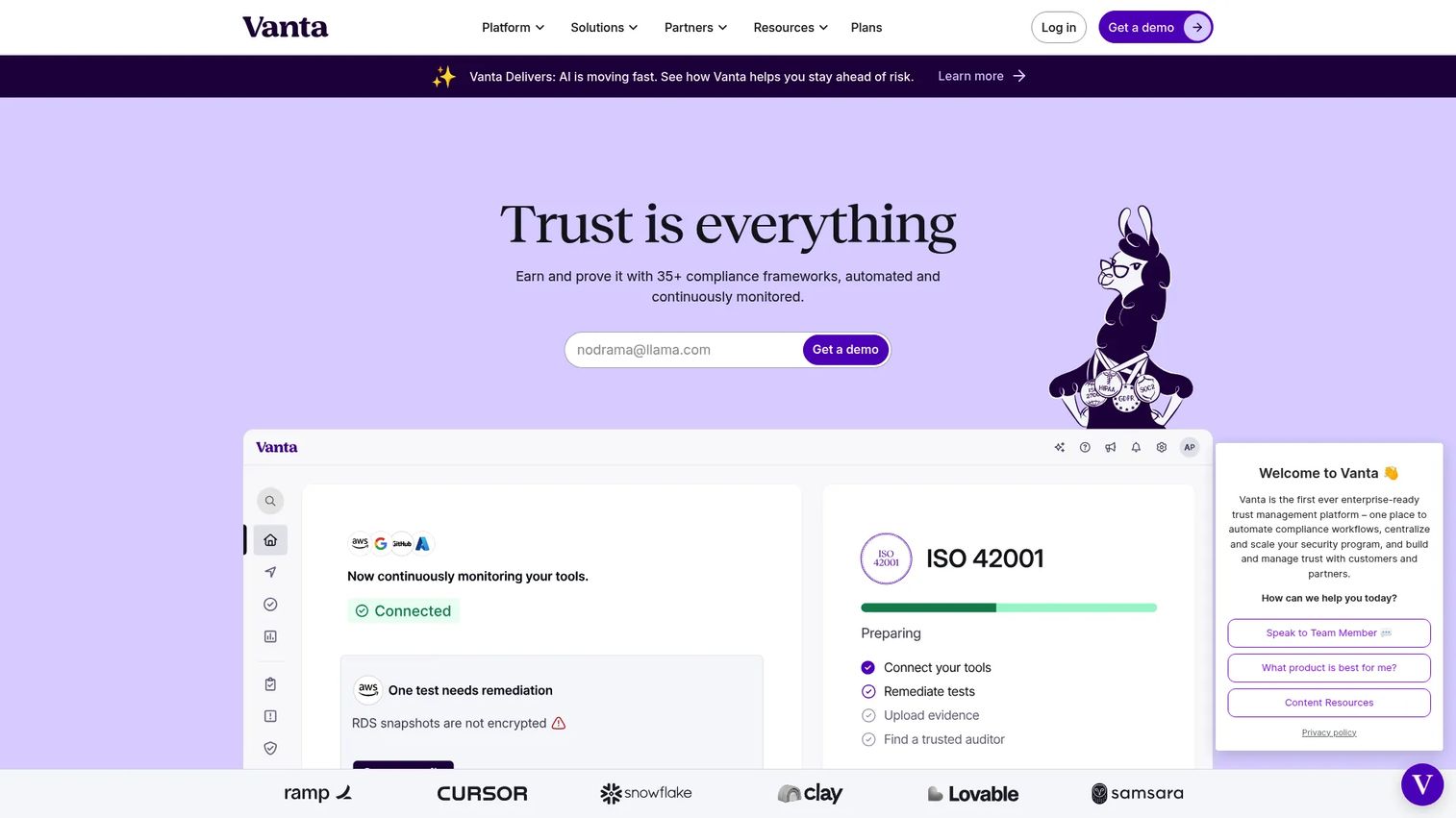
Vanta is a trust management platform that automates compliance, security, and risk across a wide set of frameworks. It runs continuous checks against your controls, collects evidence automatically, and packages your posture into a Trust Center you can share with prospects. For teams tired of chasing screenshots, it turns audit prep into an export.
Best for: Companies that need automated compliance and trust management across multiple frameworks.
Key strengths
- 300+ integrations across cloud, identity, and HR
- Continuous compliance monitoring with automated tests
- Trust Center and security questionnaire automation
- Control mapping to reuse evidence across frameworks
- Broad framework coverage for enterprise programs
Why choose Vanta: If you run several frameworks at once and want the widest integration net to keep evidence collection hands-off, Vanta is the broad default. It fits security and GRC teams that want continuous monitoring without building it themselves.
Pricing: Vanta uses personalized, quote-based pricing across Essentials, Plus, Professional, and Enterprise plans. Public dollar amounts are not listed; request a demo for a tailored quote.
2. Drata
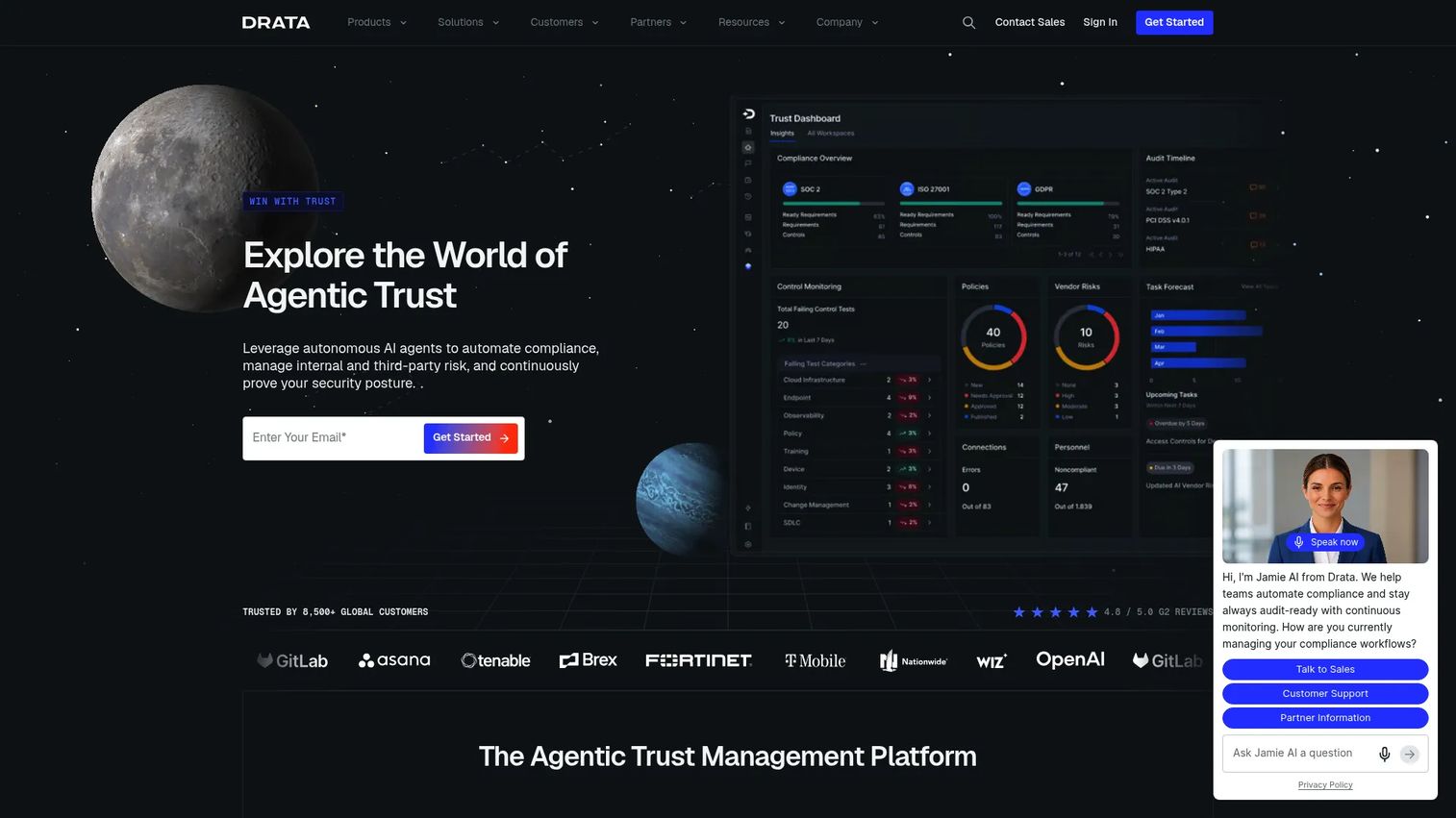
Drata is a security and compliance automation platform built around continuous control monitoring and automated evidence collection. It covers SOC 2 and stretches into broader governance, risk, and assurance workflows. The platform pairs monitoring with a Trust Center and AI-assisted questionnaire responses.
Best for: Teams needing a compliance automation platform for SOC 2 and broader GRC workflows.
Key strengths
- Automated evidence collection and control monitoring
- Trust Center for sharing security posture and documents
- AI questionnaire assistance for faster responses
- Third-party risk management built in
- Audit workflows that keep evidence current
Why choose Drata: Drata suits teams that start with SOC 2 but expect to grow into a full GRC program. The continuous monitoring and audit workflows reduce the manual grind between cycles.
Pricing: Drata offers Foundation, Advanced, and Enterprise plans across its GRC and Assurance platforms. Pricing is personalized and routed through sales rather than published.
3. Secureframe
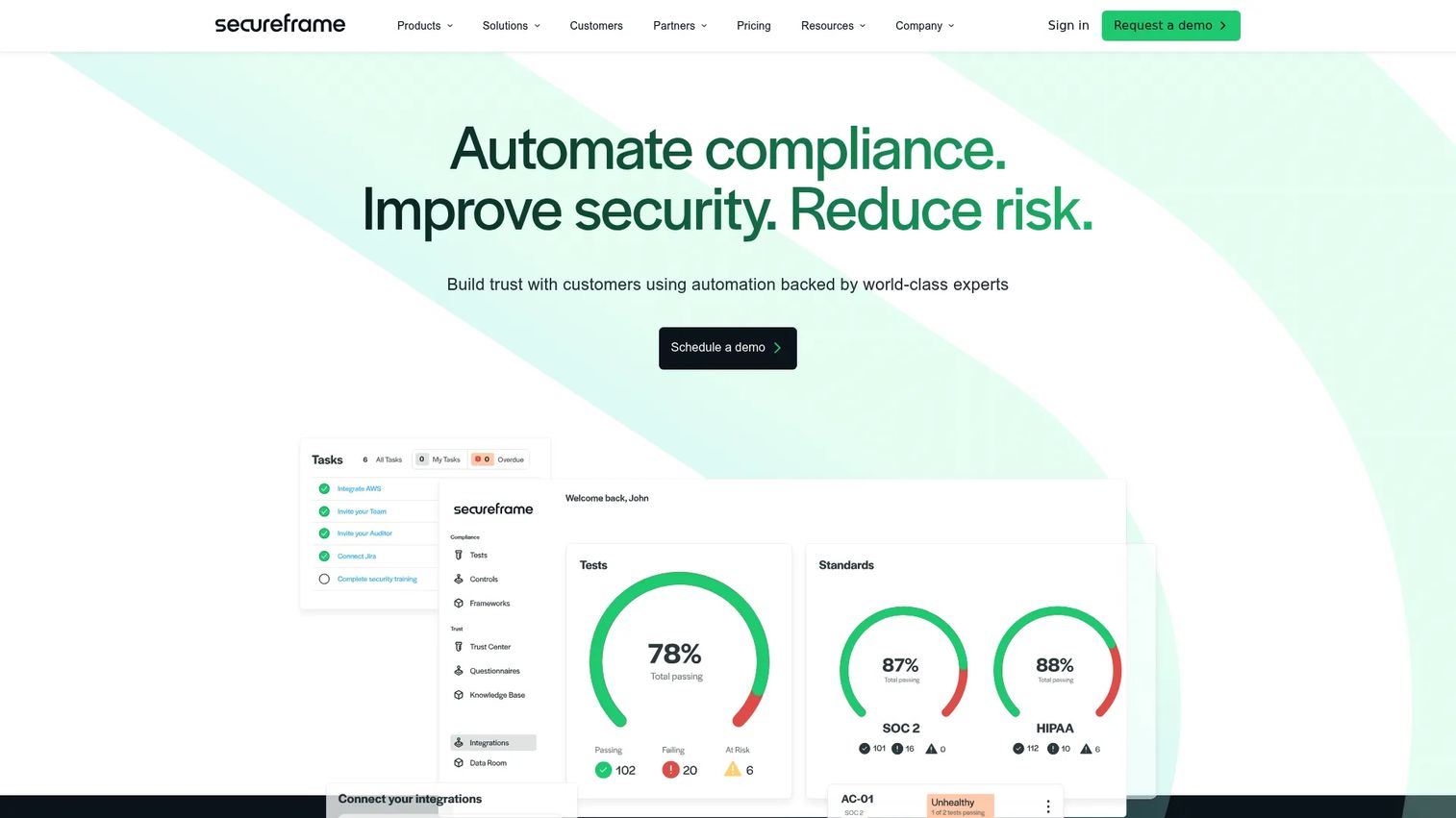
Secureframe automates security and privacy compliance with a focus on getting audit-ready fast. It handles evidence collection continuously, monitors controls, and uses AI to speed remediation and questionnaire work. The platform supports SOC 2, ISO 27001, HIPAA, and CMMC among others.
Best for: Teams that need automated compliance management for SOC 2, ISO 27001, HIPAA, and CMMC.
Key strengths
- Automated evidence collection across systems
- Continuous control monitoring
- AI-assisted remediation and questionnaires
- Broad framework coverage
- Centralized evidence for faster audit readiness
Why choose Secureframe: Choose Secureframe if centralized evidence and quick audit readiness are your priority. The AI remediation help is useful for lean teams that cannot staff a full GRC function.
Pricing: Secureframe lists quote-based plans named Fundamentals, Complete, and Defense. No public numeric pricing is shown; you request a quote per plan.
4. Cynomi
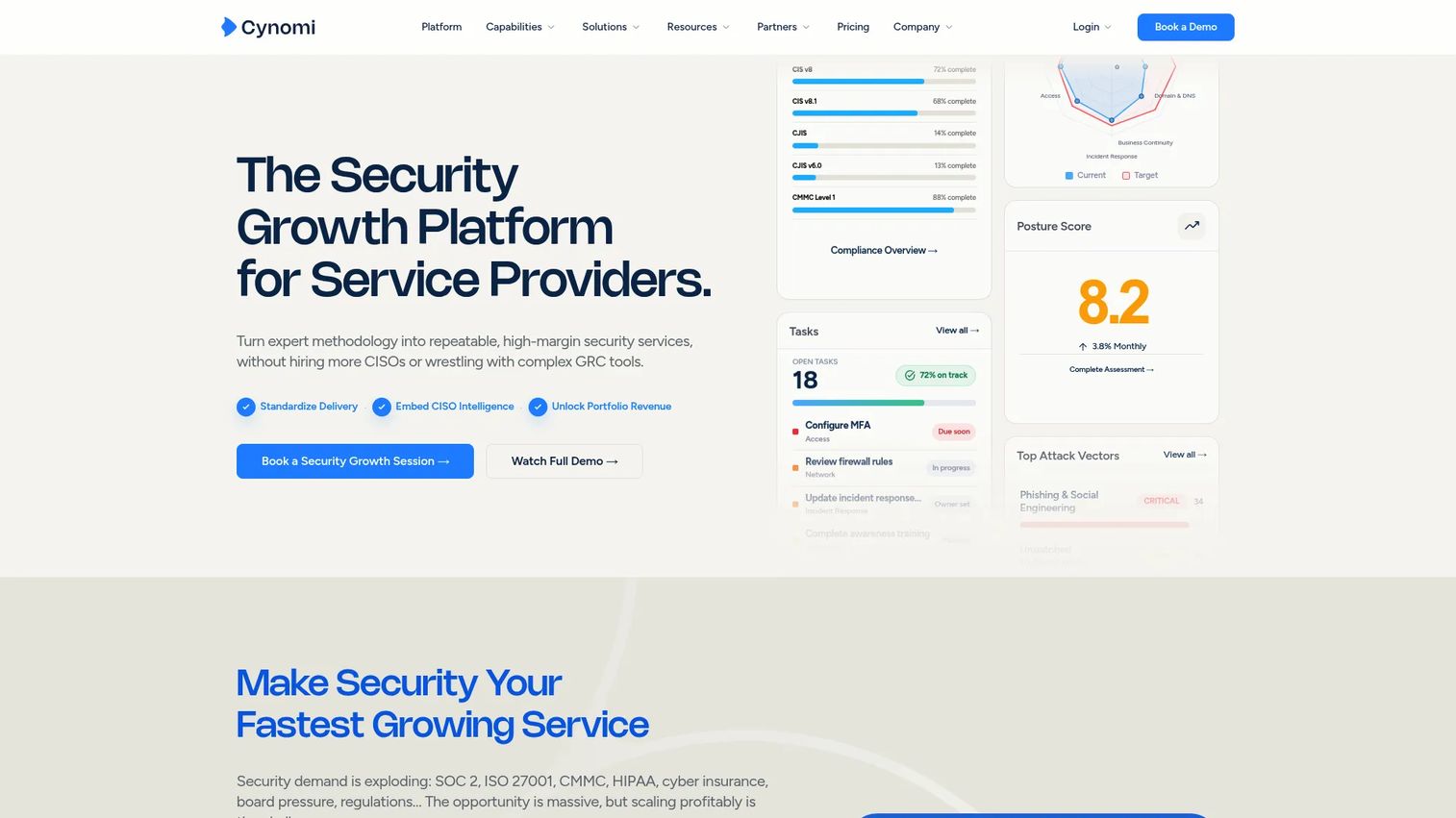
Cynomi is an AI-powered security and compliance platform built for MSPs, MSSPs, and consultancies delivering vCISO services. It bakes CISO-level intelligence into workflows so partners can run security programs and compliance readiness across many clients. Coverage spans 40+ frameworks with executive reporting for QBRs.
Best for: MSPs, MSSPs, and consultancies delivering scalable vCISO and compliance services.
Key strengths
- CISO intelligence built into workflows
- Compliance readiness across 40+ frameworks
- Multi-tenant delivery for service providers
- Third-party risk management
- Executive reporting and QBR dashboards
Why choose Cynomi: If you deliver compliance as a service to multiple clients, Cynomi is purpose-built for that motion. The multi-tenant model and vCISO tooling let a small team support many accounts.
Pricing: Cynomi offers an à la carte structure with Pro, Core, one-time assessments, and TPRM. Pricing is partner and demo based rather than publicly listed.
5. Hyperproof
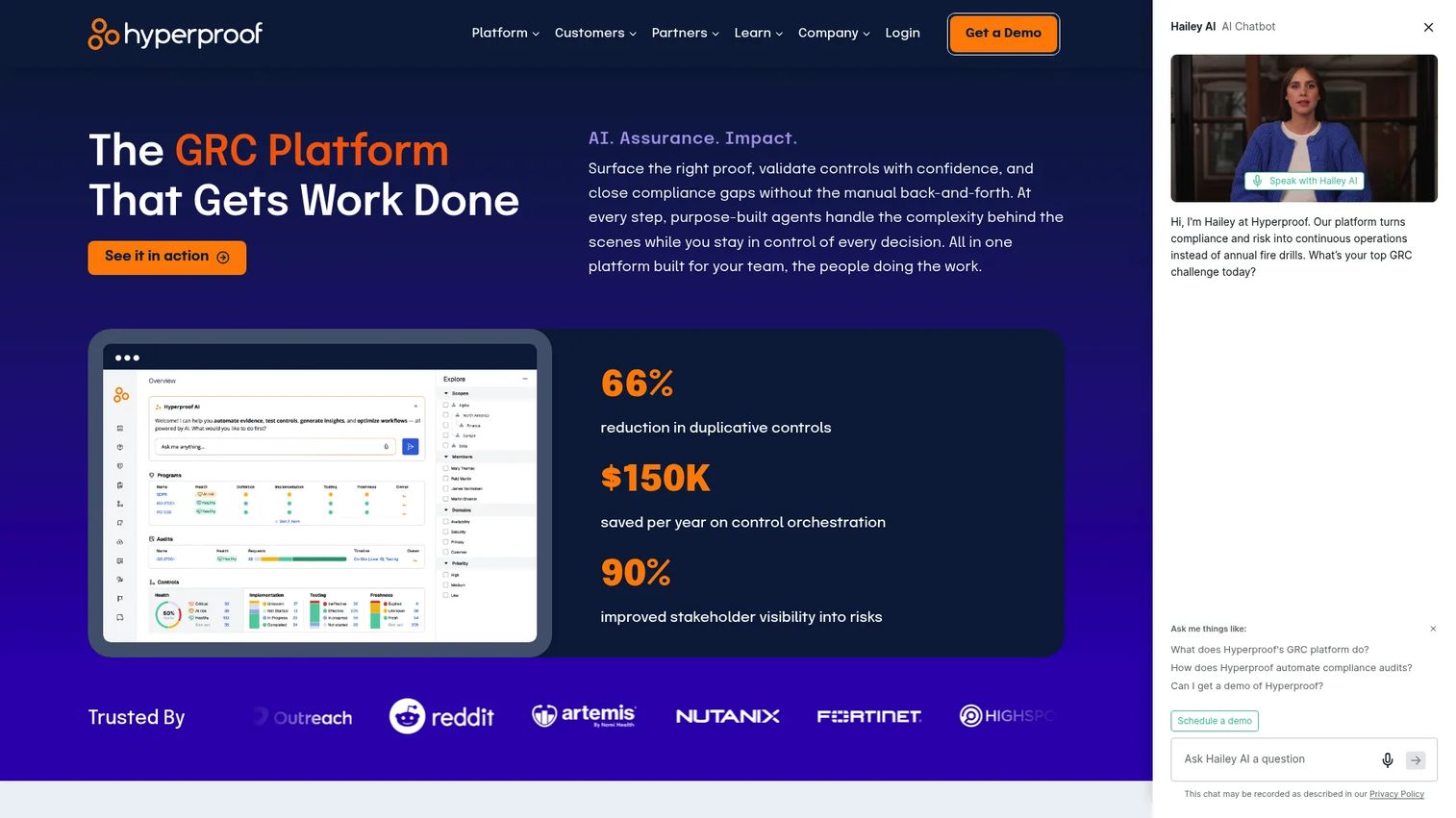
Hyperproof is an AI-powered GRC platform that unifies compliance, risk, audit, and third-party risk in one place. It automates control mapping and evidence collection, then layers on risk and audit management workflows. The breadth makes it a fit for teams running many frameworks at once.
Best for: Mid-market to enterprise teams managing compliance, audit, and third-party risk in one platform.
Key strengths
- Automated control mapping and evidence collection
- Risk, audit, and governance workflows
- Third-party risk with questionnaires and scoring
- Continuous monitoring across frameworks
- Central hub for multi-framework posture
Why choose Hyperproof: Hyperproof fits teams that want compliance, risk, and audit under one roof rather than stitched across tools. The control mapping is strong for broad, multi-framework operations.
Pricing: Hyperproof does not publish numeric pricing on its site. Its third-party risk module shows a free trial for TPRM, with Core and Advanced tiers available via demo request.
6. AuditBoard
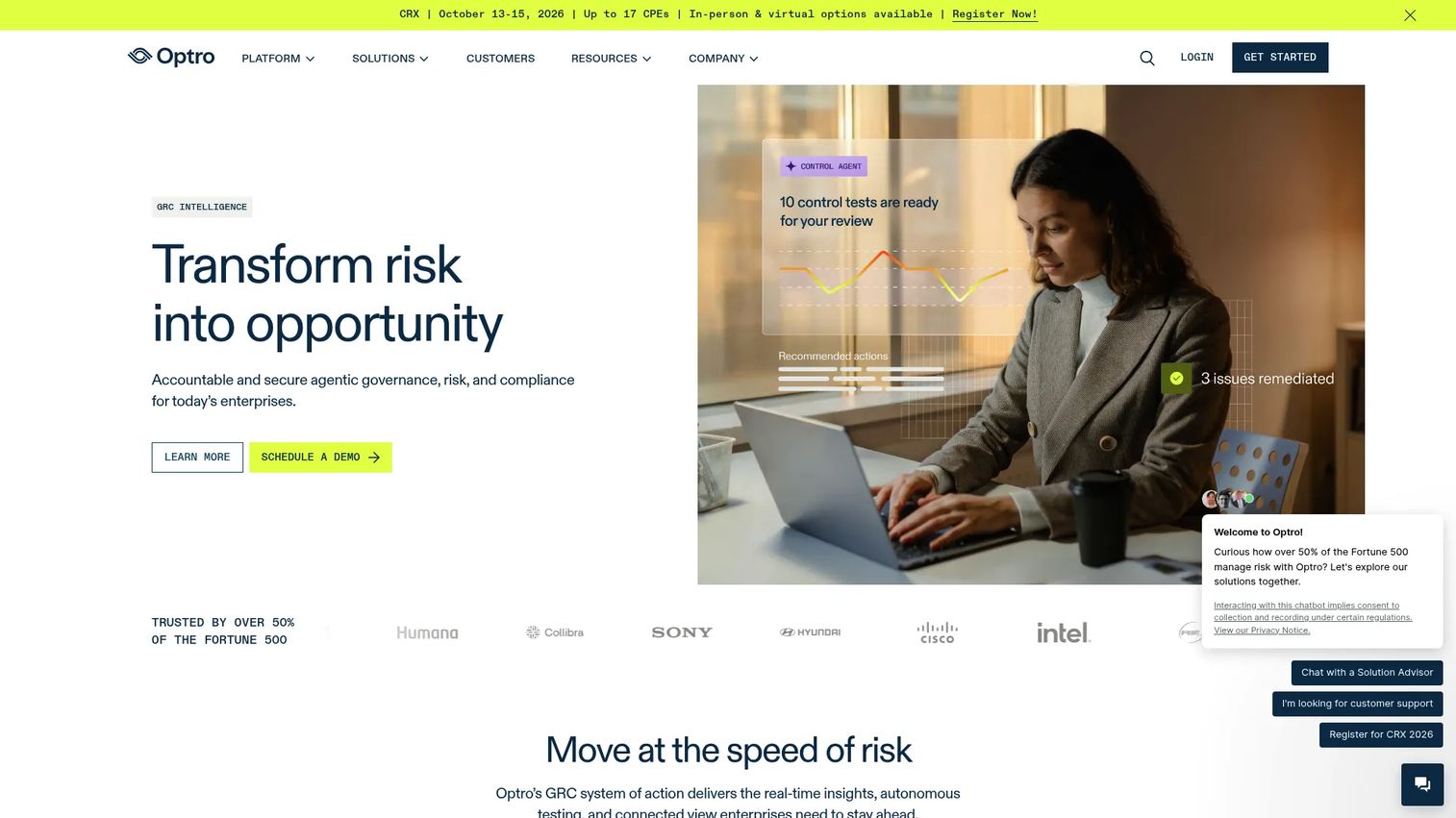
AuditBoard is a cloud-based audit, risk, and compliance platform built for larger organizations. It connects internal audit, IT risk, and regulatory compliance so the same data flows across functions. For enterprises with formal audit programs, it is a control-centric backbone.
Best for: Large organizations needing connected audit, risk, and compliance workflows.
Key strengths
- Audit and controls management
- IT risk and compliance workflows
- Regulatory and ESG compliance modules
- Connected data across audit, risk, and compliance
- Enterprise-scale reporting
Why choose AuditBoard: AuditBoard is the pick when audit and risk are formal, staffed functions rather than a side task. The connected workflows keep large programs coordinated.
Pricing: AuditBoard uses quote-based, demo-led pricing. No public numeric pricing is shown on its site.
7. LogicGate
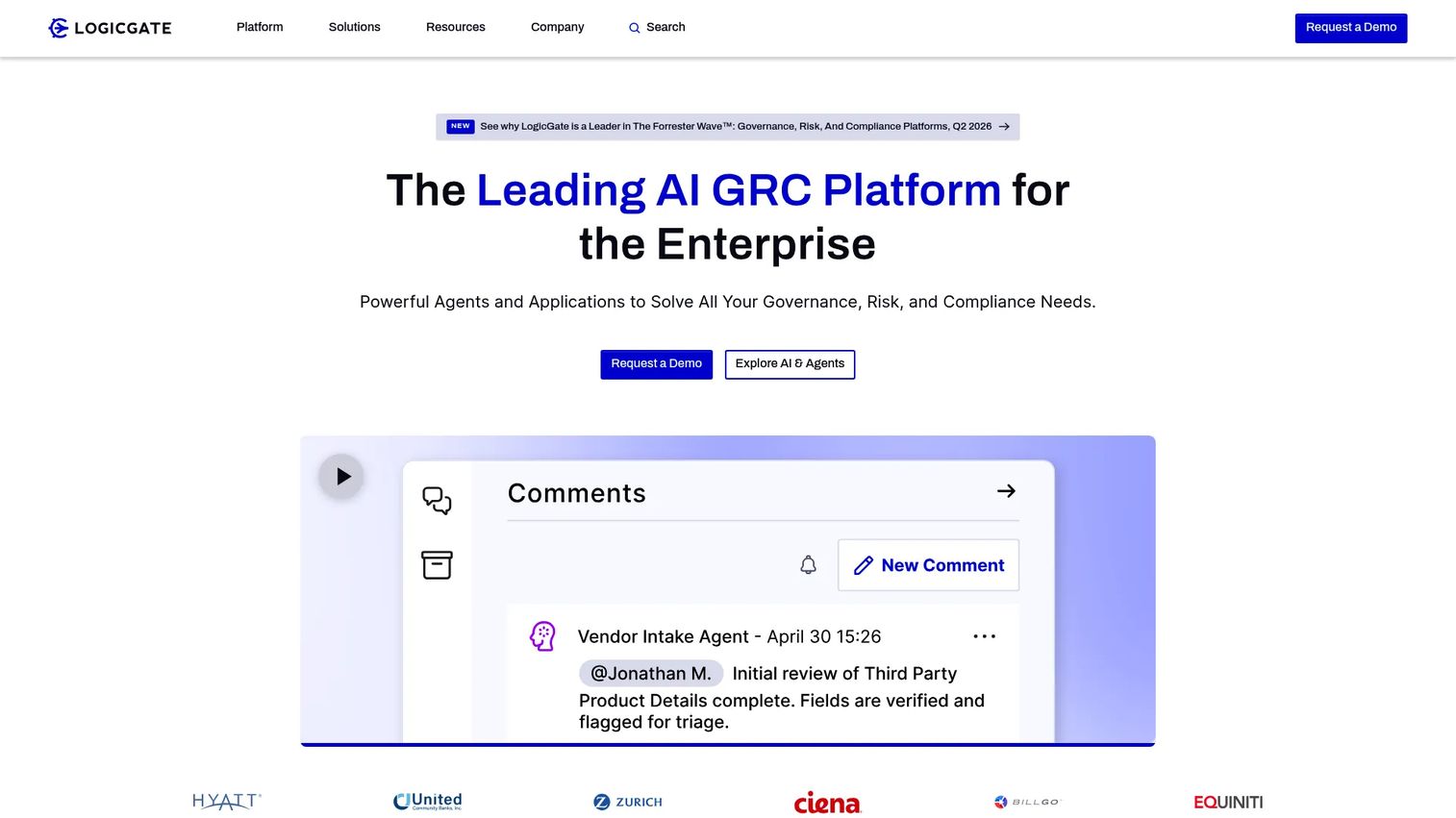
LogicGate is an AI-powered enterprise GRC platform built around configurable, no-code workflows. Its graph-database model lets teams design compliance and risk processes that match how they actually operate. Automated evidence monitoring and role-based dashboards round out the platform.
Best for: Enterprise teams needing configurable GRC workflows and risk/compliance reporting.
Key strengths
- No-code, flexible workflow builder
- Graph-database process modeling
- Automated evidence monitoring
- Role-based dashboards and analytics
- AI-generated reporting summaries
Why choose LogicGate: LogicGate wins when your process does not fit a template. The no-code workflow builder lets process-heavy teams shape the platform around their operating model.
Pricing: LogicGate uses custom pricing based on Applications and Power User licenses. The pricing page routes to a request for a tailored quote.
8. Scrut
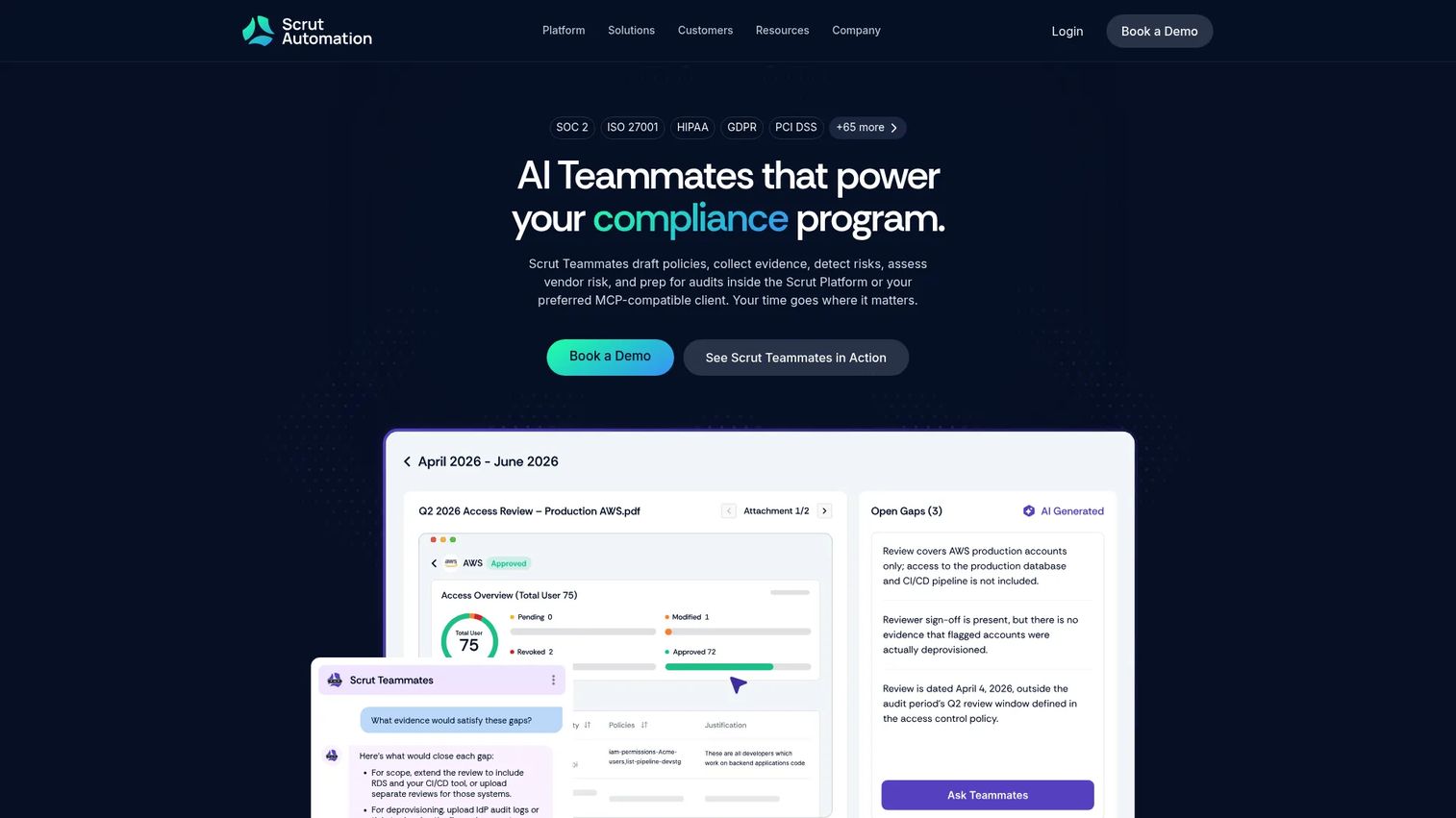
Scrut is an AI-powered GRC and compliance automation platform aimed at security-first teams. It automates evidence collection from a large integration set and monitors controls across many frameworks. Risk, vendor, audit, and trust center workflows sit in one place.
Best for: Teams needing a unified platform for compliance automation, audits, and continuous risk monitoring.
Key strengths
- Automated evidence collection from 150+ integrations
- Continuous control monitoring across 70+ frameworks
- Risk and vendor management workflows
- Audit and trust center in one platform
- Asset management for compliance context
Why choose Scrut: Scrut fits fast-growing security teams that want wide framework coverage and deep integrations without juggling separate tools. The unified workflows keep everything in one system.
Pricing: Scrut uses custom pricing based on business needs. No public numeric pricing is shown; you contact sales for a quote.
9. JupiterOne
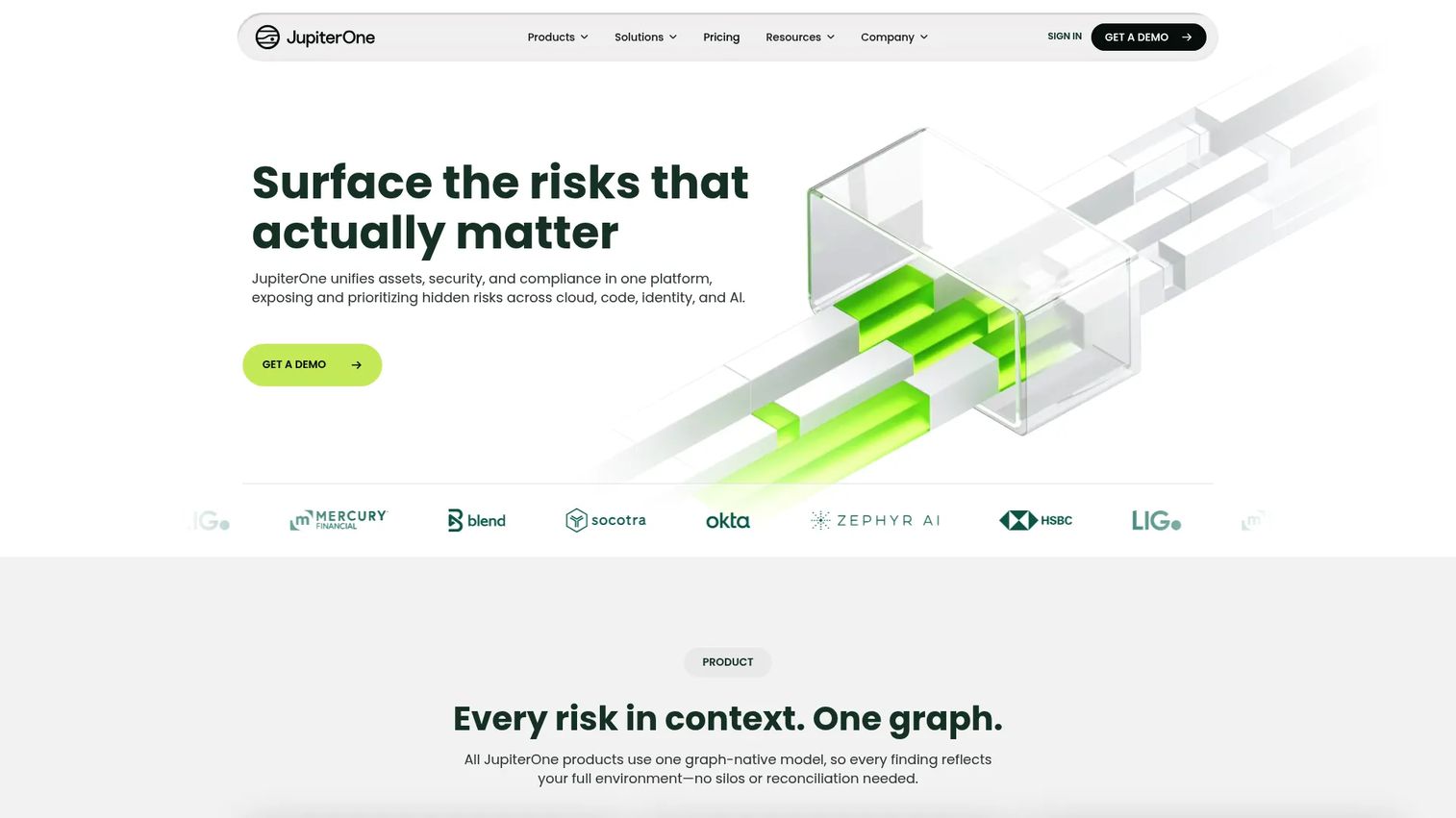
JupiterOne is a cyber asset attack surface management platform that gives security teams unified asset visibility and risk context. It maps relationships across assets and runs continuous controls monitoring on top of that graph. Natural-language querying makes it easy to answer compliance questions on demand.
Best for: Security teams needing asset graph visibility, risk prioritization, and compliance monitoring across cloud and SaaS.
Key strengths
- 200+ integrations for asset data collection
- Relationship mapping and blast-radius analysis
- Natural-language querying and reporting
- Continuous controls monitoring
- Workflow automation on asset data
Why choose JupiterOne: JupiterOne suits teams whose compliance problem starts with not knowing what they have. The asset graph turns visibility into a foundation for monitoring.
Pricing: JupiterOne publishes annual tiers based on datapoints: Small-Market at $25,000, Mid-Market at $50,000, and Enterprise at $100,000, with custom pricing beyond one million datapoints.
10. Sprinto
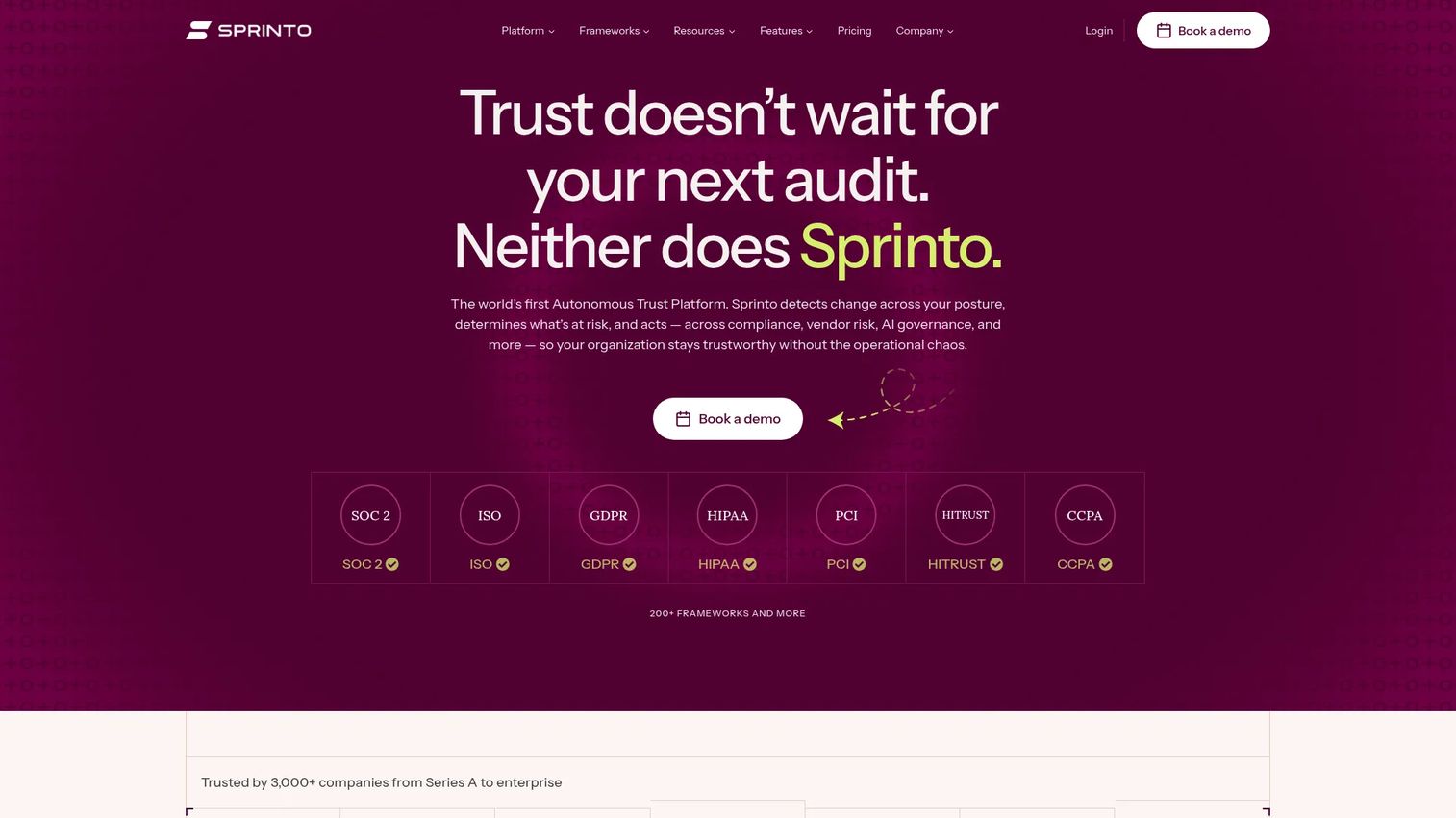
Sprinto is a compliance automation and GRC platform built for fast-scaling companies. It automates evidence collection with signed artifacts and organizes controls under a Common Control Framework so overlapping requirements reuse the same work. Lean teams use it to move quickly toward audit readiness.
Best for: Teams needing automated compliance and audit readiness workflows.
Key strengths
- 300+ integrations for evidence collection
- Common Control Framework for reuse across standards
- Automated evidence collection with signed artifacts
- Continuous monitoring for audit readiness
- Workflow design for lean teams
Why choose Sprinto: Sprinto is a strong fit for lean teams that need speed and a clean path to audit readiness. The Common Control Framework reduces duplicate work across overlapping standards.
Pricing: Sprinto lists Starter, Professional, Advanced, and Enterprise plans. Public pricing numbers are not displayed; contact Sprinto for a quote.
11. Scytale AI
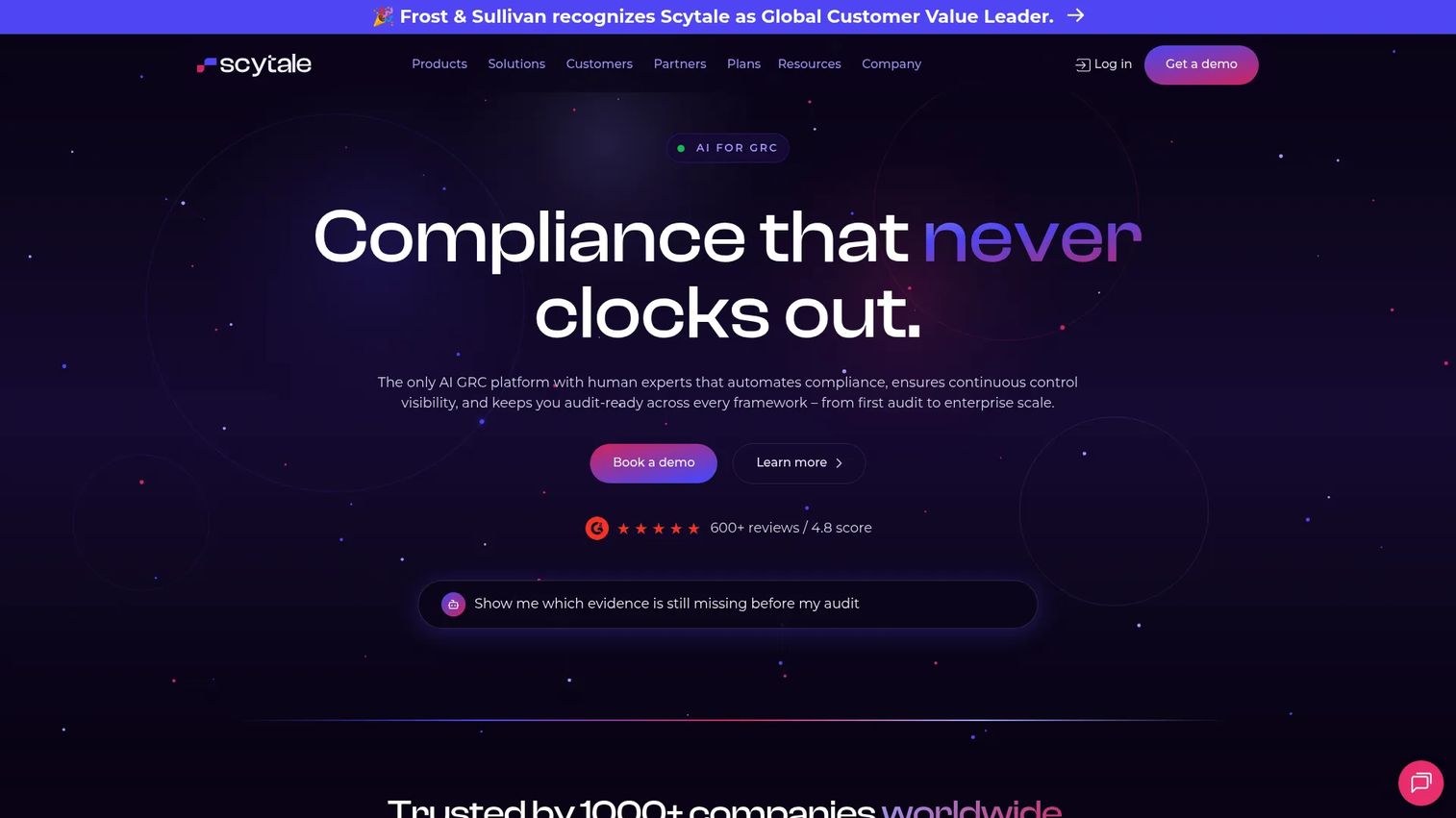
Scytale AI pairs AI-powered GRC automation with human expert support to guide teams through compliance. It runs continuous control monitoring, automates evidence collection, and adds a Trust Center plus AI governance and policy tooling. The expert layer helps teams that want guidance, not just software.
Best for: Teams needing automated compliance across multiple frameworks with expert guidance.
Key strengths
- 24/7 continuous control monitoring
- Automated evidence collection
- Trust Center for posture sharing
- AI governance and policy automation
- Human expert support alongside the platform
Why choose Scytale AI: Scytale AI suits teams that want automation and a human to lean on. The expert support smooths first-time audits across multiple frameworks.
Pricing: Scytale AI shows plan names including Build Starter, Build DFY, Build Stronger, Scale, and Enterprise. Pricing is quote-based and demo-led rather than public.
12. OneTrust
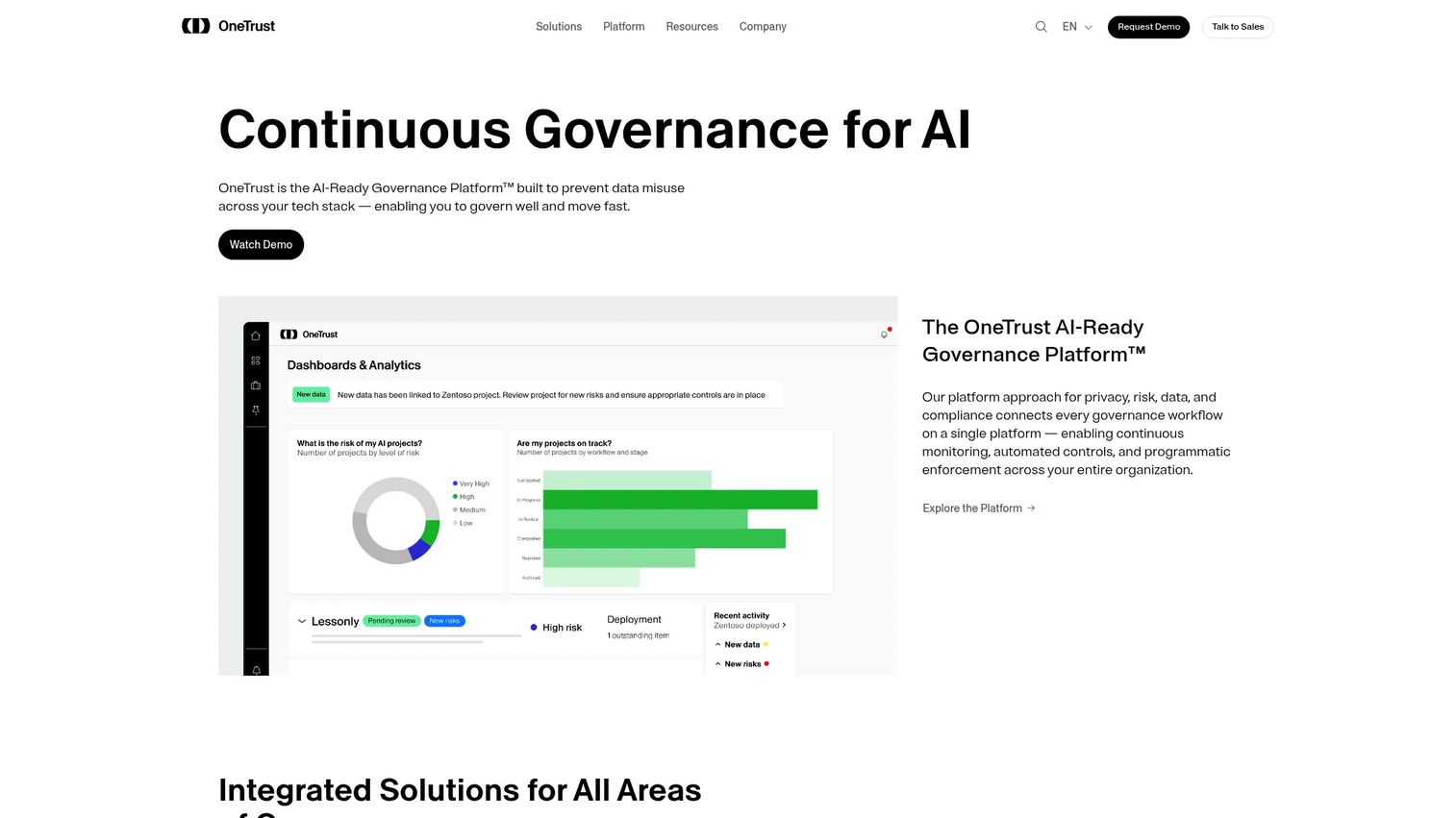
OneTrust is an AI-ready governance platform spanning privacy, security, risk, and responsible data use. It goes beyond framework attestation into consent management, privacy automation, and AI governance. For organizations where privacy and data governance are central, it is a broad option.
Best for: Enterprises needing a unified platform for privacy, consent, risk, and AI/data governance.
Key strengths
- AI governance capabilities
- Consent and preferences management
- Privacy automation workflows
- Tech risk and compliance modules
- Third-party management
Why choose OneTrust: OneTrust is the pick when privacy and data governance sit at the center of your compliance program. Its breadth covers consent and AI governance that narrower tools do not.
Pricing: OneTrust does not disclose public pricing. Its site describes solution packages and usage-based meters with a contact-sales flow.
13. Fortinet
Fortinet is a cybersecurity and networking vendor whose security operations tooling supports compliance through monitoring and control enforcement. Rather than a dedicated GRC suite, it approaches compliance from the security platform side. Teams already standardized on Fortinet can extend that into compliance monitoring.
Best for: Organizations that need consolidated networking and cybersecurity across branch, cloud, and SOC use cases.
Key strengths
- Next-generation firewall and network security
- Secure SD-WAN and SASE
- Security operations with threat intelligence
- Monitoring that supports compliance evidence
- Consolidated security across environments
Why choose Fortinet: Fortinet fits teams that treat compliance as an extension of security operations. If your controls live in the network layer, its monitoring feeds compliance evidence directly.
Pricing: Fortinet publishes firewall hardware guidance, noting small-business firewall hardware can run $700-$1,000 and 15 to 100 user setups $1,500-$4,000. Broader portfolio pricing is quote-based.
14. Workstreet
Workstreet combines AI-powered tooling with managed security and compliance services for fast-growing technology companies. It delivers turnkey compliance across many frameworks plus vCISO and questionnaire support. For startups without an internal security team, it fills the gap with people and software together.
Best for: Startups and growth-stage SaaS companies needing outsourced security/compliance expertise.
Key strengths
- Turnkey compliance for 35+ frameworks
- Security questionnaire and RFP support
- vCISO and managed security services
- AI-powered compliance tooling
- Hands-on expert delivery
Why choose Workstreet: Workstreet is the choice when you need compliance handled, not just software to run yourself. The managed service model suits startups without security headcount.
Pricing: Workstreet does not publish plan pricing on its site. Engagements are scoped to the services you need, so contact them for a quote.
Considerations
Before you commit, run every shortlisted tool through this checklist.
Framework coverage
Confirm the platform covers the frameworks you actually need today and the ones you will need next year. A tool strong on SOC 2 may be thin on HIPAA or CMMC. Match framework coverage to your roadmap, not just your current audit.
Integrations and automation depth
Check that the platform connects to your cloud, identity, ticketing, and HR systems. The value of automated compliance software comes from integrations that make evidence collection hands-off. Shallow integrations mean you are back to manual work for the gaps.
Evidence and reporting
Verify that evidence collection and compliance reporting are audit-ready, repeatable, and easy to maintain. Ask whether one piece of evidence maps to many controls. A live compliance dashboard should show current posture, not last quarter's snapshot.
Governance and controls
Look at ownership, approvals, role-based access, versioning, and audit trails. Policy management and remediation workflow features matter here. Good governance keeps the system trustworthy as more people touch it.
Adoption and maintainability
The best platform is the one your team keeps current. Ask how much upkeep each tool needs and who owns it. A compliance automation platform that goes stale is just an expensive spreadsheet with a login.
How to choose the right compliance automation software
If you need the strongest all-around option
For most teams, Vanta is the broad default. Its wide integration coverage and continuous monitoring handle multi-framework programs with minimal manual effort. It is the safe pick when you want proven breadth over a specialization.
If you run a large audit and risk program
For formal, staffed audit and risk functions, look at AuditBoard or OneTrust. AuditBoard connects audit, risk, and compliance for enterprises with heavy governance needs. OneTrust fits when privacy and data governance sit at the center of the program.
If you need MSP or multi-tenant delivery
If you deliver compliance as a service across many clients, Cynomi is the specialized option. Its multi-tenant model and vCISO tooling are built for MSPs and consultancies rather than a single in-house team.
If you want workflow flexibility
For process-heavy teams whose workflows do not fit a template, LogicGate is the best fit. Its no-code, graph-based builder lets you shape compliance and risk processes around how you actually operate.
Conclusion
Manual compliance does not fail loudly. It just quietly eats time until an audit forces a reckoning. The tools here replace that spreadsheet grind with continuous compliance, centralized evidence, and reporting that stays current.
If you want the strongest all-around choice, start with Vanta. If audit and risk are formal enterprise functions, evaluate AuditBoard or OneTrust. If you deliver compliance as a service, Cynomi is built for that. And if your process needs custom workflows, LogicGate gives you the flexibility.
Your next step: shortlist two or three tools that match your framework roadmap and stack, then run a real audit cycle through each in a trial or demo. The right platform pays for itself the first time an auditor asks for six months of logs and you export them in minutes instead of hunting for eleven days.
Start your journey with Guideflow today!
FAQs
Compliance automation software automates evidence collection, control monitoring, reporting, and recurring compliance tasks across regulatory frameworks. It replaces manual, point-in-time tracking with a continuous process. The result is faster audit readiness and less spreadsheet work for the team.
Continuous compliance means the platform monitors your controls on an ongoing basis rather than only at audit time. It connects to your systems, runs automated checks, and flags drift when a control breaks. Because automated compliance monitoring runs daily, issues surface in hours instead of at the next audit.
The core features are automated evidence collection, continuous control monitoring, control mapping across frameworks, policy management, and remediation workflow. Strong integrations and a live compliance dashboard round out the set. Prioritize the ones that remove the most manual work for your specific frameworks.
They collect and map evidence continuously, so it is ready when an auditor asks. Instead of a two-week evidence hunt, you export proof already tied to each control. That is the practical difference between audit readiness and audit panic.
Compliance automation focuses on automating evidence, monitoring, and reporting for specific frameworks. GRC software is broader, covering governance, risk management, and compliance as connected functions. Many platforms here, like Hyperproof, AuditBoard, and LogicGate, span both because the lines blur in practice.
All three are strong compliance automation platforms with continuous monitoring and Trust Centers. Vanta leads on integration breadth for multi-framework programs. Drata suits teams growing from SOC 2 into full GRC, while Secureframe emphasizes fast audit readiness with AI remediation. Match the choice to your framework roadmap and how lean your team is.
For most controls, yes. Automated compliance software collects, maps, and monitors evidence continuously, which is what a spreadsheet cannot do. Some judgment-heavy tasks still need a human, but the manual tracking that eats time disappears. Treat the platform as your source of truth, not a workbook.
At minimum, it should connect to your cloud providers, identity and access management, HR system, and ticketing tool. These integrations are what make evidence collection and automated compliance monitoring hands-off. The more of your stack it covers, the less manual work remains in the gaps.