Your employee data lives in four places. Payroll is in one tool, PTO is in a spreadsheet, offer letters sit in a shared drive, and the org chart is a Figma file someone updated last quarter. Every time your board asks for headcount by department or your new finance lead needs turnover numbers, someone spends an afternoon reconstructing the truth from fragments. That someone is often you.
That is the exact problem an HRIS solves. A human resource information system becomes the single system of record for employee data, so onboarding, payroll, benefits, and compliance stop being founder-owned chaos and start being repeatable operations a team can run without you.
The stakes are not small. Around 50% of U.S. SMBs already use HR management or HRIS software, representing roughly 3.2 million small and mid-sized businesses, according to Stellar Market Research (2025). At Series B, clean people data is not a nice-to-have. It is what makes weekly decisions, board reporting, and the next fundraise defensible.
This guide compares 10 real HRIS systems by fit, not hype. If you are also evaluating adjacent categories, it pairs well with our roundups of the best customer data platform options and best marketing resource management software, since founders consolidating one system of record usually rethink the rest of the stack too.
What's inside
This is a founder-oriented HRIS systems list, not a generic HR buyer's guide. We selected 10 hr software companies based on four criteria that matter when you are scaling headcount fast: system of record strength, core HR workflow coverage (onboarding, payroll, benefits, time), reporting depth leadership can trust, and implementation fit for a 30 to 150 person company. Every hris platform here is a real, widely-adopted product with verified pricing and G2 ratings where public. We ordered the list by relevance to a Series B SaaS founder, not alphabetically.
TL;DR
- Best for fast-growing teams that want one system for HR, IT, and payroll: Rippling
- Best for all-in-one payroll and HR at SMB scale: Gusto and Paycor
- Best for global hiring across multiple countries: Deel
- Best for enterprise complexity and unified HR/finance: Workday and UKG Pro
- Best for clean onboarding and employee self-service: BambooHR and HiBob
- Best for payroll-centric operations with deep compliance support: ADP and Paylocity
What is HRIS software?
An HRIS, or human resource information system, is software that centralizes employee data and automates core HR workflows in one system of record. That is the short HRIS meaning: one place where employee records, payroll inputs, benefits, time off, and org structure live and stay in sync.
The category matters more every year. HRIS and HR software accounts for 27% of the global HR tech stack, ahead of HRMS at 25% and HCM at 21%, per Business Research Insights (2025). The broader HR software market is projected to grow from USD 26.21 billion in 2026 to USD 66.70 billion by 2034 at a 12.38% CAGR, according to Fortune Business Insights (2024). Founders are buying into a maturing, cloud-first category.
Core functions most HRIS platforms cover:
- Employee records as the system of record (personal data, role, comp, documents)
- Onboarding and offboarding workflows
- Payroll processing or tight payroll integration
- Benefits administration and open enrollment
- Time off, attendance, and scheduling
- Compliance, tax, and audit support
- Reporting and analytics on headcount, turnover, and cost
HRIS vs HRMS vs HCM
These three terms get used interchangeably, but they are not identical. An HRIS is the data backbone: records, workflows, and reporting. An HRMS (human resource management system) adds operational layers like payroll and time management on top. An HCM (human capital management) suite goes furthest, folding in talent management, performance, learning, and workforce planning. For most Series B companies, the practical answer is that modern platforms blur these lines. What you actually buy is a spectrum, and you should pick based on the workflows you need, not the label.
Cloud vs on-premise
Cloud won. Cloud-based HR solutions captured 68.05% of HR management software deployments in 2025, with hybrid models growing fastest at a 12.14% CAGR through 2031, per Mordor Intelligence (2025). For a 30 to 150 person SaaS company, cloud is the default: faster setup, automatic updates, no infrastructure to own, and easier integration with your existing stack.
Why founders care, not just HR managers
At Series B, your job is to prove the company runs without founder heroics. An HRIS is infrastructure for that. It removes admin drag, keeps employee data clean enough to survive due diligence, and gives your first HR or finance hire something that works on day one. When onboarding, payroll, and reporting live in one system, you stop being the person who reconstructs headcount before every board meeting. Several of these hris examples also connect directly to the payroll software, onboarding software, and employee management software you may already run.
When to use an HRIS
Centralize employee records before headcount gets messy
The right time to adopt an HRIS is before the spreadsheet breaks, not after. Somewhere around 30 to 50 employees, manual record-keeping stops scaling and errors start compounding. Putting a system of record in place early means every new hire, promotion, and departure updates one source of truth.
Replace spreadsheets and manual workflows
If your offer letters, PTO tracking, and org chart live in separate files, you are paying a hidden tax in time and mistakes. An HRIS replaces those manual workflows with automated, repeatable processes, which is exactly the kind of HR automation that frees your team from copy-paste work.
Standardize onboarding, payroll, and benefits
Inconsistent onboarding hurts time-to-productivity and first impressions. A good hris platform standardizes the flow: paperwork, provisioning, benefits enrollment, and first-week checklists run the same way every time, whether you hire one person or ten.
Create reporting the leadership team can trust
Boards and finance leaders need headcount, turnover, and comp data that ties out. When your people data lives in one system, reporting stops being a manual reconstruction and becomes a dashboard your team can pull on demand. That is the difference between defending your numbers and hoping they hold up.
Comparison table: best HRIS systems for 2026
Here is the shortlist at a glance. Pricing reflects publicly listed figures where vendors disclose them; several enterprise HRIS platforms are quote-based. G2 ratings are current where verifiable. Use this to narrow to two or three, then read the sections below.
| # | Product | Intent | Key use case | Pricing | G2 rating |
|---|---|---|---|---|---|
| 1 | Rippling | Unified HR, IT, payroll | One platform for people, devices, and spend | Custom quote | 4.8/5 |
| 2 | Deel | Global hiring and payroll | Hire and pay teams across countries | From $49/contractor/mo | 4.8/5 |
| 3 | Gusto | SMB payroll and HR | Payroll plus benefits for small teams | From $49/mo + $6/person | Not verified |
| 4 | BambooHR | Core HR for SMB/mid-market | Records, self-service, and onboarding | From $10/employee/mo | 4.4/5 |
| 5 | HiBob | Modern people management | Configurable HRIS for distributed teams | Custom quote | 4.5/5 |
| 6 | Paycor | All-in-one HR and payroll | Payroll, recruiting, and workforce mgmt | From $99/mo + $5/employee | 3.9/5 |
| 7 | Rippling alt: Paylocity | HR, payroll, finance, IT | Mid-market all-in-one platform | Custom quote | 4.5/5 |
| 8 | ADP | Payroll-centric HCM | Payroll, tax, and compliance at scale | Custom quote | 4.2/5 |
| 9 | Workday | Enterprise HR and finance | Unified HR/finance for large orgs | Custom quote | 4.2/5 |
| 10 | UKG Pro | Enterprise HCM | Complex payroll and workforce mgmt | Custom quote | 4.3/5 |
1. ADP
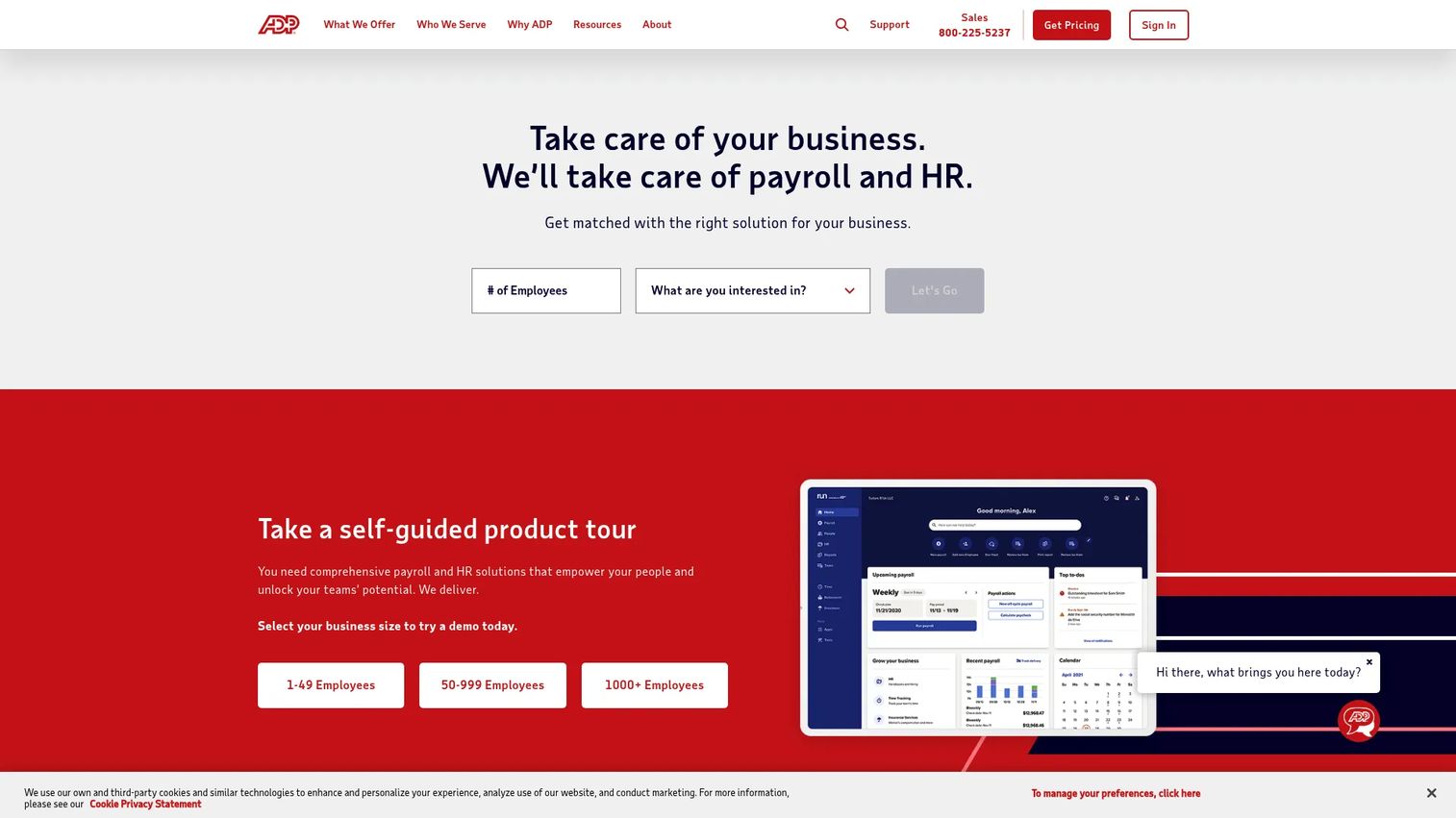
ADP is one of the oldest and most established names in payroll and HR outsourcing, offering cloud-based HCM that spans payroll, tax, HR, talent, time, and benefits administration. It scales from small businesses up to global enterprises, and its compliance depth is hard to match. For founders who see payroll accuracy and tax compliance as non-negotiable, ADP is a safe, proven choice.
Best for: Businesses that want payroll-centric HCM with deep compliance and tax support.
Key strengths
- Payroll and tax: Full payroll processing plus tax filing built for accuracy across jurisdictions.
- HR, talent, and benefits: Administration for HR data, talent, time, and benefits in one suite.
- Compliance and outsourcing: Business outsourcing services that offload compliance-heavy work.
Why choose ADP: If compliance risk keeps you up at night, ADP's track record and breadth are the draw. It is built to handle complex payroll and regulatory requirements as you scale headcount across states or countries. The trade-off for a lean Series B team is that the platform can feel heavier than a modern all-in-one, so it fits best when payroll and compliance are your center of gravity.
Pricing: ADP publishes package names for its payroll and HR plans, including Essential Payroll, Enhanced Payroll, Complete Payroll & HR Plus, and HR Pro Payroll & HR, but it does not display public numeric pricing. You request a quote based on headcount and needs. ADP Workforce Now holds a G2 rating of 4.2/5.
2. Workday
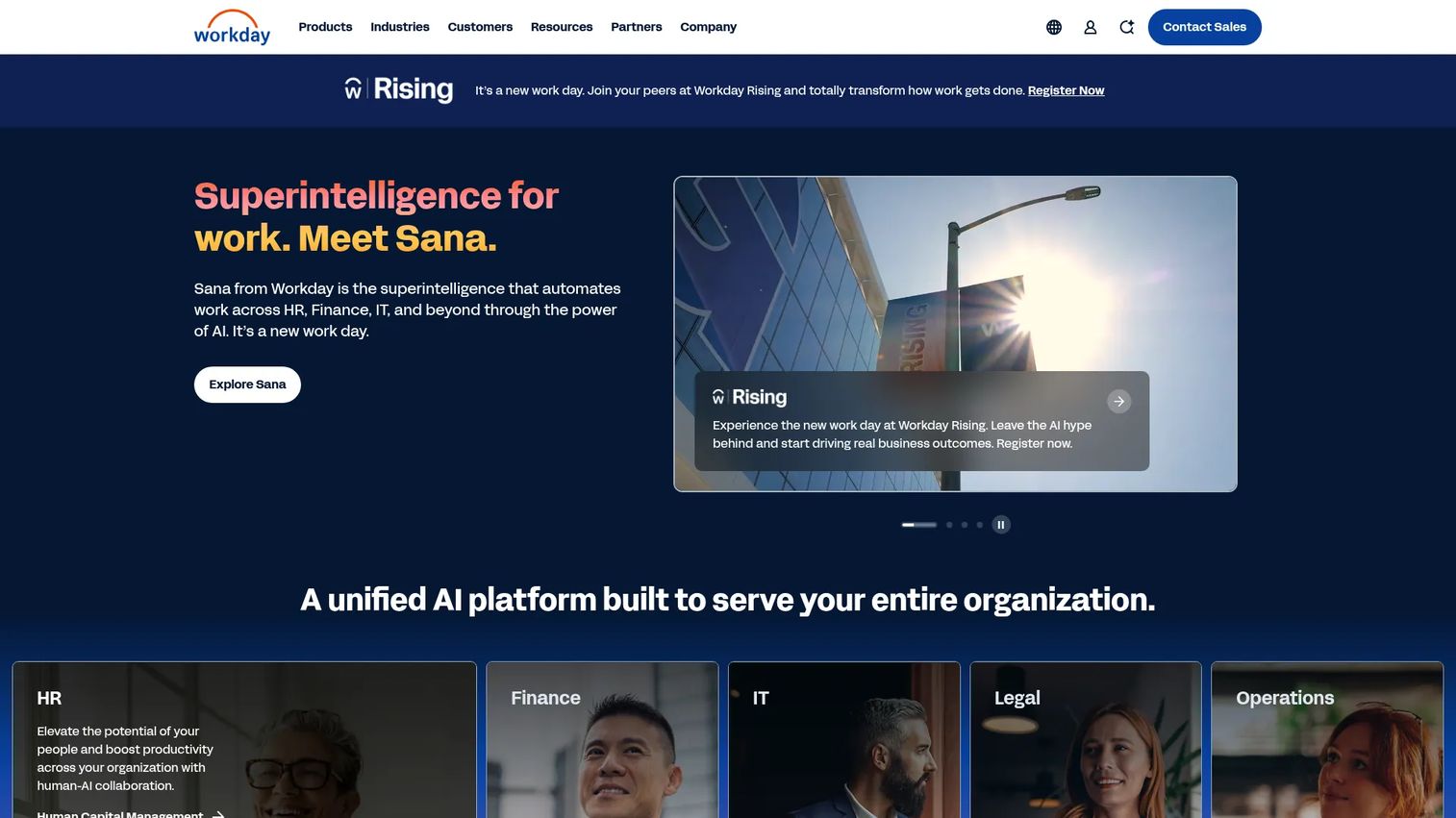
Workday is the enterprise standard for unifying HR and finance in one platform. It combines core HR, payroll, workforce management, planning, and ERP with AI automation, which is why large, complex organizations standardize on it. For a founder, Workday is usually a future-state choice rather than a Series B starting point, but it is worth knowing where the road leads.
Best for: Large organizations that need a unified HR and finance platform with AI-driven automation.
Key strengths
- Unified HR and finance: One system for people and money, which removes reconciliation between separate tools.
- AI agents and automation: Built-in AI to automate workflows and surface insights.
- Planning and workforce management: ERP, planning, payroll, and workforce management in a single suite.
Why choose Workday: Workday fits when your org is large enough that HR and finance fragmentation is a real cost. The depth and configurability are the selling points, and the same qualities mean it rewards companies with the scale and internal resources to run it. For most Series B teams it is aspirational, but if you expect rapid enterprise-grade complexity, it belongs on your radar.
Pricing: Workday uses quote-based pricing and does not publish public numeric prices for its core suite. Its Adaptive Planning product offers a 30-day free trial, with paid offerings priced on request. Workday holds a G2 rating of 4.2/5.
3. BambooHR
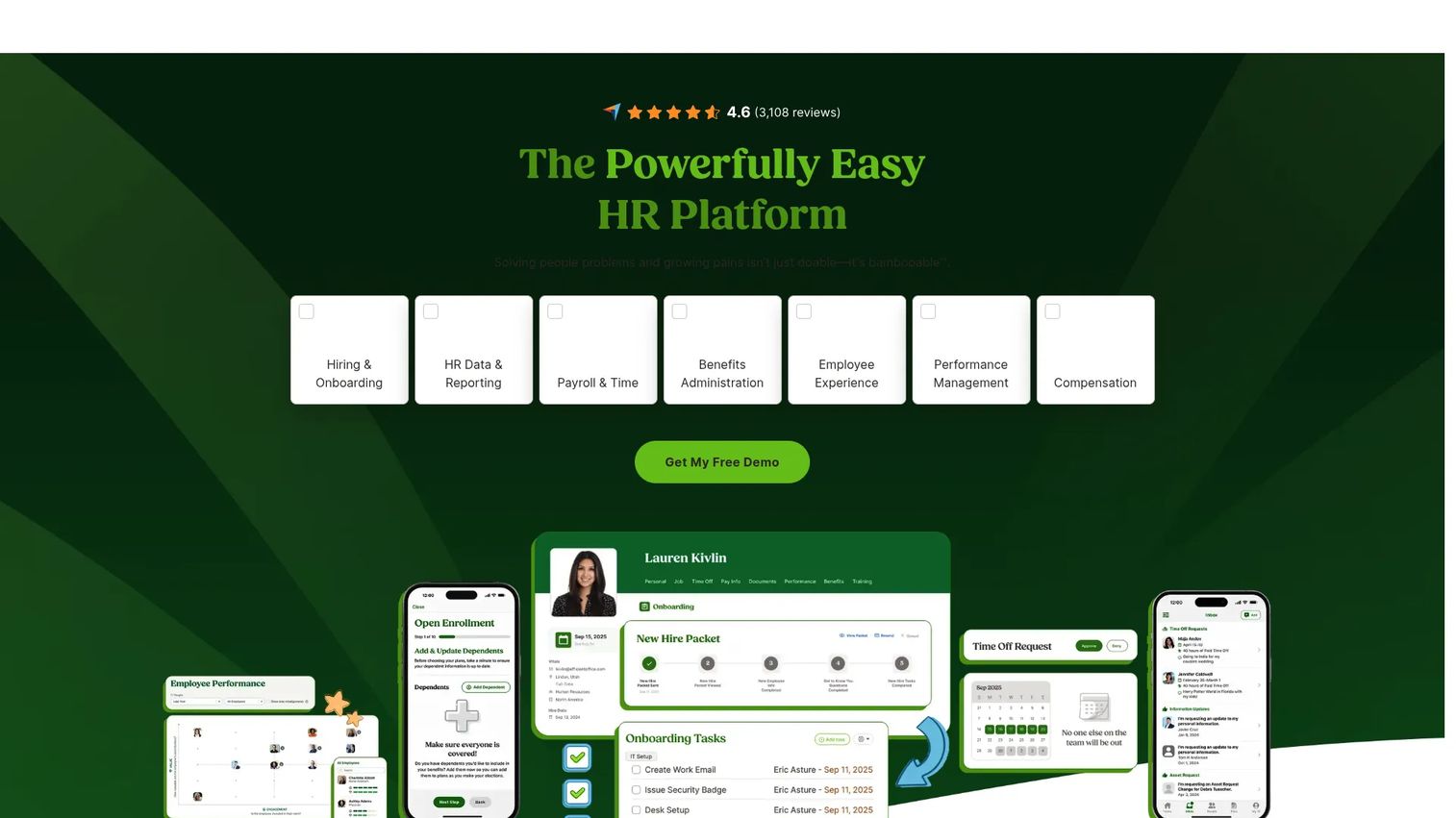
BambooHR is one of the most popular HRIS platforms for small and midsize companies, built around clean employee records, self-service, and painless onboarding. It is often the first real HRIS a growing company adopts, and for good reason: it is approachable, the interface is friendly, and it covers core HR without overwhelming a small team.
Best for: Small to midsize companies that want an approachable all-in-one HR platform.
Key strengths
- Employee records and reporting: A clean system of record with built-in HR data and reporting.
- Workflows and reminders: Approvals, workflows, and automated reminders that reduce manual chasing.
- Self-service and mobile: Employee self-service plus a mobile app so people update their own info.
Why choose BambooHR: BambooHR hits the sweet spot for a company that has outgrown spreadsheets but does not need enterprise machinery. Onboarding and self-service are genuinely strong, which frees your team from admin. It fits best as your core HR system when payroll is handled elsewhere or via an add-on, and when ease of adoption matters more than deep customization.
Pricing: BambooHR prices per employee per month for companies over 25 employees: Core at $10, Pro at $17, and Elite at $25 per employee per month. Companies with 25 or fewer employees start at a flat rate around $250 per month. There is no free tier. BambooHR holds a G2 rating of 4.4/5.
4. Deel
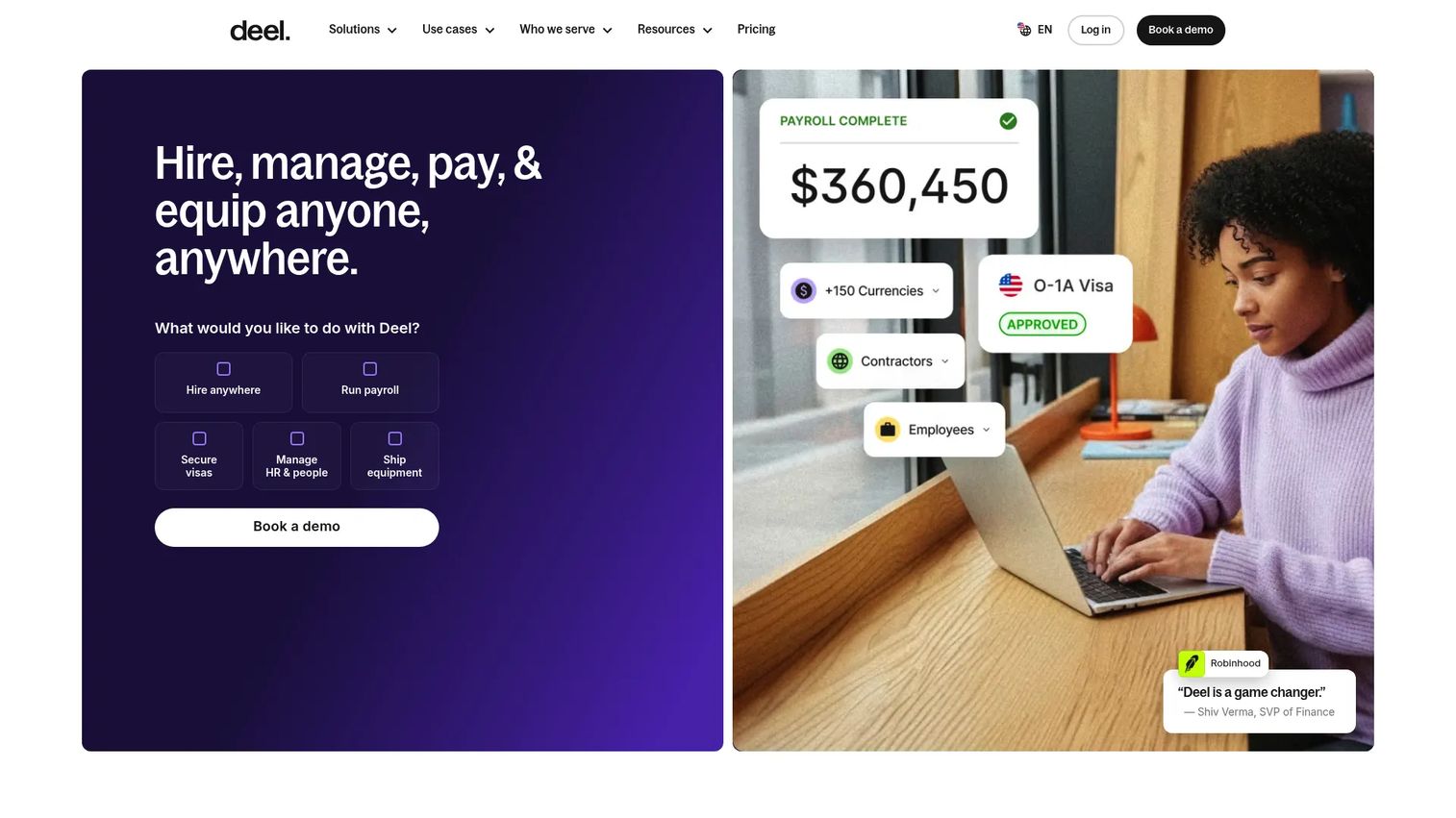
Deel is the go-to platform for companies hiring and paying people across borders. It combines global HR, payroll, contractor management, employer of record (EOR), and compliance in one system, which makes it invaluable for SaaS companies building distributed teams. If your next 20 hires are spread across five countries, Deel removes the compliance and payroll headache.
Best for: Companies hiring, paying, and managing global teams across multiple countries.
Key strengths
- Global hiring and EOR: Employer of record coverage to hire compliantly in countries where you have no entity.
- Contractor management: Onboard, manage, and pay contractors and freelancers worldwide.
- HR, payroll, and compliance: Unified HR, payroll, IT, and compliance workflows across regions.
Why choose Deel: Deel is the clearest fit when global hiring is central to your growth plan. It turns the legal and payroll complexity of international teams into a manageable workflow, which is exactly the kind of drag a founder wants off their plate. It works both as a standalone global HR platform and alongside a domestic HRIS, depending on how distributed your team is.
Pricing: Deel publishes transparent module pricing. Contractor management starts at $49 per contractor per month, EOR Standard at $599 per employee per month, PEO at $125 per employee per month, and Deel HR Basic at $5 per employee per month, with international payroll from $29 per employee per month. There is no free tier. Deel holds a strong G2 rating of 4.8/5.
5. Gusto
Gusto is a favorite among small businesses for combining payroll, benefits, and HR in one clean, easy-to-use platform. It automates payroll, taxes, and filings, handles benefits administration, and adds HR tooling, all with an interface that a non-specialist can run. For early-stage and small SaaS teams, Gusto is often the fastest path to legitimate payroll and HR.
Best for: Small businesses that need payroll plus HR and benefits in one straightforward platform.
Key strengths
- Automated payroll and taxes: Payroll, tax calculations, and filings handled automatically.
- Benefits administration: Health benefits and administration built into the platform.
- HR tools and support: Core HR tooling and support for teams without a dedicated HR function.
Why choose Gusto: Gusto wins on simplicity and speed to value. A founder or office manager can run payroll without a specialist, and the pricing is transparent. It fits best for smaller teams and early-stage companies; as you scale past a couple hundred employees or go heavily global, you may outgrow it, but for the SMB stage it is hard to beat on ease.
Pricing: Gusto lists four plans. Contractor Only starts at $0 per month plus $6 per person (a limited-time base price for the first six months), Simple at $49 per month plus $6 per person, Plus at $80 per month plus $12 per person, and Premium at $180 per month plus $22 per person. A Capterra rating is available; a current G2 rating was not verified at writing time.
6. HiBob
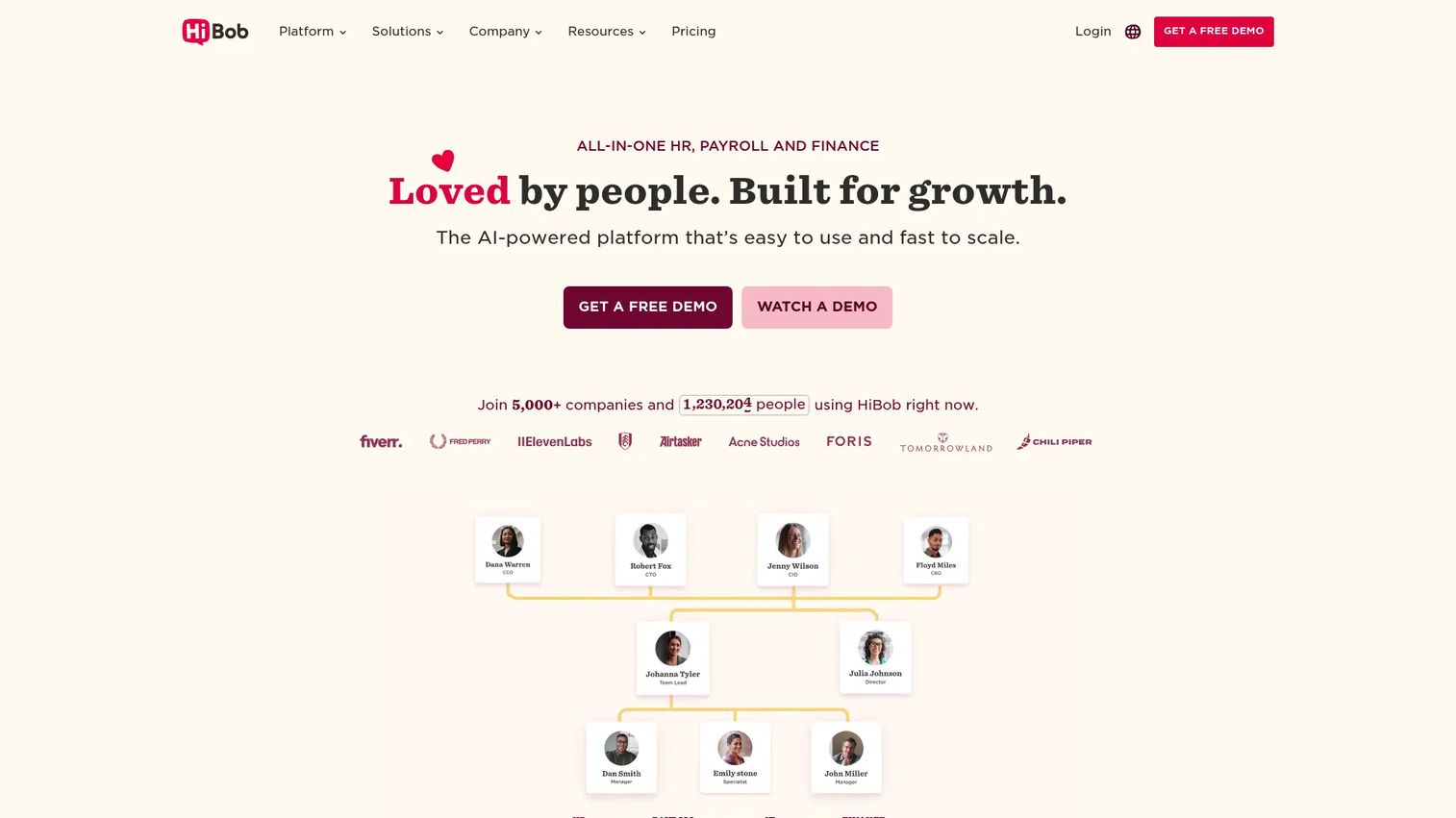
HiBob, often called Bob, is a modern people management platform built for distributed, fast-moving companies. It covers core HR, onboarding, time off, time and attendance, performance, compensation, and analytics, with a configurable design that appeals to companies that want their HRIS to reflect how they actually work. HiBob is a strong fit for culture-forward SaaS companies scaling globally.
Best for: Mid-market and distributed companies wanting a configurable, modern HRIS.
Key strengths
- Core HR and digital admin: A flexible system of record with strong digital admin workflows.
- Onboarding and time management: Onboarding, time off, and time and attendance in one flow.
- Performance and analytics: Performance, compensation, a payroll hub, and people analytics.
Why choose HiBob: HiBob appeals to companies that see people operations as a competitive advantage, not just admin. Its configurability and modern UX make it a favorite among growing tech companies. It fits best for mid-market teams that want workflows tailored to their culture and are ready to invest in a platform that scales with headcount and geography.
Pricing: HiBob uses custom, quote-based pricing that depends on employee count and selected features, including Core HR and Digital Admin. No public numeric price is listed. HiBob holds a G2 rating of 4.5/5.
7. Paycor
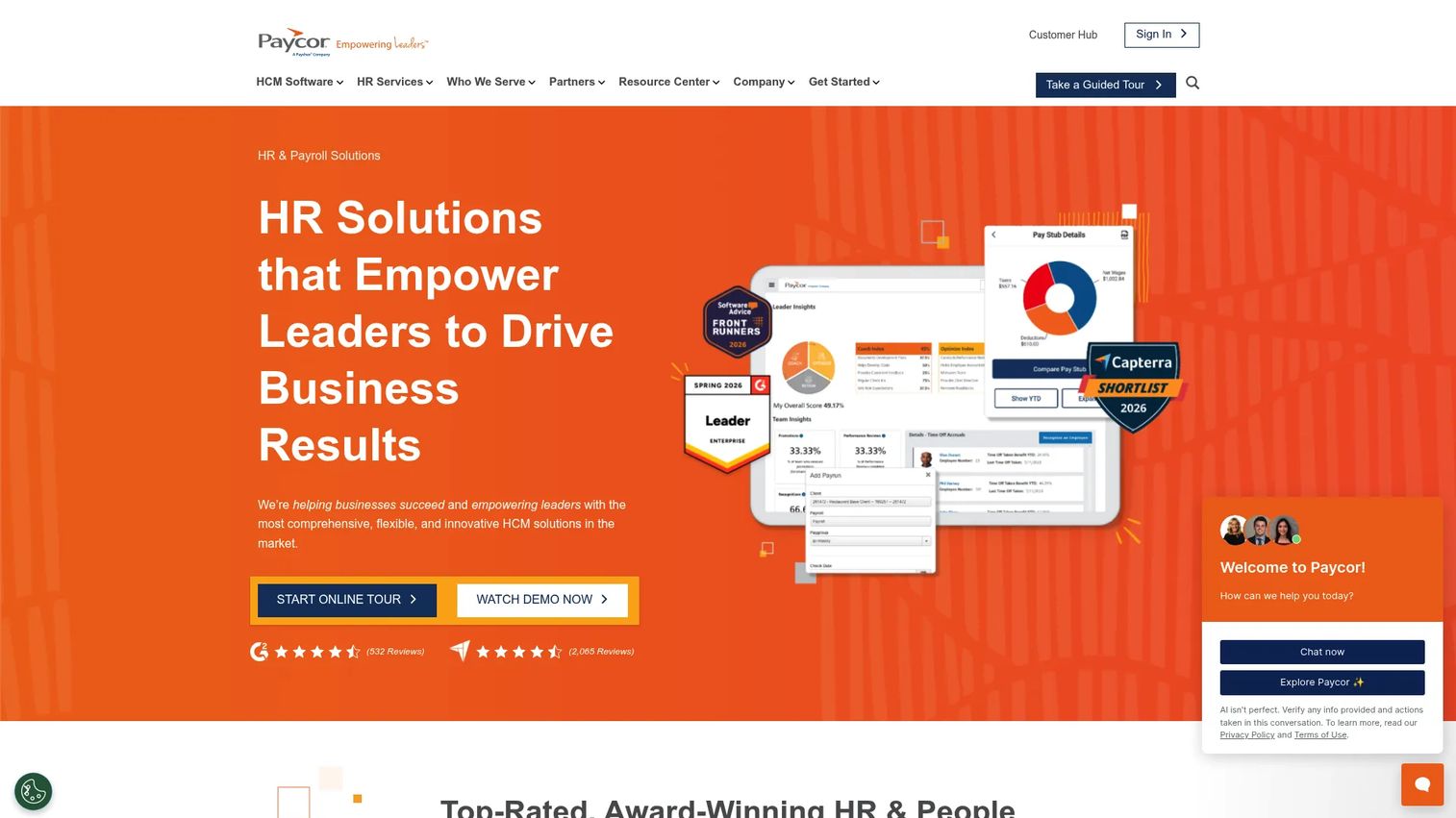
Paycor is a cloud-based HCM platform covering payroll, HR, recruiting, talent, time, and benefits, aimed at small and mid-sized businesses that want everything in one place. It combines payroll and tax filing with recruiting, onboarding, and workforce management, and its published small-business pricing makes it easy to evaluate. Paycor is a practical all-in-one for companies that want payroll and HR under one roof.
Best for: Small to mid-sized businesses needing an all-in-one HR and payroll platform.
Key strengths
- Payroll and tax filing: Reliable payroll processing with automated tax filing.
- Recruiting and onboarding: Built-in recruiting and onboarding to run hiring end to end.
- Time and workforce management: Time tracking, scheduling, and workforce management tools.
Why choose Paycor: Paycor fits founders who want a single vendor for payroll and HR without moving to enterprise pricing. Its transparent small-business tiers make budgeting straightforward, and the recruiting and onboarding tools cover the hiring surge that comes with a Series B. It works best for companies growing headcount steadily who value having one integrated platform.
Pricing: Paycor's small-business plans are public: Basic at $99 per month plus $5 per employee, Essential at $149 per month plus $6 per employee, Complete at $199 per month plus $7 per employee, and HCM at $199 per month plus $12 per employee. Mid-market pricing is quote-based. Paycor holds a G2 rating of 3.9/5.
8. Rippling
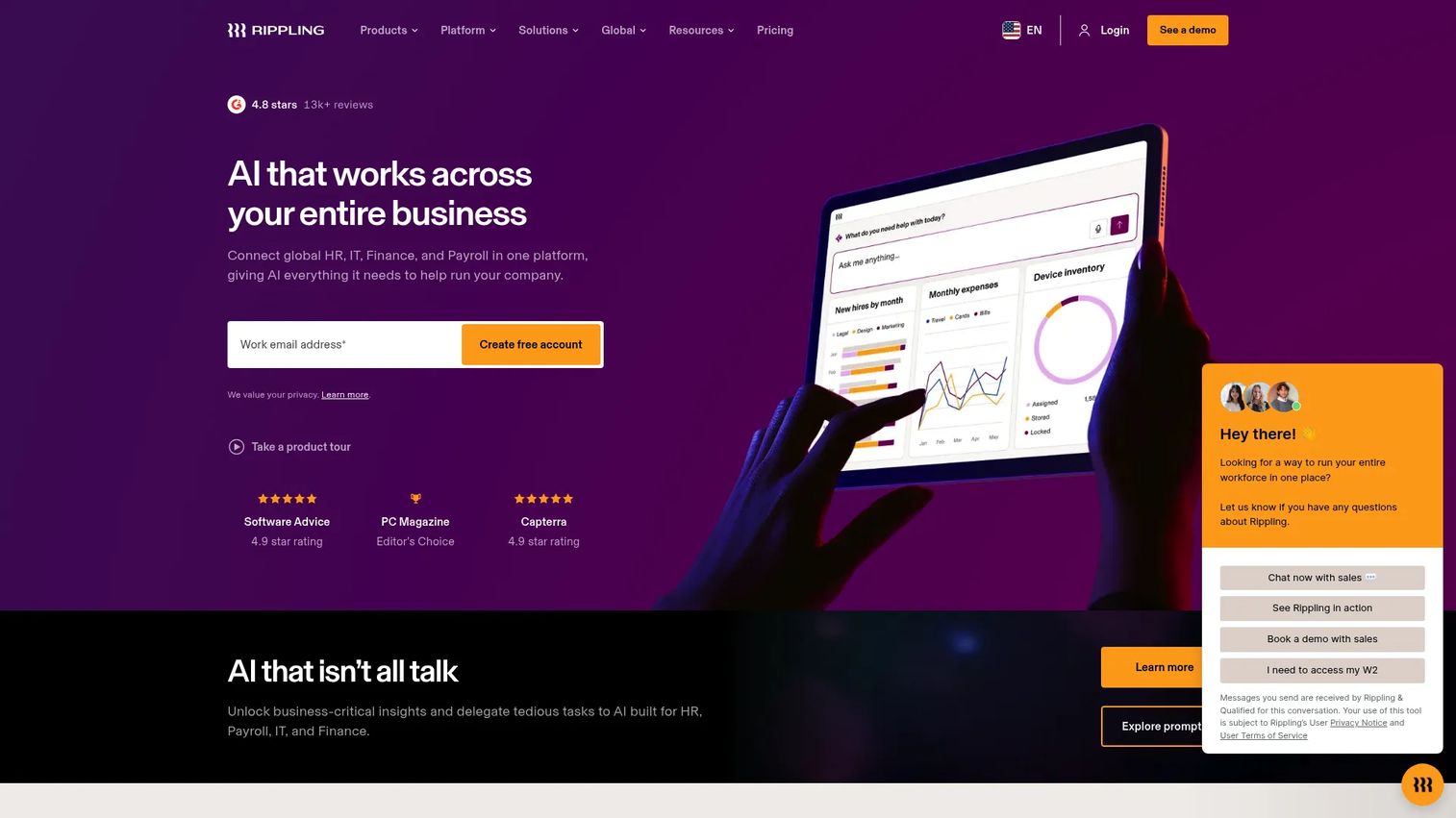
Rippling is a workforce management platform that unifies HR, IT, finance, payroll, and spend in one system. Its differentiator is that a single employee record drives everything, so onboarding a new hire can provision their payroll, benefits, laptop, and app access in one workflow. For a Series B SaaS founder trying to reduce tool sprawl, that consolidation is compelling.
Best for: Fast-growing companies that want one platform for HR, payroll, IT, and spend.
Key strengths
- Unified workforce platform: A single employee record powering HR, IT, and finance together.
- Modular products: HR, IT, and finance modules you can add as your needs grow.
- Automation and permissions: Workflow automation and granular permission controls across the org.
Why choose Rippling: Rippling is the standout when consolidation is the goal. Instead of stitching together an HRIS, an IT tool, and a spend platform, you run one system with one source of truth. That is exactly the "reduce tools while increasing signal" outcome a Series B founder is chasing. It fits best for companies ready to commit to a platform play rather than best-of-breed point tools.
Pricing: Rippling uses custom, quote-based pricing. Most products bill per employee per month, with some monthly base fees, and the company asks prospects to request a free quote. No public numeric price is listed. Rippling holds a G2 rating of 4.8/5.
9. UKG Pro
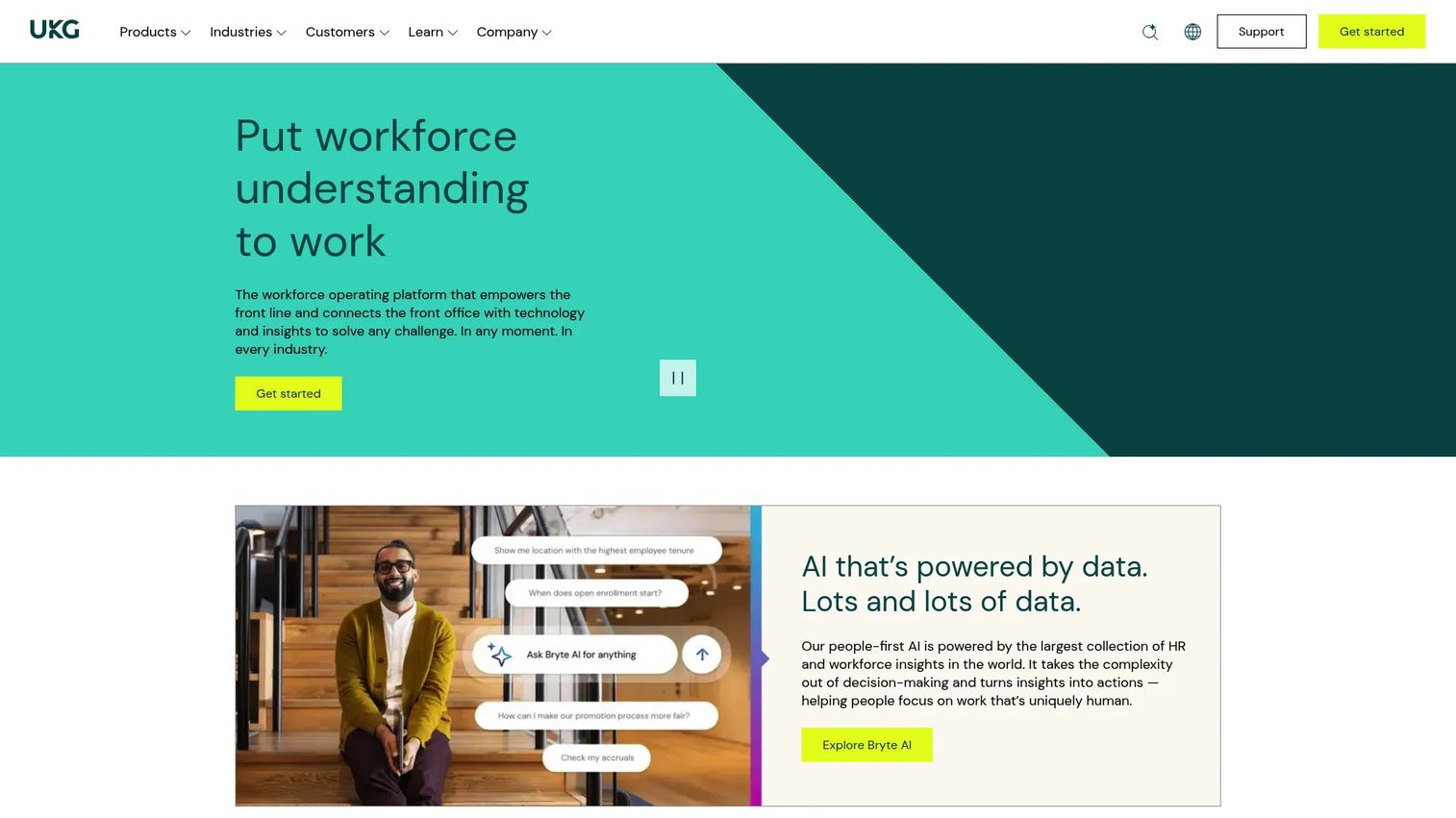
UKG Pro is an enterprise human capital management suite covering HR, payroll, talent, time and attendance, scheduling, workforce planning, compliance, and analytics, with a built-in AI assistant. It is designed for large organizations with complex payroll and workforce management needs, particularly those with hourly, shift-based, or unionized workforces. UKG Pro is enterprise-grade infrastructure.
Best for: Large organizations with complex HCM, payroll, and workforce management requirements.
Key strengths
- Full HCM suite: HR, payroll, talent, and time and attendance in one enterprise platform.
- Workforce planning and scheduling: Scheduling and workforce planning built for complex operations.
- Compliance and analytics: Compliance support plus analytics and reporting, with an AI assistant.
Why choose UKG Pro: UKG Pro fits when workforce complexity is high and you need depth across payroll, scheduling, and compliance. Its strength is handling the hard cases that trip up lighter platforms. For most Series B SaaS companies it is more than needed today, but if your model involves complex, high-volume workforce management, it is built for exactly that.
Pricing: UKG does not publish public pricing for UKG Pro; it is quote-based and configured to your organization. UKG Pro is widely reviewed on G2, with reported ratings around 4.3/5.
10. Paylocity
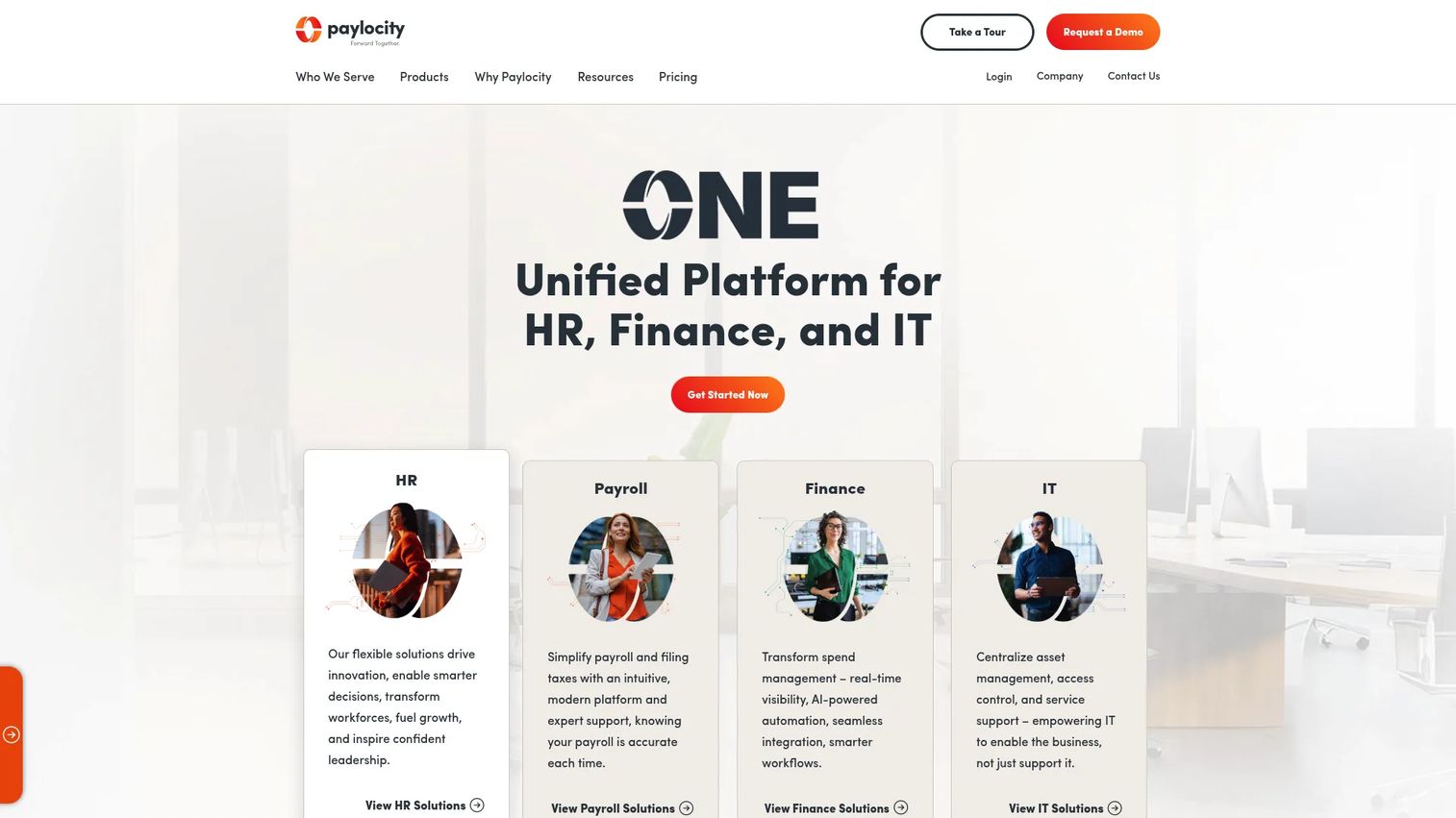
Paylocity is a cloud-based platform spanning HR, payroll, finance, and IT, aimed at mid-market organizations that want an all-in-one system. Beyond core payroll and HR workflows, it adds finance capabilities like expense management, corporate cards, AP automation, and headcount planning, plus IT features for access and asset management. Paylocity is a broad platform for companies consolidating operations.
Best for: Mid-market organizations wanting an all-in-one HR, payroll, finance, and IT platform.
Key strengths
- Payroll and HR workflows: Reliable payroll processing plus core HR workflows in one place.
- Finance capabilities: Expense management, corporate cards, AP automation, and headcount planning.
- IT capabilities: Access management, asset management, and integrations via APIs.
Why choose Paylocity: Paylocity fits mid-market founders who want HR and payroll plus a growing set of finance and IT tools without adding separate vendors. The finance and headcount planning features are a genuine differentiator for companies thinking about operational consolidation. It works best when you are building toward a unified operations platform rather than isolated point tools.
Pricing: Paylocity uses custom, quote-based pricing tailored to your organization and does not display public numeric prices. Paylocity holds a rating of 4.5/5 on Capterra.
Considerations before you buy
Once you have a shortlist, run each option through this founder checklist before committing.
How much of the HR stack it replaces
Map what each platform actually consolidates. Some HRIS tools are core HR only, while others fold in payroll, benefits, IT, and spend. The more real tools a platform retires from your stack, the stronger the ROI argument, and the easier the "what does this replace" conversation with your team.
Whether payroll is native or separate
Payroll is where HRIS decisions get real. Confirm whether payroll is built in, an add-on, or an integration with a separate provider. Native payroll reduces reconciliation and sync errors; a separate provider can still work well if the integration is clean and reliable.
Reporting depth
You are buying this partly for reporting leadership can trust. Test whether the platform gives you headcount, turnover, comp, and cost reporting out of the box, and whether you can export or connect it to your BI stack. Weak reporting means you are back to manual reconstruction.
Implementation speed and compliance fit
Ask hard questions about time to go live, data migration, and support during setup. A platform that takes months to implement delays every downstream benefit. At the same time, verify compliance and security fit: SOC 2, data residency, and tax handling across the states or countries where you operate. If you hire globally, confirm real employer of record or multi-country payroll coverage rather than a thin integration.
Conclusion: choosing the best HRIS software for your stage
The best HRIS software depends on your stage, payroll footprint, and how distributed your team is. For small and early-stage teams, Gusto and Paycor deliver payroll plus HR without complexity. For fast-growing companies chasing consolidation, Rippling unifies HR, IT, and payroll in one system. If global hiring drives your growth, Deel removes the cross-border headache. For approachable core HR and clean onboarding, BambooHR and HiBob are strong. And when enterprise complexity arrives, Workday, UKG Pro, ADP, and Paylocity handle depth at scale.
Your next step is simple. Shortlist two or three of these hris solutions based on three inputs: current headcount, whether you need native payroll, and the reporting your board and finance lead actually require. Then run short trials or scoped demos before committing. The right system of record earns its place in your stack within the first quarter by removing admin drag and giving you people data you can defend.
FAQs
HRIS software is a human resource information system that centralizes employee data and automates core HR workflows like records, onboarding, payroll inputs, benefits, and time off. It acts as the single system of record for your people data, so information stays consistent and reporting stays reliable.
An HRIS focuses on the data backbone: employee records, core workflows, and reporting. An HRMS (human resource management system) adds operational layers such as payroll and time management on top of that foundation. In practice, many modern platforms combine both, so the label matters less than the workflows the tool actually covers.
HRIS is the system of record for employee data and core HR processes. HCM (human capital management) is broader, adding talent management, performance, learning, and workforce planning on top of core HR. For most growing companies, an HRIS covers the essentials, and you move toward full HCM as complexity and headcount grow.
It depends on your priorities. Rippling suits founders who want to consolidate HR, IT, and payroll into one platform. Deel fits companies hiring globally. BambooHR and HiBob work well for clean core HR and onboarding, while Gusto and Paycor cover payroll-first SMB needs. Shortlist based on headcount, payroll footprint, and reporting needs.
Sometimes. Platforms like Rippling, Gusto, Paycor, ADP, and Deel include native payroll, so they can replace a standalone payroll tool. Others focus on core HR and integrate with a separate payroll provider. Confirm whether payroll is native, an add-on, or an integration before you buy.
It varies by platform and company size. Lightweight SMB tools can be live in days to a few weeks, while enterprise HCM suites often take several months due to data migration, configuration, and integrations. Ask each vendor for a realistic timeline and what support they provide during setup.
Prioritize system of record strength, native or cleanly integrated payroll, reporting depth leadership can trust, fast implementation, and compliance and security fit. If you hire globally, add real multi-country payroll or employer of record coverage. The goal is one clean source of truth that reduces admin and survives due diligence.
Cloud-based, in almost every case. Cloud HRIS platforms are faster to deploy, update automatically, require no infrastructure to maintain, and integrate more easily with your existing stack. On-premise is now rare and mostly relevant to organizations with specific data residency or regulatory constraints.