

You hit every onboarding call. You ran the QBRs. The relationship felt healthy. Then the renewal email comes back declined, and you never saw the signal.
That gap between what you feel about an account and what is actually happening inside the product is where churn hides. Customer retention software exists to close it. It tracks engagement, scores account health, flags risk before renewal, and helps you act while there is still time.
The economics are not subtle. Research by Frederick Reichheld of Bain & Company found that increasing customer retention rates by 5% increases profits by 25% to 95%, and acquiring a new customer can cost five to 25 times more than keeping one (Harvard Business School). For a CSM carrying a book of accounts, retention is not a defensive metric. It is the growth engine.
Retention economics: A 5% lift in retention can raise profits by 25% to 95% (Reichheld, Bain & Company). Churn costs U.S. businesses roughly $136 billion a year, yet 44% of companies still focus more on acquisition than retention (industry research, 2025).
The problem is that retention signals live in too many places. Usage data in one tool. Tickets in another. Renewal dates in the CRM. NPS in a survey platform. The right customer retention software pulls those threads together so you can spot trouble early and prove your impact with data.
What's inside
This guide is written for Customer Success Managers and CS-adjacent roles: Client Success Managers, Customer Experience Managers, Onboarding Managers, and CS-focused Account Managers at B2B SaaS companies.
We selected 12 customer retention tools against four criteria that matter for CS work:
- Churn signal detection: health scores, usage tracking, and at-risk alerts.
- Onboarding and adoption support: does it actively drive product adoption, not just measure it?
- Integrations with the CS stack: Salesforce, HubSpot, Slack, support desks, analytics.
- Analytics depth and pricing transparency: can you measure retention and know what you will pay?
Tools span customer success platforms, CRMs, support desks, product analytics, adoption tools, and feedback platforms.
TL;DR
Short on time? Here are the decision shortcuts by CS sub-segment.
- Best all-in-one CS platform for enterprise: Gainsight.
- Best for churn reduction at mid-market: ChurnZero.
- Best for product adoption analytics: Pendo.
- Best for PLG adoption-led retention: Userpilot.
- Best CRM plus retention in one stack (with a free tier): HubSpot.
- Best for feedback-driven and predictive retention: Qualtrics.
- Best free tier for behavioral retention analysis: Mixpanel.
Match the tool to your motion. A high-touch enterprise CSM and a low-touch product-led growth motion CSM should not buy the same customer retention platform.
What is customer retention software
Customer retention software is a category of tools that help teams keep existing customers by tracking engagement, predicting churn, automating interventions, and improving product adoption.
It sits on top of your product usage data, support history, and CRM records to give CSMs a single view of account health. A good customer retention management system turns scattered signals into a clear answer to one question: which accounts are at risk, and what should I do about it?
The category is broad. Some tools are full customer success platforms. Others are CRMs, support desks, analytics tools, or feedback systems that contribute a retention function. Most CS teams run two or three together.
Core features of customer retention software
A capable customer retention system usually includes most of these:
- Customer health scores: composite signals (usage, engagement, support, sentiment) that flag risk.
- Churn prediction: models that estimate renewal risk before it surfaces.
- Segmentation: group accounts by plan, lifecycle stage, usage, or persona.
- Automation and playbooks: trigger tasks, emails, or alerts when signals shift.
- Integrations: sync with Salesforce, HubSpot, Slack, support desks, and analytics tools.
- Analytics and reporting: retention rate, NRR, churn, adoption, and impact attribution.
- Feedback collection: NPS, CSAT, and survey signals tied to accounts.
- In-app engagement: messages, nudges, and walkthroughs delivered inside the product.
- Onboarding and adoption support: help users reach value faster.
Types of retention software by function
No single tool owns retention. The category breaks down by job:
- CS platforms: Gainsight, ChurnZero, Totango, Custify. Health scoring, playbooks, renewals.
- CRMs: HubSpot. Unified customer record plus service and feedback.
- Support desks: Zendesk. Ticketing, self-serve help, CSAT.
- Product analytics: Mixpanel, Pendo. Behavioral retention and adoption data.
- Adoption and onboarding tools: Userpilot, Whatfix. In-app guidance that drives usage.
- Feedback and experience: Qualtrics. Predictive churn from feedback signals.
- Retention marketing: Optimove. Lifecycle orchestration and loyalty.
The adoption layer deserves attention because product education is a direct retention lever. Customers who reach value early stay longer, and self-serve product education scales onboarding without adding CSM hours. Interactive demos work well here: guided, clickable walkthroughs let customers learn features at their own pace inside onboarding flows, help centers, and feature announcements. That reinforces adoption-led retention across the lifecycle, which is exactly what feeds the health scores your CS platform tracks. For teams comparing tools in this space, the best digital adoption platforms and best onboarding flow software guides go deeper on the adoption layer.
Why customer retention matters for CSMs
Retention is the metric CS leadership measures you against. Each capability below ties to a KPI you already own.
Reduce churn before renewal
The worst renewals are the ones that surprise you. Health scores and usage signals let you spot a declining account weeks or months before the contract date. That lead time is the difference between a save and a loss. A CSM who can see falling logins, unused core features, or rising ticket volume has room to intervene. Tie this to your churn rate and gross retention.
Increase product adoption and time-to-value
Adoption drives stickiness. Customers who use more of the product, and reach value faster, churn less. Faster time-to-value lowers early churn, the kind that hits within the first 90 days before a relationship exists. Adoption tooling and in-app guidance shorten that window. You can boost product adoption with interactive demos that guide users to value without adding CSM hours. Tie this to feature adoption and time-to-value.
Prove CS impact with data
Fragmented metrics make CS work hard to measure. When usage, sentiment, and renewals live in separate tools, you cannot attribute outcomes to your work. Consolidating those signals lets you show leadership the retention and expansion your team drove. Tie this to net revenue retention benchmarks for SaaS and CSAT or NPS.
How to choose customer retention software
Pattern-match your situation to one of these before you shortlist.
Scaling onboarding without adding headcount
When manual onboarding stops scaling, every new account stretches your team thinner. You repeat the same walkthroughs, answer the same questions, and quality slips. Look for tools that automate onboarding sequences and deliver self-serve product education. The right user onboarding software can deliver consistent activation without a linear increase in CSM hours.
Getting ahead of churn signals
When retention is reactive and renewals surprise you, the problem is visibility. You need health scoring and usage signals that surface risk early, plus automated playbooks that trigger the right intervention. If your current process means you learn about churn at the renewal call, prioritize churn prediction and at-risk alerts.
Consolidating a fragmented CS stack
When data lives in too many disconnected tools, you spend more time stitching reports than helping customers. Look for a platform that integrates with your CRM, support desk, and analytics so you get one account view. Consolidation cuts manual work and makes impact attribution possible.
Comparison table
Here is the shortlist at a glance. Use it to narrow to two or three, then read the full sections. This customer retention management software comparison covers intent, primary use case, pricing, and G2 software review platform rating.
| # | Product | Intent | Key use case | Pricing | G2 rating |
|---|---|---|---|---|---|
| 1 | Gainsight | CS platform | Enterprise health scoring and renewals | Request pricing | 4.5/5 |
| 2 | ChurnZero | CS platform | Mid-market churn reduction | Quote-based | 4.7/5 |
| 3 | Totango | CS platform | Composable, scaling CS orgs | Talk to sales | 4.3/5 |
| 4 | Custify | CS platform | SMB to mid-market SaaS CS | Demo-led pricing | 4.7/5 |
| 5 | HubSpot | CRM and service | CRM plus retention in one stack | Free, then from $10/mo per seat | 4.5/5 |
| 6 | Zendesk | Support and CX | Support-led retention | From $19/agent/mo | 4.3/5 |
| 7 | Userpilot | Product adoption | PLG adoption-led retention | From $299/mo | 4.6/5 |
| 8 | Whatfix | Digital adoption | Enterprise adoption at scale | Quote-based | 4.6/5 |
| 9 | Qualtrics | Feedback and CX | Predictive, feedback-driven retention | Free, then from $420/mo | 4.4/5 |
| 10 | Mixpanel | Product analytics | Behavioral retention analysis | Free, then from $0 usage-based | 4.5/5 |
| 11 | Optimove | Retention marketing | Lifecycle orchestration | Custom | 4.6/5 |
| 12 | Pendo | Product experience | Adoption plus retention alignment | Free, then custom | 4.4/5 |
The 12 best customer retention software tools for 2026
Each section covers what the tool does, who it fits, key strengths, and verified pricing. Pricing and ratings change, so confirm current figures on each vendor's site before you buy.
1. Gainsight
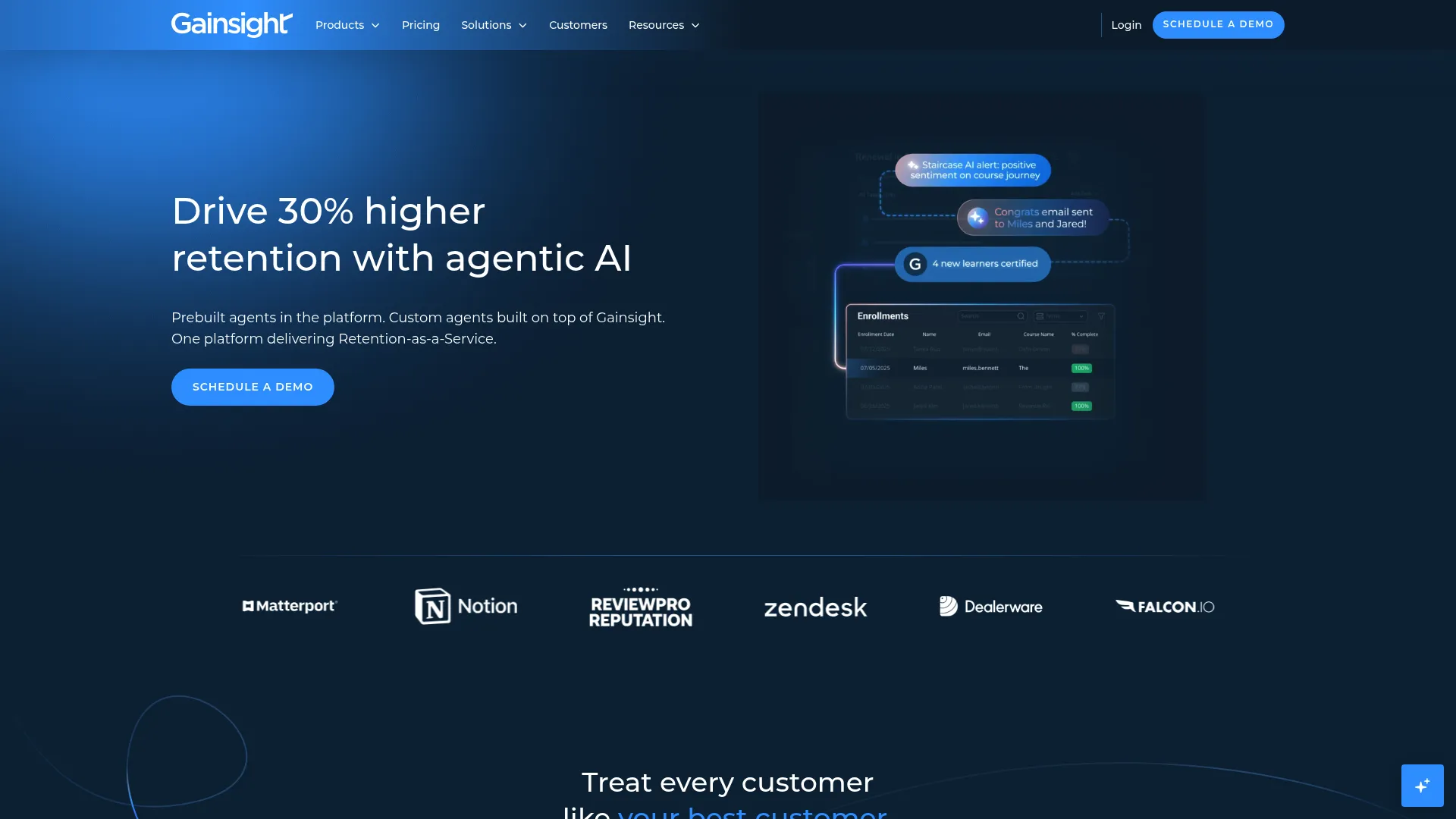
Gainsight is a customer platform for helping customers learn, adopt, connect, and succeed across post-sales journeys. It is the most established name in enterprise customer success, built for CS teams managing large books of business across complex accounts. The platform unifies health scoring, renewal forecasting, and journey automation in one system.
For CSMs, the draw is consolidation. Customer 360 pulls usage, support, and relationship data into one profile, while health scorecards turn that into a risk signal you can act on. Renewal and expansion forecasting gives leadership the pipeline view they ask for.
Best for: Enterprise CS teams managing many accounts who need a unified retention, adoption, and expansion platform.
Key strengths
- Health scorecards: Configurable scores that combine usage, sentiment, and engagement into early risk signals.
- Journey orchestration: Automated email and lifecycle journeys tailored by health score, usage, survey results, and lifecycle stage.
- Renewal forecasting: Renewal and expansion forecasting that ties CS activity to revenue.
Why choose Gainsight
Gainsight fits CS orgs that have outgrown spreadsheets and need governance, depth, and cross-functional reporting. It pairs Customer Success with Product Experience (product analytics and in-app guides), so adoption data feeds retention work. It is the right call when scale and proof of impact matter more than speed to set up.
Gainsight pricing
Gainsight uses request pricing for its main offerings. The Customer Success product is available in Essentials and Enterprise tiers, both quote-based. Product Experience is also quote-based and offers a free trial. There is no public free tier. Expect enterprise-level contracts, so budget accordingly and request a quote scoped to your account count. Gainsight holds a 4.5 out of 5 rating on G2.
2. ChurnZero
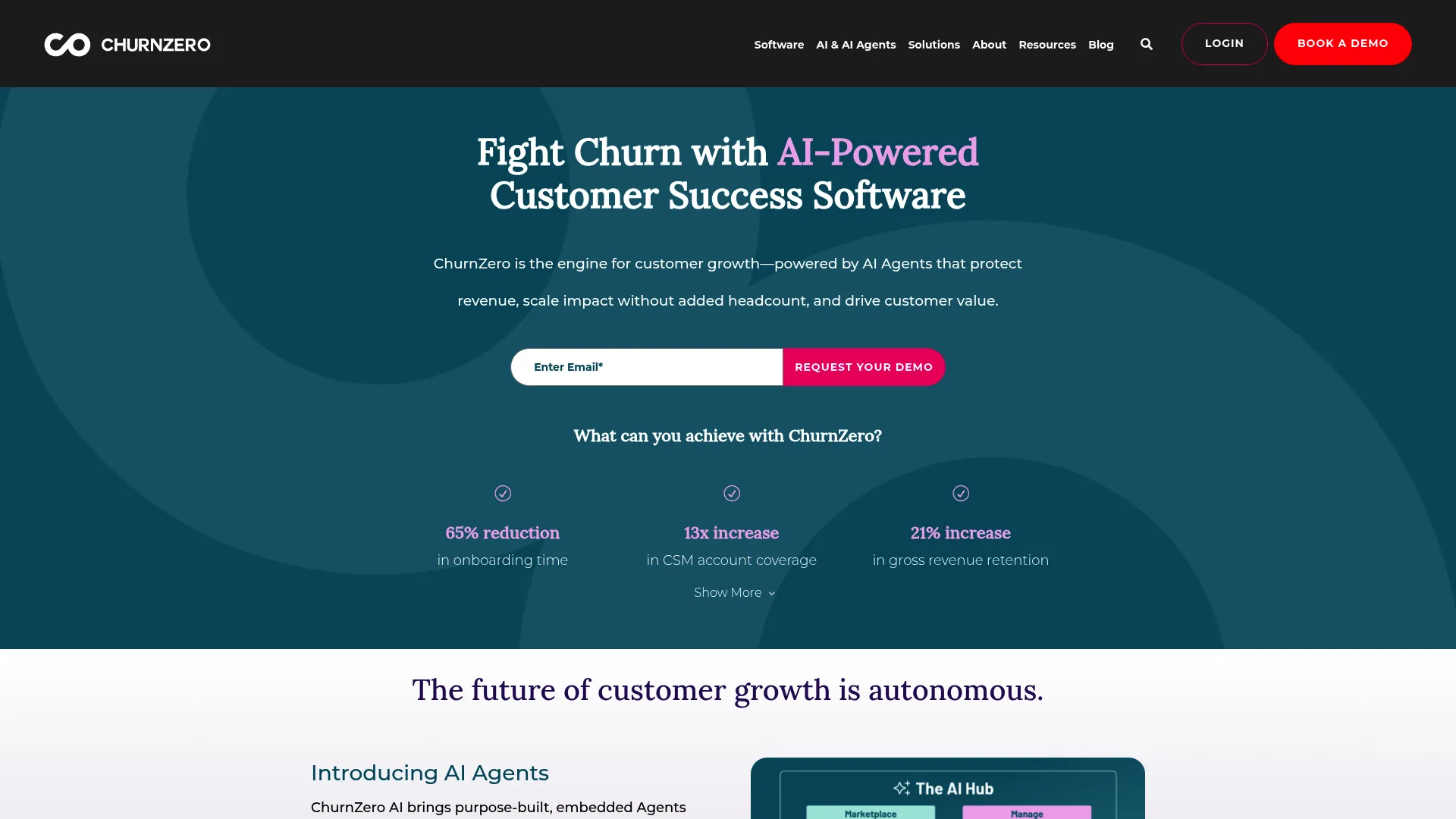
ChurnZero is an AI-powered customer success platform for customer growth, retention, account health, engagement, renewals, and expansion. As the name suggests, it is built around reducing churn. The platform combines real-time health scores with automation so CSMs can act the moment a signal shifts.
It earns one of the highest ratings in the category, which reflects how closely it maps to day-to-day CS work. Segments, playbooks, and in-app communications let you run proactive motions without manual tracking.
Best for: Mid-market SaaS CS teams that want a focused, automation-heavy platform to cut churn.
Key strengths
- Real-time health scores: Account health and profiles that update continuously, not on a reporting lag.
- Playbooks and automation: Customer journeys, plays, segments, and real-time alerts that trigger the right intervention.
- In-app communications: Walkthroughs and messages delivered inside your product to drive adoption.
Why choose ChurnZero
ChurnZero suits CS teams whose core mandate is retention and who want software that mirrors that focus. Its engagement AI, renewal forecasting, and in-app communications support both proactive saves and expansion. Choose it when you want depth in churn reduction without the implementation weight of a broader suite.
ChurnZero pricing
ChurnZero uses quote-based pricing, and public numeric tiers are not listed on its pricing page. Pricing is typically scoped to your customer base and feature needs, so request a quote and ask what is included at the entry level. ChurnZero holds a 4.7 out of 5 rating on G2, among the highest in this list.
3. Totango
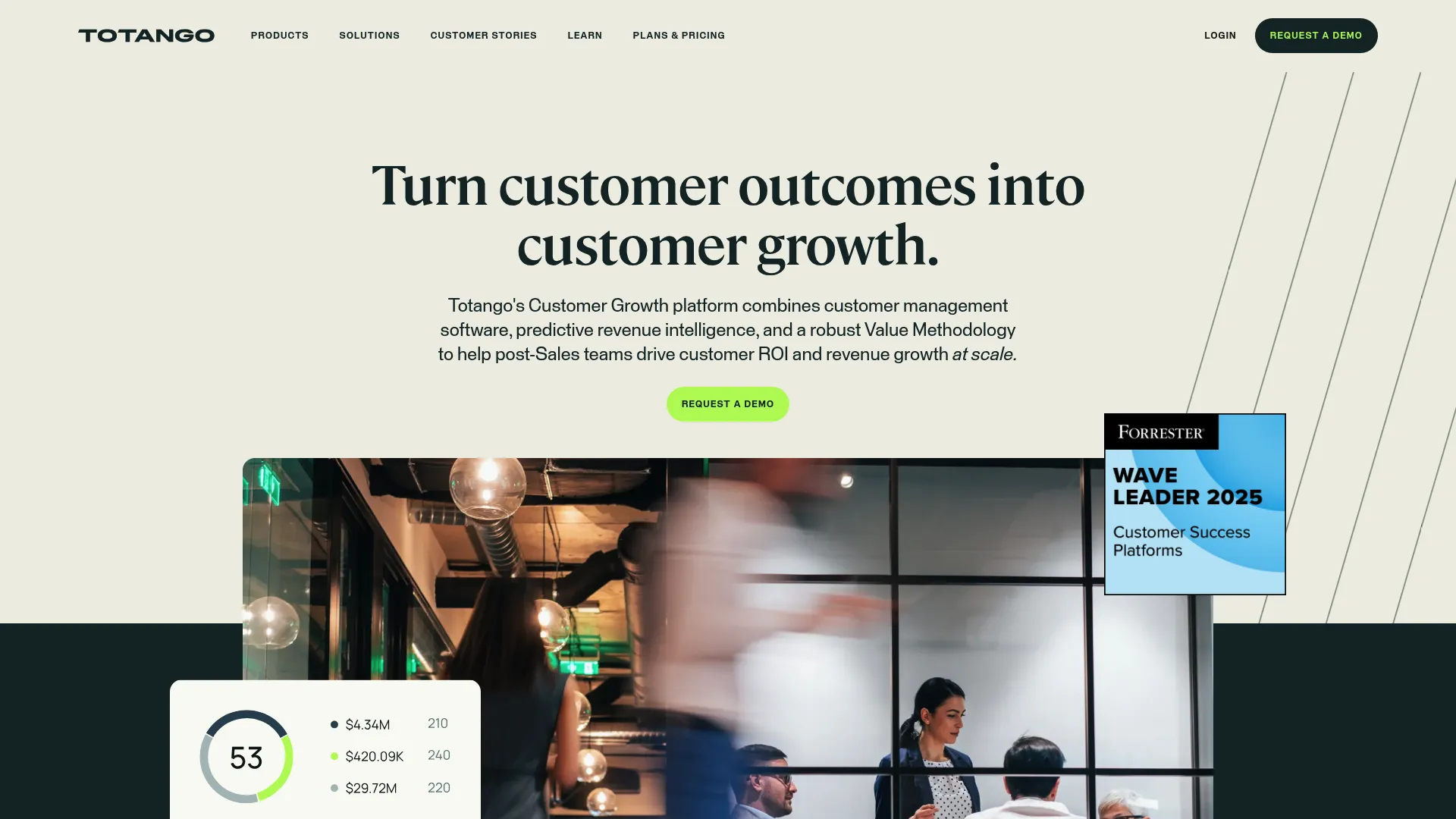
Totango provides customer success, customer intelligence, and customer growth software for protecting and growing customer revenue. Its defining trait is a composable model: rather than one rigid workflow, you assemble the pieces your CS motion needs. That suits scaling orgs that expect their processes to change.
SuccessBLOCs, the platform's prebuilt templates, codify best practices and dashboards for stages across the customer journey. CSMs get health monitoring and automation without building everything from scratch.
Best for: Scaling CS orgs that want modular, configurable workflows they can iterate over time.
Key strengths
- Composable workflows: Compose, manage, and iterate the customer journey as your motion evolves.
- Multidimensional health scores: Health signals across multiple inputs to catch risk early.
- Segmentation and automation: Group accounts and trigger automated workflows at scale.
Why choose Totango
Totango fits teams that do not want to be locked into one prescribed workflow. The composable approach and SuccessBLOC templates let a growing CS org start fast and adjust as the book of business changes. Choose it when flexibility and scalability rank above out-of-the-box rigidity.
Totango pricing
Totango uses talk-to-sales pricing across its packages, which span the Customer Success Platform, Unison Customer Intelligence Engine, and Catalyst Customer Growth Platform. No public numeric prices are displayed, so request a scoped quote. Totango holds a 4.3 out of 5 rating on G2.
4. Custify
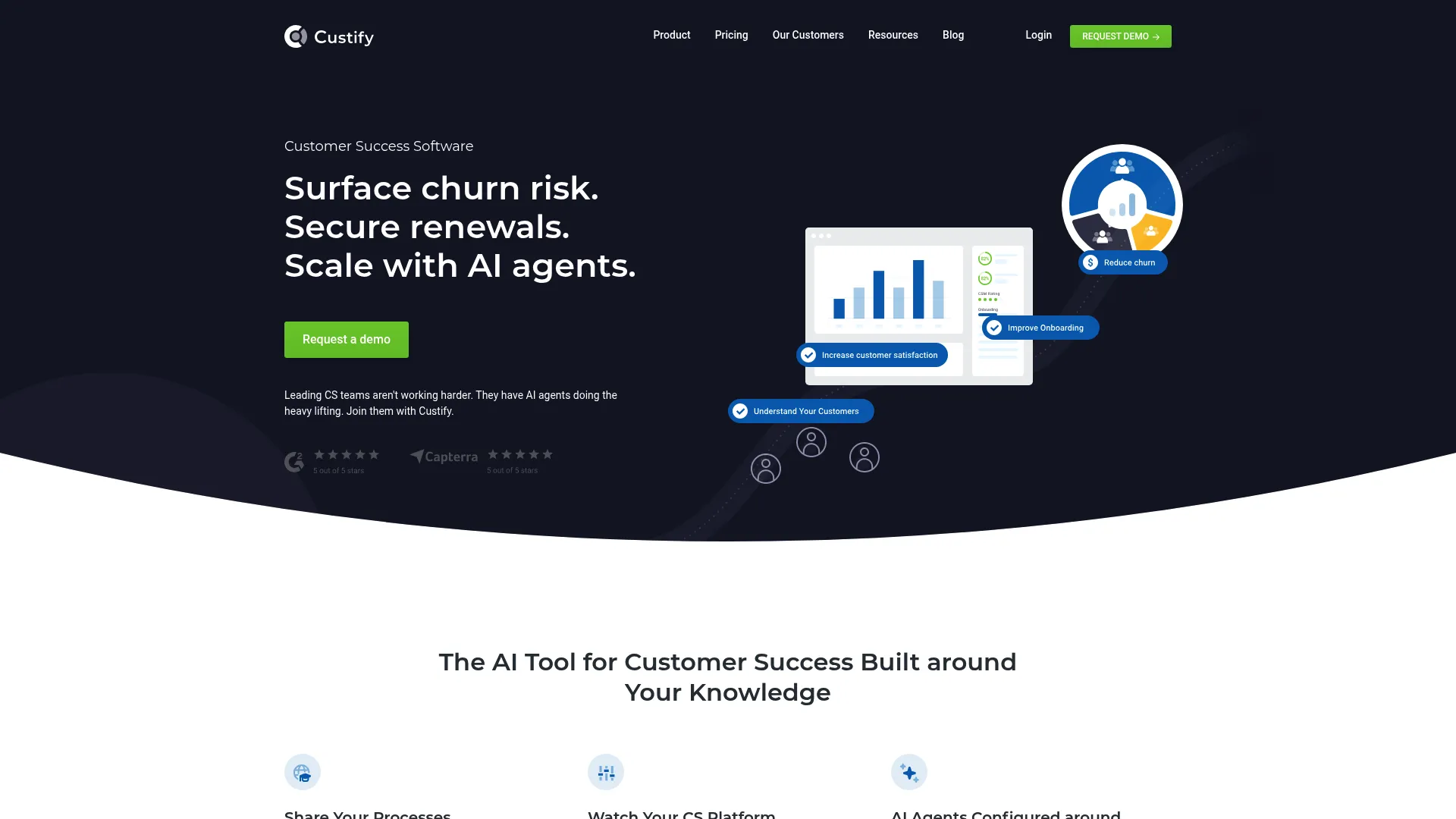
Custify is a customer success software platform for B2B SaaS teams to centralize customer data, track health, automate workflows, and manage churn, renewals, and expansion. It targets SMB and mid-market SaaS, where CS teams need power without enterprise complexity. The platform consolidates scattered data into one hub with dashboards and dynamic health scores.
CSMs use it to see performance and engagement trends in one place, then automate the follow-up. It supports both low-touch and high-touch motions, so it scales with your account mix.
Best for: SMB to mid-market SaaS CS teams that want centralized data and automation without heavy setup.
Key strengths
- Customer 360 view: Relevant customer data in one place for a complete account picture.
- Health scores and churn signals: Dynamic health scores that surface churn risk early.
- Automation and playbooks: Tasks, alerts, and playbooks that keep proactive motions running.
Why choose Custify
Custify fits CS teams that want a focused, usable platform tuned to SaaS without the implementation overhead of larger suites. Its concierge onboarding and support for mixed touch models make it a practical fit as you grow. Choose it when you want a clean customer health dashboard fast.
Custify pricing
Custify uses a demo-led pricing flow, and public numeric prices are not displayed on its pricing page. Request a demo to get pricing scoped to your customer count and feature needs. Custify holds a 4.7 out of 5 rating on G2, tied among the highest here.
5. HubSpot
HubSpot is an AI-powered customer platform with marketing, sales, customer service, content, data management, commerce, and CRM tools. For retention, the value is one unified customer record across the lifecycle. Service Hub adds ticketing, feedback, and automation on top of the CRM, so CS data sits next to sales and marketing data.
That matters for CSMs who want context. You see the full relationship, not a siloed CS view. NPS and CSAT feedback, automation, and a deep integration ecosystem round out the retention toolkit. If you're comparing options here, our roundup of the best CRM software breaks down how the leading platforms stack up.
Best for: Teams that want CRM, service, and retention in one platform rather than a standalone CS tool.
Key strengths
- Unified customer record: AI-powered Smart CRM that keeps sales, service, and CS data together.
- Service and feedback tools: Ticketing plus NPS and CSAT to track sentiment and resolution.
- Automation and integrations: Workflow automation and a large integration library across the stack.
Why choose HubSpot
HubSpot fits teams that prefer a consolidated stack over best-of-breed point tools. If your CRM is already HubSpot, layering service and retention on top removes data silos and the integration tax. Choose it when a single customer platform beats specialized CS depth.
HubSpot pricing
HubSpot offers a free tier at $0 per month with no credit card required, which includes basic ticketing and a shared inbox. The Starter plan starts at $10 per month per seat. Professional starts at $1,450 per month with six seats included, and Enterprise starts at $4,700 per month with eight seats. HubSpot holds a 4.5 out of 5 rating.
6. Zendesk
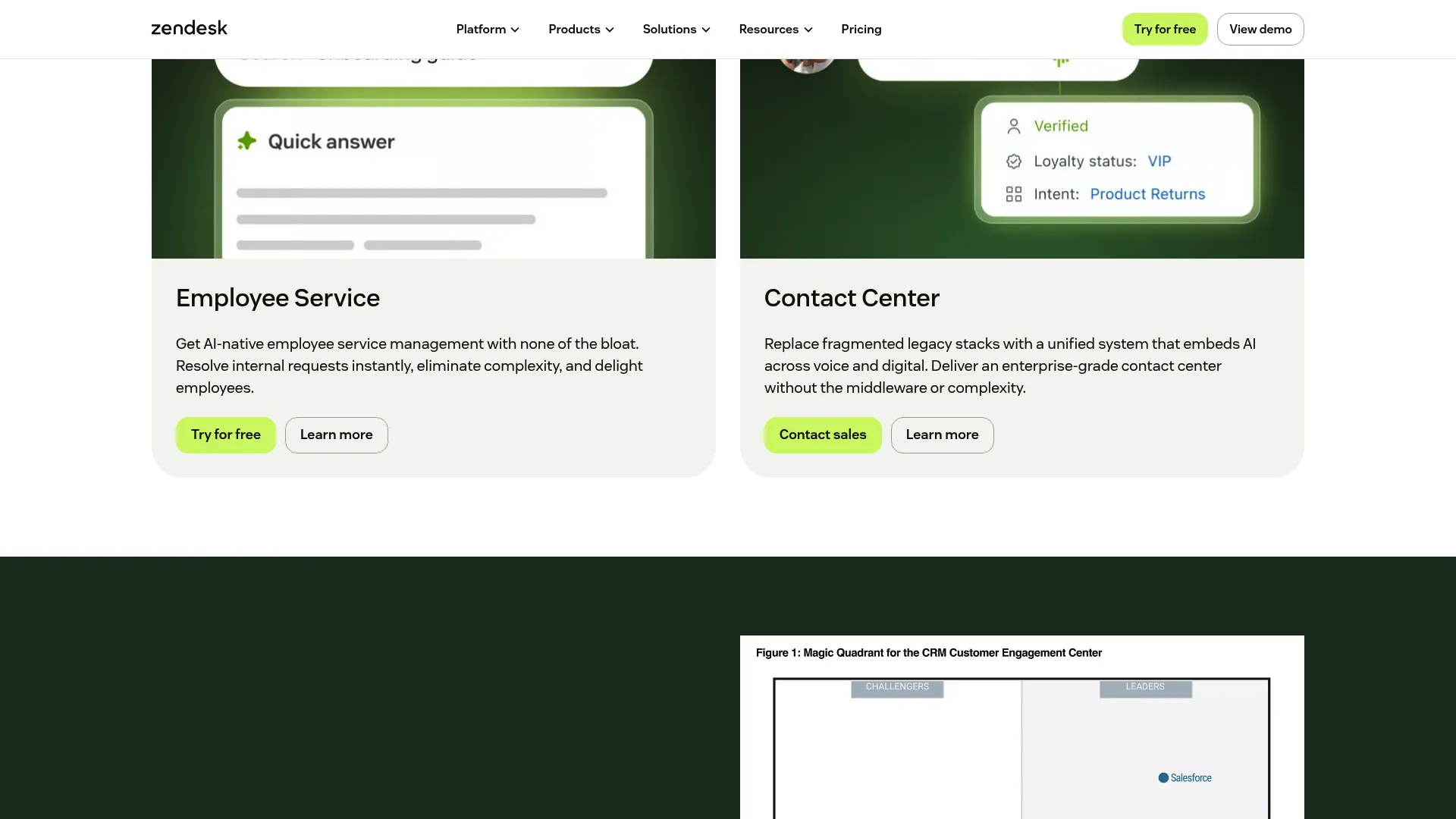
Zendesk is an AI-first service platform for resolving customer and employee requests across channels including email, messaging, live chat, phone, social, and help center. Support quality is a retention lever, and Zendesk makes it measurable. Fast resolution and strong self-serve help reduce the frustration that drives churn.
For CSMs, the relevant signals are CSAT, ticket volume, and help center usage. A customer drowning in unresolved tickets is a churn risk, and Zendesk surfaces that pattern.
Best for: Teams pursuing support-led retention and ticket deflection through self-serve help.
Key strengths
- Ticketing system: Omnichannel ticketing that centralizes every customer request.
- Help center and self-serve: Knowledge base and messaging that deflect repetitive issues. The right knowledge base software amplifies this deflection further.
- Analytics dashboards: Prebuilt reporting for CSAT, resolution, and volume trends.
Why choose Zendesk
Zendesk fits teams where support experience is the primary retention driver, especially at scale where ticket volume grows with the user base. Proactive messaging and self-serve help reduce reactive load while keeping satisfaction high. Choose it when support quality, not CS playbooks, is your main churn lever.
Zendesk pricing
Zendesk Support Team starts at $19 per agent per month, paid yearly. Suite Team is $55 per agent per month, Suite Professional is $115 per agent per month, and Suite Enterprise plus Copilot is available by talking to sales. A free trial is offered, but there is no permanent free tier. Zendesk holds a 4.3 out of 5 rating on G2.
7. Userpilot
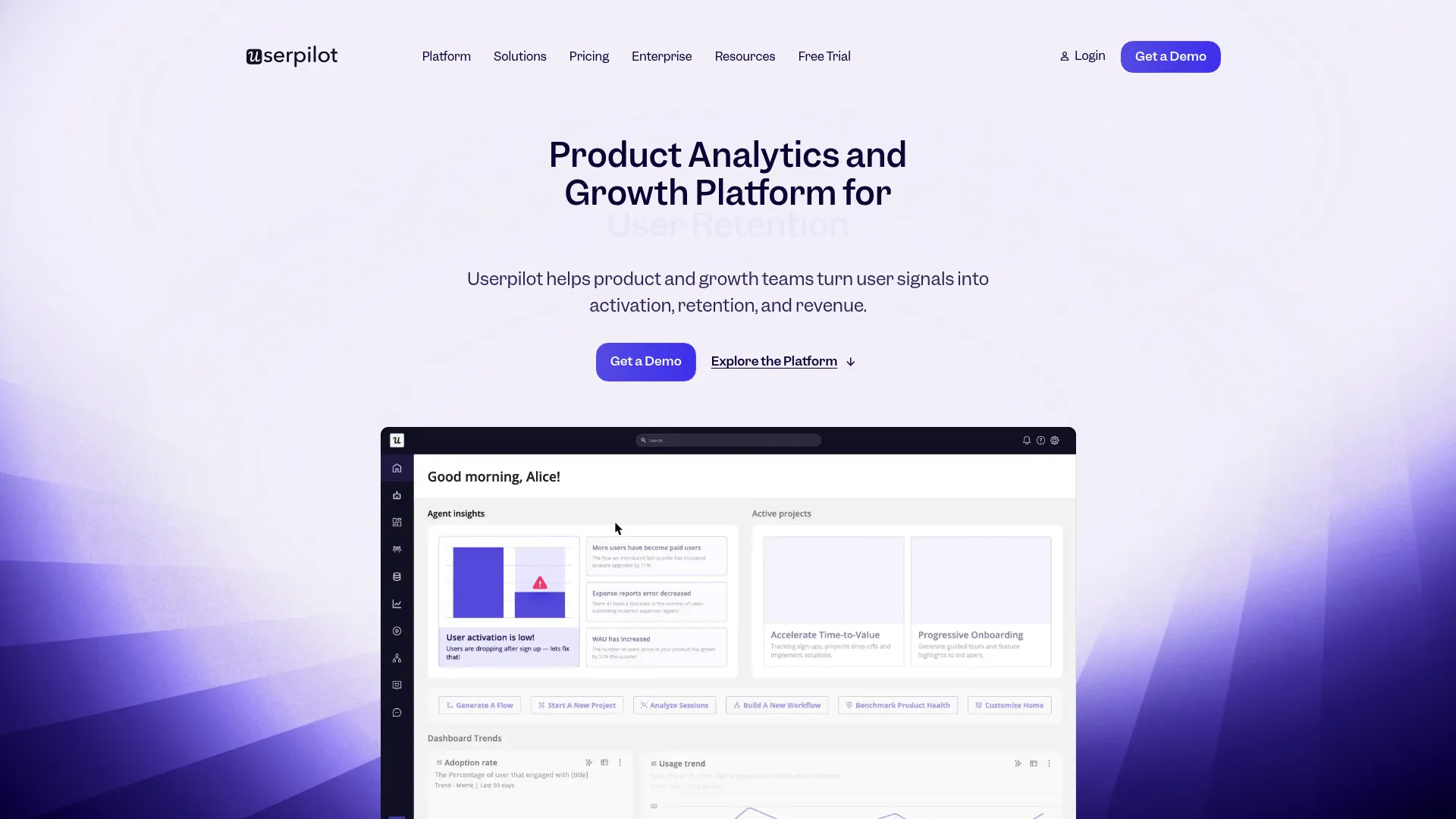
Userpilot is a product analytics and growth platform for user activation, retention, and revenue. It sits in the adoption layer, where retention starts. No-code in-app flows guide users to value, while product analytics show whether adoption is actually happening.
For CSMs at product-led companies, this is the engine behind adoption-led retention. You can build onboarding flows, nudge underused features, and measure the result, all without engineering. Self-serve in-app guidance and clickable product walkthroughs reinforce that motion by helping users learn features at their own pace, which lifts adoption and the health scores tied to it.
Best for: PLG teams driving adoption-led retention through in-app onboarding and feature engagement.
Key strengths
- In-app onboarding flows: No-code flows, tooltips, banners, and nudges that guide users to value.
- Product analytics: Path, funnel, trend, and cohort reports to track adoption and retention.
- User feedback: NPS, CSAT, and in-app surveys tied to user behavior.
Why choose Userpilot
Userpilot fits CS and product teams at PLG companies where activation and feature adoption drive retention. It connects what users do to what you do about it, all in-app and no-code. Choose it when adoption is your primary retention lever and you want to act inside the product. For a wider view of this category, see the best product tour software.
Userpilot pricing
Userpilot Starter starts from $299 per month, paid annually, and includes up to 2,000 monthly active users with engagement, segmentation, and an NPS survey. The Growth and Enterprise plans are quote-based. A 14-day free trial is available with no credit card required, but there is no permanent free tier. Userpilot holds a 4.6 out of 5 rating on G2.
8. Whatfix
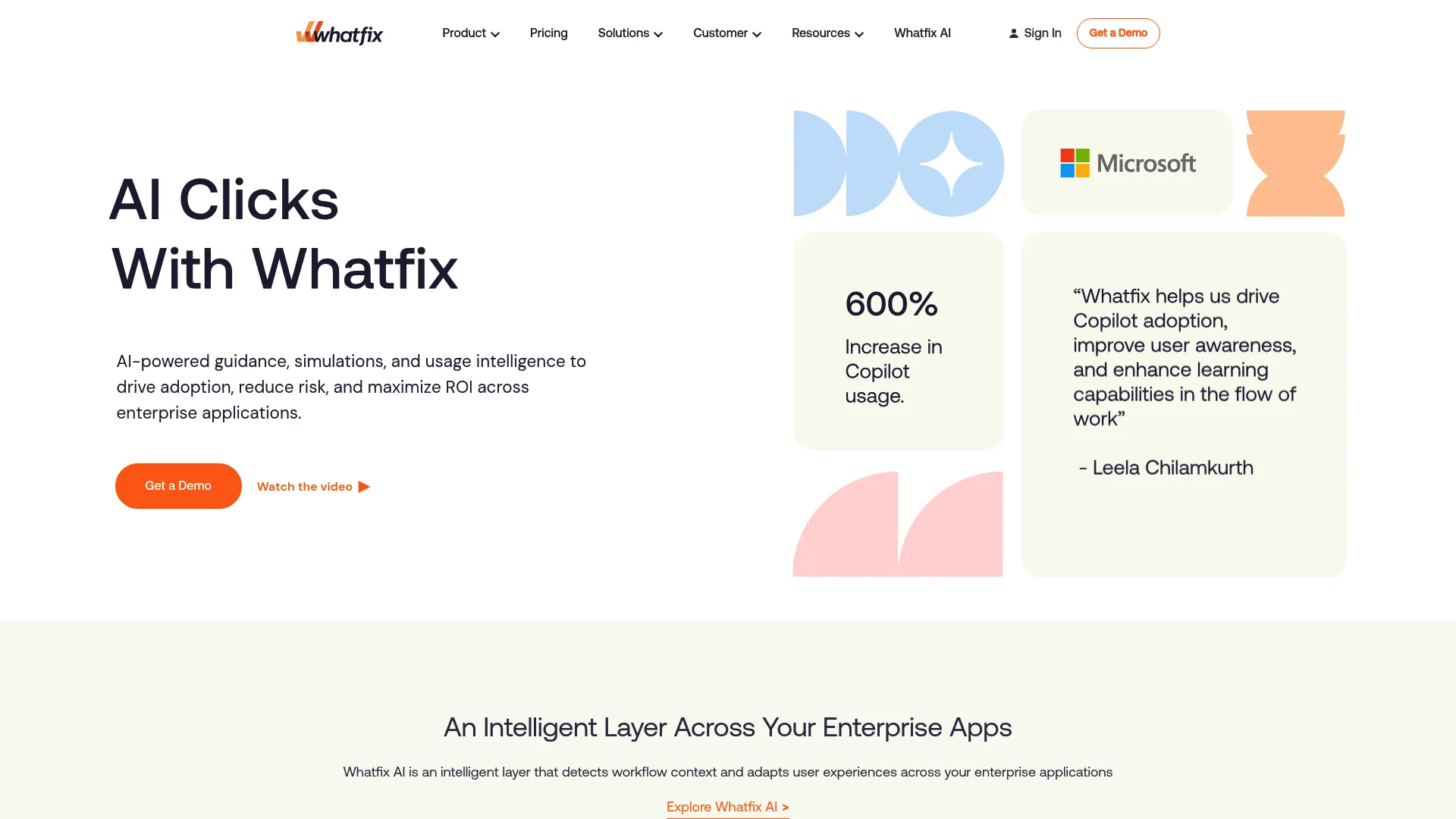
Whatfix is an AI-powered digital adoption platform for in-app guidance, simulations, usage intelligence, and analytics across enterprise applications. It targets complex products where adoption is hard, and where low adoption is a leading churn indicator. In-app guidance walks users through workflows in real time.
For enterprise CS teams, Whatfix reduces the support load that comes from confused users while driving the adoption that keeps accounts healthy. Its analytics show where users get stuck so you can fix the friction.
Best for: Enterprises driving adoption across complex products with in-workflow guidance and analytics.
Key strengths
- In-app guidance: Flows, task lists, smart tips, and pop-ups that guide users through workflows.
- Adoption analytics: Guidance and product analytics that track engagement, journeys, and adoption gaps.
- Mirror simulations: Interactive sandbox replicas and simulated workflows for safe training.
Why choose Whatfix
Whatfix fits enterprises with complex applications where users need in-workflow help to reach value. Strong analytics let CS and enablement teams pinpoint adoption gaps and reduce support burden. Choose it when product complexity is the main barrier between signup and retention.
Whatfix pricing
Whatfix uses quote-based pricing with Standard, Premium, and Enterprise plans. Each uses a flat fee plus user license fees: employee-facing pricing is based on total users, while customer-facing pricing is based on monthly active users. There is no public numeric price and no standalone free tier, so request a scoped quote. Whatfix holds a 4.6 out of 5 rating on G2.
9. Qualtrics
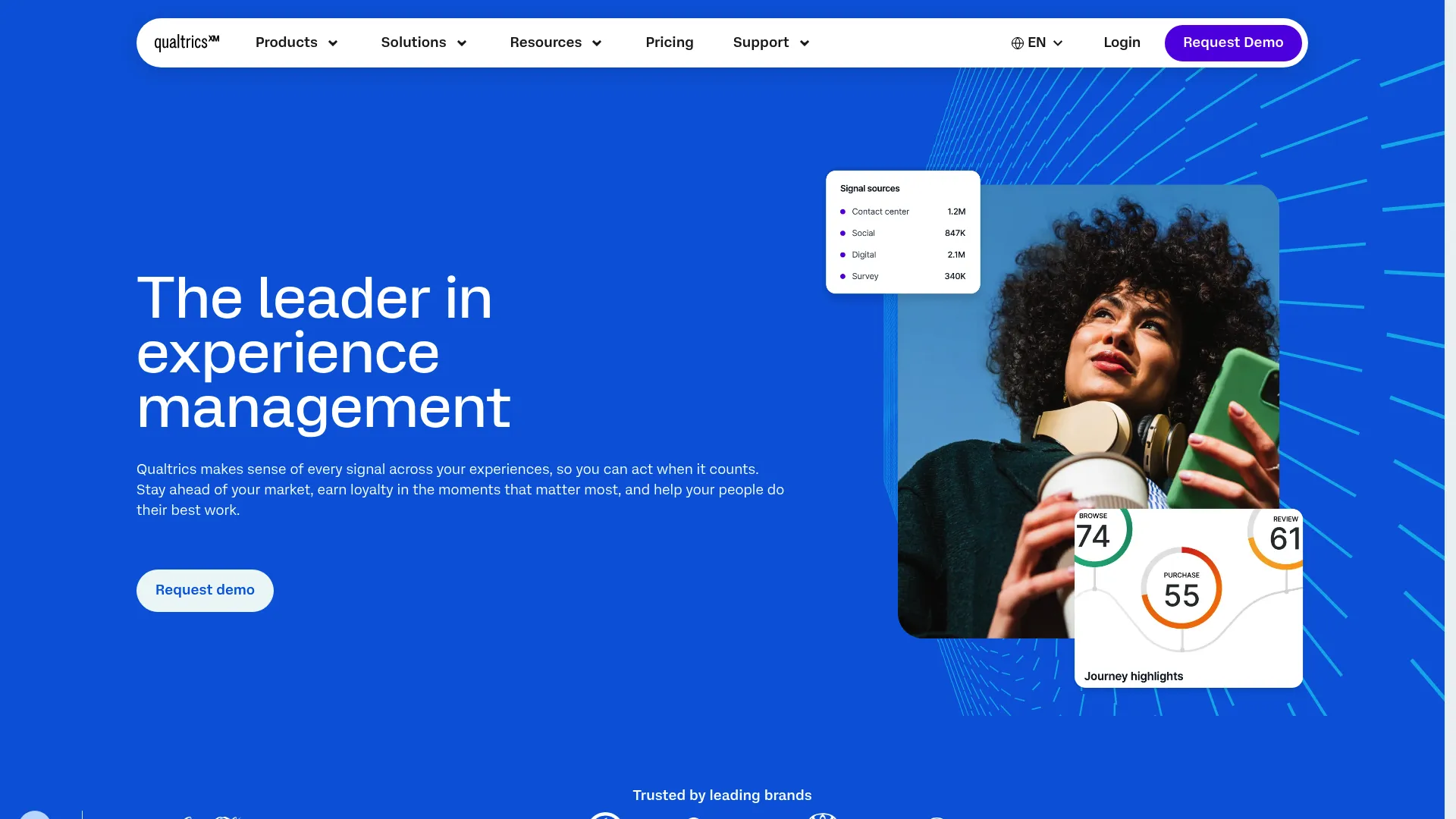
Qualtrics is an experience management platform for customer experience, employee experience, and market research. Its retention angle is feedback and prediction. Qualtrics helps use customer experience data to predict behavior such as likelihood to churn, marrying feedback with business metrics through advanced analytics.
For CSMs who run a feedback-driven motion, this turns survey signals into early warnings. NLP analysis of open-text feedback, multi-channel signals, and automated actions let you respond before sentiment becomes churn.
Best for: CX-led teams that want predictive, feedback-driven retention with deep analytics.
Key strengths
- Voice of the Customer methodology: Omnichannel experience management that captures sentiment across touchpoints.
- Predictive churn: Qualtrics iQ marries feedback with business metrics to predict and prioritize risk.
- Automated actions: Trigger workflows from feedback signals to close the loop.
Why choose Qualtrics
Qualtrics fits teams that treat feedback as the leading retention signal and want statistical depth behind it. Its predictive analytics surface churn risk from sentiment, not just usage. Choose it when feedback and experience data sit at the center of your retention strategy.
Qualtrics pricing
Qualtrics offers a free Surveys account with no credit card required. The Strategic Research plan for small business is $420 per month, billed as $5,040 annually for 1,000 responses shared across users. Strategic Research for Enterprise is custom and available by quote. Qualtrics holds a 4.4 out of 5 rating on G2.
10. Mixpanel
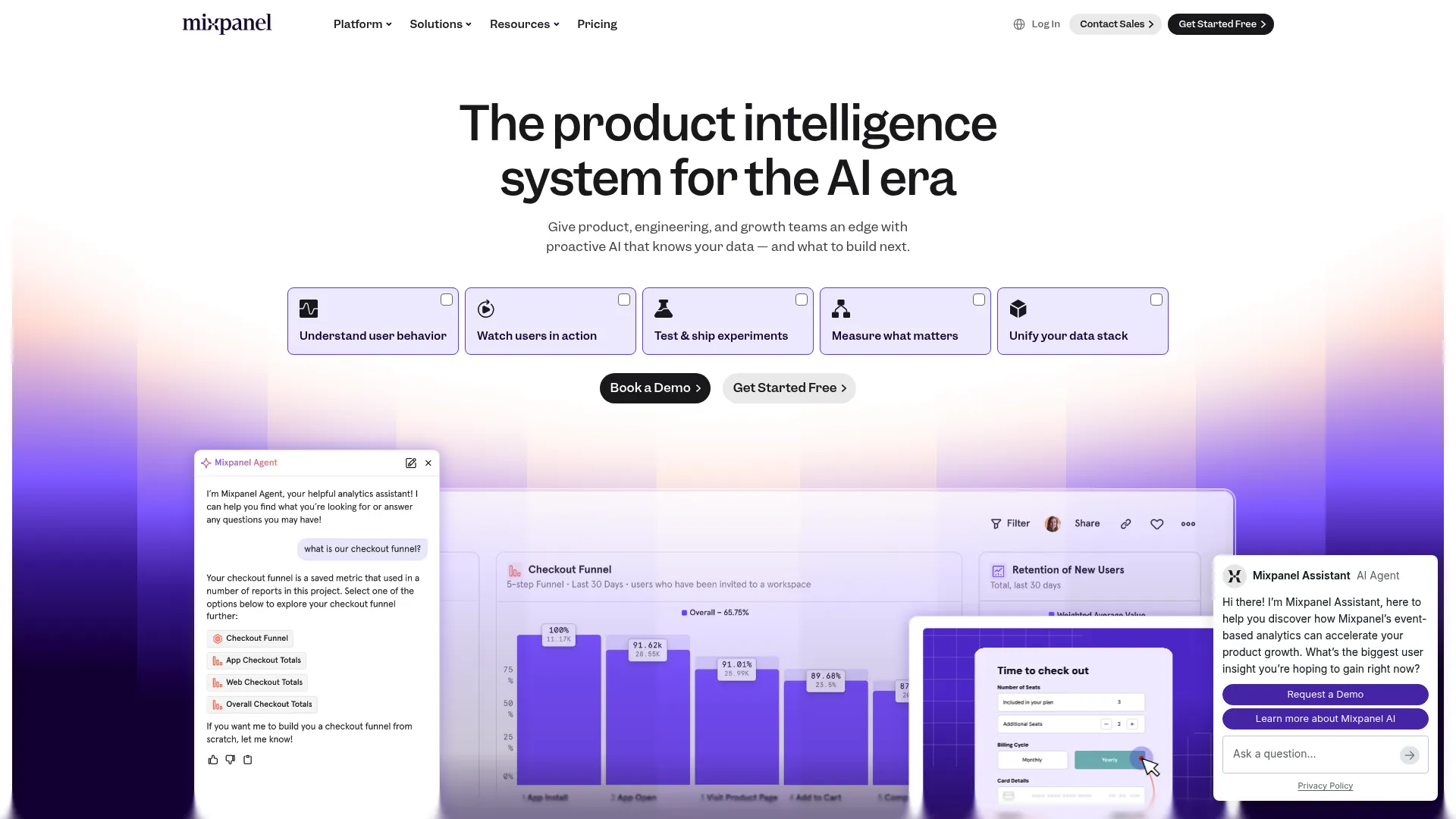
Mixpanel is a product intelligence and digital analytics platform for product, engineering, marketing, and data teams. For retention, it answers the behavioral question: who is actually using the product, and are they coming back? Retention cohorts and funnels show exactly where users drop off.
For data-driven CS teams, Mixpanel is the layer that measures retention at the behavior level. You can segment by cohort, track feature usage, and see which behaviors correlate with accounts that stay.
Best for: Data-driven CS teams that want to measure retention behaviorally through usage data.
Key strengths
- Retention analysis: Cohort and retention reports that show who returns and who lapses.
- Funnels and segmentation: Funnel and trend reports to find where users drop off.
- Session replay: Replay and heatmaps tied to analytics for behavioral context.
Why choose Mixpanel
Mixpanel fits CS and product teams that want hard behavioral evidence behind retention, not just survey sentiment. Its self-serve analytics let you build cohorts and answer retention questions without a data team. Choose it when you want to measure and diagnose retention at the usage level. The best product analytics software roundup covers more alternatives in this space.
Mixpanel pricing
Mixpanel offers a free-forever plan with up to 1 million monthly events, 5 saved reports, and 10,000 monthly session replays. The Growth plan starts at $0 with 1 million monthly events free, then $0.28 per 1,000 events after, plus unlimited reports. Enterprise is contact-sales pricing with unlimited events. Mixpanel holds a 4.5 out of 5 rating on G2.
11. Optimove
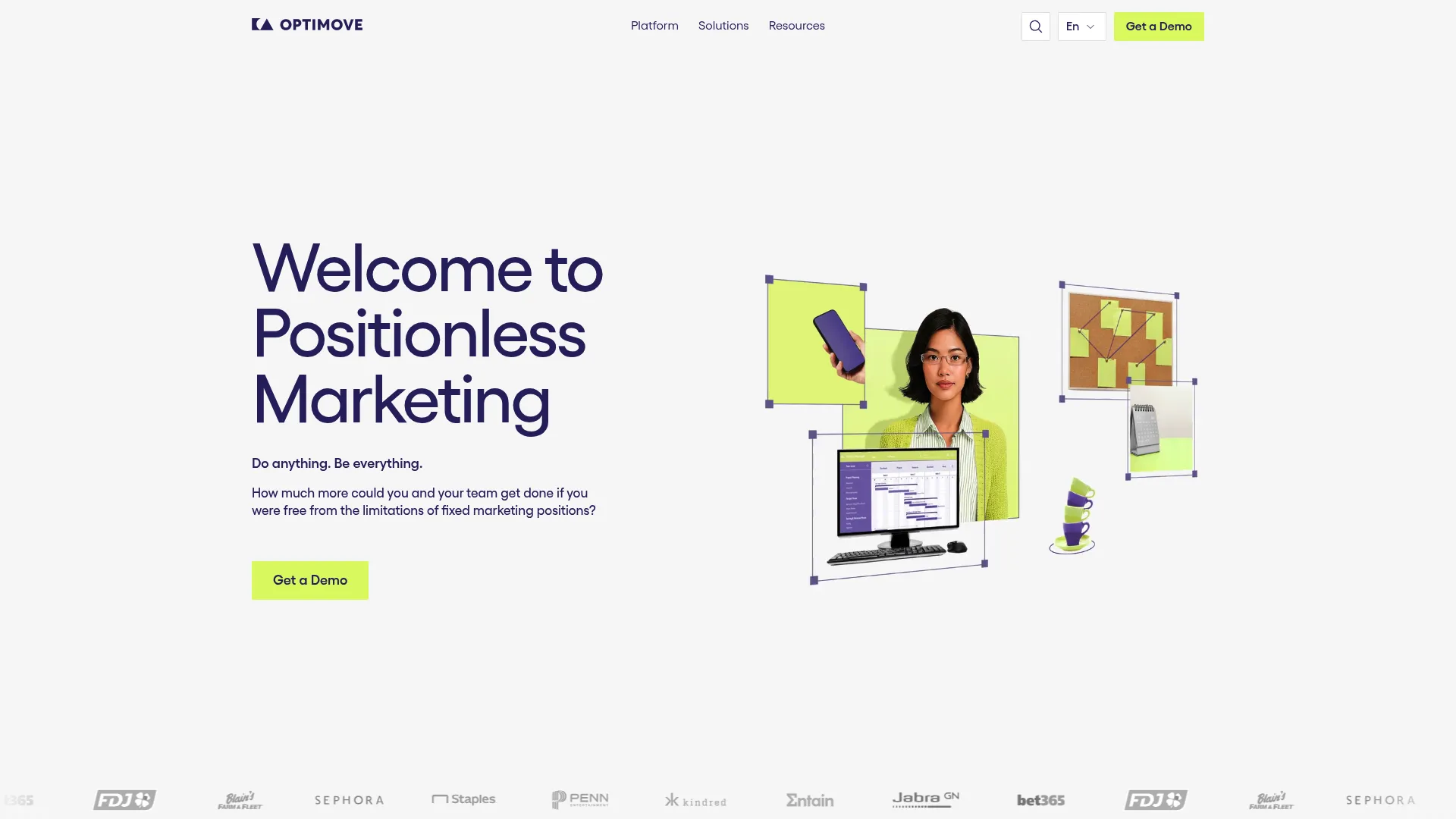
Optimove is a Positionless Marketing platform for delivering personalized customer experiences at scale. It approaches retention from the lifecycle marketing side: AI-driven segmentation and orchestration determine the next-best-action for each customer to improve retention and customer lifetime value.
For CS teams that own lifecycle and loyalty motions, Optimove automates personalized campaigns across channels. It is the orchestration engine behind customer retention automation, less a CS workspace and more a retention marketing brain.
Best for: Teams running retention marketing and lifecycle orchestration at scale.
Key strengths
- Customer insights and segmentation: Precise targeting and hyper-personalization across the base.
- Journey automation: Campaign and message optimization through automated journeys and testing.
- AI decisioning: Predictive modeling and next-best-action recommendations per customer.
Why choose Optimove
Optimove fits teams that treat retention as a lifecycle marketing discipline, with multichannel campaigns and loyalty at the core. Its AI decisioning scales personalization beyond what manual CS outreach can reach. Choose it when orchestrated, automated customer retention campaigns are central to your motion. Teams focused on loyalty programs should also review the best loyalty management software.
Optimove pricing
Optimove uses custom pricing scoped to each organization. Its Orchestrate documentation notes pricing is flexible and scalable, based on usage indicators such as customer data volume, active customer profiles, and orchestration scope. No public numeric price is displayed, so request a scoped quote. Optimove holds a 4.6 out of 5 rating on G2.
12. Pendo
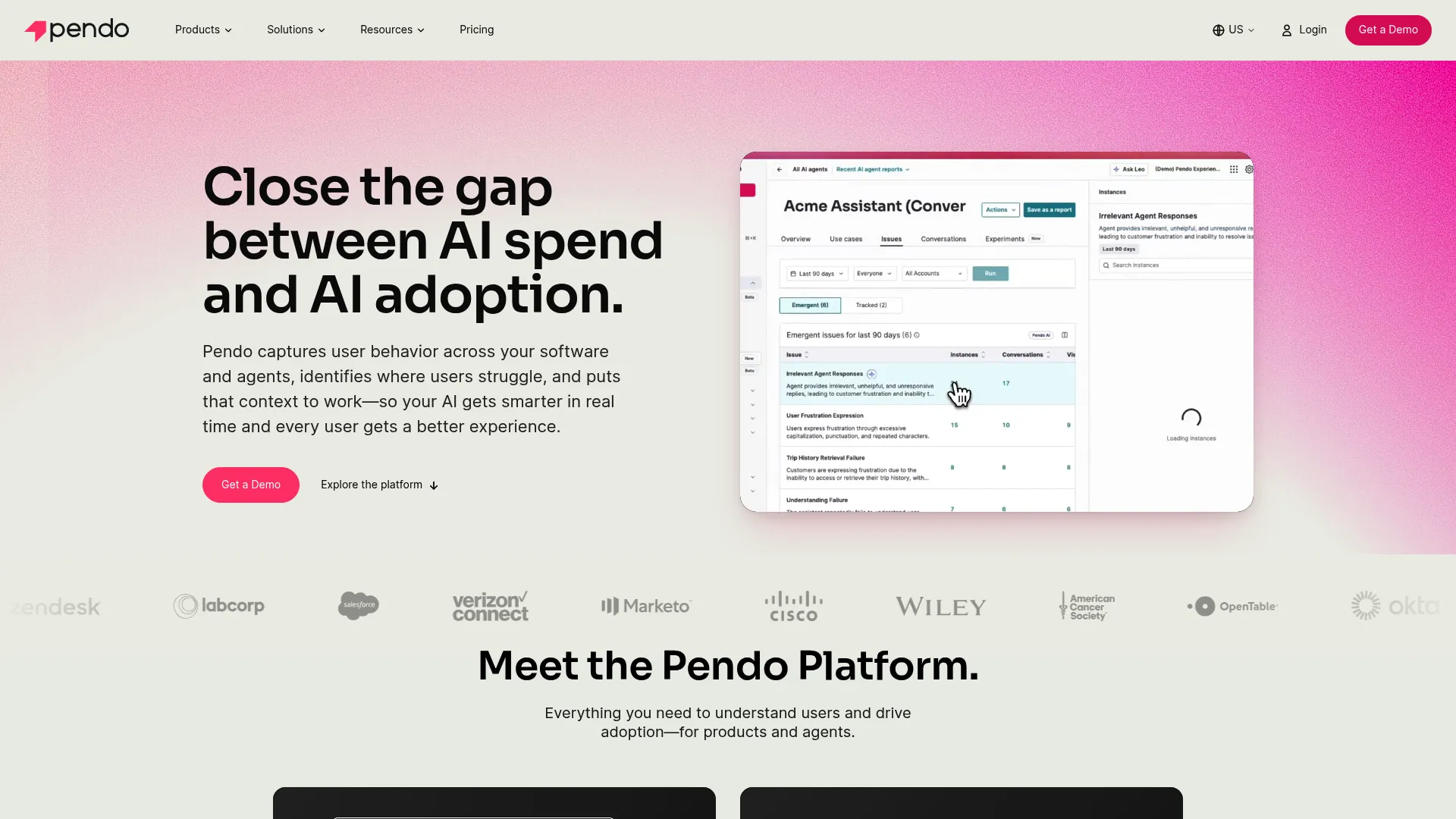
Pendo is a product management and user experience platform for understanding and improving customer and employee interactions with applications. It bridges product analytics and in-app guidance, which makes it a strong fit where product and CS teams align on adoption and retention.
For CSMs, Pendo connects what users do (analytics) with what you tell them (in-app guides) and how they feel (NPS). That loop, all tied to product health, is exactly the adoption-driven retention signal CS teams need.
Best for: Product and CS teams that want to align adoption and retention in one platform.
Key strengths
- Product analytics: Behavior, journeys, funnels, feature adoption, and product health metrics.
- In-app guides: Resource Center and targeted walkthroughs for adoption and communication.
- Surveys and feedback: NPS, CSAT, and PMF surveys plus session replay tied to usage.
Why choose Pendo
Pendo fits teams that want analytics and in-app guidance in one place, so adoption insight and adoption action live together. The free tier makes it easy to start without procurement. Choose it when aligning product and CS around adoption-led retention is the goal.
Pendo pricing
Pendo offers a free plan with Product Analytics, in-app guides, and Pendo-branded NPS for up to 500 monthly active users, with no credit card required. Paid plans (Base, Core, and Ultimate) use custom pricing based on monthly active users and selected functionality. Request a quote for paid tiers. Pendo holds a 4.4 out of 5 rating on G2.
Considerations before you buy
Before you commit, run this checklist against your shortlist.
Integration with your existing CS stack
Retention software is only useful if it talks to your other tools. Confirm it syncs with your CRM (Salesforce or HubSpot), your support desk, Slack, and your product analytics. A tool that creates another data silo adds work instead of removing it.
Churn-signal accuracy and health scoring
Health scores are only as good as their inputs and configuration. Ask how scores are built, what signals feed them, and how much you can customize. A generic score that fires false alarms erodes trust fast, so test it against accounts you already know.
Onboarding and adoption support
Decide whether you need a tool that measures adoption or one that actively drives it. Analytics tools show you the gaps. Adoption tools and interactive demos help close them. Adoption-led retention depends on closing the gap, not just seeing it.
Analytics and impact attribution
You will be asked to prove CS value. Check whether the tool reports retention rate, NRR, churn, and adoption in a way you can show leadership. Exportable, shareable analytics make the difference between assumed impact and proven impact.
Implementation effort and time-to-value
Some platforms go live in days, others take months. Be honest about your team's capacity. A powerful tool nobody has time to configure delivers nothing. Match implementation effort to the headcount and timeline you actually have.
Conclusion
Retention is the growth engine, and the right customer retention software gives CSMs the visibility to protect it. The best customer retention software for your team depends entirely on your motion.
For enterprise CS teams managing many accounts, Gainsight offers the deepest all-in-one platform. For mid-market teams focused on cutting churn, ChurnZero maps tightly to that goal. For adoption-led retention at product-led companies, Userpilot and Pendo connect usage to action. If you want CRM and retention in one stack, HubSpot consolidates it with a free tier to start. For feedback-driven and predictive retention, Qualtrics leads. For behavioral retention analysis on a budget, Mixpanel's free tier is hard to beat.
Do not buy the first tool you demo. Shortlist two or three that match your motion, run trials with real accounts, and test how the health scores hold up against churn you already understand. The tool that surfaces risk you would have missed is the one worth keeping.
FAQs
Customer retention software is a category of tools that help teams keep existing customers by tracking engagement, predicting churn, automating interventions, and improving product adoption. It pulls usage, support, and CRM data into one view so CSMs can spot at-risk accounts early. Tools span CS platforms, CRMs, support desks, analytics, and feedback systems.
It reduces churn by surfacing risk before renewal. Health scores and usage signals flag declining accounts weeks or months ahead, giving you time to intervene. Automated playbooks then trigger the right action, while adoption nudges and in-app guidance drive the usage that keeps customers engaged.
Start with your motion. A high-touch enterprise CSM needs different software than a low-touch PLG CSM. Match the tool to your churn-signal needs, your stack integrations, and your budget. Then run trials against accounts you already understand to test whether the health scores are accurate.
Most tools integrate with CRMs like Salesforce and HubSpot, support desks, Slack, and product analytics platforms. Strong integration is what prevents the "another disconnected tool" problem. Before buying, confirm the specific connectors you need exist and that data syncs both ways, so the tool enriches your existing systems rather than creating a new silo.
Track retention rate (customers retained over a period divided by customers at the start), churn rate (100% minus retention rate), and net revenue retention. Add CSAT or Net Promoter Score framework for sentiment, product adoption and feature usage for engagement, and time-to-value for early churn risk. Together these show both the what and the why behind retention.
Yes. A CRM stores relationship and deal data and is built around sales pipeline. Customer retention software adds health scoring, churn prediction, and proactive CS workflows on top of that data. Some platforms, like HubSpot, combine both, but a standalone CRM alone usually lacks the predictive and proactive retention layer CSMs need.
It ranges widely. Free tiers exist (HubSpot, Mixpanel, Pendo, and a Qualtrics Surveys account), while entry paid plans start from around $10 to $299 per month depending on the tool. Enterprise CS platforms like Gainsight, Totango, and ChurnZero use custom pricing, often scoped to your number of seats or accounts.
Yes. Adoption tooling and in-app guidance shorten time-to-value by helping users reach their first meaningful outcome faster, which reduces early churn. Self-serve product education, in-app flows, and guided walkthroughs scale onboarding without adding CSM hours, and the resulting adoption feeds the health scores that retention platforms track.