You hired your fortieth employee last quarter. Now payroll lives in one tool, headcount lives in a spreadsheet, PTO lives in Slack threads, and your finance lead asks for a clean headcount number that nobody can produce in under a day.
That is the moment most scaling companies start shopping for human capital management software. Not because they love HR admin, but because the cost of fragmented people data has finally become visible. When your board asks for revenue per employee, ramp time by cohort, or fully loaded labor cost by team, you need a single source of truth, not five disconnected systems stitched together by hand.
The market reflects that pressure. The global HCM software market is projected to grow from $31.47B in 2026 to $44.74B by 2030 at a 9.2% CAGR, according to Research and Markets (2026). And 73.6% of human capital management deployments were cloud-based in 2025, per Precedence Research (2025), making the cloud-based HCM platform the default rather than the exception.
This guide ranks the 10 best HCM software systems for 2026 and frames each one around a real buying decision: company stage, payroll depth, geographic reach, and how clean your workforce analytics need to be. If you are also evaluating adjacent operational stacks, our roundups of the best contract management software tools, the best customer data platform, and analytics platforms that drive ROI use the same practical, stage-aware lens.
What's inside
This guide is for founders, HR leaders, and finance-adjacent operators comparing HCM platforms for employee records, payroll, talent, compliance, and reporting. We selected these HCM software vendors based on four things: depth of employee lifecycle coverage, payroll and workforce management strength, analytics and reporting quality, and fit by company stage and geography. We prioritized cloud-based HCM platforms with broad adoption and verified buyer trust signals. Pricing and ratings reflect first-party and G2 sources current as of mid-2026. You will get a comparison table, ten tool breakdowns, a buyer's checklist, and FAQs.
TL;DR
- Best for large enterprise scale: Workday HCM and Oracle Fusion Cloud HCM, both built for global, multi-thousand-employee organizations.
- Best for global, modular HR suites: SAP SuccessFactors for international teams that need configurable talent and learning modules.
- Best for all-in-one workforce operations: Dayforce and UKG Pro, strong on payroll, time and attendance, and labor cost control.
- Best for mid-market HR with payroll trust: ADP Workforce Now, backed by decades of payroll and compliance scale.
- Best for fast-growing startups consolidating tools: Rippling for HR plus IT plus payroll in one system.
- Best for SMB simplicity: BambooHR and Gusto for smaller teams that want clean core HR and painless payroll.
- Best for global and contractor-heavy teams: Deel for cross-border hiring, payroll, and compliance.
What is HCM software?
HCM software, short for human capital management software, is a cloud-based system that manages the full employee lifecycle in one place: hiring, onboarding, payroll, benefits, performance, learning, compensation, and workforce reporting. So when people ask what does HCM stand for, the answer is human capital management, a category that treats your workforce as data and capability you actively manage, not just records you store.
A human capital management system pulls together what used to live in separate tools. Instead of a payroll vendor, an applicant tracking system, a benefits portal, and a spreadsheet of org charts, you get a single record of each employee that every module reads from.
Core modules in a modern HCM platform usually include:
- Recruiting: sourcing, applicant tracking, and offer management
- Onboarding: new hire workflows, document collection, and provisioning
- Learning: training content, certifications, and skill development
- Performance: reviews, goals, and continuous feedback
- Compensation: salary planning, merit cycles, and pay equity
- Succession: talent pools and leadership pipeline planning
- Benefits: enrollment, administration, and carrier connections
- Payroll: gross-to-net calculation, tax filing, and direct deposit
- Workforce management: time and attendance, scheduling, and labor cost tracking
HCM vs HRIS, HRMS, and ERP
These acronyms get used interchangeably, but they are not the same thing.
HCM vs HRIS: An HRIS (human resources information system) is the system of record for employee data: profiles, org structure, time off, and basic compliance. HCM software includes the HRIS and adds strategic talent layers like recruiting, learning, performance, and succession. Every HCM is an HRIS, but not every HRIS is a full HCM.
HCM vs HRMS: An HRMS (human resources management system) sits between the two, typically adding payroll and time management to the core HRIS. In practice, HRMS and HCM overlap heavily, and many vendors use the labels loosely. The practical difference is talent depth: HCM leans harder into the strategic, develop-and-retain side of people management.
HCM vs ERP: An ERP (enterprise resource planning) system runs the whole business: finance, supply chain, procurement, and operations. HCM is the people module within or alongside that. Some suites, like Oracle and SAP, sell HCM as part of a broader ERP. Others, like Workday, started in HCM and expanded into finance.
For most scaling companies, the takeaway is simple: you want a single cloud-based HCM platform that gives leadership clean workforce data, dependable payroll, and integration depth into your finance and identity stack.
When to use HCM software
Not every company needs a full HCM suite on day one. Here is how to tell when fragmented tools start costing you more than the platform would.
Centralize employee data and reduce spreadsheet sprawl
When your headcount number depends on which spreadsheet you open, you have a visibility problem. Fragmented systems create reconciliation work, slow board reporting, and quiet data errors that compound over time. An HCM platform gives every team one record per employee, so org charts, headcount, and reporting all pull from the same truth. For a founder trying to answer board questions without a fire drill, that single source of truth is the whole point.
Improve payroll, time tracking, and compliance accuracy
Payroll errors are expensive in two directions: they cost money to fix and they erode employee trust. As you add states, contractors, or countries, manual payroll and time tracking break down fast. A strong HCM system automates gross-to-net calculation, syncs time and attendance directly to pay, and keeps you current on tax and labor compliance. The payoff is fewer errors, cleaner labor cost visibility, and audit-ready records when you need them.
Scale hiring, onboarding, and talent management
Point solutions work until they do not talk to each other. When your applicant tracking system, onboarding checklist, and performance tool all live separately, candidates fall through cracks and new hires wait weeks for access. A unified platform connects recruiting, onboarding, and talent management so a hire flows from offer to fully provisioned employee without manual handoffs. This is the moment most companies outgrow stitched-together point tools.
Comparison table
Here is how the 10 HCM companies stack up. Read the table by starting with the Intent column to find your stage, then check Key differentiation for what each platform does best. Pricing for enterprise HCM software vendors is largely quote-based, so we have noted public figures where vendors publish them and flagged the rest as contact sales.
| # | Product | Intent | Key differentiation | Pricing | G2 rating |
|---|---|---|---|---|---|
| 1 | Workday HCM | Enterprise | Core HCM, workforce planning, and analytics in one suite | Contact sales | 4.1/5 |
| 2 | Oracle Fusion Cloud HCM | Enterprise | Global HR, payroll, and talent inside a broader ERP | Contact sales | Not listed |
| 3 | SAP SuccessFactors | Global enterprise | Modular talent, learning, and core HR | Contact sales | 4.1/5 |
| 4 | Dayforce | Mid-market to enterprise | Single-system payroll and workforce management | Contact sales | 4.2/5 |
| 5 | ADP Workforce Now | Mid-market | Payroll and compliance depth at scale | Contact sales | 4.2/5 |
| 6 | UKG Pro | Mid-market to enterprise | Workforce management and labor operations | Contact sales | 4.3/5 |
| 7 | Rippling | Fast-growing startups | HR, IT, and payroll unified in one system | Contact sales | 4.8/5 |
| 8 | BambooHR | SMB to mid-market | Easy core HR and onboarding | From $10/employee/mo | 4.4/5 |
| 9 | Gusto | Small business | Payroll-led HR and benefits | From $49/mo + $6/person | 4.6/5 |
| 10 | Deel | Global and distributed teams | Cross-border hiring, payroll, and compliance | From $49/contractor/mo | 4.8/5 |
1. Workday HCM
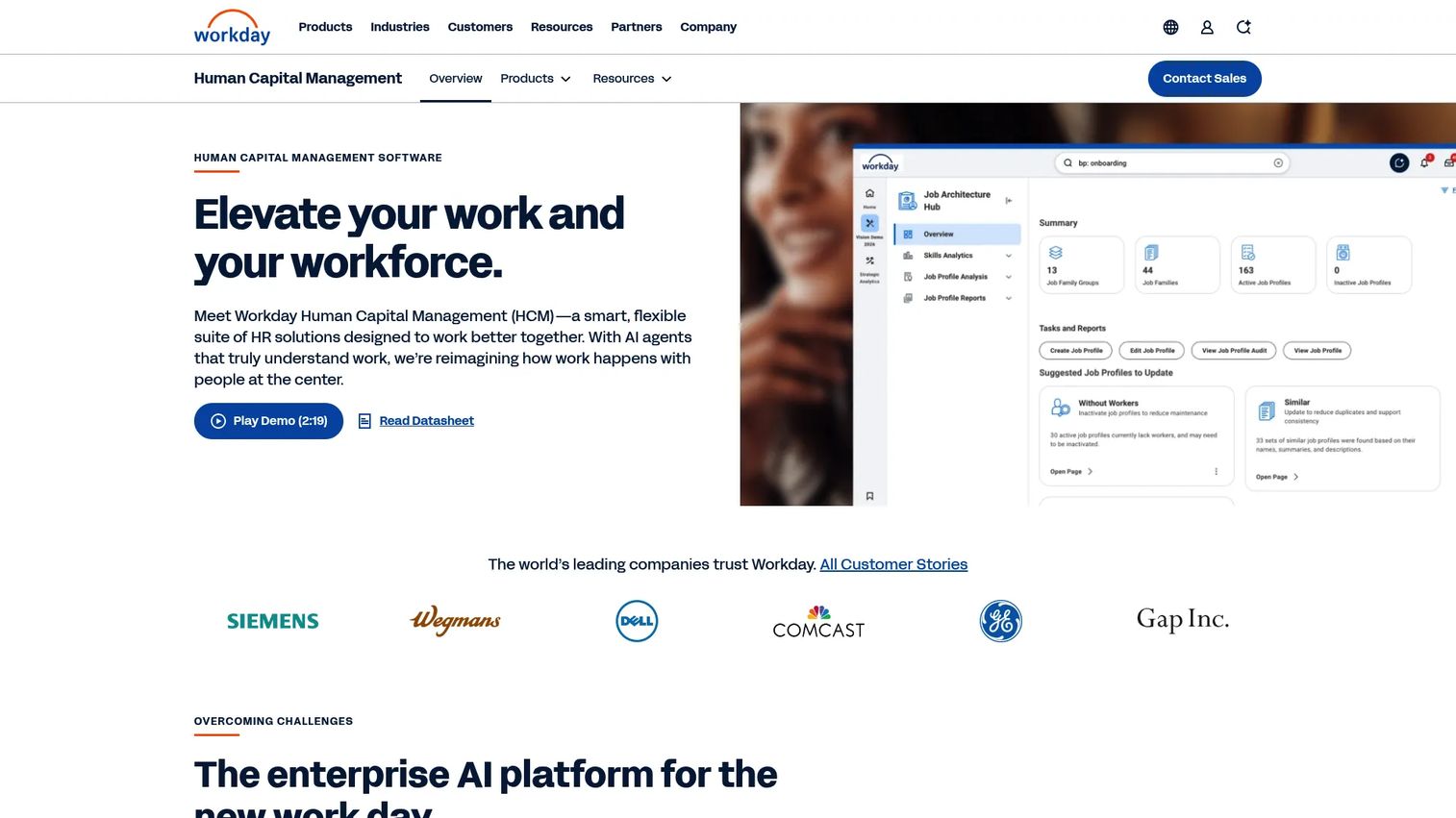
Workday HCM is a cloud-based human capital management suite built for large organizations that need HR, workforce planning, talent, and analytics working as one system. It started in HCM and earned its reputation with finance and HR leaders who want a single, modern platform rather than a patchwork of legacy modules. If your company is scaling past a thousand employees or you simply want enterprise-grade workforce reporting, Workday is the suite most boards recognize.
Best for: Large or fast-scaling organizations that need an integrated enterprise HCM platform with deep analytics.
Key strengths
- Core HCM: A unified record for HR, organizational structure, and employee lifecycle management across the company.
- Workforce planning and analytics: Real-time workforce analytics that let leadership model headcount, cost, and skills without exporting to a separate tool.
- Talent management: Recruiting, performance, and skills-based talent planning connected to the same data your reporting runs on.
Why choose Workday HCM: Workday fits companies that have outgrown stitched-together point tools and want one system leadership trusts for board-level numbers. The strength is consistency: payroll, talent, and planning all read from the same record, which keeps your workforce analytics clean as you grow. It is an investment, so it suits organizations ready to commit to enterprise infrastructure rather than teams looking for a quick SMB setup.
Workday HCM pricing: Workday does not publish public pricing. The HCM overview page directs prospects to contact sales for a custom quote based on headcount and modules. Plan on an enterprise-tier implementation rather than a self-serve signup, and budget for configuration time alongside the license.
2. Oracle Fusion Cloud HCM
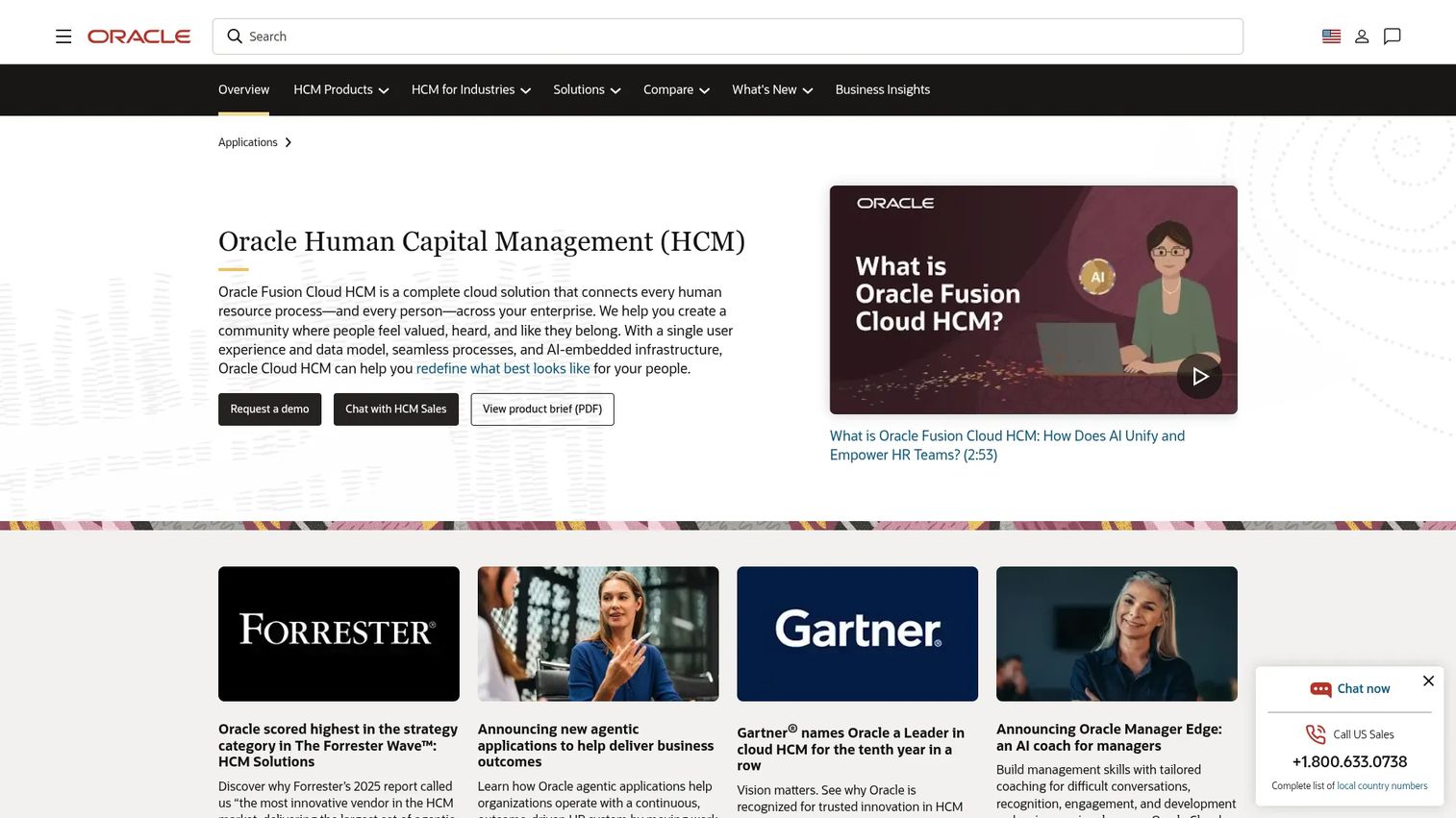
Oracle Fusion Cloud HCM is Oracle's cloud human capital management suite for managing HR, talent, workforce, and payroll inside a broader enterprise stack. For companies already running Oracle ERP or weighing an HCM vs ERP decision, Fusion HCM keeps people and finance data under one roof. It is built for global organizations that need consistent processes across many countries and currencies.
Best for: Large, global organizations that need an enterprise HCM suite with deep international HR and payroll.
Key strengths
- Global workforce management: Localized HR, payroll, and compliance support designed for global workforce management across regions.
- Talent management: A connected talent flow from recruiting through performance, learning, and succession.
- Payroll and analytics: Integrated payroll plus embedded workforce analytics for headcount, cost, and compliance reporting.
Why choose Oracle Fusion Cloud HCM: Oracle suits enterprises that value a unified suite spanning HR and finance, especially those already invested in the Oracle ecosystem. The breadth of modules and global readiness make it a strong fit for multinational teams managing complex, multi-country operations. As with most enterprise suites, expect a structured implementation rather than a same-week rollout.
Oracle Fusion Cloud HCM pricing: Oracle does not list public pricing for Fusion Cloud HCM. The product pages describe capabilities and route prospects to sales and demo CTAs. Pricing depends on modules, headcount, and region, so plan to scope a custom quote with Oracle directly.
3. SAP SuccessFactors
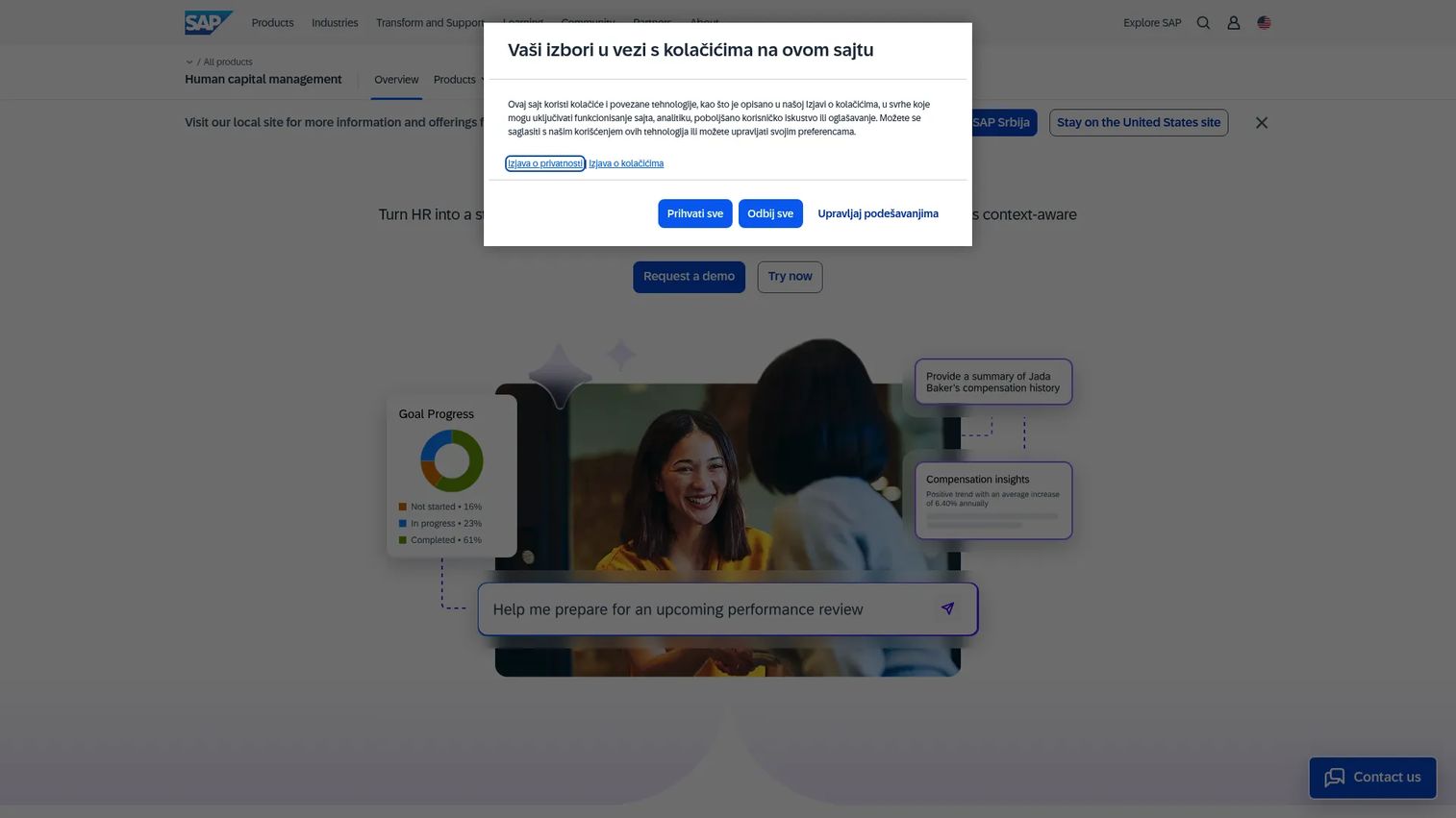
SAP SuccessFactors is a cloud-based human capital management system covering core HR, payroll, talent, analytics, and workforce planning. It is one of the platforms large international teams compare most often, partly because of its modular design and partly because of SAP's deep enterprise footprint. You can adopt the modules you need, from core HR to learning, and expand over time.
Best for: Large, global organizations that want a modular HR suite they can configure module by module.
Key strengths
- Core HR and payroll: A central system of record with payroll support built for multi-country operations.
- Talent management: Strong recruiting, performance, learning, and succession modules for develop-and-retain strategies.
- HR analytics and workforce planning: Embedded workforce analytics and planning tools to model cost and capability.
Why choose SAP SuccessFactors: SuccessFactors fits enterprises that want to assemble their HCM module by module rather than buy one fixed package. The learning and talent depth is a real draw for companies investing heavily in employee development. It is best suited to organizations with the scale and configuration appetite to tailor the suite to their processes.
SAP SuccessFactors pricing: SAP's HCM pricing page shows modular add-ons such as Learning and Career Development and Pay for Performance, and directs buyers to contact sales for a quote. No public starting price is displayed on the first-party pricing page, so plan to scope pricing by module and headcount with SAP.
4. Dayforce
Dayforce is a cloud HCM platform built around a single-system architecture for HR, payroll, workforce management, talent, and analytics. Its calling card is real-time payroll: because time, attendance, and pay run on the same engine, you get continuous calculation rather than a frantic end-of-period scramble. That makes it a favorite for companies with hourly workforces and tight labor cost control needs.
Best for: Mid-market to enterprise organizations that want an all-in-one HCM suite with strong payroll and workforce management.
Key strengths
- Unified HR records: One employee record feeding HR, payroll, and workforce management with no reconciliation between systems.
- Global payroll: Payroll and global payroll across 200+ countries and territories from a single platform.
- Workforce management: Time, attendance, and scheduling tied directly to pay for accurate, real-time labor cost visibility.
Why choose Dayforce: Dayforce shines for organizations where payroll accuracy and labor cost control are central, especially those with shift-based or hourly teams. The single-system design means fewer integrations to maintain and cleaner compliance reporting. It scales well from mid-market into enterprise, making it a durable choice for companies expecting steady headcount growth.
Dayforce pricing: Dayforce sells its platform by module and directs prospects to sales to learn about pricing and licensing. No public price is shown on its first-party pages, so expect a custom quote scoped to the modules and headcount you need.
5. ADP Workforce Now
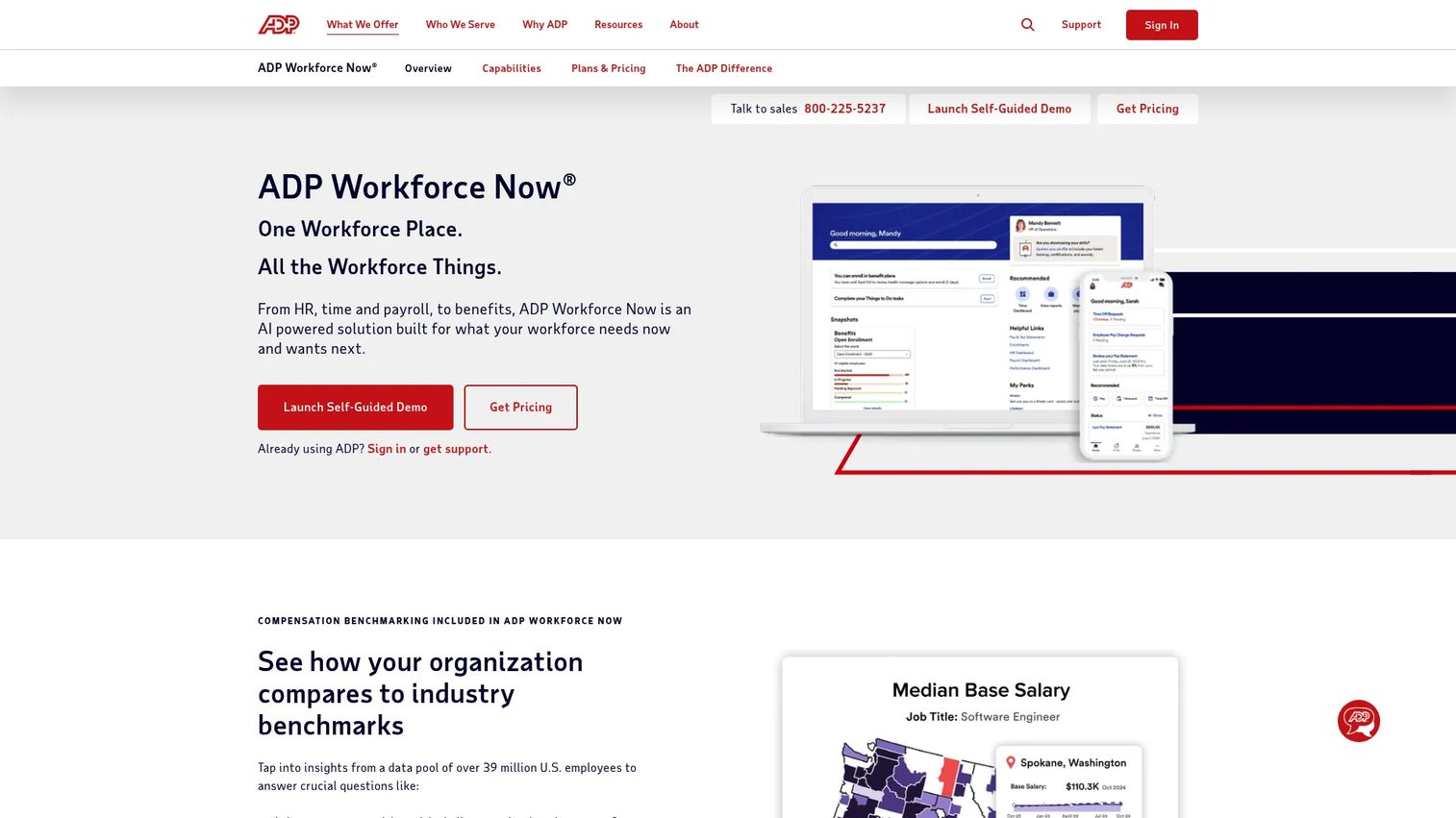
ADP Workforce Now is an all-in-one cloud HR suite covering payroll, HR, benefits, talent, time, and analytics. ADP is one of the most recognized names in payroll software, and that depth shows in Workforce Now's compliance and tax handling. For mid-market companies that want payroll they can trust at scale, ADP is almost always on the shortlist.
Best for: Midsize to enterprise organizations that want a unified HCM platform anchored in proven payroll and compliance.
Key strengths
- Payroll with anomaly detection: AI-powered anomaly detection and real-time calculations help catch payroll errors before they ship.
- HR management and self-service: Employee self-service tools and core HR management that reduce admin load on small teams.
- Workforce, benefits, and analytics: Workforce management, benefits administration, talent, and reporting in one connected suite.
Why choose ADP Workforce Now: ADP suits companies that prioritize payroll reliability and compliance coverage above all else. Decades of payroll scale mean fewer surprises with tax filing and regulatory change, which matters as you add states and headcount. It is a dependable backbone for mid-market HR teams that want one vendor accountable for pay and compliance.
ADP Workforce Now pricing: ADP surfaces a Plans and Pricing section with Get Pricing CTAs but does not display public numeric pricing on its product pages. Pricing is quote-based and depends on headcount, modules, and payroll frequency, so contact ADP for a tailored figure.
6. UKG Pro
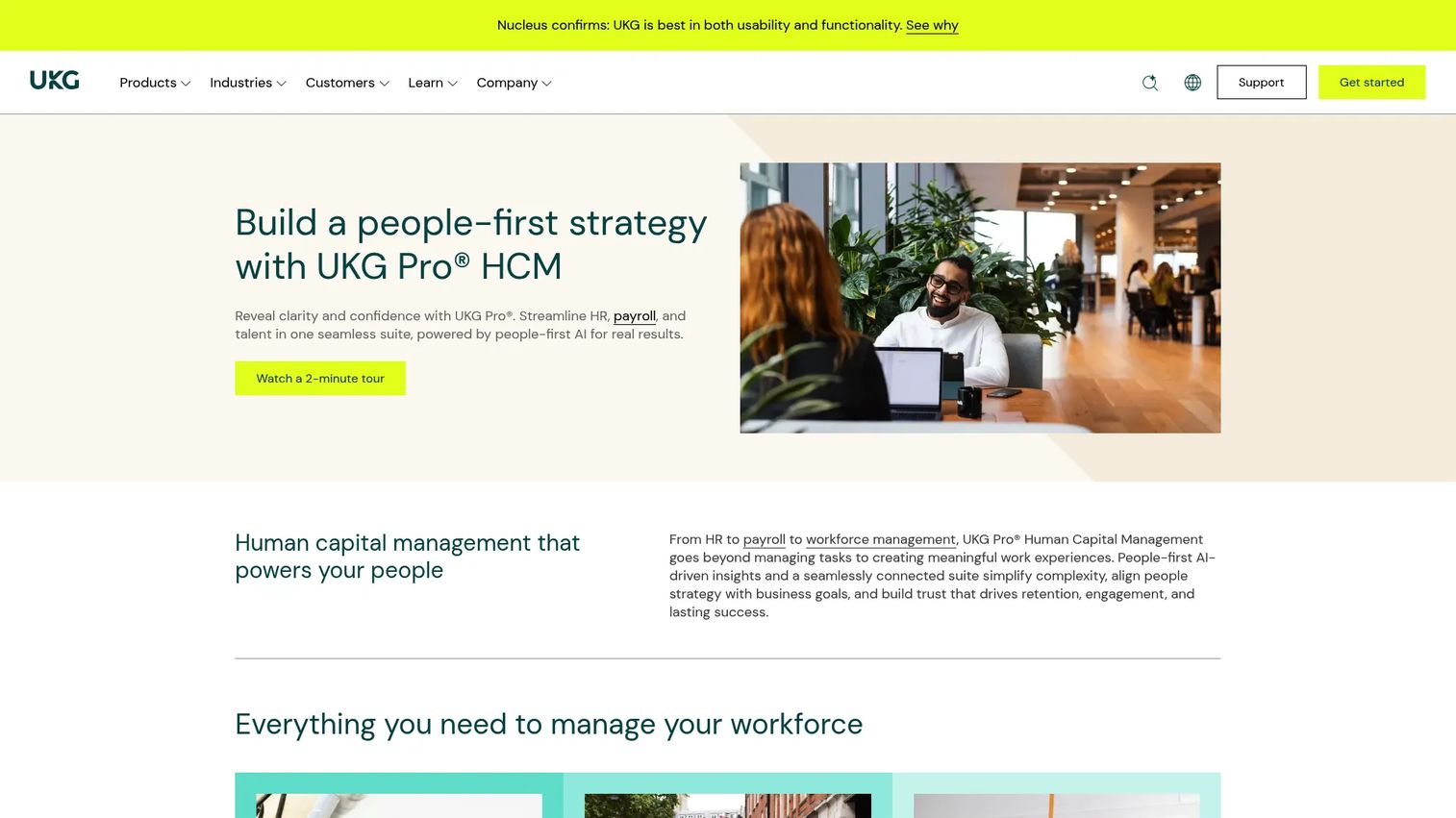
UKG Pro is an AI-driven human capital management platform for HR, payroll, talent, and workforce management. UKG built its reputation on workforce management depth, so it is a strong fit for organizations where scheduling, time and attendance, and labor operations are core to the business. It pairs that operational strength with a polished employee experience layer.
Best for: Mid-market and enterprise organizations that care heavily about workforce management and labor operations.
Key strengths
- Human resources: A unified people record with strong employee experience and self-service tooling.
- Payroll: Integrated payroll connected directly to time and attendance for accurate pay.
- Workforce management: Deep scheduling, time and attendance, and labor analytics for complex, shift-based operations.
Why choose UKG Pro: UKG fits companies that treat workforce management as a strategic function, not an afterthought, such as healthcare, retail, manufacturing, and hospitality with large hourly populations. The depth in scheduling and labor analytics helps control one of the biggest line items on the books. It scales comfortably from mid-market into enterprise.
UKG Pro pricing: UKG does not display public pricing or plan names on its product page. Pricing is quote-based and scoped by headcount, modules, and workforce management needs, so plan to engage UKG sales for a custom estimate.
7. Rippling
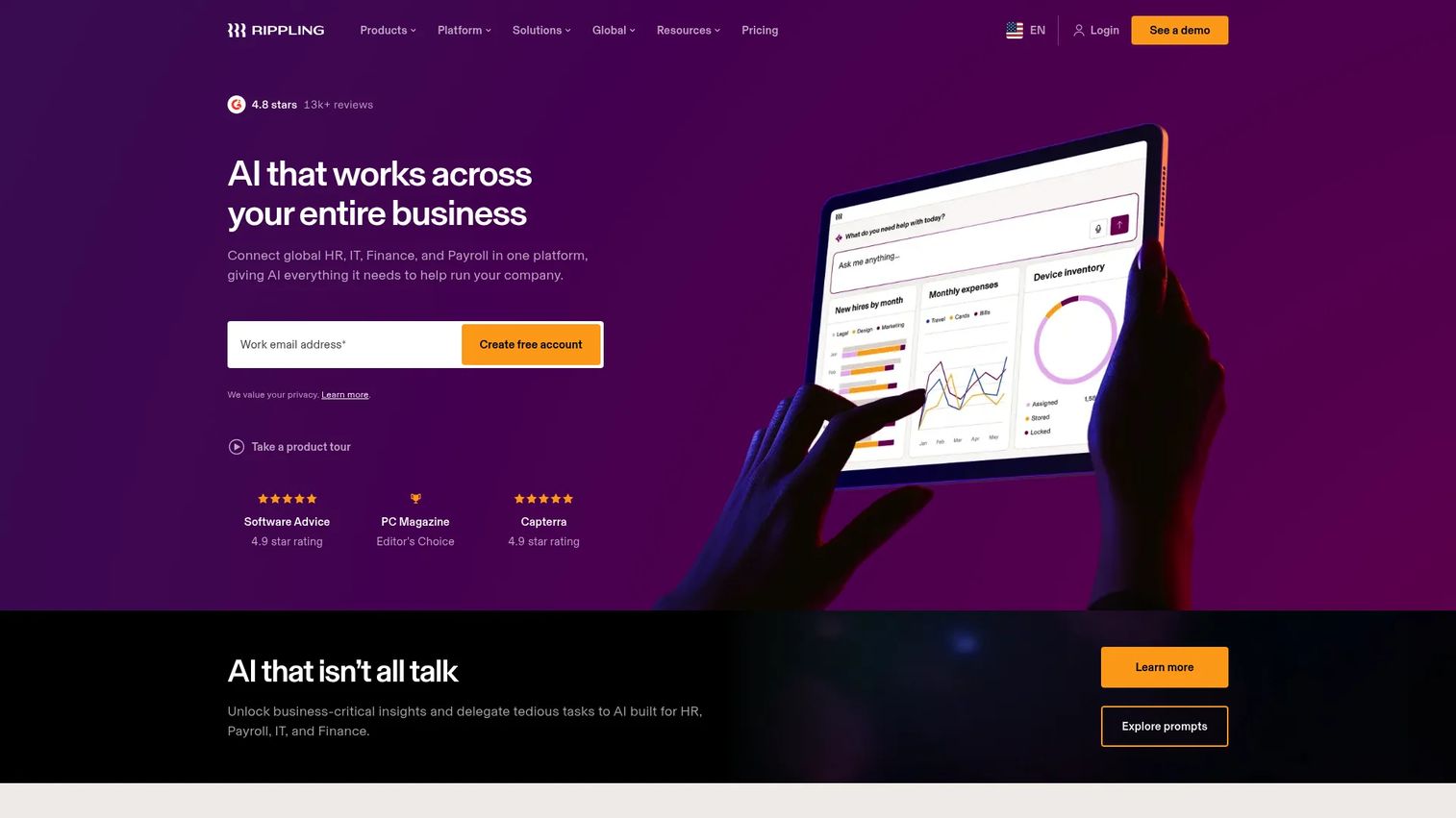
Rippling is a unified workforce platform that combines HR, IT, payroll, finance, and global operations in one system. Its differentiator is consolidation: a new hire's record drives not just HR and payroll but device provisioning, app access, and spend controls. For fast-growing companies trying to reduce tool sprawl while increasing signal, Rippling collapses several stacks into one.
Best for: Fast-growing companies that want one system to manage HR, IT, payroll, and spend together.
Key strengths
- HR, payroll, and benefits: HRIS, payroll, benefits, recruiting, performance, LMS, surveys, and scheduling in one platform.
- IT management: Identity and access, device management, inventory, and compliance tied to the same employee record.
- Finance and spend: Corporate cards, expenses, bill pay, and travel managed alongside HR data.
Why choose Rippling: Rippling appeals to founders and operators who want to consolidate tools and remove manual handoffs between HR, IT, and finance. Onboarding and offboarding become single workflows that touch payroll, devices, and app access at once. It fits companies scaling quickly that want infrastructure a new VP can rely on from day one.
Rippling pricing: Rippling sells products separately alongside a required core platform, and says most products are billed per employee per month. No public starting price is shown on its pricing page, so contact Rippling to scope a quote based on the modules you select.
8. BambooHR
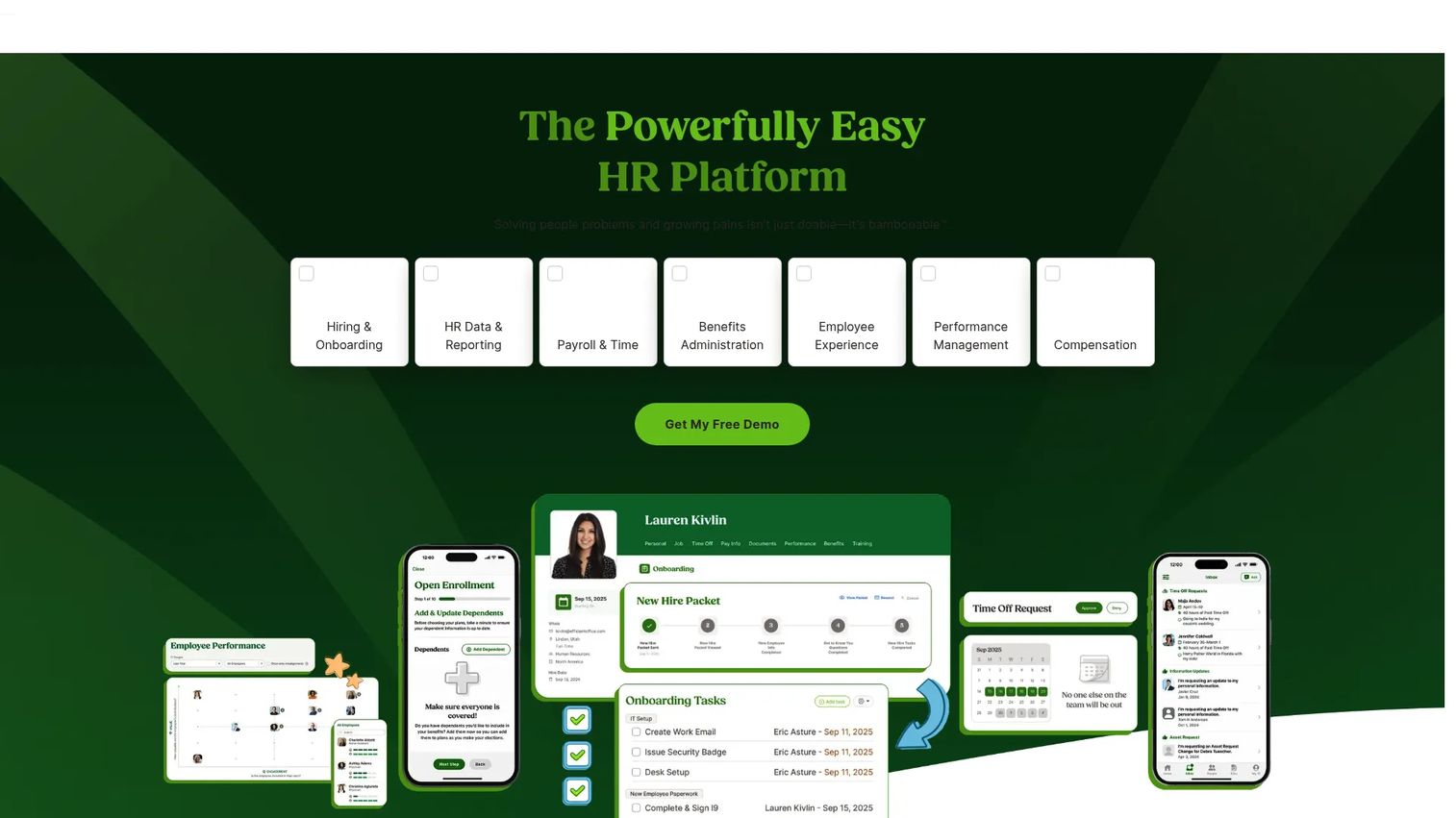
BambooHR is cloud-based HR software built for growing teams that want clean core HR without enterprise complexity. Smaller companies shortlist it for one reason: it is genuinely easy to use, from onboarding to employee records to time off. If you are between 25 and a few hundred employees and want HR that works without a dedicated admin, BambooHR is a frequent winner.
Best for: Small to mid-sized businesses that want an approachable all-in-one HR platform.
Key strengths
- Core HR and records: A clean system of record for employee data and org structure that teams actually keep current.
- Time, attendance, and PTO: Built-in time, attendance, and PTO tracking without bolt-on tools.
- Onboarding and talent basics: Onboarding, performance, compliance, and payroll covering the essentials for a growing team.
Why choose BambooHR: BambooHR fits teams that value usability and fast adoption over deep enterprise configuration. The interface keeps employees and managers engaged, which means your data stays accurate and your reporting stays usable. It is a strong starting point for companies that want to graduate off spreadsheets without committing to a heavyweight suite.
BambooHR pricing: BambooHR publishes public pricing. Companies with more than 25 employees pay per employee per month across Core at $10, Pro at $17, and Elite at $25. Teams of 25 employees or fewer can start at a flat $250 per month. There is no free tier.
9. Gusto
Gusto is an all-in-one payroll, benefits, and HR platform built for small businesses. It leads with payroll, so for founders who mostly want pay, taxes, and filings handled correctly with minimal admin, Gusto is one of the simplest ways to get there. Setup is fast, and the HR layer covers the essentials a small team needs.
Best for: Small businesses that want payroll, benefits, and HR in one simple system.
Key strengths
- Automated payroll: Automated payroll, taxes, and filings that run with little manual effort.
- Benefits administration: Benefits and deductions synced directly with payroll to avoid reconciliation.
- HR tools: Onboarding, time tracking, and employee management bundled in for small teams.
Why choose Gusto: Gusto suits founders and small business owners who want payroll software that simply works without an HR department behind it. The setup speed and clean interface mean you spend minutes, not days, on pay runs. It is best for smaller headcounts; companies scaling toward enterprise complexity typically graduate to a fuller suite over time.
Gusto pricing: Gusto publishes public pricing with no free tier. Plans run from Contractor only at $0/mo plus $6 per person, Simple at $49/mo plus $6 per person, Plus at $80/mo plus $12 per person, and Premium at $180/mo plus $22 per person. Add-ons are available on top of each plan.
10. Deel
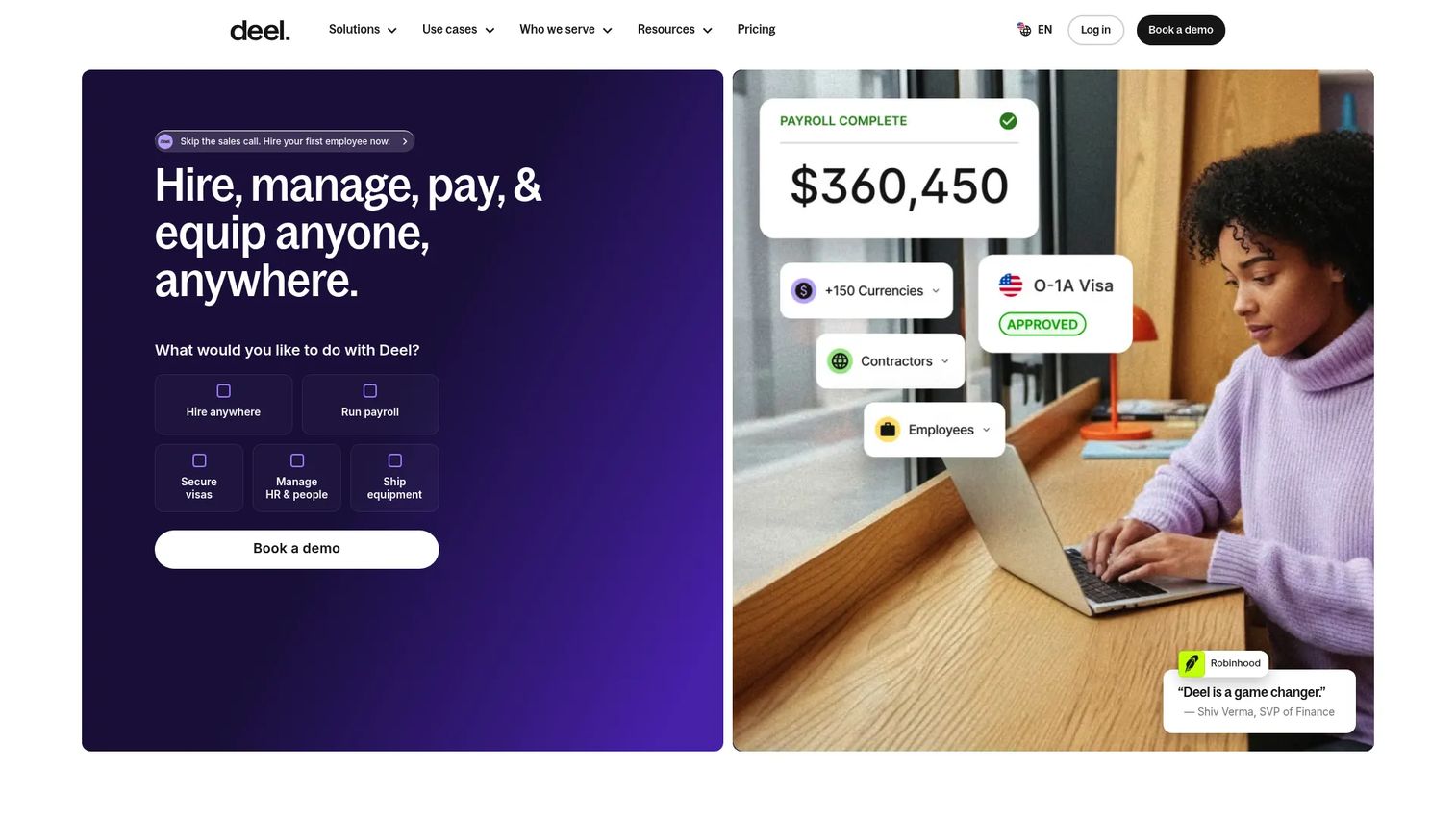
Deel is a global people platform for hiring, payroll, HR, and compliance across borders. If your team is distributed or you hire internationally, Deel handles the parts that break most HCM systems: employer of record hiring, contractor payments, and multi-country compliance. It is purpose-built for global workforce management rather than retrofitted for it.
Best for: Companies hiring, paying, and managing global teams across multiple countries.
Key strengths
- Global payroll: Run payroll across many countries from one platform with local compliance built in.
- Employer of Record hiring: Hire employees in countries where you have no legal entity through Deel's EOR.
- Contractor management: Onboard, manage, and pay contractors and freelancers worldwide with compliant agreements.
Why choose Deel: Deel fits distributed and cross-border teams that need to hire and pay people in places where standing up a local entity is impractical. It removes the legal and compliance friction that usually stalls international hiring. For a founder building a remote-first or globally distributed company, Deel handles the operational complexity so you can hire where the talent is.
Deel pricing: Deel publishes public pricing with no free tier. Contractor management starts at $49 per contractor per month, Contractor of Record at $325, EOR Standard at $599 per employee per month and Enterprise at $899, PEO at $125 per employee per month, and Global Payroll at $29 per employee per month. Some products are quote-based.
Considerations for HCM system selection
Once you have a shortlist, evaluate each platform against the criteria that actually matter for repeatable scale. Feature breadth is the easy part to compare; these factors are where the real fit shows up.
Scalability by headcount and geography
Check that the platform handles your current size and the size you expect in two years, including any countries you plan to hire in. A tool that fits 50 employees may strain at 500, and a domestic-only system breaks the moment you hire abroad. Match the platform to your growth curve, not just today.
Payroll accuracy and compliance coverage
Confirm the system handles every state, region, and tax jurisdiction you operate in, with automated filings and clear audit trails. Payroll errors and compliance gaps cost real money and erode trust, so weight this heavily. Ask specifically about how the vendor keeps current with regulatory change.
Integrations with your existing stack
Verify the HCM connects cleanly to your finance, identity, ATS, and ERP systems. Clean integrations are what turn fragmented data into a single source of truth, so a platform that does not talk to your stack defeats much of the purpose. Map your required connections before you sign.
Implementation time, support, and admin overhead
Ask about realistic implementation timelines and the ongoing admin burden once you are live. Enterprise suites deliver depth but take time to configure; lighter platforms go live faster. Factor in support quality, because the cost of a stalled rollout is mostly your team's time.
Analytics depth and data ownership
Compare how each platform handles workforce analytics and executive reporting, and confirm you own and can export your data. Clean, exportable workforce data is what lets you answer board questions without a fire drill. Also verify security, privacy, and compliance certifications before committing.
Conclusion
The best HCM software is not the one with the most modules. It is the one that gives leadership clean workforce data, dependable payroll and compliance, and enough integration depth to reduce tool sprawl. That definition changes by stage.
If you are running a large or global enterprise, Workday HCM, Oracle Fusion Cloud HCM, and SAP SuccessFactors give you the depth and reach to standardize people operations worldwide. For all-in-one workforce operations with strong payroll, Dayforce and UKG Pro lead, while ADP Workforce Now anchors mid-market teams in proven payroll and compliance. Fast-growing startups consolidating tools should look hard at Rippling. Smaller teams will move fastest with BambooHR or Gusto, and globally distributed companies should start with Deel.
Shortlist two or three vendors that match your stage and geography, then run each against the considerations above: scalability, payroll accuracy, integrations, implementation, and analytics. Score them on the factors that affect your numbers, not the longest feature list, and you will land on the platform that actually supports repeatable scale.
FAQs
HCM software is a cloud-based human capital management system that manages the full employee lifecycle in one platform, from recruiting and onboarding through payroll, benefits, performance, learning, and workforce reporting. It replaces a patchwork of separate HR, payroll, and talent tools with a single record of each employee. The goal is cleaner data, dependable payroll, and reporting leadership can trust.
An HRIS is the system of record for core employee data: profiles, org structure, time off, and basic compliance. HCM software includes that HRIS foundation and adds strategic talent layers like recruiting, learning, performance, compensation, and succession. In short, every HCM contains an HRIS, but an HRIS alone covers less than a full HCM.
An HRMS typically adds payroll and time management on top of a core HRIS. HCM and HRMS overlap heavily, and many vendors use the terms loosely. The practical difference is talent depth: HCM leans harder into the develop-and-retain side with stronger recruiting, learning, and succession capabilities.
An ERP runs the entire business across finance, supply chain, procurement, and operations, while HCM is the people-focused part of that picture. Some vendors, like Oracle and SAP, sell HCM as a module within a broader ERP suite. Others, like Workday, started in HCM and expanded into finance, so the line depends on the vendor.
A strong cloud-based HCM platform should cover recruiting, onboarding, core HR records, payroll, benefits, time and attendance, performance, learning, compensation, and succession. It should also include workforce analytics and executive reporting, plus integrations with your finance, identity, and ATS systems. Security, compliance coverage, and data ownership round out the must-haves.
Pricing varies widely by company size, modules, and geography. Many enterprise HCM software vendors like Workday, Oracle, SAP, Dayforce, ADP, and UKG use quote-based pricing scoped to headcount and modules. SMB-focused options publish public rates: BambooHR starts at $10 per employee per month, Gusto from $49 per month plus $6 per person, and Deel from $49 per contractor per month.
Prioritize scalability by headcount and geography, payroll accuracy and compliance coverage, and clean integrations with your finance, identity, ATS, and ERP systems. Then weigh implementation time, support quality, admin overhead, analytics depth, and data ownership. The best fit is the platform that gives leadership clean workforce data and dependable payroll, not the one with the longest feature list.
Both, but the right tool differs. Enterprise teams typically choose Workday, Oracle, or SAP for global reach and deep configuration, while mid-market teams often land on ADP Workforce Now, Dayforce, or UKG Pro for strong payroll and workforce management without full enterprise complexity. Fast-growing and smaller companies frequently start with Rippling, BambooHR, or Gusto and graduate up as headcount grows.