

Most SaaS teams run A/B tests the same way they did five years ago: spin up a tool, test a button color, call it optimization. Meanwhile, the companies actually moving metrics are running experiments across their entire product, from onboarding flows to pricing pages to feature rollouts.
The gap between "we do A/B testing" and "we have an experimentation culture" is usually the tooling - particularly when 58% of companies still base changes on opinions, not data. This guide covers 15 A/B testing platforms built for SaaS teams, with honest takes on where each one fits, what it costs, and when you might outgrow it.
What's inside
This guide covers the best A/B testing software for SaaS teams in 2026. You'll find tools for every use case, from visual website testing to server-side product experimentation and feature flagging. We selected platforms based on statistical rigor, ease of use, integration depth, and how well each fits SaaS-specific workflows like onboarding optimization, pricing page tests, and feature rollouts.
TL;DR
- Best for enterprise: Optimizely, Adobe Target, Kameleoon
- Best open-source and free A/B testing tools: PostHog, GrowthBook, Statsig
- Best for product and engineering teams: LaunchDarkly, Split.io, Eppo
- Best visual editor for marketers: VWO, AB Tasty, Convert, Unbounce
- Guideflow complements A/B testing by letting you test and optimize interactive demo experiences
What is A/B testing software
A/B testing tools compare two or more versions of a web page, app screen, or email to determine which performs better. The platforms split your traffic between variants and measure outcomes, so you can make data-driven decisions instead of guessing.
You might also hear A/B testing tools called split testing tools, bucket testing software, or CRO (conversion rate optimization) platforms. Here's how the main testing types differ:
- A/B testing (split testing): Compares two versions (A vs B) to see which drives better results
- Multivariate testing: Tests multiple variables simultaneously to find the optimal combination
- Feature flagging: Controls which users see new features, often combined with experimentation to measure impact
Most modern platforms blend A/B testing, multivariate testing, and feature flagging capabilities. The right choice depends on whether you're optimizing marketing pages, running product experiments, or both.
When to use A/B testing tools for SaaS
Website and landing page optimization
Marketing teams use A/B testing to experiment with headlines, CTA buttons, images, and page layouts. Many tools include visual editors that let non-technical users create and launch test variants without writing code. Even small improvements here compound over time.
Product feature experimentation
Product and engineering teams run server-side tests to measure the impact of new features, algorithm changes, or UI variations. Feature flags let you safely roll out changes to a subset of users before a full release. Server-side testing reduces risk and gives you real data on what actually moves your metrics.
Email and campaign testing
Testing subject lines, email content, and send times can improve open and click-through rates. While many marketing automation tools have built-in A/B testing for email, dedicated platforms offer more statistical rigor for complex campaigns.
Pricing and conversion flow tests
Experimenting with checkout flows, pricing page designs, and signup sequences can reduce friction and increase revenue - yet only 24% of SaaS companies regularly test pricing. For SaaS companies, even a 5% improvement in trial-to-paid conversion can translate to meaningful annual revenue gains.
How to choose the best A/B testing platform
Statistical engine and sample size requirements
Different tools use different statistical approaches. Bayesian engines often declare winners faster with less traffic, while Frequentist methods are more traditional. Lower-traffic SaaS products benefit from tools with more sensitive statistical engines. Before committing, check whether your traffic volume can reach statistical significance in a reasonable timeframe.
Visual editor vs code-based testing
Visual editors empower marketers to create test variations through a point-and-click interface. Code-based or server-side testing gives developers granular control for complex experiments. Most mature teams eventually want a platform that offers both.
Client-side vs server-side capabilities
Client-side testing renders changes in the user's browser, which works well for visual modifications on marketing pages. Server-side testing runs experiments in your backend, which is essential for testing product logic, pricing models, or API responses. Many teams combine this with sandbox environments to create safe spaces for experimentation without affecting production. SaaS teams typically want both capabilities.
Integrations with your SaaS stack
Your A/B testing tool works best when it connects to your existing analytics, CRM, and data warehouse. Look for native integrations with platforms like Segment, Amplitude, Mixpanel, HubSpot, and Salesforce. The easier data flows between systems, the faster you can act on insights.
Pricing models and traffic limits
Most platforms price based on monthly tracked users (MTUs) or events. Free tiers often come with traffic caps or limited features. Enterprise tools typically require annual contracts and custom pricing. Match the pricing model to your traffic volume and testing frequency.
A/B testing tools comparison table
| # | Product | Intent | Key use case | Pricing | G2 rating |
|---|---|---|---|---|---|
| 1 | Optimizely | Enterprise experimentation | Full-stack testing | Custom | 4.3/5 |
| 2 | VWO | Marketing CRO | Visual website testing | From $299/mo | 4.3/5 |
| 3 | AB Tasty | Personalization + testing | AI-powered optimization | Custom | 4.4/5 |
| 4 | Adobe Target | Enterprise personalization | Complex targeting | Custom | 4.0/5 |
| 5 | LaunchDarkly | Feature management | Feature flags + experiments | From $75/seat/mo | 4.5/5 |
| 6 | PostHog | Product analytics | Unified analytics + testing | Free tier available | 4.4/5 |
| 7 | GrowthBook | Warehouse-native testing | Data team experimentation | Free open-source | 4.5/5 |
| 8 | Amplitude Experiment | Behavioral targeting | Analytics-driven tests | Free tier available | 4.5/5 |
| 9 | Kameleoon | AI personalization | Real-time optimization | Custom | 4.4/5 |
| 10 | Convert | Privacy-focused testing | Accurate, unsampled results | From $99/mo | 4.7/5 |
| 11 | Split.io | Release management | Feature delivery + impact | Free tier available | 4.5/5 |
| 12 | Statsig | Modern experimentation | Enterprise-grade, affordable | Generous free tier | 4.5/5 |
| 13 | Unbounce | Landing page testing | Campaign page optimization | From $99/mo | 4.4/5 |
| 14 | Apptimize | Mobile experimentation | Native app testing | Custom | 4.2/5 |
| 15 | Eppo | Warehouse-native testing | Data-mature organizations | Custom | 4.6/5 |
15 best A/B testing tools for SaaS teams
1. Optimizely
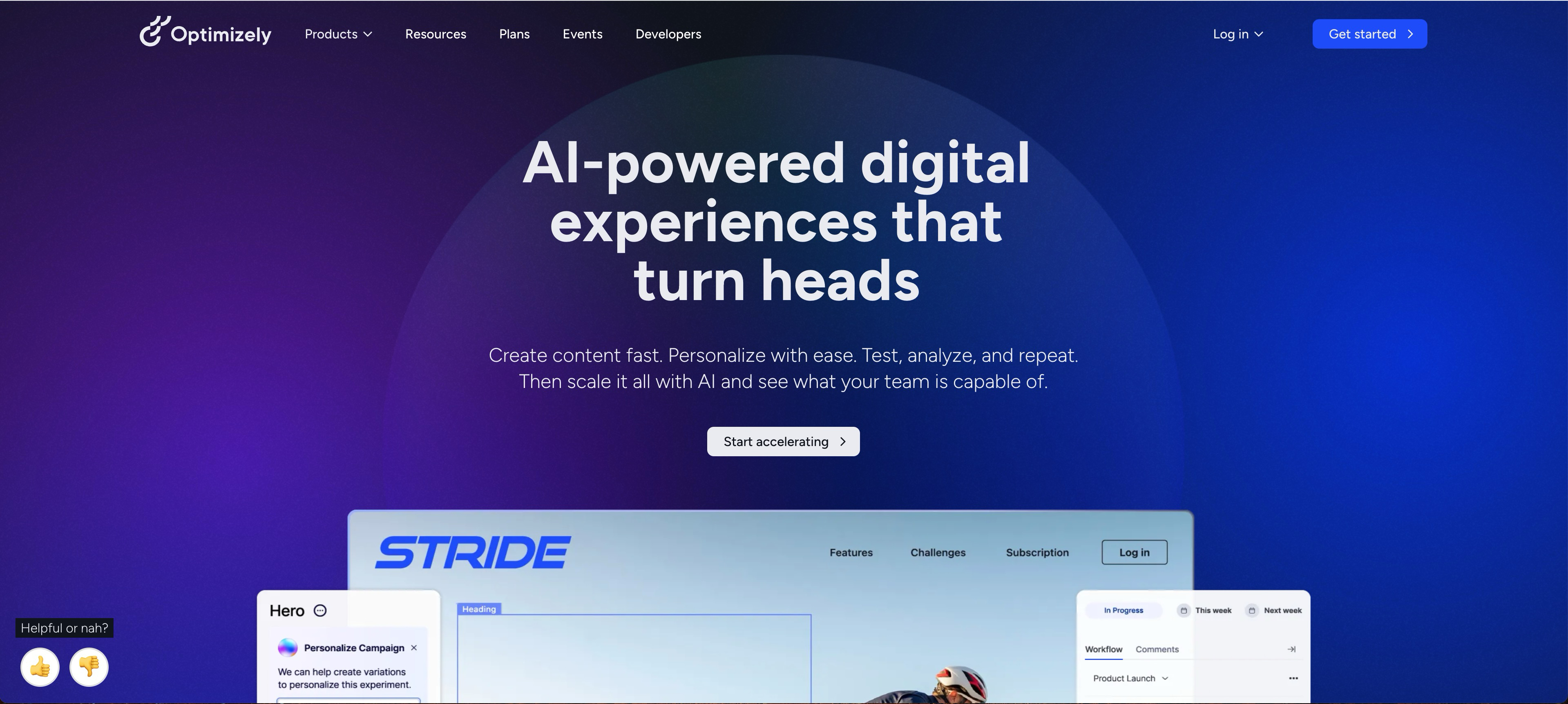
Optimizely is an industry-leading experimentation platform built for enterprise teams. The platform offers a powerful Bayesian statistics engine and full-stack experimentation capabilities, letting you run tests on the web, server-side, and with feature flags from a single platform.
Best for: Large SaaS companies with dedicated experimentation teams who want a comprehensive, battle-tested solution.
Key strengths
- Powerful Bayesian statistics engine that adapts to your traffic
- Advanced targeting and personalization capabilities
- Full-stack experimentation across web and server-side
- Comprehensive feature flagging with rollout controls
- Strong governance and collaboration features for large teams
Why choose Optimizely: Named a Forrester Wave™ DXP Leader in Q4 2025, the platform provides the depth and reliability that enterprise organizations expect. If you're running hundreds of experiments across multiple teams, Optimizely scales with you.
Pricing: No free tier. Custom pricing requires an annual contract, typically starting in the five-figure range annually.
2. VWO
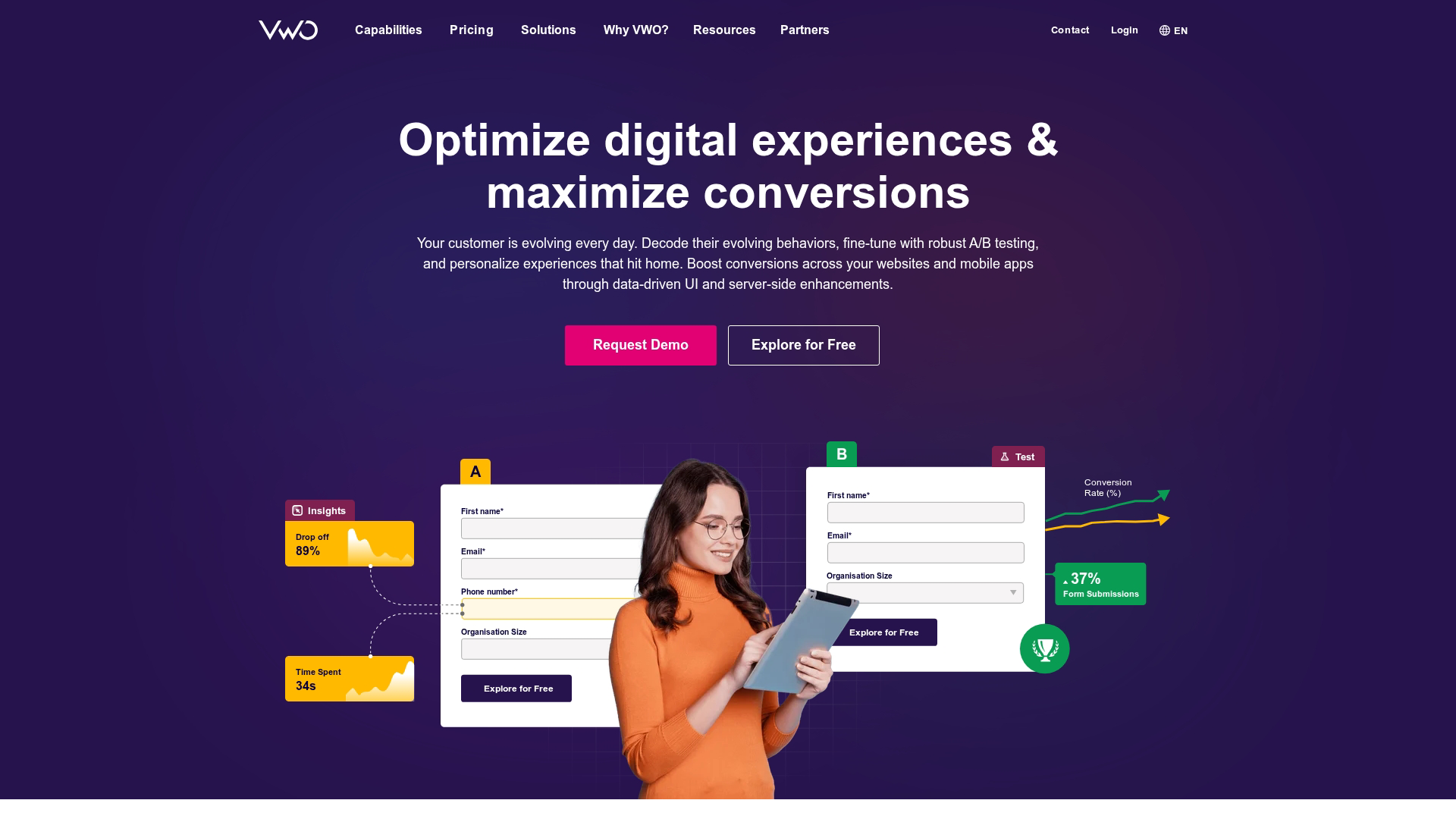
VWO (Visual Website Optimizer) is an all-in-one conversion rate optimization platform popular with marketing teams. VWO bundles a strong visual editor with CRO tools like heatmaps, session recordings, and surveys, so you can understand user behavior and test improvements in one place.
Best for: Marketing-led optimization where teams want to run tests without heavy developer involvement.
Key strengths
- User-friendly visual editor for creating test variants
- Integrated suite of CRO tools including heatmaps and recordings
- Good balance of power and usability for non-technical users
- Strong reporting and analytics dashboards
- Solid customer support and documentation
Why choose VWO: VWO is an excellent choice for teams who want a single platform for all website optimization activities. The learning curve is gentle, and you can be running tests within hours.
Pricing: Free tier for up to 50k users. Paid plans start from $299/month and scale with traffic and features.
3. AB Tasty
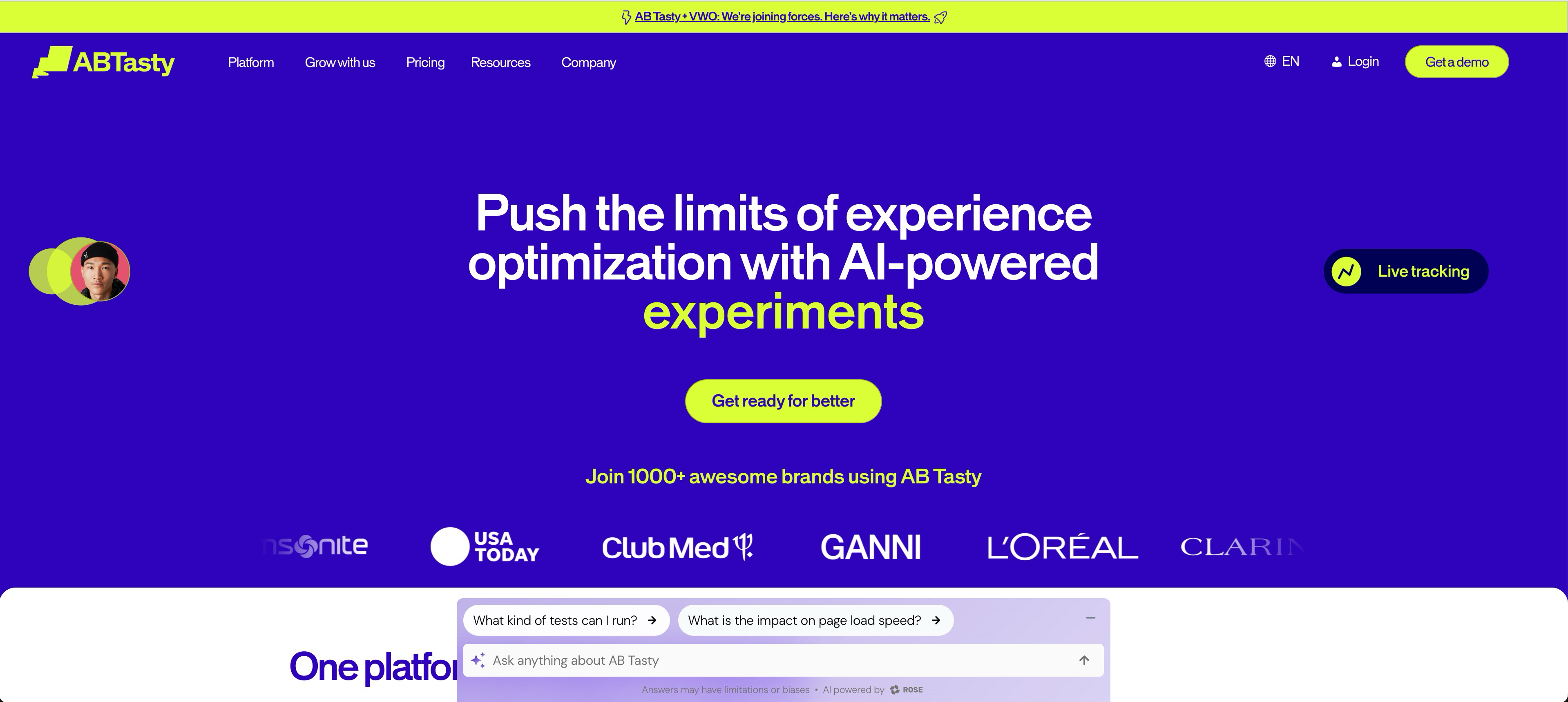
AB Tasty combines traditional A/B testing with AI-driven personalization and audience segmentation. The platform helps teams move beyond simple split tests into more sophisticated, automated optimization campaigns.
Best for: Teams wanting to combine A/B testing and personalization in one tool, particularly in e-commerce and media.
Key strengths
- Strong visual editor with no-code test creation
- AI-powered personalization and recommendations
- Both client-side and server-side testing capabilities
- Good for e-commerce product recommendations
- European headquarters with strong GDPR compliance
Why choose AB Tasty: AB Tasty excels at helping teams graduate from basic A/B tests into automated personalization. The AI features can surface optimization opportunities you might miss manually.
Pricing: No free tier. Custom pricing based on traffic volume.
4. Adobe Target
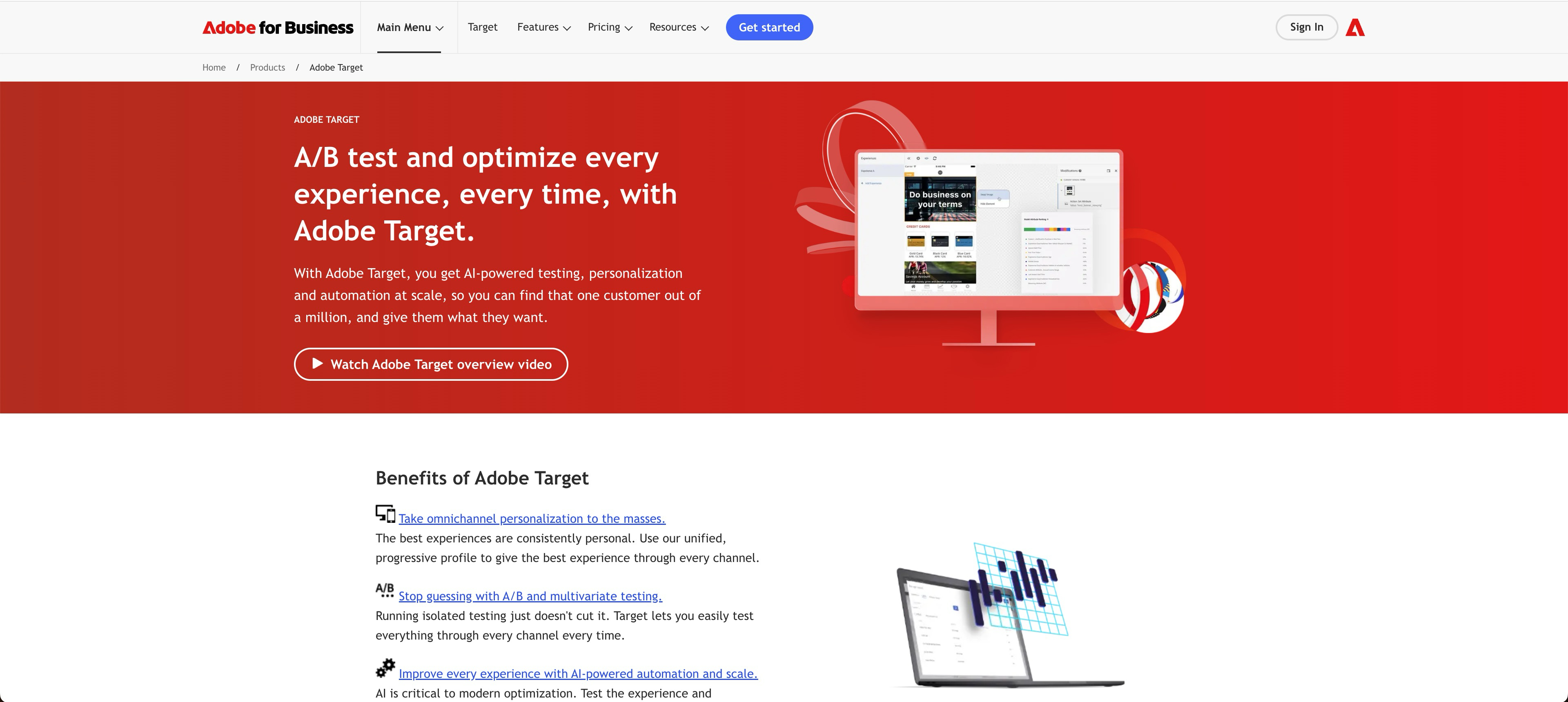
Adobe Target is the enterprise-grade personalization and A/B testing engine within Adobe Experience Cloud. The primary advantage is deep, native integration with Adobe Analytics and other Adobe products.
Best for: Large organizations already invested in the Adobe ecosystem who want unified data and testing.
Key strengths
- Seamless integration with Adobe Analytics and Experience Cloud
- AI-automated personalization through Adobe Sensei
- Advanced enterprise-level targeting and segmentation
- Both client-side and server-side testing
- Strong governance and compliance features
Why choose Adobe Target: If your company runs on Adobe, Target provides unmatched data integration. You avoid the data reconciliation headaches that come with stitching together separate tools.
Pricing: No free tier. Requires investment in Adobe Experience Cloud, typically six figures annually for enterprise deployments.
5. LaunchDarkly
LaunchDarkly is a feature management platform that has expanded to include robust experimentation capabilities. While primarily known for developer-centric feature flags, LaunchDarkly lets teams run A/B tests tied directly to feature rollouts.
Best for: Product and engineering teams managing feature releases who want experimentation built into their deployment workflow.
Key strengths
- Best-in-class feature flag management and targeting
- Strong developer experience with SDKs for every major language
- Controlled rollouts with kill switches for risk mitigation
- Integrates experimentation directly with feature delivery
- Excellent documentation and developer community
Why choose LaunchDarkly: LaunchDarkly is ideal for teams that want to tie experimentation to the software development lifecycle. You can measure the impact of features as you ship them, not as an afterthought.
Pricing: No free tier. Pricing starts at $75/month per seat, with enterprise plans for larger teams.
6. PostHog
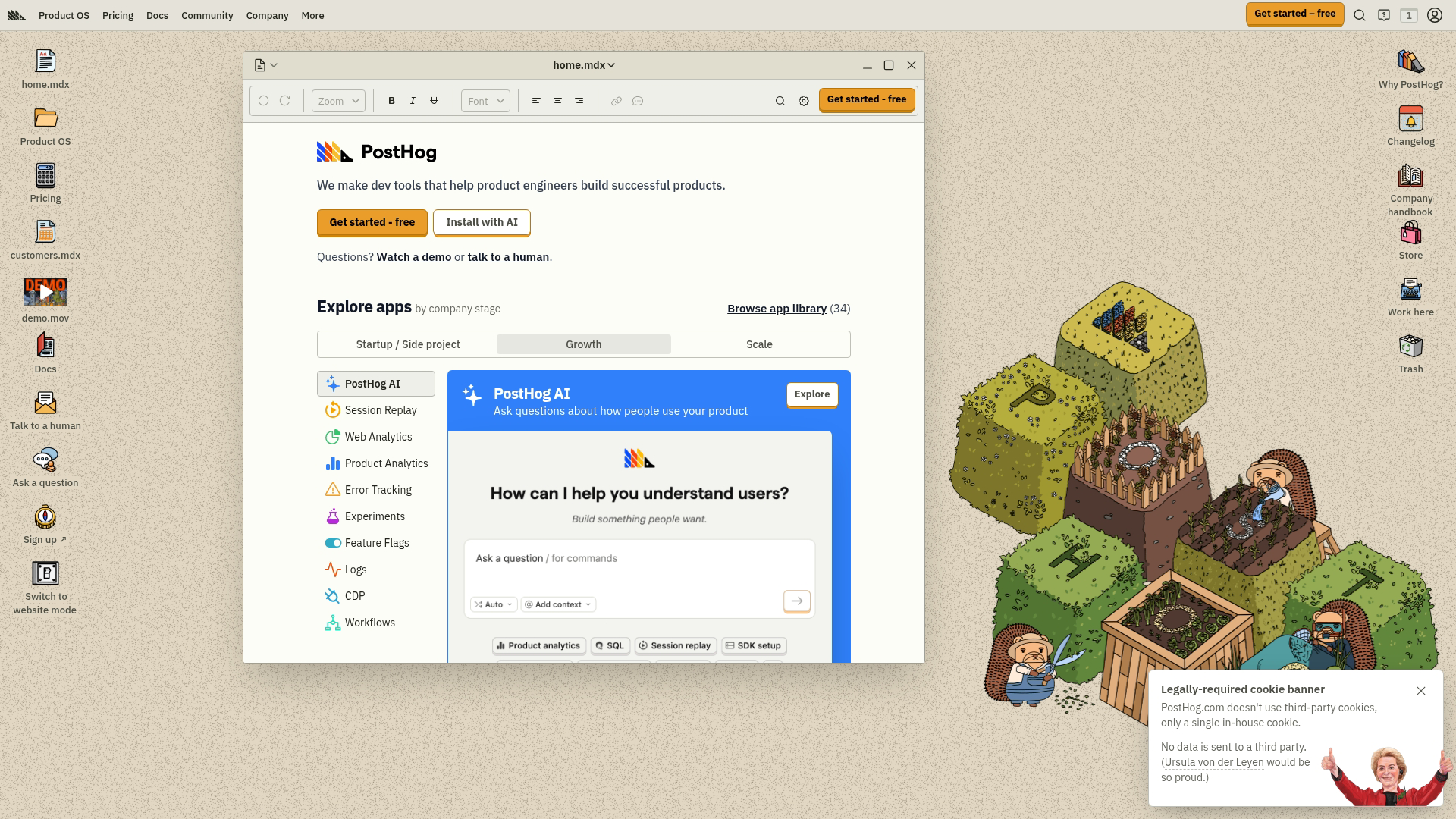
PostHog is an open-source product analytics platform that includes built-in A/B testing and feature flags. PostHog offers a unified solution that can be self-hosted or used as a cloud service, which appeals to teams who want control over their data.
Best for: Product teams wanting unified analytics and experimentation, especially startups and developer-focused companies.
Key strengths
- All-in-one product analytics, session recording, feature flags, and A/B testing
- Open-source with self-hosting option for data control
- Generous free cloud tier for getting started
- Strong developer-first focus and documentation
- Active community and rapid feature development
Why choose PostHog: PostHog eliminates the need to integrate separate tools for analytics and testing. You get a single source of truth for product data, which simplifies analysis and reduces data discrepancies.
Pricing: Generous free tier for up to 1 million events/month. Paid plans offer more features and scale based on usage.
7. GrowthBook
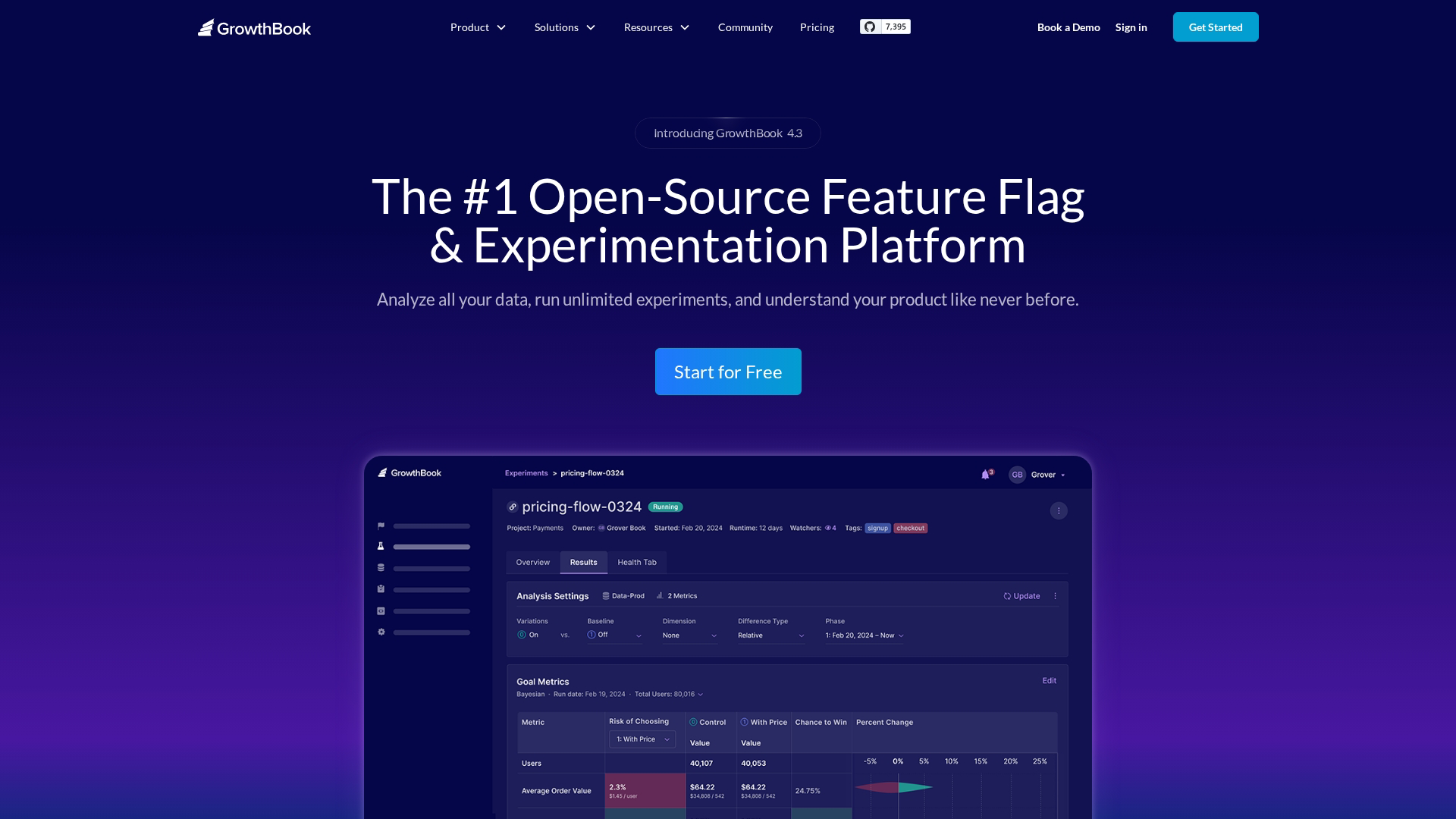
GrowthBook is an open-source A/B testing and feature flagging platform with a unique approach: GrowthBook connects directly to your existing data warehouse to run analysis. The warehouse-native approach avoids data duplication and leverages your existing analytics infrastructure.
Best for: Data-savvy teams that want to run experiments on top of their existing data warehouse investment.
Key strengths
- Open-source and self-hostable for full control
- Warehouse-native approach prevents data silos
- Both feature flagging and A/B testing in one platform
- Truly free option for powerful experimentation
- Strong statistical rigor with clear documentation
Why choose GrowthBook: GrowthBook is perfect for companies that have already invested in a modern data warehouse like Snowflake, BigQuery, or Redshift. You add a flexible experimentation layer without duplicating data.
Pricing: Free open-source version. Paid cloud plans offer hosting, support, and enterprise features.
8. Amplitude Experiment
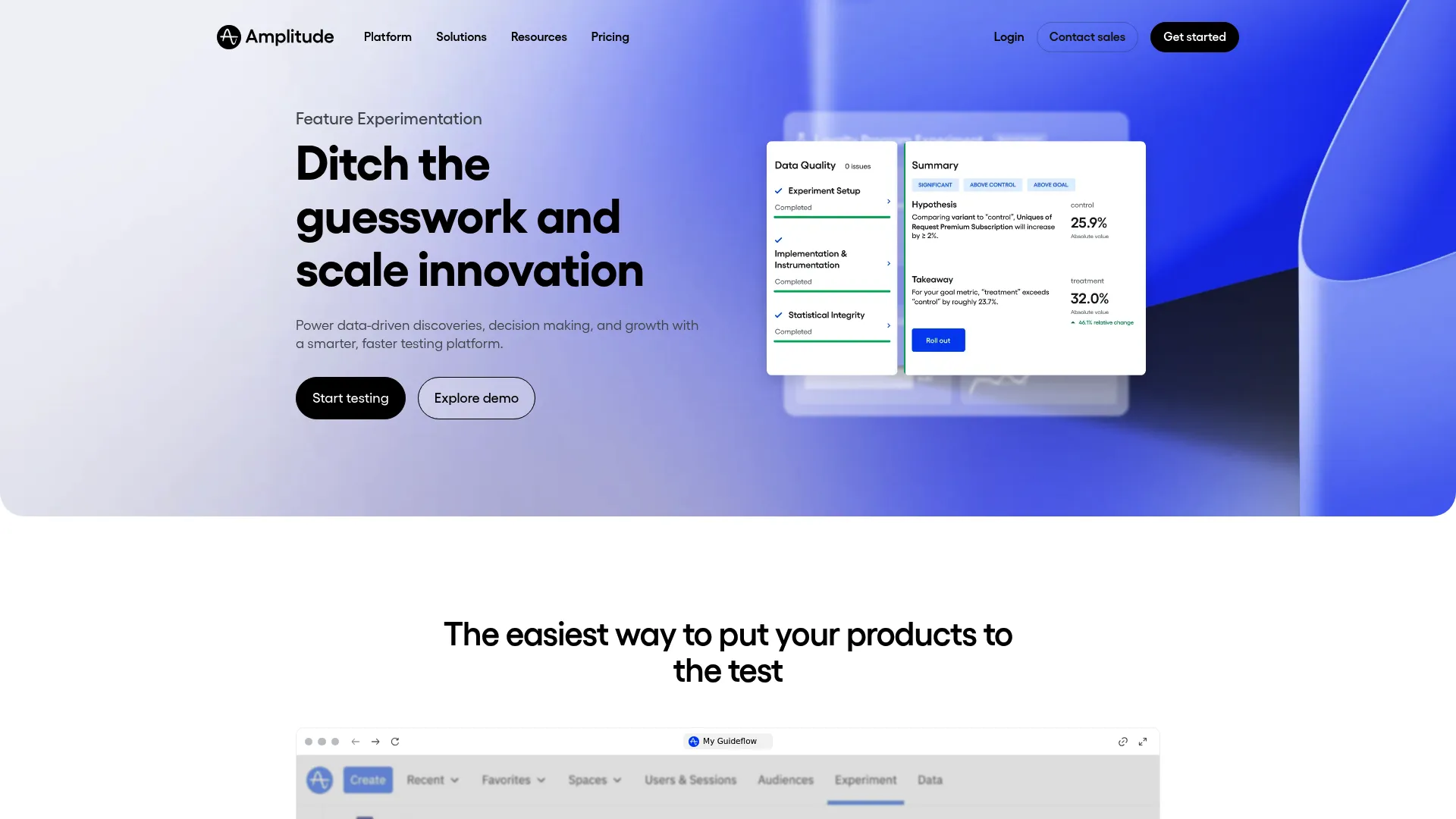
Amplitude Experiment is the experimentation product built into Amplitude's product analytics suite. The primary advantage is tight integration with Amplitude Analytics, allowing powerful targeting based on behavioral cohorts you've already defined.
Best for: Teams already using Amplitude for product analytics who want unified experimentation.
Key strengths
- Deep integration with Amplitude Analytics behavioral data
- Powerful targeting using existing behavioral segments
- Strong statistical rigor and clear reporting
- Unified data and workflow for analytics and testing
- Good collaboration features for cross-functional teams
Why choose Amplitude Experiment: You can target experiments to highly specific user segments based on their actual product behavior. Behavioral targeting leads to more insightful tests and faster learning.
Pricing: Free starter plan available. Paid plans are bundled with Amplitude Analytics.
9. Kameleoon
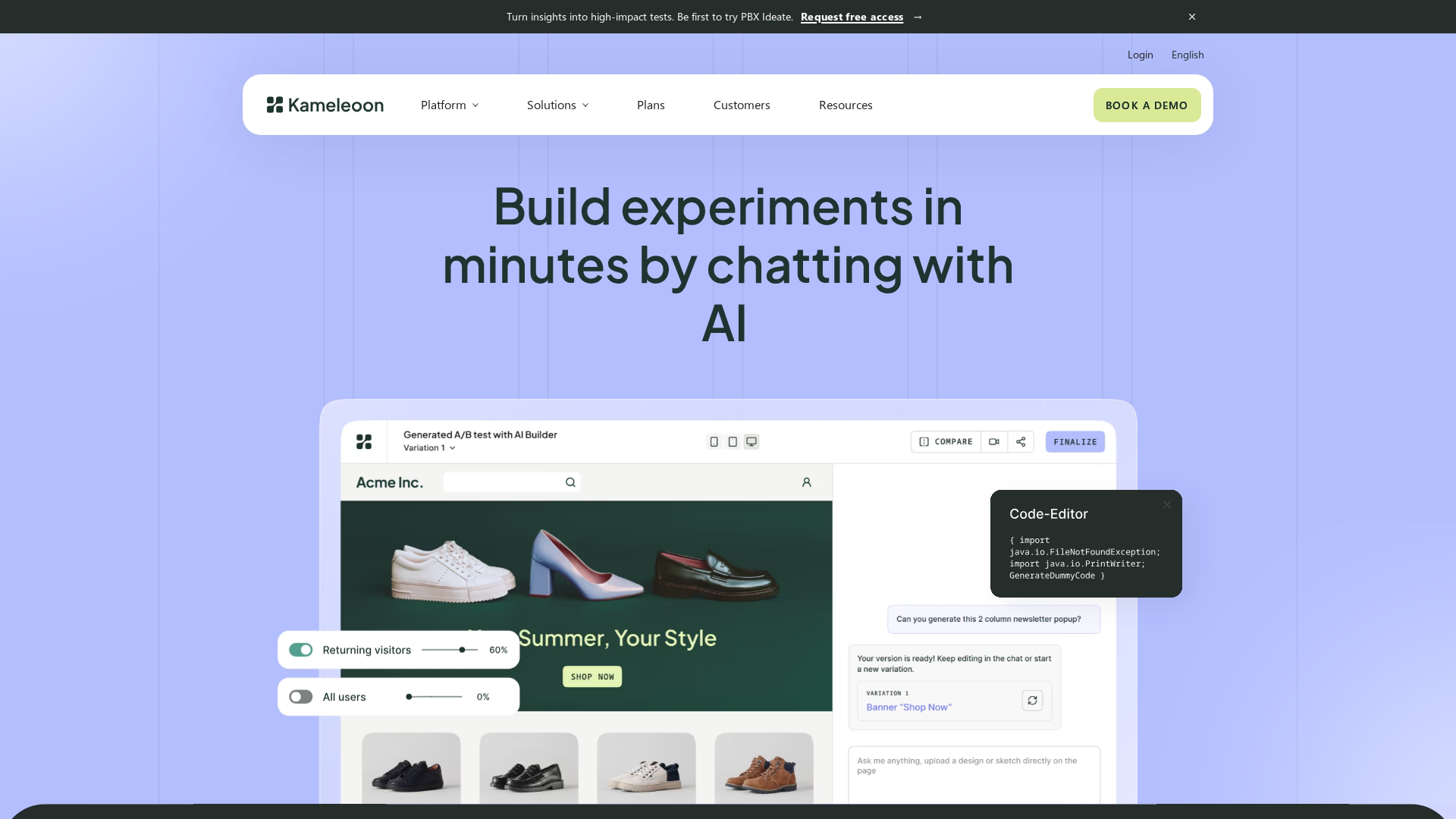
Kameleoon is an AI-powered experimentation and personalization platform focused on helping enterprise teams use machine learning to automate and optimize their testing programs.
Best for: Enterprise teams wanting to leverage AI-driven optimization and real-time personalization.
Key strengths
- Strong AI and machine learning capabilities for optimization
- Full-stack testing with both client-side and server-side
- Strong focus on GDPR and data privacy compliance
- Real-time conversion data and predictive targeting
- Good for mature experimentation programs
Why choose Kameleoon: Kameleoon is a great fit for teams looking to go beyond basic A/B tests into predictive targeting and AI-driven personalization at scale.
Pricing: No free tier. Custom enterprise pricing based on traffic and features.
10. Convert
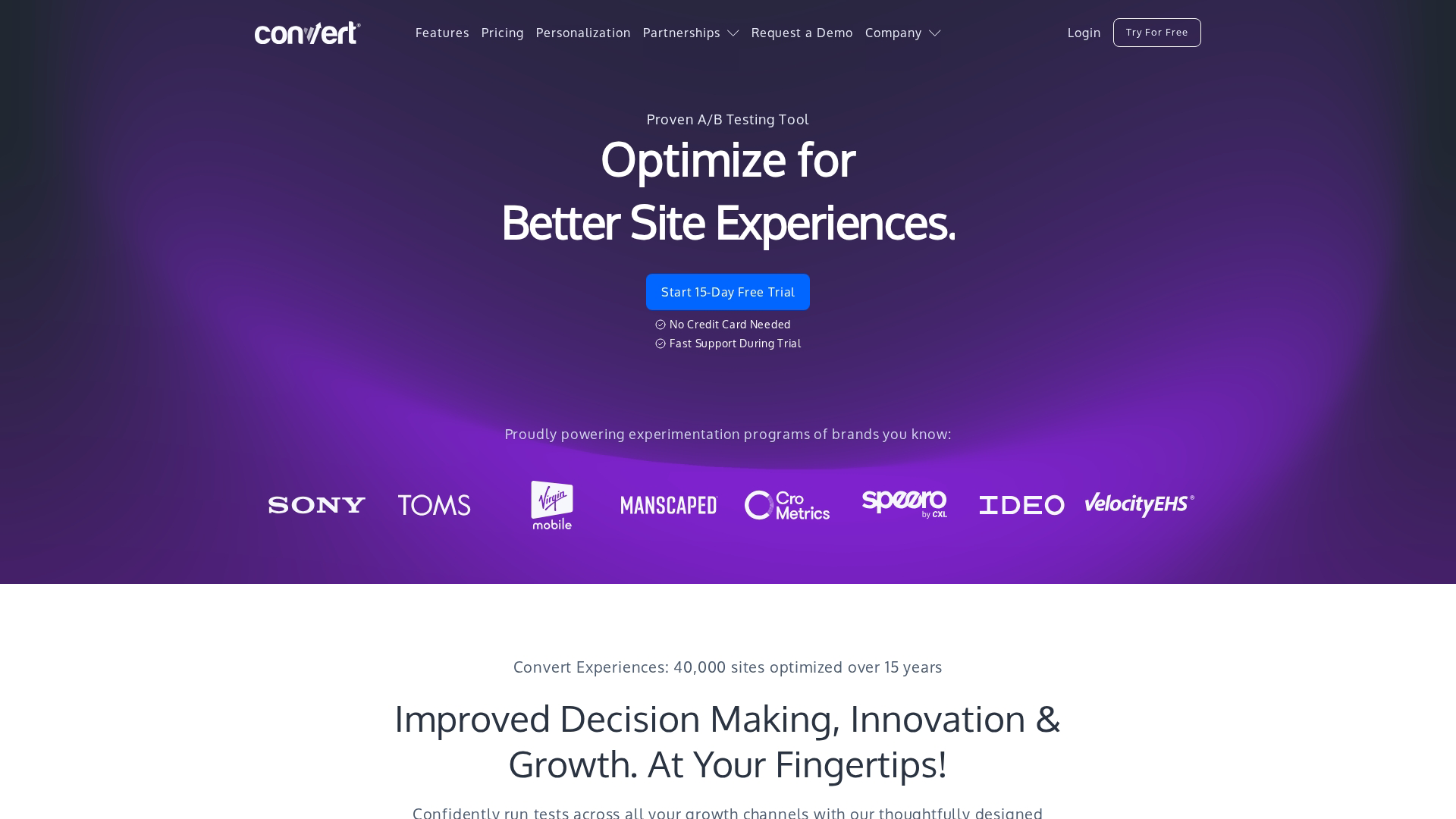
Convert is a privacy-focused A/B testing platform popular with agencies and mid-market companies. Convert stands out for not using data sampling and for strong GDPR and privacy compliance.
Best for: Teams that prioritize data privacy and want accurate, unsampled test results.
Key strengths
- No data sampling ensures result accuracy
- Strong privacy focus with GDPR/CCPA compliance
- Good visual editor and developer tools
- Transparent and reasonable pricing
- Excellent customer support reputation
Why choose Convert: Convert offers powerful, reliable testing without the enterprise price tag, all while respecting user privacy. The unsampled data means you can trust your results.
Pricing: No free tier. Plans start at $99/month and scale with traffic.
11. Split.io
Split.io is a feature delivery and experimentation platform designed for engineering teams. Now part of Harness, Split.io emphasizes controlled rollouts, impact monitoring, and risk mitigation through kill switches.
Best for: Product and engineering teams managing complex feature releases in production environments.
Key strengths
- Enterprise-grade feature flagging with fine-grained control
- Strong focus on release safety and monitoring
- Detailed audit logs and governance features
- Integrates impact measurement with feature delivery
- Good for regulated industries needing compliance
Why choose Split.io: Split.io provides the infrastructure for engineering teams to ship code faster while measuring business impact. The safety features reduce the risk of bad releases.
Pricing: Free tier for up to 10 seats. Paid plans are custom based on usage and features.
12. Statsig
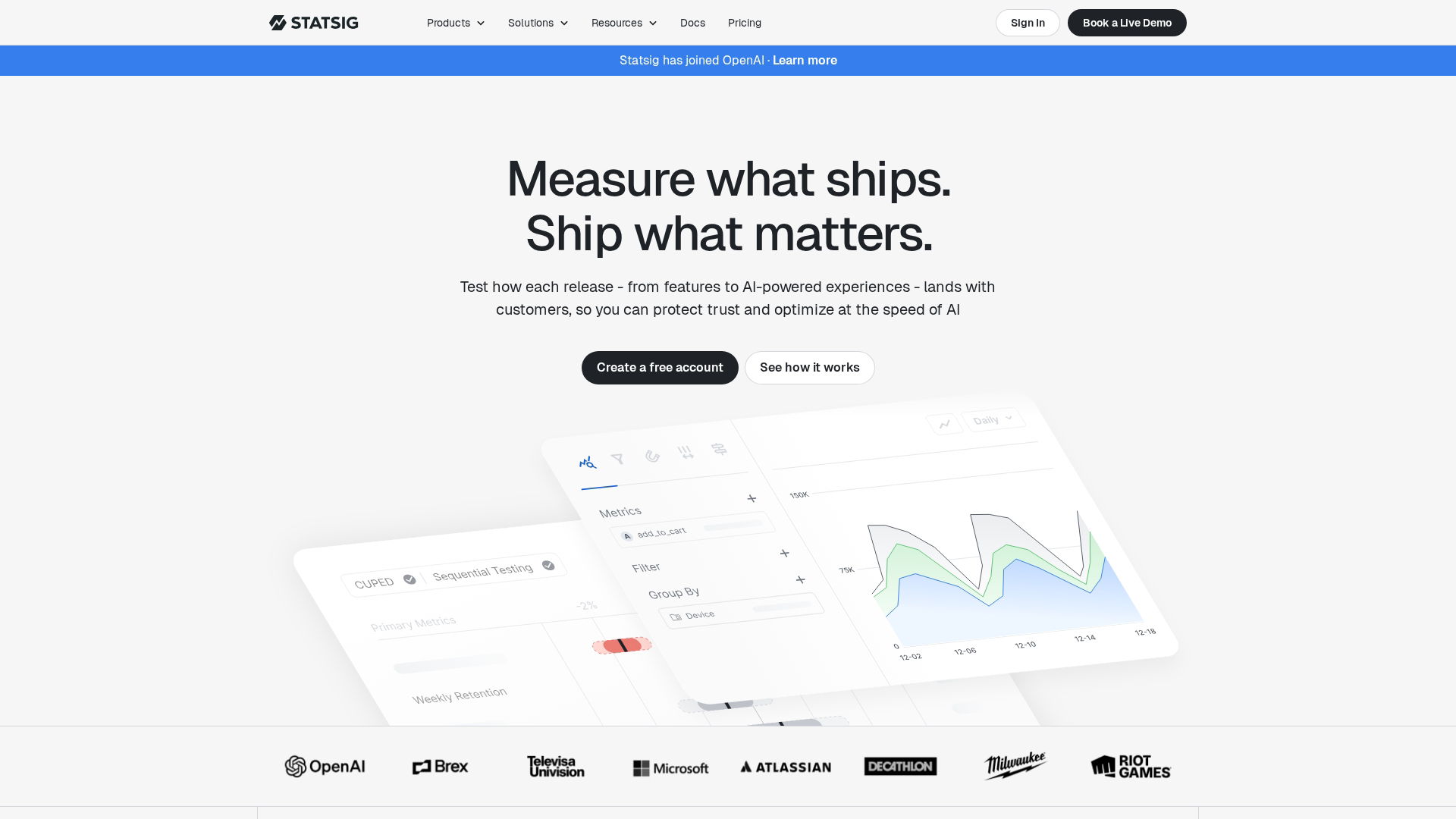
Statsig is a modern experimentation and feature management platform built by ex-Facebook engineers. Statsig offers enterprise-grade tools with a very generous free tier, making sophisticated experimentation accessible to smaller teams.
Best for: Startups and growth-stage SaaS companies wanting enterprise-grade experimentation affordably.
Key strengths
- Powerful statistical engine (Pulse) with clear diagnostics
- Generous free tier covering up to 500 million events/year
- Integrated product analytics and feature flags
- Built by engineers with deep experimentation experience
- Fast setup and good documentation
Why choose Statsig: Statsig brings the kind of sophisticated experimentation infrastructure previously only available at large tech companies to teams of any size.
Pricing: Very generous free tier. Paid plans for enterprise features, support, and scale.
13. Unbounce
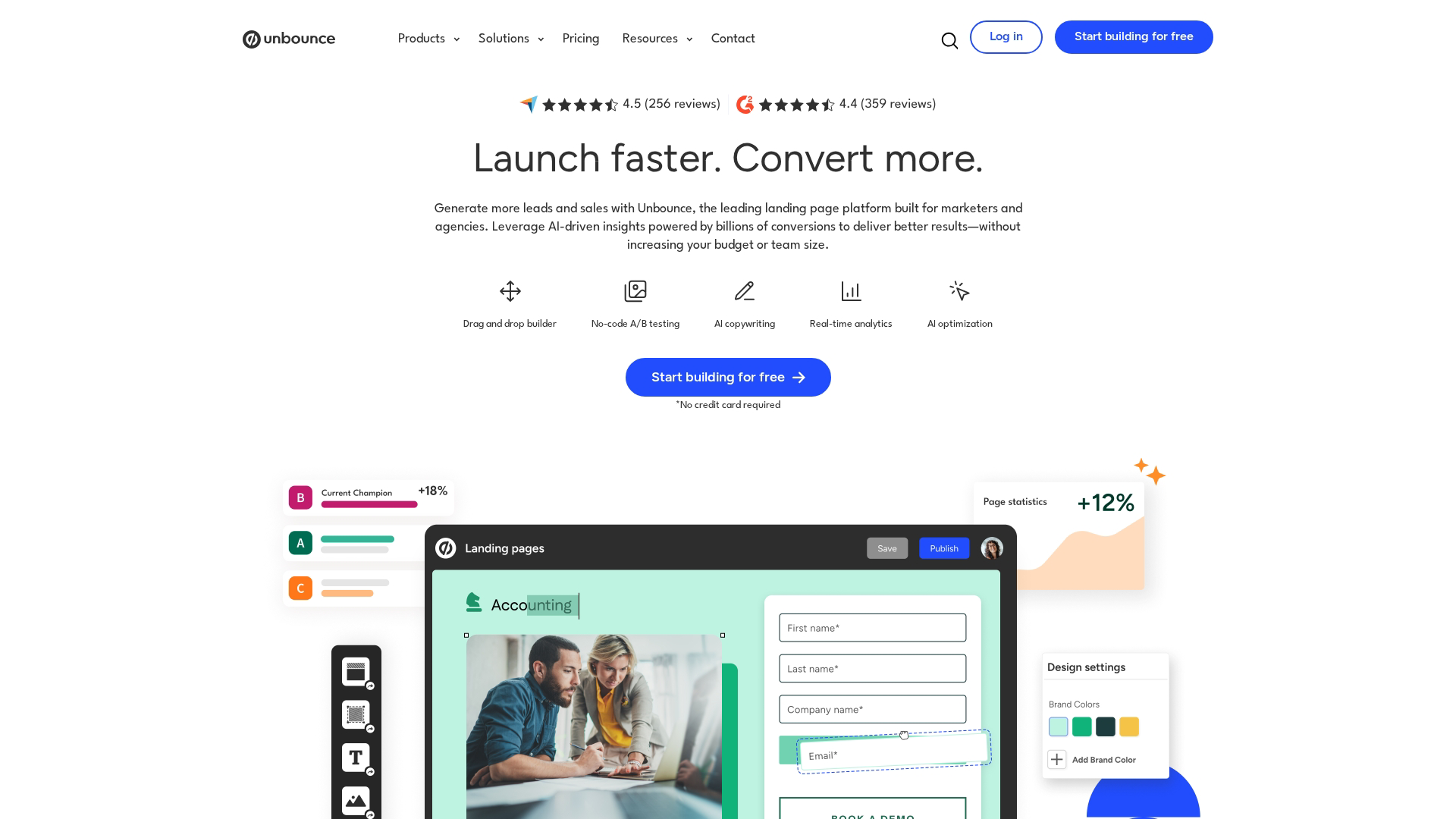
Unbounce is primarily a landing page builder that includes built-in A/B testing for landing pages. While not a full experimentation platform, Unbounce excels at its focused use case of campaign page optimization. The platform combines page creation, hosting, and testing in one workflow, letting marketing teams launch and iterate on campaign pages without touching code or waiting for developer resources.
Best for: Marketing teams focused specifically on optimizing campaign landing pages for paid advertising, email campaigns, and promotional initiatives.
Key strengths
- Easy-to-use drag-and-drop page builder with real-time preview and responsive design controls
- Simple, integrated A/B testing for landing pages with clear winner declarations based on conversion goals
- Smart Traffic feature uses AI to auto-optimize traffic distribution by sending visitors to the variant most likely to convert them
- Large library of conversion-optimized templates for quick starts across industries and campaign types
- Dynamic text replacement that personalizes landing page content based on ad keywords or URL parameters
- Built-in popups and sticky bars to capture leads before visitors leave
- Good for teams without developer resources who need to move fast on campaign launches
Why choose Unbounce: Unbounce is the fastest way for marketers to build, test, and optimize landing pages for ad campaigns without needing developer help. The Smart Traffic AI feature automatically learns which variant performs best for different visitor segments, maximizing conversions even while tests are still running.
Pricing: No free tier. Plans start at $99/month for up to 500 conversions and 20,000 visitors, with higher tiers adding more traffic capacity, additional domains, and advanced features like AMP landing pages.
14. Apptimize
Apptimize, now part of Airship, is a mobile-first A/B testing and experimentation platform designed specifically for native app environments. Apptimize provides robust SDKs for iOS and Android with support for both Swift/Objective-C and Kotlin/Java, making the platform ideal for teams testing in-app experiences, onboarding flows, and feature variations on mobile devices.
Best for: Mobile app teams running experiments on native iOS and Android applications, particularly those testing UI changes, feature rollouts, and user flows within the app experience.
Key strengths
- Robust mobile SDKs for iOS and Android with native language support
- Visual editor for mobile app changes that lets non-technical users modify UI elements without code
- Feature flags for mobile rollouts with percentage-based targeting and kill switches
- Programmatic testing for complex experiments involving backend logic and user behavior
- Real-time results dashboard showing experiment performance across devices and OS versions
- Instant updates that change app behavior without requiring app store resubmission
- Good for teams with significant mobile traffic who need to iterate quickly
Why choose Apptimize: Apptimize is purpose-built for the unique challenges of mobile experimentation, from visual UI tests to phased feature rollouts on devices. The platform handles mobile-specific concerns like offline behavior, app store review cycles, and device fragmentation that web-focused tools often miss.
Pricing: No free tier. Custom pricing based on mobile app usage and monthly active users.
15. Eppo
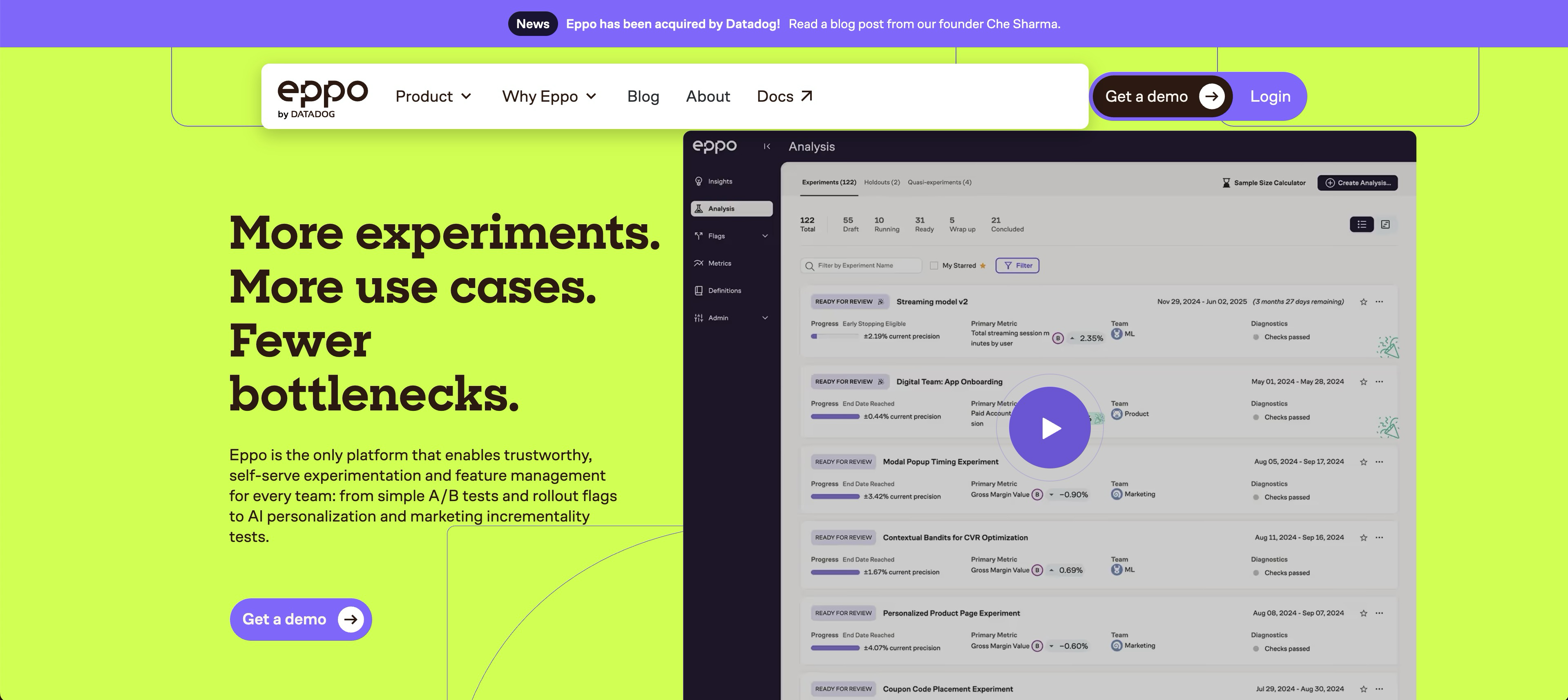
Eppo is a warehouse-native experimentation platform that runs tests directly on your data warehouse. Instead of sending event data to a separate testing tool, Eppo connects to warehouses like Snowflake, BigQuery, Databricks, or Redshift to perform analysis where your data already lives. This architecture eliminates data duplication and ensures your experiments use the same trusted metrics your data team has already defined.
Best for: Data-mature organizations with strong data warehouse infrastructure and centralized metric definitions who want experimentation aligned with their single source of truth.
Key strengths
- Warehouse-native architecture that queries your existing data directly
- Uses your data team's existing metric definitions for consistency
- Avoids data silos and the reconciliation headaches of multiple systems
- Strong statistical rigor with Sequential testing and CUPED variance reduction
- Built-in experiment diagnostics to catch issues like sample ratio mismatches
- Aligns product and data teams around shared metrics and methodology
- Assignment service handles feature flagging and user bucketing
Why choose Eppo: Eppo is designed for the modern data stack, letting companies run trustworthy experiments directly on their most valuable data asset. If your organization has invested in building a data warehouse as your source of truth, Eppo extends that investment into experimentation without creating competing systems or conflicting numbers.
Pricing: No free tier. Custom enterprise pricing based on usage and scale.
Key considerations before buying A/B testing software
Use this checklist to guide your evaluation:
- Traffic volume: Do you have enough visitors to reach statistical significance in a reasonable timeframe? Most tools provide calculators to help estimate.
- Team skills: Do you want a simple visual editor for marketers, or do you have developers who can implement experiments using SDKs?
- Existing stack: What analytics platforms, CDPs, and data warehouses do you already use? Prioritize tools with strong native integrations.
- Testing scope: Do you only test your website, or do you also want server-side, mobile, and email testing capabilities?
- Budget: Free and open-source tools are powerful, but enterprise features, support, and scale require investment.
- Privacy requirements: Do you have strict GDPR, CCPA, or data residency requirements? Check each vendor's compliance and data handling policies.
A/B testing results can inform other go-to-market activities too. For example, learnings from headline tests can help you optimize the messaging in your interactive demos, creating consistency across your entire buyer journey.
Start testing and optimizing your SaaS conversion funnel
Choosing the right A/B testing platform depends on your team's technical capacity, traffic volume, and existing tech stack. If you're budget-constrained or just starting, begin with powerful free tools like PostHog, GrowthBook, or Statsig. If your scale and complexity demand it, evaluating enterprise options like Optimizely or Adobe Target is the logical next step.
Beyond testing page variants, consider how you present your product itself. Start your journey with Guideflow today! to create interactive demos that convert.
FAQs
A/B testing compares two complete versions of a page or feature (Version A vs Version B). Multivariate testing evaluates multiple variables and their combinations simultaneously, like testing three headlines and two button colors together to find the optimal mix.
The required traffic depends on your baseline conversion rate and the minimum detectable effect you want to measure. Most tools provide sample size calculators. A site with a low conversion rate will typically require more traffic than a high-converting one to detect the same relative uplift.
Yes. Open-source tools like PostHog and GrowthBook offer production-ready experimentation with robust statistical engines. Enterprise features like advanced support, compliance certifications, and dedicated success managers typically require paid plans, but the core testing functionality is solid.
Server-side testing runs experiments in your backend code rather than in the user's browser. SaaS teams use server-side testing when testing core product logic, pricing models, search algorithms, API responses, and complex features that cannot be modified with client-side JavaScript.
Feature flags are toggles that control whether a feature is on or off for specific users, enabling safe, controlled rollouts. A/B testing platforms extend feature flags by measuring the performance impact of features on key metrics. Many modern platforms like LaunchDarkly and Statsig combine both capabilities.
Run a test until you reach statistical significance and have observed at least one full business cycle, typically one to two weeks minimum. Waiting for a full business cycle accounts for natural variations in user behavior based on day of week or other timing factors.
Statistical significance indicates the probability that the observed difference between test variants is real rather than random chance. Most teams target a 95% confidence level, meaning there's less than a 5% chance the results are due to randomness, before declaring a winner.