A congestion charge has to do four jobs at once. It has to price road use fairly, collect payment reliably, catch the vehicles that don't pay, and explain all of it to drivers who never asked for a new toll. Miss any one of those and the whole scheme loses public trust.
Most teams evaluating a congestion pricing platform run into the same problem. The tools solve one layer well and gloss over the rest. A camera vendor reads plates but doesn't handle exemptions. A billing system moves money but can't generate enforcement evidence. A policy framework tells you what's allowed but not how to run it day to day.
The stakes are real. The global congestion charging market was valued at $12.4 billion in 2025 and is projected to reach $28.6 billion by 2034, according to MarketIntelo (2025). Cities and agencies are buying, and the software layer is where policy either works or breaks.
This guide breaks down 7 congestion charge software and infrastructure providers for 2026. You'll see who each fits, what they actually do, and how to match a congestion charge system to your own zone pricing, billing, and enforcement needs.
What's inside
This guide is for the teams who actually run road pricing: city transport departments, transit and highway agencies, mobility operators, and the consultants advising them.
- We chose tools by how well they support the full workflow, not one slice of it
- Selection criteria: pricing and tariff configuration, enforcement automation, fairness and exemption handling, and operational visibility
- Each entry names who it fits, what it does, and where it sits in the stack
- The list mixes software, camera infrastructure, and policy context, because a real congestion pricing platform is rarely one product
TL;DR
- Best for automated enforcement: Tattile, for ANPR-based detection, rule checks, and evidence generation
- Best for fairness and driver-facing pricing: GoCarma, for eligibility-aware pricing and mobile activation
- Best for road-pricing operations and billing: ClearRoad, for charging, accounting, and reporting workflows
- Best for technical buyers comparing the stack: Infotech, for structured vendor evaluation
- Best for policy and funding context: FHWA, for federal program guidance and low-income mitigation
- Best for camera and capture infrastructure: Axis Communications and FLIR, for the imaging layer under ANPR
What is congestion charge software?
Congestion charge software is the system that manages congestion pricing end to end: it configures charging zones, sets tariffs, collects payment, enforces the rules, applies exemptions, and reports on the whole operation.
It helps to separate two things. Road pricing policy is the decision, meaning who pays, how much, when, and why. The software layer is the machine that runs that decision at scale across thousands of vehicles a day. You can have a great policy and a broken system, and drivers will only ever experience the system.
Core capabilities most congestion pricing software covers:
- Zone and cordon configuration: define geographic boundaries, entry points, and charged areas
- Dynamic tariffs and schedules: set time-of-day rates, peak pricing, and vehicle-class rules
- Payment and account management: register vehicles, run payment workflows, and manage accounts
- Enforcement and evidence generation: detect non-payment and produce defensible violation records
- Exemptions and fairness handling: apply resident permits, low-income mitigation, and exempt classes
- Reporting and real-time visibility: monitor traffic, revenue, and compliance as they happen
A full congestion charge system usually combines several of these. ANPR / ALPR software reads plates, a billing engine handles money, and a policy layer decides what's fair. The best platforms connect them so the data flows from camera to charge to enforcement without manual re-entry.
When to use congestion charge software
Price road use by zone or cordon
You need geographic pricing when demand concentrates in specific areas at specific times. A downtown core, a bridge, a low-emission district. Zone pricing charges for time spent inside a boundary, while cordon pricing charges at the point of crossing. Configurable zones, time bands, and tariff rules let you tune the scheme without rebuilding it. Cities running air quality pricing often layer vehicle-class rates on top, charging older or higher-emission vehicles more.
Automate payment and enforcement
Manual review stops working the moment volume climbs. Once you're processing tens of thousands of crossings a day, human checking is too slow and too error-prone. Automated billing and enforcement handle payment status checks, flag non-payment, and generate the evidence needed for a violation. Good systems reconcile the camera read against the payment record automatically, so only genuine exceptions reach a human.
Add fairness controls and exemptions
Fairness is where most schemes win or lose public support. Low-income mitigation, resident discounts, disability exemptions, and emergency-vehicle carve-outs all need to be encoded, verified, and applied automatically. A congestion pricing platform that handles exemptions cleanly protects both the vulnerable driver and the program's legitimacy. Transparency here, meaning drivers understanding why they were or weren't charged, is what keeps a scheme politically survivable.
Congestion charge software comparison
The table below sorts by relevance to running a congestion charge, not alphabetically. What matters most: how the tool handles pricing logic, enforcement automation, fairness, and interoperability with the rest of your stack.
| # | Product | Best for | Key differentiator | Pricing | G2 rating |
|---|---|---|---|---|---|
| 1 | Tattile | Automated charge detection and enforcement | ANPR/ALPR cameras plus vehicle identification software | Contact sales | 4.8/5 |
| 2 | GoCarma | Fairness and driver-facing pricing | Smartphone-based verification and eligibility-aware pricing | From $0.121 per resident/year | Not listed |
| 3 | ClearRoad | Road-pricing billing and operations | Road usage charging and financial workflows | Contact provider | Not listed |
| 4 | Infotech | Technical buyers comparing vendors | Membership research and software selection | Membership-based | 5.0/5 |
| 5 | FHWA | Policy and funding context | Federal congestion relief program guidance | Government agency | Not listed |
| 6 | Axis Communications | Camera and capture infrastructure | Network cameras and video analytics | Via partners | 3.8/5 |
| 7 | FLIR | Imaging and thermal capture | Thermal and traffic imaging hardware | From $29 per year (software) | Not listed |
Read the table as a stack, not a single winner. Items 1, 6, and 7 handle capture. Items 2 and 3 handle pricing, billing, and fairness. Item 4 helps you evaluate the whole set, and item 5 gives you the policy ground to stand on before you buy anything.
1. Tattile

Tattile builds ANPR/ALPR cameras, laser sensors, and the AI software that turns a passing vehicle into structured data. For congestion charging, that combination matters: the camera reads the plate and the software decides whether that vehicle owes a charge, qualifies for an exemption, or triggers a violation. It's the detection and enforcement engine sitting under the pricing scheme.
The value is automation at the point of capture. A vehicle enters the zone, the plate gets read, and the system checks it against payment status, exemption lists, and time-of-day schedules in one pass. When something doesn't reconcile, Tattile generates the evidence record enforcement needs.
Best for: cities and operators that want automated charge detection and defensible enforcement from the same hardware and software layer.
Key features
- ANPR/ALPR cameras for vehicle identification
- Rule checks against payment, exemptions, and schedules
- Evidence generation for enforcement workflows
- Vehicle classification for class-based tariffs
- AI software platforms for data management
Why choose Tattile: if enforcement accuracy is your first concern, buying the camera and the recognition software from one vendor removes the integration gaps where evidence usually falls apart. It fits operators who treat detection as the foundation, not an afterthought.
Tattile pricing: Tattile keeps pricing off its website. Customers have to go through the sales team to get costs, which is pretty standard for enterprise ANPR gear sold on a per-deployment basis.
Tattile holds a 4.8/5 rating in available listings, though you should confirm the source maps to this vendor before treating it as decisive.
2. GoCarma
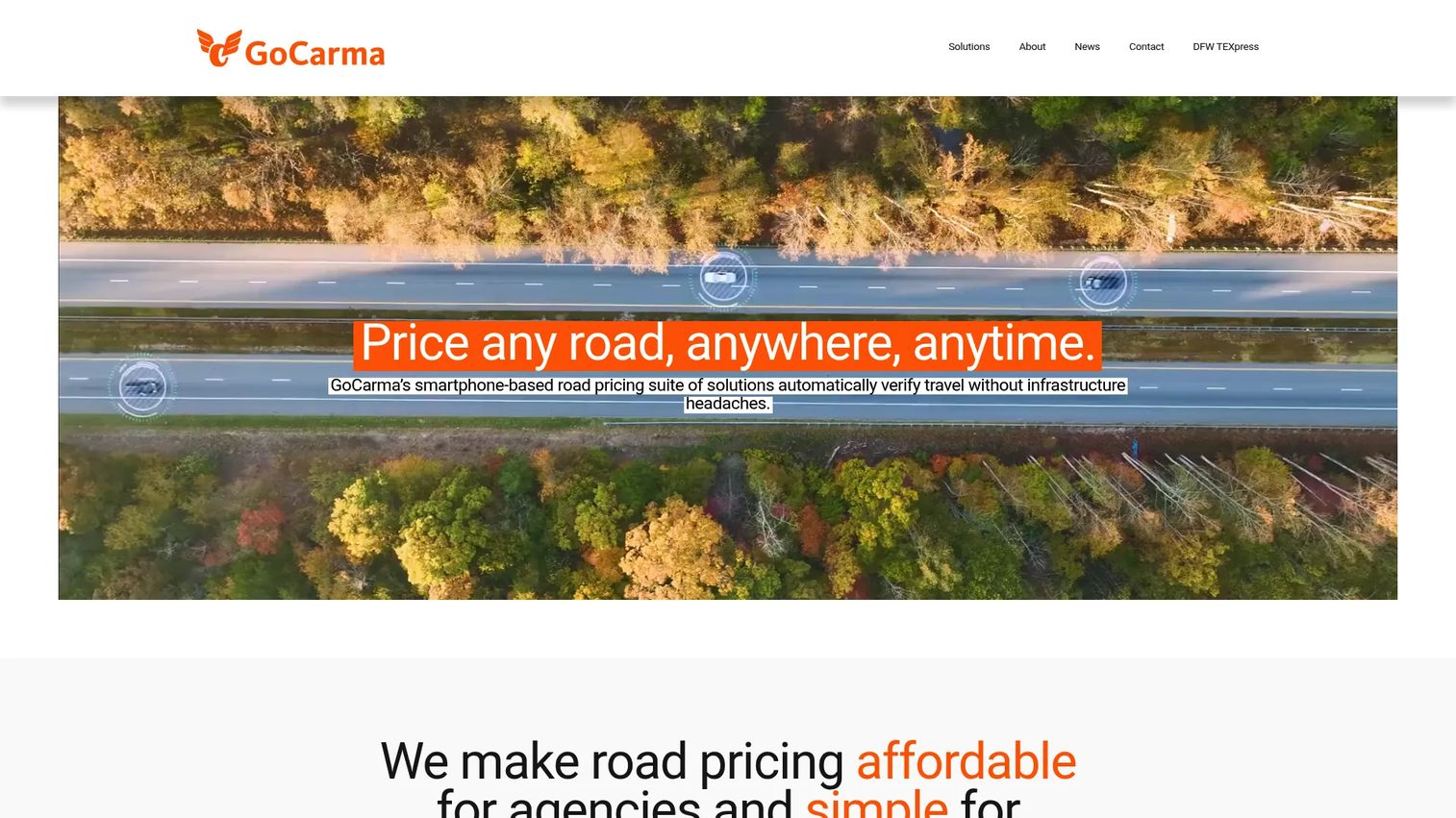
GoCarma is a smartphone-based road pricing and HOV verification platform. Instead of leading with cameras, it leads with the driver's phone, using GPS and Bluetooth to verify vehicle occupancy and apply the right price. That makes it a strong fit for schemes where fairness and driver communication carry as much weight as detection.
Its road pricing tools span tolling, congestion pricing, VMT Bank, Mobility Wallet, and RUC. The eligibility-aware angle is the differentiator: the system can confirm who qualifies for an HOV discount or a mitigation program and apply it automatically, which keeps the pricing transparent to the person paying it.
Best for: operators that need driver-facing activation, dynamic pricing logic, and eligibility handling built into one workflow.
Key features
- Occupancy verification via smartphone GPS and Bluetooth
- HOV toll discount qualification
- Congestion pricing, tolling, RUC, and VMT tools
- Mobility Wallet and travel-behavior features
- API-integrated payment workflows
Why choose GoCarma: it suits programs where public trust hinges on transparency. When drivers can see why they were charged and confirm their own eligibility, the scheme is easier to defend politically and easier to run operationally.
GoCarma pricing: GoCarma publishes pricing openly. VMT Bank SaaS tiers start at $0.121 per resident per year, and Mobility Wallet SaaS runs from $100 per commuter per year. Pilot, integration, implementation, and training are separate SKUs. There's no free tier.
A current third-party rating for GoCarma wasn't available at the time of writing.
3. ClearRoad
ClearRoad positions itself around road usage charging and the financial machinery behind it. Where camera vendors focus on capture, ClearRoad focuses on what happens after: billing, accounting, and the payment workflows that turn a road-use event into a settled charge. For agencies running broader charging programs, that financial layer is often the hardest part to get right.
Its tooling covers dashboarding, dynamic pricing, and operational visibility, plus interoperability with multiple mileage reporting technologies. That last point matters for programs that pull data from different sources, meaning cameras, in-vehicle devices, or app-based reporting, and need one billing engine to reconcile them all.
Best for: agencies and programs that need billing and enforcement operations, financial workflows, and reporting across a broader road-pricing scheme.
Key features
- Road usage charging and congestion reduction tooling
- Billing, accounting, and payment workflows
- Dashboarding and dynamic pricing
- Operational visibility and reporting
- Interoperability with multiple mileage reporting technologies
Why choose ClearRoad: if your challenge is running the money, not just reading the plate, ClearRoad's focus on charging operations and interoperable systems fits programs that span multiple data sources and need clean financial reconciliation.
ClearRoad pricing: ClearRoad doesn't post its pricing. You'll need to contact them for a quote based on your program's scope, which is common for road-usage-charging platforms sold to agencies.
4. Infotech
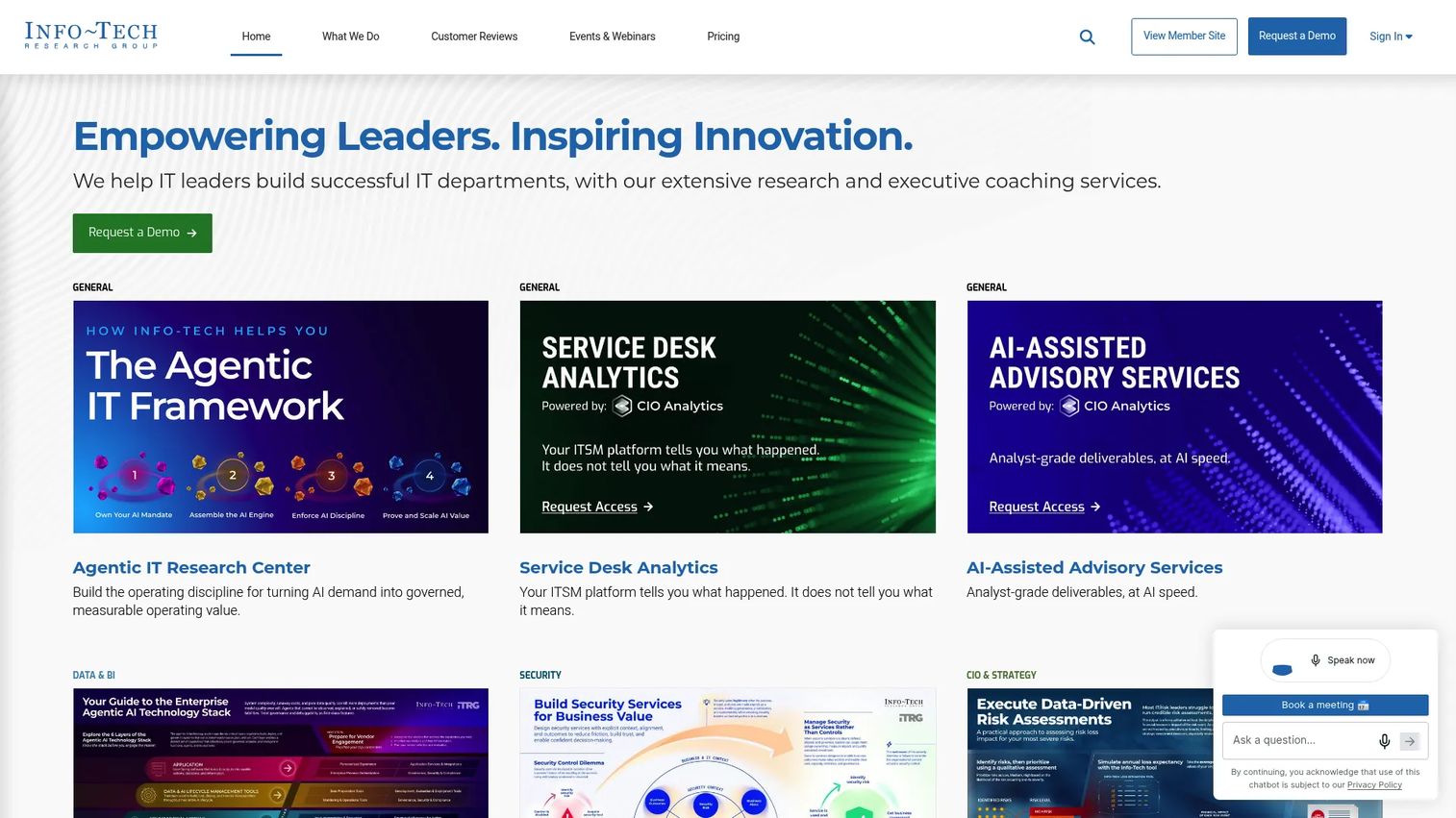
Infotech (Info-Tech Research Group) isn't a congestion pricing platform. It's an IT research and advisory firm, and it earns a place here because buying congestion charge software is a procurement decision as much as a technical one. Info-Tech's research on evaluating congestion charging technologies gives buyers a structured way to compare the stack: ANPR, dynamic pricing, payments, security, and analytics laid out as requirements rather than vendor pitches.
For a team in procurement or strategy mode, that framing is the point. Instead of trusting each vendor's own claims, you get evaluation dimensions to score them against.
Best for: procurement and strategy teams that want a research-backed framework before committing to a congestion pricing platform.
Key features
- Research on congestion charging technology evaluation
- Software selection and vendor reviews
- Coverage of ANPR, dynamic pricing, payments, security, analytics
- Benchmarks, analyst calls, and workshops
- Membership-based advisory access
Why choose Infotech: it fits teams that would rather de-risk the decision up front than discover gaps mid-deployment. The value is in the evaluation criteria, not in running the charge itself.
Infotech pricing: Info-Tech uses membership-based access with configurable, seat-based tiers. It doesn't post a single numeric starting price, so pricing comes through a conversation about your team's needs.
Info-Tech shows a 5.0/5 rating on its seller listing, though that reflects a very small number of reviews and shouldn't be read as a broad sample.
5. FHWA congestion relief program
FHWA, the Federal Highway Administration, isn't software either, and that's the point. Before a US public-sector team buys anything, it needs the policy and funding ground under its feet. FHWA frames congestion pricing as a congestion relief and funding strategy, sets out eligible activity types, and provides guidance on low-income mitigation and which entities can participate.
Treat this as the context layer. It won't read a plate or process a payment, but it shapes what your scheme is allowed to do, how it can be funded, and what fairness obligations come attached.
Best for: public-sector teams that need authoritative federal context on congestion pricing before moving into procurement.
Key features
- Congestion pricing framed as relief and funding strategy
- Guidance on eligible activity types
- Low-income mitigation direction
- Eligible-entity definitions
- Research and technical assistance for agencies
Why choose FHWA: it grounds your program in federal policy and funding rules before you spend on tools. Skipping this step is how schemes end up non-compliant or unfunded halfway through.
FHWA pricing: FHWA is a federal agency, not a commercial product, so there is no pricing. Its resources are public.
6. Axis Communications

Axis Communications supplies the network cameras, video management, and analytics that sit underneath ANPR-enabled tolling and charging. It doesn't run the charge, but it captures the images that everything else depends on. Poor capture means poor plate reads, and poor plate reads mean disputed charges, so the imaging layer is more decisive than it looks.
Axis fits teams building a stack around reliable camera input. Its strength is professional-grade surveillance infrastructure: image quality, deployment reliability, and analytics that feed the recognition software layered on top.
Best for: teams selecting capture hardware or assembling a congestion charge stack around dependable camera input.
Key features
- Network cameras and video surveillance
- Video management software
- Analytics for traffic and vehicle capture
- Access control and network intercom systems
- Professional-grade deployment reliability
Why choose Axis Communications: when your ANPR accuracy depends on the image quality feeding it, the camera layer is not the place to cut corners. Axis fits stacks where capture reliability is a hard requirement.
Axis Communications pricing: Axis doesn't sell directly and doesn't post prices. You buy through partners and local sales offices, so cost depends on the deployment and the channel.
Axis carries a 3.8/5 rating on its seller listing, though the profile may reflect a broader company than this specific product line.
7. FLIR
FLIR brings thermal imaging and sensing to the capture layer. In traffic monitoring and enforcement, thermal and specialized imaging can hold up where standard cameras struggle, meaning low light, glare, or difficult weather. For a congestion charge stack that has to run around the clock in all conditions, that resilience matters.
FLIR's role, like Axis, is infrastructure rather than the full software layer. It supplies the imaging hardware and, through FLIR Ignite, cloud storage and reporting for captured images. Teams evaluate it alongside the recognition and billing software that turns its output into charges.
Best for: teams evaluating imaging and capture vendors that need reliable detection in difficult conditions.
Key features
- Thermal imaging cameras and sensors
- Traffic monitoring and enforcement support
- MSX image enhancement
- Cloud upload and reporting via FLIR Ignite
- Detection resilience in low light and poor weather
Why choose FLIR: if your zone runs in conditions where standard cameras lose reliability, thermal imaging closes the gap. FLIR fits stacks that can't afford blind spots at night or in bad weather.
FLIR pricing: FLIR sells hardware and software separately. The FLIR Ignite software starts at $29 per year for 10 GB of storage and $79 per year for 100 GB, both on a one-year subscription. Camera and sensor pricing depends on the product.
A representative third-party product rating for FLIR wasn't available at the time of writing.
Considerations
Before you commit, run the shortlist against these criteria. They cut across every tool on the list.
Pricing model and contract structure
Congestion charge tools price in different ways: per resident, per commuter, per transaction, per deployment, or by membership. GoCarma posts per-resident and per-commuter SaaS rates, while camera and enforcement vendors quote by deployment. Map the pricing model to how your program scales, because a per-transaction cost behaves very differently from a flat annual license as volume grows.
Enforcement logic
Check exactly how the tool handles the reconciliation between a camera read, a payment record, and an exemption. Ask how evidence gets generated, how disputes are handled, and what happens when a plate read is ambiguous. Enforcement is where charges get challenged, so the evidence trail has to be defensible.
Fairness and exemption support
Confirm the system can encode resident rules, low-income discounts, disability carve-outs, and emergency exemptions, then apply and verify them automatically. Fairness handling is not a nice-to-have. It's what keeps the scheme politically viable and legally sound.
Interoperability
Verify integrations with billing, payments, GIS, and account systems, and with any in-vehicle or app-based reporting you plan to use. Interoperable systems let one billing engine reconcile data from cameras, phones, and devices without manual re-entry.
Operational visibility
Confirm you get reporting, audit trails, and live monitoring across traffic, revenue, and compliance. Operational visibility is how you prove the scheme is working, catch problems early, and answer to the public and to funders.
Conclusion
Congestion charge software is not one thing. It spans detection, billing, enforcement, fairness, and visibility, and no single tool on this list owns all of it.
Match the tool to the layer you need. For automated detection and enforcement, Tattile pairs cameras with recognition software. For fairness and driver-facing pricing, GoCarma leads with eligibility and transparency. For billing and road-pricing operations, ClearRoad focuses on the financial workflows. Infotech helps you evaluate the whole stack, FHWA grounds it in federal policy, and Axis Communications and FLIR supply the capture infrastructure everything else depends on.
The next step is to hold this shortlist against your own requirements: your zone or cordon design, your enforcement tolerance, your fairness obligations, and the systems you already run. Score each tool on how well it fits the layer you actually need to fill, not on how impressive the overall pitch sounds. A congestion charge stack that fits your policy and your operations will always outperform a bigger name that doesn't.
FAQs
It runs a congestion pricing scheme end to end. That means configuring zones and tariffs, collecting payment, detecting and enforcing non-payment, applying exemptions, and reporting on traffic, revenue, and compliance. In practice, a full congestion charge system usually combines ANPR / ALPR software, a billing engine, and a fairness layer.
Policy is the decision about who pays, how much, and when. Software is the machine that runs that decision at scale. You can have a sound policy and a system that fails to enforce it, and drivers only ever experience the system, so both have to work together.
Yes. Automated enforcement reconciles a camera read against payment status and exemption lists, then flags genuine non-payment and generates the evidence needed for a violation. Tools like Tattile focus on this detection-to-evidence workflow so only true exceptions reach a human reviewer.
The system encodes eligibility rules, meaning resident permits, low-income discounts, disability carve-outs, and emergency exemptions, then verifies and applies them automatically. Platforms like GoCarma tie eligibility to driver activation so the right price applies transparently. FHWA also provides federal guidance on low-income mitigation for US programs.
Most platforms are built to. Interoperability with billing, payments, GIS, and account systems lets one engine reconcile data from cameras, apps, and in-vehicle devices. ClearRoad, for example, emphasizes interoperable systems across multiple mileage reporting technologies.
Check the pricing model against how your scheme scales, the enforcement and evidence logic, the depth of fairness and exemption handling, interoperability with your existing stack, and the reporting and audit trails you'll rely on. Grounding the decision in federal policy through FHWA first helps avoid compliance and funding gaps later.