


Your sales team spent three hours this week copying data between apps, scheduling follow-ups, and updating CRM records. The best AI agents could have done it in minutes while they focused on actual selling.
AI agents execute multi-step tasks autonomously, connecting to your tools and completing work without constant oversight. This guide covers the 15 best AI agents across sales, support, and automation, with pricing, G2 ratings, and practical guidance for choosing the right one.
What's inside
AI agents execute multi-step tasks autonomously. The best choice depends entirely on your specific workflow. Leading solutions span general-purpose assistants, coding tools, workflow builders, and specialized customer service platforms.
This guide covers the 15 best AI agents across four categories, with a comparison table showing pricing and G2 ratings. You'll find detailed breakdowns of each tool plus practical guidance for matching agent type to your use case.
Quick Summary: Top AI Agent Picks by Use Case
- Best for beginners: ChatGPT Operator and Lindy offer natural language interfaces with zero technical setup
- Best for enterprise customer service: Salesforce Agentforce provides deep CRM integration with the Atlas reasoning engine
- Best for no-code automation: Gumloop and Zapier Central let non-technical users build complex workflows visually
- Best for developers: n8n delivers self-hostable, node-based automation with full API control
- Best for sales teams: Gong analyzes calls and surfaces coaching insights automatically
- Best for scheduling: Reclaim.ai optimizes calendars and protects focus time without manual input
What is an AI agent
An AI agent is software that plans, executes, and completes multi-step tasks without constant human oversight. Unlike a chatbot that simply responds to prompts, an AI agent takes action.
Here's the difference in practice. You ask an AI agent to book a flight to Chicago next Tuesday. The agent searches available flights, compares prices and times, selects the best option based on your preferences, and completes checkout.
A chatbot would tell you about flights. An agent books one.
The distinction matters because agents handle work that previously required human judgment and execution:
- API interactions: Connecting to external services and pulling or pushing data
- Website navigation: Clicking buttons, filling forms, completing transactions
- Database updates: Writing records, updating fields, syncing information across systems
- Multi-system coordination: Orchestrating actions across CRM, email, calendar, and other tools
Three types of AI agents
AI agents fall into distinct categories based on what they do. Understanding the categories helps you choose the right tool.
Automation agents
Automation agents execute multi-step workflows across apps without human intervention. They connect your tools, move data between systems, and trigger actions based on conditions you define.
Think of them as programmable assistants for repetitive business processes. Lead routing, data synchronization, report generation, and CRM hygiene all fit this category. Gumloop, n8n, and Zapier Central are leading examples.
Automation agents work best when you have clearly defined processes that follow predictable patterns. If you can describe your workflow as a series of steps, an automation agent can likely handle it.
Conversational agents
Conversational agents handle real-time interactions with customers or employees. They go beyond traditional chatbots by taking action during conversations, not just providing information.
When a customer asks for a refund, a conversational agent can process that refund, update the order record, and send a confirmation email. Intercom Fin, Yellow.ai, and Aisera fall into this category.
Conversational agents excel at high-volume, repetitive interactions where speed and consistency matter. Customer support, IT help desk, and HR inquiries are common use cases.
Multi-agent platforms
Multi-agent platforms orchestrate multiple specialized agents working together. Instead of one agent doing everything, you deploy several agents that share context and hand off tasks to each other.
Salesforce Agentforce and Relevance AI represent this approach. An enterprise might have one agent handling initial customer inquiries, another processing orders, and a third managing escalations. The platform coordinates their work.
This architecture suits organizations with complex workflows spanning multiple departments. The tradeoff is increased setup complexity in exchange for greater flexibility.
When AI agents actually help
AI agents deliver value in specific scenarios. Understanding the use cases helps you identify where agents fit your workflow.
Sales outreach and pipeline automation
AI agents automate the repetitive parts of sales workflows. They research prospects, personalize outreach sequences, update CRM records, and schedule follow-up tasks based on engagement signals.
A sales agent might monitor your inbox for replies, categorize responses by intent, update deal stages in your CRM, and draft personalized follow-ups. When combined with live demos that transform B2B sales, teams see even stronger engagement metrics.
The agent handles 12 hours every week of administrative work while your team focuses on conversations that require human judgment. For teams creating demos, AI-powered polishing can automatically refine content and improve flow without manual editing.
Some teams pair AI agents with interactive demos to let prospects self-qualify before a call. The agent handles outreach and scheduling while the demo handles product education.
Customer support at scale
Conversational AI agents resolve common support requests without human involvement. They answer questions, process refunds, update account information, and route complex issues to the right team. Similarly, interactive guides help customer support teams resolve issues before tickets are even created.
The value proposition is straightforward: 24/7 availability, instant responses, and consistent quality. Agents learn from your help center content and past conversations. Over time, they handle 45% of incoming queries, freeing your team for complex cases.
Scheduling and calendar management
Scheduling agents optimize calendars, protect focus time, and coordinate meetings across multiple participants. They analyze your calendar patterns, identify optimal meeting times, and automatically reschedule conflicts.
Reclaim.ai is the leading example. The agent learns your preferences, defends time blocks for deep work, and finds meeting slots that work for everyone involved.
Content and marketing workflows
AI agents assist with content generation, social scheduling, campaign reporting, and A/B testing. They draft content based on your brand guidelines, schedule posts at optimal times, and surface performance insights.
Jasper focuses specifically on marketing content. The agent maintains brand voice consistency across campaigns and helps teams produce more content without proportionally increasing headcount.
Teams using marketing automation tools often add AI agents to handle content creation and optimization within existing workflows.
How we evaluated these AI agents
We assessed each tool against five criteria:
- Ease of setup: How quickly can a non-technical user get started
- Integration depth: How well does the agent connect with existing tools like CRM, email, and Slack
- Autonomy level: Can the agent complete tasks end-to-end without babysitting
- Pricing transparency: Is the cost structure clear and predictable
- G2 rating: What do real users report in verified reviews
Comparison table of the top AI agents
# | Product | Best for | Key use case | Pricing | G2 rating |
|---|---|---|---|---|---|
1 | Lindy | Personal productivity | No-code automation across apps | $49/mo | 4.8/5 |
2 | Salesforce Agentforce | Enterprise CRM | Multi-department agent orchestration | Custom | 4.3/5 |
3 | ChatGPT Operator | General-purpose tasks | Browser automation and task completion | $200/mo (Pro) | 4.7/5 |
4 | Claude | Complex analysis | Long-context reasoning and writing | $20/mo (Pro) | 4.7/5 |
5 | Microsoft Copilot | Microsoft ecosystem | Office 365 integration | $30/user/mo | 4.5/5 |
6 | Zapier Central | Existing Zapier users | Natural language workflow creation | $50/mo | 4.5/5 |
7 | n8n | Technical teams | Self-hostable workflow automation | Free (self-host) | 4.8/5 |
8 | Gumloop | No-code automation | Visual workflow building | $97/mo | 4.7/5 |
9 | Intercom Fin | Customer support | Ticket resolution without handoff | $0.99/resolution | 4.5/5 |
10 | Reclaim.ai | Calendar optimization | Automatic scheduling and focus time | Free tier available | 4.8/5 |
11 | Jasper | Marketing content | Brand-consistent content generation | $49/mo | 4.7/5 |
12 | Moveworks | IT and HR support | Employee ticket resolution | Custom | 4.4/5 |
13 | Kore.ai | Custom virtual assistants | Multi-channel deployment | Custom | 4.7/5 |
14 | Yellow.ai | High-volume CX | Voice and chat support | Custom | 4.5/5 |
15 | Relevance AI | Multi-agent orchestration | Custom AI workforce building | $19/mo | 4.7/5 |
15 Best AI Agents for 2026
1. Lindy
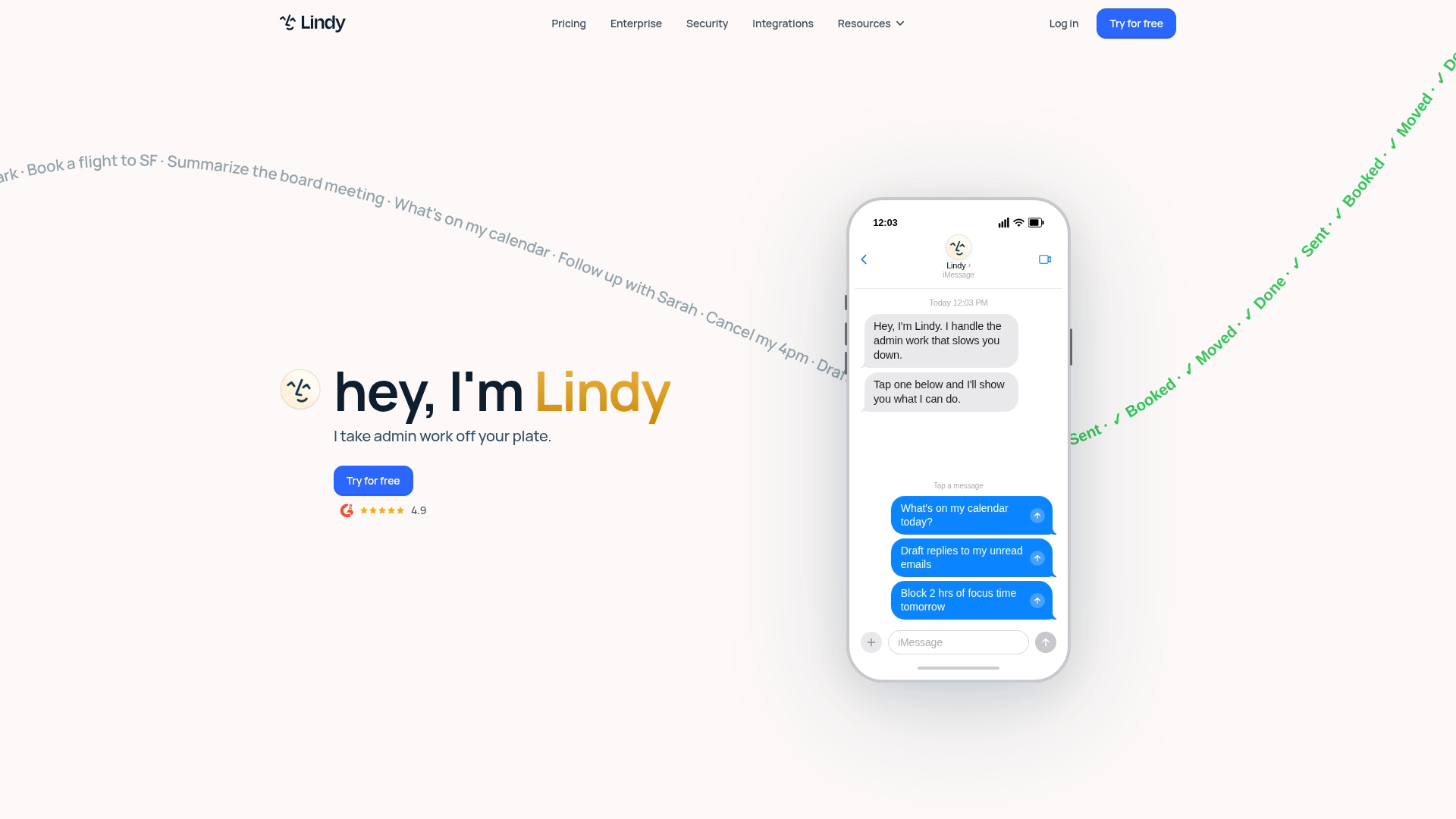
Lindy is a general-purpose productivity agent designed for individuals and small teams. The platform connects to thousands of apps and handles tasks through natural language instructions.
Best for: Individuals and small teams wanting personal productivity automation without technical complexity.
Key strengths
- Shared inbox management: Handles email triage, drafts responses, and categorizes messages automatically
- CRM automation: Keeps records clean, logs activities, and updates deal stages based on email content
- No-code setup: Non-technical users build workflows in minutes using plain English instructions
Why choose Lindy
Lindy excels at personal productivity tasks that span multiple apps. The tradeoff is that it's less suited for enterprise-scale deployments requiring complex governance and security controls.
Lindy pricing
Plans start at $49/month for the Starter tier. A free trial is available.
2. Salesforce Agentforce
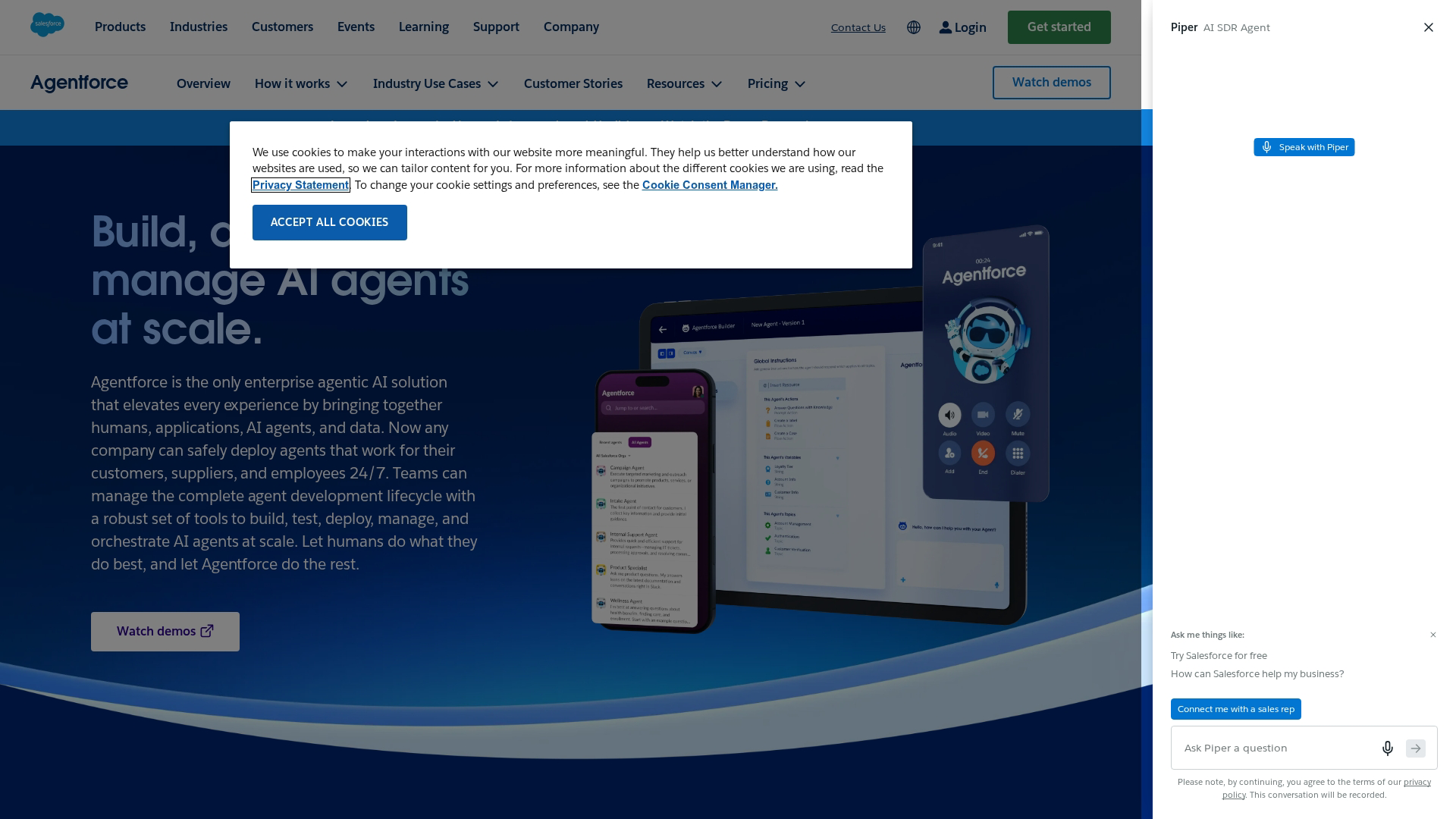
Salesforce Agentforce is the enterprise AI agent platform for Salesforce-native organizations. The Atlas reasoning engine powers autonomous agents that work across sales, service, and marketing.
Best for: Enterprises already invested in Salesforce who want AI agents with deep CRM integration.
Key strengths
- Deep CRM integration: Agents access full customer context, history, and related records natively
- Atlas reasoning engine: Handles complex, multi-step decisions using Salesforce's proprietary AI
- Multi-department orchestration: Deploy specialized agents across sales, service, and marketing that share context
Why choose Agentforce
Choose Agentforce when your organization runs on Salesforce and you want agents that understand your customer data deeply. The platform requires significant implementation effort but delivers enterprise-grade security and governance.
Agentforce pricing
Custom enterprise pricing. Contact Salesforce for quotes.
3. ChatGPT Operator
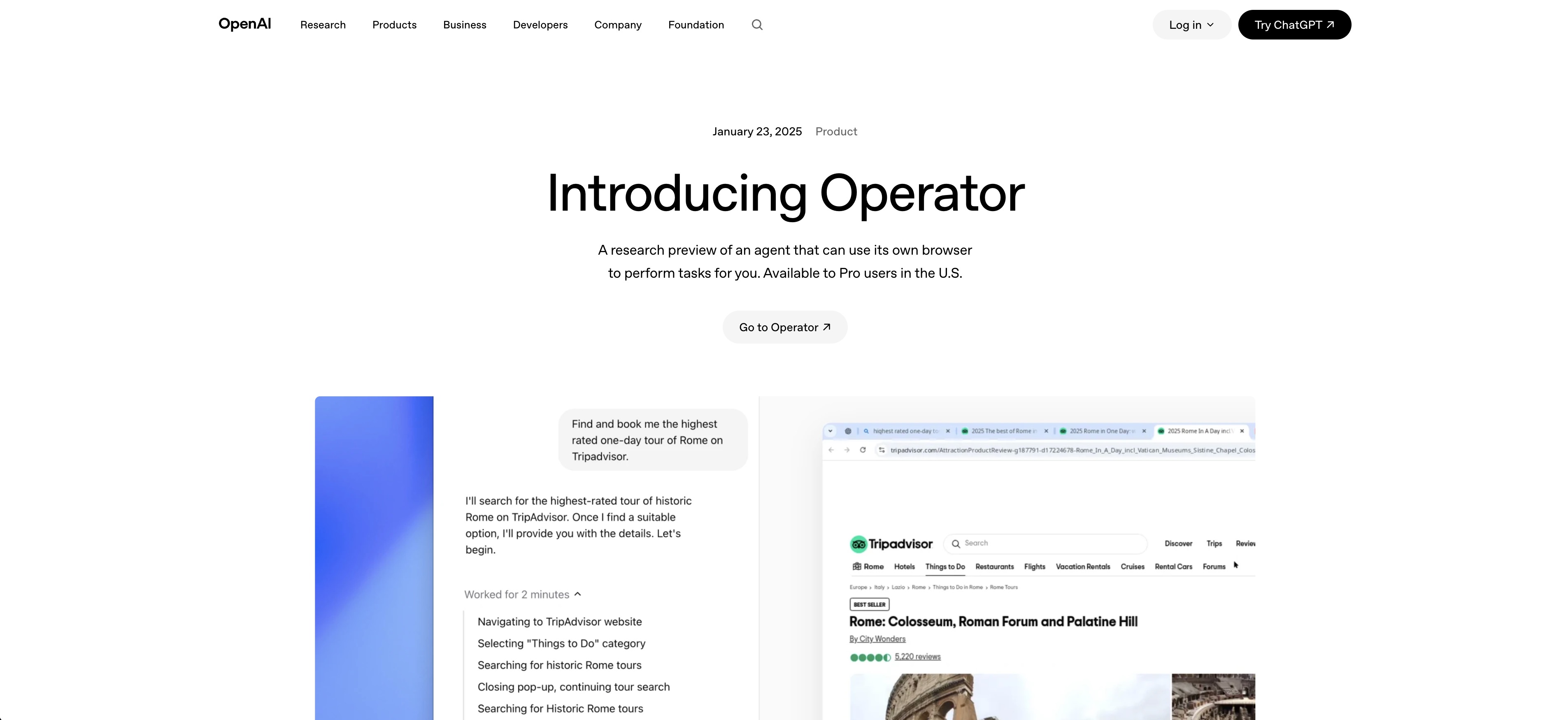
ChatGPT Operator is OpenAI's agent mode that autonomously navigates browsers, fills forms, and completes multi-step tasks. It's the most accessible entry point for general-purpose AI agents.
Best for: Users wanting immediate value from AI agents with zero technical setup.
Key strengths
- Browser automation: Navigates websites, clicks buttons, fills forms, and completes transactions
- Natural language control: Describe what you want in plain English and watch the agent execute
- Broad task coverage: Handles travel booking, shopping, research, and administrative tasks
Why choose ChatGPT Operator
Operator works best for ad-hoc tasks that don't require deep integration with your business systems. It's remarkably capable for personal productivity but lacks the workflow customization that business users often require.
ChatGPT Operator pricing
Included with ChatGPT Pro at $200/month. ChatGPT Plus ($20/month) includes limited agent capabilities.
4. Claude
Claude from Anthropic excels at complex reasoning, long-context analysis, and nuanced writing tasks. While not a traditional automation agent, Claude handles knowledge work that other agents struggle with.
Best for: Teams needing sophisticated analysis, research synthesis, and high-quality writing.
Key strengths
- Long context window: Processes up to 200,000 tokens, enabling analysis of lengthy documents
- Safety-focused design: Built with constitutional AI principles that reduce harmful outputs
- Nuanced reasoning: Handles ambiguous questions and complex analysis better than most alternatives
Why choose Claude
Claude is the right choice when your work involves synthesis, analysis, and judgment rather than repetitive automation. It won't book your flights or update your CRM, but it will help you analyze a 100-page contract.
Claude pricing
Free tier available. Pro plan at $20/month. Team and Enterprise tiers available.
5. Microsoft Copilot
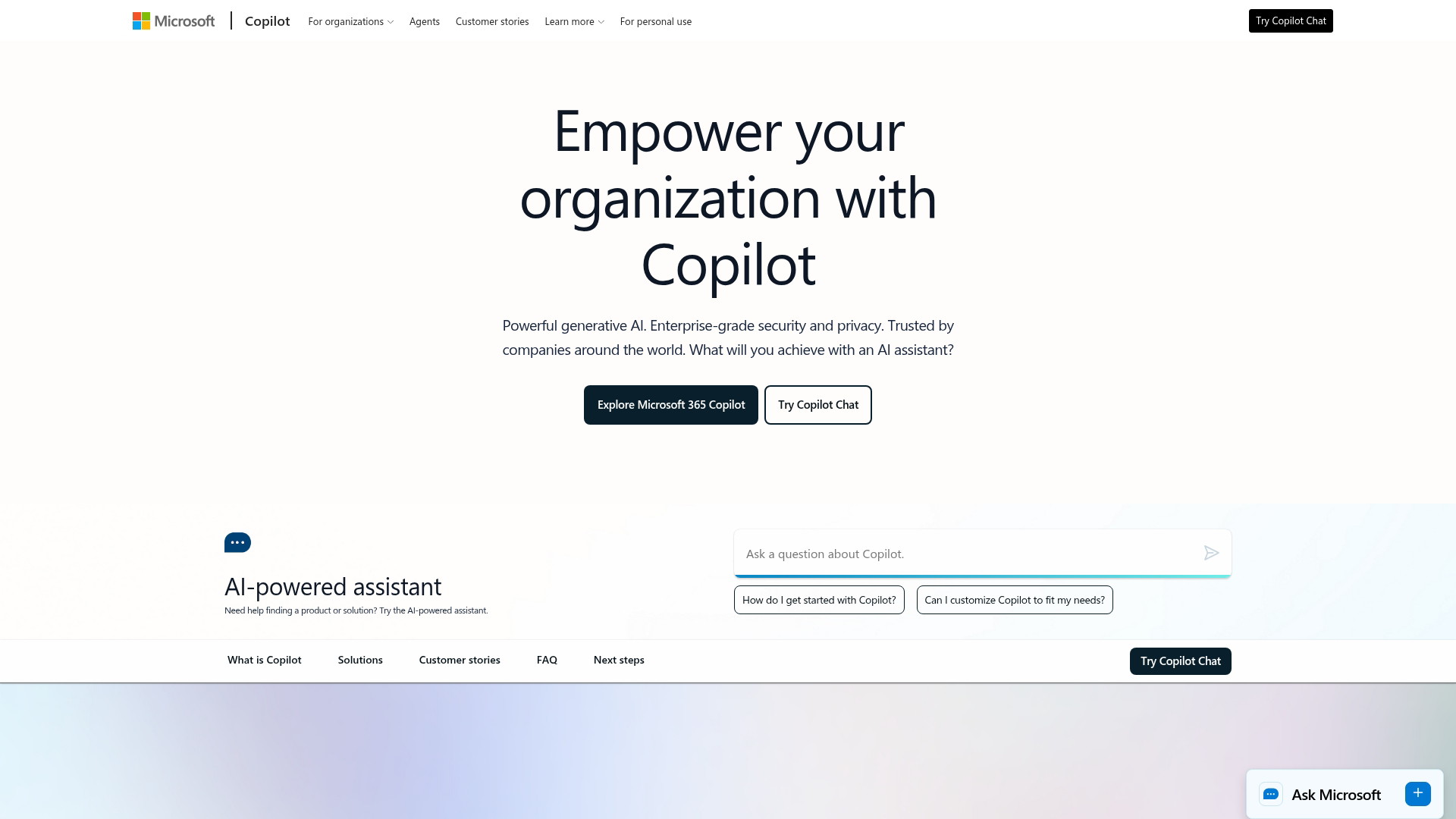
Microsoft Copilot integrates AI assistance across the Microsoft 365 suite. If your organization lives in Excel, Word, Teams, and Outlook, Copilot meets you where you already work.
Best for: Enterprises already invested in Microsoft 365 who want AI assistance without switching tools.
Key strengths
- Native Office integration: Works directly within Excel, Word, PowerPoint, Outlook, and Teams
- Enterprise security: Inherits your existing Microsoft security and compliance configurations
- Familiar interface: No new tools to learn; AI assistance appears in apps your team already uses
Why choose Microsoft Copilot
Copilot makes sense when Microsoft 365 is your primary work environment. The tradeoff is that capabilities outside the Microsoft ecosystem are limited.
Microsoft Copilot pricing
$30 per user per month for Microsoft 365 Copilot. Requires eligible Microsoft 365 subscription.
6. Zapier Central
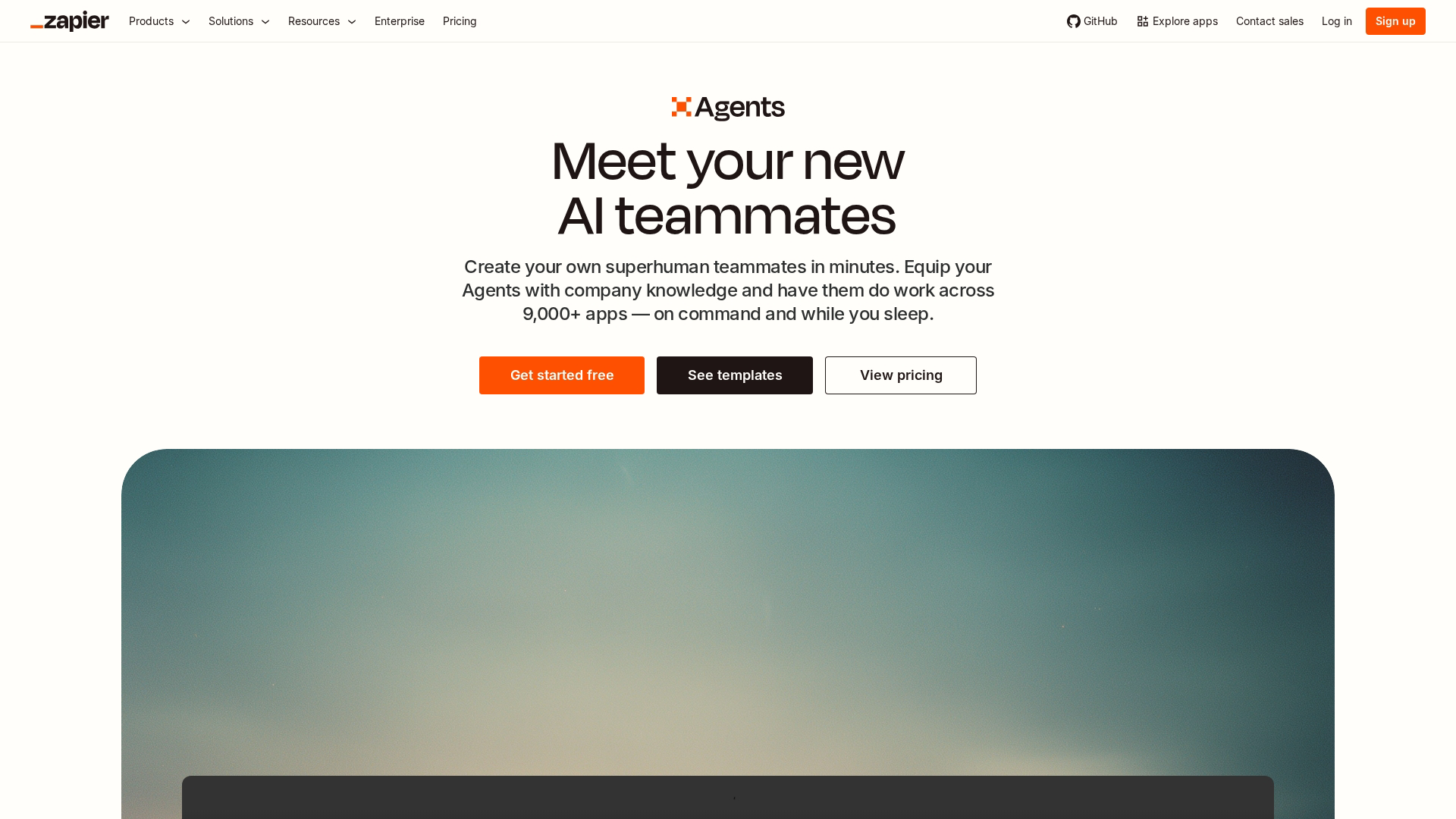
Zapier Central adds AI agent capabilities to Zapier's automation platform. Teams already using Zapier can create AI-powered workflows using natural language.
Best for: Teams already using Zapier who want to add AI-driven automation without switching platforms.
Key strengths
- Massive app library: Connects to 6,000+ apps through Zapier's existing integrations
- Natural language workflows: Describe what you want and the agent builds the automation
- Familiar platform: Builds on Zapier's interface that millions of users already know
Why choose Zapier Central
Zapier Central is the obvious choice if you're already paying for Zapier and want AI capabilities. The agent leverages your existing Zaps and connections.
Zapier Central pricing
Included with Zapier plans starting at $50/month for the Professional tier.
7. n8n
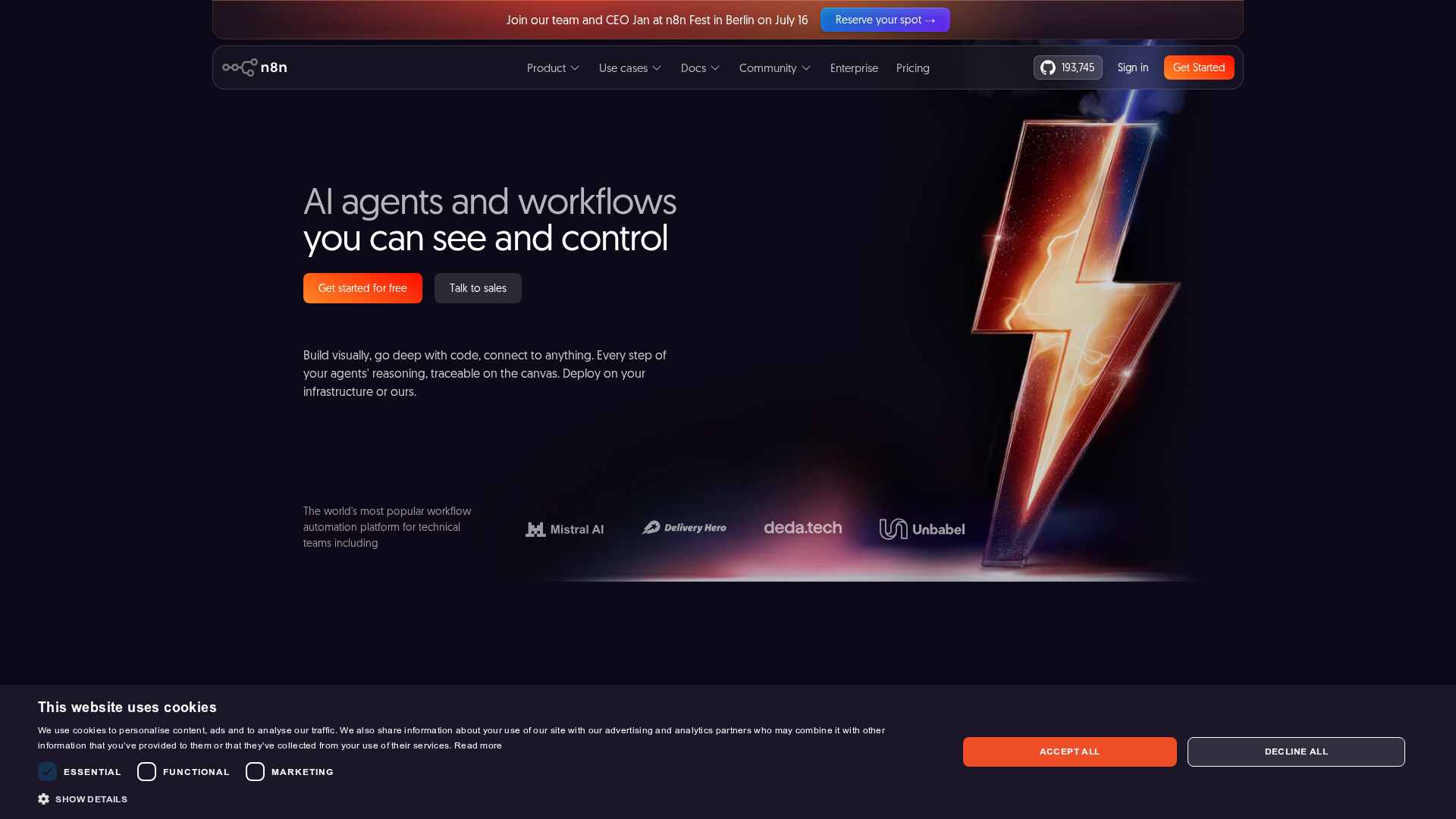
n8n is a self-hostable workflow automation platform built for technical teams. The node-based visual builder provides full control over complex automations with deep API configuration.
Best for: Developers and technical teams who want full control, self-hosting options, and deep customization.
Key strengths
- Self-hosting option: Run on your own infrastructure for complete data control
- Node-based builder: Visual interface for building complex, branching workflows
- Deep API access: Configure custom API calls and handle complex data transformations
Why choose n8n
n8n is the right choice when you have technical resources and want maximum flexibility. The self-hosting option appeals to teams with strict data residency requirements. Non-technical users will find the learning curve steep.
n8n pricing
Free for self-hosted deployments. Cloud plans start at $20/month.
8. Gumloop
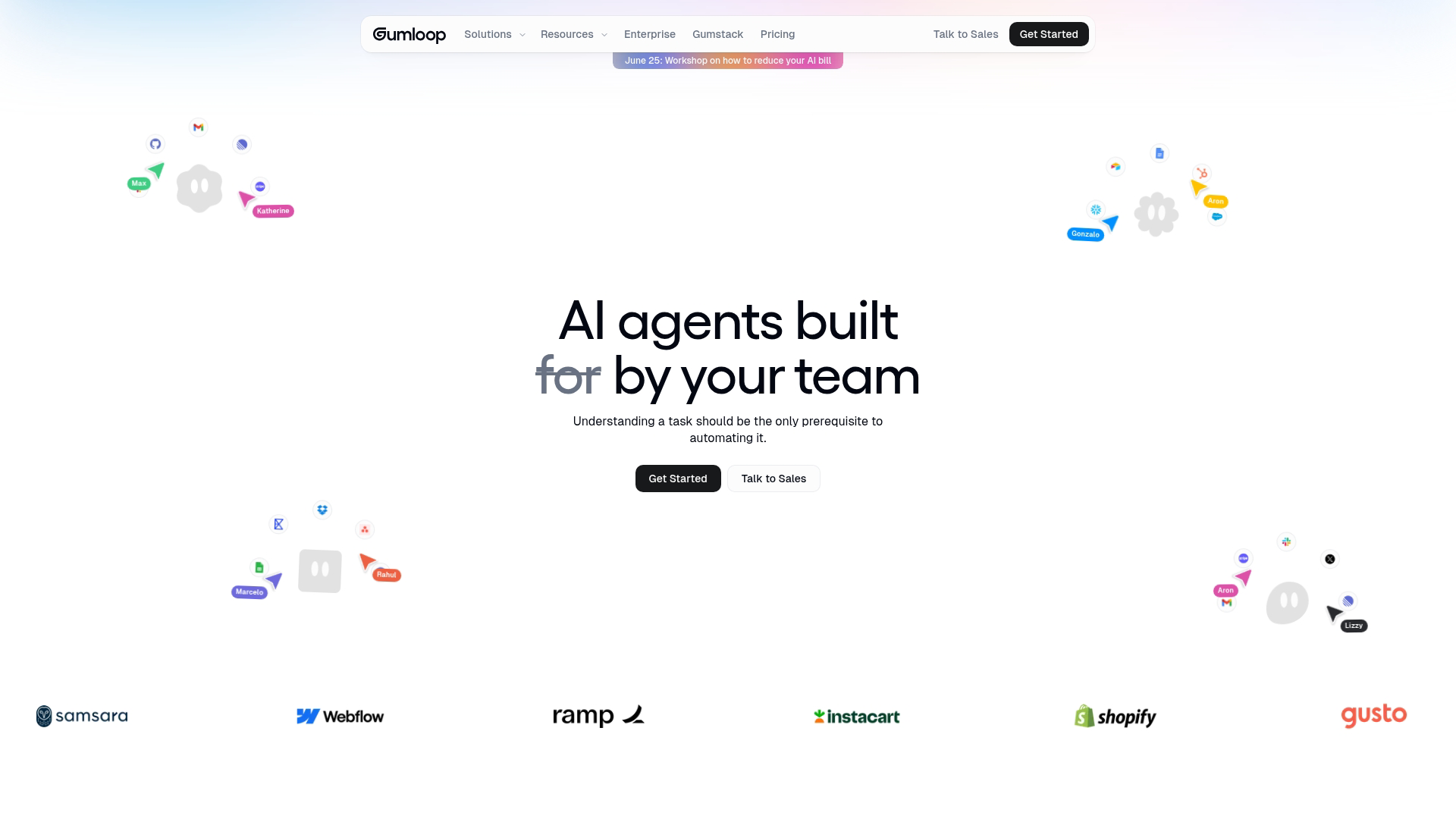
Gumloop is a no-code AI agent builder that lets users create complex, multi-step workflows visually. The platform focuses on making AI automation accessible without programming knowledge.
Best for: Non-technical users who want to build sophisticated AI workflows without coding.
Key strengths
- Visual workflow builder: Drag-and-drop interface for creating multi-step automations
- AI-native design: Built specifically for AI agent workflows rather than retrofitted
- Template library: Pre-built workflows for common use cases accelerate setup
Why choose Gumloop
Gumloop hits the sweet spot between power and accessibility. You get more sophisticated capabilities than basic automation tools without the complexity of developer-focused platforms.
Gumloop pricing
Plans start at $97/month for the Pro tier. Free trial available.
9. Intercom Fin
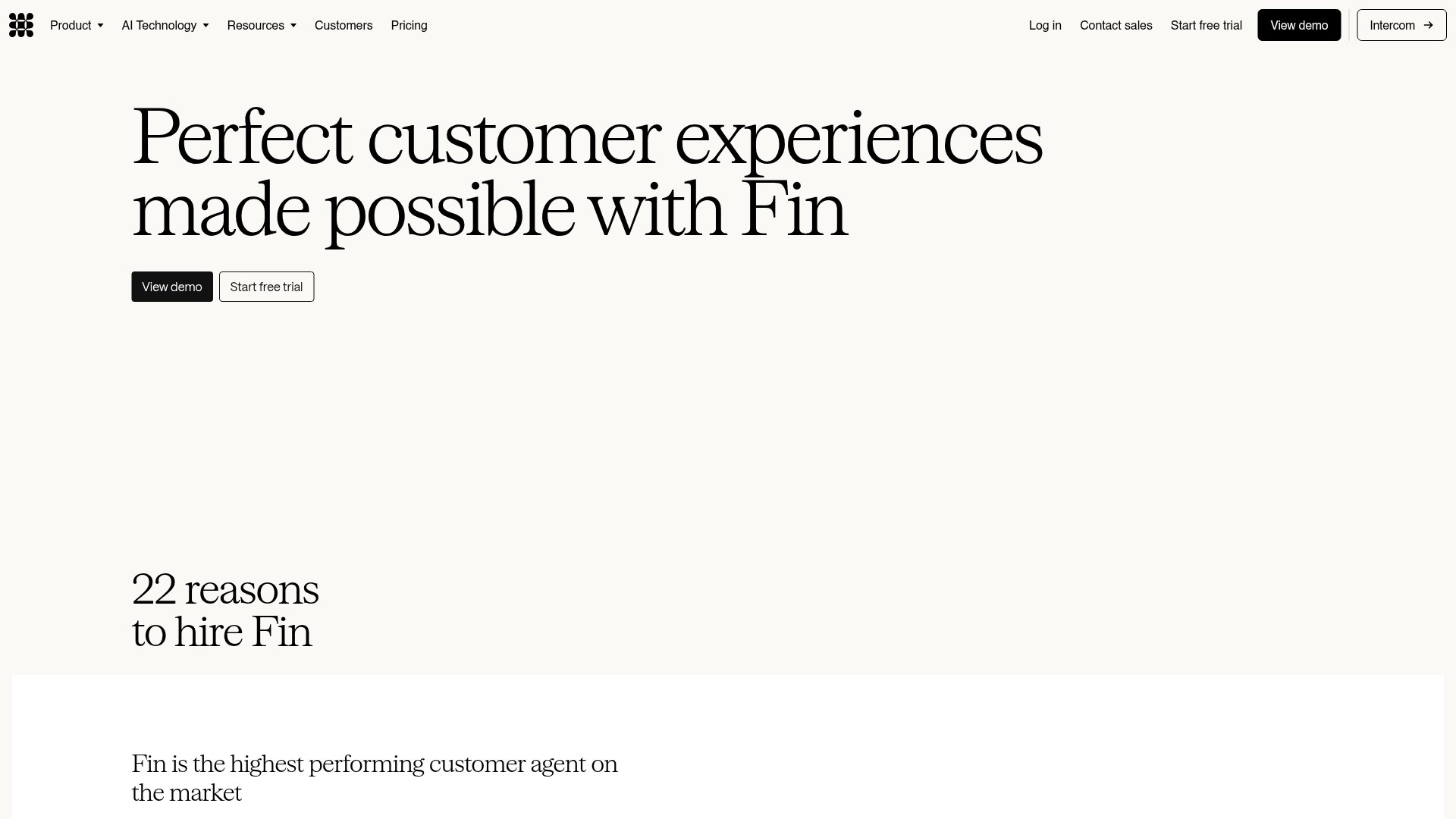
Intercom Fin is a conversational AI agent purpose-built for customer support. The agent resolves tickets by learning from your help center content and past conversations.
Best for: SaaS companies with high support volume who want AI resolution without sacrificing quality.
Key strengths
- Resolution without handoff: Handles complete support conversations from greeting to resolution
- Knowledge base learning: Improves continuously by learning from your help center and past tickets
- Seamless escalation: Routes complex issues to human agents with full conversation context
Why choose Intercom Fin
Fin makes sense if you're already using Intercom or evaluating support platforms. The per-resolution pricing model aligns costs with value delivered.
Intercom Fin pricing
$0.99 per resolution. Requires Intercom subscription.
10. Reclaim.ai
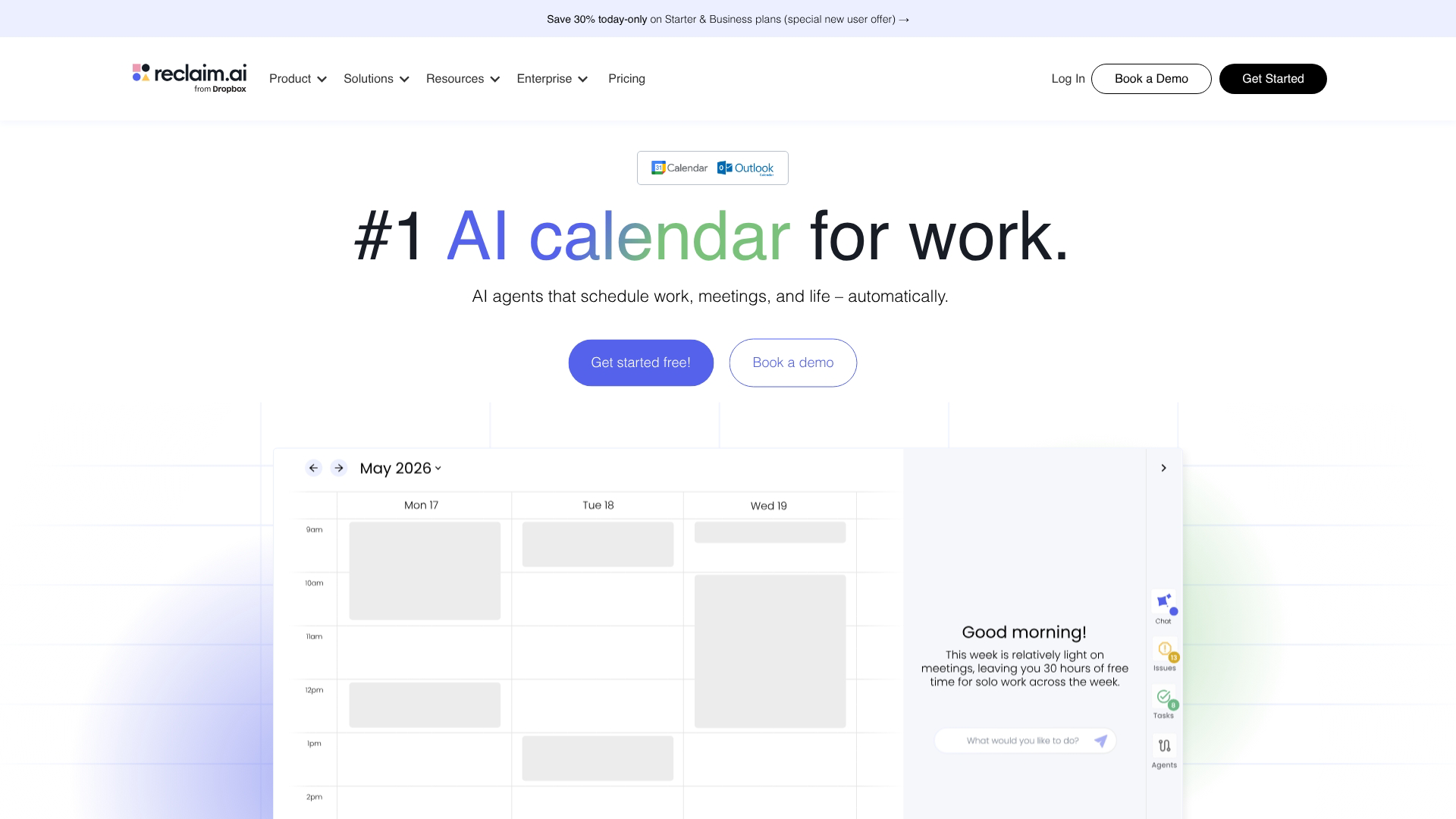
Reclaim.ai is an AI scheduling agent that optimizes calendars automatically. The agent learns your preferences, protects focus time, and finds meeting slots that work for everyone.
Best for: Busy professionals and managers who spend too much time on calendar management.
Key strengths
- Automatic scheduling: Finds optimal meeting times across multiple participants
- Focus time protection: Defends blocks for deep work against meeting creep
- Smart rescheduling: Automatically adjusts when conflicts arise
Why choose Reclaim.ai
Reclaim solves a specific, painful problem exceptionally well. If calendar management consumes significant time, the ROI is immediate.
Reclaim.ai pricing
Free tier available with core features. Starter plan at $8/user/month. Business plan at $12/user/month.
11. Jasper
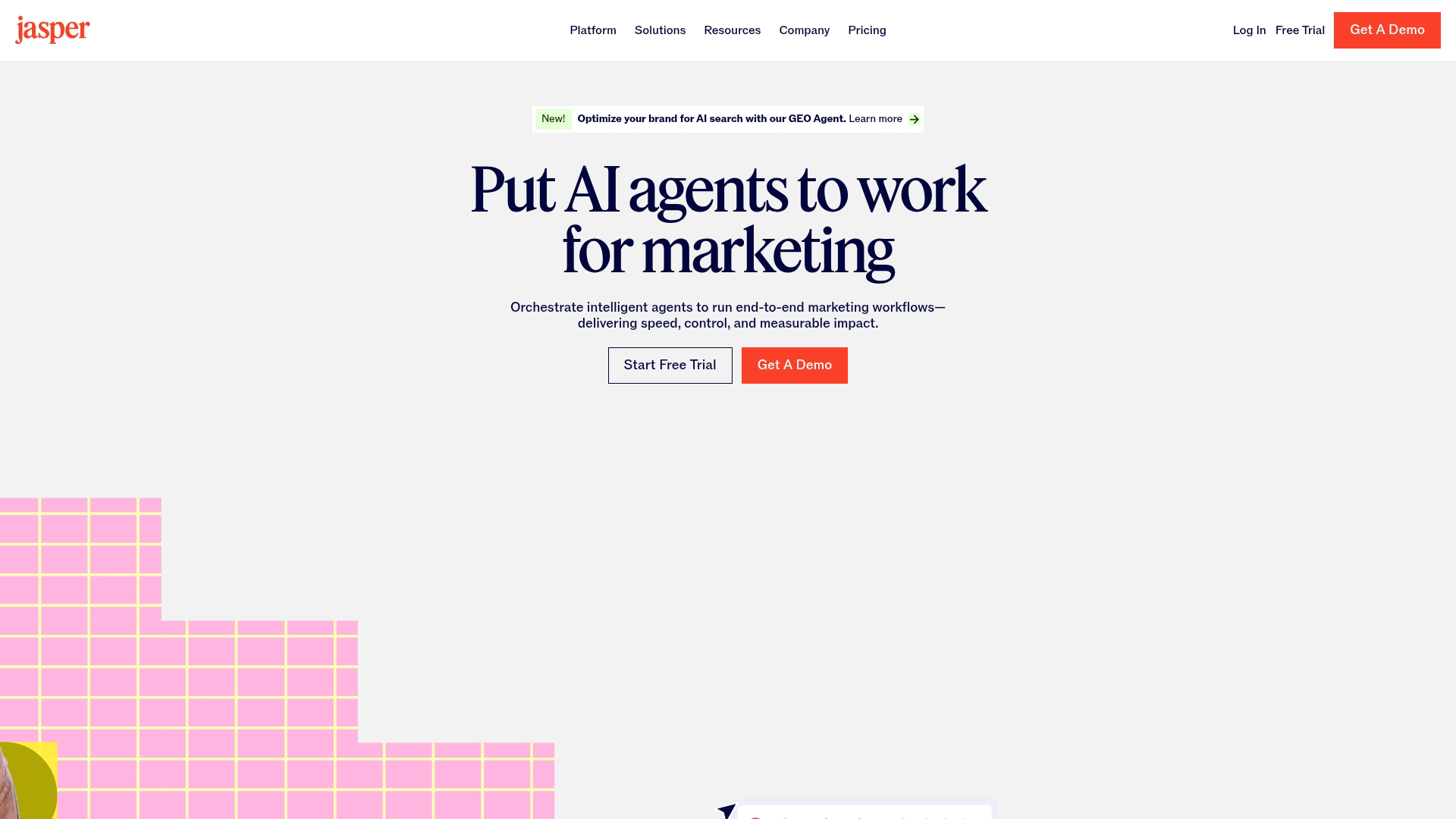
Jasper is an AI agent focused on marketing content creation. The platform maintains brand voice consistency across campaigns and helps marketing teams produce content at scale.
Best for: Marketing teams creating content at scale who want brand consistency without manual oversight.
Key strengths
- Brand voice training: Learns your brand guidelines and maintains consistency across outputs
- Campaign asset generation: Creates ads, emails, social posts, and landing page copy
- Team collaboration: Multiple users work within shared brand parameters
Why choose Jasper
Jasper excels when content volume is a bottleneck and brand consistency matters. The platform won't replace strategic thinking, but it accelerates execution.
Jasper pricing
Creator plan at $49/month. Pro plan at $69/month. Business pricing available.
12. Moveworks
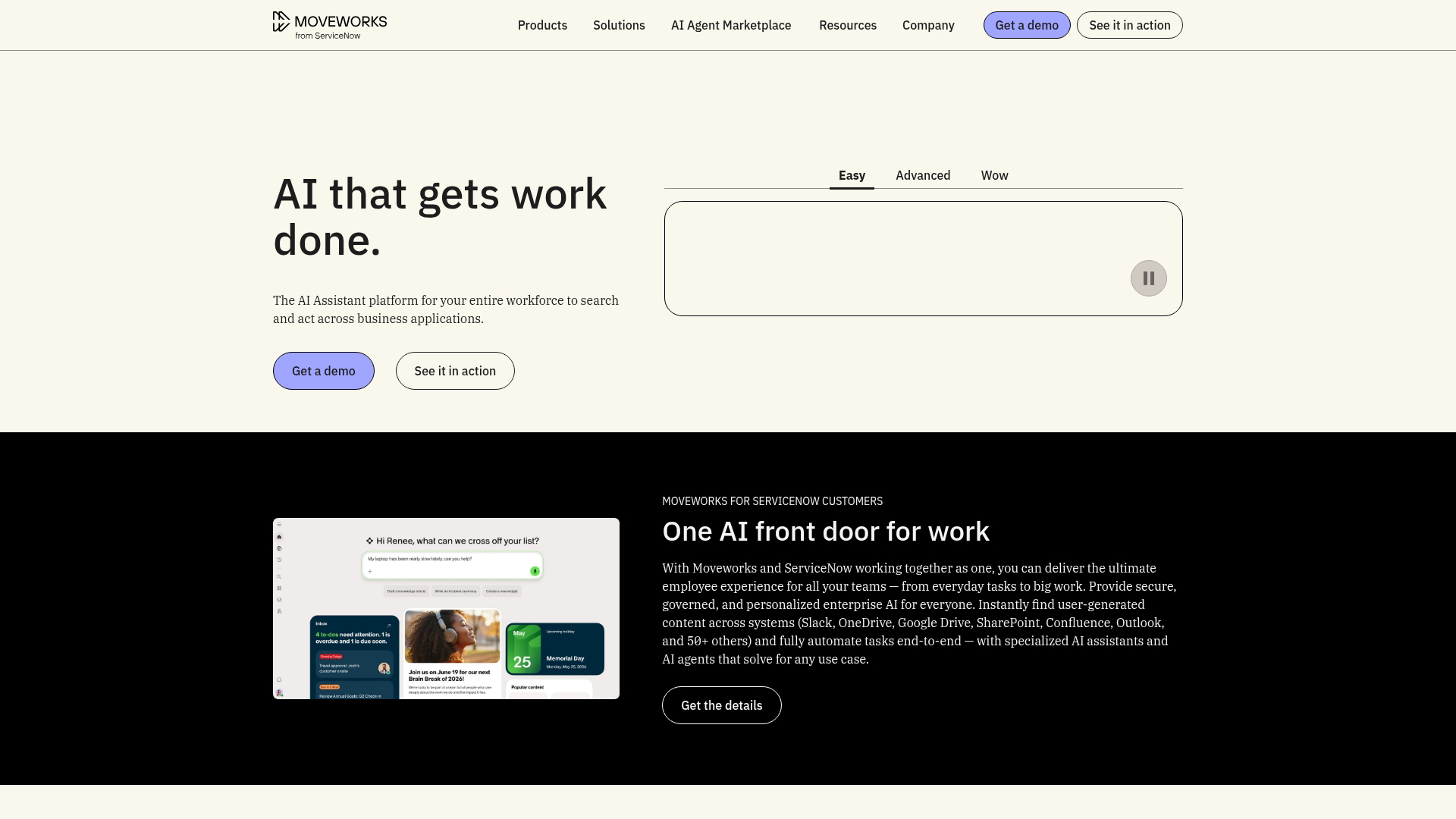
Moveworks is an enterprise AI agent for IT and HR support. The platform resolves employee tickets automatically, handling password resets, access requests, and common IT issues.
Best for: Large organizations with internal service desks handling high ticket volumes.
Key strengths
- IT ticket resolution: Handles password resets, software access, and common technical issues
- ServiceNow integration: Works within existing ITSM workflows
- Employee self-service: Reduces ticket volume by enabling employees to resolve issues themselves
Why choose Moveworks
Moveworks delivers clear ROI for enterprises with large IT support operations. Smaller organizations won't see proportional benefit.
Moveworks pricing
Custom enterprise pricing. Contact Moveworks for quotes.
13. Kore.ai
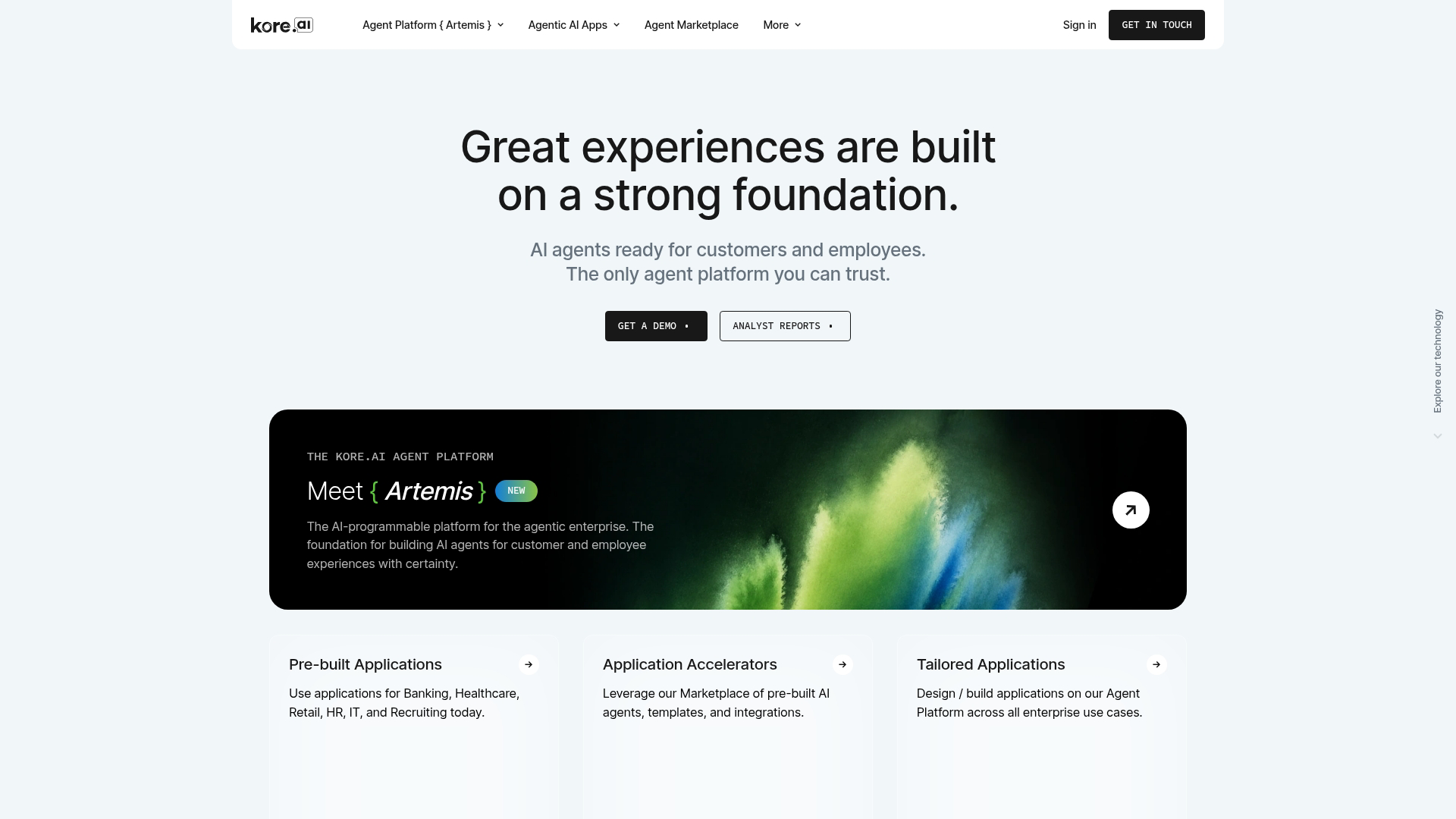
Kore.ai is an enterprise conversational AI platform for building custom virtual assistants. The platform supports multi-channel deployment with pre-built industry templates.
Best for: Enterprises building custom virtual assistants with specific industry requirements.
Key strengths
- Multi-channel deployment: Deploy agents across web, mobile, voice, and messaging platforms
- Industry templates: Pre-built solutions for banking, healthcare, retail, and other verticals
- Enterprise security: SOC 2 compliance and enterprise-grade data protection
Why choose Kore.ai
Kore.ai suits enterprises with specific requirements that off-the-shelf solutions don't address. Teams wanting quick deployment will find simpler options.
Kore.ai pricing
Custom pricing based on deployment scope and volume.
14. Yellow.ai
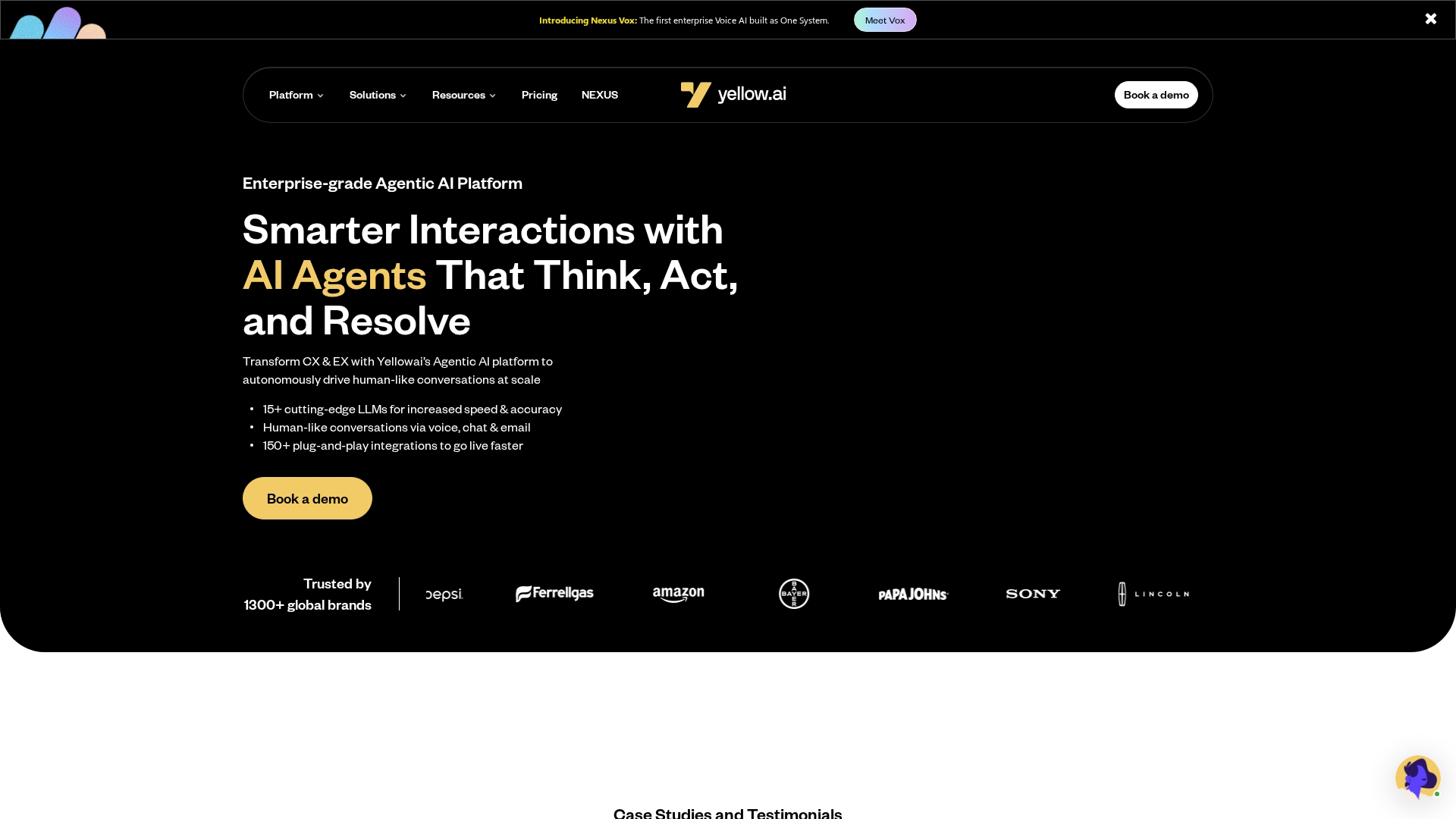
Yellow.ai is a customer experience AI platform handling high-volume interactions across voice and chat. The platform supports multiple languages and integrates with major CRM systems.
Best for: Enterprises handling high-volume customer interactions across multiple channels and languages.
Key strengths
- Voice and chat support: Handles both channels with consistent quality
- Multi-language capability: Supports 135+ languages for global deployments
- CRM integration: Connects with Salesforce, Zendesk, and other major platforms
Why choose Yellow.ai
Yellow.ai makes sense for global enterprises with diverse customer bases and high interaction volumes.
Yellow.ai pricing
Custom enterprise pricing. Contact Yellow.ai for quotes.
15. Relevance AI
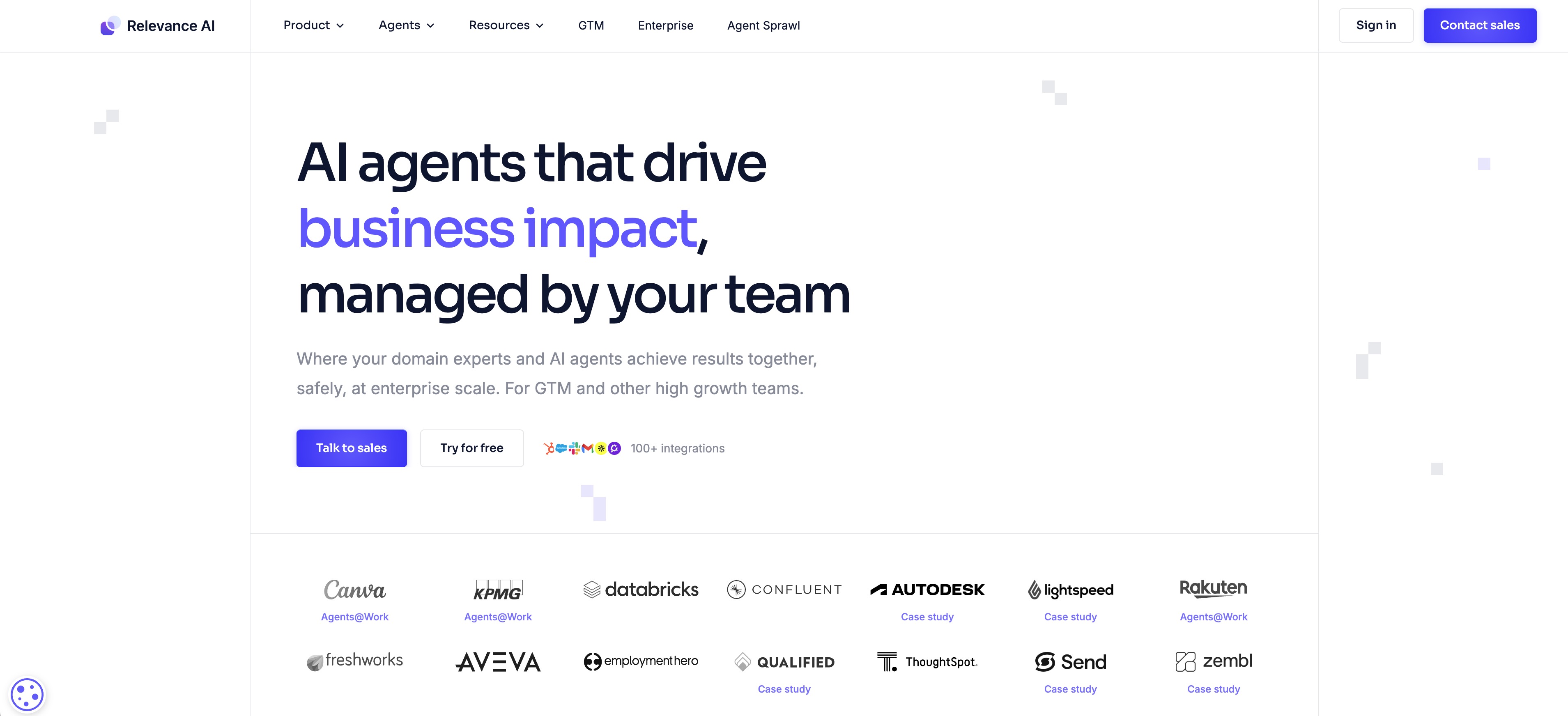
Relevance AI is a multi-agent platform for building custom AI workforces. Teams create specialized agents that collaborate on complex tasks without coding.
Best for: Teams wanting to orchestrate multiple specialized agents working together.
Key strengths
- Custom agent creation: Build agents tailored to specific tasks without programming
- Agent collaboration: Multiple agents share context and hand off work to each other
- Flexible deployment: Deploy agents across various workflows and use cases
Why choose Relevance AI
Relevance AI suits teams ready to move beyond single-purpose agents to coordinated AI workforces. Teams wanting simple, single-purpose automation will find it overkill.
Relevance AI pricing
Free tier available. Pro plan at $19/month. Team and Enterprise tiers available.
How to Choose the Best AI Agent for Your Business
Selecting the right AI agent depends on matching capabilities to your specific situation.
Match agent type to your primary use case
Start with the problem you're solving, not the technology you want to use.
- High-volume customer support: Look at conversational agents like Intercom Fin or Yellow.ai
- Sales workflow automation: Consider Lindy or Zapier Central for CRM and outreach tasks
- Complex enterprise workflows: Evaluate multi-agent platforms like Agentforce or Relevance AI
- Personal productivity: ChatGPT Operator or Lindy handle individual task automation well
Check integration support for your stack
An AI agent is only useful if it connects with your existing tools. Before committing, verify the agent integrates with HubSpot, Salesforce, and more of your critical systems.
Integration depth varies significantly. Some agents offer native, deep integrations. Others provide basic connections through Zapier or similar middleware. Native integrations typically work better.
Evaluate setup complexity and time to value
The tradeoff between power and simplicity is real. No-code agents like Lindy and Gumloop offer fast setup but less customization. Developer-focused tools like n8n offer maximum flexibility but require technical skills.
Match complexity to your team's capabilities. A powerful tool your team can't configure delivers zero value.
Calculate total cost beyond the sticker price
Pricing models vary significantly, and the advertised price rarely tells the full story.
- Usage-based pricing: Per-resolution or per-task pricing can spike unexpectedly with volume
- Seat-based pricing: Costs scale with team size
- Implementation costs: Enterprise platforms often require professional services for setup
- Overage charges: Understand what happens when you exceed plan limits
What to check before you buy an AI agent
Beyond features and pricing, several factors determine whether an AI agent will work for your organization.
Security and compliance certifications
Enterprise buyers require SOC 2 compliance, GDPR adherence, and clear data residency policies. Verify certifications match your requirements before starting a trial.
Vendor stability and funding status
The AI agent market is projected to reach USD 52.62 billion by 2030. Some vendors won't survive the next two years in a market only 17% of organizations have deployed so far. Research funding history, customer base, and market position before building critical workflows on a platform.
Usage limits and overage pricing
Understand exactly what happens when you exceed plan limits. Some platforms throttle performance. Others charge steep overage fees. A few simply stop working.
Support quality and response times
When an AI agent breaks, how fast can you get help? Test support responsiveness during your trial period.
How AI agents fit into a modern GTM stack
AI agents handle repetitive tasks so sales, marketing, and customer success teams can focus on high-value work. They're one component of a broader go-to-market technology stack.
The most effective teams pair AI agents with tools that let buyers self-serve. A demo center helps sales teams achieve 3.2x higher closure rates by providing centralized product experiences. An agent handles outreach and qualification while an interactive demo lets prospects experience the product before a call.
Pre-sales teams use AI agents to automate follow-up sequences and CRM updates while focusing their time on complex deals. These teams also leverage interactive demos to win deals before they start, combining automation with engaging product experiences.
Start building your AI agent stack today
Begin with one high-impact use case rather than deploying agents everywhere at once. Customer support and sales outreach typically offer the clearest ROI because the workflows are well-defined and the volume is measurable.
Evaluate two or three of the best AI agents from this list with free trials before committing.
Start your journey with Guideflow today!
FAQs about AI agents
Which AI agent is best for beginners?
Lindy and ChatGPT Operator offer the easiest setup for users with no technical background. Both use natural language interfaces and provide guided onboarding.
What is the difference between an AI agent and a chatbot?
A chatbot responds to prompts with text. An AI agent takes action, executes multi-step tasks, and interacts with external tools to complete goals autonomously.
Can AI agents integrate with my CRM?
Most top AI agents offer native integrations with Salesforce, HubSpot, and other major CRMs. Integration depth varies by vendor and pricing tier.
How long does it take to implement an AI agent?
No-code agents like Lindy can be productive in minutes. Enterprise platforms like Agentforce may require weeks of configuration and IT involvement.
Are AI agents secure enough for enterprise data?
Enterprise-grade agents like Agentforce, Moveworks, and Kore.ai offer SOC 2 compliance, SSO, and data encryption. Verify certifications match your specific requirements.
What happens when an AI agent fails or makes a mistake?
Most agents include human-in-the-loop fallbacks and escalation paths. Quality of error handling varies significantly between vendors.
How much do most AI agents cost per month?
Pricing ranges from free tiers for basic usage to thousands per month for enterprise plans. Most mid-market options fall between $50 and $500 monthly.
Can I use multiple AI agents together?
Yes. Many teams deploy specialized agents for different functions and connect them through workflow automation platforms like Zapier or n8n.
Do AI agents work without internet access?
Most AI agents require internet connectivity. Some enterprise deployments offer on-premise or private cloud options for air-gapped environments.
What is the 30 percent rule for AI agents?
The 30 percent rule suggests AI agents deliver meaningful productivity gains when they automate roughly 30 percent of a team's workload. This provides real time savings without creating over-reliance on automation.