Your delivery routes look clean at 6 a.m. Then two kitchens change their orders mid-morning, a refrigerated truck runs late, and your picker finds short-dated stock in the wrong slot. Generic inventory tools and disconnected accounting software were not built for this.
Foodservice distribution runs on thin margins, perishable goods, customer-specific pricing, catchweight items, lot tracking, credit limits, and multi-stop routes. According to the IFDA (2025), the U.S. foodservice distribution industry serves more than one million restaurants and foodservice outlets daily. That operational scale demands software that connects ordering, warehouse execution, delivery, and finance into one workflow, not five spreadsheets held together by email.
This guide cuts through the noise. It separates full ERPs from focused route tools, distributor-side platforms from buyer-side procurement apps, and food-specific inventory controls from generic warehouse software. Before you book a demo, know what type of problem you are actually solving.
What's inside
This guide compares 21 food distribution software options across ERP, inventory, WMS, route optimization, order management, and delivery. Tools were selected for operational relevance to foodservice distributors, HoReCa suppliers, food wholesalers, and food banks. Items were evaluated on:
- Coverage of food-specific workflows: Lot tracking, catchweight, FEFO, traceability
- Fit by distributor size and operational complexity
- Verified pricing and G2 ratings at time of publication
- Depth of delivery execution, ordering, and back-office integration
TL;DR
- Best for HoReCa and catering delivery: RouteMagic fits restaurant and hospitality suppliers needing route planning, ePOD, catchweight, and delivery confirmation
- Best for end-to-end foodservice operations: BFC Software suits distributors wanting replenishment, WMS, transportation, and operational analytics together
- Best Microsoft-based food ERP: inecta Food ERP fits teams standardizing on Microsoft Dynamics 365 Business Central, with a confirmed $150,000 budget minimum
- Best for route optimization: OptimoRoute works when delivery planning is the primary bottleneck, starting at $35.10 per driver per month
- Best for lighter inventory control: Fishbowl, ERPAG, and Order Time Inventory fit smaller distributors needing inventory discipline without full ERP complexity
- Best for B2B customer ordering: BlueCart and Now Commerce address customer self-service ordering without requiring a core ERP replacement
What is foodservice distribution software?
Foodservice distribution software helps food distributors manage orders, inventory, purchasing, warehouse operations, delivery routes, traceability, invoicing, and customer-specific pricing from one connected workflow.
The category is broader than a single product type. Some platforms are full food distribution ERPs covering finance, purchasing, inventory, and operations. Others focus narrowly on route execution, proof of delivery, or customer ordering. Choosing the wrong category is the most common and expensive mistake in this market.
Core capabilities the category covers:
- Order entry: Telesales, standing orders, online customer portals, and substitution management
- Inventory control: Lot tracking, expiry dates, FEFO (first-expired, first-out), and catchweight items
- Warehouse management: Receiving, putaway, picking, replenishment, and cycle counting
- Purchasing: Supplier management, demand forecasting, and purchase order automation
- Delivery execution: Route planning, dispatch, electronic proof of delivery, and temperature capture
- Customer pricing: Contract pricing, rebates, credit limits, and promotional rules
- Accounting and invoicing: Accounts receivable, accounts payable, tax, margin reporting, and ERP sync
- Traceability: Recall support, audit trails, lot-level tracking, and compliance reporting
- Analytics: Fill rate, OTIF, margin, waste, route cost, and picker productivity
Category boundary: Foodservice distribution software is not the same as restaurant POS software or generic inventory tools. A platform earns a place in this category when it supports wholesale ordering, warehouse movement, route execution, and food-specific controls like lot tracking and expiry management. Some tools in this list sit on the buyer side (restaurant procurement) and are labeled accordingly.
When to use foodservice distribution software
Replace spreadsheets and disconnected accounting tools
When order edits, inventory discrepancies, and invoice corrections are slowing your team down, it is time to connect orders to purchasing, stock, picking, delivery, and billing in one system. A distributor managing more than 20 SKUs with customer-specific pricing on spreadsheets is one wrong lookup away from a margin-eroding error.
Control perishable inventory and traceability
When expiry management, lot tracking, and recall readiness feel risky to handle manually, a food-specific system becomes necessary rather than optional. Buyers evaluating FSMA 204 readiness should confirm capabilities directly with vendors rather than relying on marketing language alone. Lot control, FEFO rules, and audit trails are the specific capabilities to test.
Improve delivery execution and customer service
When late deliveries, missing proof of delivery, ad hoc route changes, and customer credits are cutting into margin, the problem likely sits in delivery execution rather than inventory. Electronic proof of delivery, temperature capture, delivery photos, and driver apps address these specific failure points. A focused route tool can fix the delivery leg without requiring a full ERP migration.
Foodservice distribution software comparison
The table below covers all 21 tools with verified pricing and G2 ratings. Where pricing requires a sales conversation, that is noted clearly. Where G2 ratings could not be confirmed, the field is marked N/A.
| # | Product | Best for | Key differentiator | Pricing | G2 rating |
|---|---|---|---|---|---|
| 1 | RouteMagic | HoReCa and catering delivery operations | Route planning, ePOD, catchweight, and back-office sync | From £29/user/month | 3.5/5 |
| 2 | BFC Software | End-to-end foodservice distribution | Replenishment, WMS, load planning, and operational analytics | Contact sales | N/A |
| 3 | inecta Food ERP | Microsoft-based food ERP | Food distribution ERP built on Dynamics 365 Business Central | $150K budget minimum | N/A |
| 4 | Entree | Foodservice distributors replacing legacy systems | Food-specific ERP with catchweight, lot control, and pricing | Contact sales | N/A |
| 5 | Oasis Insight | Nonprofit food distribution programs | Client intake and inventory for food banks and pantries | From $20/user/month | 4.5/5 |
| 6 | Datacor ERP | Process and specialty distributors | ERP with batch production, lot tracking, and compliance | Contact sales | 3.2/5 |
| 7 | Kechie | Growing distributors moving off spreadsheets | Cloud ERP covering inventory, purchasing, and warehouse | Contact sales | N/A |
| 8 | Accolent ERP | Wholesale distributors needing web-based ERP | ERP and order management for distributors | Contact sales | 4.5/5 |
| 9 | Infor Distribution SX.e | Mid-market and larger distributors | Mature distribution ERP depth | Contact sales | 4.0/5 |
| 10 | S2K Enterprise for Food | Food-specific enterprise ERP | FSMA 204, catchweight, lot tracking, and route management | Contact sales | 2.8/5 |
| 11 | Fishbowl | SMB distributors using QuickBooks | Inventory, warehouse, and accounting integrations | From $229/month | N/A |
| 12 | ERPAG | Smaller distributors needing affordable cloud ERP | Inventory, sales, purchasing, and production in one platform | From $49/month | N/A |
| 13 | OptimoRoute | Route-first delivery teams | Multi-stop route optimization and proof of delivery | From $35.10/driver/month | 4.7/5 |
| 14 | Gofrugal | Hybrid retail and distribution operators | POS, inventory, and distribution workflows | From ₹500/month | 3.8/5 |
| 15 | Marketman | Restaurants managing purchasing and food cost | Supplier ordering, recipe costing, and invoice automation | From $249/month | 4.3/5 |
| 16 | Detrack | Delivery-heavy operations needing ePOD | Driver app, live tracking, and branded delivery notifications | From $29/driver/month | 4.5/5 |
| 17 | Tookan | Flexible delivery teams and dispatch operations | Dispatch management and real-time agent tracking | Contact sales | 4.2/5 |
| 18 | ChefMod | Foodservice procurement and AP automation | Multi-supplier ordering, invoice capture, and analytics | From $199/month/location | 4.0/5 |
| 19 | Order Time Inventory | SMB distributors needing order and inventory control | Inventory, lot tracking, and order management with QuickBooks sync | From $185/month | N/A |
| 20 | BlueCart | Food suppliers needing B2B online ordering | Buyer-facing storefront with wholesale order management | Contact sales | N/A |
| 21 | Now Commerce | Distributors adding customer self-service ordering | B2B customer portal with QuickBooks integration | From $150/month | 2.5/5 |
Best 21 foodservice distribution software tools for 2026
1. RouteMagic
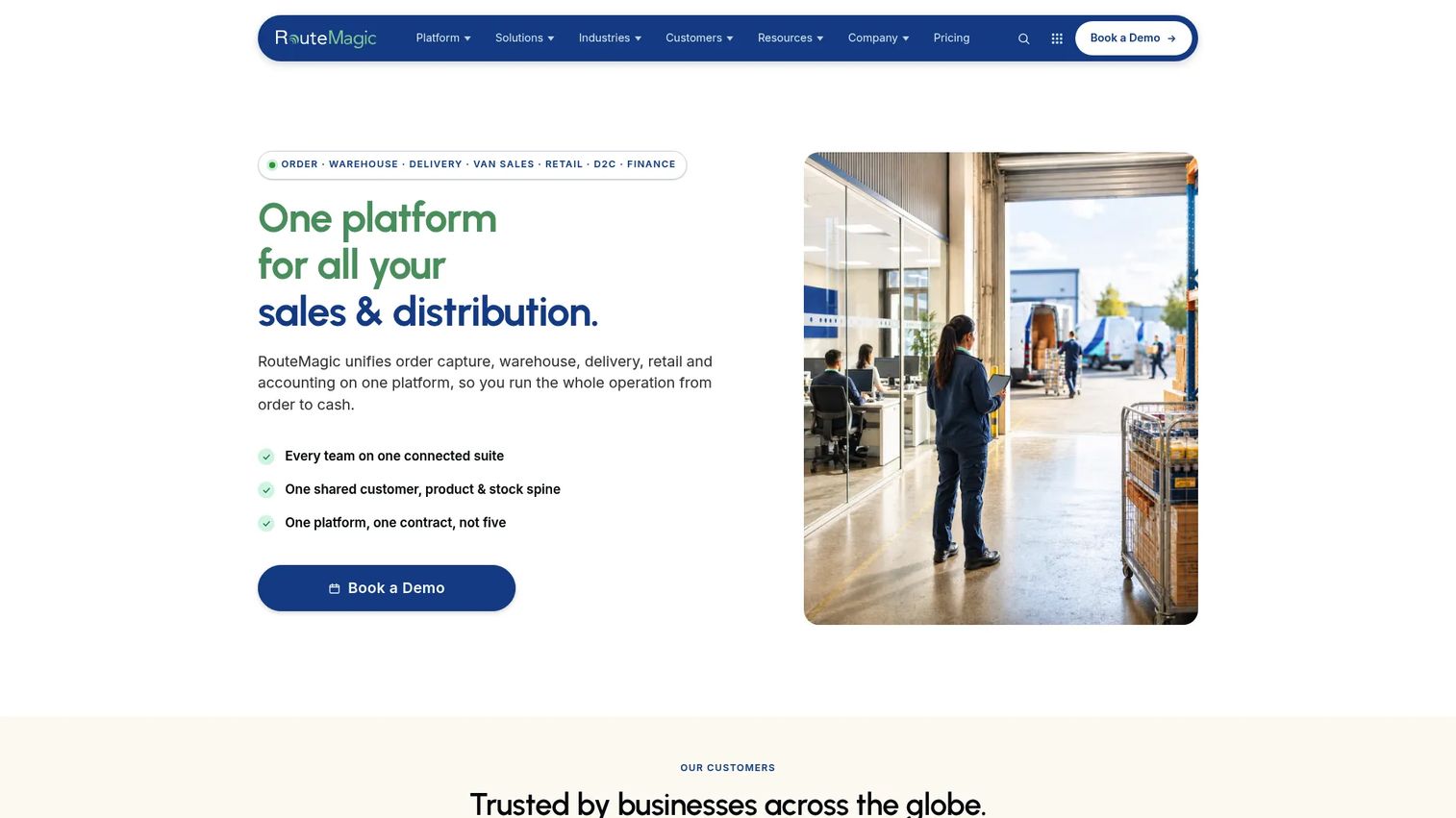
RouteMagic is a unified platform for sales, warehouse, delivery, and customer ordering operations. It covers the full order-to-cash cycle for wholesalers and route-based distributors, with apps for back-office, warehouse, drivers, and customers. The platform is built for HoReCa (hotels, restaurants, and catering) suppliers and foodservice distributors that need connected delivery and reconciliation workflows.
Best for: HoReCa and catering suppliers that need routing, proof of delivery, and accounting sync without switching to a full ERP.
Key features
- AI demand forecasting and route optimization
- Van sales and offline electronic proof of delivery
- Barcode warehouse execution with batch and expiry capture
- Automated end-of-day reconciliation
- Customer portal, D2C, and POS apps
Why choose RouteMagic: This is a delivery-first platform. It fits operations where the pain sits in route execution, driver proof, and delivery reconciliation rather than core finance or warehouse management. Integrations with accounting tools including QuickBooks and Xero make it easier to plug into an existing stack.
RouteMagic pricing: Plans start at £29 per user per month (Lite), with Core at £39 and Premium at £59. Pricing uses per-user monthly billing. No free trial is listed.
G2 rating: 3.5/5 (1 review on G2).
2. BFC Software
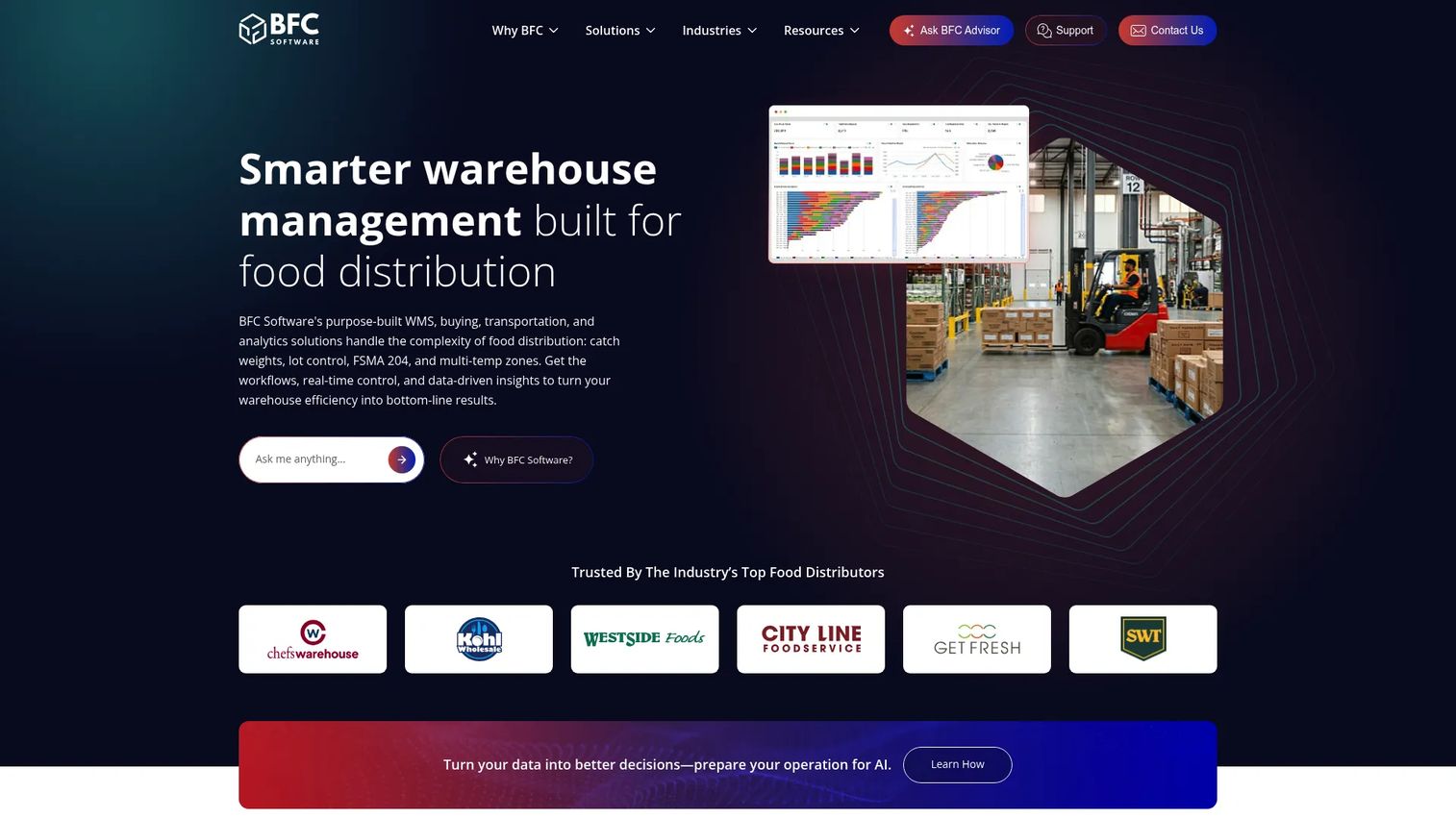
BFC Software provides purpose-built warehouse management, buying, transportation, and analytics software for food distributors. Its modules cover inbound and outbound warehouse workflows, demand forecasting, replenishment, truck building, load planning, and operational analytics. The platform is designed specifically for food distribution complexity: Catch weights, lot control, FSMA 204-ready workflows, and multi-temperature zones.
Best for: Foodservice distributors with multiple operational bottlenecks across purchasing, warehouse, transportation, and reporting.
Key features
- Food-specific WMS with inbound and outbound workflow control
- Real-time inventory with lot-level traceability and catch-weight support
- Daily demand forecasting and replenishment optimization
- Truck building and load planning with stop sequencing and temperature zones
- Operational analytics for labor productivity and customer service metrics
Why choose BFC Software: This is one of the few platforms in this list built specifically around food distribution operational complexity. FSMA 204 readiness should be confirmed directly with the vendor rather than assumed.
BFC Software pricing: Pricing requires a sales conversation. Contact BFC Software to confirm modules, implementation scope, integrations, and support package.
3. inecta Food ERP
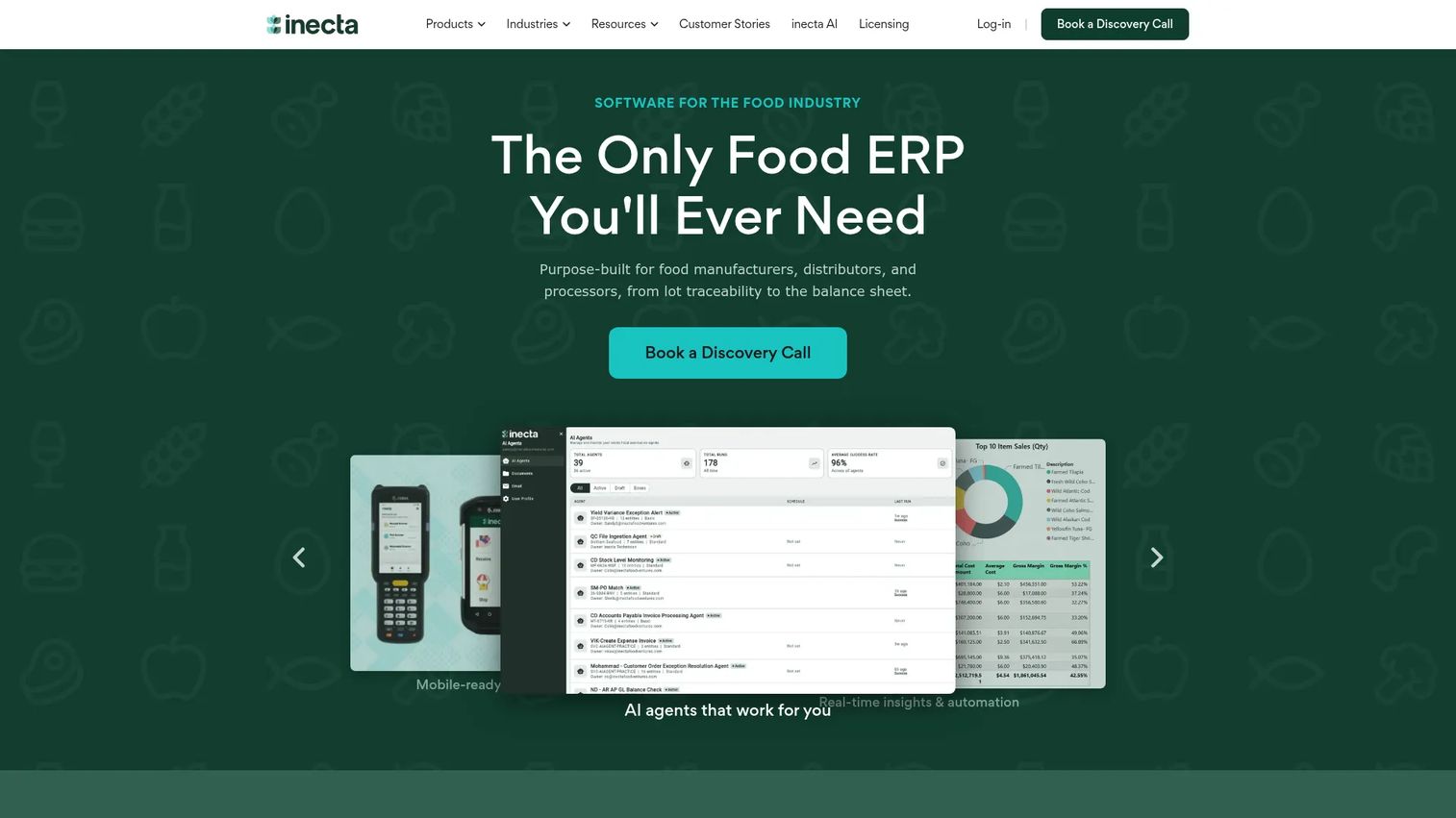
inecta Food ERP is a cloud-based food industry ERP built on Microsoft Dynamics 365 Business Central. It covers production planning, lot traceability, catch-weight handling, FEFO shelf-life management, warehouse management, quality control, allergen tracking, and financial management. The platform targets food manufacturers, processors, distributors, and traders.
Best for: Distributors that want food-specific ERP functionality on Microsoft architecture without building custom extensions.
Key features
- Microsoft Business Central as the ERP foundation
- Lot-level traceability and recall workflows
- Catch-weight and dual-unit-of-measure handling
- FEFO and shelf-life management
- Financial management with costing and margin analysis
Why choose inecta Food ERP: This is the right fit when leadership wants food-specific functionality without moving away from Microsoft's system-of-record infrastructure. IT and finance buyers who care about governance and licensing stability will find the Microsoft foundation reassuring. Budget at minimum $150,000 before starting a conversation.
inecta Food ERP pricing: inecta works with companies budgeting at least $150,000. The price depends on users, devices, modules, tenant tier, and operational complexity.
4. Entree
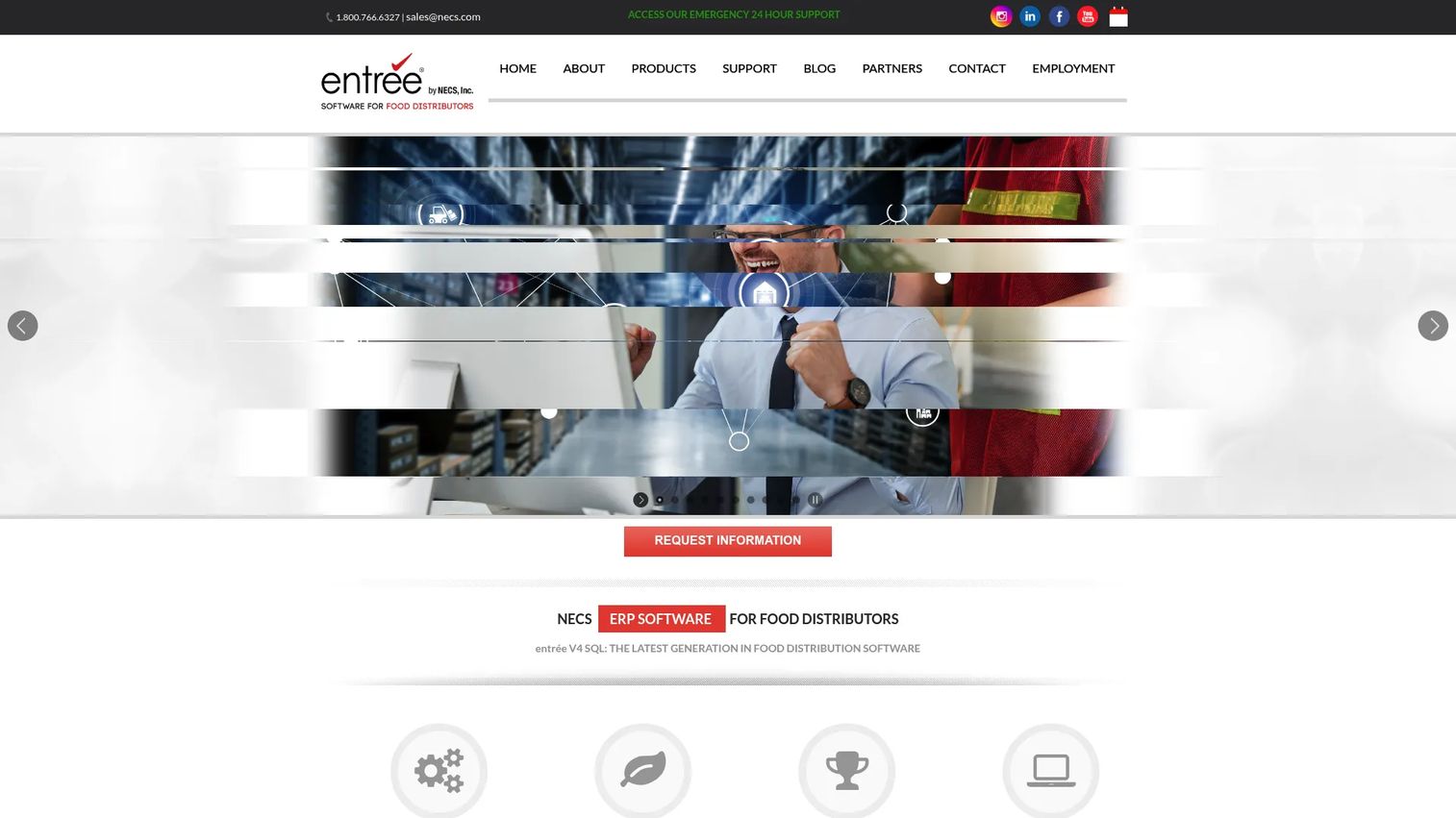
Entree by NECS is Windows-based ERP and food distribution software built specifically for foodservice and wholesale food distributors. It handles inventory control with catchweights, lot control, case-breaking, kits, and cycle counts. The platform covers customer pricing, cost management, invoicing, order entry, backorders, substitutions, and route-related workflows alongside purchasing automation and reporting.
Best for: Established foodservice distributors that need a category-specific operating system rather than a generic inventory add-on.
Key features
- Inventory control with catchweights, lot control, and FEFO
- Customer pricing, substitutions, and backorder management
- Order entry with route-related workflows
- Purchasing automation
- Customizable dashboards and hundreds of pre-built reports
Why choose Entree: Entree is purpose-built for foodservice distribution, which means the workflows around catchweight, customer-specific pricing, and route-adjacent operations are native rather than bolted on. Verify mobile, eCommerce, and route capabilities with NECS before finalizing evaluation.
Entree pricing: NECS does not display software pricing on its product pages. Contact NECS to confirm user count, module needs, training, and support requirements.
5. Oasis Insight
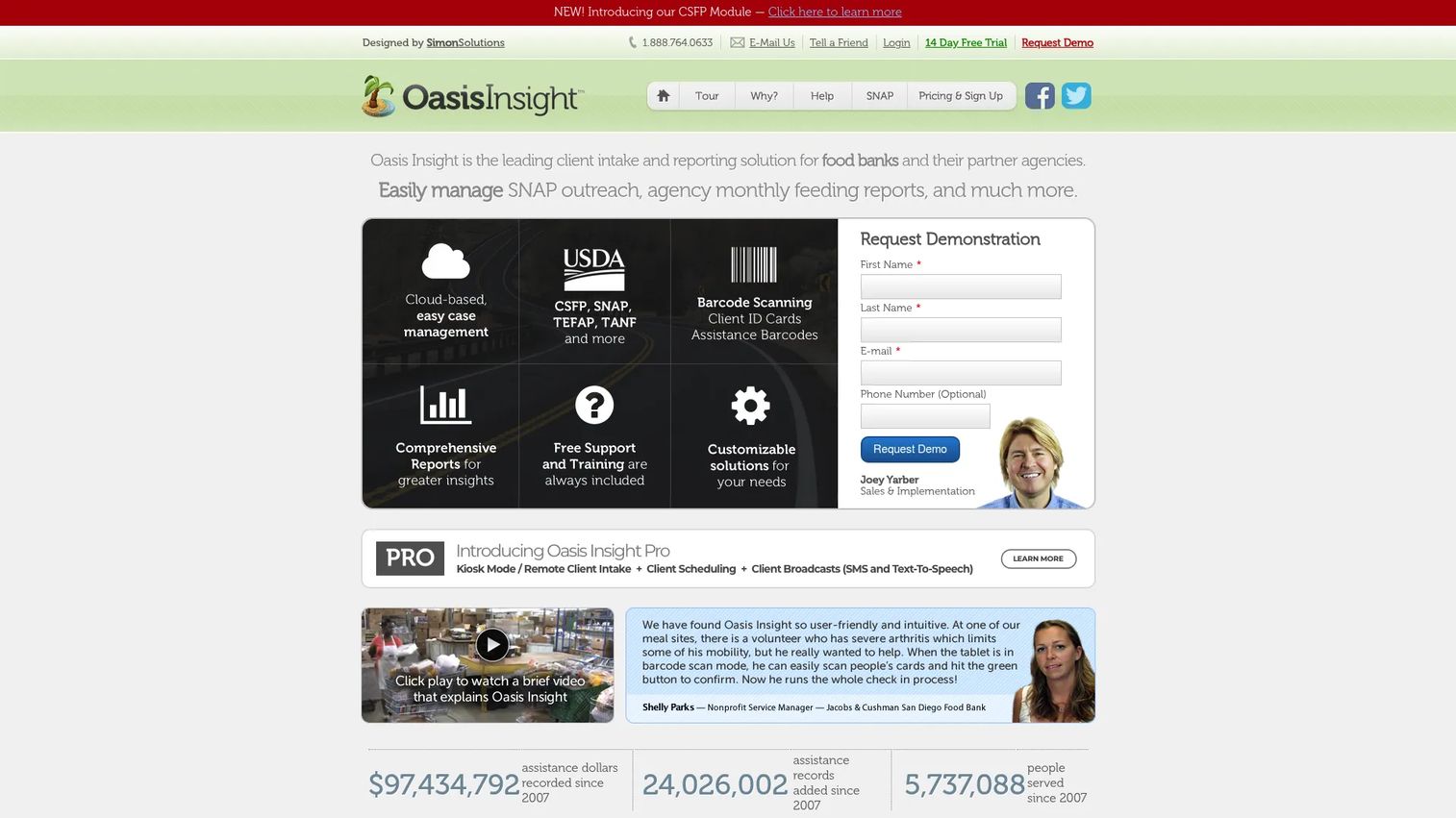
Oasis Insight is specialized software for food banks, food pantries, and partner assistance networks. It is not a commercial foodservice distributor ERP. The platform handles client intake, food distribution workflows, SNAP outreach tracking, inventory management, and reporting for nonprofit food distribution programs.
Best for: Nonprofit food distribution programs managing clients, inventory, referrals, and multi-location service delivery.
Key features
- Client intake and case management
- Pantry inventory tracking
- SNAP outreach and participation reporting
- Multi-location coordination
- Food distribution reporting dashboards
Why choose Oasis Insight: This belongs in a foodservice distribution roundup because many "food distribution" buyers operate nonprofit or assistance networks with fundamentally different workflows. If you run a food bank or pantry network, Oasis Insight addresses your actual job. Commercial distributors should look elsewhere.
Oasis Insight pricing: Plans start at $20 per user per month. A 14-day free trial is available. Annual billing includes a 10% discount. Volume and simultaneous-user pricing are available by contacting the provider.
G2 rating: 4.5/5 (4 reviews on G2).
6. Datacor ERP
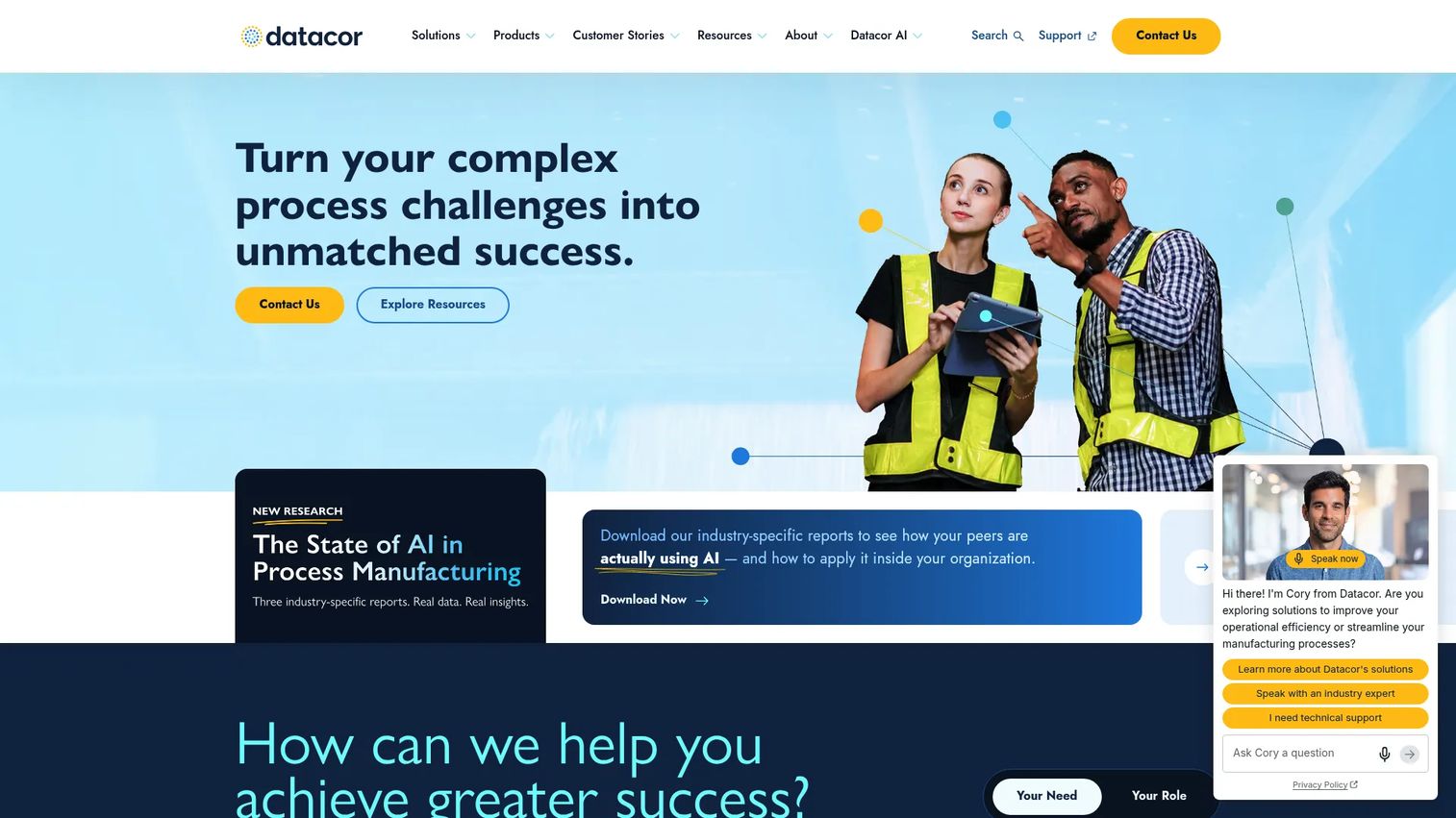
Datacor ERP is an AI-enhanced ERP platform built for process manufacturers and chemical distributors. It covers batch and formula-based production, real-time inventory, warehouse management, financial management, quality control, lab management, and regulatory compliance. For food distribution buyers, it is most relevant where operations overlap with regulated, batch-driven, or formula-based inventory workflows.
Best for: Specialty distributors that need ERP depth including lot tracking, purchasing, financial controls, and compliance reporting.
Key features
- Batch production with version control and traceability
- Real-time inventory, WMS, demand planning, and MRP
- Financial management including general ledger, AR, and AP
- Quality control, SDS/COA documentation, and regulatory compliance
- Order management, invoicing, and margin reporting
Why choose Datacor ERP: Relevant for operations that sit at the intersection of food distribution and process manufacturing. Verify food-specific capabilities before making claims about lot tracking, expiry management, or recall workflows. The platform is not narrowly positioned for foodservice, so fit depends on operational complexity.
Datacor ERP pricing: Pricing is not displayed. Contact Datacor to confirm implementation, modules, integrations, and managed services scope.
G2 rating: 3.2/5 (6 reviews on G2).
7. Kechie
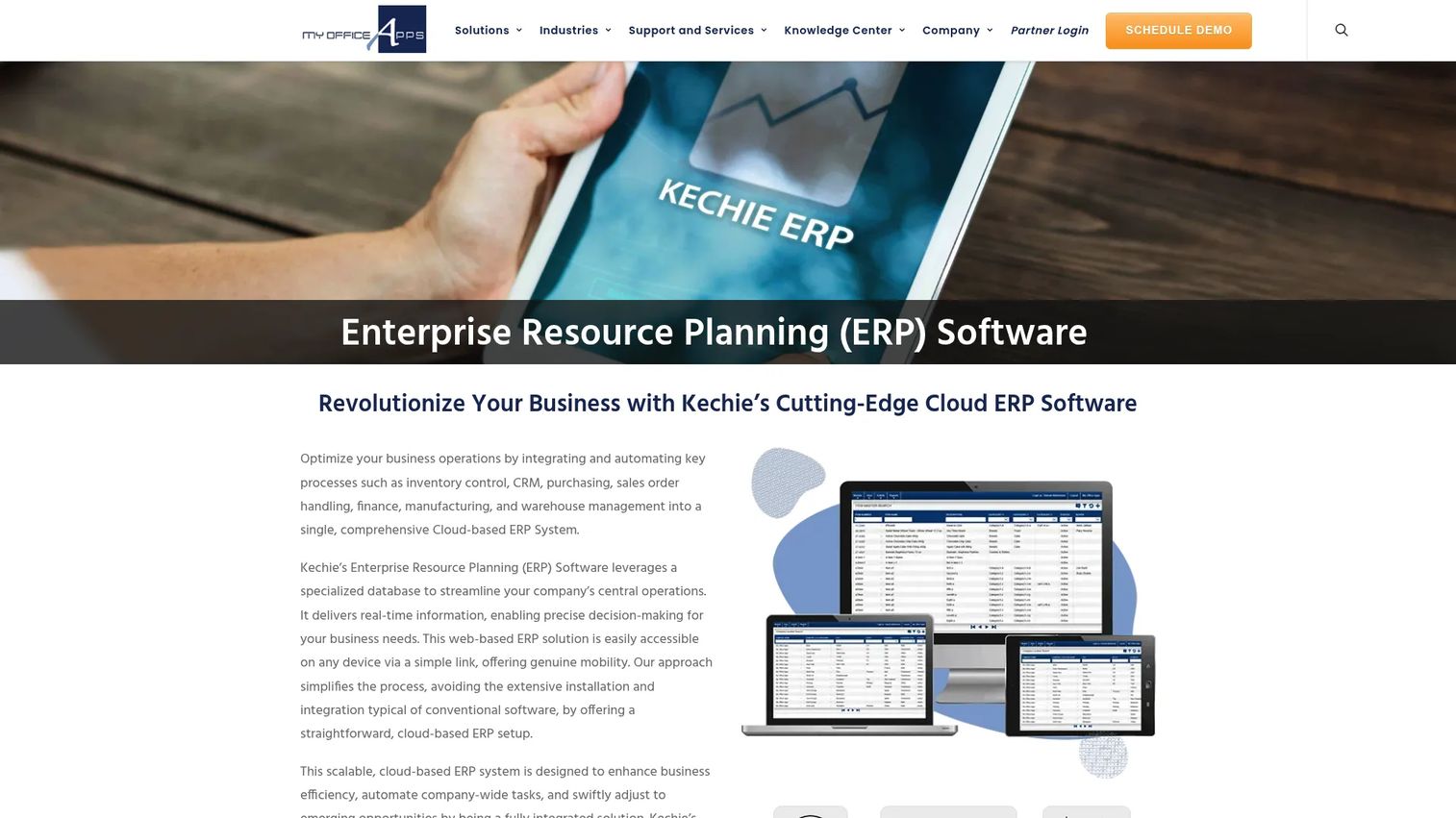
Kechie is a cloud ERP covering inventory, purchasing, sales orders, warehouse operations, and manufacturing or distribution workflows. It targets growing businesses that have outgrown entry-level accounting software and need broader operational control without jumping to enterprise ERP complexity.
Best for: Growing distributors moving off spreadsheets or basic accounting tools that need cloud ERP without an enterprise implementation project.
Key features
- Inventory management across multiple locations
- Purchasing and supplier management
- Sales order processing
- Warehouse workflows
- Cloud-based reporting and dashboards
Why choose Kechie: Positioned for businesses scaling past spreadsheets. Whether food-specific controls like FEFO, catchweight, and traceability are native capabilities should be confirmed with Kechie directly before committing to an evaluation.
Kechie pricing: Kechie's pricing page was not accessible for verification. Contact Kechie to confirm whether pricing is per-user, per-module, or package-based.
8. Accolent ERP
Accolent ERP is web-architected ERP software for wholesale distributors. It covers order management, inventory control, purchasing, CRM workflows, and B2B eCommerce. The platform is designed to run in a browser without local installation requirements, which reduces IT overhead compared to legacy on-premise ERP systems.
Best for: Wholesale distributors that need ERP, eCommerce, and order management accessible without on-premise infrastructure.
Key features
- Order management and inventory control
- Purchasing workflows
- CRM and account management
- B2B eCommerce module
- Browser-based access without local installation
Why choose Accolent ERP: A practical option for distributors that want ERP and customer-facing ordering in one platform without managing server infrastructure. Confirm food-specific traceability capabilities before selecting it for regulated food operations.
Accolent ERP pricing: Pricing is not displayed. Contact ADS Solutions (the owner of Accolent) to confirm licensing, implementation, and module structure.
G2 rating: 4.5/5 (1 review on G2).
9. Infor Distribution SX.e
Infor Distribution SX.e is a mature ERP for wholesale distributors covering warehouse management, purchasing, order entry, inventory control, service management, financial management, and customer and supplier relationship management. It targets small and mid-sized wholesale distribution businesses that need integrated ERP depth without a full enterprise implementation project.
Best for: Larger distributors with complex operations and IT capacity to support a mature enterprise distribution ERP.
Key features
- Distribution ERP across order entry and inventory control
- Warehouse management
- Purchasing and supplier management
- Financial controls and reporting
- Customer and supplier relationship management
Why choose Infor Distribution SX.e: Enterprise ERP fit depends heavily on implementation partner quality, existing system compatibility, and integration scope. This is a significant commitment. Fit for enterprise distributor operations rather than small teams.
Infor Distribution SX.e pricing: Infor does not display pricing. Contact Infor or an Infor partner to confirm licensing, implementation, support, and integration costs.
G2 rating: 4.0/5 on G2. Capterra separately lists 4.5/5.
10. S2K Enterprise for Food
S2K Enterprise for Food by VAI is industry-specific ERP software for food and beverage manufacturers, distributors, and retailers. It covers FSMA 204 compliance capabilities, catch weight processing, route and load management, lot and date tracking, warehouse management, manufacturing management, and business intelligence.
Best for: Food and beverage companies that need ERP with food-industry-specific controls built in from the start.
Key features
- FSMA 204 compliance capabilities
- Catch weight processing
- Route and load management
- Lot and date tracking
- Warehouse management and manufacturing management
Why choose S2K Enterprise for Food: The food-specific nature of the platform means fewer customizations to handle catchweight, lot tracking, and traceability. Verify FSMA 204 claims directly with VAI and confirm what "compliance" means in their specific implementation context.
S2K Enterprise for Food pricing: Pricing is not displayed. Contact VAI to confirm license model, implementation, modules, and support.
G2 rating: 2.8/5 (2 reviews on G2).
11. Fishbowl
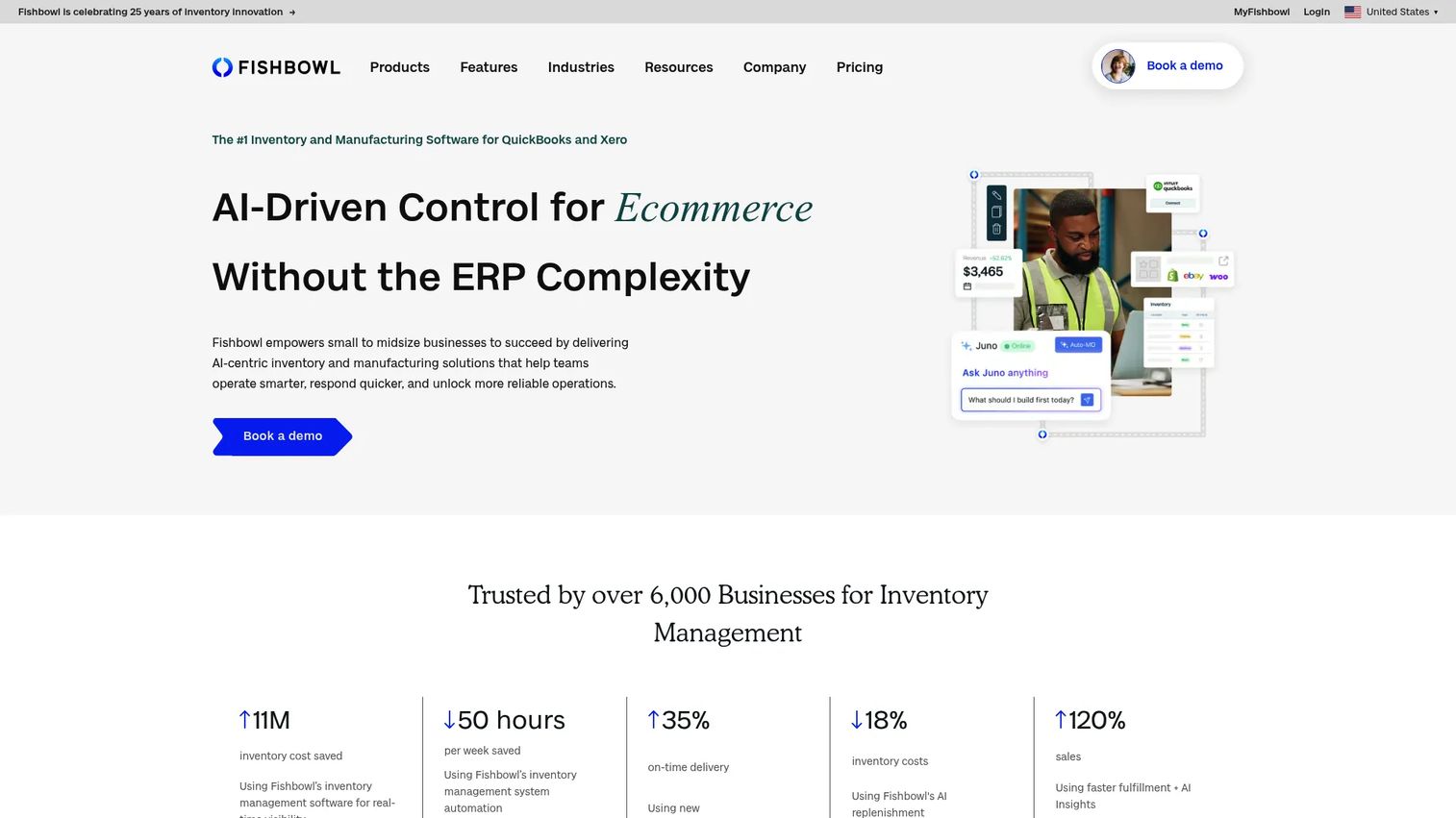
Fishbowl is cloud inventory management, manufacturing, warehouse, and order fulfillment software for businesses that make, move, and sell physical products. It is widely used by small and mid-sized businesses, particularly those running QuickBooks for accounting. The platform covers real-time inventory tracking, warehouse management, order fulfillment, and manufacturing with bills of materials.
Best for: Small and mid-sized distributors that need inventory discipline and accounting integration without a full food ERP project.
Key features
- Real-time inventory tracking across locations
- Warehouse management and order fulfillment
- Manufacturing with bills of materials, work orders, and MRP
- Barcode scanning
- QuickBooks and accounting integrations
Why choose Fishbowl: A good starting point for smaller distributors that have outgrown QuickBooks inventory but are not ready for a food ERP migration. Advanced foodservice workflows like FEFO, catchweight, and temperature zones should be confirmed before selecting Fishbowl for regulated food operations.
Fishbowl pricing: Plans start at $229 per month (Essentials), with Growth at $429 and Scale at $729, all billed annually. Advanced Manufacturing starts at $675 per month and Advanced Warehouse starts at $595 per month.
12. ERPAG
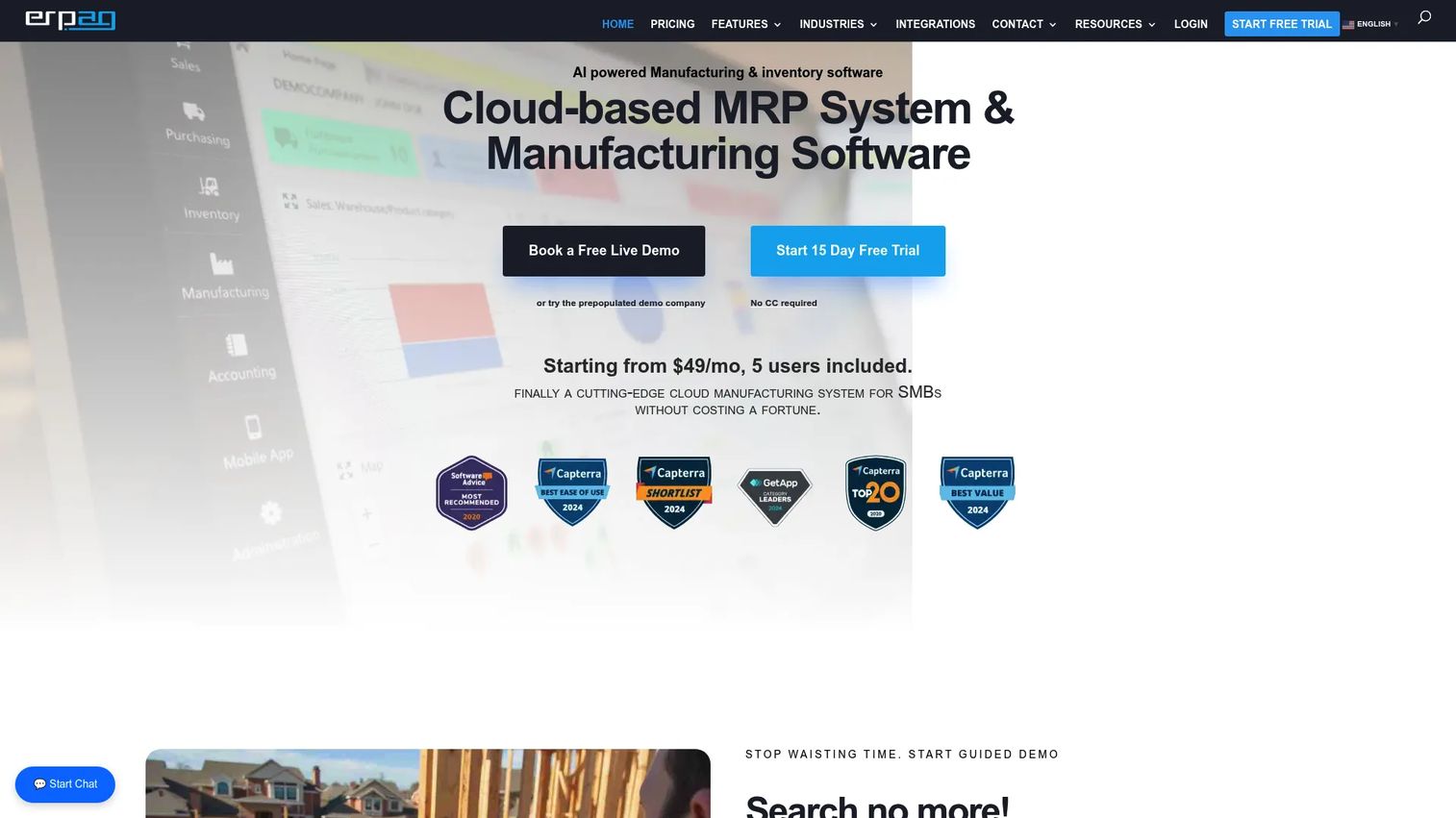
ERPAG is cloud-based ERP for small and midsized businesses, covering sales, purchasing, manufacturing, and inventory. All plans include 5 users. The platform handles inventory with multiple warehouses, lot and serial tracking, barcoding, expiry management, and inventory variations, alongside manufacturing with multi-level bills of materials and a customer portal.
Best for: Smaller distributors that need affordable cloud ERP covering inventory, purchasing, and production without a large implementation commitment.
Key features
- Inventory management with lot and serial tracking, and expiry management
- Manufacturing with multi-level bills of materials and work orders
- Sales, purchasing, customer portal, and POS
- Integrations with QuickBooks Online, Xero, Shopify, and WooCommerce
- Cloud reporting and analytics
Why choose ERPAG: An affordable entry point for distributors needing ERP functions without enterprise complexity. Confirm whether food-specific controls like FEFO picking and temperature management are available before selecting it for perishable workflows.
ERPAG pricing: The Basic plan starts at $49 per month, then $99 per month after the first 3 months. Professional starts at $49 for 3 months, then $99. Advanced is $49 for 3 months, then $199. All plans include 5 users. Additional users are $9 per month each. A 15-day free trial is available.
13. OptimoRoute
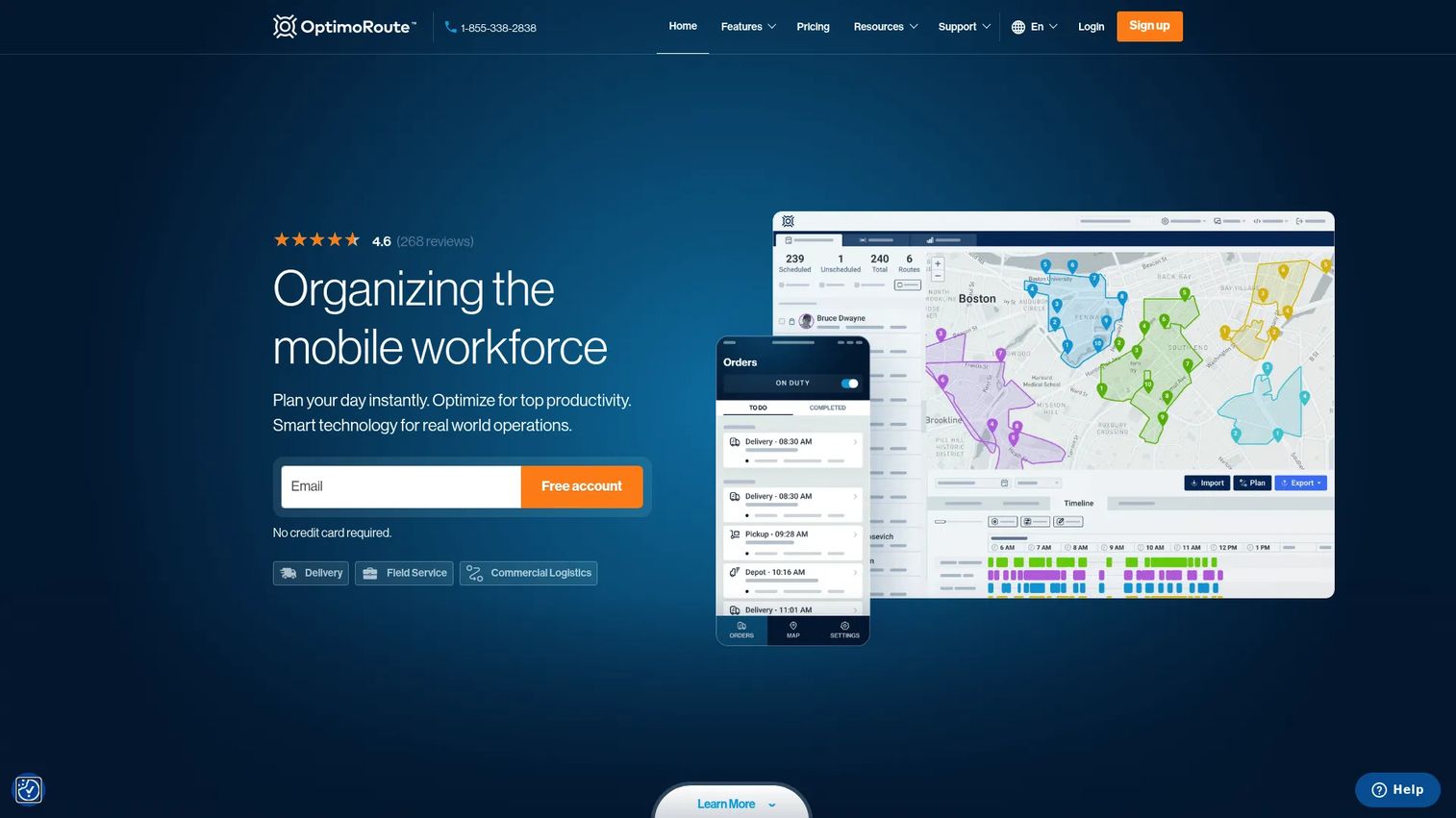
OptimoRoute is route optimization and planning software for delivery, logistics, and field service companies. It is not a full foodservice ERP. The platform focuses on automated route planning, driver scheduling, live tracking, customer notifications, and proof of delivery with signatures, photos, and notes. A 30-day free trial is available.
Best for: Distributors that need better multi-stop routing and delivery proof without replacing their ERP or warehouse system.
Key features
- Automated route planning and scheduling
- Driver mobile app with navigation and real-time updates
- Live tracking, ETAs, and breadcrumbs
- Proof of delivery with signatures, photos, and notes
- Delivery analytics and workload balancing
Why choose OptimoRoute: The right choice when your warehouse and order system are functioning but delivery planning is creating cost, lateness, or customer-service problems. It layers on top of existing systems rather than replacing them.
OptimoRoute pricing: The Lite plan starts at $35.10 per driver per month, billed annually. Pro is $44.10 per driver per month, billed annually. Custom pricing is available for larger fleets. A 30-day free trial is offered.
G2 rating: 4.7/5 on G2.
14. Gofrugal
Gofrugal provides ERP and POS software for retail, restaurant, and distribution businesses. It covers POS billing, real-time inventory tracking, multi-outlet management, integrated accounting, CRM, loyalty programs, and reporting. The platform spans retail, restaurant, and distribution workflows, making it relevant for hybrid operators.
Best for: Food retailers, wholesalers, or hybrid operators that need POS and inventory management in one platform.
Key features
- POS billing and order management
- Real-time inventory tracking and replenishment alerts
- Multi-outlet management with centralized control
- Integrated accounting and GST/VAT compliance
- CRM and loyalty programs
Why choose Gofrugal: A practical fit for businesses operating across retail and distribution without wanting separate systems. Regional support model and foodservice distribution depth should be confirmed before selection. Primary market is India and Southeast Asia.
Gofrugal pricing: Restaurant ERP starts at ₹500 per month. Retail ERP starts at ₹750 per month. Plan-specific pricing for Cash Register, Starter, Standard, Professional, and Enterprise editions should be confirmed on Gofrugal's pricing page.
G2 rating: 3.8/5 on G2.
15. Marketman
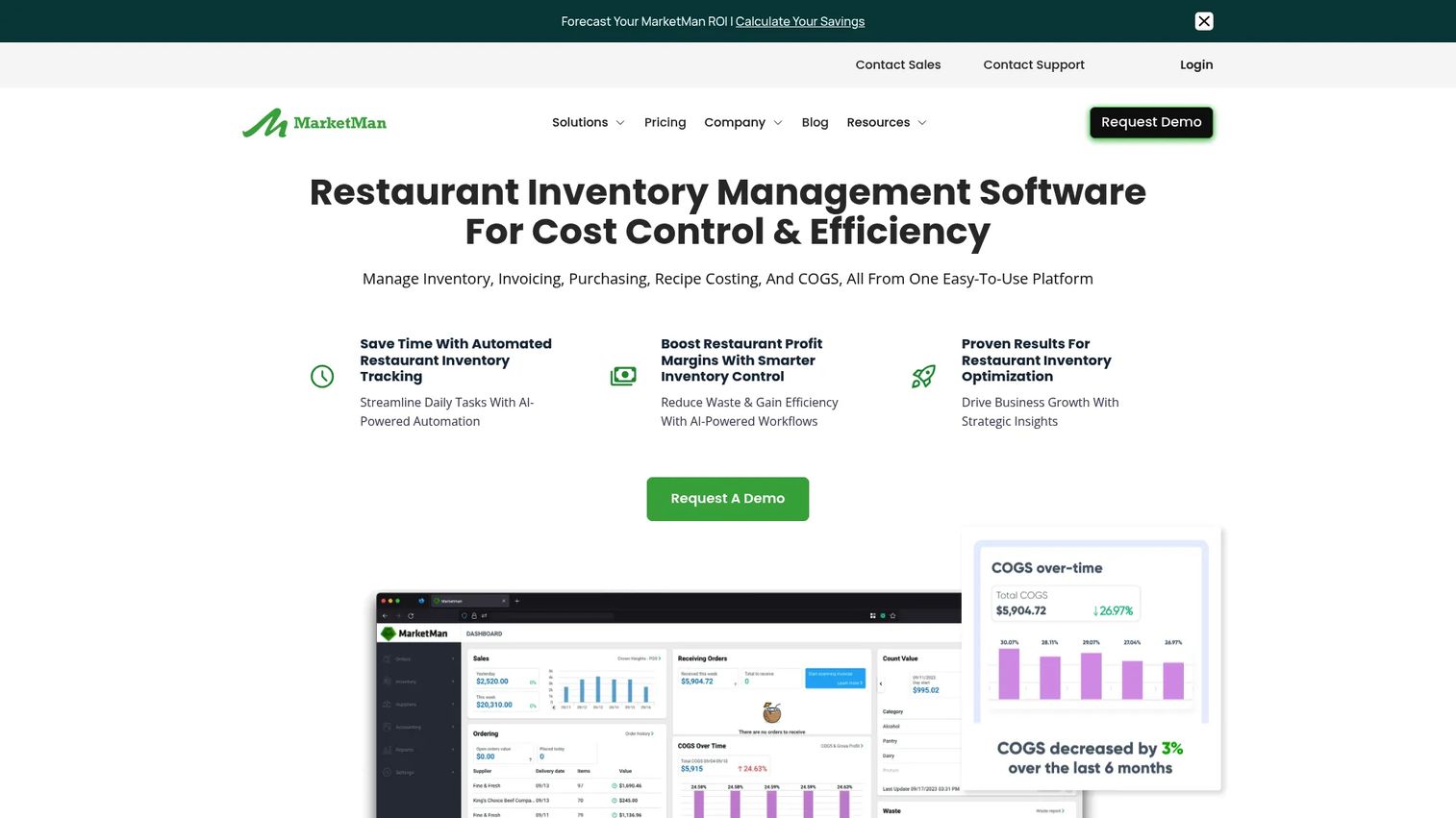
Marketman is cloud-based restaurant management software for inventory, purchasing, recipe costing, invoicing, and food-cost control. It sits on the buyer side of the food supply chain rather than the distributor side. Restaurants and hospitality groups use it to manage supplier ordering, track actual versus theoretical food costs, and automate invoice processing.
Best for: Restaurants and multi-location foodservice operators managing purchasing, supplier relationships, and food cost rather than operating as distributors.
Key features
- Real-time inventory management and counts
- Purchase orders, vendor management, and smart ordering
- Recipe costing, menu profitability, and digital cookbook
- Invoice scanning and accounts-payable automation
- Actual versus theoretical reporting and COGS analytics
Why choose Marketman: This is buyer-side software, not a distributor ERP. It belongs in this list for readers evaluating foodservice procurement and supplier order management from the restaurant or hospitality perspective. Distributors selling to restaurants may encounter buyers using Marketman on the other side of the transaction.
Marketman pricing: The Starter plan is $249 per month. Growth is $299 per month. Enterprise starts from $449. Billing is monthly.
G2 rating: 4.3/5 on G2.
16. Detrack
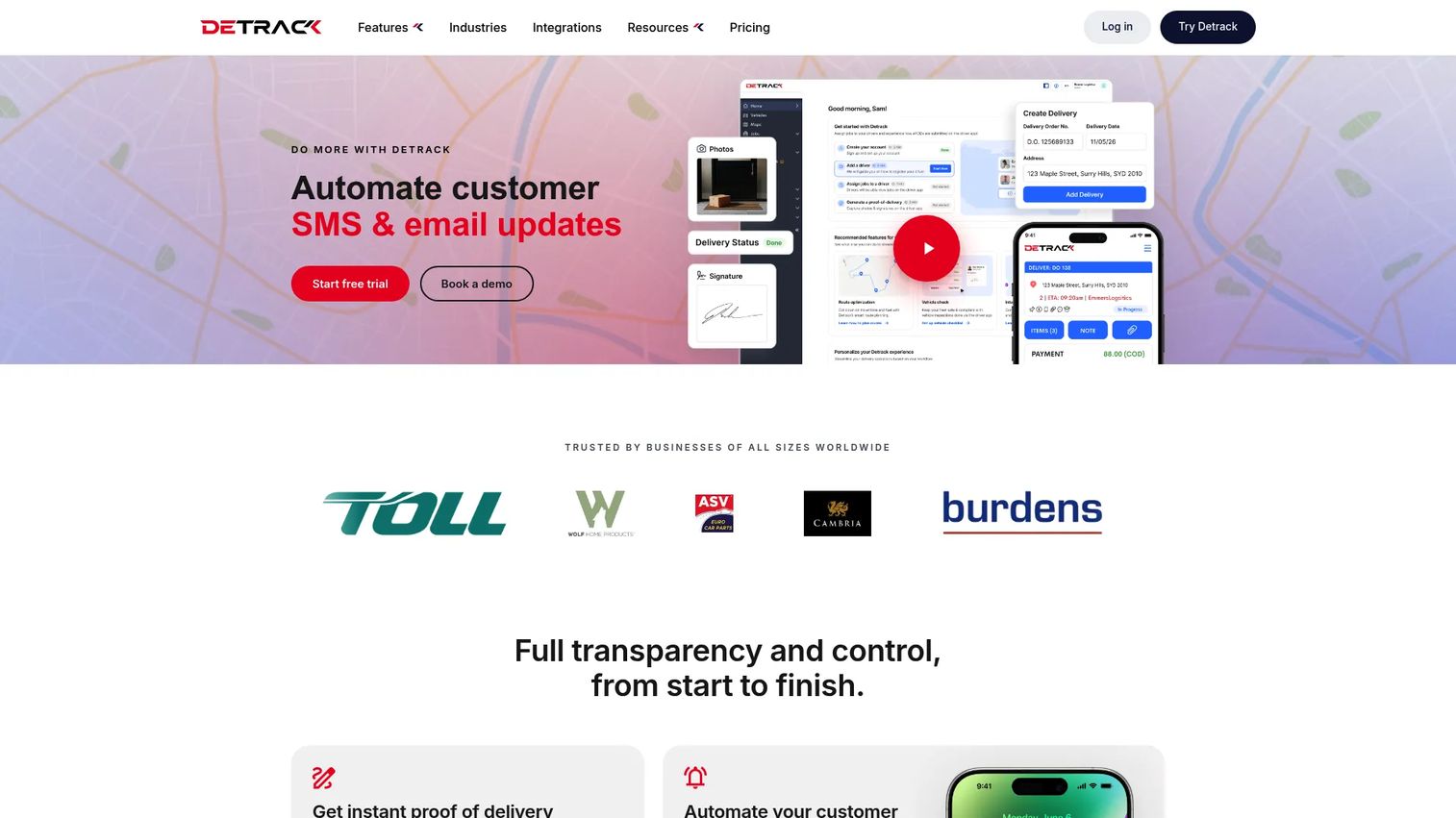
Detrack is delivery management software for proof of delivery, driver tracking, route optimization, customer notifications, and fleet operations. Plans bill per driver, include unlimited web users and unlimited jobs, and offer a 14-day free trial with no credit card required.
Best for: Distributors operating delivery fleets that need electronic proof of delivery, live visibility, and branded customer notifications.
Key features
- Electronic proof of delivery with signatures, photos, locations, and timestamps
- Real-time driver tracking and job updates
- Route optimization
- Automated branded SMS, WhatsApp, and email notifications
- API and business-platform integrations
Why choose Detrack: A focused delivery execution layer that pairs well with an existing ERP or order management system. It resolves delivery disputes and improves customer communication without requiring a full system change.
Detrack pricing: The Pro plan is $29 per driver app per month. Advanced is $39 per driver app per month. Enterprise pricing is custom. Annual billing saves 10%. A 14-day free trial is available with no credit card required.
G2 rating: 4.5/5 (12 reviews on G2).
17. Tookan
Tookan is delivery management and field-workforce tracking software covering dispatch, task assignment, route optimization, driver tracking, and API integrations. It is positioned for businesses managing flexible or high-volume delivery operations across multiple drivers and assignments.
Best for: Food distributors or suppliers managing flexible delivery teams, third-party drivers, or high-volume dispatch operations.
Key features
- Real-time delivery management and task assignment
- Route optimization
- Driver tracking and visibility
- Customer notifications
- API integrations with external platforms
Why choose Tookan: A delivery operations platform for teams managing many drivers or complex dispatch workflows. It is not a full food distribution ERP, so it works best alongside an existing order or inventory system.
Tookan pricing: Tookan's pricing page was not accessible for verification. Contact Tookan to confirm plan structure, task limits, agent limits, and add-on costs.
G2 rating: 4.2/5 on G2.
18. ChefMod
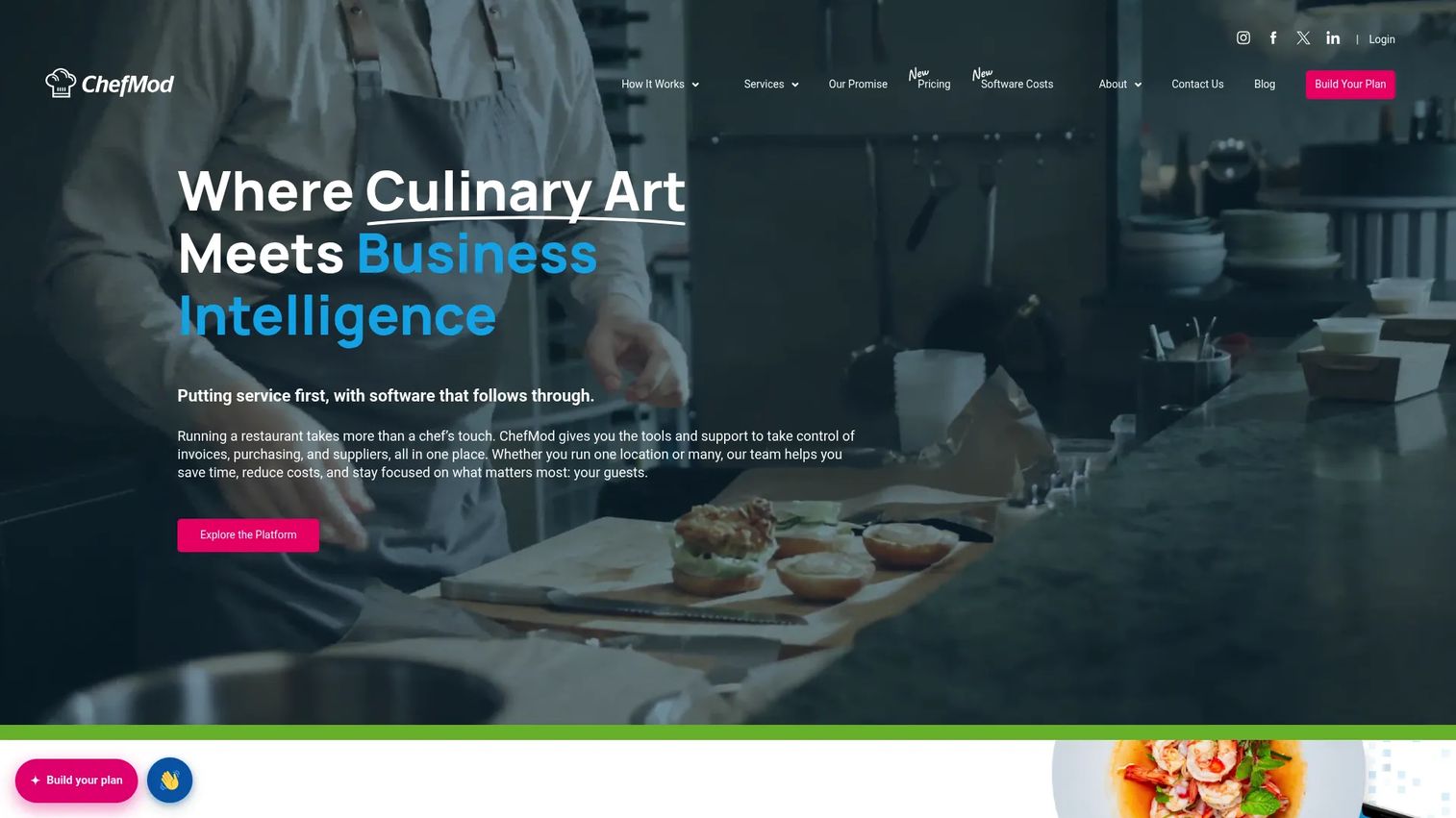
ChefMod is a restaurant procurement and operations platform combining purchasing, invoice automation, inventory, recipe management, analytics, and procurement services. Like Marketman, it operates on the buyer side of the food supply chain. Restaurants and hospitality groups use it to centralize supplier ordering, automate AP workflows, and gain visibility into food spend.
Best for: Single- and multi-location restaurant operators centralizing supplier ordering, invoice automation, and food-cost visibility.
Key features
- Multi-supplier ordering and procurement
- AP automation and invoice capture
- Inventory management and recipe costing
- Financial dashboards and spend reporting
- Mobile ordering and invoice approval
Why choose ChefMod: Frame this as a procurement-side tool. Relevant when foodservice buyers need ordering controls and supplier management rather than a full distributor operating system. Distributors selling to restaurants may encounter buyers using ChefMod.
ChefMod pricing: The Network plan starts at $199 per month per location. Control starts at $299 per month per location. Guided is custom pricing with a dedicated procurement partner. No free tier is listed.
G2 rating: 4.0/5 (3 reviews on G2).
19. Order Time Inventory
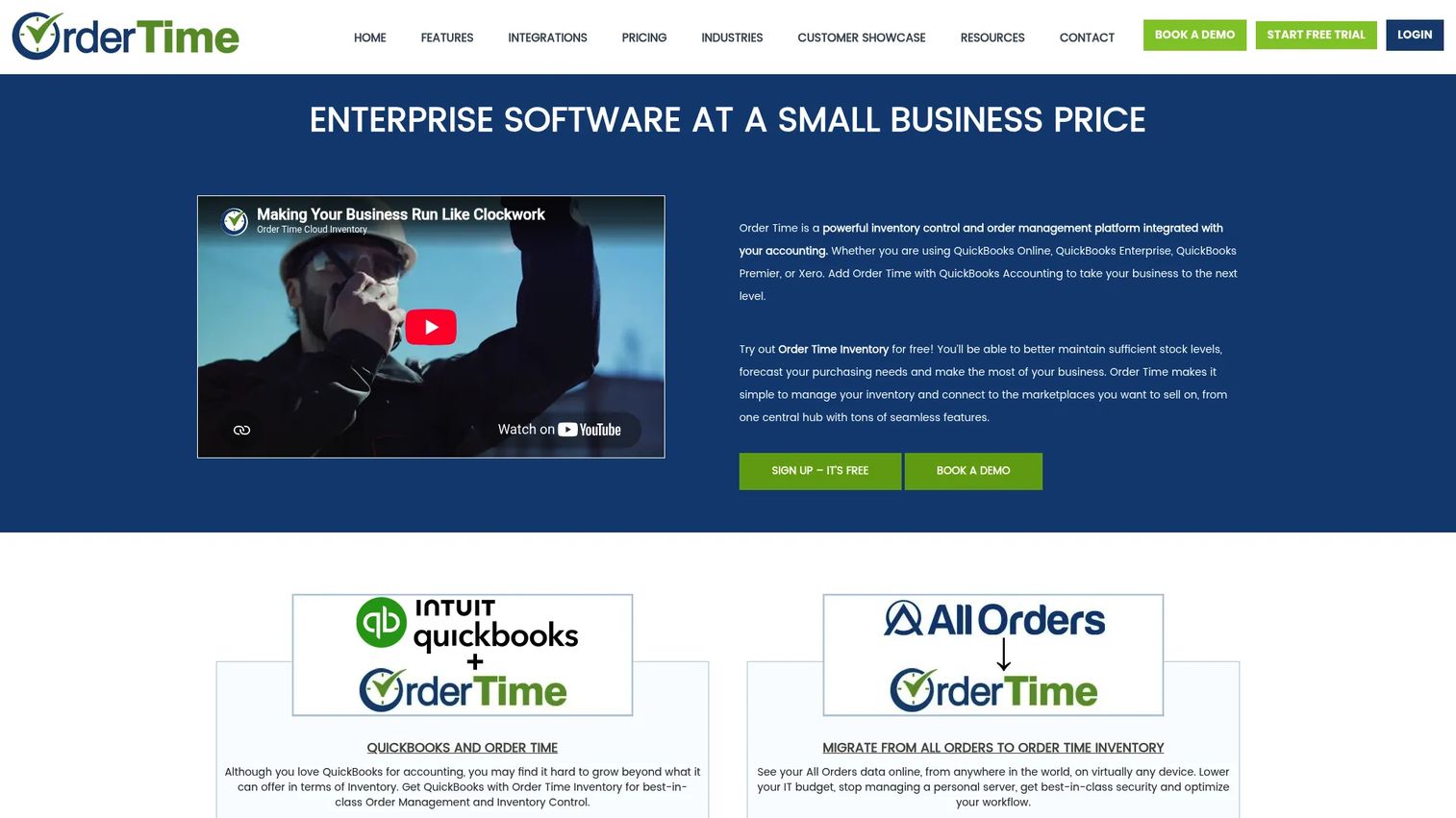
Order Time Inventory is cloud-based inventory and order management software for e-commerce businesses, manufacturers, wholesalers, and product-focused companies. It covers inventory across unlimited locations, order processing, purchasing, warehouse management, lot and serial number tracking, expiry tracking, and accounting integrations with QuickBooks and Xero. A 14-day trial is available.
Best for: Small and mid-sized distributors that need inventory and order control with QuickBooks integration and have outgrown basic accounting add-ons.
Key features
- Inventory management across unlimited locations and SKUs
- Order processing, purchasing, and warehouse management
- Lot, serial-number, and expiry tracking
- Accounting integrations with QuickBooks and Xero
- E-commerce, EDI, B2B portal, and mobile capabilities
Why choose Order Time Inventory: A practical option for growing distributors that need lot tracking and order control without committing to a full food ERP. Confirm whether FEFO picking and catchweight workflows are available before selecting it for perishable food operations.
Order Time Inventory pricing: The Standard plan is $185 per month (2 users) or $2,200 per year. Connected is $320 per month or $3,800 per year with e-commerce, EDI, API, and B2B portal. Professional is $635 per month or $7,600 per year with 8 users. A 14-day trial is available.
20. BlueCart
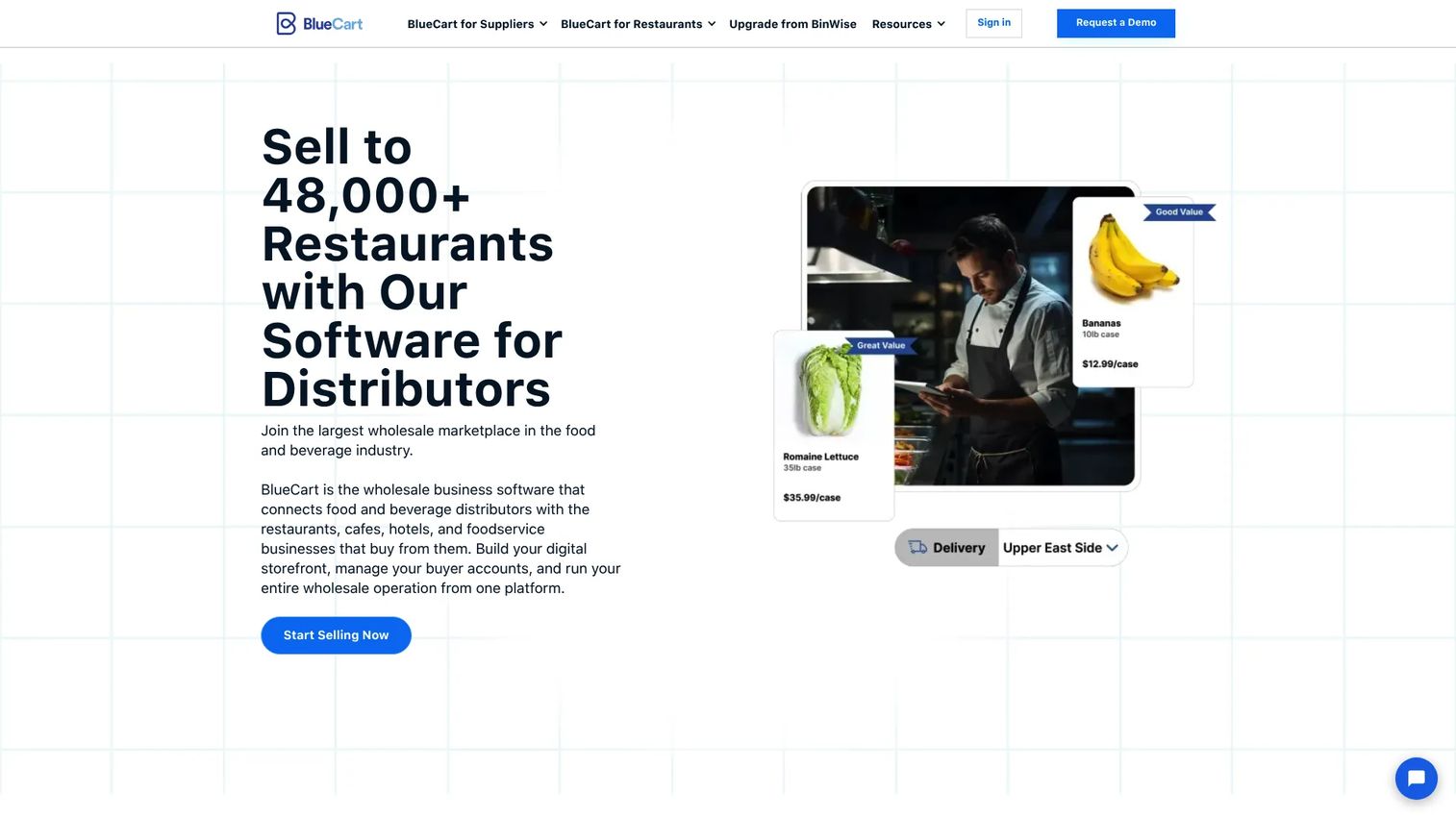
BlueCart is an all-in-one wholesale ecommerce, procurement, order management, inventory, delivery, invoicing, and CRM platform for food, beverage, hospitality, and distribution businesses. Distributors use it to give buyers a branded online storefront with account-specific pricing, manage wholesale orders, and track delivery and invoicing in one place.
Best for: Food suppliers and distributors whose primary bottleneck is order capture and customer self-service rather than warehouse or ERP operations.
Key features
- Buyer-facing ecommerce storefront with per-account pricing
- Wholesale order management, recurring orders, and order tracking
- Inventory management with real-time stock visibility and reorder alerts
- Delivery route management and sales representative mobile app
- Invoicing, payment tracking, and invoice-to-purchase-order matching
Why choose BlueCart: The right starting point when the main pain is order capture: Customers ordering by phone, text, and email, and your team spending hours reconciling requests. Confirm whether it replaces or integrates with your existing ERP.
BlueCart pricing: BlueCart does not display pricing on its website. Contact BlueCart through an order form or sales inquiry to confirm subscription structure and pricing.
21. Now Commerce
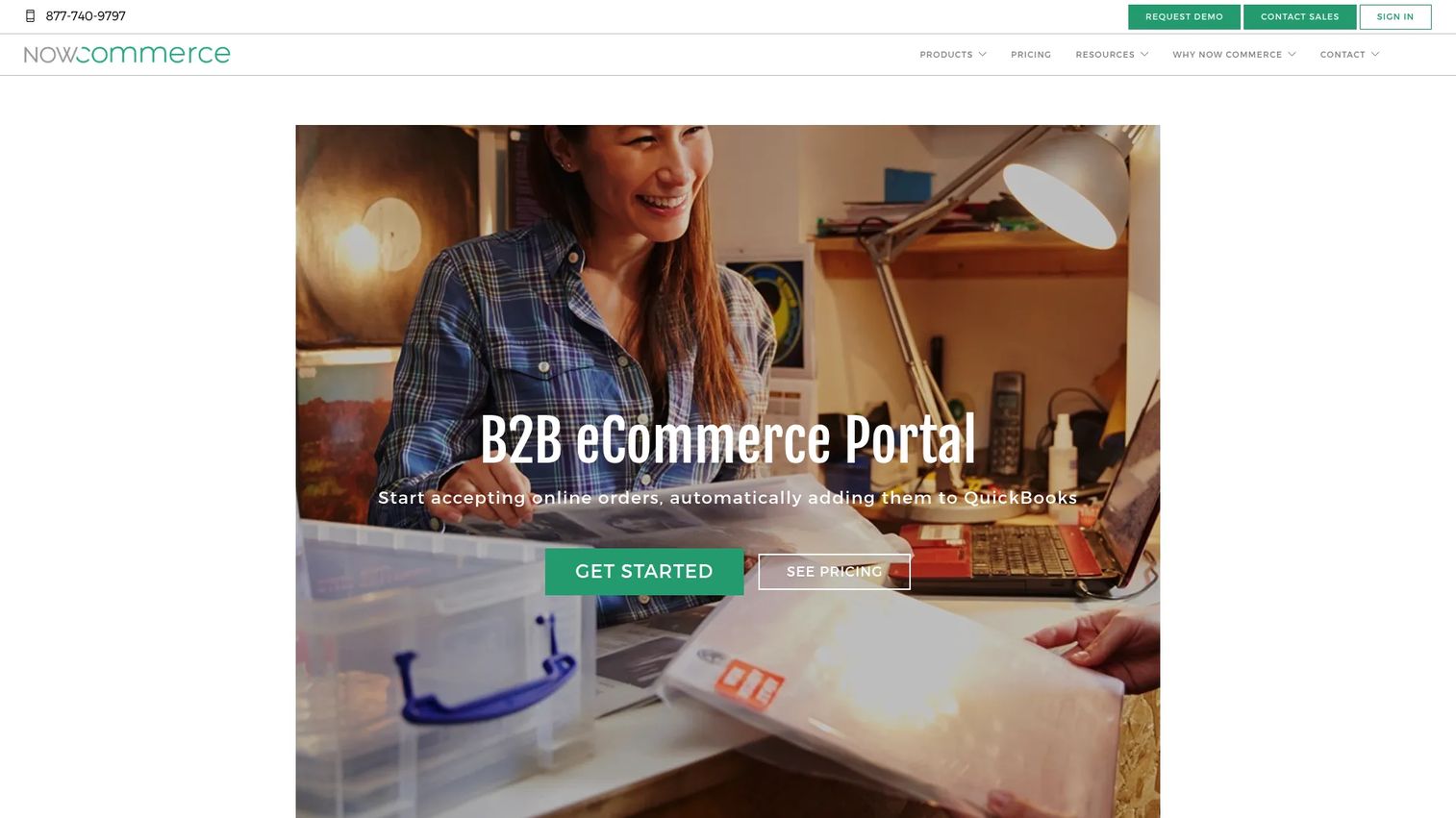
Now Commerce is a B2B eCommerce platform for wholesalers, manufacturers, and distributors that integrates with QuickBooks. It provides a branded B2B customer portal, a Sales Rep Portal for entering orders for assigned accounts, and a Shipments Manager that connects with QuickBooks and warehouse or shipping software. Month-to-month subscriptions and a 30-day free trial are offered.
Best for: Distributors using QuickBooks that want to add customer self-service ordering without replacing their back-office system.
Key features
- Branded B2B customer portal with account-specific products, pricing, and order history
- Sales Rep Portal for account-assigned order entry
- QuickBooks integration and Shipments Manager
- Inventory visibility for customers within the portal
- Customer-facing order status and history
Why choose Now Commerce: An ordering layer for distributors that already have a functioning back-office system but need a better customer-facing buying experience. The QuickBooks integration keeps it accessible for teams already running on that accounting stack.
Now Commerce pricing: The B2B Customer Portal is $280 per month. The Sales Rep Portal starts at $150 per month. Shipments Manager is $200 per month. Subscriptions are month-to-month. A 30-day free trial is available. Contact Now Commerce for teams with more than 20 sales reps.
G2 rating: 2.5/5 on G2.
Considerations when choosing foodservice distribution software
Match the tool to the real bottleneck
Identify whether the actual pain is order capture, inventory accuracy, picking efficiency, purchasing, route planning, proof of delivery, or traceability. A route optimization tool will not fix bad item masters. A full ERP migration will not automatically fix dispatch discipline. Start by mapping which daily workflow causes the most measurable cost before shortlisting platforms.
Verify food-specific inventory controls
Ask vendors to demonstrate lot tracking, expiry date management, catchweight handling, FEFO picking, recall lookup, and audit trails using your actual SKUs and inventory complexity. A feature checkbox on a product page is not the same as a tested workflow. Request a live demonstration with your item catalog before signing.
Check integration depth before signing
Ask about named integrations: Which accounting systems (QuickBooks, Sage, Xero, Microsoft Dynamics), which EDI partners, which warehouse hardware, which route apps, and which customer portals. Confirm who owns the integration during implementation and what ongoing maintenance looks like. Integration failures are the most common cause of food distribution software project delays.
Price the rollout, not just the subscription
Implementation, data migration, training, hardware, custom reports, and change management often exceed the annual subscription cost in the first year. For teams evaluating larger ERP platforms, confirm whether the implementation is fixed-fee or time-and-materials and what a realistic go-live timeline looks like.
Test the workflows your team uses daily
Before selecting any platform, run these scenarios: Standing order with a substitution, short pick on an expiring lot, delivery exception with a credit, route change mid-morning, and a recall lookup by lot number. If the software handles those workflows cleanly during the evaluation, it is likely to hold up in production.
Conclusion
The choice of foodservice distribution software depends on where your operation is actually breaking down.
For delivery execution, RouteMagic, OptimoRoute, Detrack, and Tookan each address route planning and proof of delivery at different price points and operational scales. For full ERP depth with food-specific controls, BFC Software, inecta Food ERP, S2K Enterprise for Food, and Datacor ERP each offer different architecture and investment profiles. Fishbowl, ERPAG, and Order Time Inventory give smaller distributors lighter inventory and order control without a full ERP commitment. BlueCart and Now Commerce address customer ordering and self-service as a focused layer rather than a system replacement. Marketman and ChefMod serve the buyer side of the food supply chain.
Before you book any demos, write down the 10 workflows your current system breaks most often. Then ask every vendor to show those exact workflows using your item, customer, route, and pricing complexity.
That one exercise will cut your shortlist faster than any feature matrix. For more context on adjacent accounting software, advanced planning and scheduling software, and B2B ecommerce platforms that often connect to food distribution stacks, the Guideflow blog covers those categories in detail.
FAQs
Foodservice distribution software manages ordering, inventory, warehouse operations, purchasing, delivery, traceability, invoicing, and customer-specific pricing for food distributors. Some platforms are full ERPs covering finance and operations. Others focus narrowly on routing, ordering, or inventory management.
ERP is the core system of record covering finance, inventory, purchasing, sales, and reporting. Food distribution software is a broader category that includes route planning, proof of delivery, B2B ordering, and WMS tools that may integrate with an ERP or stand alone. Not every food distribution tool is an ERP, and not every ERP handles food-specific workflows out of the box.
Smaller distributors often start with focused inventory, order management, or route tools before committing to a full ERP. Fishbowl, ERPAG, and Order Time Inventory offer accessible entry points for inventory and order control. OptimoRoute and Detrack handle route execution at a per-driver price. Match the tool to the specific workflow that is costing the most time or margin first.
Look for lot tracking, expiry date management, supplier receiving records, shipment history, recall lookup, and audit reports. BFC Software, inecta Food ERP, S2K Enterprise for Food, Entree, and Datacor ERP all claim traceability capabilities. Verify FSMA 204 readiness directly with each vendor rather than treating marketing language as a compliance guarantee.
Route optimization matters when multi-stop delivery, driver scheduling, delivery windows, fuel cost, or missed deliveries are measurably affecting margin. If your ERP and warehouse system are functioning well but delivery exceptions are generating credits and customer complaints, a focused route tool like OptimoRoute or Detrack can address the problem without a broader system change.
Receiving, putaway, picking, replenishment, barcode scanning, cycle counts, catchweight, FEFO, lot tracking, and selector productivity are the core capabilities to evaluate. Test those workflows with real SKUs from your catalog, not sample data. The gap between what a WMS claims and what it actually does with your specific item complexity often shows up in the first live demonstration.
Costs vary significantly by platform type. Full ERP systems for food distributors typically involve licensing, implementation, data migration, and support costs that can run from $50,000 into the hundreds of thousands for the first year. Route and proof-of-delivery tools price by driver, vehicle, or task and can start under $50 per driver per month. B2B ordering platforms range from $150 to $300 per month for smaller teams. Confirm current pricing directly with each vendor before building a budget.
Start with the workflow causing the largest measurable cost. If inventory accuracy and financial data are unreliable, start with ERP or inventory management. If customers are placing orders by phone and email and reconciliation consumes daily hours, prioritize ordering software. If delivery exceptions are generating credits and damaging customer relationships, prioritize route execution and proof of delivery. Buying a large ERP when the actual problem is a broken delivery leg is one of the most common and expensive mistakes in this category.