Your team can ship a feature in two sprints. Connecting it safely to customer data, internal services, and a new region can take considerably longer.
That gap is where virtual private cloud design stops being an infrastructure detail and starts becoming a product constraint. The network architecture is invisible until a launch, an enterprise security review, or a new integration suddenly depends on it.
According to Flexera's 2025 State of the Cloud Report, 70% of organizations run workloads across at least one public and one private cloud. Most are managing that complexity inside a virtual private cloud, or VPC, where they control IP ranges, subnets, routing, and access policies without owning physical infrastructure.
As a PM, you probably won't configure route tables yourself. You will, however, set the requirements that determine whether your engineering team's design holds up when you add a regulated data service, a new enterprise customer, or a second region. That's where this guide matters.
What's inside
This guide is for product managers and technical leads evaluating VPC options across major cloud providers.
- What a VPC is and how logical isolation works
- How VPCs differ from VPNs, private clouds, and public clouds
- Seven cloud provider VPC platforms compared by fit and pricing model
- What PMs should validate before committing engineering time
Tools were selected based on market presence, platform maturity, pricing transparency, and fit across different operating contexts, from early-stage SaaS to regulated enterprise deployments.
TL;DR
- Best overall for broad cloud services: Amazon VPC, for teams already building on AWS who need deep integration with managed databases, Kubernetes, and enterprise connectivity
- Best for global networking: Google Cloud VPC, for organizations that need a single VPC spanning multiple regions
- Best for Microsoft-centric environments: Microsoft Azure Virtual Network, for teams building on Azure identity and compute
- Best for enterprise hybrid-cloud programs: IBM Cloud VPC or Oracle Cloud Infrastructure Virtual Cloud Network, depending on existing enterprise systems and data gravity
- Best for simpler developer deployments: DigitalOcean Virtual Private Cloud, for smaller teams that want private networking without enterprise-scale complexity
What is a virtual private cloud?
A virtual private cloud, or VPC, is a logically isolated network inside a public cloud where an organization controls IP ranges, subnets, routing, access policies, and connections to workloads.
VPC doesn't mean dedicated physical hardware. Think of it like an apartment building: The physical structure is shared, but each tenant controls access to their own space. Your VPC gives your workloads an isolated network boundary within shared cloud infrastructure.
Core VPC components
- CIDR ranges: Define the private IP address space available to the network
- Subnets: Divide workloads by exposure level, function, or environment
- Route tables: Define where network traffic can travel within and beyond the VPC
- Firewalls and security policies: Control which traffic is allowed or denied
- Gateways and NAT services: Connect private workloads to external services without exposing them directly
- DNS and load balancers: Route user requests and service calls reliably
- Peering and private links: Connect networks, cloud services, or on-premises systems privately
VPC vs public cloud, private cloud, and VPN
| Concept | What it is | Best use |
|---|---|---|
| Public cloud | Shared provider infrastructure | Scalable compute, storage, and managed services |
| Virtual private cloud | Isolated tenant-controlled network inside public cloud | Production applications and segmented workloads |
| Private cloud | Dedicated infrastructure for one organization | Strict control or specialized deployment requirements |
| VPN | Encrypted connection between networks or users | Secure remote access or hybrid connectivity |
A VPN is a connection tool, not a hosting environment. Your VPC might use a VPN gateway as one component, but the two serve different roles.
PM takeaway
A VPC becomes a product concern when network decisions affect latency, deployment regions, data access, availability, compliance reviews, or the pace of integration work. Getting requirements right early protects the roadmap from rework later.
When to use a virtual private cloud
Separate public application traffic from private services
Most production SaaS products follow a three-tier pattern: Internet-facing services in public subnets, application logic in private subnets, and databases in fully private subnets. Your job is to define which user flows require public access and which systems must stay private. Engineering handles the routing and firewall configuration from there.
Connect cloud workloads to existing systems
Enterprise customers increasingly require private connectivity to identity providers, data warehouses, or corporate networks. Defining these integration and performance requirements before signing a cloud commitment prevents the architecture from being designed around the wrong constraints. Hybrid-cloud connectivity is much easier to plan than to retrofit.
Prepare for regional expansion or Kubernetes
Adding a second region, a Kubernetes cluster, or an acquired product line after IP ranges are already assigned creates painful rework. Early CIDR planning, environment segmentation, and routing decisions are cheap to get right upfront. They become expensive to undo after services are live.
Virtual private cloud platform comparison
All seven providers below support network isolation, subnets, routing, and private connectivity. The right selection follows current cloud footprint, regional requirements, platform services, operational skill, and cost drivers.
Pricing and G2 ratings verified October 2026 from each provider's official pricing page and G2 listing.
| # | Product | Best for | Key differentiator | Pricing | G2 rating |
|---|---|---|---|---|---|
| 1 | Amazon VPC | AWS-native SaaS platforms | Deep integration with AWS infrastructure services | No charge to create; usage charges apply for NAT gateways, IPv4, endpoints, and data transfer | 4.5/5 |
| 2 | Google Cloud VPC | Global applications and Google Cloud workloads | Global VPC model spanning regions with regional subnets | Usage-based; primarily data transfer charges | 4.5/5 |
| 3 | Microsoft Azure Virtual Network | Microsoft-centric enterprises | Strong fit with Azure identity, compute, and enterprise services | Virtual Network is free; charges apply to peering, gateways, and data transfer | 4.4/5 |
| 4 | IBM Cloud VPC | Regulated and hybrid-cloud enterprise teams | Enterprise infrastructure and IBM Cloud integration | Usage-based (Pay-As-You-Go, Reservations, Enterprise Savings Plan) | N/A on G2 |
| 5 | Oracle Cloud Infrastructure Virtual Cloud Network | Oracle database and enterprise application environments | Tight connection to Oracle Cloud services; 2 VCNs always free | Always Free tier includes 2 VCNs; usage-based for additional services | N/A on G2 |
| 6 | Alibaba Cloud Virtual Private Cloud | Teams operating in Asian cloud regions | Regional cloud footprint and Alibaba Cloud service integration | VPC creation is free; usage charges for peering, flow logs, and traffic mirroring | 4.2/5 |
| 7 | DigitalOcean Virtual Private Cloud | Smaller engineering teams and focused deployments | Simple private networking in a developer-focused environment | VPC networks are free; NAT gateways start at $40/month per size increment | 4.6/5 |
Best virtual private cloud platforms for 2026
1. Amazon VPC
Amazon VPC is the networking layer for the entire AWS cloud. Every resource you launch on AWS, whether EC2 instances, RDS databases, Lambda functions, or EKS clusters, sits inside a VPC. It gives teams configurable IP ranges, subnets, routing, and access controls across multiple Availability Zones.
Best for: Product teams whose architecture already depends on AWS services and needs granular control over network segmentation, private connectivity, and enterprise-grade isolation.
Key features
- Custom CIDR blocks and subnets across Availability Zones
- Route tables, internet gateways, and NAT gateways
- Security groups and network ACLs
- VPC peering and Transit Gateway for multi-VPC connectivity
- VPC Flow Logs for traffic monitoring and application security testing
Why choose Amazon VPC: It fits teams that need to support varied environments, private service access, enterprise security reviews, and a growing AWS footprint. The flexibility creates real architectural choices, which means teams need clear ownership for IP planning, routing, and cost controls.
Amazon VPC pricing: AWS charges nothing to create or use a VPC itself. Costs appear in NAT gateways, public IPv4 address use, traffic mirroring, IP Address Manager (IPAM), private endpoints, and data transfer out. Plan the bill around those components, not the VPC itself.
G2 rating: 4.5/5
2. Google Cloud VPC
Google Cloud VPC uses a global network model that differs from most other providers. A single VPC spans regions, while subnets remain regional. That design means you're managing one network across all your Google Cloud projects and regions rather than separate regional VPCs stitched together.
Best for: Product organizations expecting multi-region workloads, data pipelines, or Kubernetes environments that benefit from a globally scoped network without per-region VPC overhead.
Key features
- Global VPC architecture with regional subnets and CIDR expansion
- VPC Flow Logs for traffic analysis and observability
- Shared VPC for multi-project governance and centralized management
- Configurable firewall rules and packet mirroring
- Cloud VPN and Cloud Interconnect for private connectivity
Why choose Google Cloud VPC: The global model reduces networking fragmentation for teams operating across projects and regions. It pairs well with GKE (Google Kubernetes Engine) and BigQuery workloads. Product teams still need disciplined ownership for project structure, IAM permissions, and cost attribution across projects.
Google Cloud VPC pricing: Pricing ties primarily to data transfer leaving Google Cloud resources. In-network traffic within the same zone is free. New customers receive $300 in credits, but budget planning should use standard transfer rates rather than credits as a baseline. Verify current transfer rates on the Google Cloud VPC pricing page before committing to a region strategy.
G2 rating: 4.5/5
3. Microsoft Azure Virtual Network
Microsoft Azure Virtual Network, commonly called Azure VNet, is Microsoft's VPC-equivalent networking layer. It connects Azure virtual machines, managed services, and on-premises environments through private IP ranges, subnets, and access controls. VNet integrates directly with Microsoft Entra ID, Azure Kubernetes Service, and the broader Azure application and data portfolio.
Best for: Product teams selling into Microsoft-heavy enterprise environments or building products on Azure identity, data, and application services.
Key features
- Regional virtual networks with subnets and private IP ranges
- Network security groups for traffic control at subnet and NIC level
- VNet peering over the Microsoft backbone
- VPN Gateway and ExpressRoute for hybrid connectivity
- Private Link and private endpoints for secure service access
Why choose Microsoft Azure Virtual Network: Azure VNet is the natural fit when the company already runs on Azure compute, Microsoft 365, or enterprise systems tied to Microsoft infrastructure. Implementation can become complex across multiple subscriptions and hub-and-spoke topologies, so ownership boundaries need documenting early in the architecture process. Enterprise customers often require ExpressRoute connectivity during security reviews, which is worth scoping before architecture is locked in. For related context on cloud compliance tools, that guide covers security governance across cloud environments.
Microsoft Azure Virtual Network pricing: Azure Virtual Network has no direct charge. Costs arise from VNet peering, VPN gateways, Application Gateway, NAT gateways, public IP addresses, and data transfer. Peering fees in particular can add up across subscriptions, so model that cost explicitly before committing to a hub-and-spoke design.
G2 rating: 4.4/5
4. IBM Cloud VPC
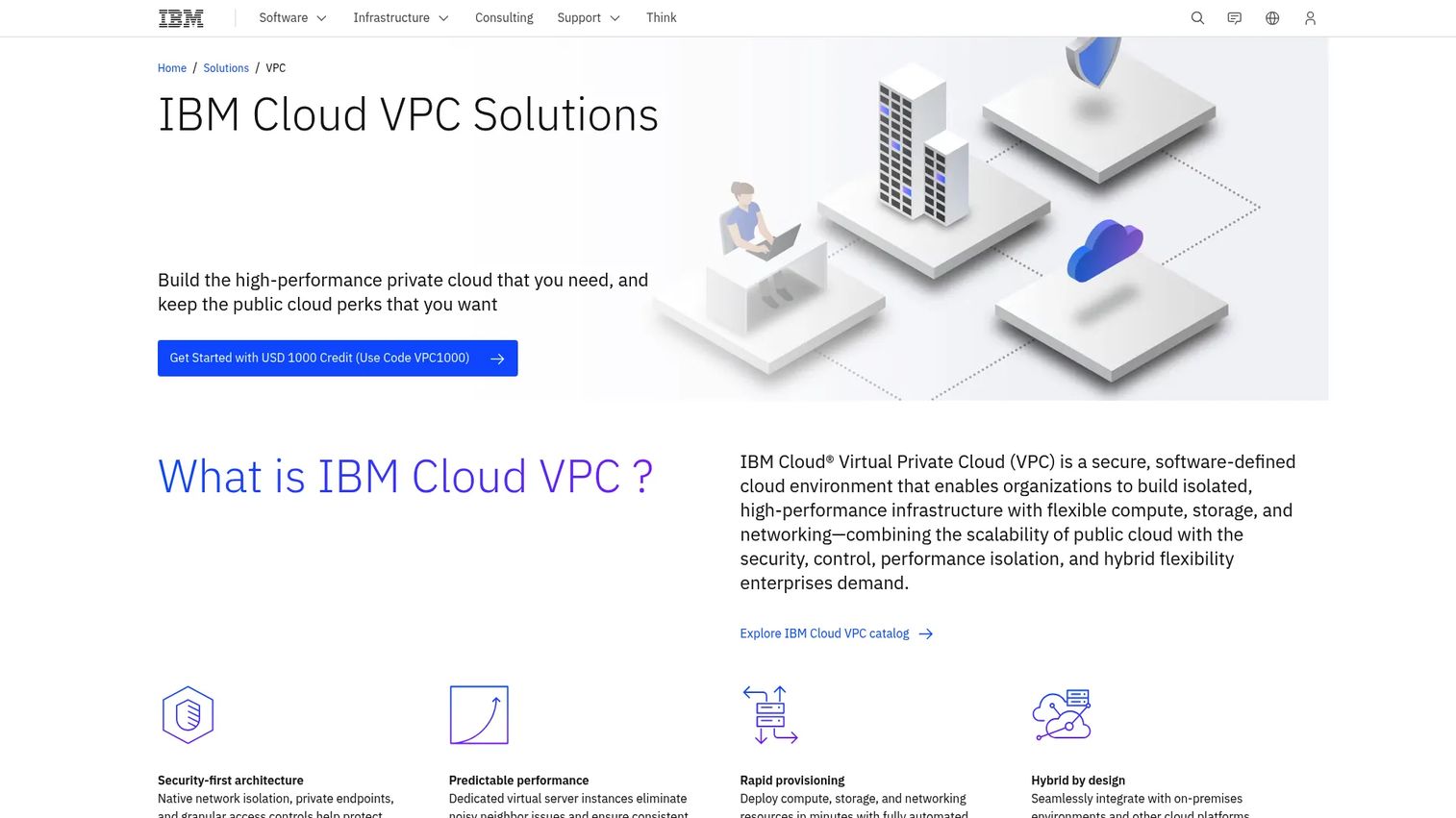
IBM Cloud VPC provides isolated compute, storage, and networking for enterprise teams running regulated workloads, hybrid-cloud programs, or infrastructure tied to IBM agreements. It supports virtual servers, bare-metal instances, GPU compute, and managed storage within a software-defined private network that connects to on-premises systems and other cloud environments.
Best for: Enterprise product teams that need to align cloud architecture with IBM Cloud services, existing IBM procurement relationships, or hybrid infrastructure programs.
Key features
- Secure networking with subnets, security groups, and network ACLs
- Flexible virtual server, bare-metal, GPU, and storage options
- Managed application and network load balancing
- Integrated observability with built-in logging and metrics
- Hybrid connectivity to on-premises and other cloud environments
Why choose IBM Cloud VPC: Evaluate IBM Cloud VPC when enterprise infrastructure, procurement cycles, data location requirements, or hybrid patterns already point toward IBM. It fits AI, HPC, SAP, and regulated-workload scenarios where IBM Cloud's infrastructure depth matters. For teams without an existing IBM footprint, the opportunity cost of learning a new platform is worth factoring into the build-versus-buy calculation.
IBM Cloud VPC pricing: IBM uses usage-based pricing across three models: Pay-As-You-Go (billed monthly), IBM Cloud Reservations (1- or 3-year terms), and an Enterprise Savings Plan for committed usage. No standard starting price is listed for VPC networking alone. Use the IBM Cloud cost estimator to model expected charges for compute, storage, load balancing, and egress before setting a launch budget.
5. Oracle Cloud Infrastructure Virtual Cloud Network
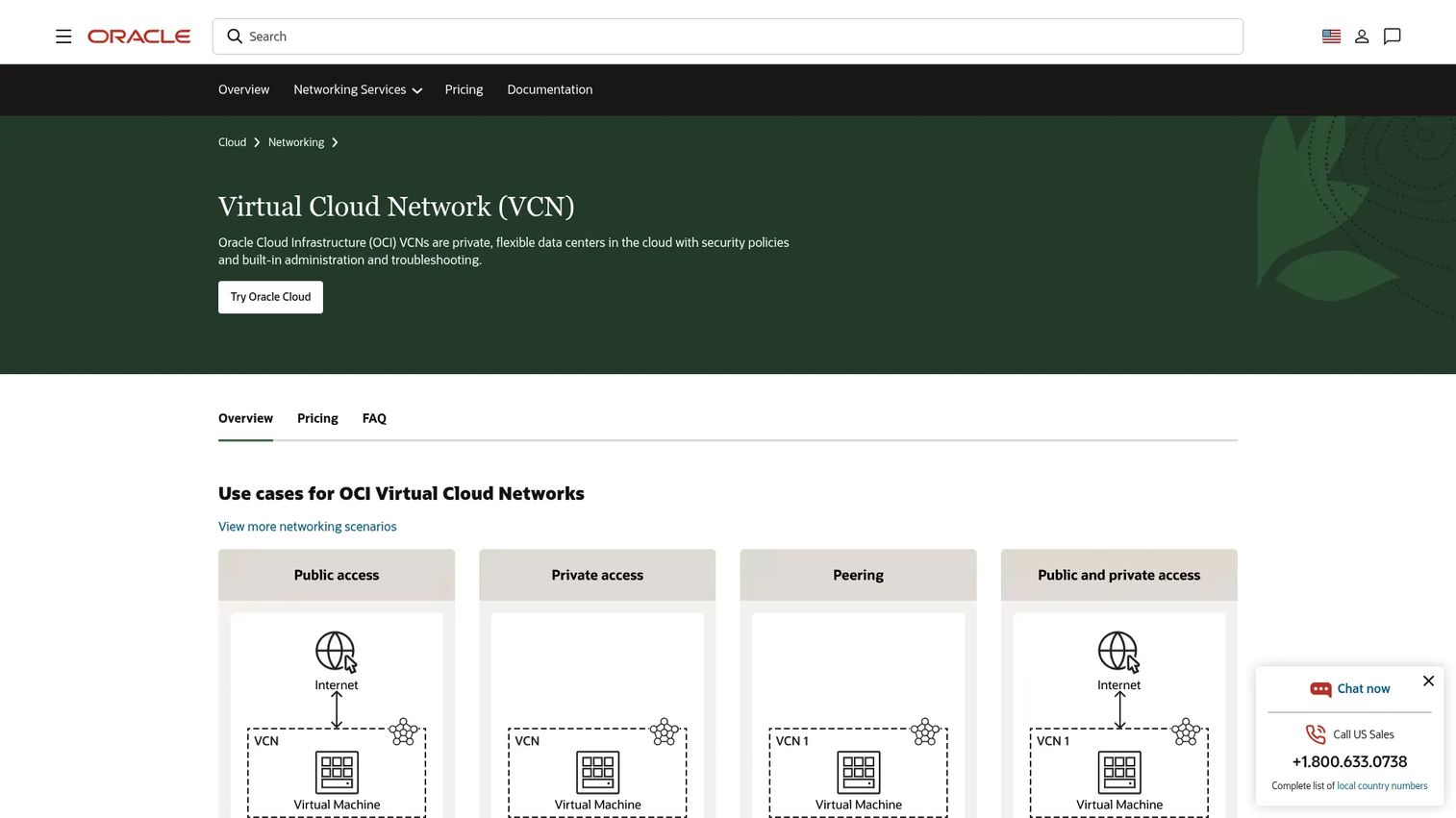
Oracle Cloud Infrastructure Virtual Cloud Network (OCI VCN) is Oracle's VPC-equivalent offering. It provides software-defined networking for Oracle Cloud workloads, with configurable security rules, gateways, routing, and network troubleshooting tools built into the platform.
Best for: Product teams with Oracle database dependencies, Oracle enterprise application integrations, or established OCI usage that want networking tightly connected to Oracle's managed services.
Key features
- Public and private subnets with IPv4 and IPv6 support
- Security lists and network security groups for policy control
- Network Visualizer, Network Path Analyzer, flow logs, and packet inspection
- Internet, NAT, service, dynamic routing, and peering gateways
- FastConnect private connectivity for hybrid-cloud scenarios
Why choose Oracle Cloud Infrastructure Virtual Cloud Network: OCI VCN is the right call when the database, enterprise application, or commercial relationship already centers on Oracle. The best decisions here come from workload adjacency and data gravity, not network feature comparison alone. OCI's Always Free tier includes two VCNs, plus site-to-site VPN with up to 50 IPSec connections and 10 TB of public internet egress per month, which meaningfully reduces evaluation costs. For related reading on cloud cost optimization software, that guide covers tools for managing cloud spend across providers.
Oracle Cloud Infrastructure Virtual Cloud Network pricing: Oracle's Always Free tier includes two VCNs at $0, plus $0 for intraregion data movement. Site-to-site VPN is also Always Free. Additional networking services and resources beyond the free tier use usage-based pricing. Verify current per-region egress rates and gateway charges on Oracle's official pricing page before committing to architecture.
6. Alibaba Cloud Virtual Private Cloud
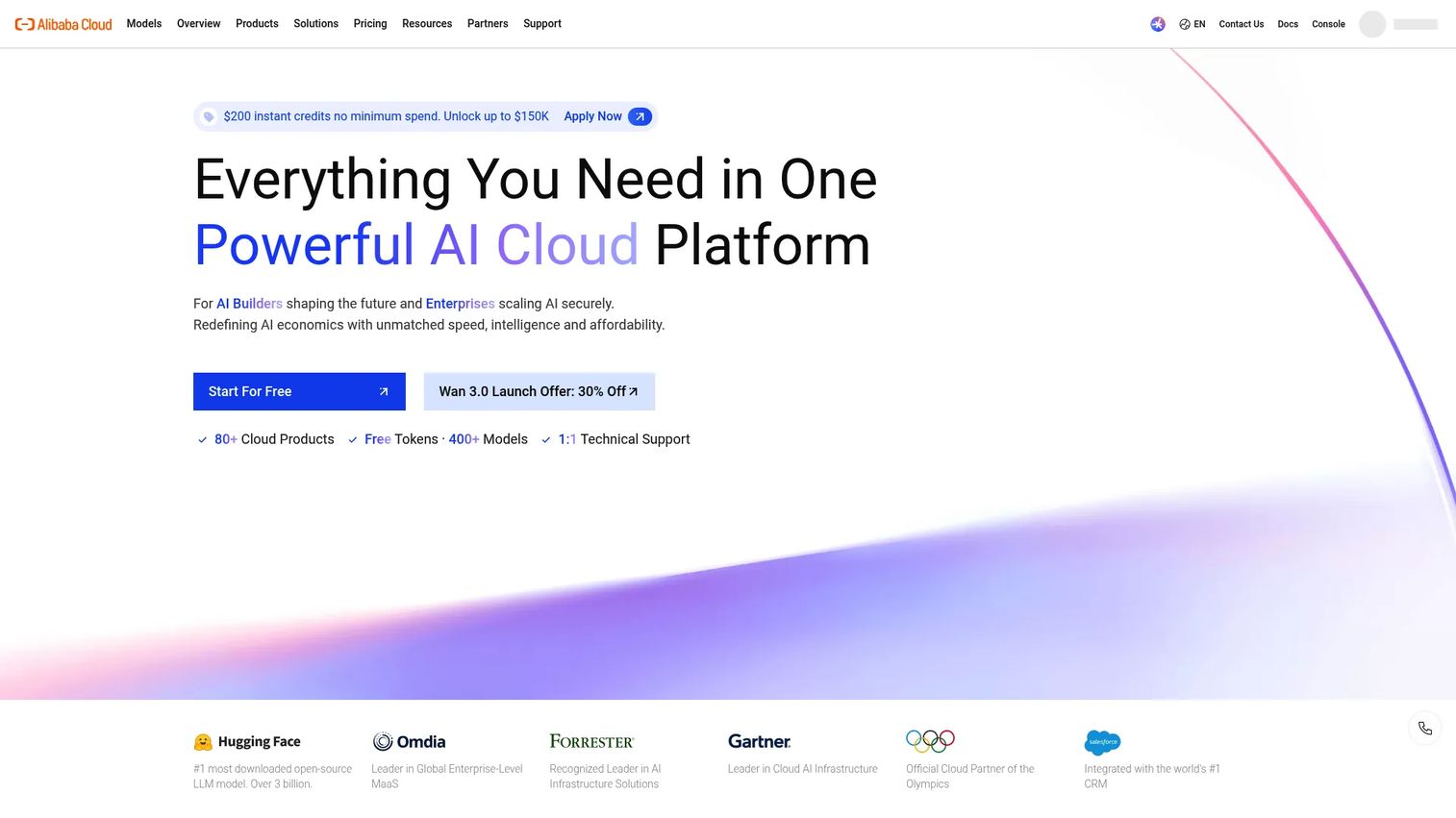
Alibaba Cloud Virtual Private Cloud provides logically isolated cloud networking for workloads deployed on Alibaba Cloud. It uses vSwitches to segment subnets across availability zones, with route tables, network ACLs, and multiple connectivity options for hybrid and multi-VPC scenarios.
Best for: Teams operating in markets where Alibaba Cloud is already part of the infrastructure strategy, particularly where regional cloud footprint and local data requirements drive provider selection.
Key features
- Logically isolated VPCs with CIDR-level network isolation
- vSwitches for subnet segmentation across availability zones
- Route tables and network ACLs for traffic control
- VPN Gateway, Express Connect, and Cloud Enterprise Network for connectivity
- Flow logs, traffic mirroring, IPAM, and IPv4/IPv6 gateway support
Why choose Alibaba Cloud Virtual Private Cloud: VPC creation on Alibaba Cloud is free, and the platform's regional footprint in mainland China and across Asia-Pacific makes it a practical fit when customer location or market-entry plans point there. It's not a substitute for AWS, Azure, or Google Cloud when those providers already anchor the architecture. The decision should follow your customers' geography and your team's operational experience with the platform. For context on banking as a service software and similar regulated verticals where regional cloud presence matters, that guide covers infrastructure considerations in financial services.
Alibaba Cloud Virtual Private Cloud pricing: The VPC itself is free. Charges apply to VPC peering connections, flow logs, traffic mirroring, and related cloud resources. Data transfer costs vary by region. Verify current rates on Alibaba Cloud's official VPC billing documentation for your specific regions before estimating monthly spend.
G2 rating: 4.2/5
7. DigitalOcean Virtual Private Cloud
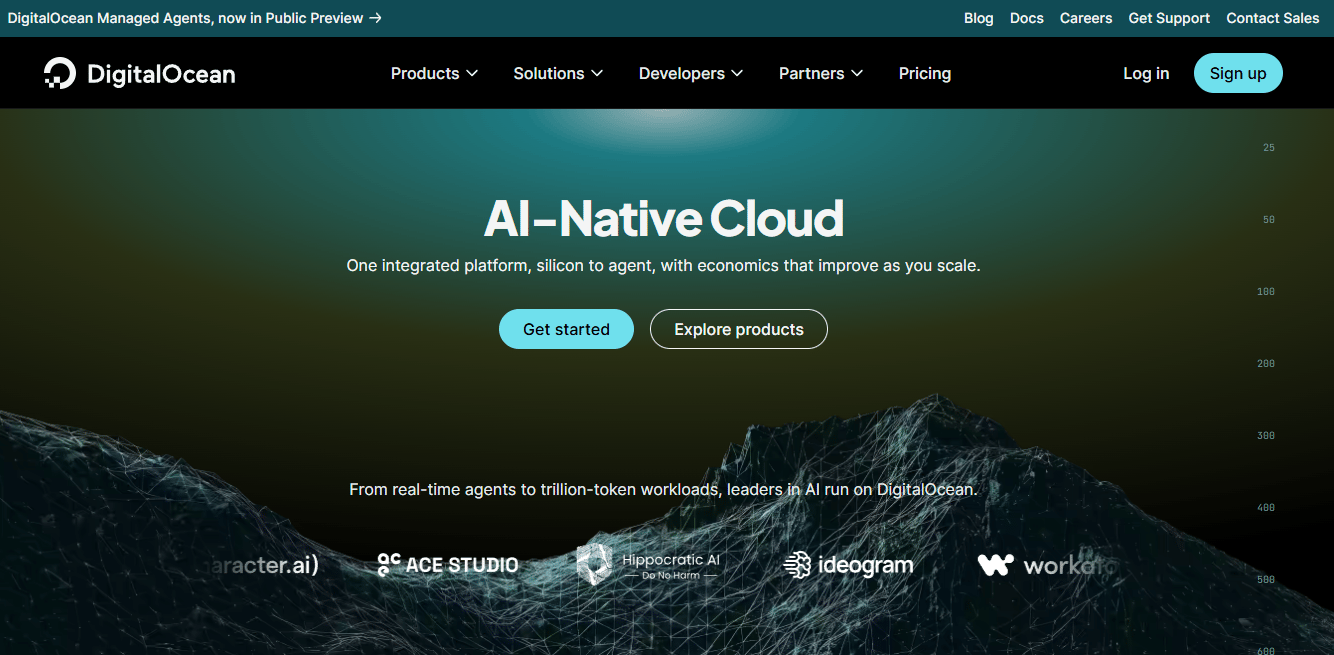
DigitalOcean Virtual Private Cloud offers private networking in a developer-focused cloud environment. It lets Droplets, managed databases, Kubernetes clusters, and load balancers communicate privately within an isolated IP range, without exposing traffic to the public internet.
Best for: Small SaaS teams and product organizations that want private network isolation around focused workloads without enterprise-scale networking complexity.
Key features
- Private network isolation from the public internet and other VPC networks
- Custom IP ranges, cloud firewalls, and VPC peering
- NAT gateways for private outbound internet connectivity
- Support for Droplets, managed databases, Kubernetes, and load balancers
- Regional VPC deployment with a developer-focused console
Why choose DigitalOcean Virtual Private Cloud: The platform's operational model fits teams that want clear pricing, fast setup, and managed services that stay within a predictable cost envelope. Teams planning deep hybrid connectivity, advanced global networking, or highly customized enterprise controls should evaluate whether DigitalOcean's service range covers those requirements before committing. For early-stage product teams, the lower operational overhead leaves more engineering time for the product itself. For adjacent reading, the guide on best onboarding flow software covers activation tooling that pairs with a stable cloud foundation.
DigitalOcean Virtual Private Cloud pricing: VPC networks carry no network charge. Cross-datacenter VPC peering costs $0.01/GiB. NAT gateways start at $40/month per size increment and include 100 GiB of outbound transfer monthly. Partner Network Connect starts at $840/month for a 1 Gbps attachment. Compute, load balancers, and managed database charges are separate and apply to resources inside the VPC.
G2 rating: 4.6/5
Considerations when choosing a virtual private cloud platform
Match the provider to the workload, not the feature checklist
Ask where the product runs today, where it must run next, and which managed services create the most dependency. A VPC on the same provider as your database, identity service, and observability stack reduces integration work. Picking a second provider for networking alone usually creates more problems than it solves.
Plan IP ranges before environments multiply
Confirm CIDR allocation for production, staging, development, future regions, and private connections before any environment is built. Renumbering after services go live requires coordinated downtime and engineering time. The change data capture software guide covers related data-layer considerations when environments are being restructured.
Separate product requirements from implementation choices
Your job is to define constraints: Customer data boundaries, regional requirements, availability targets, expected traffic, and private connectivity needs. Engineering determines the specific routing, firewall rules, and gateway configuration. Mixing those two sets of decisions in the same conversation slows both down.
Model the non-compute bill
A VPC itself often carries little or no direct charge. Real costs accumulate in NAT gateways, VPN connections, private endpoints, peering fees, public IP addresses, load balancers, and data egress. Model those line items explicitly before setting a launch budget. For guidance on cost management tooling, the cloud cost optimization software guide covers spend governance options across providers.
Define ownership and change management
Network changes should have clear owners, release controls, and documentation. This matters most when a product team adds a new service, changes an integration partner, or rolls out to an additional region. Undocumented network changes are the most common source of availability incidents in fast-shipping SaaS teams.
Conclusion
The right virtual private cloud platform follows your existing cloud footprint, not a features comparison in isolation.
Amazon VPC is the strongest choice for AWS-native products that need deep service integration, varied environments, and enterprise connectivity. Google Cloud VPC fits teams that want a single global network and benefit from Google's managed data and Kubernetes services. Microsoft Azure Virtual Network is the natural fit for Microsoft-centric enterprise environments.
IBM Cloud VPC and Oracle Cloud Infrastructure Virtual Cloud Network suit specific enterprise and hybrid-cloud contexts where data gravity or commercial relationships already point toward those providers. Alibaba Cloud Virtual Private Cloud matters when regional cloud strategy and customer location require it. DigitalOcean Virtual Private Cloud works for focused developer-centric deployments where operational simplicity and predictable pricing matter more than enterprise networking depth.
Before your next architecture conversation becomes a provider debate, turn it into a requirements review first. Define customer data boundaries, regional needs, availability targets, and connectivity requirements. Give engineering something specific to design against, rather than an open-ended provider selection.
According to IDC and Nutanix's Hybrid Cloud Directions report (2025), 88% of cloud buyers are already operating or deploying hybrid cloud. VPC design is infrastructure. Getting the requirements right before architecture is locked in is a product decision.
Start your journey with Guideflow today!
FAQs
A virtual private cloud is a private, logically isolated network inside a public cloud provider. The organization controls its own network boundaries, IP addresses, subnets, routes, and access policies without owning the physical infrastructure underneath.
VPC stands for virtual private cloud. It refers to a private network environment created within a public cloud platform, where the tenant controls the networking layer rather than sharing it with other customers.
A VPC is the cloud network itself, the isolated environment where your workloads run. A VPN is an encrypted connection that can link users, on-premises networks, or cloud networks together. A VPN gateway can be one component inside a VPC design, but the two concepts are not interchangeable.
No. A VPC uses shared public-cloud infrastructure with logical isolation at the network layer. A private cloud typically uses dedicated physical infrastructure for a single organization. The isolation in a VPC is software-defined, not hardware-enforced.
VPCs let SaaS companies segment customer-facing workloads from internal systems, keep databases private, control which services can communicate with each other, and meet enterprise security review requirements. They also support hybrid connectivity to corporate networks and provide a reliable foundation for production environments. Related context on application security testing software covers the security tooling layer that often sits on top of a VPC.
Most providers don't charge directly for creating a VPC. Costs come from the services and traffic inside it: NAT gateways, VPN connections, private endpoints, VPC peering, public IP addresses, load balancers, and data egress. Amazon VPC, Azure Virtual Network, Google Cloud VPC, Alibaba Cloud VPC, and DigitalOcean VPC all have free-tier VPC creation. Oracle Cloud includes two Always Free VCNs.
The right number follows application architecture, traffic exposure, availability zones, environment boundaries, and expected growth. A standard three-tier application separates web-facing, application-layer, and database workloads into distinct subnets. Adding multiple availability zones multiplies that count per tier. Plan for future regions, new services, and acquired products when allocating CIDR ranges.
The best choice usually follows existing cloud commitments, workload requirements, regional needs, integration dependencies, and projected data-transfer costs. Teams on AWS should use Amazon VPC. Teams on Google Cloud benefit from its global VPC model. Azure VNet fits Microsoft-centric environments. IBM and Oracle suit teams with existing enterprise relationships in those platforms. DigitalOcean fits smaller teams prioritizing operational simplicity. For additional context on cloud infrastructure tooling, the guide on call center infrastructure software covers adjacent platform decisions in a similar decision framework.