

Your dashboards are eight hours stale. The nightly batch job finished at 3 a.m., and the head of ops is looking at yesterday's numbers to make today's decision.
Most teams treat this as a scheduling problem. Run the batch more often. Add another cron job. But every full reload hammers the source database, holds locks, and pushes gigabytes across the network that barely changed since the last run.
That is the real problem. Not freshness. Load and blast radius.
Change data capture software solves it by reading only what changed, the inserts, updates, and deletes, and delivering those changes downstream in near real time. The global CDC software market was valued at $3.2 billion in 2025 and is forecast to reach $9.8 billion by 2034 at a 14.8% CAGR, according to MarketIntelo (2025). That growth is not hype. It tracks a shift toward real time analytics and cloud data warehousing that batch pipelines cannot serve.
For presales engineers, data teams, and technical buyers, choosing a CDC tool is rarely just a feature comparison. It shows up in security review, architecture diagrams, and the awkward moment when someone asks how deletes and schema changes get handled. This guide is built to help you pick a change data capture solution you can defend in front of engineering and operations.
What's inside
This guide is for data engineers, analytics engineers, platform teams, and technical GTM buyers comparing CDC tools in 2026. We picked the seven tools below on criteria that matter in production, not on marketing polish.
Selection criteria:
- Capture method and delivery semantics: log-based, trigger-based, or polling, plus how it handles ordering and retries
- Source and target compatibility: which databases, warehouses, and streaming layers it connects
- Schema evolution and delete handling: how it propagates DDL and represents deletes
- Pricing and operational complexity: what it costs and what it takes to run
The list covers both open-source and managed options so you can match the tool to your operational tolerance.
TL;DR
- Best open-source choice: Debezium, for teams that want log-based CDC with Kafka-first flexibility
- Best managed all-around option: Fivetran, for teams that want low-maintenance replication into warehouses
- Best for self-hosted control: Airbyte, for teams that want open-core flexibility and tiered pricing
- Best for real-time streaming: Striim, for teams that need low-latency replication with in-stream processing
- Best for AWS-first migrations: AWS Database Migration Service, for teams already standardizing on AWS
- Best for Google Cloud-first pipelines: Google Cloud Datastream, for teams syncing into BigQuery, Cloud SQL, or Spanner
- Best enterprise replication platform: Qlik Replicate, for teams with heterogeneous sources and targets
What is change data capture software
Change data capture software is a system that monitors source databases for inserts, updates, and deletes, then delivers those row-level changes to downstream systems in near real time.
End to end, a CDC pipeline does four things. It monitors the source, usually by reading the database transaction log. It captures each row-level change with before and after state. It applies optional transforms, masking, or validation. Then it delivers the change to a warehouse, a data lake, Kafka, or an application.
The word CDC in database contexts usually means one of several methods. They differ in latency, source load, and operational complexity.
- Log based CDC: reads the transaction log (WAL, binlog, redo). Lowest source load, near real time, handles deletes cleanly
- Trigger based CDC: database triggers write changes to a shadow table. Simple to reason about, adds write overhead
- Query based CDC: polls tables on an interval. Easy to start, can miss intermediate changes
- Timestamp based CDC: filters rows by a modified-at column. Simple, but struggles with hard deletes
- Snapshot based CDC: takes a full point-in-time copy, often for the initial load or backfill
- Hybrid: combines an initial snapshot with ongoing log-based streaming
Delivery semantics matter as much as capture. Exactly once or idempotent delivery keeps downstream tables from double-counting on retries. Deletes need explicit representation, often as tombstones or soft-delete flags, or they silently drift out of sync.
| Method | Latency | Source load | Complexity |
|---|---|---|---|
| Log based | Near real time | Low | Medium |
| Trigger based | Near real time | Medium | Medium |
| Query based | Interval | Medium to high | Low |
| Timestamp based | Interval | Low to medium | Low |
| Snapshot based | Batch | High | Low |
When to use change data capture software
Keep analytics fresher
Nightly batch means every decision runs on yesterday's data. CDC feeds real time analytics, operational reporting, and near-real-time BI by streaming changes as they happen. When a CDC pipeline replaces a batch job, dashboards reflect the last few minutes rather than the last full run. That gap matters for revenue ops, inventory, and anything a human refreshes and acts on immediately.
Sync systems without full reloads
Cloud migration and hybrid sync rarely tolerate downtime or repeated full copies. Incremental replication moves only what changed, which cuts source load and network transfer sharply. During a database cutover, CDC keeps the target in sync with the source until you flip traffic. The same pattern powers ongoing hybrid setups where an on-prem system and a cloud warehouse must stay aligned.
Support operational intelligence
Some decisions cost money when the data is late. Fraud detection, alerting, workflow automation, and customer 360 all rely on fresh state. CDC feeds these operational intelligence systems the moment a record changes, not on the next batch. A fraud rule that fires eight hours late is not a fraud rule. Streaming change events keeps the decision layer current.
Comparison table
The table below compares each CDC tool by primary method, best fit, key differentiator, pricing, and G2 rating. Use it to shortlist two or three, then read the profiles for the production detail. Pricing and ratings reflect verified vendor and G2 data at the time of writing.
| # | Product | Best for | Key differentiator | Pricing | G2 rating |
|---|---|---|---|---|---|
| 1 | Debezium | Open-source, Kafka-centered teams | Log-based CDC into Kafka Connect | Open source, free | Not listed |
| 2 | Fivetran | Managed warehouse replication | 700+ managed connectors | Free plan; usage-based paid | 4.4/5 |
| 3 | Airbyte | Self-hosted or managed control | 600+ connectors, open-core | Free; paid from $29/mo | 4.4/5 |
| 4 | Striim | Real-time streaming and CDC | In-stream SQL processing | Free developer tier; contact sales | 5.0/5 |
| 5 | AWS Database Migration Service | AWS-first migrations | Near-zero-downtime migration | Usage-based; free tier | 4.1/5 |
| 6 | Google Cloud Datastream | Google Cloud pipelines | Serverless CDC into BigQuery | Usage-based from $2.00/GiB | Not listed |
| 7 | Qlik Replicate | Heterogeneous enterprise systems | Broad source/target support | Contact sales | 4.3/5 |
Debezium leads for teams building custom pipelines, while managed options lower the operational load if you would rather not run the plumbing yourself.
Best change data capture software for 2026
1. Debezium
Debezium is an open-source distributed platform for log-based CDC. It reads the transaction log of databases like PostgreSQL, MySQL, SQL Server, MongoDB, and Oracle, then streams row-level changes as events. It runs on Kafka Connect by default, and Debezium Server or the embedded library let you route changes to other sinks. If your architecture is event-driven and Kafka is already central, Debezium fits naturally.
Best for: Engineering teams comfortable owning Kafka who want open-source log-based CDC into event streams.
Key strengths
- Log-based CDC into Kafka Connect
- Captures inserts, updates, deletes, snapshots, incremental snapshots
- Filters, masking, JMX monitoring, and SMTs
- Debezium Server and embedded library options
Why choose Debezium: It gives you full control over the capture layer and represents deletes and tombstones explicitly, which matters for correct downstream state. It suits teams that want to own operations rather than outsource them to a managed service.
Debezium pricing: Debezium is open source and free to use. There is no paid tier or license fee; your cost is the infrastructure and operational time to run it.
2. Fivetran
Fivetran is a managed data movement platform that syncs sources into cloud warehouses with minimal upkeep. It handles log-based CDC and automated schema adjustments, so pipelines keep running when source tables change. With 700+ fully managed connectors, it fits analytics teams doing warehouse loading and SaaS data consolidation without wanting to maintain pipeline infrastructure.
Best for: Analytics teams that want managed replication into a warehouse with as little pipeline maintenance as possible.
Key strengths
- 700+ fully managed connectors
- 15-minute syncs on Standard, 1-minute on Enterprise
- Automated schema drift handling
- Role-based access control and REST API
Why choose Fivetran: You trade hands-on control for speed and low upkeep. Teams pick it when engineering time is the scarce resource and the priority is reliable warehouse loading over custom routing.
Fivetran pricing: A free plan is available. Paid plans (Standard, Enterprise, Business Critical) use usage-based pricing billed monthly or annually, with pricing examples shown on the pricing page and detailed quotes through sales. Fivetran holds a 4.4/5 rating on G2.
3. Airbyte
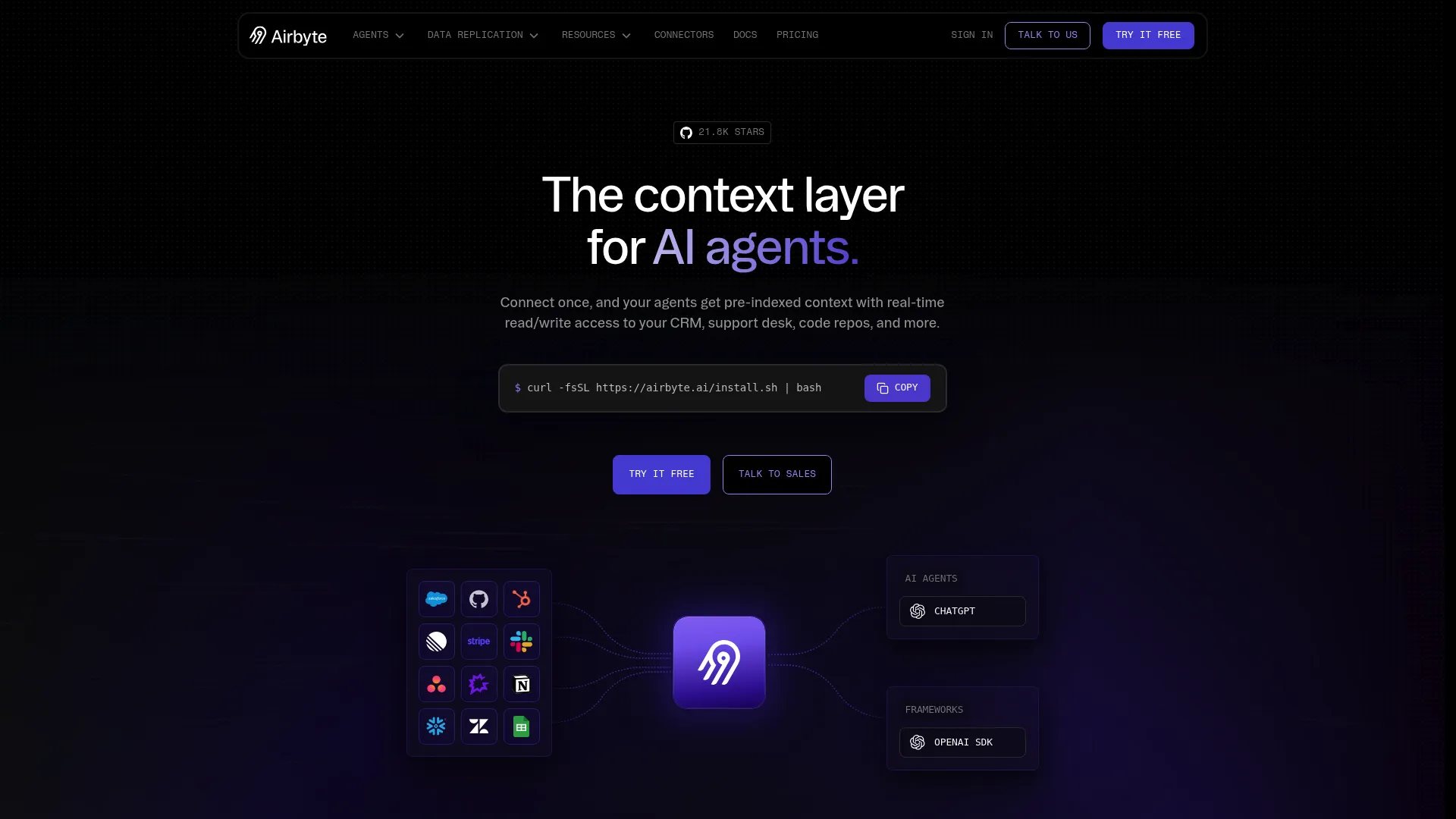
Airbyte is an open-source data integration platform with 600+ connectors and native CDC support. It offers both self-hosted and managed cloud deployment, so you choose where the infrastructure lives. Schema propagation, column selection, and a Connector Builder give data teams configurable pipelines into warehouses, lakes, databases, and AI applications.
Best for: Data teams that want open-core flexibility and the choice between self-hosting and a managed plan.
Key strengths
- 600+ connectors with CDC support
- Schema propagation and column selection
- Airbyte API, Terraform provider, PyAirbyte
- SSO and multiple workspaces
Why choose Airbyte: Self-hosting is the better fit when you need data to stay inside your own environment or want to avoid per-row managed costs. The managed tiers exist for teams that would rather not run the control plane.
Airbyte pricing: Core is always free and self-managed. Cloud plans include a Free tier at $0/month, Individual at $29/month, and Team at $299/month, with Pro and Enterprise Flex on custom pricing. Airbyte holds a 4.4/5 rating on G2.
4. Striim
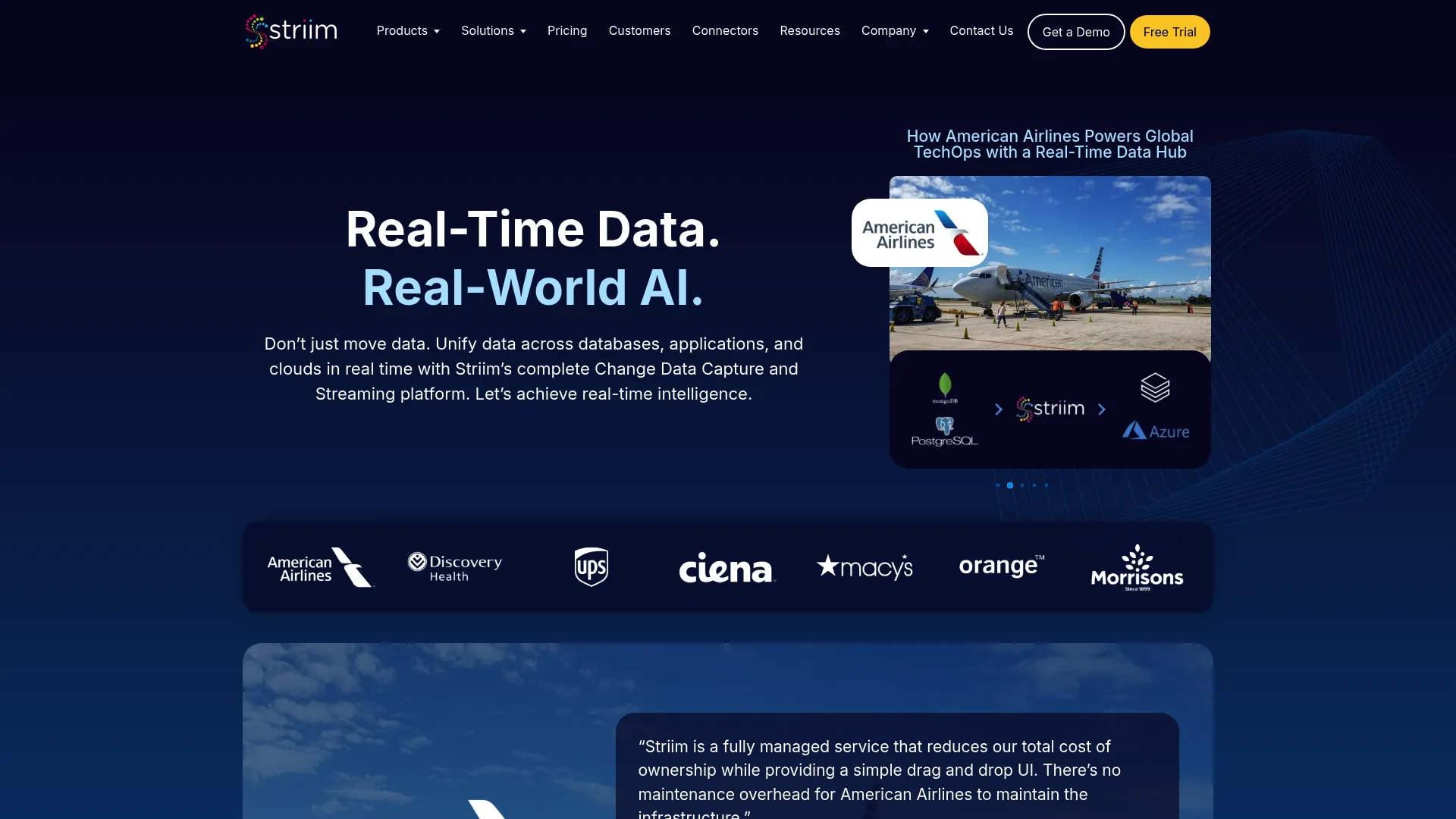
Striim is a real-time data integration and streaming platform built around CDC and low-latency delivery. What sets it apart is in-stream processing: you can filter, transform, and enrich change events with SQL while they move, before they land. That suits operational analytics and hybrid architectures where the data has to be both fast and shaped on the way through.
Best for: Enterprises that need low-latency CDC plus in-stream processing across cloud and on-prem systems.
Key strengths
- Automated real-time data pipelines
- Serverless stream processing with SQL
- Change data capture and real-time ingestion
- Cross-cloud and on-prem source support
Why choose Striim: It excels where simple replication is not enough and you need to process data mid-stream. That in-flight SQL layer is the reason teams choose it over pass-through replication tools.
Striim pricing: Striim Developer is free. Striim Cloud and Striim Platform use contact-sales custom pricing. Striim holds a 5.0/5 rating on G2, based on a small number of reviews.
5. AWS Database Migration Service
AWS Database Migration Service is a managed AWS service for migrating and continuously replicating databases with minimal downtime. It supports both homogeneous and heterogeneous migrations, so you can move Oracle to PostgreSQL or keep like-for-like. Ongoing CDC replication keeps the target in sync during a cutover, which is why AWS-first teams shortlist it first for migration-heavy work.
Best for: Teams already standardizing on AWS that need low-downtime database migration and replication.
Key strengths
- Homogeneous and heterogeneous migration support
- Near-zero-downtime, zero-data-loss migration
- Secure with IAM, SSL/TLS, and Secrets Manager
- Ongoing CDC replication during cutover
Why choose AWS DMS: It is the natural pick when your source or target already lives in AWS and you want the migration path inside the same account and IAM model. Cross-cloud and heterogeneous patterns are both supported.
AWS DMS pricing: Pricing is usage-based. On-demand replication instances and additional log storage are billed by usage, and serverless is billed by capacity used. A free tier applies to some capabilities. AWS DMS holds a 4.1/5 rating on G2.
6. Google Cloud Datastream
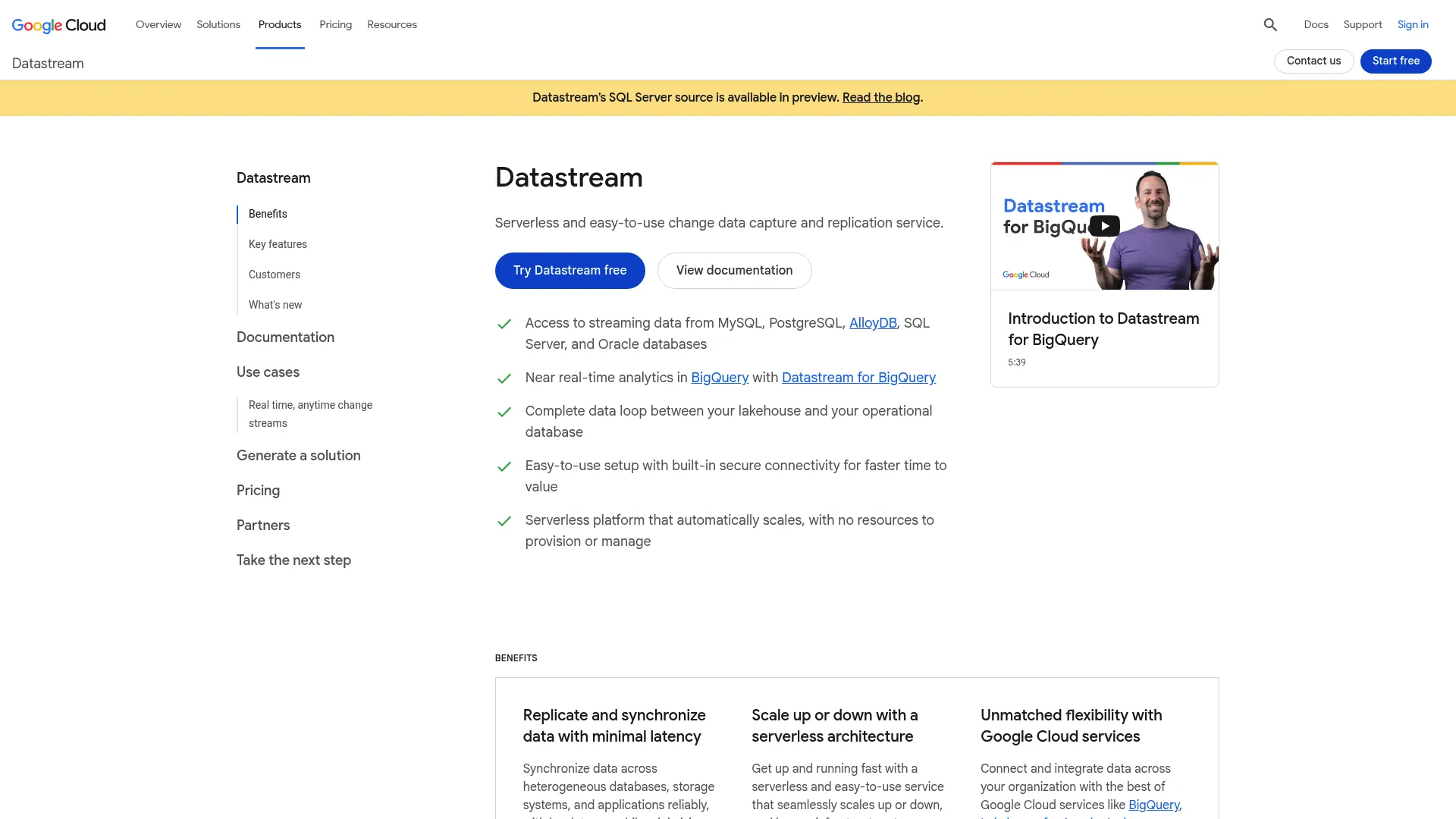
Google Cloud Datastream is a serverless CDC and replication service. It streams change events from MySQL, PostgreSQL, AlloyDB, SQL Server, and Oracle into BigQuery, Cloud SQL, Cloud Storage, and Spanner. The serverless, auto-scaling design means there is no cluster to size, which fits Google Cloud-native warehouses and operational sync.
Best for: Google Cloud-centric teams syncing operational databases into BigQuery and other Google Cloud services.
Key strengths
- Streams from MySQL, PostgreSQL, AlloyDB, SQL Server, Oracle
- Loads into BigQuery, Cloud SQL, Cloud Storage, Spanner
- Serverless, auto-scaling architecture
- Secure private connectivity
Why choose Datastream: It is the low-operational choice when your analytics live in BigQuery and you want CDC without managing infrastructure. Source and target support is scoped tightly to the Google Cloud ecosystem.
Datastream pricing: Datastream is usage-based. CDC is tiered by monthly data processed, starting at $2.00 per GiB and dropping to $0.80 per GiB at higher volumes. Backfill is free for the first 500 GiB each month. A perpetual free tier applies to eligible AlloyDB and Spanner sources up to 100 GiB of CDC data per month.
7. Qlik Replicate

Qlik Replicate is enterprise data replication software for moving, synchronizing, and streaming data across databases, warehouses, cloud, and hybrid systems. It uses log-based CDC and supports a broad matrix of sources and targets, which is why large orgs with mixed estates often land here. Load, ingest, migrate, distribute, consolidate, and synchronize all run from one platform.
Best for: Enterprises with heterogeneous sources and targets that need reliable, low-impact replication and CDC.
Key strengths
- Log-based change data capture
- Load, ingest, migrate, distribute, consolidate, synchronize
- Broad source and target support
- Cross-database, cloud, and streaming targets
Why choose Qlik Replicate: It fits regulated operations and heterogeneous environments where you need one platform spanning many database and warehouse types. The breadth of connectors is the main reason enterprises consolidate on it.
Qlik Replicate pricing: Qlik does not publish a public numeric price for Qlik Replicate; pricing is handled through sales. Qlik Replicate holds a 4.3/5 rating on G2.
Considerations
1. Source and target compatibility
Map your actual database and destination stack before you evaluate anything else. List every source (PostgreSQL, MySQL, Oracle, SQL Server, MongoDB) and every target (warehouse, lake, Kafka, or a specific cloud service). A tool that does not cleanly support one critical source is off the list, no matter how good the rest looks.
2. Latency and delivery semantics
Decide how fresh the data must be and how the tool guarantees correctness. Near-real-time delivery is common, but exactly once or idempotent semantics are what keep downstream tables from double-counting on retries. Not every CDC product handles deletes and retries the same way, so check the exact behavior rather than the marketing line.
3. Snapshot, backfill, and recovery support
Initial loads and resyncs matter as much as steady-state streaming. Check how the tool takes a snapshot backfill, how it resumes after a restart, and what happens when a connector falls behind. After a cutover or a schema change, you will need a clean resync path that does not require rebuilding the whole pipeline by hand.
4. Schema drift and delete handling
Schema drift causes real production pain. Confirm how the tool propagates DDL, handles new or dropped columns, and represents hard deletes, whether as tombstones or soft-delete flags. A pipeline that silently drops deletes or breaks on a new column will corrupt downstream state quietly, which is the worst way to find out.
5. Security, governance, and operations
Weigh encryption, RBAC, auditability, and alerting against long-term maintainability. A tool that clears security review but demands constant manual intervention will cost you later. Match the operational model, managed or self-hosted, to the team that has to run it every day.
Conclusion
The right CDC tool depends on your stack and your operational tolerance, not on a single leaderboard. Debezium fits open-source, Kafka-centered teams that want to own the capture layer. Fivetran suits analytics teams that want managed warehouse replication with minimal upkeep. Airbyte gives open-core control with a choice between self-hosting and managed cloud. Striim excels when you need real-time streaming with in-stream processing.
For cloud-native teams, AWS Database Migration Service and Google Cloud Datastream keep CDC inside your existing AWS or Google Cloud account. Qlik Replicate covers heterogeneous enterprise estates where one platform must span many source and target types.
Start with source compatibility, then narrow by latency needs and delivery semantics, then weigh operational complexity against your team's capacity. Shortlist two or three from the table above, run a proof of concept with your real schema and your real delete and backfill patterns, and pick the one you can defend in front of both engineering and operations.
FAQs
Change data capture is the practice of incrementally tracking inserts, updates, and deletes as they happen in a database. Instead of copying the whole table repeatedly, CDC captures only the row-level changes, usually by reading the transaction log. Those changes are then delivered to downstream systems in near real time.
Batch ETL copies data on a schedule, often nightly, and frequently reloads large slices of a table. CDC streams only what changed, which keeps data fresher and puts far less load on the source. Batch still makes sense when downstream freshness of minutes or seconds does not matter and simplicity is worth more than latency.
Log based CDC usually scales better because it reads the transaction log without adding write overhead to the source. Trigger based CDC can be simpler to reason about on systems where log access is restricted or unavailable. The right choice depends on source-specific constraints, so check what your database actually exposes.
Good CDC tools represent deletes explicitly, often as tombstones or soft-delete flags, so downstream tables stay accurate. Schema changes are handled through DDL propagation, though the depth of that support varies by tool. Always confirm how a specific product handles hard deletes and column changes before you commit.
Focus on source and target compatibility, latency and delivery semantics, snapshot backfill and recovery, schema drift and delete handling, security, and cost. Map your real stack first, then test the exactly once or idempotent behavior against your own retry patterns. Operational complexity should match the team that will run it.
Yes. CDC is common for freshness-sensitive dashboards and operational reporting because it streams changes as they occur rather than on a batch schedule. It feeds warehouses like BigQuery, streaming layers like Kafka, and APIs that need current state. Anything a human refreshes and acts on immediately benefits from it.
No. Kafka is a common destination and works well for event-driven architectures, but it is not mandatory. Managed tools deliver changes straight into warehouses or cloud services without a streaming layer in between, and some CDC products offer connector or destination options that skip Kafka entirely.
Yes. CDC is a core part of low-downtime migration. You take an initial snapshot, then use ongoing change capture to keep the target in sync with the source until you cut over traffic. That incremental sync is also what powers hybrid setups where an on-prem system and a cloud target must stay aligned. As a practical example, database migration and continuous replication are among the most common CDC examples in production today.