Insurance carriers don't have a data shortage. They have a decision shortage.
Underwriting wants a pricing change. Claims needs a triage rule. Finance needs a portfolio answer before the board meeting. Each team pulls from a different system, formats it differently, and produces a number nobody else can reconcile.
Dashboards alone don't fix this. A model that sits in a reporting layer doesn't change what underwriters approve or how adjusters route claims. The useful tool has to connect analysis to an operating workflow, so the output lands where someone can act on it.
86% of insurers surveyed by Reuters Events (The Future of Insurance USA, 2025) invested in data analytics in the prior 12 months. Most are still figuring out which category of tool to buy. The global insurance analytics market reached $19.3 billion in 2025 and is projected to hit $54.54 billion by 2034, according to Fortune Business Insights (2026).
The decision that matters most: Do you need a broad analytics foundation, or one product that fixes the workflow costing you the most margin?
What's inside
- A comparison of 10 insurance analytics software tools for 2026
- Selection criteria covering core-system integration, model governance, workflow fit, and implementation scope
- Tool recommendations for claims, fraud detection, pricing, underwriting, property risk, and enterprise reporting
- A buyer checklist for founders and insurance leaders who need a clear path from data to operating decisions
- Pricing guidance that explains commercial drivers rather than repeating "contact sales"
TL;DR
- Best for Guidewire-centered P&C operations: Guidewire Analytics, for insurers that need underwriting and claims insights inside core workflows
- Best for governed enterprise analytics: SAS Viya, for large carriers with mature data science teams and regulatory requirements
- Best for insurance data and embedded reporting: Majesco Analytics Platform, for teams standardizing analytics across core operations
- Best for claims fraud automation: Shift Technology or FRISS, depending on whether the priority is AI decisioning or broader trust workflows across policy and claims
- Best for pricing and underwriting modernization: Akur8 or Earnix, for insurers replacing manual rate modeling and long deployment cycles
What is insurance analytics software?
Insurance analytics software collects, prepares, models, and analyzes insurance data so carriers, MGAs, reinsurers, and brokers can make better underwriting, pricing, claims, fraud, risk, and portfolio decisions.
The category is wider than it first appears. A fraud detection product and a catastrophe risk platform are both "insurance analytics software," but they solve completely different problems. Here's how the landscape breaks down:
Core capabilities to look for:
- Data integration: Connect policy, claims, billing, geospatial, and third-party data into a common foundation
- Predictive analytics: Score risks, forecast loss severity, prioritize claims, identify fraud patterns
- Business intelligence: Produce dashboards, operational alerts, and benchmarking reports
- Decisioning: Push model outputs directly into underwriting, claims, or investigation workflows
- Model governance: Track explainability, validation history, audit trails, and regulatory documentation
- Insurance-specific data: Add property hazard scores, catastrophe models, cyber exposure, or market benchmarks
Category boundaries worth clarifying:
- Enterprise analytics suites (SAS Viya): Broad platforms requiring a data science team to configure and run
- Core-suite analytics (Guidewire Analytics, Majesco, Duck Creek): Analytics built into or tightly connected to policy and claims administration systems
- Fraud and investigation tools (Shift Technology, FRISS, DataWalk): Specialized products focused on detecting and managing fraudulent activity
- Pricing and underwriting engines (Akur8, Earnix): Purpose-built for actuarial modeling, rate deployment, and pricing governance
- Risk intelligence providers (Verisk): Proprietary data and models for property, catastrophe, and portfolio exposure
Buying the wrong category costs you twelve months and a failed implementation. Use the comparison table below to identify which class of tool matches your most expensive workflow before shortlisting vendors.
When to use insurance analytics software
Improve underwriting and pricing decisions
Rating inconsistency across product lines and underwriting teams is usually a data problem disguised as a people problem. When actuarial analysis lives in spreadsheets, rate changes take weeks to deploy, and nobody can test a new model against historical portfolio data before going live. A pricing and underwriting analytics platform shortens that cycle and makes model governance auditable.
Triage claims and detect fraud earlier
Claims analytics tools prioritize which files need adjuster attention first, surface suspicious relationships in the data, and standardize investigation workflows. The goal is shorter manual review queues and more consistent claim-level decisions, not removing human judgment from escalation decisions.
Consolidate reporting across insurance operations
Leadership cannot reconcile underwriting, claims, billing, and finance data fast enough for board reporting when each system produces its own extract. A shared analytics layer, with common data definitions, lineage, and role-based access, gives the CFO and COO a version of the truth they can actually agree on.
Insurance analytics software comparison
These 10 tools do different jobs. A carrier with a fragmented data foundation may need a broad platform first. A team losing margin through fraud often gets faster ROI from a specialist product.
| # | Product | Best for | Key differentiator | Pricing | G2 rating |
|---|---|---|---|---|---|
| 1 | Guidewire Analytics | P&C insurers on Guidewire core | Embedded analytics across underwriting, claims, and cyber risk | Contact for quote | 4.7/5 |
| 2 | SAS Viya | Enterprise analytics and AI governance | Model management, explainability, and multi-environment deployment | Contact for quote | 4.3/5 |
| 3 | Majesco Analytics Platform | Core-platform analytics and BI | Insurance data lakehouse with embedded dashboards and GenAI | Contact for quote | 3.0/5 |
| 4 | DataWalk | Fraud investigations and entity analysis | Graph analytics connecting people, claims, payments, and providers | Contact for quote | 4.7/5 |
| 5 | Shift Technology | Claims automation and fraud detection | AI decisioning for claims triage and fraud workflows | Contact for quote | 4.0/5 |
| 6 | FRISS | Insurance fraud and trust automation | Scoring and case management across policy and claims | Contact for quote | Not listed |
| 7 | Verisk Insurance Analytics | Property, catastrophe, and portfolio risk | Proprietary insurance data assets and risk intelligence | Contact for quote | 4.1/5 |
| 8 | Akur8 | Pricing and underwriting teams | Transparent actuarial pricing with GLMs and GAMs | Contact for quote | Not listed |
| 9 | Earnix | Enterprise pricing and decisioning | Real-time rating engine with scenario testing and governance | Contact for quote | Not listed |
| 10 | Duck Creek Technologies | Cloud-native P&C core systems | Analytics connected to policy, billing, and claims operations | Contact for quote | 4.6/5 |
Pricing verified October 2026 from each vendor's pricing page or sales contact page. G2 ratings sourced from current G2 listings.
Best 10 insurance analytics software tools for 2026
1. Guidewire Analytics
Guidewire Analytics is a portfolio of analytics products built for property and casualty insurers. It covers predictive modeling, property risk data, cyber exposure analytics, and near-real-time business intelligence, all connected to Guidewire's core policy and claims systems. The value proposition is that analytics appear where underwriters and claims teams already work, rather than sitting in a separate reporting environment that nobody checks.
Best for: P&C insurers already invested in Guidewire core products that want analytics embedded in daily underwriting and claims workflows.
Key features
- Embedded analytics in underwriting and claims workflows
- Predictive model building, importing, deployment, and monitoring
- Property hazard risk scoring via HazardHub data
- Cyber risk modeling and exposure analytics
- Curated P&C datasets and insurance-ready data models
Why choose Guidewire Analytics: The integration advantage is strongest when your insurer has an established Guidewire footprint. Without that foundation, you're evaluating an analytics layer that requires a core-system investment first.
Guidewire Analytics pricing: Guidewire does not publish tier prices. Contract value reflects modules selected, core-product footprint, deployment scope, data usage, and implementation requirements. Contact Guidewire for a quote.
G2 rating: 4.7/5 (based on Guidewire Predict, an Analytics portfolio product, per G2).
2. SAS Viya
SAS Viya is a unified data and AI platform that covers data management, machine learning, model governance, business rules, and real-time event detection. For insurers, it supports fraud and financial crime analytics, actuarial modeling, regulatory reporting, and enterprise-scale AI deployment. Think of it less as a point product and more as an operating environment for a mature data science organization.
Best for: Large carriers with dedicated data science resources, high governance requirements, and multiple analytics use cases spanning departments.
Key features
- Model development workbench supporting SAS, Python, R, and REST APIs
- Explainable AI with audit trails and model governance controls
- Fraud and financial crime analytics
- Cloud, hybrid, and on-premises deployment
- Business rules and real-time decisioning engine
Why choose SAS Viya: This fits teams that can support model development, validation, and ongoing operations. If your insurer lacks a model-ops team, a more focused insurance product will reach a first operating result faster.
SAS Viya pricing: SAS offers four named tiers (SAS Viya, SAS Viya Advanced, SAS Viya Enterprise, and SAS Viya Programming), plus pay-as-you-go options. No prices appear on the SAS website. Contract value varies by users, compute, deployment model, data volume, and solution modules.
G2 rating: 4.3/5 per G2.
3. Majesco Analytics Platform
Majesco Analytics Platform is an insurance-focused data and analytics layer that provides a cloud-native data lakehouse, embedded business intelligence, operational dashboards, GenAI capabilities, and the Majesco Copilot. It is built for P&C and life, annuity, and health insurers that want common data definitions across policy, billing, and claims without building a custom data architecture from scratch.
Best for: Insurers consolidating operational reporting around a modern core insurance environment and looking for embedded analytics as part of a broader platform strategy.
Key features
- Cloud-native data lakehouse unifying internal and external sources
- Embedded BI with pre-built dashboards and real-time telemetry
- GenAI and Majesco Copilot across insurance workflows
- Property intelligence integration
- Claims recovery and subrogation analytics
Why choose Majesco Analytics Platform: This makes sense when analytics is one component of a multi-year insurance modernization program. Teams buying only a reporting fix may find the implementation scope larger than the problem warrants.
Majesco Analytics Platform pricing: Majesco directs prospects to request information rather than publishing tier prices. Contract value reflects product modules, lines of business, cloud deployment, and integration requirements. The G2 rating for Majesco Business Analytics is 3.0/5, based on two reviews, so treat that figure as limited signal.
G2 rating: 3.0/5 per G2 (2 reviews).
4. DataWalk
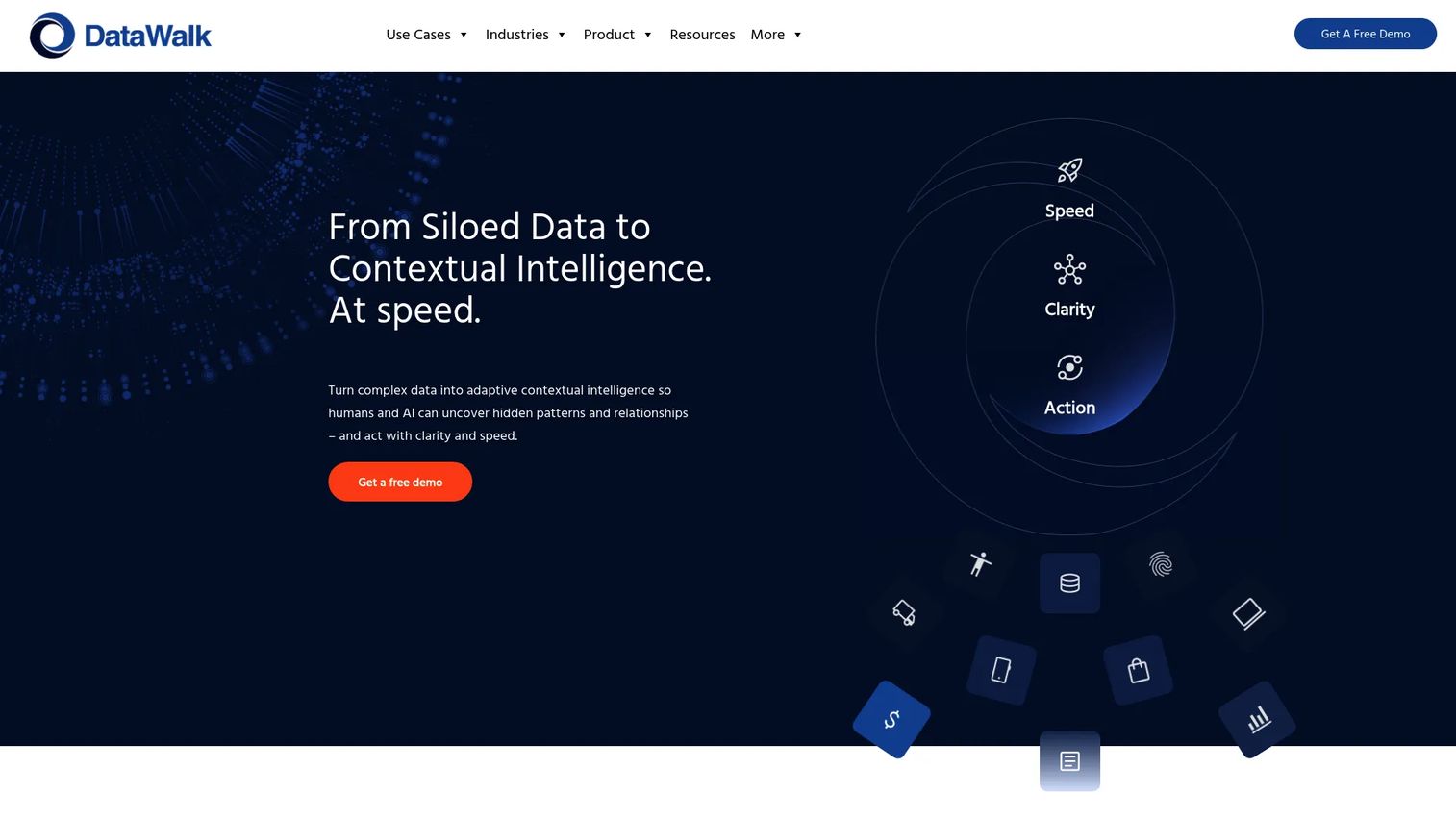
DataWalk is an enterprise graph and AI analytics platform for data fusion, knowledge graphs, investigation workflows, and decision automation. In insurance, it connects people, policies, claims, payments, providers, and external data to reveal suspicious relationships that column-based reporting misses. Special investigations units use it to visualize networks of connected entities across large, disparate datasets.
Best for: SIU and fraud teams dealing with complex multi-party relationships across claims, providers, claimants, and payment records.
Key features
- No-code data fusion and ontology mapping
- Knowledge graph and hybrid graph-relational database
- Entity resolution and contextual search
- Link charts, maps, flows, and path-finding for investigations
- Embedded AI and machine learning with Jupyter Notebook
Why choose DataWalk: It excels when the hard problem is connecting disparate entities and tracing relationship chains. It's a specialized investigation platform, not a replacement for a broad insurance BI or pricing tool.
DataWalk pricing: DataWalk directs prospects to its contact page for pricing. Contract drivers include data source volume, investigator seats, workflow scope, and integration complexity. You'll need to contact DataWalk directly for any figures.
G2 rating: 4.7/5 per G2 (12 reviews).
5. Shift Technology
Shift Technology delivers AI agents and decisioning for insurance carriers across claims assessment, fraud detection, subrogation, injury analysis, and payment integrity. It automates claim triage, assigns fraud cases, generates subrogation demand packages, and provides human-in-the-loop workflows with explainable, auditable AI decisions. The product covers the full claims lifecycle rather than one narrow point.
Best for: Claims organizations that need to prioritize adjuster effort, improve fraud detection rates, and standardize claim-level decisions at volume.
Key features
- Claims assessment, triage, advising, and straight-through processing
- Fraud and risk detection with automated case assignment
- Subrogation opportunity detection and demand-package generation
- Coverage, liability, injury, and payment-integrity analysis
- Explainable, auditable AI with human-in-the-loop workflows
Why choose Shift Technology: A strong model only creates value if claims leaders adopt the routing and escalation workflows behind it. Validate integration depth and adjuster adoption plan before signing.
Shift Technology pricing: Pricing is not published. Commercial terms typically reflect claim volume, selected modules, geography, deployment scope, and integration requirements. Request a demo to get to figures.
G2 rating: 4.0/5 per G2 (1 review, so treat this as directional).
6. FRISS
FRISS provides Trust Automation software for P&C insurers, covering claims analytics, underwriting risk scoring, enterprise investigations, KYC compliance screening, and media verification for AI-generated or manipulated claims content. The platform scores applications and claims in real time, surfaces suspicious activity, and organizes investigation case management in a single environment.
Best for: P&C insurance fraud teams that need practical risk scoring and investigation support woven into policy and claims workflows.
Key features
- Real-time claim trust scoring and claims analytics
- Underwriting risk scoring and application screening
- Enterprise investigations and case management
- KYC compliance screening against sanctions and PEP lists
- Media checks for manipulated or reused claims images
Why choose FRISS: It's a focused fraud and risk platform rather than a general enterprise data foundation. It fits best when your insurer has a defined fraud program and a measurable leakage target to improve.
FRISS pricing: FRISS does not publish pricing figures or named plan tiers. Primary pricing drivers include claims volume, policy volume, selected modules, regions covered, and integration requirements. A current G2 rating for FRISS could not be verified.
7. Verisk Insurance Analytics
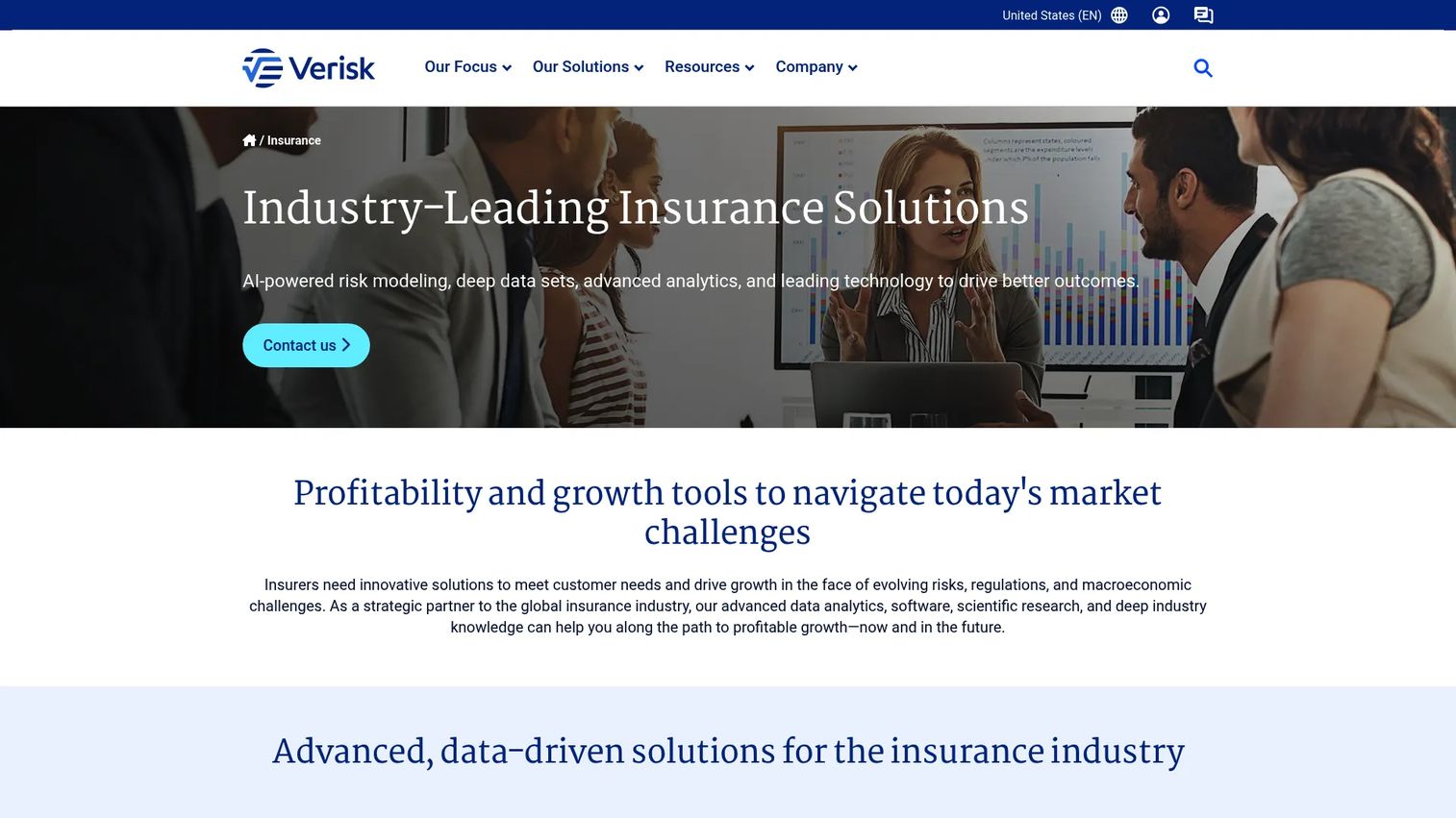
Verisk Insurance Analytics provides insurance-focused data, analytics software, and risk-management products covering underwriting intelligence, claims fraud detection, catastrophe risk modeling, compliance reporting, and property, auto, commercial, cyber, and actuarial applications. Verisk's differentiation sits in its proprietary data assets and risk models, which have been built across decades of industry data.
Best for: Insurers and reinsurers whose central question is "What risk are we actually writing?" rather than "How do we consolidate enterprise reporting?"
Key features
- Underwriting data and predictive analytics for personal and commercial lines
- Claims fraud detection, claims matching, and investigation workflows
- Catastrophe risk modeling and portfolio analytics
- Compliance and regulatory reporting products
- Property, auto, cyber, and actuarial insurance data and solutions
Why choose Verisk Insurance Analytics: Proprietary risk data can create a durable analytical advantage. Evaluate data rights, export terms, refresh cadence, and model assumptions before signing, because those terms shape the total dependency you're taking on.
Verisk Insurance Analytics pricing: Verisk does not publish numerical pricing. Contract value reflects data products selected, geographic scope, portfolio size, model access, and service scope. Contact Verisk for pricing.
G2 rating: 4.1/5 per G2 (aggregated across Verisk's seller profile, not a single product listing).
8. Akur8
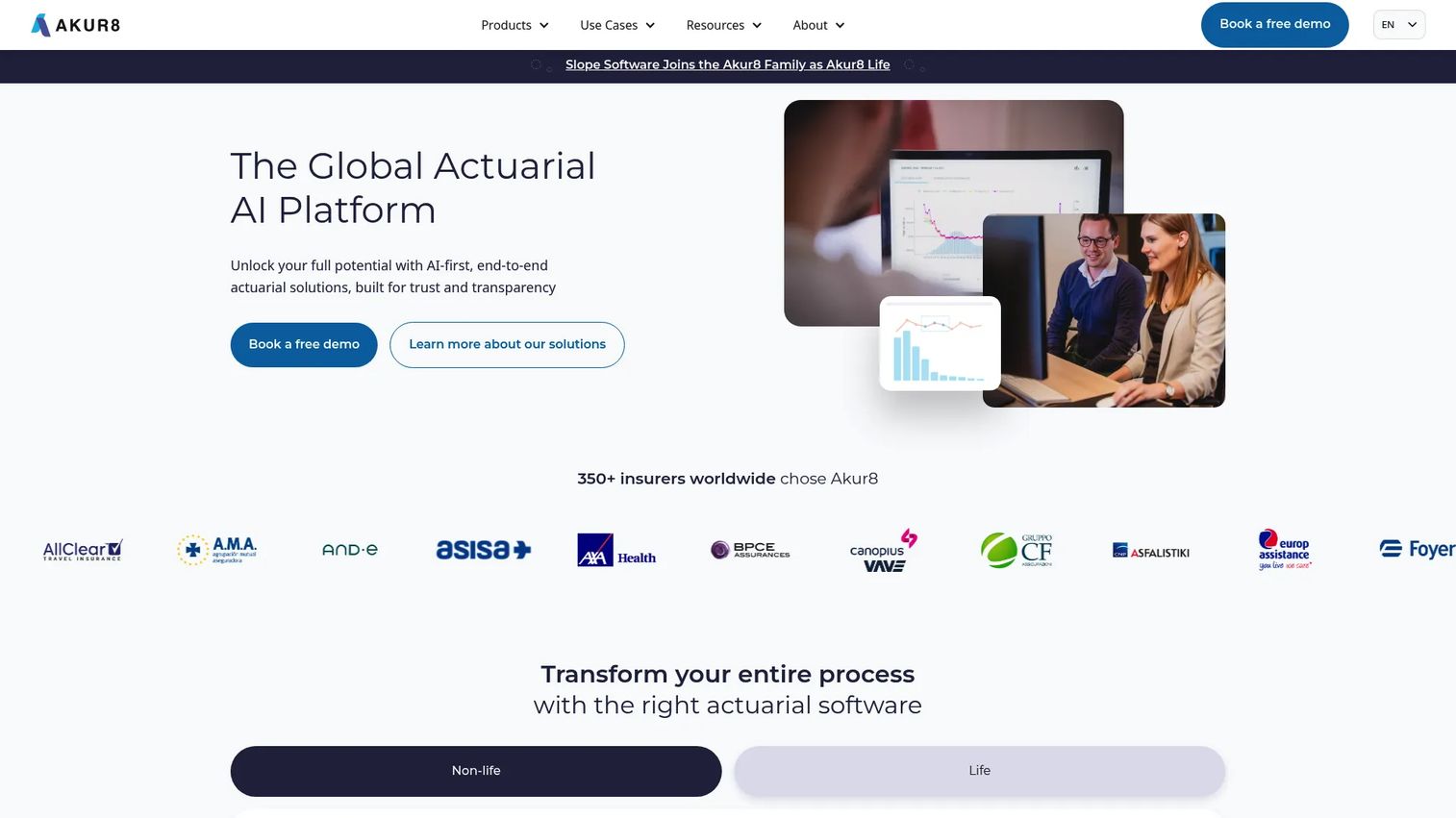
Akur8 is an AI-first actuarial software platform for insurance pricing, reserving, and life modeling. It helps actuarial and underwriting teams build transparent machine-learning pricing models, including GLMs and GAMs, validate them, and deploy rate changes without moving everything through a manual coding cycle. The platform covers data preparation, risk and demand modeling, rate making, and production deployment in a cloud-native collaborative environment.
Best for: Insurers and MGAs replacing spreadsheet-heavy pricing processes or trying to shorten the actuarial analysis to rate deployment cycle.
Key features
- Transparent ML pricing models including GLMs and GAMs
- End-to-end pricing from data prep through rate deployment
- Cloud-native collaboration with no-code workflows
- Rate change simulation and portfolio monitoring
- Model documentation and audit tooling
Why choose Akur8: It's a pricing product, not a broad claims or fraud suite. The strongest business case is pricing speed, governance, and model transparency, not consolidated enterprise reporting.
Akur8 pricing: Akur8's pricing page notes that free pilots are available and that ongoing pricing depends on the volume of insurance premiums modeled. Specific contract figures require contacting Akur8 directly.
9. Earnix
Earnix is an AI-driven pricing, analytics, and digital decisioning platform for insurance and banking. It covers dynamic price optimization, enterprise rating engine deployment, analytical underwriting, predictive and machine-learning modeling, product personalization, scenario testing, and governance with audit trails. The platform is built for insurers looking to coordinate pricing strategy across markets and deploy rate changes in real time rather than through a manual cycle.
Best for: Large insurers that need enterprise pricing, rating, and decisioning capabilities across multiple insurance products or markets.
Key features
- Dynamic pricing and price optimization
- Enterprise rating engine with real-time rate deployment
- Predictive and ML modeling with scenario testing
- Product personalization and customer engagement
- Governance, audit trails, and model version control
Why choose Earnix: It's a fit for enterprise pricing transformation, not a tactical fix for one rating workflow. Validate deployment model, product-line coverage, and the change-management requirements before committing.
Earnix pricing: Earnix does not publish pricing figures. Contract value typically reflects product modules, markets covered, transaction volume, implementation scope, and enterprise support requirements.
10. Duck Creek Technologies
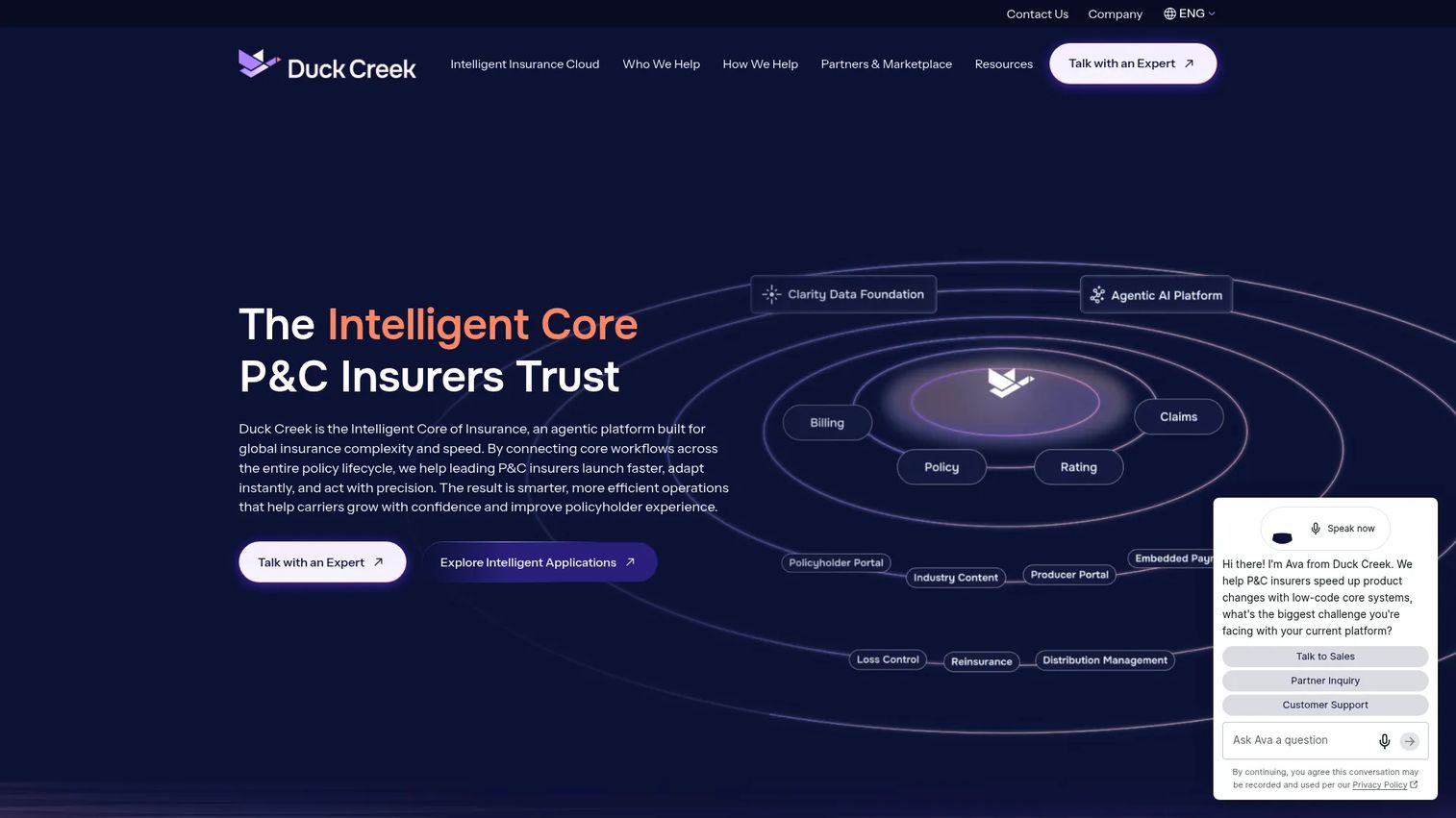
Duck Creek Technologies provides a cloud-native SaaS platform for P&C insurers, covering policy administration, rating, billing, claims, reinsurance, distribution management, and agentic applications including underwriting and FNOL automation. Its analytics and reporting capabilities are connected directly to core operational data rather than requiring a separate extract-and-load process. Duck Creek delivers the platform as evergreen SaaS with managed upgrades.
Best for: Enterprise P&C insurers using or evaluating Duck Creek core products who want reporting and analytics aligned with policy, billing, and claims operations from day one.
Key features
- Policy administration and product configuration with low-code rating tools
- Insurance rating with what-if modeling and lifecycle management
- Billing, claims, reinsurance, and distribution management
- Agentic underwriting and FNOL applications
- Evergreen SaaS delivery with continuous updates
Why choose Duck Creek Technologies: This is strongest when core-platform alignment matters more than vendor-neutral BI flexibility. Compare the integration upside against the flexibility you'd give up in a multi-vendor data strategy.
Duck Creek Technologies pricing: Duck Creek directs prospects to its sales team. The platform is not priced publicly. Contract value reflects core modules, lines of business, cloud deployment scale, and implementation work.
G2 rating: 4.6/5 per G2.
Considerations when choosing insurance analytics software
Choose the workflow before the platform
Start with the operating workflow that creates the biggest financial drag: Risk selection, claims triage, fraud investigation, pricing deployment, or portfolio reporting. A platform evaluation without a primary use case produces a feature spreadsheet, not a buying decision.
Validate the data foundation first
Ask what data the product needs, how it connects to your policy, billing, and claims sources, and who owns data quality at your company. A well-built model on inconsistent claims coding produces polished but unreliable outputs.
Test how recommendations enter daily workflows
A model that stays inside a dashboard doesn't change underwriting or claims performance. Require the vendor to show how their outputs reach the people making decisions, who can override them, and what gets logged when an override happens.
Check AI governance before scaling
Evaluate explainability, model validation procedures, version control, audit trails, and the ability to investigate decision outcomes. This matters most when analytics affect pricing, coverage decisions, claim routing, or fraud escalation.
Model the total cost, not just the license
Enterprise insurance analytics projects typically include implementation, data preparation, integrations, training, and change management on top of the annual contract. Build the business case around operating impact, not contract value alone.
Conclusion
The market gives you two broad paths: A platform that covers many analytics use cases across the enterprise, or a focused product that fixes the single workflow where margin or decision quality is breaking right now.
Guidewire Analytics and Duck Creek Technologies fit insurers that want analytics connected to an established core system. SAS Viya fits teams running enterprise-wide analytics programs with data science capacity. Majesco Analytics Platform suits insurers building a modern data foundation alongside core operations. DataWalk, Shift Technology, and FRISS are specialists: Reach for one of them when fraud or investigation is the measurable financial problem. Verisk Insurance Analytics fits when property, catastrophe, and portfolio risk intelligence is the primary need. Akur8 and Earnix are pricing specialists built for actuarial and underwriting teams ready to move off spreadsheet-driven rate cycles.
The practical next step: Identify the one workflow where data delays, inconsistent decisions, or fraud leakage costs you the most. Assign a cross-functional owner from operations, data, and the business function that will act on the output. Then shortlist the two or three tools whose category directly matches that workflow.
If your company sells complex insurance analytics software, buyers need to see the underwriting, claims, or pricing workflow before they'll believe the value. An interactive product demo lets prospects explore the product story without requiring a live environment or a scheduled call.
Start your journey with Guideflow today!
FAQs
Insurance analytics software is a category of tools that collect, prepare, model, and analyze insurance data to support better decisions in underwriting, pricing, claims management, fraud detection, risk assessment, and portfolio reporting. The category spans broad enterprise platforms, core-suite analytics, fraud specialists, pricing engines, and proprietary risk data providers. The best tool depends on which workflow creates the highest operating cost or margin loss for your specific business.
Common use cases include underwriting risk scoring, actuarial rate modeling and deployment, claims triage and prioritization, fraud detection and investigation case management, catastrophe exposure modeling, regulatory reporting, loss forecasting, and executive dashboard reporting. The tools in this list cover all of these, but no single product handles all of them equally well. Choosing by primary use case produces faster time-to-value than choosing by feature count.
Core software runs the transactions: Policy issuance, billing, and claims payments. Analytics software prepares data, builds models, creates insights, and can feed recommendations back into those operating systems. Some vendors (Guidewire, Majesco, Duck Creek) integrate both layers tightly. Others (SAS Viya, Akur8, Earnix) are pure analytics platforms that connect to whichever core system you already run.
The best fit depends on the specific bottleneck. Teams that need AI-driven triage and fraud detection at scale should evaluate Shift Technology. Those dealing with complex multi-party fraud investigations benefit most from DataWalk's graph analytics. FRISS covers fraud scoring and case management across both policy and claims. For claims performance reporting and operational dashboards inside a Guidewire environment, Guidewire Analytics is the natural choice.
Underwriting and pricing teams should prioritize model transparency, portfolio testing capability, rating workflow integration, and the ability to deploy approved rate changes without a manual coding cycle. Akur8 and Earnix are both built specifically for this job. Akur8 focuses on transparent actuarial modeling with GLMs and GAMs; Earnix covers enterprise pricing, real-time rating deployment, and customer-level decisioning. SAS Viya supports pricing analytics as part of a broader enterprise data science capability.
Most enterprise insurance analytics vendors use contract-based pricing with no rates published. Costs vary by insurance line, policy or claims volume, selected modules, data products, integration scope, implementation requirements, and support model. Verisk, Guidewire, SAS, Majesco, Duck Creek, DataWalk, Shift Technology, and FRISS all require direct contact for pricing. Akur8 notes that ongoing pricing depends on premium volume modeled. Budget for implementation, data preparation, and change management on top of any annual contract figure.
AI in insurance analytics can support claims prioritization, fraud pattern detection, loss forecasting, and pricing decisions. Safe deployment requires evaluating model explainability, data quality, performance monitoring, human review protocols, governance controls, and audit trails before putting AI outputs into high-impact decisions. Shift Technology and SAS Viya both include explainability and audit tooling. For insurers building AI governance programs, see the Guideflow guide on ai governance tools for a broader view of what governance infrastructure looks like.
Pick the smallest product category that solves the highest-value workflow first. Evaluate integration burden, time to a first operating result, data dependencies, and whether your team can own the output without ongoing vendor support. Avoid buying a broad enterprise platform before you have a repeatable use case. For context on building a scalable analytics foundation, the Guideflow roundup on best predictive analytics software tools covers adjacent platforms worth understanding. For pricing-specific tooling, the actuarial software guide covers that category in depth.
A fraud specialist tool like Shift Technology, FRISS, or DataWalk is pre-built for insurance fraud patterns, investigation workflows, and case management. A general analytics platform like SAS Viya can be configured for fraud, but requires more data science work to reach the same operational output. If fraud leakage is the primary business problem, a specialist typically reaches a first measurable result faster than a platform configuration project.