You quoted a lane in one tab, checked carrier authority in another, posted the load on a board in a third, and updated a spreadsheet to keep it all straight. Then the check call slipped, the invoice went out late, and the margin you thought you protected got eaten by manual work nobody tracked.
That is the real cost of running a brokerage on disconnected portals. Not one big failure, but a hundred small leaks across quoting, tracking, settlements, and compliance. Every tab switch is a place where data drifts and time disappears.
The category is growing fast because operators feel this pain. The worldwide freight broker software market reached USD 1.35 billion in 2025 and is projected to hit USD 2.66 billion by 2032 at a 10.25% CAGR, according to PW Consulting (2026). Cloud-based deployments already accounted for 76.4% of that market in 2025, which tells you where operators are moving: away from local, siloed tools and toward a single brokerage operating system.
The right freight brokerage software collapses those tabs into one workflow. Load posting, carrier sourcing, rate quoting, tracking and trace, accounting, and compliance stop being separate jobs and start being one connected flow of data. That is the difference between a system you fight and a system that fights for your margin.
This guide ranks seven platforms so you can match the right one to your operation without guessing.
What's inside
This guide ranks seven freight brokerage software tools built for brokers and 3PLs. Some are load boards with broker intelligence layered on top, others are full broker TMS platforms, and a few sit closer to collaborative logistics systems.
We ranked and described each tool against the criteria that actually decide whether software earns its place: workflow consolidation, accounting and settlements depth, tracking and trace, carrier onboarding and compliance, workflow automation, and how well it scales as your team and load volume grow. Pricing and ratings should be verified against each vendor before you sign, since plans and packaging change often in this category.
TL;DR
- Best overall for broker workflow depth: DAT, for pairing a dominant load board with broker TMS and rate intelligence in one platform.
- Best load board and risk intelligence: Truckstop, for load sourcing, broker and payment ratings, and fraud and risk workflows.
- Best workflow automation and modern TMS: Alvys and Rose Rocket, for automation, EDI, and configurable no-code workflows.
- Best for collaborative logistics and visibility: Turvo, for shipment visibility across a shared network of shippers, carriers, and 3PLs.
- Best small brokerage fit: Tailwind TMS and AscendTMS, for accessible pricing and core dispatch, accounting, and portal workflows.
What is freight brokerage software?
Freight brokerage software is the operating system for a brokerage: a single platform that manages loads, carriers, rates, tracking, documents, and money from quote to settlement. A broker TMS (transportation management system for brokers) is the core of that system, connecting the day-to-day workflows a broker runs dozens of times per shift.
Instead of stitching together a load board, a spreadsheet, an email inbox, and an accounting tool, a freight brokerage TMS keeps the whole lifecycle in one place. That matters because every handoff between disconnected tools is where margin, time, and data accuracy leak out.
Here are the core capabilities that define the category:
- Load posting and carrier sourcing. Post loads to load boards, search available capacity, and match freight to carriers by lane, equipment, and rate.
- Carrier onboarding, compliance, and monitoring. Verify authority and insurance, run continuous monitoring, and reduce double brokering risk before you tender a load.
- Tracking and trace. Get real-time visibility into shipment status through check calls, driver apps, ELD feeds, or integrated tracking providers.
- Rate quoting and pricing. Generate quotes using historical lane data, live market rates, and margin targets so pricing stays consistent across reps.
- Accounting, invoicing, and settlements. Handle carrier settlements, customer invoicing, reconciliation, and factoring connections without exporting to a separate system.
- Document handling and automation. Manage POD and BOL, invoice processing, and rate confirmations, with workflow automation that moves documents through the process automatically.
- Integrations and APIs. Connect load boards, tracking providers, accounting systems, and EDI so data flows without manual re-entry.
The knowledge-graph short version: freight broker software is a category of transportation management system for brokers that unifies load, carrier, rate, tracking, document, and financial workflows into one brokerage operations system.
When to use freight brokerage software
Not every operation needs the same depth. Here is how to map the software to a real operational problem you can measure.
Replace tab switching and disconnected portals
If your reps toggle between a load board, a spreadsheet, an email thread, and an accounting tool to move one load, you are paying a tab-switching tax on every shipment. Each switch is a chance for data to drift and for a step to get skipped. A broker TMS consolidates load posting, carrier sourcing, tracking, and settlements into one screen so the workflow stops fragmenting across tools and browser windows.
Standardize quoting, tracking, and settlements
When quoting lives in one rep's head and tracking depends on who remembers to make the check call, your results swing rep to rep. Freight broker TMS software standardizes rate quoting and pricing against lane history and market data, enforces consistent tracking and trace, and routes settlements through a repeatable process. The payoff is predictable margin and cleaner books, not heroics from your best rep.
Scale operations without adding headcount
Growth usually means more loads per rep, not more reps per load. Workflow automation, document handling, and carrier monitoring let a brokerage add volume without linearly adding staff. If you are hiring to keep up with manual reconciliation, POD chasing, or invoice processing, that is the signal to let software absorb the repeatable work first.
Comparison table
The table below positions each tool by brokerage workflow relevance, from load board and risk intelligence through full broker TMS depth to small brokerage fit. Pricing and G2 ratings shift often in this category, so verify both against each vendor before you commit.
| # | Product | Intent | Key differentiation | Pricing | G2 rating |
|---|---|---|---|---|---|
| 1 | Truckstop | Load board and risk intelligence | Load board with broker/payment ratings and rate insights | Broker plans from $109/user/month | 4.0/5 |
| 2 | DAT | Broker TMS and freight marketplace | Load board plus rate analytics and broker tools | Load board plans from $54/month | 4.6/5 |
| 3 | Alvys | Modern cloud broker TMS | Automation, EDI, tracking, accounting in one TMS | From $514/month | 4.7/5 |
| 4 | Turvo | Collaborative logistics platform | Shared-network visibility and shipment collaboration | From $5,000/month | 4.4/5 |
| 5 | Rose Rocket | Configurable AI-native TMS | No-code workflows and email-to-order AI | From $2,080/month | 4.8/5 |
| 6 | Tailwind TMS | Small to mid broker TMS | Dispatch, customer and carrier portals | From $69/month | 5.0/5 |
| 7 | AscendTMS | Accessible entry-point TMS | Free tier plus load and rate tools | Free; Premium $99/user/month | 4.4/5 |
1. Truckstop
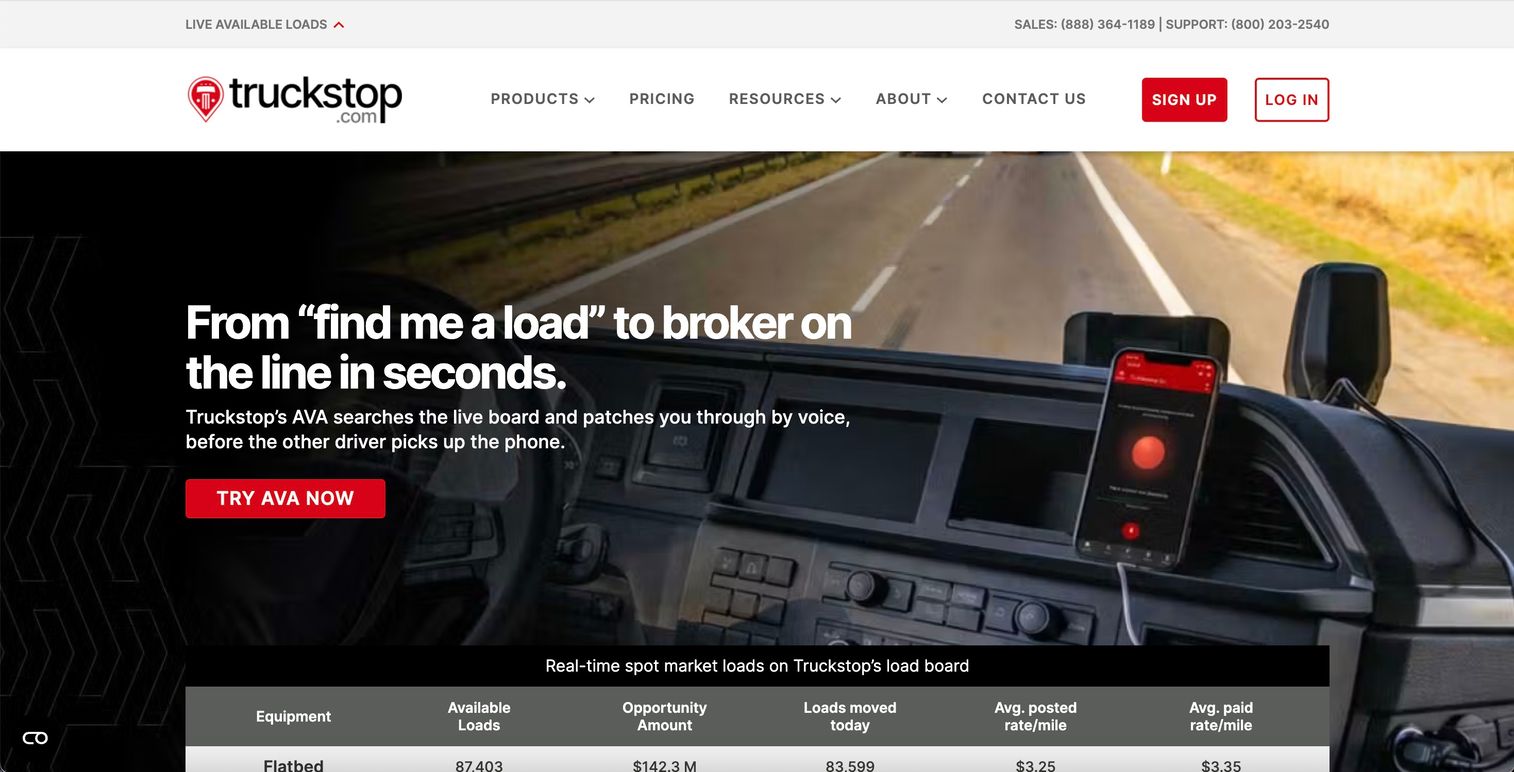
Truckstop is one of the longest-running freight ecosystems in North America, built around a load board that carriers, brokers, and shippers use to find and move freight. For brokers, the value is not just posting loads. It is the layer of broker and payment ratings, rate insights, and risk workflows that help you source capacity and vet who you tender to before double brokering risk becomes a problem.
If your primary pain is load posting, load sourcing, and knowing which carriers are safe to work with, Truckstop is a natural anchor for your stack.
Best for: Brokers and carriers who need a high-volume load board paired with broker and rate intelligence to source and vet capacity.
Key strengths
- Load searching and posting: Post loads and search available capacity across lanes and equipment types from one board.
- Broker and payment ratings: See how carriers rate brokers and how payment behavior scores, which supports carrier vetting and reduces risk.
- Rate insights and live load updates: Use live rate data and real-time load activity to price and match freight accurately.
Why choose Truckstop: Choose Truckstop when load sourcing and carrier risk are your two biggest daily jobs. The combination of a deep load board, broker and payment ratings, and rate insights makes it strong for the top of the brokerage workflow, where finding capacity and vetting it matter most. It pairs well with a dedicated broker TMS if you also need heavy accounting and settlements depth.
Truckstop pricing: Truckstop publishes broker plans starting at Broker Basic at $109 per user per month, with Broker Pro at $239 per user per month and Broker Premium at $369 per user per month, all billed monthly. Carrier plans start lower, from $42 per month. There is no free tier. Verify current plan names, user limits, and pricing on the Truckstop broker pricing page before committing.
2. DAT
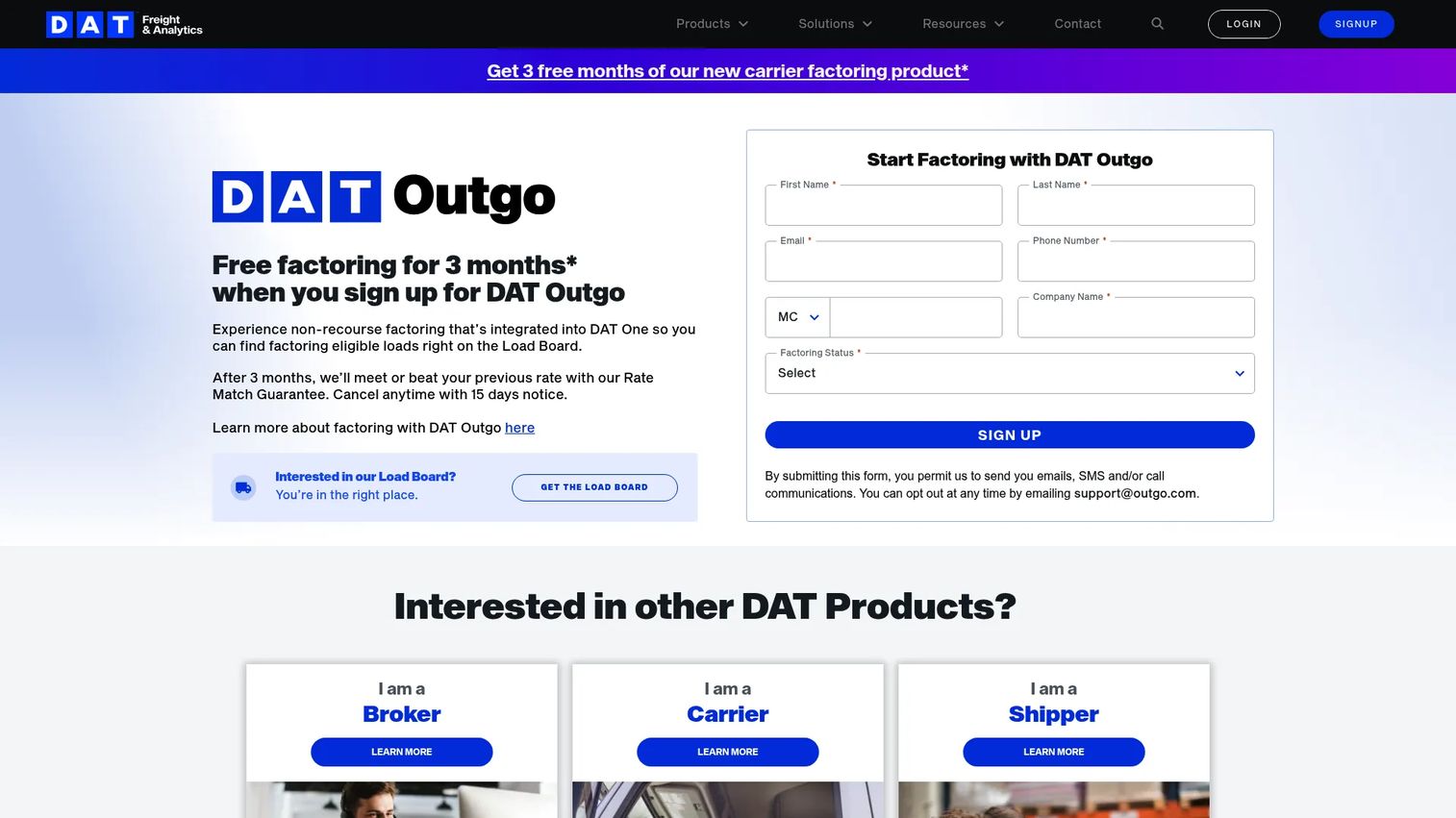
DAT runs one of the largest freight marketplaces in the industry, and for brokers it goes well beyond load matching. DAT combines its load board with rate analytics and broker tools such as carrier vetting, credit data, and lane matching, giving you a one-platform workflow that connects sourcing, pricing, and risk in a single system.
That consolidation is the point. Instead of pricing in a spreadsheet and vetting carriers in a separate portal, DAT puts load posting, rate intelligence, and carrier data in one place so productivity climbs without more tab switching.
Best for: Brokers who want a dominant load board tied directly to rate intelligence and carrier vetting in one operational workflow.
Key strengths
- DAT One load board and mobile app: Access a large marketplace of loads and capacity from desktop and mobile.
- DAT RateView and DAT iQ analytics: Price lanes against historical and current market rate data for consistent quoting.
- Broker tools: Use carrier vetting, credit data, and lane matching to source safely and reduce double brokering risk.
Why choose DAT: Choose DAT when you want the reach of a top-tier load board combined with the rate intelligence to defend your margin on every lane. The pairing of DAT One, RateView, and broker vetting tools makes it a strong operational core for brokers who price aggressively and source constantly. It is the closest thing in this list to a load board and broker TMS working as one system.
DAT pricing: DAT publishes carrier load board plans from DAT One Standard at $54 per month up to DAT One Office at $329 per month, all billed monthly. Shipper and broker-specific packages are marked contact for pricing on DAT's site. There is no free tier. Confirm current tiers and broker-specific pricing directly with DAT before you buy.
3. Alvys
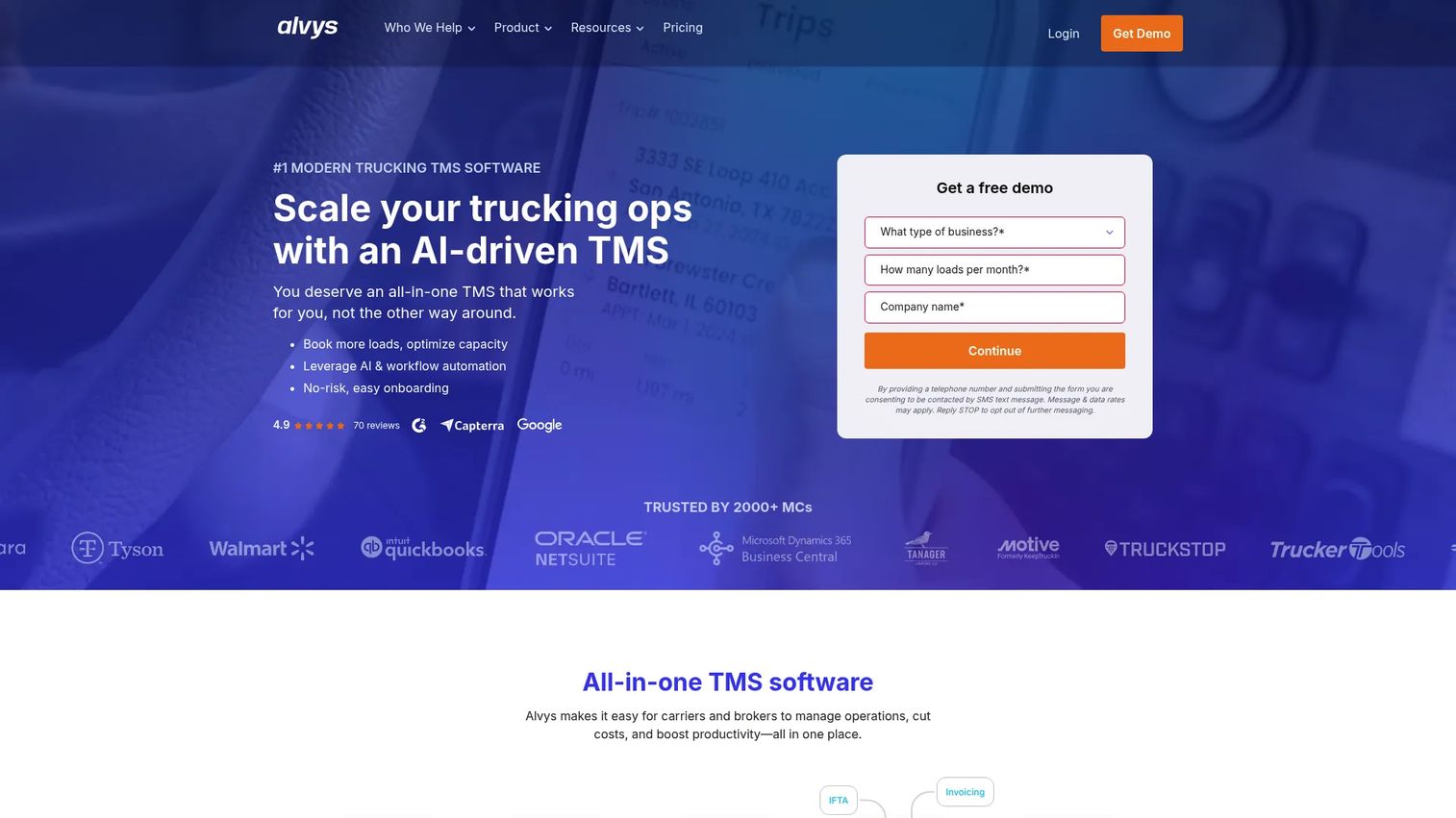
Alvys is a modern cloud TMS built for logistics companies, and it leans hard into automation. For freight brokers, that means dispatching and load management, real-time tracking through a driver app, and compliance, safety, accounting, and IFTA tools connected in one system. The design goal is to remove the manual re-entry that slows a brokerage down.
Where Alvys stands out is workflow automation and EDI. If you are moving enough volume that manual document handling and status updates are eating rep time, Alvys is built to absorb that work and give you real-time visibility across the operation.
Best for: Carriers, brokers, and hybrid fleets that want an all-in-one cloud TMS with automation, EDI, and tracking built in.
Key strengths
- Dispatching and load management: Manage the full load lifecycle from tender to delivery in one modern interface.
- Driver app and real-time tracking: Get tracking and trace through a connected driver app for real-time visibility.
- Compliance, safety, accounting, and IFTA tools: Run carrier onboarding, compliance, accounting, invoicing, and settlements without leaving the platform.
Why choose Alvys: Choose Alvys when you want a modern TMS that treats automation and EDI as core, not add-ons. The combination of dispatching, tracking, compliance, and accounting in one cloud platform suits brokers and hybrid fleets that want to scale volume without scaling headcount. Implementation and workflow automation are where it earns its keep.
Alvys pricing: Alvys uses usage-based pricing with a publicly visible starting point of $514 per month, billed monthly or annually. One G2-listed plan appears as contact us for 100 loads per month. There is no free tier. Because the public site shows a starting price rather than a full tier table, confirm exact usage-based pricing with Alvys for your load volume.
4. Turvo
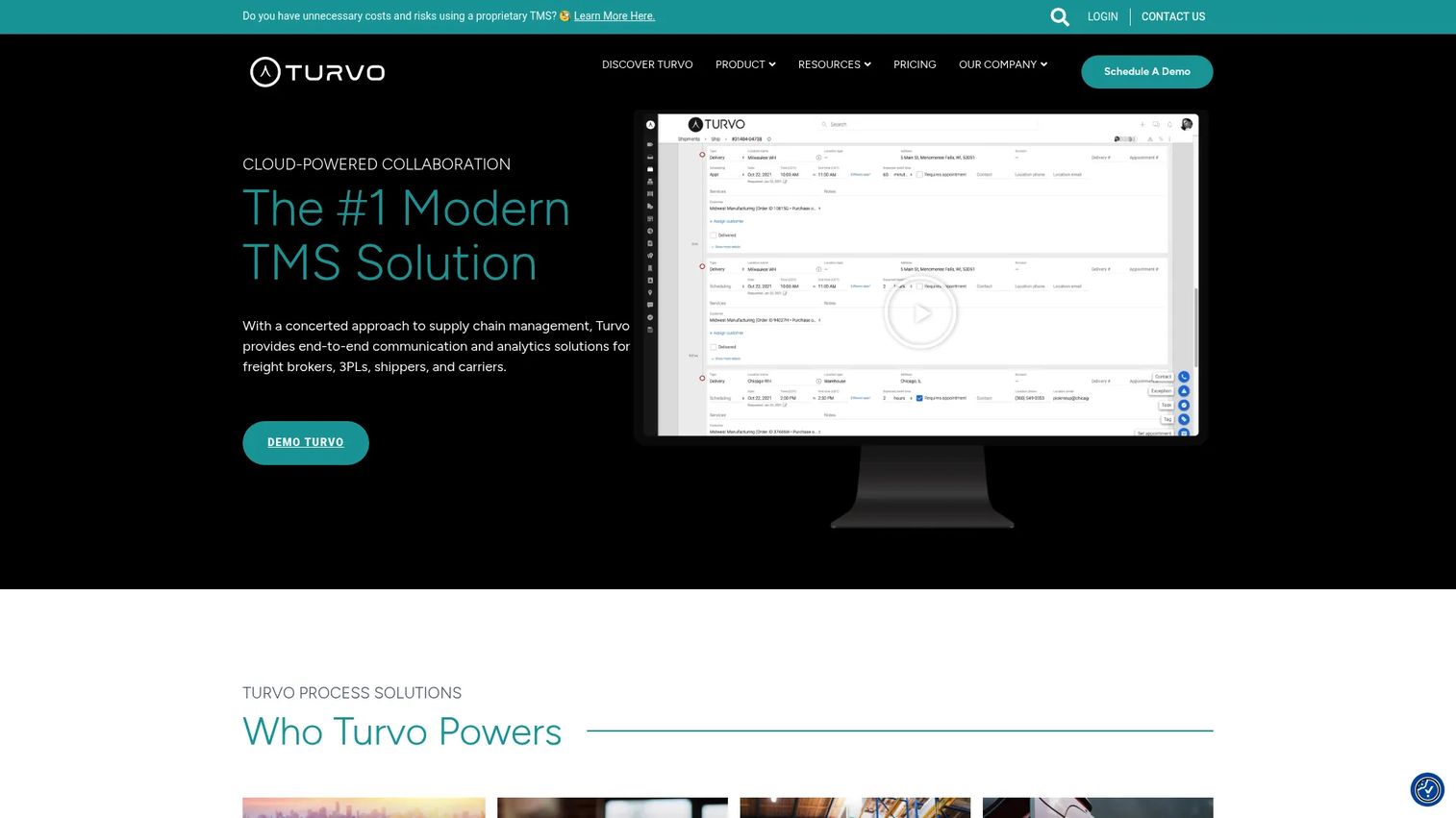
Turvo approaches the category from a different angle. Rather than a broker-only tool, it is a collaborative logistics platform that connects shippers, brokers, 3PLs, and carriers on a shared network. The emphasis is coordination and shipment visibility, so everyone touching a load sees the same real-time status instead of trading emails and check calls.
For brokers running complex, multi-party freight, that shared visibility is the differentiator. Order-to-shipment planning, inventory and warehouse visibility, and shipment execution live in one collaborative workspace.
Best for: Logistics teams and larger brokerages that need a collaborative TMS with strong shipment visibility across a network of partners.
Key strengths
- Order-to-shipment planning: Plan and execute freight from order through delivery in one connected workflow.
- Inventory and warehouse visibility: See inventory and warehouse status alongside shipment data for fuller context.
- Shipment execution and collaboration: Coordinate shippers, carriers, and partners on a shared platform with real-time visibility.
Why choose Turvo: Choose Turvo when collaboration across parties is the core of your operation and shipment visibility drives your value to customers. The shared-network model reduces the back-and-forth of tracking and trace across email and phone. It fits brokerages and 3PLs that manage complex freight with multiple stakeholders on every shipment.
Turvo pricing: Turvo publishes two options: a plan to plan, execute, and settle freight starting at $5,000 per month, and a collaboration and visibility plan available upon request. There is no free tier verified. Given the enterprise-level entry point, confirm scope and pricing with Turvo against your specific network and volume.
5. Rose Rocket

Rose Rocket is an AI-native TMS built for freight operations that want to shape the software around their process, not the other way around. It handles order, dispatch, tracking, and invoicing, then layers on no-code custom boards, fields, automations, and workflows so teams can configure the system without engineering. Its TED email AI turns inbound emails into orders and quotes automatically.
That configurability is what sets Rose Rocket apart for growing brokerages. As your workflows get more specific, the platform bends to match instead of forcing you into a fixed template.
Best for: Brokers, carriers, and freight operators who need a configurable TMS or ERP platform that scales across teams and workflows.
Key strengths
- Order, dispatch, tracking, and invoicing: Run the core brokerage lifecycle including accounting, invoicing, and settlements in one place.
- No-code custom boards, fields, automations, and workflows: Configure the platform to your process without engineering support.
- TED email AI: Turn inbound emails into orders and quotes automatically to cut manual data entry.
Why choose Rose Rocket: Choose Rose Rocket when workflow automation and configurability matter as much as core TMS features. The no-code customization and email-to-order AI make it strong for operations that have outgrown rigid tools and want to scale across teams. It fits brokers who treat their workflow as a competitive edge worth tailoring.
Rose Rocket pricing: Rose Rocket publishes a Full Service Platform starting at $2,080 per month, billed monthly, and an Enterprise plan with custom pricing. There is no free tier. Confirm current tier scope and any volume-based adjustments with Rose Rocket before committing.
6. Tailwind TMS
Tailwind TMS is a cloud-based trucking and freight brokerage TMS aimed squarely at small to mid-sized operations. It covers the core brokerage workflows a growing broker needs: dispatching, a customer portal, and a carrier portal, so shippers and carriers can self-serve instead of flooding your inbox. The appeal is usability and operational control at an accessible price.
For a small brokerage that wants to move off spreadsheets without taking on an enterprise platform, Tailwind is a practical starting point.
Best for: Small to mid-sized trucking companies and freight brokerages that want core TMS workflows without enterprise complexity.
Key strengths
- Dispatching: Manage load assignment and dispatch from a single cloud interface.
- Customer portal: Give shippers a self-serve portal to reduce inbound status requests.
- Carrier portal: Let carriers access documents and updates directly, cutting manual back-and-forth.
Why choose Tailwind TMS: Choose Tailwind when you are a small to mid-sized broker who needs dispatch, accounting, and portal workflows in an approachable package. The customer and carrier portals reduce manual communication, which is where small teams lose the most time. It is a strong fit for operations graduating from spreadsheets to a real broker TMS.
Tailwind TMS pricing: Tailwind states its TMS is available for as little as $69 a month, though public tier names were not verified from its own site and this figure is reported through G2. There is no free tier verified. Because pricing detail is limited publicly, confirm current plans and inclusions directly with Tailwind before you commit.
7. AscendTMS
AscendTMS is a transportation management system for freight brokers, 3PLs, trucking companies, and shippers, and its standout is accessibility. It offers a free tier alongside paid plans, which makes it one of the lowest-friction ways to move a small brokerage off manual tools. Core coverage includes load management, truckload rate tools, and LTL rate tools.
If you want to try a real broker TMS without a budget commitment first, AscendTMS is a practical entry point that still covers the essential brokerage workflows.
Best for: Small to mid-sized freight operations that want a low-cost or free TMS to run core load and rate workflows.
Key strengths
- Load management: Handle the core load lifecycle from creation through delivery.
- Truckload rate tools: Support rate quoting and pricing for truckload freight.
- LTL rate tools: Quote and manage less-than-truckload freight alongside truckload.
Why choose AscendTMS: Choose AscendTMS when cost and low friction are the priority and you want to validate a TMS before paying. The free tier plus load and rate tools make it an accessible on-ramp for small operations. It fits brokers who want to standardize load management and rate quoting without an upfront commitment.
AscendTMS pricing: AscendTMS lists a Basic plan at $0 per user per month and a Premium plan at $99 per user per month, with a free version and free trial available, per Capterra. First-party pricing was not fully readable from the accessible site, so confirm current tiers and inclusions directly with AscendTMS before scaling.
Considerations before you choose
Selecting freight brokerage software is a bet on your operation for the next several years, so weigh these criteria before you sign.
Workflow consolidation first
Count how many tools a rep touches to move one load today. The whole point of a broker TMS is to collapse load posting, carrier sourcing, tracking, and settlements into one workflow. Prioritize the platform that eliminates the most tab switching, spreadsheets, and data silos for your specific process.
Accounting, invoicing, and settlements depth
Software that stops at load management pushes financial work back into a separate tool, which reintroduces the reconciliation drag you are trying to escape. Evaluate how deeply each platform handles accounting, invoicing, settlements, and factoring connections, and whether that data flows without manual export.
Carrier onboarding, compliance, and monitoring
Double brokering risk and carrier fraud are real threats to your margin and your reputation. Look for carrier onboarding, compliance, and continuous monitoring built in, plus broker and payment ratings or vetting data where available. This is not a nice-to-have; it is margin and risk protection.
Freight broker software cost and buy vs build
Compare freight broker software cost against the fully loaded cost of building and maintaining internal tools plus the rep hours lost to manual work. For most brokerages, buy beats build because the vendor absorbs updates, compliance data, and integrations. Weigh entry price against how the platform scales as load volume grows.
Conclusion
The right pick depends on where your workflow breaks first. For load sourcing and carrier risk, Truckstop and DAT anchor the top of the brokerage workflow, with DAT pairing a dominant load board with the rate intelligence and vetting tools that make it the strongest all-around broker TMS core in this list. For workflow automation and a modern, configurable operating system, Alvys and Rose Rocket lead, with EDI, no-code workflows, and email-to-order AI that let brokers scale volume without scaling headcount. For collaborative, multi-party freight with heavy shipment visibility needs, Turvo is the fit. And for small brokerage teams and broker software for scale on a budget, Tailwind TMS and AscendTMS deliver core dispatch, accounting, and portal workflows at accessible entry points.
Choose on workflow consolidation, tracking and trace, accounting, and compliance first. Speed and cost matter, but they matter second. The platform that removes the most manual work and protects the most margin is the one that pays for itself in staffing productivity and cleaner books. Shortlist two, run your real lanes through a trial, and let the workflow decide.
FAQs
Freight brokerage software is a platform that manages the full brokerage lifecycle: load posting, carrier sourcing, rate quoting, tracking and trace, document handling, and accounting. It acts as the operating system for a brokerage, replacing the load board, spreadsheet, and accounting tool combination with one connected workflow.
A broker TMS, or transportation management system for brokers, connects the day-to-day workflows a broker runs on every load. That includes load management, carrier onboarding and compliance, tracking, rate quoting and pricing, and accounting, invoicing, and settlements, all in one freight brokerage TMS instead of separate tools.
Brokers evaluate freight broker TMS software on workflow consolidation, accounting and settlements depth, tracking and trace, carrier onboarding and compliance, workflow automation, and how well it scales with load volume. The practical test is how many tools a rep can retire and how much manual re-entry the platform removes.
The features that matter most are load board and carrier sourcing, carrier onboarding and monitoring, real-time tracking and trace, consistent rate quoting and pricing, and accounting, invoicing, and settlements. Document handling for POD and BOL and strong integrations round out a platform that eliminates data silos.
Freight broker software cost ranges widely. Load board plans can start around $54 per month, small broker TMS options start near $69 per month, and full modern TMS platforms range from roughly $500 to $5,000 per month or more depending on volume and scope. Some tools, like AscendTMS, offer a free tier. Always verify current pricing with each vendor.
For a small brokerage, Tailwind TMS and AscendTMS are strong fits because they deliver core dispatch, accounting, and portal workflows at accessible entry points, and AscendTMS offers a free tier to start. Both let a small team move off spreadsheets without an enterprise commitment.
Load boards handle load posting and carrier sourcing, the front end of the brokerage workflow. Platforms like Truckstop and DAT pair a load board with broker intelligence such as rate analytics, carrier vetting, and payment ratings, so sourcing and risk decisions happen in one place rather than across disconnected portals.
For most brokerages, buying a broker TMS beats building internally. The vendor absorbs software updates, compliance data, integrations, and maintenance, while an internal build ties up engineering time and rarely keeps pace with load board, tracking, and accounting requirements. Build only when your process is so unusual no platform can match it.