Your moderation queue does not sleep. Comments, reviews, images, live chat, and ad submissions arrive faster than any human team can read them, and the volume keeps climbing. TrustLab estimates that up to 90% of online content could be synthetically generated by 2026, which means moderators are no longer just catching the occasional bad actor. They are filtering a flood of AI-generated text, deepfakes, and machine-written spam mixed in with real user voices.
The numbers behind the category tell the same story. Mordor Intelligence projects the global content moderation market will reach USD 13.31 billion in 2026, up from USD 11.63 billion in 2025, on its way to USD 26.09 billion by 2031 at a 14.42% CAGR. Images alone accounted for 46.12% of moderation revenue in 2025, while live-stream and voice moderation is the fastest-growing format at an 18.12% CAGR. The work is expanding across every content type at once.
The stakes are not abstract. The UK Online Safety Act now places statutory duties on platforms that host user-generated content, with real penalties for failure. GDPR governs how you process and store moderation data. CSAM laws require detection, reporting, and removal, often through hash-matching. Get moderation wrong and you risk brand trust, legal exposure, and user harm in the same incident. The right content moderation software lets you catch harmful content at scale without drowning your team or your budget.
What's inside
This guide is for trust and safety leads, community managers, marketplace and platform owners, and marketers who manage user generated content moderation at scale. Whether you run a review site, a gaming community, an ad submission flow, or a social platform, the goal is the same: catch harmful content fast while staying compliant. If keeping your community healthy is a core part of your job, our roundup of the best community management software pairs well with the moderation tools covered here.
We chose tools on four criteria. First, content-format coverage across text, image, video, and audio. Second, automation quality and AI accuracy. Third, integration and API depth, so the platform fits your existing stack. Fourth, compliance and data controls for regulations like the UK Online Safety Act and GDPR. Pricing and G2 ratings were verified against vendor pages and G2 listings at the time of publication.
TL;DR
- Best for multimodal AI at scale: Hive AI handles text, image, video, and audio with dedicated CSAM and deepfake models.
- Best developer-first API: Sightengine offers fast image, video, text, and audio moderation with clear usage pricing.
- Best hybrid AI plus human: WebPurify blends automated moderation with managed human review services.
- Best for enterprise trust and safety: ActiveFence (now Alice) covers red-teaming, runtime guardrails, and threat intelligence.
- Best for compliance-led teams: Checkstep ties moderation to DSA and Online Safety Act reporting.
- Best for communities and gaming: CleanSpeak and Lasso Moderation handle chat, profanity, and review queues well.
What is content moderation software?
Content moderation software is a platform that automatically detects, filters, and reviews user-generated content (text, images, video, and audio) against your safety policies. It combines machine learning models with human review workflows to flag, remove, or escalate content that breaks community guidelines, contains derogatory language, or violates law.
Modern content moderation solutions are increasingly multimodal. A single platform may scan a forum post, the image attached to it, and the audio in a linked video, all against the same policy set. This matters because harmful content rarely stays in one format. Hate speech gets embedded in images. Misinformation spreads through video. Automated content moderation has to read all of it.
Most content moderation platforms share a core set of capabilities:
- ML and NLP text analysis to detect hate speech, harassment, profanity, and spam.
- Image and video classification for nudity, violence, weapons, drugs, and other unsafe categories.
- OCR for text in images to catch slurs and policy violations hidden inside graphics or memes.
- ASR for audio to transcribe and screen voice content in live streams and clips.
- User flagging and reporting workflows that route community reports into review.
- Blacklist and keyword filtering with customizable word lists across languages.
- PII and PHI detection to catch exposed personal data.
- Escalation and human-review queues so edge cases reach a person.
- Analytics and transparency reporting to track decisions and support compliance.
The distinction between software, solutions, and services matters when you buy. Content moderation software and platforms are self-serve tooling you run. Content moderation services are managed, where human moderators handle the work for you. Solutions usually blend both. Many vendors on this list sit somewhere in the middle, pairing an API with optional human review.
When to use content moderation tools
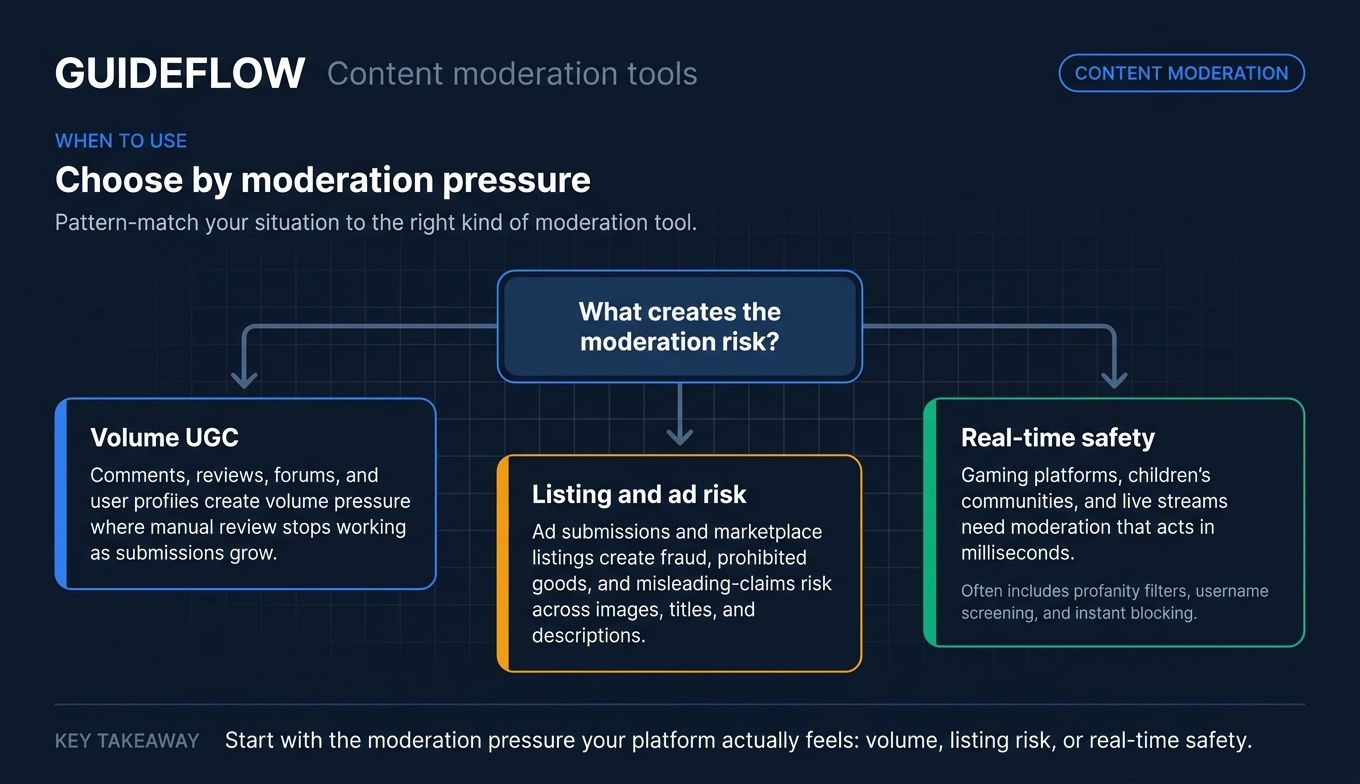
Not every platform needs the same moderation depth. Here is how to pattern-match your situation to the right kind of tool.
Moderate user-generated content at scale
If you run comments, reviews, forums, or user profiles, manual review stops working the moment volume grows. Automated content moderation screens text and images on submission, flags the gray-area cases, and routes them to your team. This is the most common reason platforms buy moderation tooling. The job is catching the obvious violations automatically so humans focus on judgment calls, not spam.
Screen ad submissions and marketplace listings
Marketplaces, classifieds, and ad platforms face a different problem: fraud, prohibited goods, and policy violations buried in listings and creatives. Content moderation tools for ad submissions auto-screen images, titles, and descriptions before they go live. Vendors built for this space detect scams, counterfeit goods, banned products, and misleading claims. For ad-heavy properties, this is the difference between a clean marketplace and a compliance liability.
Keep live chat and communities safe in real time
Gaming platforms, children's communities, and live streams need moderation that acts in milliseconds. Pre-moderation reviews content before it appears, which protects vulnerable audiences but adds latency. Post-moderation publishes first and reviews after, which keeps conversation flowing. Real-time tools support both, plus profanity filters, username screening, and instant blocking. For kid-safe chat especially, low-latency moderation is non-negotiable.
Content moderation operating models
The tool you choose depends partly on how you want moderation to run. Four operating models dominate, and most platforms mix them.
| Model | How it works | Best fit |
|---|---|---|
| Pre-moderation | Content is reviewed before it publishes | Children's communities, high-risk platforms, ad submissions |
| Post-moderation | Content publishes immediately, then gets reviewed | Active forums and social feeds where speed matters |
| Reactive moderation | Content is reviewed only after users flag it | Lower-risk communities with engaged users |
| Automated / AI moderation | ML models screen content instantly at scale | High-volume platforms across any format |
Automated content moderation underpins all of the others. Even pre-moderation relies on AI to triage, because no human team reviews millions of items by hand. The practical question is how much you automate versus how much you keep in human queues, and which tools give you control over that balance.
Comparison table
The table below ranks all 11 tools by relevance to user-generated content moderation. Pricing and G2 ratings were verified against vendor pages and live G2 listings at publication. Where vendors gate pricing behind sales, that is noted.
| # | Product | Intent | Key use case | Pricing | G2 rating |
|---|---|---|---|---|---|
| 1 | Hive AI | Multimodal AI moderation | Text, image, video, audio plus CSAM and deepfake detection | From $0.02 / minute, usage-based | 4.5/5 |
| 2 | Sightengine | Developer API moderation | Image, video, text, audio API with OCR | From $29/mo | 4.5/5 |
| 3 | WebPurify | Hybrid AI plus human | Text, image, video with human review services | From $0.0026 per image | 4.3/5 |
| 4 | ActiveFence (Alice) | Enterprise trust and safety | AI red-teaming, runtime guardrails, threat intelligence | Custom | 4.5/5 |
| 5 | Checkstep | Compliance-led moderation | Policy management plus DSA and OSA reporting | Custom (volume and seats) | Not yet rated |
| 6 | Lasso Moderation | Workflow-centric moderation | Marketplace and UGC queues, human plus AI | From $99/mo | 4.9/5 |
| 7 | CleanSpeak | Profanity and chat filtering | Kid-safe communities, gaming, usernames | Custom | Not yet rated |
| 8 | Besedo / Implio | Marketplace moderation | Classifieds and ad-submission screening | Custom | Not yet rated |
| 9 | Microsoft Azure AI Content Safety | Cloud-native moderation | Text and image classification on Azure | Free tier plus usage | 4.6/5 |
| 10 | Amazon Rekognition | Image and video at AWS scale | Image and video moderation APIs | From $0.0010 per image | 4.3/5 |
| 11 | PicPurify | Image moderation API | Real-time image and video filtering | Free tier, from $19/mo | 4.5/5 |
The 11 best content moderation tools for safer UGC in 2026
Each tool below covers a real slice of the moderation problem. Read the persona fit and pricing notes to find the one that matches your content formats and compliance needs.
1. Hive AI

Hive AI provides AI models and APIs for content moderation, brand protection, media search, and generative AI. For trust and safety teams, the draw is breadth. Hive moderates across visual, text, and audio content, and runs dedicated models for CSAM, OCR, and demographic classification. It also detects AI-generated images, video, and audio, which matters as synthetic content floods platforms.
Best for: High-volume platforms and marketplaces that need one provider for text, image, video, and audio moderation plus AI-content detection.
Key strengths
- Multimodal coverage: One API set handles visual, text, audio, CSAM, and OCR use cases.
- AI-content detection: Dedicated models flag AI images, deepfakes, AI video, and AI audio.
- Broad AI suite: Media search, reverse image search, logo recognition, speech-to-text, and AutoML custom training extend beyond moderation.
Why choose Hive AI: If your platform handles every content format and you do not want to stitch together separate vendors, Hive consolidates the stack. Its deepfake and CSAM models make it a strong fit for teams facing the synthetic-content surge head-on. Technology, media, and advertising teams use it for production-grade content understanding at scale.
Hive AI pricing: Hive uses usage-based pricing rather than flat monthly tiers. Public examples include text moderation at $0.50 per 1,000 requests, visual moderation at $3.00 per 1,000 requests, and speech-to-text at $0.02 per minute. There is a Developers plan that includes $50 or more in free credits after you add a payment method, plus a custom-priced Enterprise plan. Hive holds a 4.5 out of 5 rating on G2.
2. Sightengine
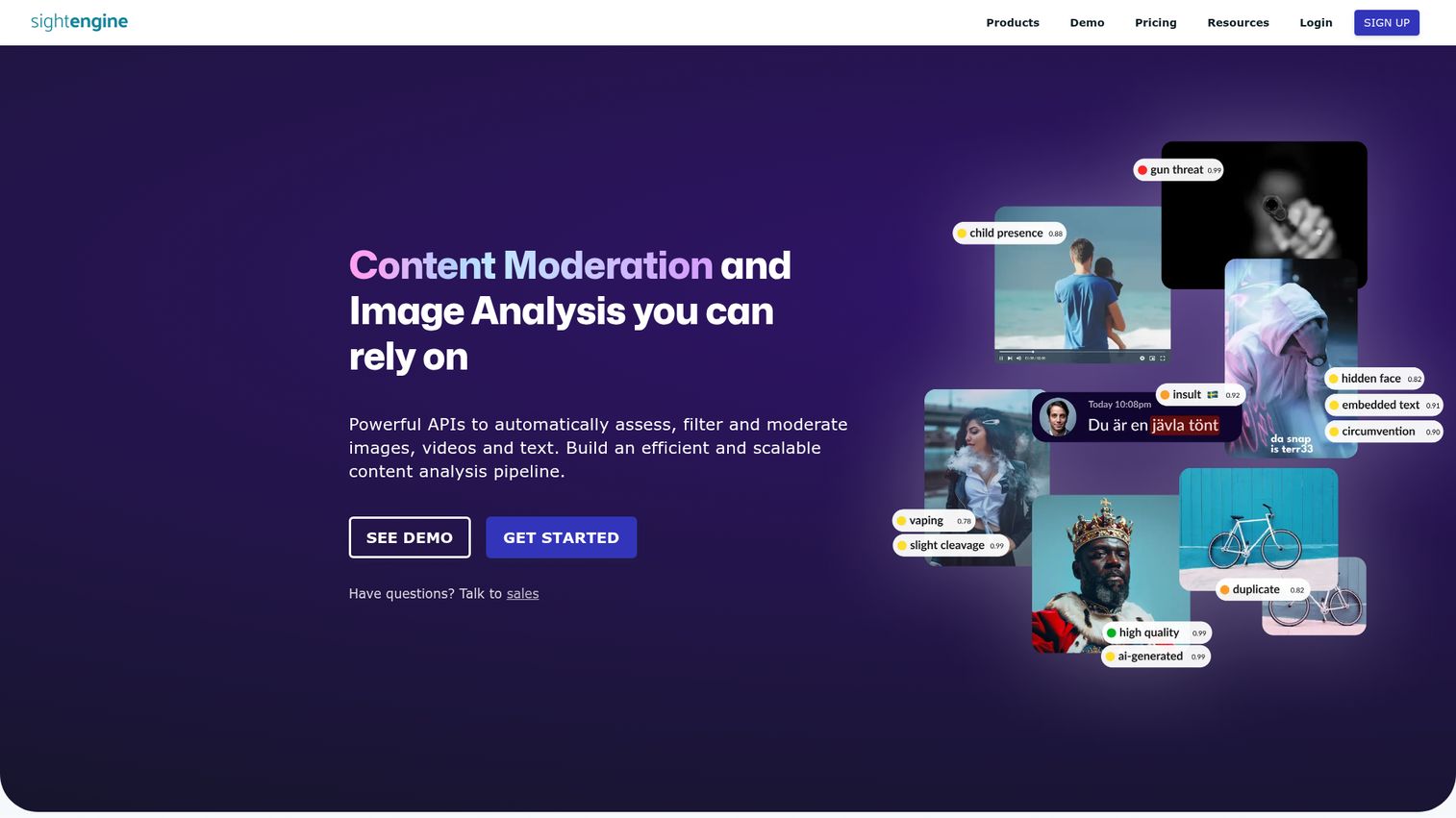
Sightengine provides APIs to automatically assess, filter, and moderate images, videos, audio, and text. It is built for developers, with clear documentation, SDKs, and predictable usage pricing. For teams that want to wire moderation into their own product without a heavy services layer, it is one of the cleaner options on this list.
Best for: Platforms and developer teams that need fast, API-based moderation across images, video, audio, and text.
Key strengths
- Multimodal API: Image and video moderation covers nudity, hate, violence, drugs, weapons, and self-harm classes.
- Text and AI detection: Text moderation catches inappropriate content, personal information, links, and usernames, plus AI-generated and deepfake detection.
- Real-time and OCR: Low-latency responses and OCR catch text embedded inside images.
Why choose Sightengine: This is the pick for product and engineering teams that want to own the integration. The free tier supports proof-of-concepts, and the paid tiers add video, live-stream, audio moderation, and custom models as you scale. If documentation and API ergonomics matter to your buying decision, you may also want to study how vendors present capabilities through an interactive demo before committing. It appears in multiple competitor roundups, including CometChat's 2026 list, which signals consistent developer trust.
Sightengine pricing: Sightengine offers a free tier with 2,000 operations per month for testing. The Starter plan is $29 per month for 10,000 operations plus $0.002 per additional operation. The Pro plan runs $99 per month for 40,000 operations and adds advanced video, live-stream, and audio moderation along with liveness and age estimation. Enterprise is custom-priced with SLAs and a dedicated support engineer. Sightengine holds a 4.5 out of 5 rating on G2.
3. WebPurify

WebPurify provides AI and human content moderation services for text, images, video, metaverse, and generative AI use cases. Its differentiator is the hybrid model: automated tools handle volume, and trained human moderators handle the cases AI cannot decide. For brands that want a managed layer rather than just an API, WebPurify fills that gap.
Best for: Brands that need scalable moderation across text, images, or video using AI, human reviewers, or a hybrid of both.
Key strengths
- Text and profanity moderation: Filters hate speech, bigotry, sexual advances, and more.
- Flexible image moderation: Choose automated AI, human review, or a hybrid AI plus human workflow.
- Live video review: Human moderators with AI-assisted escalation handle video content.
Why choose WebPurify: If your team lacks the headcount to staff a 24/7 moderation desk, WebPurify's human services layer is the reason to pick it. You get AI speed where it works and human judgment where it matters, without building either in-house. That blend suits brands with sensitive content and reputational risk.
WebPurify pricing: WebPurify prices by product area. Image moderation through WebPurify AIM starts at $0.0026 per image, live moderation runs $0.02 per photo, and video moderation is 15 cents per minute. Profanity filter plans range from $5 per month for plugins only to $50 per month for the Enterprise tier, with custom dedicated-server options. WebPurify offers trials including 100 free photo moderations and a 14-day profanity-filter trial. It holds a 4.3 out of 5 rating on G2.
4. ActiveFence
ActiveFence, now operating as Alice, is a security, safety, and trust platform for enterprise AI. It helps test, protect, and monitor AI apps and agents, extending trust and safety beyond classic content moderation into the AI systems themselves. For enterprises and platforms with mature trust and safety operations, this is the deepest option here.
Best for: Enterprises, foundation model labs, and large UGC platforms that need AI safety, red-teaming, runtime guardrails, and trust-and-safety controls at scale.
Key strengths
- Pre-launch red teaming: Stress-tests AI models, apps, and agents before they ship.
- Runtime guardrails: Dynamic protection for live AI apps and agents.
- Ongoing monitoring: Automated red-teaming detects drift and emerging risks over time.
Why choose ActiveFence: Pick ActiveFence when moderation is part of a broader trust and safety mandate, not just a content filter. Its threat intelligence and red-teaming suit organizations defending against coordinated abuse and evolving AI risk. This is enterprise tooling for teams that treat safety as an operating function.
ActiveFence pricing: ActiveFence does not publish public pricing or plan tiers; the platform is sold through direct sales conversations. Given the enterprise positioning and red-teaming scope, expect custom contracts scoped to your platform's size and risk profile. ActiveFence, listed on G2 under the Alice brand, holds a 4.5 out of 5 rating.
5. Checkstep

Checkstep is an AI content moderation platform built for trust and safety teams that need to enforce policies and prove compliance. It scans content, automates moderation workflows, and generates the transparency reporting that regulations like the EU Digital Services Act and the UK Online Safety Act require. For compliance-led buyers, that reporting layer is the whole point.
Best for: Online platforms and marketplaces that need scalable AI-assisted moderation tied directly to policy enforcement and regulatory reporting.
Key strengths
- Policy and compliance engine: Customizable policy management drives consistent enforcement.
- Multi-format scanning: Detects across text, image, audio, and video content.
- Transparency reporting: Generates DSA transparency reports, Statements of Reasons, Notices, and Appeals.
Why choose Checkstep: If your buying decision is driven by legal and compliance teams, Checkstep speaks their language. The human-in-the-loop workflows and Advanced ModBot handle moderation, while the reporting tools turn that work into the documentation regulators expect. That combination is rare in the category. Compliance-led buyers often look closely at how a vendor handles its own security and compliance posture as part of due diligence.
Checkstep pricing: Checkstep does not publish public numeric pricing. The company describes a pricing model built on a matrix of setup cost, volume tiers, and operator seats, with variables including content volume, media types, abuse types, latency, and accuracy needs. You will need to contact Checkstep for a scoped quote. The platform does not yet have enough G2 reviews for a rating.
6. Lasso Moderation
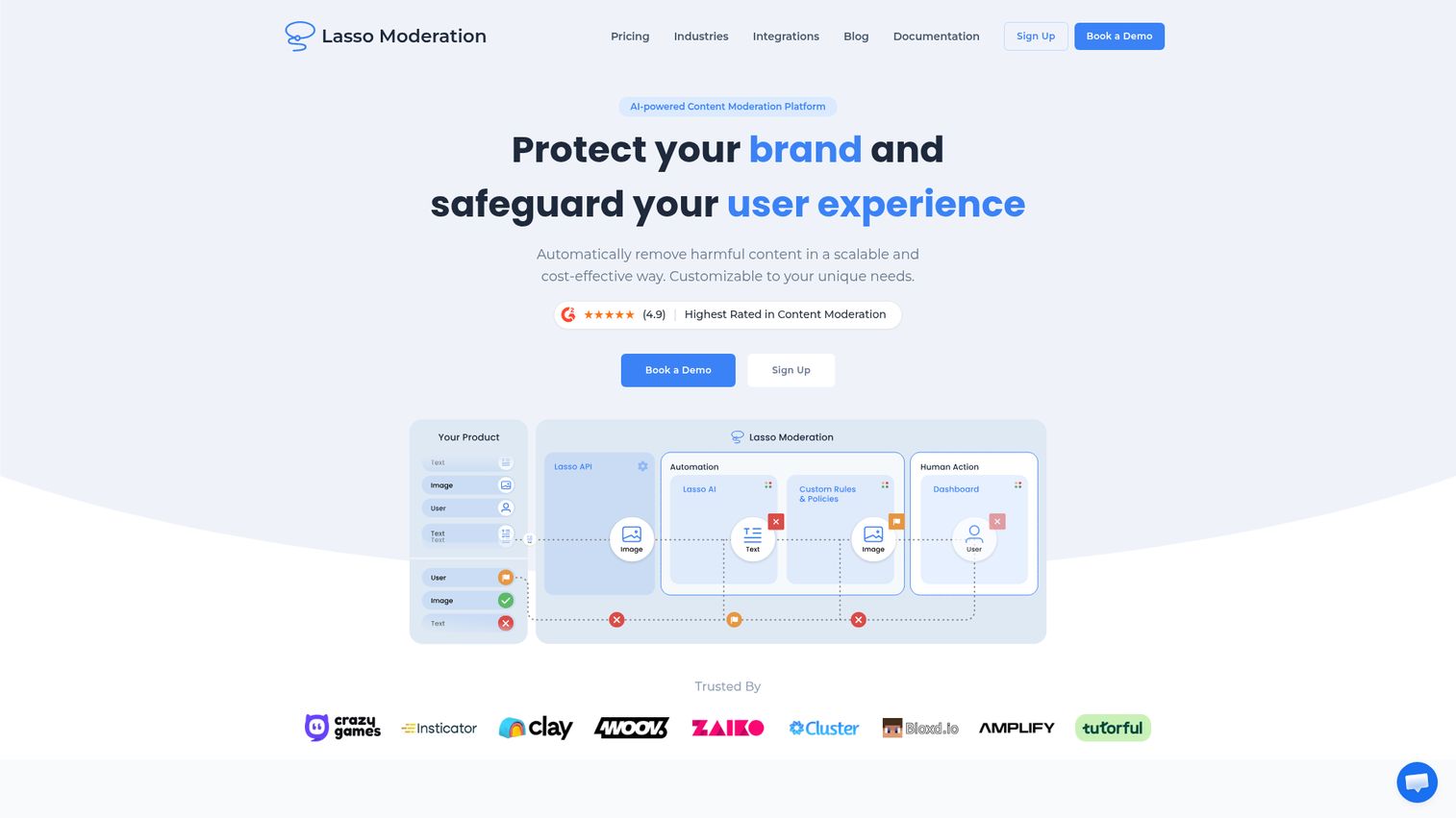
Lasso Moderation is an AI-powered content moderation platform for automatically removing harmful user-generated content, with customizable rules and a human moderation dashboard. It is workflow-centric, built around review queues, user reports, and analytics. For teams that want clear control over how content flows through moderation, Lasso makes that visible.
Best for: Online communities, apps, marketplaces, gaming, chat, and social platforms that need scalable AI-assisted moderation with a clean review dashboard.
Key strengths
- Full-format moderation: Handles text, image, video, and audio.
- Custom rules: Define moderation policies and rules that match your guidelines.
- Moderation dashboard: Review queues, user reports, analytics, and webhooks in one place.
Why choose Lasso Moderation: Lasso fits teams that want transparent pricing and a hands-on dashboard rather than an opaque enterprise contract. The published tiers make it easy to estimate cost as you grow, and the human plus AI queue model keeps your team in control of edge cases. Its 4.9 out of 5 G2 rating across 21 reviews reflects strong user satisfaction.
Lasso Moderation pricing: The Lite plan starts at $99 per month for up to 10,000 items per month and one moderator. The Pro plan is $499 per month for up to 100,000 items and three moderators. Enterprise is contact-us pricing for unlimited items and moderators. Lasso holds a 4.9 out of 5 rating on G2.
7. CleanSpeak

CleanSpeak is a customizable moderation and filtering toolset for user-generated content, powered by AI and machine learning, with profanity filtering in multiple languages. It is best known for chat, username, and forum filtering, with a strong focus on gaming and family-friendly communities. If your priority is keeping language clean in real-time interactions, this is its core competency.
Best for: Companies that need scalable moderation and profanity filtering for chat, forums, profiles, reviews, images, or videos, especially in gaming and kid-safe communities.
Key strengths
- Moderation queues: Review problematic content, escalations, and automation in one workflow.
- ML models: Machine learning handles text, image, and video moderation.
- Custom blocklists: Word and phrase lists across 22 or more base languages.
Why choose CleanSpeak: CleanSpeak is the pick when profanity and chat filtering are your central problem, particularly for gaming platforms and children's communities where username and message screening protect young users. The multilingual blocklists and customization give you fine control over what counts as a violation. That precision suits communities with specific tone standards.
CleanSpeak pricing: CleanSpeak does not publish public pricing or named plan tiers. The website directs prospective buyers to schedule a demo or contact sales for a quote scoped to your moderation volume and use case. The platform does not yet have enough G2 reviews for a rating.
8. Besedo / Implio
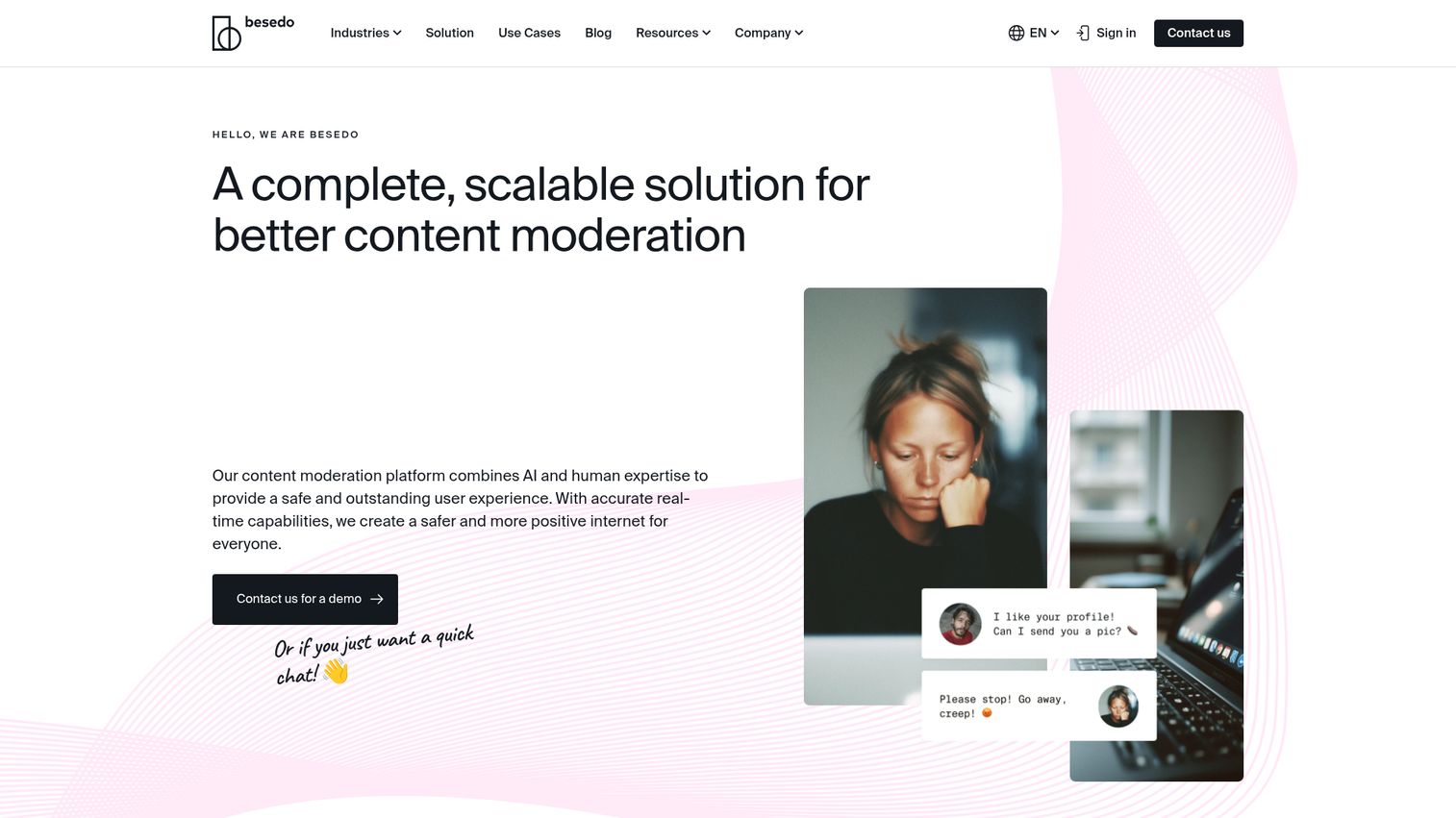
Besedo, through its Implio platform, provides AI-assisted and human content moderation for user-generated content, with a focus on spam, fraud, abuse, and harmful-content detection. It is built for marketplaces and classifieds, which makes it the natural fit for ad-submission and listing screening. If prohibited goods and scam listings are your problem, this vendor targets them directly.
Best for: Online platforms and marketplaces that need scalable AI-plus-human moderation for user-generated text, images, video, chat, fraud, and abuse.
Key strengths
- AI-assisted routing: Automated moderation sorts content into OK, NOK, and Uncertain queues.
- Flexible rules: Create custom rules and content filters for your policy set.
- Human moderation: Purpose-built review UI plus on-demand human moderators.
Why choose Besedo / Implio: Choose Besedo when ad submissions and marketplace listings are the heart of your moderation challenge. The OK, NOK, Uncertain routing model is built for classifieds, where fraud and prohibited goods hide in listings. The on-demand human moderation layer covers the judgment calls AI routes as uncertain.
Besedo / Implio pricing: Besedo does not publish public pricing or plan tiers. The company directs buyers to its contact page for a quote scoped to your platform's needs. Given the blend of AI automation and human moderation services, expect a custom contract. Besedo does not yet have enough G2 reviews for a rating.
9. Microsoft Azure AI Content Safety

Microsoft Azure AI Content Safety is a Microsoft Azure AI service for detecting and mitigating harmful user-generated and AI-generated text, image, and multimodal content. It is the cloud-native successor to the older Azure Content Moderator, which is being retired. For teams already on Azure, it slots into the existing stack with minimal friction.
Best for: Teams building AI applications or UGC platforms that need Azure-native content moderation and AI guardrails.
Key strengths
- Severity-based detection: Detects and blocks violence, hate, sexual, and self-harm content with configurable thresholds.
- Custom filters: Build your own categories for content specific to your platform.
- Prompt shields: Protects against prompt injection and jailbreak attempts on AI apps.
Why choose Microsoft Azure AI Content Safety: If your infrastructure already runs on Azure, this is the path of least resistance. The configurable severity thresholds let you tune sensitivity, and the prompt shields extend protection to AI features, not just user content. That dual focus suits teams shipping generative AI products.
Microsoft Azure AI Content Safety pricing: Azure AI Content Safety offers a free tier including 5,000 text records and 5,000 images per month. Beyond that, the Standard tier is usage-based, priced per 1,000 text records and per 1,000 images, billed through your Azure account. Check the Azure pricing page for current per-unit rates in your region. The service holds a 4.6 out of 5 rating on G2.
10. Amazon Rekognition Content Moderation

Amazon Rekognition Content Moderation uses AWS-managed machine learning APIs to detect and moderate inappropriate, unwanted, or offensive content in images and videos. For platforms already on AWS, it brings image and video moderation at cloud scale with pay-as-you-go pricing. It is a focused image and video tool rather than a full multi-format suite.
Best for: Organizations that need scalable, API-based moderation of user-generated image and video content on AWS.
Key strengths
- Broad detection: Flags adult and suggestive content, violence, drugs, hate symbols, gambling, and disturbing content.
- Structured output: Returns moderation labels, confidence scores, and video timestamps in a hierarchical taxonomy.
- Human review and custom models: Integrates with Amazon Augmented AI for human review and supports Custom Moderation adapters.
Why choose Amazon Rekognition: If you run on AWS and need image and video moderation without standing up a new vendor, Rekognition is the native choice. The confidence scores and timestamps make it easy to build automated rules, and Custom Moderation adapters let you tune detection to your content. The pay-as-you-go model keeps entry costs low.
Amazon Rekognition pricing: Rekognition uses pay-as-you-go pricing with no upfront commitment. Image content moderation starts at $0.0010 per image for the first million images, and video content moderation is priced at $0.10 per minute for stored video analysis. Custom Moderation adds adapter training at $5 per hour plus $0.0012 per image. The AWS Free Tier is available for eligible new accounts. Rekognition holds a 4.3 out of 5 rating on G2.
11. PicPurify
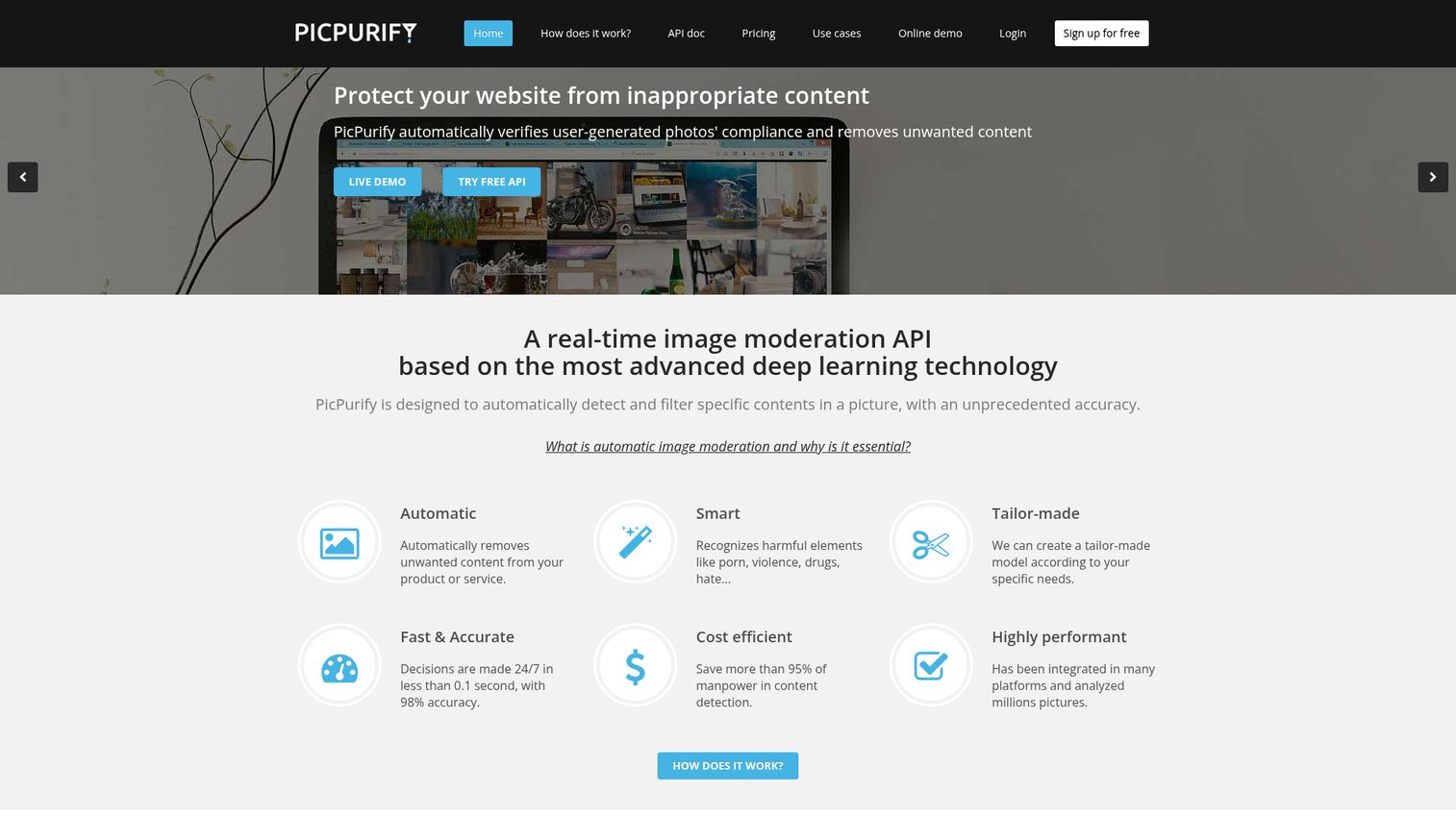
PicPurify is a real-time image and video moderation API for detecting and filtering inappropriate user-generated content. As an automatic image moderation tool, it focuses on visual content: porn, nudity, violence, weapons, drugs, hate signs, and obscene gestures. For platforms whose main risk is unsafe images, it offers a focused, well-priced API.
Best for: Platforms that need API-based moderation of user-generated images or videos for adult, violent, drug, weapon, hate-symbol, or similar unsafe content.
Key strengths
- Automatic image moderation: Detects porn, nudity, violence, weapons, drugs, hate signs, money, and obscene gestures.
- Face and demographic detection: Includes face, gender, and age detection.
- Video moderation: Automatic video moderation and filtering alongside images.
Why choose PicPurify: PicPurify suits teams that need straightforward, real-time image moderation without a complex contract. The unit-based pricing scales cleanly from a free tier through high-volume plans, so you only pay for what you process. For image-heavy platforms with a clear visual-risk profile, it is a practical, low-friction option.
PicPurify pricing: PicPurify prices by units, where one unit is consumed each time a task runs on one image. The FREE plan includes 2,000 units. Paid plans start at $19 per month for 10,000 units (STARTER), $49 per month for 30,000 units (PRO), and scale up to $499 per month for 450,000 units (SUPRA). Larger or specialized needs require a custom quote. PicPurify holds a 4.5 out of 5 rating on G2.
Considerations before you buy
Shortlisting moderation tools is easier when you know which trade-offs actually matter for your platform. Run any candidate through these five checks before you commit. If you want a repeatable framework for this kind of decision, our guide to SaaS tool evaluation walks through how to score vendors against your stack.
Content-format coverage
Map your content types against each tool's coverage. A text-only filter is useless if your real risk is unsafe images, and an image API misses harmful video. If you handle all four formats, prioritize multimodal platforms over single-format APIs so you are not stitching vendors together.
Automation accuracy and human-in-the-loop
No automated content moderation is perfect. Ask about false-positive rates and how the tool routes uncertain cases. The best fit balances automation for volume with human-review queues for judgment calls. Over-aggressive filters frustrate real users; loose ones let harmful content through. If you also need to surface AI capabilities to your own customers, see how teams use AI-powered features to demonstrate value clearly.
Compliance and data handling
Confirm the tool supports GDPR-compliant processing, CSAM hash-matching, and any regional regulations you face, including the UK Online Safety Act. Check data residency options if you operate across borders. For compliance-led teams, transparency reporting is often the deciding factor.
Integration and API depth
Look at what the platform replaces and how it fits your existing stack. Strong API documentation, webhooks, and SDKs reduce engineering lift. The same logic applies to any tool you adopt: favor platforms with deep integrations that absorb more of the job rather than adding another disconnected system.
Pricing model and scalability
Moderation tools price per item, per API call, per seat, or by volume tier. Model your costs at current and projected volume, because per-item pricing that looks cheap at launch can balloon as UGC grows. Predictable cost as you scale matters as much as the entry price.
Conclusion
The right content moderation platform depends on your dominant content format and your compliance burden. For multimodal breadth at scale, Hive AI consolidates text, image, video, and audio with strong CSAM and deepfake detection. Developer teams that want to own the integration will land on Sightengine or, for image and video on AWS, Amazon Rekognition. If you need a managed human layer, WebPurify blends AI with human review services. Enterprise trust and safety operations lean toward ActiveFence, while compliance-led buyers get the reporting they need from Checkstep. For communities, gaming, and chat, CleanSpeak and Lasso Moderation handle queues and profanity well, and PicPurify offers focused, low-friction image moderation.
If your moderation work sits alongside building safe, well-onboarded communities, it is worth reviewing the best user onboarding software and the best digital adoption platforms to round out your stack.
Your next step is concrete. Shortlist two or three tools that match your primary content format and compliance needs, then run a trial against your real UGC samples, not vendor demos. Test false-positive rates on your own edge cases. The tool that performs best on your actual content, at your actual volume, is the one worth buying.
FAQs
Content moderation tools are platforms that automatically detect, filter, and review user-generated content against your safety policies. They use machine learning to screen text, images, video, and audio, then flag, remove, or escalate content that breaks your guidelines. Most pair automated detection with human-review queues for cases that need judgment.
There is no single best tool, because the right choice depends on your content formats and compliance needs. For multimodal coverage across text, image, video, and audio, Hive AI is a strong AI content moderation option. Sightengine suits developer teams wanting a clean API, and WebPurify fits brands that need a managed human layer alongside automation. Match the tool to your dominant content type first.
Pricing models vary by vendor. Many use per-item or per-API-call pricing, where you pay per image or per thousand requests, with entry points as low as fractions of a cent per image. Others use monthly plans, like Lasso Moderation at $99 per month or Sightengine at $29 per month. Enterprise-focused tools like ActiveFence, Checkstep, and Besedo use custom pricing scoped to your volume and seats.
Yes. Automatic image moderation tools use AI to classify visual content for nudity, violence, weapons, drugs, and other unsafe categories. Many also run OCR to catch text hidden inside images, like slurs embedded in memes. Video moderation works the same way, analyzing frames and often transcribing audio with ASR to screen the full clip. Tools like Sightengine, Amazon Rekognition, and PicPurify specialize in this.
Content moderation software, or a platform, is self-serve tooling you run yourself, usually through an API or dashboard. Content moderation services are managed, where the vendor's human moderators handle review for you. Solutions typically blend both, pairing AI automation with optional human moderation. Many vendors sit in the middle, offering an API plus human-review services as an add-on.
Content moderation tools for ad submissions auto-screen ad creatives and marketplace listings before they go live. They detect fraud, prohibited goods, misleading claims, and policy violations across the images, titles, and descriptions in a submission. Vendors built for marketplaces and classifieds, like Besedo and Implio, route listings into OK, not-OK, and uncertain queues so humans only review the edge cases.
Automated content moderation supports compliance with the UK Online Safety Act by helping platforms detect and remove illegal and harmful content at scale, and by generating the records regulators expect. The Act places duties of care on platforms hosting user-generated content, with real penalties for failure. Tools like Checkstep add transparency reporting built for this. This is not legal advice; consult counsel for your specific obligations.
Pre-moderation reviews content before it publishes, which protects vulnerable audiences but adds latency. Post-moderation publishes content immediately, then reviews it afterward, which keeps conversation flowing. Reactive moderation reviews content only after users flag it. Most platforms mix these models, using automated AI moderation to triage in all three cases because no human team can review every item by hand.