A grievance lands in someone's inbox. It gets forwarded. Then it sits in a spreadsheet tab named "complaints_final_v3." Two weeks later, nobody remembers who owns it, what stage it's in, or whether the deadline already passed.
If you run operations for a union, an association, or any organization that handles stakeholder complaints, you already know this failure mode. Ad hoc handling works until volume climbs. Then the cracks show: missed deadlines, inconsistent outcomes, and no clean record when someone asks what happened.
The market has noticed. The global complaint management software market reached USD 2.9 billion in 2025 and is forecast to hit USD 6.3 billion by 2034, a CAGR of 8.57% through 2034, according to the IMARC Group (2025). Complaint handling is now the largest solution segment inside quality management software, at 16.1% of global revenue in 2025 per Grand View Research (2025). Organizations are buying because manual processes stop scaling right around the moment leadership starts asking for real numbers.
Good grievance tracking software fixes the same core problems: it centralizes intake, routes cases automatically, tracks status through resolution, preserves a full audit trail, and reports outcomes in a form that survives scrutiny. This guide ranks seven platforms against those criteria. If you also manage adjacent workflows, it's worth scanning our roundups on contract lifecycle management, audit management software, and community management, since grievance handling rarely lives in isolation.
What's inside
This guide covers seven tools built for centralized intake, workflow automation, real-time visibility, reporting, and secure case handling. The selection favors teams that need grievance tracking software, a public-facing grievance portal, or union and stakeholder case management. We evaluated each product on six criteria: intake flexibility, automation depth, reporting and dashboards, security and access control, integrations, and fit for a specific operating model. Some tools lean toward broad complaint tracking software; others specialize in union or professional-standards workflows. We flag which is which so you can match the tool to your governance model, not just its feature list.
TL;DR
- Best for stakeholder engagement and centralized context: Simply Stakeholders ties complaints to the broader relationship record.
- Best for anonymous or public-facing portals: Borealis leads with self-serve submissions and transparency.
- Best for union-specific workflow: GrieveRight is built around stewards, deadlines, and contract-based grievances.
- Best for association or professional standards handling: CASEPRO structures complaint submission and panel management.
- Best for low-code Microsoft stack teams: Grievance Management System by Dhyey Consulting runs on Power Apps and SharePoint.
- Best for broad complaint tracking and reporting: Internet Grievance System covers web-based grievance and case management.
- Best for federated or multi-local governance: RepliaOS handles grievances plus the wider union operations stack.
What is grievance management software?
Grievance management software is a system that centralizes complaint intake, routes each case to the right owner, tracks actions through resolution, preserves a complete history, and reports outcomes. It replaces the spreadsheet-and-email pattern with a structured electronic grievance system where every case has a status, an owner, and a deadline.
The core job stays consistent across vendors: capture the complaint, route it, track the actions taken, keep the record, and report what happened. Where products differ is in who they serve and how much workflow structure they impose.
Most grievance resolution software covers some or all of these capabilities:
- Intake forms: Configurable submission forms, embedded on a portal or website, sometimes supporting anonymous reporting.
- Routing and escalation workflows: Automatic assignment based on type, region, or severity, with escalation rules for stalled cases.
- Task assignment: Clear ownership so no case falls between people.
- Status tracking: A live view of where every case sits in its lifecycle.
- Dashboards and reporting: Aggregate views of volume, resolution time, and outcomes for leadership.
- Security and access control: Role-based permissions, confidentiality controls, and data protection.
- Auditability: A timestamped log of every action, so the record holds up under review.
That combination is what separates real case management from a shared inbox with color-coded labels.
When to use grievance management software
Not every team needs a dedicated system on day one. Here's how to tell when the switch pays for itself.
Replace email threads and spreadsheets
The trigger is volume. When you're handling a handful of grievances a year, a spreadsheet holds. Once you cross into dozens of active cases across multiple people, ad hoc tracking breaks down: deadlines slip, ownership blurs, and reconstructing history becomes a chore. A centralized system removes the reconstruction work entirely, because the record builds itself as people act.
Standardize resolution steps across teams or locations
If two locals, departments, or regions handle the same type of grievance differently, outcomes drift and disputes get harder to defend. Configurable workflows fix this by enforcing the same stages, deadlines, and approvals everywhere. That consistency matters most when your governance model is federated and multiple offices operate semi-independently.
Improve visibility for leadership and stakeholders
When accountability is on the line, "I think it's being handled" isn't an answer. Dashboards, progress tracking, and audit trails give leadership a live picture of volume, aging cases, and resolution times. For a founder or operator, that visibility is the difference between a board conversation grounded in data and one grounded in guesswork.
Comparison table
Use this table to sort by fit, not feature count. The Intent column tells you the operating model each tool is built for; Key differentiation is the reason you'd pick it over the others. Pricing and G2 ratings shift over time, so confirm current numbers on each vendor's site before you commit.
| # | Product | Intent | Key differentiation | Pricing | G2 rating |
|---|---|---|---|---|---|
| 1 | Simply Stakeholders | Stakeholder-context complaint management | Ties complaints to the full relationship record | Quote-based (Core, Plus, Pro) | 5.0/5 |
| 2 | Borealis | Public-facing grievance and feedback portal | Self-serve, anonymized submissions with real-time status | Quote-based | 3.8/5 |
| 3 | GrieveRight | Union grievance workflow | Contract-based grievance drafting and deadline tracking | From $10/mo | Not listed |
| 4 | RepliaOS | Federated union operations | Grievances plus meetings, governance, and reporting | From $49/month | Not listed |
| 5 | CASEPRO | Association professional standards | Complaint submission with panel management | Contact for pricing | Not listed |
| 6 | Grievance Management System (Dhyey) | Microsoft low-code stack | Power Apps and SharePoint with auto ticket generation | Not publicly listed | Not listed |
| 7 | Internet Grievance System | Broad grievance and case management | Web-based intake with document storage | Not publicly listed | Not listed |
1. Simply Stakeholders
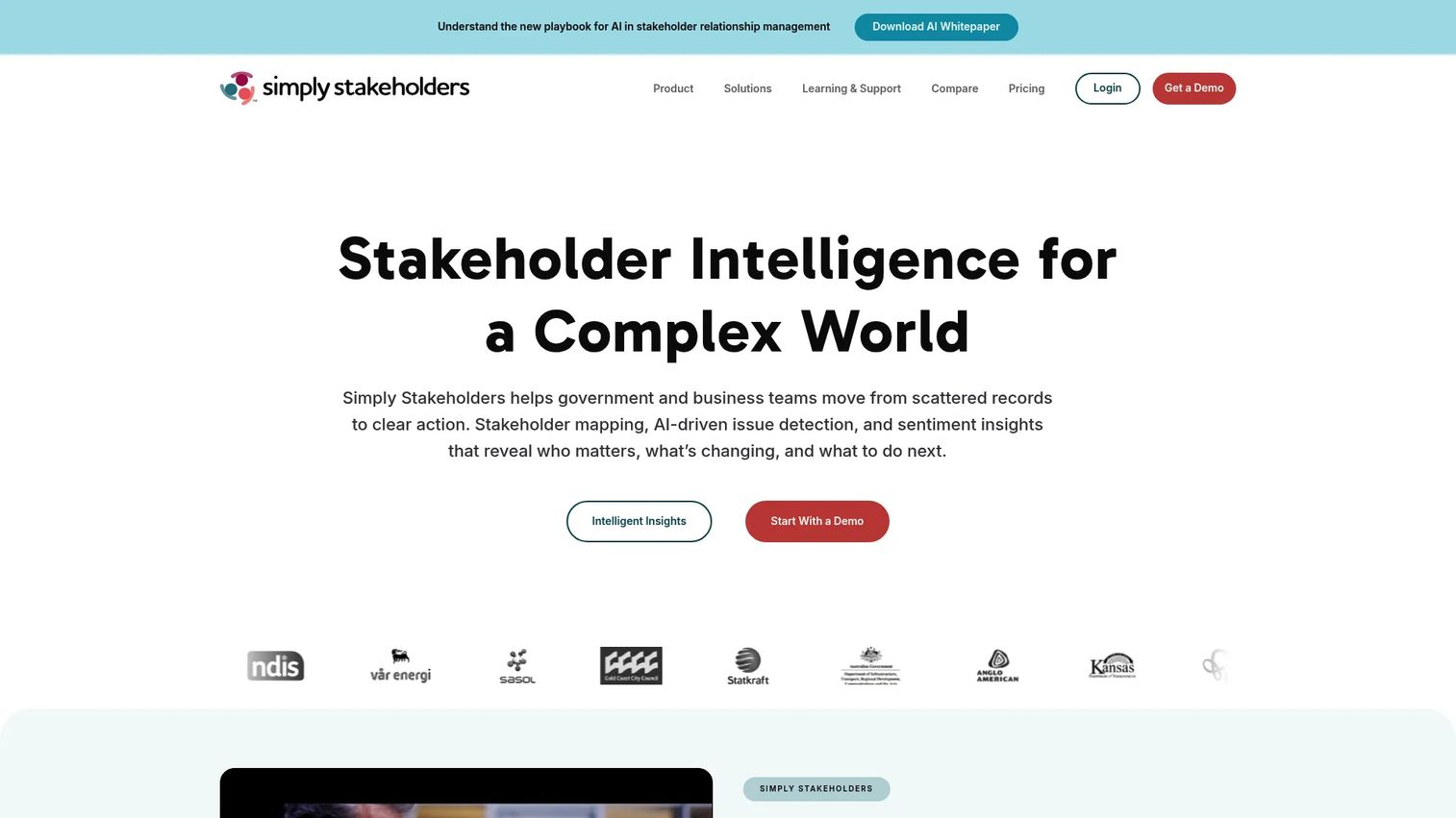
Simply Stakeholders is cloud-based stakeholder relationship management software that treats a complaint as one interaction inside a larger relationship, not an isolated ticket. It maps stakeholders, tracks engagement history, analyzes sentiment, and reports on the whole picture. For organizations where the person filing a grievance is also a community member, partner, or regulator you'll deal with again, that context changes how you handle the case.
Best for: Government, nonprofits, and businesses managing complex stakeholder relationships alongside complaint history.
Key strengths
- Stakeholder register and interaction tracking: Every complaint links to a complete history of that relationship, so context is never lost.
- Stakeholder mapping: Multi-dimensional and 3D network maps show how issues connect across people and groups.
- AI-driven sentiment analysis: Automated summaries and reporting surface tone and patterns without manual tagging.
Why choose Simply Stakeholders: If your grievances arrive from people you have ongoing relationships with, isolating each complaint in a standalone tracker loses the thread. This platform keeps the relationship at the center. It fits public affairs, ESG, land, and community engagement teams who need complaints tied to the record they already maintain. The tradeoff is scope: this is a relationship-first system that handles complaints, not a grievance-first system.
Simply Stakeholders pricing: Plans are Core, Plus, and Pro, all billed annually. Pricing is quote-based and depends on plan, modules, and user count, so no public number is listed. A free trial is available by contacting the team. On G2, it holds a 5.0/5 rating across a small number of reviews.
2. Borealis
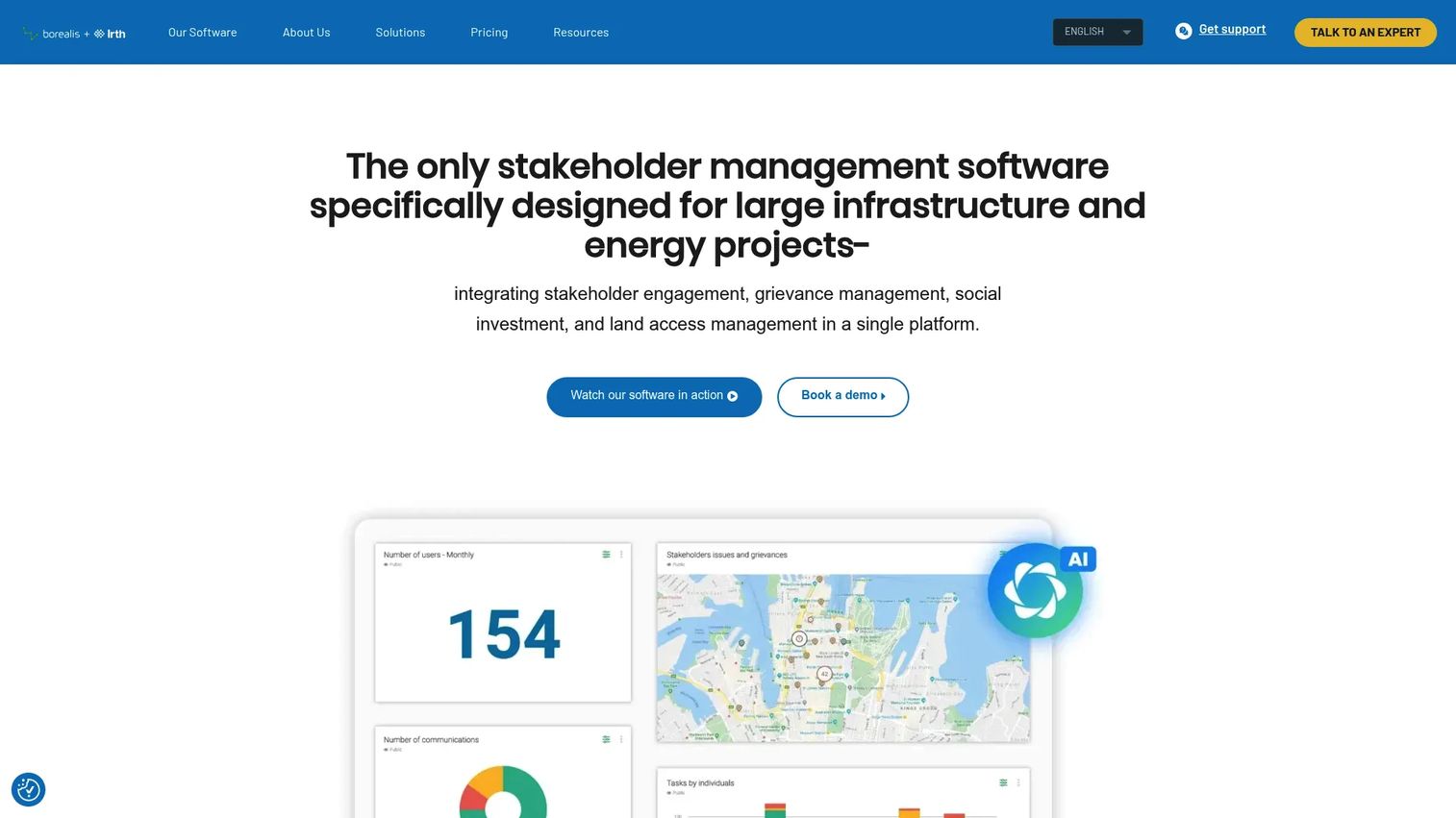
Borealis is stakeholder engagement and management software with a strong grievance and feedback portal. It performs best when you need a public-facing intake channel: people submit complaints through a branded portal, optionally anonymously, and can track real-time status without emailing anyone. That transparency builds trust, which matters when the whole point is showing stakeholders their concerns are taken seriously.
Best for: Teams needing stakeholder relationship management for community, land, public affairs, or ESG workflows with a self-serve grievance portal.
Key strengths
- Stakeholder engagement management: Tracks relationships, commitments, issues, and reporting in one place.
- AI tools: Assists with summaries and analysis across engagement records.
- Stakeholder mapping: Visualizes how stakeholders and issues connect across a project or region.
Why choose Borealis: Anonymous reporting and real-time status visibility make this a fit for organizations where trust and transparency drive complaint volume. Configurable fields and branding let you match the portal to your identity. It suits community, land, and ESG teams running structured engagement programs. Like Simply Stakeholders, it's a stakeholder platform first, so grievance handling sits inside a broader engagement toolset rather than standing alone.
Borealis pricing: Public pricing is not shown. The site describes Essential, Professional, and Enterprise packages, all billed annually, with final pricing delivered as a personalized quote based on users, add-ons, and one-time setup. On G2, the Borealis Application holds a 3.8/5 rating from a small number of reviews.
3. GrieveRight
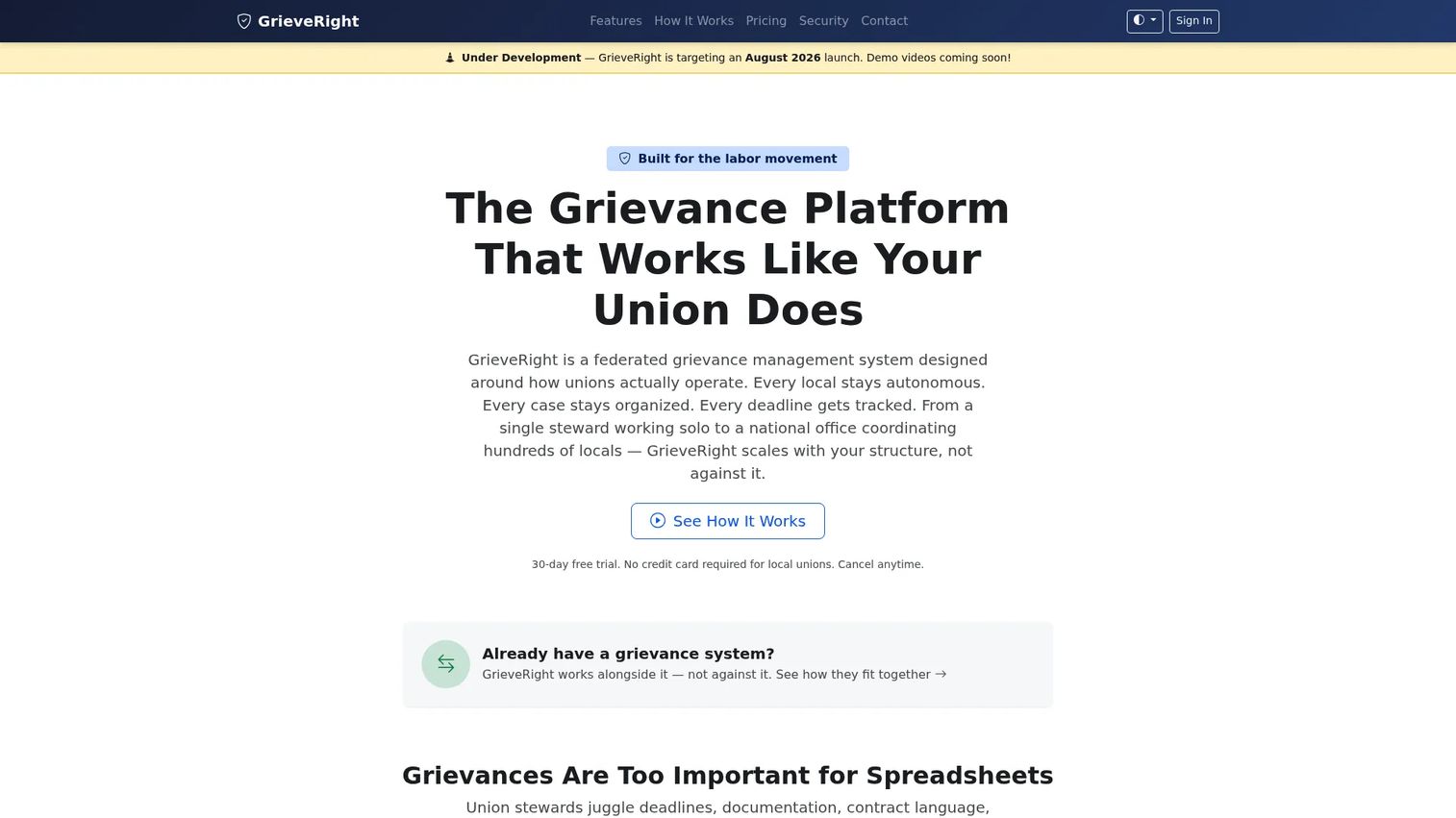
GrieveRight is federated union grievance tracking software built for stewards and locals. Unlike stakeholder platforms that add complaints as a feature, this one starts from the union grievance lifecycle: contract-based grievances, stage templates, deadlines, and case handoffs. If you've ever missed a filing deadline because it lived only in someone's calendar, this is the category built to prevent that.
Best for: Union locals and national offices managing grievance workflows with strict contractual deadlines.
Key strengths
- Custom grievance workflows and stage templates: Model your contract's grievance stages so every case follows the same path.
- AI writing assistant: Drafts contract-based grievances, reducing the blank-page problem for stewards.
- Deadline tracking with reminders: Automated reminders and case handoffs keep filings from slipping past contractual windows.
Why choose GrieveRight: For union work, generic complaint tracking software misses the structure that matters: contract references, filing deadlines, and the steward-to-local-to-HQ handoff. GrieveRight is purpose-built for that federated flow. It fits locals that need deadline discipline and national offices that need visibility across cases. The product is under development with an August 2026 launch target, so evaluate timing against your rollout plan.
GrieveRight pricing: Three plans, billed annually with higher monthly alternatives. Solo Steward starts at $10/mo (or $13/mo monthly), Local Union at $20/seat/mo (or $28/seat/mo monthly), and Union HQ at $25/seat/mo (or $30/seat/mo monthly). A 30-day free trial is mentioned. No G2 rating is published yet.
4. RepliaOS
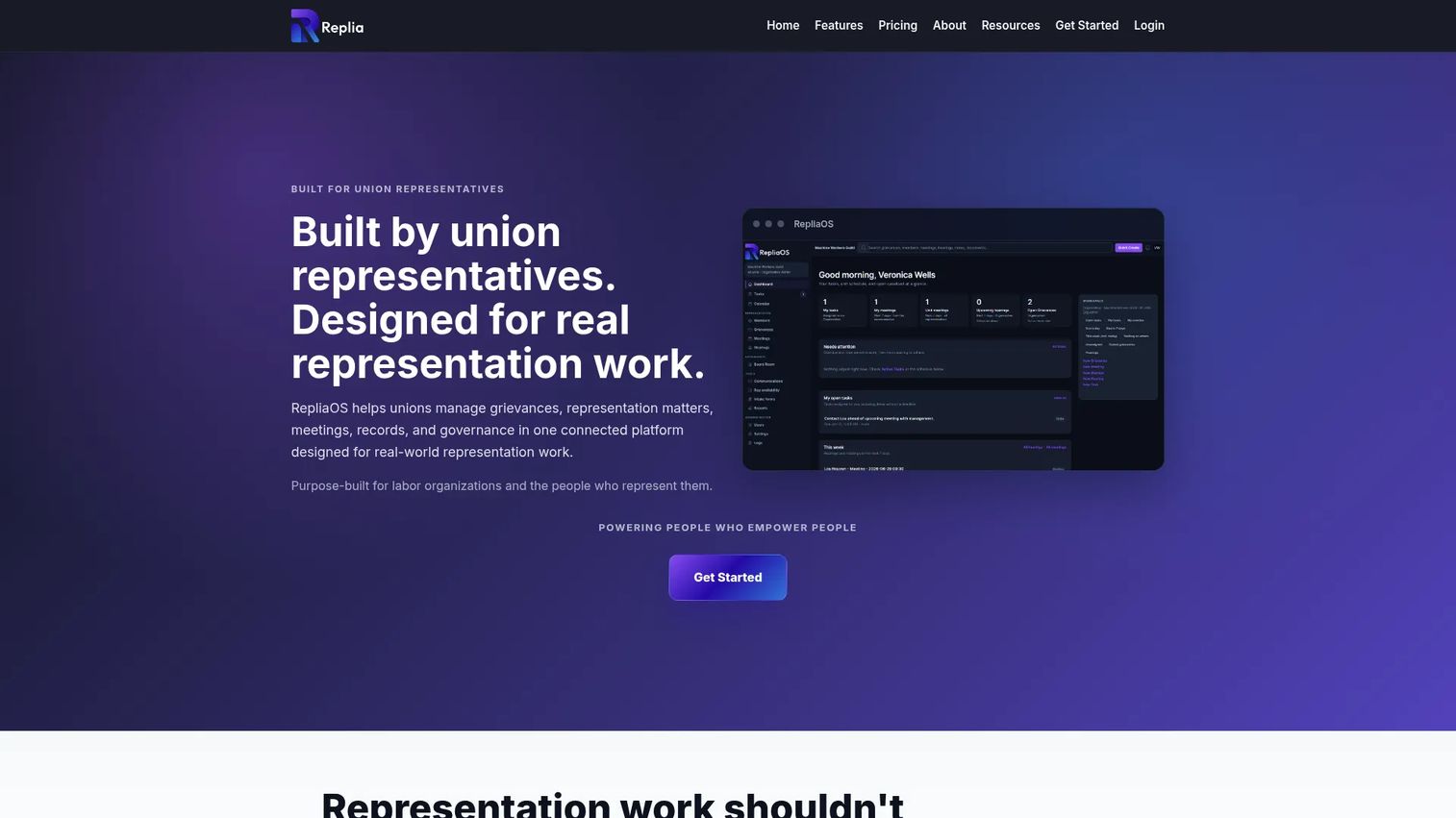
RepliaOS is union grievance management and representation workflow software that goes beyond grievances to cover the wider operations of a labor organization. Grievance and matter tracking sits alongside meetings, hearings, governance tools, calendars, and configurable workflows. For a national office running many locals, that breadth means grievances live in the same system as the governance work they connect to.
Best for: Labor unions managing grievances, meetings, and governance in one system across a represented membership.
Key strengths
- Grievance and matter tracking: Handles grievances plus related representation matters in a single case view.
- Meetings, hearings, and governance tools: Runs the organizational work that surrounds grievance handling.
- Reports, calendar, and configurable workflows: Standardizes process and surfaces reporting across the organization.
Why choose RepliaOS: If your grievance handling can't be separated from meetings, hearings, and governance, a grievance-only tool leaves gaps. RepliaOS consolidates the whole representation workflow, which suits federated organizations with multiple locals and a central office. Member-based pricing that includes unlimited users fits organizations where headcount would otherwise inflate per-seat costs. The tradeoff is that broad scope means more to configure at setup.
RepliaOS pricing: Member-based pricing scales by represented membership, with unlimited users, representatives, and organizational units included. Plans run $49/month for up to 5,000 members, $69/month for 5,001 to 10,000, $89/month for 10,001 to 25,000, and $100+/month above 25,000. Optional assisted setup and import services are listed separately. No G2 rating is published.
5. CASEPRO
CASEPRO is professional standards case administration software built for associations. It structures the full complaint lifecycle for organizations that run formal review processes: complaint submission, an admin portal for staff, and panel management for the people who adjudicate. For a REALTOR association or any professional body handling standards complaints, that panel structure is the part generic tools don't offer.
Best for: Associations needing structured professional standards case administration with formal review panels.
Key strengths
- Complaint submission: A structured intake process that captures the details a formal review requires.
- Admin portal: Gives staff a central place to manage cases through their lifecycle.
- Panel management: Supports the panel-based adjudication that professional standards processes rely on.
Why choose CASEPRO: Professional standards work has a review structure that consumer complaint tools ignore. CASEPRO builds around it, handling submission, administration, panel coordination, and summary reporting in one place. It fits associations and professional bodies with formal standards processes and integration needs. Because it's built for a specific organizational model, evaluate fit against your review process rather than a generic feature checklist.
CASEPRO pricing: Pricing is based on installation or API integration, annual licensing, and Azure cloud hosting. The site directs you to contact them for a quote, so no public number is listed. No G2 rating was confirmed from primary sources.
6. Grievance Management System by Dhyey Consulting
Grievance Management System by Dhyey Consulting is a Microsoft Power Apps and SharePoint-based grievance management tool for submitting, tracking, and resolving employee complaints. If your organization already runs on the Microsoft stack, this fits inside infrastructure you own, rather than adding another standalone vendor. Submissions generate tickets automatically, and everything stays inside your Microsoft 365 environment.
Best for: Organizations wanting a Microsoft-based internal grievance workflow with an audit trail and role-based controls.
Key strengths
- Structured submission and auto ticket generation: Every complaint creates a tracked ticket without manual data entry.
- Integrated chat, timestamps, and action logs: Conversation and actions stay attached to the case for a complete record.
- Role-based dashboard with filters: Secure access and admin filtering keep the right people on the right cases.
Why choose Dhyey's Grievance Management System: For teams standardized on Microsoft 365, a low-code app built on Power Apps and SharePoint avoids new-vendor overhead and keeps data inside your tenant. Role-based access control and a full action log support the audit trail internal HR processes require. It fits organizations with the Microsoft stack in place and internal IT that can support Power Platform. Evaluate it against your existing Microsoft governance model.
Grievance Management System by Dhyey Consulting pricing: Pricing is not publicly listed on the accessible product page. Because it's a Power Apps and SharePoint solution, cost typically depends on your existing Microsoft 365 licensing plus implementation. Contact Dhyey directly for a quote. No G2 rating was confirmed.
7. Internet Grievance System
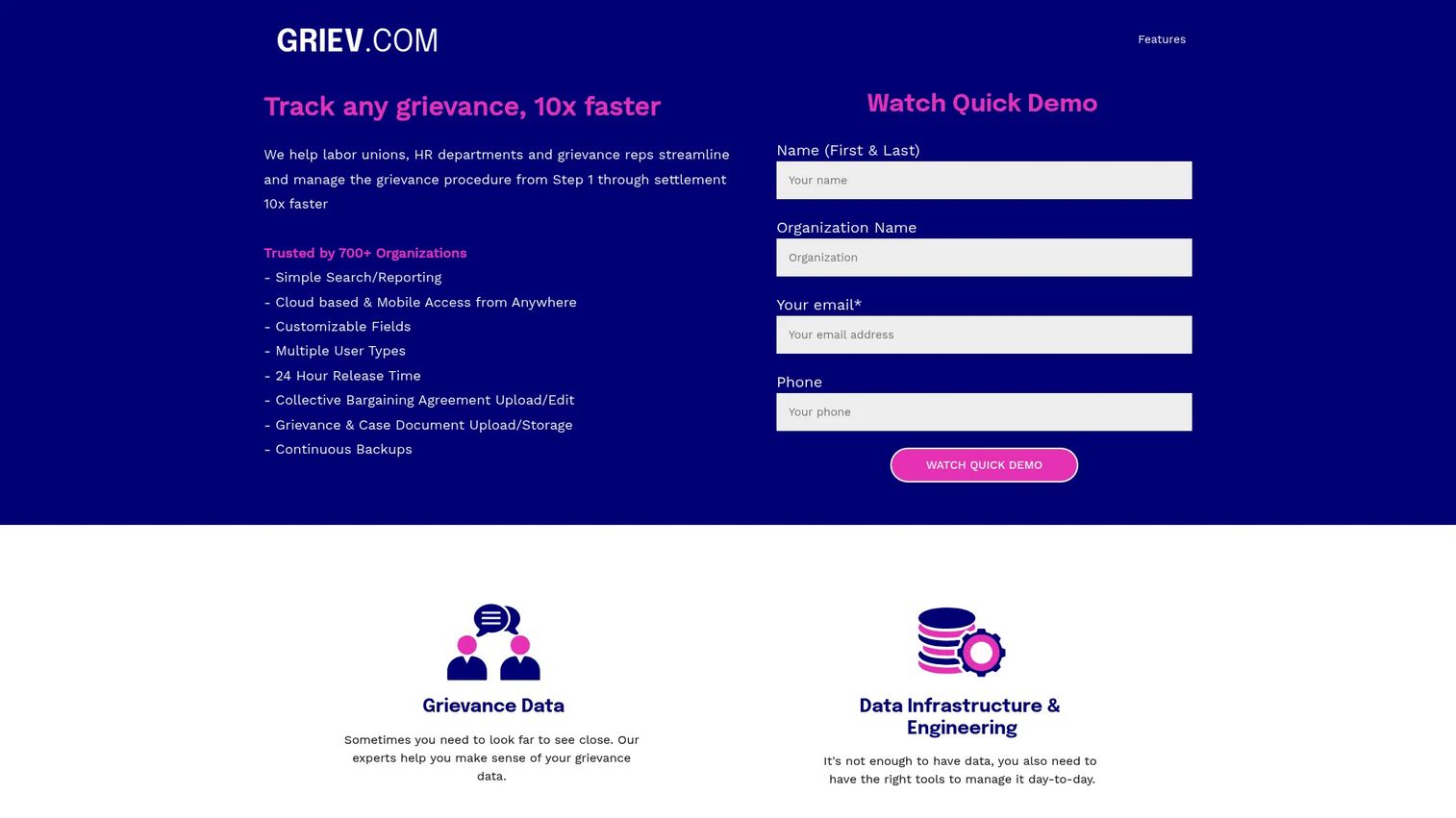
Internet Grievance System is web-based grievance and case management software for labor unions, HR departments, and grievance representatives. It covers the practical basics well: complaint intake, case tracking, document storage, and broad case management with customizable fields. For teams that want a straightforward, cloud-based grievance portal without a heavy platform around it, this focus keeps things simple.
Best for: Labor unions and HR teams managing grievance workflows and the documents that go with them.
Key strengths
- Cloud-based and mobile access: Reach cases and documents from anywhere, with continuous backups protecting the record.
- Customizable fields and multiple user types: Adapt intake to your process and give each role the right access.
- Grievance and case document storage: Upload and store case documents and collective bargaining agreements in one place.
Why choose Internet Grievance System: If you want grievance and case management without adopting a broad stakeholder or operations platform, this stays focused on the core job. Collective bargaining agreement upload and document storage make it practical for union representatives who work from contracts. It fits labor unions and HR teams that value simplicity and mobile access. Evaluate the depth of automation against your volume before committing.
Internet Grievance System pricing: No public pricing page or visible price was found on the site. Contact the vendor directly for a quote. No G2 rating was confirmed from primary sources.
What to evaluate before you buy
The right tool depends less on feature counts than on your operating model. Run any shortlist through these criteria.
Governance and operating model
Federated unions, single-office HR teams, and professional associations need different structures. Match the tool to how your organization actually distributes authority. A federated body needs multi-local visibility; a professional body needs panel management; an internal HR team needs role-based confidentiality. Buying against the wrong model creates workarounds on day one.
Intake channels and anonymous reporting
Decide how complaints arrive. A public-facing grievance portal with anonymous reporting suits stakeholder and community contexts. Internal HR grievances may route through a form inside your existing systems. Confirm the tool supports the intake channels your people will actually use, including anonymity where confidentiality drives participation.
Automation, dashboards, and reporting
Look past intake to what happens next. Routing, escalation workflows, and reminders are what shorten resolution times. Dashboards and reporting are what make the process defensible in a board or membership conversation. If reporting is thin, you'll rebuild it in spreadsheets, which defeats the purpose.
Confidentiality and access control
Grievances carry sensitive information. Verify role-based access, data protection, and a complete audit trail before you trust the system. For internal HR cases especially, who can see what is a compliance question, not a preference.
Implementation speed and stack fit
For a founder or operator, first-quarter fit matters. A Microsoft-native app slots into an existing tenant fast; a standalone platform may deliver more depth but takes configuration. Weigh time-to-value against the completeness you need, and check integration with the systems you already run. It's the same discipline you'd apply when evaluating contract management or event management tools.
Conclusion
The pattern across these seven tools is simple: pick by operating model, not feature list. Simply Stakeholders and Borealis win when complaints belong inside a broader stakeholder relationship, with Borealis leading for anonymous, public-facing portals. GrieveRight and RepliaOS win for union work, with RepliaOS reaching into meetings and governance while GrieveRight stays tight on the grievance lifecycle. CASEPRO fits associations running formal standards panels. Dhyey's Grievance Management System fits Microsoft-stack teams that want to build inside infrastructure they own. Internet Grievance System keeps things focused for unions and HR teams that want core grievance and case management without a wider platform.
Your next step: name your governance model, your primary intake channel, and your reporting needs in one sentence each. Those three answers eliminate most of this list and point you at the one or two tools worth a trial. Start the trial before you commit, and load real cases so you're testing your workflow, not the demo data. For adjacent operations, our guides on loyalty management and marketing resource management follow the same fit-first approach.
FAQs
Grievance management software centralizes how an organization receives, tracks, and resolves complaints or grievances. It captures each case through an intake form, routes it to the right owner, tracks status through resolution, preserves a full history, and reports on outcomes. It replaces scattered email threads and spreadsheets with a single system of record.
Prioritize five things: flexible intake (forms and portals, including anonymous reporting where needed), workflow automation (routing, assignment, and escalation), status tracking so nothing gets lost, dashboards and reporting for leadership, and security with role-based access and a complete audit trail. Everything else is secondary to those five.
Yes, many platforms support anonymous reporting through a public-facing grievance portal. Borealis, for example, offers anonymized submissions. Anonymity matters when fear of retaliation would otherwise suppress complaints, so if participation depends on confidentiality, confirm the tool supports anonymous intake before buying.
The terms overlap heavily. Complaint management software is the broader category, often covering customer or consumer complaints across any industry. Grievance management software typically implies a more formal process with defined stages, deadlines, and appeals, common in union, HR, and professional standards contexts. Appeals and grievances software adds structured review and escalation on top. In practice, many tools serve both jobs.
Often, yes. Union grievance tracking software models the contract-based grievance lifecycle: stage templates, filing deadlines, steward-to-local-to-HQ handoffs, and collective bargaining agreement references. Generic complaint tools miss that structure. If your grievances follow a contractual process with hard deadlines, a purpose-built tool like GrieveRight or RepliaOS usually fits better than a general system.
It removes the delays baked into manual handling. Automated routing sends each case to the right owner instantly. Task assignment fixes accountability. Reminders and escalation workflows keep cases from stalling. Dashboards let managers spot aging cases before they become problems. Together, these shorten the gap between intake and resolution without adding headcount.
Yes. Professional standards work involves formal complaint submission, administrative review, and often panel-based adjudication. Tools like CASEPRO structure that process end to end, including panel management and summary reporting. Associations and professional bodies benefit from a system built for formal review rather than a general complaint tracker.
Focus on five things: implementation speed and whether it fits your existing stack, process fit against your governance model, reporting depth that holds up in board or membership conversations, confidentiality and access control for sensitive cases, and integration with systems you already run. Trial the shortlist with real cases so you test your actual workflow, not sample data.