


You got pinged in Slack last Tuesday with a new battlecard. Updated competitive pricing, revised objection handlers, a fresh talk track for the mid-market segment. Someone built it. Someone interviewed three reps who lost deals last quarter, pulled pricing data from a competitor's website, and turned it into something you can actually use in a technical evaluation.
That someone is probably a sales enablement manager.
But what do they actually do all day? And if you're an SE or presales manager, why should you care?
Here's why: the quality of the enablement function directly shapes the quality of your demos, your onboarding experience, your competitive readiness, and the content you hand to buying committees. According to the Sales Enablement Collective's 2025 industry report, dedicated enablement roles have grown steadily across B2B SaaS companies, with the majority of mid-market and enterprise orgs now employing at least one full-time enablement manager. Understanding what this person does, how they measure success, and how to work with them makes you better at your job.
This is the most detailed breakdown of the sales enablement manager role you'll find online. It's written from the perspective of someone who understands how enablement connects to the presales workflow, not from a recruiter's template.
What you'll learn
- What a sales enablement manager actually owns (and what they don't)
- How the role differs from sales ops, sales training, and revenue operations
- What a sales enablement manager does hour by hour on a typical day (not the job description version)
- 2026 salary benchmarks broken down by experience level, geography, and compensation structure
- The specific tools and technology stack enablement managers use daily
- How enablement managers work with presales and SE teams, and how to improve that relationship
TL;DR
- A sales enablement manager owns the content, training, tools, and processes that help sales teams close deals consistently. They don't carry a quota, but their work directly affects win rates and sales cycle length.
- In 2026, US base salaries range from $103,000 to $139,000 for mid-level managers, with Directors earning $150,000 to $210,000+. Enablement roles have higher base pay and lower variable compensation than most SE roles.
- The daily workflow involves constant context-switching: updating battlecards in the morning, running a sales training session before lunch, building demo content in the afternoon, and pulling analytics before a leadership sync.
- The SE-to-enablement career path is one of the strongest entry points because SEs bring deep product knowledge and buyer empathy that's hard to develop from other backgrounds.
- The biggest enablement mistakes happen when content is built without field input, when activity is measured instead of outcomes, and when the technology stack is ignored.
What is a sales enablement manager?
A sales enablement manager is the person responsible for equipping sales teams with the content, training, tools, and processes they need to close deals consistently. The sales enablement role sits at the intersection of sales, marketing, product, and operations, but it doesn't own any of those functions directly. Instead, it serves all of them.
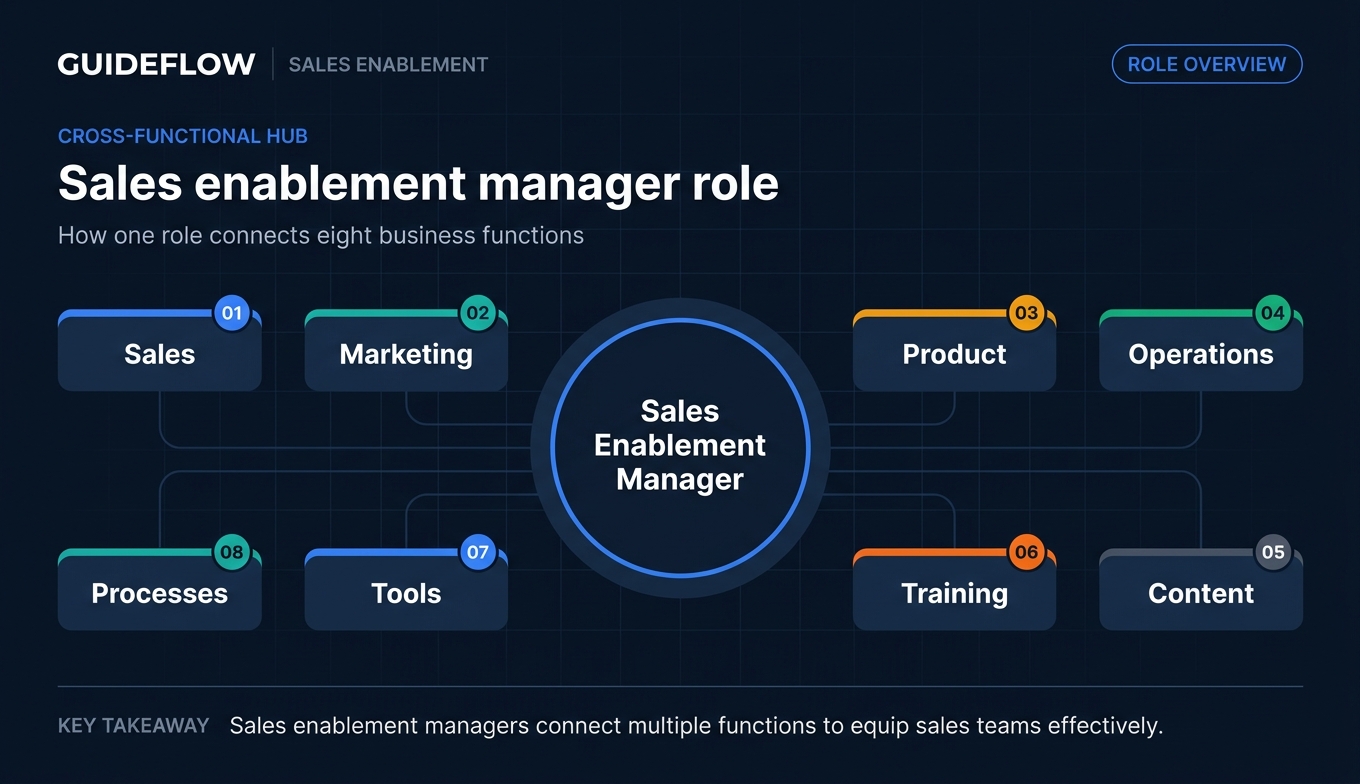
If you're an SE, this is the person who builds your demo scripts, runs your onboarding when you join, and creates the battlecards you use (or ignore) in competitive deals. They're the one who coordinates with product marketing when a new feature launches so you're not caught off guard by a prospect's question on day one. They're also the one tracking whether the content they built is actually being used, and whether it's helping your team win.
The title itself varies across organizations. Common variants include:
- Sales Enablement Manager (most common)
- Revenue Enablement Manager (broader scope, often includes CS and partnerships)
- Enablement Lead or Enablement Program Manager
- Sales Readiness Manager
The revenue enablement rebrand has accelerated in 2025 and 2026. Many companies now use this title to reflect a broader scope that extends beyond the sales team to include customer success, partner enablement, and marketing alignment. In practice, the core work is similar, but the revenue enablement manager title signals that the person supports the full customer lifecycle, not just net-new deals.
Where does this role sit in the org chart? In most B2B SaaS companies, the enablement manager reports to the VP of Sales, the CRO, or the VP of Revenue Operations. Less commonly, they report into marketing or a standalone enablement function led by a Head of Sales Enablement. The reporting line matters because it shapes what the enablement manager prioritizes: a sales-reporting enablement manager focuses on deal execution and rep readiness, while a rev-ops-reporting enablement manager tends to focus more on process and data.
Sales enablement manager vs. adjacent roles
One of the most common points of confusion: how is this role different from sales ops? Or sales training? Or the head of enablement?
Here's the practical distinction, framed from the SE's perspective. This is how to tell the difference between the person who fixes your CRM fields and the person who builds your competitive battlecards.
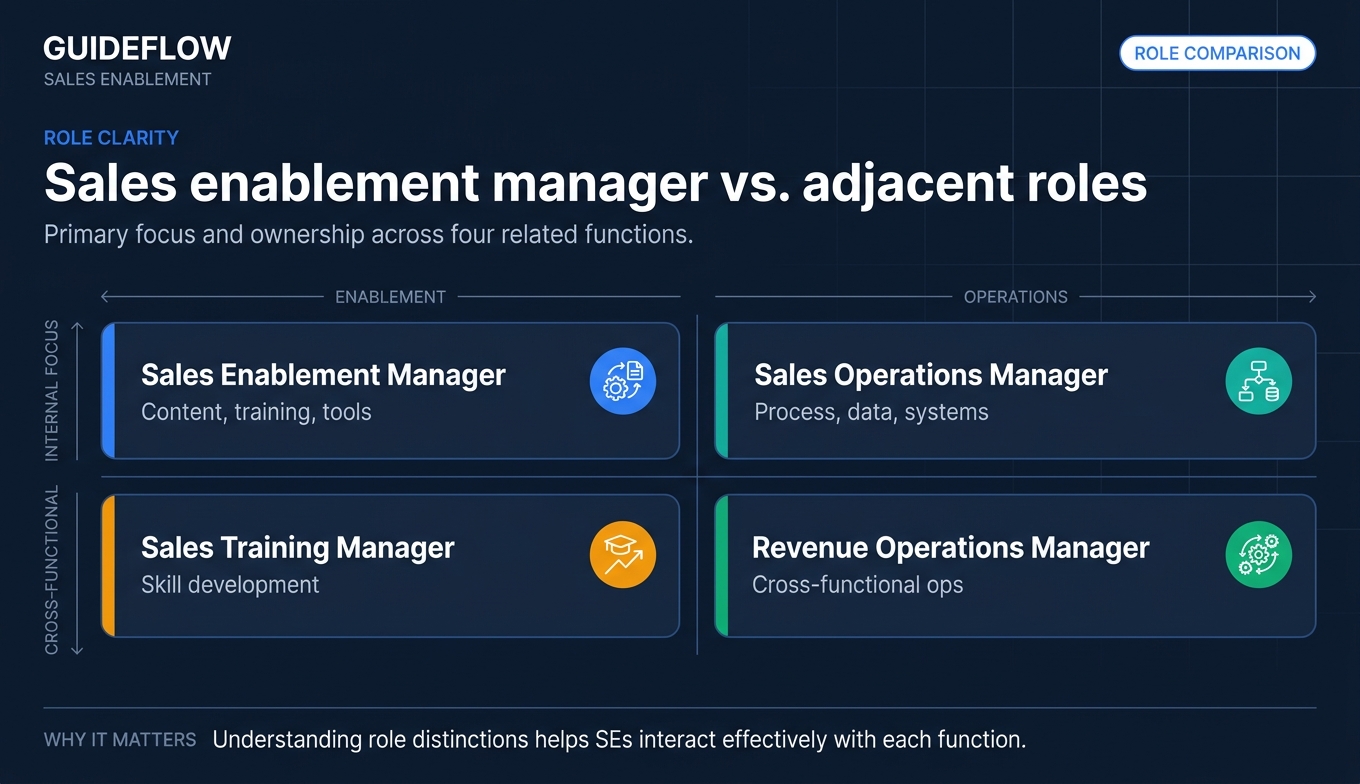
| Role | Primary focus | What they own | How SEs interact with them |
|---|---|---|---|
| Sales Enablement Manager | Content, training, tools | Battlecards, demo scripts, onboarding programs, training sessions | Directly: you receive their outputs daily |
| Sales Operations Manager | Process, data, systems | CRM configuration, pipeline reporting, territory planning, deal routing | Indirectly: they build the systems you report into |
| Sales Training Manager | Skill development | Workshops, certifications, coaching programs, role-play sessions | Directly: they run your training sessions |
| Head of Sales Enablement | Strategy, team leadership | Enablement roadmap, budget, vendor selection, team management | Indirectly: they decide what tools and programs you get |
| Revenue Operations Manager | Cross-functional ops | Full-funnel data, tech stack governance, forecasting models | Indirectly: they own the infrastructure that connects everything |
The key difference: Sales Ops owns the CRM workflow and deal routing. Enablement owns the content and training that help reps use the CRM data to win. Sales Training is a subset of enablement focused specifically on skill development. The Head of Enablement is the strategic leader who manages the enablement manager and sets the roadmap.
In smaller companies (under 200 employees), one person often covers enablement and training. In larger orgs, these are distinct roles with separate headcount.
Core responsibilities of a sales enablement manager
The sales enablement manager job description sounds broad because the role is broad. But there's a pattern: every responsibility connects back to one question: "Is the sales team ready to win today's deals?"
Here are the six core areas, with the specificity that generic job descriptions leave out.
Content creation and management
This is where most of the enablement manager's visible output lives. They build and maintain the sales collateral that reps use in every stage of the deal cycle: battlecards, one-pagers, case studies, ROI calculators, demo scripts, email templates, and objection-handling guides.
A typical battlecard covers 3 to 5 competitors and includes pricing comparisons, common objections with counter-talk tracks, and win/loss insights from the most recent quarter. The enablement manager builds this from win/loss interviews, competitive intelligence tools, and product marketing input. It's not a one-time project. Battlecards need updates every quarter as competitors change pricing, messaging, and feature sets.
The content lifecycle matters here: creation, distribution (getting it into the hands of reps who need it), measurement (tracking whether reps actually use it), and retirement (removing outdated content that creates confusion).
Sales training and onboarding
The enablement manager designs and runs new-hire sales onboarding programs, ongoing sales training sessions, product launch training, and skill development workshops. This includes both live sessions (workshops, role-plays, certifications) and asynchronous formats (recorded walkthroughs, self-paced modules, knowledge checks).
If you went through a structured onboarding program when you joined, with a demo certification, product knowledge checks, and a 90-day ramp plan, an enablement manager built that. If you didn't, that's usually a sign the company doesn't have one yet.
The best enablement managers segment their training by role and experience level. A 10-year SE and a new hire don't need the same session on competitive positioning. They need different depth, different context, and different formats.
Demo and presentation enablement
This is the responsibility most directly relevant to SEs. The enablement manager creates demo environments, standardized demo flows, and presentation templates that SEs and AEs use in customer-facing meetings. They manage demo libraries and work to ensure consistency across the team.
The enablement manager decides whether your team uses a shared demo environment, a demo automation platform, or individual instances. They build the standard demo flow for each persona and use case, then train the team on how to customize it per account.
Modern enablement managers increasingly use interactive demo platforms to create self-serve product experiences that SEs can personalize per prospect in minutes. These interactive demos let buying committee members explore the product on their own time, which compresses the evaluation phase and reduces the scheduling bottleneck of live demos. Engagement analytics at the session level show exactly which features each stakeholder explored, giving the SE precise context for follow-up conversations.
Cross-functional alignment
The enablement manager coordinates between sales, marketing, product, and customer success. When product ships a new feature, the enablement manager translates the release notes into sales-ready messaging: what it means for the buyer, how to position it competitively, and what demo flow to use. When marketing creates a new campaign, the enablement manager ensures the sales team knows the messaging and has supporting content.
This is often the most time-consuming part of the role. Alignment doesn't happen in one meeting. It requires ongoing coordination, follow-up, and sometimes diplomacy.
Sales process optimization
The enablement manager analyzes the sales process to identify friction points. Where are deals stalling? Which stages take longest? What content is missing at key decision points? They work with sales ops on pipeline stage definitions, handoff criteria between SDR and AE, and the qualification frameworks the team uses (MEDDIC, SPIN, Challenger, or whatever the org has adopted).
Performance measurement and reporting
Everything the enablement manager builds needs to be measured. They track content usage rates, training completion, new hire ramp time, win rates on deals where enablement content was used, and sales cycle length. They report to leadership on enablement ROI and use data to decide what to build next, what to update, and what to retire.
A day in the life: Sales enablement manager daily workflow
No competitor covers this, and it's the section that matters most if you want to understand what the role actually feels like. Here's a realistic walkthrough of a typical Tuesday for a mid-level enablement manager at a Series C SaaS company with 150 employees and a 25-person sales team.

8:30 AM She opens Slack to a queue of messages. An AE in the enterprise segment needs a custom one-pager for a prospect in healthcare. A new SE (two weeks in) has questions about the standard demo flow for the security persona. A sales manager flagged that the competitor battlecard for their biggest rival is missing the pricing change announced last week.
9:00 AM She pulls up the competitive battlecard and starts updating it. The pricing change came from a lost deal debrief she ran on Friday. She cross-references with the competitor's website, adds the new pricing tier, updates the objection handler for "they're cheaper," and writes a two-sentence Slack summary for the team. Total time: 40 minutes.
9:45 AM Quick prep for the training session she's running at 10. It's a 45-minute product launch session for the SE team covering a new integration that shipped last week. She reviews the demo flow she built, checks her presenter notes, and tests the interactive demo one more time.
10:00 AM Live training session with 8 SEs. She walks through the new integration: what it does, how to position it, the standard demo flow, and the three most common objections prospects will raise. She runs a live Q&A and captures two feature requests from the SEs that she'll pass to product.
11:00 AM Sync with product marketing. They're planning next quarter's major launch and need to align on messaging, timeline, and enablement deliverables. She maps out what the sales team will need: updated pitch deck, new demo flow, competitive positioning guide, and a training session two weeks before launch.
12:00 PM Lunch. She catches up on industry reading and scans a few LinkedIn posts from enablement peers at other companies.
1:00 PM She builds a new demo flow for the mid-market segment. The current flow is designed for enterprise buyers and includes too much detail on compliance features that mid-market prospects don't care about. She captures the streamlined flow using a demo automation platform, adds persona-specific callouts, and saves it to the team's demo library.
2:00 PM She pings the AE about the healthcare one-pager. After a 10-minute Slack exchange to clarify what the prospect cares about, she pulls a template, customizes the proof points for healthcare, and sends it for review.
2:30 PM Analytics time. She pulls content usage data from the enablement platform: which battlecards were accessed this month, which demo flows were shared with prospects, and which training modules have the lowest completion rates. She spots a pattern: the new objection-handling guide she published two weeks ago has a 12% adoption rate. She makes a note to resurface it in next week's team meeting and ask reps why they're not using it.
3:00 PM One-on-one with the VP of Sales. They review onboarding metrics for the latest hire cohort: average ramp time is 47 days, down from 62 days last quarter. They discuss the low adoption rate on the objection guide and agree to test a different distribution format (short video instead of a PDF).
4:00 PM She writes and schedules the weekly enablement newsletter for the sales team. It includes: the updated battlecard, a link to the new mid-market demo flow, a reminder about next week's training session, and one competitive insight from a recent win.
4:45 PM She responds to the new SE's Slack questions about the demo flow, shares two recorded examples from senior SEs, and schedules a 15-minute coaching session for Thursday.
That battlecard you got pinged about at 2 PM? She spent the morning building it from a lost deal interview and a competitive analysis she ran last week.
The pattern is clear: constant context-switching between content creation, training delivery, data analysis, and cross-functional coordination. No two days look the same, but the rhythm is consistent.
Skills required for a sales enablement manager
If you're considering a move into enablement, here's what the role actually requires. Not a generic list of 15 skills, but the specific capabilities that separate effective enablement managers from the ones whose content sits unused in a shared drive.
Hard skills
- Content creation and copywriting. You're writing battlecards, talk tracks, training materials, and internal communications constantly. The writing needs to be clear, concise, and immediately usable by a rep who has five minutes before a call.
- Data analysis and reporting. You'll pull CRM data, content usage metrics, and win/loss analysis regularly. You need to be comfortable in dashboards and able to translate data into actionable recommendations for leadership.
- Sales technology proficiency. You'll manage or contribute to the enablement platform, CRM, demo automation tools, learning management system, and conversation intelligence tool. You don't need to be an admin, but you need to understand how data flows between systems.
- Project management. Product launches, training programs, and cross-functional initiatives all require timelines, stakeholder coordination, and follow-through. The enablement manager is often the project manager for GTM readiness.
- Sales methodology knowledge. You need to understand the framework your org uses (MEDDIC, SPIN, Challenger, or a custom methodology) well enough to build content and training that reinforces it.
Soft skills
- Cross-functional influence without authority. You don't manage the sales team, the product team, or the marketing team. But you need all three to align on messaging, timing, and priorities. This requires persuasion, not positional power.
- Active listening and field empathy. The biggest risk in enablement is building content that leadership wants but reps don't need. The best enablement managers spend significant time listening to reps, sitting in on calls, and understanding what actually happens in deals.
- Prioritization under competing demands. Every team wants something different from enablement. Sales wants battlecards. Marketing wants launch support. Leadership wants metrics. You need to prioritize ruthlessly and communicate trade-offs clearly.
- Training and facilitation. Running a training session that holds attention and changes behavior is a distinct skill. It's not presenting. It's facilitating learning, which requires different pacing, interaction, and follow-up.
- Stakeholder management. You're managing up to the VP of Sales while serving the individual contributors. Balancing strategic reporting with tactical support is a daily challenge.
Sales enablement manager salary in 2026
This is the section most people skip to. Here's the data, broken down with the specificity the topic deserves.
Average base salary and OTE
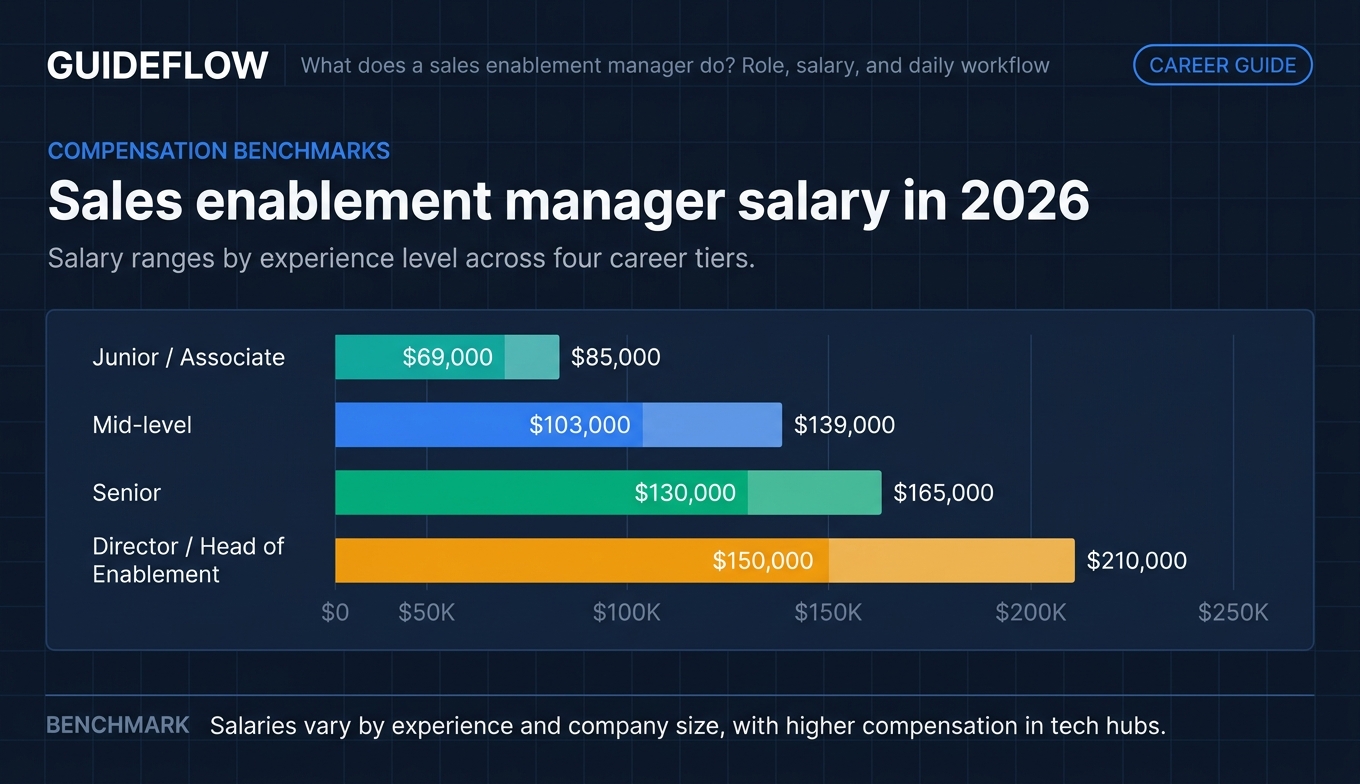
In the US, the sales enablement manager salary ranges from $103,000 to $139,000 in base compensation for mid-level managers, according to 2026 data from the Sales Enablement Collective and Apollo.io 2026 Salary Insights. On-target earnings (OTE) typically add 10 to 20% through bonuses, bringing total cash compensation to roughly $115,000 to $165,000.
One important structural difference from SE compensation: enablement roles are less variable-comp-heavy. Most enablement managers have a 75/25 or 80/20 base-to-variable split. Some orgs run 90/10. The variable component is usually tied to team-level metrics (win rate, ramp time, content adoption) rather than individual deal outcomes.
Salary by experience level
| Level | Base salary range | OTE range |
|---|---|---|
| Junior / Associate (0 to 2 years) | $69,000 to $85,000 | $78,000 to $100,000 |
| Mid-level (2 to 5 years) | $103,000 to $139,000 | $115,000 to $165,000 |
| Senior (5 to 8 years) | $130,000 to $165,000 | $150,000 to $190,000 |
| Director / Head of Enablement | $150,000 to $210,000 | $180,000 to $250,000+ |
Sources: Sales Enablement Collective 2025 Salary Guide, Apollo.io 2026 Salary Insights, Glassdoor 2026 data. Ranges reflect US-based roles at B2B SaaS companies.
Factors that influence compensation
- Company size and stage. A Series B startup with 80 employees pays differently than a public company with 3,000. Larger companies tend to offer higher base salaries and equity; startups may offer lower base with more upside through stock options.
- Industry. SaaS companies typically pay 15 to 25% more than non-tech industries for the same role and experience level.
- Geography. San Francisco and New York command the highest salaries, roughly 20 to 30% above the national average according to Apollo.io data. Remote roles at SF-based companies often pay at or near headquarters rates. LCOL markets see lower ranges.
- Scope. An individual contributor enablement manager earns less than one managing a team of 3 to 5 enablement specialists. The "revenue enablement" title, with its broader cross-functional scope, often commands higher compensation than a sales-only enablement role.
- Equity. At SaaS companies, equity (RSUs or stock options) can add 15 to 30% to total compensation, especially at growth-stage startups.
How enablement pay compares to SE compensation
This is the question SE readers are actually asking. At similar experience levels (3 to 7 years), SE roles often have higher OTE because of larger variable components tied to deal outcomes. A mid-level SE at a SaaS company might earn $120,000 base with $160,000 OTE, while a mid-level enablement manager earns $115,000 base with $140,000 OTE.
The trade-off: enablement compensation is more predictable. Higher base percentage, lower variable risk. You won't have a blow-out quarter where you earn 2x OTE, but you also won't have a quarter where a deal slips and your variable drops to zero.
| Dimension | Sales Engineer (mid-level) | Enablement Manager (mid-level) |
|---|---|---|
| Base salary | $110,000 to $135,000 | $103,000 to $139,000 |
| Variable % | 20 to 30% of OTE | 10 to 25% of OTE |
| OTE | $140,000 to $175,000 | $115,000 to $165,000 |
| Income predictability | Moderate (tied to deals) | High (tied to team metrics) |
Career path: How to become a sales enablement manager
If you're an SE considering enablement, here's what the transition looks like. And an honest assessment of the trade-offs.
Common entry paths into enablement
- From Sales Engineering / Solutions Consulting. This is one of the strongest entry paths. SEs bring deep product knowledge, understanding of the buyer's technical evaluation process, and credibility with the sales team. You already know what good demo content looks like because you deliver demos every day.
- From Account Executive / Sales Rep. AEs understand the selling motion, objection handling, and deal dynamics. The transition involves shifting from individual deal execution to team-level program building.
- From Sales Training / L&D. Strong facilitation and instructional design skills translate directly. The gap is usually sales process knowledge and competitive fluency.
- From Product Marketing. PMMs bring messaging, positioning, and content skills. The gap is typically field empathy and understanding of what reps actually need versus what looks good in a deck.
- From Sales Operations. Strong process and data skills. The gap is content creation and training facilitation.
The SE-to-enablement path is strong because you've lived the experience your enablement content needs to support. You know which battlecards get used and which get ignored. You know what a good demo flow feels like. That perspective is hard to develop from outside the field.
Career progression from enablement manager
The sales enablement career path is well-defined in most SaaS organizations:
- Sales Enablement Manager (IC, 2 to 5 years)
- Senior Sales Enablement Manager (IC or small team lead, 4 to 7 years)
- Director of Sales Enablement (team leadership, budget ownership, 6 to 10 years)
- Head of Revenue Enablement / VP of Enablement (strategic leadership, cross-functional scope)
- CRO or VP of Sales (less common, but possible for those who build strong GTM strategy skills and want to return to a revenue-carrying role)
Be honest about the trade-offs. Enablement is less deal-focused and more process-focused than presales. Some SEs love this shift because they enjoy building systems and seeing team-wide impact. Others miss the energy of being in deals and the satisfaction of a technical win. Talk to enablement managers at your company or in your network before making the move.
Tools in the sales enablement manager's stack
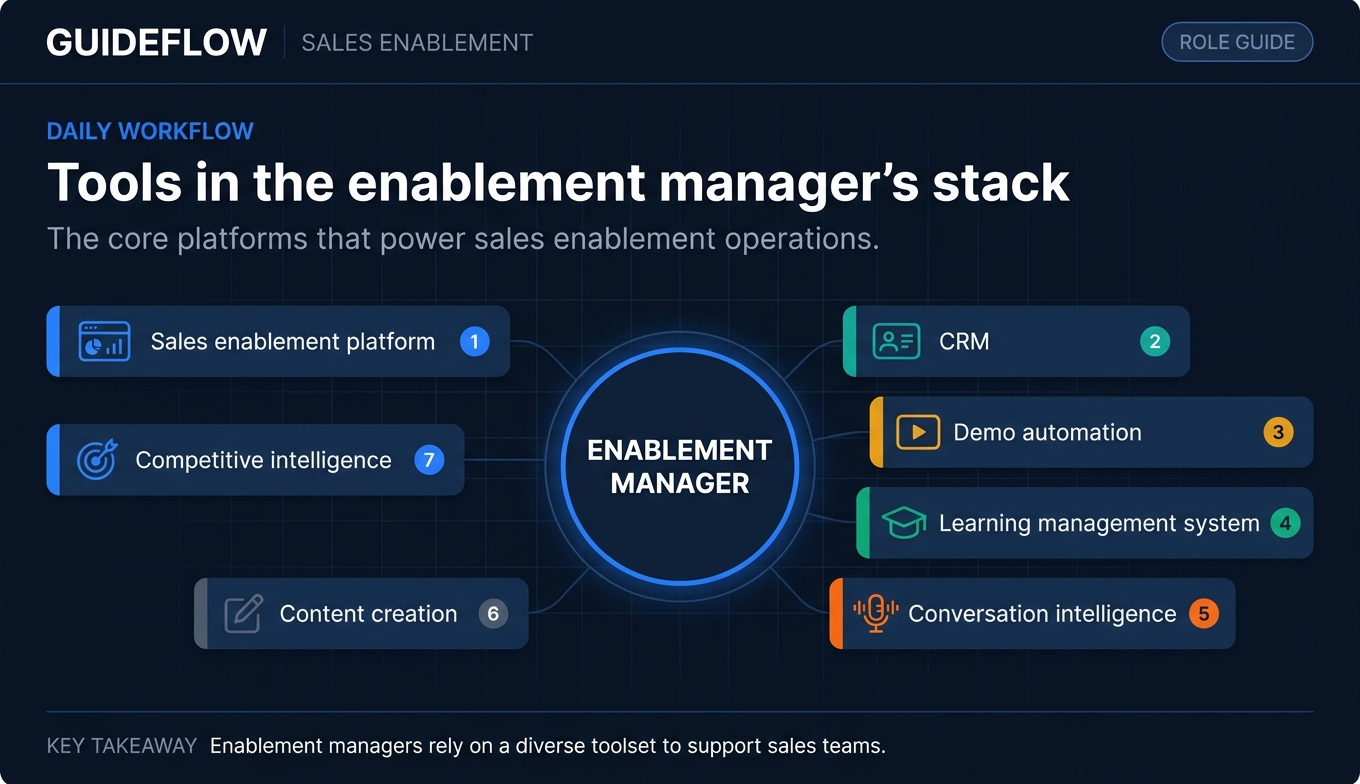
No ranking competitor covers this, which is a gap. Here are the tool categories that enablement managers use daily, with the purpose of each category and representative examples.
| Category | Purpose | Example tools |
|---|---|---|
| Sales enablement platform | Content management, training delivery, analytics | Highspot, Seismic, Showpad |
| CRM | Deal data, pipeline visibility, activity tracking | Salesforce, HubSpot |
| Demo automation | Interactive demos, demo libraries, sandbox environments | Guideflow |
| Learning management system | Training delivery, certification, onboarding modules | Seismic Learning (formerly Lessonly), WorkRamp |
| Conversation intelligence | Call recording, coaching insights, talk pattern analysis | Gong, Chorus |
| Content creation | Battlecards, one-pagers, presentations, internal docs | Google Workspace, Notion, Canva |
| Competitive intelligence | Competitor tracking, pricing monitoring, win/loss analysis | Klue, Crayon |
The demo automation category is where enablement managers create standardized demo flows that SEs can personalize per account in minutes, track engagement analytics at the session level, and share with buying committees asynchronously. Instead of relying on fragile staging environments or scheduling live demos for every stakeholder, enablement managers use interactive demo platforms to build a demo library organized by persona, use case, and vertical. SEs pick the right flow, personalize it for the account, and share a link. The prospect clicks through the experience. The SE sees exactly what they explored.
The typical enablement manager doesn't need every category on day one. The minimum viable stack is a CRM, a content creation tool, and a way to deliver and track training. Demo automation and conversation intelligence come next as the team scales.
How sales enablement managers work with presales and SE teams
This is the section that makes this article relevant to you specifically. No competitor covers the enablement-to-presales relationship in practical terms. Here are the specific touchpoints where enablement and presales intersect.
Demo scripts and standard demo flows. Enablement builds them; SEs customize and deliver them. The enablement manager creates the baseline flow for each persona and use case, including the narrative arc, key proof points, and recommended feature sequence. The SE then adapts it per account based on discovery findings. When this works well, SEs spend less time on demo prep and more time on personalization that matters.
Competitive battlecards. Enablement creates them; SEs use them in technical evaluations. The best battlecards are co-created: enablement interviews SEs who won or lost competitive deals, synthesizes the patterns, and publishes the card. SEs who provide input get better battlecards. SEs who don't provide input get generic ones.
New hire onboarding and ramp programs. Enablement designs and runs them; SEs are the primary audience. A well-structured onboarding program includes product knowledge training, demo certification, competitive positioning, and shadowing rotations. The enablement manager measures ramp time and adjusts the program based on where new hires struggle.
Product launch training. Enablement coordinates with product marketing; SEs need to be ready for customer questions on day one. The enablement manager ensures that launch training happens before the feature goes live, not after the first prospect asks about it.
Win/loss analysis. Enablement conducts the interviews; SE insights are a primary input. When enablement runs a win/loss program, they interview the AE, the SE, and sometimes the buyer. The SE's perspective on the technical evaluation is often the most valuable data point.
Demo certification programs. Enablement designs the criteria and evaluation process; SEs go through it. Interactive demos are particularly effective here because they let SEs practice standardized flows, receive feedback, and demonstrate competency in a measurable format.
If you want better enablement at your company, here's the actionable advice: give your enablement manager the feedback they need. Tell them which battlecards you actually use and which ones miss the mark. Share what prospects ask that the current demo flow doesn't cover. Flag when training content is outdated. The enablement managers who build the best content are the ones with the strongest feedback loops from the field.
KPIs and metrics a sales enablement manager tracks
What does success look like for this role? Here are the metrics enablement managers report to leadership, and why they matter to you as an SE.
| KPI | What it measures | Why it matters to SEs |
|---|---|---|
| New hire ramp time | Days from start to first solo demo or first closed deal | Shorter ramp = you get a productive teammate faster |
| Content usage rate | % of reps actively using enablement assets | Low usage signals the content doesn't match field needs |
| Training completion rate | % of reps completing required training | Compliance baseline and readiness indicator |
| Win rate (influenced) | Win rate on deals where enablement content was used | Direct ROI signal for enablement programs |
| Sales cycle length | Average days from opportunity creation to close | Enablement should help compress this |
| Demo completion rate | % of interactive demos completed by prospects | Engagement signal for self-serve demo content |
| Rep satisfaction / NPS | Internal survey score from the sales team | Qualitative measure of whether enablement is actually helping |
When your enablement manager asks you to fill out a post-demo survey or log your battlecard usage, this is why. They're building the data set that justifies their budget, their headcount, and the tools you use. Helping them measure impact helps you get better enablement.
The strongest signal is comparing win rates and cycle times for reps who actively use enablement resources versus those who don't. When enablement can show a measurable difference, they get more budget to build more of what works.
Common mistakes to avoid when building an enablement function
You've seen what good enablement looks like. Here's what to watch out for, framed as patterns to recognize at your company.
Building content without field input
Creating battlecards and demo scripts in a vacuum, without interviewing SEs and AEs, produces content that looks polished but doesn't match what happens in real deals. The objection handlers address objections that prospects stopped raising six months ago. The demo flow highlights features that buyers don't care about.
What works instead: Structured feedback loops where enablement reviews content with 2 to 3 reps before publishing. A 15-minute review call catches 80% of the issues a solo effort would miss.
Measuring activity instead of outcomes
Tracking "number of training sessions delivered" or "number of battlecards published" instead of "impact on win rate" or "reduction in ramp time." Activity metrics make enablement look busy. Outcome metrics make enablement look valuable.
What works instead: Tying every enablement program to a pipeline or revenue metric from the start. If you can't connect a program to a business outcome, question whether it's worth building.
Treating all reps the same
Running the same training for a 10-year SE and a new hire. Sending the same enablement newsletter to the enterprise team and the SMB team. One-size-fits-all enablement wastes the experienced rep's time and overwhelms the new one.
What works instead: Segmented enablement programs by experience level, segment, and role. The new hire gets a structured ramp plan. The senior SE gets advanced competitive workshops and early access to new demo flows.
Ignoring the technology stack
Relying on shared drives, email attachments, and tribal knowledge instead of purpose-built enablement and demo automation tools. When content lives in 15 different Google Drive folders, reps can't find what they need. When demo environments are manually maintained, they break before the big meeting.
What works instead: Investing in a small, integrated stack that includes a content platform, a demo automation tool, and a conversation intelligence tool. The stack doesn't need to be expensive, but it needs to be intentional.
Launching without a feedback mechanism
Shipping a new program or asset with no way to measure whether reps used it or whether it helped. The enablement manager publishes a new objection guide, moves on to the next project, and never learns that only 12% of the team opened it.
What works instead: Building measurement into every enablement initiative from the start. Usage tracking, rep surveys, and outcome correlation should be part of the launch plan, not an afterthought.
Conclusion
The sales enablement manager is the person who makes the entire sales team more effective by building the content, training, and tools that reps use every day. For SEs, understanding this role means better collaboration, better enablement inputs, and a potential career path worth considering.
If your company has an enablement manager, schedule a 30-minute conversation about what they need from the SE team. Ask which battlecards need updating, which demo flows are outdated, and what feedback would help them build better content. That conversation will improve your enablement experience more than any tool purchase.
If your company doesn't have an enablement manager yet, share this article with your VP of Sales. The data on ramp time reduction, win rate improvement, and content adoption makes a clear case for the hire.
For enablement managers building their demo automation stack, Guideflow lets you create interactive demos in minutes that SEs can personalize per prospect, track engagement at the session level, and share with buying committees asynchronously.
Start your journey with Guideflow today
FAQs
Sales enablement focuses on content, training, and tools that help reps sell more effectively. Sales operations focuses on process, data, systems, and reporting infrastructure. Enablement is about "what reps say and show." Ops is about "how the pipeline moves and gets measured." In most orgs, they collaborate closely but own different outcomes.
A typical day includes reviewing field requests, updating competitive battlecards, running training sessions, syncing with product marketing on messaging, building demo content, analyzing content usage data, and meeting with sales leadership to review program metrics. The role requires constant context-switching between content creation, training delivery, and cross-functional coordination.
In the US, base salary ranges from $103,000 to $165,000 depending on experience and company size, with OTE ranging from $115,000 to $190,000. Directors and Heads of Enablement can earn $150,000 to $250,000+ in total compensation. SaaS companies in major metros typically pay at the higher end of these ranges, according to the Sales Enablement Collective and Apollo.io 2026 salary data.
Yes. SEs bring deep product knowledge, buyer empathy, and technical credibility that are difficult to develop from other entry paths. The transition involves shifting from deal-level execution to team-level program building. The trade-off: less deal energy, more process and content work. The upside: broader organizational impact and a clear path to VP-level roles.
The typical enablement stack includes a sales enablement platform (Highspot, Seismic), CRM (Salesforce, HubSpot), demo automation platform (Guideflow), learning management system, conversation intelligence tool (Gong), and competitive intelligence platform (Klue, Crayon). The specific tools vary by company size and budget.
Revenue enablement is a broader scope that extends beyond sales to include customer success, partnerships, and sometimes marketing enablement. The title shift reflects a trend toward full-funnel enablement rather than sales-only support. In practice, many revenue enablement managers do the same core work as sales enablement managers but with additional cross-functional responsibilities and typically higher compensation.
No specific degree is required. Most enablement managers come from sales, presales, marketing, or training backgrounds. Relevant experience matters more than formal education. Some professionals pursue certifications from organizations like the Sales Enablement Collective or Sales Enablement PRO, but these are supplementary, not required.
The most direct metrics are new hire ramp time (reduction in days to first solo demo or first closed deal), win rate on deals where enablement content was used, content adoption rates across the sales team, and impact on sales cycle length. The strongest ROI signal is comparing win rates and cycle times for reps who actively use enablement resources versus those who don't.