A GraphQL stack gets messy fast. Schema ownership drifts between teams. Federation config lives in one repo, codegen in another, and nobody agrees on where types come from. You add a tool to solve a linting gap, another to catch breaking changes, and a third to stitch two services together. Six months later, your GraphQL layer has more moving parts than the product it fronts.
That sprawl is not a niche problem anymore. Gartner predicted more than 50% of enterprises would run GraphQL in production by 2025, up from less than 10% in 2021 (Gartner via IBM, 2024). By 2026, 61% or more of organizations reportedly had GraphQL in production, most using it as a backend-for-frontend layer (Digital Applied, 2026). GraphQL job postings grew 156% on major platforms (Tech Insider, 2026). More adoption means more schemas to govern, more services to compose, and more surface area where things break.
The job here is simple: pick tools that help teams ship, validate, and maintain GraphQL APIs with less drift. For presales and solutions teams, that also means being able to explain the ecosystem clearly to a technical buyer who wants to know how your architecture holds together. The same clarity that helps a platform team pick tools helps a sales engineer walk a prospect through a schema-first design decision without hand-waving. If you build technical content or product walkthroughs around GraphQL, mapping the stack by layer beats listing packages at random.
What's inside
This guide covers the GraphQL tools ecosystem, not one library. We ordered the list the way developers actually build and govern GraphQL systems: schema, server, federation, code generation, schema management, and linting.
We selected tools on four criteria:
- Workflow coverage: how much of a real GraphQL job the tool owns
- Ecosystem adoption: how widely it is used across production stacks
- Documentation quality: how quickly a new team can get productive
- Stack fit: how cleanly it slots into schema, server, federation, or codegen work
Every tool here is open source and battle-tested. The list favors tools that do one layer well and compose with the rest, rather than all-in-one platforms that lock you in.
TL;DR
- Best overall foundation: GraphQL Tools, the umbrella suite for schema-first builds, mocking, and schema stitching.
- Best for direct schema control: GraphQL.js, the reference implementation everything else is built on.
- Best for server delivery: GraphQL Yoga, a spec-compliant server with strong defaults.
- Best for type safety: GraphQL Code Generator, for typed queries, mutations, and resolvers.
- Best for multi-source APIs: GraphQL Mesh, to unify REST, gRPC, and other backends into one schema.
- Best for governance: GraphQL Inspector, for schema change detection and breaking-change checks in CI.
If you want the fastest path to a working, typed, governable GraphQL stack, start with GraphQL Tools plus GraphQL Yoga plus GraphQL Code Generator, then add Mesh or Inspector as scale demands.
What are GraphQL tools?
GraphQL tools are the libraries, servers, and utilities teams use to build, run, compose, generate code for, and govern GraphQL APIs across the development lifecycle. They span the full GraphQL ecosystem rather than one framework.
The ecosystem breaks into six layers. Understanding these layers is the difference between a coherent stack and a pile of packages.
- Schema tools: define, mock, merge, and stitch GraphQL schemas. This is where the API contract lives.
- Server tools: bind an executable schema to HTTP and handle requests, subscriptions, and responses.
- Federation and gateways: compose multiple services or backends into one unified GraphQL API, often a supergraph.
- Code generation: produce typed clients, resolvers, and SDKs from a schema so implementation matches the contract.
- Schema management: detect breaking changes, validate operations, and enforce governance in CI.
- IDE and linting tools: improve developer experience with editor support, linting, and consistent standards.
Most GraphQL server tools depend on GraphQL.js underneath. Most schema tools, codegen, and governance tools read the same schema definition language (SDL), which is why they compose well. A typed GraphQL workflow usually means SDL as the source of truth, codegen producing types from it, and a linter plus a schema management tool keeping it honest. When teams talk about GraphQL-first development, they mean treating that schema as the contract everything else derives from.
The strongest stacks pick one tool per layer and let SDL tie them together. That is the frame for the ordering below.
When to use GraphQL tools
Not every team needs every layer. Here is how to pattern-match your situation before scanning the list.
Build a GraphQL API from schema-first definitions
Reach for schema tools when you want the schema to be the contract. SDL-first workflows let you write the GraphQL schema in plain definition language, then map resolvers to it, producing an executable schema. This suits teams that want product, backend, and frontend to agree on the API shape before anyone writes a resolver. Mocking on top of the schema means the frontend can build against realistic responses while the backend catches up. GraphQL Tools and GraphQL.js own this layer.
Compose multiple services into one API
Reach for federation, gateways, and schema composition when one GraphQL endpoint needs to front many services or protocols. GraphQL federation lets independent teams own their subgraphs while a gateway presents a single supergraph to clients. Schema stitching, an older but still useful approach, merges multiple remote schemas into one. This is where ownership and governance concerns get real: who owns which type, how breaking changes propagate, and how you enforce naming across teams. GraphQL Mesh handles composition when your backends are not all GraphQL to begin with.
Improve developer experience and type safety
Reach for code generation, linting, and plugin systems when errors and inconsistency are slowing the team down. GraphQL code generation removes the mismatch between schema and implementation by producing types directly from SDL. Linting catches naming drift and anti-patterns before review. Plugin systems add logging, caching, and monitoring at the execution layer without forking your server. These tools pay off most in CI and in the day-to-day loop of a growing GraphQL codebase.
Comparison table
Here is how the ten tools map to the stack. Ordering reflects how teams build and govern GraphQL systems, from schema foundation through governance and interoperability. Every tool is open source, so pricing is listed as a practical signal rather than a buying decision.
| # | Product | Intent | Key use case | Pricing | G2 rating |
|---|---|---|---|---|---|
| 1 | GraphQL Tools | Schema foundation | SDL-first schema creation, mocking, and stitching | Free, open source | 3.9/5 |
| 2 | GraphQL.js | Core implementation | Direct control over schema parsing, validation, execution | Free, open source | Not listed |
| 3 | GraphQL Yoga | Server runtime | Spec-compliant GraphQL server with strong defaults | Free, open source | Not listed |
| 4 | GraphQL Code Generator | Type safety | Typed queries, resolvers, and SDKs from schema | Free, open source | Not listed |
| 5 | GraphQL Mesh | Federation and composition | Unify REST, gRPC, and other sources into one schema | Free, open source | Not listed |
| 6 | GraphQL Inspector | Schema management | Breaking-change detection and validation in CI | Free, open source | Not listed |
| 7 | Envelop | Execution plugins | Cross-cutting concerns like logging and caching | Free, open source | Not listed |
| 8 | GraphQL ESLint | Linting | Consistent schema and operation standards | Free, open source | Not listed |
| 9 | SOFA | Interoperability | Generate REST endpoints from a GraphQL schema | Free, open source | Not listed |
| 10 | GraphQL Scalars | Schema types | Reusable custom scalars like Date and JSON | Free, open source | Not listed |
1. GraphQL Tools
GraphQL Tools is the umbrella package suite for SDL-first GraphQL work. It bundles utilities for building executable schemas, mocking responses, merging schemas, and schema stitching into one coherent set of libraries. Because it operates on plain schema definition language, it slots into almost any JavaScript or TypeScript GraphQL server, which is why it sits at the foundation of so many stacks.
Best for: Teams building or composing GraphQL schemas and server utilities in JavaScript or TypeScript.
Key strengths
- GraphQL-first workflow: Define the schema in SDL, then map resolvers to it, keeping the contract front and center.
- Mocking for fast prototyping: Generate realistic responses from the schema so frontend work starts before the backend lands.
- Schema stitching and merging: Combine multiple schemas and compose resolvers into one executable schema.
Why choose GraphQL Tools: If your team treats the schema as the source of truth, this suite gives you the primitives to build, test, and compose without reinventing them. It composes cleanly with a server runtime and codegen, so it rarely locks you into one framework. New teams get productive quickly because the utilities map directly to schema-first concepts.
GraphQL Tools pricing: Free and open source. The official product page shows no paid tiers or public pricing. The 3.9/5 rating comes from G2's general GraphQL listing rather than a dedicated GraphQL Tools page, so treat it as a category proxy.
2. GraphQL.js
GraphQL.js is the official JavaScript implementation of the GraphQL specification. It is the reference layer nearly every other JavaScript GraphQL tool builds on, providing the parser, validator, executor, type system, and core utilities. When you need direct control over how a schema is parsed, validated, and executed, this is where you work.
Best for: Teams building GraphQL APIs and tooling in JavaScript or TypeScript who want direct control.
Key strengths
- Full execution pipeline: Parser, validator, executor, and type system in one canonical library.
- Broad support: Powers GraphQL servers, clients, tools, and schema workflows across the ecosystem.
- Current release line: Actively maintained, with the v17 line keeping the reference implementation modern.
Why choose GraphQL.js: Platform teams and library authors reach for GraphQL.js when higher-level abstractions hide too much. If you are building your own server internals, a custom execution layer, or tooling that other teams depend on, working directly against the reference implementation gives you the control you need. It is also the right mental model for understanding what every other tool is doing underneath.
GraphQL.js pricing: Free and open source. No public pricing exists because it is a specification implementation, not a commercial product. No verified G2 rating was available for the library itself.
3. GraphQL Yoga
GraphQL Yoga is a fully featured, open-source GraphQL server built for easy setup, performance, and extensibility. It handles the job of binding an executable schema to HTTP, and it pairs naturally with GraphQL Tools for schema construction. Strong defaults mean you get a working server without wiring together a dozen middleware packages first.
Best for: Teams that want a self-hosted, extensible GraphQL server with sensible defaults out of the box.
Key strengths
- Spec-compliant server: Implements GraphQL over HTTP correctly, so clients behave predictably.
- Built-in essentials: Ships with GraphiQL, health checks, and error masking already configured.
- Subscriptions and federation: Supports subscriptions over Server-Sent Events and Apollo Federation.
Why choose GraphQL Yoga: Yoga is the server layer for teams that want to move fast without sacrificing extensibility. The strong defaults get you running in minutes, and the plugin architecture, which builds on Envelop, lets you add exactly the behavior you need. It is a practical middle ground between hand-rolling a server on GraphQL.js and adopting a heavier framework.
GraphQL Yoga pricing: Free, open source, and self-hosted. No public pricing appears on the project site, and no verified G2 rating was available.
4. GraphQL Code Generator
GraphQL Code Generator is an open-source, plugin-based tool that generates type-safe code from your GraphQL schema and operations. It produces typed queries, mutations, subscriptions, fragments, resolvers, and SDKs, so the code you write matches the contract you defined. This is the tool that turns a typed GraphQL ambition into an enforced reality.
Best for: Teams that need type-safe GraphQL code generation across client and server stacks.
Key strengths
- Typed operations: Generate types for queries, mutations, subscriptions, and fragments automatically.
- Typed resolvers and SDKs: Produce server-side resolver types and client SDKs from the same schema.
- Plugin ecosystem: Customize output through a rich library of plugins for different frameworks and targets.
Why choose GraphQL Code Generator: GraphQL code generation removes an entire class of bugs, the silent mismatch between what the schema promises and what the code assumes. Frontend and full-stack teams use it to keep client queries in lockstep with the schema, catching breaking changes at compile time instead of in production. Wire it into CI and every schema change forces the types to update.
GraphQL Code Generator pricing: Free and open source. No paid plans or public pricing appear on the product site, and no dedicated G2 rating was verified.
5. GraphQL Mesh
GraphQL Mesh is an open-source GraphQL federation framework that composes and transforms many API types into a single GraphQL schema. It reads REST, gRPC, OpenAPI, SOAP, JSON Schema, and GraphQL sources, then presents them as one unified GraphQL layer. This is the tool for teams whose backends were never GraphQL to begin with.
Best for: Teams that need to unify multiple non-GraphQL and GraphQL backends behind one schema.
Key strengths
- Multi-protocol composition: Bring REST, gRPC, OpenAPI, SOAP, JSON Schema, and GraphQL sources together.
- Schema transforms: Reshape and rename types with built-in and custom transforms.
- Broad deployment: Supports subscriptions and webhooks across JavaScript runtimes.
Why choose GraphQL Mesh: Mesh shines during API unification and migration. If you are moving from REST to GraphQL incrementally, Mesh lets you put a GraphQL gateway in front of existing services without rewriting them first. It is also how teams give frontend developers a single typed schema over a fragmented backend, buying time to modernize services behind the scenes.
GraphQL Mesh pricing: Free and open source. No product-specific pricing page was found, and no verified G2 rating was available for Mesh itself.
6. GraphQL Inspector
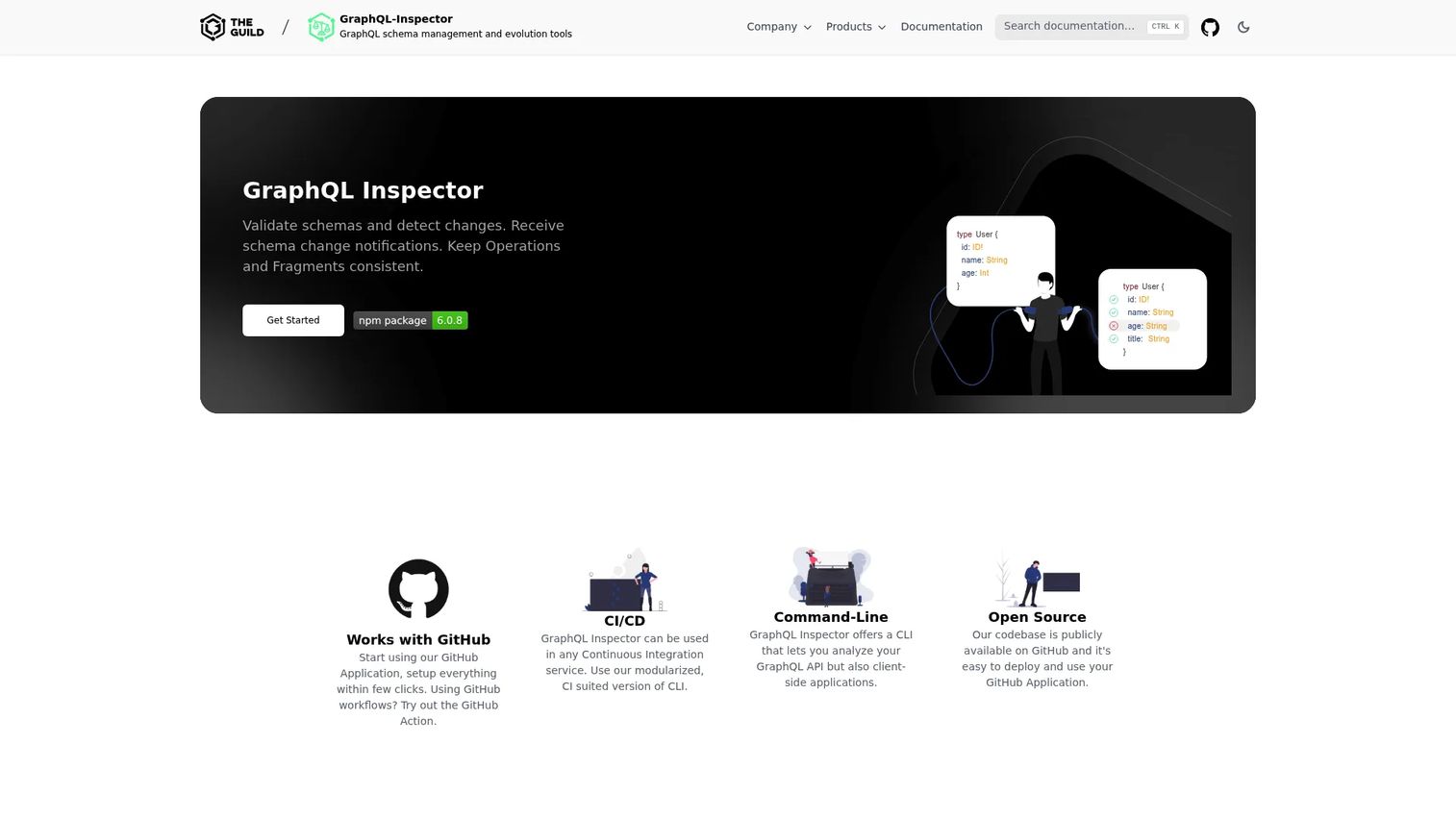
GraphQL Inspector is a set of open-source tools for schema management and evolution. It compares GraphQL schemas to detect changes, flags breaking changes before they ship, and validates operations against a schema. For any team past the early prototype stage, this is the guardrail that keeps schema changes from silently breaking clients.
Best for: Teams that need CI-friendly GraphQL schema diffing and validation.
Key strengths
- Schema diffing: Compare two schema versions and surface exactly what changed.
- Operation validation: Check documents and fragments against a schema to catch invalid queries early.
- Change notifications: Push schema-change alerts to Slack, Discord, or webhooks.
Why choose GraphQL Inspector: Schema management usually lands with the platform or API governance team, and Inspector is built for that job. Wire it into CI and a pull request that removes a field or changes a type gets flagged before merge, not after a client breaks. That release safety matters more as the number of teams consuming your schema grows.
GraphQL Inspector pricing: Free and open source. The project site presents it as open source with no public pricing, and no verified G2 rating was available.
7. Envelop
Envelop is a lightweight plugin system for the GraphQL execution layer. It gives you a pluggable pipeline where you compose cross-cutting concerns, logging, monitoring, caching, authentication, without hard-coding them into your server. It is framework-agnostic, so it works whether you run Yoga, a custom server on GraphQL.js, or something else.
Best for: Teams building custom GraphQL server behavior with reusable plugins.
Key strengths
- Pluggable pipeline: Compose execution-layer behavior from small, focused plugins.
- Framework-agnostic: Integrates with any HTTP or server setup rather than locking you to one runtime.
- Community plugins: Draw on an ecosystem of ready-made plugins for common concerns.
Why choose Envelop: When you need consistent logging, caching, or monitoring across every GraphQL request, Envelop lets you add it once as a plugin instead of scattering middleware. Teams that value framework flexibility choose it precisely because it does not assume a particular server. It also underpins GraphQL Yoga, so adopting Yoga gives you Envelop's extensibility for free.
Envelop pricing: Free and open source. No public pricing page exists, and no verified G2 rating was available.
8. GraphQL ESLint
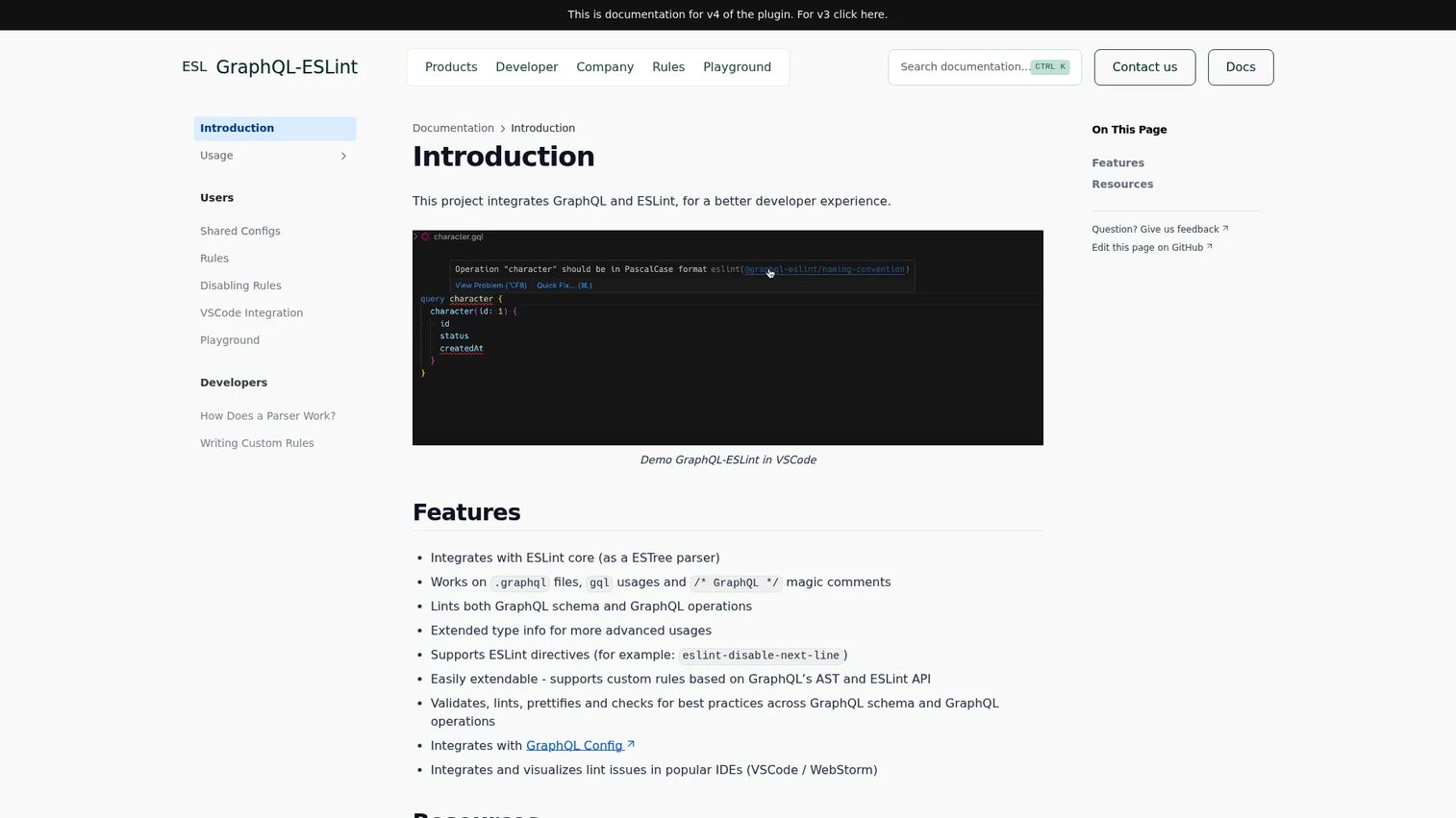
GraphQL ESLint is an open-source ESLint parser, plugin, and rule set for GraphQL. It lints both schema definitions and operations, catching naming inconsistencies, anti-patterns, and mistakes before they reach review. Because it integrates with ESLint core, it drops into the linting setup most JavaScript teams already run.
Best for: Teams that want to lint GraphQL schemas and operations with ESLint across their codebase.
Key strengths
- ESLint integration: Works as a parser inside ESLint core, so GraphQL joins your existing lint pipeline.
- Schema and operation linting: Lints
.graphqlfiles plusgqltags and magic comments in code. - Custom rules and IDE support: Supports custom rules, GraphQL Config, and in-editor lint visualization.
Why choose GraphQL ESLint: Consistency is cheap to enforce early and expensive to fix late. Running GraphQL ESLint in CI and the IDE keeps schema naming, deprecation practices, and operation structure aligned across a growing team. For platform teams that want to codify GraphQL standards, it turns tribal knowledge into automated rules.
GraphQL ESLint pricing: Free and open source. No public pricing page was found, and no verified G2 rating was available.
9. SOFA
SOFA is an open-source library that turns a GraphQL schema into a RESTful API. It generates REST endpoints from your existing GraphQL server, supports queries, mutations, and subscriptions as webhooks, and produces OpenAPI and Swagger definitions automatically. It is the bridge for teams that have GraphQL internally but need to serve REST consumers.
Best for: Teams that want to expose GraphQL data as REST endpoints.
Key strengths
- REST from GraphQL: Generate REST endpoints directly from a GraphQL schema.
- Full operation support: Serve queries, mutations, and subscriptions as webhooks.
- Auto documentation: Produce up-to-date OpenAPI and Swagger definitions from the schema.
Why choose SOFA: SOFA is a niche but genuinely useful bridge. Some clients, partners, or legacy systems only speak REST, and rebuilding a REST layer by hand is wasted effort when the GraphQL schema already describes everything. SOFA also gives teams a transition path, letting them adopt GraphQL internally while continuing to serve REST consumers until they are ready to migrate.
SOFA pricing: Free and open source. No public pricing page was found on the official site, and no verified G2 rating was available.
10. GraphQL Scalars
GraphQL Scalars is an open-source library of custom scalar types for precise, type-safe schemas. It provides ready-to-use implementations for common types like Date, DateTime, JSON, and email, complete with validation. Instead of hand-rolling a Date scalar in every project, you pull in a tested one.
Best for: Teams that need reusable custom GraphQL scalars in JavaScript or TypeScript.
Key strengths
- Common scalar types: Ready-made scalars for dates, JSON, and other frequently needed types.
- Schema-first and code-first: Works with either schema construction approach.
- Validation included: Ships scalar definitions with resolvers and validation logic built in.
Why choose GraphQL Scalars: Custom scalars are a small thing that eats time when you build them repeatedly. GraphQL Scalars shortens implementation and standardizes how your schemas represent dates, JSON, and other common types. Standardizing scalars across services also makes schema composition cleaner, since every team represents the same concept the same way.
GraphQL Scalars pricing: Free and open source. The product page shows no paid pricing, and no verified G2 rating was available.
What to check before adopting a GraphQL tool
The list narrows fast once you apply real criteria. Here is what to evaluate before committing.
Layer fit
Match the tool to the layer of the stack it owns. A codegen tool does not replace a server, and a linter does not manage schema evolution. Map your gap to a layer first, then pick the tool that owns it. Adding tools that overlap is how sprawl starts.
Composability
The best GraphQL tools compose because they share SDL as a common language. Check that a new tool reads the same schema your other tools do, and that it does not force a parallel source of truth. Tools built on GraphQL.js and standard SDL almost always compose well.
Maintenance and adoption
Open source lives and dies on maintenance. Look at release cadence, open issue response, and how widely the tool is used in production. A tool with broad adoption and active maintenance is a safer long-term bet than a clever but abandoned one.
CI and governance fit
For anything touching schema management, federation, or linting, check that it runs cleanly in CI. Breaking-change detection and linting only pay off when they gate merges automatically. If a tool cannot run headless in a pipeline, it will not enforce anything.
Conclusion
The GraphQL ecosystem is not a pile of competing products. It is a stack of layers, and the strongest teams pick one tool per layer and let SDL tie them together.
A practical starting path: use GraphQL Tools or GraphQL.js for schema work, GraphQL Yoga for server delivery, and GraphQL Code Generator for type safety. Add GraphQL Mesh when you need to compose multiple backends, GraphQL Inspector when schema governance matters, and Envelop when you want consistent execution-layer behavior. Reach for GraphQL ESLint, SOFA, and GraphQL Scalars as your standards, interoperability, and type needs mature.
With more than half of enterprises now running GraphQL in production, the tools have stopped being experimental and started being infrastructure. Pick for the layer, favor composability, and your GraphQL stack stays coherent as it grows. If you also need to explain those architecture choices to buyers or new hires, the same layer-by-layer clarity that guides your tool selection makes the story easy to tell.
FAQs
Start with a practical starter stack: schema tooling, a server runtime, and code generation. GraphQL Tools plus GraphQL Yoga plus GraphQL Code Generator covers schema-first design, delivery, and type safety. Add governance and linting tools as the codebase and team grow.
GraphQL.js is the core reference implementation of the GraphQL specification, providing the parser, validator, and executor. GraphQL Tools is a higher-level suite of utilities built for schema-first workflows like mocking, merging, and stitching. You use GraphQL.js for direct control and GraphQL Tools for productive schema construction on top of it.
Use GraphQL Mesh when you need to unify multiple backends or translate non-GraphQL sources into a single GraphQL schema. It reads REST, gRPC, OpenAPI, SOAP, and other sources, making it a strong fit for API unification and incremental migration from REST to GraphQL.
GraphQL Inspector compares schema versions, detects breaking changes before they ship, and validates operations against a schema. Teams wire it into CI so a pull request that removes a field or changes a type gets flagged before merge. It is a core tool for schema management and API governance.
GraphQL Code Generator produces typed queries, mutations, subscriptions, resolvers, and SDKs directly from your schema. That removes the silent mismatch between what the schema promises and what the code assumes, catching breaking changes at compile time. Frontend and full-stack teams use it to keep client operations in lockstep with the schema.
Schema stitching combines multiple GraphQL schemas into one unified API by merging their types and resolvers. It predates federation and still fits older or specialized architectures where you need to compose remote schemas directly. GraphQL Tools provides the stitching and merging utilities for this workflow.
GraphQL ESLint is the standard choice for linting GraphQL schemas and operations. It integrates with ESLint core, supports custom rules and GraphQL Config, and runs in both CI and the IDE. Teams use it to enforce naming standards and catch anti-patterns before review.
No. Most GraphQL tools support the server workflow rather than replace the server itself. Schema tools, codegen, linters, and governance tools operate around the server, while runtimes like GraphQL Yoga, built on GraphQL.js, handle the actual request execution.