
You finished your last session at 6 p.m. It's now 8:30 p.m., and you're still writing notes.
That gap is the real cost of running a behavioral health practice. Not the therapy. The documentation, the claim rejections, the double-booked calendar, the client who couldn't find the telehealth link. Every hour spent on admin is an hour you don't spend with clients or at home.
The category that fixes this goes by a few names: behavioral health EHR, mental health EHR, therapy EHR, or clinical documentation software. Whatever you call it, the buyer's problem is the same. One system has to handle progress notes, scheduling, a client portal, telehealth, insurance claims, and HIPAA compliance without adding more clicks than it removes.
The global behavioral health care software and services market reached USD 4.14B in 2024 and is projected to hit USD 8.61B by 2030, according to Grand View Research (2024). Verified Market Reports (2024) found that roughly 80% of behavioral health professionals were expected to adopt some form of therapy notes software by 2023. The category is crowded, and the tools are not interchangeable.
This guide ranks eight of them and tells you which fits which practice.
What's inside
This guide is for therapists, private practice owners, clinic administrators, and behavioral health group operations leads comparing therapy notes software in 2026. We reviewed each tool against the factors that actually change your day.
- Documentation depth: note templates, SOAP and DAP support, diagnosis codes, treatment plan templates
- Practice management: scheduling, reminders, client portal, secure messaging
- Billing and claims: insurance claims, ERAs, CMS-1500 forms, superbills, card processing
- HIPAA posture: encryption, access controls, audit trails
- AI therapy notes: whether AI note generation is native, optional, or absent
Pricing and fit vary by solo, group, and multi-clinician practices, so we flag who each tool serves best.
TL;DR
- Best overall for all-in-one behavioral health practice management: TherapyNotes
- Best for solo and small private practices: SimplePractice
- Best for scheduling, notes, and billing depth: TheraNest
- Best for customizable notes and teletherapy: TheraPlatform
- Best for modern, client-facing wellness workflows: Practice Better
- Best for clean, simple practice management: Sessions Health
- Best for polished scheduling and multi-practice operations: Jane App
- Best for lightweight but complete clinical coverage: CounSol.com
No single winner. The right pick depends on practice size, billing complexity, and whether you want AI note generation. Read the item sections for the fit, then shortlist two or three.
What is therapy notes software
Therapy notes software is a category of behavioral health EHR and practice management software that helps mental health professionals document sessions, schedule appointments, run telehealth, manage a client portal, and submit insurance claims from one HIPAA-compliant system.
It sits at the intersection of clinical documentation software and practice management software for therapists. The clinical side handles progress notes, treatment plans, and diagnosis coding. The operational side handles scheduling, reminders, billing, and client communication. Good therapy EHR tools connect both so a completed session note can flow into a claim without re-entry.
Here's what buyers should expect from the category:
- Clinical documentation: SOAP notes, DAP notes, intake forms, treatment plan templates, and progress notes software with diagnosis code search
- Scheduling and reminders: calendar management, recurring appointments, and automated text or email reminders
- Telehealth and client portal: encrypted video sessions plus a portal for intake, secure messaging, and self-scheduling
- Billing and claims: superbills, CMS-1500 forms, electronic claims, ERAs, and card processing
- Compliance: HIPAA compliant therapy software with encryption, role-based access, and audit trails
- Reporting: outcome measures, caseload views, and financial summaries
The best tools reduce the number of places you have to click. The weakest ones just digitize the paperwork.
When to use therapy notes software
Run a private practice without endless manual admin
If you're a solo clinician, you're the therapist, the biller, the scheduler, and the front desk. Therapy notes software collapses those roles into one login. Notes, invoices, reminders, and telehealth links live in the same place, so you stop toggling between a calendar app, a spreadsheet, and a video tool.
Standardize documentation across a group practice
Group practices have a consistency problem. Ten clinicians document ten different ways, and supervisors can't review what they can't find. Shared note templates, treatment plan templates, and supervisor workflows keep documentation uniform and audit-ready across the whole team.
Reduce billing and scheduling friction
Claim rejections and no-shows quietly drain revenue. Software that handles insurance claims, ERAs, eligibility checks, and automated reminders cuts both. When a signed note generates a superbill or a CMS-1500 form automatically, you stop losing money to manual re-entry.
Add telehealth and client self-service
A client portal lets people book, complete intake, message securely, and join sessions without emailing you. Add integrated telehealth and the whole virtual visit runs inside one HIPAA-compliant system instead of a patchwork of tools.
Use AI to speed up note creation
AI therapy notes turn session audio or shorthand into a structured draft. You review and sign instead of writing from scratch. For clinicians drowning in after-hours documentation, this is the single biggest time saver in the category right now.
Comparison table
Here's how the eight tools compare on fit, differentiator, therapy notes software pricing, and G2 rating. Prices reflect entry tiers verified from each vendor at the time of writing. Use the table to narrow the field, then read the sections for the detail that matters to your practice.
| # | Product | Best for | Key differentiator | Pricing | G2 rating |
|---|---|---|---|---|---|
| 1 | TherapyNotes | All-in-one behavioral health practice management | Integrated scheduling, notes, and claims built for behavioral health | From $69/month | 4.4/5 |
| 2 | SimplePractice | Solo and small private practices | Broad practice management with strong client portal | From $49/month | 4.1/5 |
| 3 | TheraNest | Scheduling, notes, and billing depth | AI Session Assistant plus automated billing | From $29/therapist/month | 4.2/5 |
| 4 | TheraPlatform | Customizable notes and teletherapy | Built-in teletherapy and AI therapy notes | From $19.50/3 months | 3.9/5 |
| 5 | Practice Better | Modern client-facing wellness workflows | Programs, forms, and workflow automation with a free tier | Free; paid from $25/month | Not listed |
| 6 | Sessions Health | Clean, simple practice management | Therapist-designed EHR with a free tier | Free; paid from $39/month | 4.8/5 |
| 7 | Jane App | Polished scheduling and multi-practice ops | Online booking and charting with modular add-ons | From $54/month | 4.0/5 |
| 8 | CounSol.com | Lightweight but complete clinical coverage | Client portal, scheduling, and billing in one | From $49.95/month | 4.4/5 |
Best 8 therapy notes software for 2026
1. TherapyNotes

TherapyNotes is a behavioral health practice management and EHR platform built specifically for mental health work, not adapted from general medical software. It ties scheduling, clinical documentation, and insurance claims into one workflow, so a completed session note moves toward billing without re-keying. The behavioral-health specificity shows in its note templates and claim handling.
Best for: behavioral health practices that need integrated scheduling, notes, and billing in a single system.
Key strengths
- Behavioral health note templates with diagnosis code support
- Integrated scheduling with automated reminders
- Billing and insurance claims, including electronic submission
- Client portal and telehealth for virtual visits
Why choose TherapyNotes: If billing and documentation are your two biggest time sinks, TherapyNotes connects them tightly. It fits solo clinicians and group practices that submit insurance claims and want notes, calendar, and claims to feel like one product rather than three bolted together.
TherapyNotes pricing: The Solo plan starts at $69/month. The Group plan is $79/month for the first clinician and $50/month per additional clinician. A Storage option runs $9/month for the first user and $3/month per additional user. Every plan includes a 30-day free trial. There is no free tier.
2. SimplePractice

SimplePractice is practice management software for therapists and other mental health practitioners, built for solo and group practices that want one tool for the whole workflow. Its strength is the client-facing experience: intake, scheduling, secure messaging, and a polished client portal that reduces the back-and-forth of booking and paperwork.
Best for: solo and group mental health practices that want an approachable all-in-one EHR with a strong client portal.
Key strengths
- Scheduling with automated appointment reminders
- Secure messaging and a client portal for intake and self-scheduling
- Billing and payments, including superbills and card processing
- Integrated telehealth for virtual sessions
Why choose SimplePractice: The onboarding is friendly and the client experience is clean, which matters if a chunk of your admin time goes to answering "how do I book" and "where's my form" questions. It suits practices that value client self-service as much as clinical documentation.
SimplePractice pricing: Three plans: Starter at $49/month, Essential at $79/month, and Plus at $99/month. The pricing page shows a 30-day free trial. There is no permanent free tier.
3. TheraNest
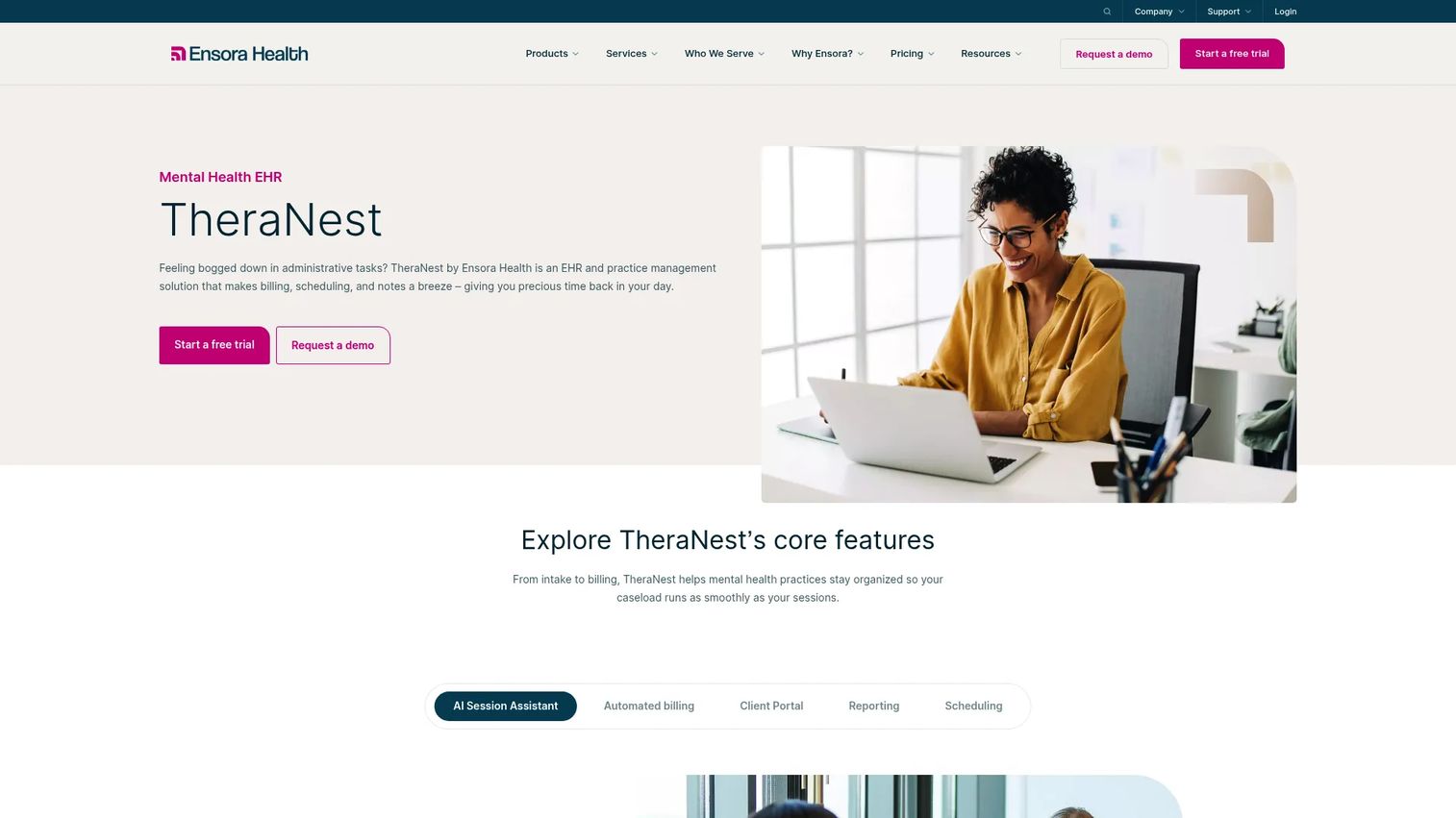
TheraNest, now part of Ensora Health, is a mental health EHR and practice management platform for therapy practices that want scheduling, notes, billing, and portal depth in one place. Its AI Session Assistant helps draft documentation, and automated billing keeps claims and invoices moving without constant manual work.
Best for: solo and small-to-mid mental health practices that need an all-in-one EHR with real billing depth.
Key strengths
- AI Session Assistant for faster note drafting
- Automated billing and claims workflows
- Client portal and secure client communication
- Scheduling plus reporting for caseload and finances
Why choose TheraNest: It balances documentation, calendar, and billing without forcing you into the most expensive tier for the basics. Small and midsize clinics that want reporting on top of day-to-day practice management get a lot from it.
TheraNest pricing: Per-therapist monthly plans: Essentials at $29/therapist/month, Advanced at $59/therapist/month, and Premier at $89/therapist/month. Annual billing includes one month free, and a 21-day free trial is available on Premier. There is no free tier.
4. TheraPlatform

TheraPlatform is an all-in-one practice management, EHR, billing, and teletherapy platform for therapists and related providers. It leans into flexible documentation and built-in telehealth, with support for SOAP notes, DAP notes, intake forms, and AI therapy notes alongside HIPAA-compliant video and a branded client portal.
Best for: therapists and small practices that want customizable notes, integrated telehealth, and billing in one system.
Key strengths
- HIPAA-compliant video conferencing and secure chat
- Customizable therapy notes, forms, and AI note support
- Scheduling, reminders, and a branded client portal
- Billing and insurance claims
Why choose TheraPlatform: If teletherapy is central to your practice and you want documentation you can shape to your clinical style, TheraPlatform covers both without charging extra for video sessions. It's a strong fit for telehealth-first clinicians.
TheraPlatform pricing: Public pricing shows three plans, Basic, Pro, and Pro Plus, with entry pricing starting at $19.50 for the first three months under a limited-time 50% offer. The platform advertises a 30-day free trial with no credit card required, no setup fee, and cancel anytime. There is no permanent free tier.
5. Practice Better
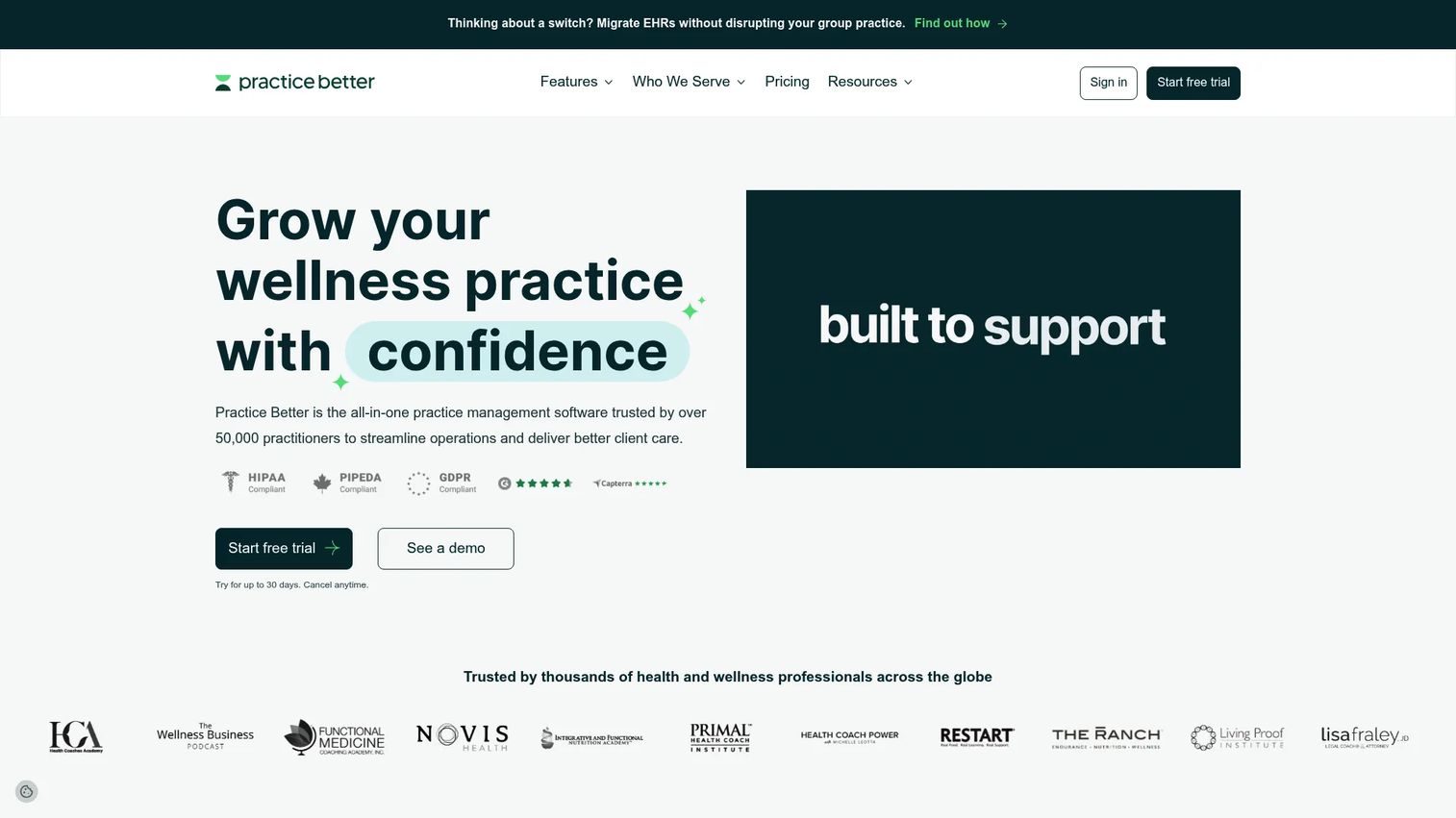
Practice Better is an all-in-one EHR and practice management platform built for health and wellness practitioners, with a modern, client-facing feel. It combines client management, scheduling, secure messaging, telehealth, and a strong system for programs, forms, templates, and workflow automation.
Best for: wellness and health-adjacent therapy practices that want a polished client experience and automated workflows.
Key strengths
- Client management and scheduling in one view
- Secure messaging and integrated telehealth
- Programs, forms, templates, and workflow automation
- Free tier to start, with room to scale
Why choose Practice Better: It stands out for client-facing workflows and automation, which suits practices where the client journey, intake, programs, and follow-through, matters as much as the session note itself. The free Sprout plan makes it easy to test before committing.
Practice Better pricing: A free Sprout plan is available. Paid plans include Starter at $25/month billed annually or $35/month monthly, Professional at $59/month, Plus at $89/month, and Team at $145/month with two practitioner licenses. Trials are available on paid plans.
6. Sessions Health

Sessions Health is an all-in-one, HIPAA-compliant EHR and practice management platform designed by therapists for mental health care. It focuses on clean, easy workflows: scheduling, custom note templates, assessments, treatment plans, integrated telehealth, a client portal, and billing tools that stay out of your way.
Best for: therapists and group mental health practices that want a HIPAA-compliant EHR with a simple, organized workflow.
Key strengths
- Scheduling with calendar integration
- Custom forms, note templates, assessments, and treatment plans
- Integrated telehealth, client portal, and billing tools
- Strong HIPAA posture with encryption and access controls
Why choose Sessions Health: It earns high marks on ease of use and organization, holding a 4.8/5 rating on G2. If you've been burned by cluttered EHRs, its therapist-designed workflow feels intentional rather than overloaded. The free tier lets small practices start without a commitment.
Sessions Health pricing: A free plan covers up to three active clients. The Professional plan starts at $39/month for the first practitioner, with additional practitioners at $29/month each. Integrated telehealth is an optional add-on at $10/month per practitioner.
7. Jane App
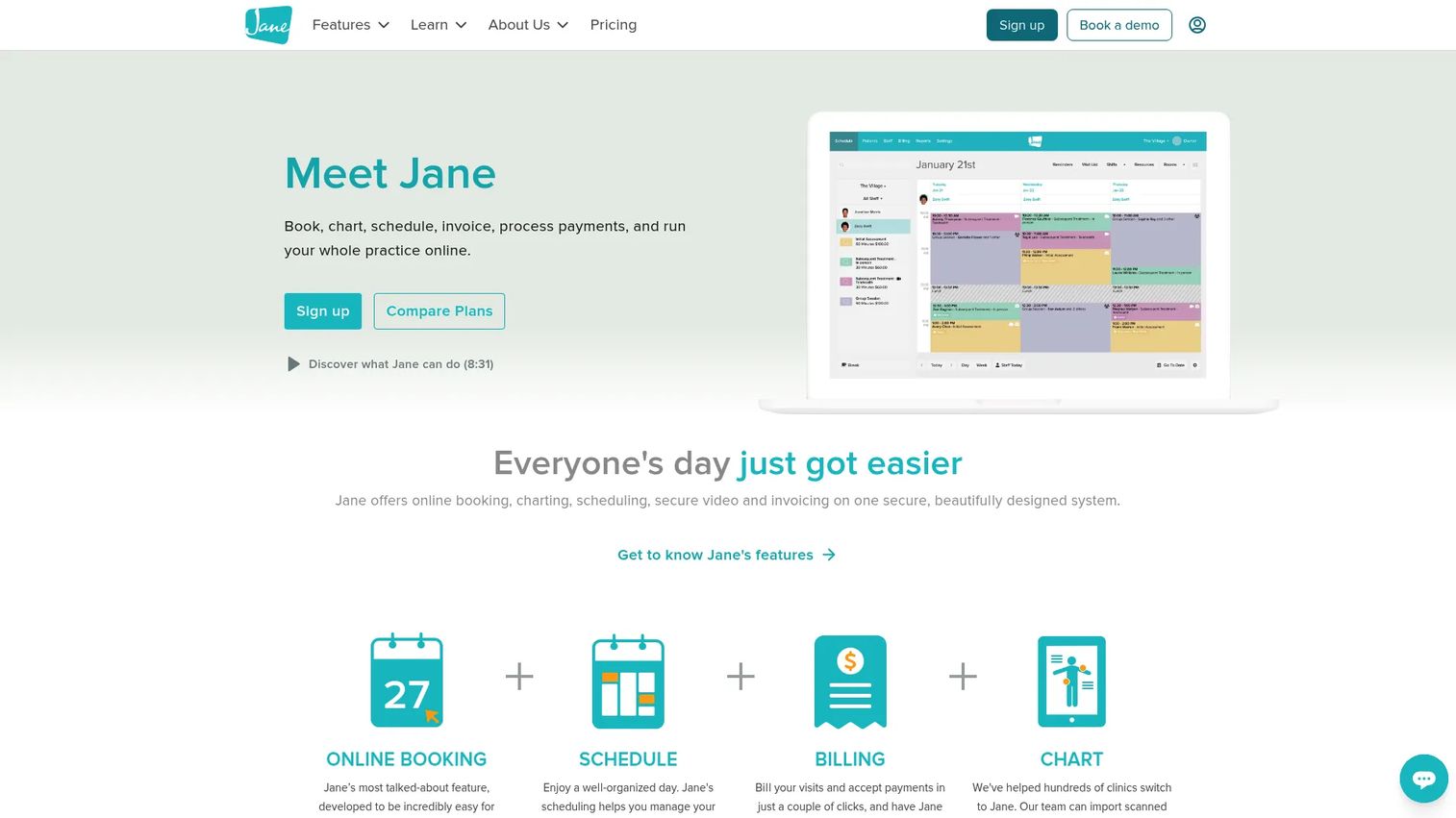
Jane App is practice management software for health and wellness clinics, known for polished online booking and clean charting. It handles scheduling, documentation, billing, payments, and patient communication, with modular add-ons so multi-practice and multi-discipline clinics can build the exact setup they need.
Best for: clinics that want scheduling, charting, billing, and client communication in one operationally polished system.
Key strengths
- Online booking with a strong client-facing experience
- Charting and documentation for clinical notes
- Billing and payments built in
- Add-ons for AI Scribe, group telehealth, and insurance billing
Why choose Jane App: Its booking and scheduling are among the most refined in the category, which matters for busy or multi-practitioner clinics. The modular add-ons let you pay for AI Scribe, insurance billing, or group telehealth only when you need them, so the base plan stays lean.
Jane App pricing: Published plans are Balance at USD $54/month, Practice at USD $79/month, and Thrive at USD $99/month. Add-ons include AI Scribe at $15/month per opted-in practitioner, Group Telehealth at $15/month per opted-in practitioner, Insurance Billing at $20/month, and Jane Websites at $59/month per clinic. There is no free tier.
8. CounSol.com
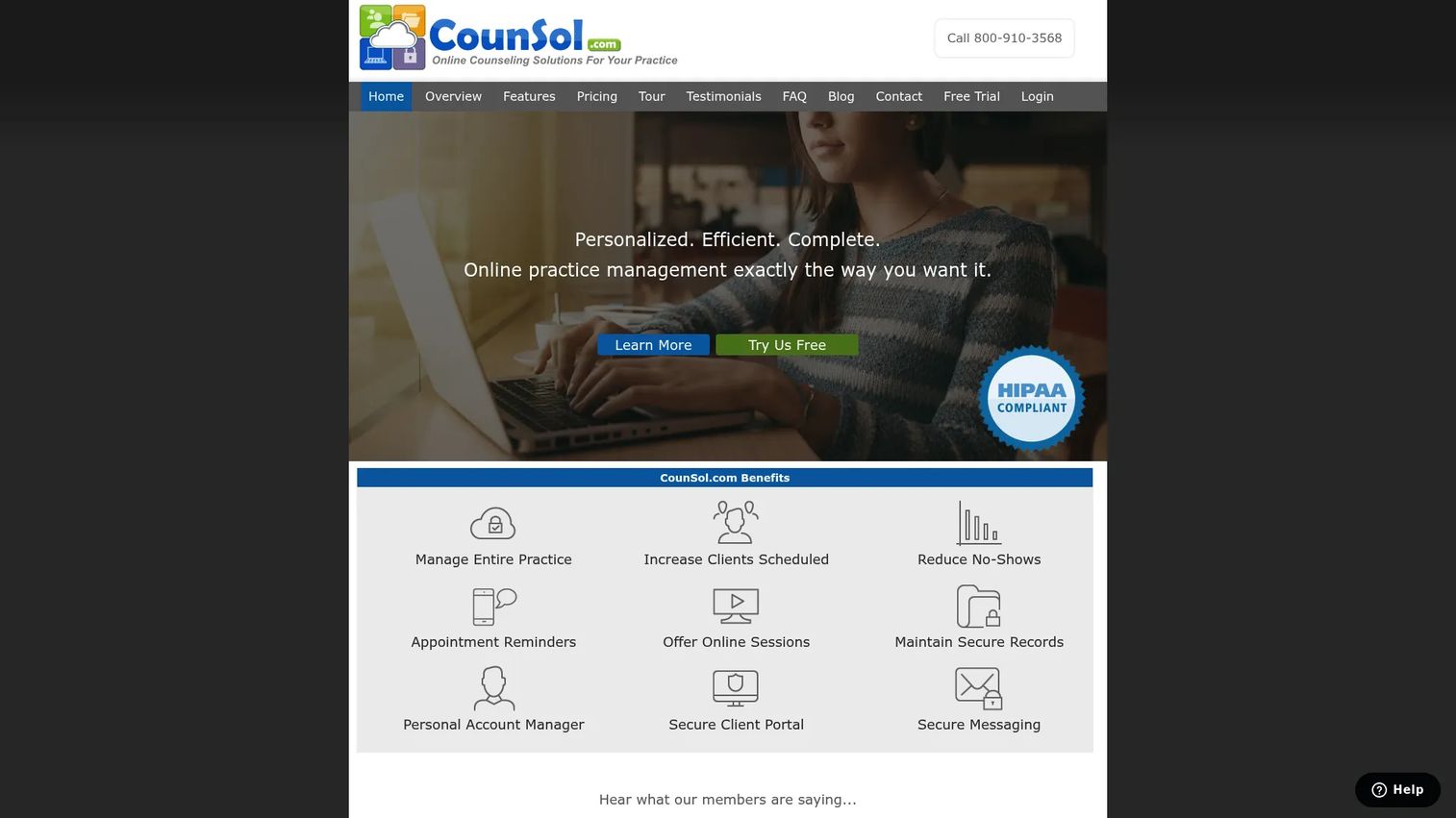
CounSol.com is cloud-based practice management software for counselors and mental health practices that want complete clinical coverage without excess complexity. It pairs a secure client portal with scheduling, telehealth, notes, and billing, giving smaller teams a functional all-in-one system at an accessible entry price.
Best for: independent counselors and small practices that want an all-in-one client portal, scheduling, and billing system.
Key strengths
- Secure client portal and messaging
- Appointment scheduling and reminders
- Billing, invoicing, and claims
- Notes and telehealth in one place
Why choose CounSol.com: It's a practical choice when you want the full clinical workflow, portal, scheduling, notes, telehealth, billing, without paying for features aimed at large groups. Optional add-ons like Wiley Practice Planners and e-prescribing let you extend it as the practice grows.
CounSol.com pricing: Monthly plans include Standard at $49.95, Standard Plus at $59.95, Premium at $64.95, and Premium Plus at $69.95, with $0 setup fees. A credit card is not required to start. Add-ons include Wiley Practice Planners and e-prescribing.
Considerations
Before you commit, run each shortlisted tool through these criteria. They're where therapy notes software reviews tend to diverge most.
Documentation depth
Look at the note builder, not just the marketing page. Does it support SOAP notes, DAP notes, intake forms, and treatment plan templates you can customize? Can you search diagnosis codes inline and export records cleanly for audits or client transfers? Shallow templates create rework at 8 p.m.
Billing complexity
If you bill insurance, this is where tools separate. Check for electronic claims, ERAs, CMS-1500 forms, eligibility checks, superbills, and integrated card processing. A practice that submits claims weekly will feel every gap here in rejected claims and delayed payments.
Telehealth and client portal
The portal is where clients live. Test whether they can book, complete intake, message securely, and join a session without emailing you. Integrated telehealth that runs inside the same HIPAA-compliant system beats stitching a separate video tool onto your EHR.
HIPAA and security
HIPAA compliant therapy software should offer encryption in transit and at rest, role-based access controls, and audit trails. For group practices, confirm you can scope what each role sees. Ask about a signed business associate agreement before you enter any client data.
AI note automation
AI therapy notes range from native session-to-note drafting to a light add-on to nothing at all. Confirm whether AI is built in, optional, or just marketing language, and check how the draft handles review and sign-off. The point is to cut writing time, not add a proofreading step.
Pricing transparency
Read the tiers and the add-ons together. A low entry price can climb fast once you add telehealth, extra clinicians, or insurance billing. Map your real practice, number of clinicians, telehealth needs, claim volume, against the plan that actually covers it.
Conclusion
There's no universal best therapy notes software, only the best fit for your practice shape.
For all-in-one behavioral health practice management with tight billing and documentation, TherapyNotes is the strong overall pick. Solo and small practices that value a clean client experience lean toward SimplePractice. Billing-heavy small-to-mid clinics get depth from TheraNest, while telehealth-first clinicians will like TheraPlatform. Practice Better suits modern, client-facing wellness workflows, Sessions Health wins on simplicity and its 4.8/5 G2 rating, Jane App on operational polish, and CounSol.com on complete coverage at a lightweight price.
Don't try to crown one winner. Shortlist the two or three that match your practice size, billing complexity, and note-writing style. Then start a free trial with each and put your actual workflow through it: write a real note, run a mock claim, and book a test telehealth session. The tool that removes the most 8 p.m. admin is the one to keep.
FAQs
For solo and small private practices, SimplePractice and Sessions Health are common favorites for their approachable workflows and strong client portals. If insurance billing is central, TherapyNotes ties notes and claims tightly together. The best pick depends on whether you prioritize client self-service, billing depth, or a free entry tier.
TherapyNotes and TheraNest stand out for billing and claims, with electronic claim submission, superbills, and automated billing workflows. Jane App offers insurance billing as a modular add-on. If you submit claims weekly, prioritize tools with ERAs, CMS-1500 support, and eligibility checks, then confirm those features are included in the tier you're pricing.
Several tools now offer AI therapy notes. TheraNest includes an AI Session Assistant, TheraPlatform supports AI note generation, and Jane App offers an AI Scribe add-on. Confirm whether AI is native or a paid add-on, and test how the draft handles clinical review and sign-off before relying on it.
Most modern behavioral health EHR tools include integrated telehealth. TherapyNotes, SimplePractice, TheraPlatform, Practice Better, Sessions Health, and CounSol.com all offer HIPAA-compliant video, though some treat it as an add-on. Sessions Health and Jane App, for example, price telehealth as an optional per-practitioner add-on, so check the tier detail.
Look for encryption in transit and at rest, role-based access controls, and audit trails that log who viewed or changed a record. A vendor should sign a business associate agreement before you enter client data. For group practices, confirm you can restrict what each role sees so supervisors, billers, and clinicians only access what they need.
Yes. Group practices benefit most from shared note templates, supervisor workflows, role-based permissions, and centralized billing. TherapyNotes, TheraNest, and Sessions Health all support multi-clinician setups. When comparing, check how per-clinician pricing scales and whether supervisor review and co-signing are built in.
Entry pricing typically runs from around $29 to $99 per month, with per-clinician pricing common in group plans. Some tools, like Practice Better and Sessions Health, offer free tiers with client limits. Watch add-on costs for telehealth, insurance billing, and extra practitioners, since they can raise the real monthly figure well above the advertised entry price.
For most solo and small-to-mid behavioral health practices, yes. Tools like TherapyNotes, TheraNest, and TheraPlatform combine clinical documentation, scheduling, telehealth, and billing in one HIPAA-compliant system, removing the need for a separate billing platform. Very large groups with complex payer contracts sometimes still pair an EHR with a dedicated billing service, so map your claim volume against each tool's billing depth first.