The first hundred rides are easy. You can match a rider to a driver over text, eyeball the route, and settle payment by hand. The problem starts when volume climbs. Dispatch becomes a queue you cannot clear fast enough, rider-driver matching slips, drivers idle in the wrong zones, and a single mispriced fare turns into a refund thread that eats your afternoon. The coordination that felt scrappy at launch turns into the thing that caps your growth.
For a founder, that matters less because of the operational pain and more because of what it hides. When dispatch and billing live in someone's head or a spreadsheet, you cannot see what is actually working. You cannot tell a board whether the model scales or whether it only scales because you keep pouring manual effort into the cracks. The ride sharing market backs the urgency here. Research and Markets pegs the global ride-sharing market at roughly USD 189.25 billion in 2026, growing at about 21.2% annually toward USD 408.64 billion by 2030. That is a market expanding faster than most teams can build for, which is exactly why buying the right platform beats building one from scratch.
The right ride sharing software absorbs that coordination so it stops routing through you. We evaluated each tool below on rider-driver matching, real-time tracking, payments, pricing logic, dispatch workflow, fleet visibility, and how cleanly it supports a branded mobile app. If you are weighing a launch or a rebuild, this is the shortlist worth your time.
What's inside
This guide is for founders, operators, and mobility leads choosing software to run or launch a ride sharing, ride hailing, taxi dispatch, commuter, or fleet operation. We did not rank vendor brochures. We scored each platform on the workflows that break first at scale: dispatch and rider-driver matching, rider and driver apps, payments and fare calculation, fleet visibility, integrations, and proof of real market traction. The list spans taxi dispatch software, commuter ridesharing software, public mobility platforms, and white-label ride hailing software, so you can match a tool to your actual model rather than a generic feature checklist. If you are evaluating adjacent stacks, our roundups on best mobile marketing software and best mobile attribution platforms cover the demand side of a rider app launch.
TL;DR
- Best overall for broad ride sharing operations: AllRide Apps, for end-to-end dispatch, tracking, and white-label apps.
- Best for commuter programs and reporting: TripSpark Technologies, for fixed-route, paratransit, and mode-shift visibility.
- Best for public mobility and transit complexity: Via Transportation, for microtransit, paratransit, and service design.
- Best for white-label launch flexibility: Ridewolf, for multi-mode vehicle sharing fleets.
- Best for budget-conscious branded taxi platforms: BetterSuite, for fast branded launch with cloud or self-hosted options.
- Best for taxi dispatch automation: RideLogic, for white-label dispatch plus retention tools.
- Best for an integrated management suite: ZervX, for a unified admin, driver, and passenger toolkit.
If you want a parallel buyer's lens on retention and lifecycle tooling that pairs with a rider app, our best loyalty management software guide is a useful companion read.
What is ride sharing software?
Ride sharing software is the operational layer that matches riders with drivers, manages dispatch, calculates fares, processes payments, and tracks vehicles in real time across a branded mobile app and admin dashboard. It replaces the manual coordination that breaks once a fleet grows past a handful of drivers, turning ad hoc matching and billing into a repeatable system.
Most platforms in this category, whether sold as rideshare software, ride hailing software, or taxi dispatch software, share a common set of core capabilities:
- Rider-driver matching: assigning the nearest available driver to a request automatically.
- Real-time GPS tracking: live location for riders, drivers, and dispatchers.
- Route optimization: efficient routing that reduces idle time and fuel cost.
- Secure cashless payments: in-app card, wallet, and split-fare handling.
- Mobile apps: dedicated rider and driver apps for Android and iOS.
- Driver profiles and ratings: onboarding, documents, and two-way ratings.
- Safety controls: SOS workflows, background checks, and trip sharing.
- Admin dashboard: a control center for dispatch, pricing, fleet, and reporting.
The category serves a wide spread of operators. Taxi businesses use it to modernize legacy dispatch. Fleet operators use it for utilization and route optimization. Employers and transit agencies use commuter ridesharing software for fixed routes and vanpools. Mobility startups use white-label ride hailing software to launch a branded marketplace without building the backend themselves.
When to use ride sharing software
Launching a ride hailing app without building from scratch
Building rider-driver matching, payments, dispatch, and live tracking from zero takes a year and a backend team you probably do not have. White-label and ready-made platforms compress that to weeks. Founders reach for these tools when they need a branded rider app and driver app live fast, with the app-based booking and fare calculation logic already proven in production elsewhere.
Managing dispatch, pricing, and tracking at scale
Once ride volume climbs, manual coordination produces delays, missed pickups, and pricing mistakes that compound. Dispatch automation assigns the nearest driver in seconds, dynamic pricing adjusts fares to demand without a human touching the math, and real-time tracking gives both riders and your ops team a single source of truth. The result is fewer cancellations and a dispatch process that does not depend on a person watching a map all day.
Running commuter, shuttle, or vanpool programs
Not every operation is on-demand. Employers, campuses, and transit agencies run fixed routes, employee commuting, shuttle software, and vanpool programs where the value sits in reporting and participation, not surge pricing. These programs need ridership data, mode-shift measurement, and scheduling tools that prove the program is working to the people funding it.
Comparison table
Here is how the seven platforms compare on intent, primary use case, pricing, and rating. Pricing reflects publicly listed figures at the time of writing; verify current numbers with each vendor.
| # | Product | Intent | Key use case | Pricing | G2 rating |
|---|---|---|---|---|---|
| 1 | AllRide Apps | Broad ride sharing operations | Dispatch, tracking, white-label apps | From $99/mo | 5.0/5 |
| 2 | TripSpark Technologies | Commuter and transit programs | Fixed route, paratransit, reporting | Custom quote | Not listed |
| 3 | Via Transportation | Public mobility complexity | Microtransit, paratransit, planning | Custom quote | Not listed |
| 4 | Ridewolf | White-label launch flexibility | Multi-mode vehicle sharing | From $50/device/mo | Not listed |
| 5 | BetterSuite | Budget-conscious branded launch | Cloud or self-hosted taxi platform | From $119/mo | Not listed |
| 6 | RideLogic | Taxi dispatch automation | White-label dispatch plus retention | Custom quote | Not listed |
| 7 | ZervX | Integrated management suite | Admin, driver, passenger tooling | Custom quote | Not listed |
1. AllRide Apps
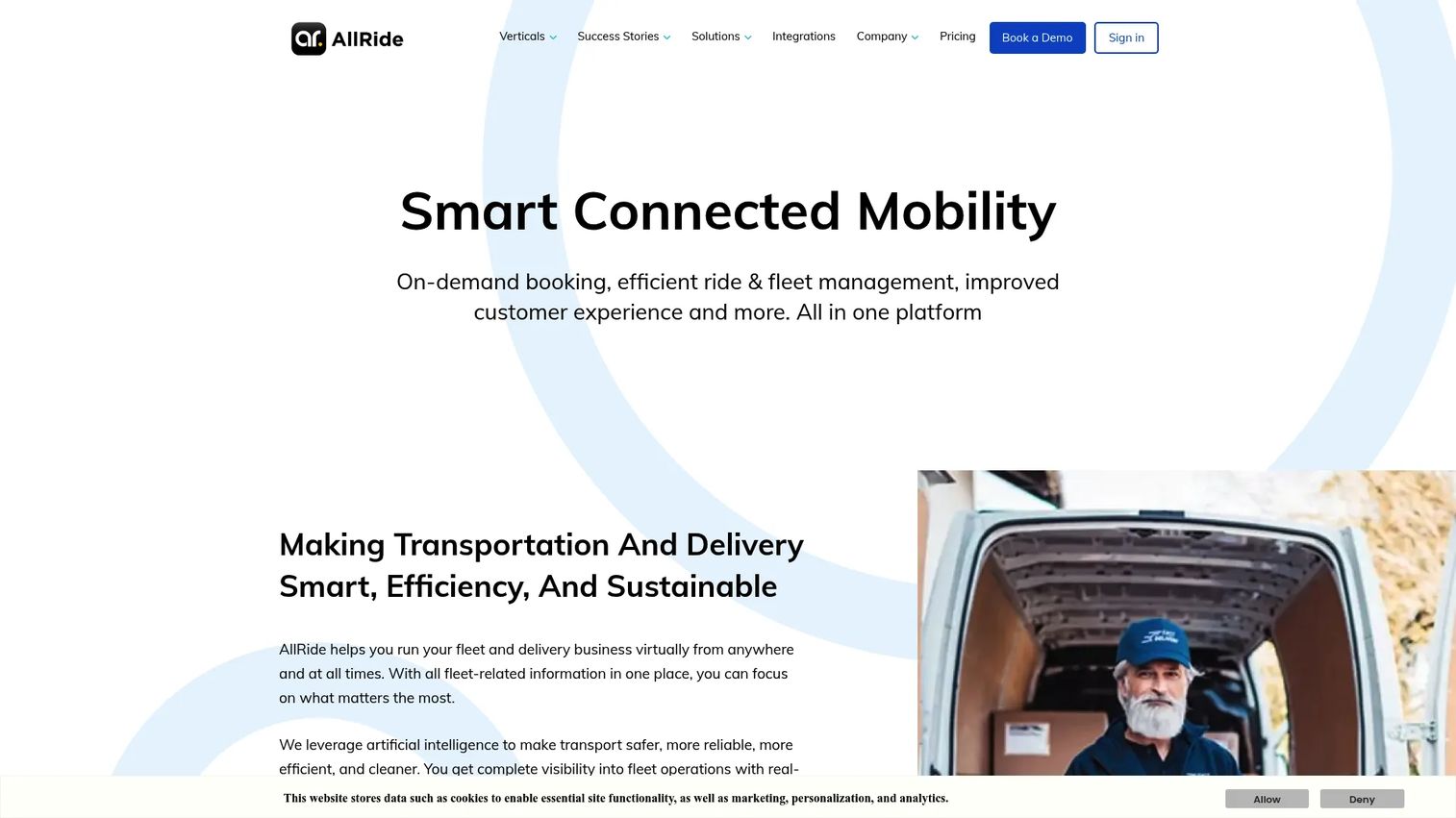
AllRide Apps is an AI-powered transport and delivery platform for mobility and logistics businesses, and it is the most feature-complete general ride sharing software on this list. It covers the full operational chain: trip booking, automated driver assignment, real-time trip tracking, route management, dynamic pricing, and a white-label app and dispatch stack that you can put your brand on. For a founder who wants one platform to absorb most of the coordination load rather than stitching point tools together, this is the broadest starting point.
What makes it stand out for operators is the suite breadth. AllRide ships vertical-specific products across cab, delivery, and logistics, so an operation that starts with ride hailing and later adds parcel or shuttle services does not have to migrate platforms. The white-label apps and admin dispatch panel give you a branded rider and driver experience plus the operational visibility a growing team needs.
Best for: Transport and delivery operators that want a broad feature set and a white-label ride hailing stack under one roof.
Key strengths
- Trip booking and driver assignment: Automated app-based booking with nearest-driver matching that scales past manual dispatch.
- Real-time tracking and route management: Live trip visibility plus route optimization to cut idle time and fuel cost.
- White-label apps and dispatch panel: Branded rider and driver apps with a central admin console for fleet control.
Why choose AllRide Apps: If your operation is likely to expand beyond pure ride hailing into delivery or logistics, AllRide's multi-vertical suite means you grow inside one platform instead of re-buying. The breadth fits founders who want repeatability across services rather than a single-purpose tool.
AllRide Apps pricing: Public pricing starts at $99 per month for the Starter plan, with a Growth plan at $149 per month. Annual options are listed, including Starter at $990 per year and Growth at $1,490 per year. There is no free tier. AllRide holds a 5.0 out of 5 rating on G2.
2. TripSpark Technologies

TripSpark Technologies is a transportation technology provider for public and private transit operators, trusted for over 30 years by North America's mid-sized urban, suburban, and rural agencies. It is built for fixed route, paratransit, on-demand, and rideshare services rather than pure on-demand ride hailing, which makes it the strongest fit when reporting and ridership visibility matter more than surge pricing.
The reason TripSpark earns its place here is the commuter and transit angle. If you run employee commuting, shuttle, or paratransit programs, the value is in integrated routing, dispatch, in-vehicle technology, and the reporting that proves mode shift and ridership to whoever funds the program. That reporting depth is exactly what a generic on-demand platform tends to underweight.
Best for: Transit agencies and commuter programs needing integrated routing, dispatch, and passenger technology with strong reporting.
Key strengths
- Fixed route software: Schedule and manage fixed-route and commuter services with ridership data baked in.
- Paratransit and on-demand software: Coordinate accessible and demand-response trips alongside scheduled routes.
- In-vehicle technology: Hardware and software that connect drivers, dispatch, and riders across the fleet.
Why choose TripSpark Technologies: For operators whose success metric is participation and service coverage rather than ride volume, TripSpark's reporting and transit-grade routing matter more than dynamic pricing. The three-decade track record with public operators is a real trust signal for grant-funded and municipal programs.
TripSpark Technologies pricing: TripSpark does not publish prices. It provides a tailored quote after a discovery call, which is typical for transit-grade software scoped to agency size and service mix. Plan for a sales conversation rather than self-serve signup.
3. Via Transportation
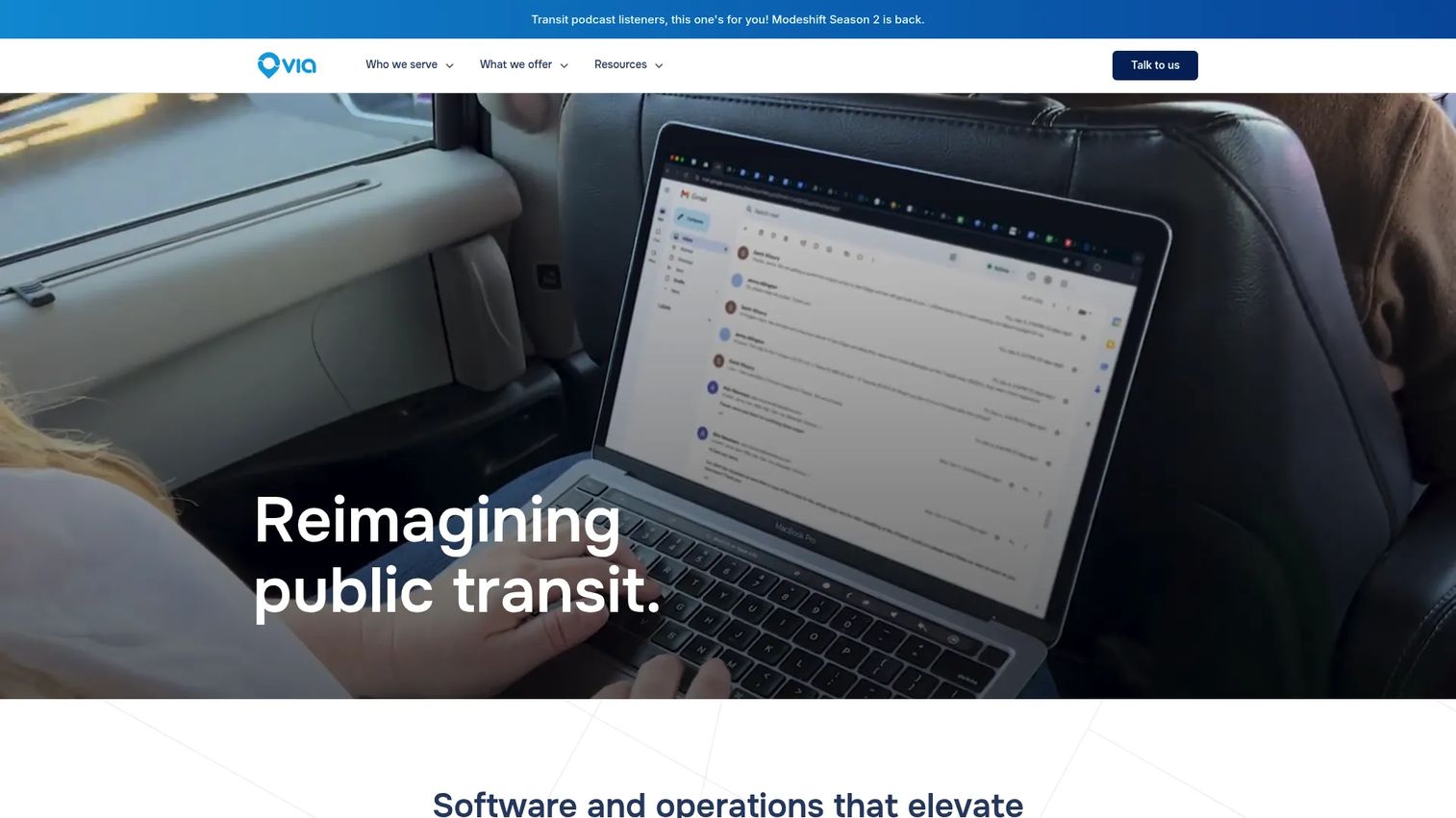
Via Transportation operates at the complex end of public mobility, with a product family spanning microtransit, paratransit, student transit, campus shuttles, and the planning tools agencies use to design service. It layers on Via Intelligence, a vertical AI platform engineered for public transportation, which is where the scheduling and service-design depth shows up.
Via fits organizations managing public or semi-public transportation networks where the hard problem is not matching a single rider to a driver but designing and operating an entire service. If you need route planning, demand modeling, and operational intelligence across multiple transit categories at once, Via is built for that scale of complexity rather than a quick branded launch.
Best for: Public agencies, campuses, and transit operators running complex multi-mode networks that need planning and service design.
Key strengths
- Microtransit and paratransit: Demand-responsive and accessible service management across a public network.
- Student and campus transit: Dedicated tools for school and campus shuttle operations.
- Via Intelligence planning layer: AI-driven service design, demand modeling, and operational intelligence.
Why choose Via Transportation: For transit complexity, Via covers scheduling, service design, and operational intelligence in one platform, which a generic ride hailing tool does not attempt. It fits operators who think in networks and routes rather than individual ride requests.
Via Transportation pricing: Via does not list public pricing. As an enterprise public-mobility platform, it scopes engagements to the agency and service network, so expect a custom quote following a discovery process.
4. Ridewolf
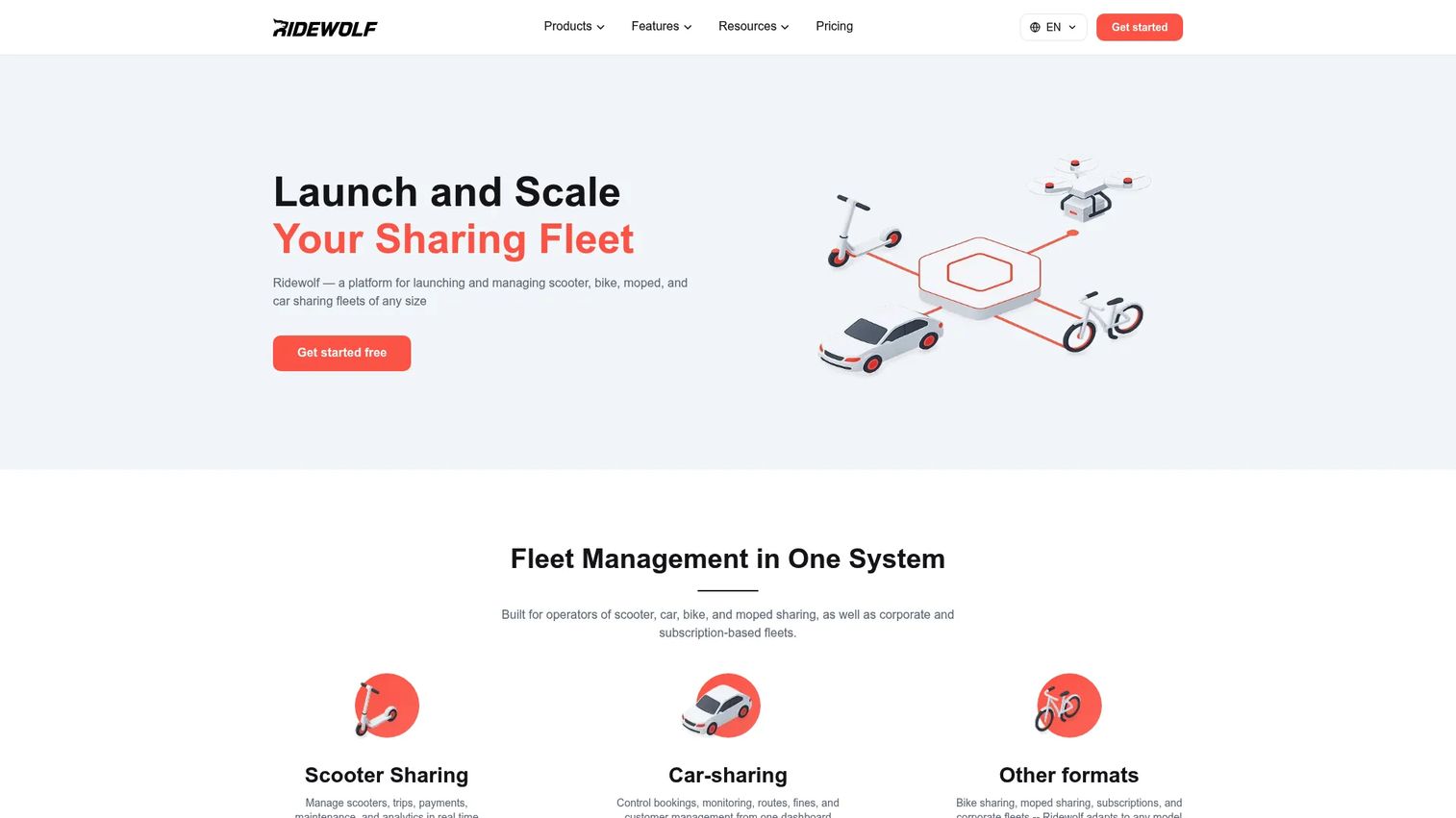
Ridewolf is a mobility software platform for launching and managing sharing fleets of any size, covering scooter, bike, moped, car-sharing, and rental modes. It ships a rider app, operator app, fleet dashboard, payments, IoT connectivity, real-time tracking, and analytics, which makes it a clean white-label stack for operators who want to run more than one vehicle type from a single backend.
The multi-mode positioning is what sets Ridewolf apart. A startup that launches with scooters and later adds car-sharing does not need a second platform, and the IoT connectivity gives the hardware-level control that vehicle-sharing fleets require. For founders who want modern, transparent, device-based pricing and a branded app pair, it is one of the more accessible white-label entry points here.
Best for: Operators of scooter, bike, moped, car-sharing, or rental fleets wanting a modern multi-mode white-label stack.
Key strengths
- Rider and operator apps: Branded apps for both sides of the marketplace plus an operator control surface.
- Fleet dashboard and IoT connectivity: Real-time tracking and hardware-level control across the fleet.
- Payments and analytics: Cashless payments with dispatch, maintenance, and ride analytics built in.
Why choose Ridewolf: If your model spans multiple vehicle-sharing types, Ridewolf's multi-mode coverage and per-device pricing scale with your fleet rather than your headcount. The transparent pricing model is a refreshing contrast to the quote-only norm in this category.
Ridewolf pricing: Ridewolf publishes per-device pricing. The Starter plan is $50 per device per month and Growth is $105 per device per month, with an Enterprise tier available by contacting sales. A free tier is available, which lets you validate the platform before committing fleet hardware to it.
5. BetterSuite

BetterSuite is a white-label on-demand software platform for launching and operating branded delivery and service businesses, including taxi and ride hailing marketplaces. It offers both cloud SaaS and self-hosted deployment, white-label customer, provider, and admin apps, and built-in real-time dispatch, parcel delivery, and surge pricing. The pitch is launch speed: get a branded platform, apps, and backend live in days rather than months.
BetterSuite fits teams that want a taxi or ride hailing marketplace live quickly without an enterprise budget, and the deployment choice is the differentiator. Cloud plans get you running fast with managed infrastructure, while the self-hosted licenses give teams that want to own the codebase a path to full control. More than 100 businesses have used it to launch branded services.
Best for: Teams needing a branded on-demand platform with either managed cloud or self-hosted deployment.
Key strengths
- Cloud and self-hosted options: Managed SaaS for speed or a self-hosted license for full ownership.
- White-label apps across roles: Branded customer, provider, and admin apps out of the box.
- Built-in dispatch and surge pricing: Real-time dispatch and dynamic pricing without custom development.
Why choose BetterSuite: The cloud-versus-self-hosted choice lets you trade launch speed against long-term ownership depending on stage. Early teams launch fast on cloud; teams that want to own the stack can buy a license and self-host. That flexibility is rare at this price point.
BetterSuite pricing: Cloud SaaS plans start at $119 per month for Starter, with Professional at $399 per month and Enterprise at $2,499 per month. Self-hosted licenses run from $4,999 one-time for a Binary License up to $99,999 for an Enterprise License. A 14-day free trial is available on cloud plans.
6. RideLogic
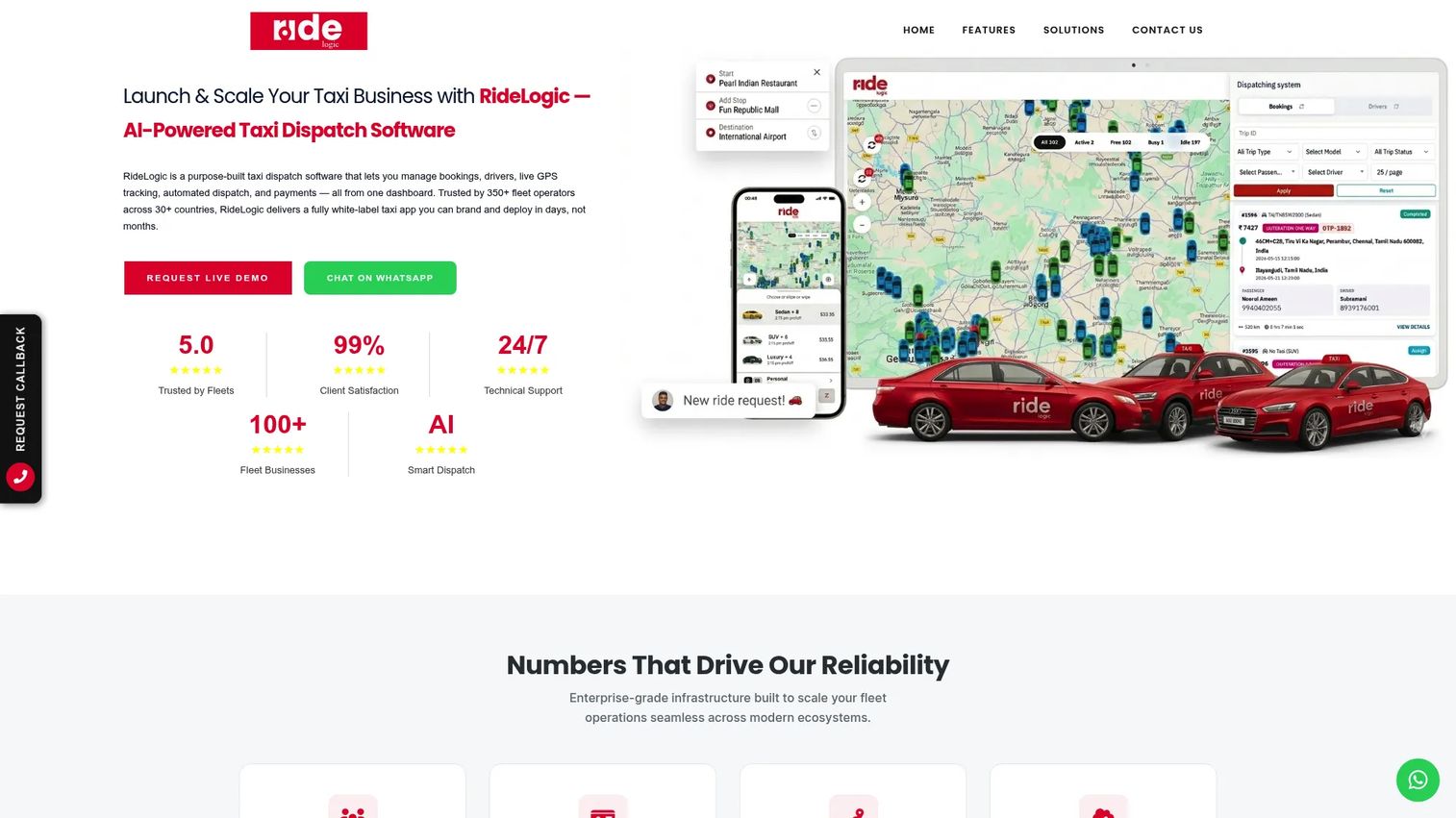
RideLogic is AI-powered taxi dispatch software for fleet operators and white-label ride-hailing businesses. Its AI matching engine assigns the nearest available driver within seconds, and it pairs that automated dispatch with live GPS fleet tracking and white-label branding so you run the operation under your own name.
What earns RideLogic its spot is the combination of dispatch automation and retention tooling in a taxi-focused package. Beyond core dispatch, it bundles features aimed at recurring business and fleet utilization, which matters for taxi operators whose economics depend on keeping both riders and drivers active rather than chasing one-off trips. It is a focused fit for established taxi businesses modernizing their dispatch.
Best for: Taxi and fleet operators wanting a white-label dispatch platform with automation and retention features.
Key strengths
- Automated ride assignments: AI matching that assigns the nearest available driver in seconds.
- Live GPS fleet tracking: Real-time visibility across the whole fleet for ops and riders.
- White-label branding: Run rider and driver apps under your own brand.
Why choose RideLogic: For a taxi business that wants dispatch automation without giving up its brand, RideLogic's white-label approach and retention-oriented features support recurring ridership and fleet utilization. It is a practical pick for operators focused on a single, well-run taxi marketplace.
RideLogic pricing: RideLogic does not publish pricing on its site. Expect to request a quote scoped to fleet size and feature needs, which is common for white-label taxi platforms sold through a sales process.
7. ZervX
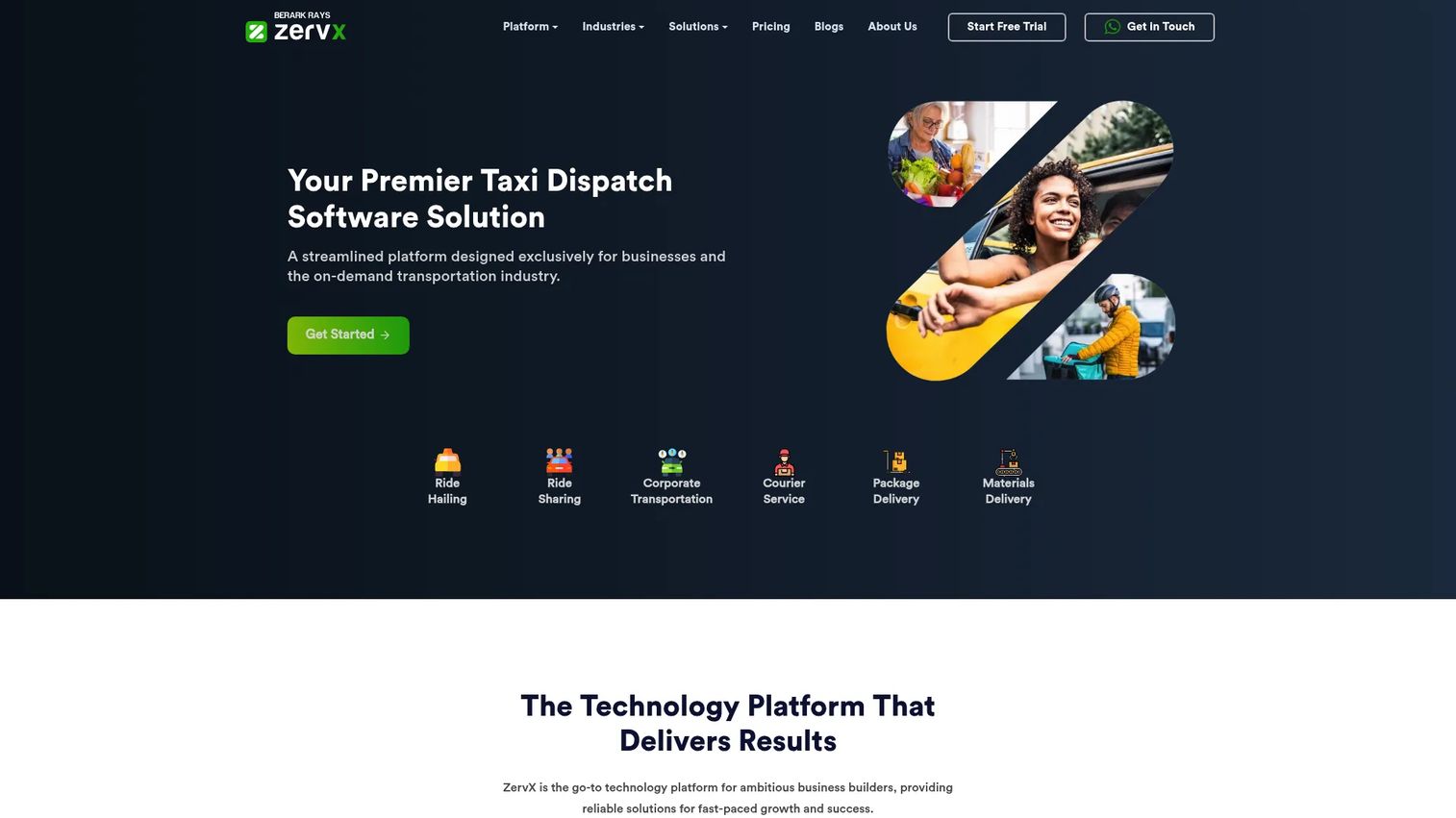
ZervX is taxi dispatch and on-demand mobility software for ride-hailing and delivery businesses, built as an integrated management suite. It brings ride hailing, ride sharing, driver management, live tracking, fleet management, payments, analytics, and an admin dashboard into one place, with capabilities like predictive ETA and automated dispatching at the core.
The reason ZervX suits founders is the unified admin dashboard. When dispatch, drivers, payments, and fleet data live in one console, you get the operational visibility that lets you read the business at a glance rather than reconciling five tools. ZervX reports serving more than 100 cities, onboarding 80,000-plus drivers, completing over 10 million jobs, and maintaining 99.99% average uptime, which signals it has run at real operational scale.
Best for: Mobility operators needing branded dispatch, passenger, driver, and admin tooling in one suite.
Key strengths
- Predictive ETA: Accurate arrival estimates that improve rider trust and dispatch decisions.
- Automated dispatching: Hands-off driver assignment that scales with ride volume.
- Driver tracking and admin dashboard: Unified visibility across drivers, fleet, and payments.
Why choose ZervX: For founders who want one console rather than a patchwork, ZervX consolidates ride hailing, ride sharing, fleet management, and payments into a single suite. The unified admin view is the operational visibility that makes the business legible to you and a board.
ZervX pricing: ZervX states it offers flexible plans with no hidden charges but does not expose numeric pricing on its site. Plan to request a tailored quote based on your operation's size and feature requirements.
Considerations before you choose
Dispatch accuracy and workflow fit
The platform lives or dies on matching. Test how it handles rerouting, cancellations, no-shows, and peak demand, not just a clean single-trip request. Ask how rider-driver matching behaves when supply is thin and how quickly the dispatch logic reassigns a dropped trip. The difference between a 30-second and a 3-minute reassignment is the difference between a rider who waits and one who churns.
Rider and driver app quality
You are running a two-sided marketplace, so both apps have to be good. Verify the rider app handles app-based booking, live tracking, and cashless payments cleanly, and that the driver app makes accepting trips, navigation, and earnings obvious. Confirm both ship on Android and iOS, since a gap on either platform shrinks your addressable market on day one.
Pricing and implementation model
Compare upfront cost, contract structure, and what setup support is included. A low monthly price means little if implementation drags for months or a self-hosted license needs an engineering team you do not have. Map total cost across the first year, including onboarding, and weigh it against how fast the platform earns its place in your stack.
Integrations and ecosystem
Check the payment gateways supported, whether there is real API access, and how analytics export. Your ride sharing software has to talk to the rest of your stack, from accounting to the demand tooling covered in our best account based marketing software tools and best email tracking software tools roundups. Thin integration depth becomes a tax you pay every month.
Safety, trust, and compliance
Trust is the product in mobility. Confirm background-check workflows, SOS and emergency features, two-way ratings, and continuous location tracking. These are not nice-to-haves; they are what keeps riders booking and what regulators will ask about. For programs handling sensitive ridership data, also confirm how the vendor handles audit trails, a topic our audit management software guide covers in depth.
Conclusion
The right pick depends less on a feature checklist and more on what you are actually running. If you are launching or scaling a broad ride hailing marketplace, AllRide Apps gives you the widest feature depth and a multi-vertical path. If your success metric is commuter participation and ridership reporting, TripSpark Technologies is built for that. If you operate complex public or semi-public transit, Via Transportation handles the planning and service design generic tools skip. Ridewolf, BetterSuite, RideLogic, and ZervX each fit narrower lanes, from multi-mode vehicle sharing to fast branded launches to taxi dispatch automation.
Do not buy on the demo alone. Shortlist two platforms that match your model, then validate them against your real dispatch, billing, and tracking workflows with live data before you commit. The platform that absorbs your coordination load without breaking at peak demand is the one that earns its place, and the one that lets you read the business instead of running it by hand.
FAQs
Ride sharing software matches riders with drivers, automates dispatch, calculates and collects fares, and tracks vehicles in real time through a branded mobile app and admin dashboard. Operators use it to replace manual coordination so a fleet can scale past a handful of drivers without breaking. It covers app-based booking, cashless payments, route optimization, and driver management in one operational layer.
At minimum, look for rider-driver matching, real-time GPS tracking, secure cashless payments, dynamic pricing or fare calculation, dedicated rider and driver mobile apps, driver profiles and ratings, safety controls like SOS, and an admin dashboard for dispatch and reporting. Stronger platforms add route optimization, fleet management, analytics, and API integrations. The features you weight most should map to whether you run on-demand, commuter, or fleet operations.
Ride hailing software is built around app-based, on-demand booking where riders request trips through a mobile app and the system matches them automatically. Taxi dispatch software focuses on coordinating an existing fleet of taxis, often with white-label branding, live tracking, and automated assignment of the nearest driver. The line blurs in modern platforms, since many ride hailing tools include dispatch automation and many taxi dispatch tools now ship rider apps.
For commuter, fixed-route, shuttle, and vanpool programs, TripSpark Technologies stands out because it is built for transit-grade routing, dispatch, and the ridership reporting that proves mode shift to program funders. Via Transportation is the stronger fit when the program is part of a larger public or semi-public mobility network needing service design and planning. Both prioritize reporting and participation over the surge pricing that on-demand ride hailing tools emphasize.
Yes. Most platforms in this category, including AllRide Apps, Ridewolf, BetterSuite, RideLogic, and ZervX, offer white-label rider and driver apps you can launch under your own brand. White-label support is what lets founders go to market with a branded ride hailing app in weeks instead of building one from scratch. Confirm the branding extends to both Android and iOS and to the admin and driver experiences, not just the rider app.
Dynamic pricing adjusts fares automatically based on demand, supply, time, and distance, so prices rise during peak demand without a human recalculating anything. Fare splitting lets multiple riders share the cost of a single trip, with the software dividing the fare and charging each rider's payment method separately. Both run on the platform's fare calculation engine, which combines base rates, distance, time, and any surge multiplier into the final charge.
Validate dispatch accuracy under peak load and dropped-trip reassignment, the quality of both rider and driver apps on Android and iOS, the total first-year cost including implementation, integration depth for payments and analytics, and safety and compliance features like background checks and SOS. Shortlist two platforms, then test them against your real dispatch, billing, and tracking workflows with live data before committing. The platform that holds up at peak demand is the one worth your stack.