

You briefed three creators last month. One delivered late. One missed the script. One sent footage you legally cannot run in a paid ad because nobody locked down the usage rights. Sound familiar?
That is the real friction with user generated content. The content itself converts. The coordination around it does not. You are juggling creator outreach, briefs, revisions, licensing, and channel handoffs across spreadsheets and DMs, and the bottleneck is never the footage. It is everything that surrounds the footage.
UGC platforms exist to remove that operational drag. They give you a repeatable way to source creators, brief them, manage usage rights, approve assets, and push content into paid social, product pages, and lifecycle campaigns without manual chaos. And the stakes are rising. The user generated content platform market is projected to grow from about $7.38 billion in 2024 to $75.03 billion by 2033, a 29.4% CAGR, according to SkyQuest (2024). By 2033, Market.us projects 78% of all online content will be user-generated.
If you own messaging, launches, and proof points, that shift matters. Authentic creator content is becoming the default unit of credibility, and you need infrastructure to produce it on demand. This guide compares the best UGC platforms for teams that need creator sourcing, content reuse, and governance, with a buyer's framework built for product marketers and growth teams rather than generic marketers. The same "show, don't tell" logic that powers an interactive demo applies to UGC: a believable, hands-on signal beats a polished claim every time.
What's inside
This guide is for product marketing managers, demand gen leads, ecommerce marketers, and creator marketing owners who are actively comparing user generated content platforms and need more than a feature dump.
We selected and ranked platforms based on the factors that actually move launch and pipeline work:
- Creator network quality and fit across geography, vetting, and category match
- Content formats and asset variety, from short-form video to photos and testimonials
- Rights management and usage permissions you can defend across paid and organic
- Workflow depth, including briefs, approvals, and collaboration
- Distribution and integrations into your existing marketing stack
Every entry includes who it fits, key strengths, verified pricing where public, and a G2 rating where available.
TL;DR
- Best for managed, enterprise-grade creator content: Cohley pairs a structured platform with managed services and perpetual rights.
- Best for curated creator quality on demand: Trend uses content packs and a vetted creator pool for repeatable campaigns.
- Best for speed and creator volume: Influee delivers fast UGC at scale from 120,000+ vetted creators.
- Best for ecommerce reviews plus UGC: Yotpo and Bazaarvoice anchor product-page trust and conversion.
- Best for embedding social proof on-site: Taggbox and TINT aggregate and display UGC across pages and campaigns.
- Best for visual-heavy industries: CrowdRiff fits travel, hospitality, and destination marketing.
For the deeper logic behind authentic proof, our guides on customer advocacy and content marketing tools pair well with this list.
What UGC platforms are and why they matter
A UGC platform is software that helps brands source, manage, license, and reuse content created by everyday creators and customers, including photos, videos, testimonials, and reviews. Instead of one-off creator outreach, it gives you a repeatable system for turning authentic content into marketing assets.
The category exists because UGC works and manual coordination does not scale. Ads containing UGC generate 73% more positive feedback than traditional ads, according to Market.us (2024). But producing that content reliably means coordinating dozens of creators, tracking permissions, and shipping assets across channels. That is what these tools handle.
Core capabilities to expect across the category:
- Creator discovery: Find and vet creators by audience, geography, niche, and past work.
- Brief creation: Send structured campaign briefs so creators know exactly what to produce.
- Rights management: Lock down usage permissions, licensing windows, and renewals.
- Content approval: Review, request revisions, and approve assets before they ship.
- Distribution: Push content into paid social, product pages, email, and embeds.
- Analytics: Track engagement, conversion, and which assets actually perform.
North America remains the largest regional market, holding a 34.1% share in 2022, per Grand View Research (2023). For product marketers, this category is less about content volume and more about credible, reusable proof points you can deploy across launches and the full funnel. Many teams pair UGC with broader content creation and ai content creation tools to round out their asset pipeline.
What to look for in a UGC platform
The right platform is the one that fits your content mix, your rights complexity, and your distribution channels. Here is the framework to use with stakeholders before you commit budget.
Creator network quality and fit
Vanity creator counts mean nothing if none of them match your category or voice. Judge a network on vetting rigor, audience fit, geographic coverage, and the diversity of creators available.
What to evaluate:
- Vetting and quality control before creators enter the pool
- Geographic and language coverage for your markets
- Category and niche depth relevant to your product
- Sample work that matches your brand's tone
Fit drives authenticity. A creator who genuinely understands your category produces content that lands; a mismatched one produces footage you will never run.
Content formats and asset variety
Different channels demand different formats. Short-form video fuels paid social, photos populate product pages, testimonials build landing-page trust, and raw assets give your team material to recut.
Tie format to use case:
- Short-form video for TikTok, Reels, and paid social
- Photos for product detail pages and lifecycle email
- Testimonial video for landing pages and launch assets
- Raw and edit-ready files so your team can repurpose freely
The more formats a platform supports, the further a single creator brief stretches across your channels.
Rights management and usage permissions
This is where reuse lives or dies. A platform that handles licensing cleanly lets you run a creator's video in a paid ad today and a product page next quarter without legal anxiety.
Evaluate:
- Default licensing terms and whether perpetual rights are available
- Renewal and expiration tracking
- Clear records of what you can use, where, and for how long
- Approval workflows that document consent
Product marketers care about proof they can safely reuse across every channel. Messy rights tracking is the fastest way to strand good content.
Workflow, approvals, and collaboration
If you have ever needed five people to sign off on one asset, you know workflow is not a footnote. Strong platforms reduce the back-and-forth that stalls launch work.
Look at:
- Briefing templates that keep creators on-message
- Revision rounds and how feedback is captured
- Internal review and stakeholder approval steps
- Communication that lives in one place, not scattered DMs
Distribution and integrations
Content that sits in a library does nothing. The platform should connect to the channels and tools where your content actually ships.
Check for:
- Direct publishing or export to paid social and ad platforms
- Ecommerce integrations for product pages
- CRM and marketing automation connections
- Asset library and DAM compatibility
The tighter the integration with your stack, the less manual handoff work your team absorbs.
When to use a UGC platform
Not every team needs a dedicated platform on day one. These are the trigger moments when the category earns its budget.
When your team needs creator content at scale
One-off creator outreach breaks the moment you need volume. Sourcing five creators by email is manageable; sourcing fifty across markets and formats is not. A platform standardizes the motion, so briefing, approval, and licensing become repeatable instead of bespoke every time. If you are feeding paid social creative weekly, that repeatability is the difference between shipping and stalling.
When rights management is slowing reuse
Manual licensing tracking becomes a bottleneck fast. You find a great creator video, then spend a day confirming whether you can legally run it in a new channel. Platform workflows document permissions up front, so your team reuses assets with confidence instead of caution. That confidence is what lets one asset live across an ad, a product page, and a launch deck.
When proof points need to feel more authentic
Launches and testimonials carry more weight when they sound like real customers, not your marketing team. UGC platforms help you collect authentic stories on demand, which is exactly what product marketers need to close credibility gaps in positioning. When features converge and everyone claims the same benefits, authentic proof is what differentiates. Adjacent customer advocacy software often complements this motion.
Comparison table
Here is the full shortlist ranked by relevance to creator-focused UGC work, so you can compare UGC video platforms by ease of use, rights handling, and distribution fit at a glance. Pricing and ratings reflect verified public sources as of mid-2026; where a vendor gates pricing, we note custom pricing.
| # | Product | Intent | Key differentiation | Pricing | G2 rating |
|---|---|---|---|---|---|
| 1 | Cohley | Managed creator content | AI-native content with perpetual rights | Custom pricing | 4.4/5 |
| 2 | Trend | Curated UGC on demand | Content packs with vetted creators | From $550/pack | 4.5/5 |
| 3 | Influee | Scale and speed | 120,000+ vetted creators | From $229/mo | 5.0/5 |
| 4 | Archive | Creator content tracking | Detects brand content without tags | Credit-based | 5.0/5 |
| 5 | Aspire | Creator relationships | Influencer plus UGC program management | Custom pricing | - |
| 6 | Billo | Creator video ads | Fast ad-ready video production | Free sign-up | 4.4/5 |
| 7 | Insense | Recurring creator campaigns | UGC plus influencer in one workflow | From $500/mo | 4.5/5 |
| 8 | Skeepers | Reviews and advocacy | UGC, reviews, and VoC suite | From $99/mo | 4.1/5 |
| 9 | Yotpo | Ecommerce UGC and reviews | Reviews plus loyalty in one platform | Free plan; from $15/mo | 4.3/5 |
| 10 | Bazaarvoice | Enterprise review syndication | Ratings, reviews, and syndication at scale | Custom pricing | 4.2/5 |
| 11 | PowerReviews | Ratings and reviews | UGC display, syndication, analytics | Custom pricing | 4.4/5 |
| 12 | Taggbox | UGC aggregation and display | Embeddable social and review widgets | Free plan; from $19/mo | 4.8/5 |
| 13 | TINT | Social UGC experiences | Aggregation and branded display | Custom pricing | - |
| 14 | ShortStack | Campaign and contest UGC | Contests and submission mechanics | Free plan; from $24/mo | 4.5/5 |
| 15 | CrowdRiff | Visual UGC for travel | Sourcing plus DAM for destinations | From $1,875/mo | 4.7/5 |
1. Cohley
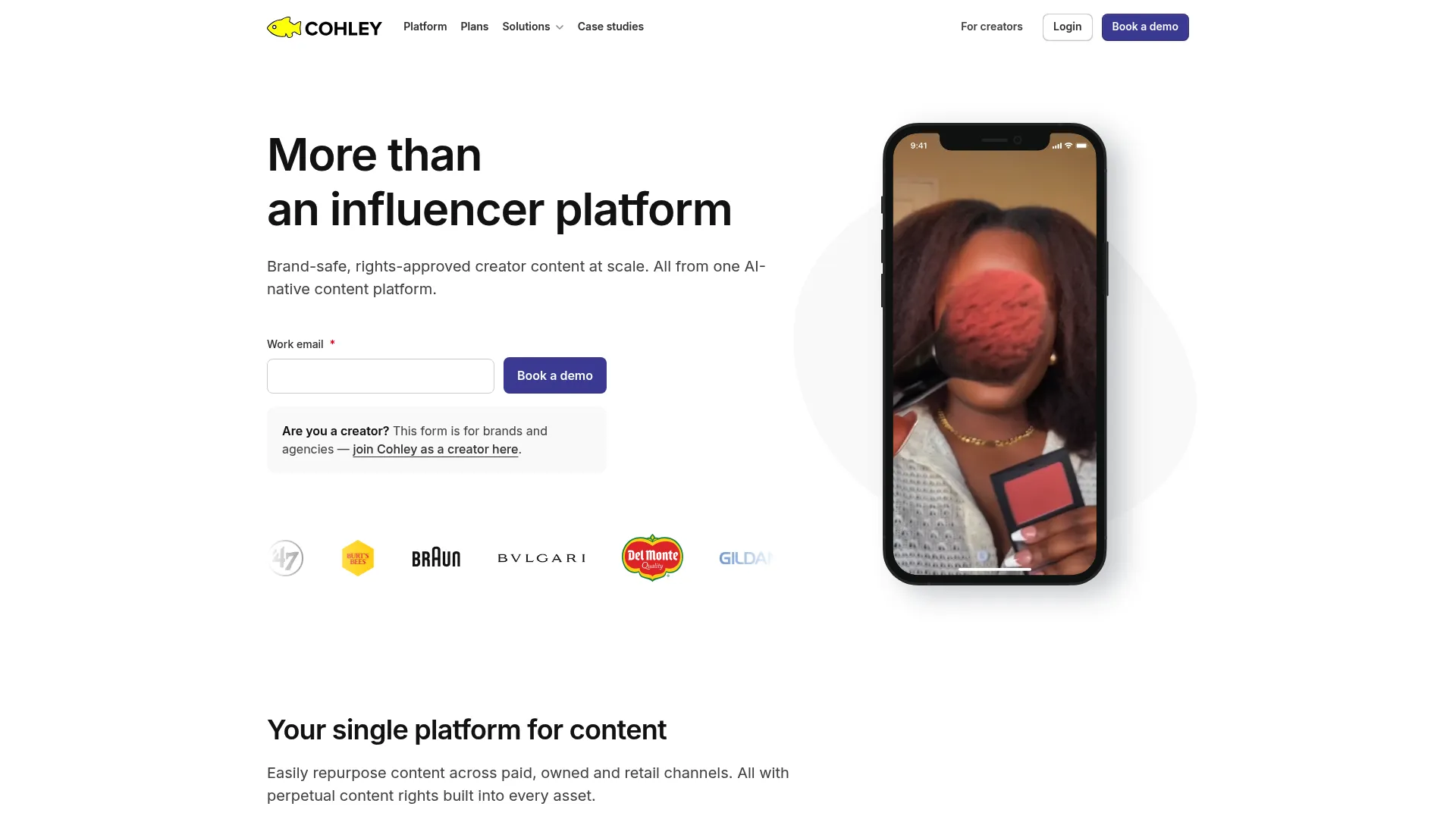
Cohley is an AI-native creator content platform that helps brands generate UGC, influencer content, reviews, and professional photography in one place. It leans toward structured, enterprise-minded workflows, which makes it a strong fit when content governance and rights clarity matter as much as output. Teams use it to run creator campaigns from sourcing through licensing without stitching together separate tools.
Best for: Enterprise brands that need managed or self-serve creator content at scale with clean rights handling.
Key strengths
- UGC video and photography: Source creator-made video and product photography from a single platform.
- Influencer and product seeding: Run gifting and influencer partnerships alongside UGC campaigns.
- Perpetual content rights: Lock down reviews and content with perpetual usage rights you can reuse freely.
Why choose Cohley: If you are a product marketer who needs proof points that hold up across launches and channels, Cohley's perpetual rights and managed services remove the licensing friction that strands good content. It fits teams that would rather operate a structured platform than coordinate creators manually.
Cohley pricing: Cohley lists Platform and Managed Services plans, both with custom pricing based on content volume. An optional three-month paid pilot is available. There is no public numeric price or free tier shown on the pricing page, so plan to scope volume with their team.
2. Trend
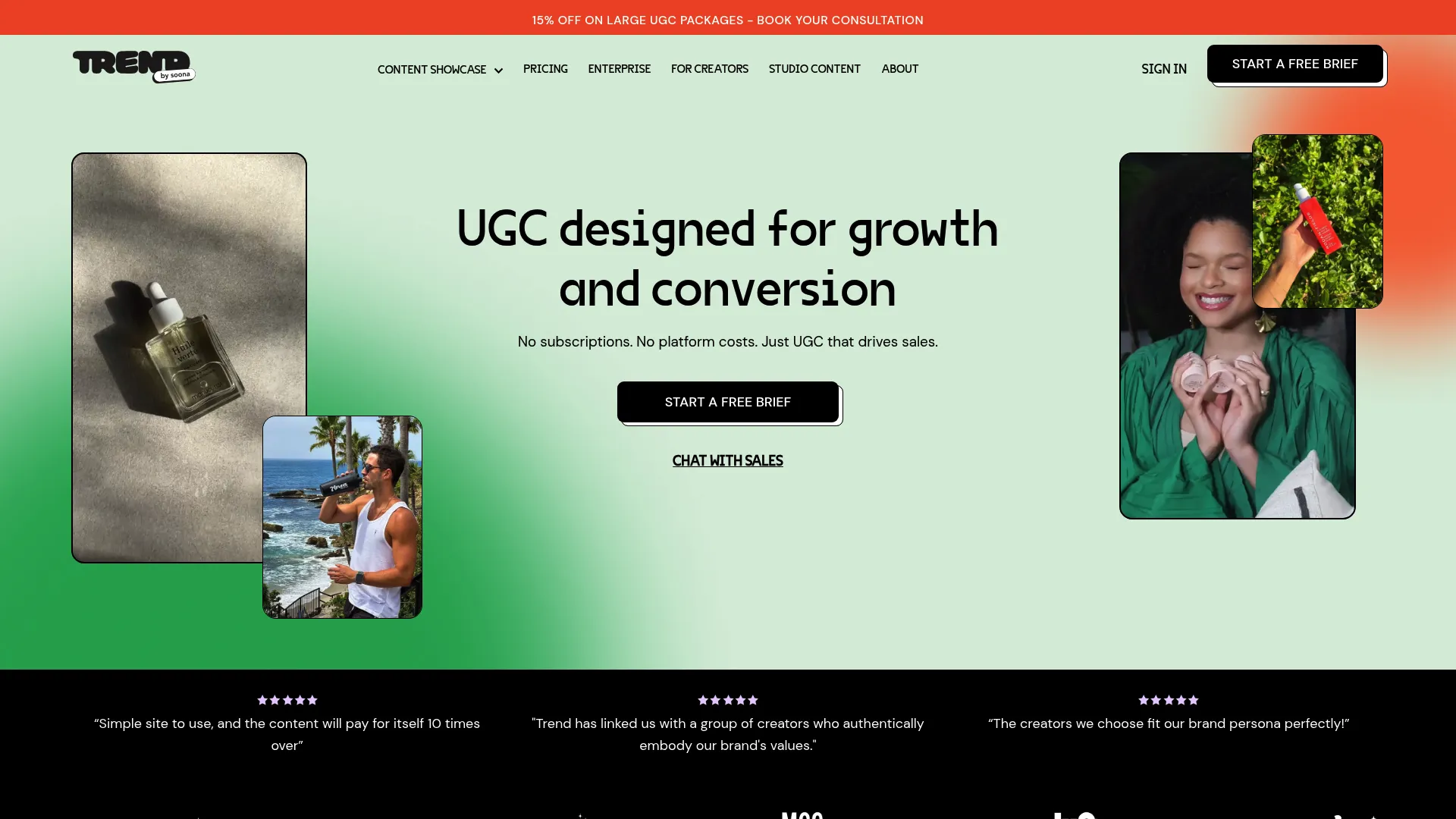
Trend is an image and video creative services platform that lets brands source UGC, product photos, and creator-made videos through curated content packs. Its model favors repeatable campaigns: you choose a pack, review applications from a diverse creator pool, and receive content with full licensing. That packaging makes budgeting and planning predictable.
Best for: Brands that need on-demand UGC, product photos, and creator-made videos without a long sourcing cycle.
Key strengths
- Unlimited project requests: Submit project requests without per-request gating inside your pack.
- Diverse creator applications: Review applications from a varied creator base before selecting.
- Full licensing and distribution rights: Receive content with full licensing and distribution rights included.
Why choose Trend: When creator quality control matters and you want a repeatable, pack-based workflow, Trend performs best. The included licensing means the content you receive is ready to deploy across channels without a separate rights negotiation.
Trend pricing: Trend uses content-pack pricing rather than a subscription. Packs start with Starter at $550, then Essential at $1,045, Growth at $1,980, and Scale at $3,872, each billed as a one-time content pack. Creator credits are noted at $9.16 each. There is no free tier.
3. Influee
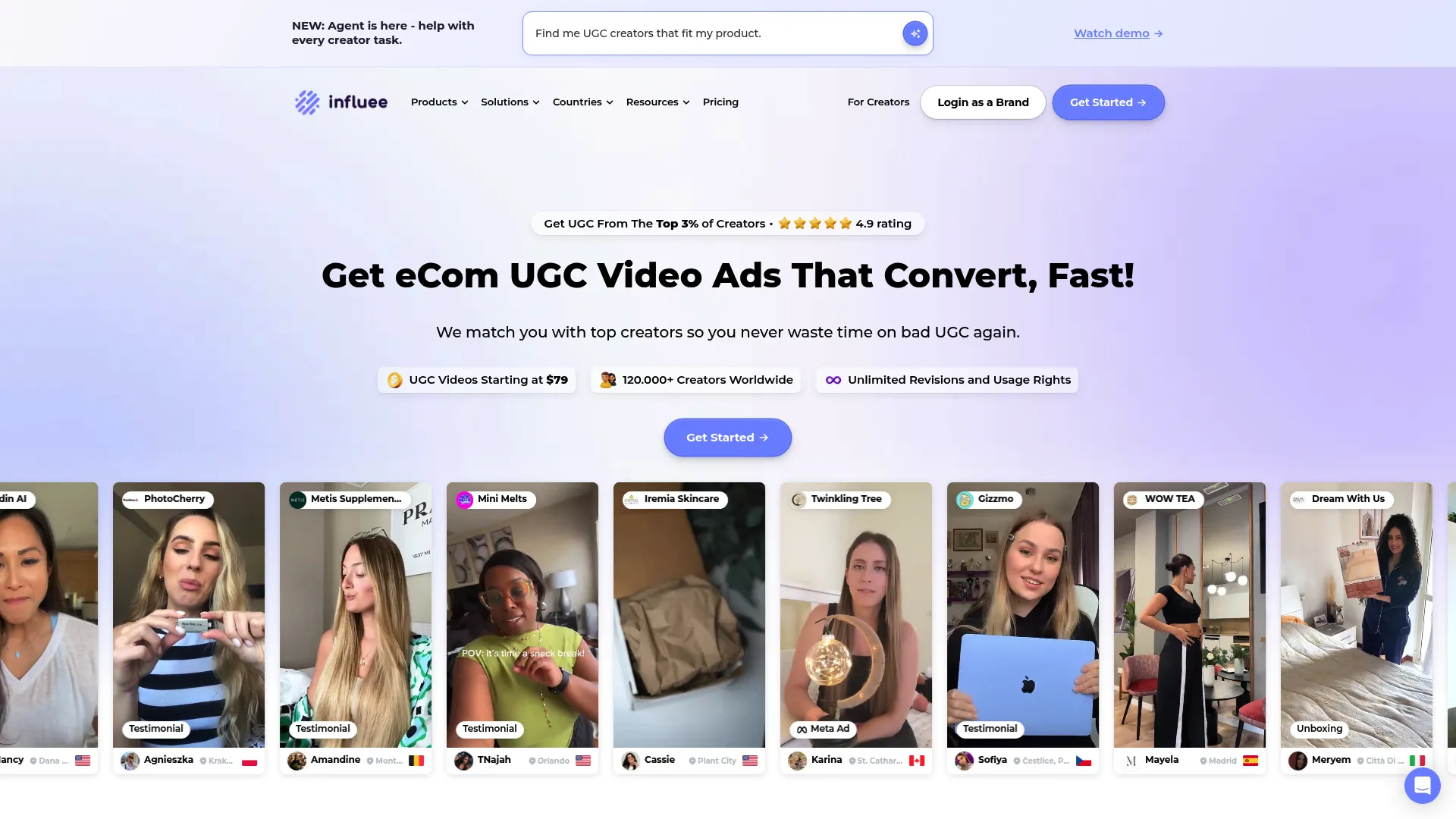
Influee is a UGC creator marketplace and campaign platform built for speed and volume. With more than 120,000 vetted creators worldwide, it suits teams that need a steady stream of authentic content and the workflow tools to run creator campaigns end to end. Unlimited revisions with final approval keep output on-brand without slowing delivery.
Best for: Brands that need on-demand UGC creators plus workflow tools to run creator campaigns at scale.
Key strengths
- 120,000+ vetted creators: Tap a large global pool of pre-vetted creators across niches.
- Usage rights included: Content usage rights come included so reuse is straightforward.
- Unlimited revisions: Request unlimited revisions with final approval before you accept content.
Why choose Influee: If your priority is creator volume and fast turnaround for paid social, Influee excels. The included usage rights and revision workflow mean you can move from brief to ad-ready asset without the licensing and quality back-and-forth that usually slows scaled production.
Influee pricing: Influee runs a month-to-month subscription with separate creator payments. Starter is $229/month, Basic is $529/month, Pro is $849/month, and Enterprise is tailored. There is no free tier.
4. Archive
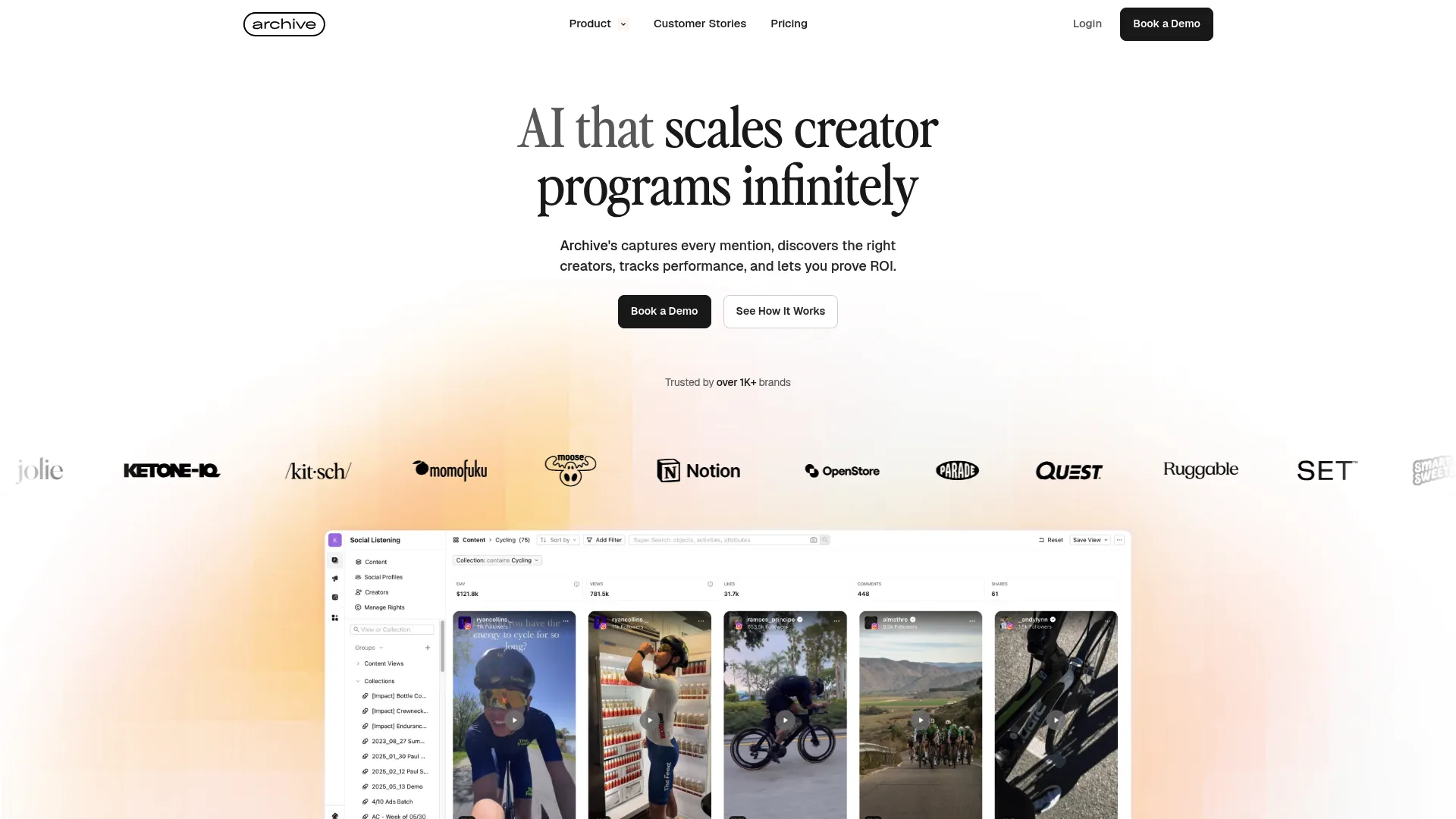
Archive is a creator marketing and UGC capture platform focused on tracking, organizing, and analyzing brand content. Its standout is detection: Archive Radar surfaces brand content even when creators do not tag or mention you, which makes it a practical option for teams that want to capture and reuse organic UGC they would otherwise miss.
Best for: Brands and agencies managing creator content, UGC, and social listening in one place.
Key strengths
- Archive Radar: Detect brand content even without tags or mentions.
- Smart AI Fields: Auto-tag captured posts with attributes like product, campaign, and sentiment.
- Social listening and reports: Monitor and report on UGC and creator content in one view.
Why choose Archive: For teams that want simpler UGC operations centered on capturing and organizing what creators already post, Archive fits well. The auto-tagging and detection reduce the manual sorting that usually buries good organic content.
Archive pricing: Archive's help center describes a 2026 credit-based model with Startup, Growth, Enterprise, and Agency plans. No public numeric prices were visible on its pages, so scope pricing directly with their team.
5. Aspire
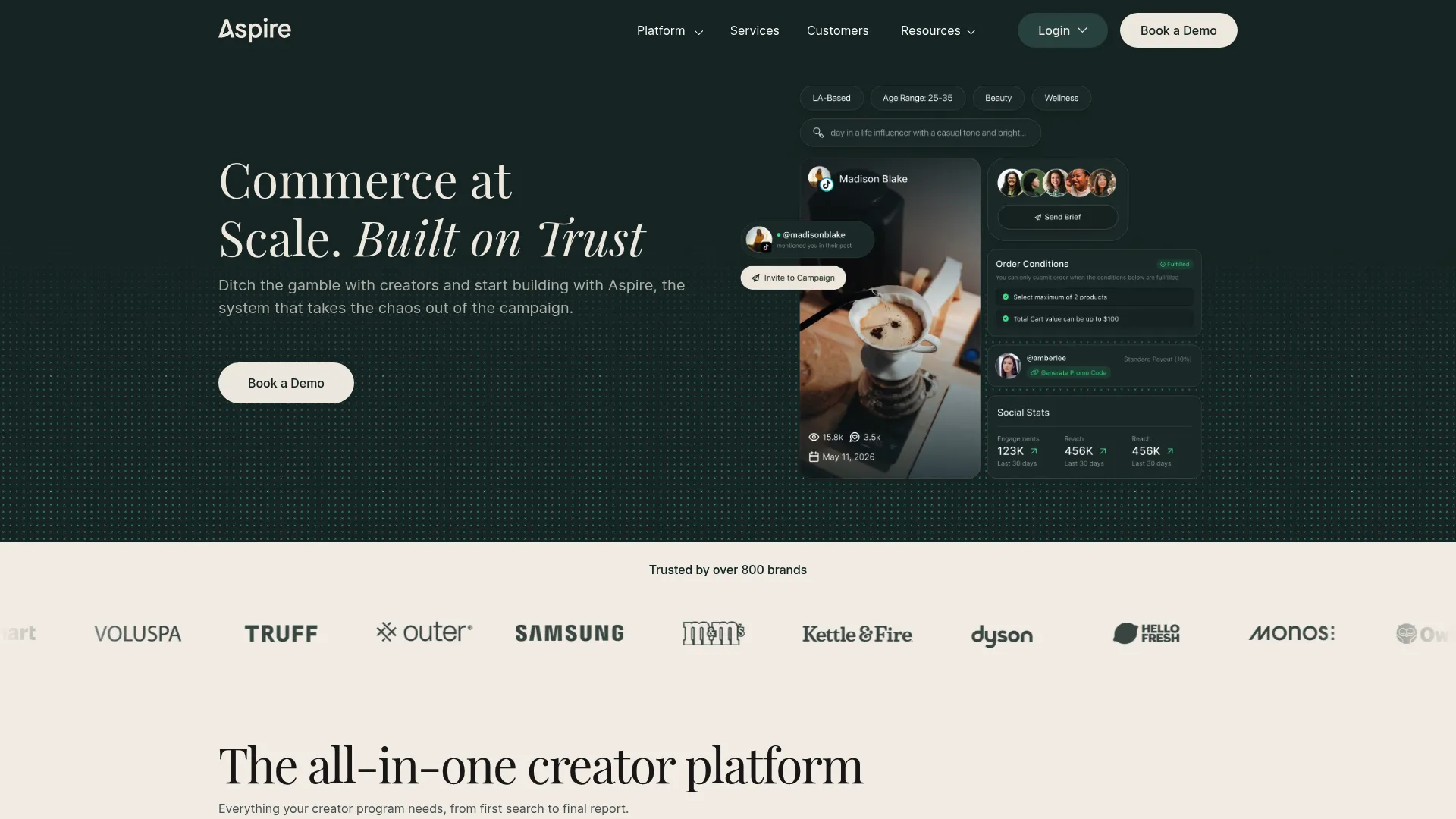
Aspire is influencer marketing software that helps brands discover creators, manage campaigns, measure ROI, and run related programs. It sits at the intersection of influencer and UGC work, which makes it useful for larger creator marketing programs where relationships and content reuse run side by side.
Best for: Brands running influencer, affiliate, ambassador, or UGC programs from one platform.
Key strengths
- Influencer discovery: Find creators across social channels for campaigns and programs.
- Relationship management: Manage campaigns, affiliate programs, and product seeding in one place.
- ROI measurement: Track and report on program ROI and reporting.
Why choose Aspire: When your creator marketing spans more than UGC, including affiliate and ambassador motions, Aspire's program management depth fits. It works well for teams that want to manage creator relationships and content reuse together rather than in separate tools.
Aspire pricing: Aspire directs prospects to a demo request rather than listing public pricing. No public price, tier names, or free-tier status are published on its site, so plan to scope through their team.
6. Billo
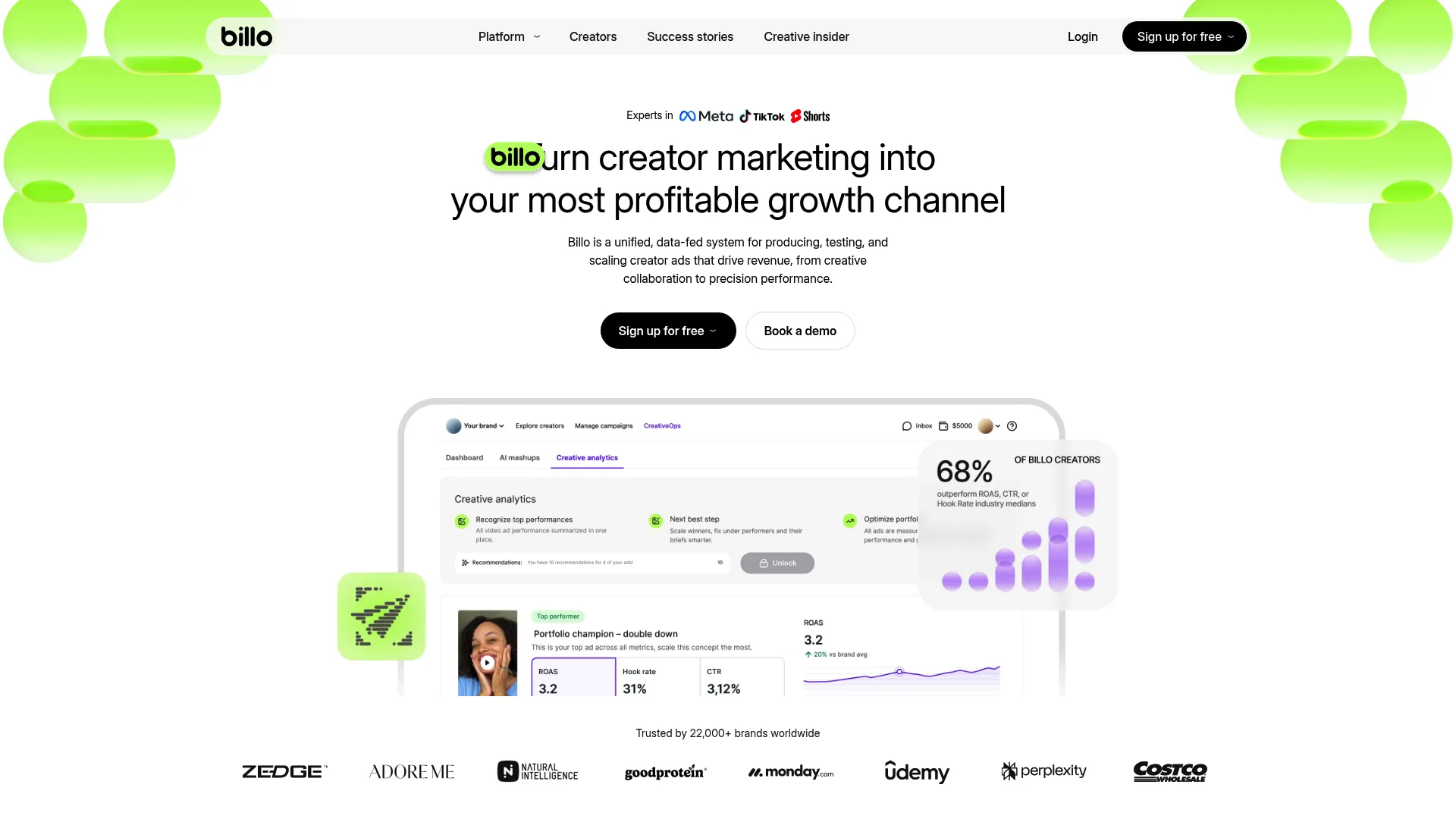
Billo is a creator marketing platform built for producing, testing, and scaling creator video ads. Speed and simplicity are its calling cards, which makes it a fit for paid social teams that need ad-ready video on a quick turnaround. Its CreativeOps layer adds script generation, creator matching, and creative analytics to the production flow.
Best for: Brands and agencies that want creator-led video ad production and performance workflows.
Key strengths
- Partnerships Hub: Run vetted creator partnerships and UGC video ads.
- CreativeOps: Generate scripts, match creators, build ad variations, and analyze creative.
- Organic and partnership posting: Support organic creator posting and partnership ads.
Why choose Billo: If your team lives in paid social and needs a fast pipeline from brief to ad-ready video, Billo's production focus fits. The creative analytics help you test variations and scale what performs rather than guessing.
Billo pricing: Billo's pricing page is gated behind a login, so public plan names and prices were not verifiable. Free sign-up language appears on the homepage. Plan to confirm pricing details directly with Billo.
7. Insense
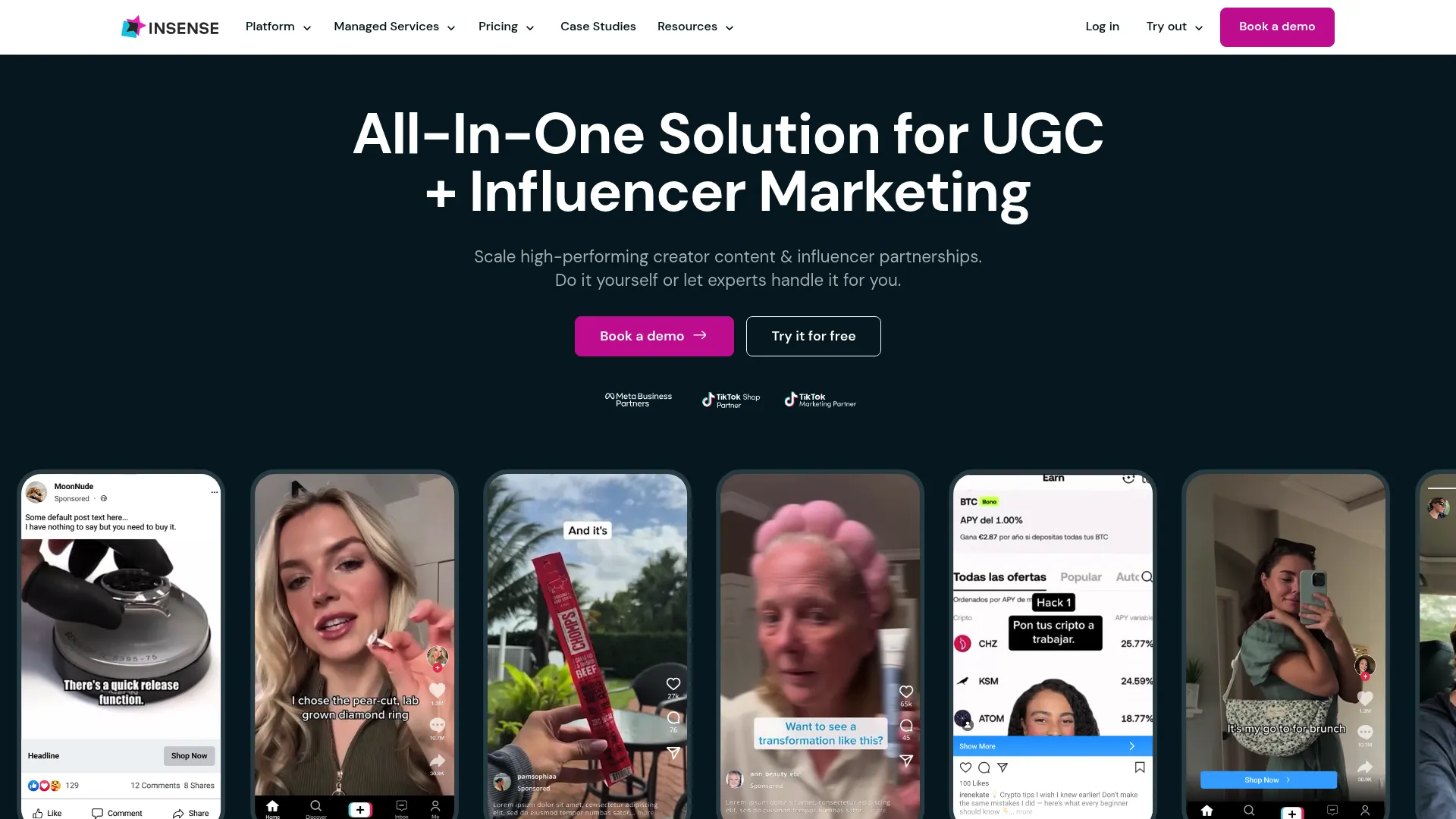
Insense is an all-in-one UGC and influencer marketing platform for brands and agencies. It combines creator sourcing, campaign management, automated contracts, payments, and creator chat in one workflow, with integrations into Meta, TikTok, Shopify, and Stripe. That makes it a strong fit for teams running recurring creator campaigns and social ad content.
Best for: Brands and agencies running UGC and influencer campaigns at scale.
Key strengths
- Campaign management: Run UGC and influencer campaigns from one workflow.
- Native integrations: Connect Meta, TikTok, Shopify, and Stripe directly.
- Automated contracts and payments: Handle contracts, payments, and creator chat in-platform.
Why choose Insense: For teams that run creator campaigns on a recurring cadence and need social ad content flowing into Meta and TikTok, Insense's automation reduces the contract and payment overhead. The integrations keep distribution close to where the content runs.
Insense pricing: Insense publishes Trial, Brand, and Agency plans. Brand is $500/month billed quarterly at $1,500, Agency is $800/month billed quarterly at $2,400, and Trial runs one month at $650. Creator payments and marketplace fees are separate. There is no free tier.
8. Skeepers
Skeepers is a UGC and customer feedback suite for collecting, managing, and activating reviews, influencer content, and customer insights. It blends verified reviews, influencer marketing, and feedback management, which makes it a fit for teams that want UGC plus review-led proof and voice-of-customer data in one stack.
Best for: Mid-market and enterprise brands needing UGC, reviews, and VoC tooling together.
Key strengths
- Verified Reviews: Collect, publish, and syndicate authentic customer reviews.
- Influencer Marketing: Run scaled gifting campaigns with creator matching.
- Feedback Management: Run NPS and CSAT surveys with VoC analytics.
Why choose Skeepers: When trust-building and ecommerce proof are the goal, Skeepers' combination of reviews, UGC, and feedback data fits. It works for brands that want authentic customer content and structured feedback insights without running separate review and survey tools.
Skeepers pricing: Public pricing was only verified through a third-party listing, which shows Verified Reviews at $99 per feature per month. The brand's own site is demo-led, so confirm exact pricing with Skeepers directly. There is no free tier shown.
9. Yotpo
Yotpo is an ecommerce retention platform for reviews, loyalty, referrals, and customer engagement. Its ratings and reviews module supports photo and video UGC, which makes it a natural fit for ecommerce teams that want customer content on product pages alongside loyalty and retention programs.
Best for: Ecommerce brands that want reviews, UGC, and loyalty in one platform.
Key strengths
- Ratings and Reviews: Collect reviews with photo and video UGC.
- Loyalty and Referrals: Run loyalty and referral programs alongside reviews.
- Flexible billing: Use usage-based billing for Yotpo Email and scale-dependent plans.
Why choose Yotpo: For ecommerce marketers focused on product-page conversion and retention, Yotpo's combination of UGC reviews and loyalty in one platform fits. The customer content sits exactly where buyers make decisions, on the product detail page.
Yotpo pricing: Yotpo offers a free Reviews plan, with Growth starting at $15/month and Prime at $119/month. Loyalty Pro starts at $199/month. Pricing is product-specific and can be scale-dependent, so some plans are quote-based.
10. Bazaarvoice
Bazaarvoice is a UGC and shopper-experience platform for brands and retailers, centered on ratings, reviews, Q&A, syndication, creator marketing, and sampling. Its syndication network and moderation depth make it a fit for larger retail and ecommerce organizations that need product-page trust at scale across many channels and retail partners.
Best for: Brands and retailers that need enterprise UGC collection, moderation, and syndication.
Key strengths
- Ratings, Reviews, and Q&A: Collect and display reviews and shopper questions.
- Syndication: Syndicate reviews and social content across retail partners.
- Creator marketing and sampling: Run creator campaigns and UGC sampling programs.
Why choose Bazaarvoice: For enterprise retail and ecommerce teams that sell across many channels, Bazaarvoice's syndication reach extends product-page trust beyond your own site. It suits organizations that need moderation and governance at scale.
Bazaarvoice pricing: Bazaarvoice offers multiple packages for enterprise and SMB and directs prospects to contact sales. No public numeric price is published, so scope pricing with their team.
11. PowerReviews
PowerReviews is a UGC platform for ratings and reviews, Q&A, product sampling, syndication, analytics, and store experience feedback. Its breadth of display options and UGC analytics make it a fit for ecommerce teams that want to collect, display, syndicate, and measure customer content with conversion in focus.
Best for: Enterprise brands and retailers that want to collect, display, syndicate, and analyze customer-generated content.
Key strengths
- Ratings, Reviews, and Q&A: Generate reviews and shopper Q&A.
- Display and analytics: Use thousands of display options with UGC analytics.
- Syndication and sampling: Syndicate UGC and run product sampling campaigns.
Why choose PowerReviews: For teams that prioritize trust-building content and want to measure its conversion impact, PowerReviews' analytics depth fits. The display flexibility lets you surface reviews and UGC across the buying journey rather than in one fixed spot.
PowerReviews pricing: No public pricing page or numeric price was found on the brand's site during research. Plan to confirm pricing directly with PowerReviews.
12. Taggbox
Taggbox is a UGC and social widgets platform for embedding social feeds, review widgets, social walls, and shoppable galleries. It makes collecting and showcasing UGC quick, which suits teams that want to display social proof on websites, product pages, or event screens without heavy build work.
Best for: Brands that want to embed UGC, reviews, and social content on websites or event screens.
Key strengths
- Social media widgets: Embed feeds from 20+ social platforms.
- Review widgets: Pull review widgets from 10+ review platforms.
- Social walls: Display social walls for events and campaigns.
Why choose Taggbox: When you want to collect and showcase UGC quickly across pages and campaigns, Taggbox's widget library fits. It works for teams that need social proof on-site fast without engineering involvement.
Taggbox pricing: Taggbox offers four monthly plans: Free at $0, Starter at $19/month, Growth at $39/month, and Advance at $99/month. Annual billing is also available on the pricing page.
13. TINT
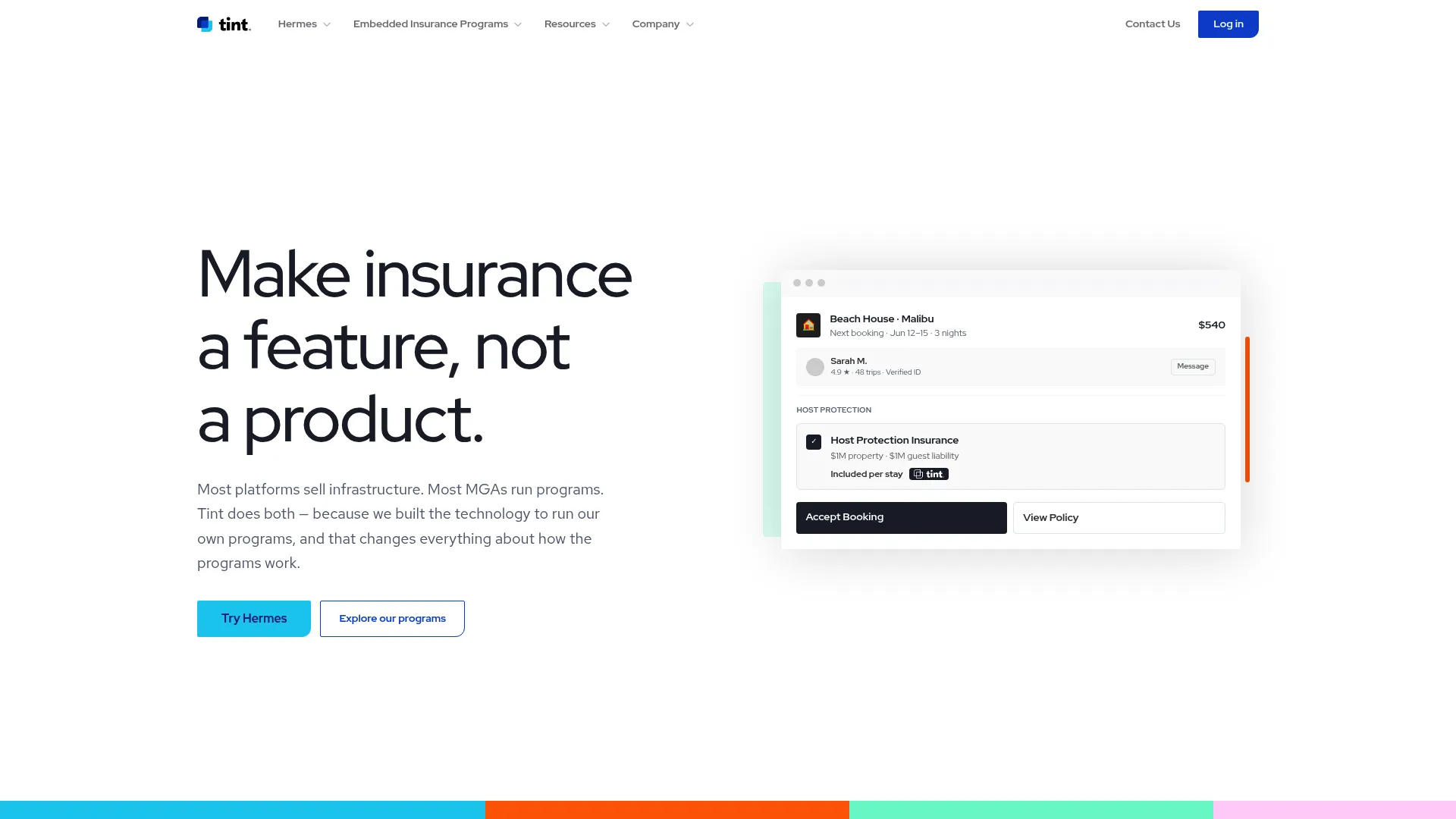
TINT is a social content and UGC experience platform focused on aggregation, rights, and branded display. It helps teams collect social content, secure rights, and showcase UGC across pages, campaigns, and brand experiences, which suits teams running social proof campaigns at scale.
Best for: Brands running social proof campaigns and branded UGC experiences at scale.
Key strengths
- Content aggregation: Pull social content into a single managed feed.
- Rights and permissions: Request and document rights on collected UGC.
- Branded display: Showcase UGC across pages, campaigns, and experiences.
Why choose TINT: For teams that want a social proof and display layer with rights handling built in, TINT fits. It works when aggregation and branded display matter more than creator sourcing, complementing platforms that handle production.
TINT pricing: No public pricing page with numeric figures was verifiable during research. The site directs prospects to contact sales, so confirm pricing with their team.
14. ShortStack
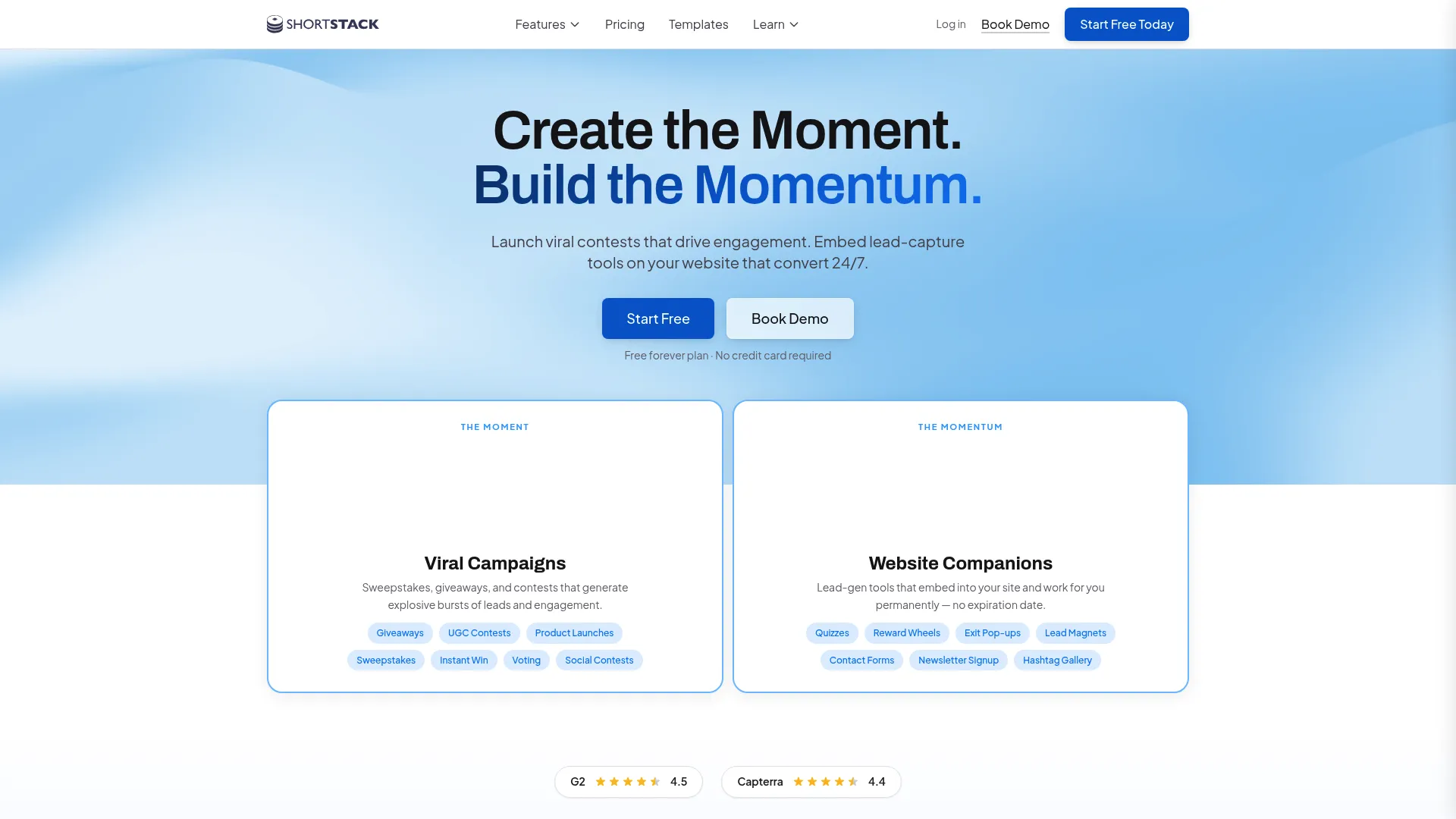
ShortStack is a campaign platform for landing pages, pop-ups, contests, quizzes, and social promotions. Its contest and submission mechanics make it useful for collecting UGC through interactive campaigns rather than passive aggregation, which fits marketers who want engagement-driven content collection.
Best for: Teams running branded contests, giveaways, and lead-gen campaigns that collect UGC.
Key strengths
- Landing pages: Build unlimited landing pages across plans.
- Pop-ups and forms: Run pop-ups and forms for capture and engagement.
- Contests and sweepstakes: Run contests and sweepstakes to collect submissions.
Why choose ShortStack: When you want interactive collection mechanics, like contests and submission forms, ShortStack fits. It suits marketers who would rather invite UGC through campaigns than aggregate existing posts.
ShortStack pricing: ShortStack offers a Free plan, then Launch at $24/month, Build at $49/month, Scale at $99/month, and Max at $166/month, available monthly or annually. All plans include unlimited landing pages, pop-ups, and forms.
15. CrowdRiff
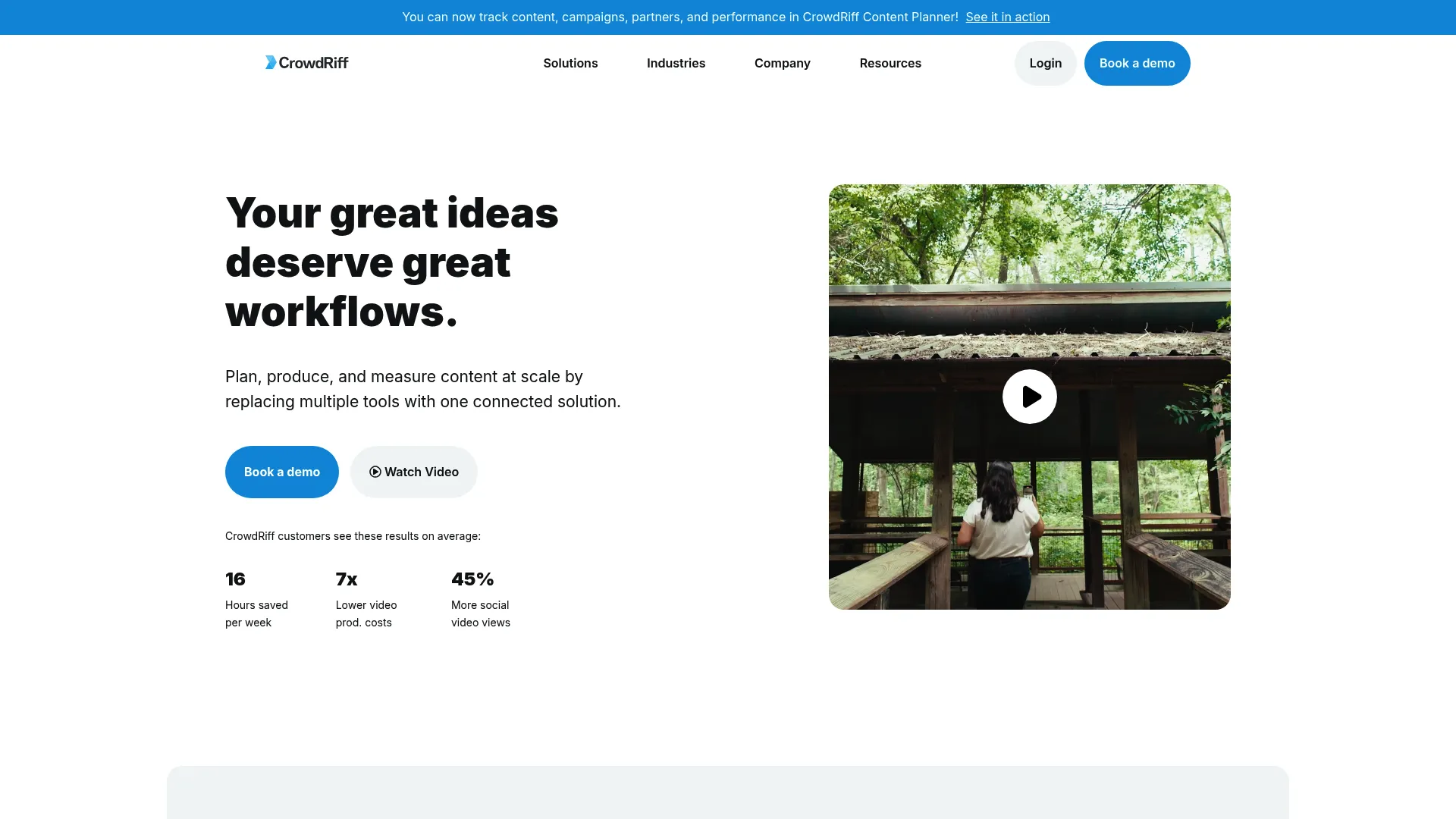
CrowdRiff is visual marketing software for destination marketers, combining UGC, digital asset management, creator video, and planning workflows. Its visual-content focus and rights handling make it a fit for travel, hospitality, and experience-driven brands that depend on rich imagery and need to reuse it across campaigns.
Best for: Destination marketing teams needing visual content sourcing, asset management, and creator video workflows.
Key strengths
- UGC sourcing and publishing: Source and publish user-generated visual content.
- Digital asset management: Manage media in a central hub.
- Creator video and planning: Produce short-form creator video and plan content with performance tracking.
Why choose CrowdRiff: For visually rich industries like travel and hospitality, CrowdRiff's mix of UGC sourcing and DAM fits. It works for teams that need both authentic visual content and a system to organize and reuse it across campaigns.
CrowdRiff pricing: CrowdRiff Creators publishes Trial at $2,500/project, Flex at $8,000/project, Essential at $1,875/month, and Standard at $3,000/month, with Essential and Standard billed annually in USD. The core platform's pricing is not publicly listed.
How to choose the right UGC platform
The shortlist narrows fast once you anchor on your actual content demand, workflow complexity, rights needs, and distribution goals. Walk through these four lenses with your stakeholders.
Choose based on your content mix
Your dominant format should drive the decision. Video-heavy teams running paid social need creator production depth; review-heavy ecommerce teams need ratings and syndication; photo-heavy brands need visual sourcing and asset management.
- Video-first: Influee, Billo, and Insense lean into creator video.
- Review-first: Yotpo, Bazaarvoice, and PowerReviews anchor product-page trust.
- Photo and visual: Trend and CrowdRiff fit visual-heavy programs.
Match the tool to where your content demand actually concentrates, not to the broadest feature list.
Choose based on workflow complexity
Simpler tools work when one or two people own UGC end to end. Collaborative approvals matter more when launch work routes through product, brand, and legal before anything ships.
- Lean teams: aggregation and widget tools like Taggbox keep things light.
- Multi-stakeholder launches: platforms with structured briefs and approval flows, like Cohley and Insense, reduce the back-and-forth.
Tie tool complexity to your team's actual review reality, not an aspirational one.
Choose based on rights and compliance needs
If you reuse content across paid, organic, and product pages, licensing clarity is non-negotiable. The legal comfort of knowing exactly what you can run, where, and for how long is worth real money in avoided risk.
- Prioritize perpetual or clearly documented rights, like Cohley's perpetual model or Trend's included licensing.
- Confirm renewal and expiration tracking so reuse never strands.
Choose based on distribution goals
Where the content ships should shape your shortlist. Paid social, ecommerce product pages, partner pages, and landing pages each favor different platforms.
- Paid social ads: Billo, Influee, and Insense connect to ad platforms.
- Product pages and PDPs: Yotpo, Bazaarvoice, and PowerReviews.
- On-site social proof: Taggbox and TINT.
Pick by your channel mix, and the integration requirements sort themselves out.
Conclusion
The best UGC platform is the one that matches your creator workflow, your rights handling, and your distribution needs, not the one with the longest feature list. If you need managed creator content with clean rights, Cohley fits. For curated quality on demand, Trend's content packs deliver. For speed and creator volume, Influee scales. For ecommerce reviews and product-page trust, Yotpo, Bazaarvoice, and PowerReviews anchor the category. And for embedding social proof, Taggbox and TINT handle aggregation and display.
Start by naming your dominant content format and your hardest rights constraint. Those two answers eliminate most of the list and point you toward a focused shortlist worth a demo. The credibility you build with authentic creator content compounds across every launch, every product page, and every campaign, so choosing infrastructure that scales with you matters more than chasing the cheapest entry tier.
If your team also needs to show the product itself, not just customer content, pairing UGC with interactive product experiences gives buyers both authentic proof and a hands-on feel before they ever talk to sales.
FAQs
A UGC platform is software that helps brands source, license, manage, and reuse content created by everyday creators and customers, including photos, videos, testimonials, and reviews. It replaces one-off creator outreach with a repeatable system. The goal is to turn authentic content into marketing assets you can deploy across paid, organic, and product-page channels.
Most platforms follow a similar flow: you discover and brief creators, they produce content, you review and approve assets, and the platform handles usage rights and licensing. From there, you push content into your channels, whether that is paid social, product pages, or email. Analytics then show which assets actually drive engagement and conversion.
Focus on creator network quality and fit, content format variety, rights management, workflow depth, and distribution integrations. The right balance depends on your content mix and how many stakeholders approve launch assets. For product marketers, defensible rights and reusable proof points usually matter most.
For most ecommerce brands, yes. Customer reviews and UGC on product pages directly influence buying decisions, and ads with UGC generate 73% more positive feedback than traditional ads, per Market.us (2024). Platforms like Yotpo, Bazaarvoice, and PowerReviews are built specifically to put that content where shoppers convert.
Platforms document creator consent and licensing terms up front, so you know what you can use, where, and for how long. Some offer perpetual rights, while others license for a set window with renewal tracking. This documentation is what lets you safely reuse one asset across an ad, a product page, and a launch deck without legal risk.
A UGC platform focuses on sourcing authentic content you own and reuse, often from everyday creators rather than large audiences. An influencer platform focuses on creators with reach, where the value is their audience as much as the content. Many tools, like Aspire and Insense, blend both, but the core distinction is content ownership versus audience access.
For creator video at speed and scale, Influee, Billo, and Insense are strong picks, since they focus on production workflows and ad-ready output. These are among the top UGC video platforms for generating authentic customer stories that run well on paid social. Confirm that included usage rights cover your intended ad channels before you commit.
For creator sourcing and end-to-end campaign management, Influee, Insense, Cohley, and Aspire stand out. They combine large or vetted creator pools with briefing, approvals, contracts, and rights handling in one workflow. The best fit depends on whether you also need influencer relationships, review collection, or pure UGC production.