You can survive the first wave of fraud with spreadsheets, manual review queues, and a few Stripe rules. That stops working fast.
At Series B, fraud prevention stops being an ops problem and starts being a board problem. INTERPOL estimated global financial fraud losses reached $442 billion in 2025. Your investors are asking about payment approval rates, false positive ratios, and whether your onboarding controls are audit-ready. The answers matter before the next fundraise, not after.
The real problem is not catching fraud in hindsight. It is making real-time risk decisions across onboarding, account activity, and payments without a system that blocks good customers or buries your analysts in noise. Financial fraud prevention software is the infrastructure layer that handles those decisions at scale, so your team is not the bottleneck.
This guide compares 15 of the most credible fraud detection platforms across fintech, banking, identity verification, and compliance workflows.
What's inside
This guide is for founders, VPs of Risk, and Finance or Operations leads evaluating fraud prevention infrastructure. Tools were selected based on:
- Real-time fraud detection and decisioning capability
- Coverage across onboarding, payments, account activity, and AML software workflows
- Fit for banks, fintechs, marketplaces, and SaaS platforms with embedded payments
- Analyst workflow depth: Case management, alert queues, and false-positive controls
- Pricing transparency and verified G2 ratings where available
TL;DR
- Best overall for fintech and embedded finance: Sardine
- Best for community banks and credit unions: Abrigo
- Best for fraud plus AML convergence: ComplyAdvantage
- Best for enterprise transaction monitoring: Featurespace or Feedzai
- Best for identity-first onboarding risk: Persona, Onfido (now Entrust IDV), Sumsub, Trulioo, Veriff, or Incode
- Best for configurable risk operations: Unit21 or Oscilar
- Best transparent entry pricing: SEON starts at $699/month; Veriff starts at $0.80 per verification; Sumsub starts at $1.35 per verification
What is financial fraud prevention software?
Financial fraud prevention software helps organizations detect, prevent, investigate, and respond to fraudulent financial activity across onboarding, account access, payments, transactions, and compliance workflows.
It is broader than fraud detection alone. Detection identifies suspicious events. Prevention adds the decisioning layer: Blocking a transaction, routing a user to step-up verification, flagging an account for analyst review, or closing a case with an audit trail.
Core capability groups:
- Real-time transaction monitoring: Flags suspicious activity across payment rails and account events as they happen
- Identity verification: Validates users, documents, businesses, devices, and risk signals at the point of onboarding
- Behavioral analytics: Spots unusual patterns across sessions, devices, transactions, and user actions
- Rules and machine learning: Combines configurable logic with adaptive detection models
- Risk scoring: Assigns a decision score to users, transactions, accounts, or specific events
- Case management: Routes alerts to analysts with supporting evidence, notes, queues, and audit trails
- AML integration: Connects fraud signals to sanctions screening, watchlists, transaction monitoring, and suspicious activity reporting workflows
Key distinction: Fraud prevention software sits upstream of investigation. The goal is to stop loss before it compounds, reduce manual review volume, and generate the signal your compliance team needs without slowing down legitimate customers.
Modern platforms combine several of these capabilities in a single risk layer. That matters for founders building toward an audit or a Series C due diligence process, where stitched-together tooling becomes a liability.
You can also check our guide to best identity verification software for a focused comparison of standalone identity tools.
When to use financial fraud prevention software
Stop manual review from becoming a headcount problem
Spreadsheets and ad hoc rules hold up for a few hundred transactions a week. At thousands of transactions daily, manual review becomes a full department. Fraud prevention software automates the scoring and routing decisions, so analysts handle exceptions rather than every flag.
Reduce fraud without blocking good users
False positives are a revenue problem, not just a risk-team annoyance. A good customer declined at payment is a churned customer. The right fraud detection platform tunes approval rates alongside block rates, so you protect revenue on both sides of the decision.
Connect fraud, identity, and compliance into one workflow
Companies at Series B often have separate tools for KYC, AML monitoring, payment risk, and investigation. Those silos create blind spots where a fraudster passes each check individually but would fail a combined signal. A converged fraud platform closes that gap and gives your new VP of Risk a system that actually talks to itself.
Financial fraud prevention software comparison
The 15 tools below cover the full range of fraud detection use cases: Payment fraud, onboarding identity risk, AML-connected workflows, enterprise transaction monitoring, and configurable risk operations. Use this table to shortlist by buyer type, then read the detailed entries for the tools that match your fraud moment.
| # | Product | Best for | Key differentiator | Pricing | G2 rating |
|---|---|---|---|---|---|
| 1 | Sardine | Fintechs and embedded finance | Fraud, AML, and identity in one risk layer | Custom pricing | 4.8/5 |
| 2 | Abrigo | Community banks and credit unions | BSA, AML, and fraud aligned to banking workflows | Custom pricing | 4.6/5 |
| 3 | ComplyAdvantage | AML-connected fraud operations | Starts at $99/month; enterprise POA | Essentials from $99/mo | 4.3/5 |
| 4 | Featurespace | High-volume enterprise fraud | Adaptive behavioral analytics at scale | Custom pricing | N/A |
| 5 | Feedzai | Bank and fintech RiskOps | AI-powered RiskOps platform | Custom pricing | N/A |
| 6 | Hawk:AI | AI-assisted AML and fraud monitoring | Explainable AI with low alert noise | Custom pricing | N/A |
| 7 | Onfido (Entrust IDV) | Identity-first onboarding fraud | Document and biometric fraud detection | Custom pricing | 4.4/5 |
| 8 | SEON | Digital-first fraud prevention | Transparent pricing; email, phone, and device signals | From $699/mo | 4.6/5 |
| 9 | Unit21 | No-code risk and AML operations | Configurable rules without engineering queues | Custom pricing | 4.6/5 |
| 10 | Persona | Flexible identity infrastructure | Configurable KYC, KYB, and risk orchestration | From $250/mo | N/A |
| 11 | Sumsub | Global KYC and KYB compliance | Per-verification pricing; global coverage | From $1.35/verification | 4.6/5 |
| 12 | Trulioo | Global identity breadth | Person and business verification at global scale | Custom pricing | 4.4/5 |
| 13 | Veriff | Conversion-focused identity verification | Self-serve per-verification pricing | From $0.80/verification | 4.5/5 |
| 14 | Incode | Biometric-first enterprise identity | No-code workflow builder with deepfake detection | Custom pricing | 5.0/5 |
| 15 | Oscilar | Agentic risk decisioning across the lifecycle | 160+ integrations with AI agent hub | Custom pricing | 4.8/5 |
Best 15 financial fraud prevention software tools for 2026
1. Sardine
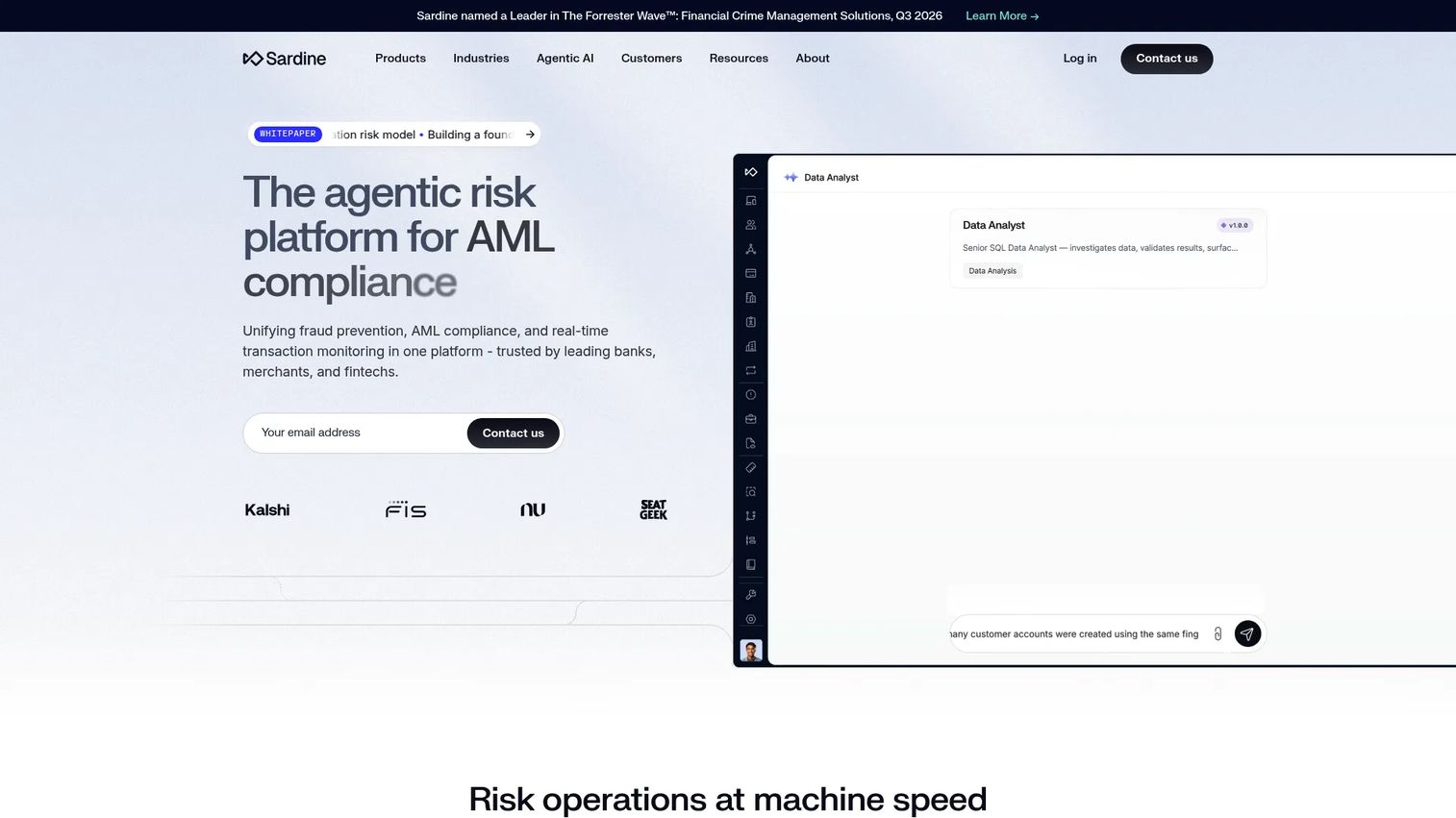
Sardine positions itself as an agentic financial crime platform, unifying fraud prevention, AML compliance, and real-time transaction monitoring in a single risk layer. It covers device intelligence, behavioral biometrics, global identity verification, payment fraud detection, and AI-assisted case management, targeting fintechs, neobanks, crypto platforms, and embedded finance teams.
Best for: Banks, fintechs, merchants, and financial businesses that need fraud, identity, and AML signals inside one risk workflow rather than stitched together across vendors.
Key features
- Device intelligence and behavioral biometrics
- Global KYC, KYB, and bank account verification
- Real-time payment and transaction fraud prevention
- Transaction monitoring, sanctions screening, and customer risk rating
- AI agents for fraud and AML case operations
Why choose Sardine: The core argument for Sardine is convergence. If your fraud loss points span onboarding, payments, and AML reporting, running them through one platform reduces the gap where fraudsters move between signal layers. It is a strong fit for companies scaling through regulated or high-velocity payment markets.
Sardine pricing: Sardine prices by quote. Contact sales for a proposal tied to products, transaction volume, and risk modules.
G2 rating: 4.8/5
2. Abrigo
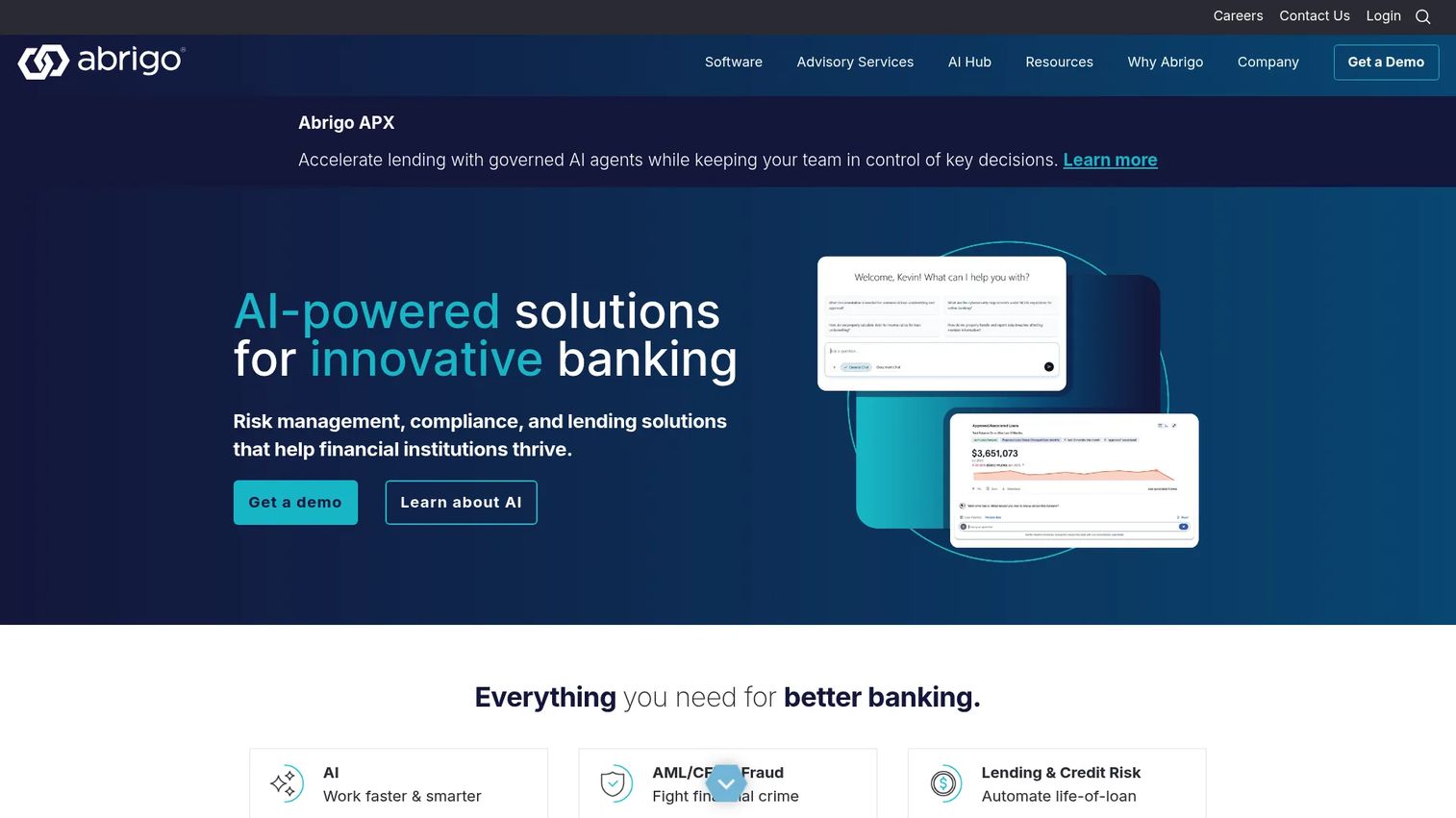
Abrigo provides AI-powered lending, credit risk, financial crime prevention, and banking analytics software built specifically for financial institutions. Its fraud detection module covers check fraud, ACH and wire monitoring, debit card fraud, new-account fraud, and investigation workflows, all integrated with BSA and AML operations.
Best for: Community banks and credit unions that need fraud detection aligned to BSA, AML, and regulatory examination workflows.
Key features
- Check fraud, ACH, and wire transaction monitoring
- Debit card and new-account fraud detection
- Explainable machine learning alongside configurable rules
- Alert management and investigation workflows
- BSA and AML compliance integration
Why choose Abrigo: Abrigo's strength is depth in the regulated banking environment. Its fraud tools are built to coexist with the BSA workflows, examination documentation, and compliance reporting that community banks and credit unions face. If your institution needs fraud detection that also satisfies your next exam, Abrigo is a natural fit.
Abrigo pricing: Pricing requires a sales conversation and is typically quoted by institution size, modules selected, and implementation scope.
G2 rating: 4.6/5
3. ComplyAdvantage
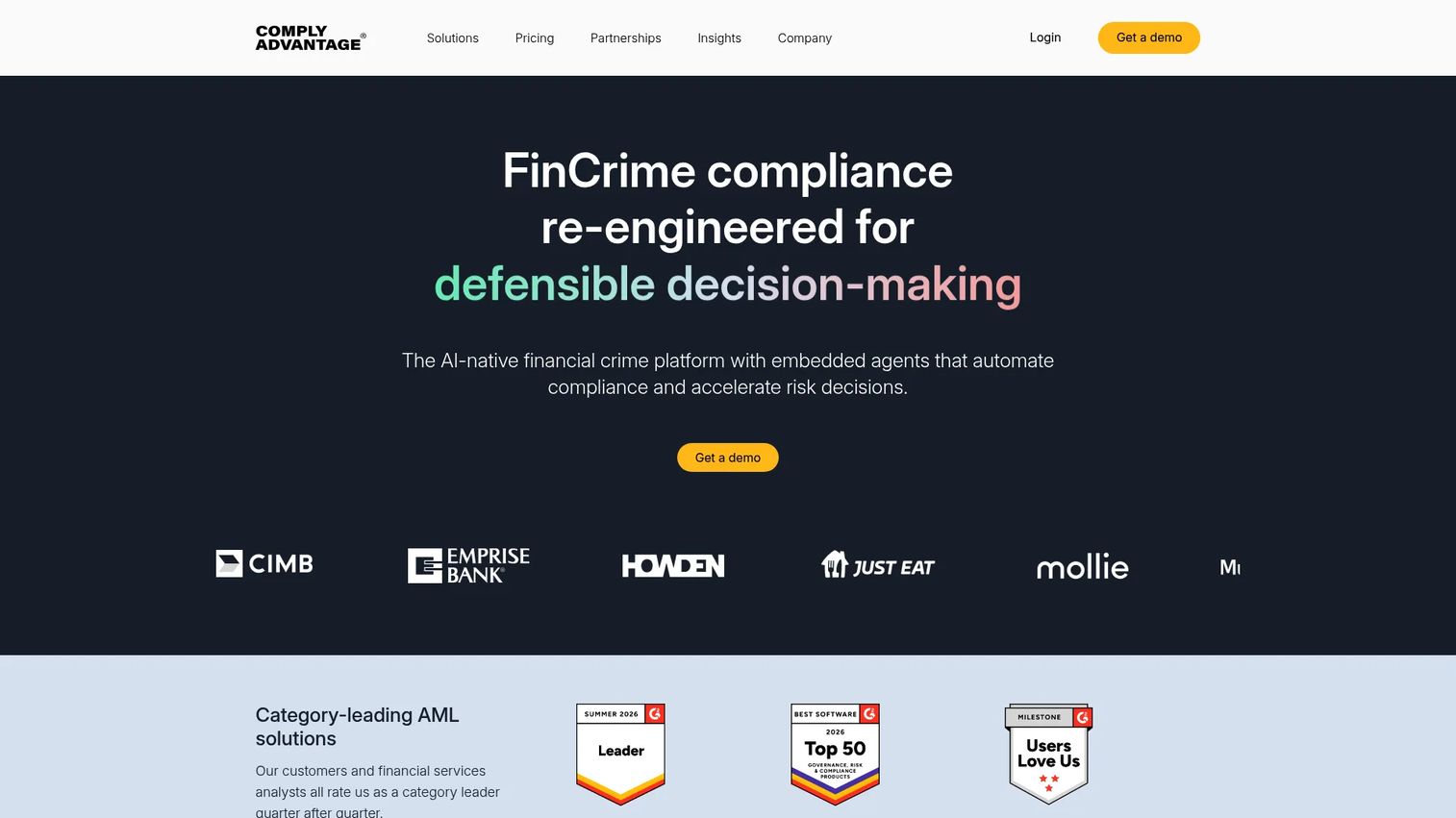
ComplyAdvantage provides financial crime compliance software covering customer screening, transaction monitoring, sanctions and watchlist screening, adverse media, and agentic workflows. It is built for fintechs and financial institutions that want fraud and AML risk handled in a single operating model rather than separate vendor relationships.
Best for: Fintechs and financial institutions that need fraud prevention and AML risk aligned under one workflow, with public entry-level pricing for smaller teams.
Key features
- Customer and company screening against sanctions, PEPs, and adverse media
- Ongoing monitoring with automated alert workflows
- Transaction monitoring and payments screening
- Graph analytics and identity clustering
- Agentic workflow support for analyst operations
Why choose ComplyAdvantage: The case for ComplyAdvantage is convergence between fraud and compliance. Teams that separate fraud detection from AML monitoring create gaps where high-risk customers pass both reviews individually. ComplyAdvantage is also one of the few financial crime platforms with published self-serve pricing, which matters if you want to start small and scale.
ComplyAdvantage pricing: The Essentials Starter Plan begins at $99/month with annual billing (up to 2,000 entities). The Agentic Starter Plan begins at $149/month. Enterprise is priced by proposal.
G2 rating: 4.3/5
4. Featurespace
Featurespace is an AI-native fraud detection and financial crime management platform built for large-scale financial institutions. Its core technology, Adaptive Behavioral Analytics, models individual customer behavior to detect anomalies in real time, covering payment fraud, card fraud, merchant acquiring, check fraud, application fraud, and AML.
Best for: Large banks, payment processors, and enterprises with high-volume transaction streams where behavioral modeling at the individual level matters.
Key features
- Adaptive Behavioral Analytics modeling individual customer behavior
- Real-time transaction monitoring and risk scoring across payment rails
- Payment, card, merchant acquiring, check, and application fraud detection
- Anomaly detection with false-positive reduction controls
- Cloud or on-premise deployment with multi-tenancy support
Why choose Featurespace: The differentiator is the behavioral modeling approach. Rather than scoring transactions against population averages, it models each customer individually, which reduces false positives significantly at high transaction volumes. If payment fraud at scale is your core problem, Featurespace is worth a detailed evaluation.
Featurespace pricing: Contact sales for a proposal.
5. Feedzai

Feedzai is an AI-powered RiskOps platform for detecting and preventing fraud and financial crime across banking and fintech. It covers real-time transaction fraud, AML monitoring, scam detection, account opening risk, and case management, with AI and machine learning at the core of its decisioning layer.
Best for: Banks, fintechs, and payment providers that need a mature enterprise platform for consolidating fraud and financial crime operations.
Key features
- Real-time transaction fraud detection across payment rails and channels
- AML transaction monitoring and watchlist screening
- Scam detection and account opening risk assessment
- AI-powered risk decisions using behavioral, device, and network signals
- Case management for analyst investigation workflows
Why choose Feedzai: Feedzai suits organizations that want to consolidate fraud and financial crime into one risk operations model. Its platform maturity and enterprise deployment experience make it a credible choice when multiple fraud types need to be managed from a single team and tool.
Feedzai pricing: Pricing is quote-based and tailored to the organization. Contact sales through the Feedzai website.
6. Hawk:AI
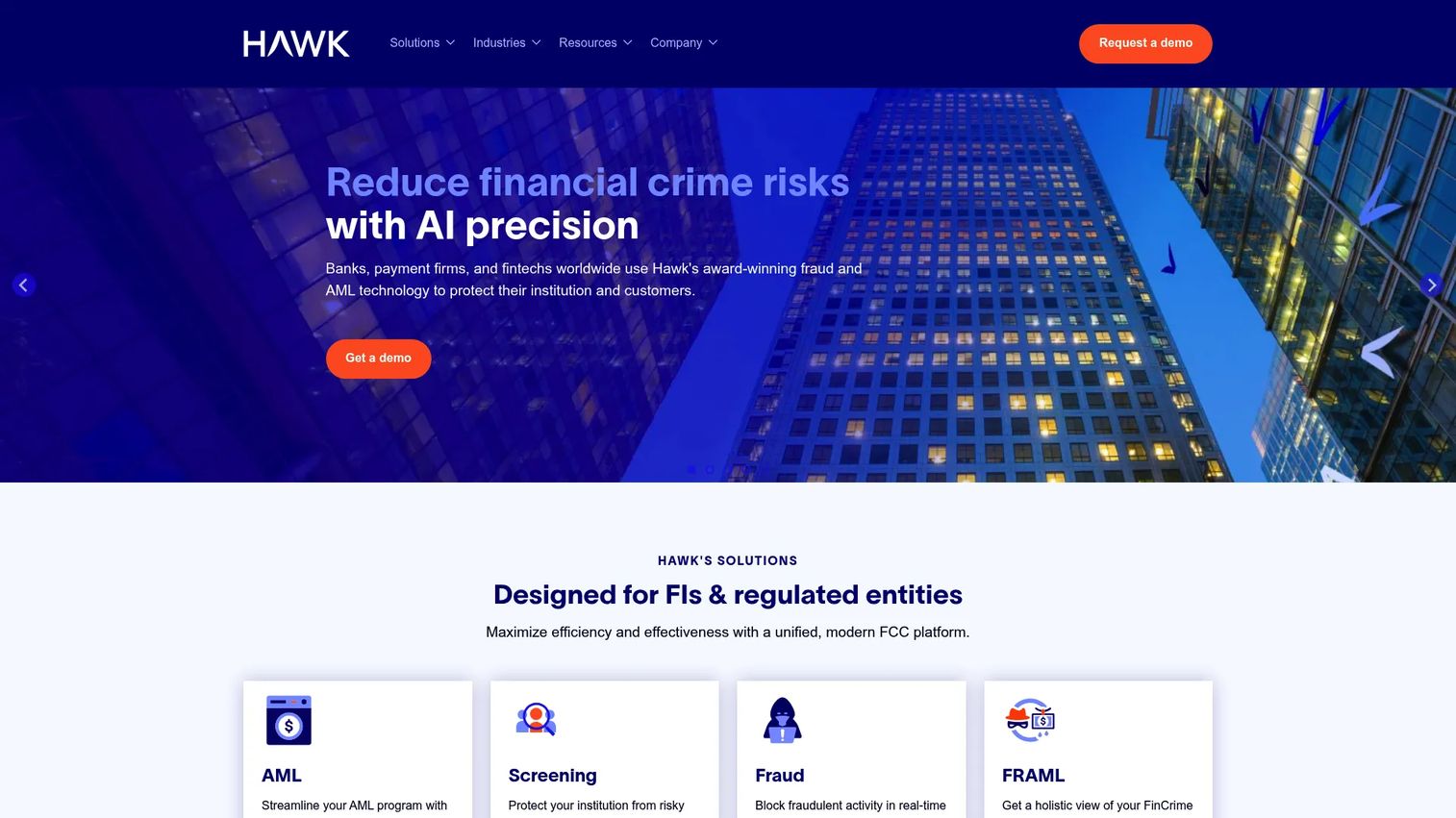
Hawk:AI provides AI-powered AML transaction monitoring, fraud prevention, sanctions and PEP screening, and financial crime compliance software for regulated financial institutions. Its explainable AI approach is designed to reduce alert noise, improve analyst efficiency, and generate documentation that holds up in regulatory review.
Best for: Banks, payment companies, and fintechs that need AI-assisted AML and fraud monitoring with lower alert volumes and better explainability for examiners.
Key features
- AI-powered AML transaction monitoring and customer risk rating
- Sanctions, PEP, adverse media, and payment screening
- Real-time transaction fraud prevention
- Unified case management, analytics studio, and regulatory reporting
- Explainable AI with self-service rule configuration and audit documentation
Why choose Hawk:AI: Alert fatigue is the real cost in financial crime operations. Hawk:AI focuses on reducing false alert rates and surfacing explainable decisions, which matters both for analyst productivity and for regulatory examination readiness. It is a strong fit when AML and fraud investigation workflows need to run on the same platform.
Hawk:AI pricing: Contact Hawk:AI for a proposal.
7. Onfido (now Entrust identity verification)

Onfido has rebranded as Entrust Identity Verification Solutions. The platform provides AI-powered identity verification for digital onboarding, covering document verification, biometric checks, deepfake detection, synthetic identity fraud signals, and KYC and AML compliance support.
Best for: Financial institutions and other organizations that need identity-first fraud prevention with strong document and biometric verification at onboarding.
Key features
- Document verification with OCR and forgery detection
- Biometric verification and passive liveness detection
- KYC and AML compliance support
- Deepfake, synthetic identity, and injection-attack detection
- Data verification for broader identity corroboration
Why choose Onfido: When onboarding fraud is the first loss point, stopping it at identity verification is cheaper than catching it downstream. Entrust IDV is a focused identity layer rather than a full transaction monitoring platform, so pair it with a transaction or AML tool if your exposure extends beyond account creation.
G2 rating: 4.4/5
8. SEON
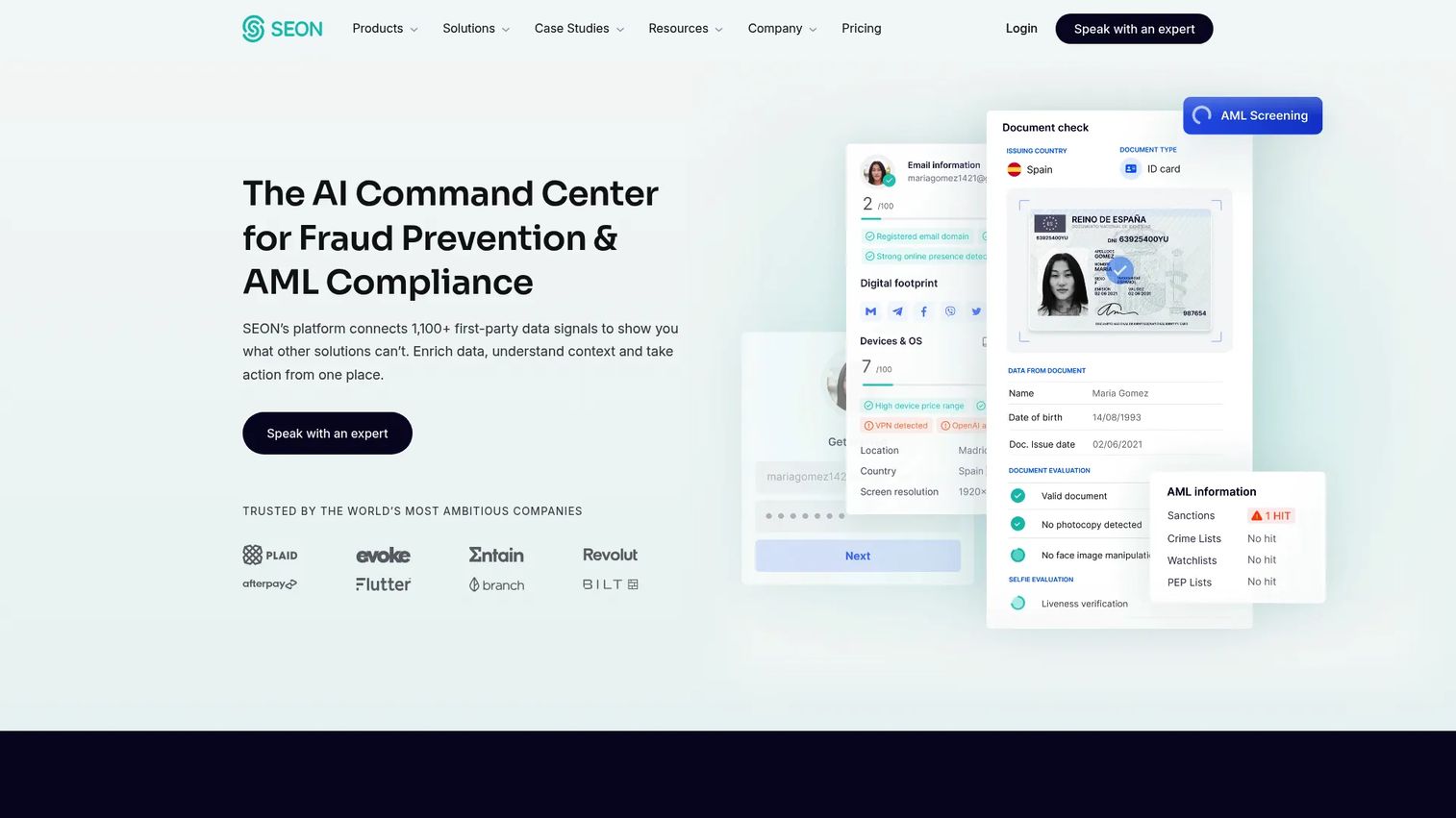
SEON is an AI-powered fraud prevention and AML compliance platform for digital businesses. It analyzes email, phone, IP, and device signals alongside behavioral biometrics and AI risk scoring to detect fraud across the customer journey, including account takeover, payment fraud, and bonus abuse.
Best for: Fintech, payments, iGaming, and e-commerce businesses that need fast, transparent fraud checks using digital footprint signals without starting with a heavy enterprise deployment.
Key features
- Digital footprint analysis across email, phone, and IP data
- Device intelligence and persistent device fingerprinting
- Behavioral biometrics, session monitoring, and bot detection
- Real-time rules-based and AI risk scoring
- Case management, identity verification software, and AML compliance workflows
Why choose SEON: SEON is one of the few fraud prevention platforms with published, self-serve pricing, which makes it easier to evaluate cost before committing to a sales process. It is a strong starting point for digital-first fraud patterns where email, phone, and device signals catch most risk before a transaction even clears.
SEON pricing: The Starter plan is $699/month, covering 2,500 fraud checks, 10 users, and 50 custom rules. Premium is custom-priced for unlimited API calls, users, and rules, plus case management and AML compliance.
G2 rating: 4.6/5
9. Unit21
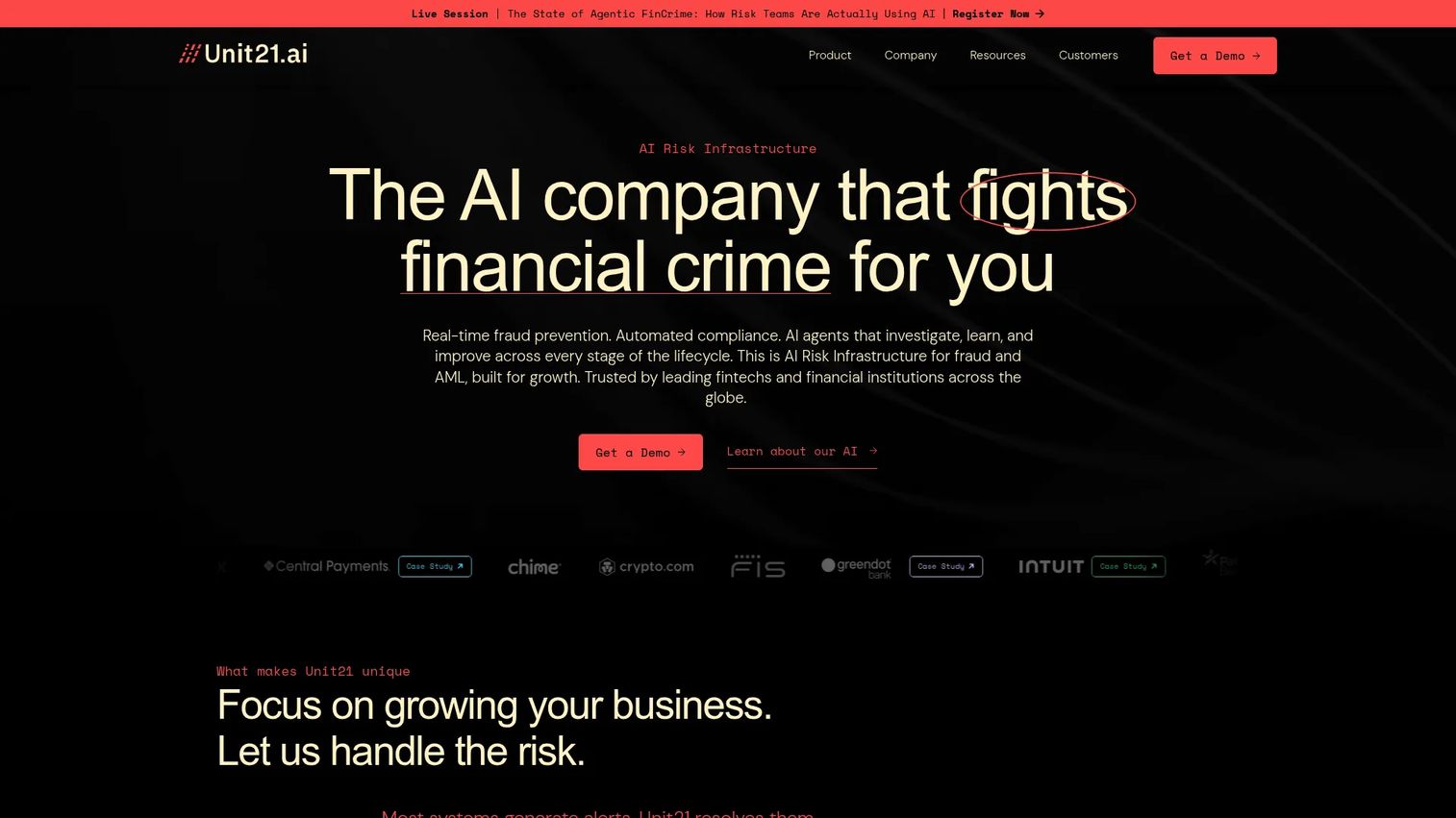
Unit21 is an agentic AI platform for fraud and AML operations. It provides no-code rule configuration, real-time transaction monitoring, alert management, case management, and automated regulatory filing support for fintech and financial institution risk teams.
Best for: Financial institutions and fintechs that want configurable fraud and AML operations without routing every rule change through an engineering queue.
Key features
- AI agents for fraud detection and investigation workflows
- No-code rule builder with real-time transaction monitoring
- Alert queue management and case management
- Automated regulatory filing support
- AML monitoring aligned to compliance requirements
Why choose Unit21: The operational control Unit21 gives risk teams is the main draw. A no-code rule builder means your fraud analyst can iterate on detection logic the same day a new attack pattern appears, without waiting for a sprint cycle. It is a strong fit for teams that want to move fast on fraud operations without adding engineering headcount.
Unit21 pricing: Pricing requires a sales conversation. Contact Unit21 for a quote.
G2 rating: 4.6/5
10. Persona

Persona is a configurable identity platform covering identity verification, fraud prevention, KYC, KYB, AML compliance, case management, and risk orchestration. Its strength is flexibility: Verification flows can be adapted by segment, region, risk profile, or use case without engineering-heavy customization.
Best for: SaaS, fintech, and marketplace teams that need identity risk checks during user or business onboarding, with the ability to configure flows without rebuilding the integration each time.
Key features
- Government ID, selfie, document, database, phone, and email verification
- KYB workflows with business verification and ownership discovery
- Watchlist screening including sanctions, PEPs, and adverse media
- Configurable verification flows, passive signals, and risk orchestration
- Case management with Graph and Data Explorer tools
Why choose Persona: Persona earns its place when onboarding flows need to differ by user type, geography, or risk tier. Rather than building separate integrations for each scenario, teams configure a single platform and branch from there. It is a good fit for companies that need identity infrastructure to scale with product complexity.
Persona pricing: The Essential plan starts at $250/month (12-month minimum). Growth and Enterprise tiers are contact-sales.
11. Sumsub
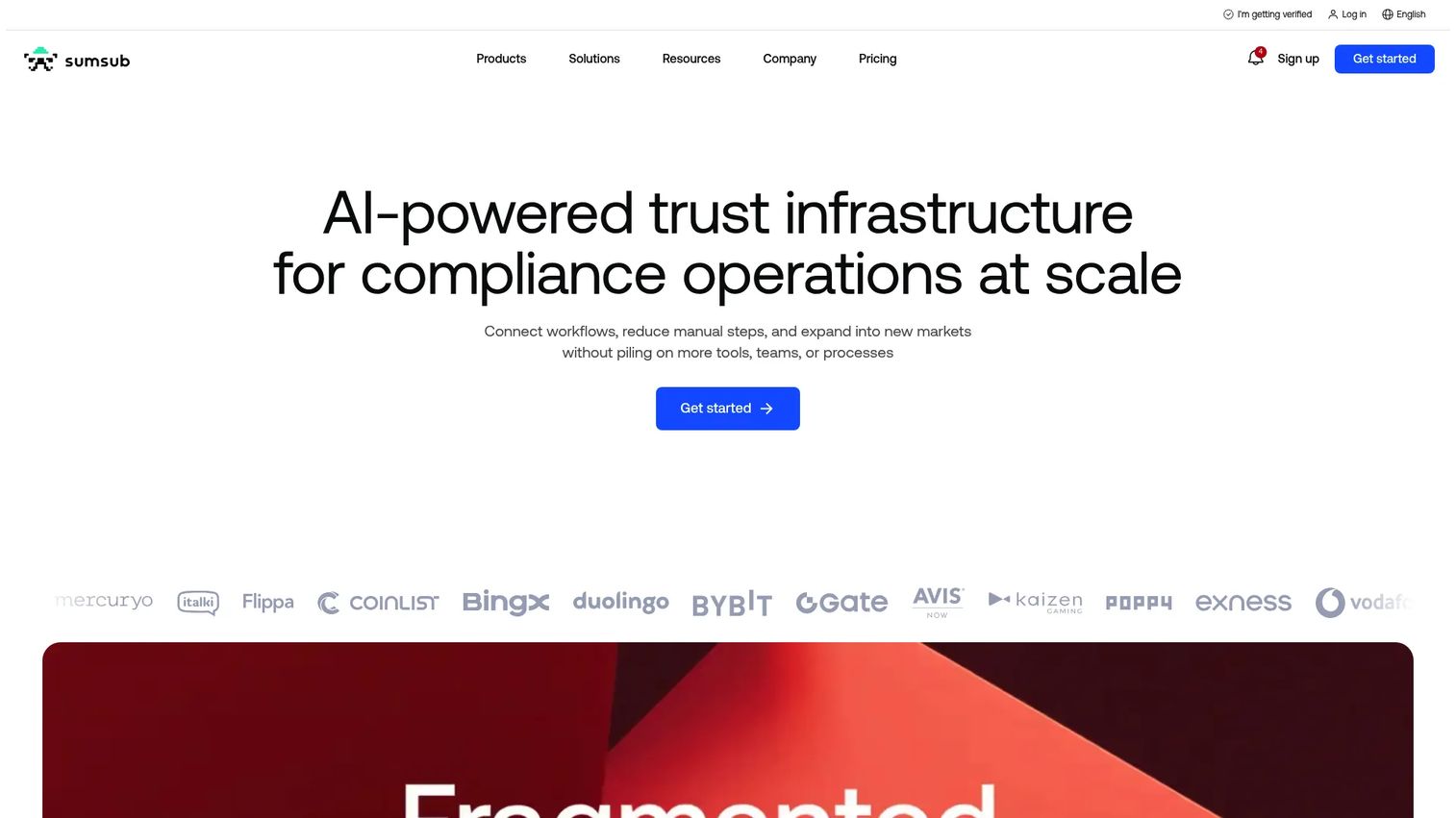
Sumsub is an AI-powered identity verification and compliance platform covering KYC, KYB, AML screening, transaction monitoring, liveness checks, proof-of-address verification, and fraud prevention. It is built for global teams that need identity and fraud checks across multiple countries under a single platform.
Best for: Scaling companies that need KYC, KYB, and AML checks across multiple regions, with per-verification pricing that fits early-stage volumes before committing to a large contract.
Key features
- KYC and KYB verification with document checks and liveness detection
- AML screening and ongoing monitoring
- Transaction monitoring and fraud prevention signals
- Database validation and proof-of-address verification
- Global coverage for multi-country onboarding programs
Why choose Sumsub: The per-verification pricing model makes it accessible before you have predictable volume. A 14-day trial with 50 free checks lets teams validate fit before committing. As volume grows, the per-verification structure scales without requiring a renegotiated enterprise contract upfront.
Sumsub pricing: Basic is $1.35 per verification with a $149 monthly minimum. Compliance (which adds AML screening and address verification) is $1.85 per verification with a $299 monthly minimum. Custom plans are available for enterprise.
G2 rating: 4.6/5
12. Trulioo
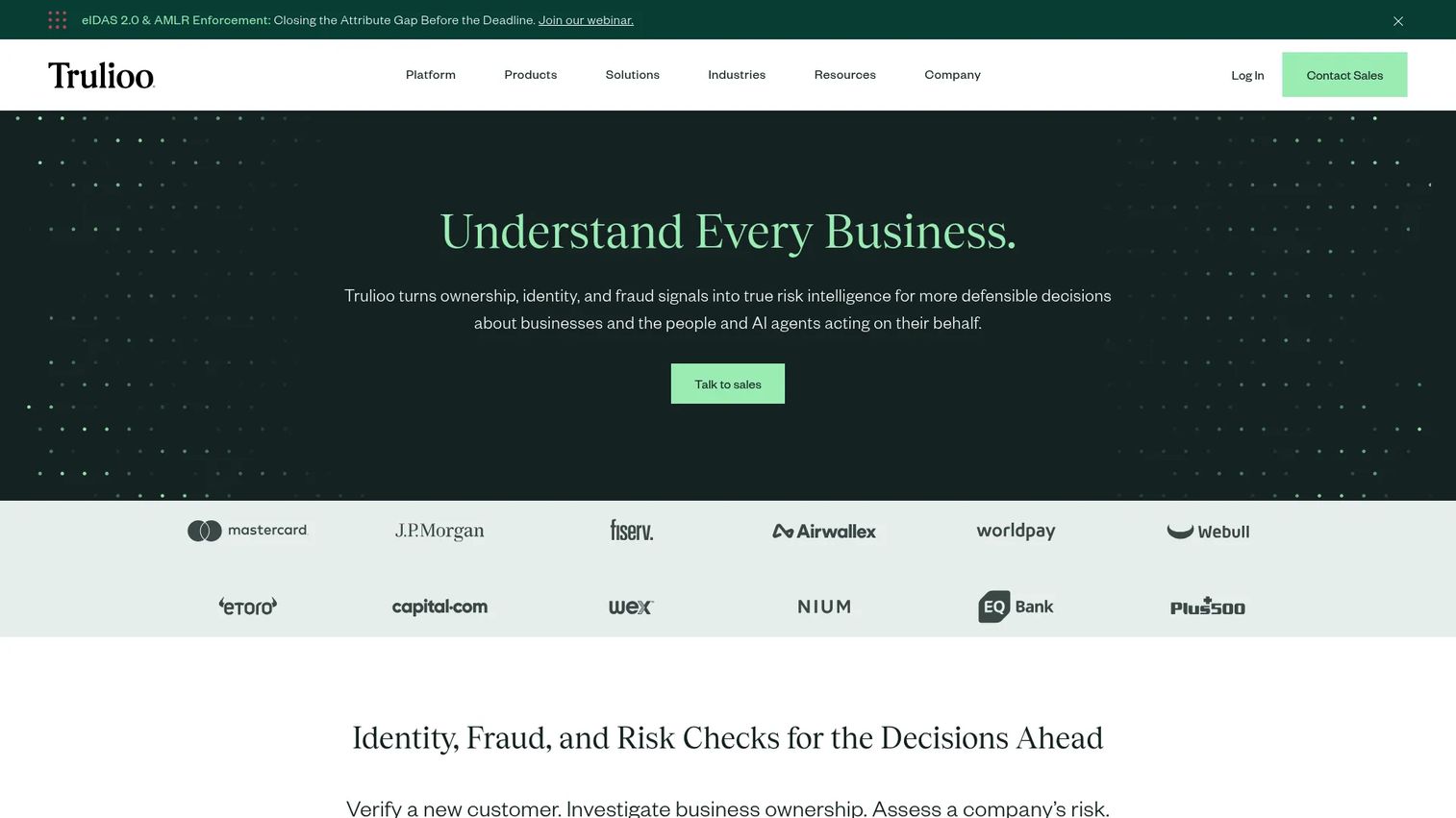
Trulioo provides global person and business verification, fraud prevention, AML screening, and risk intelligence. It covers identity data, document verification, biometrics, digital IDs, ownership discovery for KYB, and sanctions and adverse media screening, with API and no-code workflow integrations.
Best for: Global enterprises and scaling companies that need broad identity data coverage across many countries, particularly for programs where geographic reach is the primary constraint.
Key features
- Person verification using identity data, document checks, biometrics, and digital IDs
- Business verification and ownership discovery for KYB
- Fraud prevention using email, phone, IP, device, and behavioral signals
- Sanctions, PEP, and adverse media screening
- API, SDK, and no-code workflow integrations
Why choose Trulioo: Trulioo is strongest as a global identity layer for programs where verifying users across dozens of markets is the main challenge. It is not primarily a transaction monitoring or AML case management platform, so pair it with a downstream fraud or AML tool if those workflows are also in scope.
G2 rating: 4.4/5
13. Veriff

Veriff provides AI-powered identity verification, KYC, biometric authentication, and fraud prevention software. Its self-serve pricing model and 15-day free trial make it accessible to product-led and growth-stage teams that need identity checks without a lengthy enterprise procurement cycle.
Best for: Product-led and marketplace teams that need conversion-conscious identity verification with self-serve access and transparent per-verification pricing.
Key features
- ID document verification with data extraction and forgery detection
- Biometric face matching and passive liveness detection
- PEP, sanctions, watchlist, and adverse media screening
- Device and network analytics alongside fraud review tools
- Business verification and proof-of-address verification
Why choose Veriff: Veriff's value is in the combination of onboarding conversion and fraud resistance. Its per-verification pricing starts low enough to test at startup scale, and its self-serve plan removes the procurement overhead of a traditional enterprise contract. The 15-day free trial with 50 live verifications lets teams prove fit before spending anything.
Veriff pricing: Essential is $0.80 per verification with a $49 monthly minimum. Plus is $1.39 per verification ($99 minimum). Premium is $1.89 per verification ($209 minimum). Enterprise is custom-priced.
G2 rating: 4.5/5
14. Incode

Incode provides AI-powered identity verification, biometric authentication, compliance, and fraud prevention software for enterprises. It covers document verification, biometric face matching, liveness detection, KYC and AML screening, business verification, deepfake detection, and injection-attack detection, with a no-code workflow builder for verification flows.
Best for: Enterprises and regulated businesses that need identity verification and biometric fraud checks at scale, with strong deepfake and injection-attack defenses.
Key features
- Document verification with OCR and forgery detection
- Biometric facial matching and liveness detection
- KYC, AML, PEP, and sanctions screening
- Deepfake and injection-attack detection
- No-code verification workflow builder with platform integrations
Why choose Incode: Incode carries a 5.0/5 G2 rating from verified reviews, which signals strong customer satisfaction in enterprise deployments. Its biometric-first approach and deepfake defense make it a fit when identity fraud at the account level, rather than transaction fraud, is the primary concern.
Incode pricing: Pricing and contract structures are not shown on the website. Contact Incode directly for a proposal.
G2 rating: 5.0/5
15. Oscilar
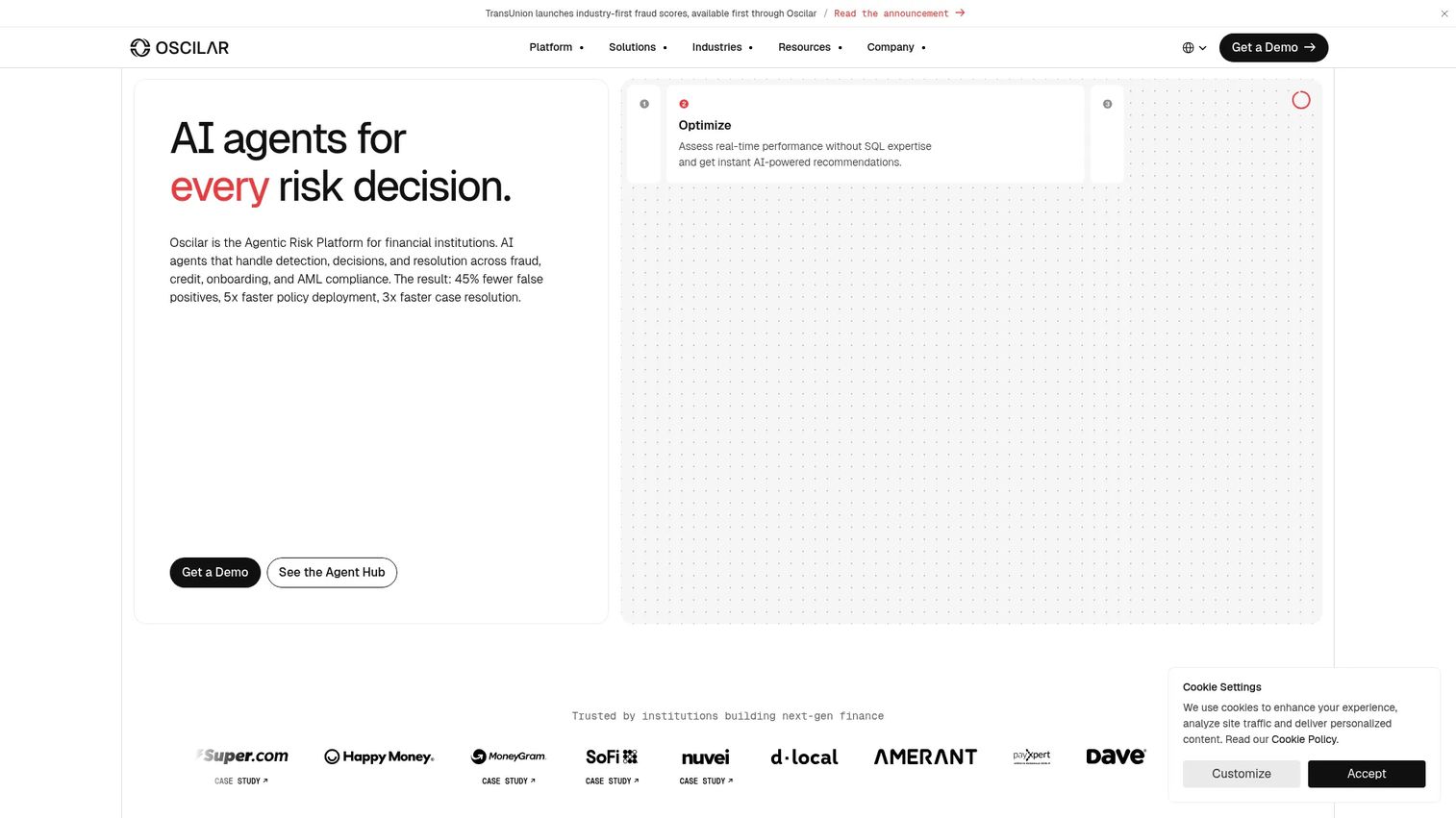
Oscilar is an end-to-end agentic risk management platform covering onboarding, credit, fraud, and AML across the customer lifecycle. It combines an AI agent hub, no-code risk workflow configuration, case management with intelligent queues, device and behavioral intelligence, and more than 160 integrations.
Best for: Banks, fintechs, and other financial institutions that want one configurable AI risk decisioning layer across onboarding, transactions, credit, and fraud operations rather than separate tools per risk type.
Key features
- Agent Hub with purpose-built AI risk agents and human-in-the-loop approvals
- No-code and low-code risk workflow builder with backtesting and A/B testing
- AI case management with intelligent queues, prioritization models, and case summaries
- Device and behavioral intelligence signals
- 160-plus integrations with a unified customer and transaction data layer
Why choose Oscilar: Oscilar suits teams that want a single risk decisioning layer across the full customer lifecycle rather than separate tools for onboarding, credit, and fraud. Its backtesting and A/B testing capability lets risk teams validate rule changes before they go live, which reduces the chance of unintended false-positive spikes.
G2 rating: 4.8/5
Considerations when choosing financial fraud prevention software
Match the tool to your fraud moment
Some platforms are strongest at onboarding, others at transaction monitoring, account takeover, or AML case management. Map your biggest loss points before booking vendor calls: Identity fraud at account creation, payment fraud at checkout, or AML exposure across transactions. A tool optimized for one of those moments may underserve the others.
Measure false positives, not just blocked fraud
A tool that stops fraud but rejects good customers at a high rate is a revenue problem disguised as a risk win. During evaluation, ask vendors for approval rate data, manual review rates, and customer drop-off metrics alongside fraud catch rates. The goal is a high catch rate and a high approval rate running in parallel.
Check payment rail and workflow coverage
List the rails and event types relevant to your business: Card, ACH, wire, bank transfer, account opening, login events, refund requests, chargeback workflows, or marketplace payouts. Not every fraud platform covers all of these equally. Confirm coverage before procurement rather than discovering gaps during integration.
Evaluate analyst workflow depth
A better detection model is not enough if your team cannot act on the alert. Look for queue management, evidence views, decision notes, escalation paths, audit trails, and case management that supports regulatory documentation. Analyst efficiency is as important as model accuracy for a team that is scaling.
Confirm integrations before you sign
Ask specifically about connections to your payment processor, core banking system, data warehouse, CRM, customer support tools, and any existing KYC or AML vendors. Missing a key integration means engineering work you have not budgeted for. Webhook support and API documentation quality are worth evaluating during a proof-of-concept phase.
Conclusion
Fraud prevention infrastructure earns its place in your stack when it stops being a cost center and starts being a growth enabler: Higher payment approval rates, faster onboarding, fewer analyst hires, and clean metrics for your next board review.
The right tool depends on where fraud enters your business.
For broad fintech fraud and AML coverage, Sardine is the most complete starting point. For community banks and credit unions, Abrigo aligns fraud detection to BSA and examination workflows. ComplyAdvantage connects AML monitoring to fraud signals with published self-serve pricing. Featurespace and Feedzai are the strongest choices for enterprise-scale transaction monitoring. For identity-first fraud prevention, the shortlist depends on your geographic scope: Sumsub and Veriff offer per-verification pricing that scales well at growth stage, while Trulioo and Incode suit global or enterprise programs. Persona is the strongest choice when onboarding flows need to differ by user type or region. For configurable risk operations across the full lifecycle, Unit21 and Oscilar are the top two options.
Shortlist three vendors based on your primary fraud moment, then run a structured proof-of-concept against approval rate and false-positive targets before committing.
Start your journey with Guideflow today!
FAQs
Financial fraud prevention software helps organizations detect, prevent, investigate, and respond to fraudulent financial activity. It covers onboarding identity fraud, account takeover, payment fraud, AML monitoring, and case management workflows. Prevention goes beyond detection by adding real-time blocking, step-up verification, and analyst routing.
Fraud detection identifies suspicious events by scoring transactions, users, or accounts against risk signals. Fraud prevention adds the response layer: Blocking a transaction, routing a user to additional verification, or closing an account pending investigation. Most modern platforms combine both functions rather than separating them.
Banks typically need transaction monitoring across payment rails, AML alignment, audit-ready case management, and explainable decisioning for examiners. Abrigo is built specifically for community banks and credit unions. Featurespace and Feedzai are strong for high-volume transaction environments. ComplyAdvantage and Hawk:AI are well-suited when AML and fraud investigations need to run on the same platform.
Fintechs often need onboarding identity checks, real-time payment fraud detection, account takeover prevention, and AML support, frequently across multiple geographies. Sardine covers all of these in a single platform. SEON offers transparent pricing suitable for earlier-stage fintechs. Unit21 and Oscilar are strong for teams that want configurable risk operations without heavy engineering support.
Start by identifying your first fraud loss point: Is it at onboarding, at payment, or in account activity? Then estimate the current manual review cost per week and the revenue impact of blocked legitimate users. Use those numbers to size the ROI before committing. Prioritize vendors that offer a proof-of-concept phase with real approval rate and false-positive data, so you are comparing outcomes rather than feature lists.
The most operationally important features are real-time risk scoring, identity verification at onboarding, behavioral analytics across sessions and devices, configurable rules alongside machine learning, payment rail coverage matched to your business, and analyst-ready case management with audit trails. AI-assisted decisioning matters when it reduces alert volume; otherwise, it adds noise rather than signal.
Better tools combine more context in each decision: Device signals, identity verification results, behavioral session history, transaction patterns, and analyst feedback over time. The goal is to approve a returning customer with a clean history even when a single signal looks unusual. Platforms that combine several signal types outperform single-signal rule-based systems on approval rate without increasing fraud loss.
They overlap significantly but address different regulatory obligations. Fraud prevention focuses on stopping financial loss and protecting customers from fraudulent activity. AML software focuses on detecting money laundering patterns and meeting anti-money-laundering reporting requirements. Many modern financial crime platforms, such as Sardine, ComplyAdvantage, and Feedzai, combine both workflows so teams do not have to run separate systems. For a focused comparison of AML-specific tools, see our guide to AML software.