Every verification step you add to onboarding costs you conversions. Every step you remove opens a door to fraud. That is the tension every growth and operations team lives with when they shop for identity verification software.
The stakes keep rising. The global identity verification market is projected to grow from USD 15.84 billion in 2026 to USD 50.58 billion by 2034, a 15.6% CAGR, according to Fortune Business Insights (2025). That growth is not abstract. It reflects regulators tightening KYC and AML rules, fraud rings adopting deepfakes and synthetic identities, and buyers abandoning signups that feel like an interrogation.
So the real question is not "which tool is the most secure." It is "which tool gives me the security and compliance I need without bleeding conversion at the exact moment a customer decides to commit." That tradeoff sits at the center of every evaluation, whether you run a fintech, a marketplace, a crypto exchange, or a lending product.
This guide is for the person who has to make a defensible recommendation to security, compliance, and finance, then live with the conversion numbers afterward. We looked at how each platform handles document verification, liveness detection, face match, and AML screening, plus how it deploys, what it costs, and where it fits in a modern stack. If you are also tightening up adjacent infrastructure, it pairs well with how you think about your best customer data platform and email verification tools for lead quality.
What's inside
This guide covers nine identity verification platforms, chosen on five criteria that actually move a buying decision: identity verification breadth, liveness and biometric strength, compliance coverage across KYC, KYB, and AML, integration depth via API and SDK, and pricing visibility. The shortlist is balanced between API-first platforms built for engineering teams and no-code or hosted verification workflows that ship without heavy implementation. The list reflects 2026 market positioning and commercial evaluation intent, not a generic feature dump. Every pricing figure and rating comes from a verified source, and where a vendor keeps pricing behind sales, we say so plainly.
TL;DR
- Best overall for regulated onboarding: Persona, for configurable identity flows and fraud orchestration across the full lifecycle.
- Best for unified compliance: Sumsub, for combining KYC, KYB, AML screening, and transaction monitoring in one stack.
- Best for fast, transparent self-serve start: Veriff, with public per-verification pricing and a hosted verification page.
- Best for global coverage: Trulioo, for person and business verification across a wide set of countries and data sources.
- Best for compliance-heavy financial workflows: Ondato, for KYC, KYB, and AML lifecycle management.
- Best for the deepest enterprise identity stack: Entrust, when identity proofing ties into a broader trust and IAM strategy.
What is identity verification software?
Identity verification software is a category of tools that confirm a person or business is who they claim to be, using document checks, biometric face match, liveness detection, and database or watchlist screening before granting access to an account, service, or transaction.
In practice, a modern identity verification platform stitches together a stack of capabilities. The core building blocks look like this:
- Document verification: Capturing and validating government-issued IDs with OCR to extract and check data fields.
- Liveness detection: Confirming a real, present human is on camera, not a photo, replay, or deepfake.
- Face biometrics and face match: Comparing the selfie to the document photo to confirm the same person.
- Compliance workflows: KYC, KYB, and AML screening with audit trails regulators can review.
- Manual review escalation: Routing edge cases to human reviewers when automated checks are inconclusive.
- API and SDK deployment: Embedding verification into web and mobile flows, with webhooks for status updates.
- Global document and country coverage: Supporting passports, national IDs, and driver licenses across many jurisdictions.
- Fraud and deepfake defense: Detecting spoofing, synthetic identities, and injection attacks.
Buyer expectations are higher in 2026 than they were even two years ago. Fraud is more sophisticated, with AI-generated faces and document forgeries that pass casual inspection. At the same time, conversion friction matters more because acquisition costs are up and patience is down. Biometric verification is projected to hold roughly 55% of the ID verification market in 2026, with BFSI as the leading application at about 35% share, according to Persistence Market Research (2024). That tells you where the technology and the buyers are concentrated.
When to use identity verification software
Reduce onboarding fraud without killing conversion
Identity verification earns its place at the points where a fake account creates real loss. That means account creation in regulated products, account recovery flows where takeover risk is high, payouts on a marketplace, and seller or buyer verification where trust between strangers is the product. The goal is to verify at the riskiest moments, not every moment, so legitimate users move through quickly while bad actors hit a wall.
Support compliance-heavy customer journeys
When KYC, KYB, and AML screening are legally required, identity verification stops being optional. Fintechs onboarding account holders, crypto exchanges meeting travel rule obligations, lenders running affordability and identity checks, and marketplaces handling cross-border payments all need defensible audit trails. The platform has to produce evidence a regulator will accept, not just a pass or fail flag.
Add high-trust verification to sensitive workflows
Some moments justify stronger checks even outside formal compliance. A high-value transaction, a change to payout details, a password reset on a sensitive account, or a step-up challenge when a fraud signal fires all benefit from biometric verification plus manual review fallback. The pattern is simple: match verification strength to the risk of the action, and keep a human escalation path for the cases automation cannot resolve.
Comparison table
The table below summarizes intent, differentiation, pricing, and current G2 ratings. Pricing reflects publicly listed figures where vendors publish them, and a clear contact-sales note where they do not.
| # | Product | Intent | Key differentiation | Pricing | G2 rating |
|---|---|---|---|---|---|
| 1 | Persona | Configurable regulated onboarding | Modular flows plus fraud orchestration | From $250/month | 4.3/5 |
| 2 | Sumsub | Unified KYC/KYB/AML | One stack for verification and monitoring | From $1.35/verification | 4.6/5 |
| 3 | Veriff | Fast self-serve start | Public per-verification pricing | From $0.80/verification | 4.5/5 |
| 4 | Trulioo | Global coverage | Wide country and data source reach | Contact sales | 4.4/5 |
| 5 | Ondato | Compliance-first onboarding | KYC, KYB, AML lifecycle | From €0.50/verification | 4.8/5 |
| 6 | iDenfy | Broad coverage, plugin-friendly | 3D liveness plus wide document support | From $1.30/verification | 4.9/5 |
| 7 | Jumio | Enterprise verification | Biometrics plus large transaction scale | Contact sales | 4.0/5 |
| 8 | Entrust | Identity in a broader trust stack | IDV tied to IAM and digital trust | From $2/user/month | 4.3/5 |
| 9 | Veridas | Biometric-led verification | Document, face, and voice biometrics | Contact sales | Not enough reviews |
Best identity verification software for 2026
1. Persona
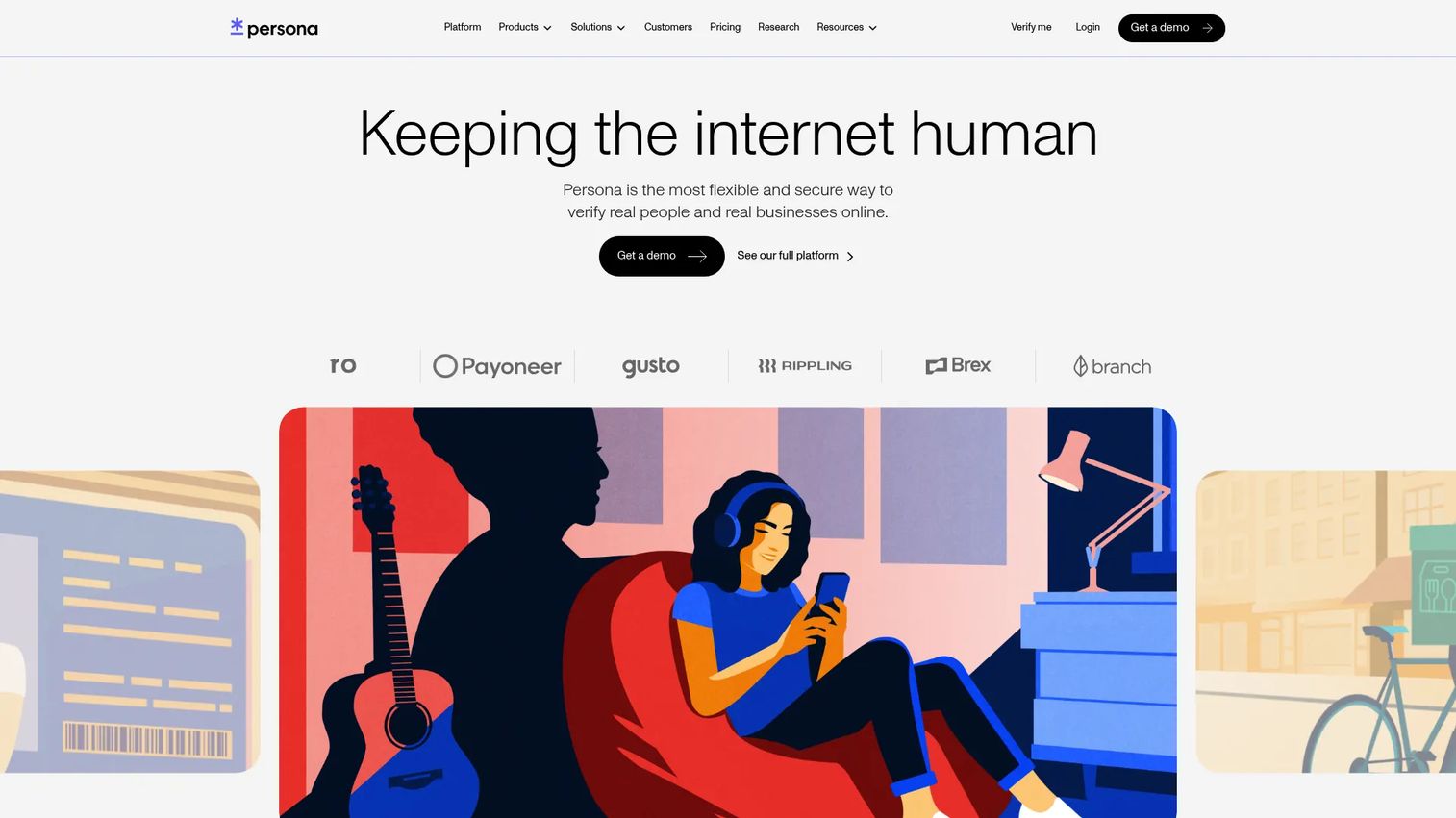
Persona is an identity verification and identity management platform built around configurability. Its modular approach lets teams verify, prevent fraud, and orchestrate identity across the full customer lifecycle, automating processes for KYC, KYB, and workforce verification from a single platform.
Best for: Businesses that need configurable identity verification, fraud prevention, and compliance workflows they can shape to their own risk model.
Key strengths
- Layered verification methods: Government ID, selfie, document, and database verifications combine into the checks each use case needs.
- Dynamic Flow: Customizable data-collection experiences let you tailor what you ask of users and when, so low-risk paths stay short.
- Fraud orchestration: Workflows, Graph, and Cases give teams the tooling to connect signals, link related identities, and run manual review at scale.
Why choose Persona: If your evaluation hinges on control, Persona is the strongest fit on this list. Growth and operations teams that want to adjust verification strength by risk segment, route edge cases through a review queue, and connect identity signals across the funnel get an enterprise-grade orchestration layer without rebuilding it in-house. It rewards teams willing to invest in configuration.
Persona pricing: The Essential plan starts at $250/month on a 12-month contract and includes 500 free services per month. Growth and Enterprise tiers are quote-based and require contacting sales. Persona also offers a 60-day free trial, which gives teams real runway to test flows before committing. Its G2 rating sits at 4.3/5.
2. Sumsub
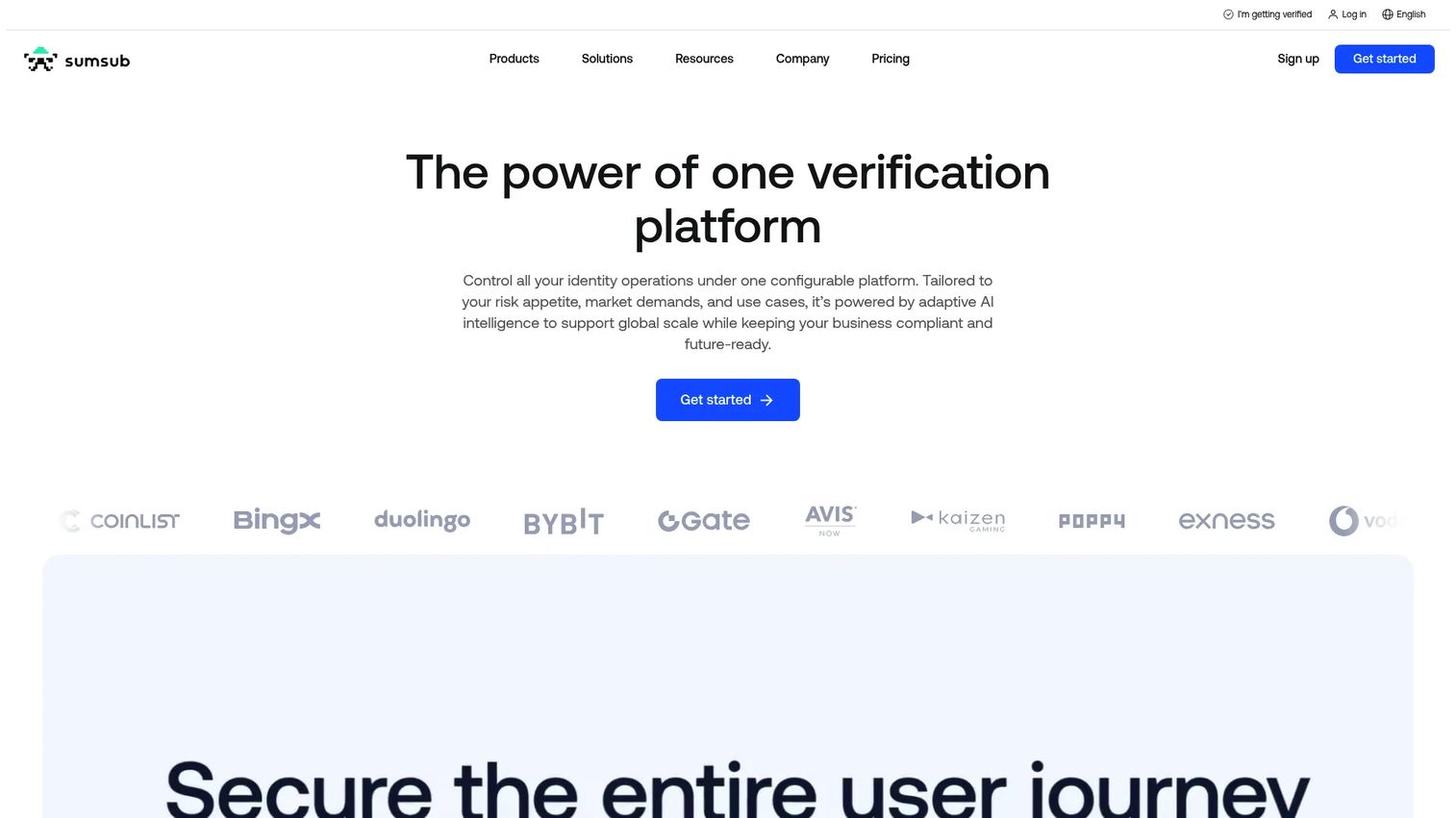
Sumsub is a verification and compliance platform that pulls identity verification, AML screening, business verification, and transaction monitoring into one stack. For teams tired of stitching separate vendors together, that consolidation is the pitch.
Best for: Regulated businesses that want a single platform covering verification and ongoing compliance rather than a patchwork of point tools.
Key strengths
- Identity verification: Document checks, liveness, and face match handle individual onboarding end to end.
- AML screening and ongoing monitoring: Watchlist and sanctions screening continue after onboarding, not just at signup.
- Business verification (KYB): Corporate onboarding and ultimate beneficial owner checks live in the same place as individual KYC.
Why choose Sumsub: Consolidation is the reason most teams pick Sumsub. When KYC, KYB, AML, and transaction monitoring all sit under one roof, you cut integration overhead and get a consistent audit trail. Forrester Consulting's Total Economic Impact study of Sumsub's verification platform reported cost savings and revenue gains for companies using it, which gives finance a number to point at.
Sumsub pricing: Sumsub publishes per-verification pricing. The Basic plan runs $1.35 per verification with a $149 monthly minimum, and the Conformity plan runs $1.85 per verification with a $299 monthly minimum. Enterprise is custom. A 14-day free trial includes 50 free checks. Its G2 rating is 4.6/5.
3. Veriff
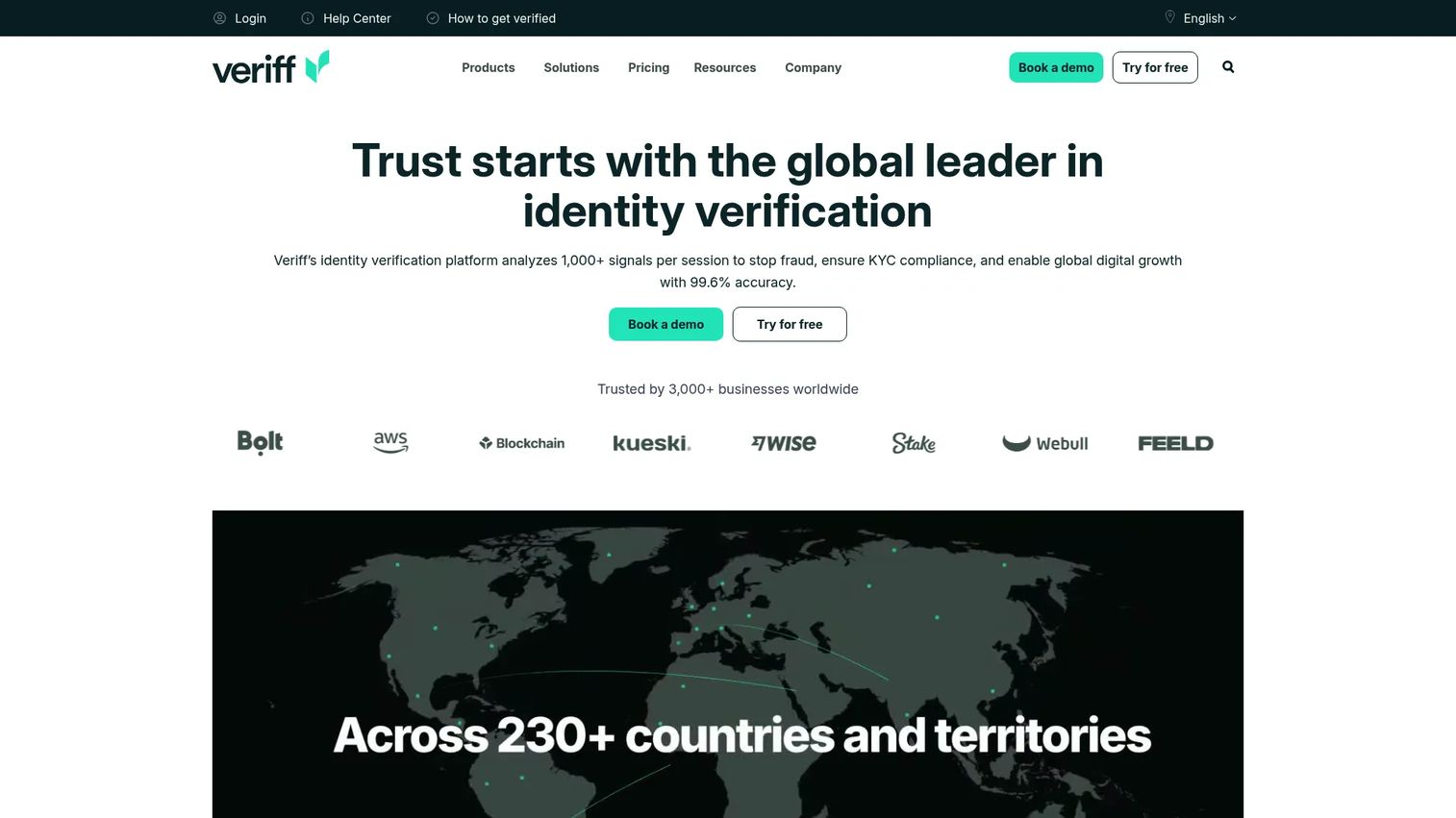
Veriff is an AI-powered identity verification platform built for document, biometric, and fraud checks at global scale. Its self-serve pricing and hosted verification page make it one of the faster platforms to get live without a long implementation.
Best for: Teams that want clear pricing, a quick start, and global verification without negotiating a contract before they can test.
Key strengths
- Identity and document verification: Captures and validates IDs across a wide range of countries and document types.
- Biometric authentication and liveness: Confirms a real, present user and matches the selfie to the document.
- AML screening and proof of address: Database verification, watchlist screening, and address checks extend coverage beyond the basic identity check.
Why choose Veriff: Veriff is the easiest entry point for teams that hate opaque pricing. You can read the cost, start on a self-serve plan, and embed the hosted verification page or SDK without waiting on procurement. Veriff reports its platform analyzes more than 1,000 signals per session to stop fraud and support KYC compliance, with 99.6% accuracy. That depth sits behind a deliberately simple front door.
Veriff pricing: Self-serve plans are public. Essential is $0.80 per verification with a $49 monthly minimum, Plus is $1.39 per verification with a $99 minimum, and Premium is $1.89 per verification with a $209 minimum. An Enterprise plan is custom, and a 15-day free trial is available. Its G2 rating is 4.5/5.
4. Trulioo

Trulioo is a global identity verification platform covering person and business verification, compliance, and fraud prevention. Its reach is the headline: a full suite of in-house verification capabilities spanning a wide set of countries and data sources.
Best for: Enterprises onboarding customers across many regions that need consistent person and business verification under one API.
Key strengths
- Person verification and KYC: Identity checks and document verification handle individual onboarding across jurisdictions.
- Business verification and KYB: Corporate identity and ownership checks support B2B onboarding and marketplace seller vetting.
- Fraud intelligence and risk signals: Risk scoring layers on top of verification to flag suspicious applications early.
Why choose Trulioo: If your problem is global, Trulioo's regional flexibility is the draw. One API-first integration reaches data sources across many countries, which spares engineering teams from wiring up separate regional vendors. The modular platform lets you turn on document and biometric checks where you need them and lean on data verification where you do not.
Trulioo pricing: Trulioo does not publish pricing on its site. Plans are quote-based and run through a demo-led sales process, so you will need to contact sales for a number tied to your volume and country mix. Its G2 rating is 4.4/5.
5. Ondato
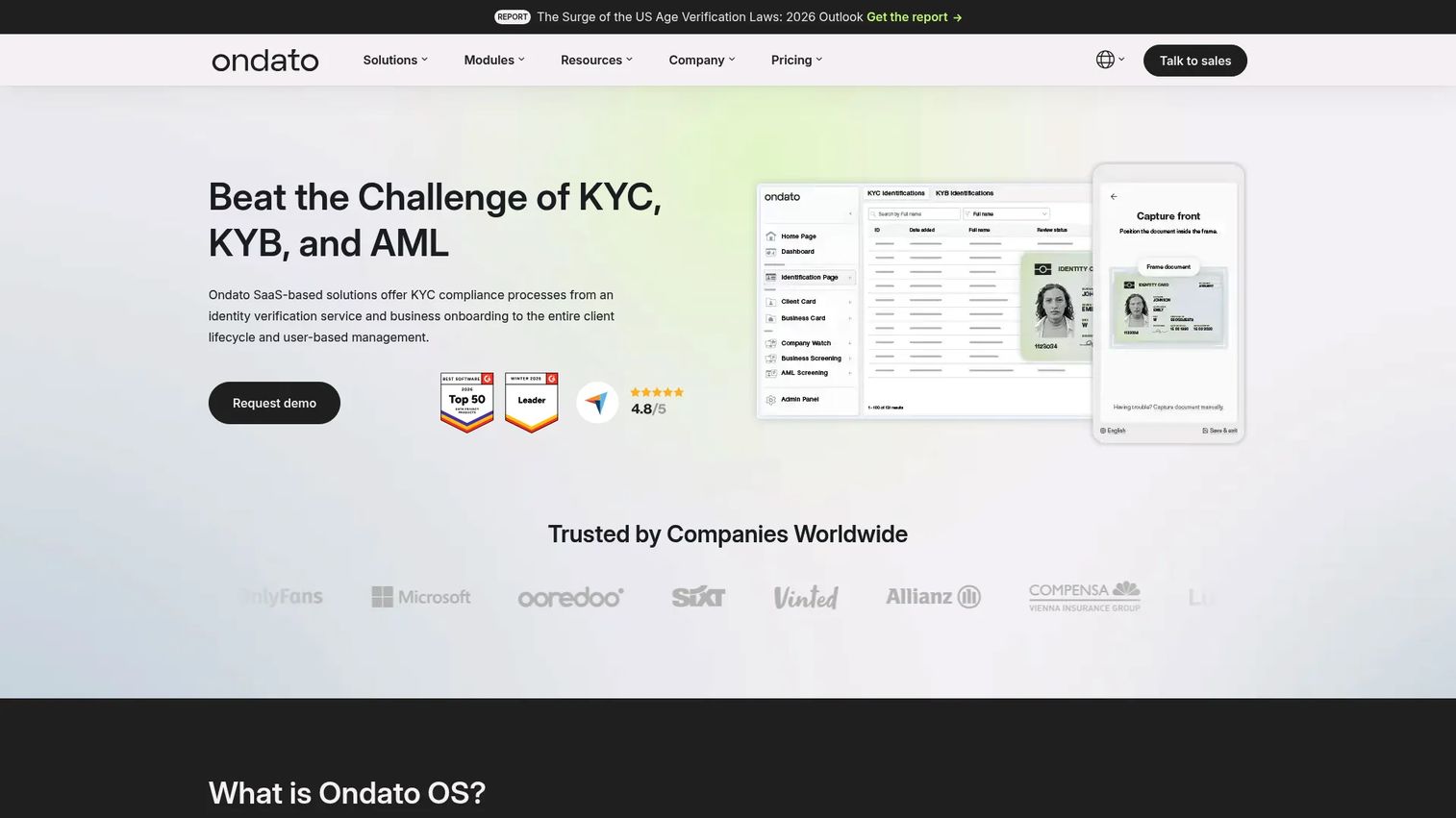
Ondato is a KYC, KYB, AML, identity verification, and age verification platform built compliance-first. It pairs identity verification with screening and lifecycle management, which is exactly what regulated financial teams shortlist for.
Best for: Regulated and financial services businesses that need identity verification plus AML screening and ongoing lifecycle management.
Key strengths
- Identity verification: Photo, video, and NFC-based checks handle individual onboarding with strong document support.
- Business onboarding (KYB): Corporate verification covers business customers and ownership structures.
- AML screening and monitoring: Continuous screening and monitoring keep compliance alive after the first check.
Why choose Ondato: Ondato is a clean fit when compliance is the spine of the project, not an afterthought. The platform orchestrates identity verification, screening, and workflow management together, so financial services buyers get a defensible end-to-end process. That compliance-first framing is why it lands on so many regulated shortlists.
Ondato pricing: Ondato publishes solution-specific pricing. Identity Verification ranges from roughly €1.40 down to €0.50 depending on volume and features, Know Your Business starts from €600 per month, and Age Verification ranges from €0.30 down to €0.01. Pricing varies by volume, solutions, and additional checks. Its G2 rating is 4.8/5.
6. iDenfy
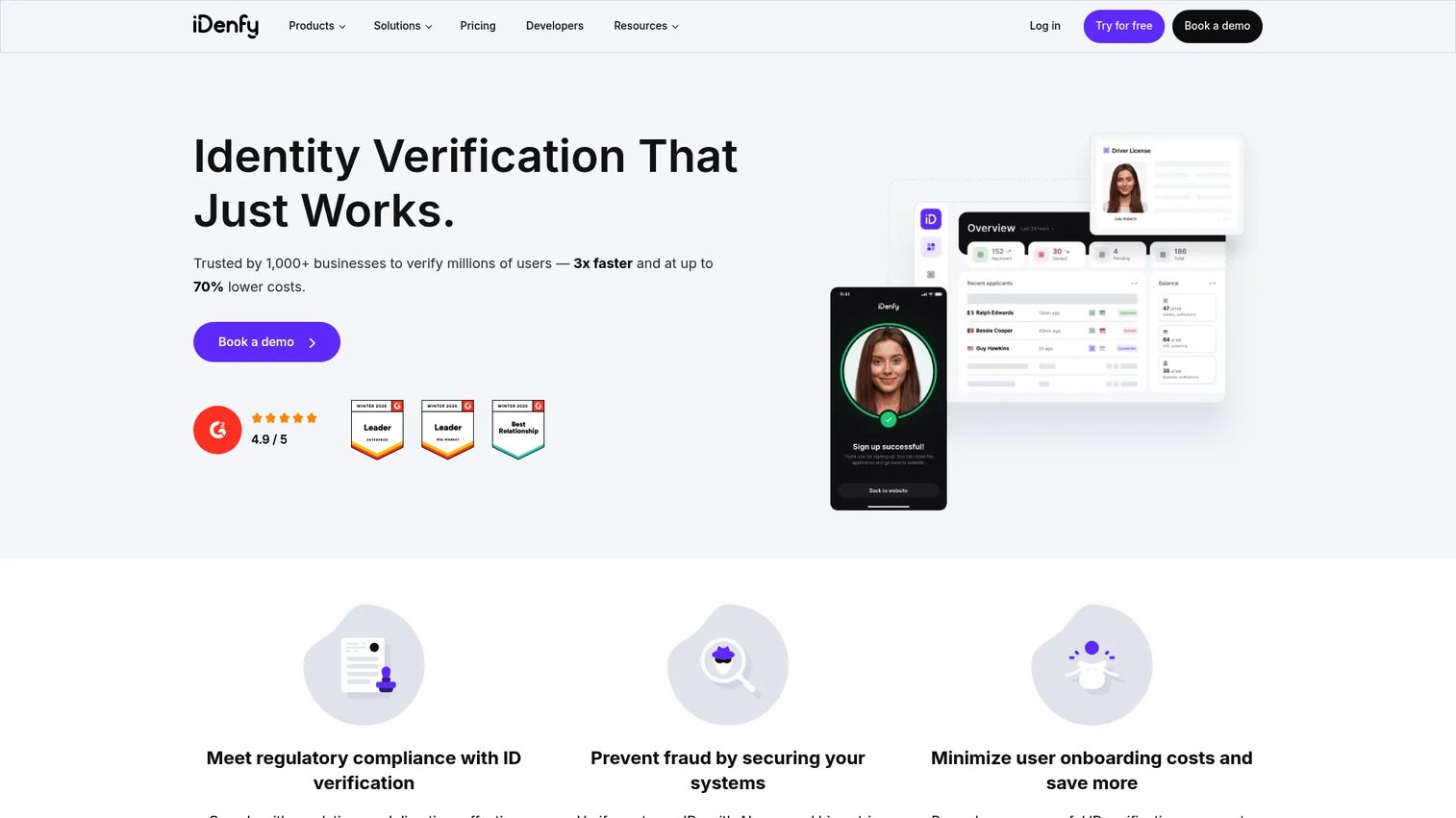
iDenfy is identity verification and compliance software for onboarding, KYC, KYB, and fraud prevention. It is known for broad coverage and plugin-friendly deployment, with patented 3D liveness detection that spots fraudulent attempts during the check.
Best for: Teams that want wide document and country coverage plus easy, plugin-friendly integration.
Key strengths
- ID verification: Data extraction in 0.02 seconds from more than 3,500 active government-issued documents across 200-plus countries and territories.
- AML software: Screening and monitoring run alongside verification for a combined compliance view.
- Business verification: KYB checks cover corporate onboarding next to individual KYC.
Why choose iDenfy: iDenfy pairs broad coverage with human oversight, offering 24/7 manual review supervision within three minutes when a case needs a person. The patented 3D liveness detection adds spoof resistance against photos, replays, and deepfake attempts. For teams that want plugin-friendly deployment without sacrificing review depth, it is a strong option.
iDenfy pricing: iDenfy publishes per-verification pricing. The Basic plan is $1.35 per verification with a $135 monthly minimum, and Premium is $1.30 per verification with a $325 monthly minimum. Enterprise uses volume-based pricing that can drop as low as $0.50 per verification. A 14-day free trial includes 10 free checks. Its G2 rating is 4.9/5, among the highest on this list.
7. Jumio
Jumio is an AI-powered identity verification and AML platform for onboarding, authentication, and fraud prevention. Built on the Jumio Platform, it leans on biometrics, AI, and current detection techniques, and it shows up consistently on enterprise evaluation lists.
Best for: Enterprises that need automated identity verification and compliance workflows at large transaction volumes.
Key strengths
- Identity verification: Document checks and data extraction handle onboarding across a wide country footprint.
- Selfie and liveness detection: Biometric technology and liveness detection are positioned to stop deepfakes and advanced spoofing attacks.
- AML screening and monitoring: Ongoing screening extends compliance coverage past the initial check.
Why choose Jumio: Jumio's scale is the selling point for enterprise buyers. The company reports processing more than 1 billion transactions across over 200 countries and territories from real-time web and mobile flows. For a regulated enterprise weighing global onboarding at volume, that track record carries weight in a procurement review.
Jumio pricing: Jumio does not publish public pricing. Its site is demo-led and routes buyers to sales, so you will need a quote sized to your volume and regions. Its G2 rating is 4.0/5.
8. Entrust
Entrust is identity-centric security software spanning IAM, identity verification, PKI, signing, and cryptographic security. Identity verification sits inside a broader trust stack, which is the point: Entrust fits when identity proofing connects to a wider identity strategy.
Best for: Organizations that need enterprise identity, authentication, and digital trust infrastructure, with verification as one layer of it.
Key strengths
- Document, biometric, and data verification: Entrust enables financial institutions, gaming companies, and retail providers to verify identities using all three.
- Identity as a Service (IDaaS): MFA, passwordless access, and SSO tie verification to ongoing authentication.
- Cryptographic Security Platform: Keys, certificates, and secrets management round out the broader trust strategy.
Why choose Entrust: Entrust is the pick when identity verification is part of something larger. If you are already standardizing on an identity and access management strategy, verifying users at onboarding and authenticating them afterward from one vendor reduces fragmentation. Entrust was named in the 2025 Gartner Magic Quadrant for Identity Verification for the second consecutive year, which helps with stakeholder buy-in.
Entrust pricing: Entrust Identity as a Service publishes bundle pricing. The Standard Workforce Bundle is $2 per user per month and the Plus Workforce Bundle is $3.50 per user per month, with a Premium bundle quoted by sales. A free trial is available. Note that this pricing reflects the IDaaS workforce bundles; dedicated verification products are quote-based. Its G2 rating is 4.3/5.
9. Veridas
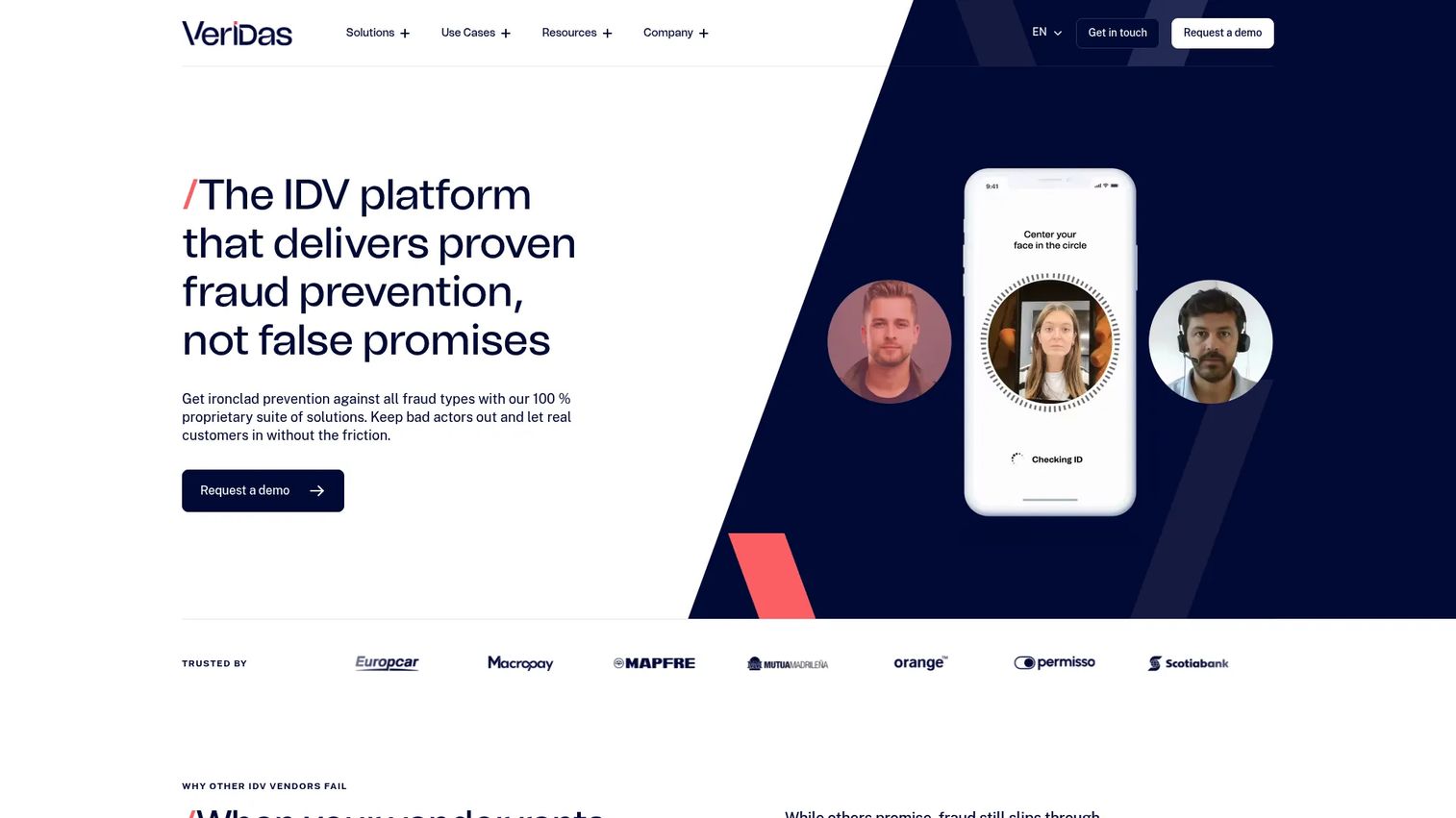
Veridas is an identity verification and biometric authentication platform with a strong biometric emphasis. Its portfolio of modular solutions includes ID document verification, face biometrics, and voice biometrics, and it was named a Visionary in Gartner's 2025 Magic Quadrant.
Best for: Organizations that want identity verification anchored in document and biometric workflows across multiple platforms.
Key strengths
- Identity verification: Document checks paired with facial biometrics confirm identity at onboarding.
- Face authentication: Biometric face match supports both verification and returning-user authentication.
- Voice authentication: Voice biometrics add a distinct modality most competitors do not offer.
Why choose Veridas: Veridas stands out on biometric depth and user experience. The verification process is integrated so smoothly that users barely notice the check, and its liveness detection, certified at the highest levels, is built to thwart 3D masks and digital deepfakes. Its Digital Onboarding service runs across web, Android, iOS, and Webviews, so deployment fits the surface your users are on.
Veridas pricing: Veridas does not publish public pricing; it appears to be quote-based, so contact sales for a figure tied to your use case. G2 does not show an aggregate rating because there are not yet enough reviews to produce one.
Considerations before you commit
The right platform is the one that balances fraud risk, compliance burden, and conversion for your specific flow. Before you sign, pressure-test these criteria.
Document and country coverage
Map the platform's supported documents and countries against where your users actually live. A tool that excels in one region may thin out in another. Ask for the specific document types and jurisdictions, not a headline country count, and confirm coverage for your fastest-growing markets.
Liveness and biometric quality
Not all liveness is equal. Ask whether liveness is active or passive, how it handles injection and deepfake attacks, and whether the vendor holds independent certification such as iBeta PAD testing. Face match accuracy matters most at the margins, where fraud lives.
Compliance fit
Confirm the platform supports the exact obligations you carry, whether that is KYC, KYB, AML screening, or all three, and that it produces audit trails your regulator will accept. Check certifications like SOC 2, ISO 27001, and GDPR handling, especially for cross-border data.
Integration and deployment
Decide whether you need an API-first build, an SDK, a hosted verification page, a no-code workflow, or a plugin. Confirm webhook support for status updates and how the verification step fits your existing onboarding and CRM. Cleaner integration here protects conversion later.
Pricing model and manual review
Compare per-verification pricing, monthly minimums, and enterprise contract terms, then factor in the cost and speed of manual review. A low per-check price can erode if review queues are slow or priced separately. Model your real volume, not a best case.
Conclusion
The shortlist sorts cleanly by buying need. Persona is the best all-around regulated platform when you want configurable flows and fraud orchestration. Veriff is the best quick-start option for teams that want public pricing and a fast self-serve launch. Trulioo is the best global coverage choice when onboarding spans many regions. Ondato is the best fit for compliance-heavy financial workflows where KYC, KYB, and AML have to work together. Sumsub earns the nod when you want all of that consolidated into one stack, and Entrust fits when verification is one layer of a broader identity strategy.
Whichever way you lean, evaluate the same things before you commit: document support, liveness quality, pricing model, manual review, and integration fit. Run the free trials the vendors offer, test against your own document mix and risk segments, and bring real numbers to the security and finance conversation. The best identity verification software is the one that protects you from fraud and satisfies your auditors without quietly costing you the conversions you worked to earn. Narrow to two or three, run them side by side, and let your own data decide.
FAQs
Identity verification software confirms that a person or business is genuinely who they claim to be before granting access to an account, service, or transaction. It typically combines document verification, biometric face match, and liveness detection, often alongside database and watchlist screening. The goal is to separate legitimate users from fraudsters at the moments where a fake identity would cause real harm.
The features that drive a decision are document capture and OCR, liveness detection, face match accuracy, compliance coverage for KYC, KYB, and AML, and deployment options like API, SDK, and hosted pages. Human review escalation matters too, because automated checks will always produce edge cases that need a person. Weight these against your specific fraud risk and conversion goals rather than chasing the longest feature list.
Identity verification proves who someone is the first time, usually at onboarding, by checking a document and a live selfie against each other. Authentication proves that a returning user is the same person who already verified, typically through passwords, MFA, or biometrics at login. You verify once to establish identity, then authenticate repeatedly to confirm it. Many platforms handle both, but they solve different problems.
It depends on what you onboard and the rules you operate under. KYC applies when you onboard individual customers in regulated industries like fintech, crypto, and lending. KYB applies when you onboard businesses and need to verify corporate identity and beneficial ownership. AML screening checks users against sanctions and watchlists and usually runs continuously, not just at signup. Regulated financial services often need all three together.
Liveness detection confirms that a real, present human is in front of the camera, not a photo, a screen replay, or a deepfake. It is what stops a fraudster from passing a face match using a stolen image or an AI-generated face. As deepfakes get more convincing, liveness quality and independent certification such as iBeta PAD testing have become the dividing line between strong and weak verification.
Look past the headline per-verification price to the full cost. Check monthly minimums, whether manual review is included or billed separately, and how enterprise contracts are structured. Some vendors publish self-serve pricing while others quote based on volume and country mix. Model your realistic monthly verification volume, then compare total cost at that volume rather than the lowest advertised rate.
Global onboarding hinges on document coverage, country coverage, language support, and handling of regional rules. Platforms with broad in-house data sources and wide document support tend to fit best when you onboard across many regions. Confirm coverage for your specific growth markets, not just a total country count, and check that the platform meets local data residency and compliance requirements.
Ask about integration effort and which deployment options are supported, how manual review queues work and what they cost, how the platform handles deepfake and injection attacks, and which compliance frameworks and certifications it carries. Push for reporting and analytics detail so you can prove conversion and fraud impact later. Finally, ask for pricing tied to your real volume, not a generic rate card.