A driver goes offline mid-shift. Two bookings land at the same minute. A regular account customer calls, but your dispatcher is already on another line. By the time anyone reassigns the ride, the passenger has opened a rideshare app instead.
That is the daily reality when a fleet outgrows radios, whiteboards, and spreadsheets. Manual coordination works until it doesn't, and the failure point usually arrives right as volume climbs. The global taxi dispatch software market sits around $1.05 to $1.62 billion in 2026 and is forecast to keep growing at double-digit rates through the early 2030s, according to Business Research Insights and Global Growth Insights (2025). Cloud-based dispatch migration already sits near 68% adoption, per Global Growth Insights (2025). Operators are moving off manual systems because the math stopped working.
If you are searching for taxi dispatch software right now, you are almost certainly past the "do I need this" stage. You need a shortlist. The problem is that nearly every vendor claims to be the all-in-one answer, which makes real comparison hard. This guide cuts through that. We evaluated eight taxi management software platforms on the criteria that actually decide whether a rollout succeeds: dispatch automation, live GPS tracking, driver and passenger apps, booking channels, pricing clarity, reliability, and how fast you can launch.
What's inside
This is a practical buyer's guide for fleet owners, private hire operators, dispatch managers, and transportation founders comparing taxi dispatch systems in 2026. It is written for the person who owns the outcome, not just the feature checklist.
We selected and ranked eight platforms based on:
- Dispatch automation depth - how much manual assignment the system removes
- Real-time GPS tracking and visibility - live vehicle status, ETAs, and rerouting
- Driver and passenger apps - quality, branding flexibility, and communication tools
- Booking channels - phone, web, app, and corporate account intake
- Pricing transparency - published models versus quote-only
- Reliability and implementation effort - uptime and how quickly you go live
TL;DR
- Best overall / broadest fit: TaxiCaller. Cloud dispatch, booking, driver and passenger apps, and clear per-vehicle pricing with a 14-day trial.
- Best for pricing transparency and small fleets: Gazoop. A free Lite tier plus low weekly per-driver plans.
- Best for enterprise dispatch precision: iCabbi. AI-first dispatch, deep configuration, per-driver SaaS pricing.
- Best for analytics and white-label scale: TaxiMobility. Per-driver plans from $14, predictive analytics, multi-vertical support.
- Best for white-label mobile-first launches: Onde. Branded rider and driver apps with published launch pricing.
- Best for SMB usability and marketplace demand: Moovs for clean workflows, Autocab for booking consolidation and its aggregation network.
What is taxi dispatch software?
Taxi dispatch software is a cloud or on-premise system that automates booking intake, assigns rides to drivers, tracks vehicles in real time, and keeps passengers updated across the trip. It replaces the radio, the paper log, and the spreadsheet with a single operations layer.
The core workflow runs in a loop. A booking arrives through phone, web, app, or a corporate account. The system assigns it, usually automatically, to the nearest or best-matched driver. The driver receives it in a companion app with navigation. The passenger gets status, ETA, and live tracking. The trip completes, payment processes, and every ride feeds analytics and reporting.
In 2026, a serious cab dispatch software platform should give you:
- Automated dispatch with configurable rules for zones, priority, and driver ranking
- Real-time GPS tracking for live vehicle status, ETAs, and mid-trip rerouting
- A driver app with navigation, job flow, earnings, and safety features
- A passenger app or booking widget with live tracking and passenger communication
- Multi-channel booking across phone, web, app, and corporate accounts
- Payments and invoicing for cash, card, and account billing
- Analytics and reporting on utilization, revenue, response times, and driver performance
A cloud taxi dispatch system adds automatic updates, remote access, and easier scaling as your fleet grows. What it replaces is the fragile combination of a dispatcher's memory, a wall of radios, and a booking log that no one can query.
When to use taxi dispatch software
Reduce dispatch chaos
Most fleets hit a wall around the point where one dispatcher can no longer hold the whole board in their head. Manual scheduling, radio calls, and spreadsheet coordination create missed rides, slow assignments, and an overloaded dispatch office. When a driver forgets a job or two bookings collide, revenue leaks quietly. Dispatch automation removes the guesswork by matching rides to drivers on defined rules, so the office stops firefighting and starts managing exceptions instead of every single ride.
Add real-time visibility
Service levels in this business are decided minute by minute. If you cannot see where every vehicle is, you cannot promise an accurate ETA, reroute around a delay, or explain to an account customer why a pickup slipped. Real-time GPS tracking gives dispatchers live status on every car, automatic ETA updates for passengers, and the ability to reassign the nearest available driver when a job goes sideways. Taxi tracking software turns "I think he's near there" into a fact on a map.
Scale bookings across channels
Growth means bookings stop arriving from one place. You get inbound phone calls, web requests, in-app bookings, and standing corporate accounts, often all at once. Without a single dispatch layer, each channel becomes its own manual process. Taxi booking software consolidates them:
- Inbound phone calls captured and logged by the dispatch console
- App and web requests flowing straight into the assignment queue
- Corporate and account bookings handled with their own billing rules
When every channel feeds one queue, you can scale volume without scaling headcount at the same rate.
Comparison table
Here is how the eight platforms stack up on intent, core use case, published pricing, and current G2 rating. Use it to narrow to two or three before reading the full sections.
| # | Product | Intent | Key use case | Pricing | G2 rating |
|---|---|---|---|---|---|
| 1 | TaxiCaller | Broad all-rounder | Cloud dispatch, booking, driver and passenger apps | Per-vehicle monthly, 14-day trial | 4.2/5 |
| 2 | iCabbi | Enterprise dispatch | AI-first dispatch and configuration | Per-driver SaaS, quote-based | Not listed |
| 3 | Autocab | Booking consolidation | End-to-end dispatch plus aggregation network | Quote-based | 4.5/5 |
| 4 | TaxiMobility | Analytics and white-label | Cloud dispatch with predictive analytics | From $14/driver | 4.3/5 |
| 5 | Gazoop | Budget and small fleets | Dispatch, booking, driver management | Free tier, from $4/driver weekly | 4.9/5 |
| 6 | Moovs | SMB usability | Dispatch, calendar, booking links | Public plans | 4.5/5 |
| 7 | Onde | White-label mobile | Branded rider and driver apps | From $4,500 one-time | 4.8/5 |
| 8 | Ridecell | Mobility automation | Fleet orchestration and shared mobility | Quote-based | 4.5/5 |
Read the table as a starting filter, not a verdict. A 4.9/5 rating on a smaller review base is not directly comparable to a 4.2/5 across many reviews, and quote-based pricing often reflects enterprise depth rather than a red flag. Match the intent column to your own situation first, then dig into pricing and apps.
1. TaxiCaller
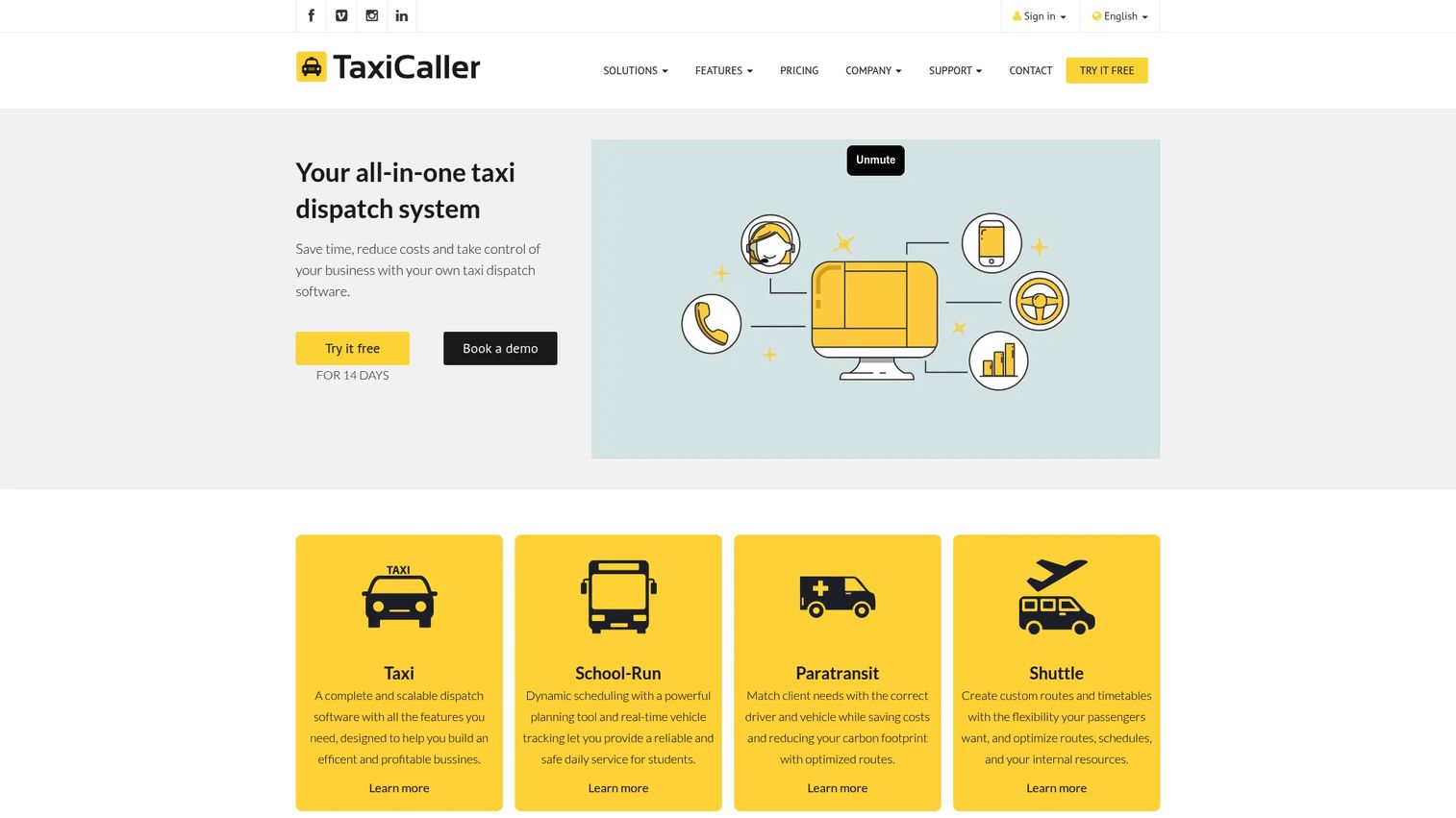
TaxiCaller is a cloud-based taxi dispatch and booking platform built for taxi, limo, private hire, and general transport operators. It bundles automated dispatch, a driver app, a passenger app, web and corporate booking, and reporting into one system. It is the safest starting point for most fleets because it covers the full workflow without forcing you into a heavy custom build, and its pricing is easier to reason about than most.
Best for: taxi and private-hire fleets that want broad, all-in-one functionality with clear per-vehicle pricing.
Key strengths
- Automated dispatch: rules-based assignment that removes manual matching and speeds up driver allocation.
- Real-time vehicle tracking: live location and status across the fleet for accurate ETAs and rerouting.
- Multi-channel booking: web, app, and corporate account channels feeding a single dispatch console.
Why choose TaxiCaller: if you want one vendor that handles booking, dispatch, apps, and reporting without a long implementation, this is the default pick. It fits operators who value predictable per-vehicle costs and a system they can stand up quickly rather than a bespoke platform that needs months of configuration.
TaxiCaller pricing: the public pricing page shows a per-vehicle monthly Taxi Dispatch Solution plan (billed monthly, excluding VAT) and an Enterprise plan with custom pricing. A 14-day free trial is available, so you can validate the workflow before committing. TaxiCaller holds a 4.2/5 rating on G2.
2. iCabbi
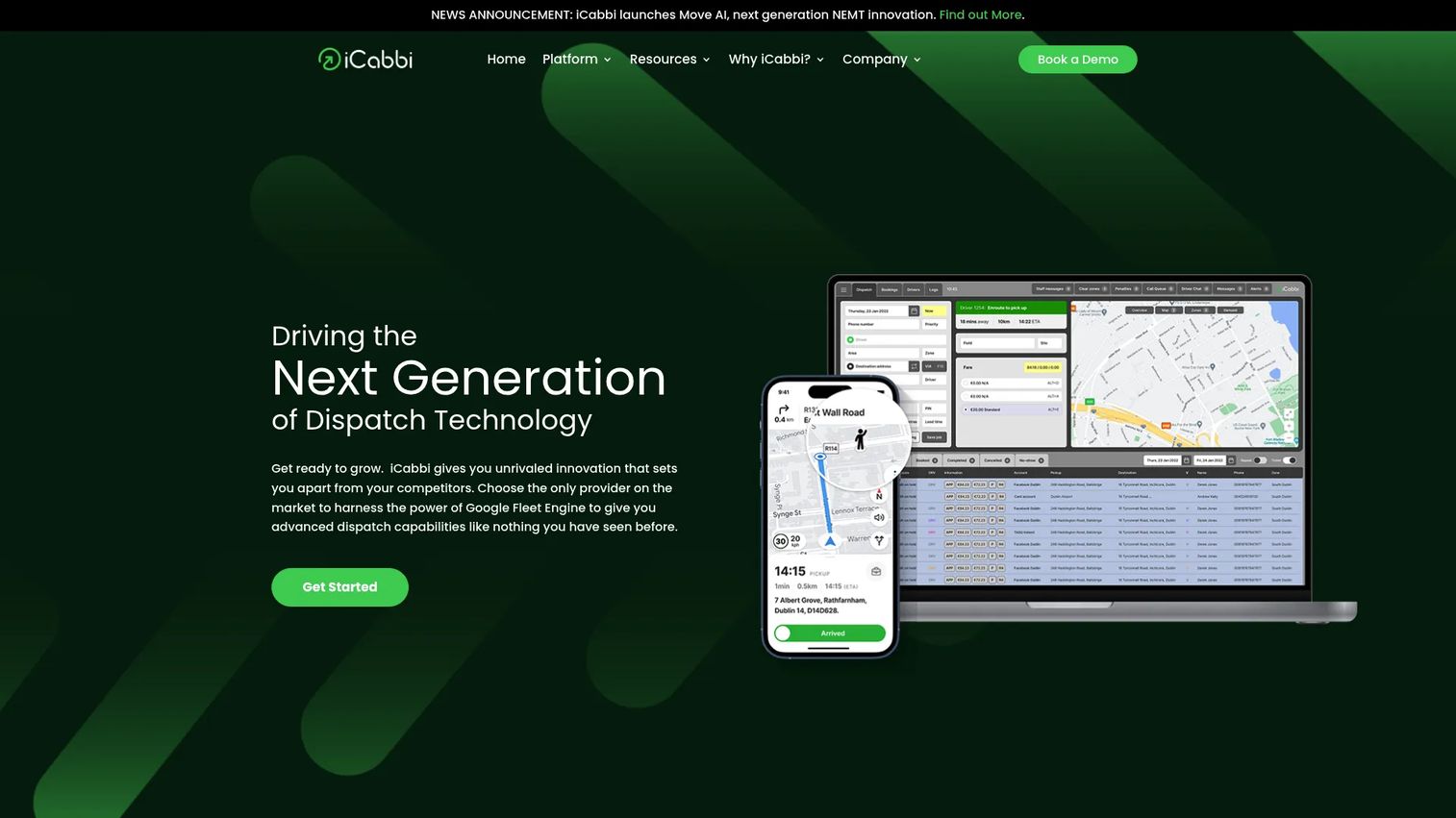
iCabbi is a taxi dispatch and mobility platform aimed at fleets that need precise, configurable dispatch at scale. It positions itself as an AI-first dispatch system, pairing automated assignment with a passenger app that includes live tracking and vehicle selection, and a driver app with navigation, safety, and earnings tools. For operations leaders who care about dispatch precision and control, this is the enterprise-leaning option on the list.
Best for: larger taxi and private-hire fleets that need deep dispatch configuration and strong operational control.
Key strengths
- AI-first dispatch: automated matching tuned for accuracy and efficiency across high booking volume.
- Passenger app with live tracking: riders see vehicle location, ETAs, and vehicle selection.
- Driver app with safety and earnings tools: navigation, job flow, and driver-facing reporting in one place.
Why choose iCabbi: choose iCabbi when configuration depth and dispatch precision matter more than the fastest possible setup. It suits operators running significant volume who want fine-grained control over assignment logic and a mature payments and passenger experience, and who are comfortable working through a tailored onboarding.
iCabbi pricing: iCabbi does not publish public pricing. The company describes a per-driver SaaS model and asks fleets to contact them for a tailored quote. That structure is common at the enterprise end of this online taxi dispatch system category, where pricing scales with fleet size and required modules.
3. Autocab
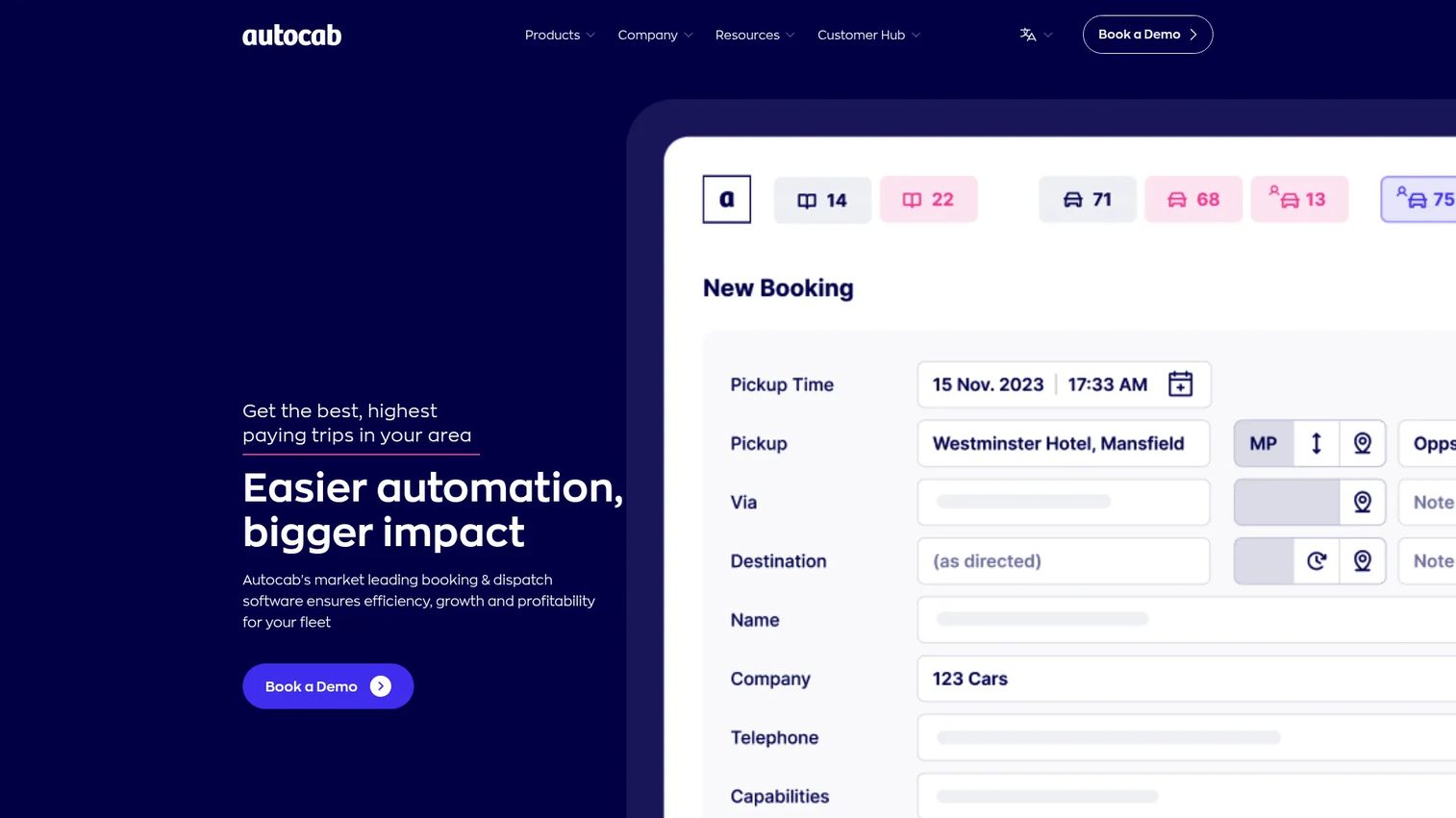
Autocab is an end-to-end taxi and private-hire software platform covering booking, dispatch, management and accounts, a driver companion app, a passenger app, corporate accounts, and analytics. Its standout angle is the iGo aggregation marketplace, which routes external demand into your fleet. For operators focused on growth and booking consolidation, that network access is the differentiator.
Best for: taxi and private-hire operators that want a full dispatch and management platform plus access to aggregated demand.
Key strengths
- Booking and dispatch plus Phantom: demand management and automated assignment across channels.
- Corporate accounts portal and E-Booker: structured account bookings and self-service booking tools.
- iGo aggregation marketplace: access to external ride demand routed into your fleet.
Why choose Autocab: pick Autocab if consolidating bookings from multiple channels and tapping an aggregation network matters to your growth plan. It is a broad platform with analytics and a full module set, so operators who want a simpler, lighter setup may prefer a more focused system, while those chasing demand and scale will value the ecosystem.
Autocab pricing: Autocab does not publish pricing on its site, so expect a quote based on your fleet size and the modules you need. It carries a 4.5/5 rating on G2 for its technology platform, which points to solid satisfaction among operators using the full suite.
4. TaxiMobility
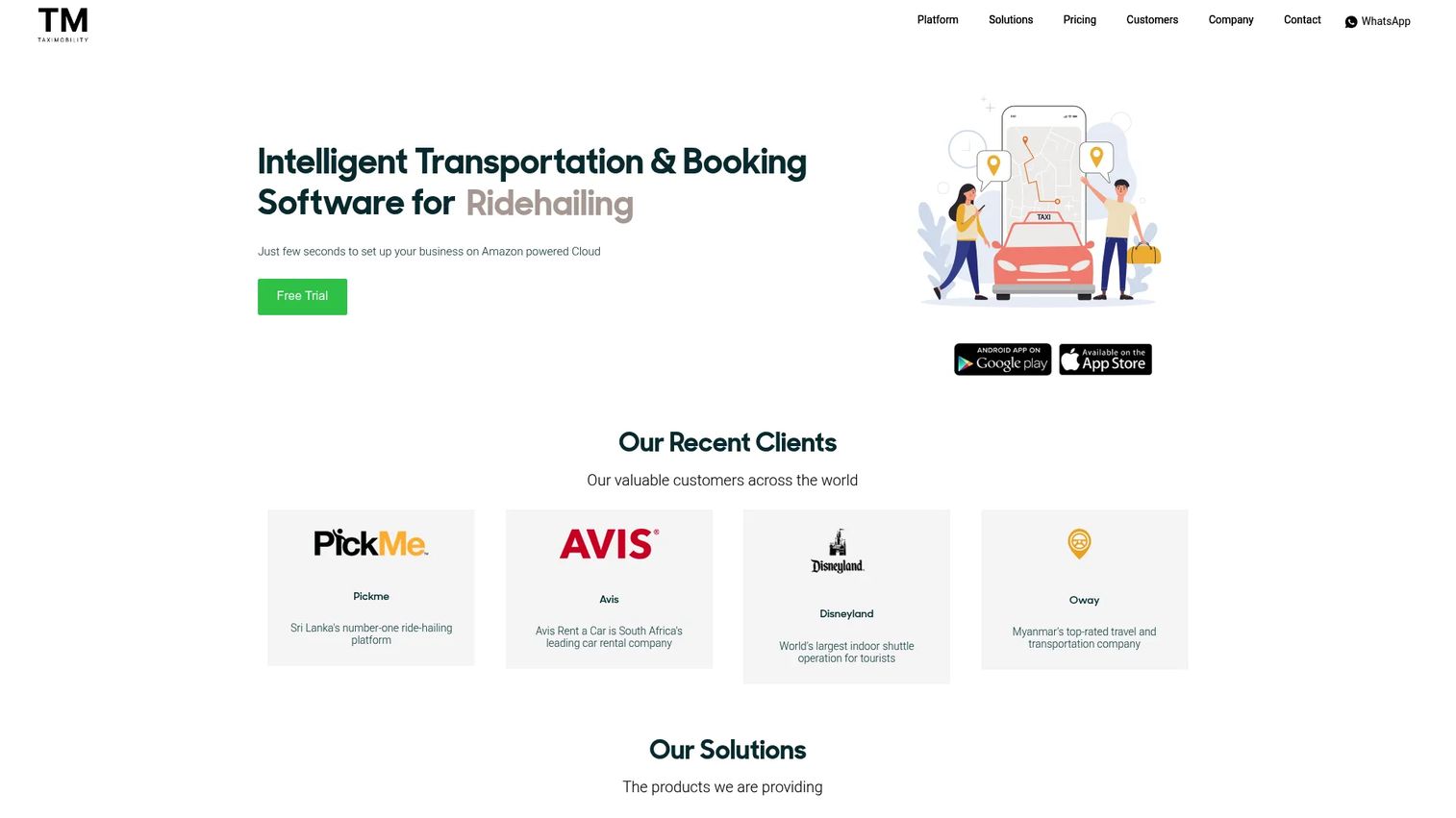
TaxiMobility is a cloud taxi management and dispatch platform with a strong analytics and white-label focus. It offers a white-label passenger app, driver dispatch and trip management, and real-time dispatch, tracking, and reporting, with predictive analytics layered on top. It also supports multiple mobility verticals, so it fits operators who plan to run more than a single taxi service.
Best for: taxi and mobility companies that want a white-label, analytics-forward platform that scales across drivers and verticals.
Key strengths
- White-label passenger application: launch rider apps under your own brand.
- Real-time dispatch, tracking, and reporting: live visibility with performance and revenue reporting.
- Predictive analytics: demand and operational insights to inform planning.
Why choose TaxiMobility: this is the pick when analytics and reporting depth carry real weight in your decision and you want per-driver pricing you can model in advance. The multi-vertical support and white-label apps suit operators who expect to expand their service lines rather than run a single fixed offering.
TaxiMobility pricing: pricing is published and per-driver. The Professional plan is $14 per driver for up to 50 drivers, the Enterprise plan is $16 per driver for unlimited drivers, and a Standalone option carries a flexible one-time fee for unlimited drivers. A free trial is available, and some app branding items cost extra. TaxiMobility holds a 4.3/5 rating on G2.
5. Gazoop
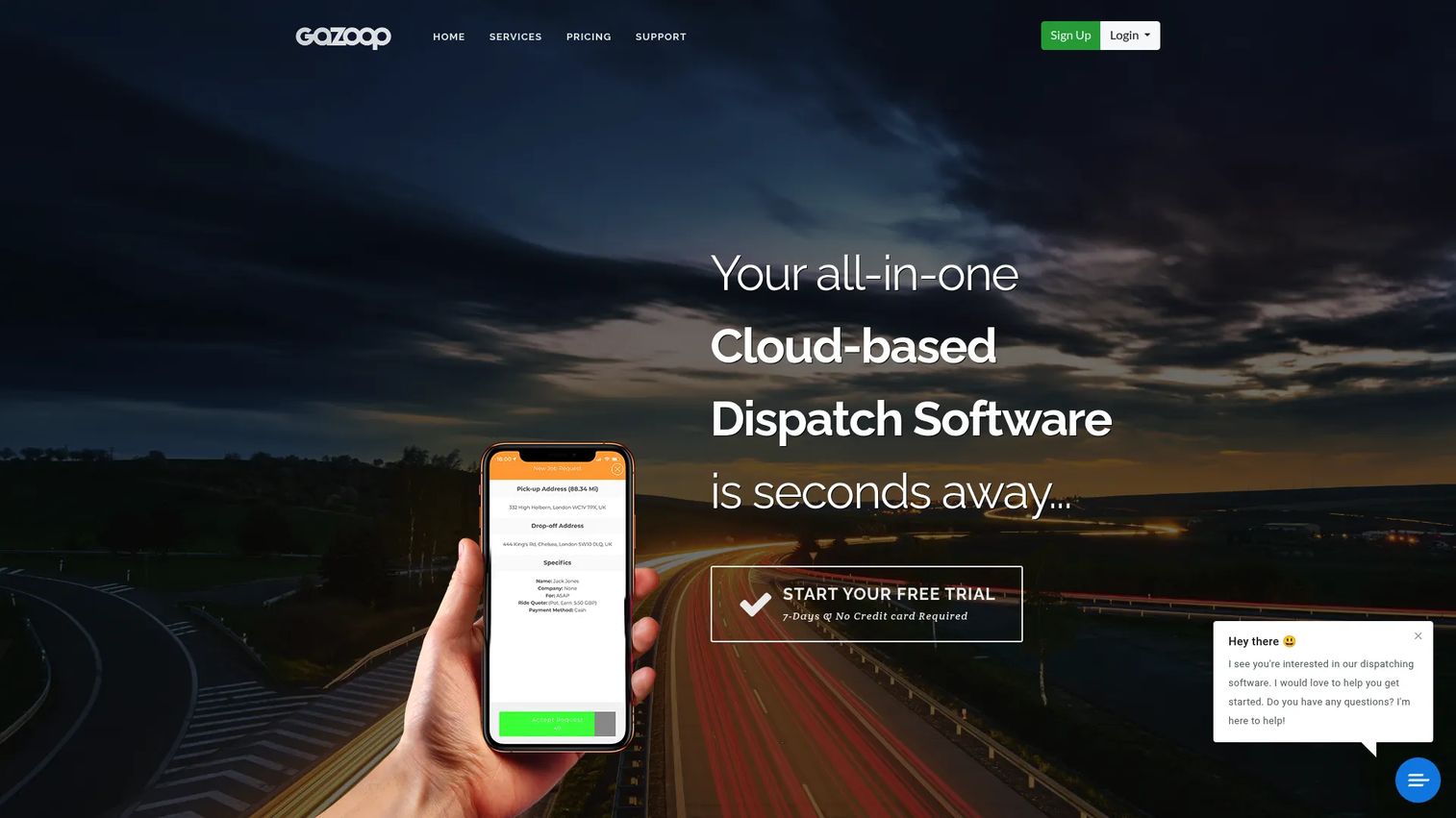
Gazoop is a cloud-based taxi and fleet dispatch platform built with a pay-as-you-go, low-commitment model that appeals to smaller and cost-sensitive operators. It covers dispatch and booking management, driver and customer management, and payments, invoicing, and API integrations. The free Lite tier makes it easy to try before spending anything, which is rare in this category.
Best for: small fleets and budget-conscious operators who want to start free and scale cost per driver.
Key strengths
- Dispatch and booking management: core automated dispatch without a heavy upfront commitment.
- Driver and customer management: organize drivers, customers, and bookings in one system.
- Payments, invoicing, and API integrations: billing tools plus integration flexibility.
Why choose Gazoop: Gazoop is the low-friction, price-sensitive choice. If you run a small fleet, want to validate the workflow at zero cost, and prefer weekly per-driver billing over annual contracts, it removes the financial barrier to getting started. Larger operators may eventually want deeper configuration, but the entry path is unmatched.
Gazoop pricing: the Lite plan is free for up to 10 bookings per month. Paid plans bill weekly per driver: Standard at $4, Premium at $5, and Ultimate at $6 per driver each week. Gazoop shows a 4.9/5 rating on its own reviews page, the highest score in this roundup, though that reflects self-hosted reviews rather than a third-party G2 listing.
6. Moovs
Moovs positions itself as a clean, transparent platform for smaller operator teams and multi-service transportation businesses. It centers on an easy-to-use dispatch and booking workflow with strong customer communication features, making it a good fit for operators who want usability over configuration complexity. Booking links and a straightforward interface help teams get moving without a steep learning curve.
Best for: SMB operators and multi-service transportation teams that want a clean workflow and transparent plans.
Key strengths
- Dispatch and booking workflow: an intuitive grid and calendar for managing rides and drivers.
- Customer communication: built-in passenger updates and booking links.
- Usability focus: a lower learning curve for smaller teams onboarding quickly.
Why choose Moovs: if your priority is a system your team can actually use without training and you value transparent plans, Moovs is built for that. It fits operators who want to spend time serving customers rather than configuring software, and who run smaller or mixed-service fleets rather than large single-service operations.
Moovs pricing: Moovs publishes its plans on its site. It holds a 4.5/5 rating on G2, with Capterra reviewers reporting similarly strong satisfaction, which supports its usability-first positioning. Confirm current plan details and any free option directly on its pricing page before committing.
7. Onde
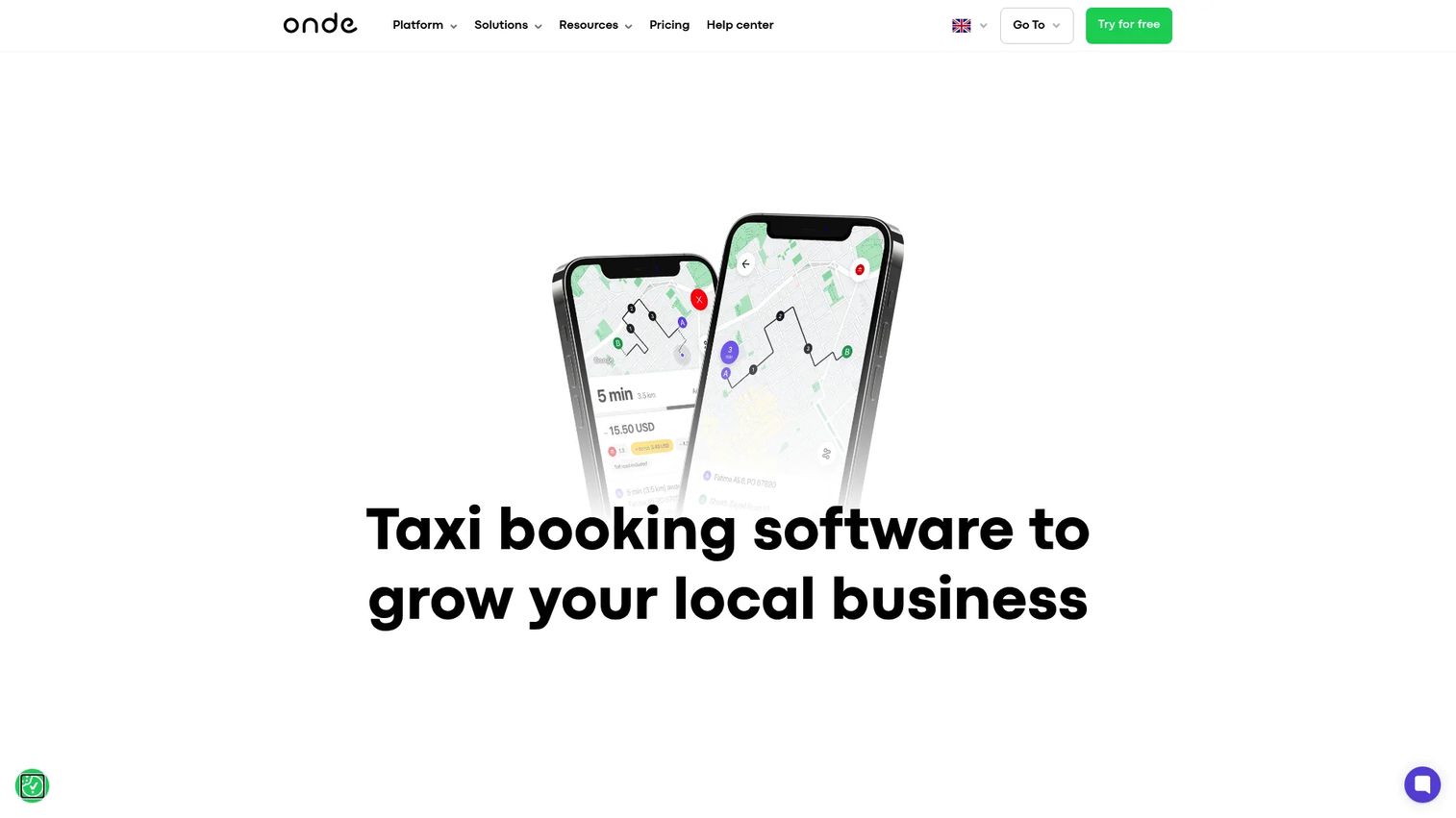
Onde is white-label ride-hailing software built to launch and operate a branded taxi or on-demand mobility business quickly. It ships white-label iOS and Android customer and driver apps, order management and admin dispatch tools, and performance reports with in-app marketing. For operators who care about brand control and mobile-first operations, Onde is designed around getting a branded product live fast.
Best for: ride-hailing and taxi operators that want a branded, mobile-first platform they can launch and scale.
Key strengths
- White-label customer and driver apps: fully branded iOS and Android apps for riders and drivers.
- Order management and dispatch tools: admin controls for assignment and operations.
- Analytics and in-app marketing: performance reports plus tools to drive rider engagement.
Why choose Onde: Onde is the pick when your brand is the product and you want to launch mobile-first without building apps from scratch. It suits growth-oriented operators who want ownership of the customer experience, though the one-time-plus-support pricing model means you should read the plan structure carefully against your budget.
Onde pricing: Onde publishes four plans, each combining a one-time fee, a monthly support fee, and a revenue share. Starting up is $4,500 one-time plus $99 monthly, Professional is $8,500 plus $99, Super App is $6,500 plus $259, and Expert is $23,000 plus $99. A 14-day free trial is offered, and Onde.Light carries no setup fee. Onde holds a 4.8/5 rating on G2.
8. Ridecell
Ridecell is a fleet orchestration and shared mobility platform that reaches beyond taxi-only use cases into vehicle sharing, rentals, and corporate mobility. It offers automated driver verification and credit checks, dynamic pricing and recurring billing, and real-time vehicle monitoring, diagnostics, and workflow automation. Operators shortlist it when automation depth and broader mobility operations matter as much as dispatch.
Best for: operators needing a white-label shared mobility platform with heavy fleet automation and integration depth.
Key strengths
- Automated driver verification and credit checks: streamlined onboarding and risk workflows.
- Dynamic pricing and recurring billing: flexible pricing plus subscription-style billing.
- Real-time monitoring and workflow automation: vehicle diagnostics and automated operational flows.
Why choose Ridecell: Ridecell fits operators whose ambitions extend past classic taxi dispatch into shared mobility, rentals, or corporate fleets. If you want automation and data integration across a wider mobility operation, it delivers that breadth, while operators who need a taxi-specialist tool first may prefer one of the focused platforms above.
Ridecell pricing: Ridecell does not publish pricing on its site and routes buyers to demo and contact flows, so expect a tailored quote. It carries a 4.5/5 seller rating on G2. Given the platform's automation depth, pricing will typically reflect the scope of mobility operations you plan to run.
Considerations before you buy
Once you have a shortlist, pressure-test each option against the criteria that decide whether the rollout sticks.
Dispatch automation depth
Look past "automated dispatch" as a checkbox. Ask how assignment rules work: can you weight by proximity, zone, driver rank, and vehicle type? The more the system handles automatically, the less your dispatch office fights fires. Shallow automation just relocates the manual work.
App quality and passenger communication
Your driver and passenger apps are the product your customers actually touch. Evaluate driver navigation, job flow, and earnings visibility, plus passenger live tracking, ETAs, and notifications. Weak passenger communication is a direct churn risk when riders can open a rideshare app instead.
Reliability and fleet scalability
Downtime in dispatch is lost revenue, full stop. Ask about uptime commitments and how the platform behaves at peak volume. A cloud taxi dispatch system should scale as you add vehicles without a rebuild, so confirm the pricing and architecture support the fleet size you expect in two years.
Pricing clarity and total cost
Published per-vehicle or per-driver pricing is easier to model than quote-only, but quote-based often reflects enterprise depth rather than a hidden trap. Map setup fees, support fees, revenue share, and any per-app branding costs into a total, not just the headline number.
Implementation and onboarding effort
A cloud platform with a free trial can go live in days. A heavily customized or white-label build takes longer. Match the setup effort to your timeline and your team's appetite for configuration, and use any trial to test the real workflow before you sign.
Conclusion
There is no single best taxi dispatch software, only the best fit for your fleet size, growth plan, and tolerance for setup. For most operators, TaxiCaller is the safest all-rounder thanks to broad functionality and transparent per-vehicle pricing. Budget-conscious and small fleets should start with Gazoop and its free tier. Enterprise operators who need dispatch precision will lean toward iCabbi, while analytics-forward teams get strong value from TaxiMobility. If brand control and mobile-first launch matter most, Onde is built for that, and Moovs wins on clean usability for smaller teams. Autocab stands out for booking consolidation and aggregated demand, and Ridecell for broader mobility automation.
Keep the buying criteria front and center: automation depth, real-time tracking, app quality, uptime, pricing clarity, and onboarding effort. Your next step is simple. Pick two or three that match your intent, start a free trial where one exists, and run your real booking volume through each before committing. If you build software of your own and want prospects to experience it before a call, you can Start your journey with Guideflow today!
FAQs
Taxi dispatch software is a system that automates booking intake, assigns rides to drivers, tracks vehicles in real time, and keeps passengers updated across the trip. It replaces manual radio dispatch, paper logs, and spreadsheets with a single operations layer. Most modern options are cloud-based, so you get remote access and automatic updates.
At a minimum, look for automated dispatch, real-time GPS tracking, a driver app, a passenger app or booking widget, and multi-channel booking across phone, web, app, and corporate accounts. Payments and invoicing plus analytics and reporting round out the core. The depth of each feature, not just its presence, is what separates platforms.
For a small fleet, dispatch software removes manual coordination that eats a dispatcher's day. It cuts missed rides, speeds up driver assignment, and adds consistency without hiring more office staff. Platforms with free or low-cost per-driver tiers, like Gazoop, let small operators start without a big financial commitment.
A generic scheduling tool handles shifts and calendars, not live ride operations. Taxi dispatch software adds ride assignment, real-time GPS tracking, passenger apps, and trip-level payment and reporting that a general planner cannot do. If you are coordinating live pickups minute by minute, a purpose-built taxi system is the right fit.
Pricing varies widely by model. Per-driver plans start around $14 with TaxiMobility, Gazoop runs from $4 per driver weekly with a free tier, and Onde uses a one-time fee plus monthly support and revenue share starting at $4,500. Enterprise platforms like iCabbi, Autocab, and Ridecell use quote-based pricing that scales with fleet size and modules. Factor in setup, support, and any per-app branding fees.
Most serious platforms include both a driver companion app and a passenger app or booking widget. Quality and white-label flexibility vary a lot: TaxiMobility and Onde emphasize fully branded white-label apps, while others provide functional apps under their own branding. Confirm which apps are included at your chosen tier and whether branding costs extra.
Focus on dispatch automation depth, real-time tracking, app quality, analytics and reporting, uptime reliability, support, and onboarding speed. Match published or quoted pricing to your fleet size, and use free trials to test your real booking volume. The right online taxi dispatch system is the one that fits your operation, not the one with the longest feature list.
It depends on the platform type. A cloud taxi dispatch system with a free trial can go live in days once you configure zones, drivers, and booking channels. Heavily customized or white-label builds, common with branded mobile platforms, take longer because apps and branding need setup. Use any trial period to validate the workflow before you commit.