You can run one production model in a spreadsheet longer than you should. Add batches, assemblies, rework, shelf life, make-to-order jobs, and shared inventory, and the spreadsheet becomes the bottleneck. The operations leader firefights. Finance closes the month with numbers that don't match the floor. The board asks about gross margin, and nobody has a clean answer.
This is the core problem with manufacturing organizations that combine process and discrete production: Most software handles one model well and forces the other into workarounds. According to IndustryWeek (2025), 94% of North American manufacturing leaders planned to invest in ERP within 12 to 24 months. The pressure to consolidate fragmented planning, traceability, and financial data into a single operational system is real.
The right mixed mode ERP system lets you run batch-produced ingredients alongside configured assemblies, connect recipe data to BOM-driven production, and give your new VP of Operations something that works on day one.
What's inside
This guide is for founders, operations executives, and ERP project owners evaluating platforms that handle more than one manufacturing model. Items were selected based on four criteria:
- Mixed-mode production fit: Support for process, discrete, batch, repetitive, make-to-stock, and make-to-order workflows
- Operational depth: Planning, scheduling, inventory, quality, traceability, and costing in one system
- Deployment options: Cloud, on-premise, or hybrid availability
- Implementation practicality: Evidence of partner ecosystems, realistic go-live paths, and total cost transparency
TL;DR
- Best for flexible cloud manufacturing: Acumatica handles varied production methods with consumption-based licensing and broad business management coverage
- Best for manufacturing-specific mixed-mode depth: SYSPRO ERP is built specifically for manufacturers combining discrete, process, and batch production
- Best for industrial manufacturers: Aptean Industrial Manufacturing ERP covers production planning, quality, shop-floor operations, and job costing for industrial environments
- Best for job shops and engineer-to-order: ECI M1 ties estimating, scheduling, and job costing to each customer-specific order
- Best for open-source flexibility: xTuple suits teams with internal technical ownership that need a configurable ERP foundation
- Best for enterprise scale: SAP S/4HANA Cloud Public Edition and Microsoft Dynamics 365 Supply Chain Management fit organizations with global operations, complex governance, or an existing Microsoft stack. Implementation capacity and partner fit decide which earns the cost
What is mixed mode ERP software?
Mixed mode ERP software is an enterprise resource planning system designed to manage organizations that combine two or more manufacturing methods, such as process, discrete, batch, repetitive, make-to-stock, and make-to-order production, within a single operational system.
The manufacturing modes it brings together
Each production type carries different data requirements. A mixed mode ERP system needs to handle all of them without forcing teams into disconnected workflows:
- Process manufacturing: Recipes, formulas, batches, yields, variable units of measure, shelf life, and lot tracking
- Discrete manufacturing: Bills of materials, assemblies, routings, work orders, serial numbers, and component traceability
- Make-to-stock: Production based on forecasted demand and inventory targets
- Make-to-order: Production triggered by confirmed customer demand
- Engineer-to-order: Production that begins after design or engineering work is complete
- Job-shop production: High-mix work moving through different work centers on individual schedules
- Repetitive and continuous production: Standardized or uninterrupted production flows
The capabilities mixed-mode manufacturers need
A credible mixed mode ERP system covers:
- Bills of materials, formulas, and recipes in a shared item master
- MRP, purchasing, and materials planning
- Production orders, routings, and finite scheduling
- Inventory, lot, serial, and shelf-life traceability
- Quality checks, nonconformance tracking, and corrective actions
- Costing by material, labor, overhead, yield, and variance
- Shop-floor execution and production reporting
- Finance, order management, and demand forecasting
Why one operational system matters
The value is not simply more features. It is fewer manual handoffs between recipe-driven production, assembly work, inventory, purchasing, finance, and customer commitments. When those functions share a data model, operations leaders get reliable views of margin, backlog, and quality risk without stitching together five dashboards.
| Operational element | Process manufacturing | Discrete manufacturing | Mixed-mode requirement |
|---|---|---|---|
| Production unit | Batch or lot | Work order or job | Both, connected |
| Materials definition | Recipe or formula | Bill of materials | Shared item master |
| Traceability | Lot and batch | Serial and component | Combined trace chain |
| Costing | Yield and variance | Labor and overhead | Unified cost model |
When to use mixed mode ERP software
Run process and discrete production in the same facility
A manufacturer that produces a batch compound, coating, or ingredient, then uses it as a component in a finished assembly, needs recipe data and BOM data to connect. Without that connection, production planning creates two separate material flows that never reconcile in inventory or cost.
Plan forecast-driven and customer-specific work together
Keeping finished goods available while also responding to bespoke orders creates a planning tension. Inventory allocation, capacity decisions, and purchasing lead times change when both models operate simultaneously. A mixed mode ERP system resolves this by running MRP across stock targets and open customer orders from the same planning engine.
Improve traceability and quality across varied workflows
Lot traceability, serial tracking, quality checkpoints, and supplier records often span different production processes. A single ERP connects them without side spreadsheets, which matters when a quality event on a batch-produced sub-component needs to trace forward to finished assemblies already shipped. For more on batch management software that feeds into this workflow, that guide covers dedicated batch tracking tools.
Mixed mode ERP software comparison
Software fit in this category turns on the balance of process versus discrete production, current implementation capacity, industry regulations, and how much operational complexity the organization can absorb during go-live. No platform wins across all dimensions. The table below orders tools by relevance to mixed-mode manufacturing.
| # | Product | Best for | Key differentiator | Pricing | G2 rating |
|---|---|---|---|---|---|
| 1 | Acumatica | Cloud-first manufacturers with varied production methods | Flexible cloud ERP with industry editions and unlimited-user licensing | From under $1,495/mo (APEX) | 4.4/5 |
| 2 | SYSPRO ERP | Mixed-mode manufacturers needing manufacturing-specific depth | Discrete, process, batch, repetitive, and mixed-mode support | Custom pricing | 4.1/5 |
| 3 | Aptean Industrial Manufacturing ERP | Industrial manufacturers needing vertical manufacturing workflows | Production scheduling, quality, job costing, and shop-floor management | Custom pricing | N/A |
| 4 | ECI M1 | Job-shop and engineer-to-order manufacturers | Estimating, quoting, scheduling, and job-cost visibility | Custom pricing | N/A |
| 5 | xTuple | Teams with technical ownership needing a configurable ERP foundation | Manufacturing and distribution ERP with open, configurable architecture | Custom pricing | 3.0/5 |
| 6 | Epicor Kinetic | Mid-market to enterprise manufacturers with complex production | Manufacturing-focused ERP with planning, shop-floor, and supply-chain depth | Custom pricing | 3.9/5 |
| 7 | Infor CloudSuite Industrial | Complex discrete and mixed-mode operations | Industry workflows, advanced planning, and operational analytics | Custom pricing | N/A |
| 8 | Microsoft Dynamics 365 Supply Chain Management | Organizations on the Microsoft stack | Deep supply-chain, planning, finance, and Microsoft application integration | From $210/user/mo | 3.7/5 |
| 9 | Oracle NetSuite | Growing manufacturers prioritizing finance-first cloud ERP | Unified cloud ERP with manufacturing, inventory, and financial management | Custom pricing | 4.1/5 |
| 10 | SAP S/4HANA Cloud Public Edition | Global or highly complex enterprise operations | Enterprise-scale financial, supply-chain, production, and governance support | Custom pricing | 4.4/5 |
Best 10 mixed mode ERP software tools for 2026
The platforms below are ordered by fit for mixed-mode manufacturing, operational breadth, deployment flexibility, and realistic implementation path for organizations at the growth stage where operational debt becomes a drag on margin and reporting credibility.
1. Acumatica
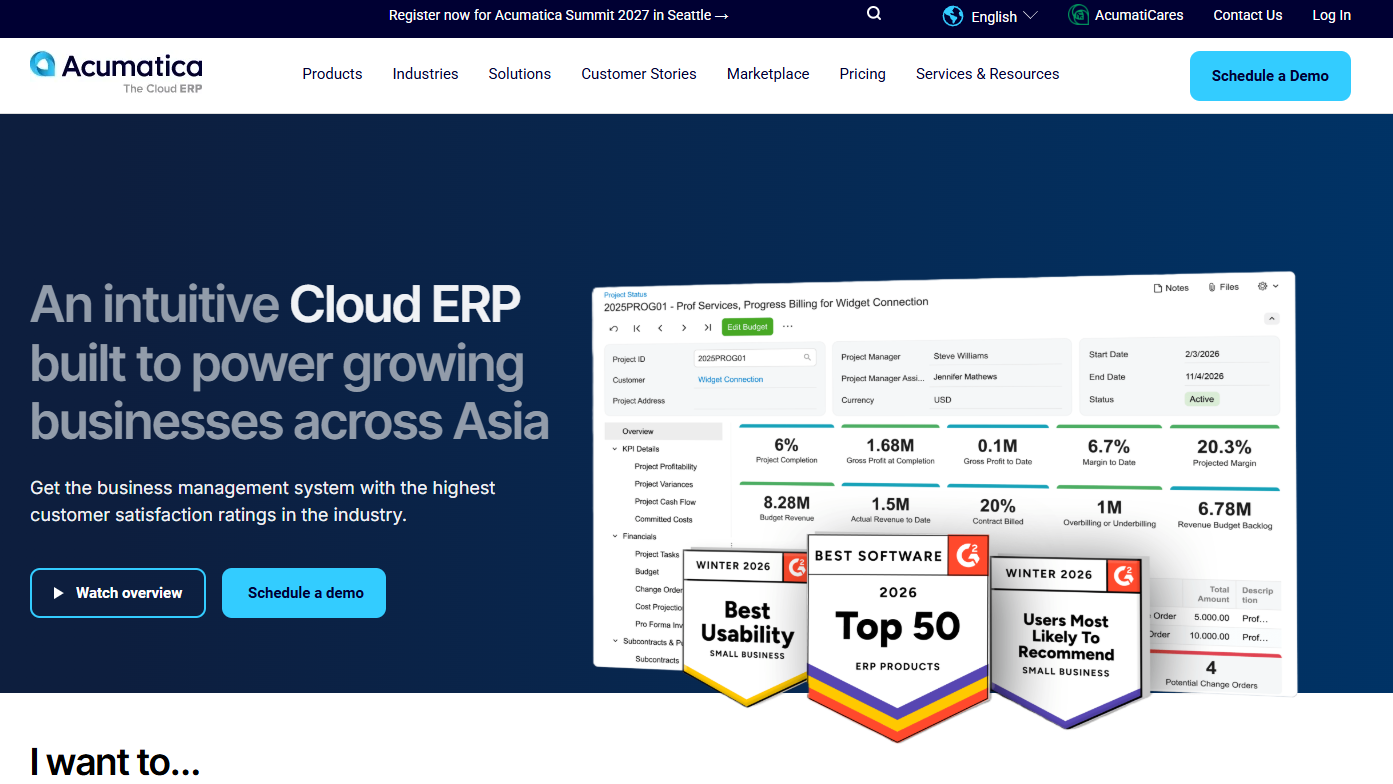
Acumatica is a cloud ERP and business management platform built for growing small and midsize organizations. Its manufacturing edition covers production planning, bills of materials and routings, material requirements planning, production order management, and inventory and warehouse controls. The platform offers industry-specific editions for manufacturing, distribution, construction, and retail, and runs on a consumption-based licensing model rather than a per-seat structure.
Best for: Growing manufacturers that need cloud ERP coverage across finance, inventory, production, and customer orders without committing to a per-seat cost model.
Key features
- Cloud-based manufacturing edition with industry-specific configuration
- Bills of materials, routings, and production order management
- Material requirements planning and purchasing integration
- Inventory, warehouse, and lot traceability controls
- Unlimited users under consumption-based licensing
Why choose Acumatica: The unlimited-user model removes a common scaling friction. If your operations team, finance team, and shop-floor supervisors all need system access, you're not paying per seat for every additional person. That pricing structure, combined with configurable cloud workflows, makes Acumatica a practical choice for organizations that want a single operational system before they need a full enterprise stack.
Acumatica pricing: Acumatica's APEX for Manufacturing package starts under $2,185 per month. Standard production pricing is customized by applications, business usage, and deployment preferences.
G2 rating: 4.4/5
2. SYSPRO ERP
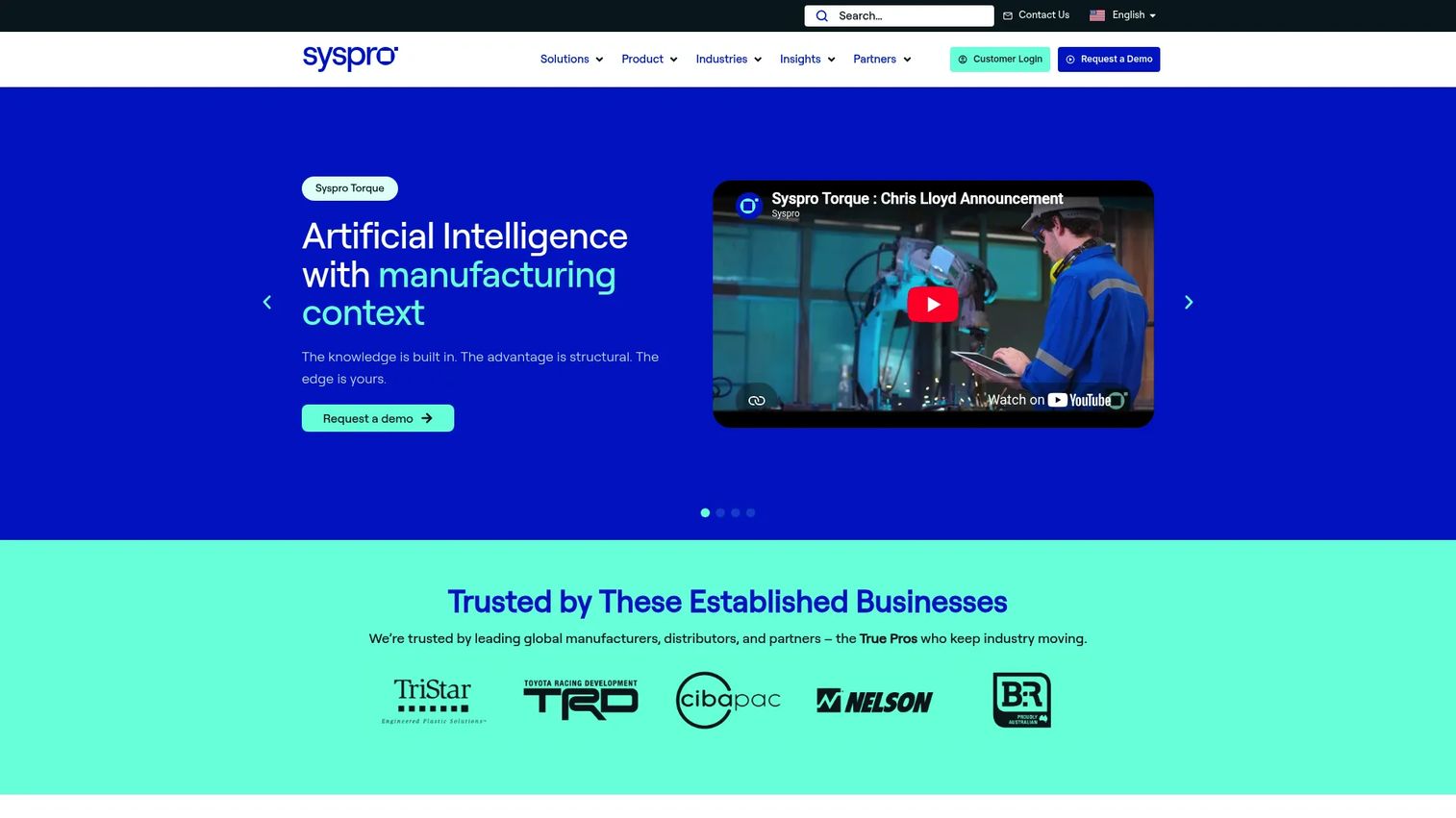
SYSPRO ERP is an industry-specific ERP platform built for manufacturers and distributors. It supports discrete, process, batch, repetitive, and mixed-mode production models, along with financial management, supply-chain operations, warehouse management, and embedded analytics. The platform is available as cloud, on-premise, or hybrid deployment, and includes AI and machine learning capabilities alongside workflow automation.
Best for: Mid-sized manufacturing and distribution companies that need production planning, traceability, quality management, and inventory controls built around diverse production models.
Key features
- Mixed-mode manufacturing support: Discrete, process, batch, and repetitive
- Bill of materials, MRP, and manufacturing operations management
- Batch and lot traceability with quality management controls
- Warehouse management and automated inventory replenishment
- Embedded analytics, AI, and workflow automation
Why choose SYSPRO ERP: Manufacturing specificity matters when a generic ERP pushes production complexity into spreadsheet workarounds. SYSPRO is designed around manufacturing workflows from the data model up, which reduces the configuration effort required to make standard ERP modules reflect how factories actually operate. Buyers whose primary selection criteria are production depth and operational visibility across different methods will find SYSPRO worth evaluating closely.
SYSPRO ERP pricing: SYSPRO prices by custom quote based on organization size, users, modules, deployment method, and implementation requirements. Contact SYSPRO directly for a current range.
G2 rating: 4.1/5
3. Aptean Industrial Manufacturing ERP
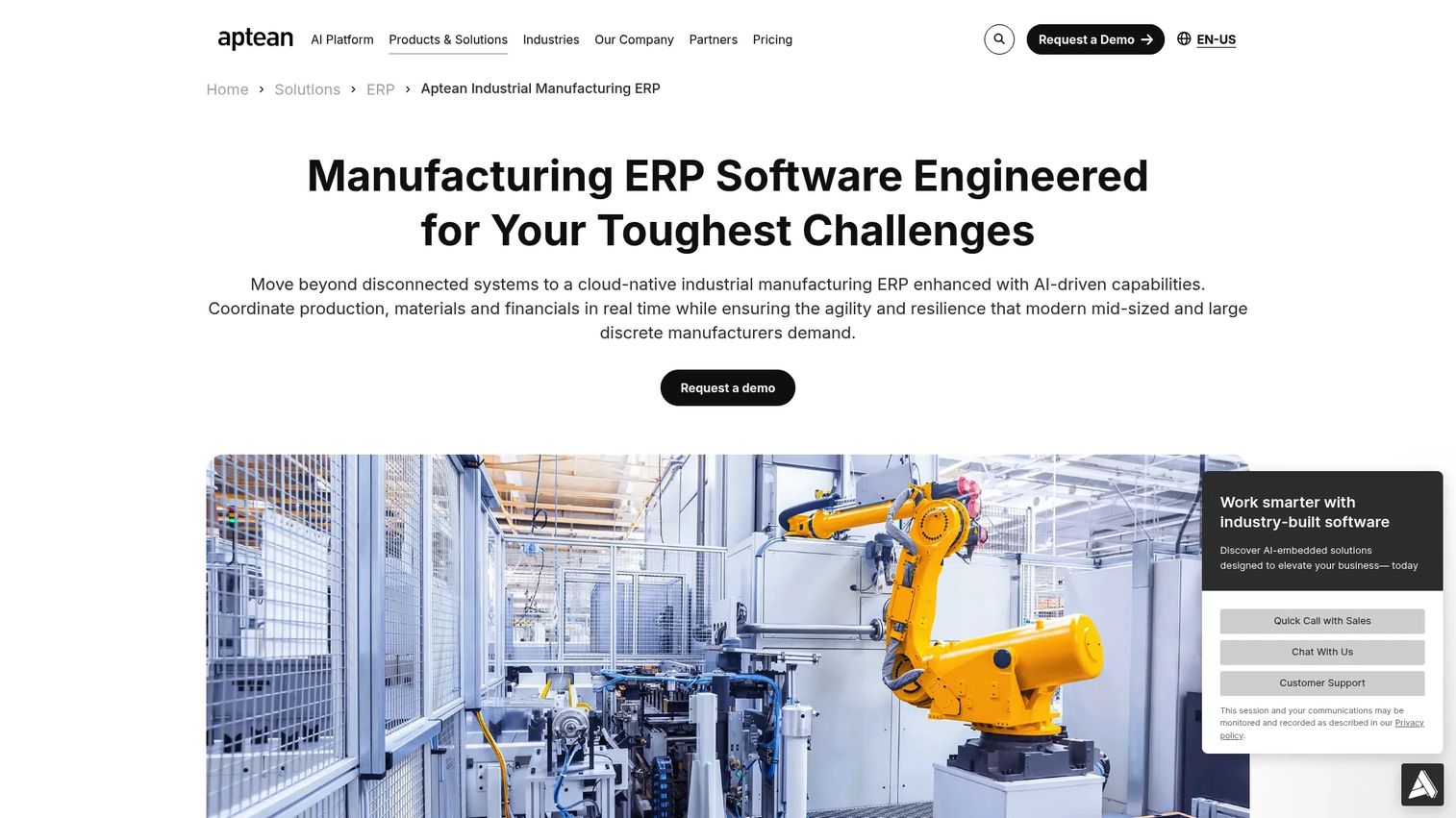
Aptean Industrial Manufacturing ERP is a cloud-native, AI-enabled ERP platform for mid-sized and large industrial and discrete manufacturers. It covers production planning and scheduling, materials and inventory management, multi-level bill of materials, shop-floor operations, engineering change management, job costing, and financial management. The platform positions itself as a vertical manufacturing solution rather than a generic ERP with manufacturing modules added.
Best for: Industrial manufacturers with complex production workflows that need planning, quality, shop-floor coordination, and job costing built for manufacturing environments.
Key features
- Production planning and scheduling
- Multi-level bill of materials and engineering change management
- Materials and inventory management
- Shop-floor operations and real-time reporting
- Job costing and financial management
Why choose Aptean Industrial Manufacturing ERP: The case for Aptean is operational structure. Companies that have outgrown general-purpose accounting plus inventory tools often find that a manufacturing-specific platform reduces the configuration overhead required to get production visibility. If planning, quality, and shop-floor coordination are recurring bottlenecks, this platform addresses those gaps with vertical manufacturing workflows rather than horizontal feature additions. Ask the vendor to demonstrate one end-to-end production scenario with quality checkpoints and cost variance reporting before moving forward.
Aptean Industrial Manufacturing ERP pricing: Aptean does not display public pricing. Contact Aptean for packaging, implementation approach, and contract structure.
4. ECI M1
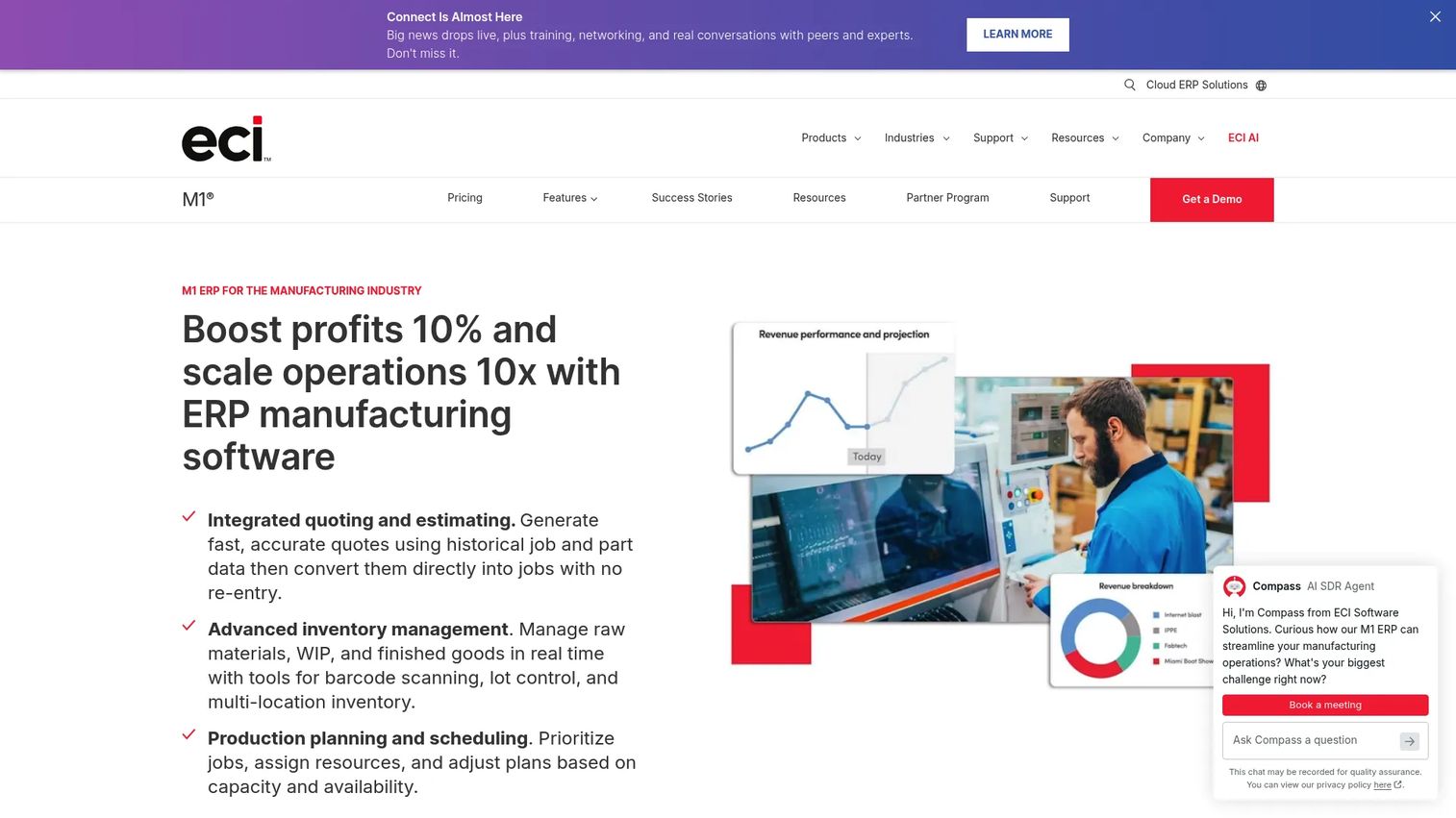
ECI M1 is a cloud-based ERP and business management platform for discrete and mixed-mode manufacturers. It is frequently evaluated by job shops and engineer-to-order operations where customer-specific quotes, engineering changes, and job-level scheduling decisions drive profitability. Core capabilities include integrated quoting and estimating, advanced inventory management with multi-location support, production planning and scheduling, job costing, and customer order management.
Best for: High-mix manufacturers where every job may differ, and where accurate estimating, capacity visibility, and handoff speed from sales to production directly affect margin.
Key features
- Integrated estimating and quoting workflows
- Job costing and profitability tracking per order
- Production scheduling and multi-location inventory management
- Customer order management and purchasing controls
- Multi-location inventory with traceability
Why choose ECI M1: Job shops and engineer-to-order operations have a fundamentally different planning challenge than repetitive manufacturers. ECI M1 is built around the estimating-to-delivery cycle, which means the data model reflects job-level cost visibility rather than product-line aggregates. For a founder evaluating this platform for a subsidiary or portfolio company running custom fabrication or configured products, ask ECI to run a scenario that moves from a customer inquiry through quoting, production scheduling, material issuance, and job close with cost variance reporting.
ECI M1 pricing: ECI does not publish numeric pricing. Contact ECI for current package names, quote model, and implementation guidance.
5. xTuple
xTuple is an ERP platform for manufacturing and distribution organizations covering accounting, CRM and sales, distribution, inventory management, manufacturing, and MRP. The platform emphasizes configurable workflows and flexible deployment, including cloud and on-premise options, with an architecture that allows technical teams to tailor processes to their operational requirements. Pricing is described as comprehensive and all-inclusive, covering software licenses, onboarding, cloud hosting or on-premises deployment, and ongoing support.
Best for: Small and midsized manufacturing and distribution businesses that have internal technical ownership and want a configurable ERP foundation rather than a preconfigured vertical package.
Key features
- Accounting, financial management, and CRM
- Inventory, warehouse management, and purchasing controls
- Manufacturing, bill of materials, and production planning
- MRP and distribution workflows
- Configurable business processes and open architecture
Why choose xTuple: The strongest fit is for teams that value control and the ability to configure workflows to match existing operational processes. That benefit requires implementation discipline. A highly configurable platform without internal governance creates its own technical debt over time. xTuple works well when the COO or Head of Operations is prepared to own the configuration and maintenance decisions rather than handing them to a partner indefinitely.
xTuple pricing: xTuple does not display numeric pricing. The all-inclusive model covers software, onboarding, hosting, and support. Contact xTuple for a current quote.
G2 rating: 3.0/5
6. Epicor Kinetic
Epicor Kinetic is a cloud ERP built specifically for manufacturers. It supports make-to-order, configure-to-order, engineer-to-order, and make-to-stock production models, along with planning and scheduling, project management, business intelligence, shop-floor data collection, and supply-chain management. The platform includes forecasting, MRP, advanced planning and scheduling, and multi-site management, with extensibility through configurable workflows, REST APIs, and enterprise search. According to IDC via Epicor (2025), 43% of manufacturers planned to adopt new ERP solutions within two years.
Best for: Mid-market and enterprise manufacturers with multi-site operations, complex planning requirements, or a need for stronger control across production, supply chain, and financial operations.
Key features
- Production management for make-to-order, configure-to-order, and engineer-to-order
- Advanced planning and scheduling with MRP and multi-site support
- Manufacturing execution and shop-floor data collection
- Supply-chain management and product configuration support
- Self-service analytics, real-time production intelligence, and operational dashboards
Why choose Epicor Kinetic: Epicor earns consideration when operational complexity is the primary driver. Multi-site manufacturers that need finite scheduling, product configuration, and a data model that handles diverse production methods across plants will find the depth justifies the implementation investment. Epicor Kinetic is not a first ERP for a small team. It rewards a structured implementation with a qualified partner and defined success criteria before the project starts.
Epicor Kinetic pricing: Epicor does not publish pricing. Contact Epicor for module and deployment options, with independent ranges available through G2 reviewer reports.
G2 rating: 3.9/5
7. Infor CloudSuite Industrial
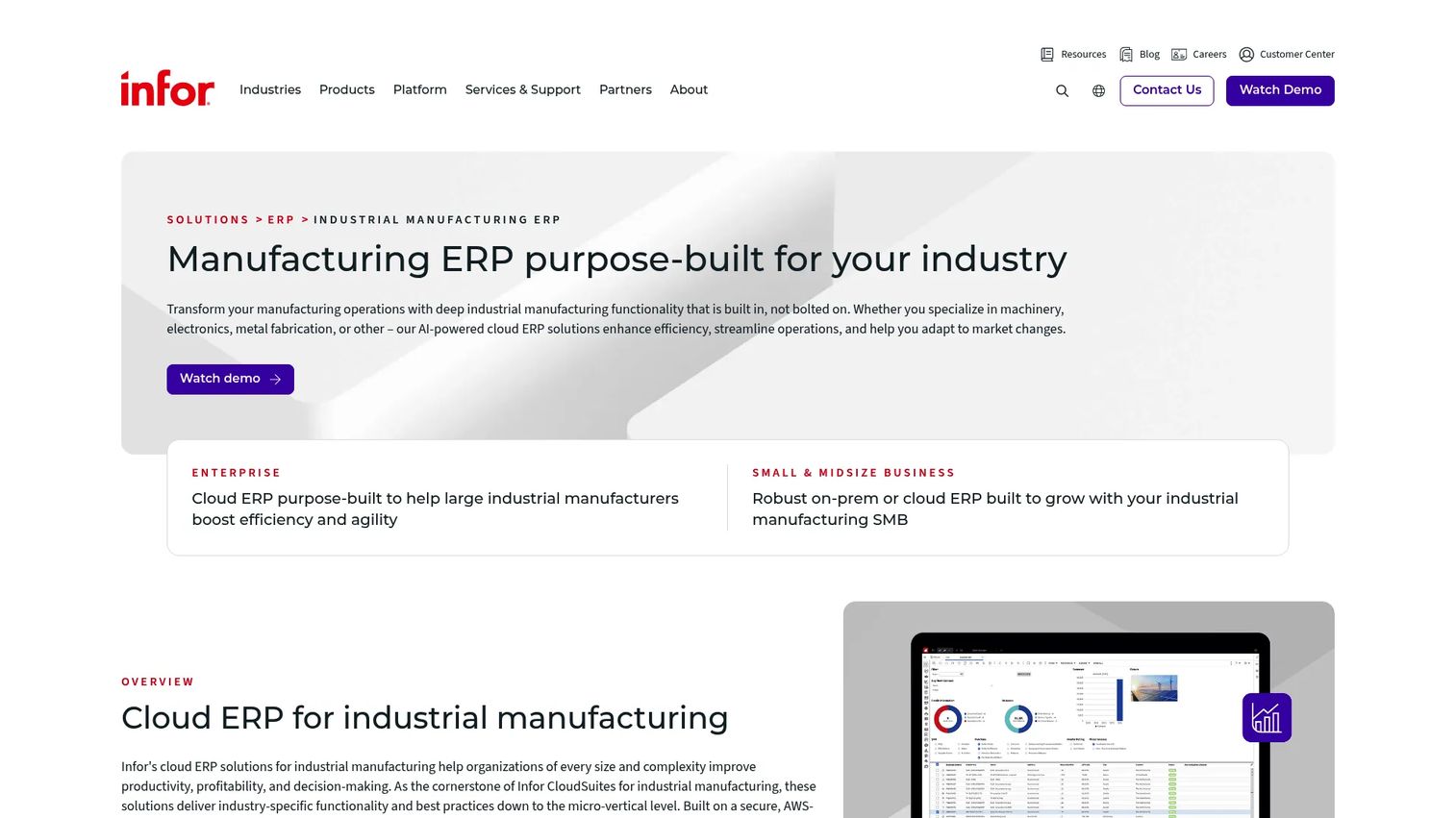
Infor CloudSuite Industrial is an industry-specific cloud ERP for industrial manufacturers, supporting enterprise and small-to-midsize operations. It covers manufacturing, inventory, planning, supply chain, financial management, quality, and service capabilities, with support for multi-site, multi-company, and multi-country operations. The platform includes real-time analytics, process mining, AI, and automation, along with industry-specific workflows that reflect manufacturing operational patterns rather than generic ERP configurations.
Best for: Manufacturers with complex discrete or mixed-mode operations that need configurable planning and established industry workflows without building them from scratch.
Key features
- Advanced planning and scheduling
- Manufacturing execution and supply-chain coordination
- Inventory and warehouse management
- Multi-site, multi-company, and multi-country operations
- Real-time analytics, AI, and process automation
Why choose Infor CloudSuite Industrial: The strongest case for Infor CSI is when operational complexity and process discipline justify more structured implementation and governance. This platform fits organizations that need established industry workflows rather than a configuration-heavy implementation. The tradeoff is that implementation rigor and partner quality significantly affect outcomes. Validate the partner ecosystem and ask for reference customers at a similar scale before committing.
Infor CloudSuite Industrial pricing: Infor does not publish pricing. Contact Infor for current cloud deployment model, contract structure, and cost benchmarks.
8. Microsoft Dynamics 365 Supply Chain Management

Microsoft Dynamics 365 Supply Chain Management is a cloud supply-chain management solution covering planning, procurement, manufacturing, order management, warehousing, inventory, and asset management. Its primary appeal in manufacturing organizations is integration with the Microsoft business platform: Finance, Power BI, Teams, and Azure services. Capabilities include AI-assisted demand planning, procurement and sourcing automation, manufacturing and shop-floor management, warehouse management with guided fulfillment, and predictive asset maintenance.
Best for: Midmarket and enterprise organizations already invested in Microsoft business systems that need supply-chain and manufacturing capability connected to a broader operational stack.
Key features
- AI-assisted demand planning and forecasting
- Manufacturing and shop-floor management
- Warehouse management and guided fulfillment with mobile tools
- Real-time inventory and order visibility
- Microsoft business application integration (Finance, Power BI, Teams)
Why choose Microsoft Dynamics 365 Supply Chain Management: The decision here is largely a platform alignment decision. If your finance, HR, and business intelligence stack runs on Microsoft, the integration argument is real. The manufacturing module depth is genuine. The risk is that Dynamics 365 implementations are complex, partner-dependent, and expensive when scope expands. Platform fit and implementation partner quality will heavily determine whether the outcome justifies the investment.
Microsoft Dynamics 365 Supply Chain Management pricing: The standard plan runs $210 per user per month, billed yearly. The Premium plan, which adds advanced demand planning and analytics, runs $300 per user per month, billed yearly. For capacity planning software that integrates with Dynamics environments, that guide covers complementary planning tools.
G2 rating: 3.7/5
9. Oracle NetSuite
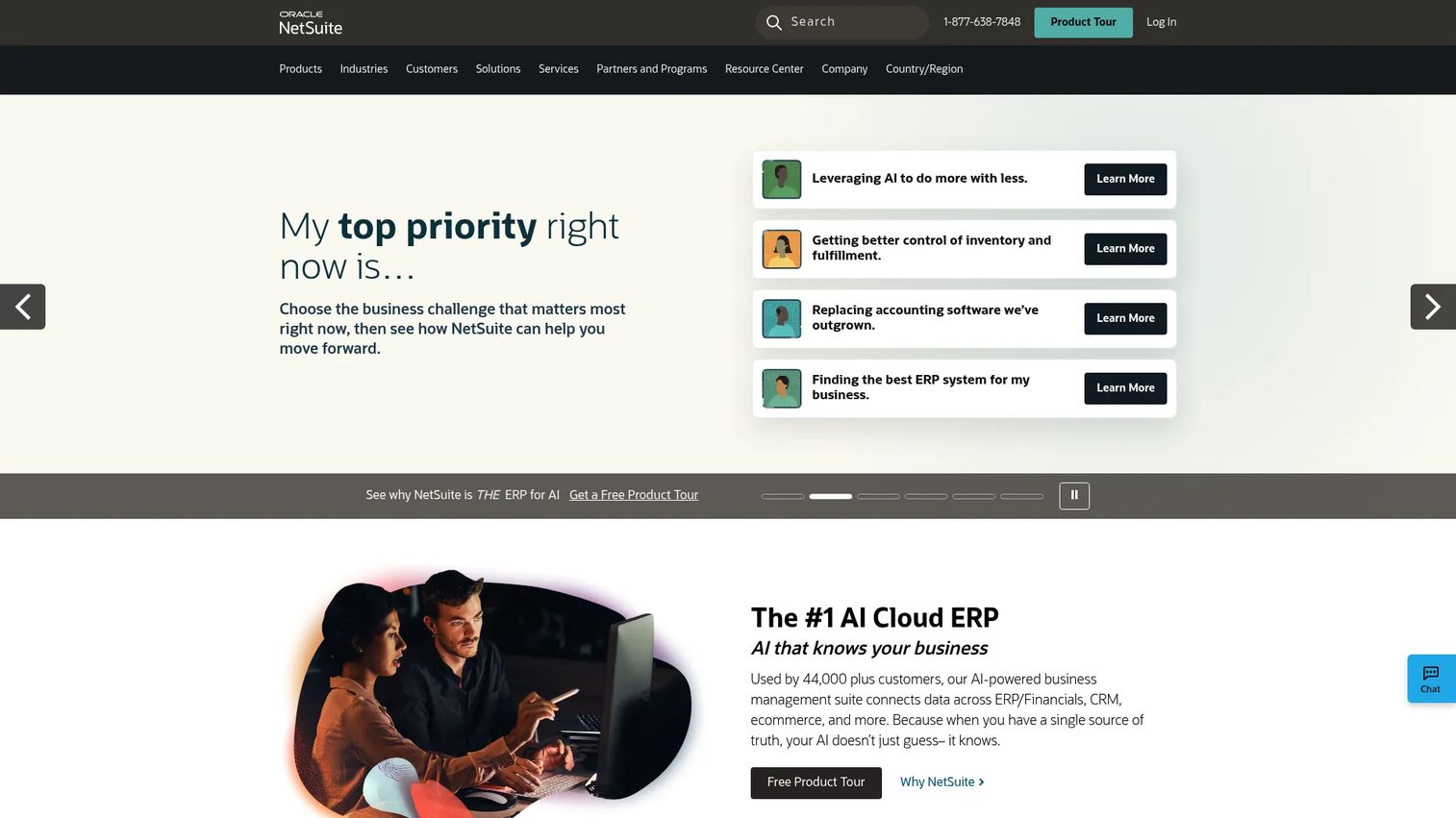
Oracle NetSuite is a cloud-based ERP and business management suite covering ERP, financials, CRM, inventory, order management, analytics, and workflow automation. For manufacturing organizations, it includes work orders and assemblies, demand planning support, and multi-entity reporting. NetSuite positions itself as a finance-first cloud ERP, with manufacturing capability added through its operations modules and, more recently, AI through Ask Oracle and NetSuite Next.
Best for: Growing manufacturers that need to replace disconnected accounting, inventory, and order-management processes with a cloud ERP foundation, where finance visibility is the immediate priority.
Key features
- Unified cloud ERP: Financials, CRM, and order management
- Work orders, assemblies, and demand planning support
- Multi-entity reporting and workflow automation
- Analytics, dashboards, and conversational AI (Ask Oracle)
- Inventory management with purchasing integration
Why choose Oracle NetSuite: NetSuite is attractive when the immediate need is financial consolidation and operational standardization for a growing business. The finance capability is strong. The manufacturing depth is more limited than platforms built specifically for production environments. Buyers should validate mixed-mode manufacturing fit, specifically recipe management, lot traceability, and finite scheduling, during the demo and proof-of-concept process before signing. For advanced planning and scheduling software that can layer onto a NetSuite foundation, that guide covers dedicated planning tools.
Oracle NetSuite pricing: NetSuite structures pricing as an annual license fee covering the core platform, optional modules, and users, plus a one-time implementation fee. Contact NetSuite for current module costs and implementation guidance.
G2 rating: 4.1/5
10. SAP S/4HANA Cloud Public Edition
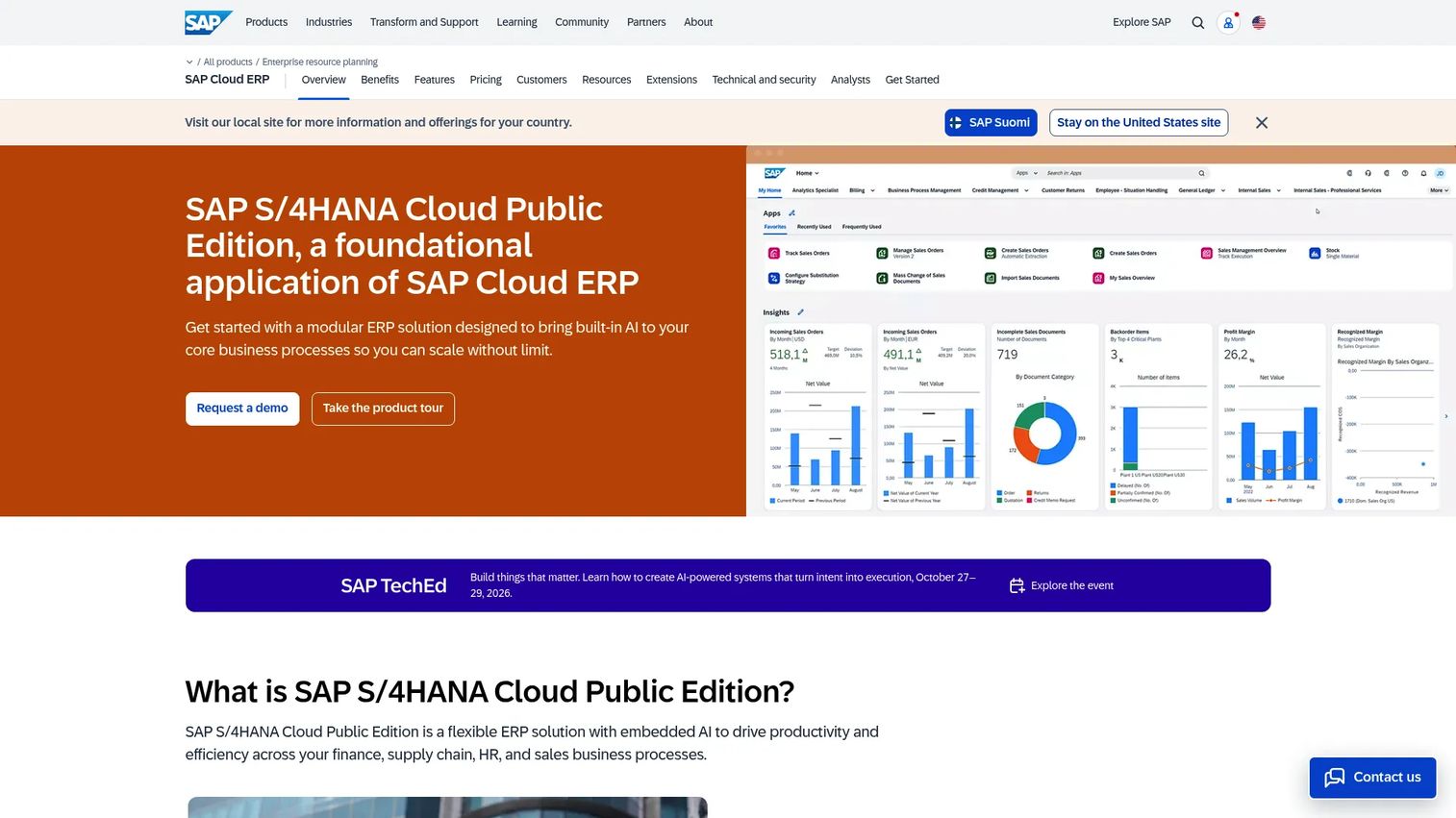
SAP S/4HANA Cloud Public Edition is a modular public-cloud ERP with embedded AI for finance, supply chain, manufacturing, procurement, sales, service, and HR. It offers preconfigured industry best-practice processes, real-time analytics on SAP HANA, and governance support for global, multi-entity, and regulated operations. SAP offers a limited 30-day trial at no cost for evaluation purposes.
Best for: Larger manufacturers with global, multi-entity, regulated, or highly governed operations that can support a significant transformation program.
Key features
- Enterprise financial management with real-time analytics on SAP HANA
- Production planning and supply-chain management
- Preconfigured industry best-practice processes
- Global operational governance and multi-entity support
- AI across finance, supply chain, and operations
Why choose SAP S/4HANA Cloud Public Edition: SAP earns serious consideration when global scale, standardized enterprise controls, or regulatory governance are non-negotiable. For a Series B company or a growing subsidiary, it is often more system than the organization needs unless complexity, international operations, or a future acquisition path justifies the transformation investment. The implementation program is substantial. Buyers should model total cost over three years, including implementation services, internal project time, partner fees, and ongoing licensing, before comparing it to mid-market alternatives.
SAP S/4HANA Cloud Public Edition pricing: SAP prices by custom quote. A 30-day basic trial is available. Contact SAP for production subscription costs.
G2 rating: 4.4/5
Considerations when choosing mixed mode ERP software
Match the ERP to your real production mix
Do not select based on a vendor's broad manufacturing claim. Map the current and planned share of process, discrete, batch, make-to-order, engineer-to-order, and repetitive work before evaluating platforms. A platform optimized for discrete assembly may handle batch processes through configuration rather than native data models, which creates ongoing maintenance debt.
Test the connection between formulas, BOMs, routings, and costing
Ask every vendor to demonstrate one complete end-to-end workflow. Create a batch-produced subassembly, consume it in a discrete finished good, issue the production order, record actual material usage, and report the cost variance. If the vendor cannot run that scenario cleanly in the product, the gap will become your implementation problem.
Treat implementation as an operating change
Evaluate master data quality, chart of accounts structure, inventory records, quality documentation, integration requirements, reporting needs, user adoption planning, and who owns the system after go-live. The implementation partner matters as much as the software. Hybrid ERP deployment models represented 25.6% of the market in 2025 (MarketIntelo, 2025), which means most buyers are navigating both cloud and legacy system transitions simultaneously.
Model total cost over three years
Compare subscription or license costs alongside implementation services, integrations, data migration, internal project time, training, customization, and support. A lower initial subscription can produce a more expensive operating model when implementation complexity is higher. Ask each vendor for a reference customer at your scale and production complexity before finalizing the shortlist.
Require reporting that survives board scrutiny
A founder needs more than production status. Require reliable views of inventory exposure, gross margin by product line, backlog, capacity constraints, order profitability, quality risk, and cash impact. If the ERP cannot generate those views without custom reporting development, that cost belongs in the total cost model. For business process management software that connects ERP data to operational reporting, that guide covers complementary tools.
Conclusion
Mixed mode ERP selection is an operating-model decision, not a software procurement. The system you choose will shape how your operations leader reports margin, how your finance team closes the month, and how clearly you can answer a board question about inventory exposure or production cost variance.
For flexible cloud manufacturing, Acumatica's consumption-based licensing and configurable manufacturing edition suit growing organizations that need broad operational coverage. SYSPRO offers manufacturing-specific depth for organizations that combine process and discrete production. Aptean Industrial Manufacturing ERP, ECI M1, and xTuple address more specific operational profiles: Industrial manufacturing workflows, job-shop and engineer-to-order operations, and configurable ERP foundations respectively.
Epicor Kinetic and Infor CloudSuite Industrial step up for mid-market to enterprise complexity. Microsoft Dynamics 365 is the natural fit when the organization runs on the Microsoft stack. Oracle NetSuite works when finance consolidation drives the decision. SAP S/4HANA Cloud Public Edition belongs at the top of the list only when enterprise governance and global scale are the primary requirements.
Build one test scenario before your final shortlist: A batch-produced sub-component, consumed in a customer-specific assembly, with a quality checkpoint and a cost variance report at close. Ask every vendor to run the same scenario. How they handle it tells you more than any feature list.
Start your journey with Guideflow today!
FAQs
Mixed mode ERP software is an enterprise resource planning system that manages organizations combining two or more manufacturing methods in one operational system. Process manufacturing (recipes, batches, yields, lot traceability) and discrete manufacturing (bills of materials, work orders, serial tracking, routings) are the most common pairing. A true mixed mode ERP connects both data models so planning, inventory, costing, and quality management operate from shared records rather than disconnected modules.
Process manufacturing ERP manages production defined by recipes and formulas, where output quantity depends on yields, batch sizes, shelf life, and variable units of measure. Discrete manufacturing ERP manages production defined by bills of materials, where finished goods are assembled from counted components with traceable serial numbers. Mixed mode ERP connects both: A recipe-managed batch can become a component in a BOM-driven assembly, with cost, inventory, and traceability linked across the full chain.
Industries with the clearest need are those that combine ingredient or compound production with finished-goods assembly: Food and beverage, specialty chemicals, industrial equipment, medical devices, electronics, and automotive components. Consumer packaged goods manufacturers that produce formulated products and package them into configured SKUs are another strong fit. Any manufacturer that runs batch production alongside make-to-order assembly under the same roof will encounter the data-reconciliation problems a mixed mode ERP is built to resolve.
Yes, if the platform supports demand planning, inventory policies, customer-order triggers, production order management, and capacity planning across both workflows from the same planning engine. The critical test is whether MRP runs against both forecasted stock targets and open customer orders simultaneously, and whether the resulting production schedule reflects actual capacity rather than infinite capacity assumptions. Validate this in a live demo before shortlisting.
The operational minimum includes bills of materials, recipes and formulas, MRP, production scheduling, inventory management, lot and serial traceability, quality management, job costing, variance reporting, and integrated finance. Manufacturers with regulated products add shelf-life management, nonconformance tracking, corrective actions, and audit trail requirements. For additive manufacturing software or other specialized production tools that complement ERP workflows, dedicated guides cover those categories separately.
Software cost is one component of a larger investment. Subscription or license fees vary by platform, user count, and modules selected. Implementation services typically represent one to three times the first-year software cost for mid-market deployments. Data migration, integrations, internal project time, training, and ongoing support add to the total. Microsoft Dynamics 365 Supply Chain Management publishes per-user pricing starting at $210 per user per month. Most other platforms on this list price by custom quote, with implementation costs driving significant variation in total investment across similar software tiers.
Cloud deployment can simplify software updates, remote access, and integration management for manufacturing organizations that lack dedicated IT infrastructure. It does not guarantee operational fit. Hybrid deployment models represented 25.6% of the market in 2025 (MarketIntelo, 2025), reflecting that many manufacturers run cloud ERP alongside on-premise systems for specific operational requirements. The production-model fit, data model design, implementation partner quality, and reporting capability matter more than deployment method when selecting a mixed mode ERP system.
Timing depends on plant count, data quality, production complexity, integration requirements, regulatory documentation, and scope discipline. A single-site mid-market implementation with clean master data and a defined scope typically runs six to twelve months. Multi-site or highly complex implementations often extend to eighteen months or more. Separating initial go-live scope from phase-two improvements is one of the most effective ways to control both timeline and total project cost. Define what "done" means before the contract is signed. For aerospace ERP software or other regulated manufacturing contexts where implementation timelines are longer, that guide covers vertical-specific ERP considerations.