A missed serial number on one flight-critical part can trigger a stop-ship, an audit finding, and a program-cost hit that ripples across every contract you touch. That is the reality aerospace and defense operators live with. Standard manufacturing ERP was never built to carry that weight. It tracks inventory and posts costs, but it does not natively handle ITAR-controlled data, AS9100 quality records, configuration-managed BOMs, or DCAA-compliant project accounting.
The stakes are climbing alongside the market. The global aerospace and defense ERP market is projected to reach $2.7 billion by 2028, according to Allied Market Research (2024). Manufacturing already accounts for roughly 24% of overall ERP demand, per Maximize Market Research (2025), which makes it the largest ERP-adopting sector and puts real pressure on vendors to serve regulated industries well.
The wrong ERP fit does not announce itself on day one. It surfaces months later as traceability gaps, revision-control confusion, unrecoverable program costs, and a compliance posture that will not survive an audit. So the evaluation is less about feature checklists and more about operational fit across five dimensions: compliance and audit readiness, traceability and configuration control, program cost and schedule control, supply chain and supplier collaboration, and MRO and aftermarket lifecycle support.
This guide walks through nine aerospace ERP systems and where each one earns its place.
What's inside
This guide compares nine aerospace ERP options for 2026, spanning both broad enterprise platforms and aerospace-specialized systems. The list is built for aerospace and defense operations leaders, manufacturing and supply chain buyers, and the product-minded operators who own vendor evaluation.
Each tool was selected against four criteria that matter most in this space:
- Aerospace and defense fit, including industry-specific workflows and data models
- Compliance depth across ITAR, AS9100, CMMC 2.0, FAR, DFARS, and DCAA
- Manufacturing and MRO functionality, from shop floor to aftermarket
- Cloud readiness and implementation practicality for real deployment timelines
TL;DR
- Best overall for large aerospace and defense enterprises: SAP S/4HANA, for global standardization and deep process coverage.
- Best for aerospace and defense-specific cloud ERP: Infor CloudSuite Aerospace & Defense, purpose-built around compliance and program accounting.
- Best for regulated discrete manufacturing: Epicor Kinetic, strong on shop-floor and make-to-order operations.
- Best for project-centric lifecycle operations: IFS Cloud, tying engineering, manufacturing, maintenance, and sustainment together.
- Best for mid-market cloud flexibility: Acumatica Cloud ERP, with unlimited-user licensing and broad functionality.
- Best for aviation parts and MRO specialists: Pentagon 2000SQL ERP and ERP.AERO, built around parts distribution, repairs, and traceability.
What is aerospace ERP software?
Aerospace ERP software is an enterprise resource planning system built for the compliance, traceability, and program-control demands of aerospace and defense manufacturing, distribution, and maintenance operations. It extends standard ERP with industry-specific quality, configuration, and regulatory capabilities that generic systems lack.
Where general ERP for aerospace and defense breaks down is in the details that auditors and program managers care about. An aerospace manufacturing ERP has to prove where every part came from, what revision it was built to, and who touched it. Here is what separates a purpose-built aviation ERP software platform from a generic one:
- Compliance and audit readiness: Native support for ITAR-controlled data handling, AS9100 quality records, CMMC 2.0 cybersecurity controls, and FAR/DFARS contract clauses, with audit trails that hold up under DCAA review.
- Traceability and configuration control: Full genealogy on serialized and lot-controlled parts, plus BOM revision control and configuration management so as-designed, as-built, and as-maintained states stay reconciled.
- Supply chain and supplier collaboration: Multi-tier supplier visibility, certificate and conformance tracking, and collaboration tools that keep quality records flowing with the parts.
- Project and program accounting: Cost tracking by contract, work breakdown structure, earned-value-style progress measurement, and profitability analysis across long program lifecycles.
- Quality management and MES integration: Nonconformance handling, corrective and preventive action, first-article inspection, and connection to shop-floor execution systems.
- MRO and lifecycle support: Repair workflows, maintenance planning, and aftermarket parts operations that extend the system well beyond initial manufacture.
- AI and advanced tech integrations: Embedded analytics, demand forecasting, and increasingly generative capabilities that surface risk and speed decisions.
When to use aerospace ERP software
Not every manufacturer needs a specialized aerospace and defense software platform. These three situations are where the specialized systems earn their cost.
Manage compliance-heavy operations
If your contracts pull in ITAR, EAR, CMMC 2.0, FedRAMP, FAR, DFARS, or DCAA requirements, generic ERP starts to strain. It can store the data, but it cannot enforce controlled-data segregation, generate the audit trails an assessor expects, or map quality records to AS9100 clauses without heavy customization. Aerospace manufacturing software builds these controls into the data model, so compliance is a byproduct of normal operations rather than a bolt-on project.
Control complex program costs and schedules
Aerospace work is project-based and runs for years. You need to track cost and revenue by contract and work breakdown structure, measure progress against baselines, and forecast profitability before a program slips. General ERP posts costs to the ledger but rarely ties them to program schedules and milestones. ERP for aerospace and defense connects the financial view to the operational one, so a schedule delay shows up as a cost signal early enough to act.
Support traceability, revision control, and supplier collaboration
When a BOM changes mid-program, you need to know which units were built to which revision, which suppliers shipped which lots, and whether any affected parts are already in the field. That is traceability, configuration management, and supplier collaboration working together. It is also the backbone of audit readiness. A system that treats these as first-class capabilities protects you when a quality escape or a recall investigation lands on your desk.
Comparison table
The table below helps you narrow the shortlist quickly. It maps each aerospace ERP system to its primary buyer intent, its key differentiation, published pricing posture, and current G2 rating. Use it to spot the two or three systems worth a deeper look, then read the full sections.
| # | Product | Intent | Key differentiation | Pricing | G2 rating |
|---|---|---|---|---|---|
| 1 | SAP S/4HANA | Global enterprise standardization | Deep process coverage with embedded AI | Quote-based | 4.4/5 |
| 2 | Infor CloudSuite Aerospace & Defense | A&D-specific cloud ERP | Built-in CMMC, DCAA, FAR, DFARS, ITAR support | Quote-based | 3.9/5 |
| 3 | IFS Cloud | Project and asset-intensive operations | Unified ERP, EAM, SCM, and field service | Quote-based | 4.0/5 |
| 4 | Epicor Kinetic | Regulated discrete manufacturing | Real-time shop-floor and make-to-order depth | Quote-based | 3.9/5 |
| 5 | Acumatica Cloud ERP | Mid-market cloud flexibility | Unlimited-user licensing, open APIs | From under $1,495/mo | 4.4/5 |
| 6 | Sage X3 | Mid-sized manufacturing and distribution | Configurable production and supply chain | Quote-based | 3.9/5 |
| 7 | Oracle NetSuite | Growing multi-entity operations | Unified cloud financials and operations | Quote-based | 4.1/5 |
| 8 | Pentagon 2000SQL ERP | Aerospace and defense MRO specialists | Industry-specific MRO and traceability | Quote-based | 4.3/5 |
| 9 | ERP.AERO | Aviation parts suppliers and repair shops | Cloud-native parts and repair workflows | From $110/user/mo | Not yet rated |
1. SAP S/4HANA
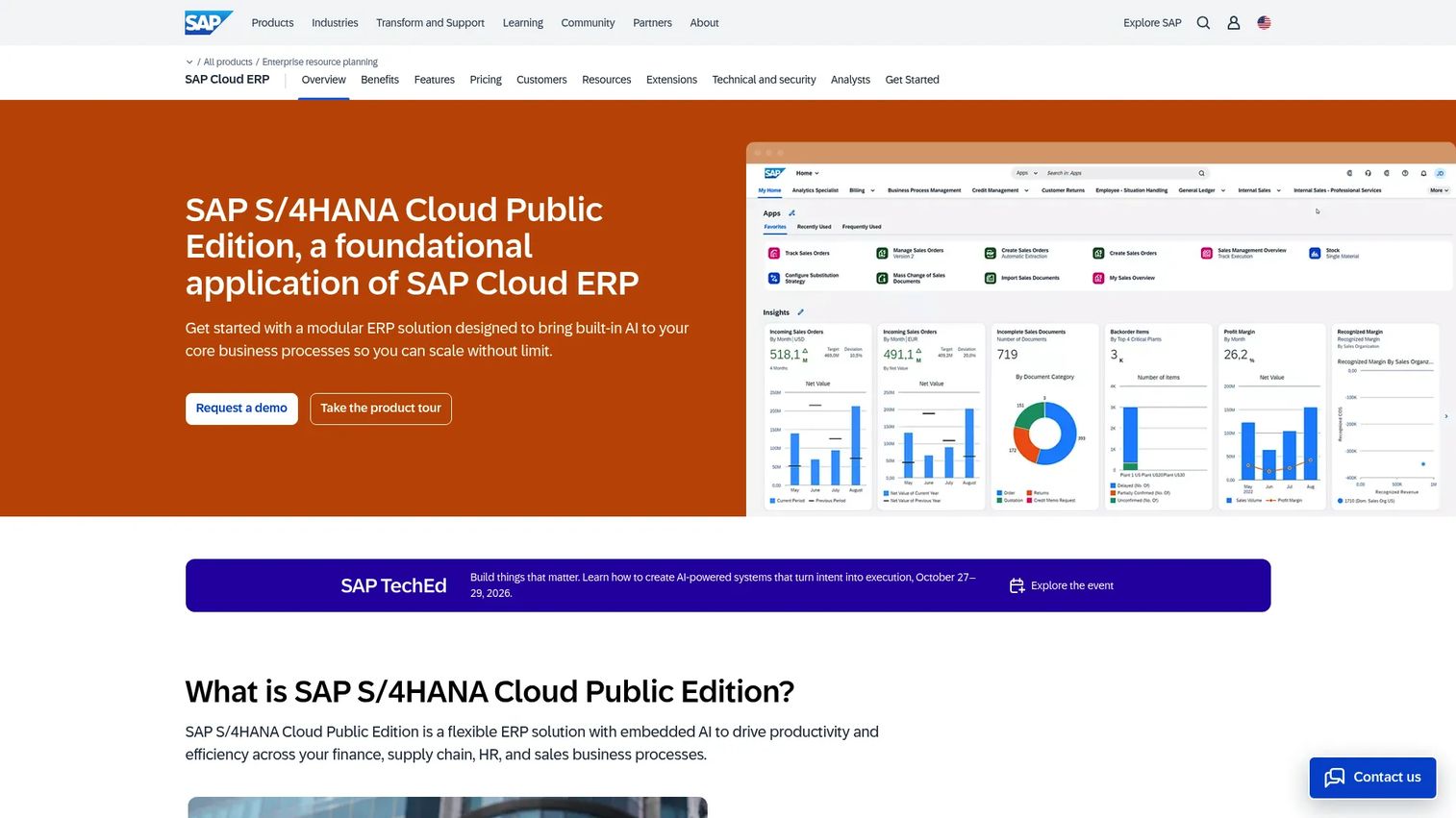
SAP S/4HANA is SAP's ERP suite for finance, supply chain, HR, and sales, with embedded AI and cloud deployment options. For aerospace and defense enterprises operating across multiple sites and countries, it offers the process depth and standardization that global programs demand. Preconfigured best-practice processes give large organizations a proven starting point rather than a blank canvas.
Best for: Large aerospace and defense enterprises that need one standardized ERP platform across global operations.
Key strengths
- Embedded AI across core processes: Surfaces risk and automates routine decisions inside finance, supply chain, and manufacturing workflows.
- Preconfigured best-practice processes: Gives large A&D organizations a proven operational blueprint that shortens design debates.
- Continuous updates and cloud scalability: Keeps the platform current and lets it scale across new sites, entities, and programs.
Why choose SAP S/4HANA: SAP fits organizations that value deep process coverage and global consistency over lightweight simplicity. It is the choice when standardization across many entities matters more than a fast, narrow rollout, and when you have the internal capacity to run a serious ERP program. The tradeoff is scope: this is enterprise-grade software that rewards commitment.
SAP S/4HANA pricing: SAP does not publish list pricing on its product page. Instead, it uses a request-a-quote flow, so cost depends on modules, deployment model, and user counts. On G2, SAP's cloud ERP listing holds a 4.4/5 rating.
2. Infor CloudSuite Aerospace & Defense
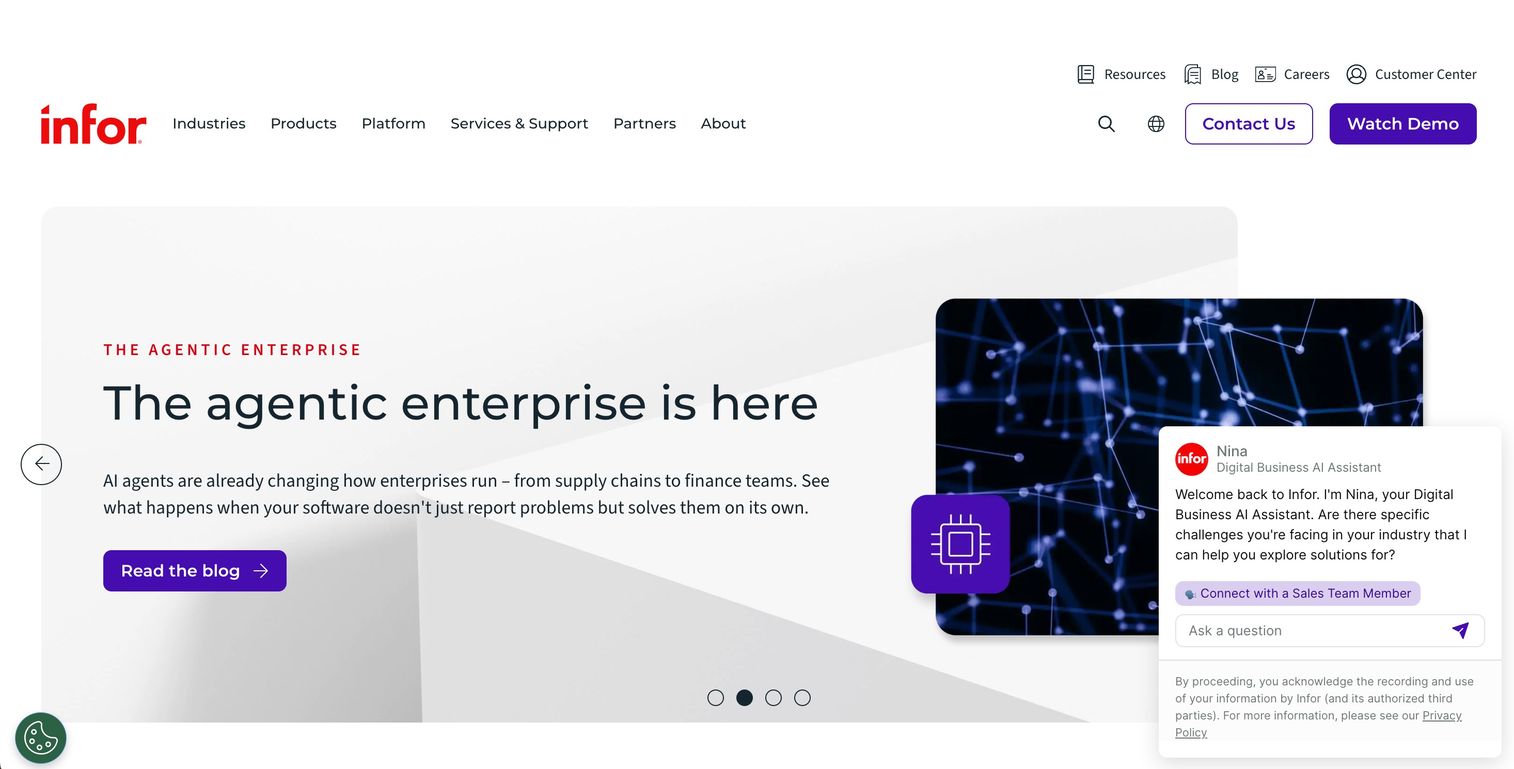
Infor CloudSuite Aerospace & Defense is a cloud ERP suite built specifically for aerospace and defense companies. It manages compliance, projects, supply chain, manufacturing, and financial operations inside a single industry-tailored platform. Where broad ERP suites require configuration to fit A&D, Infor starts from the industry's requirements and works outward, which is why it consistently shows up on aerospace shortlists.
Best for: Aerospace and defense manufacturers and contractors that want cloud ERP purpose-built for their compliance and program needs.
Key strengths
- Compliance management support: Native handling for CMMC 2.0, DCAA, FAR, DFARS, and ITAR requirements.
- Project and program management: Cost tracking, scheduling, and profitability analysis across long program lifecycles.
- End-to-end operational coverage: Supply chain visibility, manufacturing execution, product lifecycle, asset lifecycle, and financial management in one suite.
Why choose Infor CloudSuite Aerospace & Defense: This is the option for teams that want the regulatory and program-accounting depth of a specialized system without building it themselves on top of a generic platform. It fits contractors and manufacturers who treat compliance as a daily operating condition, not an occasional project. If aerospace and defense is your core business rather than one segment among many, Infor's industry focus is the argument.
Infor CloudSuite Aerospace & Defense pricing: Infor does not publish public pricing; cost is quote-based and depends on scope and deployment. Infor's overall seller rating on G2 sits at 3.9/5, though that reflects the seller rather than this specific suite.
3. IFS Cloud

IFS Cloud is industrial cloud enterprise software spanning ERP, enterprise asset management, supply chain management, and field service in one composable platform. Its project-centric architecture and strong maintenance capabilities make it a natural fit for aerospace organizations that manage the full lifecycle, from engineering and manufacturing through sustainment and MRO.
Best for: Asset-intensive, service-led aerospace organizations that need engineering, manufacturing, maintenance, and support coordinated on one platform.
Key strengths
- Unified operations platform: ERP, EAM, SCM, and field service management share one data model, so lifecycle data stays connected.
- Composable architecture with evergreen releases: Twice-yearly updates keep the platform current without disruptive re-implementations.
- Industrial AI: Applies predictive and optimization capabilities to maintenance, planning, and service operations.
Why choose IFS Cloud: IFS fits organizations where the maintenance and sustainment side of the business is as important as manufacturing. If you build complex products and then support them in the field for decades, having engineering, production, and MRO on one platform removes the seams where data usually gets lost. It rewards teams that value lifecycle continuity over point-solution simplicity.
IFS Cloud pricing: IFS presents pricing as contact-sales; no public figure is available on its product pages. On G2, IFS Cloud holds a 4.0/5 rating.
4. Epicor Kinetic
Epicor Kinetic is cloud ERP for manufacturers, built around real-time visibility, collaboration, and manufacturing operations. Its discrete-manufacturing depth and shop-floor focus make it a strong aerospace manufacturing ERP for regulated make-to-order and mixed-mode production. Planning, scheduling, and product management are treated as core rather than add-ons.
Best for: Aerospace manufacturers running discrete, make-to-order, or mixed-mode operations that need industry-specific ERP.
Key strengths
- Planning and scheduling: MRP and advanced planning and scheduling keep complex production schedules realistic.
- Product management with BOM and BOO control: Handles bills of material, bills of operations, and CPQ for configured products.
- Cloud ERP for manufacturers: Real-time operational visibility built for the shop floor rather than retrofitted onto it.
Why choose Epicor Kinetic: Epicor fits manufacturers whose competitive edge lives on the shop floor and who need tight control over configured, make-to-order work. It suits mid-market and upper-mid-market aerospace suppliers that want manufacturing depth without the weight of a top-tier enterprise rollout. The fit is strongest when production complexity, not multi-entity finance, is your hardest problem.
Epicor Kinetic pricing: Epicor does not publish first-party pricing; it operates a contact-sales model, so cost depends on deployment and modules. On G2, Epicor Kinetic holds a 3.9/5 rating.
5. Acumatica Cloud ERP
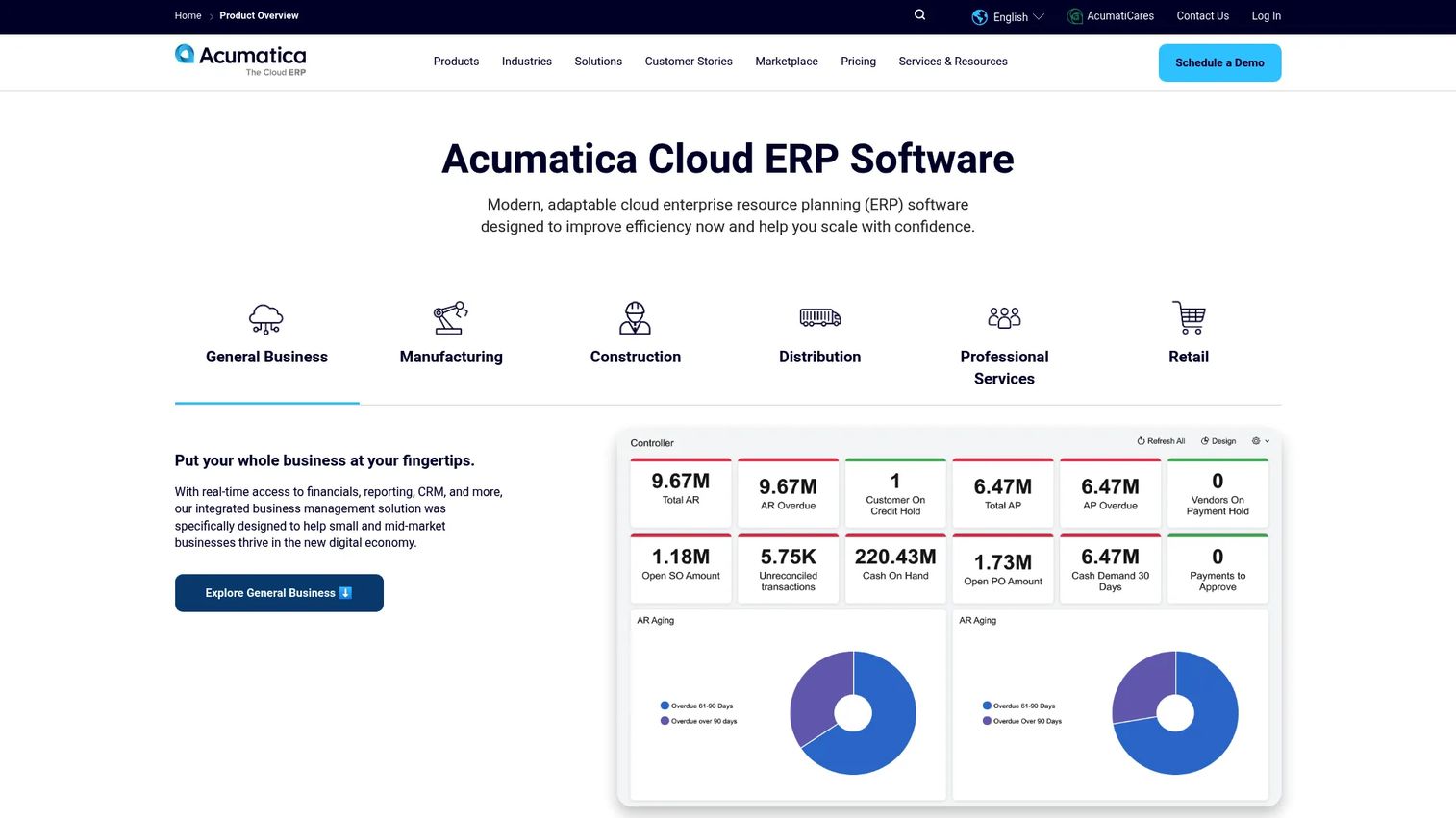
Acumatica Cloud ERP is cloud ERP for growing businesses, covering finance, operations, inventory, and project capabilities. Its unlimited-user licensing model and open architecture make it a flexible cloud ERP for aerospace suppliers that want to scale usage without per-seat cost pressure. Customizable workflows and a marketplace of extensions let teams shape it to their operations.
Best for: Mid-sized aerospace suppliers that want customizable cloud ERP with predictable, resource-based licensing.
Key strengths
- Unlimited-user licensing: Pricing scales with resources and applications rather than seat count, which suits growing teams.
- Customizable workflows and no-code reporting: Dashboards, workflows, and reports adapt to specific operational needs.
- Built-in mobility and open APIs: A marketplace of extensions and open integration points support aerospace-specific add-ons.
Why choose Acumatica Cloud ERP: Acumatica fits mid-market aerospace suppliers that value agility and broad ERP coverage, and that expect to extend the platform with ecosystem add-ons for deeper aerospace specialization. It is a practical choice when you want a modern cloud foundation you can grow into. For heavy A&D-specific compliance depth, plan to pair it with specialized extensions.
Acumatica Cloud ERP pricing: Acumatica tailors pricing by applications, usage, and deployment. Packaged offers publish starting rates, including its APEX for distribution offer starting under $1,495 monthly and APEX for manufacturing starting under $2,185 monthly, while core editions are custom-quoted. There is no free tier. On G2, Acumatica holds a 4.4/5 rating.
6. Sage X3
Sage X3 is ERP software for mid-sized, product-centric businesses with manufacturing, distribution, and supply chain needs. It offers strong operational coverage across production, procurement, and finance without the complexity of a top-tier enterprise suite, which makes it a practical option for midsize aerospace manufacturers and distributors.
Best for: Mid-sized aerospace manufacturers and distributors that want configurable ERP with solid operational coverage.
Key strengths
- Production management: BOM planning, shop-floor control, quality control, and project management in one module.
- Supply chain management: Purchasing, inventory, sales, and customer service coordinated across the operation.
- Financial management: Budgets, fixed assets, and multi-currency, multi-tax, multi-company reporting for complex structures.
Why choose Sage X3: Sage X3 fits teams that need dependable manufacturing and distribution coverage and multi-entity finance, but do not want to take on enterprise-scale implementation weight. It is a middle path: more capable than lightweight ERP, lighter than the largest suites. For aerospace suppliers, its quality and project management modules provide a workable base to layer compliance processes on.
Sage X3 pricing: Sage uses a request-pricing model; no public figure is shown on its product pages. On G2, Sage X3 holds a 3.9/5 rating.
7. Oracle NetSuite
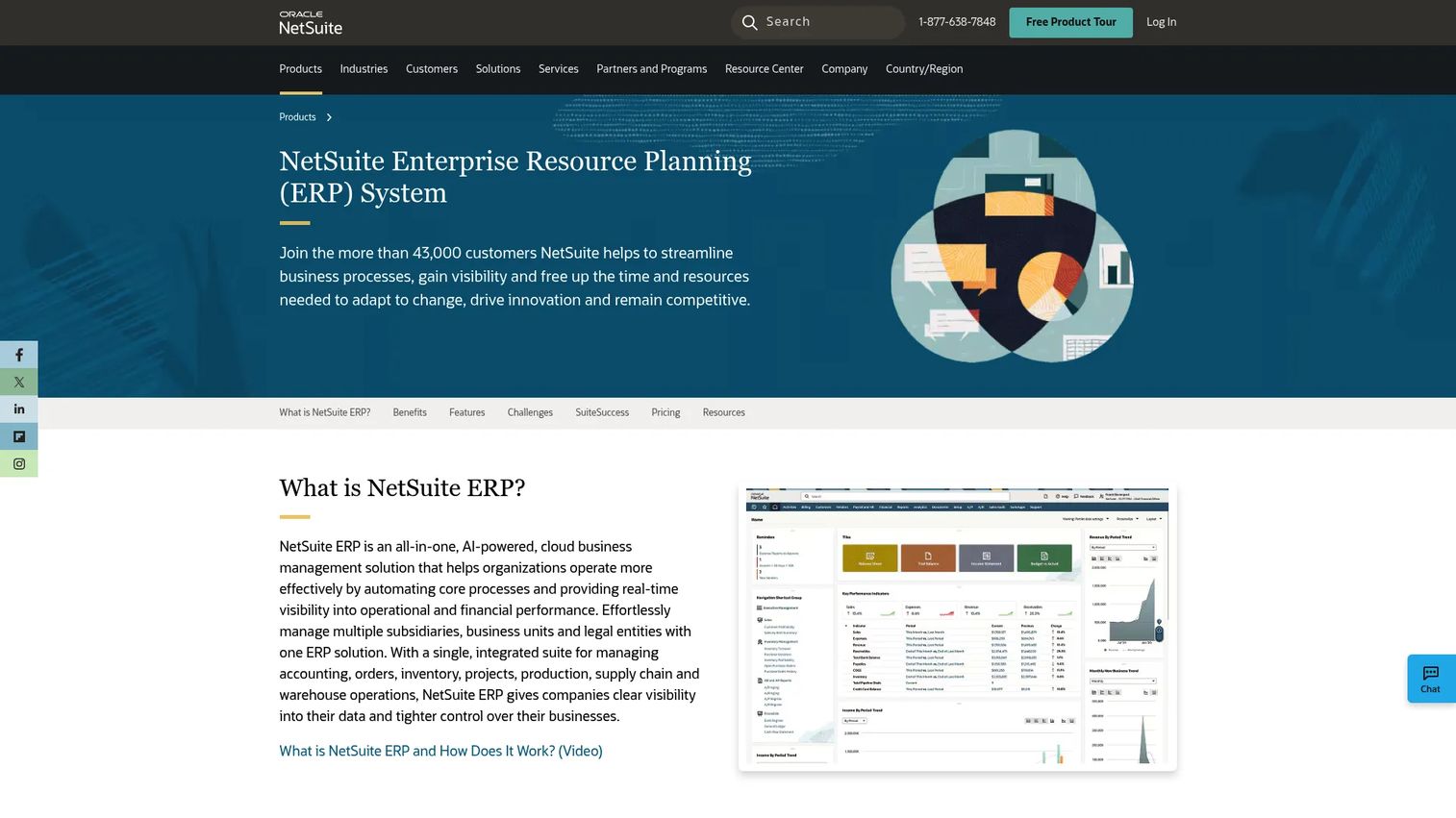
Oracle NetSuite is cloud ERP and business management software covering finance, operations, and back-office processes. Its financial depth and multi-entity capabilities make it a strong backbone for aerospace suppliers scaling across locations and subsidiaries, though aerospace-specific depth is lighter than the specialist systems on this list.
Best for: Growing mid-market aerospace suppliers that need a unified cloud ERP with strong multi-entity financials.
Key strengths
- Financial management and accounting: Robust core financials with multi-subsidiary and multi-currency consolidation.
- Order-to-cash and procure-to-pay: End-to-end transactional workflows across the back office.
- Inventory and supply chain visibility: Real-time stock and supply chain data across entities.
Why choose Oracle NetSuite: NetSuite fits aerospace suppliers whose primary need is a scalable financial and operational backbone as they grow across entities. Be honest about the tradeoff: for deep aerospace compliance, configuration management, and MRO, you will likely add specialized modules or partner solutions on top. It is strongest when clean multi-entity finance matters more than out-of-the-box A&D specialization.
Oracle NetSuite pricing: NetSuite pricing is quote-based, with cost driven by modules, users, and add-ons; no public figure is published. On G2, NetSuite ERP holds a 4.1/5 rating.
8. Pentagon 2000SQL ERP
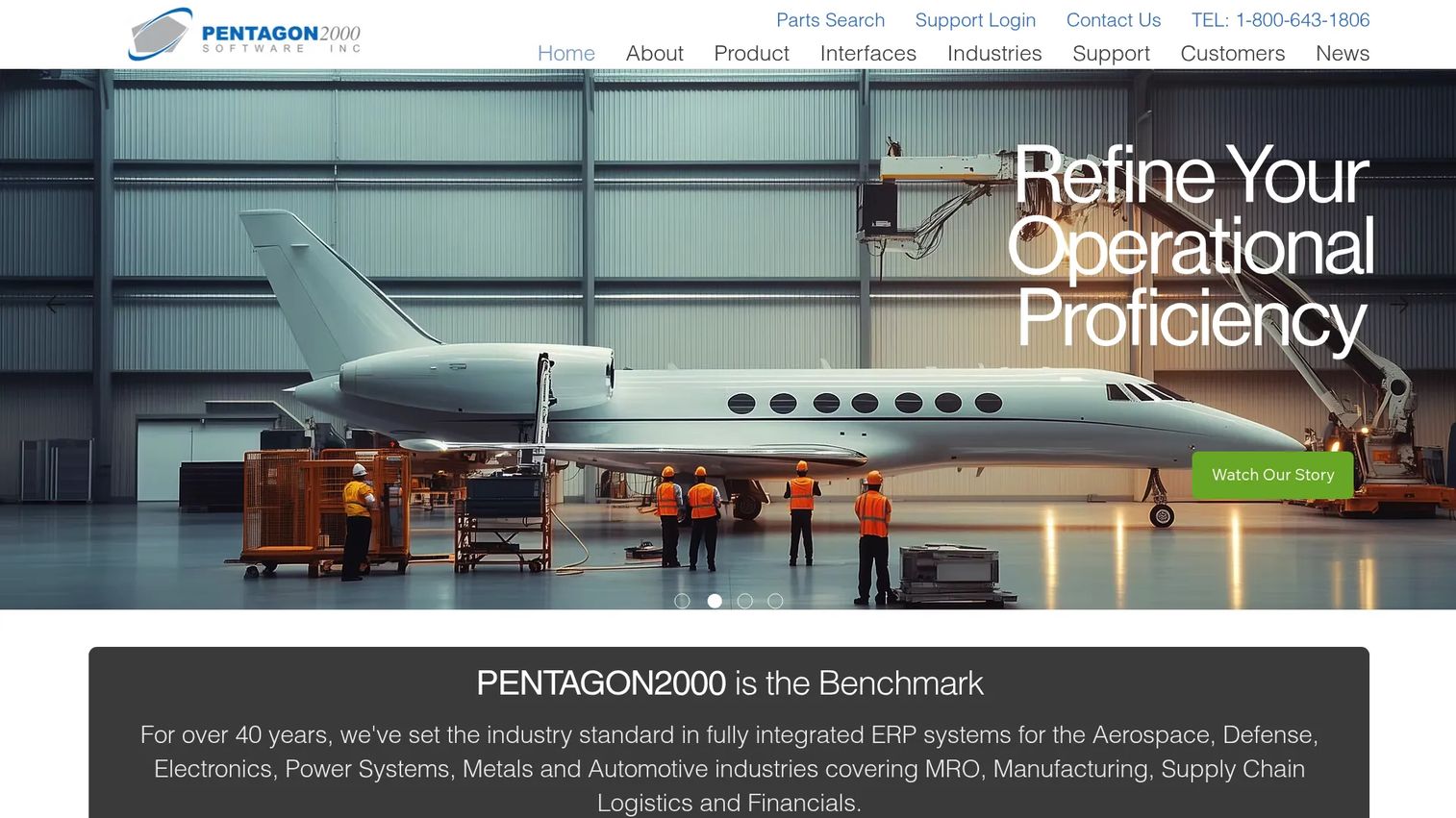
Pentagon 2000SQL ERP is ERP software built for aerospace, defense, electronics, and heavy-duty parts operations. Its deep MRO ERP software capabilities, parts traceability, and industry-specific workflows make it a specialist's choice for organizations that prioritize operational precision over broad generality. This is a system designed by and for the aerospace and defense world.
Best for: Aerospace and defense organizations that need industry-specific ERP and MRO workflows out of the box.
Key strengths
- Materials management: Purpose-built handling of aerospace parts, lots, and serialized inventory.
- Manufacturing and MRP: Production and material planning tuned to A&D operations.
- Supply chain management and traceability: Full part genealogy and supplier tracking that supports audit readiness.
Why choose Pentagon 2000SQL ERP: Pentagon fits organizations that want aerospace and defense specialization built in rather than configured on top of a generic platform. It is especially strong for MRO providers and parts distributors where traceability and repair workflows are the core of the business. If operational specificity beats broad flexibility for your team, Pentagon deserves a close look.
Pentagon 2000SQL ERP pricing: Pentagon does not publish public pricing; cost is quote-based. On G2, Pentagon 2000SQL holds a 4.3/5 rating.
9. ERP.AERO
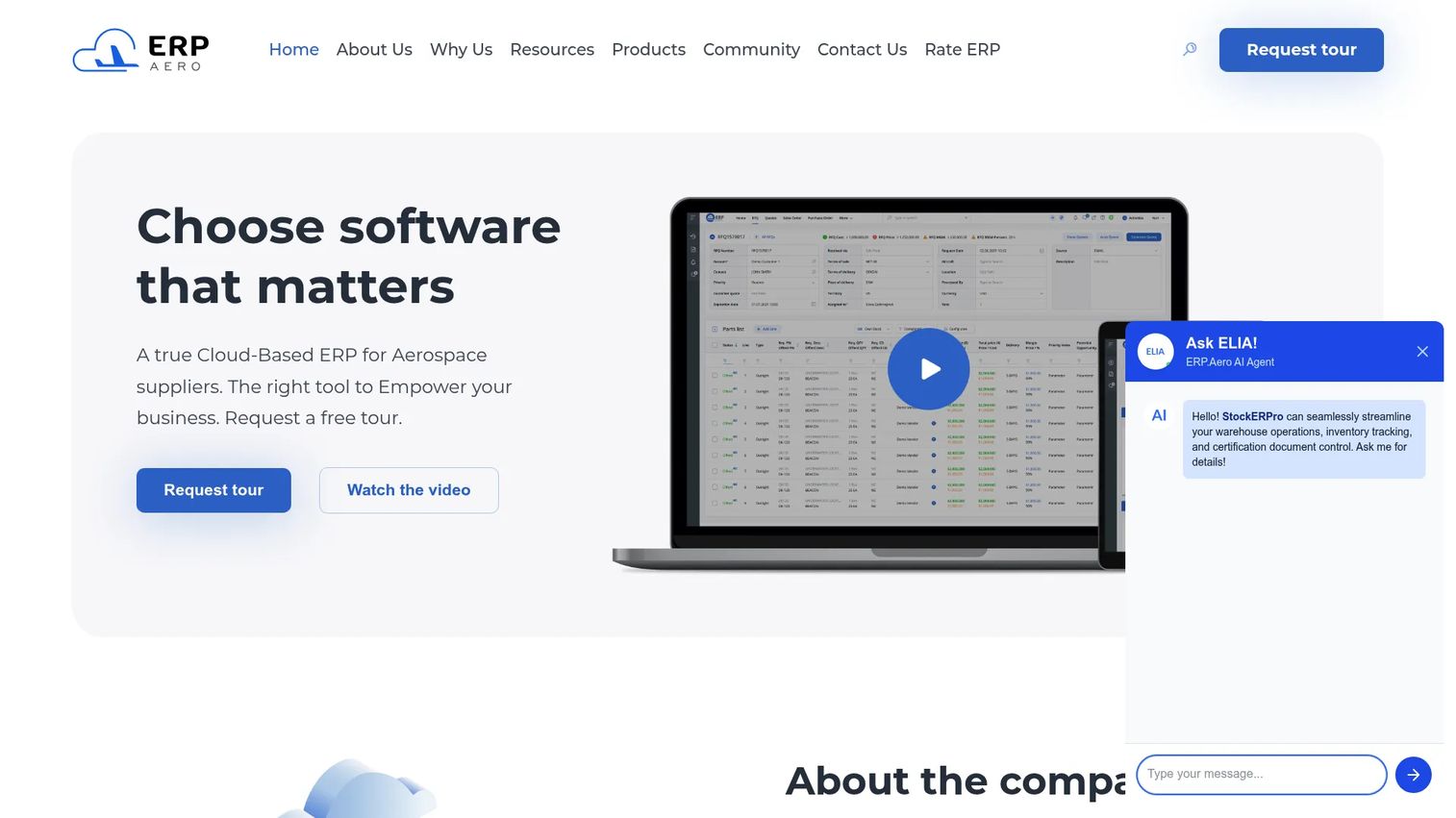
ERP.AERO is a cloud ERP and CRM platform built for aerospace parts suppliers and repair organizations. It handles the full parts lifecycle, from RFQ and quote through order, invoice, inventory, and repairs, with certificate tracking and audit trails woven throughout. Its cloud-native design and AWS backing position it for aviation suppliers that want a modern, focused system.
Best for: Aviation parts suppliers, MRO providers, and defense contractors that want a cloud-native, industry-specific ERP.
Key strengths
- Quote-to-invoice workflows: RFQ, quote, order, invoice, and shopping cart flows built for parts commerce.
- Parts and certification tracking: Aircraft parts inventory, vendor, customer, and cert tracking in one place.
- Repairs and MRO with audit trails: Repair workflows, approvals, sourcing, and purchasing with full audit history.
Why choose ERP.AERO: ERP.AERO fits aviation suppliers and repair shops that want a focused, cloud-native platform combining ERP and CRM around parts operations rather than a broad horizontal suite. Its industry-specific workflows and integrated approach suit teams whose whole business is parts, quotes, and repairs. As a newer, specialized platform, it rewards buyers who value focus over breadth.
ERP.AERO pricing: ERP.AERO's own site indicates subscription plans and a free plan. G2 lists third-party pricing starting at $110.00 per user per month. The product is not yet rated on G2.
Considerations before you buy
A shortlist is only the start. Before you commit, pressure-test each system against the criteria that actually determine success in aerospace and defense.
Compliance and audit readiness
Confirm the system natively supports the standards your contracts require, including ITAR data segregation, AS9100 quality records, CMMC 2.0 controls, and DCAA-compliant cost accounting. Ask to see the audit trail, not a slide about it. Native support beats customization every time an assessor walks in.
Traceability and configuration management
Verify full genealogy on serialized and lot-controlled parts, plus BOM revision control that keeps as-designed, as-built, and as-maintained states reconciled. When a revision changes mid-program, you need to know instantly which units and suppliers are affected.
Program cost and schedule control
Check that the system ties cost and revenue to contracts and work breakdown structures, and that it can measure progress against baselines. If a schedule slip does not surface as an early cost signal, the system is not doing the job aerospace demands.
MRO and aftermarket fit
If you maintain, repair, or distribute parts, confirm the system handles repair workflows, exchange and core tracking, and aftermarket inventory. Many broad platforms treat MRO as an afterthought; specialists treat it as the core.
Implementation risk and total cost
Estimate implementation honestly: data migration, integration with MES and quality systems, and change management all carry real cost. Ask vendors for reference customers of your size and type, and weigh cloud versus on-premise against your security posture.
Conclusion
The right aerospace ERP depends on which problem is hardest for your organization. For global standardization and process depth, SAP S/4HANA leads. For aerospace and defense-specific compliance and program accounting out of the box, Infor CloudSuite Aerospace & Defense is purpose-built. IFS Cloud shines when engineering, manufacturing, and sustainment must live together. Epicor Kinetic and Sage X3 serve regulated discrete and mid-sized manufacturing. Acumatica Cloud ERP and Oracle NetSuite offer flexible cloud backbones for growing suppliers, while Pentagon 2000SQL ERP and ERP.AERO bring deep MRO and aviation parts specialization.
Your next step: build a scorecard weighted around the four dimensions that decide fit in this industry, which are compliance depth, traceability and configuration control, program cost control, and implementation effort. Score each finalist against your actual contracts and operations, then run a demo focused on those scenarios rather than a generic feature tour. The system that survives that test is your system.
FAQs
Aerospace ERP adds industry-specific compliance, traceability, and configuration-management capabilities that generic manufacturing ERP lacks. It handles ITAR-controlled data, AS9100 quality records, serialized part genealogy, and program-level cost accounting natively, so audit readiness is built into daily operations rather than bolted on through customization.
At minimum, look for native support across ITAR, EAR, AS9100, CMMC 2.0, FAR, and DFARS, plus DCAA-compliant cost accounting for government contracts. Cloud deployments should also address FedRAMP where federal data is involved. The system should generate audit trails an assessor can review directly, not summaries you assemble after the fact.
Some do, deeply. Specialist platforms like Pentagon 2000SQL ERP and ERP.AERO are built around repair workflows, exchange and core tracking, and aviation parts distribution. IFS Cloud also covers maintenance and sustainment strongly. Broader suites can handle MRO with added modules, so confirm the depth against your actual repair and aftermarket needs.
Yes, when the platform meets the right controls. Cloud ERP for aerospace can satisfy CMMC 2.0 and FedRAMP requirements through compliant hosting and data segregation, and many vendors offer government-specific cloud regions. The key is verifying that controlled data handling, encryption, and access controls match your contract obligations before committing.
It is central. Aerospace products change over long lifecycles, and you must reconcile as-designed, as-built, and as-maintained configurations at any point. Strong BOM revision control and configuration management let you identify which units and suppliers are affected by a change, which is essential for both quality escapes and audit readiness.
Anchor the demo in your real scenarios, not a generic tour. Ask to see a live audit trail, a mid-program BOM revision and its downstream impact, program cost tied to a work breakdown structure, and an MRO or repair workflow if relevant. Watching the system handle your actual edge cases reveals fit far better than a feature checklist.
They estimate the full effort: data migration, integration with MES and quality systems, and change management, not just license cost. They also request reference customers of similar size and operational type, and they weigh cloud versus on-premise against their security posture. Implementation risk, not sticker price, is where most ERP projects succeed or struggle.
Suppliers and MRO providers often favor specialists like Pentagon 2000SQL ERP, ERP.AERO, or mid-market platforms such as Epicor Kinetic and Acumatica Cloud ERP for their focus and agility. Large OEMs and prime contractors typically choose SAP S/4HANA, Infor CloudSuite Aerospace & Defense, or IFS Cloud for enterprise-scale standardization, program accounting, and lifecycle coordination.