Your enterprise prospect just sent a security questionnaire with an emissions section. Your board wants a credible baseline before the next fundraise. Your head of finance has a spreadsheet that nobody wants to defend in a diligence call.
This is where most Series B founders end up: Emissions reporting is no longer a sustainability team problem. It is a governance problem. According to BCG and CO2 AI (2025), only 7% of large companies comprehensively report Scope 1, Scope 2, and Scope 3 greenhouse gas (GHG) emissions. The gap between reporting expectations and what most companies can actually produce is wide, and it is closing fast under CSRD, ISSB, and enterprise procurement pressure.
The right carbon accounting software turns emissions data from a founder-owned fire drill into a repeatable company system. This guide gives you the shortlist and the criteria to evaluate it without overbuying.
What's inside
This guide compares 21 carbon accounting software platforms for 2026. It is written for founders, finance leaders, and operators who need a defensible emissions baseline without a dedicated sustainability team.
Tools were selected based on:
- Scope 1, Scope 2, and Scope 3 coverage and methodology depth
- Reporting framework alignment (GHG Protocol, CSRD, ISSB, CDP, SBTi)
- Integration fit with finance and operational systems
- Implementation speed and ownership clarity
- Pricing transparency and company-stage fit
Pricing and ratings were verified against vendor pricing pages and G2 listings.
TL;DR
- Best first baseline for mid-market SaaS: Plan A or Greenly offer guided onboarding and structured Scope 1, 2, and 3 accounting without requiring a sustainability team on day one
- Best for enterprise climate programs: Watershed, Persefoni, IBM Envizi, and Microsoft Sustainability Cloud suit companies with complex reporting, multi-entity structures, or formal disclosure obligations
- Best for audit-ready ESG reporting: Workiva Carbon and KEY ESG connect carbon data to finance-grade disclosure controls
- Best for supplier and value-chain emissions: Sweep, Emitwise, and carbmee address Scope 3 beyond internal operations
- Still on spreadsheets: Shortlist tools with fast onboarding and clean audit trails before optimizing for scenario modeling or supplier engagement
What is carbon accounting software?
Carbon accounting software helps organizations collect activity data, calculate greenhouse gas emissions, organize Scope 1, Scope 2, and Scope 3 inventories, and prepare emissions data for reporting, audit, and reduction planning.
The GHG Protocol defines the accounting framework most platforms follow. Scope 1 covers direct emissions from company-owned sources. Scope 2 covers purchased energy. Scope 3 covers everything in the value chain, from suppliers to business travel to sold products, and it is usually the largest and hardest category to measure.
According to MIT Sustainable Supply Chain Lab and CSCMP (2025), about 70% of firms say they lack sufficient supplier data to measure supply-chain emissions accurately. That same research found that 50% of North American firms still use spreadsheets to tabulate emissions data.
Key capabilities to look for
- Scope 1, Scope 2, and Scope 3 calculations with category-level detail
- Emissions-factor libraries from recognized databases (EPA, DEFRA, ecoinvent)
- Supplier data collection and engagement workflows
- Audit trails with source documentation and calculation history
- Reporting-framework mapping for GHG Protocol, CSRD, ESRS, ISSB, CDP, and SBTi
- ERP, finance, and procurement integrations
- Decarbonisation planning and target tracking
- Product carbon footprint calculations
Software versus spreadsheets
Spreadsheets break when reporting involves multiple legal entities, supplier data, repeat annual cycles, or board review. A spreadsheet cannot enforce calculation methodology, store source assumptions, or produce assurance-ready evidence. When an auditor, investor, or enterprise procurement team asks how you got the number, a spreadsheet answer is a credibility problem.
When to use carbon accounting software
Build a defensible emissions baseline
Finance and your board need to trust the numbers, not just see them. Software normalizes data across sources, tracks methodology assumptions, and prevents the drift that happens when one person owns a spreadsheet nobody else can read or update.
Prepare for customer, investor, or regulatory reporting
Many SaaS companies face reporting pressure before formal regulation applies to them. Enterprise customers include emissions questions in security questionnaires. Investors ask for baselines during diligence. The pressure arrives before the sustainability function does.
Move from measurement to reduction planning
Once a credible footprint exists, the question shifts to where to act. Mature teams need hotspot analysis, supplier engagement tools, target setting aligned with SBTi, and initiative tracking. The right tool depends on whether you are measuring for the first time or managing a multi-year decarbonisation plan.
Carbon accounting software comparison
The 21 platforms below are ordered by relevance to most buyers. Verify pricing directly with each vendor before contracting. Ratings are from each tool's live G2 listing.
| # | Product | Best for | Key differentiator | Pricing | G2 rating |
|---|---|---|---|---|---|
| 1 | Plan A | Mid-market and enterprise emissions management | Carbon accounting plus decarbonisation planning | Custom pricing | N/A |
| 2 | Watershed | Enterprise climate programs | Deep enterprise reporting and supplier workflows | Custom pricing | 4.5/5 |
| 3 | Persefoni | Finance-grade carbon accounting | Free Pro plan; audit-oriented carbon ledger | Free / custom | 4.8/5 |
| 4 | Sweep | Value-chain emissions collaboration | Networked supplier and business-unit tracking | Custom pricing | 4.8/5 |
| 5 | Greenly | Fast-start carbon accounting | Guided assessment for growing companies | Custom pricing | 4.7/5 |
| 6 | IBM Envizi | Large enterprise ESG data management | Enterprise sustainability data architecture | Custom pricing | 4.3/5 |
| 7 | Microsoft Sustainability Cloud | Microsoft-centric enterprise teams | Native Microsoft data and cloud alignment | From $4,000/tenant/month | 4.4/5 |
| 8 | Salesforce Net Zero Cloud | Salesforce-heavy revenue organizations | Carbon accounting inside Salesforce workflows | From $48,000/org/year | 4.4/5 |
| 9 | Sphera | Industrial and operational emissions | EHS, ESG, and operational risk depth | Custom pricing | 4.0/5 |
| 10 | Workiva Carbon | Audit-ready ESG reporting | Reporting controls and disclosure workflow | Custom pricing | 4.5/5 |
| 11 | Emitwise | Supplier emissions programs | Procurement-led Scope 3 engagement | From £7,500/year | N/A |
| 12 | SINAI Technologies | Decarbonisation strategy | Scenario modeling and abatement planning | Custom pricing | N/A |
| 13 | Cority Environmental Cloud | EHS-led environmental reporting | Environmental compliance and EHS workflows | Custom pricing | 4.0/5 |
| 14 | carbmee | Manufacturing and product carbon footprints | Product and supply-chain emissions depth | Custom pricing | 4.5/5 |
| 15 | Carbonfact | Fashion and consumer goods | Product-level carbon data for apparel brands | Custom pricing | 4.9/5 |
| 16 | Coolset | European SMEs and mid-market teams | CSRD-oriented workflow and accessible setup | Custom pricing | 4.7/5 |
| 17 | Position Green | ESG and sustainability management | Broader ESG reporting with carbon modules | Custom pricing | N/A |
| 18 | Normative | Corporate carbon accounting | Activity-based emissions calculations | Custom pricing | N/A |
| 19 | ClimatePartner Hub | Platform plus advisory | Software and climate action support combined | Custom pricing | N/A |
| 20 | KEY ESG | Private markets and investor reporting | ESG data and carbon reporting for finance teams | Custom pricing | 4.4/5 |
| 21 | Seedling | Smaller teams starting emissions tracking | Free starter plan with expert guidance | Free / custom | N/A |
Best 21 carbon accounting software tools for 2026
1. Plan A
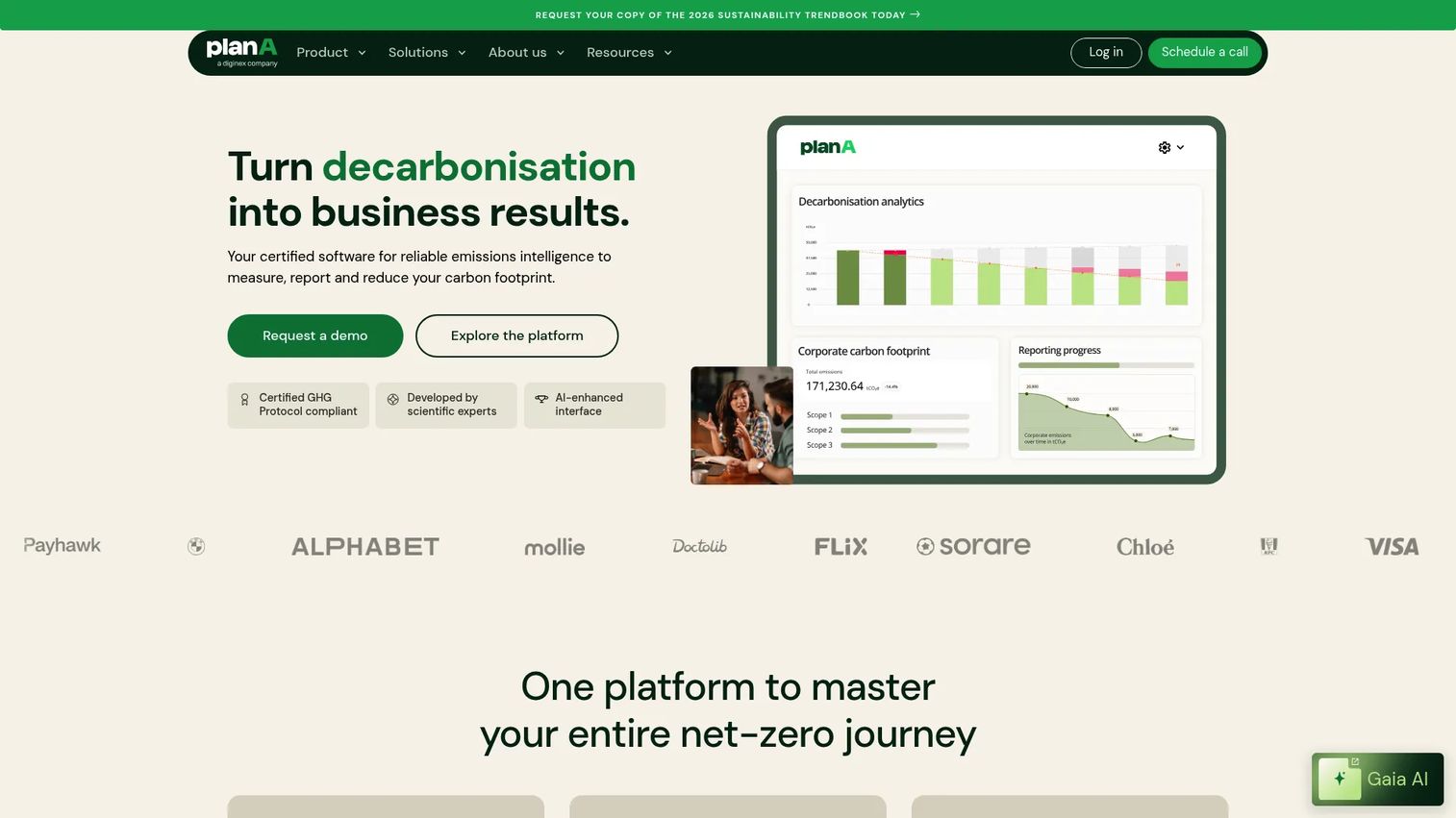
Plan A is a carbon accounting and ESG management platform that connects emissions measurement, reporting, and decarbonisation planning in one workflow. It supports GHG Protocol-aligned accounting across Scope 1, Scope 2, and Scope 3, with dashboards, report exports, and supplier data collection. Customers include companies that need a system finance and the board can stand behind, not just a snapshot calculation.
Best for: Companies moving beyond spreadsheets that need measurement and reduction planning in the same platform.
Key features
- Scope 1, 2, and 3 GHG accounting with audit-ready data trails
- Decarbonisation target setting and action planning
- ESG reporting dashboards, visual charts, and report exports
- Supplier data collection and engagement
- Internal carbon pricing support
Why choose Plan A: Plan A suits founders who want emissions data treated as a company system rather than a one-off project. The platform covers the full arc from measurement to decarbonisation planning without requiring a separate tool for each step.
Plan A pricing: Plan A sells through a sales process across Essential, Pro, and Enterprise tiers. Pro adds API access and a dedicated customer success manager. Enterprise adds personalized expert support and 500 suppliers included. Talk to their team for a quote based on company size and reporting scope.
2. Watershed
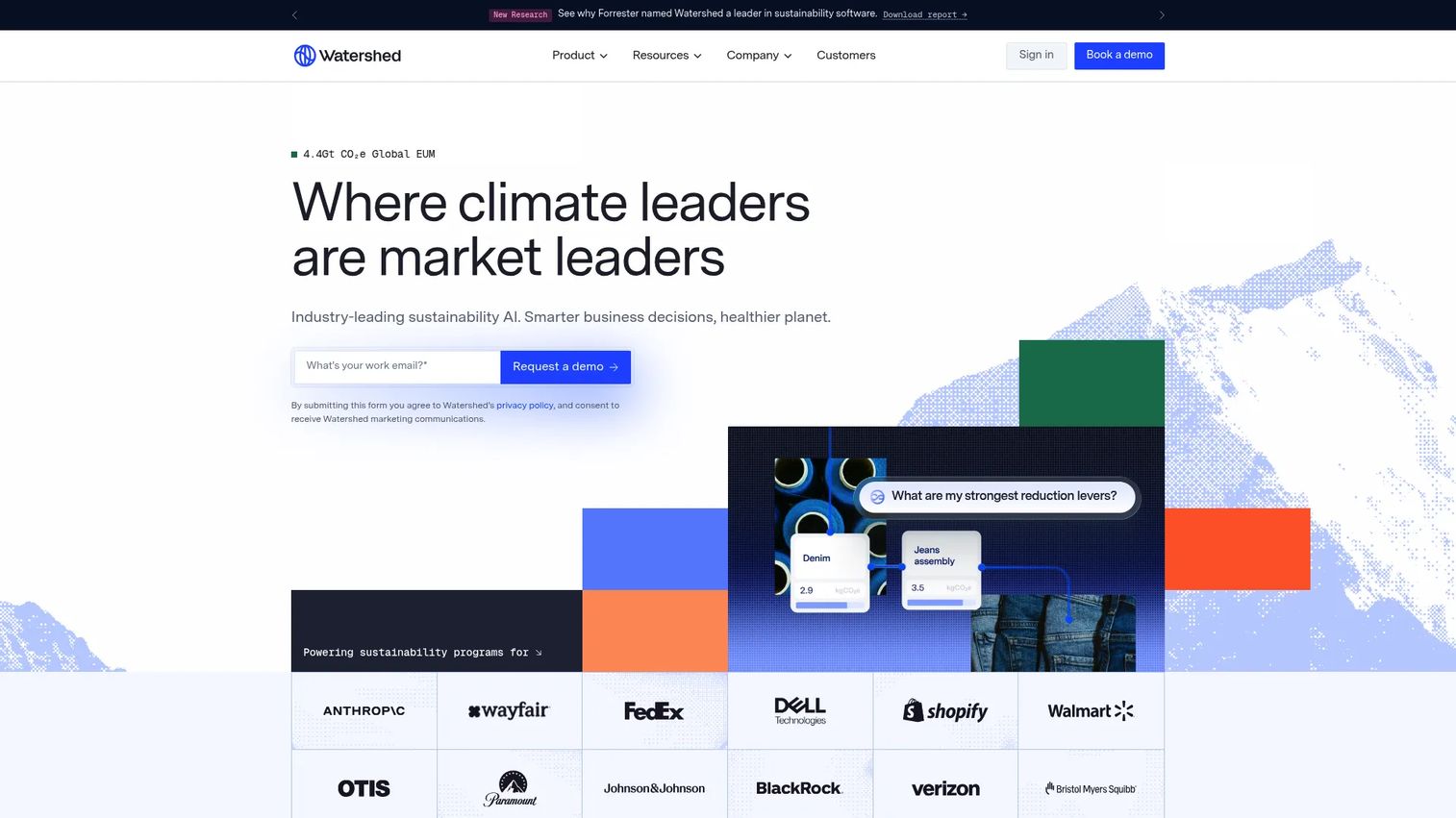
Watershed is a major enterprise climate platform used by large organizations for emissions measurement, supplier engagement, reporting, and climate program management. Its AI-assisted tools cover data cleaning, product carbon footprints, and report drafting. Framework support spans CSRD, CDP, ISSB, TCFD, and California SB253.
Best for: Larger companies with complex Scope 3 data, formal climate reporting programs, and dedicated sustainability or finance resources.
Key features
- Scope 1, 2, and 3 emissions measurement with audit trails and emissions-factor databases
- AI-assisted data cleaning and report drafting
- ESG reporting across CSRD, CDP, ISSB, and TCFD
- Supplier engagement workflows and clean-power procurement
- Decarbonisation planning and scenario modeling
Why choose Watershed: This is the tool to shortlist when climate reporting has become a board, finance, and procurement workflow rather than a one-person effort. It may be more platform than an early-stage team needs, but that is a stage question, not a quality one.
Watershed pricing: Watershed prices through a sales process. Cost is driven by footprint complexity, reporting requirements, and supplier workflow depth. Contact their team for a quote.
G2 rating: 4.5/5
3. Persefoni
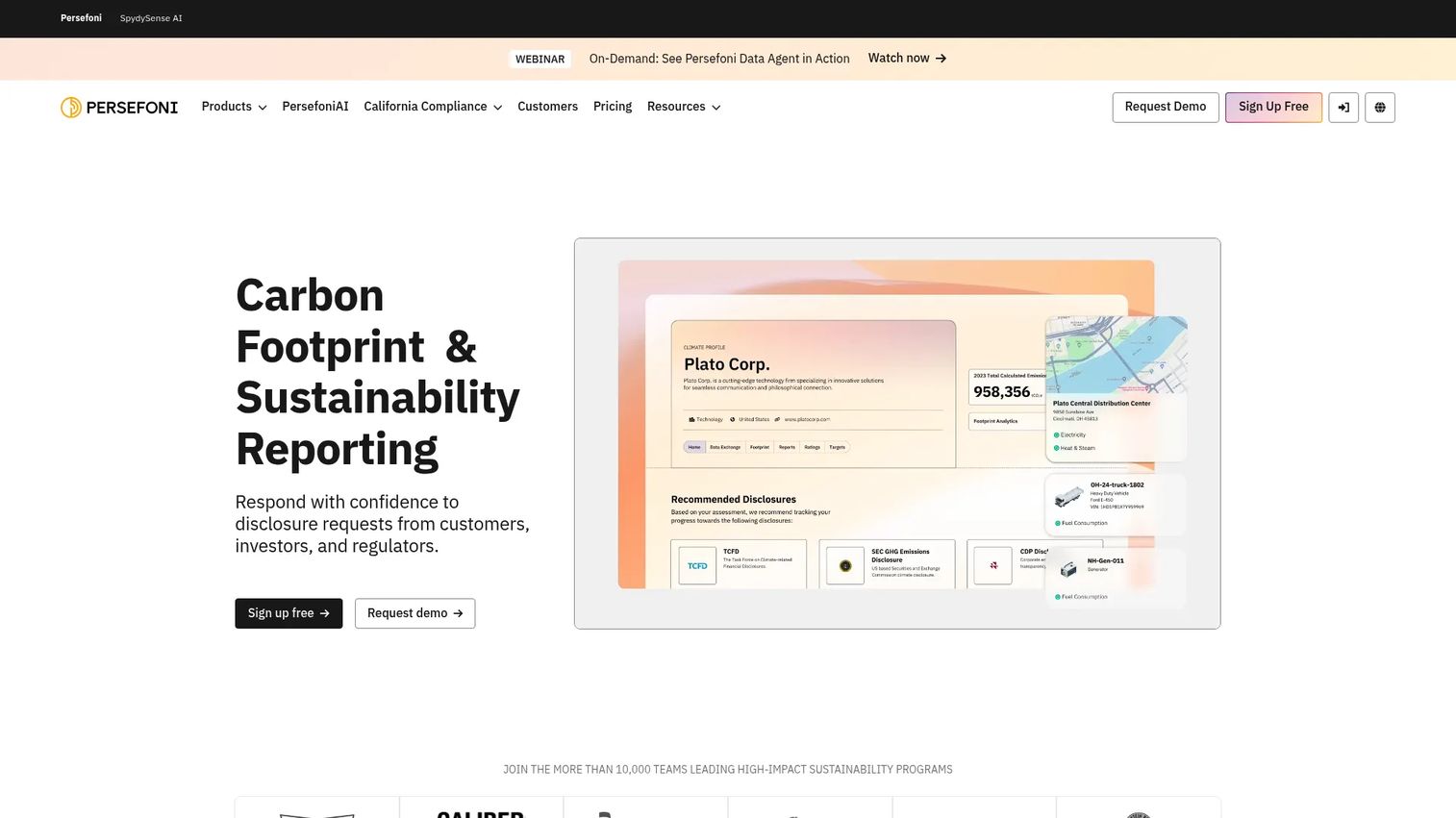
Persefoni is a climate management and carbon accounting platform with strong finance, audit, and disclosure positioning. Its carbon ledger approach treats emissions data with the same controls as financial data, which resonates with CFOs and finance teams preparing for investor diligence or enterprise procurement.
Best for: Finance-led teams that need defensible carbon accounting and disclosure support with a free entry point.
Key features
- Scope 1, 2, and 3 emissions accounting with audit trails
- Carbon ledger with enterprise controls and emissions-factor management
- Sustainability reporting for CSRD, ISSB, and CDP
- Net-zero target setting and supplier engagement
- AI-powered Copilot and anomaly detection
Why choose Persefoni: When the CFO or board wants emissions data treated like financial data, Persefoni's audit-oriented design fits naturally into that frame. It is one of the few platforms on this list with a meaningful free tier.
Persefoni pricing: The Pro plan is free with no trial period. Advanced adds expanded carbon and sustainability management capabilities at custom pricing through a sales conversation.
G2 rating: 4.8/5
4. Sweep
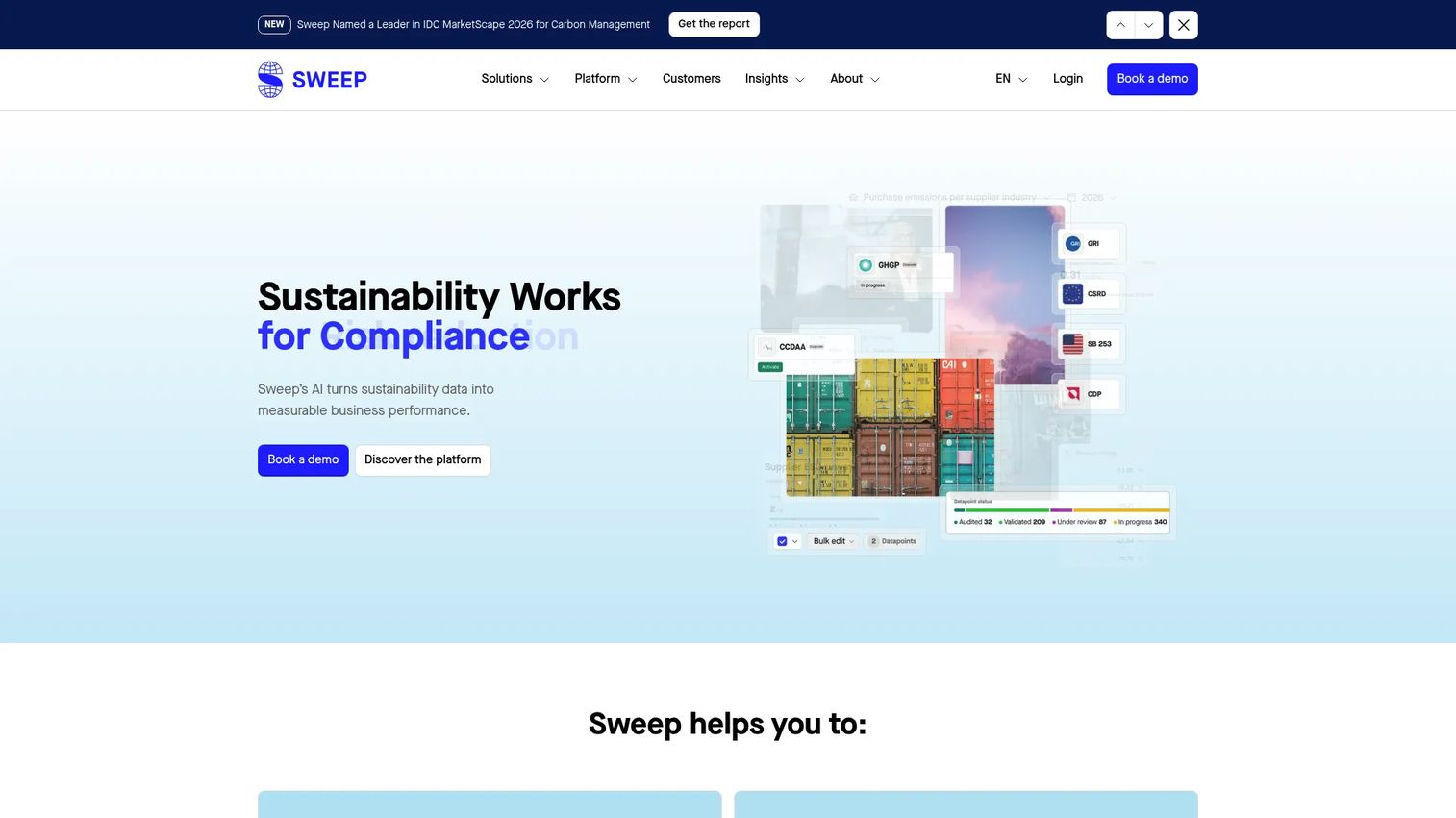
Sweep is a sustainability intelligence platform built around data collaboration across teams, business units, and suppliers. Its network-style data collection is designed for companies whose emissions picture involves many contributors. Framework support covers ISSB, GRI, CDP, CSRD, and California SB 253.
Best for: Companies that need multiple internal teams or external suppliers to contribute emissions data.
Key features
- Carbon accounting across corporate, product, financed, and supply-chain emissions
- Supplier engagement with automated data collection
- Audit trails, data lineage, and governance controls
- AI-powered dashboards and scenario modeling
- Third-party verification support
Why choose Sweep: The hardest part of Scope 3 accounting is usually coordination, not calculation. Sweep addresses that by treating data collection as a collaborative workflow rather than a manual CSV exercise.
Sweep pricing: Sweep prices through a sales process. Cost is driven by entity count, user seats, supplier volume, and reporting workflows. Contact their team for a quote.
G2 rating: 4.8/5
5. Greenly
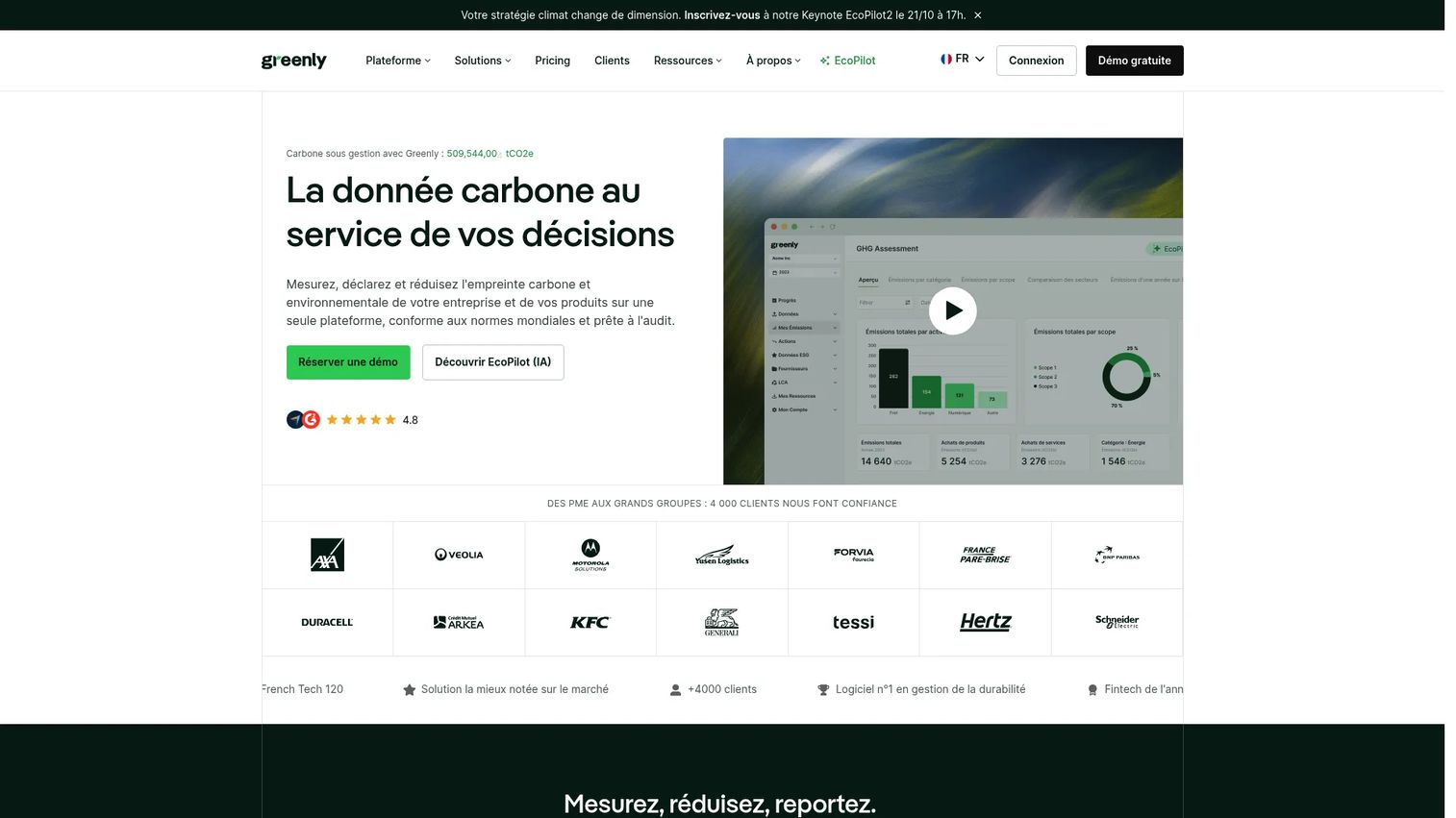
Greenly is an AI-powered carbon accounting platform known for helping companies start quickly with emissions measurement. Guided carbon assessments and 100-plus integrations make it accessible for teams without a dedicated sustainability function. Reporting covers SBTi, TCFD, CDP, and California disclosure laws.
Best for: Growing companies that need a practical first emissions baseline without hiring a sustainability team first.
Key features
- GHG emissions calculation across Scope 1, Scope 2, and Scope 3
- Guided carbon assessment with personalized action plans
- Product life-cycle assessment and product reporting
- Supplier engagement and value-chain reporting
- 100-plus integrations with automated data harmonization
Why choose Greenly: For a founder who wants first-week progress on emissions reporting rather than a multi-month implementation, Greenly's guided setup and broad integration library reduce the activation barrier significantly.
Greenly pricing: Greenly uses a calculator-based pricing process. You enter company details to receive an initial estimate, then engage their team for a proposal. Cost varies by company size and reporting scope.
G2 rating: 4.7/5
6. IBM Envizi
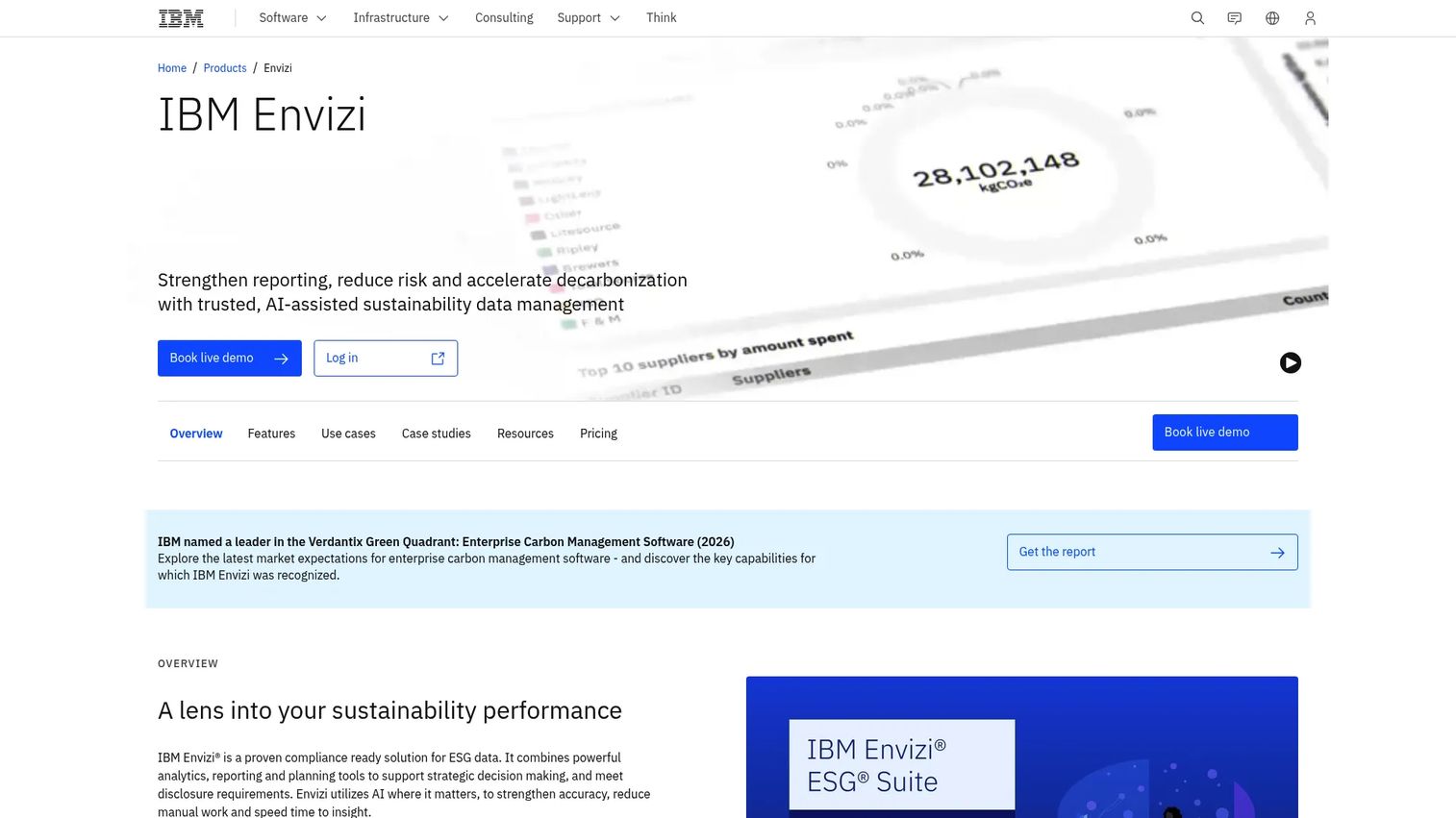
IBM Envizi is a compliance-ready ESG data management and sustainability performance platform built for large organizations. It consolidates data across facilities, energy, utilities, and supply chains, applying GHG accounting methodology at enterprise scale. IBM's Essentials, Standard, and Premium bundles allow organizations to scope the platform to their data volume and reporting needs.
Best for: Large enterprises managing ESG data across many sites, systems, and reporting frameworks simultaneously.
Key features
- Automated ESG data capture and consolidation across energy and utilities
- Scope 1, 2, and 3 GHG accounting with audit trails
- ESG data quality checks, hierarchy management, and normalization
- Supply-chain intelligence and supplier engagement
- Target setting, dashboards, and multi-framework reporting
Why choose IBM Envizi: IBM Envizi is built for organizations with complex operating footprints. Most Series B SaaS companies will not need this level of infrastructure unless they carry parent-company obligations or formal enterprise reporting requirements.
IBM Envizi pricing: IBM prices Envizi across Essentials, Standard, and Premium account bundles. Cost is tailored to data volume and selected functionality. Request a quote directly from IBM.
G2 rating: 4.3/5
7. Microsoft Sustainability Cloud
Microsoft Sustainability Cloud is a suite of capabilities for collecting, analyzing, and acting on ESG and emissions data across the Microsoft ecosystem. The primary priced product within the suite is Microsoft Sustainability Manager, which handles carbon, water, and waste data management with AI-powered insights.
Best for: Companies already standardized on Microsoft cloud, Azure, and productivity infrastructure who want sustainability data inside the same environment.
Key features
- Centralized ESG data collection and analytics inside Microsoft
- Environmental impact management through Microsoft Sustainability Manager
- ESG data governance, audit trails, and workflow management
- Value-chain sustainability visibility and product carbon footprint tracking
- Cloud-emissions analysis through the Emissions Impact Dashboard
Why choose Microsoft Sustainability Cloud: If your stack already runs on Microsoft, this reduces integration friction considerably. The decision is fundamentally whether sustainability data should live inside your existing Microsoft environment or in a specialist platform.
Microsoft Sustainability Cloud pricing: Microsoft Sustainability Manager Essentials starts at $4,000 per tenant per month (billed monthly). The Premium tier is $12,000 per tenant per month and adds advanced Scope 3 management, AI-powered insights, and product carbon footprint management.
G2 rating: 4.4/5
8. Salesforce Net Zero Cloud
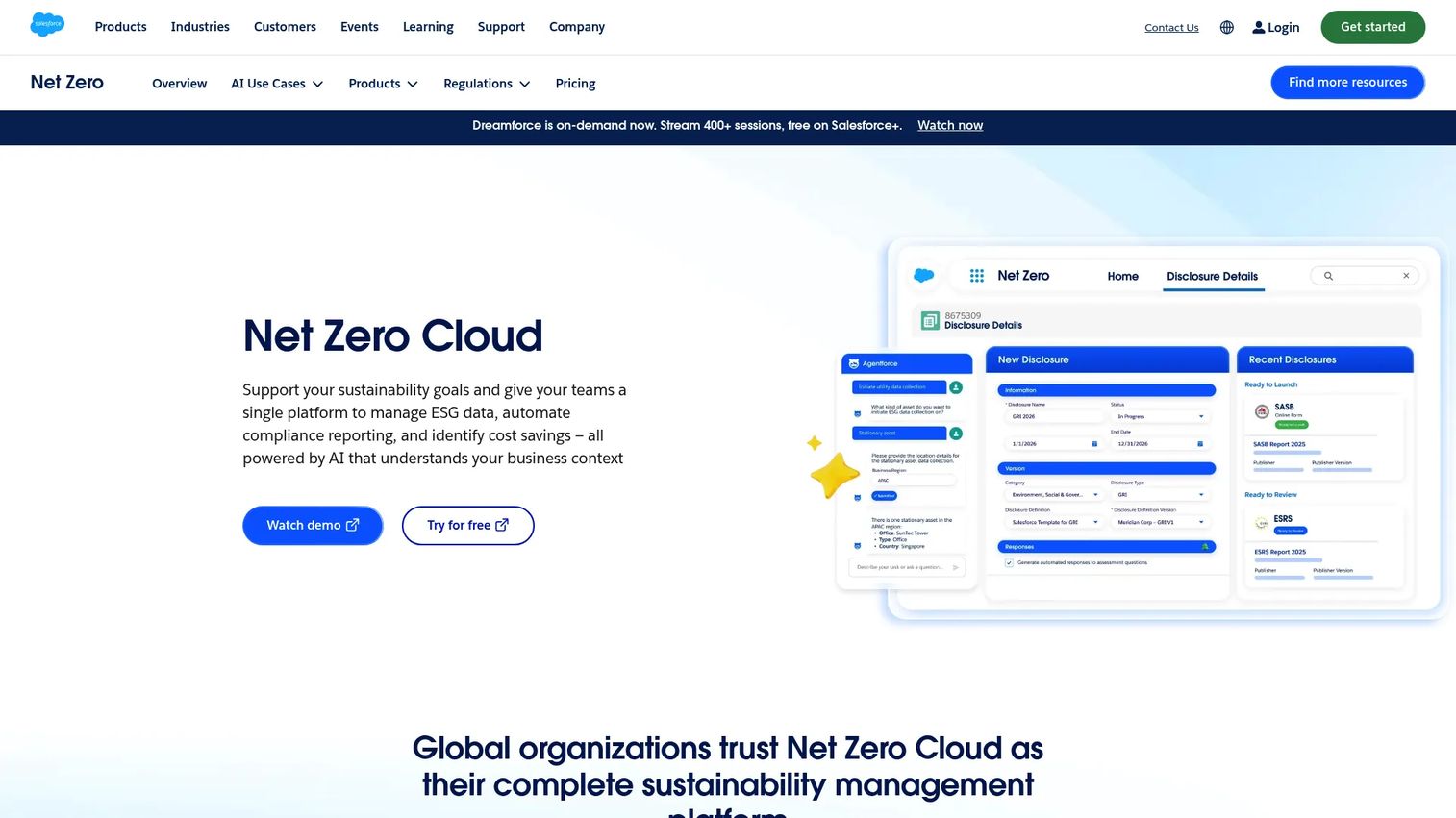
Salesforce Net Zero Cloud (now marketed as Agentforce Net Zero in some Salesforce documentation) supports carbon accounting and ESG reporting inside the Salesforce environment. It connects emissions data to existing CRM workflows and includes AI-assisted ESG disclosure authoring through Agentforce.
Best for: Salesforce-heavy organizations that want carbon and supplier emissions workflows connected to their existing customer and operational data.
Key features
- Carbon accounting across Scope 1, Scope 2, and Scope 3 emissions
- What-if analysis and emissions forecasting
- Supplier emissions and sustainability-risk tracking
- Framework-specific reporting for CSRD, SASB, GRI, and CDP
- Agentforce-assisted ESG disclosure authoring
Why choose Salesforce Net Zero Cloud: For companies already deep in Salesforce, adding emissions data to the same environment means sustainability reporting benefits from existing data hygiene and workflow discipline. It is worth evaluating if sustainability data should connect to customer or supplier workflows already in Salesforce.
Salesforce Net Zero Cloud pricing: Starter is $48,000 per org per year (billed annually). Growth is $210,000 per org per year. Add-ons including multi-organization support and expanded analytics are priced separately.
G2 rating: 4.4/5
9. Sphera
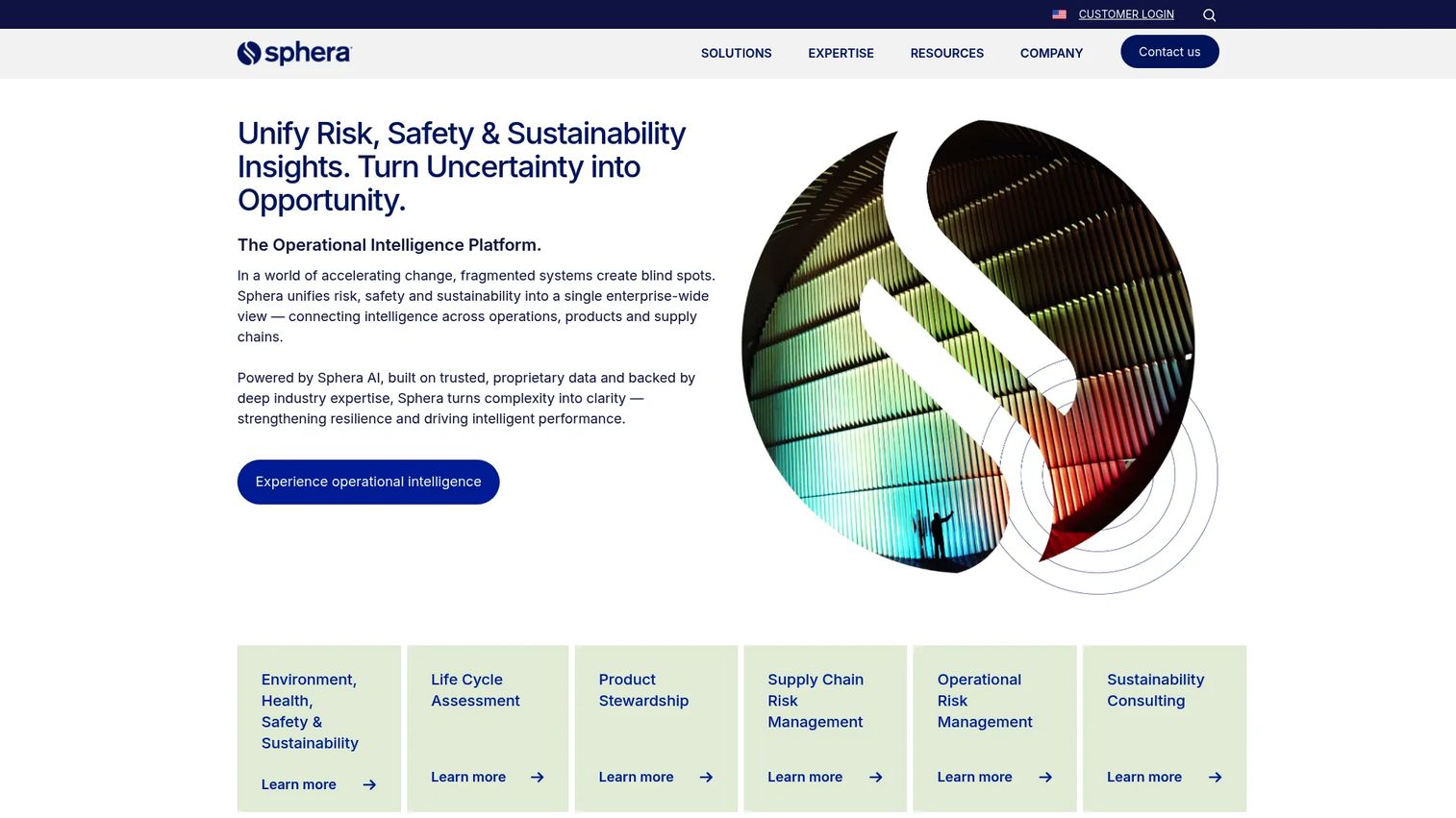
Sphera offers ESG, environmental health and safety (EHS), operational risk, and sustainability software with carbon management capabilities. Its SpheraCloud platform brings incident management, risk assessment, environmental accounting, and life-cycle assessment into one environment for complex industrial organizations.
Best for: Companies with complex environmental, health, safety, and operational sustainability requirements where carbon sits inside a broader EHS or risk function.
Key features
- Health and safety management with incident and risk-assessment workflows
- Environmental accounting with emissions calculations and audit trails
- Advanced risk assessment supporting HAZOP, LOPA, and FMEA methodologies
- Life-cycle assessment software and managed LCA data
- Unified platform with EHS and ESG integration
Why choose Sphera: Sphera suits operationally complex companies, not lightweight SaaS teams. If carbon accounting is part of a broader EHS compliance program with multiple sites, Sphera's integration of those functions reduces fragmentation.
Sphera pricing: Sphera prices through a sales process. Cost is driven by modules selected, site count, and implementation scope. Contact their team for a quote.
G2 rating: 4.0/5
10. Workiva Carbon
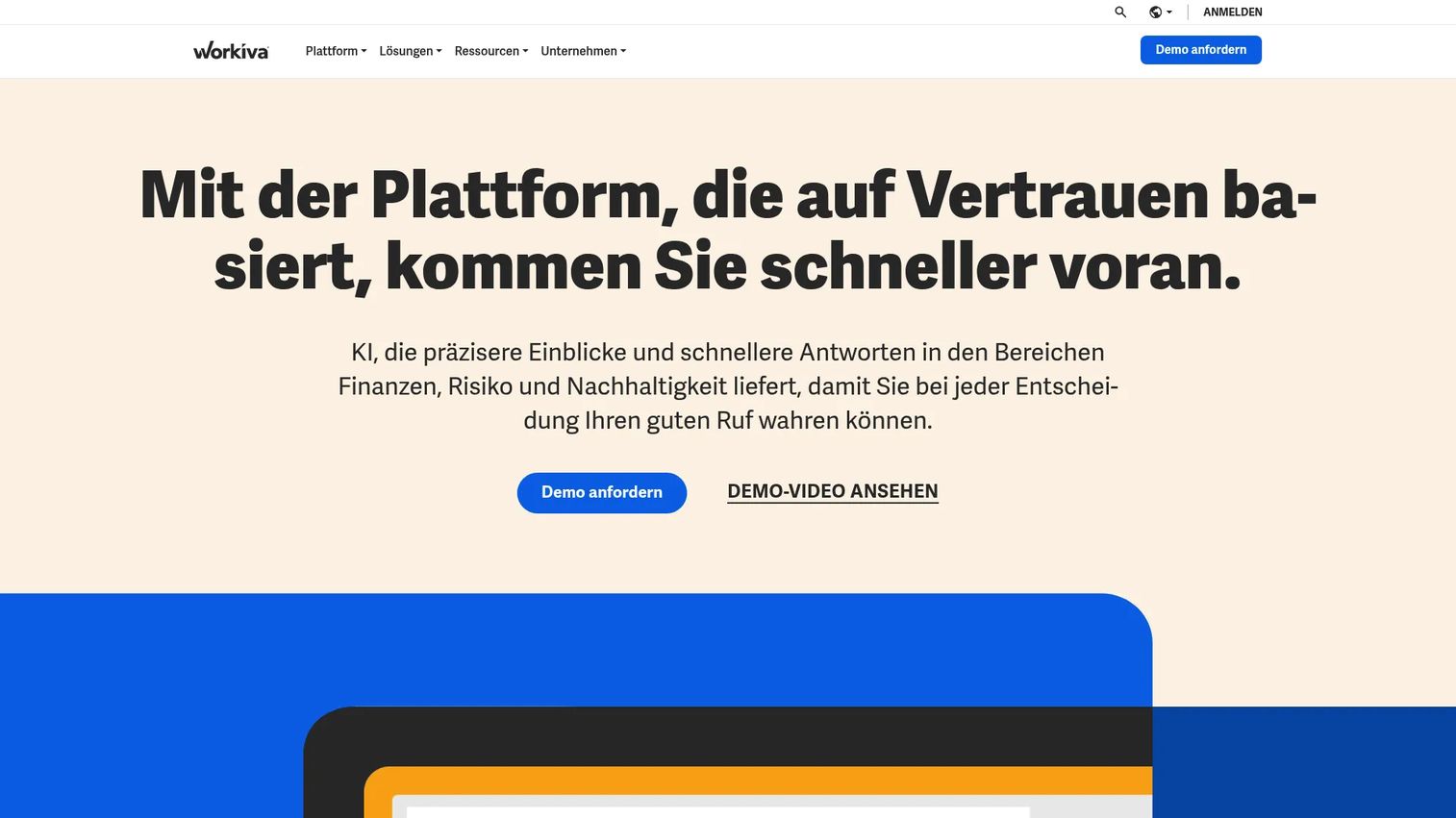
Workiva Carbon connects carbon accounting with reporting controls, disclosure workflows, and ESG data management. Workiva's strength is treating the reporting process with the same rigor applied to financial disclosures: Controls, approval workflows, and assurance-ready documentation.
Best for: Finance and reporting teams that need carbon data tied to ESG disclosure controls with board-packet quality.
Key features
- Scope 1, 2, and 3 emissions calculations and data collection
- ESG disclosure workflows with control documentation
- Reduction-pathway modeling and decarbonisation planning
- Supply-chain risk assessment and supplier engagement
- Assurance-ready emissions disclosures
Why choose Workiva Carbon: When the reporting process matters as much as the calculation, Workiva Carbon fits naturally alongside existing financial reporting workflows. For founders preparing for investor diligence or board packets, finance-grade governance over emissions data is the specific value.
Workiva Carbon pricing: Workiva prices through a sales conversation. Cost is driven by reporting scope, modules, user count, and assurance requirements. Contact Workiva directly.
G2 rating: 4.5/5
11. Emitwise
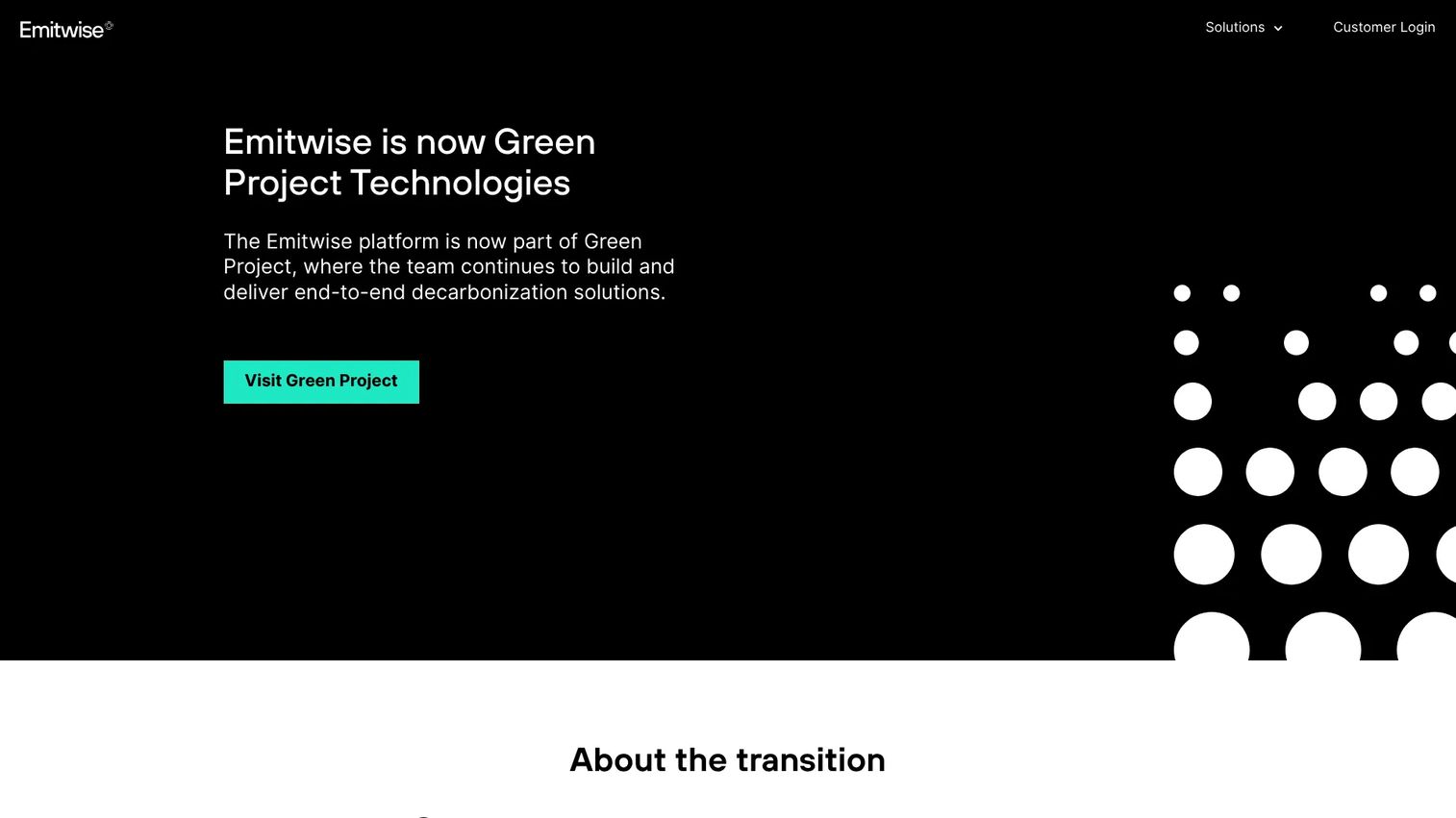
Emitwise focuses on supply-chain carbon accounting and supplier emissions management. Note: Emitwise was acquired by Green Project Technologies in July 2025 and is no longer sold as a standalone product. Its Foundations Package remains publicly listed for buyers evaluating what the technology offers.
Best for: Companies with material supplier emissions and procurement-led climate programs needing Scope 3 engagement.
Key features
- Scope 1, 2, and 3 emissions accounting
- Supplier emissions data collection and engagement
- Carbon data analysis by scope, category, region, facility, and supplier
- Emissions reduction target setting and tracking
- CSRD-compliant emissions reporting
Why choose Emitwise: For companies whose carbon footprint lives primarily outside their own walls, Emitwise's procurement and supplier focus addresses the hardest Scope 3 categories. Given the acquisition, confirm current product availability and roadmap before committing.
Emitwise pricing: The Foundations Package is publicly listed at £7,500 per annum. Given the acquisition by Green Project Technologies, contact the team to confirm current packaging.
12. SINAI Technologies
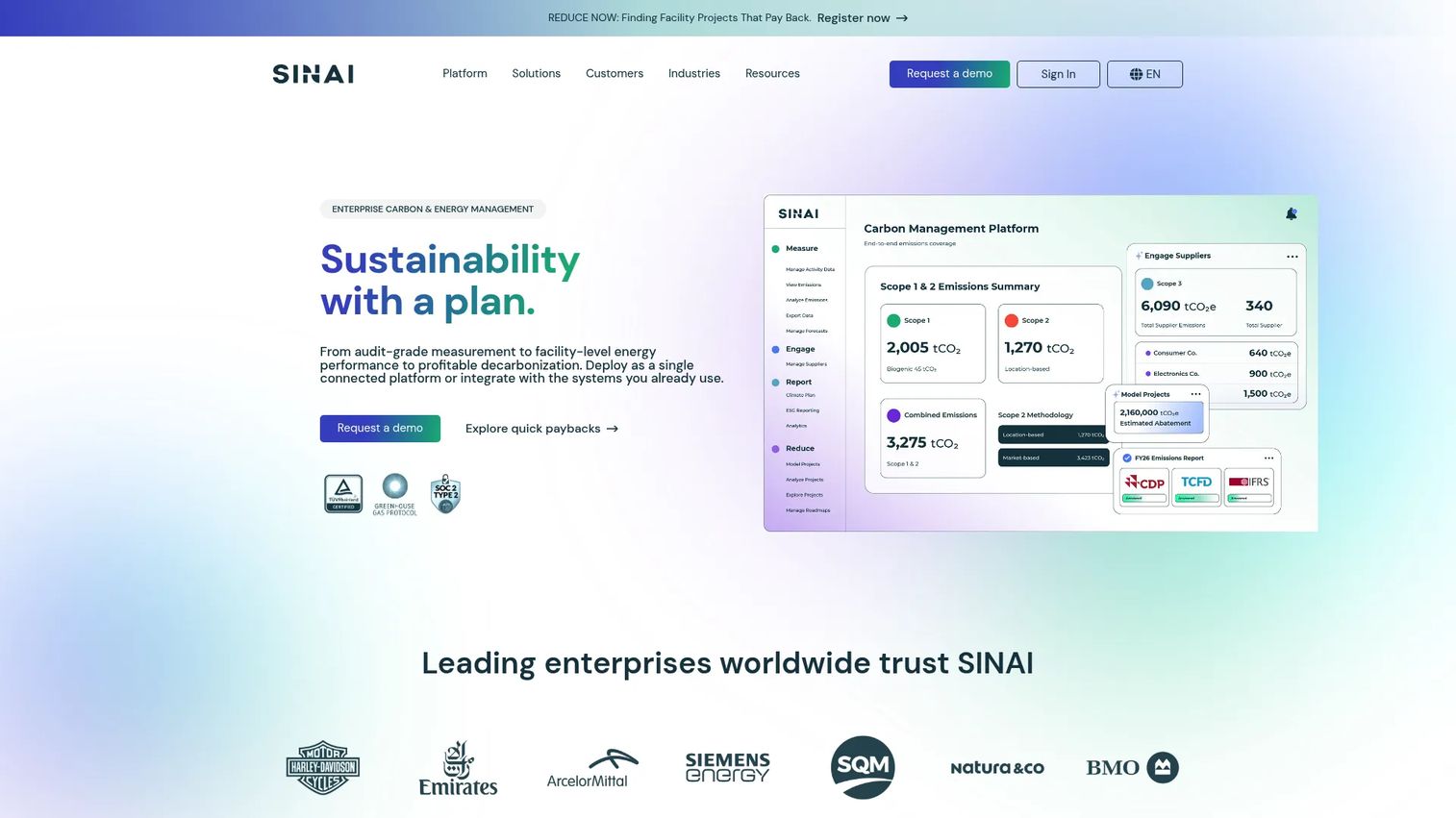
SINAI Technologies (now operating at sinai.com) supports enterprise carbon accounting, decarbonisation planning, scenario modeling, and emissions reduction strategy. Its financial modeling and marginal abatement cost curves make it useful when the question shifts from "what are our emissions?" to "which reductions should we fund?"
Best for: Teams that need to model reduction pathways, compare abatement options, and connect decarbonisation investments to financial planning.
Key features
- Audit-grade Scope 1, 2, and 3 carbon accounting
- Supplier engagement and Scope 3 emissions measurement
- Compliance reporting for CSRD, CBAM, CDP, and SBTi
- Scenario modeling and decarbonisation planning
- Financial modeling and marginal abatement cost curves
Why choose SINAI Technologies: When capital allocation decisions depend on which emission-reduction investments deliver the best return, SINAI's abatement curve modeling gives that analysis a structured foundation. It fits boards that want to see the cost of getting to net zero, not just the current footprint.
SINAI Technologies pricing: SINAI prices through a sales process. Cost is driven by facilities, emissions categories, planning module depth, and support needs. Request a demo at sinai.com.
13. Cority Environmental Cloud
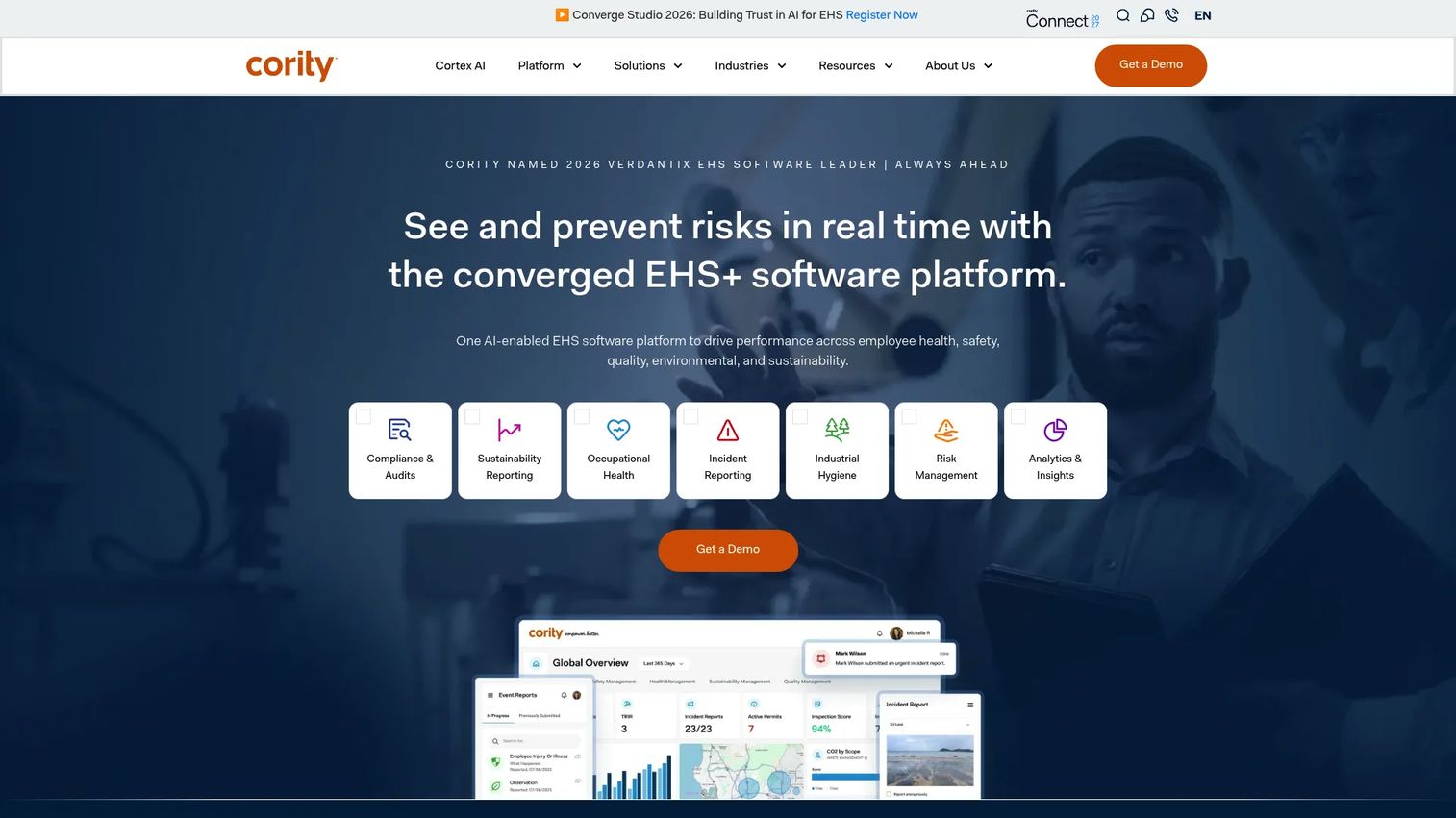
Cority Environmental Cloud supports environmental management, EHS, sustainability, and compliance workflows for organizations with regulated operations and multi-site environmental obligations. It handles air emissions, chemical management, waste, and water alongside sustainability dashboards.
Best for: Organizations where carbon accounting sits inside broader environmental compliance, permit management, and EHS programs.
Key features
- Air emissions tracking and regulatory reporting
- Chemical lifecycle and safety data sheet management
- Waste generation, storage, and disposal tracking
- Water and wastewater data, permits, and reporting
- Environmental compliance workflows and regulatory tracking
Why choose Cority Environmental Cloud: Cority fits companies with operational sites, environmental permits, and dedicated EHS teams. For pure SaaS founders without physical facilities or regulated environmental exposure, it is more platform than required.
Cority Environmental Cloud pricing: Cority prices on a custom basis driven by selected modules, site count, and implementation scope. Contact Cority for a quote.
G2 rating: 4.0/5
14. carbmee
carbmee is an enterprise environmental intelligence platform for carbon accounting, product carbon footprints, supply-chain emissions, and decarbonisation planning. It is built for manufacturers and product companies that need emissions data at product, supplier, or bill-of-materials level. CBAM and EUDR compliance are included in its scope.
Best for: Manufacturers and product companies needing product-level emissions insights and supply-chain carbon management.
Key features
- Company carbon accounting across scopes
- Supply-chain emissions management and supplier engagement
- Product carbon footprinting
- Carbon forecasting and pricing intelligence
- CBAM and EUDR compliance support
Why choose carbmee: When emissions data needs to go down to product or SKU level, most general-purpose platforms fall short. carbmee's depth in supply-chain and product footprinting earns a place on the shortlist for companies with physical goods or complex supplier networks.
carbmee pricing: carbmee offers Small, Medium, Large, and Enterprise tiers, all individually quoted. Contact carbmee for a proposal based on company size and carbon accounting scope.
G2 rating: 4.5/5
15. Carbonfact
Carbonfact is an environmental data platform purpose-built for apparel and footwear. It covers carbon accounting, product life-cycle assessments (LCAs) across a full catalogue with 16 PEFCR indicators, digital product passports, and eco-design scenario modeling. Vertical specialization means the methodology and data models match how physical goods manufacturers actually operate.
Best for: Apparel and footwear brands and suppliers that need product-level environmental measurement and reporting aligned with EU textile regulations.
Key features
- Full GHG Scope 1, 2, and 3 inventory
- Product LCAs across the full catalogue with 16 PEFCR indicators
- Automated data cleaning, gap filling, and quality assurance
- Digital Product Passport generation
- Eco-design and decarbonisation scenario modeling
Why choose Carbonfact: Vertical specialization beats generic software for physical goods manufacturers. If you are in fashion or footwear, Carbonfact's category-specific data models and Digital Product Passport capability address regulatory requirements that a horizontal platform will require significant configuration to match.
Carbonfact pricing: Carbonfact offers Carbon Accounting and Product LCA as core solutions, with Reporting and Decarbonization add-ons and Expert Services available separately. All are quote-based. Contact Carbonfact for a proposal.
G2 rating: 4.9/5
16. Coolset
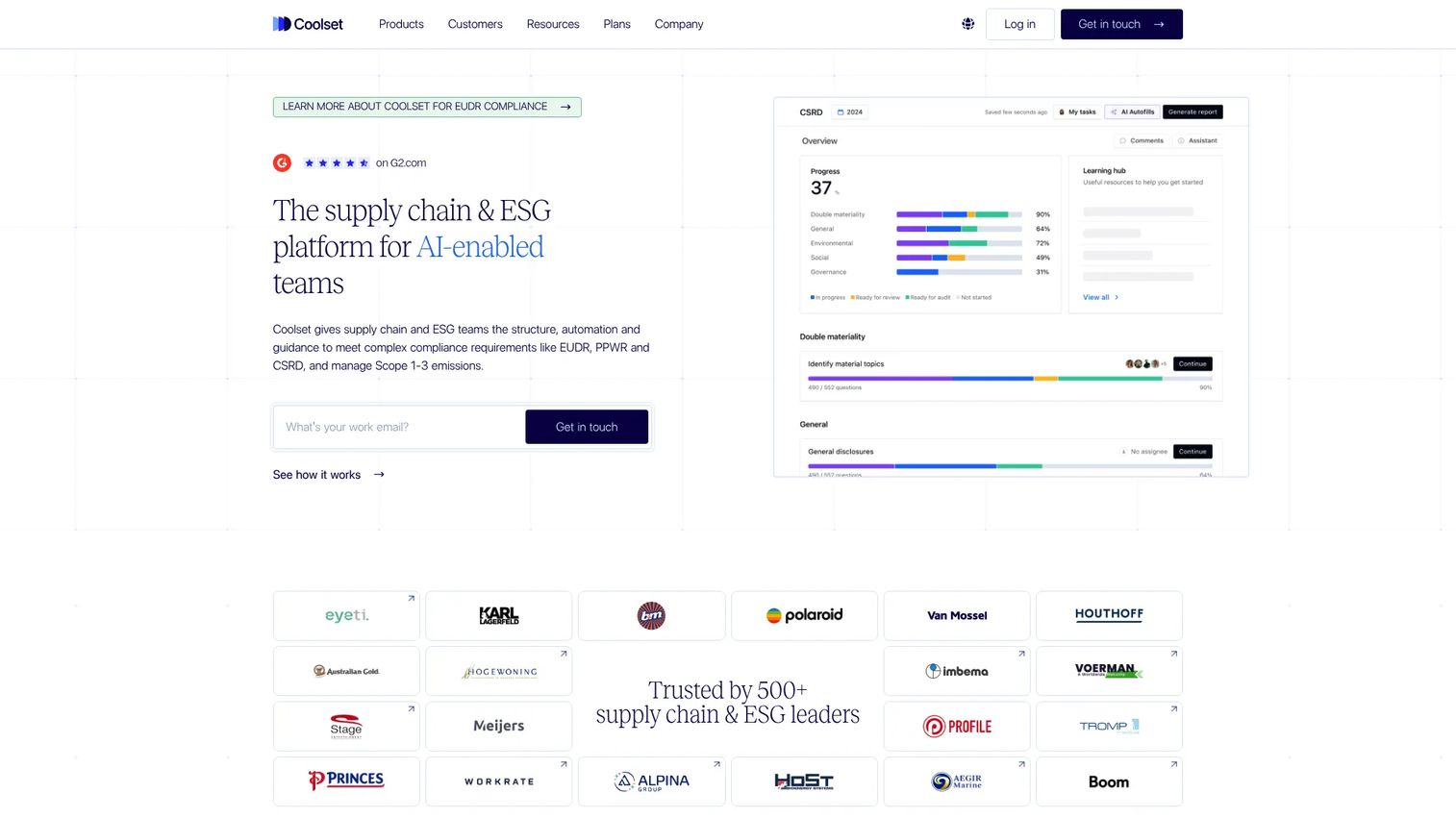
Coolset is an ESG and supply-chain compliance platform covering Scope 1, 2, and 3 emissions, CSRD and ESRS workflows, EU Taxonomy, EUDR supply-chain traceability, and VSME compliance. Its module-based structure lets organizations start with what they need and expand.
Best for: European SMEs and mid-market teams preparing for CSRD, EUDR, or EU Taxonomy compliance alongside carbon accounting.
Key features
- Scope 1, 2, and 3 emissions measurement and reporting
- CSRD, ESRS, EU Taxonomy, and VSME compliance workflows
- EUDR and PPWR supply-chain traceability and audit records
- Module-based platform with onboarding and support included
- EcoVadis reporting support
Why choose Coolset: For European companies facing CSRD deadlines alongside supply-chain regulation like EUDR, Coolset's combined compliance scope reduces the number of platforms to manage. The module structure also means you pay for what you actually need rather than committing to full enterprise scope upfront.
Coolset pricing: Coolset prices by module on a quote basis. Onboarding and support are included at no additional cost. Contact Coolset for a quote covering the modules relevant to your reporting obligations.
G2 rating: 4.7/5
17. Position Green
Position Green is a sustainability reporting and management platform covering carbon accounting, ESG reporting for CSRD and ESRS, GRI and GHG Protocol alignment, supplier management, group reporting, and benchmarking. AI-assisted data consolidation and analysis reduce manual reporting work.
Best for: Companies that want carbon accounting inside a wider ESG reporting and sustainability governance program.
Key features
- Carbon management and emissions accounting
- Automated sustainability reporting for CSRD, ESRS, GRI, and GHG Protocol
- Supplier management and risk identification
- Group reporting and consolidation
- Benchmarking and performance analytics
Why choose Position Green: If investors or customers are asking for ESG data beyond just emissions, a platform that covers carbon inside a broader reporting program prevents the need to stitch together multiple tools later. Position Green suits organizations where sustainability governance is becoming a formal function.
Position Green pricing: Position Green prices through a sales process. Cost is driven by modules, entities, reporting frameworks, and support scope. Contact Position Green for a proposal.
18. Normative
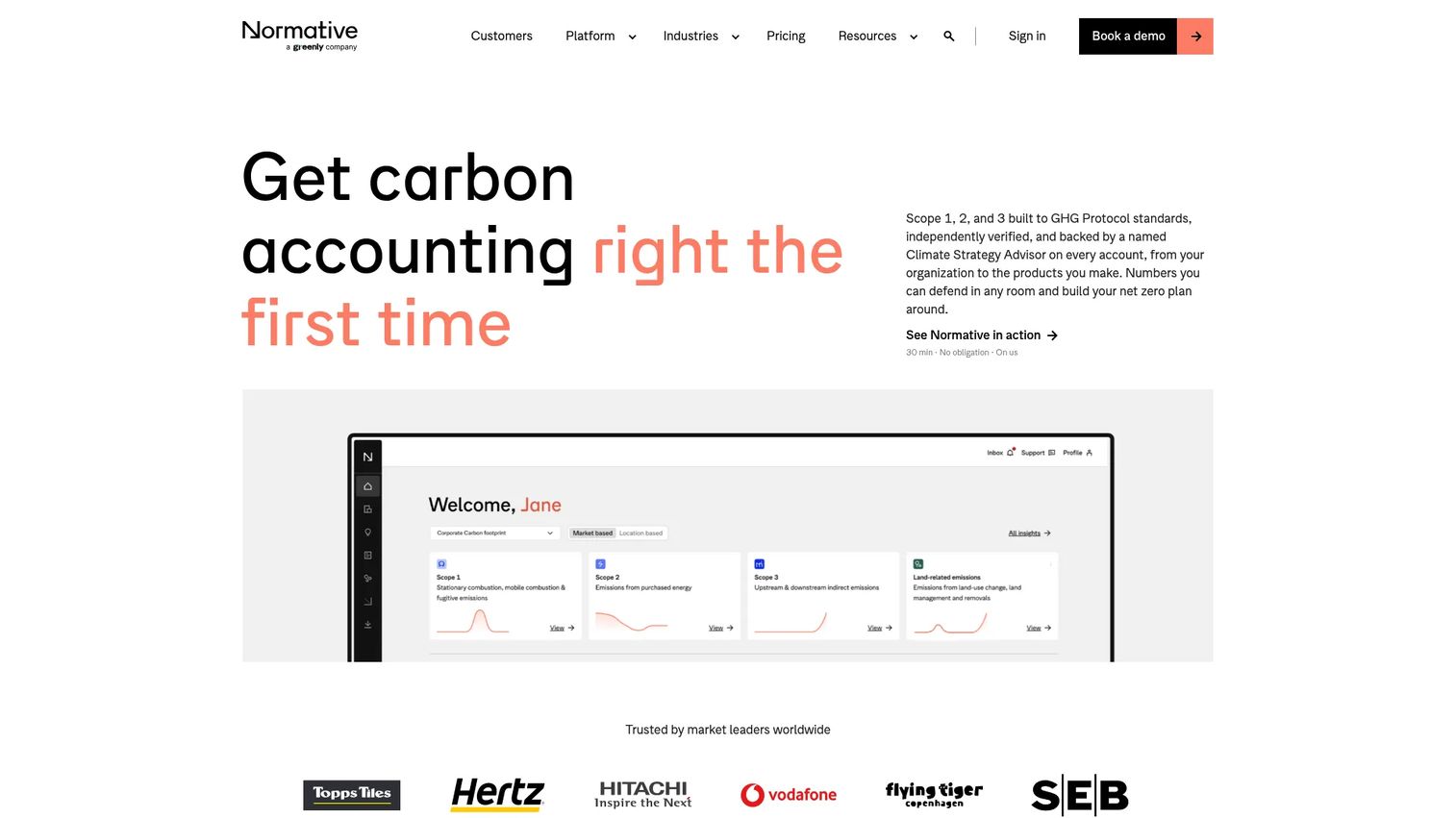
Normative is a carbon accounting platform focused on Scope 1, 2, and 3 emissions calculations, activity data mapping, and structured reduction planning. Its AI-powered data validation and categorization help automate the data-cleaning work that manual carbon accounting requires. CSRD and SECR reporting support are included.
Best for: Enterprise sustainability teams needing audit-ready carbon accounting with guided methodology and strategic reduction planning.
Key features
- AI-powered data validation and categorization
- Scope 1, 2, and 3 carbon accounting with dynamic dashboards
- CSRD and SECR reporting support
- Reduction scenarios and strategic reduction planning
- Supplier and value-chain engagement
Why choose Normative: For founders evaluating whether spreadsheets can still carry methodology and traceability requirements, Normative's structured approach answers that question clearly. Its Essential and Premium tiers let organizations scale from baseline measurement to full value-chain engagement.
Normative pricing: Essential and Premium plans are both quote-based. Essential covers carbon calculations, reporting, compliance, and support. Premium adds enhanced data management, value-chain engagement, and strategic reduction planning. Contact Normative for a quote.
19. ClimatePartner Hub
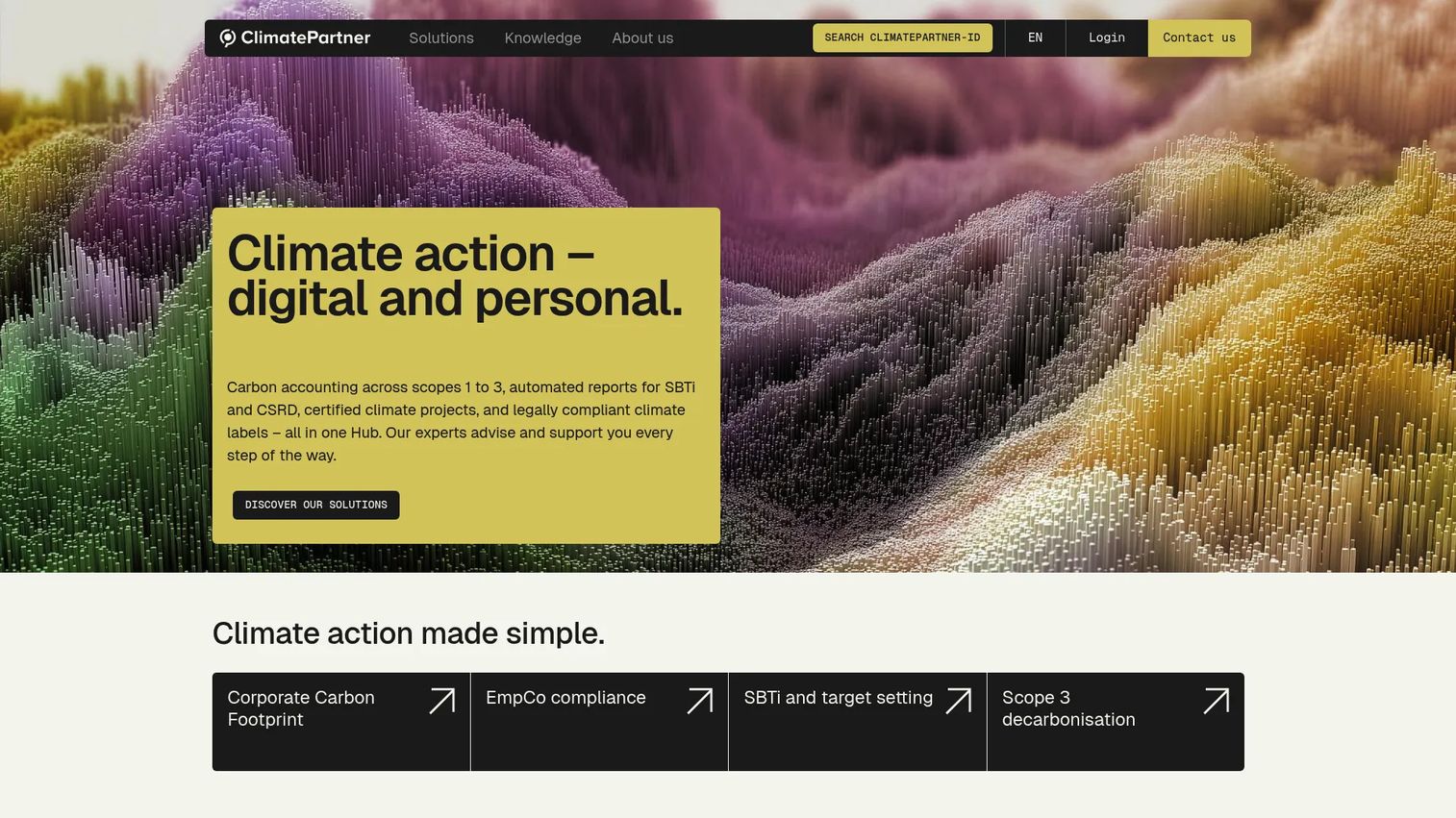
ClimatePartner Hub combines carbon accounting software with climate action services, giving companies a platform and advisory support in the same buying motion. Corporate carbon footprint calculations, product carbon footprints with automated mass uploads, and reduction roadmaps are core capabilities.
Best for: Medium-sized companies that want software and expert climate support without building internal sustainability expertise from scratch.
Key features
- Corporate Carbon Footprint calculation across Scope 1, 2, and 3
- Product Carbon Footprint calculation with automated mass uploads
- AI-assisted emission-factor matching and data uploads
- Emissions analytics, hotspot analysis, and reduction roadmaps
- Compliance-ready reporting aligned with GHG Protocol, CSRD, and SBTi
Why choose ClimatePartner Hub: For founding teams without a sustainability hire, the combination of platform and advisory support reduces the internal time required to produce credible emissions data. The payoff is avoiding the VP time cost of building methodology expertise in-house.
ClimatePartner Hub pricing: ClimatePartner prices through a sales process. Cost is driven by company size, accounting scope, advisory support level, and climate action services selected. Contact ClimatePartner for a quote.
20. KEY ESG
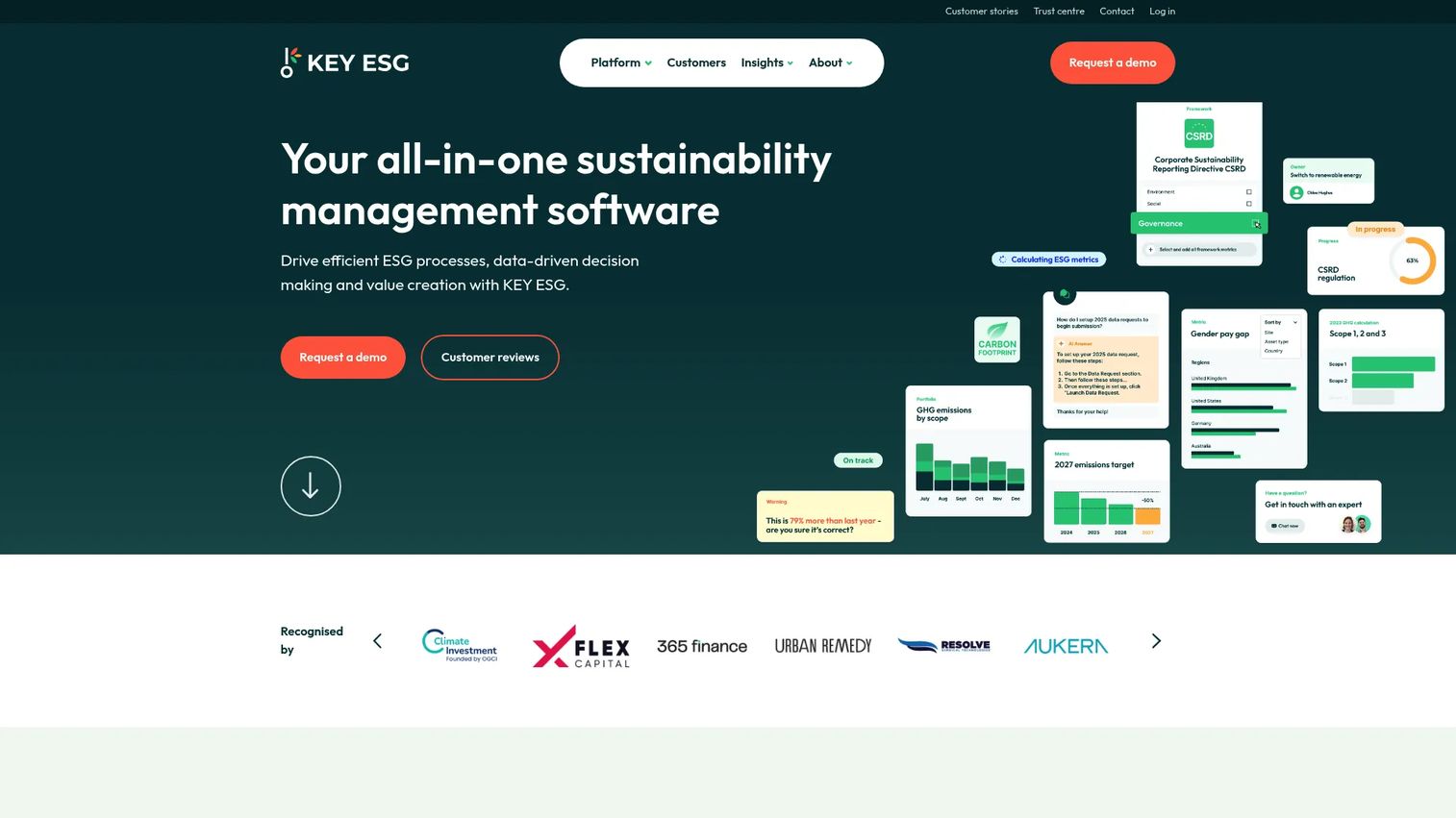
KEY ESG is an enterprise AI sustainability management platform for collecting, calculating, and reporting ESG and carbon data. It serves companies, private equity firms, and fund managers that need multi-entity ESG reporting, Scope 1, 2, and 3 carbon accounting, and regulatory compliance across CSRD, SFDR, IFRS, TCFD, and EDCI.
Best for: Companies and private markets investors that need ESG and carbon data in one reporting environment connected to investor communication.
Key features
- ESG data collection, review, sign-off, and audit trails
- Scope 1, 2, and 3 carbon accounting aligned with the GHG Protocol
- Reporting support for CSRD, SFDR, IFRS, TCFD, and EDCI
- API integrations with business applications
- AI-assisted data validation and qualitative disclosure support
Why choose KEY ESG: When carbon reporting is tied to investor communication, fundraising data requests, or private markets reporting requirements, KEY ESG's finance-oriented design fits the use case better than a pure sustainability platform. For Series B founders preparing for the next round, investor-facing ESG data management is the specific differentiator.
KEY ESG pricing: KEY ESG prices through a sales process. Cost is driven by portfolio complexity, entity count, reporting workflows, and module selection. Contact KEY ESG for a quote.
G2 rating: 4.4/5
21. Seedling
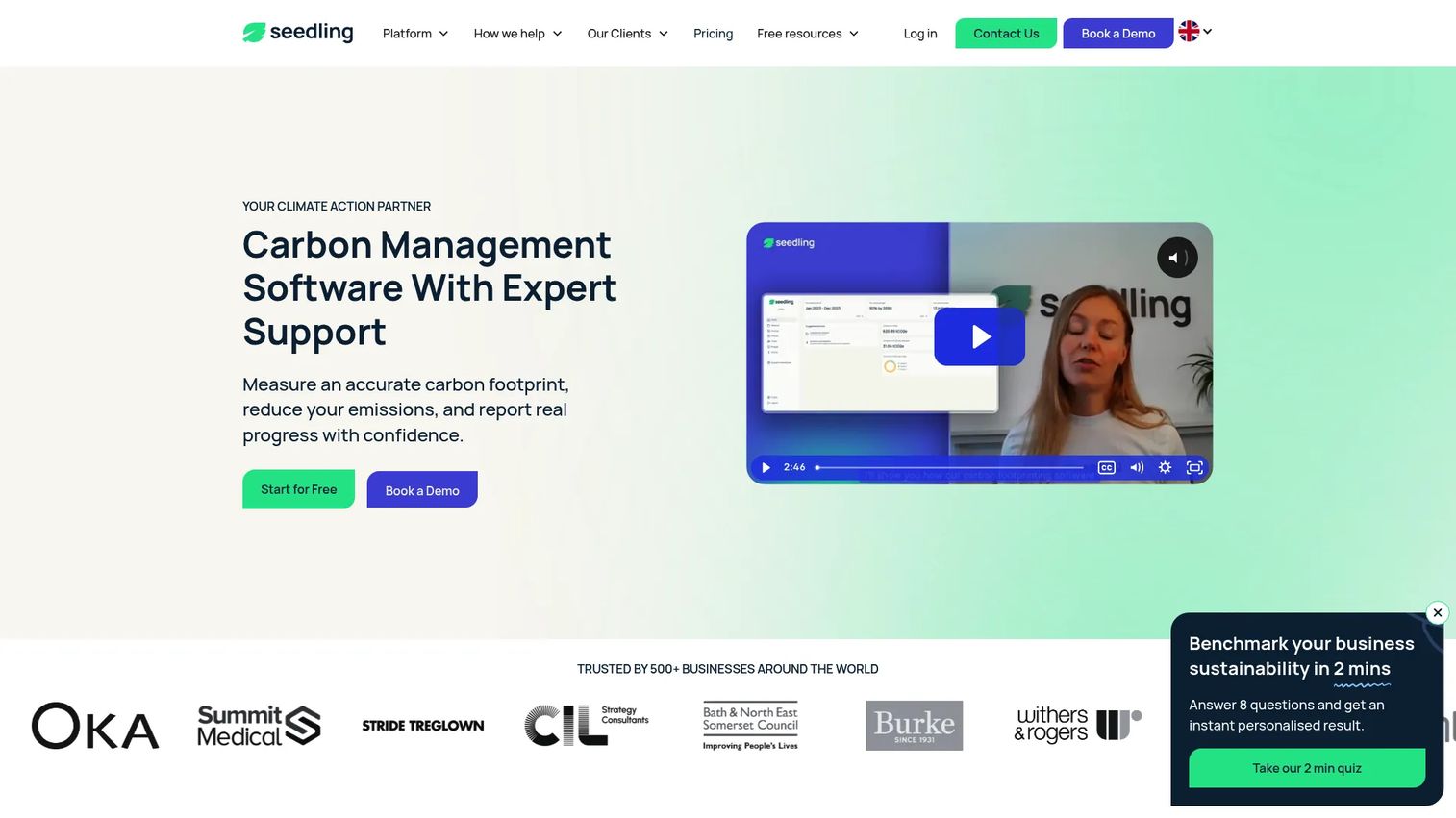
Seedling is a carbon management platform for growing businesses that pairs software with one-to-one expert guidance. It covers Scope 1, 2, and 3 carbon footprint measurement, SBTi-aligned target setting, decarbonisation modeling, and compliance-ready reporting for GHG, B Corp, PPN 006, and SECR. A free Starter plan makes it accessible for teams not yet ready to commit to enterprise pricing.
Best for: Smaller companies starting their first emissions tracking effort, particularly those in the UK where SECR and B Corp frameworks apply.
Key features
- Scope 1, 2, and 3 carbon footprint measurement
- SBTi-aligned target setting and decarbonisation modeling
- Compliance-ready GHG, B Corp, PPN 006, and SECR reporting
- Expert one-to-one guidance alongside the platform
- Free Starter plan for early-stage measurement
Why choose Seedling: Seedling is the practical choice for founders who know they need to start but do not want to overbuy. The free Starter plan removes the cost barrier, and expert guidance reduces the internal time investment required to produce a credible first footprint.
Seedling pricing: Seedling Starter is free. Seedling Core and Seedling Advanced require a personalized quote. Contact Seedling to scope pricing based on company size and reporting requirements.
Considerations when choosing carbon accounting software
Scope coverage and calculation methodology
Scope 3 is usually where the largest emissions sit and where data quality is hardest to defend. Before committing to a platform, verify which Scope 3 categories it covers, whether it supports both location-based and market-based Scope 2 calculations, and what emissions-factor databases it draws from. Methodology transparency matters when an auditor or board member asks how the number was produced.
Audit trails and source documentation
Assume the numbers will be challenged. An enterprise customer questionnaire, an investor, or a third-party assurance provider will want to see assumptions, source files, calculation history, and approval workflows. A platform that stores that evidence automatically removes the manual reconstruction work that spreadsheets create.
Integrations with finance and operational systems
The first baseline can often be built with manual data inputs or CSV uploads. Recurring reporting cannot. Ask whether the platform connects to your ERP, cloud billing provider, procurement system, HR system, and accounting software. For audit management workflows specifically, seamless data flow between finance and emissions reporting systems matters as scrutiny increases.
Reporting framework alignment
Verify support for GHG Protocol, CSRD, ESRS, ISSB, CDP, and SBTi before signing. Required frameworks depend on geography, company type, investor expectations, and customer requirements. Software structures reporting but does not replace legal, assurance, or regulatory advice on what disclosures are required of your specific organization.
Implementation effort and owner fit
A tool fails when no one owns the data workflow. Decide before buying whether finance, operations, sustainability, or procurement will own the system. The platform that fits your internal owner is more important than the platform with the deepest feature set. Also ask how long onboarding typically takes and whether implementation services are included or quoted separately.
Conclusion
Carbon accounting software is not a sustainability initiative. For a Series B founder, it is a governance decision: The difference between emissions data you can defend and emissions data that creates risk in a diligence call.
For a fast first baseline, Plan A, Greenly, Coolset, and Seedling offer structured onboarding and accessible Scope 1, 2, and 3 accounting without requiring a sustainability hire. For enterprise programs with formal reporting obligations, Watershed, Persefoni, IBM Envizi, and Microsoft Sustainability Cloud carry the depth and framework coverage that serious disclosure workflows require. When reporting governance is the priority, Workiva Carbon and KEY ESG connect emissions data to finance-grade controls. For supplier and product-level emissions, Sweep, Emitwise, carbmee, and Carbonfact address the value-chain complexity that corporate footprints alone cannot solve.
Shortlist 3 to 5 tools based on your reporting pressure, company stage, and where your activity data actually lives. Do not buy the deepest enterprise platform if the immediate job is a credible baseline and a repeatable annual reporting workflow.
The goal is a system your finance lead can own, your board can trust, and your next investor can audit. Start there.
FAQs
Carbon accounting software helps organizations collect activity data, calculate greenhouse gas (GHG) emissions, and organize those emissions into Scope 1, Scope 2, and Scope 3 inventories. It applies emissions factors from recognized databases, maps calculations to reporting frameworks like the GHG Protocol and CSRD, and produces documentation suitable for audit or external disclosure. Most platforms also support reduction planning and target tracking alongside measurement.
SaaS companies typically need cloud infrastructure, office operations, business travel, and vendor procurement covered as their primary emission sources. For a first baseline, Plan A, Greenly, and Seedling offer accessible onboarding and structured methodology without requiring a sustainability team. For formal disclosure workflows tied to investor diligence or enterprise customer requirements, Persefoni's free Pro plan is worth evaluating as a starting point before moving to a paid tier.
For recurring, multi-source, or audit-sensitive reporting, yes. Spreadsheets work for a first rough estimate with limited data sources, but they become fragile as reporting involves multiple legal entities, supplier data, or repeat annual cycles. According to MIT Sustainable Supply Chain Lab and CSCMP (2025), 50% of North American firms still use spreadsheets for emissions tabulation, which creates compounding risk as disclosure expectations rise.
Carbon accounting software focuses specifically on measuring greenhouse gas emissions, organizing them by scope and category, and supporting reduction planning. ESG reporting software covers a broader set of environmental, social, and governance data, often treating carbon as one module within a wider reporting program. Platforms like Workiva Carbon, Position Green, and KEY ESG operate across both functions, while tools like Greenly and Normative focus primarily on the carbon accounting layer.
Most serious platforms support at least some Scope 3 categories, but depth varies significantly. Verify which categories a platform covers, whether it supports spend-based and activity-based calculation methods, and how it handles supplier data collection. According to MIT Sustainable Supply Chain Lab and CSCMP (2025), roughly 70% of firms say they lack sufficient supplier data to accurately measure supply-chain emissions. Platforms like Sweep, Emitwise, and carbmee specifically address that supplier data gap.
Pricing in this category is almost entirely quote-based. Cost typically scales with entity count, data integration complexity, supplier volume, reporting frameworks required, and whether advisory services are included. The clearest exceptions are Persefoni, which offers a free Pro plan, and Seedling, which offers a free Starter plan. Salesforce Net Zero Cloud and Microsoft Sustainability Manager publish starting prices ($48,000 per org per year and $4,000 per tenant per month respectively), giving a reference point for enterprise budget conversations.
The GHG Protocol is the central accounting framework that most platforms follow for emissions categorization and calculation methodology. Beyond that, the required disclosure frameworks depend on your geography, company type, and stakeholder expectations. European companies facing CSRD obligations need ESRS alignment. Publicly committed companies may need CDP and SBTi support. Finance-oriented disclosures may require ISSB or TCFD alignment. Software helps structure reporting against these frameworks, but does not substitute for legal or regulatory advice on what your specific organization is required to disclose.
Four checks cover most of the decision: First, who inside the company will own the data workflow day-to-day. Second, which reporting deadline or stakeholder request is creating immediate pressure. Third, where activity data currently lives (finance systems, procurement, HR, cloud billing) and whether the platform connects to those sources. Fourth, whether the platform can produce the specific evidence format required, whether that is an audit trail for an assurance provider, a framework-specific export for CDP, or a structured report for a board packet. Clarifying those four points before taking demos will narrow the shortlist faster than any feature comparison.