The audit is in three weeks. Your HACCP records live in a binder in the back office. Temperature logs are on clipboards, half of them water-stained. Supplier certificates are somewhere in an email thread from last quarter. Someone has to reconstruct all of it before the auditor walks in.
This is the reality for most food operations still running on paper. And it does not scale. Add a second site, a new product line, or a supplier who ships without a valid certificate, and the gaps multiply faster than anyone can track them.
The market is moving. According to MarketIntelo (2025), the global food safety compliance software market was valued at $3.2 billion in 2025 and is projected to reach $6.3 billion by 2034. More telling: over 60% of food-related businesses are transitioning from manual processes to automated HACCP systems, per Market Growth Reports (2026).
The reason is simple. Software turns audit prep from a scramble into a search. It replaces the binder with an audit trail you can filter in seconds. It closes the supplier certificate gap before it becomes a finding. This guide breaks down the tools that actually do that work.
What's inside
This guide is built for quality assurance leads, food safety managers, operations leaders, and founders evaluating software to replace paper logs and scattered spreadsheets. Here is how we chose and what we compared:
- Who it's for: food manufacturers, distributors, restaurants, and multi-site operators
- How tools were selected: relevance to real compliance workflows, not marketing claims
- What we weighed: HACCP support, audit readiness, traceability and recall coverage, supplier document control, digital forms, and real-time monitoring
- What we skipped: generic form builders with no food safety context and any tool without verifiable pricing or feature data
TL;DR
- Best for workflow automation: foodflou centralizes document control, CAPA, and supplier management in one system
- Best for mobile inspections and multi-site: SafetyCulture handles inspections, actions, and training across locations
- Best for audit-ready document control: Paperless Forms by Datahex turns paper checklists into searchable digital forms
- Best for AI-assisted setup: FoodReady builds HACCP plans and tracks traceability with an AI-driven workflow
- Best for monitoring and daily checks: FoodDocs generates monitoring plans and runs daily checks on mobile
- Best for supplier and compliance at scale: TraceGains connects supplier management, quality, and regulatory workflows
- Best for fast FSQA digitization: Allera converts food safety and quality paperwork into digital forms with compliance review
What food safety compliance software is
Food safety compliance software is a system that centralizes the records, logs, inspections, corrective actions, and audit evidence a food operation needs to prove it meets regulatory and certification requirements.
Instead of storing HACCP plans in a binder and temperature logs on clipboards, the software keeps everything in one place, timestamped and searchable. When an auditor asks for six months of sanitation records, you filter and export. When a supplier certificate expires, the system flags it. When a corrective action is opened, it stays open until someone closes it with evidence.
Most food safety management software covers a consistent set of capabilities:
- Centralized compliance records that replace paper files and scattered spreadsheets
- HACCP workflows for hazard analysis, critical control points, and monitoring plans
- Digital forms and inspection logs for daily checks, sanitation, and receiving
- Audit trails and corrective actions with a full history of what happened and when
- Traceability and recall management across lots, batches, and suppliers
- Supplier document control for certificates, specifications, and approval status
The category overlaps with adjacent terms. HACCP software focuses on the plan and its monitoring. FSMA compliance software emphasizes preventive controls and regulatory alignment. Food traceability software centers on lot and batch tracking. Most modern platforms blend these into one food safety management system rather than selling them separately.
When to use food safety compliance software
Replace paper logs and spreadsheets
Paper works at one site with a small team. It breaks the moment you scale. Logs get lost, handwriting gets misread, and no one can search a filing cabinet during an audit. Spreadsheets are worse in some ways: no audit trail, no version control, and anyone can overwrite a cell without a record. Digital forms for food safety fix this by capturing every entry with a timestamp and a user, so the record is defensible.
Prepare for audits and inspections
Audit prep is where the value shows up first. Instead of reconstructing evidence from memory and paper, you pull it. Good audit management software lets you retrieve corrective action history, past inspection results, and monitoring records in seconds. GFSI, SQF, and BRC audits all demand documented evidence of ongoing control. When that evidence is centralized and time-stamped, the auditor's questions become a search query rather than a fire drill.
Track traceability, recalls, and supplier documents
A recall is a race against time. If a supplier ingredient turns out to be contaminated, you need to know every lot it touched and every finished product it went into, fast. Food traceability software maps that chain so you can isolate the affected batches instead of pulling everything. Supplier management software runs alongside it, tracking certificates and specifications so an expired document never slips through receiving unnoticed.
Comparison table
The seven tools below cover the full range of food compliance workflows, from single-site restaurants to multi-plant manufacturers. Pricing and G2 ratings reflect verified, current values at the time of writing. Some vendors quote by revenue band or solution scope, so treat starting prices as entry points rather than final figures.
| # | Product | Best for | Key use case | Pricing | G2 rating |
|---|---|---|---|---|---|
| 1 | foodflou | Centralized compliance and quality management | Document control, CAPA, and supplier management | From €89/month | Not yet rated |
| 2 | Allera | Fast FSQA digitization | Digital forms, document control, supplier portals | From $50/month | Not yet rated |
| 3 | Paperless Forms by Datahex | Digital forms and checklists | Drag-and-drop forms with e-signatures | Free plan; from $14.95/month | 4.6/5 |
| 4 | SafetyCulture | Mobile inspections and multi-site | Inspections, actions, and training | Free plan; from $24/month | 4.6/5 |
| 5 | FoodReady | AI-assisted HACCP and traceability | HACCP builder, lot traceability, recall readiness | Quote-based; 14-day free trial | 4.5/5 |
| 6 | FoodDocs | Monitoring plans and daily checks | HACCP, monitoring, traceability | From $79/month | 4.9/5 |
| 7 | TraceGains | Supplier and compliance at scale | Supplier management, quality, regulatory | From $20,000/year | 4.1/5 |
Best 7 tools for food safety compliance
1. foodflou
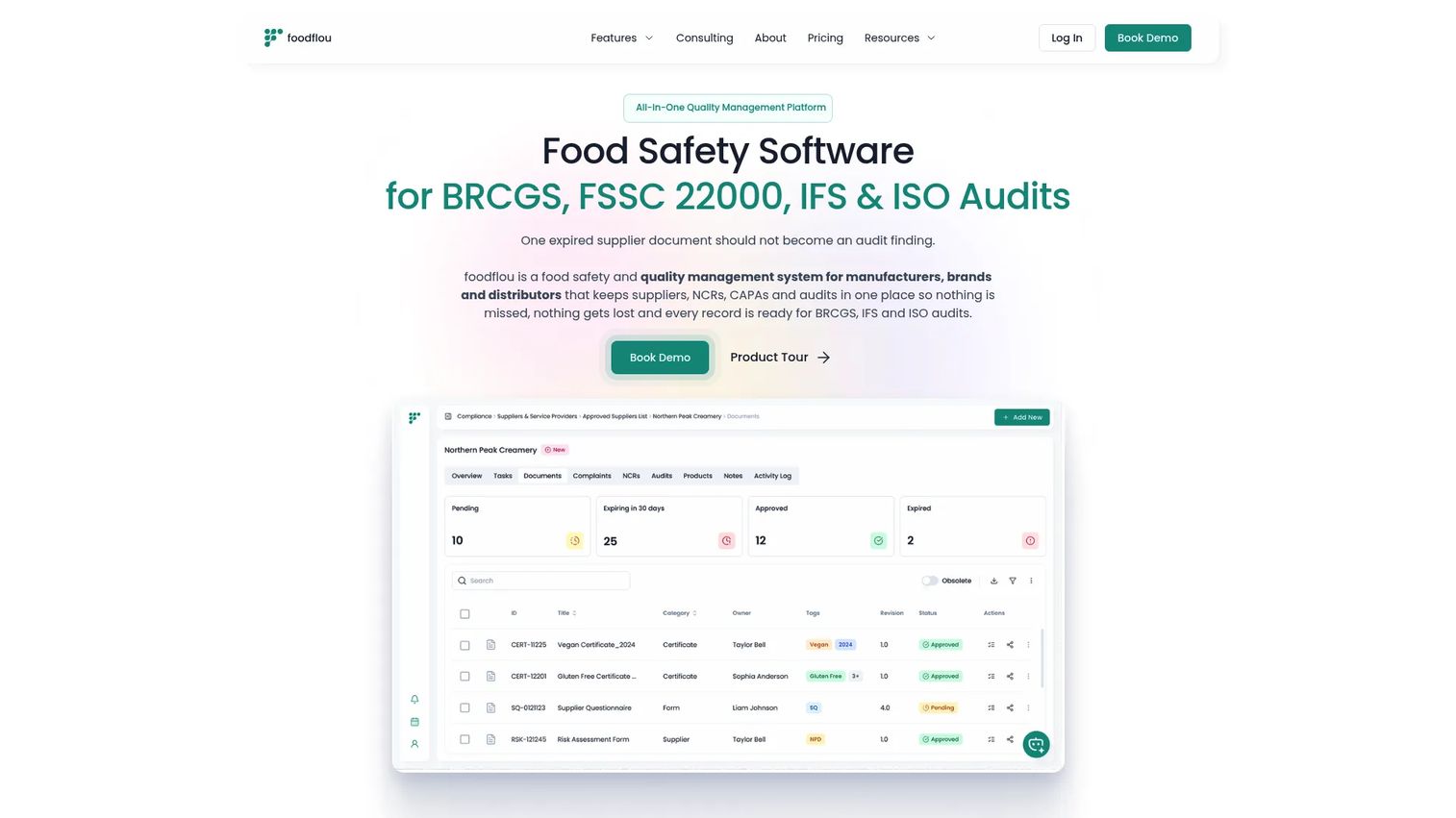
foodflou is food safety and quality management software built for food manufacturers, brands, and distributors. It pulls document control, supplier management, and corrective action workflows into one system, so the admin work that usually lives in scattered files gets a single home. The workflow-first approach means non-conformances, complaints, and CAPA actions link together instead of sitting in separate trackers.
Best for: food companies that want a centralized compliance and quality management system rather than a stack of point tools.
Key features
- Document control for procedures and records
- Supplier management with certificate tracking
- Customer complaints, NCRs, and CAPA linked together
- Forms, audits, and checklists
Why choose foodflou: if your biggest pain is admin noise, scattered documents, disconnected corrective actions, and manual supplier follow-up, foodflou consolidates it. The linkage between non-conformances and CAPA keeps issues from falling through the cracks.
foodflou pricing: the Little plan starts at €89 EUR per month and the Standard plan is €129 EUR per month. Pricing scales by company type and annual revenue. An Enterprise plan is quoted individually.
2. Allera
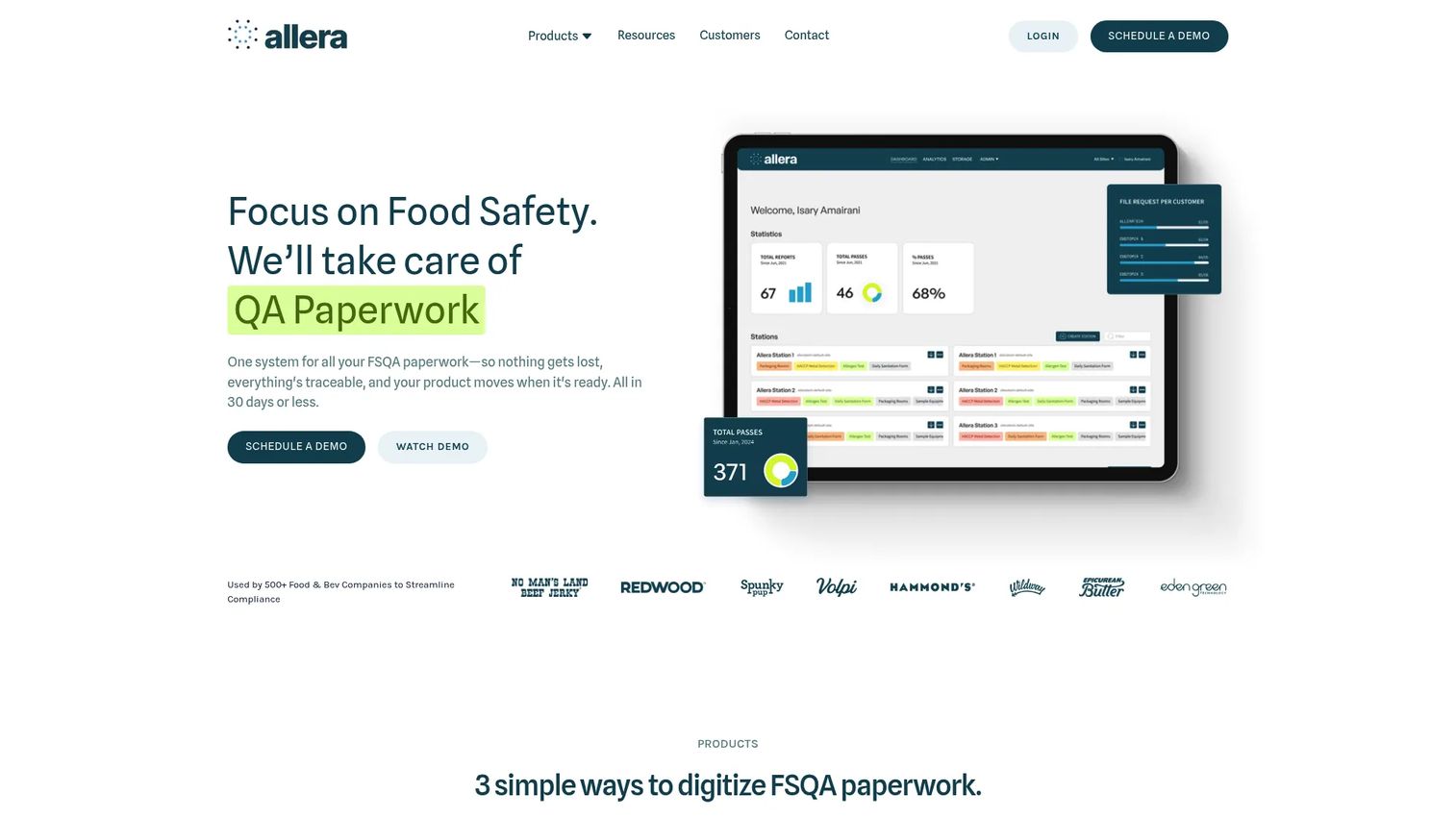
Allera is food safety and quality management software focused on digitizing FSQA paperwork fast. It targets the gap between paper-based food safety and quality assurance forms and a searchable digital record. The document control includes an AI-driven compliance review, and supplier portals let vendors submit documents without needing a login, which cuts the follow-up burden on your team.
Best for: food manufacturers that want to move FSQA forms off paper quickly and tighten document control.
Key features
- Digital FSQA forms
- AI-driven document control with compliance review
- Supplier management with no-login portals
Why choose Allera: if the priority is speed to digitize and reducing the back-and-forth of collecting supplier documents, Allera's no-login portals lower the friction. It fits teams that want a fast path off paper without a heavy rollout.
Allera pricing: Allera advertises a $100 per month Document Control pilot and lists supplier management at $50 per month on its site. Full-platform pricing is quote-based.
3. Paperless Forms by Datahex
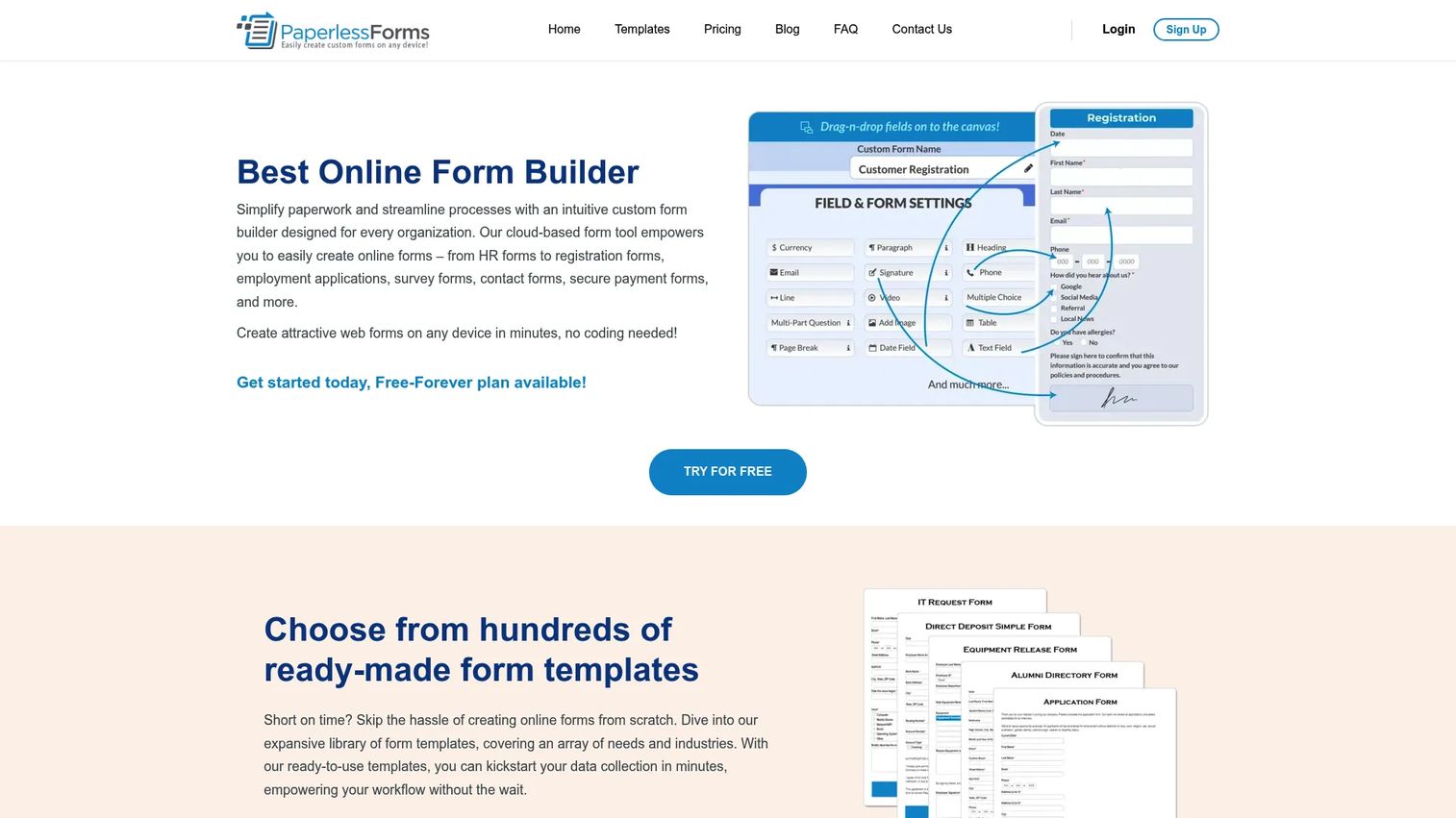
Paperless Forms by Datahex is a cloud-based form builder for creating, sending, and tracking digital forms. It is not food-specific, but its drag-and-drop builder and compliance-friendly workflows make it a practical way to turn paper inspection checklists, sanitation logs, and receiving forms into searchable digital records. E-signatures and multi-channel distribution mean forms reach the floor by email, SMS, or link.
Best for: teams that want a simple, flexible digital form builder to replace paper checklists without a full food safety platform.
Key features
- Free-forever plan
- Drag-and-drop form builder
- Collect e-signatures
- Send forms by email, SMS, or link
- Accept payments
Why choose Paperless Forms by Datahex: if your immediate need is getting digital forms for food safety in place, sanitation logs, receiving checks, daily monitoring, this covers it at a low entry cost. The free tier makes it easy to pilot before committing.
Paperless Forms by Datahex pricing: a Free Forever plan is available. Paid plans run $14.95 per month (Basic), $39.95 per month (Business), $59.95 per month (Enterprise), and $129.95 per month (Premium). Additional user licenses are $14.95 per user per month.
4. SafetyCulture
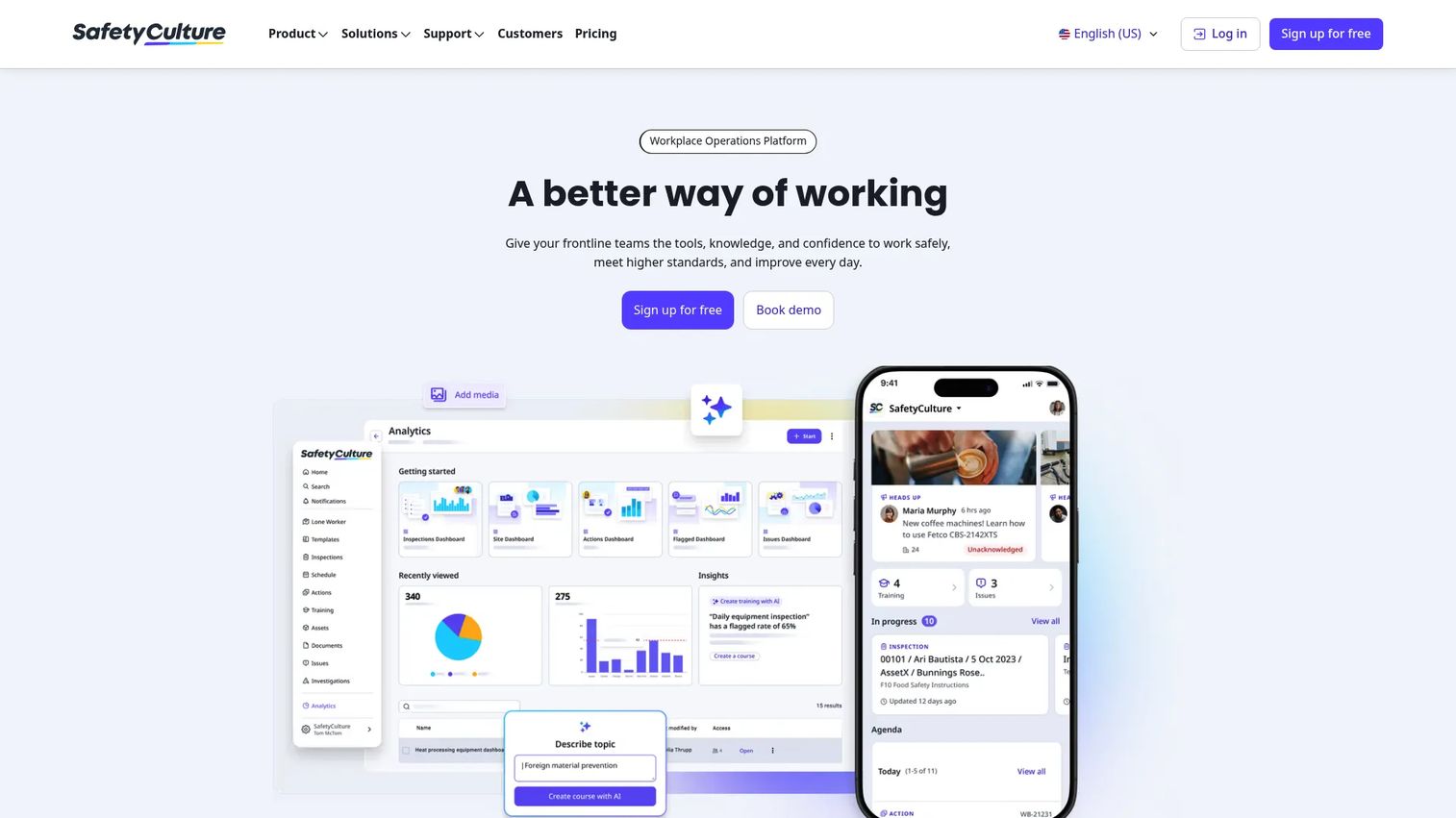
SafetyCulture is a workplace operations platform covering inspections, issues, training, assets, documents, and sensors. For food operations, its strength is mobile-first inspections and corrective actions. Floor teams complete checks on a phone or tablet, flag issues on the spot, and assign actions that stay tracked until resolved. Template libraries cover common food safety checklists, and sensor integrations support temperature monitoring.
Best for: multi-site food businesses that need reliable mobile inspections, corrective actions, and team training in one platform.
Key features
- Customizable inspection templates
- Mobile inspections with photo capture
- Corrective actions tracking
- Training modules for teams
Why choose SafetyCulture: if inspections and mobile checks are your highest-friction workflow, especially across several locations, SafetyCulture's mobile experience and action tracking are hard to beat. It scales from a single restaurant to a distributed operation.
SafetyCulture pricing: a Free plan is available. The Premium plan is $24 per month. Seat-based pricing includes a Lite seat at $5 per seat per month and a Full seat at $24 per seat per month, billed annually. Enterprise pricing is contact-sales.
5. FoodReady
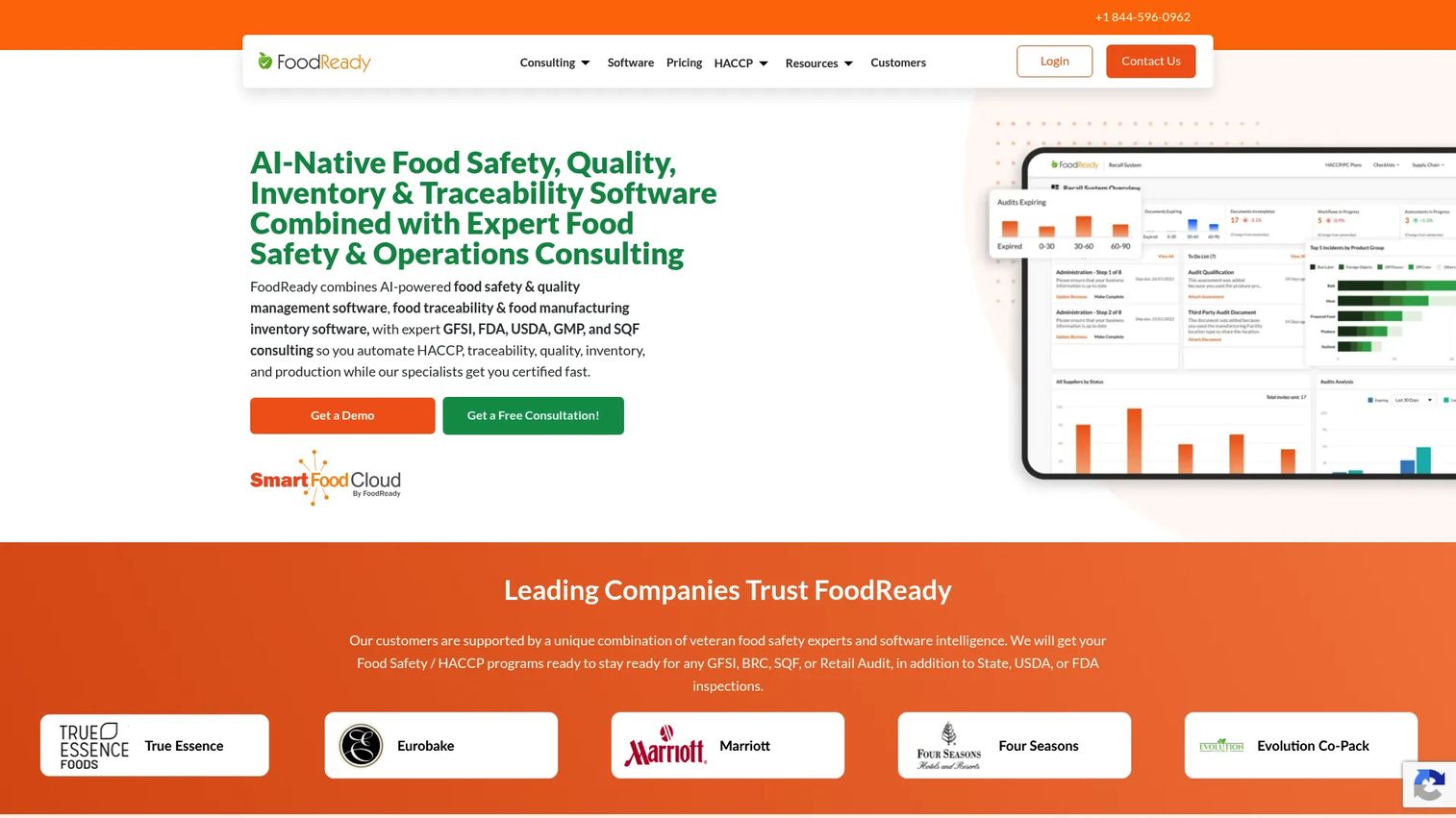
FoodReady is AI-powered food safety, traceability, and quality management software with consulting support. Its AI HACCP builder speeds up plan creation, and lot traceability plus supplier approval workflows tie the compliance picture together. Dashboards give visibility into task completion and audit readiness, and the recall readiness features map lots to finished products so isolation is fast when it matters.
Best for: food manufacturers, processors, distributors, and food service teams that want audit-ready HACCP and traceability with AI assistance.
Key features
- AI HACCP builder
- Inventory and lot traceability
- Supplier approval and document requests
Why choose FoodReady: if building and maintaining a HACCP plan is your bottleneck, the AI builder cuts the setup time, and the traceability layer makes recall readiness concrete rather than theoretical. The consulting option helps teams without a dedicated food safety expert on staff.
FoodReady pricing: public numeric pricing is not displayed. The pricing page shows quote-based packages for three segments, restaurant/grocery/food service, manufacturer/processor, and enterprise, on annual commitments. The platform can be tried free for 14 days.
6. FoodDocs
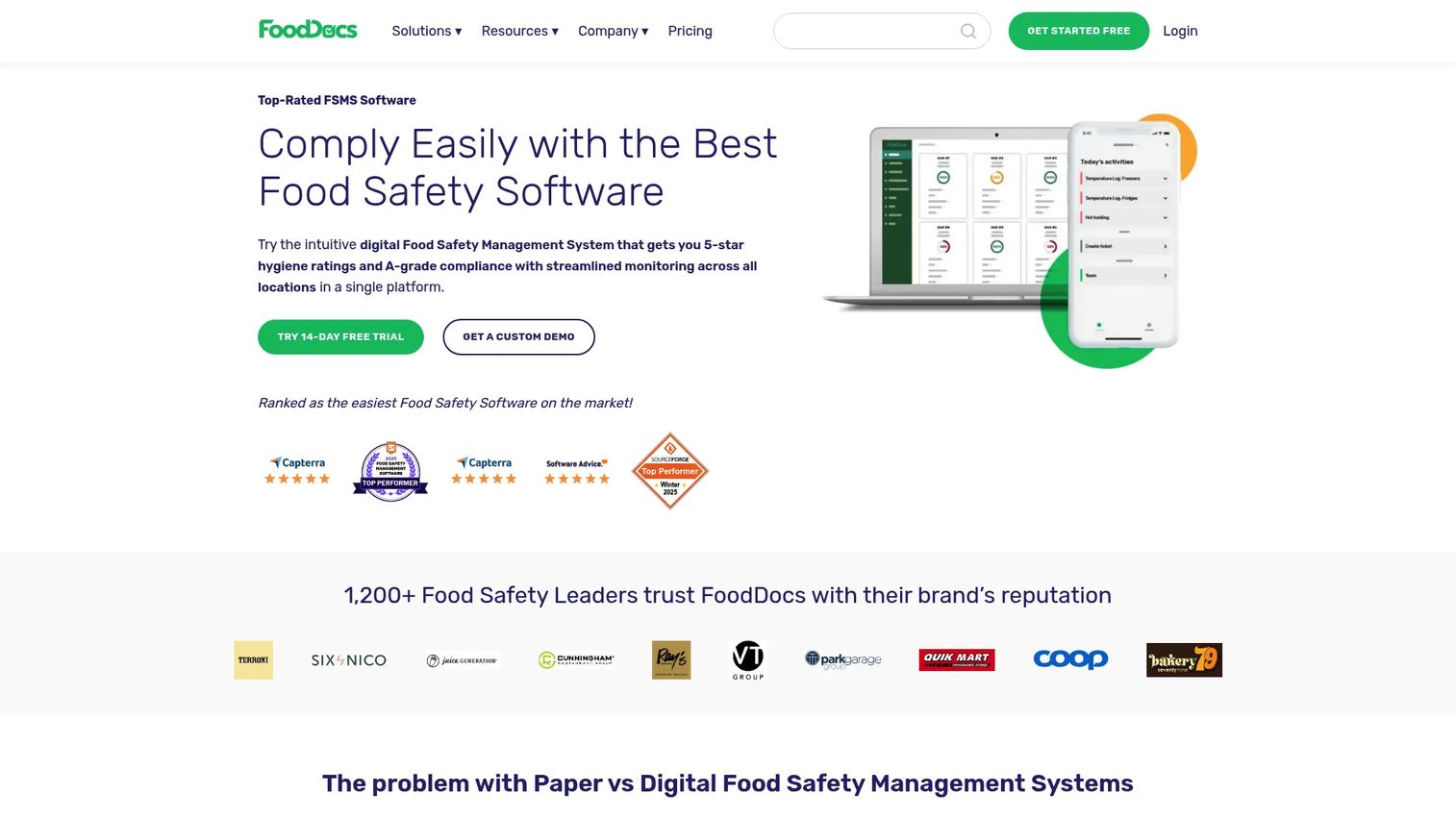
FoodDocs is food safety management software built around HACCP, monitoring, and traceability. It generates monitoring plans automatically and runs daily checks on mobile, so floor teams complete tasks without paper. A real-time overview lets managers see task completion across locations, and AI reports surface compliance insights. The AI HACCP setup shortens the path from signup to a working plan.
Best for: multi-site foodservice businesses that need HACCP, monitoring, and traceability in a single system.
Key features
- Real-time overview and remote control across locations
- AI reports for task completion and compliance insights
- Cloud storage, exports, integrations, and traceability
Why choose FoodDocs: if daily monitoring and cross-location visibility are your priorities, FoodDocs pairs automated monitoring plan generation with mobile daily checks. The real-time overview gives managers a live picture instead of a lagging paper summary.
FoodDocs pricing: the Lite plan starts at $79 per month, Standard is $167 per month, and Professional is $250 per month, billed annually. Enterprise is custom pricing. A 14-day free trial is available with no credit card required.
7. TraceGains
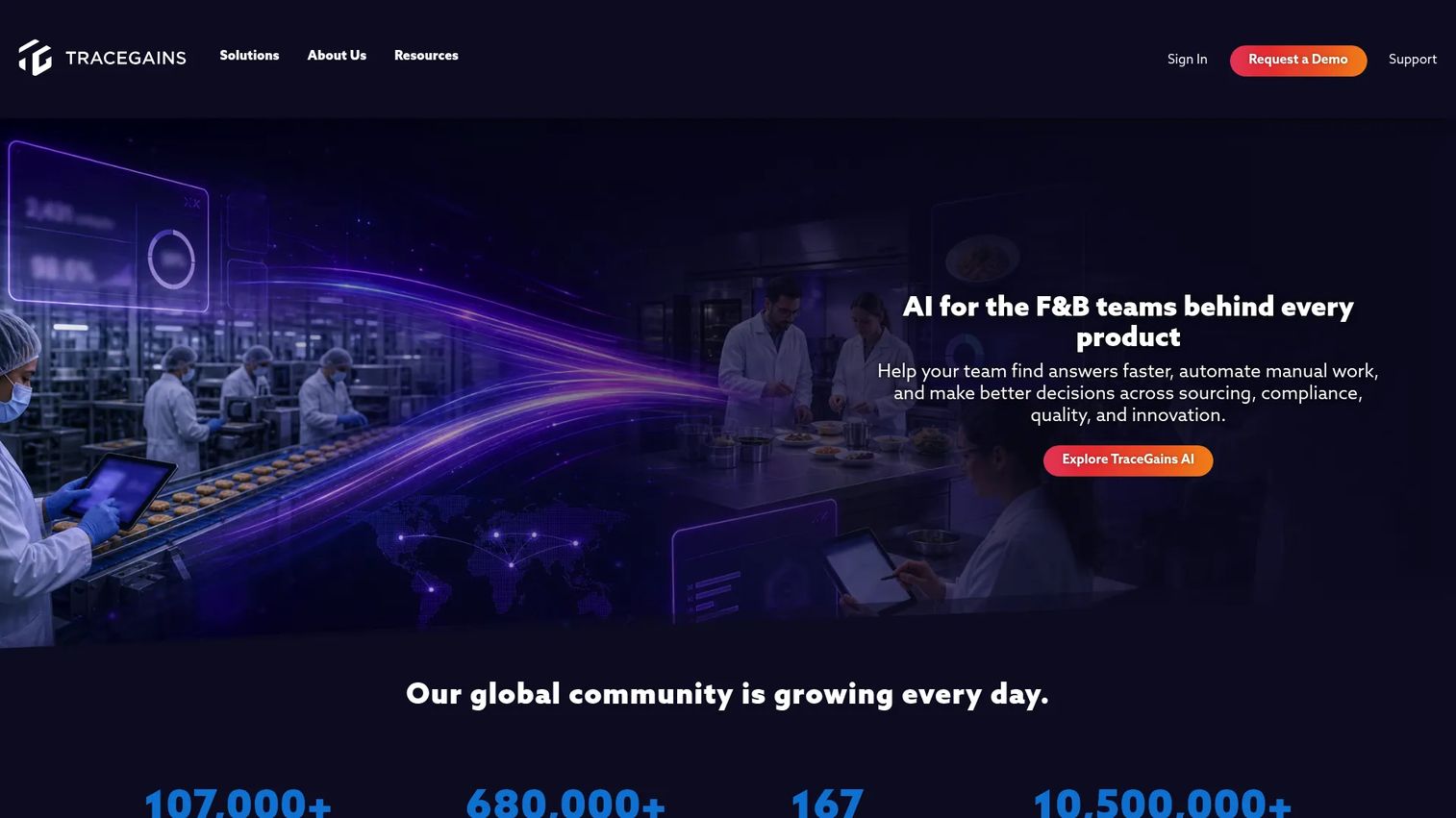
TraceGains is a food-and-beverage platform for supplier, quality, compliance, and product development workflows. It is the enterprise end of this list. Supplier management and supplier compliance sit at its core, with quality, audit, CAPA, and regulatory workflows layered on top. Product development tools, including formula and specification management, extend it beyond pure compliance into R&D.
Best for: food and beverage companies that need a connected platform for compliance, supplier management, and product development at scale.
Key features
- Supplier management and supplier compliance
- Quality, audit, CAPA, and regulatory compliance workflows
- Product development tools including formula and specification management
Why choose TraceGains: if supplier management at scale is the core problem, tracking hundreds of suppliers, their documents, and their compliance status, TraceGains is built for that volume. The product development tools make it a fit for companies where compliance and formulation live in the same workflow.
TraceGains pricing: TraceGains uses modular pricing that starts around $20,000 per year and scales with usage and solution scope. Specific tier details are quote-based.
Considerations
Before you commit, run each shortlisted tool against the criteria that actually determine whether it survives an audit and a scale-up.
Audit trail depth
The point of the software is retrieval under pressure. Check how quickly you can pull a corrective action's full history, a monitoring record from six months ago, or every entry a specific user made. Shallow audit trails create findings; deep ones close them. Confirm that every record carries a timestamp, a user, and a change history.
Traceability and recall readiness
Ask what lot, batch, and supplier coverage the tool provides. A recall is only as fast as your ability to map an ingredient to every finished product it entered. Test whether you can trace forward and backward, and how the system handles multi-ingredient products where one supplier lot touches several SKUs.
Mobile and offline use
Floor teams do not sit at desks. Verify that inspections, monitoring, and daily checks work reliably on a phone or tablet, and confirm what happens when connectivity drops in a cooler or a receiving dock. If the mobile experience is clunky, adoption stalls and you are back to paper.
Integrations and exports
CRM is irrelevant here, but ERP, QMS, BI, and document systems are not. Check whether the tool connects to your existing stack and how cleanly it exports audit-ready records. You should be able to hand an auditor a filtered export without manual reformatting.
Multi-site governance
If you run more than one location, you need roles, permissions, and standardized templates. Confirm you can push a corrected HACCP plan or a new checklist to every site at once, and that site-level managers see only what they should. Governance is what keeps a growing operation consistent.
Conclusion
The strongest pick depends on your highest-friction workflow, not the longest feature list.
If document control and corrective actions are drowning your team, foodflou consolidates them. If your gap is mobile inspections across sites, SafetyCulture handles it. If you just need paper checklists to go digital cheaply, Paperless Forms by Datahex does the job. For AI-assisted HACCP and traceability, FoodReady fits. For automated monitoring plans and daily checks, FoodDocs. And for supplier management and compliance at enterprise scale, TraceGains is built for the volume. Allera is the fast path off FSQA paperwork.
Start with the tool that matches the workflow costing you the most time and stress right now. Digitizing one high-friction process, whether that is audit prep, supplier documents, or daily monitoring, delivers a faster return than a broad rollout that stalls. The payoff is consistent: fewer paper gaps, evidence you can retrieve in seconds, and traceability that turns a recall from a panic into a query.
FAQs
It centralizes the records, logs, inspections, corrective actions, and audit evidence a food operation needs to prove compliance. Instead of paper binders and spreadsheets, everything is timestamped and searchable. During an audit, you filter and export rather than reconstruct from memory.
Not exactly. HACCP software focuses on the hazard analysis plan and its monitoring points. Food safety compliance software is broader, covering HACCP plus audits, traceability, supplier documents, and corrective actions in one food safety management system. Most modern platforms include HACCP as one module among several.
Audit trail depth is first. You need timestamped records, user attribution, and a full change history you can retrieve fast. Corrective action tracking matters next, since auditors want evidence that issues were resolved. Fast, filtered exports turn a document request into a search rather than a scramble.
Yes. Food traceability software maps ingredients across lots, batches, and finished products. When a supplier ingredient is flagged, you trace every product it entered and isolate the affected batches instead of pulling everything. That speed is the difference between a targeted recall and a costly blanket one.
No. Restaurants and multi-site foodservice usually prioritize mobile inspections, daily monitoring, and temperature checks. Manufacturers need deeper HACCP, lot traceability, and supplier management at scale. A restaurant chain leans toward tools like SafetyCulture or FoodDocs, while a manufacturer may need FoodReady or TraceGains.
Check how the tool collects, stores, and tracks supplier certificates and specifications. Look for expiration alerts so lapsed documents get flagged before receiving. Supplier portals that let vendors submit documents without a login cut your follow-up work. Confirm you can see approval status at a glance.
Inspections are routine internal checks, daily sanitation, receiving, monitoring, often completed on mobile by floor teams. Audits are formal evaluations against a standard like SQF or BRC, internal or third-party. Good software supports both: inspection checklists for daily control and audit management for structured, evidence-backed reviews.
Prioritize multi-site governance: roles, permissions, and standardized templates you can push to every location at once. Confirm the mobile experience works reliably on the floor and offline. Then match the platform to your highest-friction workflow, whether that is inspections, monitoring, or supplier management, and pilot it at one site before rolling out.