Your board wants cleaner pipeline reporting. Your sales lead wants better handoffs. Your customer team wants a complete account history. Instead, everyone is exporting different spreadsheets from different systems.
That's not a data problem. It's a CRM problem. And in financial services, the stakes are higher than in most verticals: Client data is sensitive, relationships are multi-threaded across households and legal entities, and workflows often have governance requirements attached. According to Dataintelo (2025), the financial services CRM software market reached $15.3 billion in 2025, with 62.4% of revenue coming from cloud deployments. That growth reflects how seriously operators across banking, wealth management, insurance, and fintech are taking this infrastructure decision.
The right platform depends on whether you need advisor-first relationship management, enterprise workflow control, or a CRM your GTM team can adopt this quarter. This guide cuts through the options.
What's inside
This guide is for founders, RevOps leaders, and operators at fintech, wealth-tech, insurtech, lending, and financial-services SaaS companies who need to shortlist a CRM. Tools were evaluated on:
- Financial-services data model fit (households, entities, advisor workflows)
- Automation, governance, and integration depth
- Pricing and total first-year cost
- Adoption speed and scalability across team sizes
TL;DR
- Best for enterprise financial-services operations: Salesforce Financial Services Cloud for firms that need industry data models, workflow depth, and extensive ecosystem support
- Best for advisor-first teams: Wealthbox CRM for firms that want relationship management without enterprise-level administration
- Best for advisor workflow and integrations: Redtail CRM for established advisory firms using wealth-tech tools
- Best for broader Microsoft environments: Microsoft Dynamics 365 for organizations already committed to Power Platform and Azure
- Best for fast GTM adoption: HubSpot CRM or Pipedrive for growing teams that prioritize speed and sales alignment
What is financial services CRM software?
Financial services CRM software is customer relationship management software built or configured to manage client relationships, financial workflows, regulated communications, and complex account structures across banking, wealth management, insurance, lending, and fintech.
What makes a CRM financial-services-ready?
A CRM earns the "financial services" label when it can handle the relationship complexity and governance requirements this sector demands. Key capabilities include:
- Household and entity management: Contacts, trusts, joint accounts, and business entities linked into one relationship view
- Pipeline and opportunity tracking: Across advisory, lending, or institutional sales motions
- Workflow automation: For client onboarding, task routing, renewals, and follow-ups
- Document management: Secure storage and collaboration with access controls
- Audit trails and permissions: Role-based access, activity logs, and governance controls
- Financial-system integrations: Planning, portfolio, lending, communication, and data systems
- Reporting: For sales, revenue forecasting, client service, and retention metrics
Financial-services CRM versus general CRM software
A general CRM can work well for early-stage fintechs with straightforward sales motions. Specialized platforms earn their cost when relationship data, advisor workflows, or financial-system integrations become central to the operating model.
| General CRM | Financial services CRM |
|---|---|
| Standard contacts and companies | Households, trusts, joint accounts, and related entities |
| Broad sales workflows | Advisor, lending, banking, or client-service workflows |
| Flexible reporting | Financial-services reporting, audit trails, and governed records |
| Broad integrations | Planning, portfolio, banking, document, and communication integrations |
When to use financial services CRM software
Centralize complex client and relationship data
When your business has outgrown contact-level records, you need a CRM that can represent how clients actually structure their assets and relationships. Household records, legal entities, investors, advisors, beneficiaries, and institutional stakeholders all need to live in one connected view. Without that structure, your team is building context from scratch on every call.
Standardize revenue and client-service workflows
Repeatable workflows for lead intake, task routing, client onboarding, renewal management, and referrals are how you remove founder dependency from the GTM motion. A CRM that enforces process consistency means your new VP of Sales can step in without needing you to explain how things work.
Give leadership a view of pipeline, retention, and account risk
Board meetings get harder when forecast confidence depends on who remembers what. Dashboard quality ultimately depends on process and data hygiene, but the right CRM makes both achievable. Reliable pipeline coverage ratios and churn signals require clean, consistently captured CRM data, not spreadsheet aggregation.
Financial services CRM software comparison
The platforms below span two distinct needs. Some are built around advisor and wealth-management workflows. Others are broader CRM platforms that financial-services teams configure for scale, automation, and cross-functional visibility.
| # | Product | Best for | Key differentiator | Pricing | G2 rating |
|---|---|---|---|---|---|
| 1 | Salesforce Financial Services Cloud | Enterprise financial-services organizations | Industry data model and enterprise extensibility | From $325/user/month | 4.2/5 |
| 2 | Wealthbox CRM | Independent advisors and wealth firms | Advisor-first usability and relationship management | From $59/user/month | 4.6/5 |
| 3 | Redtail CRM | Established advisory firms | Advisor workflows and wealth-tech integrations | From $39/user/month | 4.3/5 |
| 4 | Microsoft Dynamics 365 | Microsoft-centric financial-services teams | Power Platform customization and enterprise workflows | From $65/user/month | N/A |
| 5 | HubSpot CRM | Growth-focused fintech and financial-services teams | Marketing, sales, and service alignment | Free; paid from $15/seat/month | 4.4/5 |
| 6 | Zoho CRM | Cost-conscious teams that need customization | Broad suite coverage and flexible configuration | Free; paid from $14/user/month | 4.1/5 |
| 7 | Creatio CRM | No-code process automation buyers | Composable workflows and no-code configuration | From $40/user/month | 4.6/5 |
| 8 | Oracle CX for Financial Services | Large, complex enterprise environments | Enterprise data, service, and CX depth | Custom pricing | N/A |
| 9 | Pipedrive | Sales-led teams with simple CRM needs | Pipeline visibility and rep adoption | From $14/seat/month | 4.3/5 |
| 10 | Advyzon | Wealth-management firms needing integrated operations | Advisor platform and client-management workflows | Custom pricing | N/A |
| 11 | AdvisorEngine | Digital wealth-management operations | Wealth-tech platform and advisor experience | Custom pricing | 4.3/5 |
| 12 | Envestnet Tamarac | RIAs with complex portfolio workflows | Portfolio-management ecosystem fit | Custom pricing | 4.0/5 |
Best 12 financial services CRM software tools for 2026
1. Salesforce Financial Services Cloud
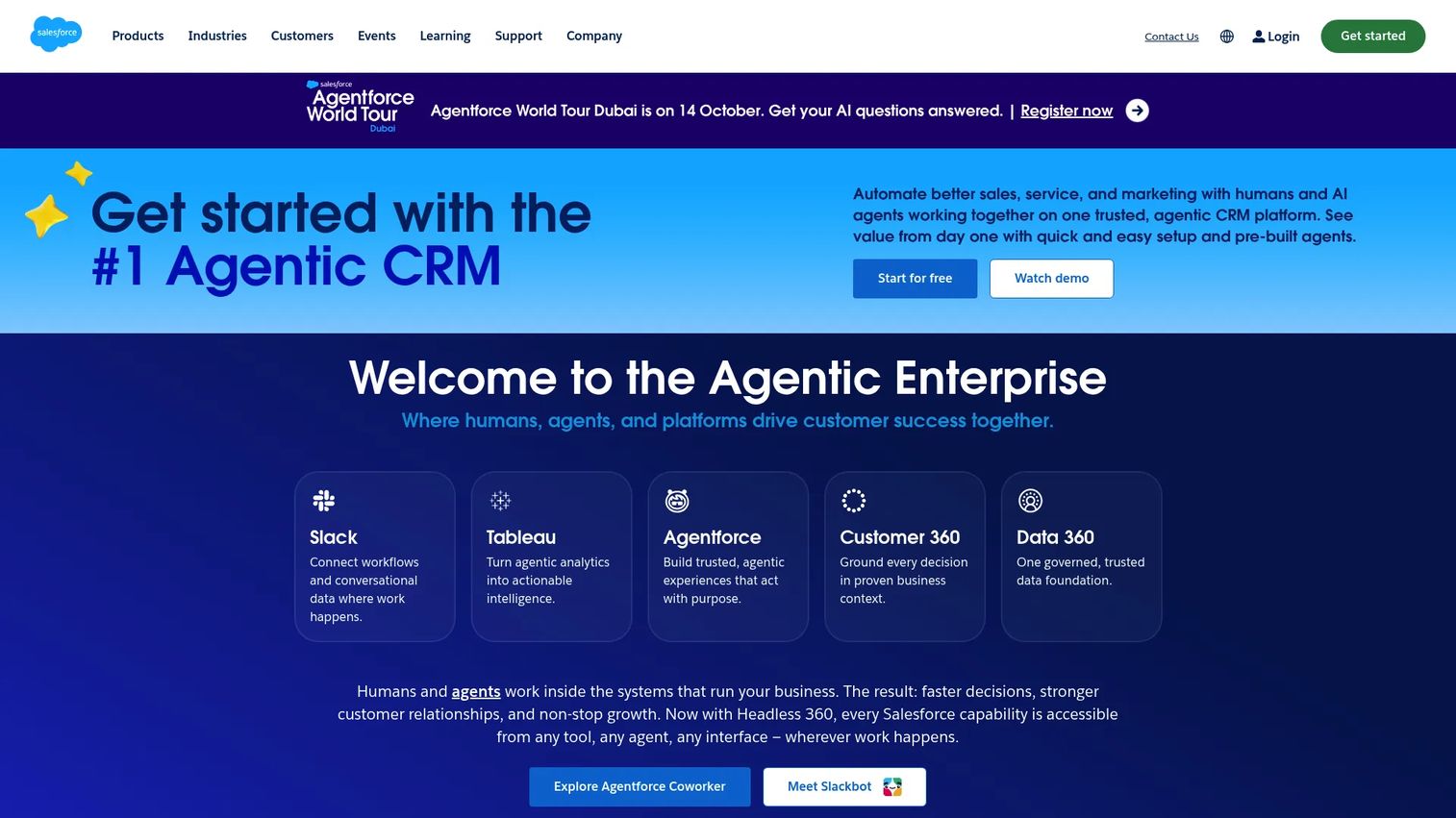
Salesforce Financial Services Cloud (now also referred to as Agentforce Financial Services) is a purpose-built CRM and AI platform for banking, wealth management, insurance, and lending organizations. It extends Salesforce's core CRM with industry-specific data models, unified client views across households and financial accounts, and workflow automation for advisor and service operations. Large financial-services teams use it when CRM becomes operating infrastructure rather than a sales database.
Best for: Banks, insurers, wealth firms, lenders, and high-growth financial-services companies with dedicated CRM administration or implementation capacity.
Key features
- Industry-specific financial-services data models and workflows
- Unified customer and household relationship views
- AI-powered automation with Agentforce for financial services
- Enterprise reporting, dashboards, and governance controls
- Broad integration and customization options across the Salesforce ecosystem
Why choose Salesforce Financial Services Cloud: It fits companies where the CRM needs to carry the full weight of the operating model, not just sales tracking. The trade-off is real: It requires clear ownership, a credible implementation plan, and ongoing administration. Teams that treat it as plug-and-play tend to underuse it.
Salesforce Financial Services Cloud pricing: Plans start at $325 per user per month (billed annually) for Financial Services Cloud for Sales or for Service. The combined Sales and Service edition starts at $350 per user per month. Agentforce 1 editions are $750 per user per month. A free trial is available.
G2 rating: 4.2/5
2. Wealthbox CRM
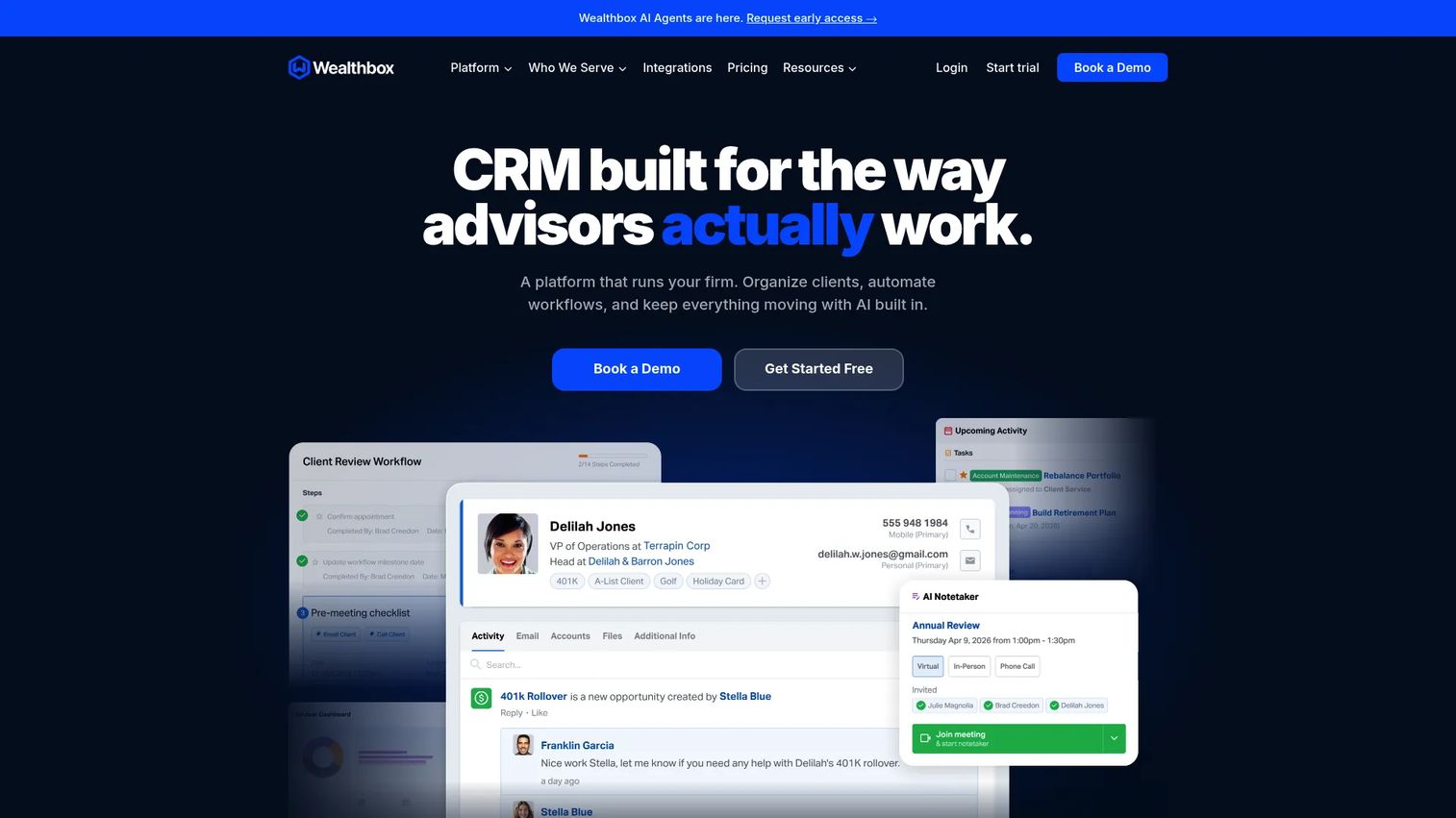
Wealthbox CRM is designed for financial advisors and RIA firms that want strong relationship management without the overhead of an enterprise CRM. It covers client and household records, task workflows, two-way email and calendar sync, opportunity pipeline tracking, and advisor collaboration tools. The platform also includes 150+ integrations and an open API for connecting to the broader wealth-tech stack.
Best for: Independent financial advisors, RIAs, and smaller wealth-management firms that need usable advisor tools without a major CRM administration function.
Key features
- Contact and household relationship records
- Workflow automation and task management
- Two-way email and calendar sync
- Opportunity pipeline tracking
- 150+ integrations and open API
Why choose Wealthbox CRM: It fits founders and operators who need advisor adoption quickly. Firms with highly customized enterprise processes, extensive data architecture requirements, or global operations may eventually need a broader platform.
Wealthbox CRM pricing: Basic starts at $59 per user per month; Pro is $75 per user per month; Premier is $99 per user per month. Enterprise pricing is custom. No permanent free tier, but a free trial is available.
G2 rating: 4.6/5
3. Redtail CRM
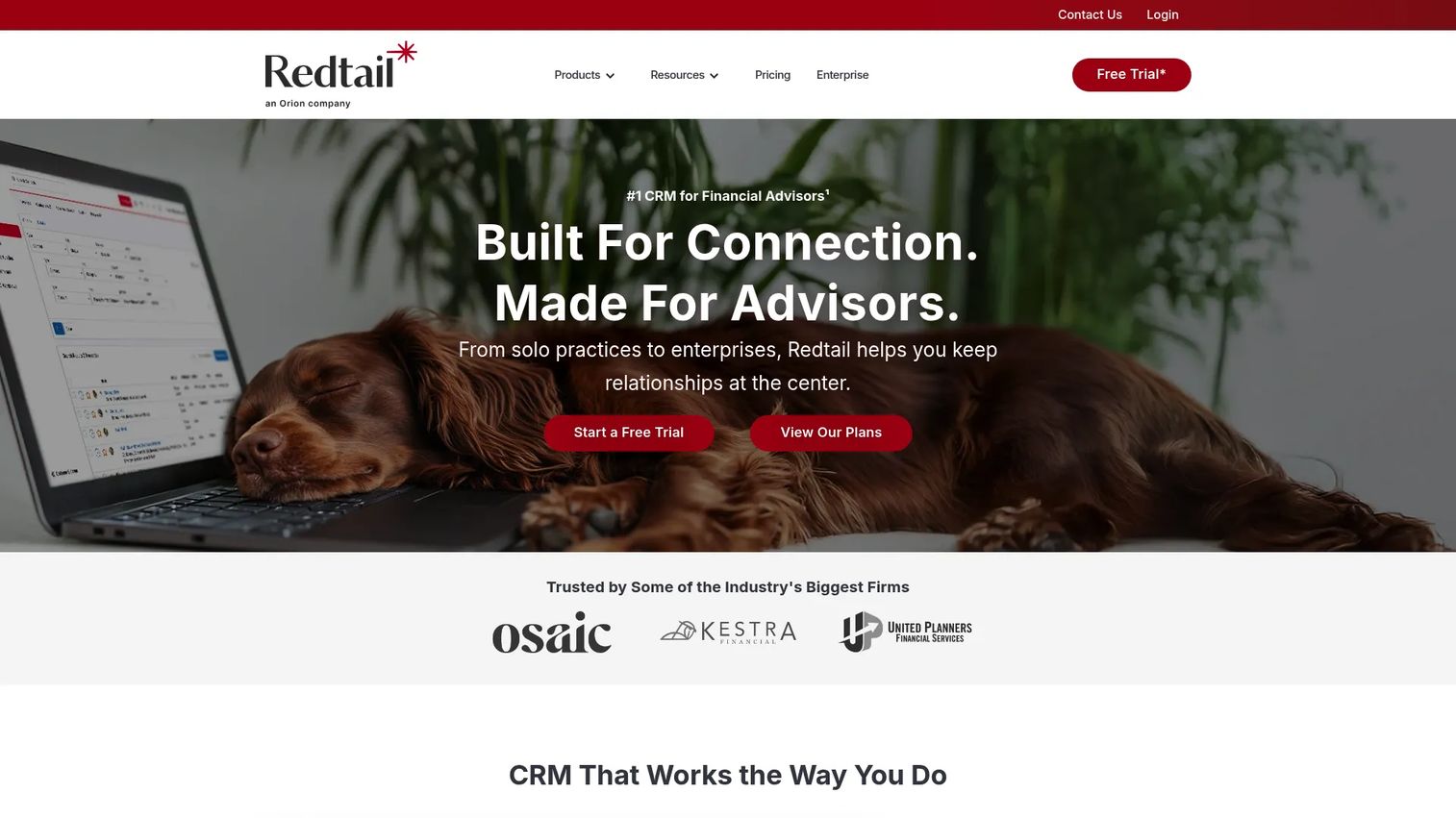
Redtail CRM has a long track record in the advisor market, focusing on contact management, activity history, workflow automation, and connections to the wider advisor-tech ecosystem. It supports document storage, seminar management, opportunity tracking, and a mobile app alongside core contact and calendar features. Advisory firms use it as the operational hub for client servicing and task execution.
Best for: Advisory firms and RIAs centered on client servicing, task automation, and wealth-management or financial-planning workflow integration.
Key features
- Contact and account management with activity history
- Workflow templates and recurring automation triggers
- Customizable reporting and advanced search
- Document storage and communication tracking
- Wealth-management ecosystem integrations and mobile app
Why choose Redtail CRM: It suits firms that want an established advisor workflow system with deep wealth-tech connections. Founders building broader fintech GTM organizations should validate reporting flexibility and customization depth before committing.
Redtail CRM pricing: Launch supports up to 5 users at $39 per user per month (billed annually) or $45 per user per month (billed monthly). Growth supports unlimited users at $59 per user per month (billed annually) or $65 per user per month (billed monthly). Enterprise pricing requires a minimum license commitment and is quoted directly.
G2 rating: 4.3/5
4. Microsoft Dynamics 365
Microsoft Dynamics 365 is a configurable enterprise CRM and ERP suite covering sales, service, finance, and operations. For financial-services organizations already standardized on Microsoft 365, Teams, and Azure, it reduces operational fragmentation by connecting customer data with the tools teams use daily. The Power Platform layer allows custom workflow automation, reporting, and application development without writing code from scratch.
Best for: Larger firms with Microsoft-standardized IT environments and the internal capacity to build and govern workflows across the Microsoft stack.
Key features
- Sales, service, finance, and operations applications
- Power Platform automation and custom app development
- Microsoft 365 and Teams connectivity
- AI-powered insights and Copilot experiences
- Azure-aligned enterprise data controls and configurable dashboards
Why choose Microsoft Dynamics 365: The core value is stack fit. When Microsoft is already the system standard, adding Dynamics reduces the integration surface and gives leadership a connected data view. It is a heavier commitment when the organization lacks CRM administration, process design ownership, or technical governance capacity.
Microsoft Dynamics 365 pricing: Dynamics 365 Sales Professional starts at $65 per user per month; Sales Enterprise Edition is $105 per user per month; Sales Premium is $150 per user per month. A free trial is available. Note that Dynamics 365 consists of multiple separate applications, each with its own pricing.
5. HubSpot CRM

HubSpot CRM gives fintech and growth-stage financial-services companies a foundation for connecting marketing, sales, and customer-service teams around shared records. The free tier covers core CRM functionality including contact and deal management, email tracking, and pipeline reporting. Paid hubs add marketing automation, lifecycle workflows, advanced analytics, and customer service tools. It is a practical starting point for teams that need first-quarter adoption without a heavy implementation project.
Best for: Series B fintechs and financial-services SaaS companies that prioritize GTM adoption, inbound conversion, and lifecycle visibility.
Key features
- Free CRM with contact, deal, and task management
- Email tracking, templates, and engagement notifications
- Deal pipelines and import workflows
- Reporting and lifecycle automation on paid tiers
- Marketing and service hub integrations
Why choose HubSpot CRM: It connects the founder's need for repeatable GTM to a CRM the whole team can adopt quickly. Teams with highly specialized advisor records, complex household structures, or deeply governed enterprise processes will eventually hit the ceiling and should plan that transition early.
HubSpot CRM pricing: Free tier available. Starter begins at $15 per seat per month; Professional at $50 per seat per month; Enterprise at $75 per seat per month, all billed monthly. Annual billing is available at a discount.
G2 rating: 4.4/5
6. Zoho CRM
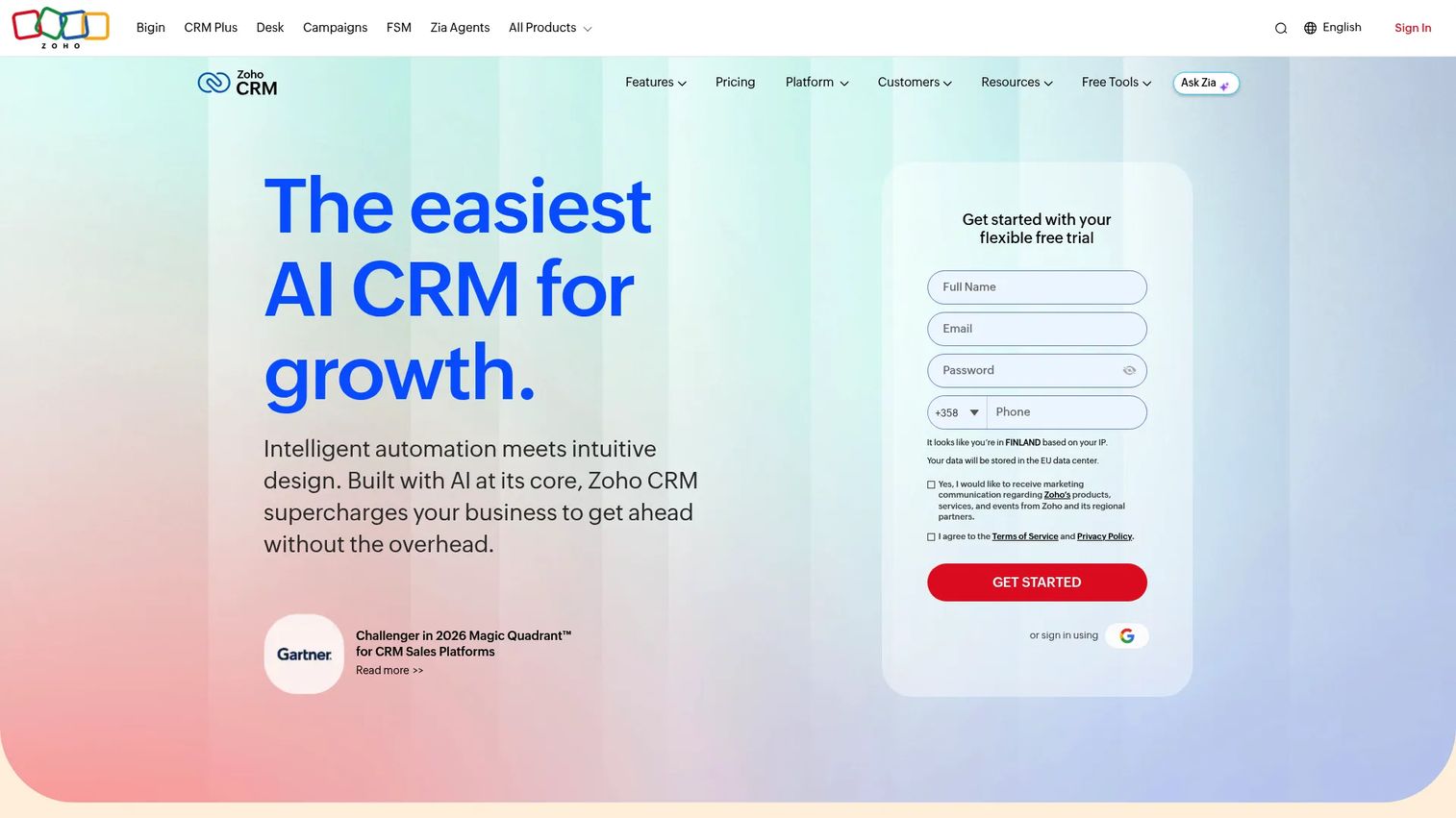
Zoho CRM offers a customizable CRM for teams that need configurable workflows, custom modules, and broad application coverage without committing to enterprise implementation costs. It covers sales force automation, omnichannel lead management, workflow rules, business analytics, and AI-powered assistance. The Canvas layer allows teams to redesign the interface layout without developer involvement, and the broader Zoho suite adds marketing, help desk, and finance applications.
Best for: Smaller financial-services firms and early-stage fintech teams that need a configurable CRM at a manageable cost.
Key features
- Custom modules, fields, and Canvas interface redesign
- Workflow automation and process rules
- Sales pipeline management and forecasting
- Business analytics, dashboards, and AI assistance
- Zoho suite integrations across marketing, service, and finance
Why choose Zoho CRM: It works for teams that need to adapt the CRM around their specific process rather than adapt their process to a rigid platform. Bespoke configuration still requires a clear data model, named ownership, and an adoption plan before launch.
Zoho CRM pricing: Free tier for up to 3 users. Standard is $14 per user per month (billed annually); Professional is $23 per user per month; Enterprise is $40 per user per month; Ultimate is $52 per user per month.
G2 rating: 4.1/5
7. Creatio CRM
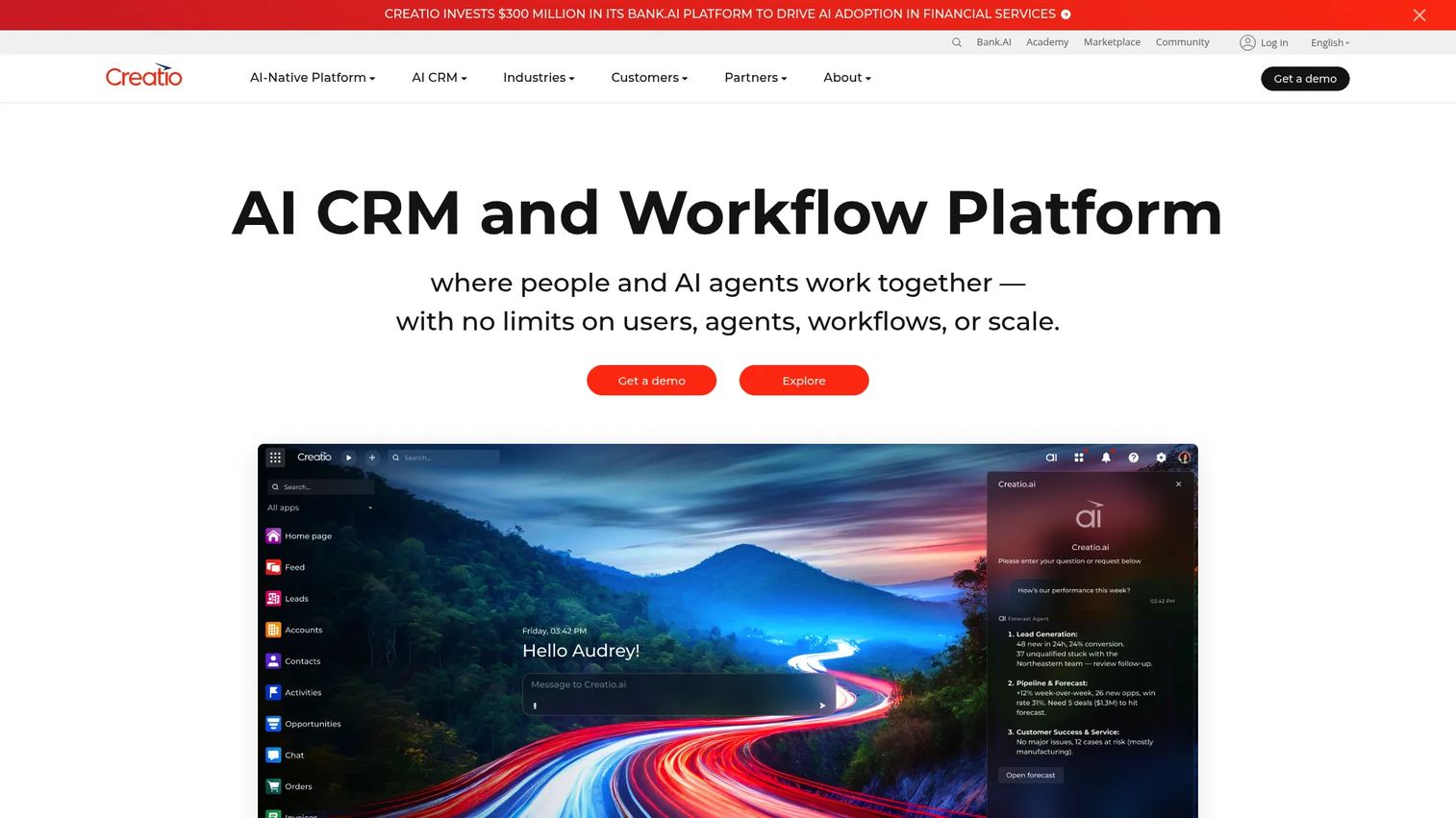
Creatio CRM is an AI-native CRM and workflow platform designed for organizations that need configurable customer processes without custom code on every system change. It covers sales, marketing, and service modules alongside case management and role-based permissions. The no-code workflow designer lets operations and product teams build, modify, and extend processes directly, which matters when your sales motion or onboarding flow changes faster than an IT queue can keep up.
Best for: Mid-market and enterprise teams with complex onboarding, service, lending, or case-management workflows that change frequently.
Key features
- No-code workflow design and process automation
- Unified customer data with 360-degree profiles
- AI agents and agentic workflow support
- Lead, opportunity, and pipeline management
- Marketing automation and omnichannel communications
Why choose Creatio CRM: It suits companies with a clear workflow problem to solve and the operational maturity to map the customer lifecycle before building automations. It is not a fix for poor process design. Success here requires scoping the workflows before touching the platform.
Creatio CRM pricing: Growth plan is $40 per user per month; Enterprise plan is $55 per user per month; Unlimited plan is custom pricing. Individual CRM products (Sales, Marketing, Service) are also available separately at $15 per user per month each.
G2 rating: 4.6/5
8. Oracle CX for Financial Services
Oracle CX for Financial Services is a cloud-based customer acquisition and experience suite for banking, insurance, wealth management, and securities. It spans advertising, marketing, sales, commerce, and service capabilities connected through Oracle's enterprise data and AI layer. Firms use it to deliver personalized digital banking experiences, streamline self-service account originations, and connect customer data across the full relationship lifecycle.
Best for: Large financial institutions with established Oracle infrastructure, specialized implementation partners, and long-term enterprise architecture plans.
Key features
- Omnichannel customer engagement across marketing, sales, and service
- Personalized digital banking and self-service originations
- Customer data integration, analytics, and AI-powered insights
- Enterprise governance controls and large-scale integration options
- End-to-end customer experience across the financial-services lifecycle
Why choose Oracle CX for Financial Services: This is a strategic infrastructure decision for organizations already running Oracle or with the operational maturity to support it. A lean Series B team rarely needs this level of platform. When the enterprise environment already anchors on Oracle, the integration depth and data governance justify the investment.
Oracle CX for Financial Services pricing: Pricing is quote-based. The total depends on modules selected, user count, implementation services, and enterprise requirements. Contact Oracle directly for a proposal.
9. Pipedrive
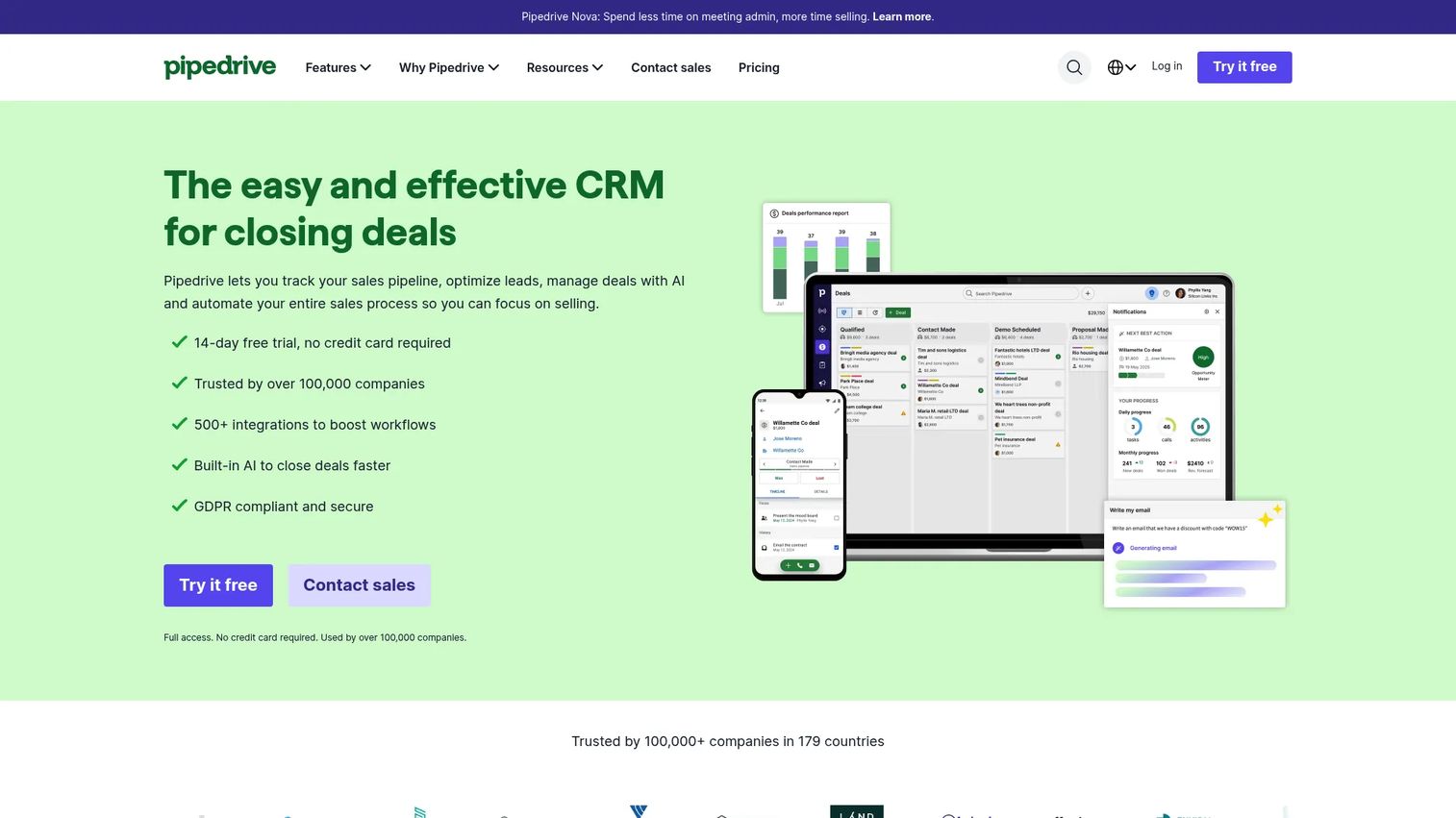
Pipedrive is a sales pipeline CRM built around rep activity, visual deal management, and consistent follow-up. It keeps pipeline progression front and center through activity-based selling, automations, and reporting dashboards. Insurance brokers, lending teams, and sales-led fintechs with straightforward sales motions use it to enforce process discipline without asking reps to navigate a complex platform.
Best for: Sales-led fintechs, insurance brokers, lenders, and smaller financial-services teams with a simple, repeatable sales motion.
Key features
- Visual deal pipelines and activity-based selling
- Lead management and sales automation
- Email synchronization and tracking
- Reporting, analytics, and revenue forecasting
- Meeting intelligence and AI-powered tools, plus 500+ integrations
Why choose Pipedrive: It works when the central challenge is sales-process discipline and rep accountability. Move to a more specialized platform when household models, advisor records, advanced service workflows, or governance requirements become the primary drivers.
Pipedrive pricing: Lite starts at $14 per seat per month (billed annually); Growth is $39 per seat per month; Premium is $59 per seat per month; Ultimate is $79 per seat per month. A 14-day free trial is available.
G2 rating: 4.3/5
10. Advyzon
Advyzon is an integrated wealth-management platform combining portfolio management, client reporting, billing, rebalancing, CRM, document management, and a client portal in one environment. The CRM component supports advisor and client relationship workflows, prospect management through its Growth Suite, and integrations with Microsoft 365 and Google Workspace. It is designed for advisory firms that want their operational data, not just their contact records, in a single platform.
Best for: Registered investment advisors seeking an all-in-one platform where client relationship data sits alongside portfolio management, billing, and compliance workflows.
Key features
- Advisor and client relationship workflows with prospect management
- Portfolio management and client reporting
- Billing, fee management, and Quantum rebalancing
- Secure document management with WORM support and audit trails
- Client portal, mobile app, and advisor-focused AI
Why choose Advyzon: Choose it when the firm's operating model centers on connecting client relationships to portfolio data, not just managing contacts. Validate the depth of your CRM customization and marketing automation requirements before committing, since Advyzon's strength is operational integration rather than flexible CRM configuration.
Advyzon pricing: Pricing is not publicly listed and requires a direct conversation with Advyzon's team. Reach out through their website for a quote based on your AUM, user count, and required modules.
11. AdvisorEngine
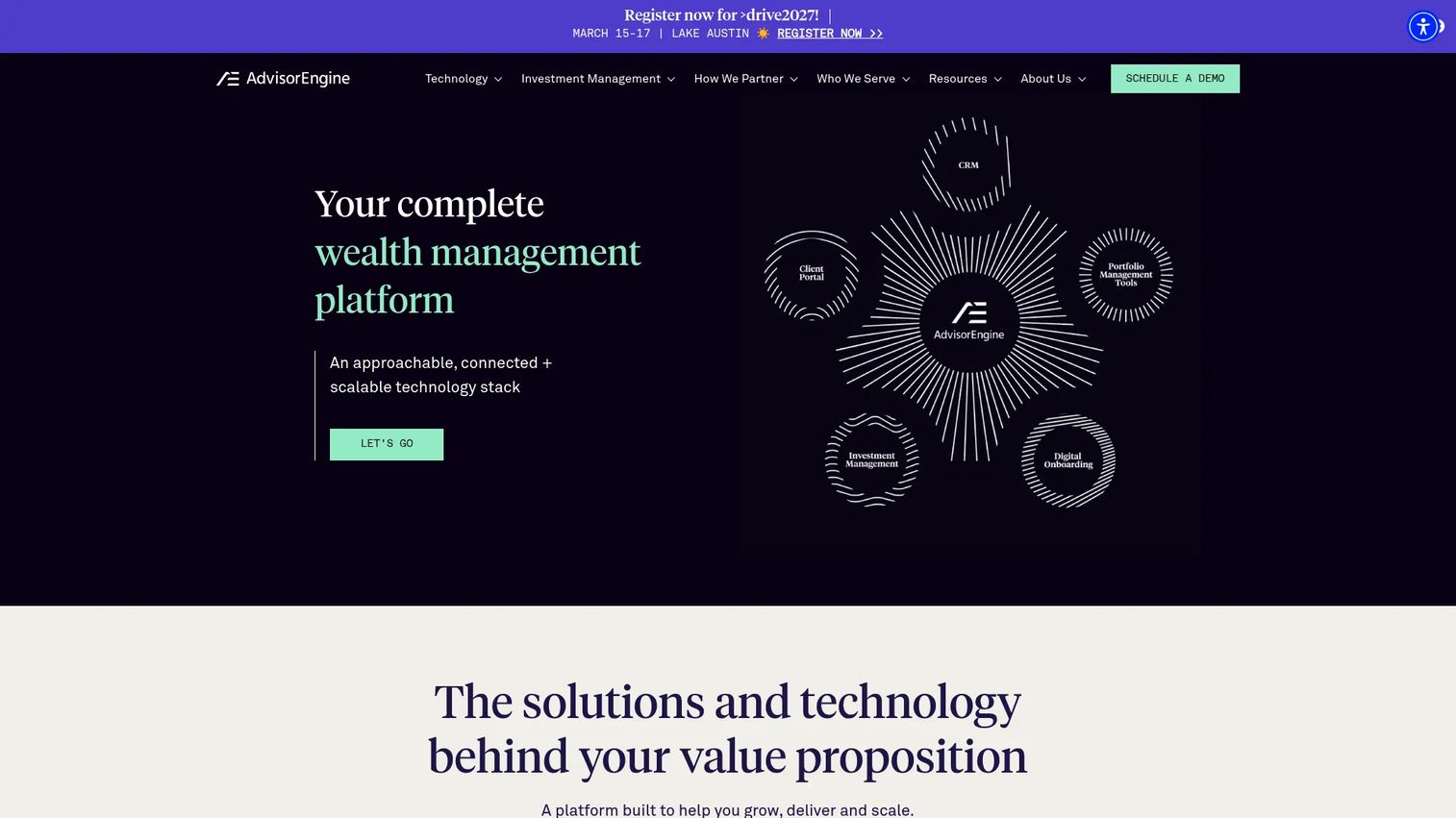
AdvisorEngine is an end-to-end wealth management platform for financial advisors and RIAs, covering CRM, digital onboarding, portfolio management, performance reporting, client portal, and business intelligence in one environment. It connects advisor workflow support with goals-based planning, rebalancing, trading, fee billing, and modern client engagement tools. Firms use it when they want the advisor experience and client service to run on a shared operating model.
Best for: Advisory firms and wealth-tech businesses focused on modern digital client experiences and advisor productivity within an integrated platform.
Key features
- Wealth-management CRM with workflows and practice management
- Digital onboarding and account-opening workflows
- Portfolio management with goals-based planning, rebalancing, and fee billing
- Customizable performance reporting and business intelligence
- Modern client portal and advisor-facing analytics
Why choose AdvisorEngine: It fits firms that see client experience and advisory operations as one model rather than separate systems. Validate data migration requirements, integration needs, and administration capacity before committing. The platform is optimized for advisory businesses, not for general-purpose fintech sales motions.
AdvisorEngine pricing: Pricing varies by firm size and required features. Contact AdvisorEngine directly for a customized quote.
G2 rating: 4.3/5
12. Envestnet Tamarac
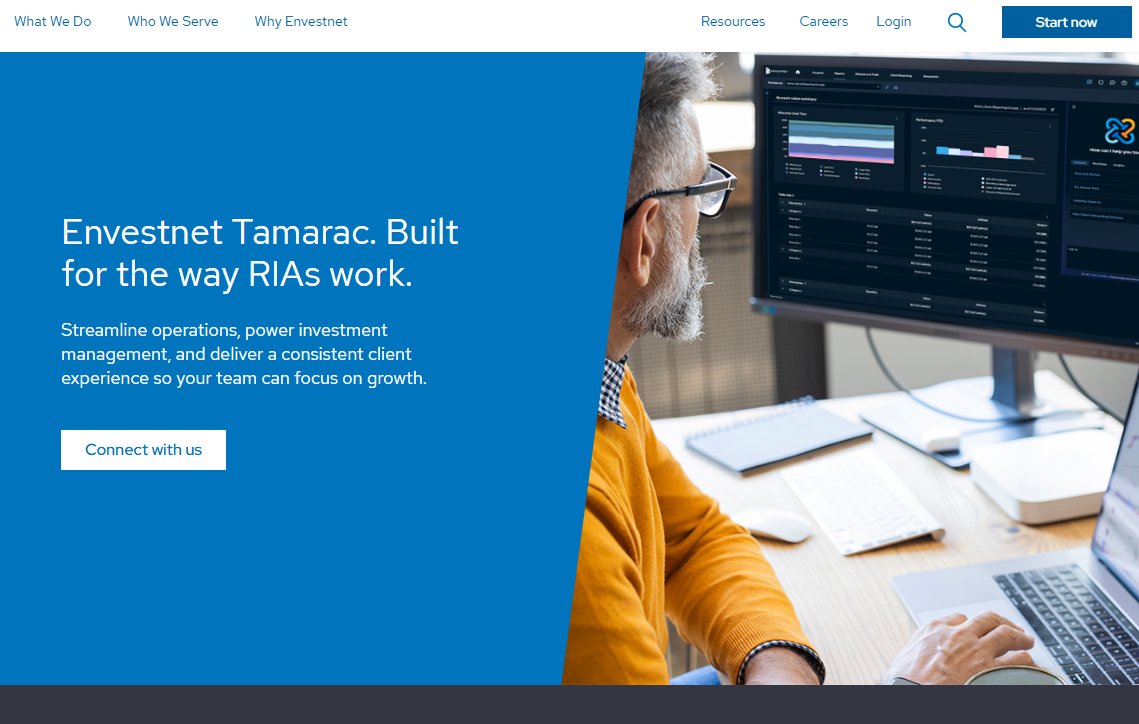
Envestnet Tamarac is a wealth-management technology platform for RIAs combining trading, rebalancing, billing, reporting, CRM, client portal, and proposal tools in one environment. The CRM integrates with Microsoft 365, Outlook, Tamarac Reporting, and Tamarac Trading, making it most valuable when the firm's operating model is already anchored to the Tamarac ecosystem. RIAs choose it when CRM selection connects directly to portfolio management, compliance workflows, and advisor operations.
Best for: Registered investment advisors with complex portfolio workflows that need CRM capability as part of a broader wealth-management technology environment.
Key features
- RIA-focused CRM with Microsoft 365 and Outlook integration
- Trading, rebalancing, and compliance workflows
- Customizable performance, holdings, and business-intelligence reporting
- Client portal with document exchange and financial information access
- Proposal tool and unified managed account capabilities
Why choose Envestnet Tamarac: It is a strong fit when the firm's operating model centers on the Tamarac ecosystem and when CRM, portfolio management, and reporting need to share the same data layer. For smaller sales-led fintechs or firms with simple relationship models, the platform may be more than the situation requires.
Envestnet Tamarac pricing: Pricing requires direct contact with Envestnet. No standard public price list is available, and the total typically depends on assets, user count, modules, and platform services.
G2 rating: 4.0/5
Considerations when choosing financial services CRM software
Match the data model to your customer reality
Test household records, joint accounts, trusts, legal entities, and multi-stakeholder buying groups before committing. A CRM that cannot represent how your customers actually hold assets or structure their relationships will require workarounds that compound over time.
Treat migration as a business project
The software does not clean your data. Define ownership, duplicate rules, required fields, reporting standards, and migration scope before selecting a platform. Teams that skip this step spend the first six months reconciling conflicting records instead of using the CRM.
Check integration depth before buying
Build a short list of systems the CRM must connect to. For advisors, that typically means planning, portfolio, reporting, and document tools. For fintechs, the list usually includes marketing automation, customer support, billing, product analytics, and a data warehouse. A weak integration on a critical system adds manual work that erodes adoption.
Evaluate governance without making legal claims
Check permissions, access controls, audit trails, document handling, and retention settings. Involve your security, legal, and compliance teams early. The CRM selection should not get derailed during a security review that could have been completed before the contract was drafted.
Measure first-quarter adoption
Define the proof point before purchase. Pipeline coverage accuracy, activity capture rate, onboarding-cycle time, and reductions in duplicate data entry all work as early indicators. A platform that cannot show a measurable win in 90 days rarely improves on its own.
How to choose the right financial services CRM for your team
If you run an advisor or RIA business
Start with Wealthbox CRM, Redtail CRM, Advyzon, AdvisorEngine, and Envestnet Tamarac. Rank fit based on your existing wealth-tech tools, relationship complexity, and how tightly your CRM needs to connect to portfolio operations. Redtail and Wealthbox are the fastest to adopt. Advyzon, AdvisorEngine, and Tamarac earn their cost when the operating model requires integrated portfolio and billing data alongside client records.
If you run a growing fintech or financial-services SaaS company
Start with HubSpot CRM, Pipedrive, Zoho CRM, or Salesforce Financial Services Cloud. The choice depends on GTM complexity, reporting requirements, and how much administration capacity your team can realistically own. HubSpot and Pipedrive get your new VP of Sales productive in weeks. Salesforce Financial Services Cloud gives you a more durable foundation for complex multi-product or multi-segment GTM.
For a broader comparison of account management software options that can complement a CRM deployment, our related guide covers the category in depth. You may also want to review our guide to client management software for tools that sit adjacent to CRM in financial-services customer workflows.
If enterprise workflow and governance drive the decision
Evaluate Salesforce Financial Services Cloud, Microsoft Dynamics 365, Creatio CRM, and Oracle CX for Financial Services. Prioritize data architecture, implementation support, permissions, integration maturity, and long-term operating ownership. Each of these requires a named CRM owner and a clear process design before go-live.
If you need a first win within one quarter
Favor the platform with the cleanest fit to your existing motion. A smaller CRM used consistently beats an enterprise deployment that takes a year to stabilize. For most Series B teams, that means starting with HubSpot or Pipedrive and planning the migration path to a more specialized platform when the data model or governance requirements justify it.
Conclusion
Financial services CRM decisions are infrastructure decisions. The wrong choice does not just create friction; it creates the fragmented data problem that makes board reporting unreliable and founder dependency hard to break.
Use this as your starting framework:
- Salesforce Financial Services Cloud and Microsoft Dynamics 365 for enterprise-scale operating models
- Wealthbox CRM and Redtail CRM for advisor-focused firms that want adoption without heavy administration
- Creatio CRM for mid-market teams with complex, frequently changing workflows
- HubSpot CRM, Zoho CRM, and Pipedrive for growth-stage teams that need a fast, clean GTM foundation
- Advyzon, AdvisorEngine, and Envestnet Tamarac for wealth-management firms whose CRM decision is inseparable from portfolio and billing operations
Build a shortlist of three platforms, map each against your current data model and integrations, then ask every vendor to show the exact workflow that currently creates the most manual work in your business.
Start your journey with Guideflow today!
FAQs
There is no single best answer because financial-services buyers have fundamentally different needs. Salesforce Financial Services Cloud fits large, complex institutions with dedicated CRM administration. Wealthbox CRM and Redtail CRM serve most advisory firms. HubSpot CRM, Zoho CRM, and Pipedrive work for growth-stage fintechs with more standard GTM motions. Match the platform to your relationship model, not your feature wishlist.
A financial services CRM adds household and entity management, advisor or banking workflows, financial-system integrations, and governance controls that standard CRMs do not include by default. Standard CRMs can still work for early-stage fintechs with simple contact-based sales motions. The gap widens when you need to represent trusts, joint accounts, or multi-threaded client relationships across a governed environment.
Wealthbox CRM and Redtail CRM are among the most widely adopted by independent advisors and RIAs. Larger advisory firms or those with complex portfolio operations may use Advyzon, AdvisorEngine, or Envestnet Tamarac, where the CRM is one component of a broader wealth-management platform. The choice typically follows the advisor's existing wealth-tech stack rather than the CRM feature list.
Household management matters when multiple individuals, trusts, joint accounts, businesses, or beneficiaries must be viewed as one relationship network. For advisory and wealth-management firms, it is nearly always required. For simple B2B fintech sales motions where each account is an organizational entity, standard company-level records often work well enough.
Cost varies significantly. Advisory-focused CRMs like Wealthbox start around $59 per user per month and Redtail at $39 per user per month. Broader platforms like Salesforce Financial Services Cloud start at $325 per user per month. Enterprise platforms including Oracle CX and integrated wealth platforms like Advyzon and Tamarac operate on custom quotes. Calculate total first-year cost including implementation, integrations, data migration, and training, not only the subscription line.
Yes, and many do. Both fit fintechs with straightforward lead, deal, and customer-lifecycle workflows. HubSpot adds marketing and service tools that matter for inbound-driven fintechs. Pipedrive works well for sales-led motions where pipeline discipline is the primary need. Reassess when complex account hierarchies, regulated workflow requirements, or advanced service processes become central to the operating model.
The answer depends on the business type. Advisors typically need planning tools, portfolio systems, reporting platforms, document management, and communication tools. Fintechs usually need marketing automation, customer support, billing, product analytics, and a data warehouse. Map your required integrations before evaluating platforms; a gap on a critical system is cheaper to find before signing than after.
A lightweight CRM like HubSpot or Pipedrive can be operational for a small team within weeks. An enterprise deployment of Salesforce Financial Services Cloud or Microsoft Dynamics 365 can take three to twelve months, depending on data cleanup, process design, integrations, permissions setup, and change management. The biggest delays come from data hygiene and undefined process ownership, not the software itself.