A VC firm can close a fund with a handful of people. Running a growing portfolio on inbox threads, disconnected spreadsheets, and quarterly data scrambles is a different story.
The cost shows up in slow LP updates, partners debating which numbers are current, and founders answering ad hoc data requests that nobody standardized. G2 tracks 94 venture capital management software products and reports a category average of 4.62 out of 5 as of October 2026, which tells you two things: The market is deep and buyers are, broadly, satisfied. The harder question is which platform actually fits the way your fund operates.
The category spans several distinct jobs: Deal pipeline management, portfolio monitoring, fund administration, LP reporting, and reserve planning. Buying the wrong one for your bottleneck wastes budget and creates more workflow debt.
Which platform fits the way your fund actually operates?
What's inside
This guide covers 10 venture capital management software tools evaluated for VC fund operations teams, finance leads, and Series B founders who need to understand what investor-reporting systems look like from the inside.
Tools were chosen based on:
- Workflow coverage across portfolio monitoring, CRM, reporting, and fund administration
- Data collection depth and integration flexibility
- Pricing transparency and verified G2 ratings
- Fit across emerging managers and established multi-fund firms
TL;DR
- Best for founder and portfolio reporting: Visible, with a free tier and structured data collection from portfolio companies
- Best for relationship intelligence and deal flow: Affinity, built for relationship-driven investment sourcing
- Best all-around VC workflow platform: Edda, covering deal flow through LP reporting in one workspace
- Best for standardized portfolio metrics: Standard Metrics, focused on comparable KPI collection across a fund
- Best for complex fund operations and LP administration: Atominvest, covering investor lifecycle management end to end
- Best for equity and fund administration: Carta, which connects cap table data to fund operations
- Best for reserve planning and portfolio construction: Tactyc, a specialist tool for follow-on modeling
- The right choice depends on whether your bottleneck is data collection, investor reporting, deal flow, or fund accounting
What is venture capital management software?
Venture capital management software is a category of systems that helps investment firms manage deal flow, portfolio-company data, fund operations, investor reporting, and performance analysis from a central operating record.
Core jobs the software supports
- Deal and relationship management: Track founders, co-investors, pipeline stages, meetings, and next steps
- Portfolio monitoring: Collect operational and financial KPIs from portfolio companies
- Investor relations and LP reporting: Prepare notices, updates, portals, capital account information, and performance reports
- Fund operations: Support cash flows, allocations, waterfalls, valuations, audit workflows, and compliance records
- Planning and analysis: Model reserves, follow-on strategy, portfolio exposure, IRR, MOIC, DPI, and RVPI
Key features to look for
- Portfolio-company data collection workflows
- Configurable metrics and reporting templates
- CRM and relationship intelligence
- Fund accounting and waterfall support
- LP portals and investor communications
- Integration with accounting software, spreadsheets, and data warehouses
- Role-based access and audit history
- AI support for document parsing, summaries, and anomaly detection
Portfolio management vs fund administration
| Capability | Portfolio management | Fund administration |
|---|---|---|
| Primary focus | Investment tracking, company KPIs, valuation | Fund accounting, capital accounts, waterfalls |
| Key outputs | Performance dashboards, IRR, MOIC | Capital notices, allocations, LP statements |
| Who owns it | Investment and portfolio ops teams | Finance and fund admin teams |
For SaaS founders: The tool your investor uses affects the update templates, KPI definitions, reporting cadence, and data requests your team receives. Ask which metrics are required, who owns submission, and whether your existing finance stack can export them reliably.
When to use venture capital management software
Replace spreadsheet-based portfolio reporting
Quarterly updates become a manual exercise the moment portfolio reporting spans more than a handful of companies. KPI definitions drift, version control fails, and partners end up debating which numbers are current. A structured data collection workflow becomes necessary when your fund has outgrown a shared spreadsheet as the source of truth.
Build a repeatable LP reporting process
Investor updates, capital activity, valuations, and fund performance need to be shared consistently across every distribution cycle. Permission controls, audit trails, and report templates stop being optional once you have LPs who expect standardized communications on a predictable schedule.
Centralize deals, relationships, and investment committee work
Sourcing and diligence live across inboxes, personal contacts, and meeting notes when a team is small. As the partnership grows, that institutional memory disappears with every partner departure. CRM and relationship intelligence become necessary when the team grows beyond two or three decision-makers.
Venture capital management software comparison
Tools in the table below reflect their primary operating job. Most funds pair at least two platforms. A relationship CRM does a different job than a portfolio reporting tool, which does a different job than fund administration software.
| # | Product | Best for | Key differentiator | Pricing | G2 rating |
|---|---|---|---|---|---|
| 1 | Visible | Founder updates and portfolio reporting | Structured data collection from portfolio companies | Free; paid from $59/mo | Not listed |
| 2 | Affinity | Relationship-driven deal sourcing | Relationship intelligence and automatic activity capture | From $2,000/user/year | 4.4/5 |
| 3 | Edda | End-to-end VC workflows | Deal flow, portfolio monitoring, and LP portal | Custom pricing | Not listed |
| 4 | Standard Metrics | Portfolio data normalization | Standardized KPI collection and reporting | Custom pricing | 4.5/5 |
| 5 | Atominvest | Complex fund operations | Fund administration, LP portal, and accounting | Custom pricing | Not listed |
| 6 | Carta | Equity and fund administration | Cap table intelligence plus fund administration | Free tier; paid by quote | 4.3/5 |
| 7 | DealCloud | Configurable investment CRM | Highly configurable private capital workflow management | Custom pricing | 4.2/5 |
| 8 | Dynamo Software | Institutional investment operations | Broad fund management and investor relations | Custom pricing | 4.2/5 |
| 9 | Tactyc | Reserves and portfolio construction | Scenario modeling for follow-on strategy | Custom pricing | Not listed |
| 10 | Vestberry | Portfolio analytics | Investment tracking and reporting dashboards | Custom pricing | 4.8/5 |
Best 10 venture capital management software tools for 2026
1. Visible
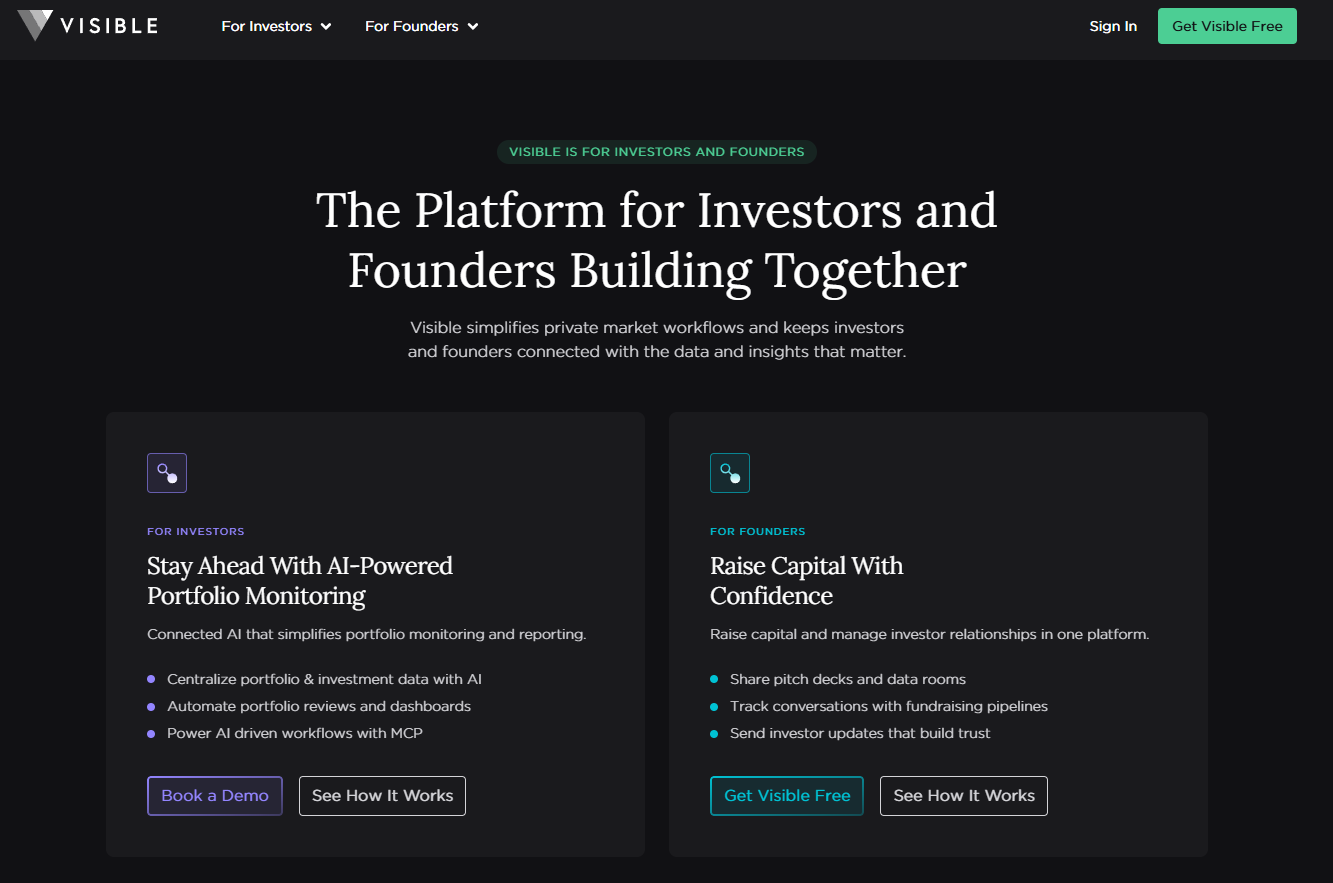
Visible is a platform for investors and founders covering portfolio monitoring, fundraising, investor updates, dashboards, data rooms, and LP reporting. It serves two sides of the same data problem: The fund wants consistent portfolio metrics, and the founder wants a single place to manage updates and fundraising materials. The platform collects recurring company data using structured templates and surfaces it in configurable dashboards.
Best for: Funds that need a repeatable system for collecting company metrics, founder updates, and portfolio reporting across many portfolio companies.
Key features
- AI-powered portfolio monitoring and data collection
- Investor update templates, pitch decks, and fundraising pipelines
- Portfolio reports, metric alerts, benchmarking, and LP reporting
- Data rooms for fundraising and investor sharing
- Spreadsheet integrations for data import and export
Why choose Visible: The free Starter plan makes it accessible for emerging managers, and the structured update workflow removes the chase that comes with bespoke spreadsheet requests. Funds primarily needing deal sourcing CRM or full fund accounting should assess those categories separately.
Visible pricing: Visible offers a free Starter plan. Paid plans for founders run $59/month (Base, billed annually) or $69/month billed monthly, $129/month (Core, annually) or $149/month billed monthly, and $199/month (Growth, annually) or $249/month billed monthly. Investor plans use custom pricing with no published figures.
2. Affinity
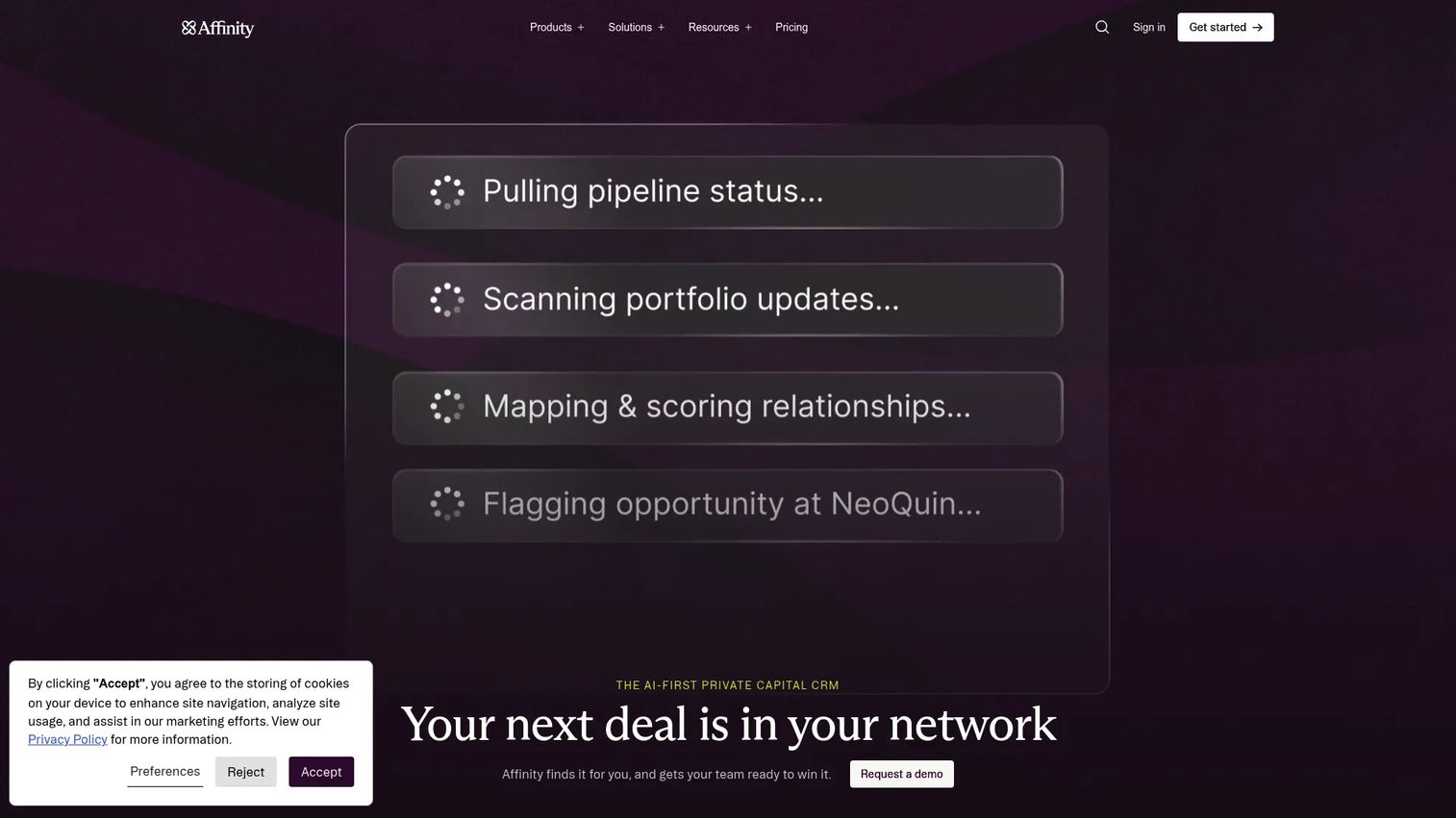
Affinity is an AI-first private capital CRM built on relationship intelligence. It automatically captures email and calendar activity, scores relationships, and surfaces warm introduction paths. Investment teams use it to track contacts, deal flow, and co-investor networks without manual data entry consuming partner time.
Best for: Investment teams whose sourcing edge depends on relationships, referral networks, and accurate activity history across the partnership.
Key features
- Automatic email and calendar activity capture
- Relationship intelligence, scoring, and warm-introduction paths
- Deal pipeline management and reporting dashboards
- AI Chat and meeting Notetaker for deal context
- Data enrichment and workflow integrations
Why choose Affinity: Funds that have outgrown partner-owned contact lists and need institutional memory as the team grows will find Affinity's automatic capture especially useful. It is a CRM-first platform, so buyers needing fund accounting or LP administration need a separate tool or integration.
Affinity pricing: Affinity sells annually. Essential runs $2,000 per user per year, Scale runs $2,300 per user per year, and Advanced runs $2,700 per user per year. Enterprise pricing is custom. No free tier was listed on the official pricing page.
G2 rating: 4.4/5
3. Edda
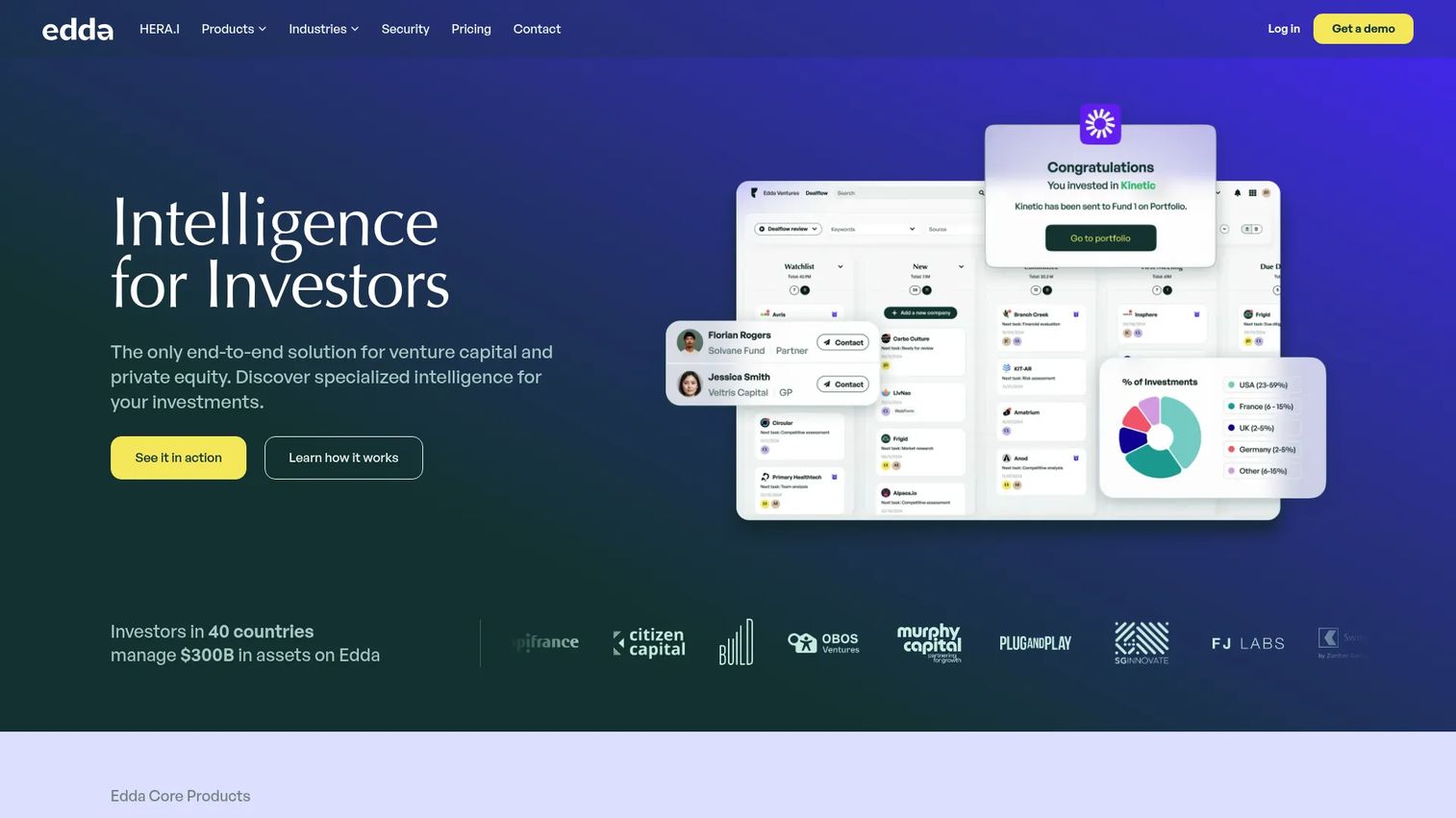
Edda is an end-to-end investment management platform covering deal flow, CRM, portfolio monitoring, investor reporting, and LP portal. It is designed as a VC-native workspace rather than a general CRM adapted for investment use. Portfolio companies move automatically from the deal pipeline into the portfolio module once an investment closes.
Best for: Emerging managers and growing funds that want one VC-specific workspace before stitching together several category tools.
Key features
- Deal sourcing pipelines with customizable stages and collaborative review
- Portfolio monitoring with financial metrics and automated reports
- CRM with contact management and relationship intelligence
- LP Portal for sharing fund information with limited partners
- HERA.I tools: Pitch Deck Reader, Due Diligence Assistant, and Decision Writer
Why choose Edda: The VC-native design reduces the configuration overhead of adapting a general CRM to investment workflows. Implementation still requires cleaning historical deal, contact, and portfolio data before the platform delivers consistent output.
Edda pricing: Edda does not display numeric pricing on its site. All four plans (First-Time GP, Premium, Pro, Enterprise) use a contact-sales flow. Request a quote directly from Edda.
4. Standard Metrics
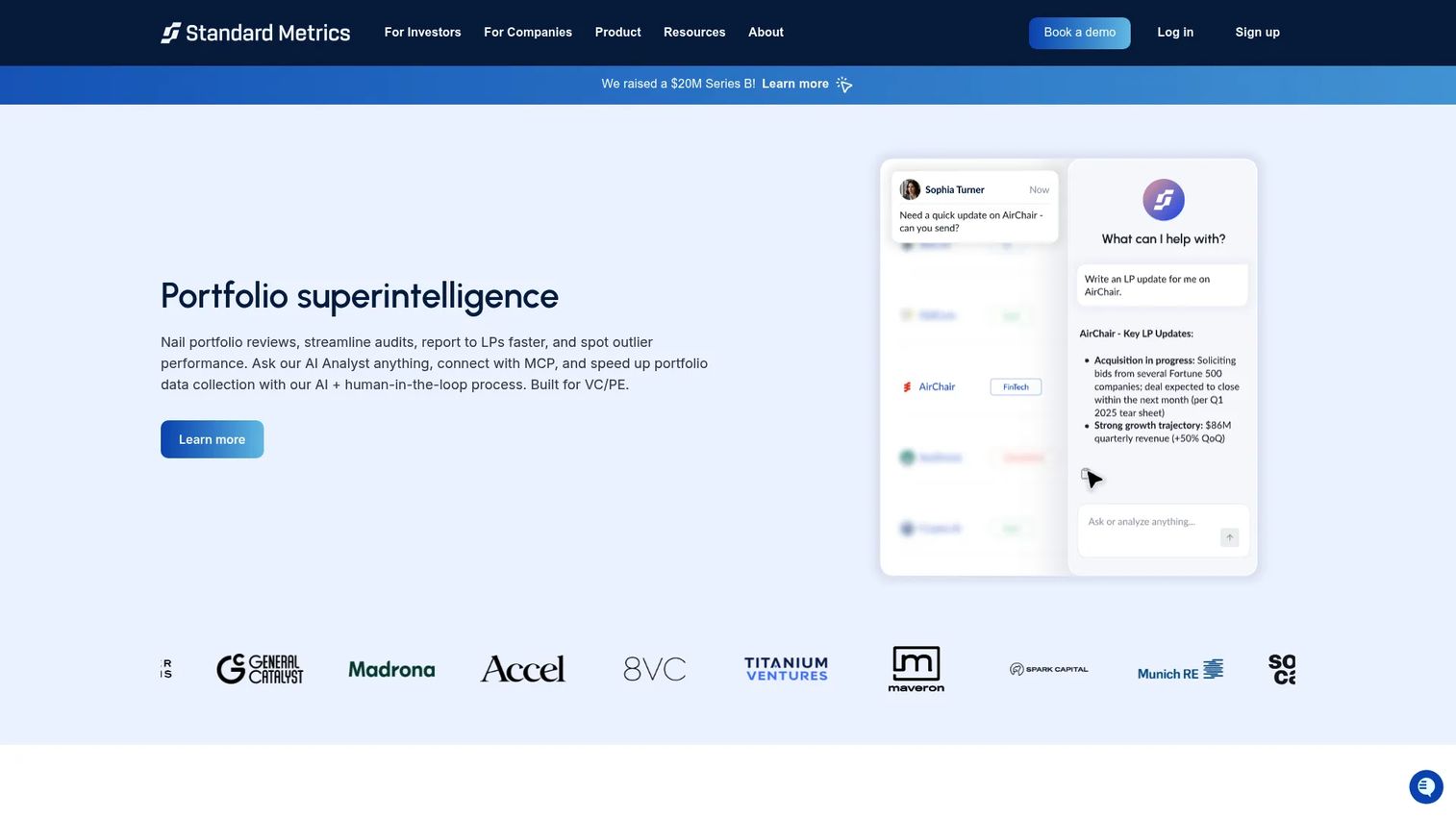
Standard Metrics is an AI-powered portfolio monitoring and financial data platform for venture capital and private equity firms. Its focus is making portfolio-company data collection consistent and comparable across a fund. An AI Analyst answers natural-language questions about the portfolio, and AI document parsing with human quality assurance handles incoming financial data.
Best for: Funds that want comparable portfolio data without asking each founder to build a custom board update every quarter.
Key features
- AI Analyst for natural-language portfolio questions
- AI document parsing with human quality assurance
- Portfolio data collection, reporting, and auditable dashboards
- Benchmarking against anonymized venture-backed startup data
- MCP server and embedded business intelligence tools
Why choose Standard Metrics: The benchmarking layer is particularly useful for funds with large portfolios or a heavy reporting burden, where comparing companies against anonymized peers adds analytical context. Funds needing a full deal CRM or capital-accounting system should assess those needs separately.
Standard Metrics pricing: Standard Metrics does not display pricing on its site. Contact the team directly for a quote.
G2 rating: 4.5/5
5. Atominvest
Atominvest is software for alternative investment managers covering investor lifecycle management, fundraising, e-subscriptions, LP reporting, portfolio data, cash flow tracking, and fund accounting workflows. The platform is designed for funds that need integrated LP operations alongside portfolio data, rather than point solutions for each job.
Best for: Multi-fund or institutionally managed VC firms that need integrated LP operations, fund accounting, and investor reporting controls.
Key features
- LP investor portal for self-service access
- Digital onboarding and e-subscription workflows
- Fund accounting tools and capital account management
- Portfolio data collection and reporting
- Cash flow tracking and investor communications
Why choose Atominvest: The integrated scope makes it practical for firms managing multiple entities or institutional LP relationships where separate systems create reconciliation risk. A smaller fund still validating its operating model may find the implementation scope larger than the current workflow demands.
Atominvest pricing: Atominvest does not display pricing on its site. The platform is typically sold through a demo and sales conversation. Contact Atominvest directly for a quote.
6. Carta
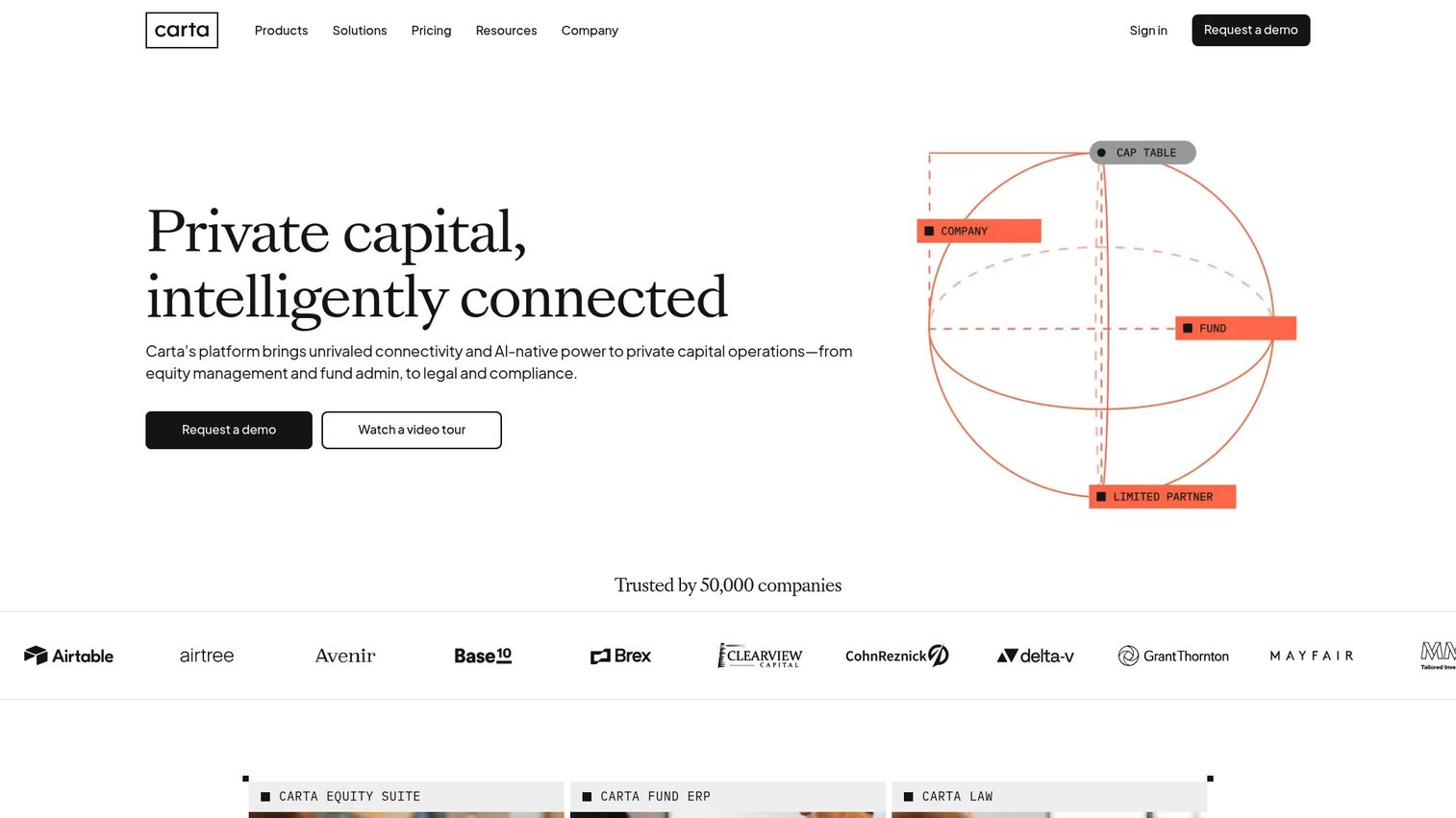
Carta provides connected software for private-capital operations, including equity management, fund administration, and legal and compliance workflows. For venture firms, the core value is connecting cap table data across portfolio companies with fund-level equity visibility, investor administration, and fund administration services.
Best for: Funds that want stronger equity data visibility and may also need fund administration services in the same platform.
Key features
- Cap table management and securities issuance
- Equity valuations and share-plan management
- Fund administration, forecasting, tax, SPVs, and portfolio analytics
- Investor relations, deal CRM, and LP CRM
- KYC/AML, compliance, and contract workflows
Why choose Carta: Carta has a natural fit when equity records and fund administration belong close together. Clarify which product line solves the specific need before buying, since Carta covers several distinct modules with different pricing structures.
Carta pricing: The Launch plan is free for companies with up to 25 stakeholders and $1M raised. Paid plans (Build, Grow, Scale) are priced per stakeholder with a minimum annual fee and require contacting sales for figures.
G2 rating: 4.3/5
7. DealCloud
DealCloud, now part of Intapp, is an AI-powered deal and relationship intelligence platform built for professional investment firms. Private capital teams use it to manage deal pipelines, relationships, research, investment workflows, and reporting on a highly configurable data model.
Best for: Established investment teams that need a configurable workflow layer across sourcing, diligence, and portfolio operations.
Key features
- Relationship intelligence and relationship mapping
- Zero-entry activity capture from Outlook
- Configurable workflows with automation and embedded compliance
- Industry-specific data models and flexible schemas
- AI-powered deal, pipeline, and diligence insights
Why choose DealCloud: The configurable schema and workflow engine suits firms with defined processes that need formalization across a larger team. Configuration projects require an internal owner and clear data governance from day one.
DealCloud pricing: DealCloud does not display pricing on its site. Pricing is sales-led. Contact Intapp for a quote.
G2 rating: 4.2/5
8. Dynamo Software
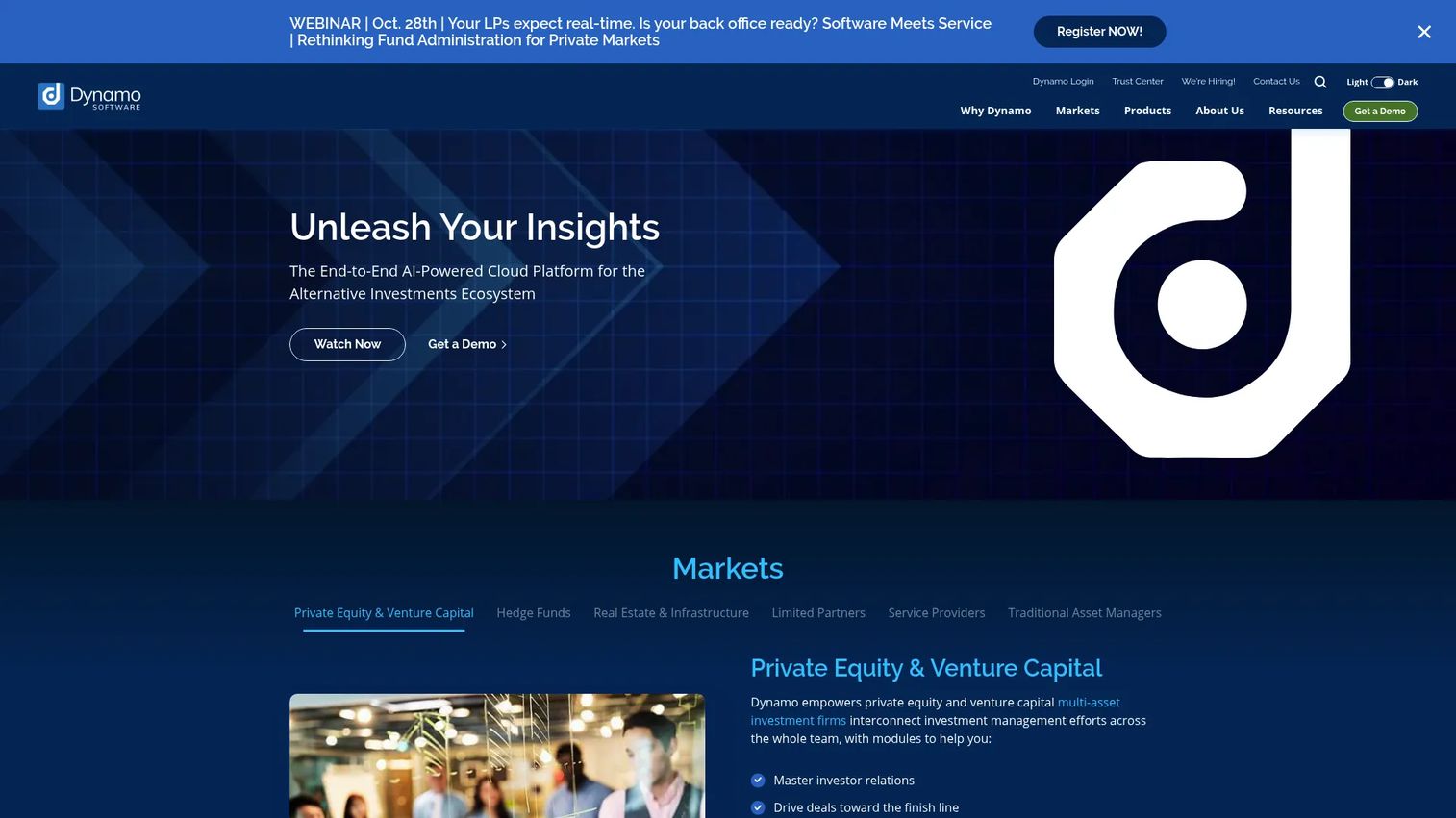
Dynamo Software is cloud-based, AI-powered investment management software for alternative investment firms, institutional investors, and fund managers. According to a 2025 Dynamo survey, 29% of GPs and LPs incorporated AI into their processes in 2025, up from 20% in 2024. Dynamo's platform spans fundraising, deal sourcing, research, portfolio management, fund accounting, investor servicing, and compliance reporting.
Best for: Larger firms that need investment operations, investor communications, reporting, and governance within a mature operating environment.
Key features
- Fundraising and investor relations management
- Deal sourcing, pipeline management, and due diligence workflows
- Portfolio management and analytics
- Fund accounting and compliance reporting
- Data visualization, reporting, and third-party integrations
Why choose Dynamo Software: The breadth of coverage makes it practical for institutional teams that have outgrown point solutions and need one platform across the full investment lifecycle. A smaller fund should scrutinize implementation scope and total cost before committing. The same 2025 Dynamo survey found that 64% of fund accountants cited manual data entry and reconciliation as a top challenge, which points to where the platform's automation focus is aimed.
Dynamo Software pricing: Dynamo does not display pricing on its site. Prospects are directed to request a demo and speak with sales. Contact Dynamo directly for a quote.
G2 rating: 4.2/5
9. Tactyc
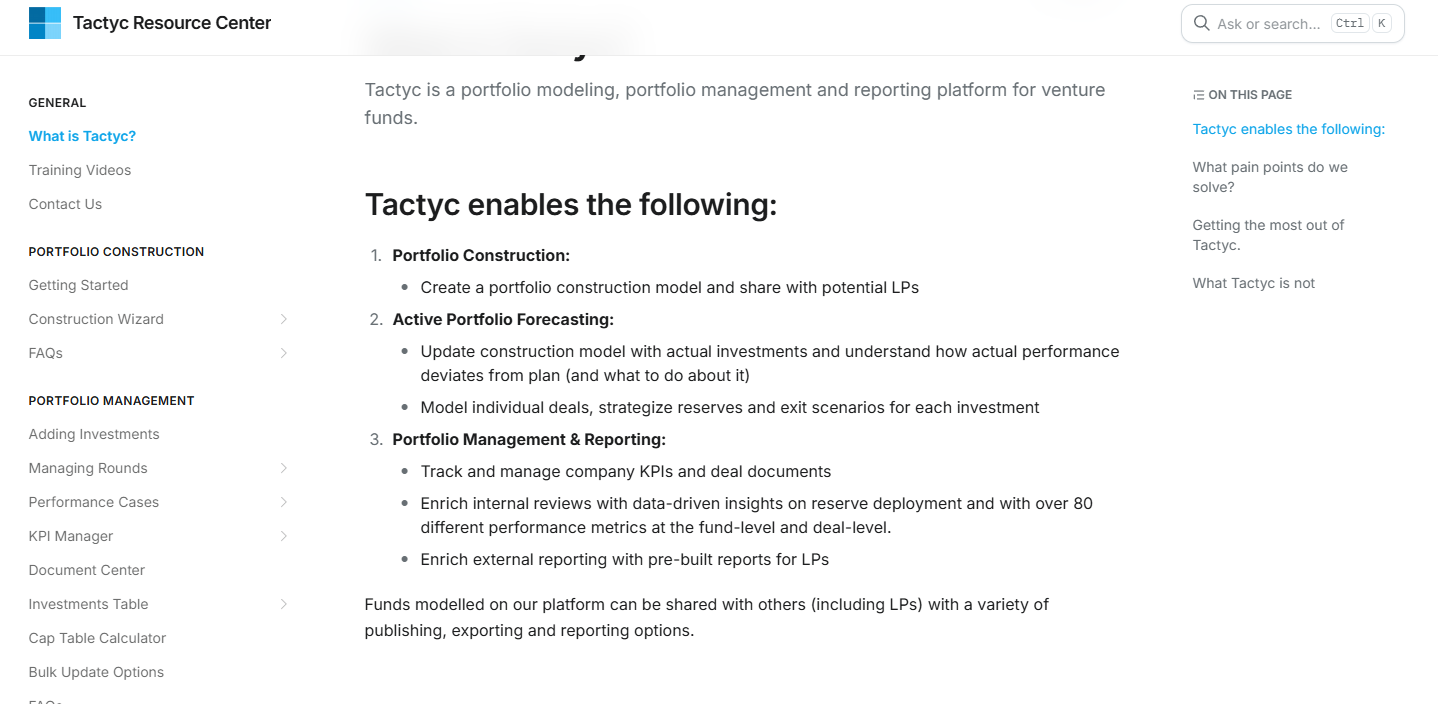
Tactyc is a portfolio modeling, portfolio management, and reporting platform built specifically for venture funds. Its core job is helping GPs make more disciplined follow-on decisions by modeling reserve allocation, fund deployment, and ownership targets across scenarios.
Best for: Funds that need to make structured follow-on decisions and model the consequences of reserve allocation choices across the portfolio.
Key features
- Portfolio construction modeling and active forecasting
- Follow-on investment scenario analysis
- Fund-level and deal-level performance metrics
- LP reporting and shareable dashboards
- Cap table calculator for SAFEs and convertible notes
Why choose Tactyc: Reserve strategy and portfolio construction are high-stakes decisions that most CRM and reporting platforms handle poorly. Tactyc is a specialist choice for that specific problem. It complements rather than replaces a primary VC CRM, fund administration platform, or portfolio reporting tool.
Tactyc pricing: Tactyc references Solo and Enterprise plans in its documentation, but current numeric pricing was not available on a verified first-party pricing page. Contact Tactyc directly for current figures.
10. Vestberry
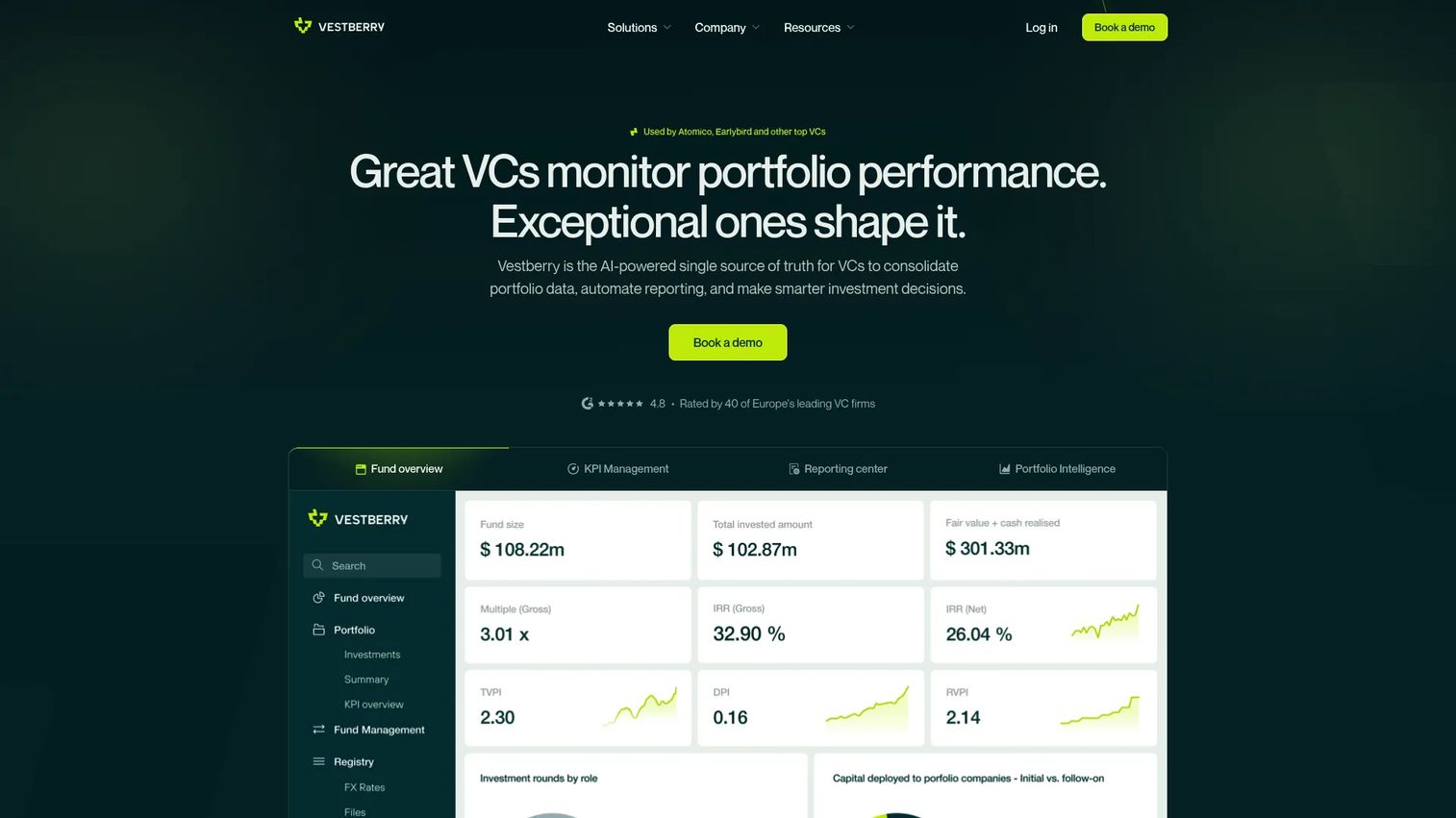
Vestberry is AI-powered portfolio intelligence and management software for venture capital firms. It focuses on investment tracking, portfolio monitoring, KPI and ESG data collection, automated LP reporting, and portfolio analytics. An AI document extraction feature and portfolio assistant reduce manual data handling.
Best for: Investment teams that want clearer portfolio performance views and reporting without turning a general-purpose spreadsheet into a manual reporting system.
Key features
- Portfolio and investment data management
- KPI and ESG data collection through an investee portal
- Automated and customizable LP reporting
- AI document extraction and portfolio assistant
- Cap table and investment transaction tracking
Why choose Vestberry: The automated LP reporting and investee portal reduce the back-and-forth that manual data collection creates. Validate CRM depth, fund accounting needs, and integration requirements before treating it as your only operating system.
Vestberry pricing: Vestberry does not display pricing on its site. Prospects are directed to book a demo. Contact Vestberry directly for a quote.
G2 rating: 4.8/5
Considerations when choosing venture capital management software
Match the tool to the actual bottleneck
Do not buy a full fund administration platform if portfolio-company updates are the real problem. Map the operational workflow first: Identify whether the pain is data collection, investor communications, deal sourcing, or fund accounting before evaluating platforms.
Define data ownership and reporting cadence
Decide who submits portfolio data, who validates it, and when it becomes reportable. A platform cannot fix unclear KPI definitions or missing internal ownership. Standardize the definitions before selecting software.
Check integration depth
Evaluate how the system connects with accounting software, spreadsheets, CRM, email, and existing investor portals. Ask whether the integration is read-only, export-only, or bi-directional, and confirm which direction data flows in each case.
Price implementation, not only licenses
The subscription is one part of the total cost. Include data migration, template design, reporting rebuilds, systems integration, administrator time, and training in the budget. Some platforms have significant configuration requirements before they produce usable output.
Test permissions and audit requirements
Funds handle sensitive financial data, LP information, deal notes, and portfolio-company metrics. Review access controls, audit history, SSO requirements, and data export policies before signing a contract.
How to choose the right venture capital management software for your team
If you need consistent founder updates and portfolio KPIs
Start with Visible or Standard Metrics. The deciding factor is whether you need a platform your founders will also use (Visible has a strong founder-facing side) or whether the priority is purely analytical data normalization across a portfolio (Standard Metrics).
If your sourcing process depends on relationships
Evaluate Affinity, Edda, or DealCloud. Affinity excels when automatic activity capture and relationship scoring are the priority. Edda suits funds that want deal flow, CRM, and portfolio monitoring in one VC-native workspace. DealCloud fits established teams with defined processes that need formalization.
If fund operations and LP reporting drive the decision
Evaluate Atominvest, Carta, or Dynamo Software. Atominvest and Dynamo Software cover integrated LP operations at institutional scale. Carta is the natural choice when equity records and fund administration belong close together, particularly for funds with heavy cap table management needs.
If reserve planning changes investment committee decisions
Add Tactyc to the shortlist. It is a specialist platform for follow-on strategy, deployment pacing, and ownership targets. Use it alongside a primary portfolio reporting or fund administration tool rather than as a replacement.
Conclusion
Venture capital management software is not one buying decision. It covers several connected operating jobs, and the right tool depends on where the current bottleneck sits.
For portfolio reporting and founder data collection: Visible and Standard Metrics. For relationship-driven sourcing and deal flow: Affinity, Edda, or DealCloud. For LP operations and fund accounting at institutional scale: Atominvest, Carta, and Dynamo Software. For reserve planning and portfolio construction: Tactyc. For portfolio analytics and reporting dashboards: Vestberry.
For a SaaS founder, the practical takeaway is this: Better investor operations should reduce ad hoc reporting, not create another layer of manual work. Align on KPI definitions, submission timing, and data ownership before your investor picks a reporting workflow for you. If your investor uses a structured collection platform, ask for the template, map it to your existing finance exports, and assign internal ownership before the first submission deadline.
And if your team needs to show product value to investors or customers through interactive demos, Guideflow helps you build and share them without production cycles or engineering handoffs.
Start your journey with Guideflow today!
FAQs
Venture capital management software covers the systems investment firms use to manage deal flow, portfolio-company data, fund operations, investor reporting, and performance analytics. No single platform handles every job equally well, so most funds pair at least two tools from different categories such as a relationship CRM alongside a portfolio reporting or fund administration platform.
Portfolio management software focuses on investment tracking, company KPIs, valuation monitoring, and performance metrics such as IRR and MOIC. Fund administration software centers on fund accounting, capital accounts, allocations, waterfalls, capital notices, and LP statements. Some platforms, like Dynamo Software and Atominvest, cover both jobs, while others specialize in one.
Core performance metrics include IRR, MOIC, DPI (distributions to paid-in), and RVPI (residual value to paid-in). Portfolio-level data typically covers unrealized value, cash flows, ownership percentage, and reserves. Company-level operating metrics usually include revenue growth, burn rate, runway, and headcount. KPI definitions should be standardized across the portfolio before automation begins.
Founders typically interact with the data-collection side rather than buying the full platform. Visible, for example, has a founder-facing product for managing updates, fundraising, and data rooms. The benefit is a consistent reporting process rather than bespoke spreadsheet requests. The risk is maintaining multiple investor update formats that require manual reconciliation, which consumes finance team time without adding analytical value.
Start with a clear source of truth for relationships, pipeline, portfolio updates, and LP communications. Implementing every software category at once creates configuration debt before the operating model is proven. Most emerging managers get more value from a focused tool that handles one job well than from an enterprise platform that requires months of setup.
Yes. Spreadsheets remain practical for funds with a small number of investments and stable reporting needs. The common breaking point is when metric definitions drift across companies, version control fails across quarters, and partner reporting requires manual consolidation before every board meeting. That pattern usually signals that a structured collection workflow would reduce coordination costs. Our guide on cash flow management software covers related tracking considerations for finance teams.
Practical AI applications in this category include extracting data from incoming financial documents, summarizing meeting notes and deal memos, enriching company records from public sources, identifying reporting anomalies across portfolio companies, and drafting internal research summaries. According to State Street's 2025 research, 83% of surveyed institutions recognize GenAI's value for turning unstructured information into analyzable data. AI output still requires a human review process for investment and financial decisions.
A focused portfolio reporting rollout can take a few weeks if the underlying data is clean and KPI definitions are already agreed. A full CRM and fund administration implementation across multiple entities typically takes several months and requires internal ownership of data migration, template design, and integration work. The difference in timeline comes down to data cleanup, reporting rebuilds, entity structure complexity, and how clearly ownership is defined before the project starts. For related application portfolio management software considerations, that guide covers adjacent evaluation frameworks useful for finance and ops teams.