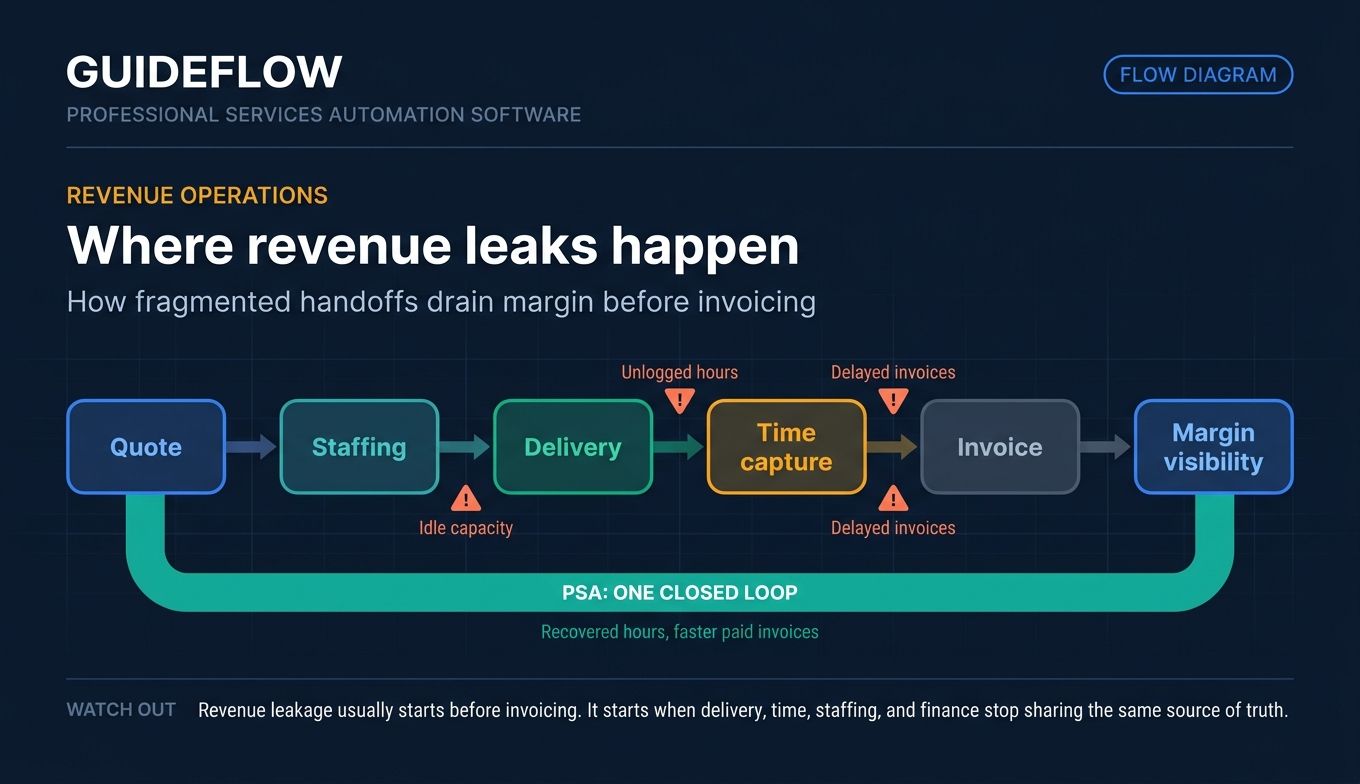
You finished a project on time. The client was happy. Then you ran the numbers and the margin was thinner than the quote promised. Someone forgot to log billable hours. An invoice went out three weeks late. Two people sat idle while another was overbooked. Nobody could tell you why until the quarter closed.
That gap between delivering work and getting paid fairly for it is where most services firms leak money. When projects, time, staffing, and billing live in separate spreadsheets, no single person sees the full picture. Utilization stays a guess. Billing recovery slips. Margin visibility arrives too late to act on.
Professional services automation software closes that gap. It connects the full services lifecycle, from quote to staffing to delivery to billing to profitability analysis, in one system. The category is growing fast: the global professional services automation software market is expected to reach US$15.0 billion in 2026 and US$32.5 billion by 2033, a 11.5% CAGR, according to Persistence Market Research PSA market forecast. Industry benchmarks from Service Performance Insight benchmark research also show that firms using integrated PSA achieve higher billable utilization and profit margins than peers without it.
This guide compares the platforms worth shortlisting, with verified features, pricing where it is public, and clear best-for picks for each buyer segment.
What's inside
This guide is for operations leaders, finance leaders, agency owners, and IT services or managed service provider (MSP) owners evaluating PSA software. It is built for buyers replacing spreadsheets and disconnected tools with one professional services automation system.
We selected the 12 platforms below based on four criteria that matter most to services firms: lifecycle coverage (proposals through profitability analysis), depth of resource and project management, billing and revenue recognition strength, and integration breadth across CRM, ERP, and finance tools. Each entry includes what the tool does well, who it fits, and verified pricing where vendors publish it. No tool earns a slot for marketing reasons alone.
TL;DR
Short on time? Here are the decision shortcuts from the list below.
- Best for client-facing project delivery: Rocketlane
- Best for mid-market and enterprise services orgs: Kantata
- Best Salesforce-native PSA: Certinia
- Best for agencies wanting unified ops and finance: Scoro
- Best for IT services and MSPs: ConnectWise PSA or HaloPSA
- Best for enterprise services orgs on a unified HR and finance platform: Workday
If you run an agency or consultancy and want fast quote-to-cash, Scoro and Productive are the strongest starting points. If you run an MSP, jump straight to the IT PSA software section.
What is professional services automation software?
Professional services automation (PSA) software is a platform that manages the full services lifecycle, from proposals and resource staffing through project delivery, time tracking, billing, and profitability analysis, in a single system.
Instead of stitching together a project tool, a spreadsheet for resourcing, a timesheet app, and a separate invoicing system, PSA software keeps that data connected. That connection is the point. When a billable hour logged on Tuesday flows straight into an invoice and updates project margin in real time, finance and delivery finally see the same numbers.
Core features of most PSA tools include:
- Project management: Plan, schedule, and track delivery with Gantt chart project scheduling method, task boards, milestones, and dependencies.
- Resource management: Forecast capacity, plan staffing, and match people to projects by skills and availability.
- Time and expense tracking: Capture billable and non-billable hours plus project costs.
- Billing, invoicing, and revenue recognition: Support fixed-fee, time-and-materials, milestone, and retainer billing, with compliance for ASC 606 revenue recognition standard and IFRS 15.
- Reporting and analytics: Surface utilization, margin, and forecast data in real time.
- Integrations: Connect to CRM, ERP, HCM, and finance systems.
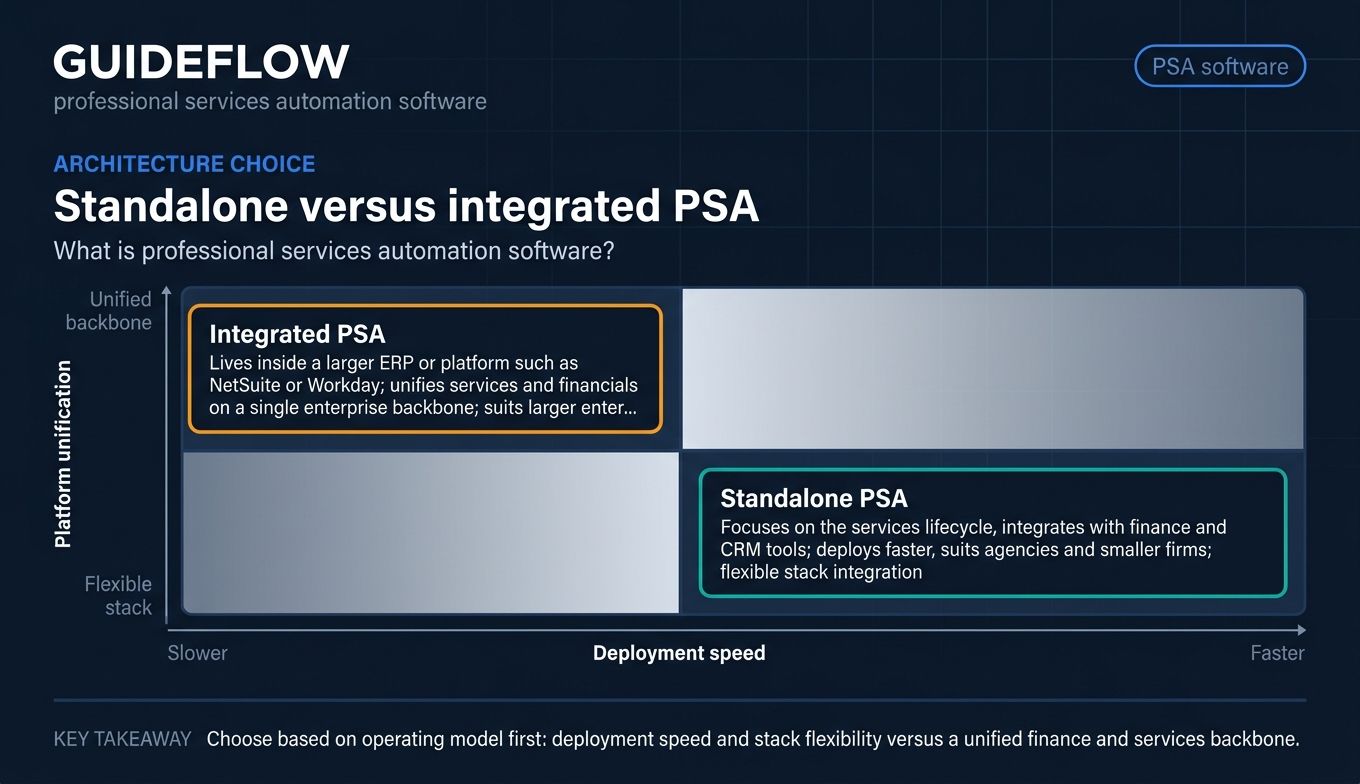
There are two broad types. Standalone PSA software focuses on the services lifecycle and integrates with your finance and CRM stack. Integrated PSA lives inside a larger ERP or platform (think NetSuite or Workday), sharing one data model across services and finance. Standalone tools tend to deploy faster and suit agencies and smaller firms. Integrated PSA suits enterprises that want services and financials on a single backbone.
When to use professional services automation software
Not every team needs a full PSA platform on day one. These three triggers signal it is time.
Replace spreadsheets across the services lifecycle
When project plans live in one tool, time in another, and invoices in a third, data falls through the cracks. Hours go unlogged. Status updates lag. Nobody can answer "are we on budget?" without a manual reconciliation. PSA automation software pulls that fragmented data into one system, so delivery and finance work from the same source.
Improve resource utilization and capacity planning
If staffing decisions are guesswork, you either overbook your best people or leave billable capacity idle. Both hurt margin. PSA tools forecast capacity, flag over- and under-allocation, and match people to work by skill. That visibility turns utilization from a quarterly surprise into a daily lever.
Tighten billing and quote-to-cash
Slow invoicing is slow cash. When billable work is not captured cleanly or invoices go out weeks late, revenue leaks. PSA software automates the path from quote to staffed project to invoice, recovering hours that would otherwise vanish and shortening the time between delivered work and paid invoice. When you onboard new clients onto a delivery process, building a smooth experience with client-facing onboarding flows can shorten time-to-value during implementation.
Comparison table
The table below summarizes the best PSA software by buyer intent, primary use case, public pricing, and G2 rating. Pricing reflects each vendor's published entry tier where available; several enterprise and ERP-native platforms use custom pricing and are marked accordingly. Use it as a fast filter, then read the full entry for the tools that fit your services motion.
| # | Product | Intent | Key use case | Pricing | G2 rating |
|---|---|---|---|---|---|
| 1 | Rocketlane | Client-facing delivery | Onboarding and project delivery with client portals | From $19/team member/mo (annual) | 4.7/5 |
| 2 | Kantata | Mid-market to enterprise PSA | Resourcing, delivery, and project financials | Custom | 4.2/5 |
| 3 | Certinia | Salesforce-native PSA | Full lifecycle on Salesforce | Custom | 4.1/5 |
| 4 | Scoro | Agency and consultancy ops | Quote-to-cash and profitability | From $19.90/user/mo (annual) | 4.5/5 |
| 5 | Accelo | Recurring client work | Projects, retainers, and billing | Custom | 4.4/5 |
| 6 | Productive | Agency operations | Resourcing, budgeting, and margins | From $10/user/mo (annual) | 4.6/5 |
| 7 | BigTime | Finance-led services | Time, billing, and project accounting | From $20/user/mo | 4.5/5 |
| 8 | Workday | Enterprise services | PSA tied to HCM and finance | Custom | 4.1/5 |
| 9 | NetSuite SuiteProjects Pro | ERP-native PSA | PSA inside NetSuite ERP | Custom | 4.1/5 |
| 10 | ConnectWise PSA | IT services and MSPs | Ticketing, projects, and agreements | Custom | 4.3/5 |
| 11 | HaloPSA | MSP all-in-one | Service desk, contracts, and billing | Custom | 4.6/5 |
| 12 | Planview | Enterprise portfolios | Resource and portfolio management | Custom | 4.1/5 |
12 best professional services automation software for 2026
Each entry below covers what the tool does, who it fits best, its standout strengths, and verified pricing. Tools are ordered by relevance to the core PSA buyer.
1. Rocketlane
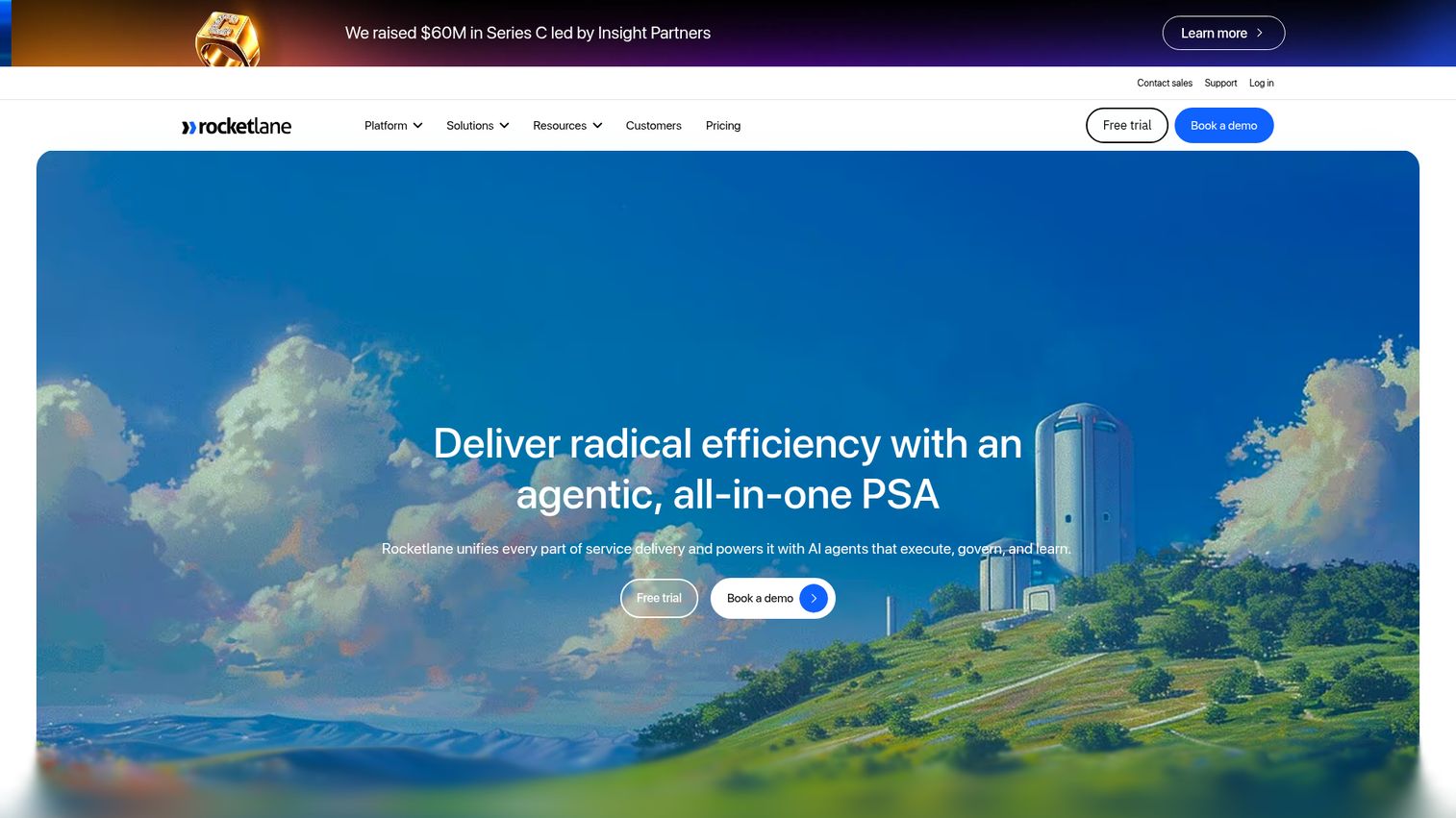
Rocketlane is an all-in-one PSA platform that unifies service delivery with a strong client-facing layer. It pairs project and portfolio management with a branded customer portal, so clients see plans, approve work, and collaborate in one place. That makes it a natural fit for onboarding and implementation teams where the delivery experience is part of the product. Teams that want to show clients exactly how to use a deliverable often pair these portals with interactive product demos to guide users through key workflows.
Best for: Professional services, onboarding, and implementation teams that want client-facing delivery, resource planning, and financials in one platform.
Key strengths
- Branded customer portal: Share project plans, collect approvals, and collaborate with clients without endless email threads.
- Flexible project views: Plan and track delivery in Gantt, List, and Kanban, matching how each team works.
- Connected financials: Run time tracking, timesheets, resource management, and reporting alongside delivery, not in a separate tool.
Why choose Rocketlane
If your firm delivers structured onboarding or implementations where the client experience matters, Rocketlane keeps delivery and the customer relationship in one system. Teams that win or lose renewals on how smoothly the first 90 days go get the most from its portal-first design.
Rocketlane pricing
Rocketlane publishes per-team-member pricing billed annually. The Essential plan starts at $19 per team member per month (minimum five members), Standard is $49, Premium is $69, and Enterprise is $99 per team member per month. Premium adds resource management, financial management, and comprehensive reporting; Enterprise adds unlimited automations, RBAC, SAML, and Snowflake support. There is no free tier, but a free trial is available. Rocketlane holds a 4.7/5 rating on G2.
2. Kantata
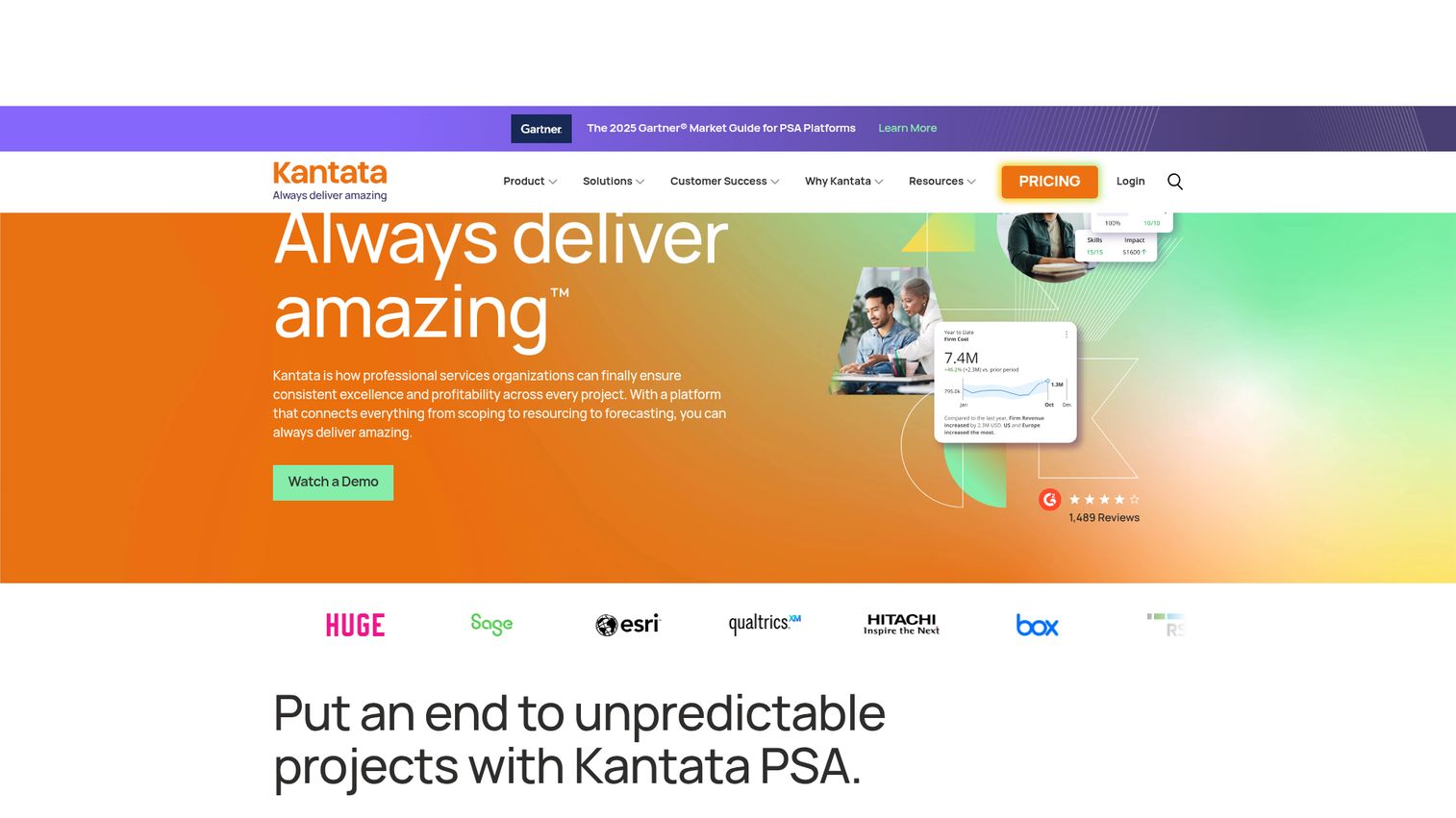
Kantata is an AI-powered PSA platform purpose-built for services organizations and agencies. It manages projects, resources, finances, reporting, and collaboration in one place, with particular depth in resource forecasting and project accounting. For firms where resourcing and financial accuracy decide profitability, that depth is the draw.
Best for: Mid-size and enterprise professional services organizations needing PSA across resourcing, delivery, financials, and reporting.
Key strengths
- Resource management and forecasting: Plan capacity, model staffing scenarios, and match people to demand before bottlenecks form.
- Project management: Run delivery with the structure larger services teams need across complex, multi-stage engagements.
- Financial management: Tie project accounting to delivery so margin visibility stays current, not quarterly.
Why choose Kantata
Kantata fits firms that have outgrown lightweight tools and need serious resourcing plus financial rigor in one system. If utilization forecasting and project profitability are your top two metrics, its purpose-built depth earns the evaluation.
Kantata pricing
Kantata does not publish public pricing. The vendor tailors quotes based on company size, goals, and how the team works, so you request pricing directly. Plan on a sales conversation and a scoped quote rather than a self-serve tier. Kantata holds a 4.2/5 rating on G2.
3. Certinia (Professional Services Cloud)
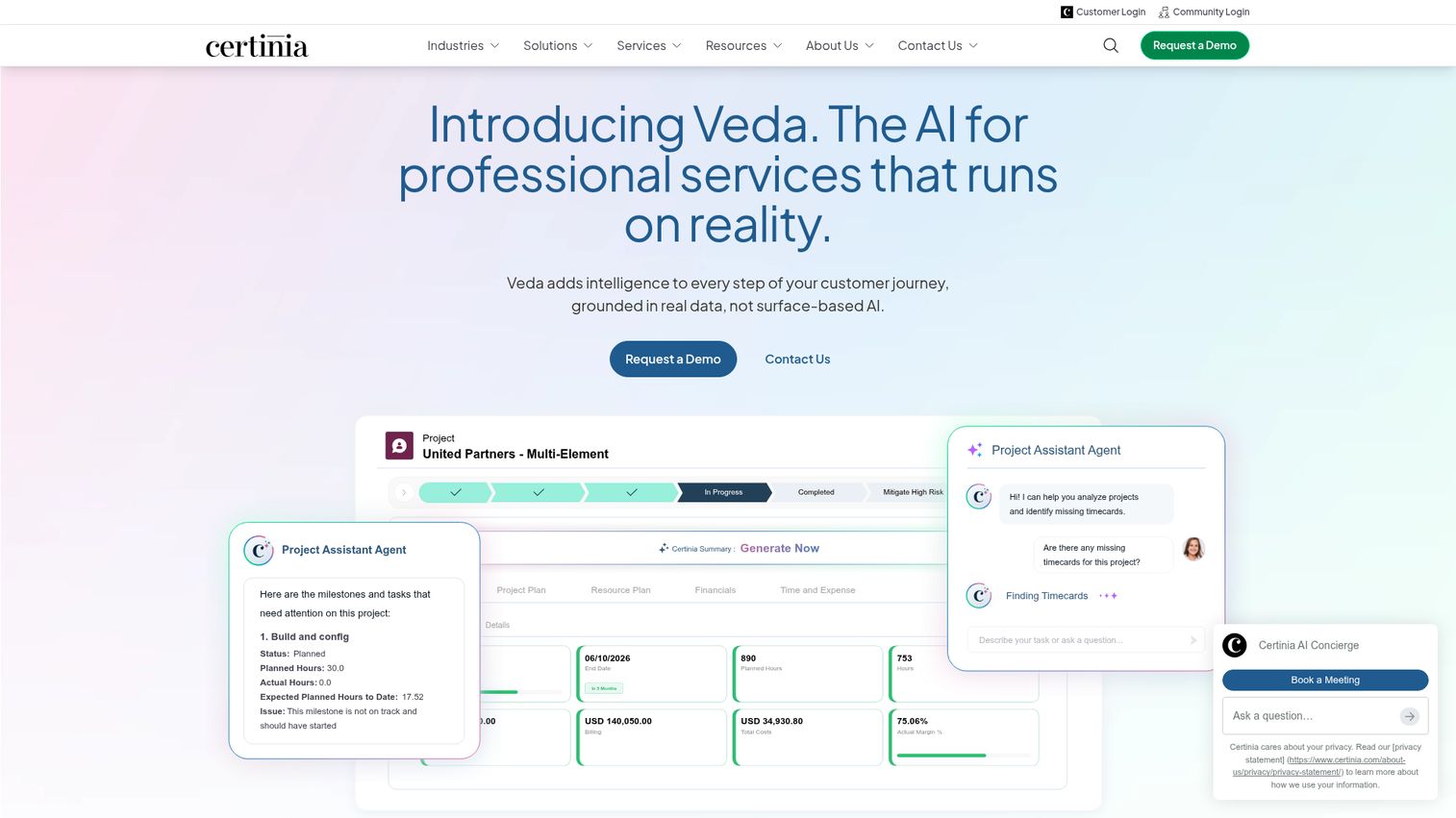
Certinia delivers Salesforce-native PSA through its Professional Services Cloud, paired with Financial Management Cloud and Customer Success Cloud. Because it runs on Salesforce, it connects the front office (sales, customer data) to the back office (delivery, billing, revenue) on one platform. Its Veda AI agents assist with estimating, staffing, and delivery workflows.
Best for: Services-led organizations already standardized on Salesforce that want connected PSA, financials, and customer success.
Key strengths
- Salesforce-native lifecycle: Run resource planning, project delivery, and billing on the same platform as your CRM data.
- Connected financials: Link billing and revenue management to customer and delivery records, including ASC 606 and IFRS 15 revenue recognition.
- Veda AI agents: Automate estimating, staffing, delivery workflows, and project summaries.
Why choose Certinia
If Salesforce is your system of record, Certinia removes the integration tax of bolting a separate PSA onto your CRM. The unified front-and-back-office model is its core advantage for Salesforce-centric services firms. If you're still evaluating your underlying CRM, our roundup of the best CRM software is a useful companion read.
Certinia pricing
Certinia does not publish public pricing; its pricing request page routes to a demo. Pricing depends on the clouds you deploy and your Salesforce footprint, so expect a custom quote scoped to your org. Certinia holds a 4.1/5 rating on G2 across more than 1,100 reviews.
4. Scoro
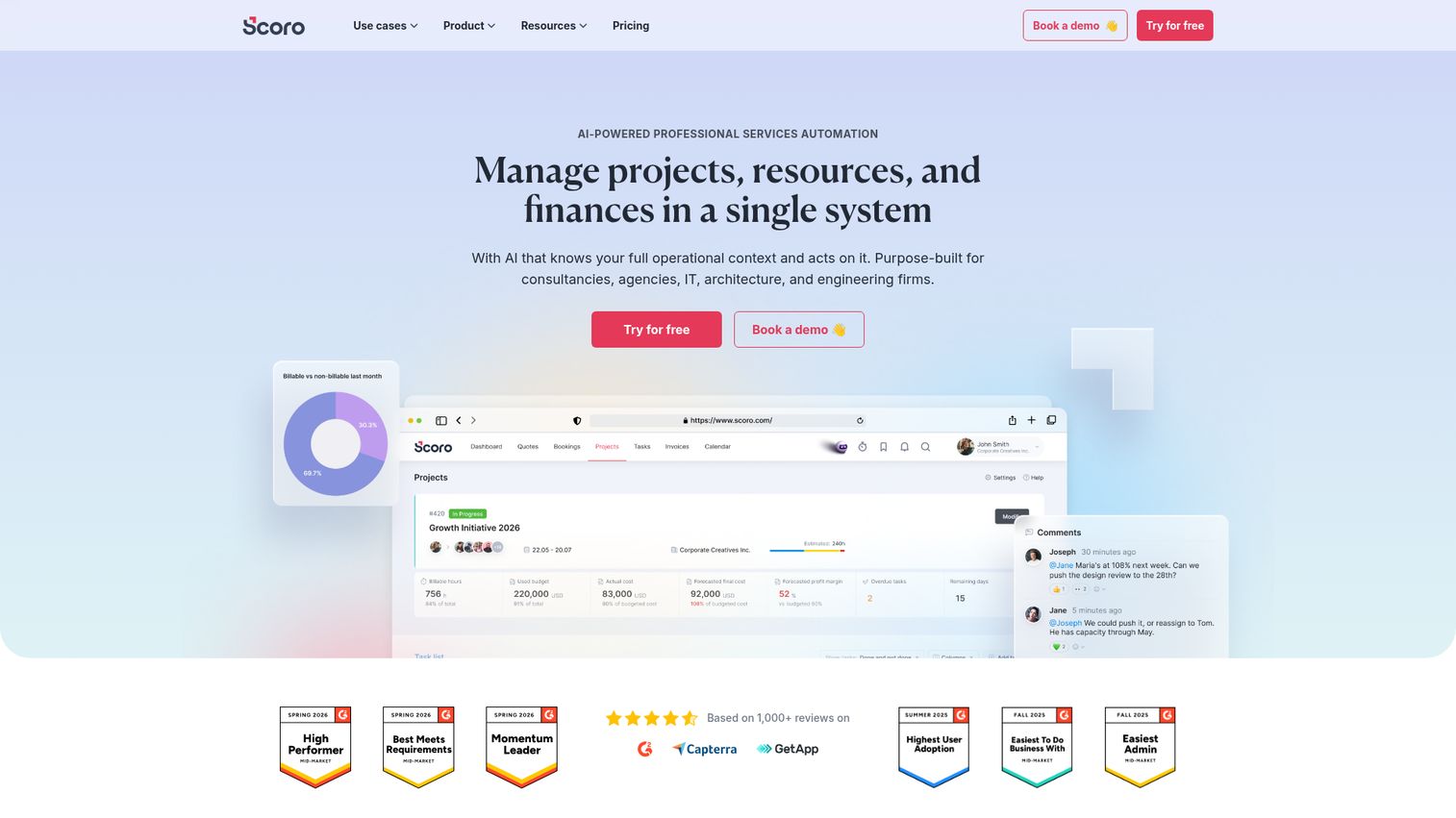
Scoro is a cloud-based PSA platform built for professional and creative services. It unifies clients, projects, resources, financials, and business intelligence, with strong quote-to-cash and profitability reporting. Agencies and consultancies use it to run operations and finance in one place rather than across a stack of point tools.
Best for: Professional services firms, agencies, and consultancies that want one system for delivery, resourcing, time, billing, and profitability.
Key strengths
- Quote-to-cash workflows: Move from quote to order to invoice without re-entering data across tools.
- Profitability dashboards: Track labor cost, project budgets, utilization, and margin in real time.
- Project and financial management: Run calendars, task boards, Gantt charts, budgets, and forecasts in one view.
Why choose Scoro
Scoro suits agencies that want operations and finance tightly linked without an enterprise implementation. Its profitability reporting and quote-to-cash flow make it a strong pick when margin visibility is the priority. Agencies that send a high volume of estimates may also want to review the best proposal software to tighten the quote stage.
Scoro pricing
Scoro publishes transparent per-user pricing billed annually. Core starts at $19.90 per user per month, Growth is $32.90, Performance is $49.90, and Enterprise is custom. Growth adds budgeting, retainers, utilization, and detailed financial reports; Performance adds forecasting, planner, and timesheets; Enterprise adds company budgets, approvals, WIP, SSO, and multi-account reporting. A 14-day free trial is available. Scoro holds a 4.5/5 rating on G2.
5. Accelo
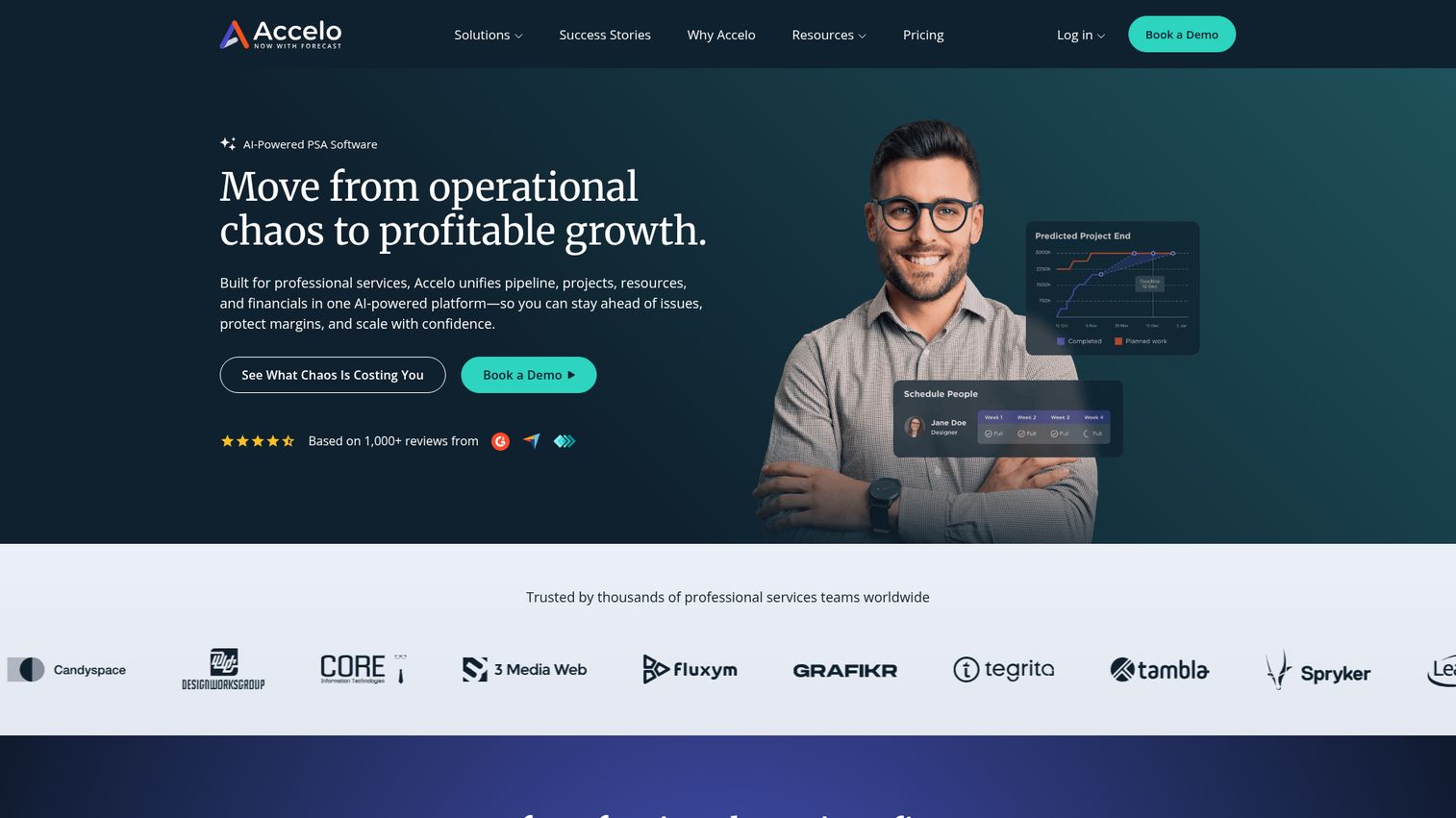
Accelo is PSA software for managing the full project lifecycle across projects, resourcing, time tracking, financials, and reporting. It stands out for handling recurring client work, retainers, and ticketing alongside project delivery, which suits firms running ongoing engagements rather than one-off projects.
Best for: Professional services teams managing retainers and recurring client work alongside project delivery.
Key strengths
- Retainers and ticketing: Manage ongoing client agreements and support requests in the same system as projects.
- AI-assisted resourcing: Get capacity forecasting, utilization reports, and allocation recommendations.
- Project financials and billing: Track budgets, profitability, and expenses, then automate invoicing.
Why choose Accelo
Accelo fits service businesses where recurring revenue and retainers are core, not an afterthought. If your model blends projects, support tickets, and ongoing agreements, its unified client-work approach keeps all of it in one platform.
Accelo pricing
Accelo does not publish public pricing. The vendor scopes quotes based on team size and growth goals, so you request a custom quote. Expect packaging tailored to your business rather than a fixed public tier. Accelo holds a 4.4/5 rating on G2 across more than 500 reviews.
6. Productive
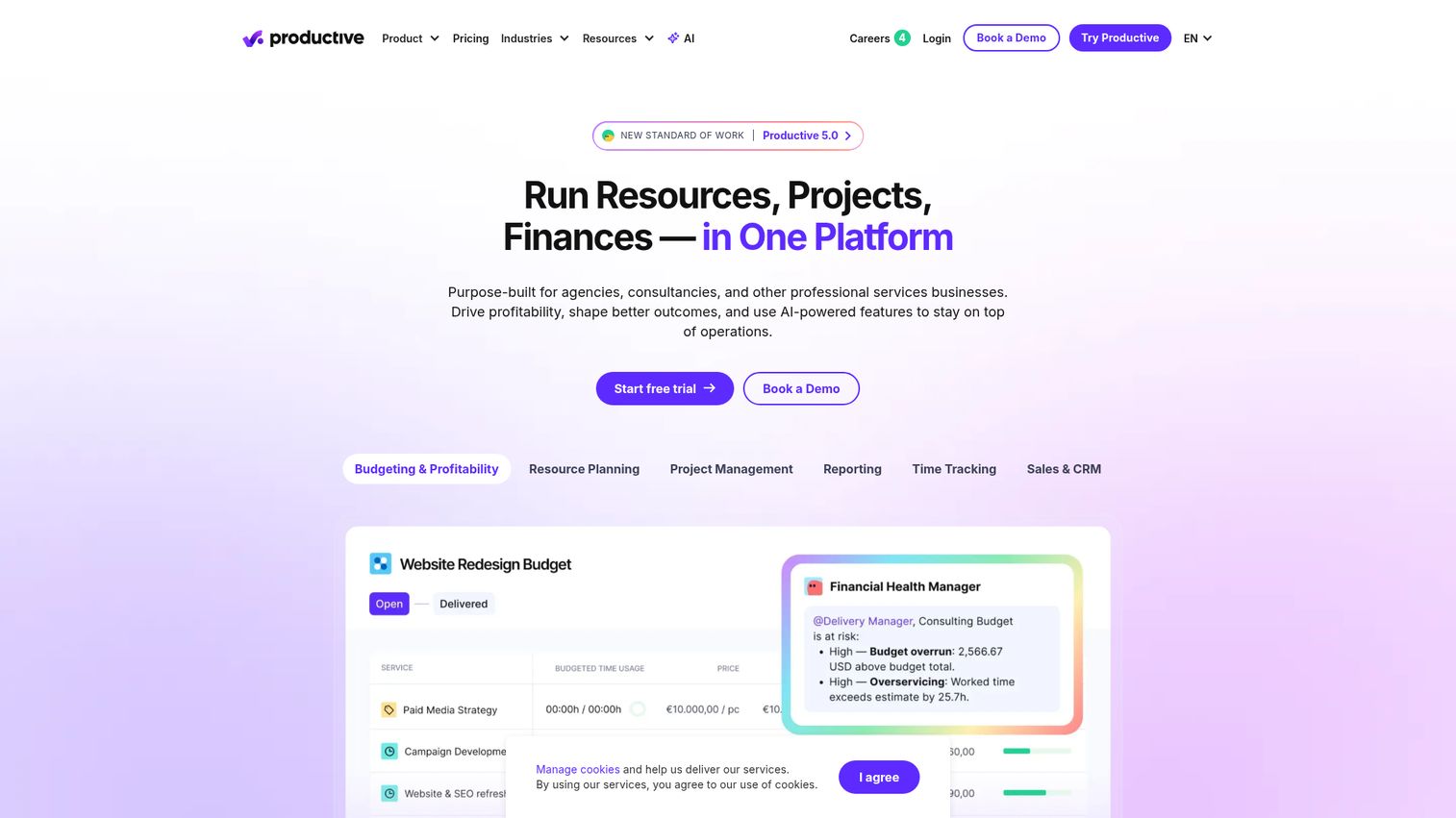
Productive is a professional services platform for agencies, consultancies, and other services businesses to run resources, projects, and finances in one place. It is especially strong on budgeting and profitability tracking, giving agency leaders a clear view of margin at the project and client level.
Best for: Agencies and services teams that need integrated resource planning, project delivery, budgeting, and invoicing.
Key strengths
- Resource planning: Schedule people against demand and spot over- or under-allocation early.
- Budgeting and profitability: Track project margins in real time, not after the invoice clears.
- Project management: Run delivery alongside finance so operations and money stay connected.
Why choose Productive
Productive is a strong fit for agencies that live and die by project margin and want one system for delivery and finance. Its profitability focus makes it easy to see which clients and projects actually pay.
Productive pricing
Productive publishes per-user pricing billed yearly. Essential starts at $10 per user per month, Professional is $25, and Ultimate is $33 per user per month (monthly billing runs higher). Professional suits growing teams scaling operations; Ultimate adds advanced financial oversight for complex organizations. A 14-day free trial is available, and all plans require at least three seats. Productive holds a 4.6/5 rating on G2.
7. BigTime
BigTime is an AI-powered PSA platform focused on quoting, staffing, project delivery, time and expenses, billing, invoicing, payments, and analytics. Its finance-first design and integrations with QuickBooks and Sage Intacct cloud financial management make it a natural fit for accounting and consulting firms that treat billing accuracy as non-negotiable.
Best for: Professional services firms that need finance-focused PSA across quote-to-cash, time, billing, and project profitability.
Key strengths
- Time and expense management: Capture billable hours and costs cleanly so nothing slips before invoicing.
- Billing and invoicing: Run rate management, approvals, and automated reconciliation, with multi-currency on higher tiers.
- Project accounting integrations: Connect to QuickBooks accounting software, Sage Intacct, Salesforce, and Jira for a finance-grade stack.
Why choose BigTime
BigTime fits firms where billing precision and project accounting come first. If you bill in detail and reconcile against an accounting system, its finance-led design and native integrations cut manual work.
BigTime pricing
BigTime publishes a starting price of $20 per user per month for its Essentials plan, which includes time and expense, billing and invoicing, project portfolio management, QuickBooks and HubSpot integrations, and SSO. Advanced, Premier, and Enterprise tiers add custom reporting, project budgeting, Sage Intacct and API integrations, and more, with pricing available on request. BigTime holds a 4.5/5 rating on G2.
8. Workday (Professional Services Automation)
Workday is an enterprise cloud platform for HR, finance, planning, procurement, and operations on a single data model. Its professional services automation capabilities tie project delivery to that backbone, so staffing draws on real HCM talent data and project financials roll straight into Workday Financials. Workday PSA suits large services orgs already standardized on the platform.
Best for: Medium-to-large enterprises that want PSA on a unified HR, finance, and planning platform.
Key strengths
- Talent-aware staffing: Match people to projects using live workforce and skills data from Workday HCM.
- Unified financial visibility: Connect project billing and costs directly to enterprise financials.
- Flexible billing: Support multiple project billing models within one governed system.
Why choose Workday
For enterprises already running Workday for HR and finance, Workday professional services automation removes a major integration seam. Project staffing, delivery, and financials share one secure data model rather than syncing across systems.
Workday pricing
Workday does not publish suite-wide public pricing. Its Adaptive Planning product lists a 30-day free trial with paid offerings priced on request, and broader Workday deployments are quoted by sales based on modules and scale. Expect an enterprise procurement process. Workday HCM holds a 4.1/5 rating on G2.
9. NetSuite SuiteProjects Pro
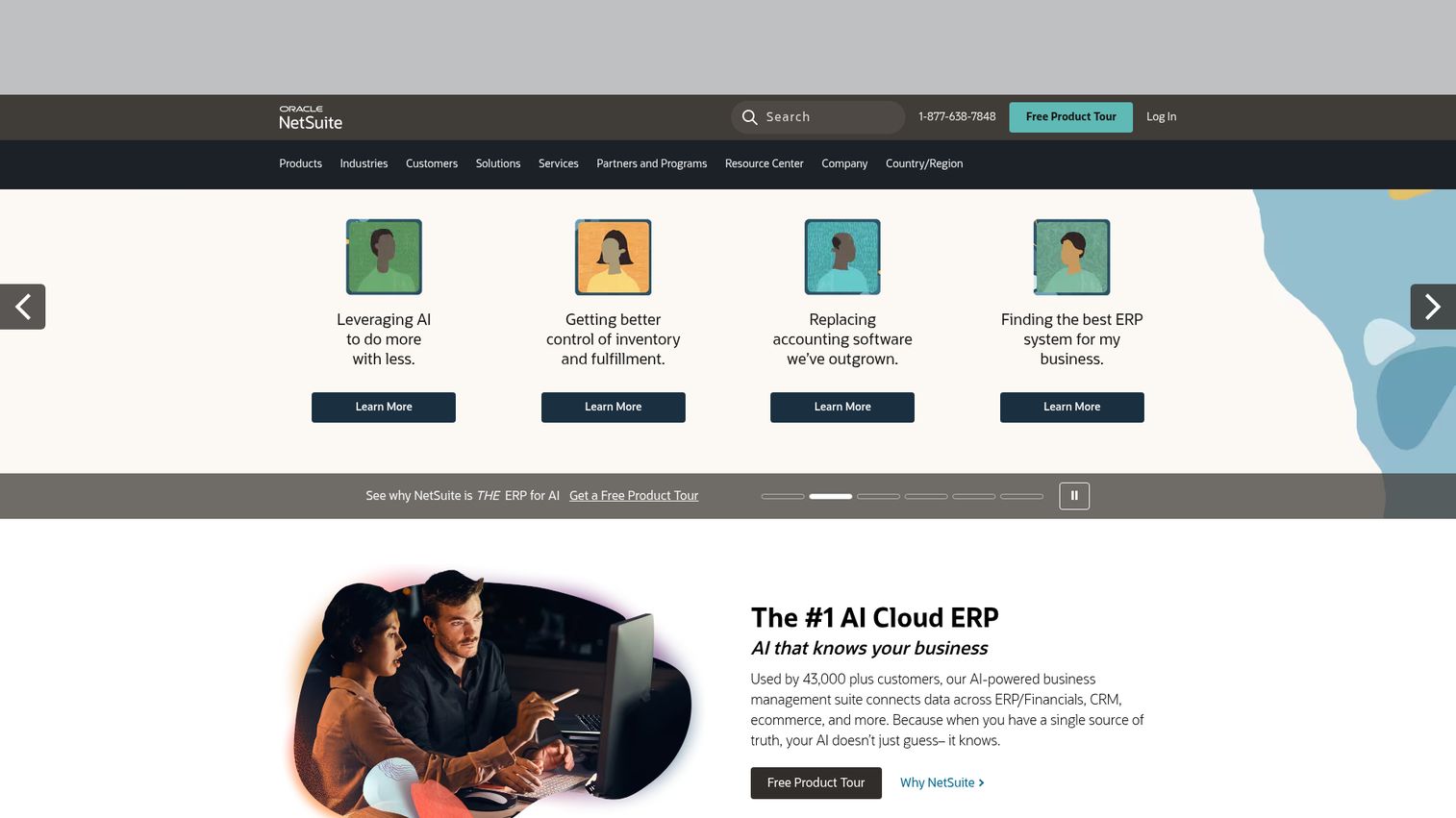
NetSuite is Oracle's cloud ERP platform, and SuiteProjects Pro brings PSA inside it. Project management, resource allocation, billing, and revenue recognition run within the same system as financials, inventory, and order management. For firms already on NetSuite, that shared data model keeps services and accounting aligned.
Best for: Growing and mid-market services firms running NetSuite that want PSA inside their ERP.
Key strengths
- ERP-native delivery: Run projects and resourcing on the same platform as financials and operations.
- Connected billing and revenue: Handle project billing and revenue recognition without exporting to a separate system.
- Unified data model: Keep services, finance, and order management on one record of truth.
Why choose NetSuite SuiteProjects Pro
If NetSuite already runs your back office, adding SuiteProjects Pro avoids the reconciliation work of a standalone PSA. Services delivery and financials share one platform, which matters most as transaction complexity grows.
NetSuite pricing
NetSuite does not publish public pricing. Customers subscribe to an annual license made up of the core platform, optional modules, and user count, plus a one-time implementation fee. Pricing scales with the modules and seats you deploy, so request a quote. NetSuite holds a 4.1/5 rating on G2.
10. ConnectWise PSA
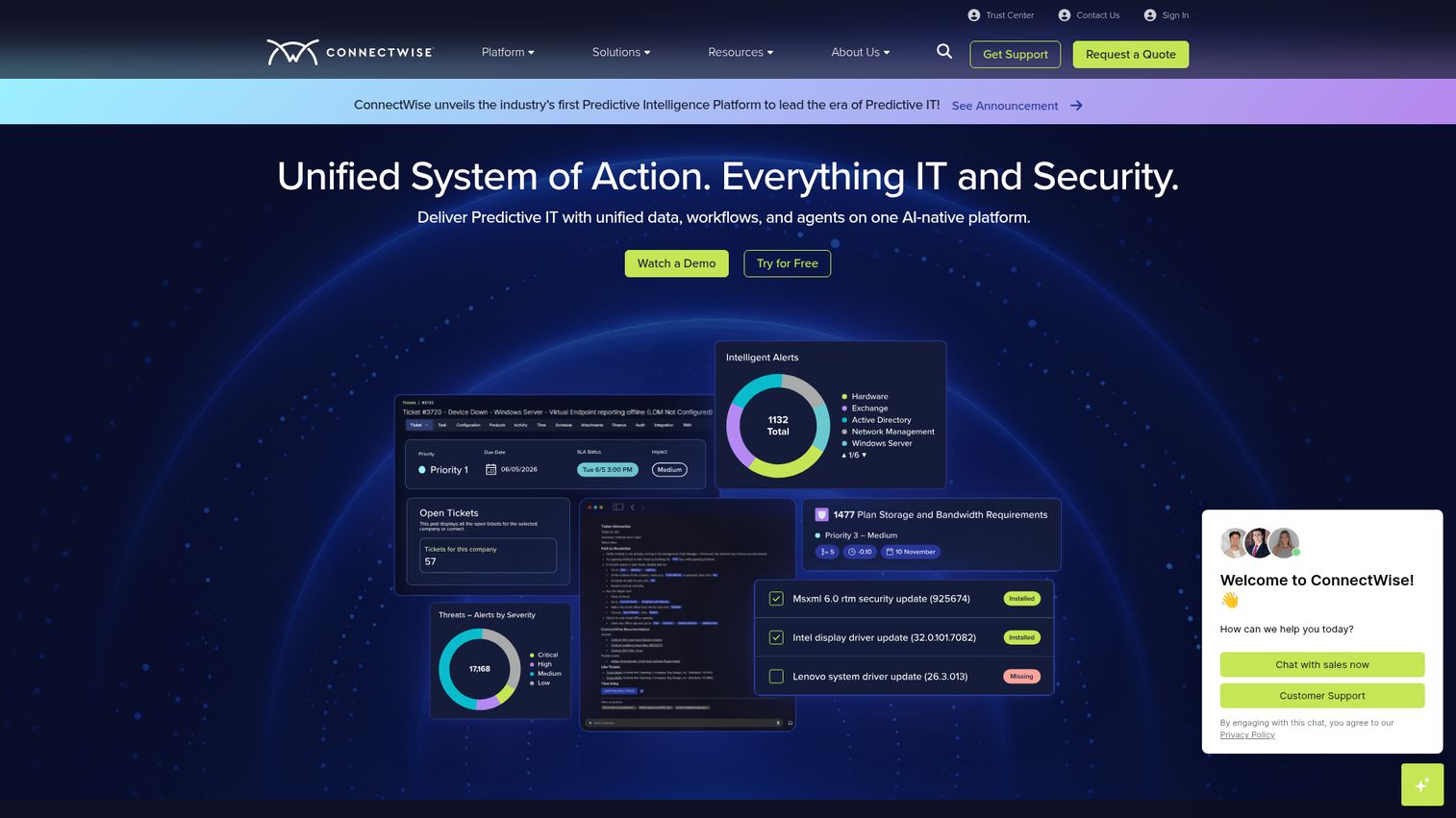
ConnectWise is an IT management platform built for MSPs, and ConnectWise PSA is its service operations core. It unifies service desk ticketing, project management, billing, and agreements, then connects to RMM, endpoint management, and security tools in the broader ConnectWise stack. For IT services providers, this is purpose-built IT PSA software.
Best for: MSPs and IT service providers that want ticketing, projects, billing, and agreements in one platform.
Key strengths
- Service desk ticketing: Centralize support requests and service management for IT teams.
- Agreements and billing: Manage recurring service contracts and invoice against them accurately.
- Unified MSP stack: Connect PSA to RMM, endpoint management, remote access, and security tools.
Why choose ConnectWise PSA
ConnectWise fits MSPs that want PSA inside a wider IT operations platform rather than as a standalone tool. If you already run ConnectWise RMM or security products, the PSA keeps tickets, projects, and billing in the same ecosystem.
ConnectWise pricing
ConnectWise does not publish public PSA pricing on its main pricing page; it routes buyers to compare packages and request a quote. Pricing depends on the products and seat counts in your stack. A free trial link is available for parts of the platform. ConnectWise holds a 4.3/5 rating on G2.
11. HaloPSA
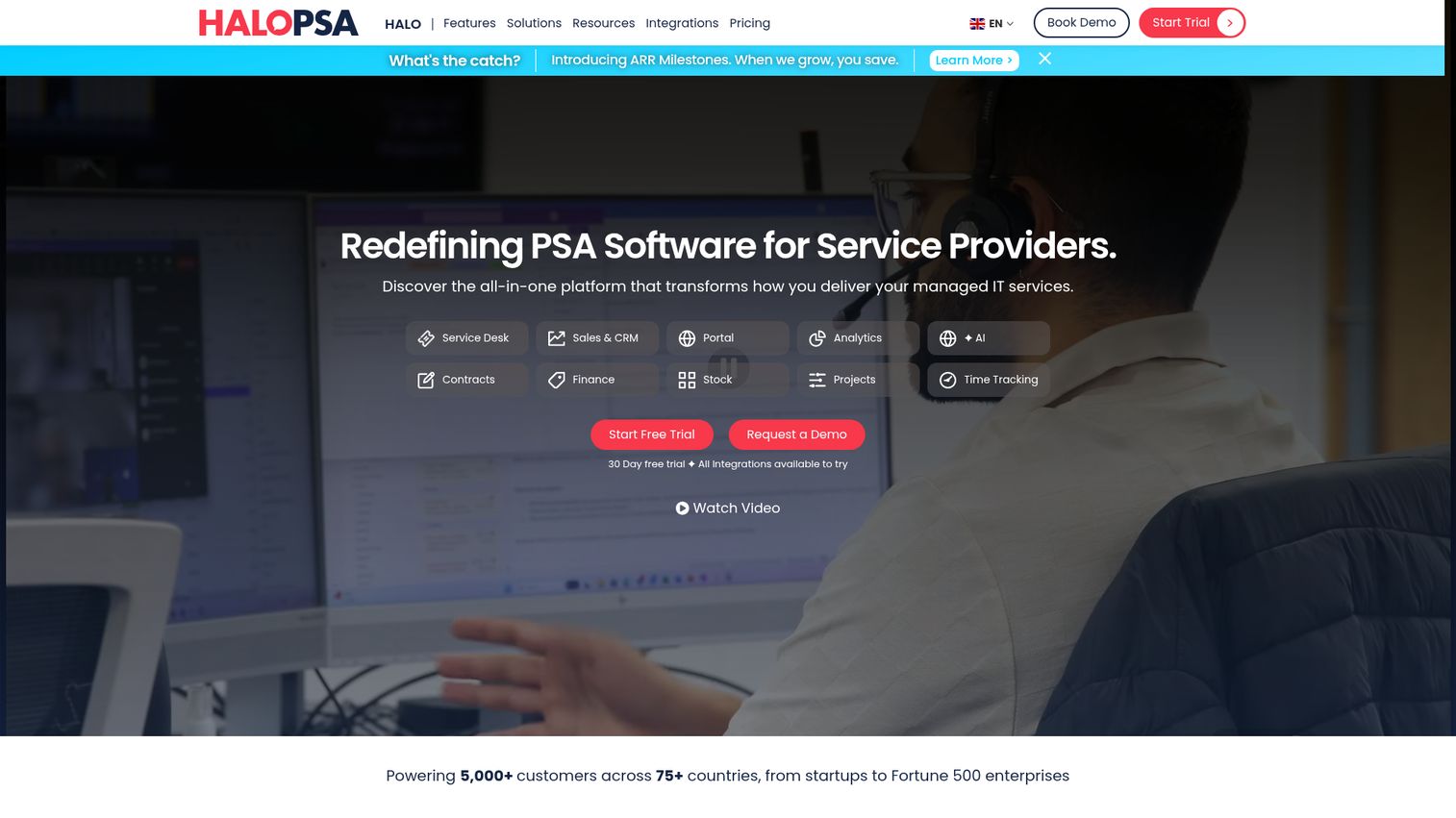
HaloPSA is an all-in-one PSA platform for service providers and MSPs covering service desk, CRM, contracts, billing, projects, stock, reporting, and time tracking. Its appeal is breadth in a single, all-inclusive product, so MSPs run the full operation without bolting on extra modules.
Best for: Managed service providers that want one PSA system for tickets, CRM, projects, contracts, billing, and reporting.
Key strengths
- MSP-focused service desk: Run ticketing designed around managed services workflows.
- Contracts and billing: Manage agreements, invoices, and billable time in one place.
- All-in-one breadth: Cover CRM, projects, stock, and reporting without paywalled add-ons.
Why choose HaloPSA
HaloPSA suits MSPs that want everything in a single platform rather than assembled from parts. Its all-inclusive model means features aren't locked behind upgrade tiers, which simplifies both buying and operating. For firms that manage many service agreements, pairing HaloPSA with dedicated contract management software can add deeper renewal and compliance tracking.
HaloPSA pricing
HaloPSA presents one all-inclusive plan priced per agent per month, with a currency selector covering USD and several other currencies. Exact figures are quoted through the vendor, and a 30-day free trial is available. The single-plan structure avoids feature gating across tiers. HaloPSA holds a 4.6/5 rating on G2.
12. Planview (PSA)
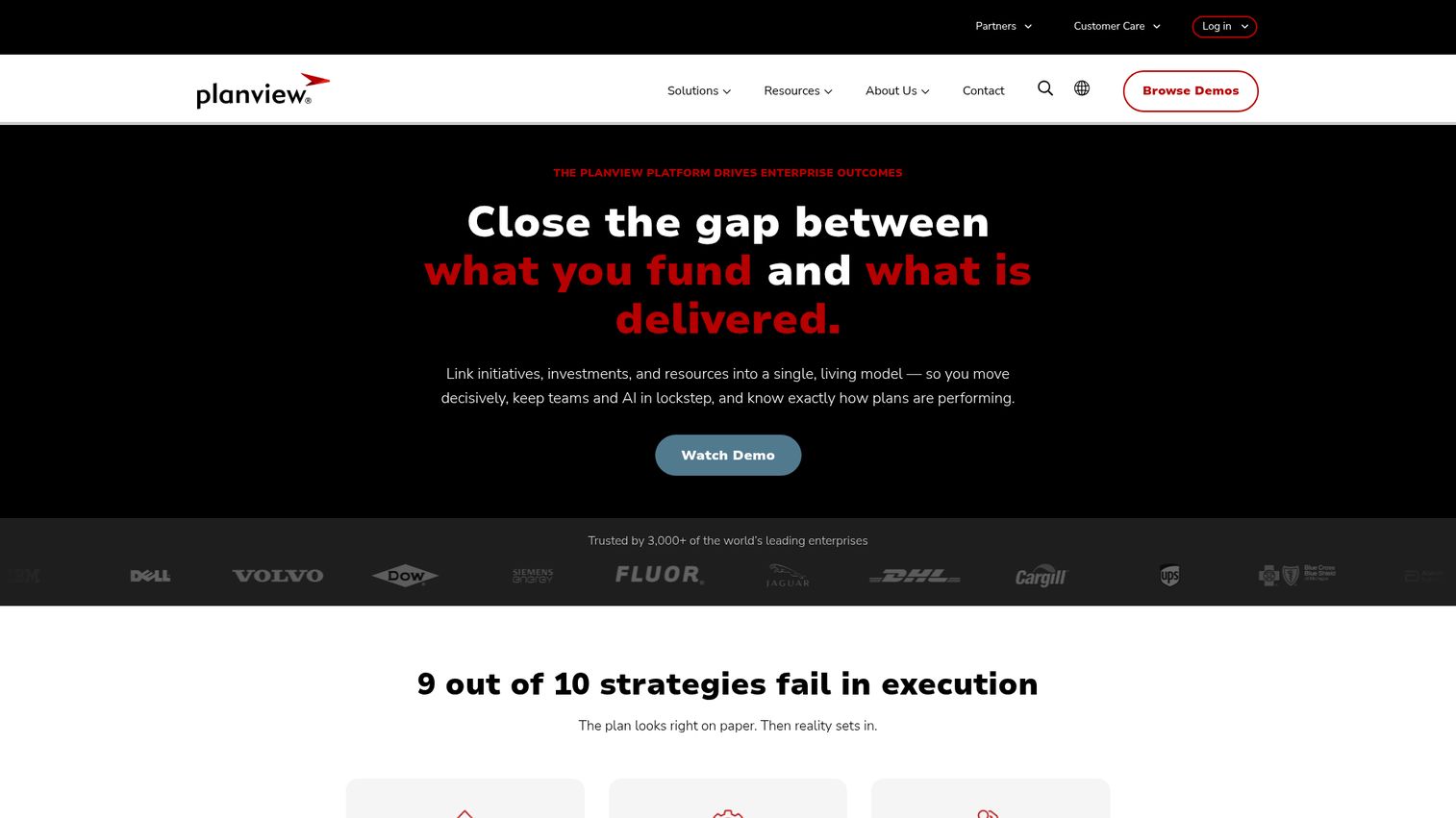
Planview is an enterprise platform for strategic portfolio management and digital product development. Its PSA and PPM capabilities cover resource capacity planning, project portfolio management, and financials at scale, making it a fit for large organizations managing many projects across multiple teams and methodologies.
Best for: Large enterprises managing complex project portfolios, resources, and cross-functional delivery.
Key strengths
- Resource capacity planning: Balance demand and capacity across a large, multi-team portfolio.
- Project portfolio management: Prioritize investments and track delivery across the whole portfolio.
- Enterprise financials and analytics: Manage cost, financial planning, and reporting with AI assistance and 60+ integrations.
Why choose Planview
Planview fits enterprises whose challenge is portfolio scale, not single-project delivery. When you manage hundreds of projects and need capacity planning plus investment prioritization across the org, its PPM depth is the differentiator. Teams evaluating broader delivery tooling may also find our best product management tools guide helpful.
Planview pricing
Planview does not publish public pricing; its ProjectPlace page describes a single plan with full functionality and directs buyers to contact sales. A fully functional 30-day free trial is available. Pricing is scoped to enterprise deployments. Planview holds a 4.1/5 rating on G2.
Considerations before you buy
Before you book demos, pressure-test each shortlisted tool against the five criteria below. They separate a platform that fits your services motion from one that creates new gaps.
Lifecycle coverage
Does the tool span proposals, staffing, delivery, billing, and profitability analysis, or only one stage? A tool that nails project management but lacks billing leaves you back in spreadsheets. Map each platform against your actual workflow from quote to cash before committing.
Resource management depth
Look beyond basic scheduling. Check for utilization forecasting, capacity planning, and skills-based matching. The difference between a calendar and a real resourcing engine shows up directly in your billable utilization rate in professional services and margin.
Billing and revenue recognition
Confirm support for your billing models: fixed-fee, time-and-materials, milestone, and retainer. For finance teams, verify ASC 606 and IFRS 15 revenue from contracts with customers and a clean quote-to-cash flow. This is where billing leakage gets recovered.
Integrations
PSA software should connect to the rest of your stack: CRM, ERP, HCM, and finance tools like QuickBooks, Sage Intacct, NetSuite, and Salesforce. Integration depth, not just a logo on a page, decides how much manual data entry you actually eliminate.
Analytics and profitability visibility
Real-time margin, utilization, and forecast reporting is the payoff. Verify you can see profitability at the project and client level when it still matters, not after the quarter closes.
Conclusion
The right PSA software depends on your services motion. For client-facing onboarding and implementation, Rocketlane keeps delivery and the customer experience together. Agencies and consultancies chasing margin visibility do well with Scoro or Productive. Mid-market and enterprise services orgs that live on resourcing and financials should look hard at Kantata, while Salesforce-centric firms get the cleanest fit from Certinia. MSPs and IT service providers belong on ConnectWise PSA or HaloPSA. Enterprises already standardized on Workday or NetSuite gain the most from PSA inside that platform, and large portfolio-driven organizations should evaluate Planview.
Your next step is simple. Shortlist two or three tools that match your segment, then start a trial with the platform that fits your services motion. During the trial, validate the two things that decide ROI: whether billing and revenue recognition match how you actually invoice, and whether integrations connect cleanly to your current finance and CRM stack. Test those against real projects, not demo data, and the right pick will be obvious. If part of your delivery motion involves training clients or internal teams, building a demo center of guided walkthroughs can speed up onboarding and reduce support load.
FAQ
Professional services automation software is a platform that manages the full services lifecycle in one system, from proposals and resource staffing through project delivery, time tracking, billing, and profitability analysis. It replaces disconnected spreadsheets and point tools with a single source of truth, so delivery and finance teams work from the same numbers in real time.
Project management software focuses on task and project execution: plans, timelines, assignments, and status. PSA software covers that plus resource management, time and expense tracking, billing, revenue recognition, and profitability analysis across the whole services lifecycle. In short, project management runs the work, while a PSA tool runs the business of delivering and getting paid for that work.
Pricing varies widely by tool and tier. Self-serve PSA tools start around $10 to $20 per user per month billed annually, such as Productive ($10), Rocketlane ($19), Scoro ($19.90), and BigTime ($20). Enterprise and ERP-native platforms like Kantata, Certinia, Workday, NetSuite, ConnectWise, and Planview use custom pricing quoted by sales. Many vendors offer a free trial, so test before you commit.
For agencies, Scoro and Productive are strong starting points. Scoro unifies quote-to-cash, project management, and profitability dashboards in one platform, which suits agencies wanting operations and finance together. Productive leads with resource planning and project-level margin tracking, ideal for agencies that manage profitability closely. Both publish transparent per-user pricing and offer free trials.
IT PSA software is professional services automation built for MSPs and IT service providers. It combines service desk ticketing, project management, billing, and service agreements, often alongside RMM and security tooling. ConnectWise PSA and HaloPSA are leading examples. They handle recurring contracts and ticket-based work that general PSA tools are not designed around.
Yes. Most PSA platforms integrate with CRM and accounting systems such as Salesforce, QuickBooks, Sage Intacct, and NetSuite. BigTime, for example, connects natively to QuickBooks and Sage Intacct, while Certinia is Salesforce-native. Integration depth matters because it decides how much manual data re-entry you eliminate between sales, delivery, and finance.
PSA software is used by consultancies, agencies, IT services firms and MSPs, and tech-enabled services organizations. Inside those firms, the buyers and daily users are operations leaders, finance and RevOps teams, agency and MSP owners, and delivery leads who own utilization, billing, and project margin.
Industry benchmarks from Service Performance Insight show that professional services organizations using integrated PSA achieve higher billable utilization and stronger profit margins than peers without it. The returns typically come from three places: better utilization through capacity planning, recovered revenue through tighter billing and quote-to-cash, and clearer margin visibility that lets leaders correct course before a project loses money.